


Community hub
Recent from talks
Contribute something
Nothing was collected or created yet.
Sundbyberg Municipality
View on WikipediaSundbyberg Municipality (Swedish: Sundbybergs kommun or Sundbybergs stad) is a municipality in Stockholm County in east central Sweden, just north of the capital Stockholm. Sundbyberg is wholly within the Stockholm urban area and has a 100% urban population.
Key Information


Sundbyberg was detached from Bromma (which since 1916 is in Stockholm Municipality) in 1888 as a market town (köping). It got the title of a city in 1927. In 1949 parts of Solna Municipality and Spånga Municipality (when the rest of Spånga was amalgamated into Stockholm) were added. A proposed merger with Solna in 1971 was never implemented, making Sundbyberg, with an area of 8.83 square kilometres (3.41 sq mi), the smallest municipality in Sweden, but also the most densely populated. The municipality prefers to call itself a city, which, however, has no legal significance.
History
[edit]Sundbyberg was for a long time only an area of small agriculture value and most of all used as a place to spend summer for rich families in the city.[citation needed] In 1863, almost the entire area was bought by Anders Petter Löfström, including Duvbo Estate, who began building houses there.[citation needed] In 1870, the first industrial plot was sold and from there the town did expand with railroad, houses, industries and community services of all kind. A. P. Löfström also donated to the municipality, all land for roads, streets, parks, school, church and other public areas.[citation needed]

In 1888, Sundbyberg municipality was formed with 1,133 inhabitants,[3] splitting off from Bromma. At the time the municipality only constituted Central Sundbyberg and the undeveloped Storskogen. Sundbyberg was known in its early years for its beer, its spirited political discourses, its muddy streets, and the danger of the streets at night[4] (nowadays the crime-hit areas are Hallonbergen and Rissne instead[5]). Sales of land was aimed at workers and industry, and the relative lack of public services caused a strong cooperative spirit to form.[6] Suburbs bordering Sundbyberg were also built – Lilla Alby and Mariehäll in the 1880s and Duvbo around 1900. While trains stopped in Sundbyberg, they did so at a low frequency, and most commuters used the steam boat.[6] In 1910 a tram line was built from Stockholm and Råsunda to the municipal border, and then into Sundbyberg in 1928, running until 1959.[3]
A new city plan was established in 1941, prescribing the construction of lamellhus, rectangular multi-residential buildings with typically four floors, leading to the demolishment of most of the wooden houses in Sundbyberg in the 1940s, while brick or concrete buildings were kept. Many industrial buildings were converted to residential use at the same time. Rising housing prices led to a more densely built suburb than envisioned in the city plan,[7] as well as cause Sundbyberg to rapidly lose its industrial character.[6]
In 1946 Sundbyberg municipality, which by then had 15,000 inhabitants, bought Storskogen, with the first homes going up there in 1952. In 1949 Spånga municipality was split between neighbouring municipalities, giving Duvbo, Ursvik and some other land to Sundbyberg. Lilla Alby was transferred from Solna municipality to Sundbyberg at the same time.[3] Since the 1950s when Storskogen was built, Sundbyberg has expanded one district each decade, with Ör built in the 1960s, Hallonbergen and its metro line (which also serves Storskogen and Ör) in the 1970s, Rissne and its metro line (which also serves Central Sundbyberg and Lilla Alby) in the 1980s, Brotorp and Stora Ursvik in the 2000s.[4][8]
Economy
[edit]The roughly 50,000 inhabitants live in about 20,000 households. The industrial policy of the municipality is to provide one job opportunity for every household, with there being around 23,000 jobs in the municipality (in 2015[9][10]). So unlike other municipalities in Metropolitan Stockholm, Sundbyberg is not a bedroom suburb wherefrom people commute to Stockholm, but also a place commuted to from outside. In total, 19,000 commuters travel in each direction to or from Sundbyberg every day (in 2014).[9] The unemployment rate in Sundbyberg closely tracks the average for Stockholm County[11] and is generally lower than the Swedish average.[12]
In the first half of its existence, Sundbyberg saw a strong expansion of industrial activity, and most residents were industrial workers, but in the 1940s the industry almost entirely disappeared from Sundbyberg. By the 1970s warehouses and IT businesses had established themselves instead, and an attempt to establish industry in Hallonbergen had failed due to high rental costs.[6] Today the service sector dominates, with Sundbyberg having become a place with office workers, as a result of Sundbyberg becoming more central as Stockholm has expanded and public transport has been strengthened.[4] The most common professions for people working in Sundbyberg are (in order from most employed): IT developer, banker, human relations, secretary, business seller/purchaser, accountant, retail clerk, truck/bus driver, teacher, tax collector.[9] There are office districts in Central Sundbyberg (Sundbyberg centrum and Allén), Rissne (Ursviks Entré) and Hallonbergen (Sundby Park). In 2015 Sundbyberg centrum offices had rents (2,100 kr/m2/year) similar to Kista, Alvik and the adjacent Solna Business Park, while in Allén they a bit lower and similar to Lidingö Centrum and the nearby Solna Strand, and Ursviks Entré and Sundby Park both have further lower office rents similar to Farsta and Tyresö Centrum.[13]
Unusually for Stockholm suburbs, Sundbyberg has a proper town centre,[14] with plenty of nice shops in the Central Sundbyberg area, which makes the little city a bit independent. There are also smaller concentrations of stores elsewhere in the municipality, such as by the Rissne and Hallonbergen metro stations.[15] The proximity of the shopping centres Bromma Blocks (1 km away) and Mall of Scandinavia (2 km away) has hindered establishment of a shopping centre in Central Sundbyberg.[16] Businesses in Hallonbergen suffer from getting few customers from elsewhere due to the area's poor reputation, whereas the area's locals don't mind going elsewhere, e.g. to cafés in Central Sundbyberg.[17]
Demography
[edit]Population growth
[edit]| Year | Population |
|---|---|
| 1970 | |
| 1975 | |
| 1980 | |
| 1985 | |
| 1990 | |
| 1995 | |
| 2000 | |
| 2005 | |
| 2010 | |
| 2015 | |
| 2019 | |
| 2020 |
2022 by district
[edit]This is a demographic table based on Sundbyberg Municipality's electoral districts in the 2022 Swedish general election sourced from SVT's election platform, in turn taken from SCB official statistics.[19]
In total there were 53,431 residents, including 38,222 Swedish citizens of voting age.[19] 56.1% voted for the left coalition and 42.2% for the right coalition. Indicators are in percentage points except population totals and income.
| Location | Residents | Citizen adults |
Left vote | Right vote | Employed | Swedish parents |
Foreign heritage |
Income SEK |
Degree |
|---|---|---|---|---|---|---|---|---|---|
| % | % | ||||||||
| Brotorp/Kymlinge | 2,188 | 1,299 | 53.3 | 45.9 | 88 | 64 | 36 | 38,888 | 74 |
| Centrala Sbg 1 | 2,081 | 1,715 | 52.8 | 46.3 | 86 | 67 | 33 | 34,739 | 64 |
| Centrala Sbg 2 | 1,420 | 1,213 | 51.1 | 48.0 | 85 | 75 | 25 | 31,602 | 57 |
| Centrala Sbg 3 | 1,623 | 1,307 | 54.1 | 44.7 | 83 | 72 | 28 | 31,409 | 57 |
| Centrala Sbg 4 | 1,203 | 1,014 | 54.2 | 44.7 | 85 | 75 | 25 | 31,330 | 61 |
| Centrala Sbg 5 | 1,744 | 1,440 | 55.8 | 43.1 | 85 | 76 | 24 | 33,013 | 64 |
| Centrala Sbg 6 | 1,676 | 1,345 | 54.7 | 44.3 | 86 | 77 | 23 | 32,902 | 59 |
| Centrala Sbg 7 | 1,296 | 1,051 | 54.0 | 44.7 | 83 | 73 | 27 | 30,722 | 63 |
| Duvbo 1 | 1,435 | 1,061 | 50.0 | 48.9 | 83 | 75 | 25 | 33,582 | 59 |
| Duvbo 2 | 1,439 | 1,059 | 45.6 | 54.1 | 84 | 79 | 21 | 37,112 | 69 |
| Hallonbergen 1 | 2,472 | 1,503 | 63.5 | 33.5 | 70 | 22 | 78 | 21,480 | 42 |
| Hallonbergen 2 | 2,011 | 1,138 | 67.3 | 28.7 | 63 | 19 | 81 | 18,314 | 34 |
| Hallonbergen 3 | 1,700 | 1,091 | 68.2 | 28.9 | 68 | 19 | 81 | 19,235 | 35 |
| Lilla Alby 1 | 1,949 | 1,532 | 53.9 | 44.5 | 85 | 72 | 28 | 31,456 | 57 |
| Lilla Alby 2 | 1,991 | 1,559 | 54.8 | 44.0 | 84 | 70 | 30 | 33,106 | 60 |
| Lilla Alby 3 | 1,462 | 1,226 | 48.5 | 51.0 | 89 | 81 | 19 | 39,377 | 68 |
| Lilla Alby 4 | 1,755 | 1,404 | 52.6 | 46.1 | 85 | 68 | 32 | 34,680 | 62 |
| Lilla Ursvik | 1,077 | 738 | 48.9 | 50.3 | 85 | 73 | 27 | 36,365 | 63 |
| Rissne 1 | 2,428 | 1,536 | 60.0 | 36.4 | 77 | 41 | 59 | 26,343 | 45 |
| Rissne 2 | 2,393 | 1,666 | 64.5 | 32.8 | 75 | 36 | 64 | 24,882 | 43 |
| Rissne 3 | 1,866 | 1,150 | 66.0 | 32.6 | 71 | 27 | 73 | 24,263 | 48 |
| Rissne 4 | 1,836 | 1,268 | 67.0 | 30.1 | 72 | 37 | 63 | 23,795 | 35 |
| Stora Ursvik 1 | 1,688 | 977 | 50.2 | 47.8 | 87 | 68 | 32 | 39,810 | 74 |
| Stora Ursvik 2 | 1,771 | 1,089 | 60.5 | 37.5 | 84 | 37 | 63 | 31,254 | 61 |
| Stora Ursvik 3 | 1,638 | 1,002 | 59.5 | 36.8 | 80 | 39 | 61 | 27,666 | 47 |
| Stora Ursvik 4 | 2,152 | 1,401 | 59.2 | 39.5 | 86 | 48 | 52 | 33,753 | 66 |
| Storskogen 1 | 1,574 | 1,371 | 57.9 | 40.2 | 76 | 68 | 32 | 24,384 | 43 |
| Storskogen 2 | 1,564 | 1,230 | 53.8 | 44.8 | 83 | 63 | 37 | 31,041 | 58 |
| Tulemarken | 1,675 | 1,298 | 54.0 | 44.9 | 86 | 76 | 24 | 34,892 | 64 |
| Ör | 2,324 | 1,539 | 59.7 | 37.9 | 77 | 47 | 53 | 24,379 | 43 |
| Source: SVT[19] | |||||||||
Residents with a foreign background
[edit]On 31 December 2017 the number of people with a foreign background (persons born outside of Sweden or with two parents born outside of Sweden) was 20 229, or 40.93% of the population (49 424 on 31 December 2017). On 31 December 2002 the number of residents with a foreign background was (per the same definition) 8 531, or 25.24% of the population (33 797 on 31 December 2002).[20] On 31 December 2017 there were 49 424 residents in Sundbyberg, of which 14 954 people (30.26%) were born in a country other than Sweden. Divided by country in the table below - the Nordic countries as well as the 12 most common countries of birth outside of Sweden for Swedish residents have been included, with other countries of birth bundled together by continent by Statistics Sweden.[21]
| Country of birth[21] | ||
|---|---|---|
| 31 December 2017 | ||
| 1 |  Sweden Sweden |
34,470 |
| 2 | Asia: Other countries | 2,002 |
| 3 |  European Union: Other countries European Union: Other countries |
1,770 |
| 4 |  Iran Iran |
1,394 |
| 5 | Africa: Other countries | 1,393 |
| 6 |  Eritrea Eritrea |
1,270 |
| 7 |  Finland Finland |
1,047 |
| 8 |  Syria Syria |
992 |
| 9 |  Iraq Iraq |
842 |
| 10 |  Poland Poland |
745 |
| 11 | South America | 665 |
| 12 | Europe outside of the EU: other countries | 586 |
| 13 |  Turkey Turkey |
333 |
| 14 | North America | 286 |
| 15 |  Somalia Somalia |
267 |
| 16 |  Thailand Thailand |
263 |
| 17 |  Germany Germany |
213 |
| 18 |  Bosnia and Herzegovina Bosnia and Herzegovina |
211 |
| 19 |  Yugoslavia / Yugoslavia /  Serbia and Montenegro Serbia and Montenegro |
165 |
| 20 |  Norway Norway |
163 |
| 21 |  Afghanistan Afghanistan |
138 |
| 22 |  Denmark Denmark |
77 |
| 23 |  Soviet Union Soviet Union |
51 |
| 24 | Oceania | 39 |
| 25 |  Iceland Iceland |
38 |
| 26 | Unknown country of birth | 4 |
By district
[edit]| District | Population 2020[22] | New homes planned 2021-2034[22] | Housing tenure 2018 rental/coop/house[23] | Higher education of 20-64yo 2018[24] | Foreign born 2010 [25] | Sickness days/year 2010[26] |
|---|---|---|---|---|---|---|
| Stora Ursvik | 6 706 | 4 963 | 31%/56%/14% | 59% | 20% | 15 |
| Lilla Ursvik | 1 069 | 0 | 0%/22%/78% | |||
| Brotorp/Järvastaden | 2 175 | 475 | 0%/30%/70% | |||
| Rissne | 8 601 | 1 425 | 69%/29%/2% | 37% | 50% | 30 |
| Hallonbergen | 5 984 | 3 133 | 70%/30%/0% | 30% | 67% | 38 |
| Ör | 2 298 | 846 | 47%/53%/0% | 36% | 32% | 31 |
| Duvbo | 2 212 | 0 | 35%/22%/42% | 59% | 18% | 15 |
| Central Sundbyberg | 14 585 | 1 170 | 56%/42%/1% | 54% | 20% | 22 |
| Storskogen | 3 067 | 47 | 73%/26%/1% | 43% | 21% | 29 |
| Lilla Alby | 5 946 | 230 | 56%/43%/0% | 51% | 24% | 24 |
| Other | 138 | - | Sweden: 44%[27] | Sweden: 20%[28] | Sweden: 25[29] |
Public transport
[edit]
Sundbyberg is well served by the Stockholm public transport system. There are several metro stations as well as one train station and plenty of bus routes. Even some main line trains call at Sundbyberg. The Tvärbanan light rail service was extended from Sickla Udde via Alvik to Solna centrum in October 2013. The line runs through Central Sundbyberg with tracks laid in the street and has two stops within the municipality. Construction of a northern light railway branch from Ulvsunda to Kista that will pass through Rissne and Stora Ursvik started in 2018.[30]
Districts
[edit]
Sports
[edit]The following sports clubs are located in Sundbyberg:
Gallery
[edit]-
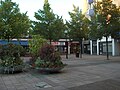 Storskogstorget, a square in Storskogen
 -
 Apartment block from 1911 in Central Sundbyberg
 -
 Lötsjön, a lake in the middle of Sundbyberg
 -
 Hallonbergen centre
 -
 Metro station in Rissne
 -
 Residential buildings in Stora Ursvik


References
[edit]- ^ "Statistiska centralbyrån, Kommunarealer den 1 januari 2014" (in Swedish). Statistics Sweden. 2014-01-01. Archived from the original (Microsoft Excel) on 2016-09-27. Retrieved 2014-04-18.
- ^ "Folkmängd och befolkningsförändringar - Kvartal 2, 2025" (in Swedish). Statistics Sweden. 21 August 2025. Retrieved 21 August 2025.
- ^ a b c "Några årtal ur stadens historia". Sundbyberg stadsmuseum. 7 June 2016. Retrieved 1 Sep 2020.
- ^ a b c "Historia". Sundbyberg municipality. Retrieved 1 Sep 2020.
- ^ "Kriminaliteten i Rissne och Hallonbergen har ökat". Mitt i Sundbyberg. 3 June 2019. Retrieved 1 Sep 2020.
- ^ a b c d "Industriminnen i Sundbyberg, 1978, Länsstyrelsen i Stockholms län". Kulturarv Stockholm. Retrieved 26 Aug 2020.
- ^ Rolf Hammarskiöld & Hanna Hjalmarsson. "Sundbybergs bebyggelse Rapport 2016:10 Antikvariskt kunskapsunderlag" (PDF). Stockholms läns museum. Retrieved 12 Feb 2021.
- ^ "Konsten i trafiken - Historia". Storstockholms Lokaltrafik. Retrieved 1 Sep 2020.
- ^ a b c "Sundbyberg 2016 kommunfakta" (PDF). Sundbyberg municipality. Retrieved 17 Aug 2020.
- ^ "Fakta om SL och länet 2018" (PDF). Storstockholms Lokaltrafik. Retrieved 17 Aug 2020.
- ^ Ronja Mårtensson (1 Sep 2020). "Arbetslösheten ökar - lär bli värre i höst". Mitt i Sundbyberg.
- ^ "Arbetslöshet (Arbetsförmedlingen), Sundbyberg". ekonomifakta.se. Retrieved 8 Sep 2020.
- ^ "Projekt Enköpingsvägen Utveckling av kontor i Madendalen - analys av fyra alternativ". Sundbyberg municipality / evidens. Retrieved 11 Mar 2021.
- ^ "Sundbyberg – växer på höjden: Sverige på gång". Ekonomikanalen EFN. 14 January 2016. Archived from the original on 2021-12-11. Retrieved 8 Sep 2020.
- ^ "Från miljonprogram till framtidens boende". Stockholm Direkt. 3 Jan 2019. Retrieved 9 Sep 2020.
- ^ "Två hyresgäster lämnar Signalfabriken". 3 September 2020.
- ^ "Miljardinjektion ska bryta trend". 4 September 2018.
- ^ SCB - Folkmängd efter region och år and SCB - Folkmängd i riket, län och kommuner 30 september 2020 och befolkningsförändringar 1 juli - 30 september 2020. Totalt
- ^ a b c "Valresultat 2022 för Sundbyberg i riksdagsvalet" (in Swedish). SVT. 11 September 2022. Retrieved 13 January 2024.
- ^ "Antal personer med utländsk eller svensk bakgrund (fin indelning) efter region, ålder och kön. År 2002 - 2023". Statistikdatabasen (in Swedish). Retrieved 2024-10-16.
- ^ a b Statistiska centralbyrån: Utrikes födda efter län, kommun och födelseland 31 december 2017 (XLS-fil) Läst 4 januari 2019
- ^ a b "Befolkning och demografi". Sundbyberg municipality. 27 Aug 2020. Retrieved 11 Jan 2021.
- ^ "Översiktsplan för Sundbyberg. Sundbyberg 2030 – urbant och hållbart" (PDF). Sundbyberg municipality. Retrieved 11 Jan 2021.
- ^ "Socialt bokslut 2018" (PDF). Sundbyberg municipality. p. 45. Retrieved 11 Jan 2021.
- ^ "RUFS områdesdata 2010 - Sundbyberg personer med utländsk bakgrund". Stockholms läns landsting. Retrieved 11 Jan 2021.
- ^ "RUFS områdesdata 2010 - Sundbyberg ohälsotal". Stockholms läns landsting. Retrieved 11 Jan 2021.
- ^ "Utbildningsnivån i Sverige". Statistics Sweden (SCB). 2020-09-01. Retrieved 11 Jan 2021.
- ^ "Utrikes födda i Sverige". Statistics Sweden (SCB). 2020-09-02. Retrieved 11 Jan 2021.
- ^ "Ohälsotalet. Hela riket och kön. År 1997 - 2018". Statistics Sweden (SCB). Retrieved 11 Jan 2021.
- ^ "Tvärbanan till Kista och Helenelund - Sll". www.sll.se. Retrieved 19 April 2018.
External links
[edit]
- Sundbyberg Municipality - Official site
- Sundbyberg Museum & Archive - Official site
Places adjacent to Sundbyberg Municipality | ||||||||||||||||
|---|---|---|---|---|---|---|---|---|---|---|---|---|---|---|---|---|
| ||||||||||||||||


Municipalities and seats of Stockholm County | ||
|---|---|---|
| Municipalities |  | |
| Municipal seats | ||
| International | |
|---|---|
| National | |
| Geographic | |
| Other | |


Sundbyberg Municipality
View on GrokipediaSundbyberg Municipality (Swedish: Sundbybergs kommun, also known as Sundbybergs stad) is a compact urban municipality in Stockholm County, east-central Sweden, situated immediately north of the national capital, Stockholm, and fully integrated into its metropolitan area.[1]
With a land area of approximately 8.8 square kilometers, it holds the distinction of being Sweden's smallest municipality by territorial extent while maintaining one of the nation's highest population densities at 6,446 inhabitants per square kilometer as of 2025.[2][3]
The municipality's population stands at 56,523 residents, comprising a near-even split of 50.3% males and 49.7% females, and has experienced rapid growth, ranking among Sweden's fastest-expanding local governments over recent decades due to its proximity to Stockholm's economic hub and appeal to young professionals.[2][4][5]
Historically rooted in 19th-century industrial development that drew working-class migrants from overcrowded Stockholm, Sundbyberg today features a robust service-oriented economy with low unemployment relative to national averages, where many residents commute to jobs in information technology, finance, retail, and professional services in the capital.[6][5]
Its urban fabric, centered around districts like Central Sundbyberg, emphasizes mixed-use development with residential, commercial, and transport infrastructure, supported by efficient rail connections via Sundbyberg Station.[1]
Geography
Location and borders
Sundbyberg Municipality lies in Stockholm County in east-central Sweden, positioned directly north of the national capital, Stockholm, and forming an integral part of the expansive Stockholm urban area. This positioning places it within the densely developed core of the Greater Stockholm region, with seamless integration into the surrounding metropolitan infrastructure, including rail and road networks that facilitate rapid connectivity to central Stockholm.[7] The municipality's boundaries adjoin Stockholm Municipality to the south, west, and portions of the north, Solna Municipality to the east, and Sollentuna Municipality along its northern edge, all within Stockholm County. These borders reflect a compact urban enclave hemmed in by neighboring jurisdictions, with no extension into rural or undeveloped land, resulting in a total land area of approximately 8.8 square kilometers—making Sundbyberg the smallest municipality in Sweden by territorial extent.[8][5] Owing to its constrained geography and absence of non-urban zones, Sundbyberg exhibits one of Sweden's highest population densities, surpassing 5,000 inhabitants per square kilometer, which drives reliance on vertical construction and high-rise housing to accommodate its over 55,000 residents. This density underscores the municipality's character as a purely urban entity, optimized for compact living within the pressures of metropolitan expansion.[7][5]Physical characteristics and climate
Sundbyberg Municipality occupies flat terrain typical of the Mälaren Valley lowlands, with an average elevation of 18 meters above sea level and minimal topographic variation.[9] The landscape features sedimentary plains shaped by glacial retreat, including small watercourses like Bällstaån stream, and proximity to inland bodies such as Lötsjön lake, though larger bays like Brunnsviken lie adjacent in neighboring areas.[10] Green spaces remain limited amid pervasive urban development, resulting in a predominantly built environment with sparse natural vegetation cover.[11] The municipality experiences a humid continental climate moderated by the Baltic Sea, yielding cold winters and mild summers without extreme fluctuations. Average daily low temperatures in January hover around -3°C, while July highs reach approximately 22°C, consistent with regional data for east-central Sweden.[12] Annual mean temperature stands at 7.2°C, accompanied by roughly 619 mm of precipitation distributed fairly evenly, though snowfall accumulates during winter months.[13] Urban heat island dynamics amplify local warming in Sundbyberg, elevating temperatures above rural baselines by 1-2°C on average, as evidenced in analyses of Swedish metropolitan zones.[14] This effect, driven by concrete and asphalt absorption, intensifies during heatwaves, with Sweden's overall temperature rise of 1.9°C since the late 19th century further compounding urban-specific trends.[14]History
Origins and early settlement
The territory of present-day Sundbyberg Municipality featured sparse rural settlement with roots extending to the medieval period, particularly in areas like Duvbo, where records document a small croft known as Dufvebol owned by Uppsala Cathedral. This early agrarian presence tied into broader Uppland patterns of ecclesiastical land management and subsistence farming, though archaeological evidence of prior Viking-era activity, such as runestones erected around the early 12th century, indicates intermittent habitation amid otherwise limited permanent structures.[15] By the 18th and early 19th centuries, the landscape remained predominantly agricultural, comprising open farmlands associated with estates like Sundby gård, with minimal urbanization and reliance on crop cultivation and pastoral activities.[16] Ownership concentrated among nobility and affluent Stockholm residents, who utilized the area for seasonal retreats rather than intensive development, reflecting its peripheral status relative to the capital's expanding trade networks. Stockholm's proximity exerted indirect economic influence through provisioning markets, yet the absence of major infrastructure kept population densities low—estimated at under 1,000 residents across scattered farmsteads by mid-century—establishing a baseline of rural isolation prior to transport innovations.[17] This pre-industrial character persisted until the late 1870s, when railway construction began catalyzing shifts beyond agrarian self-sufficiency.Industrial expansion (late 19th to mid-20th century)
The construction of the Stockholm–Västerås–Bergslagen railway in the mid-1870s catalyzed Sundbyberg's transition from agricultural land to an industrial suburb, with the local station opening in 1876 and facilitating efficient goods transport and commuter access to Stockholm.[18] This infrastructure spurred land sales for industrial plots, drawing factories focused on engineering and mechanical production that leveraged the railway for raw materials and market proximity.[17] The influx of rural Swedish laborers seeking factory employment drove rapid demographic expansion, as the area's economic viability shifted from farming to manufacturing-dependent self-sufficiency.[19] By the late 19th century, Sundbyberg's industrial base solidified around sectors like metalworking and printing, which benefited from the suburb's strategic location near Stockholm's urban core without the congestion, enabling scaled operations with lower costs.[20] Population grew from approximately 1,133 residents upon its 1888 designation as a market town (köping), detached from Bromma parish, to 8,470 by 1930, reflecting sustained labor migration and housing development tied to job creation in these industries.[21] [22] This growth underscored the causal link between railway-enabled logistics and manufacturing agglomeration, as firms clustered to minimize transport frictions and access pooled skilled workers. In 1927, Sundbyberg achieved full city (stad) status, marking its administrative independence and economic maturation through industry, as the municipality demonstrated fiscal autonomy via tax revenues from factories and a burgeoning workforce no longer reliant on Bromma's oversight.[19] This evolution highlighted how transportation infrastructure not only lowered barriers to industrial entry but also fostered local governance structures responsive to proletarian demographics, with over 80% of residents employed in manufacturing by the early 20th century.[20] The period's expansion thus exemplified first-principles dynamics of agglomeration economies, where proximity to rail nodes amplified productivity gains from division of labor in engineering and printing trades.[17]Post-war modernization and suburban integration
Following World War II, Sundbyberg underwent significant residential expansion as part of Sweden's national welfare state initiatives to address urban housing shortages, with the municipality acquiring land such as Storskogen in 1946 and approving its development plan in 1950, leading to construction of functionalist-style apartments from 1950 to 1956.[23] This was followed by the development of districts like Ör in the 1960s and Hallonbergen in the early 1970s, the latter exemplifying the Million Programme (Miljonprogrammet, 1965–1974), which constructed high-rise and slab-block apartments to house approximately one million new residents nationwide amid rapid urbanization and population pressure from central Stockholm.[24] These projects, managed largely by the municipal housing company Förvaltaren (established 1947), increased local density through multi-story public rental units, shifting Sundbyberg from its pre-war industrial character toward a more uniform suburban residential profile aligned with modernist planning principles emphasizing zoned separation of housing, work, and transport.[25] The population rose accordingly, reaching 26,082 by 1955 after annexations like Lilla Alby and Duvbo, and stabilizing near 30,000 by the late 1970s as construction tapered amid national economic adjustments, with most new residents occupying Förvaltaren-managed estates.[25] Concurrently, traditional industries—such as early 20th-century factories that had defined Sundbyberg's economy—declined due to structural shifts in Sweden's post-war economy toward services and administration, reducing local manufacturing employment and reinforcing reliance on commuting to Stockholm for work.[25] This economic pivot, coupled with infrastructure like the extension of the Stockholm Metro to Hallonbergen and integration into the Mälarbanan commuter rail network, eroded Sundbyberg's semi-autonomous suburban identity, transforming it into a densely built extension of Stockholm's commuter belt where daily outflows of workers—facilitated by short travel times of 8–10 minutes to central Stockholm—reflected causal pressures from metropolitan overflow and housing demand rather than self-contained local vitality.[25] Empirical data from municipal planning records show this integration manifested in uniform high-density layouts, with over half the population by the 1970s residing in these new estates, prioritizing accessibility over distinct community cohesion.[25]Contemporary developments (1980s–present)
In the 1990s and 2000s, Sundbyberg saw increased private sector involvement in urban development, with collaborations between the municipality and real estate firms yielding detailed plans for mixed-use projects aimed at bolstering local competitiveness amid Sweden's broader neoliberal economic shifts toward deregulation and market-oriented growth.[26] These initiatives targeted revitalization of underutilized areas, including early 2000s proposals to transform dilapidated zones into commercial centers like shopping malls, though the 2008 global financial crisis delayed some implementations.[27] Urban renewal gained momentum in the municipality during this period, shifting from earlier preservation-focused efforts to integrated residential-commercial expansions that addressed post-industrial legacies while responding to regional housing demands.[28] By the 2010s, population growth accelerated sharply, rising from 38,633 in 2010 to 52,801 in 2020, primarily due to spillover from Stockholm's acute housing shortages and Sundbyberg's proximity as a high-density commuter hub.[29] Policy responses in recent years have prioritized fiscal stability amid ongoing development pressures, exemplified by the decision in October 2025 to maintain the municipal tax rate unchanged for the following year, preserving the rate at 19.25% to support economic resilience without burdening residents further.[30][7] This approach aligns with sustained investments in infrastructure and mixed-use zoning to accommodate continued population expansion, projected to reach 56,274 by 2024 estimates.[31]Government and politics
Administrative structure
Sundbyberg Municipality operates under Sweden's Local Government Act (2017:725), which establishes municipalities as self-governing entities responsible for local services including education, social welfare, elderly care, and urban planning, while coordinating with Stockholm County for regional matters such as public transport and healthcare oversight. The primary decision-making body is the municipal council (kommunfullmäktige), comprising 61 elected members serving four-year terms from 2022 to 2026, representing eight political parties.[32] This council holds ultimate authority, approving the annual budget, setting policy goals, and appointing committees and boards, with decisions requiring a quorum and often prepared through preparatory committees (beredningar).[32] The municipal executive board (kommunstyrelsen), consisting of 13 members and 13 alternates appointed by the council, serves as the primary executive organ, overseeing strategic operations, financial management, human resources, and coordination of services like public health and environmental policy.[33] Chaired by the municipal commissioner (kommunalråd), historically dominated by Social Democrats, the board implements council directives and includes specialized subcommittees for exploitation, business development, and personnel.[33] Daily administration falls to the chief executive officer (kommunchef), a non-political appointee who manages staff, executes policies, and reports to the board, ensuring operational continuity across departments.[34] In October 2025, following the resignation of prior chair Peter Schilling, the council elected Ayla Eftekhari (S) as new kommunstyrelsens ordförande on October 20, marking a leadership transition amid ongoing budget preparations for 2025–2031, which emphasize fiscal stability and service delivery under economic pressures.[35] [36] This shift has prompted reviews of administrative continuity, with the board retaining oversight of the municipality's approximately 2,800 employees and annual budget exceeding SEK 3 billion allocated to core services.[33]Political landscape and elections
In the 2022 municipal elections held on September 11, the Social Democrats (S) secured the largest share of votes in Sundbyberg Municipality at 30.79%, translating to 19 seats in the 61-member municipal council.[37][32] The Moderates (M) received 21.6%, the Left Party (V) 13.3%, and the Sweden Democrats (SD) 9.84%, with smaller shares going to the Liberals (L) at 7.07%, the Green Party (MP), Center Party (C), and Christian Democrats (KD).[37]| Party | Vote Share (%) | Seats |
|---|---|---|
| Social Democrats (S) | 30.79 | 19 |
| Moderates (M) | 21.6 | - |
| Left Party (V) | 13.3 | - |
| Sweden Democrats (SD) | 9.84 | - |
| Liberals (L) | 7.07 | - |
Policy approaches to local challenges
In response to escalating gang recruitment among youth, Sundbyberg Municipality established a local BoB-råd (Barn och unga i organiserad brottslighet) in spring 2024, supported by researchers from the Royal Institute of Technology (KTH) who provided methodological guidance for inter-agency coordination.[40] This council enables rapid identification and protective interventions for at-risk children, targeting root causes such as familial criminal ties and weak social controls that stem from prior integration shortcomings. By early 2025, the framework was formalized to enhance data-sharing among police, social services, and schools, with preliminary evaluations indicating improved case handling efficiency though long-term recidivism reductions remain unassessed due to the initiative's recency. Fiscal policies emphasize stability amid welfare pressures, with the municipal tax rate held constant at 19.25 percent (total local tax 31.63 percent) for 2025, avoiding hikes despite rising social service demands from a growing and diverse population.[41] This approach sustains funding for targeted interventions like family support programs without exacerbating household burdens, contrasting national trends of fiscal tightening, and aligns with budget priorities allocating resources to omsorg (care) sectors over expansive new entitlements.[42] These measures implicitly critique earlier national immigration frameworks, which prioritized volume over assimilation, fostering segregated enclaves where cultural enclaves impede labor market entry and amplify crime vulnerabilities—patterns evident in Sundbyberg's demographics, where foreign-born residents exceed 40 percent and correlate with localized gang incidents like the 2024 residential bombing. Official assessments underscore that such policies' causal oversights, including lax enforcement of self-sufficiency requirements, have necessitated reactive local tools like BoB-råd to enforce boundaries against organized crime's encroachment, prioritizing empirical risk factors over ideological openness.[43]Demographics
Population dynamics
The population of Sundbyberg Municipality stood at 49,424 residents as of December 31, 2017. By mid-2025, this figure had increased to 56,846 inhabitants, reflecting an average annual growth rate exceeding 2% over the period.[44] This expansion aligns with broader trends in the Stockholm region, where urban municipalities experience sustained inflows tied to regional economic opportunities and housing developments, though long-term projections depend on continued migration patterns and infrastructure capacity without guaranteed sustainability. Net migration has been the primary driver of this growth, consistently outpacing natural increase. In 2024, for instance, net migration contributed the majority of the municipality's population gain of 815 persons, with inflows substantially exceeding outflows, while births numbered around 362 and deaths 264, yielding minimal net natural growth.[45] Low natural increase stems from Sweden's national fertility rate below the replacement level of 2.1 children per woman—averaging 1.5–1.6 in recent years—and an aging demographic structure, where the proportion of elderly residents limits births relative to deaths. Sundbyberg maintains the highest population density among Swedish municipalities, at over 6,400 inhabitants per square kilometer as of 2025, compared to the national average of 26 per square kilometer.[46] This density, concentrated within its 8.8 square kilometers of land area, underscores the pressures of urban intensification in proximity to Stockholm, with growth rates placing it among the top performers nationally on a three-year basis at 5.1%.[4]Ethnic composition and migration patterns
As of 2024, 34% of residents in Sundbyberg Municipality are foreign-born, reflecting a marked increase from 30.3% in 2017 driven by sustained immigration inflows.[2] This proportion positions Sundbyberg among Sweden's municipalities with elevated foreign-born shares, comparable to broader Stockholm County trends where non-European migration has accelerated since the early 2010s.[47] Principal origins trace to waves from the former Yugoslavia during the 1990s conflicts, followed by substantial arrivals from Middle Eastern countries such as Iran, Syria, and Iraq, as well as African nations including Somalia and Eritrea.[48] Iran represents the largest single foreign-born group in Sundbyberg, a pattern linked to earlier refugee intakes in the 1980s and 1990s. The 2015-2016 migration surge, amid regional instability in Syria and surrounding areas, further amplified these demographics, with Sweden registering over 160,000 asylum seekers that year, many settling in urban municipalities like Sundbyberg due to housing availability and proximity to Stockholm.[48] These patterns have fostered concentrated ethnic enclaves, particularly in districts like Rissne and Hallonbergen, where foreign-born residents exceed 40% in localized areas, hindering broader cultural assimilation. Empirical data from official registries indicate foreign-born individuals nationally are 2.5 times more likely to be recorded as crime suspects than native Swedes, a disparity attributed to factors including socioeconomic exclusion and cultural mismatches rather than solely discrimination, as corroborated by multivariate analyses controlling for age and income.[48][49] This overrepresentation—rising to higher multiples for violent offenses—manifests locally in Sundbyberg through elevated reports of gang-related activity in immigrant-dense neighborhoods, underscoring causal links between rapid, low-skill migration and persistent parallel societies.[49]Socioeconomic profiles
Sundbyberg Municipality exhibits a median gross income of 398,517 SEK in 2023, surpassing the national average of 342,780 SEK, reflecting its proximity to Stockholm's high-wage economy.[50] However, the unemployment rate stood at 7% in 2024, marginally above the Swedish average of 6.8%, with foreign-born residents facing elevated rates consistent with national patterns where immigrant unemployment reaches 16.2%.[50][51] The share of residents with post-secondary education is 42.6%, exceeding the national figure of 34.4%, though this aggregate masks subgroup variations tied to demographic composition.[50] Welfare dependency, measured by social assistance recipiency, affects 9.1% of the population in 2024, below the national rate of 12.1%, but disparities emerge in districts with high concentrations of foreign-born residents, such as Rissne and Hallonbergen, where reliance exceeds municipal averages due to integration barriers including language proficiency and skill mismatches from origin countries.[50] Empirical data attributes these elevated rates to factors like lower pre-migration human capital and cultural differences in labor market participation, rather than institutional discrimination, as evidenced by persistent gaps even after controlling for education and experience in Swedish labor studies.[52] Educational attainment reveals stark divides, particularly among youth with foreign backgrounds. In Sundbyberg’s municipal compulsory schools, only 60.3% of ninth-graders achieved upper secondary eligibility in 2023, lagging behind independent schools at 89.6% and influenced by schools with up to 93% foreign-background pupils. Nationally, eligibility rates for foreign-background students (born abroad or with two foreign-born parents) were 73.3% in 2024, compared to 87.6% for Swedish-background peers, with Sundbyberg mirroring this gap locally where Swedish-background rates consistently outperform.[53] Causal analysis points to parental education levels and home-language environments as primary drivers, as lower origin-country schooling correlates strongly with outcomes independent of socioeconomic controls.Economy
Employment sectors
The economy of Sundbyberg Municipality is characterized by a strong orientation toward services, reflecting its post-industrial transition and proximity to central Stockholm, where a substantial portion of residents commute for work in professional and administrative roles. In 2022, approximately 80% of local jobs were concentrated in service-related sectors, including public administration and defense (21%), finance and insurance (16%), and business services (14%), with additional contributions from education (8%), healthcare and social services (7%), and information and communication technologies (4%). Manufacturing and extraction, remnants of the area's early 20th-century industrial base, accounted for only 1% of employment, underscoring the shift away from heavy industry toward knowledge-based and administrative functions.[54]| Sector | Share of Jobs (2022) |
|---|---|
| Public administration & defense | 21% |
| Finance & insurance | 16% |
| Business services | 14% |
| Education | 8% |
| Trade (retail/wholesale) | 7% |
| Healthcare & social services | 7% |
| Information & communication | 4% |
| Manufacturing & extraction | 1% |