
Recent from talks
Filter feeder
Knowledge base stats:
Talk channels stats:
Members stats:
Filter feeder
Filter feeders are aquatic animals that acquire nutrients by feeding on organic matter, food particles or smaller organisms (bacteria, microalgae and zooplanktons) suspended in water, typically by having the water pass over or through a specialized filtering organ that sieves out and/or traps solids. Filter feeders can play an important role in condensing biomass and removing excess nutrients (such as nitrogen and phosphate) from the local waterbody, and are therefore considered water-cleaning ecosystem engineers. They are also important in bioaccumulation and, as a result, as indicator organisms.
Filter feeders can be sessile, planktonic, nektonic or even neustonic (in the case of the buoy barnacle) depending on the species and the niches they have evolved to occupy. Extant species that rely on such method of feeding encompass numerous phyla, including poriferans (sponges), cnidarians (jellyfish, sea pens and corals), arthropods (krill, mysids and barnacles), molluscs (bivalves, such as clams, scallops and oysters), echinoderms (sea lilies) and chordates (lancelets, sea squirts and salps, as well as many marine vertebrates such as most species of forage fish, American paddlefish, silver and bighead carps, baleen whales, manta ray and three species of sharks—the whale shark, basking shark and megamouth shark). Some water birds such as flamingos and certain duck species, though predominantly terrestrial, are also filter feeders when foraging.
Most forage fish are filter feeders. For example, the Atlantic menhaden, a type of herring, lives on plankton caught in midwater. Adult menhaden can filter up to four gallons of water a minute and play an important role in clarifying ocean water. They are also a natural check to the deadly red tide.
In addition to these bony fish, four types of cartilaginous fishes are also filter feeders. The whale shark sucks in a mouthful of water, closes its mouth and expels the water through its gills. During the slight delay between closing the mouth and opening the gill flaps, plankton is trapped against the dermal denticles which line its gill plates and pharynx. This fine sieve-like apparatus, which is a unique modification of the gill rakers, prevents the passage of anything but fluid out through the gills (anything above 2 to 3 mm in diameter is trapped). Any material caught in the filter between the gill bars is swallowed. Whale sharks have been observed "coughing" and it is presumed that this is a method of clearing a build up of food particles in the gill rakers. The megamouth shark has luminous organs called photophores around its mouth. It is believed they may exist to lure plankton or small fish into its mouth. The basking shark is a passive filter feeder, filtering zooplankton, small fish, and invertebrates from up to 2,000 tons of water per hour. Unlike the megamouth and whale sharks, the basking shark does not appear to actively seek its quarry; but it does possess large olfactory bulbs that may guide it in the right direction. Unlike the other large filter feeders, it relies only on the water that is pushed through the gills by swimming; the megamouth shark and whale shark can suck or pump water through their gills. Manta rays can time their arrival at the spawning of large shoals of fish and feed on the free-floating eggs and sperm. This stratagem is also employed by whale sharks.
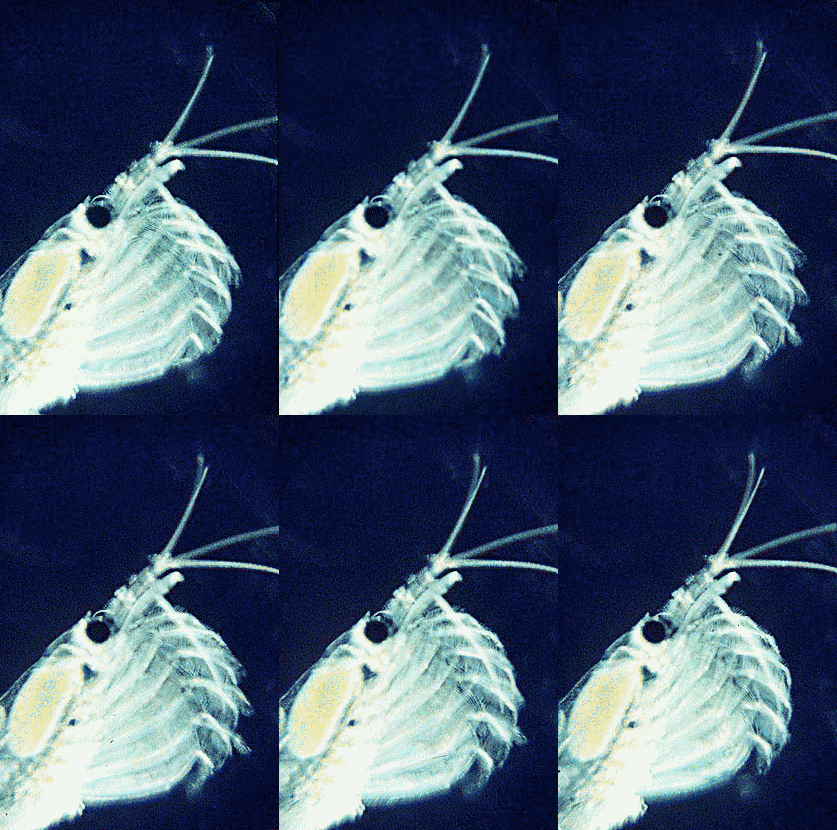
Like all arthropods, crustaceans are ecdysozoans, a clade without cilia. Cilia play an important role for many filter feeding animals, but because crustaceans don't have them, they need to use modified extremities for filter feeding instead. Mysidaceans live close to shore and hover above the sea floor, constantly collecting particles with their filter basket. They are an important food source for herring, cod, flounder, and striped bass. Mysids have a high resistance to toxins in polluted areas, and may contribute to high toxin levels in their predators.[citation needed] Antarctic krill manages to directly utilize the minute phytoplankton cells, which no other higher animal of krill size can do. This is accomplished through filter feeding, using the krill's developed front legs, providing for a very efficient filtering apparatus: the six thoracopods form a very effective "feeding basket" used to collect phytoplankton from the open water. In the animation at the top of this page, the krill is hovering at a 55° angle on the spot. In lower food concentrations, the feeding basket is pushed through the water for over half a meter in an opened position, and then the algae are combed to the mouth opening with special setae on the inner side of the thoracopods. Porcelain crabs have feeding appendages covered with setae to filter food particles from the flowing water. Most species of barnacles are filter feeders, using their highly modified legs to sift plankton from the water.
Also some insects with aquatic larvae or nymphs are filter feeders during their aquatic stage. Such as some species of mayfly nymphs, mosquito larvae, and black fly larvae. Instead of using modified limbs or mouthparts, some caddisfly larvae produce nets of silk used for filter feeding.
The baleen whales (Mysticeti), one of two suborders of the Cetacea (whales, dolphins, and porpoises), are characterized by having baleen plates for filtering food from water, rather than teeth. This distinguishes them from the other suborder of cetaceans, the toothed whales (Odontoceti). The suborder contains four families and fourteen species. Baleen whales typically seek out a concentration of zooplankton, swim through it, either open-mouthed or gulping, and filter the prey from the water using their baleens. A baleen is a row of a large number of keratin plates attached to the upper jaw with a composition similar to those in human hair or fingernails. These plates are triangular in section with the largest, inward-facing side bearing fine hairs forming a filtering mat. Right whales are slow swimmers with large heads and mouths. Their baleen plates are narrow and very long — up to 4 m (13 ft) in bowheads — and accommodated inside the enlarged lower lip which fits onto the bowed upper jaw. As the right whale swims, a front gap between the two rows of baleen plates lets the water in together with the prey, while the baleens filter out the water. Rorquals such as the blue whale, in contrast, have smaller heads, are fast swimmers with short and broad baleen plates. To catch prey, they widely open their lower jaw — almost 90° — swim through a swarm gulping, while lowering their tongue so that the head's ventral grooves expand and vastly increase the amount of water taken in. Baleen whales typically eat krill in polar or subpolar waters during summers, but can also take schooling fish, especially in the Northern Hemisphere. All baleen whales except the gray whale feed near the water surface, rarely diving deeper than 100 m (330 ft) or for extended periods. Gray whales live in shallow waters feeding primarily on bottom-living organisms such as amphipods.
Bivalves are aquatic molluscs which have two-part shells. Typically both shells (or valves) are symmetrical along the hinge line. The class has 30,000 species, including scallops, clams, oysters and mussels. Most bivalves are filter feeders (although some have taken up scavenging and predation), extracting organic matter from the sea in which they live. Nephridia, the shellfish version of kidneys, remove the waste material. Buried bivalves feed by extending a siphon to the surface. For example, oysters draw water in over their gills through the beating of cilia. Suspended food (phytoplankton, zooplankton, algae and other water-borne nutrients and particles) are trapped in the mucus of a gill, and from there are transported to the mouth, where they are eaten, digested and expelled as feces or pseudofeces. Each oyster filters up to five litres of water per hour. Scientists believe that the Chesapeake Bay's once-flourishing oyster population historically filtered the estuary's entire water volume of excess nutrients every three or four days. Today that process would take almost a year, and sediment, nutrients, and algae can cause problems in local waters. Oysters filter these pollutants, and either eat them or shape them into small packets that are deposited on the bottom where they are harmless.
Hub AI
Filter feeder AI simulator
(@Filter feeder_simulator)
Filter feeder
Filter feeders are aquatic animals that acquire nutrients by feeding on organic matter, food particles or smaller organisms (bacteria, microalgae and zooplanktons) suspended in water, typically by having the water pass over or through a specialized filtering organ that sieves out and/or traps solids. Filter feeders can play an important role in condensing biomass and removing excess nutrients (such as nitrogen and phosphate) from the local waterbody, and are therefore considered water-cleaning ecosystem engineers. They are also important in bioaccumulation and, as a result, as indicator organisms.
Filter feeders can be sessile, planktonic, nektonic or even neustonic (in the case of the buoy barnacle) depending on the species and the niches they have evolved to occupy. Extant species that rely on such method of feeding encompass numerous phyla, including poriferans (sponges), cnidarians (jellyfish, sea pens and corals), arthropods (krill, mysids and barnacles), molluscs (bivalves, such as clams, scallops and oysters), echinoderms (sea lilies) and chordates (lancelets, sea squirts and salps, as well as many marine vertebrates such as most species of forage fish, American paddlefish, silver and bighead carps, baleen whales, manta ray and three species of sharks—the whale shark, basking shark and megamouth shark). Some water birds such as flamingos and certain duck species, though predominantly terrestrial, are also filter feeders when foraging.
Most forage fish are filter feeders. For example, the Atlantic menhaden, a type of herring, lives on plankton caught in midwater. Adult menhaden can filter up to four gallons of water a minute and play an important role in clarifying ocean water. They are also a natural check to the deadly red tide.
In addition to these bony fish, four types of cartilaginous fishes are also filter feeders. The whale shark sucks in a mouthful of water, closes its mouth and expels the water through its gills. During the slight delay between closing the mouth and opening the gill flaps, plankton is trapped against the dermal denticles which line its gill plates and pharynx. This fine sieve-like apparatus, which is a unique modification of the gill rakers, prevents the passage of anything but fluid out through the gills (anything above 2 to 3 mm in diameter is trapped). Any material caught in the filter between the gill bars is swallowed. Whale sharks have been observed "coughing" and it is presumed that this is a method of clearing a build up of food particles in the gill rakers. The megamouth shark has luminous organs called photophores around its mouth. It is believed they may exist to lure plankton or small fish into its mouth. The basking shark is a passive filter feeder, filtering zooplankton, small fish, and invertebrates from up to 2,000 tons of water per hour. Unlike the megamouth and whale sharks, the basking shark does not appear to actively seek its quarry; but it does possess large olfactory bulbs that may guide it in the right direction. Unlike the other large filter feeders, it relies only on the water that is pushed through the gills by swimming; the megamouth shark and whale shark can suck or pump water through their gills. Manta rays can time their arrival at the spawning of large shoals of fish and feed on the free-floating eggs and sperm. This stratagem is also employed by whale sharks.
Like all arthropods, crustaceans are ecdysozoans, a clade without cilia. Cilia play an important role for many filter feeding animals, but because crustaceans don't have them, they need to use modified extremities for filter feeding instead. Mysidaceans live close to shore and hover above the sea floor, constantly collecting particles with their filter basket. They are an important food source for herring, cod, flounder, and striped bass. Mysids have a high resistance to toxins in polluted areas, and may contribute to high toxin levels in their predators.[citation needed] Antarctic krill manages to directly utilize the minute phytoplankton cells, which no other higher animal of krill size can do. This is accomplished through filter feeding, using the krill's developed front legs, providing for a very efficient filtering apparatus: the six thoracopods form a very effective "feeding basket" used to collect phytoplankton from the open water. In the animation at the top of this page, the krill is hovering at a 55° angle on the spot. In lower food concentrations, the feeding basket is pushed through the water for over half a meter in an opened position, and then the algae are combed to the mouth opening with special setae on the inner side of the thoracopods. Porcelain crabs have feeding appendages covered with setae to filter food particles from the flowing water. Most species of barnacles are filter feeders, using their highly modified legs to sift plankton from the water.
Also some insects with aquatic larvae or nymphs are filter feeders during their aquatic stage. Such as some species of mayfly nymphs, mosquito larvae, and black fly larvae. Instead of using modified limbs or mouthparts, some caddisfly larvae produce nets of silk used for filter feeding.
The baleen whales (Mysticeti), one of two suborders of the Cetacea (whales, dolphins, and porpoises), are characterized by having baleen plates for filtering food from water, rather than teeth. This distinguishes them from the other suborder of cetaceans, the toothed whales (Odontoceti). The suborder contains four families and fourteen species. Baleen whales typically seek out a concentration of zooplankton, swim through it, either open-mouthed or gulping, and filter the prey from the water using their baleens. A baleen is a row of a large number of keratin plates attached to the upper jaw with a composition similar to those in human hair or fingernails. These plates are triangular in section with the largest, inward-facing side bearing fine hairs forming a filtering mat. Right whales are slow swimmers with large heads and mouths. Their baleen plates are narrow and very long — up to 4 m (13 ft) in bowheads — and accommodated inside the enlarged lower lip which fits onto the bowed upper jaw. As the right whale swims, a front gap between the two rows of baleen plates lets the water in together with the prey, while the baleens filter out the water. Rorquals such as the blue whale, in contrast, have smaller heads, are fast swimmers with short and broad baleen plates. To catch prey, they widely open their lower jaw — almost 90° — swim through a swarm gulping, while lowering their tongue so that the head's ventral grooves expand and vastly increase the amount of water taken in. Baleen whales typically eat krill in polar or subpolar waters during summers, but can also take schooling fish, especially in the Northern Hemisphere. All baleen whales except the gray whale feed near the water surface, rarely diving deeper than 100 m (330 ft) or for extended periods. Gray whales live in shallow waters feeding primarily on bottom-living organisms such as amphipods.
Bivalves are aquatic molluscs which have two-part shells. Typically both shells (or valves) are symmetrical along the hinge line. The class has 30,000 species, including scallops, clams, oysters and mussels. Most bivalves are filter feeders (although some have taken up scavenging and predation), extracting organic matter from the sea in which they live. Nephridia, the shellfish version of kidneys, remove the waste material. Buried bivalves feed by extending a siphon to the surface. For example, oysters draw water in over their gills through the beating of cilia. Suspended food (phytoplankton, zooplankton, algae and other water-borne nutrients and particles) are trapped in the mucus of a gill, and from there are transported to the mouth, where they are eaten, digested and expelled as feces or pseudofeces. Each oyster filters up to five litres of water per hour. Scientists believe that the Chesapeake Bay's once-flourishing oyster population historically filtered the estuary's entire water volume of excess nutrients every three or four days. Today that process would take almost a year, and sediment, nutrients, and algae can cause problems in local waters. Oysters filter these pollutants, and either eat them or shape them into small packets that are deposited on the bottom where they are harmless.
Recent media