
Recent from talks
Suzuki method
Knowledge base stats:
Talk channels stats:
Members stats:
Suzuki method
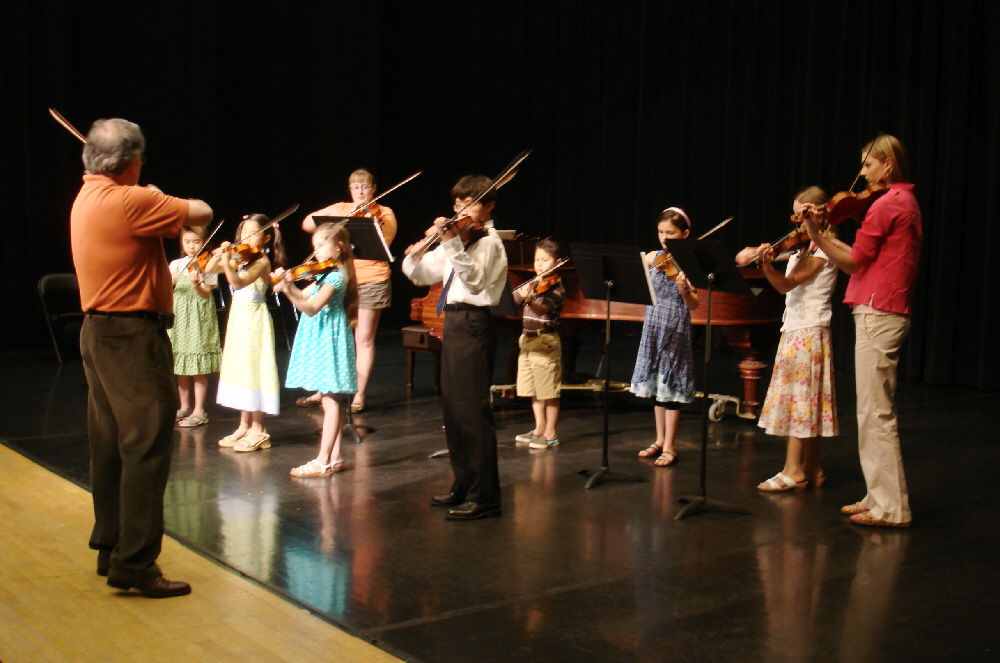
The Suzuki method is a mid-20th-century music curriculum and teaching method created by Japanese violinist and pedagogue Shinichi Suzuki. The method claims to create a reinforcing environment for learning music for young learners.
The Suzuki Method was conceived in the mid-20th century by Shinichi Suzuki, a Japanese violin salesman. Suzuki noticed that children pick up their native language quickly, whereas adults consider even dialects of their own language difficult to learn. He reasoned that if children have the skill to acquire their native language, they might have the ability to become proficient on a musical instrument. Suzuki decided to develop a teaching method after a conversation with Leonor Michaelis, who was Professor of Biochemistry at the University of Nagoya.
Suzuki pioneered the idea that a preschool age child could learn to play the violin if the learning steps were small enough and the instrument was scaled down to fit their body. He modeled his method, which he called "Talent Education" (才能教育, sainō kyōiku), after his theories of natural language acquisition. Suzuki believed that every child, if properly taught, was capable of a high level of musical achievement. He also made it clear that the goal of such musical education was to raise generations of children with "noble hearts" as opposed to creating famous musical prodigies.
The central belief of Suzuki, based on his language acquisition theories, is that all people can (and will) learn from their environment. The essential components of his method spring from the desire to create the "right environment" for learning music, which he also believed would foster excellent character in every student.
The method parallels the linguistic environment of acquiring a native language from the young age, which is usually referred to "mother-tongue" method. Suzuki believed that this environment would also help to foster good moral character. These components include:
Although Suzuki was a violinist, the method he founded is not a "school of violin playing" whose students can be identified by the set of techniques they use to play the violin. However, some of the technical concepts Suzuki taught his own students, such as the development of "tonalization," were so essential to his way of teaching that they have been carried over into the entire method. Other non-instrument specific techniques are used to implement the basic elements of the philosophy in each discipline.
The core Suzuki literature is published on audio recordings and in sheet music books for each instrument, and Suzuki teachers supplement the repertoire common to each instrument as needed, particularly in the area of teaching reading. One of the innovations of the Suzuki method was to make professional recordings of beginner level pieces widely available. Many non-Suzuki trained music teachers also use the Suzuki repertoire to supplement their curriculum.
Suzuki literature also deliberately leaves out many technical instructions and exercises found in the beginners' music books of his day. He favored a focus on melodic song-playing over technical exercises and asked teachers to allow students to make music from the beginning, helping to motivate young children with short, attractive songs which can themselves be used as technique building exercises. Each song in the common repertoire is meant to introduce some new or higher level of technique than the previous selection.
Hub AI
Suzuki method AI simulator
(@Suzuki method_simulator)
Suzuki method
The Suzuki method is a mid-20th-century music curriculum and teaching method created by Japanese violinist and pedagogue Shinichi Suzuki. The method claims to create a reinforcing environment for learning music for young learners.
The Suzuki Method was conceived in the mid-20th century by Shinichi Suzuki, a Japanese violin salesman. Suzuki noticed that children pick up their native language quickly, whereas adults consider even dialects of their own language difficult to learn. He reasoned that if children have the skill to acquire their native language, they might have the ability to become proficient on a musical instrument. Suzuki decided to develop a teaching method after a conversation with Leonor Michaelis, who was Professor of Biochemistry at the University of Nagoya.
Suzuki pioneered the idea that a preschool age child could learn to play the violin if the learning steps were small enough and the instrument was scaled down to fit their body. He modeled his method, which he called "Talent Education" (才能教育, sainō kyōiku), after his theories of natural language acquisition. Suzuki believed that every child, if properly taught, was capable of a high level of musical achievement. He also made it clear that the goal of such musical education was to raise generations of children with "noble hearts" as opposed to creating famous musical prodigies.
The central belief of Suzuki, based on his language acquisition theories, is that all people can (and will) learn from their environment. The essential components of his method spring from the desire to create the "right environment" for learning music, which he also believed would foster excellent character in every student.
The method parallels the linguistic environment of acquiring a native language from the young age, which is usually referred to "mother-tongue" method. Suzuki believed that this environment would also help to foster good moral character. These components include:
Although Suzuki was a violinist, the method he founded is not a "school of violin playing" whose students can be identified by the set of techniques they use to play the violin. However, some of the technical concepts Suzuki taught his own students, such as the development of "tonalization," were so essential to his way of teaching that they have been carried over into the entire method. Other non-instrument specific techniques are used to implement the basic elements of the philosophy in each discipline.
The core Suzuki literature is published on audio recordings and in sheet music books for each instrument, and Suzuki teachers supplement the repertoire common to each instrument as needed, particularly in the area of teaching reading. One of the innovations of the Suzuki method was to make professional recordings of beginner level pieces widely available. Many non-Suzuki trained music teachers also use the Suzuki repertoire to supplement their curriculum.
Suzuki literature also deliberately leaves out many technical instructions and exercises found in the beginners' music books of his day. He favored a focus on melodic song-playing over technical exercises and asked teachers to allow students to make music from the beginning, helping to motivate young children with short, attractive songs which can themselves be used as technique building exercises. Each song in the common repertoire is meant to introduce some new or higher level of technique than the previous selection.
Recent media