Hubbry Logo
Fernando SorFernando SorMain
Open search
Fernando Sor
Community hub
Fernando Sor
logo
8 pages, 0 posts
0 subscribers
Be the first to start a discussion here.
Contribute something
Fernando Sor
Fernando Sor
from Wikipedia

Key Information

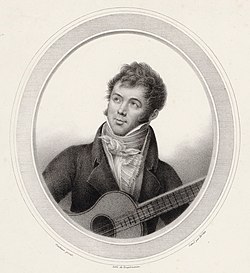
Ferran Sor (baptised 14 February 1778 – 10 July 1839), known in spanish as Fernando Sor, was a Catalan classical guitarist and composer of the late Classical era and early Romantic era. Best known for writing solo classical guitar music, he also composed an opera (at the age of 19), three symphonies, guitar duos, piano music, songs, a Mass, and at least two successful ballets: Cinderella, which received over one hundred performances, and Hercule et Omphale.

Partly because Sor was himself such a classical guitar virtuoso—contemporaries considered him to be the best in the world[1]—he made a point of writing didactic music for players of that instrument of all levels. His Twelve Studies Op. 6, the Twelve Studies Op. 29, the (24) Progressive Lessons Op. 31, and the (24) Very Easy Exercises Op. 35 have been widely played for two hundred years and are regularly reprinted.[2] On the other hand, Sor's concert pieces, like the popular Introduction and Variations on Mozart's "Das klinget so herrlich" Op. 9, belong to the advanced guitar performance repertoire.

Unlike modern classical guitar players, Sor used the smaller, slimmer "Romantic" guitars predating today's familiar guitar standards set by Torres. He used the ring finger of his plucking hand "rarely" and "only for harmony (never for melody)." He eschewed the use of nails on that hand.[3]

Variance of name

[edit]

As Sor's works were published in various countries, his name was translated, leading to variances in its spelling. These included Joseph Fernando Macario Sors, Ferdinand Sor, Ferdinando Sor[4][5][6][7][8][9][10] and, in the last years, Ferran Sor.[1] His family name appears in various forms in other contemporary documents as well, and there is not always a record of his having approved or used them. But in the file and marriage certificate of his grandfather, which includes Fernando's great-grandfathers, the name always appears as Sor, and this is true too of the corresponding document for one of the great-grandfathers, the oldest document yet found.[11]

Biography

[edit]

Spain

[edit]

Born in Barcelona to a fairly well-off family, he was baptized as José Fernando Macario Sors, as recorded in the baptismal record,[12] although in most of his manuscript and printed musical works he appears as Fernando Sor or Ferdinand Sor, and only in some cases does his surname appear as Sors.[13]

Sor was descended from a long line of career soldiers and intended to continue that legacy, but was distracted from this when his father introduced him to Italian opera. He fell in love with music and abandoned his military ambitions. Along with opera, Sor's father also introduced him to the guitar.

An oil painting depicting two men, dressed in 19th century attire, gathered around a table. The man on the right is playing the guitar.
Musician and his Family, French oil painting (Bibliothèque Marmottan, Boulogne-Billancourt, Paris)

At a young age, Sor's parents wouldn't give his musical abilities too much special attention, for fear it would distract from his Latin studies. Therefore, the young Sor (still not 11 years old) began to write songs to words in Latin to impress his parents. He even invented his own system for notating music, as he had not yet received formal training.

When he reached the age of 11 or 12, the head of the Barcelona Cathedral took notice of young Sor's talent, and he was enrolled in the school there. Not long after, his father died, leaving his mother without the funds to continue his education at the Cathedral. However, at around the same time Joseph Arredondo, the new abbot of Santa Maria de Montserrat, the famous monastery, heard of his talent, and provided funds for him to attend the choir school located at the monastery. Sor reveals in writings, mainly from the last ten years of his life, that he was greatly attached to this place, and had fond, nostalgic memories of his childhood there. But his mother began to see that Sor was becoming greatly distracted from his "chosen" path in the military or administration and, following the advice of friends, took him out of the monastery and placed him in military school for four years. It was not a terrible turn of events, as he had much free time to play and compose music in the army as well.[6][14]

In 1808, when Napoleon Bonaparte invaded Spain, Sor began to write nationalistic music for the guitar, often accompanied by patriotic lyrics. Sor was even part of traveling military bands that would play protest music on the streets. He was also promoted to captain in Córdoba and may have fought battles against the French at this time. After the defeat of the Spanish army, however, Sor accepted an administrative post in the occupying government. Here he was to be officially labeled an afrancesado along with the other Spaniards who abandoned their defense of Spain to embrace the French Revolutionary ideas. After the Spanish repelled the French in 1813, Sor and other afrancesados left Spain for fear of retribution. He went to Paris, never to return to his home country again.[6]

Paris, London, and Moscow

[edit]
Montmartre Cemetery, Paris

Having abandoned his family's ideal of a military or administrative post, Sor could finally give music a serious try in France. He gained renown at first as a virtuoso guitarist and composer for the instrument. When he attempted composing operas, however, he was rejected by the French. His Op. 7 was a large and strange piece, notated in three clefs, and no guitarist at the time could play it. [citation needed] Since France was no longer supportive of his music, Sor decided to try his talents elsewhere.

In 1815, he went to London to attempt to build a stronger music career there. Again, he gained considerable fame as a classical guitarist and gave guitar and voice lessons. Since ballet in London was more popular than opera, Sor decided to try his hand at this new genre of music. He had considerable success this time, especially with his ballet Cendrillon.[6]

By 1823, once he had acquired a level of fame in London, Sor again wandered away, this time with his wife, the ballerina Félicité Hullin, to Moscow in her quest to become a prima ballerina. Not much is known about his time there, however, despite the exaggeration about his romantic and professional life.[15] After three years in Moscow, he traveled around Europe giving concerts and getting into music circles everywhere he went.[6]

In 1827, partly due to his advancing age, he settled down and decided to live out the rest of his life back in Paris. It was during this retirement that he composed the majority of his classical guitar works. He had to comply with the demands of the public, though, and most guitarists wanted technically simple, nice-sounding pieces. It was in these last ten or so years of his life that his writings reveal his bitterness towards how his publications were being received by the public. For example, Op. 43 is entitled Mes Ennuis ("My Annoyances"), and six of his ballets are dedicated to "whoever wants them". These and other caustic remarks did not help his sales in the least. The foreword to Op. 45 goes even further than sarcasm: "Let's see if that's that. Six short and easy pieces in stages, which aim to lead to what has generally been agreed are difficulties. Composed and dedicated to the person with the least patience, by Fernando Sor. Opus 45."[16]

His last work was a mass in honour of his daughter, who died in 1837. The event sent the already sickly Sor into serious depression, and he died in 1839, of tongue and throat cancer.[6][17]

Quotations

[edit]

François-Joseph Fétis has called him "le Beethoven de la guitare",[18] though he has also remarked that Sor had failed to produce a good tone[citation needed] on one occasion.[19]

"The creative worth of Sor's guitar sonatas is high. The ideas, which grow out of the instrument yet stand up well enough apart from it, are fresh and distinctive. The harmony is skillful and surprisingly varied, with bold key changes and with rich modulations in the development sections. The texture is naturally of interest too, with the melody shifted from top to bottom, to middle, and frequent contrapuntal bits added. Among the extended forms, the first Allegro movements still show considerable flexibility in the application of 'sonata form', especially in the larger number of ideas introduced and recalled. For that matter, the style still goes back to that of Joseph Haydn and Mozart, especially in the first movement of Op. 22, which has all the neatness of syntax and accompaniment to be found in a classic symphony, and its third and fourth movements, which could nicely pass as a Minuet and Rondo by Haydn."

— The Sonata in the Classical Era (published 1963) (p. 664) by William S. Newman

"Here, Newman recognizes the creative value of Sor's guitar sonatas, but misconstrues several important points. Most significantly, Newman falls into an easy association of Sor's sonata style with that of Haydn (and Boccherini)." (p.1) (...) "The present article examines the formal and stylistic procedures employed by Sor in his guitar sonatas, determining appropriate models for these works and placing them in a likely chronological context. This examination affords a telling glimpse of Sor at two very different stages of his career: as a young composer in Spain emulating the imported cosmopolitan high-classical style of the Italian opera overture and Austro-French symphony; and as an established post-classicist exercising a personal aesthetic and a confident, individual approach to formal construction." (p. 3)

— Sor's Guitar Sonatas: Form and Style by Stanley Yates[20]

"How should one perform Sor's music? I believe the answer is with considerably more freedom, expression and passion than has, for the most part, been done in the recent past. Sor, in his method of 1830 has much to say about the use of tone color on the guitar and even discusses how to imitate the various orchestral instruments. This use of color is something that is very uncommon amongst modern guitarists. Ironically Sor says very little about other aspects of expression, but other guitar methods from the era do recommend much use of portamento, arpeggiation of chords, and other expressive devices which most people today consider anachronistic and completely out of style in the interpretation of the guitar music from this very era! (It never ceases to amaze me how so many modern guitarists and musicologists [...] don't even consider the wealth of material and instruction from Sor's era which cries out that this music is meant to be expressed with such devices as dynamics, tone color, portamento, chordal arpeggiation [...]. These same modern guitarists with the conspiratorial support of supposedly enlightened musicologists will often perform this music, sometimes on a "period" guitar, and use practically none of the above-mentioned expressive devices.)"

— Fernando Sor – Master Composer For Guitar?[21]

Works

[edit]
The cover of the first publication of Sor's Op. 9. It reads "Variations Brillantes sur un Air Favori de Mozart de l'Opéra: la Flûte Enchantée (O Cara Armonía) Pour Guitare Seule Exécutées par l'Auteur au Concert donné à l'Ecole Rle de Musique* et Dédiées à son Frère par Ferdinando Sor. Op. 9 Prix: 3f. Nouvelle Edition augmentée par l'Auteur. À Paris, au Magazin de Musique de A Meissonnier, Boulevard Montmartre, № 25. *l'Ecole Royale de Musique" in stylized text
The original cover of Sor's Variations on a Theme of Mozart, Op. 9, published in Paris in 1821

Music

[edit]

One of Sor's popular compositions is his Introduction and Variations on a Theme by Mozart, Op. 9. It is based on the melody for "Das klinget so herrlich, das klinget so schön!"[22] from The Magic Flute, composed in 1791.[23]

Didactic music

[edit]

Sor was a prolific and, in his time, quite popular composer. There was a great demand for him to compose material that was approachable by less accomplished players. The resulting body of instructional studies he produced is not only noteworthy for its value to students of the guitar, but for its inherent musicality. Much of this work is organized in several opus numbers (in increasing order of difficulty): Op. 60 (25 lessons), Op. 44 (24 lessons), Op. 35 (24 exercises), Op. 31 (24 lessons), Op. 6 (12 studies) and Op. 29 (12 studies).

Didactic manual

[edit]

Sor's Méthode pour la Guitare was first published in Paris in 1830 and translated into English by A Merrick in 1832 under the title Method for the Spanish Guitar.

An image of the cover of Sor's Méthode pour la Guitare, the title and author's name appear in stylized text
The original cover of Sor's Méthode pour la Guitare, published in Paris in 1830.

Instruments used by Sor

[edit]

Sor undoubtedly played guitars by Pierre René Lacôte, mentioning: "M. Lacote, a French maker, the only person who, besides his talents, has proved to me that he possesses the quality of not being inflexible to reasoning".[24] Some guitars of Lacôte show Sor's signature: "Fernando Sor, the Catalan man was out of his mind in Paris has signed a number of guitars by René Lacôte – examples now survive in the Edinburgh University Collection of Historic Musical Instruments, cat. no. 2521; and in private ownership (exhibited at the Londen Early Music Instrument Makers Exhibition, 1991). Sor also lent his name to the instruments of Louis Panormo of London. However, in neither case is the instrument known, then or now, as a 'Sor model'."[25]

A guitar of Lacôte that was signed by Sor is displayed at the Metropolitan Museum of Art: 1. In his method, Sor mentions:

"[...] if I wanted an instrument, I would procure it from M. Joseph Martinez of Malaga, or from M. Lacote [...]
The guitars to which I have always given the preference are those of Alonzo of Madrid, Pagès and Benediz of Cadiz, Joseph and Manuel Martinez of Malaga, or Rada, successor and scholar of the latter, and those of M. Lacote of Paris. I do not say that others do not exist; but never having tried them, I cannot decide on that which I have no knowledge."

In his method, he also mentions that "J. Panormo" of London and "Mr. Schroeder of Petersburgh", made some guitars under his direction; but it is curious that he mentions them only in regard to his own guitar design ideas, which are today partly critically viewed. Guitars made according to Sor's design have not yet been located.

Andrés Segovia selected a set of twenty studies, each emphasizing a particular aspect of technique; these studies are now some of the best known works of Fernando Sor.

Selected recordings

[edit]
  • Fernando Sor: Complete Studies for Guitar, performed by Enea Leone, on: Brilliant Classics 94791 (triple CD, 2014). Contains the complete Opp. 6, 29, 31, 35, 44, 60.
  • Fernando Sor: Piéces pour la Guitare, performed by Xavier Diaz-Latorre on a historical guitar by Blaise le Jeune (ca.1840) strung in gut, on: [1].

Bibliography

[edit]

References

[edit]
[edit]
Revisions and contributorsEdit on WikipediaRead on Wikipedia
from Grokipedia
Fernando Sor (baptized 14 February 1778 – 10 July 1839) was a Catalan composer, guitarist, and teacher renowned for elevating the guitar from a folk instrument to a respected concert vehicle through his technical innovations, extensive solo repertoire, and systematic pedagogy. Born Josep Ferran Sorts i Muntades in Barcelona, he received early musical training as a chorister at the Montserrat monastery, where he studied composition and orchestral playing before composing symphonies, operas like Telemaco nell’isola de Calipso (1797), and vocal works including seguidillas and boleros. During the Peninsular War (1808–1814), Sor supported the French occupation, composing patriotic military songs such as “Venid, vencedores” and “Vivir en cadenas,” which led to his exile from Spain in 1813; he subsequently resided in Paris, London, and Moscow, performing for nobility and staging successful ballets like Cendrillon. In Paris from the 1820s onward, he focused on guitar music, producing over 100 works including studies (opp. 6, 31, 35, 60), fantasies, variations such as those on Mozart's Die Zauberflöte (op. 9), and the influential Méthode pour la guitarre (1830), which emphasized musical expression alongside technique and influenced generations of players. His compositions prioritized artistic depth over mere virtuosity, distinguishing him from contemporaries like Mauro Giuliani, and secured his legacy as a pivotal figure in the guitar's classical tradition.

Nomenclature and Background

Variants of Name and Titles

Fernando Sor, born Josep Ferran Sorts i Muntades, was baptized on February 14, 1778, in under the name José Fernando Macario Sors, reflecting the Spanish form of his Catalan family name Sorts. The Sorts, occasionally rendered as Sors in , derives from his paternal lineage, while Muntades indicates maternal origins; these elements align with Catalan naming conventions of the era, combining given names with and surnames. For his professional output, Sor standardized his name as Fernando Sor, a simplified and Hispanicized version that appeared on most publications, facilitating recognition across . In French and English contexts, particularly during his Paris residency, it was often adapted to Ferdinand Sor, as seen in contemporary concert announcements and editions of his guitar methods. Italian transliterations included Ferdinando Sor, while rare variants like Ferunando Soru appeared in non-Iberian sources; these reflect phonetic accommodations rather than deliberate pseudonyms. Sor held no hereditary or conferred noble titles, though his ballets and guitar works earned him acclaim as a , with informal epithets such as the "Beethoven of the guitar" emerging posthumously among admirers of his technical innovations. His self-presentation emphasized artistic merit over aristocratic status, consistent with his trajectory from to performer.

Family Origins and Early Influences

Fernando Sor was baptized on February 14, 1778, in as Joseph Fernando Bacari Sors, into a bourgeois Catalan family of modest but stable means with roots in trade and military service. His father, Joan Sors, worked as a in Barcelona's municipal pawn establishment before advancing to an official role in road administration; an amateur musician, Joan played guitar, sang, and fostered his son's early interest in music through exposure to Italian operas, including a 1783 performance of Giulio Sabino that prompted the young Sor to compose a trio. The family included at least one younger brother, Carlos, whose godfather was Cayetano de Gisbert y Seriol, reflecting connections within Barcelona's mercantile circles. Joan's death in 1790, when Sor was about 12, left the family in financial difficulty and shifted Sor's path from informal tutelage in and —initially guided by his father and later by Josep Prats, the first violinist at —to more structured training. Despite the family's , which predisposed Sor toward an administrative or armed career, his musical led to enrollment as a chorister at the Escolania de monastery near around 1789–1790. There, under teachers like Padre Anselmo Viola, he studied , , and composition, performing solos and mastering , , and organ until approximately 1795. These early experiences shaped Sor's compositional style, blending Catalan bourgeois exposure to Italian opera overtures by composers such as Paisiello and Cimarosa with rigorous ecclesiastical training in and orchestration. By the mid-1790s, encounters with guitarist Federico Moretti's works influenced his adoption of the six-string guitar and contrapuntal techniques, marking a transition from familial amateurism to professional aspirations amid Barcelona's cultural milieu.

Early Life

Childhood and Initial Education in Barcelona

Josep Ferran Sorts i Muntades, later known as Fernando Sor, was baptized on 14 February 1778 in Barcelona, Catalonia, Spain, into a prosperous family of Catalan origin. His father, Joan Sor (also recorded as Juan de Sor), served as an amateur musician skilled on the guitar and violin, introducing the young Sor to these instruments as well as to Italian opera, which profoundly shaped his early musical sensibilities. His mother, Ysabel Muntades (or Montadas), came from a background that supported the family's comfortable circumstances. From childhood, Sor demonstrated aptitude for music, beginning studies on the and guitar under familial influence before formal schooling. At a young age, he was sent to the Escolania de , the choir school attached to the Montserrat Monastery near , where he served as a chorister and received a broad musical education encompassing vocal training, theory, and performance. This period in the late 1780s and early 1790s laid the foundation for his guitar proficiency, though the instrument was then viewed in elite circles as somewhat lowly compared to orchestral strings. Returning to , Sor continued honing his skills independently, performing locally and composing by his early twenties, amid a cultural milieu blending Catalan traditions with emerging classical influences.

Entry into Military Service

In 1794, at the age of 16, Fernando Sor enlisted in the as a volunteer in the , departing from the monastery where he had been studying . This decision aligned with his family's longstanding tradition of , overriding his early musical inclinations despite parental concerns that such pursuits were distracting him from a soldier's path. Sor participated in the (1793–1795), a brief conflict against French revolutionary forces invading from across the border, during which Spanish militias mobilized to defend and . His initial service reflected the era's reliance on volunteer units to supplement regular troops amid Spain's alliances against . The war concluded with the on July 22, 1795, allowing Sor to return to . There, in 1796 at age 18, he enrolled in the Real Academia de Matemática y Nobleza for four years of formal military education, focusing on , , and related disciplines essential for officers. This training elevated his rank and prepared him for subsequent roles, including eventual captaincy in the Cordovan volunteers, while he balanced studies with private .

Political and Military Engagements

Involvement in the Peninsular War

Sor entered the as a in the following the French invasion of on February 16, 1808, initially fighting against the occupiers with the regiment of Cordovan Volunteers in engagements at and . His unit included its own musician, reflecting the integration of musical elements into military life, which aligned with Sor's background in composition. Amid the early resistance, Sor composed patriotic boleros such as Venid, vencedores and Vivir en cadenas to support Spanish forces, establishing him as a key creator of military and political songs during the conflict from to 1814. These works, often accompanied by lyrics exhorting victory and decrying subjugation, were performed to rally troops and civilians. After Spanish defeats, including the French reoccupation of on December 4, 1808, Sor shifted allegiance to the French regime, accepting an administrative position in the occupying government as one of the afrancesados who collaborated in hopes of implementing reforms inspired by French revolutionary principles. By 1810–1811, he managed a factory in under French control, a role that sustained him during the war's turmoil. Historical records of Sor's precise military actions remain sparse, with limited documentation beyond these affiliations and compositions, likely due to the chaos of the conflict and his subsequent exile. This pragmatic alignment with the French, while enabling survival and administrative duties, branded him a collaborator among Spaniards upon Ferdinand VII's restoration in 1814, prompting his flight from .

Alignment with French Forces and Resulting Exile

In 1808, following the French invasion of during the , Sor initially opposed the Napoleonic forces and participated in resistance efforts aligned with Spanish patriot causes. By approximately 1810, however, amid the French occupation of much of —including the installation of as king—Sor pragmatically accepted an administrative position under the French regime, serving as a police commissioner in for over two years. This affiliation extended to his musical output, as he composed political and military songs supporting the French-aligned government, marking a shift from earlier patriotic works for the Bourbon monarchy. The decisive British and Spanish victories, culminating in the in June 1813 and the subsequent French retreat from , rendered Sor's collaboration untenable under the restored Bourbon monarchy. Facing potential imprisonment or execution as a collaborator with the defeated occupiers, Sor fled in late 1813 or early 1814, first to with his wife Joaquina, and never returned despite later opportunities under more liberal regimes. This self-imposed , lasting until his death in 1839, severed his ties to his homeland and redirected his career toward international musical pursuits in and beyond.

Professional Career Abroad

Residence and Activities in Paris

Following his exile from in 1813 due to his alignment with French forces during the , Fernando Sor settled in , where he resided until his death. He focused on establishing a career as a classical and , producing works across genres including ballets, symphonies, and guitar solos. In the early 1820s, Sor actively participated in Paris's musical scene through performances and compositions. He performed guitar solos at soirées, such as those at Manuel García's residence on October 4 and 9, 1822, and at the Cercle harmonique on November 27 and December 13, 1822. His ballet Cendrillon premiered at the Paris Opéra on March 3, 1823, achieving over 100 performances. Sor published several guitar works through Meissonnier, including Opus 16 and the Cinquième Fantaisie. Sor departed for in mid-1823 but returned around 1826–1827 with his daughter Carolina, following a separation from his wife, Félicité Hullin. He resumed teaching guitar to pupils from and at a girls' school operated by Madame Migneron, including lessons to General . Collaborating with guitarist Dionisio Aguado from 1827, Sor composed duets such as Opus 34 in 1828 and performed joint concerts until 1839. He published Méthode pour la Guitare in 1830, a foundational instructional text for beginners. Additional guitar publications included Opus 35 in 1828 and Opus 51 in 1832. In his final years, Sor continued composing and teaching despite declining health from tongue cancer. His daughter predeceased him by two years, and he died on July 10, 1839, in , subsequently buried in .

Travels to London and Moscow

In 1815, following a brief period in , Fernando Sor relocated to , where he resided until 1823, establishing himself as a prominent performer and . During this time, he participated in approximately nineteen documented across , performing both as a and vocalist, which contributed to his growing reputation in British musical circles. His vocal works, particularly Italian arietts, received acclaim, with contemporary reviews noting their popularity among audiences. Sor also benefited from royal patronage, including a previously undocumented at a that highlighted the guitar's favor among nobility and underscored his efforts to elevate the instrument's status. In , Sor focused on publishing and teaching, issuing guitar studies such as his Op. 6 variations on a theme and engaging in private instruction that sustained his career amid economic challenges. His activities extended to composing for voice and guitar, reflecting the era's demand for , though he navigated competition from other émigré musicians. By 1822, personal circumstances, including a romantic involvement with the young ballerina Félicité Hullin, prompted his departure preparations. In 1823, Sor accompanied Hullin to Moscow, where she had been engaged to perform, marking a three-year sojourn until approximately 1826. There, he oversaw the staging of his ballet Cendrillon (Cinderella), in which Hullin starred, adapting the work for Russian audiences and contributing to the local theatrical scene. Hullin's success as a dancer and emerging choreographer influenced their extended stay, during which she shaped early Russian ballet development through teaching and performances. Sor composed additional ballet music tailored to Moscow's Imperial Theatres, though specific guitar-focused output from this period remains limited in documentation. Upon returning westward via Europe, Sor resettled in Paris, leveraging connections from his travels.

Musical Compositions

Guitar-Specific Works


Fernando Sor composed a prolific body of music exclusively for the guitar, encompassing solo works catalogued under approximately 60 opus numbers from Op. 1 to Op. 60, plus several unnumbered pieces, alongside about a dozen duets. These pieces, published primarily between 1810 and 1838 by Parisian publishers including Castro, Meissonnier, and Pacini, feature forms such as divertimentos, sonatas, fantasies, variations on folk and operatic themes, waltzes, minuets, and progressive studies.
Early solo works include the Six Divertimentos, Op. 1, and Op. 2; the Fantasy, Op. 4; and the 12 Studies, Op. 6, which blend classical structure with idiomatic guitar techniques like arpeggios and scale passages. The Introduction and Variations on a Theme from 's ("O cara armonia"), Op. 9, exemplify his skill in thematic elaboration, incorporating brilliant passagework and harmonic variety tailored to the guitar's six-string range.
Sonatas and extended fantasies highlight Sor's structural ambitions, as in the Grand Solo (Sonata Prima), Op. 14, composed circa 1805 and featuring multi-movement form with lyrical themes and developmental sections. Other significant sonatas include Op. 22 (published 1825) and Op. 25 (1827), while fantasies such as Op. 16 on Paisiello's "Nel cor più non mi sento" and the Elegiac Fantasy, Op. 59, demonstrate evolving expressiveness. Variations on popular airs, like Op. 15a (Folies d'Espagne), Op. 26 ("Que ne suis-je la fougère"), Op. 27 ("Gentil housard"), Op. 28 ("Malbrough s'en va-t-en guerre"), and Op. 40 on the Scottish "Ye banks and braes," adapt external melodies to showcase guitar timbre and virtuosity. Didactic yet performable studies form a core of his output, including the 24 Very Easy Exercises, Op. 35 (1827); 24 Short Progressive Pieces, Op. 44; and 25 Progressive Studies, Op. 60, which progressively build technique through exercises in scales, chords, and dynamics. Shorter character pieces, such as the six Petites Pièces in Op. 5 (featuring the renowned Andante largo), Op. 24, Op. 32, and Op. 42, along with waltzes (Op. 17, 18, 51) and bagatelles (Op. 43 Mes Ennuis), offer concise, melodic vignettes suited for salon settings. Guitar duets, published from Op. 34 onward, include L'Encouragement, Op. 34 (1828); Les Deux Amis, Op. 41; and Souvenir of Russia, Op. 63 (1837–1838), often in divertissement or formats for amateur and professional pairs. Sor's guitar writing consistently prioritizes the instrument's polyphonic potential, employing natural harmonics, thumb independence, and balanced voicing to achieve orchestral effects within solo constraints.

Ballet, Opera, and Vocal Music

Sor composed one known , Telemaco nell'isola di Calipso (Telemachus on the Island of Calypso), which premiered in on 25 August 1797 and received 16 performances, a successful run for the young composer. The work, including its from 1796, showcased his early theatrical ambitions before his . His ballet output proved more enduring during his London and Paris periods. The three-act grand ballet Cendrillon (Cinderella), choreographed by François Decombe, premiered at London's King's Theatre on 26 March 1822, achieving 27 performances by 5 October 1822. Revived in Paris at the Opéra on 3 March 1823, it surpassed 100 performances there. Contemporary reviews lauded its graceful melodies in London but critiqued the Paris production for derivative elements, such as borrowings from Mozart's Le nozze di Figaro. Sor also supplied music for Gil Blas, a five-act operatic drama (later shortened to two acts) co-composed with Matthew Moss and premiered at London's English Opera House on 15 August 1822; its score was destroyed in an 1830 fire. Additional ballet contributions include Hercule et Omphale and extracts like the Marche du ballet de 'Cendrillon', Op. 15c. Vocal works encompassed songs, duets, and genre pieces often paired with guitar or . These included boleros and seguidillas for voices and guitar, alongside compositions in Spanish, Italian, and English. Notable examples feature ariettas such as Lagrime mie d'affanno and chansonnettes like Laurette, reflecting his skill as a singer and his integration of national styles.

Military and Political Songs

During the (1808–1814), Fernando Sor emerged as a principal composer of military and political songs in , producing works that reflected the turbulent political landscape and were often performed by crowds in public celebrations as part of the resistance against French occupation. His early vocal compositions, such as the patriotic song Venid, vencedores ("Come in, victors"), were adopted by Spanish patriots to rally support against Napoleonic forces shortly after their invasion in 1808, aligning with Sor's initial involvement in the resistance. As Sor's allegiances shifted toward collaboration with the French administration—where he held a military post and composed pieces—his songs incorporated themes supportive of French liberal ideals, including anti-slavery sentiments. A notable example is Appel des nègres aux français ("Call of the Negroes to the French"), a heroic chant (Chant Héroïque) that dramatizes enslaved people's plea for liberation under French protection, underscoring Sor's for amid the era's revolutionary rhetoric. This work, set to a poem emphasizing dramatic appeals against , exemplifies his use of to engage political discourse beyond mere . Later, following Ferdinand VII's restoration in 1814, Sor penned self-authored texts in songs like Adónde vas Fernando Incauto ("Where are you going, incautious Fernando"), which critiqued the monarch's policies and the Carlist conflicts, blending personal reflection with commentary on Spain's post-war instability. These compositions, often for voice accompanied by guitar or , not only served propagandistic roles during wartime but also contributed to Sor's reputation as a politically engaged , though many scores remain lost or unpublished, limiting modern assessments of their full scope.

Pedagogical Contributions

Guitar Method and Didactic Pieces

Fernando Sor's Méthode pour la Guitare, first published in French in in 1830, serves as a comprehensive instructional manual emphasizing proper technique, positioning, and for the guitar. The text includes detailed explanations of finger placement, scale exercises, and chord progressions, accompanied by illustrations to demonstrate hand positions and instrument holding. An English translation appeared in 1832, adapting the original for broader accessibility while retaining Sor's focus on developing both technical proficiency and interpretive skills. Sor advocated for a systematic approach, prioritizing natural hand positions to prevent strain and promote fluid execution, principles that influenced subsequent guitar . Complementing the method, Sor composed numerous didactic pieces designed as progressive studies to build foundational and advanced skills. His Op. 60, Introduction to the Study of the Guitar (c. 1830s), comprises 25 lessons starting with basic exercises in open strings and simple melodies, gradually introducing arpeggios, scales, and polyphonic textures for beginners. Earlier works like the 12 Studies of Op. 6, published in in 1815, target intermediate players with exercises focusing on right-hand independence and left-hand dexterity. The 24 Etudes of Op. 29 and Op. 31 escalate in complexity, incorporating melodic phrasing within technical drills to foster musicality alongside precision, while Op. 35 offers shorter etudes emphasizing dynamics and articulation. These compositions integrate pedagogical intent with artistic value, distinguishing them from purely mechanical exercises by embedding expressive motifs that encourage interpretive development.

Technical Innovations and Instruments

Fernando Sor advanced technique through his Méthode pour la Guitare, published in 1830, which emphasized and musical expression over isolated . He advocated for slur-based scale passages, where only the first note is plucked and subsequent notes slurred, promoting phrasing akin to orchestral strings rather than plucking. Sor divided the guitar's registers into distinct bass, middle, and treble voices to emulate orchestral accompaniment, enhancing polyphonic capabilities in solo works. In right-hand technique, Sor played without nails, using the fleshy pads of the thumb, index, and middle fingers to achieve varied tone colors unattainable with nails, which he criticized for limiting dynamic gradation. The thumb plucks the four bass strings, while the index and middle fingers handle the treble strings, with the index often reserved for the second string; the ring finger was rarely employed except in chords. Left-hand positioning featured the thumb behind the neck for stability, opposing contemporaries like who used it to fret the sixth string, and Sor damped notes with the left hand rather than the right. Sor composed études, such as those in Op. 35 and Op. 60, to systematically develop these techniques, integrating practical with exercises for arpeggios, harmonics, and position playing to minimize shifts. His approach treated the guitar as a melodic instrument capable of symphonic depth, countering its prior role as mere . Sor performed on smaller, slimmer "Romantic" guitars predating de Torres's larger concert models, favoring instruments by French Lacôte and London-based Italian maker Louis Panormo, strung with gut trebles and silk-wound basses, often tuned a below modern pitch (A=430 Hz). These guitars produced a brighter, more focused tone suited to his intimate, harmonically rich compositions.

Reception and Legacy

Contemporary Critical Views

Scholars in the late 20th and early 21st centuries have elevated Fernando Sor's status from that of a period to a foundational whose innovations shaped the classical guitar's and technique. Brian Jeffery's 1977 Fernando Sor: Composer and Guitarist argues that Sor's oeuvre demonstrates sophisticated compositional craft across genres, including ballets and operas, countering earlier dismissals of him as instrumentally limited; this work has been credited with reframing Sor as a serious whose experiences informed his cosmopolitan style. Similarly, analyses emphasize his role in pioneering modern guitar methods, with Sor ranked among the few figures, alongside , who systematically advanced finger independence, position shifts, and expressive phrasing tailored to the six-string instrument. Critical examinations of Sor's guitar-specific output highlight its melodic purity and structural balance, rooted in late Classical influences from Haydn and Mozart, yet some observers note constraints imposed by the guitar's sonic range and polyphonic challenges circa 1820. A 2012 analytical essay posits that Sor's harmonic restraint—favoring diatonic progressions over chromatic density—was a deliberate adaptation for the guitar's practicalities, enabling idiomatic writing that prioritized clarity and performability over the denser textures of contemporaneous piano or orchestral masters, though this has led to debates on whether it curtails emotional profundity. Reviews of his sonatas and variations, such as Op. 9 on Mozart's "O cara armonia," praise their thematic development and technical demands, which blend virtuosity with musical narrative, influencing Romantic-era guitarists like Julian Arcas. Pedagogical contributions receive consistent acclaim in modern guitar scholarship for their enduring utility, with Op. 60 studies lauded as progressive exercises that integrate scalar patterns, arpeggios, and dynamics to foster both mechanics and interpretation, remaining core to curricula despite evolutions in technique since 1830. Recent projects, including Erik Stenstadvold's critical edition of Sor's complete guitar works, reflect sustained academic engagement, incorporating archival revisions to beaming, fingering, and accents for to original intentions while addressing performance ambiguities. Such efforts underscore a consensus that Sor's legacy persists through his elevation of the guitar from salon novelty to concert instrument, though uneven historical documentation of his non-guitar output invites ongoing scrutiny of his broader impact.

Influence on Later Guitarists and Modern Interpretations

Fernando Sor's etudes and studies, such as those in Opp. 29, 35, and 60, established foundational techniques for , emphasizing , phrasing, and progressive difficulty, which directly informed the pedagogical traditions of later 19th-century guitarists like (1852–1909). Tárrega, who recognized shared challenges in achieving musical depth on the guitar, incorporated Sor's emphasis on and composition into his own works and teaching, bridging early Romantic-era methods to modern development. In the 20th century, (1893–1987) amplified Sor's legacy by compiling and editing Twenty Studies for Guitar in the 1920s, selecting pieces from multiple opuses—including Opp. 6, 29, and 35—revising them with fingerings tailored to contemporary technique on larger guitars. This edition, which prioritized musical and technical value over strict adherence to Sor's original slimmer , became a standard repertoire staple, influencing generations of players by integrating Sor's classical forms into Segovia's advocacy for the guitar as a concert instrument. Segovia's efforts paved the way for mid-20th-century interpreters like (1933–2020), who recorded Sor's Study in B minor (Op. 35, No. 17), Grand Solo (Op. 6), and Fantasie élégiaque (Op. 59) for two guitars with , adapting them to post-Torres instruments while preserving their structural integrity. Bream's performances highlighted Sor's melodic elegance and contrapuntal sophistication, influencing subsequent artists such as Manuel Barrueco and David Russell in their selections from Sor's solo and duo repertoire. Contemporary guitarists continue to engage Sor's works through recordings and live interpretations that balance historical fidelity with modern tonal possibilities. For instance, William Kanengiser performed the Grand Solo (Op. 6) in 2009, showcasing its demanding patterns on a contemporary concert guitar, while the Tecla Editions' New Complete Works for Guitar (published starting in the ) provides re-engraved scores enabling scholarly reinterpretations free from earlier editorial biases. Sor's Op. 60 25 Progressive Studies, originally didactic pieces from , remain integral to technique-building curricula, as evidenced by their inclusion in programs by artists like José Luis Lopategui. These efforts underscore Sor's enduring role in sustaining the guitar's classical canon amid evolving performance practices.

Selected Modern Recordings

John Holmquist's multi-volume recording of Sor's complete guitar music for , initiated in the 1990s and continuing into the 2000s, provides a comprehensive survey of the composer's solo and duet works, utilizing a modern to emphasize technical clarity and structural fidelity. These releases, such as the 1998 volume featuring Fantaisie Op. 10 and Thèmes et Menuets Op. 11, highlight Sor's variations and minuets with precise articulation, drawing on rediscovered sources for authenticity. David Starobin's Les Plus Belles Pages on Bridge Records captures selections like the Introduction and Variations Op. 9 with exalted phrasing and interpretive depth, earning praise in Gramophone for revealing the music's truest expressive potential on a contemporary instrument.
PerformerAlbum/ReleaseLabelYearKey Works/Notes
John HolmquistComplete Guitar Music (Vol. 8)Naxos1998Opp. 10-12; exhaustive series covering solos/duets with scholarly editions.
David StarobinLes Plus Belles PagesBridge1990sOp. 9 Variations; noted for phrasing and emotional insight.
Various (e.g., González)20 Studies for GuitarBrilliant Classics2011Op. 60 etudes; explores progressive techniques with dynamic range.
Unspecified (Linn Records)Le Calme: Late WorksLinn2014Late fantasias; pushes instrumental boundaries with elaborate structures.
Fabio ZanonThe 19th-Century GuitarSOMM2019Recital spanning early to advanced pieces; charts increasing technical demands.
These recordings often prioritize Sor's pedagogical intent while adapting to modern performance practices, such as enhanced sustain on strings, though some critics note the trade-offs in tonal intimacy compared to period gut-strung instruments.

References

Add your contribution
Related Hubs
Contribute something
User Avatar
No comments yet.