



Community hub
Tailorbird
View on Wikipedia
| Tailorbird | |
|---|---|

| |
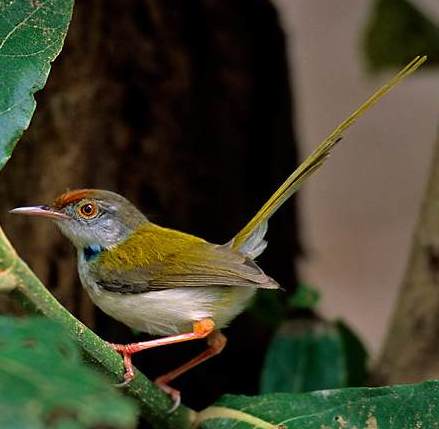
| Common tailorbirds (Orthotomus sutorius) | |
Scientific classification 
| |
| Kingdom: | Animalia |
| Phylum: | Chordata |
| Class: | Aves |
| Order: | Passeriformes |
| Family: | Cisticolidae |
| Genus: | Orthotomus Horsfield, 1821 |
| Type species | |
| Orthotomus sepium Horsfield, 1821
| |
| Species | |
|
See text | |
Tailorbirds are small birds, most belonging to the genus Orthotomus. While they were often placed in the Old World warbler family Sylviidae, recent research suggests they more likely belong in the Cisticolidae and they are treated as such in Del Hoyo et al.[1] One former species, the mountain tailorbird (and therefore also its sister species rufous-headed tailorbird), is actually closer to an old world warbler genus Cettia.[2]
They occur in the Old World tropics, principally in Asia.[citation needed]
These warblers are usually brightly colored, with green or grey upper parts and yellow white or grey under parts. They often have chestnut on the head.[citation needed]

Tailorbirds have short rounded wings, short tails, strong legs and long curved bills. The tail is typically held upright, like a wren. They are typically found in open woodland, scrub and gardens.[citation needed]
Tailorbirds get their name from the way their nest is constructed. The edges of a large leaf are pierced and sewn together with plant fibre or spider's web to make a cradle in which the actual grass nest is built.[citation needed]
Taxonomy
[edit]The genus Orthotomus was introduced in 1821 by the American naturalist Thomas Horsfield to include a single species, Orthotomus sepium Horsfield, 1821, the olive-backed tailorbird. This is therefore the type species of the genus by monotypy.[3][4] The genus name is from Ancient Greek ορθος/orthos meaning "straight" and τομευς/tomeus, τομεως/tomeōs meaning "knife" or "edge".[5]
Species
[edit]The genus contains 13 species:[6]
| Image | Common name | Scientific name | Distribution |
|---|---|---|---|
.jpg) |
Common tailorbird | Orthotomus sutorius | China, Sri Lanka, Thailand, Laos, Malaysia, Singapore, Cambodia, and Vietnam |
_-_Flickr_-_Lip_Kee.jpg) |
Dark-necked tailorbird | Orthotomus atrogularis | Bangladesh, Northeast India, and Southeast Asia |
| Cambodian tailorbird | Orthotomus chaktomuk[7] | Cambodia | |
| Visayan tailorbird | Orthotomus castaneiceps | Philippines | |
| Green-backed tailorbird | Orthotomus chloronotus | Philippines | |
| Rufous-fronted tailorbird | Orthotomus frontalis | eastern Philippines | |
| Grey-backed tailorbird | Orthotomus derbianus | Philippines (Palawan, Luzon, and Catanduanes) | |
.jpg) |
Rufous-tailed tailorbird | Orthotomus sericeus | Brunei, Indonesia, Malaysia, Myanmar, Philippines, Singapore, and Thailand |
_-_Flickr_-_Lip_Kee.jpg) |
Ashy tailorbird | Orthotomus ruficeps | Brunei, Indonesia, Malaysia, Myanmar, Philippines, Singapore, Thailand, and Vietnam |
.jpg) |
Olive-backed tailorbird | Orthotomus sepium | Indonesia (Java, Madura Island, Bali and Lombok) |
| Yellow-breasted tailorbird | Orthotomus samarensis | Philippines | |
| Black-headed tailorbird | Orthotomus nigriceps | Philippines (Mindanao, Dinagat, and Siargao) | |
| White-eared tailorbird | Orthotomus cinereiceps | Philippines (Basilan and West Mindanao) |
Two species moved to the Cettiidae:
- Mountain tailorbird, Phyllergates cucullatus
- Rufous-headed tailorbird, Phyllergates heterolaemus
References
[edit]- ^ Del Hoyo, J.; Elliot, D.; Christie A., eds. (2008). Handbook of the Birds of the World. Volume 11: Old World Flycatchers to Old World Warblers. Lynx Edicions, Barcelona. ISBN 978-84-96553-42-2.
- ^ Alström, Per; Ericson, P.G.P.; Olsson, U.; Sundberg, P. (2006). "Phylogeny and classification of the avian superfamily Sylvioidea". Molecular Phylogenetics and Evolution. 38 (2): 381–397. Bibcode:2006MolPE..38..381A. doi:10.1016/j.ympev.2005.05.015. PMID 16054402.
- ^ Horsfield, Thomas (1821). "Systematic arrangement and description of birds from the island of Java". Transactions of the Linnean Society. 13 (1): 133–200 [165-166].
- ^ Mayr, Ernst; Cottrell, G. William, eds. (1986). Check-List of Birds of the World. Vol. 11. Cambridge, Massachusetts: Museum of Comparative Zoology. pp. 173–174.
- ^ Jobling, James A. "Orthotomus". The Key to Scientific Names. Cornell Lab of Ornithology. Retrieved 28 July 2025.
- ^ Gill, Frank; Donsker, David; Rasmussen, Pamela, eds. (February 2025). "Grassbirds, Donacobius, tetrakas, cisticolas, allies". IOC World Bird List Version 15.1. International Ornithologists' Union. Retrieved 26 March 2025.
- ^ Mahood, S. P.; et al. (2013). "A new species of lowland tailorbird (Passeriformes: Cisticolidae: Orthotomus ) from the Mekong floodplain of Cambodia" (PDF). Forktail. 29: 1–14.
Further reading
[edit]- The New Student's Reference Work/Tailor-Bird
- Baker, Kevin. Warblers of Europe, Asia and North Africa. (2007). ISBN 0-7136-3971-7
- Ryan, Peter (2006). Family Cisticolidae (Cisticolas and allies). Pp. 378–492 in del Hoyo, J.; Elliott, A.; Christie, D.A. (editors). (2006). Handbook of the Birds of the World. Volume 11. Old World Flycatchers to Old World Warblers. Lynx Edicions, Barcelona. ISBN 978-84-96553-06-4
External links
[edit]Tailorbird
View on GrokipediaTaxonomy and systematics
Etymology
The common name "tailorbird" originates from the bird's remarkable nest-building technique, in which it pierces the edges of large leaves with its sharp bill and stitches them together using plant fibers, spider silk, or other materials to form a secure pouch, mimicking the actions of a tailor sewing fabric.[4] This descriptive nomenclature highlights the species' unique adaptation observed by early naturalists in tropical Asia.[7] The term "tailor bird" first appeared in ornithological literature in Thomas Pennant's 1790 publication Indian Zoology, where he described the common tailorbird as Motacilla sutoria and explicitly referred to it as the "Tailor Bird," noting its sewing-like nest construction based on accounts from Indian observers.[8] Pennant's work drew from earlier traveler reports, establishing the name in Western scientific discourse and emphasizing the bird's behavioral ingenuity over physical traits.[9] The scientific genus name Orthotomus was coined by American naturalist Thomas Horsfield in 1821 within his Systematic Arrangement and Description of Birds from the Island of Java, with the type species designated as Orthotomus sepium (the olive-backed tailorbird) from Java.[10] Derived from Ancient Greek orthos (straight) and tomeus (cutter or inciser), the name likely alludes to the bird's precise, straight incisions in leaves during nesting, reflecting Horsfield's focus on Javanese avifauna collected during his residency in the Dutch East Indies.[11] This binomial nomenclature shifted the species from earlier placements in Motacilla and underscored the genus's distinct characteristics in early 19th-century taxonomy.[12]Classification and evolution
Tailorbirds belong to the family Cisticolidae, a group of small passerine birds primarily distributed in the Old World tropics and subtropics. Historically, tailorbirds were classified within the Old World warbler family Sylviidae, but molecular phylogenetic analyses using multi-locus data from mitochondrial and nuclear genes have firmly placed them in Cisticolidae, reflecting their closer relationship to cisticolas and prinias than to typical sylviid warblers.[13] The genus Orthotomus, which encompasses most tailorbird species, currently includes 11 recognized species, though taxonomic revisions have refined its boundaries. For instance, the mountain tailorbird (formerly Orthotomus cucullatus) and rufous-headed tailorbird (formerly Orthotomus heterolaemus) were reassigned in 2016 to the genus Phyllergates within the family Cettiidae based on phylogenetic evidence showing their basal position outside Cisticolidae. These reclassifications, supported by analyses of sequence data, highlight the polyphyletic nature of the original Orthotomus concept and underscore the role of molecular data in resolving passerine relationships. Recent work in 2025 described two new subspecies of Philippine Orthotomus tailorbirds. The current taxonomy is confirmed in the IOC World Bird List version 15.1 (2025), which maintains Orthotomus as a monophyletic clade within Cisticolidae.[13][14][15][16] Tailorbirds originated in the Old World tropics, with evolutionary roots tied to the diversification of Cisticolidae during the Miocene. Genetic and fossil-calibrated molecular clock analyses estimate the basal divergence of cisticolids from other passeridan lineages around 15 million years ago in the Early to Middle Miocene, with Orthotomus diverging from its sister genus Prinia approximately 9-11 million years ago in the Late Miocene. These estimates, derived from Bayesian relaxed clock models applied to multi-gene datasets, indicate that tailorbirds evolved in Southeast Asian continental and insular environments, adapting to tropical forest understories amid tectonic changes in the region.[15][17]Description
Physical characteristics
Tailorbirds of the genus Orthotomus are small passerine birds, typically measuring 10–14 cm in total length and weighing 6–10 g.[18][19][20] These dimensions place them among the smaller members of the family Cisticolidae, with a compact, wren-like build that facilitates agile movement through dense vegetation. Their plumage is characterized by olive-green or grayish upperparts and yellowish, whitish, or grayish underparts, often accented by rufous (sometimes black) crowns or supercilia.[17] Sexual dimorphism is minimal, though males may exhibit slightly elongated central tail feathers during the breeding season.[21] Distinctive structural features include short, rounded wings for quick maneuvers, a long, graduated tail frequently cocked upright, strong legs suited for perching, and a slender, slightly decurved bill adapted for gleaning insects.[19][22] Variations in plumage occur across the genus, with some island species, such as the Ashy Tailorbird (O. ruficeps), displaying darker gray tones overall.[17] Juveniles generally show duller coloration than adults, with reduced intensity in crown and body hues.[23]Vocalizations
Tailorbirds produce a variety of vocalizations, including songs and calls, that serve essential functions in communication within their dense, vegetated habitats. The typical song of the common tailorbird (Orthotomus sutorius) consists of a series of loud, repetitive "chee-up" or "tuui-tuui" notes, often delivered from concealed perches in foliage.[22][24] These songs are frequently heard during the breeding season, where they play a key role in territorial defense and mate attraction.[22] Calls in tailorbirds are diverse and context-specific. Alarm calls are sharp and rapid, such as the repeated "pit-pit-pit" notes emitted in agitation toward intruders, often by pairs scolding potential threats.[22][25] Contact calls, used during foraging or pair maintenance, are softer and repetitive, like the "cheep-cheep-cheep" or "whee-whee" phrases that maintain proximity between individuals.[22][24] Vocalizations exhibit species-specific and geographic variations across the genus Orthotomus. In the common tailorbird, songs show dialects with differing rhythms and pitches among populations, such as more variable cheeping in Indian subspecies compared to Southeast Asian ones. The Philippine tailorbird (O. castaneiceps) features distinct trills comprising 5-10 emphasized notes lasting 0.5-0.8 seconds, with variations among island races like castaneiceps and rabori.[26] Tailorbird vocalizations are acoustically adapted to their understory environments, with high-pitched, narrow-bandwidth frequencies that reduce attenuation in dense vegetation, enhancing signal propagation through thick foliage.[27] This adaptation supports effective communication for territory defense and pair bonding in obscured settings.[27]Distribution and habitat
Geographic range
Tailorbirds of the genus Orthotomus are confined to tropical and subtropical Asia, with their primary range extending from the Indian subcontinent—including India, Pakistan, Bangladesh, and Sri Lanka—across Southeast Asia to the Philippines, the Greater Sunda Islands of Indonesia (such as Sumatra and Java), and southern China. This distribution encompasses a diverse array of mainland and island habitats, where the genus exhibits high endemism, particularly on oceanic islands like those in the Philippines and the Indonesian archipelago, reflecting early colonization events in these regions. The overall range covers approximately 18 million square kilometers for widespread species like the common tailorbird (O. sutorius), but many congeners occupy narrower, fragmented distributions.[1][6] Most Orthotomus species are sedentary, maintaining year-round residency within their breeding territories, though some exhibit limited altitudinal migration, such as seasonal movements between lowlands and foothills in response to local climatic variations. Island endemics, including several Philippine species like the yellow-breasted tailorbird (O. samarensis) and Visayan tailorbird (O. castaneiceps), are particularly restricted, with ranges limited to specific island groups and showing no evidence of inter-island dispersal. The genus comprises 13 species, all adapted to Asian ecosystems and absent from continental Africa and Australia, where ecological niches are occupied by unrelated cisticolids.[28][29][14] Phylogenetic analyses indicate that Orthotomus underwent historical range expansions following the Pleistocene, driven by post-glacial warming and paleoclimatic fluctuations that facilitated dispersal from a likely Sundaland origin into peripheral regions like the Indian subcontinent and the Philippines. These shifts, inferred from molecular divergence times and biogeographic modeling, highlight how cyclical climate changes promoted vicariance and allopatric speciation on isolated landmasses during interglacial periods.[1]Habitat preferences
Tailorbirds of the genus Orthotomus predominantly favor lowland scrub, secondary growth forests, mangroves, gardens, and forest edge zones, while typically avoiding the interiors of dense primary forests.[22] These habitats provide the dense, tangled undergrowth essential for their secretive lifestyle and activities such as foraging in the lower understory.[20] For instance, the Common Tailorbird (O. sutorius) thrives in bushy cover near villages, urban shrubbery, plantations, and even mangroves along coastal areas in Pakistan.[22] Similarly, species like the Visayan Tailorbird (O. castaneiceps) prefer secondary growth with associated dense, tangled vegetation in lowlands and adjacent clearings.[30] In terms of elevation, tailorbirds are generally found from sea level up to about 1,500 m, though some species extend higher; the Olive-backed Tailorbird (O. sepium), for example, occurs up to 1,875 m in bamboo thickets and bushy cultivation edges.[20] The Common Tailorbird has been recorded as high as 2,100 m in certain Himalayan foothills, but it shuns montane deserts and strictly montane forests.[22] Tailorbirds exhibit notable adaptations to human-modified landscapes, readily occupying agricultural edges, rural gardens, arable land, and plantations, which has contributed to their wide distribution in tropical Asia.[6] This tolerance allows them to persist in fragmented habitats amid expanding human activity, as long as sufficient dense undergrowth remains available.[31] Regarding seasonality, these birds show minor shifts in habitat use during monsoon periods, often moving toward areas with enhanced vegetation density or moisture in the wet season, though they remain resident year-round without major migrations.[32]Behavior and ecology
Foraging and diet
Tailorbirds primarily consume insects and other small invertebrates, including beetles such as tenebrionids and curculionids, bugs (Hemiptera), caterpillars, spiders, moths, bees, termites, grasshoppers, and houseflies.[22][33] They opportunistically supplement this insectivorous diet with nectar from flowers, as well as fruits, berries, and tiny seeds when available.[4] Foraging occurs mainly in low to middle strata of vegetation, where tailorbirds actively search foliage by gleaning prey directly from leaves and stems.[22] They also employ hovering maneuvers to snatch insects in mid-air and probe flowers for nectar or hidden arthropods.[34] These birds flit between shrubs and trees or occasionally hop on the ground to access food sources.[4] Their bill morphology, often slender and slightly decurved in species like the common tailorbird, facilitates precise extraction of small prey from tight spaces.[22] Tailorbirds forage during daylight hours, with peak activity in the mornings, and they typically hunt solitarily or in pairs.[22] Foraging rates and techniques show seasonal variation, with shifts in substrate use and maneuvers—such as increased reliance on certain vegetation layers—observed between breeding and non-breeding periods, potentially incorporating more fruits during the latter.[34] Across the genus Orthotomus, foraging adaptations vary; for instance, species like the long-billed tailorbird possess elongated bills for thrusting into dense vegetation to capture finer insects, while others with shorter, more delicate bills target smaller arthropods on exposed surfaces.[35]Breeding and nesting
Tailorbirds are socially monogamous, forming long-term pair bonds that often persist across breeding seasons.[36] Pairs exhibit high nest-site fidelity, with up to 90% reusing sites within a year and 80% between years, facilitating multiple clutches—up to four per season in some populations.[36] The breeding season varies regionally, typically aligning with wet periods; in India, it spans March to December, peaking from June to August.[22] Courtship involves duet singing between mates to advertise territory and strengthen bonds, with males often presenting nest-building materials to demonstrate fitness.[4] Visual displays, including upright tail postures, accompany these vocalizations during pair interactions.[37] Nesting is a distinctive biparental effort, where both sexes construct pouch-shaped nests by piercing one to three broad leaves with their sharp bills and "sewing" edges together using plant fibers, spider silk, or cotton-like materials—requiring 150–200 stitches over 3–5 days.[4][36] These camouflaged nests are typically suspended 1–2 meters above ground in shrubbery or thick foliage at branch ends.[4][38] Females lay clutches of 3–5 eggs, which are white to pale blue with brown spots or flecks.[4][38] Incubation lasts 12–14 days, primarily by the female while the male provisions her with food; both parents share duties in some cases.[4][36] Nestlings remain in the nest for about 12–14 days before fledging, during which time parents aggressively defend the site against potential intruders.[4][36] Parental care is biparental, with both adults feeding the chicks insects and removing fecal sacs to maintain nest hygiene; this continues post-fledging to support juvenile independence.[4][36]Conservation
Threats and status
Most tailorbird species (genus Orthotomus) are classified as Least Concern on the IUCN Red List, reflecting their adaptability to a range of habitats and generally stable or slowly declining populations.[6] The 2025 IUCN Red List update, which reassessed over 1,300 bird species, reported no category changes for tailorbirds, with common species like the Common Tailorbird (O. sutorius) maintaining stable trends across their extensive range.[39] However, a few endemics face higher risks; for instance, the Cambodian Tailorbird (O. chaktomuk) has been listed as Near Threatened since 2016 due to ongoing habitat pressures.[40] The primary threats to tailorbirds stem from habitat degradation in Southeast Asia, including deforestation for logging and agriculture, urbanization, and intensification of farming practices that fragment shrubby and forested areas.[41] These pressures are particularly acute for species reliant on dense undergrowth, where habitat loss specifics overlap with broader ecological shifts in tropical Asia. Population estimates vary by species, but widespread taxa like the Common Tailorbird are considered common and abundant, with an estimated global range exceeding 18 million km² and no evidence of substantial declines.[6] In contrast, the Cambodian Tailorbird's restricted distribution limits its population, with an unknown number of mature individuals, supporting its Near Threatened status amid inferred moderate declines.[40] BirdLife International monitoring highlights localized declines in fragmented habitats, with tree cover losses of 2–17% over the past three generations correlating to suspected population reductions across several species, though not rapid enough to elevate most to threatened categories.[41] These trends underscore the need for continued surveillance in rapidly developing areas of Southeast Asia.[42]Protection measures
Tailorbirds benefit from inclusion in several protected areas across their range, particularly in India and the Philippines. In India, the common tailorbird (Orthotomus sutorius) occurs within Rajaji National Park, where conservation efforts safeguard diverse habitats including moist deciduous forests and riverine vegetation that support the species.[43] In the Philippines, endemic species such as the yellow-breasted tailorbird (Orthotomus samarensis) are protected in the Anonang-Lobi Range Key Biodiversity Area, which encompasses critical lowland forests on Samar, Leyte, and Bohol islands.[44] Conservation initiatives emphasize habitat restoration and local protections, as tailorbirds are not regulated under CITES due to low trade levels and stable overall populations.[45] Mangrove restoration projects in Southeast Asia indirectly support species like the ashy tailorbird (Orthotomus ruficeps) and common tailorbird by enhancing coastal shrubby vegetation, with bird assemblages serving as indicators of restoration success through increased diversity in restored sites.[46] Community-based programs in urban Asia promote gardening to maintain bushy cover, benefiting adaptable species like the common tailorbird in city gardens and parks, though formal protections rely on national frameworks rather than international trade conventions.[47] Ongoing research includes genetic studies to refine tailorbird taxonomy, with recent analyses identifying plumage variations and a new subspecies of the white-eared tailorbird (Orthotomus cinereiceps) on Mindanao in 2025, informing post-2025 updates to the IOC World Bird List.[48] Citizen science platforms like eBird facilitate monitoring through status and trends data, enabling abundance estimates and range mapping for species such as the common tailorbird across Asia.[49] These efforts have led to successes, including stable populations of common tailorbirds in agroforestry zones like rubber plantations in Thailand, where diverse tree cover maintains bird richness comparable to natural edges.[50] International collaboration, such as through the Oriental Bird Club's conservation fund, supports Asian bird projects, including the documentation and habitat advocacy for the Cambodian tailorbird (Orthotomus chaktomuk) since its 2013 discovery.[51][52]Species
Diversity and distribution overview
The genus Orthotomus encompasses 13 species of tailorbirds, exhibiting significant evolutionary diversity shaped by insular biogeography, particularly in Southeast Asia. High endemism is evident in island populations, with seven species restricted to the Philippines, reflecting adaptive radiations in fragmented habitats. Genetic analyses reveal distinct clades that separate continental forms, such as the widespread O. sutorius, from insular lineages, including those in the Greater Sundas and Philippines, with divergence driven by allopatric speciation and habitat specialization.[53][17] Morphological patterns within the genus show convergence in plumage coloration, with many species displaying greenish upperparts and rufous crowns that provide camouflage in dense foliage and undergrowth. This similarity underscores shared selective pressures for crypsis across diverse lineages, despite genetic differentiation. Distributionally, Orthotomus species are concentrated in the Southeast Asian biodiversity hotspot, spanning from India and mainland Southeast Asia to the Indonesian archipelago and Philippines, where sympatric occurrences are common; for instance, up to three species coexist in parts of Thailand, occupying varied microhabitats without extensive hybridization.[17][54] Taxonomic stability has prevailed since the description of the Cambodian tailorbird (O. chaktomuk) in 2016, which expanded the recognized diversity to its current extent, with no additional species proposed through 2025 updates based on molecular and morphological reviews.[53]List of species
The genus Orthotomus includes 13 recognized species of tailorbirds, primarily distributed across Southeast Asia and the Philippines, with several endemics facing conservation challenges due to habitat degradation. These species are characterized by their small size, long graduated tails, and distinctive sewing behavior in nest construction, though specific traits vary. The following table catalogs all species, detailing their common and scientific names, primary geographic ranges, IUCN Red List status (as of 2024 assessments), and a brief unique identifying trait. Data are compiled from authoritative ornithological sources.[55]| Common Name | Scientific Name | Range | IUCN Status | Brief Unique Trait |
|---|---|---|---|---|
| Common tailorbird | Orthotomus sutorius | Indian subcontinent to Southeast Asia (e.g., India, Sri Lanka, Indonesia) | Least Concern | Variable plumage with rufous crown; highly adaptable to human-modified habitats. |
| Dark-necked tailorbird | Orthotomus atrogularis | Mainland Southeast Asia (e.g., Thailand, Vietnam, Malaysia) | Least Concern | Distinct black throat and upper breast in adults; prefers dense undergrowth. |
| Cambodian tailorbird | Orthotomus chaktomuk | Mekong River floodplain, Cambodia | Near Threatened (2023) | Bright yellow underparts; recently described species restricted to seasonal wetlands. |
| Visayan tailorbird | Orthotomus castaneiceps | Visayan Islands, central Philippines | Least Concern | Chestnut crown and upperparts; endemic to rapidly deforested lowland forests. |
| White-eared tailorbird | Orthotomus cinereiceps | Panay and Negros Islands, Philippines | Least Concern | Prominent white ear patch contrasting with olive-green body; forest understory specialist. |
| Rufous-fronted tailorbird | Orthotomus frontalis | Luzon and Mindoro, northern Philippines | Least Concern | Rufous forehead and lores; inhabits montane mossy forests. |
| Ashy tailorbird | Orthotomus ruficeps | Southeast Asia (e.g., mangroves from India to Indonesia) | Least Concern | Ashy-gray head and underparts; widespread in coastal wetlands. |
| Black-headed tailorbird | Orthotomus nigriceps | Samar, Leyte, and Bohol, Philippines | Least Concern | Jet-black head in males; confined to remaining lowland dipterocarp forests. |
| Olive-backed tailorbird | Orthotomus sepium | Mindanao and surrounding islands, Philippines | Least Concern | Olive upperparts with yellow undertail; endemic to southern Philippine lowlands. |
| Rufous-tailed tailorbird | Orthotomus sericeus | Peninsular Malaysia, Sumatra, Borneo | Least Concern | Silky rufous tail and underparts; forest edge dweller. |
| Grey-backed tailorbird | Orthotomus derbianus | Sulu Archipelago, southern Philippines | Least Concern (2024) | Grey back and nape; island endemic vulnerable to habitat fragmentation. |
| Green-backed tailorbird | Orthotomus chloronotus | Luzon, Philippines | Least Concern | Vivid green back and yellow belly; restricted-range species in northern forests. |
| Yellow-breasted tailorbird | Orthotomus samarensis | Samar, Leyte, and Bohol, Philippines | Least Concern (2024) | Bright yellow underparts with black hood; lowland forest endemic. |