



Community hub
Recent from talks
Contribute something
Nothing was collected or created yet.
Tautology (logic)
View on WikipediaIn mathematical logic, a tautology (from Ancient Greek: ταυτολογία) is a formula that is true regardless of the interpretation of its component terms, with only the logical constants having a fixed meaning. For example, a formula that states "the ball is green or the ball is not green" is always true, regardless of what a ball is and regardless of its colour. Tautology is usually, though not always, used to refer to valid formulas of propositional logic.
The philosopher Ludwig Wittgenstein first applied the term to redundancies of propositional logic in 1921, borrowing from rhetoric, where a tautology is a repetitive statement. In logic, a formula is satisfiable if it is true under at least one interpretation, and thus a tautology is a formula whose negation is unsatisfiable. In other words, it cannot be false.
Unsatisfiable statements, both through negation and affirmation, are known formally as contradictions. A formula that is neither a tautology nor a contradiction is said to be logically contingent. Such a formula can be made either true or false based on the values assigned to its propositional variables.
The double turnstile notation is used to indicate that S is a tautology. Tautology is sometimes symbolized by "Vpq", and contradiction by "Opq". The tee symbol is sometimes used to denote an arbitrary tautology, with the dual symbol (falsum) representing an arbitrary contradiction; in any symbolism, a tautology may be substituted for the truth value "true", as symbolized, for instance, by "1".[1]


Tautologies are a key concept in propositional logic, where a tautology is defined as a propositional formula that is true under any possible Boolean valuation of its propositional variables.[2] A key property of tautologies in propositional logic is that an effective method exists for testing whether a given formula is always satisfied (equiv., whether its negation is unsatisfiable).
The definition of tautology can be extended to sentences in predicate logic, which may contain quantifiers—a feature absent from sentences of propositional logic. Indeed, in propositional logic, there is no distinction between a tautology and a logically valid formula. In the context of predicate logic, many authors define a tautology to be a sentence that can be obtained by taking a tautology of propositional logic, and uniformly replacing each propositional variable by a first-order formula (one formula per propositional variable). The set of such formulas is a proper subset of the set of logically valid sentences of predicate logic (i.e., sentences that are true in every model).
History
[edit]The word tautology was used by the ancient Greeks to describe a statement that was asserted to be true merely by virtue of saying the same thing twice, a pejorative meaning that is still used for rhetorical tautologies. Between 1800 and 1940, the word gained new meaning in logic, and is currently used in mathematical logic to denote a certain type of propositional formula, without the pejorative connotations it originally possessed.
In 1800, Immanuel Kant wrote in his book Logic:
The identity of concepts in analytical judgments can be either explicit (explicita) or non-explicit (implicita). In the former case analytic propositions are tautological.
Here, analytic proposition refers to an analytic truth, a statement in natural language that is true solely because of the terms involved.
In 1884, Gottlob Frege proposed in his Grundlagen that a truth is analytic exactly if it can be derived using logic. However, he maintained a distinction between analytic truths (i.e., truths based only on the meanings of their terms) and tautologies (i.e., statements devoid of content).
In his Tractatus Logico-Philosophicus in 1921, Ludwig Wittgenstein proposed that statements that can be deduced by logical deduction are tautological (empty of meaning), as well as being analytic truths. Henri Poincaré had made similar remarks in Science and Hypothesis in 1905. Although Bertrand Russell at first argued against these remarks by Wittgenstein and Poincaré, claiming that mathematical truths were not only non-tautologous but were synthetic, he later spoke in favor of them in 1918:
Everything that is a proposition of logic has got to be in some sense or the other like a tautology. It has got to be something that has some peculiar quality, which I do not know how to define, that belongs to logical propositions but not to others.
Here, logical proposition refers to a proposition that is provable using the laws of logic.
Many logicians in the early 20th century used the term 'tautology' for any formula that is universally valid, whether a formula of propositional logic or of predicate logic. In this broad sense, a tautology is a formula that is true under all interpretations, or that is logically equivalent to the negation of a contradiction. Tarski and Gödel followed this usage and it appears in textbooks such as that of Lewis and Langford.[3] This broad use of the term is less common today, though some textbooks continue to use it.[4][5]
Modern textbooks more commonly restrict the use of 'tautology' to valid sentences of propositional logic, or valid sentences of predicate logic that can be reduced to propositional tautologies by substitution.[6][7]
Background
[edit]Propositional logic begins with propositional variables, atomic units that represent concrete propositions. A formula consists of propositional variables connected by logical connectives, built up in such a way that the truth of the overall formula can be deduced from the truth or falsity of each variable. A valuation is a function that assigns each propositional variable to either T (for truth) or F (for falsity). So by using the propositional variables A and B, the binary connectives and representing disjunction and conjunction respectively, and the unary connective representing negation, the following formula can be obtained:.



A valuation here must assign to each of A and B either T or F. But no matter how this assignment is made, the overall formula will come out true. For if the first disjunct is not satisfied by a particular valuation, then A or B must be assigned F, which will make one of the following disjunct to be assigned T. In natural language, either both A and B are true or at least one of them is false.

Definition and examples
[edit] | This article may be written in a style that is too abstract to be readily understandable by general audiences. (May 2020) |
A formula of propositional logic is a tautology if the formula itself is always true, regardless of which valuation is used for the propositional variables. There are infinitely many tautologies.
In many of the following examples A represents the statement "object X is bound", B represents "object X is a book", and C represents "object X is on the shelf". Without a specific referent object X, corresponds to the proposition "all bound things are books".

- ("A or not A"), the law of excluded middle. This formula has only one propositional variable, A. Any valuation for this formula must, by definition, assign A one of the truth values true or false, and assign A the other truth value. For instance, "The cat is black or the cat is not black".
- ("if A implies B, then not-B implies not-A", and vice versa), which expresses the law of contraposition. For instance, "If it's bound, it is a book; if it's not a book, it's not bound" and vice versa.
- ("if not-A implies both B and its negation not-B, then not-A must be false, then A must be true"), which is the principle known as reductio ad absurdum. For instance, "If it's not bound, we know it's a book, if it's not bound, we know it's also not a book, so it is bound".
- ("if not both A and B, then not-A or not-B", and vice versa), which is known as De Morgan's law. "If it is not both a book and bound, then we are sure that it's not a book or that it's not bound" and vice versa.
- ("if A implies B and B implies C, then A implies C"), which is the principle known as hypothetical syllogism. "If it's bound, then it's a book and if it's a book, then it's on that shelf, so if it's bound, it's on that shelf".
- ("if at least one of A or B is true, and each implies C, then C must be true as well"), which is the principle known as proof by cases. "Bound things and books are on that shelf. If it's either a book or it's bound, it's on that shelf".






A minimal tautology is a tautology that is not the instance of a shorter tautology.
- is a tautology, but not a minimal one, because it is an instantiation of .


Verifying tautologies
[edit]The problem of determining whether a formula is a tautology is fundamental in propositional logic. If there are n variables occurring in a formula then there are 2n distinct valuations for the formula. Therefore, the task of determining whether or not the formula is a tautology is a finite and mechanical one: one needs only to evaluate the truth value of the formula under each of its possible valuations. One algorithmic method for verifying that every valuation makes the formula to be true is to make a truth table that includes every possible valuation.[2]
For example, consider the formula

There are 8 possible valuations for the propositional variables A, B, C, represented by the first three columns of the following table. The remaining columns show the truth of subformulas of the formula above, culminating in a column showing the truth value of the original formula under each valuation.
| | | | |||||
|---|---|---|---|---|---|---|---|
| T | T | T | T | T | T | T | T |
| T | T | F | T | F | F | F | T |
| T | F | T | F | T | T | T | T |
| T | F | F | F | T | T | T | T |
| F | T | T | F | T | T | T | T |
| F | T | F | F | T | F | T | T |
| F | F | T | F | T | T | T | T |
| F | F | F | F | T | T | T | T |


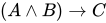

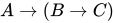

Because each row of the final column shows T, the sentence in question is verified to be a tautology.
It is also possible to define a deductive system (i.e., proof system) for propositional logic, as a simpler variant of the deductive systems employed for first-order logic (see Kleene 1967, Sec 1.9 for one such system). A proof of a tautology in an appropriate deduction system may be much shorter than a complete truth table (a formula with n propositional variables requires a truth table with 2n lines, which quickly becomes infeasible as n increases). Proof systems are also required for the study of intuitionistic propositional logic, in which the method of truth tables cannot be employed because the law of the excluded middle is not assumed.
Tautological implication
[edit]A formula R is said to tautologically imply a formula S if every valuation that causes R to be true also causes S to be true. This situation is denoted . It is equivalent to the formula being a tautology (Kleene 1967 p. 27).


For example, let be . Then is not a tautology, because any valuation that makes false will make false. But any valuation that makes true will make true, because is a tautology. Let be the formula . Then , because any valuation satisfying will make true—and thus makes true.

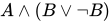


It follows from the definition that if a formula is a contradiction, then tautologically implies every formula, because there is no truth valuation that causes to be true, and so the definition of tautological implication is trivially satisfied. Similarly, if is a tautology, then is tautologically implied by every formula.
Substitution
[edit]There is a general procedure, the substitution rule, that allows additional tautologies to be constructed from a given tautology (Kleene 1967 sec. 3). Suppose that S is a tautology and for each propositional variable A in S a fixed sentence SA is chosen. Then the sentence obtained by replacing each variable A in S with the corresponding sentence SA is also a tautology.
For example, let S be the tautology:
- .

Let SA be and let SB be .


It follows from the substitution rule that the sentence:

is also a tautology.
Semantic completeness and soundness
[edit]An axiomatic system is complete if every tautology is a theorem (derivable from axioms). An axiomatic system is sound if every theorem is a tautology.
Efficient verification and the Boolean satisfiability problem
[edit]The problem of constructing practical algorithms to determine whether sentences with large numbers of propositional variables are tautologies is an area of contemporary research in the area of automated theorem proving.
The method of truth tables illustrated above is provably correct – the truth table for a tautology will end in a column with only T, while the truth table for a sentence that is not a tautology will contain a row whose final column is F, and the valuation corresponding to that row is a valuation that does not satisfy the sentence being tested. This method for verifying tautologies is an effective procedure, which means that given unlimited computational resources it can always be used to mechanistically determine whether a sentence is a tautology. This means, in particular, the set of tautologies over a fixed finite or countable alphabet is a decidable set.
As an efficient procedure, however, truth tables are constrained by the fact that the number of valuations that must be checked increases as 2k, where k is the number of variables in the formula. This exponential growth in the computation length renders the truth table method useless for formulas with thousands of propositional variables, as contemporary computing hardware cannot execute the algorithm in a feasible time period.
The problem of determining whether there is any valuation that makes a formula true is the Boolean satisfiability problem; the problem of checking tautologies is equivalent to this problem, because verifying that a sentence S is a tautology is equivalent to verifying that there is no valuation satisfying . The Boolean satisfiability problem is NP-complete, and consequently, tautology is co-NP-complete. It is widely believed that (equivalently for all NP-complete problems) no polynomial-time algorithm can solve the satisfiability problem, although some algorithms perform well on special classes of formulas, or terminate quickly on many instances.[8]

Tautologies versus validities in first-order logic
[edit]The fundamental definition of a tautology is in the context of propositional logic. The definition can be extended, however, to sentences in first-order logic.[9] These sentences may contain quantifiers, unlike sentences of propositional logic. In the context of first-order logic, a distinction is maintained between logical validities, sentences that are true in every model, and tautologies (or, tautological validities), which are a proper subset of the first-order logical validities. In the context of propositional logic, these two terms coincide.
A tautology in first-order logic is a sentence that can be obtained by taking a tautology of propositional logic and uniformly replacing each propositional variable by a first-order formula (one formula per propositional variable). For example, because is a tautology of propositional logic, is a tautology in first order logic. Similarly, in a first-order language with a unary relation symbols R,S,T, the following sentence is a tautology:



It is obtained by replacing with , with , and with in the propositional tautology: .


Tautologies in Non-Classical Logics
[edit]Whether a given formula is a tautology depends on the formal system of logic that is in use. For example, the following formula is a tautology of classical logic but not of intuitionistic logic:

See also
[edit]References
[edit]- ^ Weisstein, Eric W. "Tautology". mathworld.wolfram.com. Retrieved 2020-08-14.
- ^ a b "tautology | Definition & Facts". Encyclopedia Britannica. Retrieved 2020-08-14.
- ^ Lewis, C I; Langford, C H (1959). Symbolic Logic (2nd ed.). Dover.
- ^ Hedman, Shawn (2004). A First Course in Logic. Oxford University Press. p. 63.
- ^ Rautenberg, Wolfgang (2010). A Concise Introduction to Mathematical Logic. Springer. p. 64.
- ^ Enderton, Herbert (2001). Mathematical Introduction to Logic. Academic Press. p. 88.
- ^ Hinman, Peter (2010). Fundamentals of Mathematical Logic. Springer. p. 98.
- ^ See SAT solver for references.
- ^ "New Members". Naval Engineers Journal. 114 (1): 17–18. January 2002. Bibcode:2002NEngJ.114Q..17.. doi:10.1111/j.1559-3584.2002.tb00103.x. ISSN 0028-1425.
Further reading
[edit]- Bocheński, J. M. (1959) Précis of Mathematical Logic, translated from the French and German editions by Otto Bird, Dordrecht, South Holland: D. Reidel.
- Enderton, H. B. (2002) A Mathematical Introduction to Logic, Harcourt/Academic Press, ISBN 0-12-238452-0.
- Kleene, S. C. (1967) Mathematical Logic, reprinted 2002, Dover Publications, ISBN 0-486-42533-9.
- Reichenbach, H. (1947). Elements of Symbolic Logic, reprinted 1980, Dover, ISBN 0-486-24004-5
- Wittgenstein, L. (1921). "Logisch-philosophiche Abhandlung", Annalen der Naturphilosophie (Leipzig), v. 14, pp. 185–262, reprinted in English translation as Tractatus logico-philosophicus, New York City and London, 1922.
External links
[edit]- "Tautology", Encyclopedia of Mathematics, EMS Press, 2001 [1994]
| General | |||||||||
|---|---|---|---|---|---|---|---|---|---|
| Theorems (list) and paradoxes | |||||||||
| Logics |
| ||||||||
| Set theory |
| ||||||||
| Formal systems (list), language and syntax |
| ||||||||
| Proof theory | |||||||||
| Model theory | |||||||||
| Computability theory | |||||||||
| Related | |||||||||

| Major fields |
| ||||
|---|---|---|---|---|---|
| Foundations | |||||
| Lists |
| ||||


Common logical connectives | ||
|---|---|---|
 | ||


| Functional: |  | |
|---|---|---|
| Formal: | ||
| Negation | ||
Common logical symbols | |
|---|---|
| International | |
|---|---|
| National | |

Tautology (logic)
View on GrokipediaFundamentals
Historical Overview
The concept of tautology in logic traces its origins to ancient philosophy, particularly in Aristotle's exploration of syllogisms and necessary truths in his Prior Analytics (circa 350 BCE), where he analyzed deductions that hold invariably due to their form, independent of specific content.[4] Aristotle distinguished between assertoric syllogisms, which deal with possible matters, and apodeictic ones, which yield necessary conclusions from necessary premises, laying foundational ideas for propositions true by necessity.[5] During the medieval period, the development of logic built upon Aristotelian foundations through translators and commentators like Boethius (c. 480–524 CE), who rendered Aristotle's logical works into Latin and integrated them with rhetorical traditions. The term "tautology," derived from the Greek tautologos meaning "saying the same thing," initially appeared in rhetorical contexts to denote repetition or redundancy, as seen in classical and early medieval discussions of eloquent discourse, though not yet in the strict logical sense of formal validity.[6][7] Boethius's commentaries emphasized the categorical syllogism and topical reasoning, preserving and adapting ancient notions of inescapable logical forms amid the synthesis of pagan philosophy and Christian theology.[8] In the 19th century, George Boole advanced the algebraic treatment of logic in The Laws of Thought (1854), formalizing logical constants and operations that anticipated the identification of expressions true under all interpretations, marking a shift toward mathematical rigor in analyzing invariant truths.[9] This Boolean framework treated logic as a calculus of classes, where certain equations hold identically, influencing later developments in symbolic logic. The 20th century saw the explicit adoption and refinement of tautologies in mathematical logic by Bertrand Russell and Alfred North Whitehead in Principia Mathematica (1910–1913), where they distinguished tautologies as propositions identically true regardless of their constituents' truth values, serving as axioms in their system to derive mathematics from logic. Ludwig Wittgenstein further shaped the modern understanding in Tractatus Logico-Philosophicus (1921), introducing "tautology" in its contemporary logical sense to describe propositions that lack sense yet are true by virtue of their form; as he stated in proposition 4.46: "Among the possible groups of truth-conditions there are two extreme cases. In one of these cases the proposition is true for all the truth-possibilities of the elementary propositions. We say that the truth-conditions are tautological. In the second case the proposition is false for all the truth-possibilities: the truth-conditions are contradictory. In the first case we call the proposition a tautology; in the second, a contradiction."[10] Wittgenstein critiqued tautologies as empty, emphasizing their role in delineating the limits of meaningful language.Propositional Logic Basics
Propositional logic is a formal system for reasoning about propositions, which are statements that can be either true or false, serving as the foundational framework for concepts like tautologies.[11] It focuses on how propositions combine through logical operations to form compound statements, without delving into the internal structure of the propositions themselves.[12] In propositional logic, basic units are propositional variables, typically denoted by lowercase letters such as , , or , each standing for an atomic proposition that asserts something about the world.[13] These variables are linked using logical connectives: negation (), which reverses the truth value; conjunction (), meaning "and"; disjunction (), meaning "or"; material implication (), expressing "if...then"; and biconditional (), meaning "if and only if."[14] Each connective has a specific role in building complex expressions from simpler ones.[11] The syntax of propositional logic specifies how to construct valid expressions, known as well-formed formulas (wffs), through recursive rules. Atomic propositional variables are wffs by definition. If is a wff, then is a wff. If and are wffs, then the compounds , , , and are also wffs.[15] Parentheses ensure that formulas are unambiguous and parseable, preventing errors in interpretation.[11] Semantically, propositional logic operates within classical two-valued logic, governed by the principle of bivalence, which asserts that every proposition must be exactly true or exactly false, with no intermediate values.[16] An interpretation of a formula consists of assigning truth values—true (T) or false (F)—to each propositional variable. The truth value of the entire formula under that interpretation is computed recursively based on the connectives, using predefined truth tables.[17] For instance, the truth table for negation is: [14] The truth table for conjunction is: [13] Disjunction is true if at least one operand is true, implication is false only if is true and is false, and biconditional holds when both have the same truth value.[14] These tables provide the exhaustive rules for evaluating any well-formed formula across all possible truth assignments.[17] Propositional formulas are categorized by their behavior under all interpretations: a contingent formula evaluates to true in some interpretations and false in others, reflecting dependence on specific truth assignments.[18] In contrast, a contradiction evaluates to false in every possible interpretation, regardless of the assignments to its variables.[19] These classifications highlight the variability and absoluteness in logical expressions, setting the stage for further analysis.[17]Core Concepts
Formal Definition
In propositional logic, a formula φ is a tautology if it is true under every possible interpretation, meaning that for all truth assignments to its propositional variables, the formula evaluates to true. This semantic condition ensures that φ holds universally, regardless of the specific truth values assigned to its atomic components. The notation ⊨ φ (or equivalently |= φ) is used to denote that φ is a tautology, indicating its validity in all models of the propositional language.[20] Equivalently, φ is a tautology if it has no falsifying interpretation, such that there exists no truth assignment under which φ evaluates to false.[21] In terms of truth table analysis, this means that every row in the truth table for φ results in a true value.[22] The set of all possible interpretations for a formula φ with n distinct propositional variables consists of 2^n elements, corresponding to the exhaustive truth assignments for those variables.[23] While the concept of a tautology is specific to propositional logic, where truth depends solely on the assignments to atomic propositions and the propositional connectives, it contrasts with logical truths in broader systems like first-order logic, which involve quantifiers and relations beyond mere propositional validity; here, the focus remains on the propositional case.[2][24]Illustrative Examples
A fundamental tautology in propositional logic is the law of the excluded middle, expressed as , which holds true regardless of the truth value assigned to . When is true, is false, making the disjunction true; when is false, is true, again yielding true. This formula is always true, illustrating a statement that cannot be false under any interpretation. Another key example involves the equivalence between implication and disjunction: . This biconditional is a tautology because it evaluates to true in all possible truth assignments for and . The following truth table confirms this, with all rows resulting in true for the entire formula:| T | T | F | T | T | T |
| T | F | F | F | F | T |
| F | T | T | T | T | T |
| F | F | T | T | T | T |
Verification Methods
Truth Table Analysis
The truth table method serves as a fundamental semantic technique for verifying whether a propositional formula is a tautology by systematically evaluating its truth value across all possible truth assignments to its atomic propositions. For a formula involving n distinct atomic propositions, the truth table comprises 2^n rows, each representing a unique combination of truth values (true or false) for those propositions. The construction proceeds by first listing the atomic propositions and their exhaustive assignments, then computing the truth values of subformulas incrementally using the truth-functional definitions of the logical connectives—such as conjunction (true only if both operands are true), disjunction (true if at least one operand is true), negation (flips the truth value), and implication (false only if the antecedent is true and the consequent is false)—until the entire formula is evaluated in each row.[29][3] Algorithmically, the process involves enumerating all 2^n truth assignments, evaluating the formula under each assignment by propagating truth values through its structure, and checking if the final column for the formula contains only true values; if so, the formula is a tautology, as it holds in every possible interpretation. This method directly corresponds to the semantic definition of a tautology, which requires the formula to be true under all interpretations (i.e., all possible truth assignments to the atomic propositions), thereby providing a complete and decidable verification for propositional logic formulas.[30] A simple illustrative example is the formula , known as the law of excluded middle, which involves one atomic proposition and thus requires 2 rows in its truth table. The table is constructed as follows:| T | F | T |
| F | T | T |
Semantic and Syntactic Verification
Semantic tableaux, also known as truth trees, provide a systematic branching method for verifying whether a propositional formula is a tautology by attempting to find a falsifying assignment. The process begins by negating the formula and decomposing it according to logical connectives, creating branches that represent possible truth assignments. If every branch of the resulting tree leads to a contradiction—indicated by the presence of both a literal and its negation—the original formula is valid, as no falsifying assignment exists.[31][32] Consider the formula , which expresses the law of non-contradiction. To verify its tautological status using a semantic tableau, start with the negation: . This conjunction branches into two literals: and . Both appear on the same branch, immediately creating a contradiction that closes the tree. Since the single branch closes without an open path, no satisfying assignment exists for the negation, confirming the formula as a tautology.[33] In contrast, the syntactic approach to verification employs formal deduction systems, such as Hilbert-style systems, where tautologies are established as theorems provable from a set of axioms using specified inference rules. A standard set of axioms includes schemes like , which ensures basic implication properties, along with others capturing distributivity and negation. Tautologies are derived step-by-step within this system, providing a purely symbolic proof without reference to truth values.[34][35] The primary inference rules in Hilbert-style systems are modus ponens, which allows deriving from and , and uniform substitution, which replaces variables with formulas while preserving logical structure. These rules, applied iteratively to axioms, generate all theorems corresponding to tautologies.[36][37] A key property of these systems is soundness: every formula provable from the axioms using the rules is semantically a tautology, ensuring that syntactic derivations align with truth-table semantics. This theorem is established by induction on proof length, showing that axioms are tautologies and rules preserve tautological validity.[36][37]Logical Operations
Tautological Implication
In propositional logic, a formula tautologically implies another formula , denoted , if holds true in every truth assignment (or model) that makes true.[38] This relation captures semantic consequence, meaning the truth of necessitates the truth of across all possible interpretations.[39] Equivalently, if and only if the implication is a tautology, true under every truth assignment.[39] Illustrative examples highlight this concept. Consider the atomic proposition ; it tautologically implies the disjunction for any proposition , since any truth assignment satisfying (where is true) also satisfies regardless of 's value.[38] Another case is the conjunction tautologically implying : in any truth assignment where both and are true, is necessarily true, as the truth of the conjunction requires the truth of each conjunct.[40] Tautological implication possesses key structural properties that underpin its role in logical reasoning. Reflexivity holds, such that for any formula , since the truth of directly ensures its own truth.[38] Transitivity is also satisfied: if and , then .[38] Monotonicity further applies, meaning that if , then for any formula , as strengthening the antecedent with additional conjuncts preserves the consequence.[38] It is essential to distinguish tautological implication from material implication. The latter, , is an object-language connective that forms a proposition whose truth table evaluates to false only when is true and is false, but it does not require to follow semantically from in all cases.[20] In contrast, is a meta-language relation indicating universal semantic entailment, not merely a truth-functional operation within the language itself.[20]Substitution and Equivalence
In propositional logic, two formulas and are logically equivalent, denoted , if and only if their biconditional is a tautology, meaning they share the same truth value under every possible interpretation or valuation of their propositional variables.[41] This equivalence relation is reflexive, symmetric, and transitive, forming a basis for simplifying and transforming logical expressions while preserving semantic meaning.[42] The substitution theorem guarantees that tautologies remain valid under replacement of equivalent subformulas. Specifically, if is a tautology and , then the formula obtained by substituting for one or more occurrences of in is also a tautology.[26] This theorem, also known as the replacement theorem, ensures that logical equivalence is preserved through such substitutions, allowing for modular reasoning about complex formulas.[25] For instance, the law of excluded middle, , is a tautology. It is logically equivalent to , since is always false (a contradiction), and its negation is thus always true. Substituting for in any tautology containing the latter yields another tautology, demonstrating the theorem's application.[41] Substitution plays a crucial role in deriving normal forms for propositional formulas. By repeatedly applying equivalences—such as De Morgan's laws or distributivity—via substitution, any formula can be transformed into an equivalent disjunctive normal form (DNF), a disjunction of conjunctions of literals, or conjunctive normal form (CNF), a conjunction of disjunctions of literals.[43] This process facilitates automated reasoning and satisfiability checking, as normal forms standardize formula structure without altering truth conditions.[44] In axiomatic proof systems, such as Hilbert-style systems, the uniform substitution rule formalizes this preservation. It states that if is a theorem (or tautology), then substituting any formula for all occurrences of a propositional variable in yields another theorem.[42] This rule, distinct from general replacement, applies uniformly across all instances of the variable, ensuring soundness in derivations and enabling the instantiation of axiom schemas.[45]Theoretical Aspects
Semantic Soundness and Completeness
In propositional logic, the soundness theorem establishes that the syntactic notion of provability aligns with semantic validity: if a set of formulas Γ proves a formula φ (denoted Γ ⊢ φ), then φ is true in every interpretation satisfying Γ (Γ ⊨ φ). In the special case where Γ is empty, this means every provable formula is a tautology (⊢ φ implies ⊨ φ). This result ensures that the formal proof system does not derive invalid statements, preserving the reliability of deductions.[46] The proof of soundness proceeds by induction on the length of the proof. For the base case, all axioms are tautologies, as they hold under every truth assignment. For the inductive step, assume the theorem holds for all proofs of length at most n; then, for a proof of length n+1, the last inference rule applied (such as modus ponens) preserves truth preservation under all interpretations, since the premises are semantically valid by the induction hypothesis and the rule semantically entails the conclusion. This induction covers all derivation rules in standard Hilbert-style systems.[47] The completeness theorem complements soundness by showing the converse: if Γ ⊨ φ, then Γ ⊢ φ. Thus, every semantic tautology is syntactically provable (⊨ φ implies ⊢ φ). This theorem was first proved for propositional logic by Emil L. Post in 1921, using a construction that demonstrates the equivalence between semantic entailment and provability in the calculus. A standard proof of completeness relies on Lindenbaum's lemma, which asserts that any consistent set of propositional formulas can be extended to a maximal consistent set Γ*—one that cannot be properly extended without becoming inconsistent. From Γ*, a canonical model is constructed by assigning truth values to atomic propositions based on membership in Γ*: a proposition p is true if and only if p ∈ Γ*. This model satisfies all formulas in Γ* and, by maximality, falsifies any formula not in Γ*. If φ is a tautology not provable from Γ, extending Γ with ¬φ yields inconsistency, contradicting the assumption; hence, φ must be provable.[48] The soundness and completeness theorems together characterize propositional logic as semantically complete, meaning its proof system captures all validities. A key implication is the decidability of propositional logic: since proofs are finite and can be effectively enumerated, one can algorithmically determine tautology by searching for a proof, or equivalently, by exhaustive semantic checking via truth tables, as the finite number of interpretations allows mechanical verification.[41]Connection to Boolean Satisfiability
A propositional formula is a tautology if and only if its negation is unsatisfiable, meaning no truth assignment exists that satisfies .[49] This fundamental duality reduces tautology verification to the complement of the Boolean satisfiability (SAT) problem, known as co-SAT. The SAT problem, which determines whether a Boolean formula in conjunctive normal form has a satisfying assignment, is NP-complete, as established by the Cook-Levin theorem.[50] Consequently, the tautology problem is co-NP-complete, highlighting its computational hardness symmetric to SAT. Modern SAT solvers, which can verify tautologies by checking unsatisfiability of the negated formula, are built upon the Davis–Putnam–Logemann–Loveland (DPLL) algorithm, introduced in 1962. DPLL performs backtracking search over variable assignments, augmented by unit propagation to simplify the formula by inferring forced literals and pure literal elimination to remove unused variables. A key advancement is conflict-driven clause learning (CDCL), which analyzes search conflicts to derive new implied clauses, preventing redundant exploration and accelerating proof of unsatisfiability.[51] These techniques enable efficient handling of industrial-scale formulas, far beyond the limitations of exhaustive truth table enumeration for large variable counts. SAT solvers find extensive applications in hardware verification, where they prove circuit equivalence and detect bugs by encoding designs as SAT instances.[52] In model checking, they support bounded model checking to verify whether system properties hold within finite execution traces.[53] For AI planning, SAT encodings translate planning problems into satisfiability checks, generating action sequences that achieve goals from initial states.[54] Although both SAT and co-SAT have exponential worst-case time complexity, CDCL solvers resolve many practical instances quickly through branching heuristics and clause learning.Extensions and Comparisons
Tautologies in First-Order Logic
In first-order logic (FOL), a formula is considered valid if it holds true in every possible structure, where a structure comprises a non-empty domain along with interpretations for the constants, functions, and predicates of the language.[55] This semantic notion of validity extends the concept of propositional tautologies, which constitute a proper subset of FOL validities: any propositional tautology, when interpreted without quantifiers in FOL, remains valid across all structures.[56] However, FOL introduces a broader class of valid formulas due to the presence of quantifiers, enabling expressions that capture generalizations over domains. For example, the formula is valid in FOL, as it enforces the law of excluded middle for every element in any domain, though it lacks a purely propositional counterpart without quantification.[57] Another illustrative valid formula involving quantifiers is , which holds in all structures with non-empty domains, reflecting the existential consequence of a universal truth.[57] These quantifier-dependent validities highlight how FOL validity surpasses propositional tautologies by accounting for variable bindings and domain interpretations. The validity problem in FOL—determining whether a given formula is true in all structures—is undecidable, as independently demonstrated by Alonzo Church and Alan Turing in 1936 through reductions to the halting problem and lambda-definability. This undecidability implies that no general algorithm exists to verify FOL validity, in stark contrast to the decidable nature of propositional tautology checking via truth tables or satisfiability solvers. Herbrand's theorem offers a key theoretical bridge between FOL and propositional logic, stating that a closed FOL formula is valid if and only if, after Skolemization (which replaces existentially quantified variables with Skolem functions to obtain a universal formula while preserving satisfiability), every propositional instance in its Herbrand expansion is a tautology.[58] This reduction transforms universal validity problems into checks against infinite sets of propositional instances, underpinning resolution-based theorem proving despite the overall undecidability.[58]Tautologies in Non-Classical Logics
In non-classical logics, the concept of a tautology deviates from its classical propositional counterpart, where formulas are true under all possible valuations in bivalent semantics. These logics introduce alternative semantics, such as constructive validity, relevance conditions, modal accessibility, multi-valued truth assignments, or tolerance for inconsistency, leading to subsets of classical tautologies being valid while others fail. This variation highlights how tautologies depend on the underlying logical framework, often prioritizing aspects like proof constructibility or resource sensitivity over exhaustive truth preservation. In intuitionistic logic, classical tautologies like the law of excluded middle, , are not valid, as validity requires constructive proofs rather than mere truth in all models. Intuitionistic semantics, based on Kripke models or Heyting algebras, deems a formula a tautology only if it is provable via intuitionistic rules, excluding non-constructive principles; thus, holds only if either or can be constructively established, emphasizing the rejection of the bivalence principle in favor of potential undecided propositions.[59] Relevant logics, developed by Anderson and Belnap to enforce logical relevance between premises and conclusions, reject certain classical inference rules as tautologies, notably disjunctive syllogism: . This formula is invalid because it permits irrelevant conclusions; in relevant semantics, such as Routley-Meyer frames, validity requires that premises share propositional content with the conclusion, blocking the "paradoxes of material implication" while preserving core tautologies like modus ponens under relevance constraints.[60][61] Modal logics extend propositional logic with necessity () and possibility () operators, where basic systems like K validate tautologies such as , reflecting the necessity of logical truths across accessible worlds in Kripke semantics. However, axioms like (verification principle) are not tautologies in the minimal modal logic K, as they depend on frame conditions (e.g., reflexivity for system T); this allows modal tautologies to capture epistemic, deontic, or temporal necessities without universal classical embedding.[62] In many-valued logics, such as Łukasiewicz's three-valued system with truth values true (T=1), false (F=0), and undefined (U=1/2), classical bivalent tautologies fail under multi-valued assignments. For instance, is not a tautology, as it evaluates to U when is U, since negation maps U to U and disjunction takes the maximum (max(U, U)=U); this semantics accommodates indeterminate propositions, like future contingents, by expanding the truth table beyond binary values.[63][64] Paraconsistent logics tolerate inconsistencies without the principle of explosion, invalidating classical tautologies involving implication from contradictions, such as ex falso quodlibet: . In systems like da Costa's or Priest's LP, semantic consequence avoids explosion by using non-adjunctive or gapped negations, allowing contradictory premises to support only relevant conclusions while preserving many classical tautologies outside explosive contexts; this alters implication's behavior to prevent triviality from inconsistency.[65]References
- https://proofwiki.org/wiki/Semantic_Tableau_Algorithm_is_Decision_Procedure_for_Tautologies