


Community hub
Recent from talks
Contribute something
Nothing was collected or created yet.
Ted Stevens Anchorage International Airport
View on Wikipedia
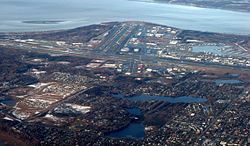
Ted Stevens Anchorage International Airport (IATA: ANC, ICAO: PANC, FAA LID: ANC)[4] is the primary airport serving the US state of Alaska, located 5 miles (8 km) southwest of downtown Anchorage.[1] The airport is named for Ted Stevens (1923–2010), who served as a senator of Alaska from 1968 to 2009. It is included in the Federal Aviation Administration (FAA) National Plan of Integrated Airport Systems for 2017–2021, in which it is categorized as a medium-hub primary commercial service facility.[5]
Key Information


History
[edit]Built in 1951, the airport was served in the 1950s by Alaska Airlines, Northwest Orient, Pacific Northern Airlines and Reeve Aleutian Airways, using aircraft ranging from Douglas DC-3s to Boeing 377s,[6] and was also a refuelling stop for Canadian Pacific Air Lines service to the Far East (one such aircraft being involved in a 1951 disappearance). From 1955 to 2011, the eastern end of the airport's southernmost runway connected to the Kulis Air National Guard Base.
By the mid-1980s the airport's nickname was "Crossroads of the World". Anchorage was a common stopover for passengers flying between Europe and East Asia,[7] because airspace in China, the Soviet Union and Eastern Bloc countries was off-limits and because the first generation of jets and widebody airliners did not have the range to fly non-stop across the Pacific Ocean. Carriers using Anchorage for this purpose included:
- Air France, British Airways, Iberia, KLM, Lufthansa, Sabena, Swissair and Spantax all used Anchorage as a stopover point between Europe and the Far East of Asia into the 1980s to 1991.[8][9]
- Japan Airlines served Seattle through Anchorage in the early 1960s,[10] and offered service through Anchorage to London, Paris, Amsterdam, Copenhagen, Düsseldorf, Hamburg, New York City & São Paulo from the 1960s until October 1991. Last JAL flight was JL438 on October 31, 1991, Paris–Charles de Gaulle - Anchorage - Tokyo–Narita.[11]
- Korean Air used Anchorage as a stopover point for flights between Seoul and both Europe and the continental US in the 1980s.[12] On September 1, 1983, one of these flights, Flight 007 was shot down by a Soviet pilot who had mistaken it for a spy plane, after unintentionally violating Soviet airspace.
- Northwest Orient, the first airline to operate scheduled trans-Pacific service after World War II, used Elmendorf Field[13] and later Anchorage International as a stopover for service between US points (Seattle, Chicago and Minneapolis at various times) and Tokyo as late as the mid-1970s.[14]
- Scandinavian Airlines (SAS) began a transpolar flight from Copenhagen to Tokyo via Anchorage on February 24, 1957.[15]
In the mid-1980s airport officials knew that the then-new Boeing 747-400, with a longer range than then-existing aircraft, would decrease stopovers. They did not expect that Mikhail Gorbachev's glasnost, towards the end of the Cold War, would open Soviet airspace to flights, causing the decrease to occur sooner than planned. By 1988, 16 airline flights that had previously stopped in Anchorage—each bringing almost $80,000 in revenue to the state—instead flew nonstop over Siberia.[7]
Most scheduled passenger service from Anchorage to Europe and Asia ceased in the early 1990s. Korean Air continued to serve Anchorage three times a week on a yearly scheduled basis until March 2005, which was reduced to three times a week only for the summer season in 2006. China Airlines, the last Asian carrier to serve Anchorage on a regular basis, used Anchorage as an intermediate stop on its Taipei-New York route until 2011, when it rerouted these flights to stop in Osaka.[16][17] While a few charter passenger aircraft still stop at Anchorage on flights between Asia and the eastern United States, scheduled cargo carriers – which benefit from more volume and thus shorter route segments – continue to use Anchorage frequently. Condor still uses the Frankfurt-Anchorage route on a Airbus A330neo.[18]
In the 1990s, Alaska Airlines and Aeroflot operated services from Anchorage to several destinations in the Russian Far East, including Khabarovsk, Magadan, Petropavlovsk, Vladivostok and Yuzhno-Sakhalinsk.[19] Alaska Airlines pulled out of these markets in 1998 due to insufficient demand,[20] while the Aeroflot services were primarily intended as technical stops en route to Seattle and San Francisco and were cancelled once newer aircraft and nonstop flights became available. Reeve Aleutian Airways, Dalavia and MAVIAL Magadan Airlines also offered service between Anchorage and the Russian Far East at various times, catering to Kamchatka oil exploration and other niche markets.[21]
The airport was renamed in 2000 by the Alaska Legislature to honor then long-standing US Senator Ted Stevens.[22] Stevens survived a crash at the airport in 1978 that killed his wife Ann.[23]
In October 2018, Alaska Governor Bill Walker and Heilongjiang Province Governor Wang Wentao announced plans to connect Anchorage and Harbin Taiping International Airport with year-round, nonstop flights as early as the summer of 2019.[24]
On November 30, 2018, the airport suffered minor damage and was temporarily closed following a magnitude 7.0 earthquake in the area.[25] In June 2019, American Airlines switched the Boeing 737-800 on their seasonal route to Phoenix with the Airbus A321neo making them the first airline to use the A321neo at Anchorage. In January 2023, Delta replaced their Boeing 737-900 and 757-200 in favor of the A321neo for their route to Minneapolis-St. Paul.[26]
During the COVID-19 pandemic, the airport was briefly the busiest in the United States due to sustained volume of cargo flights through Alaska while passenger travel sharply decreased at other American airports.[27]
Due to the 2022 Russian invasion of Ukraine and subsequent sanctions on airlines, commercial flights between Japan and Western Europe once again overfly Alaska in the eastbound direction. However, due to the advanced range of the airliners used for these flights, such as the Airbus A350, Boeing 777 and Boeing 787 Dreamliner, the stopover in Anchorage is no longer needed and flights are operated nonstop. Some re-routed cargo flights do however stop in Anchorage, such as Nippon Cargo Airlines Flight 51, which operates Amsterdam - Milan - Anchorage - Tokyo four times weekly.
Southwest Airlines is slated to begin service to Anchorage for the first time on May 15, 2026, with flights from Denver and Las Vegas, the two biggest airports they operate on their network.[28][29]
Passenger traffic
[edit].jpg)
Ted Stevens Anchorage International Airport's passenger traffic hovered around the five million mark between 1998 and 2008, apart from in 2002 when the airport suffered a 13% drop in traffic. Fairbanks and Juneau are the next busiest airports though neither managed more than half a million passengers in 2007. Anchorage traffic peaks in June, July and August when passenger numbers are twice as high as between October and April.[30] Most major US passenger carriers serve ANC, with the majority of passenger flight operations by Alaska Airlines to and from Seattle (an average of 20 flights per day) and Fairbanks (5-7 flights per day).
Anchorage is also envisioned as a future connecting point for air traffic to the Russian Far East. During the summer season of 2008, there was one weekly flight to Russia by Vladivostok Air. Yakutia Airlines resumed summer seasonal service to Russia in 2012.[31] Many of Alaska's North Slope workers live either in Anchorage or elsewhere in the Lower 48 states and fly through the airport to their jobs in Prudhoe Bay.
As per Federal Aviation Administration records, the airport had 2,599,313 passenger boardings (enplanements) in calendar year 2008,[32] 2,282,666 enplanements in 2009, and 2,342,310 in 2010.[33]
The nearest other international airports from Anchorage are Fairbanks International Airport and Juneau International Airport. Fairbanks International Airport is also the second busiest airport in Alaska.[34]
International cargo hub
[edit]Ted Stevens Anchorage International Airport is a major cargo hub. In 2023, it ranked as the second busiest cargo airport in the US and the world's fourth-busiest cargo airport. Cargo airlines travelling between Asia and the contiguous US prefer to refuel in Anchorage to carry less fuel and more cargo.[35][7]
FedEx Express and UPS Airlines operate major hubs at Anchorage International for cargo heading to and from the Far East.[30] NWA Cargo used to operate a major hub at the airport until December 28, 2009, when it closed all operations for Northwest Cargo at all airports. FedEx Express is the airport's largest cargo facility and can handle as many as 13,400 packages per hour, employing more than 1,200 people and providing a full customs clearance system. United Parcel Service's hub handles about 5,000 parcels per hour. Both companies forecast a large growth in traffic over the next several years as trade with China and other Far East countries increases and plan to expand their Anchorage facilities comparatively.[citation needed] The United States Postal Service also operates a large sectional center facility (SCF) for the 995xx ZIP Codes. It processes mail and parcels headed to and from all Alaska cities.
The United States Department of Transportation allows Anchorage and other Alaskan airports to be used as a transfer point for cargo between different aircraft of the same foreign air carrier without applying for special permission, a privilege not available at airports in the contiguous US. In 2020, the airport applied for similar authority for passenger traffic, which would potentially allow foreign airlines to use Anchorage as a connecting hub for international passengers. A similar exemption was previously granted to airports in Puerto Rico.[36][37]
Facilities and aircraft
[edit]Ted Stevens Anchorage International Airport covers an area of 4,608 acres (1,865 ha) at an elevation of 151 feet (46 m) above mean sea level. It has three runways: 7L/25R is 10,600 by 150 feet (3,231 x 46 m) with an asphalt surface; 7R/25L is 12,400 by 200 feet (3,780 x 61 m) with an asphalt/concrete surface; 15/33 is 10,865 by 200 feet (3,312 x 61 m) with an asphalt surface. The airport also has one asphalt helipad that is 100 by 100 feet (30 x 30 m).[1][38]
For the 12 months ending April 30, 2019, the airport had 261,961 aircraft operations, an average of 718 per day: 38% scheduled commercial, 32% general aviation, 29% air taxi, and <1% military. At that time there were 109 aircraft based at this airport: 61% multi-engine, 14% helicopter, 15% jet, and 10% single-engine.[1] The FAA projects operations to increase to 334,279 by 2030, or 918.882 operations per day.[39]
The airport also has a seaplane base adjacent to it, so that seaplanes and floatplanes can take off and land. The Lake Hood Seaplane Base, adjacent to Anchorage Airport, is the busiest seaplane base in the world.
Terminals
[edit]The Anchorage International Airport has two terminals: the South Terminal with 24 gates, and the North Terminal with 8 gates, for a total of 32 gates.
The South Terminal (domestic) serves Air Canada, Alaska Airlines, American Airlines, Condor (Departures), Delta Air Lines, Discover Airlines (Departures), Sun Country Airlines, and United Airlines. All regional intrastate carriers also use the South Terminal.
.jpg)
.jpg)
The South terminal contains three concourses: Concourse A, Concourse B, and Concourse C. The area of what is today Concourse C stood the original airport terminal constructed in the 1950s. A hexagonal satellite terminal was constructed across the main structure shortly afterwards. In 1969, the terminal underwent a major expansion, forming what is today Concourse B - notable new features included a curved arrival/departure structure with an elevated departure ramp for vehicles. The sweeping structure was designed to connect with the existing hexagonal satellite, now the end of Concourse B. In 1985, Concourse A was added. In 2009, this portion of the South terminal received seismic and aesthetic upgrades.
Concourse C was completely rebuilt in 2004, designed by McCool Carlson Green Architects, while Concourses A and B were built in 1985 and 1969 respectively and renovated in 2009.[40] Architects HNTB and RIM Architects performed the architectural work for A/B Concourse.[41] The south terminal also contains two L gates, numbered L1 and L2. These gates are outside security on the lower level and adjacent to Concourse A.
The North Terminal (international) serves Condor (Arrivals), Discover Airlines (Arrivals), Japan Airlines, Korean Air, Yakutia Airlines, all international seasonal charter flights, and military flights. In addition to these airlines, a few cargo airlines use the north side of the terminal for parking while their aircraft have small problems that need maintenance for a day or so. This terminal was built in 1982.[40]
Airlines and destinations
[edit]Passenger
[edit]Destination maps
[edit]| North American passenger destinations map |
|---|
  Anchorage Destinations from Ted Stevens Anchorage International Airport Red = Year-round destination Green = Seasonal destination Blue= Future destination |


| Hawaii destinations map |
|---|
Destinations from Ted Stevens Anchorage International Airport Red = Year-round destination Green = Seasonal destination |
| Europe passenger destinations map |
Destinations from Ted Stevens Anchorage International Airport Green = Seasonal destination |


Cargo
[edit] | This section needs additional citations for verification. (December 2017) |
Statistics
[edit]Top destinations
[edit]| Rank | City | Passengers | Carriers |
|---|---|---|---|
| 1 |  Seattle/Tacoma, Washington Seattle/Tacoma, Washington
|
987,540 | Alaska, Delta |
| 2 |  Fairbanks, Alaska Fairbanks, Alaska
|
175,020 | Alaska |
| 3 |  Minneapolis/St. Paul, Minnesota Minneapolis/St. Paul, Minnesota
|
123,590 | Alaska, Delta, Sun Country |
| 4 |  Chicago–O'Hare, Illinois Chicago–O'Hare, Illinois
|
105,004 | Alaska, American, United |
| 5 |  Portland, Oregon Portland, Oregon
|
101,030 | Alaska |
| 6 | Juneau, Alaska
|
83,430 | Alaska |
| 7 |  Denver, Colorado Denver, Colorado
|
81,113 | Alaska, United |
| 8 | Bethel, Alaska
|
81,030 | Alaska |
| 9 | Kodiak, Alaska
|
77,510 | Alaska |
| 10 |  Dallas/Fort Worth, TX Dallas/Fort Worth, TX
|
69,360 | American |
Airline market share
[edit]| Rank | Airline | Passengers | Percent of market share |
|---|---|---|---|
| 1 | Alaska Airlines | 3,245,000 | 63.08% |
| 2 | Delta Air Lines | 684,000 | 13.17% |
| 3 | Horizon Air | 445,000 | 8.57% |
| 4 | United Airlines | 343,000 | 6.62% |
| 5 | American Airlines | 173,000 | 3.34% |
| 6 | Other airlines | 299,000 | 5.77% |
Ground transport
[edit]Inter-terminal
[edit]A shuttle bus runs approximately every 15 minutes between the North and South terminals and the employee and long-term parking lots. A land-side inter-terminal walkway was completed in 2009. Air-side connections between the sterile areas of each terminal are not available.
To/from airport
[edit]Route 40 of the Anchorage People Mover bus system serves the airport's North and South terminals every 15 minutes from 6:00am to 7:30pm on weekdays and every 30 minutes until 2:00am, as well as service every 30 minutes all day on Saturday and Sunday, connecting it with the downtown Transit Center.[96][97]
Taxi queues are available in front of each terminal. Courtesy vans and other ground transportation options pick up from designated areas in front of each terminal.[98]
Major national rental car chains are represented in an on-site consolidated rental car facility attached to the South terminal.[99]
There is a rail station for the Alaska Railroad. It is only available during the summer season for cruise ship service. The depot opened in 2003 after funding was secured by United States Senator Ted Stevens, but commuter service never materialized.[100]
Renovations
[edit]Renovations began on the A and B concourses in fall 2006. These renovations are designed to bring the older portions into compliance with current seismic, heating, ventilation, electrical and safety codes, and also include new baggage handling systems and renovations to the interior of the concourses.[101] Since the completion of the construction, all domestic flights are operated out of the South Terminal.
Commissioned art pieces
[edit]- Euphony,[102] 2004: glass artist – Warren Carther
The piece consists of nine towers of glass, collectively adding up to 42 meters (130 ft) of span and reaching 8 meters (26 ft) at its highest point. The series of panels are inspired by Alaska's immensely rugged landscape of glaciers and mountains. The ambiguous images embedded within the sculpture address Alaska's continual balancing of the forces of technology with the vast powers of the natural world.
On November 30, 2018, at 8:29 a.m. AKST (17:29 UTC) was damaged in the 7.1 magnitude earthquake and repaired a few months later. It was damaged again in 2020 by a disgruntled passenger which still has yet to be repaired as of 2022.
Programs
[edit]The airport features an innovative customer service program, which partners with most on-site (and some nearby) vendors and concessionaires and aims to promote a positive image of the airport and the State of Alaska in the minds of travellers. This volunteer, self-funded committee mystery shops at partnering companies provides awards of cash, free covered parking, and donated prizes to winning employees.[103][104][105]
Accidents and incidents
[edit]- On May 1, 1969, a Mobil Oil Canadair CL-44 on final approach to runway 6L at ANC, the undercarriage beam bogie snapped upon landing. The right wing and no. 3 and 4 engines struck the runway. The aircraft swerved onto the grass, breaking off the right wing. A fire erupted but all four occupants managed to escape. The probable cause was the co-pilot, who was conducting the landing, didn't level off correctly and supervision by the captain was inadequate. The aircraft was destroyed and written off.[106]
- On October 1, 1970, Douglas R4D-6 N47 of the Federal Aviation Administration crashed shortly after take-off and was destroyed in the subsequent fire. The aircraft was operating a local training flight. Both crew members were killed.[107]
- On November 27, 1970, Douglas DC-8-63 of Capitol Airlines crashed on takeoff from Anchorage, killing 47 of 229 passengers and crew on board, operating as Capitol Flight 3/26.[108]
- On January 13, 1977, JAL Cargo Flight 8054, a McDonnell-Douglas DC-8-62F, crashed shortly after takeoff with a cargo of live beef cattle for delivery to Tokyo, Japan. The three crew members and the two cargo handlers aboard the aircraft died in the crash, and the aircraft was destroyed. The National Transportation Safety Board determined that the probable cause of the accident was a stall that resulted from the pilot's control inputs aggravated by airframe icing while the pilot was under the influence of alcohol.[109]
- On December 4, 1978, a Learjet 25C en route from Juneau crashed upon landing. On board were Ann Stevens, wife of US Senator Ted Stevens; lobbyist and former Alaska Commissioner of Commerce and Economic Development (and future US Ambassador to Brazil) Langhorne A. Motley, prominent Anchorage lawyer Joseph Rudd, and three others. The party was travelling from the second-term inauguration of Alaska governor Jay Hammond to an Anchorage fundraiser organized by Motley. Motley and Ted Stevens were the only survivors.[110]
- On June 8, 1983, Reeve Aleutian Airways Flight 8's propeller separated from the Lockheed L-188 Electra and tore a hole in the fuselage over the Pacific Ocean, causing explosive decompression and loss of control. The pilots managed to land the aircraft safely at Anchorage, and all 15 passengers and crew survived. Since the propeller fell into the sea the cause of the separation is undetermined.
- On December 23, 1983, the 1983 Anchorage runway collision occurred when Korean Air Lines Flight 084, a McDonnell Douglas DC-10 freighter bound for Los Angeles, attempted to take off on the wrong runway in dense fog and collided with SouthCentral Air Flight 59, a Piper PA-31 waiting to take off in the opposite direction. Both aircraft were destroyed, the three flight crew of the DC-10 were seriously injured, and three of the nine occupants of the PA-31 sustained minor injuries, but no fatalities resulted.
- On December 15, 1989, KLM Flight 867 entered a volcanic ash cloud after takeoff, created by an eruption from nearby Mount Redoubt. The flight suffered a complete loss of engine power and returned to make an emergency landing at Anchorage.
- On March 31, 1993, a Boeing 747-121, Japan Air Lines Flight 46E, operated by Evergreen International Airlines, departing Anchorage for Chicago, suffered a complete loss of the number 2 engine pylon at 2,000 ft after encountering severe-to-extreme turbulence after takeoff. The aircraft then experienced an uncommanded left bank of approximately 50 degrees. The flight crew successfully landed the aircraft back at Anchorage, to discover the number 2 engine and all of the leading edge of the wing between the number 1 and 2 engines had been torn away. The investigation found that the engine pylon had been weakened by metal fatigue cracking, which made the engine more susceptible to separation in severe turbulence.[111]
- On October 9, 2002, a Boeing 747-451, Northwest Airlines Flight 85 en route from Detroit to Tokyo, suffered a lower rudder hardover. While flying over the Bering Sea, the aircraft abruptly went into a 35- through 40-degree left bank after the lower rudder had swung left 17° and hydraulic failure caused it to be stuck in place. Captain Frank Geib and First Officer Mike Fagan were at the controls at the time, having just taken over from Senior Captain John Hanson and First Officer David Smith. Geib declared an emergency and turned the aircraft back towards Anchorage. Hanson had returned to the cockpit and soon took over the controls. He and Fagan then flew the aircraft for over an hour before successfully landing in Anchorage. To steer the aircraft, they had to use asymmetric engine thrust or varying input into the engines as they were unable to use the ailerons at the time. No passengers or crew were injured, but the incident resulted in an airworthiness directive to prevent the possibility of a future accident.
- On November 30, 2018, the airport was hit by a magnitude 7.1 earthquake which shook the terminal and damaged buildings and the tower. FedEx 49 was on final approach to runway 7R when the quake hit. Tower ordered them to go around and FedEx 49 declared a missed approach. 117 people were injured in the terminal when the ceiling came down.[112]
Media appearances
[edit]The airport was the focus of a Smithsonian Channel miniseries Ice Airport Alaska that ran in late 2020. It has also been shown in the Discovery Channel series Deadliest Catch.
References
[edit]- ^ a b c d FAA Airport Form 5010 for ANC PDF. Federal Aviation Administration. effective April 17, 2025.
- ^ a b c "RITA | BTS | Transtats". Transtats.bts.gov. Retrieved March 31, 2025.
- ^ "Air Traffic Activity System (ATADS) > Airport Operations". Federal Aviation Administration.[full citation needed] Need report details - this just goes to a report generator?
- ^ "ANC - Anchorage [Ted Stevens Anchorage Intl], AK, US - Airport - Great Circle Mapper". Archived from the original on September 19, 2015. Retrieved June 4, 2015.
- ^ "List of NPIAS Airports" (PDF). FAA.gov. Federal Aviation Administration. October 21, 2016. Archived (PDF) from the original on May 3, 2017. Retrieved May 6, 2017.
- ^ "All sizes - Anchorage55_0008 - Flickr - Photo Sharing!". Archived from the original on August 31, 2015. Retrieved June 4, 2015.
- ^ a b c Berliner, Jeff (April 24, 1988). "Glasnost, Boeing hurt Anchorage". UPI. Retrieved March 24, 2022.
- ^ "NRT83intro". Archived from the original on June 5, 2015. Retrieved June 4, 2015.
- ^ "IBERIA Resumes Tokyo Service from late-Oct 2016". Routesonline. Archived from the original on September 17, 2016. Retrieved January 18, 2016.
- ^ "JAL timetable and route map, 1961". Archived from the original on October 5, 2013. Retrieved October 2, 2013.
- ^ "1987 - Japan Air Lines (JAL) Timetables, Route Maps, and History". Archived from the original on August 3, 2014. Retrieved June 4, 2015.
- ^ "1981 - April - Korean Airlines Timetables, Route Maps, and History". Archived from the original on August 8, 2014. Retrieved June 4, 2015.
- ^ 1950 timetable [1] Archived October 5, 2013, at the Wayback Machine, [2] Archived October 4, 2013, at the Wayback Machine
- ^ "System Timetable Effective December 18, 1974". Northwest Orient. Archived from the original on June 5, 2015. Retrieved June 4, 2015.
- ^ "SAS - the world's most innovative airline" (PDF). SAS innovations. October 2009. Archived from the original (PDF) on January 18, 2017.
- ^ "China Airlines cutting nonstop flights from ANC to Asia". Anchorage Daily News. Archived from the original on November 16, 2018. Retrieved November 15, 2018.
- ^ JNTO. "News - A New Route from New York to Osaka - Official Tourism Guide for Japan Travel". us.jnto.go.jp. Archived from the original on November 16, 2018. Retrieved November 15, 2018.
- ^ https://airlinegeeks.com/2025/03/21/condor-increases-north-america-capacity/#
- ^ Brooke, James (March 30, 1997). "Alaska Airlines Opens Russia's 'Wild East'". New York Times. Archived from the original on October 4, 2013. Retrieved October 2, 2013.
- ^ "Alaska Airlines tries new approach to Russia". Puget Sound Business Journal. August 22, 1999. Archived from the original on October 7, 2013. Retrieved October 2, 2013.
- ^ Stapleton, Rob (March 11, 2007). "Russian airline to re-establish Anchorage-Far East connection". Alaska Journal of Commerce. Archived from the original on October 4, 2013. Retrieved October 2, 2013.
- ^ "Bill would rename airport for Stevens". AP. April 3, 2000. Archived from the original on October 4, 2013. Retrieved October 2, 2013.
- ^ Mark Hosenball (August 11, 2010). "NTSB Warned About Alaska Pilots' Risky Ways – and Ted Stevens Argued". Newsweek. Archived from the original on August 15, 2010. Retrieved August 13, 2010.
- ^ "Gov. Walker: Direct flights to China could come in 2019". www.ktva.com. Archived from the original on February 3, 2019. Retrieved February 2, 2019.
- ^ Falsey, Jeannette; Berman, Mark; Fritz, Angela (November 30, 2018). "'Major' damage to Anchorage area after a severe 7.0-magnitude earthquake in Alaska". Washington Post. Archived from the original on December 1, 2018. Retrieved December 1, 2018.
- ^ "Delta adds A321neo Alaska Service in 1Q23". Retrieved February 23, 2023.
- ^ "In an upside-down world, Anchorage briefly had busiest U.S. airport". Anchorage Daily News. Archived from the original on May 31, 2020. Retrieved May 28, 2020.
- ^ Southwest Airlines announces nonstop Anchorage flights for 2026
- ^ "THE SUMMER WE TURNED PLENTY OF VACATION DREAMS INTO REALITY: BOOK SUMMER 2026 ON SOUTHWEST TODAY!". KETK. October 9, 2025. Retrieved October 9, 2025.
- ^ a b "Anchorage dominates Alaskan airport landscape; Palin-mania may boost traffic as state gets massive media coverage". anna.aero. October 3, 2008. Archived from the original on October 7, 2008. Retrieved October 7, 2008.
- ^ "Alaska-Kamchatka Flights to Be Restored | Business". The Moscow Times. April 5, 2012. Archived from the original on March 20, 2013. Retrieved February 22, 2013.
- ^ "Enplanements for CY 2008" (PDF, 1.0 MB). faa.gov. Federal Aviation Administration. December 18, 2009. Archived (PDF) from the original on November 5, 2012. Retrieved June 4, 2014.
- ^ "Enplanements for CY 2010" (PDF, 189 KB). faa.gov. Federal Aviation Administration. October 4, 2011. Archived (PDF) from the original on January 17, 2012. Retrieved June 4, 2014.
- ^ "Cheap Flights to Anchorage, Alaska from $185 - Airowings". Archived from the original on January 27, 2023. Retrieved March 17, 2023.
- ^ O'Hare, Maureen (May 23, 2020). "This is now the world's busiest airport... on certain Saturdays". CNN. Archived from the original on May 23, 2020. Retrieved May 23, 2020.
- ^ "Anchorage Airport Wants To Become A Global Hub". One Mile at a Time. August 19, 2020. Archived from the original on October 24, 2020. Retrieved August 20, 2020.
- ^ "Alaska pushes for renewed role as global passenger hub". PaxEx.Aero. August 18, 2020. Archived from the original on August 21, 2020. Retrieved August 20, 2020.
- ^ "ANC airport data at skyvector.com". skyvector.com. Archived from the original on August 22, 2024. Retrieved September 2, 2022.
- ^ "FAA Terminal Area Forecast". Archived from the original on March 5, 2016. Retrieved June 4, 2015.
- ^ a b "2008 Ted Stevens Anchorage International Airport Master Plan Study Report Update" (PDF). Archived (PDF) from the original on March 30, 2013. Retrieved January 8, 2013.
- ^ "Terminal Makeover Finally a Reality at Anchorage Int'l" (PDF).[permanent dead link]
- ^ "Vancouver, BC, Canada YVR". OAG Flight Guide Worldwide. 27 (1). Luton, United Kingdom: OAG Aviation Worldwide Limited: 1184–1188. July 2025. ISSN 1466-8718. OCLC 41608313.
- ^ "Flight Schedules". Archived from the original on September 25, 2019. Retrieved June 6, 2018.
- ^ "Nonstop flights between Detroit and Alaska takeoff this summer". Detroit Business Journal. January 13, 2025. Retrieved July 8, 2025.
- ^ "Flight timetable". Archived from the original on February 2, 2017. Retrieved June 6, 2018.
- ^ "Aleutian Airways Adds Anchorage – Homer From late-Sep 2023". Aeroroutes. Archived from the original on October 31, 2023. Retrieved August 15, 2023.
- ^ "Aleutian Airways Resumes Homer Service From Nov 2024". Aeroroutes. Archived from the original on August 22, 2024. Retrieved August 16, 2024.
- ^ "Aleutian Airways Announces Daily Service to Kenai – Aleutian Airways".
- ^ "News - Aleutian Airways". October 4, 2022. Archived from the original on October 31, 2023. Retrieved October 9, 2022.
- ^ https://www.azcentral.com/story/travel/airlines/2025/10/01/american-airlines-phoenix-anchorage-flights/86465978007/
- ^ https://aviationa2z.com/index.php/2025/10/02/american-airlines-to-restart-phoenix-to-anchorage-flight/
- ^ "Flight schedules and notifications". Archived from the original on February 2, 2017. Retrieved June 6, 2018.
- ^ "Timetable". Archived from the original on June 6, 2017. Retrieved June 6, 2018.
- ^ "Delta beefs up frequency on upcoming route to Morocco". Atlanta Business Chronicle. March 31, 2025. Retrieved April 1, 2025.
- ^ "Delta Adds Another Alaska Route". AirlineGeeks. Retrieved January 22, 2025.
- ^ "FLIGHT SCHEDULES". Archived from the original on June 21, 2015. Retrieved June 6, 2018.
- ^ "Destinations - Grant Aviation". Archived from the original on June 12, 2018. Retrieved June 6, 2018.
- ^ "Hawaiian Airlines NS25 Network Adjustments – 11DEC24". Aeroroutes. Retrieved December 11, 2024.
- ^ "Destinations - Iliamna Air Taxi". Archived from the original on October 6, 2023. Retrieved September 11, 2022.
- ^ "Katmai Air Schedule". May 26, 2020. Archived from the original on October 31, 2023. Retrieved September 11, 2022.
- ^ "Home". reeveairalaska.com. Archived from the original on October 31, 2023. Retrieved March 6, 2021.
- ^ "Passenger Schedules". Ryan Air Services. Archived from the original on October 31, 2023. Retrieved September 10, 2022.
- ^ "THE SUMMER WE TURNED PLENTY OF VACATION DREAMS INTO REALITY: BOOK SUMMER 2026 ON SOUTHWEST TODAY!". KETK. October 9, 2025. Retrieved October 9, 2025.
- ^ "Route Map & Flight Schedule". Archived from the original on August 15, 2018. Retrieved June 6, 2018.
- ^ "Timetable". Archived from the original on January 28, 2017. Retrieved June 6, 2018.
- ^ "Calgary, AB, Canada YYC". OAG Flight Guide Worldwide. 27 (1). Luton, United Kingdom: OAG Aviation Worldwide Limited: 204–206. July 2025. ISSN 1466-8718. OCLC 41608313.
- ^ "WestJet NS25 Network Expansion". AeroRoutes. November 15, 2024. Retrieved November 15, 2024.
- ^ 3S534
- ^ "Freighter Schedule | Alaska Air Cargo". Archived from the original on August 23, 2018. Retrieved August 22, 2018.
- ^ "Amazon Air coming to Anchorage, speeding up package delivery - KTVA 11 - the Voice of Alaska". Archived from the original on June 22, 2019. Retrieved June 25, 2019.
- ^ "Atlas Air Schedule". Atlas Air. Archived from the original on August 13, 2023. Retrieved December 18, 2023.
- ^ Gimenez Mazó, Edgardo (January 6, 2025). "Awesome Cargo reinició sus vuelos entre México y China via Los Ángeles" [Awesome Cargo has resumed flights between Mexico and China via Los Angeles] (in Spanish). Aviation On Line. Retrieved October 23, 2025.
- ^ "Live Flight Tracker - Real-Time Flight Tracker Map". Flightradar24. Archived from the original on October 31, 2023. Retrieved May 26, 2020.
- ^ "Atlas Air Flight 4131". FlightAware. Archived from the original on December 1, 2017. Retrieved November 24, 2017.
- ^ "Atlas Air Flight 596". FlightAware. Archived from the original on October 23, 2017. Retrieved October 22, 2017.
- ^ "Atlas Air Flight 8373". FlightAware. Archived from the original on October 23, 2017. Retrieved October 22, 2017.
- ^ "Atlas Air Flight 612". FlightAware. Archived from the original on October 23, 2017. Retrieved October 22, 2017.
- ^ "Atlas Air Flight 4136". FlightAware. Archived from the original on October 27, 2017. Retrieved October 26, 2017.
- ^ "Atlas Air Flight 518". FlightAware. Archived from the original on October 23, 2017. Retrieved October 26, 2017.
- ^ "Atlas Air Flight 7167". FlightAware. Archived from the original on October 23, 2017. Retrieved October 22, 2017.
- ^ a b "Ethiopian Cargo launches Trans-Pacific cargo flight services, Incheon to Atlanta via Anchorage". Archived from the original on October 31, 2023. Retrieved November 21, 2020.
- ^ "Flight Timetable" (PDF). EVA Air Cargo. Archived from the original (PDF) on May 18, 2022. Retrieved May 9, 2022.
- ^ Megan Ramsay (April 17, 2025). "FedEx adds Singapore–US freighter flights". Air Cargo News.
- ^ a b "Live Flight Tracker - Real-Time Flight Tracker Map". Flightradar24. Archived from the original on October 31, 2023. Retrieved May 26, 2020.
- ^ "Live Flight Tracker - Real-Time Flight Tracker Map". Flightradar24. Archived from the original on October 31, 2023. Retrieved May 26, 2020.
- ^ a b "Live Flight Tracker - Real-Time Flight Tracker Map". Flightradar24. Archived from the original on October 1, 2023. Retrieved May 26, 2020.
- ^ "Live Flight Tracker - Real-Time Flight Tracker Map". Flightradar24. Archived from the original on October 31, 2023. Retrieved May 26, 2020.
- ^ "Live Flight Tracker - Real-Time Flight Tracker Map". Flightradar24. Archived from the original on October 31, 2023. Retrieved May 26, 2020.
- ^ "Nippon Cargo Resumes Frankfurt Service in Sep 2025". AeroRoutes. August 14, 2025. Retrieved August 14, 2025.
- ^ "Live Flight Tracker - Real-Time Flight Tracker Map". Flightradar24. Archived from the original on October 31, 2023. Retrieved May 26, 2020.
- ^ a b c "Live Flight Tracker - Real-Time Flight Tracker Map". Flightradar24. Archived from the original on October 31, 2023. Retrieved May 26, 2020.
- ^ a b "Live Flight Tracker - Real-Time Flight Tracker Map". Flightradar24. Archived from the original on October 1, 2023. Retrieved May 26, 2020.
- ^ "Live Flight Tracker - Real-Time Flight Tracker Map". Flightradar24. Archived from the original on October 1, 2023. Retrieved May 26, 2020.
- ^ "Live Flight Tracker - Real-Time Flight Tracker Map". Flightradar24. Archived from the original on October 1, 2023. Retrieved May 26, 2020.
- ^ "Live Flight Tracker - Real-Time Flight Tracker Map". Flightradar24. Archived from the original on October 1, 2023. Retrieved May 26, 2020.
- ^ "People Mover". People Mover. Archived from the original on July 22, 2012. Retrieved February 22, 2013.
- ^ Ted Stevens Anchorage International Airport. "Ted Stevens Anchorage International Airport – Bus & Shuttle Services". Dot.state.ak.us. Archived from the original on March 30, 2013. Retrieved February 22, 2013.
- ^ Ted Stevens Anchorage International Airport. "Ted Stevens Anchorage International Airport – Taxi Service". Dot.state.ak.us. Archived from the original on March 30, 2013. Retrieved February 22, 2013.
- ^ Ted Stevens Anchorage International Airport. "Ted Stevens Anchorage International Airport – Rental Cars". Dot.state.ak.us. Archived from the original on March 30, 2013. Retrieved February 22, 2013.
- ^ "Anchorage Airport train depot echoes silence". Anchorage Daily News. March 3, 2010. Archived from the original on December 5, 2020. Retrieved November 27, 2020.
- ^ "State of Alaska Department of Transportation". Archived from the original on May 15, 2009.
- ^ "Public Art". Warren Carther. Archived from the original on August 22, 2024. Retrieved December 5, 2016.
- ^ Ted Stevens Anchorage International Airport. "Ted Stevens Anchorage International Airport – Customer Service Partnership". Dot.state.ak.us. Archived from the original on March 30, 2013. Retrieved February 22, 2013.
- ^ "Hudson Group". Hudsongroupusa.com. Archived from the original on July 3, 2013. Retrieved February 22, 2013.
- ^ State of Alaska FY2009 Governor's Operating Budget (PDF) (Report). Alaska Department of Transportation. January 7, 2008. p. 3. Archived from the original (PDF) on May 28, 2010.
- ^ "Accident description for N446T at Aviation Safety Network". aviationsafetynetwork.org. Retrieved November 19, 2024.
- ^ "N47 Accident description". Aviation Safety Network. Archived from the original on October 26, 2011. Retrieved October 20, 2010.
- ^ "Accident description". Archived from the original on October 19, 2015. Retrieved July 15, 2013.
- ^ "Event Details". Archived from the original on September 24, 2015. Retrieved August 4, 2015.
- ^ Lemann, Nicholas (September 30, 1979). "The Great Alaska Feud". Washington Post. Washington. p. B1.
- ^ "Archived copy" (PDF). Archived from the original on October 4, 2012. Retrieved September 14, 2013.
{{cite web}}: CS1 maint: archived copy as title (link) - ^ Zak, Annie. "Anchorage airport open again for arrivals after landings were halted due to earthquake". Anchorage Daily News. Archived from the original on March 6, 2023. Retrieved August 20, 2024.
External links
[edit]
- Ted Stevens Anchorage International Airport (official site)
- Bureau of Transportation Statistics
- FAA Terminal Area Forecast
- FAA Airport Diagram (PDF), effective October 30, 2025
- FAA Terminal Procedures for ANC, effective October 30, 2025
- Resources for this airport:
- FAA airport information for ANC
- AirNav airport information for PANC
- ASN accident history for ANC
- FlightAware airport information and live flight tracker
- NOAA/NWS latest weather observations for PANC
- SkyVector aeronautical chart for ANC
- Check current FAA delays for this airport

| International | |
|---|---|
| National | |
| Geographic | |


![[1]](http://www.timetableimages.com/ttimages/nw/nw50/nw50-5.jpg)

![[2]](http://www.timetableimages.com/ttimages/nw/nw50/nw50-7.jpg)

Ted Stevens Anchorage International Airport
View on GrokipediaHistory
Origins and Early Development
The origins of what is now Ted Stevens Anchorage International Airport lie in the post-World War II expansion of civil aviation infrastructure in Alaska, prompted by the territory's strategic location and increasing air travel demands. In 1948, the U.S. Congress authorized the construction of international airports in Anchorage and Fairbanks to facilitate commercial aviation and support economic development in the region.[8] This initiative reflected the causal importance of reliable air links for a remote, resource-dependent territory, where surface transportation was limited by geography and climate.[2] Construction on the Anchorage site, located approximately five miles southwest of downtown, began in the late 1940s on federally provided land, with the airport established in 1951.[9] Initial development focused on essential runways and support facilities to accommodate propeller-driven aircraft, marking a shift from earlier makeshift fields like the 1924 Delaney Park Strip and Merrill Field, which had served Anchorage's aviation needs since the 1920s but lacked capacity for growing international traffic.[2] The facility opened as a joint-use airport shared between commercial operators and the Alaska Air National Guard, enabling immediate military-civil integration amid Cold War tensions.[7] Commercial operations commenced in 1951, with the first scheduled passenger services provided by carriers such as Alaska Airlines using the new infrastructure.[8] By 1952, construction of the initial terminal building was underway, supporting an expanding role as a refueling and maintenance stop on transpacific and emerging polar routes.[10] Early passenger volumes were modest, handling thousands annually in the mid-1950s, but the airport's position along great-circle flight paths between North America, Europe, and Asia quickly positioned it as a vital node, with traffic growing due to jet age advancements and geopolitical necessities like U.S.-Soviet standoffs.[11] This development underscored the empirical reality that Anchorage's latitude minimized fuel consumption for intercontinental flights, driving organic expansion without reliance on subsidies beyond initial federal investment.[3]Military and Strategic Role
The Ted Stevens Anchorage International Airport, upon its opening on December 10, 1951, functioned as a joint-use facility for commercial and military aviation, initially supporting the Alaska Air National Guard alongside civilian operations to alleviate congestion at existing fields like Elmendorf and Merrill.[12][7] This dual designation stemmed from Alaska's frontier status and the U.S. military's expanding presence post-World War II, with the airport's infrastructure—including its initial runways capable of handling heavy aircraft—designed to accommodate both transport and fighter operations amid rising geopolitical tensions.[6] Geographically positioned as a midpoint between continental North America and Asia, roughly 9.5 flight hours from 90% of the industrialized world, the airport assumed strategic importance during the Cold War as a mandatory refueling and technical stop for long-haul military flights circumventing Soviet airspace via the polar route.[13][14] U.S. Air Force transports and bombers utilized ANC for logistics en route to Pacific bases, enhancing rapid response capabilities against Soviet threats in the Arctic and Far East, while its reliable all-weather facilities supported continuous operations in Alaska's harsh climate.[11][6] Proximate to Elmendorf Air Force Base—established in 1940 and pivotal for intercepting potential Soviet incursions—the airport integrated with regional air defense networks, sharing airspace and runways that enabled joint exercises and emergency diversions for military aircraft.[15][16] This synergy reinforced Alaska's designation as the "Guardian of the North," with ANC facilitating the basing of fighter squadrons at Elmendorf, such as the 43rd Tactical Fighter Squadron in 1970, amid heightened deterrence needs.[2][17] The facility's role persisted into later decades, underscoring its enduring value for U.S. strategic projection in the Pacific.[6]Transition to Commercial Operations
Following World War II, the demand for civilian air travel in Alaska surged due to economic development and the strategic importance of Anchorage as a refueling stop on transpacific routes, prompting the need for a dedicated international airport separate from existing military facilities like Elmendorf Field.[1] In 1948, the U.S. federal government provided a $13 million grant to construct the facility, which addressed limitations of prior airfields used jointly by military and early commercial operators such as Northwest Orient Airlines, which had initiated post-war transpacific scheduled service via Elmendorf.[18] The new airport incorporated longer runways capable of handling larger propeller-driven aircraft, marking a shift from ad-hoc military-civilian sharing to structured joint operations with the Alaska Air National Guard.[3] The Anchorage International Airport opened for air traffic in December 1951, establishing commercial operations from its inception as Alaska's primary gateway.[1] Initial airlines included Canadian Pacific Airlines, which utilized the site for Far East refueling, alongside domestic carriers like Alaska Airlines serving intrastate routes.[7] This transition facilitated rapid growth, with the airport handling international flights from Europe and Asia amid Cold War airspace restrictions over the Soviet Union, positioning Anchorage as a vital hub rivaling major U.S. facilities in traffic volume by the mid-1950s.[3] Joint military-commercial use persisted, with the Air National Guard maintaining a presence, but civilian infrastructure expansions—such as terminal construction and apron enhancements—prioritized accommodating scheduled passenger and cargo services, underscoring the airport's evolution into a commercial powerhouse.[8] By 1953, the facility fully supported business operations, handling an estimated 90% of Alaska's air cargo and passenger movements thereafter.[2]Renaming and Expansion Era
In 2000, the Alaska state legislature renamed Anchorage International Airport as Ted Stevens Anchorage International Airport to honor U.S. Senator Ted Stevens, a longtime advocate for Alaska's aviation and transportation infrastructure who served from 1968 to 2009 and secured federal funding for numerous airport projects.[19][20] The renaming recognized Stevens' role in facilitating the airport's growth as a key hub, including exemptions from certain cabotage restrictions that boosted its cargo operations.[21] Coinciding with the renaming, the airport launched a multi-year Terminal Redevelopment Program (TRP) starting in 1999, aimed at modernizing facilities to handle rising passenger and cargo demands.[19] This included the complete demolition and rebuilding of Concourse C, addition of a new South Terminal Arrivals Hall, and expansion of the South Terminal by 447,200 square feet with nine jet gates primarily leased to Alaska Airlines, with construction spanning 1999 to 2005 and involving airline relocations for phased work.[19][22] Further renovations to Concourses A and B began in 2006, updating interiors, systems, and security features in response to post-9/11 standards, culminating in overall terminal completion by 2010.[18][23] Airfield enhancements during this era focused on capacity and safety, including reconstruction of the main runway and construction of new taxiways between 2000 and 2010 to support heavier international cargo operations and transpolar flights.[2] The Alaska Cargoport facility opened in mid-2000, enhancing cold storage and logistics capabilities amid growth in freighter traffic from carriers like Northwest Airlines, which established Anchorage as a global cargo hub.[24] These developments solidified the airport's role in handling over 2 million metric tons of cargo annually by the late 2000s, driven by its strategic position on great-circle routes between Asia and North America.[13]Facilities and Ground Infrastructure
Runways, Taxiways, and Aircraft Handling
Ted Stevens Anchorage International Airport operates three primary runways designed to support diverse aviation operations, including international passenger flights, heavy cargo transport, and military activities. Runway 07R/25L measures 12,400 feet in length by 200 feet in width, surfaced with grooved asphalt and concrete in good condition, equipped with high-intensity edge lighting, ALSF-2 approach lighting, centerline lights, and a 4-light PAPI.[25] Runway 07L/25R is 10,600 feet by 150 feet, featuring grooved asphalt, high-intensity edge lights, MALSR approach lights, centerline lights, and a 4-light PAPI.[25] Runway 15/33 spans 10,865 feet by 200 feet, with grooved asphalt, high-intensity edge lights, MALSF approach lights, centerline lights, and a 4-light PAPI.[25]| Runway | Length (ft) | Width (ft) | Surface | Lighting and Aids |
|---|---|---|---|---|
| 07R/25L | 12,400 | 200 | Asphalt/concrete, grooved | HIEL, ALSF-2, centerline, 4-light PAPI, ILS/DME [25] |
| 07L/25R | 10,600 | 150 | Asphalt, grooved | HIEL, MALSR, centerline, 4-light PAPI, ILS/DME [25] |
| 15/33 | 10,865 | 200 | Asphalt, grooved | HIEL, MALSF, centerline, 4-light PAPI, ILS/DME [25] |
Terminals and Concourses
The Ted Stevens Anchorage International Airport features two terminals: the South Terminal, which handles the majority of domestic passenger operations, and the North Terminal, primarily used for international arrivals processing and select smaller domestic carriers.[28][29] The South Terminal includes three concourses—A, B, and C—connected post-security, accommodating a total of 24 gates for airlines such as Alaska Airlines, Delta Air Lines, and United Airlines.[30][31] Concourse A primarily serves regional and mainline domestic flights with gates A1 through A17; Concourse B handles additional domestic routes via gates B1 through B8; and Concourse C supports both domestic and limited international departures with gates C1 through C8, including facilities for U.S. Customs and Border Protection preclearance where applicable.[31][30] The North Terminal, smaller in scale, contains 8 gates and focuses on international inbound flights requiring U.S. immigration and customs clearance upon arrival, as well as operations for regional carriers like Ravn Alaska.[29][32] It lacks extensive concourses but includes dedicated check-in counters, security screening, and baggage claim areas tailored for lower-volume traffic, with shuttle services available to connect to the South Terminal when needed.[33][32] Gates L1 and L2, located outside security on the lower level adjacent to Concourse A in the South Terminal, serve additional low-cost or charter operations.[31] Overall, the terminals provide essential amenities including TSA checkpoints, dining options, and free Wi-Fi, though the North Terminal sees reduced utilization following the decline in transpolar refueling stops post-Cold War.[34]Air Traffic Control and Support Systems
The Federal Aviation Administration operates the Anchorage Airport Traffic Control Tower (ATCT) at Ted Stevens Anchorage International Airport, providing continuous visual control for ground movements and airport traffic area operations. Primary tower communications occur on 118.3 MHz, with a backup frequency of 257.8 MHz, while ground control uses 121.9 MHz and 338.25 MHz.[35] The adjacent Anchorage Terminal Radar Approach Control (TRACON, designated A11) handles radar vectoring for arrivals and departures in the terminal airspace, with sector frequencies including 118.6 MHz, 119.1 MHz, 123.8 MHz, 126.4 MHz, and 134.1 MHz depending on altitude and direction.[35][36] Beyond terminal boundaries, the Anchorage Air Route Traffic Control Center (ZAN) assumes enroute control over more than two million square miles of airspace, utilizing ATOP for oceanic procedures and MEARTS/FDP-2000 for automated radar tracking in domestic sectors.[37] Navigation aids supporting approaches include the Anchorage VOR/DME on 113.15 MHz and ILS/DME systems for runways 07L, 07R, and 15, alongside RNAV (RNP/GPS) procedures available for all runways.[35] The airport maintains Class C airspace with radar services, enhanced by automated surface observing system (ASOS) weather stations and digital ATIS on 135.5 MHz for real-time advisories.[35] Instrument guidance features approach lighting systems such as ALSF-2 (2,400-foot high-intensity with sequenced flashers for Category II/III minima) on runway 07R, MALSR on 07L, and MALSF on 15, complemented by precision approach path indicators (PAPI) set at 3.00° to 3.20° glide angles on all runways.[38] In August 2025, the FAA canceled a bid for a new seismically reinforced ATCT and TRACON facility—originally planned with a 91- to 101-foot cab height—due to excessive costs exceeding budget, opting instead to reinitiate procurement.[39] Concurrently, the FAA's Anchorage Terminal Area Airspace and Procedures Study evaluates redesigns to address procedural inefficiencies and safety gaps in terminal operations.[40]Operations and Airlines
Passenger Services
Passenger services at Ted Stevens Anchorage International Airport (ANC) encompass check-in facilities for domestic and international carriers, baggage handling, and TSA security screening in both the South and North Terminals. The South Terminal primarily serves domestic flights with self-service kiosks and dedicated counters for airlines like Alaska Airlines, while the North Terminal accommodates international arrivals and select domestic operations. Baggage claim areas feature carousels equipped for efficient retrieval, with lost and found services managed by airport staff.[9][41] Amenities include free wireless internet access available throughout both terminals, accessible by connecting to the public network without passwords or fees. Dining options post-security in the South Terminal consist of outlets such as 49th State Brewing, Starbucks, Denali Pretzels, and Alaska Doghaus, offering a mix of quick-service meals, coffee, and local brews. Shopping facilities provide duty-free items, newsstands like Hudson News, and Alaska-themed souvenirs, though no full post office operates on-site. ATMs and currency exchange services support traveler needs.[34][42][43][41] Ground transportation integrates on-site short-term and long-term parking garages adjacent to terminals, with rates varying by duration; the Park, Ride & Fly lot offers lower-cost off-site parking with complimentary shuttle service every 20-30 minutes. A cell phone waiting lot facilitates pickups without circling, and connections to taxis, rideshares, and the Alaska Railroad depot serve cruise and local transfers. Accessibility features include wheelchair assistance coordinated through airlines or ground handlers like ABM, accessible restrooms, and priority TSA screening for eligible passengers. Lounge options remain limited, with the Upper One Lounge providing pre-security seating and basic refreshments.[44][45][46][47][48]Cargo Hub Dynamics
Ted Stevens Anchorage International Airport serves as a critical trans-Pacific cargo transfer hub due to its position along great circle routes connecting Asia and North America, enabling freighters to refuel and offload partial fuel loads for greater payload efficiency compared to nonstop flights.[49][50] This geographic advantage minimizes fuel weight, allowing aircraft to carry up to 20-30% more cargo on segmented routes, with most operations involving international transit rather than local Alaskan freight.[49] The airport's 24-hour operations without curfew, combined with U.S. Department of Transportation policies permitting foreign carriers to transfer cargo between aircraft without formal entry, facilitate rapid sorting and reloading by major integrators like FedEx Express and UPS Airlines, which maintain dedicated hubs for Asia-North America flows.[51][52] Northern Air Cargo and Polar Air Cargo also operate extensively, handling regional and international volumes, while recent additions in October 2024—including Awesome Cargo Airlines, Central Airlines of China, ASL Air Cargo, Aerologic Air Cargo, and CMA CGM Air Cargo—have expanded capacity amid rising global e-commerce and supply chain demands.[53][54] Cargo dynamics emphasize high-frequency freighter movements, predominantly Boeing 747 and 777 models, with peaks during Asian manufacturing cycles and U.S. holiday seasons; in 2024, ANC ranked as the fourth-busiest cargo airport globally, processing over 3.7 million metric tonnes primarily through technical stops and consolidations.[55][56] These operations rely on efficient ground handling, cold-chain capabilities for perishables, and proximity to Elmendorf Air Force Base for occasional military-civilian synergies, though challenges include weather disruptions and competition from direct Pacific routes.[50]Airlines and Destinations
Ted Stevens Anchorage International Airport accommodates scheduled passenger services from 13 airlines, connecting to 50 destinations, predominantly domestic. Alaska Airlines, the dominant carrier, operates the bulk of flights, including over 1,000 weekly departures to 40-plus intra-Alaska and Lower 48 points, serving as the primary link to Seattle-Tacoma International Airport for onward connections.[57][5] Major U.S. network carriers include Delta Air Lines with service to Atlanta, Los Angeles, Minneapolis-Saint Paul, and Seattle; United Airlines to Houston, Newark, San Francisco, and Washington, D.C.; American Airlines to Chicago-O'Hare, Dallas-Fort Worth, and Phoenix-Sky Harbor; and Hawaiian Airlines to Honolulu and Kailua-Kona. Southwest Airlines provides seasonal flights to Denver and Las Vegas, with expanded service planned from May 2026.[57][58] International passenger routes are limited and seasonal: Air Canada to Vancouver, WestJet to Calgary (inaugurated summer 2025), and Condor to Frankfurt.[59][57] Regional commuter airlines such as Ravn Alaska, Grant Aviation, Aleutian Airways, and ViaAir connect to remote Alaskan communities including Bethel, Kodiak, Nome, Unalaska (Dutch Harbor), and Deadhorse (Prudhoe Bay).[60][57] The following table summarizes key passenger destinations by category:| Category | Destinations |
|---|---|
| Intra-Alaska | Adak, Bethel, Cold Bay, Cordova, Deadhorse, Dillingham, Fairbanks, Homer, Juneau, Kenai, King Salmon, Kodiak, Kotzebue, Nome, Unalaska, and others (served primarily by Alaska Airlines and regionals)[57] |
| Lower 48 & Hawaii | Atlanta (ATL), Chicago (ORD), Dallas/Fort Worth (DFW), Denver (DEN), Honolulu (HNL), Las Vegas (LAS), Los Angeles (LAX), Minneapolis (MSP), Newark (EWR), Phoenix (PHX), San Francisco (SFO), Seattle (SEA), Washington Dulles (IAD)[57] |
| International | Calgary (YYC, seasonal), Frankfurt (FRA, seasonal), Vancouver (YVR, seasonal)[57][59] |
Traffic Statistics
Passenger Trends and Data
In calendar year 2023, Ted Stevens Anchorage International Airport recorded 2,681,818 passenger enplanements, reflecting a 2.98% increase from 2,604,308 in 2022, according to Federal Aviation Administration data.[61] Total passenger throughput, encompassing both enplanements and deplanements, reached approximately 5.4 million in fiscal year 2023, driven by seasonal tourism and business travel to Alaska's resource sectors.[5] Traffic exhibits strong seasonality, with summer months (June through August) accounting for roughly double the volume of winter periods, attributable to visitor influx for outdoor activities and cruise ship connections rather than year-round demand from local population or industry alone.[62] The COVID-19 pandemic caused a precipitous drop, with deplaned passengers falling to 732,791 in 2020 amid global travel restrictions and reduced domestic flights.[62] Recovery accelerated in 2021, yielding a 93% rise in overall passenger traffic from the prior year, supported by easing restrictions and pent-up demand for Alaska destinations.[59] By 2023, volumes surpassed immediate pre-pandemic levels in some metrics, though full historical peaks from 2019—when enplanements hit record highs for the airport—remained the benchmark for sustained growth.[55] In 2024, passenger activity continued upward, with nearly 3 million arrivals logged, indicating enplanements exceeding 2.8 million and total throughput approaching 6 million amid expanded routes and economic rebound.[63] Through October 2025, year-to-date passenger totals stood at 3,255,061, a 3% gain over the same period in 2024, positioning ANC as the 5th-busiest medium-hub airport in the U.S. and 37th among lower-48 facilities.[64] This growth correlates with Alaska's tourism recovery and oil sector stability, though vulnerability to fuel prices and weather disruptions persists, as evidenced by consistent summer dominance in operations data.[55]| Year | Enplanements (FAA CY) | Total Passengers (Approx., Enplaned + Deplaned) | Notes |
|---|---|---|---|
| 2020 | ~1,000,000 (est. from deplanements) | ~1.5 million | Pandemic low[62] |
| 2021 | ~2,100,000 (est. from deplanements) | ~4.3 million | 93% YoY increase[59] [62] |
| 2022 | 2,604,308 | ~5.2 million | Post-recovery stabilization[61] |
| 2023 | 2,681,818 | 5.4 million (FY) | Seasonal peak rebound[61] [5] |
| 2024 | ~2.9 million (est. from arrivals) | ~5.8-6 million | Continued expansion[63] [55] |
Cargo Volumes and Rankings
Ted Stevens Anchorage International Airport (ANC) handles substantial air cargo volumes, primarily serving as a technical stop and transshipment point for flights between Asia and North America. In calendar year 2023, ANC facilitated the transit, on-loading, and off-loading of over 3.7 million metric tons of cargo.[55] Cargo activity in 2024 increased by 7.6% compared to 2023, reflecting continued demand for its strategic location.[55] Through October 2024, ANC processed 2,999,201 metric tonnes, marking a 7.7% rise from 2,783,843 metric tonnes in the same period of 2023.[65] These volumes are driven by approximately 140 daily cargo aircraft landings, the third-highest annual average on record.[55] ANC consistently ranks among the top global and North American cargo airports. In 2023, it placed fourth worldwide and second in North America by cargo throughput, according to Airports Council International (ACI) data.[55][66] For 2024, ACI ranked ANC second in North America, behind Memphis International Airport's 3,754,236 metric tons.[66] This positioning underscores ANC's role in global supply chains, with volumes supported by operators like FedEx, Atlas Air, and new entrants such as CMA CGM Air Cargo in 2024.[55]| Year | Cargo Volume (Metric Tonnes) | Year-over-Year Change |
|---|---|---|
| 2023 (full) | >3,700,000 | - |
| 2024 (Jan-Oct) | 2,999,201 | +7.7% |
Market Share and Top Routes
Ted Stevens Anchorage International Airport commands the majority of Alaska's commercial passenger traffic, representing approximately 54% of statewide enplanements in 2023 with 2,681,818 passengers.[67] Preliminary data for calendar year 2024 indicate 2,767,856 enplanements at ANC, reflecting a 3.21% increase from the prior year and underscoring its role as Alaska's primary aviation gateway.[68]| Airline | Market Share (%) |
|---|---|
| Alaska Airlines | 61.92 |
| Delta Air Lines | 13.41 |
| Horizon Air | 8.47 |
| United Airlines | 6.70 |
| American Airlines | 3.37 |