


Community hub
0 subscribers8 pages, 0 posts
Recent from talks
All channels
Be the first to start a discussion here.
Be the first to start a discussion here.
Be the first to start a discussion here.
Be the first to start a discussion here.
Contribute something
Welcome to the community hub built to collect knowledge and have discussions related to Thirthahalli.
Nothing was collected or created yet.
Thirthahalli
View on Wikipediafrom Wikipedia
 | This article possibly contains original research. (June 2018) |
Thirthahalli is a panchayat town located in the Shimoga district of the state of Karnataka, India. It lies on the bank of the river Tunga and is also the headquarters of the Thirthahalli Taluk of Shimoga district.
Key Information


Geography
[edit]
Thirthahalli is located at 13°42′N 75°14′E / 13.7°N 75.23°E.[2] It has an average elevation of 591 metres (1938 feet). The Tirthahalli Town Panchayat has population of 14,528 of which 7,093 are males while 7,435 are females as per report released by Census India 2011.
Notable people
[edit]- Purandara Dasa - One of the founding proponents of Carnatic Music
- Kuvempu - Kannada author and poet, Jnanapeetha and Padma Vibhushan awardee
- Shantaveri Gopala Gowda - Socialist Leader and Politician.
- U. R. Ananthamurthy- Contemporary writer, Novelist and critic, Jnanapeetha and Padma Bhushan awardee.
- Kadidal Manjappa- Politician and former Chief Minister of Karnataka
- Justice. M Rama Jois - Advocate and Chief Justice, Former Governor of Jharkhand and Bihar
- M. K. Indira, Kannada Novelist.
- Poornachandra Tejaswi- writer, environmentalist and son of kuvempu.
- Anupama Niranjana- Novelist
- Girish Kasaravalli- Multiple award-winning Kannada Film Director, Padmashri awardee.
- Kimmane Rathnakar- Politician and former minister of Legislative assembly
- Araga Jnanendra- Home Minister of Karnataka and former chairman of Mysore Paper Mills.
- Kaviraj (lyricist)- Poet, lyricist, director in Kannada film industry
- Diganth-Kannada film actor
- Anaga - Kannada film actor
Education institutions
[edit]References
[edit]External links
[edit]
Wikimedia Commons has media related to Thirthahalli.
| International | |
|---|---|
| National | |

Thirthahalli
View on Grokipediafrom Grokipedia
Thirthahalli is a panchayat town and the administrative headquarters of Thirthahalli taluk in Shivamogga district, Karnataka, India.[1][2] Situated on the banks of the Tunga River at an elevation of 577 meters (1,893 feet), it lies within the Malnad region of the Western Ghats, encompassing coordinates 13.6897° N, 75.2359° E.[2] As of the 2011 census, the town had a population of 14,528 residents across an area of 5.91 square kilometers, while the broader taluk encompasses 142,006 people.[3][4]
Geographically, Thirthahalli is characterized by its hilly terrain, dense forests, and abundant rainfall, receiving heavy monsoon showers from June to September, which contribute to its tropical climate and verdant landscapes.[2] The region features scenic attractions such as waterfalls, including those near Agumbe, and is part of the biodiverse Sahyadri hills, making it a gateway to natural wonders in Shivamogga district.[5] The town's panchayat was established in 1938, reflecting its role as a local governance center divided into 15 wards.[1][3]
The economy of Thirthahalli is predominantly agricultural, with key crops including rice, areca nut, sugarcane, pepper, cardamom, ginger, and fruits like mangoes and bananas, supported by rain-fed farming and modern irrigation techniques.[2] The taluk's rural expanse of 1,247 square kilometers underscores its agrarian focus, contributing to Shivamogga's overall economy in horticulture and plantation crops.[6]
Culturally, Thirthahalli holds significance for its religious and literary heritage, featuring sites like the ancient Rameshwara Temple dedicated to Lord Shiva on the Tunga River, a major Hindu pilgrimage spot.[7] The taluk is also the birthplace of Kuppalli Venkatappa Puttappa (Kuvempu), the renowned Kannada poet and Jnanpith Award winner, whose childhood home in Kuppalli village serves as a memorial attracting literary enthusiasts.[8] Other notable attractions include the historic Kavaledurga Fort and Sahasralinga, enhancing its appeal as a tourist destination for nature and heritage seekers.[2]
Population growth in Thirthahalli has shown a declining trend, with the town recording a decadal decrease of 1.88% from 14,808 in 2001 to 14,528 in 2011, reflecting an annual change rate of -0.19%.[36][37] Similarly, the taluk experienced a slight decadal decline of 0.84%, from 143,207 in 2001 to 142,006 in 2011.[38][4] Based on projections using state-level growth patterns, the town's population is estimated to reach approximately 20,900 by 2025.[35]
The taluk exhibits a predominantly rural character, with 89.8% of the population (127,478 individuals) residing in rural areas and only 10.2% (14,528) in urban settings as of 2011.[39] This urban-rural divide is influenced by migration patterns, where residents from surrounding villages move to the town for education and trade opportunities.
History
Etymology and Mythology
The name Thirthahalli is derived from the Sanskrit term "tīrtha," meaning a sacred ford, crossing place, or pilgrimage site, combined with the Kannada word "halli," signifying village.[9][10] This etymology reflects the town's historical role as a spiritual hub along the Tunga River, where the waters are revered for their purifying qualities in Hindu traditions.[7] According to local folklore, the name specifically originates from "Parashurama Thirtha" or "Rama Thirtha," commemorating the mythological acts of the sage Parashurama, the sixth avatar of Vishnu.[10] Parashurama, armed with an axe bestowed by Lord Shiva, was commanded by his father, sage Jamadagni, to behead his mother Renuka as penance for her momentary lapse in devotion; after complying, he revived her through a boon from his father.[10] Seeking further atonement for the blood staining his axe, Parashurama immersed it in numerous rivers, but only the Tunga River at Thirthahalli fully cleansed it, establishing the site's sanctity as a divine bathing spot.[10][11] In gratitude, Parashurama installed a Shiva Linga—known as the "Mood Linga"—on the riverbanks, founding the Rameshwara Temple, so named as the "Rama" (Parashurama, son of Bhargava lineage) of Shiva.[10][11] Local legends portray the area as a holy confluence for pilgrims, featuring multiple sacred theerthas such as Ramatheertha (the axe-washing site), Chakratheertha, Shankatheertha, and others along the Tunga, where bathing is believed to absolve sins and facilitate spiritual renewal.[11][12] These traditions underscore Thirthahalli's enduring cultural identity within the Malnad region's spiritual landscape.[13]Ancient and Medieval Periods
Archaeological evidence indicates that the region around Thirthahalli was inhabited during the Neolithic period, with significant sites uncovered in the Kundadri Hills near Agumbe and at Yeddegudde. These locations have yielded stone tools and remnants of early settlements, reflecting agricultural and tool-making activities typical of prehistoric communities in the Western Ghats.[14] The area also features Iron Age megalithic monuments, particularly portholed burial chambers at Arehalli in Thirthahalli taluk, which served as prehistoric burial sites. Three such Iron Age megalithic sites have been identified in the district, including these chambers characterized by stone slabs with circular openings, underscoring the region's role in early funerary practices.[14] During the medieval period, Thirthahalli gained prominence as part of the Keladi Nayaka kingdom, which ruled from the late 15th to the 18th century after emerging as vassals of the Vijayanagara Empire. The Kavaledurga Fort, located about 18 km from Thirthahalli, became a key stronghold, originally constructed in the 9th century and later renovated in the 14th century before being fortified by the Nayakas in the 16th century under rulers like Venkatappa Nayaka. This hilltop fort, also known as Bhuvanagiri, featured three concentric rounds of rock wall fortifications, five gateways, round bastions, and stone walls, providing a defensive vantage point amid dense Western Ghats forests.[15][16] It served as the fourth capital of the Keladi kingdom, enabling control over coastal and inland territories from Karwar to Chikkanayakanahalli, and included structures such as a palace, guard rooms, a freshwater pond, and temples dedicated to deities like Virupaksha and Lakshminarayana.[15][16]Colonial and Modern Developments
During the British colonial period, Thirthahalli formed part of the Kingdom of Mysore, which transitioned into a princely state under British paramountcy after the Fourth Anglo-Mysore War concluded in 1799 with the defeat of Tipu Sultan.[17] The region experienced indirect rule, with the Wodeyar dynasty reinstated to govern under British oversight through subsidiary alliances and resident political agents, limiting direct colonial administration but exerting influence via revenue policies and infrastructure in the adjacent Shimoga district.[17] Local governance emphasized agricultural revenue collection and forest management, aligning with broader Mysore State reforms that modernized administration while preserving princely autonomy. In the 1920s, Thirthahalli emerged as a key hub for Indian National Congress activities in western Mysore, where a small group of about a dozen local leaders from diverse backgrounds promoted khadi adoption and constructive programs like rural self-reliance initiatives.[18] This period saw heightened participation in the freedom movement, highlighted by the 1927 visit of Mahatma Gandhi and C. Rajagopalachari, who addressed gatherings to galvanize support for non-cooperation and local economic independence.[19] Congress efforts peaked in the early 1930s, with Thirthahalli residents organizing support camps for satyagrahis amid British crackdowns on civil disobedience, fostering a politicized community that sustained activism despite a slowdown after 1932.[18] Post-independence, Thirthahalli integrated into the enlarged Mysore State following the accession of princely states in 1947, with locals joining the Mysore Chalo agitation that temporarily closed the taluk office in protest against monarchical rule and in demand for responsible government.[18] The States Reorganisation Act of 1956 formalized its status as taluk headquarters within the linguistically reconfigured Mysore State (renamed Karnataka in 1973), enhancing administrative focus on regional development.[20] This era marked growth as a panchayat town, fueled by agricultural expansion through improved irrigation and cash crop cultivation, leading to population influx and economic diversification beyond traditional farming.[19]Geography
Location and Topography
Thirthahalli is situated at coordinates 13°42′N 75°14′E in the Shivamogga district of Karnataka, India, with an average elevation of 591 meters above sea level and a town area of 5.91 km².[21][3] The town's underlying geology consists of Precambrian gneisses and lateritic soils, contributing to its hilly and forested character. The town lies on the banks of the Tunga River in the Malenadu (Malnad) region, which encompasses the foothills of the Western Ghats, characterized by undulating hilly terrain and enveloping dense forests.[7][22] Prominent topographical features in the vicinity include Kundadri Hill, rising to 826 meters and located approximately 30 km from the town center, and the Kavaledurga hills, situated around 18 km away, both contributing to the rugged landscape of the area. Thirthahalli is roughly 30 km from Agumbe and 60 km from Shivamogga, positioning it as a central point in this forested, elevated terrain.[23][24][25][26]Climate and Environment
Thirthahalli features a tropical monsoon climate typical of the Western Ghats region, marked by heavy seasonal precipitation and moderate temperatures. The area receives an average annual rainfall of 2,500 to 3,000 mm, predominantly during the southwest monsoon from June to September, when downpours contribute the bulk of the yearly total. This pattern results in lush vegetation but also occasional flooding and landslides during peak rainy months.[27] Temperatures in Thirthahalli generally range from 15°C to 30°C year-round, with highs reaching up to 36°C in pre-monsoon months like March and April, and lows dipping to around 15°C during cooler winter periods from December to February. High humidity levels, often exceeding 75%, persist throughout the year, enhancing the region's misty, verdant atmosphere. The topography of the Western Ghats amplifies orographic rainfall, sustaining the area's ecological richness.[28] As part of the Western Ghats biodiversity hotspot, Thirthahalli's environment supports diverse ecosystems, including semi-evergreen and moist deciduous forests alongside extensive areca nut plantations. The forests harbor a variety of wildlife, such as Asian elephants (Elephas maximus), which comprise about 25% of the global population in the broader Ghats region, along with numerous bird species and endemic flora exceeding 5,000 flowering plant varieties. This biodiversity underscores the area's role in regional ecological balance, with over 500 bird species and 139 mammal species recorded across the Ghats.[29][30] Despite its natural wealth, Thirthahalli faces environmental pressures from deforestation driven by agricultural expansion and infrastructure development, leading to habitat fragmentation in Shivamogga district's forests. Such activities have encroached on reserve areas, reducing forest cover and threatening species habitats. Conservation initiatives mitigate these issues, including the Mandagadde Bird Sanctuary on the Tunga River, which safeguards a variety of resident and migratory bird species through protected island habitats. Similarly, the Sakrebailu Elephant Camp, established in the 1960s by the Karnataka Forest Department, focuses on rehabilitating and training captive elephants to support population management and reduce human-elephant conflicts.[31][32][33][34]Demographics
Population Statistics
According to the 2011 Census of India, the population of Thirthahalli town was 14,528, comprising 7,093 males and 7,435 females, with a population density of 2,458 inhabitants per square kilometer over an area of 5.91 km².[35][3] The taluk as a whole had a total population of 142,006, including 69,882 males and 72,124 females. Of this, Scheduled Castes numbered 24,104 (17%) and Scheduled Tribes 2,845 (2%).[4]| Demographic Indicator | Thirthahalli Town (2011) | Thirthahalli Taluk (2011) |
|---|---|---|
| Total Population | 14,528 | 142,006 |
| Males | 7,093 | 69,882 |
| Females | 7,435 | 72,124 |
| Population Density (per km²) | 2,458 | 113 |
| Sex Ratio (females per 1,000 males) | 1,048 | 1,032 |
| Scheduled Castes | 1,908 | 24,104 |
| Scheduled Tribes | 145 | 2,845 |
Languages, Religion, and Literacy
Thirthahalli's linguistic landscape is dominated by Kannada, the official language of Karnataka, which serves as the primary medium for administration, education, and local media. As per the 2011 census data for the Shimoga district encompassing Thirthahalli, Kannada is the mother tongue of about 66.5% of the population, with higher prevalence in rural taluks like Thirthahalli.[40] Minority languages such as Urdu, Telugu, and Lambadi are spoken by other groups, constituting the remainder. Religion in Thirthahalli is overwhelmingly Hindu, accounting for 91.76% of the taluk's population according to the 2011 census, with the community strongly influenced by Veerashaiva traditions that emphasize devotion to Shiva and social reform principles originating from the 12th-century Lingayat movement in Karnataka.[41] Muslims form the next largest group at 6.9%, primarily residing in urban pockets and engaging in trade, while Christians make up 1.24%, often linked to missionary activities in the region.[4] Other faiths, including Sikhs and Jains, are negligible, representing under 0.1% each. The Veerashaiva influence is evident in local customs, temple practices, and community organizations that promote egalitarian values within the Hindu majority.[42] The literacy rate in Thirthahalli taluk stood at 83.06% as per the 2011 census, surpassing the state average of 75.36% and reflecting progress in educational access.[43] Male literacy was notably higher at 88.8%, compared to 77.54% for females, highlighting a gender gap of about 11.26% that has been narrowing through targeted initiatives. Rural areas reported a slightly lower rate of 82.09%, while the urban center of Thirthahalli town achieved 91.63%. Improvements have been driven by local government schools and adult education programs under schemes like Sarva Shiksha Abhiyan, which have expanded enrollment and infrastructure in the taluk's remote villages.Economy
Agriculture and Primary Industries
Thirthahalli taluk's economy is predominantly agrarian, with arecanut (Areca catechu) serving as the primary cash crop and a major export commodity, alongside coffee, black pepper, and paddy as key cultivations. The fertile alluvial soils along the Tunga River basin enable multiple cropping cycles annually, supporting intercropping practices such as combining arecanut with pepper vines or coffee shrubs for enhanced productivity and shade benefits. Arecanut plantations dominate the landscape, with smallholder farmers typically managing 2-5 acres, contributing to the taluk's role as a traditional hub for high-quality varieties like those graded as Nuli and Hasa, which command premium prices due to their superior arecoline content and processing attributes.[44][45] In terms of production, the taluk forms a vital part of Shivamogga district's arecanut output, which accounts for approximately 17.69% of Karnataka's total arecanut production, exceeding 1.08 million tonnes statewide. Rice and arecanut remain the cornerstone crops, with horticultural additions like ginger and cardamom also prominent in the hilly terrain. Around 55% of the working population—roughly 39,000 individuals out of 70,820 total workers (as per the 2011 census)—is engaged in agriculture, with seasonal labor peaks during harvesting and intercropping maintenance, reflecting the labor-intensive nature of these plantations. The region's environmental factors, including average annual rainfall of about 3,000 mm, further bolster crop yields but tie production closely to monsoon patterns.[46][47][4] Agricultural challenges in Thirthahalli include heavy reliance on monsoons for water, leading to vulnerabilities from erratic rainfall and droughts that affect arecanut and paddy yields. Pest infestations, particularly spindle bugs and yellow leaf disease, pose significant threats to plantations, often requiring integrated pest management to mitigate losses. Government interventions, such as irrigation schemes from the Tunga Anicut Dam, which supports cultivable command areas of over 8,900 hectares across the region, help alleviate water scarcity through canal networks, enabling stabilized cropping in the Tunga basin.[48][49]Trade, Services, and Emerging Sectors
Thirthahalli serves as a key trade hub in Shivamogga district, primarily facilitating the exchange of agricultural commodities through its regulated markets. The local Agricultural Produce Market Committee (APMC) yard operates weekly markets, notably on Sundays, where arecanut varieties such as Rashi, Gorabalu, and Sippegotu are traded alongside spices like black pepper.[50][51] These markets support small-scale traders and farmers, with arecanut prices fluctuating based on quality and demand, often reaching averages of ₹50,000 per quintal for premium grades.[52] The town's proximity to Shivamogga, approximately 60 kilometers away via well-connected roads, enhances export logistics, allowing efficient transport of goods to larger distribution centers and ports for international shipment.[26][53] The services sector in Thirthahalli is anchored by essential infrastructure supporting daily economic activities and resident welfare. Banking services are provided through branches of major institutions, including Canara Bank, State Bank of India, HDFC Bank, and Karnataka Bank, offering deposits, loans, and agricultural credit to local farmers and businesses.[54][55] Healthcare is facilitated by primary health centers, such as the Thirthahalli Taluk Hospital and community health centers in areas like Kannangi, which handle routine medical care, vaccinations, and outbreak responses, including for regional diseases like Kyasanur Forest Disease.[56][57] Small retail outlets, including general stores and cooperatives, cater to consumer needs, while the growing eco-tourism sector has spurred services like homestays, with over 20 establishments offering accommodations amid the town's forested landscapes, promoting sustainable visitor experiences.[58][59] Emerging sectors in Thirthahalli are gaining traction through value-added activities and modernization efforts. Handicrafts, particularly those utilizing local bamboo and wood resources, are being developed by artisans in the region, with initiatives to create dedicated markets for items like baskets, mats, and carvings, supported by district-level proposals for artisan malls.[60][61] Horticulture processing shows potential, exemplified by the Thirthahalli Horticultural Farmers Producer Company Limited, which focuses on value addition for crops like vanilla, pepper, and arecanut through small-scale units for drying, grading, and packaging.[62][63] Post-2020, digital initiatives for farmers have expanded via platforms like the Krishi Vigyan Kendra in Shivamogga, providing online training in post-harvest management and market linkages, alongside state-wide programs for e-NAM integration to enable direct sales.[64]Culture and Heritage
Festivals and Traditions
Thirthahalli's festivals and traditions embody the region's rich cultural tapestry, where religious rituals intertwine with communal gatherings and artistic expressions, fostering a sense of unity among residents along the banks of the Tunga River. These events, influenced by local Veerashaiva practices and folk customs, emphasize devotion, harvest celebrations, and performative arts that have been passed down through generations.[65] The Thirthahalli Jatre, locally known as Ellu Amavasye Jatre, serves as the taluk's premier annual fair, occurring on the new moon day (Amavasya) of the Margashirsha month, usually spanning late December into early January. This five-day utsava centers around the Sri Rameshwara Temple, featuring vibrant cultural performances such as folk dances and music, bustling trade stalls showcasing local agricultural products, handicrafts, and cuisine, and elaborate river processions where the temple's main idol is carried to the Tunga River for ceremonial bathing. The event commemorates the legendary cleansing of Sage Parashurama's axe in the river, drawing thousands of devotees and highlighting Thirthahalli's spiritual and commercial vibrancy.[65] Integral to the Jatre is the Theppotsava, a spectacular boat festival held on the Tunga River, particularly during the third day of the celebrations, often aligning with the Makara Sankranti period in mid-January. Illuminated floats and rafts bearing the deity's idol glide across the waters amid fireworks, traditional drumming, and bhajans, symbolizing divine blessings and the harvest's bounty; the event transforms the riverbanks into a lively spectacle of light and sound, reinforcing community bonds through shared rituals.[66] The Yellamma Fair, associated with the Shree Yellamma Renuka Devi Nagayakshini Temple in the vicinity, upholds longstanding devotional practices through annual utsavas that include ritualistic offerings and gatherings, reflecting the enduring worship of the goddess in local folklore. Complementing these are Thirthahalli's Yakshagana theater traditions, a dynamic folk art form blending dance, music, elaborate costumes, and improvised dialogues to enact stories from epics like the Ramayana and Mahabharata. Rooted in Veerashaiva devotion and regional folk elements, Yakshagana performances occur year-round but peak during festivals, with Thirthahalli producing renowned artists such as Gopal Achari, a veteran in the Badagutittu style who performed for over four decades. These traditions not only preserve linguistic and philosophical heritage but also promote social harmony through all-night enactments in open-air venues.[67][68]Temples, Monuments, and Folklore
Thirthahalli's religious landscape is anchored by the Sri Rameshwara Temple, an ancient Shiva shrine situated on the banks of the Tunga River, where devotees perform holy dips at the nearby Parasurama Theertha.[65] The temple's stone architecture houses a linga believed to have been installed by Sage Parashurama, and its construction features traditional stone architecture with a sanctum sanctorum and mantapa.[65] Legends attribute the site's sanctity to Parashurama cleansing his axe in the Tunga on Sesame Amavasya, an event said to have originated the town's name from its multiple tirthas or sacred bathing spots.[65] Another prominent site is the Sri Siddhivinayak Temple at Chibbalagudde, dedicated to Lord Ganesha and located 9 km from Thirthahalli along the Tunga River, drawing pilgrims seeking blessings for obstacle removal.[69] The temple's folklore centers on a healing tradition for skin ailments known as "chibbu" or "sibbu," where offerings of rice to river fish and fruits to the deity are believed to cure the afflicted, a practice sanctified by ancient sages' penance.[69] Among historical monuments, the remnants of Kavaledurga Fort, 20 km from Thirthahalli, include ruined palaces, granaries, water tanks, and defensive structures such as watchtowers, dating back to the 9th century and serving as a strategic hill fortress in the Western Ghats.[70] Thirthahalli's folklore intertwines with regional luminaries and rulers, including legends of Purandara Dasa, the 16th-century composer born in nearby Araga village.[71] Stories also highlight the patronage of Keladi Nayakas, who ruled the area from the 15th to 18th centuries and supported temple constructions and renovations across the Malnad region, fostering a legacy of Shaivite and Vaishnavite devotion.[72]Tourism
Natural Attractions
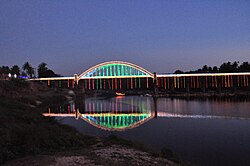
Thirthahalli, nestled in the Malnad region of Karnataka's Western Ghats, boasts an array of natural attractions that highlight its lush biodiversity and rugged terrain, drawing nature lovers for serene escapes and outdoor adventures. The Tunga River, originating from the Varaha Parvata hills and flowing through Thirthahalli taluk, forms the lifeline of the area's ecology with its crystal-clear waters and verdant riverbanks. The historic Tunga Bridge, spanning the river in the heart of Thirthahalli and constructed in 1943, offers pedestrians stunning panoramic views of the flowing waters, misty hills, and surrounding greenery, while the cool breeze enhances the tranquil experience.[73] Local spots along the riverbanks serve as popular fishing areas, where enthusiasts cast lines for native species amid the soothing sounds of the current.[74] Upstream, the Tunga Anicut Dam, located near Sakrebailu on the Shimoga-Thirthahalli route, facilitates essential water management and irrigation for agricultural lands in the region, supporting the taluk's paddy fields and horticulture.[75] Thirthahalli's waterfalls and hills provide invigorating trekking opportunities amid dense shola forests. Barkana Falls, situated approximately 10 km from Agumbe within Thirthahalli taluk, plunges 260 meters from the Seetha River, creating a majestic cascade enveloped by thick rainforest; the short trek to its base is most rewarding during the post-monsoon months when the water flow is robust.[76] Nearby, Onake Abbi Falls, about 8 km from Agumbe and 40 km from Thirthahalli town, drops around 500 feet through a forested ravine, accessible via a moderate 4-5 km hike that rewards visitors with secluded pools and the roar of untamed waters.[77] For elevated vistas, the Kundadri Hills, rising to 826 meters and roughly 20 km from Thirthahalli, feature a 7 km trekking trail through wild vegetation and streams, culminating in breathtaking 360-degree panoramas of the Western Ghats' rolling peaks and expansive valleys, especially at sunrise or sunset.[78] Wildlife sanctuaries in the vicinity underscore Thirthahalli's rich fauna. The Mandagadde Bird Sanctuary, perched on an islet in the Tunga River 31 km from Thirthahalli, shelters a variety of resident and migratory avian species, including egrets, kingfishers, and grey herons that flock here from October to March, offering prime opportunities for birdwatching from observation decks.[79] Complementing this, the Sakrebailu Elephant Camp, a rehabilitation facility 14 km from Shimoga along the road to Thirthahalli on the Tunga River's banks, houses around 20-25 captive elephants; visitors can witness their daily bathing rituals and feeding sessions in a natural setting, promoting conservation awareness.[80]Historical and Cultural Sites
Thirthahalli taluk in Karnataka's Shivamogga district is home to several historical and cultural sites that reflect its rich heritage, blending architectural remnants from medieval kingdoms with literary landmarks tied to Kannada cultural icons.[16][8] One prominent attraction is Kavaledurga Fort, located approximately 18 kilometers from Thirthahalli, which dates back to the 9th century and served as a strategic stronghold for the Keladi Nayakas.[16] This fort, renovated in the 14th century by Cheluvarangappa, features multiple layers of rock fortifications and was the fourth and last capital of the Keladi kingdom, underscoring its role in regional power dynamics during the medieval period.[15] Visitors access the ruins via a moderate trek through forested paths, offering panoramic views of the surrounding Malnad landscape from the hilltop.[16] The site's dilapidated structures, including guard quarters and water management systems adapted for the region's heavy rainfall, highlight innovative defensive architecture of the era.[81] Another key site is Kuppalli, situated about 18 kilometers northeast of Thirthahalli, renowned as the ancestral home of Rashtrakavi Kuvempu, the Jnanpith award-winning Kannada poet and author.[8] The modest house, known as Kavimane or "Poet's Abode," has been preserved as a museum by the Rashtrakavi Kuvempu Pratishtana since the 1970s, displaying personal artifacts such as manuscripts, photographs, and everyday items that provide insight into Kuvempu's early life and creative influences.[82] Surrounding the museum are well-maintained gardens and a memorial rock called Kavishaila, which honors Kuvempu's literary legacy and attracts scholars, poets, and tourists seeking to connect with Karnataka's modern cultural heritage.[8] The serene village setting evokes the rural inspirations behind Kuvempu's works, like his epic Ramayana Darshanam.[82] Nearby, in the Agumbe rainforest area roughly 30 kilometers from Thirthahalli, cultural elements intertwine with natural features at sites like the renowned sunset viewpoint and Jogi Gundi Falls, which features a cave associated with local folklore. The Agumbe Sunset Point, elevated on the Western Ghats escarpment, has long been a vantage for observing dramatic sunsets, drawing visitors who appreciate its ties to regional storytelling traditions. Jogi Gundi Falls, named after the saint Jogi who is said to have meditated in the adjacent cave, embodies folklore of spiritual retreat and asceticism, with the cave's position behind the cascading water adding to its mystical allure in local narratives.[83] These elements highlight how Agumbe's landscape has shaped cultural expressions in Thirthahalli's broader heritage.Education
Primary and Secondary Schools
Thirthahalli taluk's primary and secondary education system emphasizes accessible foundational learning through a network of government and private institutions, primarily using Kannada as the medium of instruction, supplemented by English options in select private schools. Government Higher Primary Schools (GHPS) serve as the core providers, with multiple facilities across the taluk ensuring coverage for early grades. For instance, GHPS Thirthahalli (Kuvempu), established in 1898 and managed by the Department of Education, operates in an urban setting to support local students up to higher primary levels.[84] Other GHPS, such as GHPS Seebinakere and GHPS Bettamakki, extend this reach into rural clusters, promoting universal elementary education under state guidelines.[85] Private schools complement government efforts by offering diverse pedagogical approaches and additional amenities. Sevabharathi Higher Primary School, founded in 1982 in Thirthahalli town, is a co-educational institution serving grades 1 to 7, focusing on holistic development in an aided setup.[86] Similarly, Shree Sai Skanda Pre-School provides early childhood education, emphasizing play-based learning for young children in the region, though detailed operational data remains community-oriented.[87] These private entities, including English-medium options like St. Mary's Higher Primary School, enhance enrollment choices and contribute to higher retention rates.[88] Secondary education builds on this base, with institutions transitioning students to higher grades through integrated curricula. Key initiatives like the statewide mid-day meal scheme, delivering 450 calories and 12 grams of protein daily to primary students, have notably boosted attendance and female participation by addressing nutritional barriers.[89] Scholarships, including targeted programs for economically weaker sections, further support equity, aligning with Karnataka's efforts to achieve gender parity in elementary education.Higher Education Institutions
Thirthahalli hosts several key higher education institutions that contribute to regional development by offering undergraduate and professional programs tailored to local needs. These colleges, primarily affiliated with Kuvempu University, emphasize accessible education in arts, sciences, commerce, and teacher training, serving students from rural backgrounds in the Malnad region. Tunga Mahavidyalaya, established in 1967 as one of the oldest private aided colleges in Shivamogga district, focuses on arts and commerce education. Affiliated to Kuvempu University, it provides undergraduate and postgraduate degrees in disciplines such as economics, history, political science, Kannada, sociology, English, and commerce. The institution promotes holistic development, including moral and intellectual growth, to prepare students for societal contributions.[90][91] The Vagdevi Group of Institutions encompasses a Pre-University College and the Vagdevi College of Education, established in 2007 under the Sathpatha Education Trust. The College of Education, affiliated to Kuvempu University and recognized by the National Council for Teacher Education, offers a two-year B.Ed program with an annual intake of 50 students, half allocated through government quotas. It specializes in teacher training, integrating Indian values, teamwork, integrity, and rural exposure to foster effective educators equipped for community-oriented teaching.[92] Government First Grade College, Thirthahalli, delivers undergraduate programs in sciences, humanities, commerce, and computer applications, affiliated to Kuvempu University. It supports local access to higher education by emphasizing scholarships, including government schemes providing up to ₹5,000 for meritorious science students from economically disadvantaged backgrounds. The college plays a vital role in advancing regional literacy and skill development through its diverse course offerings.[93][94]Government and Infrastructure
Administration and Governance
Thirthahalli functions as a panchayat town and the administrative headquarters of Thirthahalli Taluk within Shivamogga district, Karnataka, India.[95] The local governance is managed by the Thirthahalli Town Panchayat, established in 1938, which operates through 15 wards to oversee urban civic affairs in the region.[96][3] The Town Panchayat is led by an elected President and supported by a Chief Officer, with Sri. Nagaraja D holding the position of Chief Officer as of August 2025.[97] At the state legislative level, the Thirthahalli Assembly constituency is represented by Araga Jnanendra of the Bharatiya Janata Party, who was elected as the Member of the Legislative Assembly (MLA) in May 2023.[98] Key responsibilities of the Town Panchayat encompass essential civic services, including water supply with a treatment capacity of approximately 4.5 million liters per day (MLD) from the Balebailu plant, though actual supply is around 2.4 MLD from surface sources to meet residential and public needs,[99][3][100][101] as well as public health and sanitation initiatives that cover solid waste management, conservancy, and drainage systems under the Swachh Bharat Mission, focusing on individual household latrines and community facilities to promote open-defecation-free status.[99][3] These efforts ensure basic infrastructure maintenance, such as roads and street lighting, while granting building licenses to regulate urban development.[99] In alignment with broader rural development objectives, the administration implements national schemes like the Mahatma Gandhi National Rural Employment Guarantee Act (MGNREGA), which guarantees at least 100 days of wage employment per year to eligible rural households, often focusing on agricultural and allied activities in Thirthahalli Taluk.[102] This program supports local employment and infrastructure projects, contributing to sustainable rural livelihoods in the area.[104]Transportation and Utilities
Thirthahalli's road connectivity primarily relies on National Highway 169 (NH-169), which links the town to Shivamogga (Shimoga), approximately 60 kilometers away, facilitating access to broader regional networks.[26] Local transportation is supported by the Karnataka State Road Transport Corporation (KSRTC), which operates regular bus services connecting Thirthahalli to Shivamogga, Agumbe, and other nearby destinations, with multiple daily departures from the town's bus stand.[105] The Agumbe Ghat road, a scenic but challenging route through the Western Ghats, begins about 20 kilometers from Thirthahalli and provides linkage to coastal areas like Udupi, though it features narrow, winding sections prone to maintenance issues.[106] Utilities in Thirthahalli are managed through local infrastructure, with electricity supplied via the Mangalore Electricity Supply Company (MESCOM) grid, ensuring coverage for residential and commercial needs across the taluk.[107] Water supply is sourced from the Tunga River, providing treated water through a centralized system that draws from the river's upstream reservoirs, with schedules available for residents.[108] Sanitation efforts have advanced under the Swachh Bharat Mission, focusing on individual household latrines and community facilities to promote open-defecation-free status. Infrastructure faces seasonal challenges, particularly during monsoons, when heavy rainfall causes landslides and disruptions on routes like the Agumbe Ghat, leading to temporary road closures and diversions that affect local travel and commerce. To address connectivity gaps, plans for a railway extension from Shivamogga via Thirthahalli to Sringeri and Mangaluru—covering about 220 kilometers—have progressed to the survey stage, with a physical survey completed a few years ago; however, land acquisition hurdles persist as of October 2025.[109]Notable People
Literary and Artistic Figures
Thirthahalli, nestled in the Malnad region of Karnataka, has nurtured several prominent figures in Kannada literature and performing arts, whose works draw inspiration from the area's lush landscapes, rivers, and cultural traditions. These individuals have significantly enriched Kannada language and arts, contributing to both classical and modern expressions of regional identity.[110] Kuppali Venkata Puttappa, better known by his pen name Kuvempu, was born on December 29, 1904, in Hirekodige village of Koppa taluk, Chikmagalur district, but spent his formative years in Kuppali village within Thirthahalli taluk of Shivamogga district. Raised amidst the verdant hills and rivers of Malnad, his poetry and novels vividly capture the region's natural beauty and rural life, as seen in his epic work Sri Ramayana Darshanam, a Kannada retelling of the Ramayana that earned him the inaugural Jnanpith Award in 1967, making him the first Kannada recipient of this prestigious honor. Kuvempu's philosophy of "Yaksha Gana" emphasized harmony with nature, reflecting the serene environment of Thirthahalli that shaped his worldview and literary output.[110][110][82] Purandara Dasa, the 16th-century pioneer of Carnatic music and a revered Haridasa saint, is traditionally linked to Araga village in Thirthahalli taluk, Shivamogga district, according to a 2018 report by a Karnataka government committee, though his birthplace remains a subject of debate, with traditional accounts placing it near Pune, Maharashtra. Born around 1484 as Srinivasa Nayaka to a wealthy merchant family, he renounced material life after a spiritual awakening and composed devotional keertanas in praise of Lord Krishna, with traditional accounts attributing over 475,000 such compositions to him, though approximately 1,000 have survived. His works, often performed along the banks of the Tunga River near Thirthahalli, laid the foundational structure for Carnatic music pedagogy, including swara exercises and varisais that remain integral to musical training today.[71][111][111] Other notable literary figures from Thirthahalli include M.K. Indira, a pioneering Kannada novelist born on January 5, 1917, in the town, whose works like Phaniyamma explore themes of widowhood, social reform, and Malnad life, earning her acclaim as one of the first major female voices in modern Kannada fiction. Poornachandra Tejaswi, son of Kuvempu and born on September 8, 1938, in Mysore but raised in the family's Kuppali home in Thirthahalli taluk, was a multifaceted writer, environmentalist, and photographer whose novels such as Chidambara Rahasya blend science fiction with ecological concerns rooted in Karnataka's biodiversity. U.R. Ananthamurthy, born on December 21, 1932, in Melige village of Thirthahalli taluk, spearheaded the Navya movement in Kannada literature with introspective novels like Samskara, critiquing tradition and modernity, and received the Jnanpith Award in 1994.[112][113][114] In the performing arts, Thirthahalli has produced influential Yakshagana artists, including Gopal Achari (1925–2003), a legendary performer in the Badagutittu style who dominated the stage for over four decades with his versatile portrayals of mythological characters, training generations of artists and elevating the folk theater form's reach across Karnataka. Local troupes continue to draw from Thirthahalli's folklore for Yakshagana productions, preserving the region's oral traditions through vibrant all-night performances that fuse dance, music, and dialogue. Modern Kannada poets from the area, such as those inspired by Alaka's lyrical explorations of rural ethos, further extend this legacy by incorporating Malnad motifs into contemporary verse.[115]Political and Social Contributors
Araga Jnanendra, born in 1953 in Araga village of Thirthahalli taluk, has served as the Member of the Legislative Assembly (MLA) for Thirthahalli since 1994, securing victories in multiple elections including 2023 as a Bharatiya Janata Party candidate.[116] As former Home Minister of Karnataka from 2021 to 2023, he has prioritized infrastructure development and education reforms in the taluk, including funding classroom constructions and upgrades at local government schools to address poor facilities.[117][118] His efforts have extended to supporting educational institutions, such as contributing to the revival of under-enrolled schools through community and governmental resources.[119] Local freedom fighters from Thirthahalli played key roles in India's independence movement, particularly during Mahatma Gandhi's 1927 visit to the region alongside C. Rajagopalachari to mobilize support for the freedom struggle.[19] Participants, including figures like Devangi Manappa Gowda and Ramasharma Basavani, contributed to the logistics and organization of Gandhian activities, which laid groundwork for later efforts such as the Quit India Movement in 1942 by fostering local nationalist networks.[120] Shantaveri Gopala Gowda, born in 1923 in Araga village, emerged as a prominent socialist leader and freedom fighter, representing Thirthahalli in the assembly during 1952, 1962, and 1967 while advocating for labor rights and social justice.[120] Social reformers from Thirthahalli have advanced community leadership in the Malnad region, focusing on education and equality. Institutions like the Vagdevi Group of Institutions, established in 1999 by the Sathpatha Education Trust in Thirthahalli, have supported broader educational access, embracing students from diverse backgrounds to foster inclusive learning environments.[92] Historical efforts in the area, aligned with regional reformers, emphasized women's education and caste equality, building on Gandhian principles to challenge traditional hierarchies in rural Malnad society.[120]References
- https://nregastrep.nic.in/netnrega/states/pv_nt.aspx?page=p&state_name=[KARNATAKA](/page/Karnataka)&state_code=15&district_name=SHIVAMOGGA&district_code=1524&block_code=1524007&block_name=TIRTHAHALLI%20&fin_year=2025-2026