Hubbry Logo
Revolt of the Three FeudatoriesRevolt of the Three FeudatoriesMain
Open search
Revolt of the Three Feudatories
Community hub
Revolt of the Three Feudatories
logo
8 pages, 0 posts
0 subscribers
Be the first to start a discussion here.
Revolt of the Three Feudatories
from Wikipedia
Revolt of the Three Feudatories

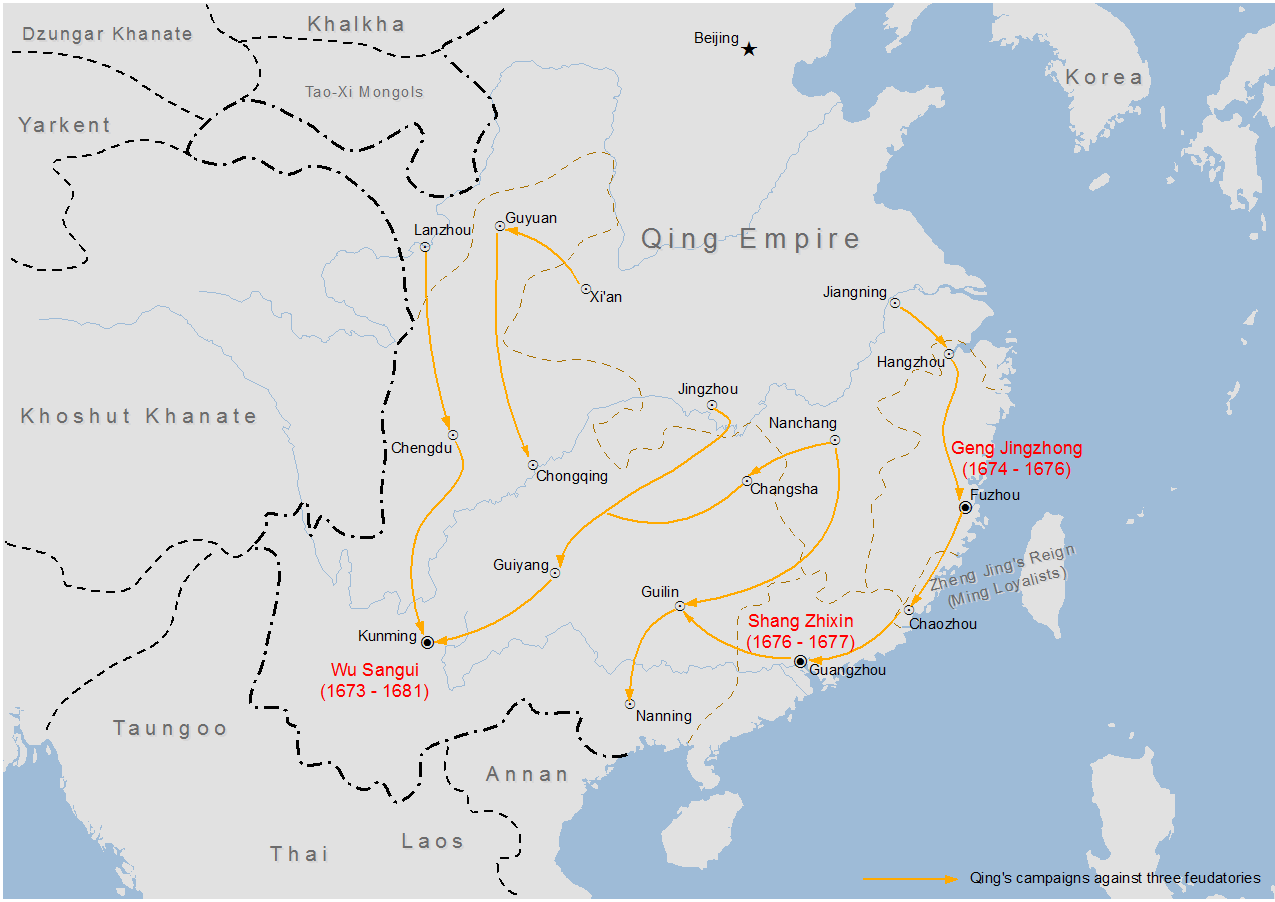
Map showing Qing's campaigns against the Three Feudatories
DateAugust 1673 – November 1681
Location
Chinese provinces south of the Yangtze River
Result Qing victory
Territorial
changes
Yunnan, Fujian and Guangdong provinces recovered by Qing dynasty
Belligerents
Qing dynasty Qing dynasty Wu Sangui
Shang Zhixin
Geng Jingzhong
Chinggisid
Chahar Mongol
Zheng's Taiwan
Other rebels
Tiandihui
Commanders and leaders
Qing dynasty Kangxi Emperor
Giyesu
Yolo
Shang Kexi
Wu Sangui
Wu Shifan
Geng Jingzhong (1674–76)
Shang Zhixin (1676–79)
Borni (Burni)
Abunai
Lubuzung
Zheng Jing
Strength
400,000 Wu Sangui: 200,000
Shang Zhixin: 100,000
Geng Jingzhong: 200,000
Chahar Mongols: 10,000
Zheng Jing: 10,000
Wang Fuchen: several thousands
Sun Yanling/Kong Sizhen: 10,000

The Revolt of the Three Feudatories, (Chinese: 三藩之亂; pinyin: Sānfān zhī luàn) also known as the Rebellion of Wu Sangui, was a rebellion lasting from 1673 to 1681 in the early Qing dynasty of China, during the reign of the Kangxi Emperor (r. 1661–1722). The revolt was led by Wu Sangui, Shang Zhixin and Geng Jingzhong, the three ethnic Han lords of Yunnan, Guangdong and Fujian provinces whose hereditary titles were given to them for defecting to and helping the Qing dynasty conquer China proper, who rebelled after the Qing central government started abolishing their fiefs.[1] The feudatories were supported by Zheng Jing's Kingdom of Tungning on the island of Taiwan, which sent forces to invade Mainland China. Additionally, minor Han military figures, such as Wang Fuchen, and the Chahar Mongols, also revolted against Qing rule.

Due to their history as defectors that helped to topple the Southern Ming dynasty, the Three Feudatories failed to win over the support of the general Han populace and were eventually defeated by the Qing forces. After the last remaining Han resistance had been put down, the former princely titles were abolished.

Background

[edit]

After the Qing dynasty from Manchuria conquered China proper, during the reign of the Shunzhi Emperor (1643–1661), the central government's authority was not strong enough to control the provinces in southern China directly. The government initiated a policy of "letting the Han Chinese govern the Han Chinese" (以漢制漢). Some generals of the former Ming dynasty who had surrendered to the Qing were allowed to help govern the provinces in the south.[2]

That was the result of the crucial contributions those generals had made at decisive moments during the Qing conquest of China. For instance, the navy of Geng Zhongming and Shang Kexi brought about the quick capitulation of Joseon in 1636, allowing rapid advance into Ming territories without worrying about what was behind. The defection and subsequent cooperation of Wu Sangui allowed swift capture and settlement of the Ming capital Beijing. In return, the Qing government had to reward their achievements, and acknowledge their military and political influence.

In 1655, Wu Sangui was granted the title of "Pingxi Prince" (平西王; "West Pacifying Prince") and granted governorship of the provinces of Yunnan and Guizhou. Shang Kexi and Geng Zhongming were granted the titles of "Pingnan Prince" and "Jingnan Prince" (both mean "South Pacifying Prince") respectively, and were put in charge of the provinces of Guangdong and Fujian. The three lords had great influence over their lands and wielded far greater power than any other regional or provincial governors. They had their own military forces and had the authority to alter tax rates in their fiefs.

The Three Feudatories

[edit]
Wu Sangui, titled "Prince Who Pacifies the West"(平西王

In Yunnan and Guizhou, Wu Sangui was granted permission by the Shunzhi Emperor to appoint and promote his own personal group of officials, as well as the privilege of choosing warhorses first before the Qing armies. Wu Sangui's forces took up several million taels of silver in military pay, a third of the Qing government's total tax revenue. Wu was also in charge of handling the Qing government's diplomatic relationships with the Dalai Lama and Tibet. Most of Wu's troops were formerly Li Zicheng and Zhang Xianzhong's forces and they were well-versed in warfare.

In Fujian province, Geng Zhongming ruled as a tyrant over his fief, allowing his subordinates to extort food supplies and money from the common people. After Geng's death, his son Geng Jimao inherited his father's title and fiefdom, and Geng Jimao was later succeeded by his son Geng Jingzhong.[3]

Shang Kexi, known to the Dutch as the "Old Viceroy" of Guangdong, drawn by Johan Nieuhof in 1655.

In Guangdong province, Shang Kexi ruled his fief in a similar fashion to Geng Jingzhong. In total, much of the central government's revenue and reserves were spent on the Three Feudatories, and their expenditure emptied almost half of the imperial treasury. When the Kangxi Emperor came to the throne, he felt that the Three Feudatories posed a great threat to his sovereignty and wanted to reduce their power.

In 1667, Wu Sangui submitted a request to the Kangxi Emperor, asking for permission to be relieved of his duties in Yunnan and Guizhou provinces, on the premise that he was ill. Kangxi, not yet ready for a trial of strength with him, refused Wu's request.[4] In 1673, Shang Kexi asked for permission to retire,[5] and in July, Wu Sangui and Geng Jingzhong followed suit. Kangxi sought advice from his council on the issue and received divided responses. Some thought that the Three Feudatories should be left as they were, while others supported the idea of reducing the three lords' powers. Kangxi went against the views of the majority in the council and accepted the three lords' requests for retirement, ordering them to leave their respective fiefs and resettle in Manchuria.[6]

Declaring rebellion

[edit]

In December 1673, Wu Sangui ended his connection to the Qing dynasty and instigated the rebellion under the banner of "opposing Qing and restoring Ming" (反清復明). Wu courted Han Chinese officials to join the rebellion by restoring Ming customs and cutting off queues.[7]

Wu's forces captured Hunan and Sichuan provinces. In 1674 both Geng Jingzhong in Fujian and after Shang Zhixin, the man who massacred Guangzhou, died, his son followed suit in Guangdong.[8] At the same time, Sun Yanling and Wang Fuchen also rose in revolt in Guangxi and Shaanxi provinces. Zheng Jing, ruler of the Kingdom of Tungning, led an army from Taiwan and landed in Fujian and Guangdong to fight and join the rebel forces.[9]

Wu entrusted the 5th Dalai Lama to negotiate with the Kangxi Emperor about dividing China along the Yangtze, with Wu ruling the south and Qing retaining the north, but the Emperor rejected this proposal.[10] Later on in 1678, he declared a new dynasty, the Zhou, invoking the name of the great pre-imperial dynasty.[11]

Composition of Qing armies

[edit]
Shang Zhixin, known to the Dutch as the "Young Viceroy of Canton", armed on horseback and protected by his bodyguards.

The Qing forces were initially defeated by Wu in 1673–1674.[12] Manchu Generals and Bannermen were put to shame by the performance of the Han Chinese Green Standard Army, who fought better than them against the rebels. The Qing had the support of the majority of Han Chinese soldiers and the Han elite, as they did not join the Three Feudatories. Different sources offer different account of the Han and Manchu forces deployed against the rebels. According to one, 400,000 Green Standard Army soldiers and 150,000 Bannermen served on the Qing side during the war.[13] according to another, 213 Han Chinese Banner companies, and 527 companies of Mongol and Manchu Banners were mobilized by the Qing.[14] According to a third, the Qing mustered a massive army of more than 900,000 northern Han Chinese to fight the Three Feudatories.[15]

Fighting in northwestern China against Wang Fuchen, the Qing put Bannermen in the rear as reserves while they used Han Chinese Green Standard Army soldiers and Han Chinese Generals like Zhang Liangdong, Wang Jinbao, and Zhang Yong as their main military force.[16] The Qing thought that Han Chinese soldiers were superior at fighting other Han people and so used the Green Standard Army as their main army against the rebels instead of Bannermen.[17][18][19] As a result, after 1676, the tide turned in favor of the Qing forces. In the northwest, Wang Fuchen surrendered after a three-year-long stalemate, while Geng Jingzhong and Shang Zhixin surrendered in turn as their forces weakened.[20]

Pacification Campaign

[edit]
Map showing Qing's armies suppressing the rebellion

In 1676 Shang Zhixin joined the rebellion, consolidating Guangdong under his rule and sending troops north into Jiangxi.[21]

In 1677, Wu Sangui suspected Sun Yanling would surrender to the Qing in Guangxi and he sent his relative Wu Shizong, to assassinate Sun. Sun's wife Kong Sizhen took control of his troops after his death, although she may already have had control beforehand.

In the south, Wu Sangui moved his armies north after conquering Hunan,[when?] while the Qing forces concentrated on recapturing Hunan from him. In 1678, Wu finally proclaimed himself emperor of the Great Zhou Dynasty (大周)[22] in Hengzhou (衡州; present-day Hengyang, Hunan province) and established his own imperial court. However Wu died of illness in August (lunar month) that year and was succeeded by his grandson Wu Shifan, who ordered a retreat back to Yunnan.[23] While the rebel army's morale was low, Qing forces launched an attack on Yuezhou (岳州; present-day Yueyang, Hunan province) and captured it, along with the rebel territories of Changde, Hengzhou and others. Wu Shifan's forces retreated to the Chenlong Pass. Sichuan and southern Shaanxi were retaken by the Han Chinese Green Standard Army under Wang Jinbao and Zhao Liangdong in 1680,[24] with Manchu forces involved only in dealing with logistics and provisions, not combat.[25][26] In 1680, the provinces of Hunan, Guizhou, Guangxi, and Sichuan were recovered by the Qing, and Wu Shifan retreated to Kunming in October.

In 1681, the Qing general Zhao Liangdong proposed a three-pronged attack on Yunnan, with imperial armies from Hunan, Guangxi and Sichuan. Cai Yurong, Viceroy of Yun-Gui, led the attack on the rebels together with Zhang Tai and Laita Giyesu, conquering Mount Wuhua and besieging Kunming. In October, Zhao Liandong's army was the first to break through into Kunming and the others followed suit, swiftly capturing the city. Wu Shifan committed suicide in December and the rebels surrendered the following day.[27]

Zheng Jing's forces were defeated near Xiamen in 1680 and forced to withdraw to Taiwan.[28] The final victory over the revolt was the Qing conquest of the Kingdom of Tungning on Taiwan. Shi Lang was appointed as admiral of the Qing navy and led an invasion of Taiwan, defeating the Tungning navy under Liu Guoxuan in the Battle of Penghu.[29] Zheng Jing's son Zheng Keshuang surrendered in October 1683, and Taiwan became part of the Qing Empire. Zheng Keshuang was awarded by the Kangxi Emperor with the title "Duke of Haicheng" (海澄公) and he and his soldiers were inducted into the Eight Banners.[30][31]

Aftermath

[edit]

Shang Zhixin was forced to commit suicide in 1680;[32] of his thirty six brothers, four were executed when he committed suicide, while the rest of his family was allowed to live. Geng Jingzhong was executed; his brother Geng Juzhong (耿聚忠) was in Beijing with the Qing court with the Kangxi Emperor, during the rebellion, and was not punished for his brother's revolt. Geng Juzhong died of natural causes in 1687. Several Ming princes had accompanied Koxinga to Taiwan in 1661–1662, including the Prince of Ningjing, Zhu Shugui and Prince Zhu Honghuan (朱弘桓), son of Zhu Yihai. The Qing sent the 17 Ming princes still living on Taiwan back to mainland China where they spent the rest of their lives in exile since their lives were spared from execution.[33]

In 1685, the Qing used former Ming loyalist Han Chinese naval specialists who had served under the Zheng family in Taiwan in the siege of Albazin.[21][34] Former Ming loyalist Han Chinese troops who had served under Zheng Chenggong and who specialized at fighting with rattan shields and swords (Tengpaiying, 藤牌营) were recommended to the Kangxi Emperor to reinforce Albazin against the Russians. Kangxi was impressed by a demonstration of their techniques and ordered 500 of them to defend Albazin, under Ho Yu, a former Koxinga follower, and Lin Hsing-chu, a former General of Wu Sangui. These rattan shield troops did not suffer a single casualty when they defeated and cut down Russian forces traveling by rafts on the river, only using the rattan shields and swords while fighting naked.[35][36][37]

"[the Russian reinforcements were coming down to the fort on the river] Thereupon he [Marquis Lin] ordered all our marines to take off their clothes and jump into the water. Each wore a rattan shield on his head and held a huge sword in his hand. Thus they swam forward. The Russians were so frightened that they all shouted: 'Behold, the big-capped Tartars!' Since our marines were in the water, they could not use their firearms. Our sailors wore rattan shields to protect their heads so that enemy bullets and arrows could not pierce them. Our marines used long swords to cut the enemy's ankles. The Russians fell into the river, most of them either killed or wounded. The rest fled and escaped. [Lin[ Hsing-chu had not lost a single marine when he returned to take part in besieging the city.", written by Yang Hai-Chai, who was related to Marquis Lin, a participant in the war[38]

Literature

[edit]

The revolt is featured in Louis Cha's novel The Deer and the Cauldron. The story tells of how the protagonist, Wei Xiaobao, helps the Kangxi Emperor suppress the rebellion.

Tsao, Kai-Fu. The Rebellion of the Three Feudatories Against the Manchu Throne in China, 1673–1681: Its Setting and Significance.

References

[edit]
[edit]
Revisions and contributorsEdit on WikipediaRead on Wikipedia
from Grokipedia
The Revolt of the Three Feudatories (1673–1681) was a large-scale civil conflict in the of , pitting three semi-autonomous lords— governing , Geng Jingzhong in , and Shang Zhixin (son of Shang Kexi) in —against the Manchu central government under the young . These feudatories had been granted hereditary control over southern territories and substantial military forces by the as a pragmatic measure to stabilize Qing rule after the conquest of Ming loyalist holdouts in the 1650s and 1660s. The uprising began when Kangxi ordered the lords' relocation northward to diminish their regional power bases and integrate their armies into the central banner system, prompting to rebel in December 1673 by seizing . He proclaimed the Great and named himself emperor in March 1678 at Hengzhou (present-day Hengyang). Geng and Shang's son soon followed suit, allying with Wu and coordinating offensives that overran much of southern and central , including and , while drawing support from disaffected Ming remnants and even indirect aid from the Kingdom of Tungning in . The rebels' combined armies, numbering over 300,000, initially exploited Qing administrative inexperience and Manchu-Han tensions, pushing imperial forces to the brink and forcing Kangxi to purge conservative ministers obstructing vigorous response. Qing victory hinged on strategic patience, exploiting rebel disunity—such as Geng's early surrender in 1676 after devastating —and Wu's death from illness in 1678, which fragmented his coalition amid supply shortages and desertions. By 1681, imperial bannermen and Green Standard troops had recaptured key strongholds, executing the rebel leaders and dismantling the feudatories, an outcome that enabled Kangxi to abolish hereditary provincial commands, redistribute garrisons, and assert direct control over 's periphery, marking a pivotal consolidation of dynastic authority despite immense human and fiscal costs estimated in millions of casualties.

Historical Context

Origins of the Feudatory System

The established the feudatory system during the Shunzhi Emperor's reign (1643–1661) as a pragmatic mechanism to secure loyalty and administer southern amid ongoing conquests against Ming remnants. Following the Manchu entry into in and subsequent southward campaigns, the numerically inferior Qing faced entrenched resistance in provinces like , , , and , where Han populations and loyalist forces posed threats of prolonged and naval incursions. To address this, the court granted hereditary fiefs to select Han generals who had defected from the Ming or proven their utility in battle, empowering them with provincial governorships, princely titles, and command over substantial personal armies—often exceeding 100,000 troops per feudatory—while requiring tribute, military aid, and adherence to Manchu directives. This "use Han to rule Han" (yi Han zhi Han) approach exploited the generals' ethnic affinity with local populations, military experience, and networks to suppress uprisings more effectively than direct Manchu garrisons could achieve alone. Key appointments formalized the system in the 1650s. Shang Kexi, a Ming defector since 1634 who aided Qing coastal operations, received the title Pingnan Prince (South-Pacifying Prince) and oversight of , including hereditary control and tax rights, to stabilize the southeast against maritime threats. The Geng clan, led initially by Geng Zhongming—a naval who surrendered in the 1630s—secured the Jingnan Prince title and governorship to counter Zheng Chenggong's fleet and inland rebels, with succession passing to Geng Jingmao and later Geng Jingzhong. , whose 1644 alliance at Shanhaiguan enabled the Qing's northern victory, was elevated to Pingxi Prince (West-Pacifying Prince) in 1662, assigned and after vanquishing leader Li Dingguo, granting him autonomy to patrol frontiers and extract resources from remote terrains. These enfeoffments prioritized short-term stability over centralized control, reflecting causal realities of : the Qing's limited manpower (Manchu bannermen numbered around 200,000 initially) necessitated to proven defectors, whose personal stakes in the new order incentivized suppression of rivals. However, the system's design—combining fiscal , self-sufficiency, and hereditary status—fostered entrenched power bases, as feudatories amassed wealth from , , and taxation while resisting Beijing's oversight. Empirical outcomes included successful pacification by the 1660s, yet it deviated from traditional Chinese imperial norms of bureaucratic oversight, echoing earlier feudal experiments but adapted to Manchu minority rule.

Qing Consolidation and Policy Shifts

Following the Manchu conquest of in 1644 and the establishment of the Shunzhi Emperor's reign, the initially consolidated control over southern by enfeoffing key Han defectors as semi-autonomous princes to suppress Ming loyalist resistance and secure strategic regions. received the title Prince Pingxi (Pacifier of the West) in 1655, governing and with an army of over 100,000 troops; Shang Kexi became Prince Pingnan (Pacifier of the South) in ; and Geng Jimao was enfeoffed as Prince Jingnan (Pacifier of the South) in . These feudatories commanded forces equivalent to half the Qing military and consumed comparable state revenues, allowing the dynasty to prioritize northern stabilization while delegating southern pacification. By the early 1670s, under the —who assumed governance in 1669 after ousting the regency—these arrangements increasingly threatened central authority, as the princes' hereditary powers and regional armies risked fragmentation akin to warlordism. Kangxi prioritized fiscal efficiency and administrative uniformity, viewing the feudatories' exemptions from standard taxation and bureaucratic oversight as unsustainable drains that hindered nationwide integration. In May 1673, Shang Kexi petitioned to retire to his native Liaodong, prompting Kangxi to approve the request while signaling broader intent to dismantle the system by requiring and Geng Jingzhong to similarly withdraw, transferring their commands to centrally appointed officials. This policy pivot from conquest-era to imperial centralization aimed to replace feudal dependencies with bureaucratic rule, aligning southern provinces with the Manchu system and civil administration. The shift reflected Kangxi's broader consolidation strategy, informed by the Shunzhi era's vulnerabilities, whereby reliance on Han generals had expedited unification but entrenched potential . By annexing feudatory lands, the Qing sought to standardize , reduce expenditures exceeding 10 million taels annually for the southern garrisons, and mitigate risks of hereditary . However, the abrupt retraction of privileges—without gradual integration—underscored tensions between short-term conquest necessities and long-term dynastic stability, as the princes had amassed personal loyalties and resources rivaling the throne's.

Key Figures and Factions

Wu Sangui and His Ambitions

(1612–1678) rose from a Ming military family to become a key commander defending the northeastern frontier against Manchu incursions. In 1644, following the capture of by Li Zicheng's rebel forces, Wu opened the Shanhaiguan Pass to Qing armies on May 22, allowing them to defeat the intruders and enter northern . This act facilitated the Qing conquest, earning him the title of Prince Pacifying the West (Pingxi wang) and governorship over and provinces, where he enjoyed semi-autonomous authority, including command over substantial personal armies and fiscal resources equivalent to half of the Qing state's expenditures. Under the , the feudatory system granted Wu and similar generals like Shang Kexi and Geng Jingzhong extensive privileges to secure loyalty during the turbulent conquest of southern , reflecting Qing pragmatism in delegating military pacification to proven defectors. Wu's forces effectively subdued Ming remnants in the southwest, consolidating Qing rule but fostering a power base that rivaled central authority, with his administration in operating independently in appointments, taxation, and troop maintenance. As the matured and sought to centralize power in the 1670s, policies aimed at curtailing feudatory autonomy—such as relocating their heirs to and reducing provincial garrisons—threatened Wu's entrenched position. In 1673, Wu rebelled, rapidly seizing , , and other provinces as local officials defected, initially framing the uprising as opposition to Qing rule and restoration of Ming legitimacy to rally support. This strategic invocation masked deeper personal ambitions, evident when, in 1678, he proclaimed himself emperor of the Great Zhou dynasty in Hengzhou (modern Hengyang, ), establishing a rival imperial court and minting coinage to legitimize his claim to the throne. Wu's shift from nominal Ming loyalism to self-proclaimed sovereignty underscored his opportunistic pursuit of supreme authority, leveraging his military prowess and regional control not merely for defense against centralization but for dynastic founding, though dysentery claimed his life months later on October 2, 1678, passing leadership to his grandson Wu Shifan. His actions reveal a pattern of allegiance shifts driven by self-preservation and expansionist goals, prioritizing personal dominion over ideological fidelity amid the Qing's fragile consolidation.

Shang Kexi and Geng Jingzhong

Shang Kexi (1604–1676), originally a general from Liaodong, defected to the Manchus early in their conquest of , aiding their campaigns in exchange for territorial rewards; he was enfeoffed as the Prince of Pingnan with semi-autonomous control over , , and parts of surrounding regions to secure southern loyalty for the nascent Qing regime. By the 1670s, his administration mirrored that of other feudatories, maintaining large private armies—estimated at over 100,000 troops—and extracting revenues that rivaled central Qing collections, fostering de facto independence amid fears of dynastic overreach. In 1671, illness prompted him to designate his son Shang Zhixin as heir, who expanded familial influence through marriage alliances, including wedding Geng Jingzhong's daughter, linking the Pingnan and Jingnan houses. Facing Qing centralization under the young , Shang Kexi petitioned in 1673 for permission to retire to his ancestral Liaodong, ostensibly for health reasons but signaling unease over edicts to integrate feudatory forces into imperial garrisons and replace Han commanders with Manchu overseers; the court initially approved but intended phased absorption of his . When rebelled in November 1673, Shang remained outwardly loyal, even alerting Kangxi to Geng Jingzhong's brewing unrest due to kinship ties, yet his son Shang Zhixin, resentful of succession uncertainties and autonomy threats, seized power in early 1676, placed his father under house arrest, and declared rebellion, joining Wu Sangui's forces, aligning with Wu and Geng to proclaim the "Great . Shang Kexi, confined and powerless, attempted suicide in protest but survived only briefly, dying in on November 12, 1676 amid the chaos his family ignited. Geng Jingzhong (died 1682), grandson of early defector Geng Zhongming and son of Geng Jimao, inherited the Prince of Jingnan title in 1671 upon his father's death, commanding province with a force of approximately 50,000–70,000 soldiers and exerting tyrannical rule that included subordinates' extortion of grain and funds from locals, exacerbating grievances in a province still scarred by anti-Qing resistance. Like Shang Kexi, he queried retirement to Liaodong in July 1673, interpreting Qing responses as preludes to disbandment of his banner armies and fiscal oversight, which clashed with hereditary privileges granted post-conquest. Following Wu Sangui's uprising, Geng proclaimed rebellion on August 25, 1674, consolidating before launching offensives into , where his forces briefly captured key cities like , leveraging naval assets and alliances with Wu to challenge Qing coastal control. The intertwined ambitions of Shang's lineage and Geng centered on preserving autonomous power bases against Kangxi's reforms, with familial bonds facilitating coordination—evident in Shang Zhixin's deference to Geng's overtures—yet rebel fractures soon emerged as personal rivalries and Qing counteroffensives eroded their , underscoring the feudatories' reliance on mutual for Qing stability rather than ideological cohesion. 's campaign faltered by 1676 due to overextension and internal betrayals, leading to his surrender around 1676 and execution in 1682, while Shang Zhixin's resistance prolonged Guangdong's turmoil until his defeat in 1677.

Supporting Rebel Elements

, ruler of the Kingdom of Tungning based in , emerged as the most significant external ally to the rebels, dispatching naval forces and troops to coordinate with Geng Jingzhong in following the latter's declaration of in 1674. In 1676, Zheng's armies landed at Siming Prefecture, bolstering rebel positions against Qing advances in southeastern . His forces withdrew to Taiwan following defeat near Xiamen in 1680, with the Kingdom of Tungning surrendering to the Qing in 1683 under his son Zheng Keshuang. This support included funding and logistical aid aimed at exploiting Qing vulnerabilities on multiple fronts. Within the mainland territories, substantial backing came from Han Chinese elites, gentry, and local officials who resented Manchu governance, including heavy taxation and cultural impositions like the queue hairstyle. Wu Sangui capitalized on this sentiment by proclaiming the abolition of the queue and invoking Ming restoration rhetoric, drawing defections from provincial administrators in neighboring regions such as Hunan and Guizhou early in the revolt. These elements provided administrative continuity, resource mobilization, and intelligence, enabling rebels to sustain operations amid Qing blockades. Smaller contingents of anti-Qing forces, including some Chahar Mongol defectors numbering around 3,000, aligned with rebel campaigns in northern theaters, reflecting broader ethnic tensions against Manchu rule. However, such peripheral support often proved transient, with internal fractures and Qing countermeasures eroding cohesion by 1677.

Outbreak of Rebellion

Triggers and Declarations

The primary trigger for the revolt was the Kangxi Emperor's initiative to eliminate the semi-autonomous status of the three feudatories, which had been granted to secure Han Chinese loyalty after the Qing conquest of southern China. In 1673, Shang Kexi, Prince of Pingnan governing Guangdong, petitioned the throne for permission to retire to his native Liaodong and nominate his son Shang Zhixin as successor. Kangxi approved the retirement but rejected hereditary succession, ordering Shang Kexi to relocate and effectively dismantling the Guangdong fiefdom by integrating its forces under central command. Wu Sangui, Prince of Pingxi in Yunnan, interpreted this as a precursor to similar directives targeting his own extensive military holdings, which included over 100,000 troops and significant administrative autonomy. On November 28, 1673, Wu mobilized his forces from Kunming, advancing into Hunan and initiating open rebellion against Qing authority. By December 1673, he formally declared independence, establishing a new regime titled the Great Zhou dynasty with himself as king. Geng Jingzhong, Prince of Jingnan in Fujian, quickly aligned with Wu, declaring rebellion in early December 1673 to preserve his fiefdom's privileges. Shang Zhixin, defying his father's loyalty to the Qing, followed suit later that month in Guangdong, seizing control and proclaiming support for the rebels. Shang Kexi, however, remained loyal and attempted to suppress his son's uprising before his death in 1676. These declarations transformed a policy dispute into a widespread southern insurgency challenging Qing consolidation.

Initial Rebel Mobilization

In response to Qing imperial edicts demanding the reduction of feudatory autonomy, mobilized his substantial personal army stationed in and provinces during late 1673. Refusing orders to relocate to and relinquish administrative control, he initiated rebellion by denouncing the Manchu regime and rallying local garrisons under his command, which had been built up over decades of loyal service to the Qing . This force, drawn from hereditary troops loyal to Wu's family, enabled rapid consolidation of power in the southwest without immediate significant resistance. Wu's early mobilization focused on securing supply lines and expanding influence northward; by early 1674, his troops advanced into , capturing key cities like through coordinated marches and local defections, as provincial officials often submitted to avoid prolonged conflict. This initial surge overwhelmed scattered Qing defenses, allowing Wu to establish a provisional base for further operations against central authority. Geng Jingzhong, the jingnan wang in , joined the revolt in 1674, mobilizing his regional forces to challenge Qing control in the southeast. Leveraging naval assets and coastal fortifications originally granted for anti-Ming campaigns, Geng's troops launched incursions into , aiming to link up with Wu's advances and disrupt Qing reinforcements from the north. His rebellion was precipitated by similar fears of dismantled privileges, prompting swift assembly of banner and green standard units under his sway. Shang Zhixin, son of the pingnan wang Shang Kexi in Guangdong, initially mobilized rebel elements in 1674 after confining his father, who favored loyalty to the Qing. Shang's forces, comprising veteran soldiers from the conquest era, undertook defensive preparations and limited offensives to protect the feudatory's maritime domains, though internal divisions hampered coordinated action with other rebels. Shang Kexi himself alerted the Kangxi Emperor to emerging unrest, reflecting divided loyalties within the Guangdong command.

Military Dynamics

Rebel Forces and Strategies

The rebel forces in the Revolt of the Three Feudatories comprised the personal armies of , Shang Kexi's son Shang Zhixin, and Jingzhong, consisting mainly of troops who had previously served under these lords during the Ming-Qing conquest. These armies were semi-autonomous, allowing the feudatories to maintain substantial military power in their southern fiefdoms—Yunnan and for Wu, for Shang, and for Geng—as a means of securing Qing rule over recently subdued territories. The forces drew on local recruitment, experienced veterans from earlier campaigns, and control over regional revenues, which funded sustained operations without immediate reliance on central Qing supplies. Wu Sangui's army formed the core of the rebellion, leveraging his command over southwestern resources to mobilize large-scale offensives, while Geng Jingzhong's troops incorporated elements suited for coastal and amphibious actions in . Shang Zhixin's forces, after deposing his father in 1674, focused on consolidating Guangdong's defenses and launching incursions eastward. Limited external support came from figures like in , who provided funding and opportunistic naval aid to divert Qing attention. Overall, the rebels' military strength lay in their decentralized control of productive regions, enabling initial rapid advances but hampered by heterogeneous loyalties tied to individual lords rather than unified ideology. Strategically, the rebels aimed to exploit geographic separation to fragment Qing responses, with Wu Sangui initiating the uprising on December 28, 1673, by declaring a new Zhou dynasty and framing the revolt as resistance to Manchu overreach, appealing to Han loyalist sentiments. Wu advanced northward through Hunan toward the Yangzi River, seeking to link with eastern allies, while Geng Jingzhong invaded Zhejiang in 1674 to pressure Qing northern flanks. Shang Zhixin's participation added pressure in the southeast, intending a pincer movement against central Qing territories. However, the absence of effective joint command, exacerbated by personal ambitions and failed diplomacy—such as Wu's unfulfilled calls for broader anti-Qing unity—led to operational silos and vulnerability to Qing divide-and-conquer tactics. Rebel tactics emphasized defensive strongholds in rugged terrains, guerrilla harassment, and propaganda to erode Qing legitimacy, though prolonged sieges and supply strains ultimately exposed strategic overextension.

Qing Military Composition and Challenges

The Qing military was structured around two primary institutions: the and the . The formed the elite, hereditary core, organized under Manchu leadership since Nurhaci's reforms in the early , with divisions for Manchu, Mongol, and Han bannermen totaling an estimated 1.3 to 2.4 million registered individuals by the late , though effective fighting strength hovered around 200,000 to 300,000 deployable troops. These units emphasized and , garrisoned in strategic northern and central locations, and served as the dynasty's primary offensive arm, but their hereditary nature often led to declining discipline and combat readiness by the 1670s. The , by contrast, comprised mostly provincial levies under mixed Manchu-Han officer corps, numbering approximately 500,000 to 600,000 soldiers organized into battalions for infantry-focused duties like border patrol and internal security. During the revolt, which erupted in 1673, the Qing could draw on loyal Green Standard units from the north and center, but the feudatories controlled substantial southern contingents—Wu Sangui alone commanded over 100,000 troops in —effectively denying the court access to roughly half its southern military apparatus. Key challenges arose from structural mismatches and operational constraints. Bannermen, accustomed to open-field battles on the plains, struggled in the humid, mountainous south, where , supply shortages, and ambushes inflicted disproportionate losses; early campaigns saw banner units suffer heavy attrition without decisive gains. The court's initial regency under prioritized caution, mobilizing fewer than troops in 1674 and avoiding deep penetration, which allowed rebels to consolidate gains across and . Logistical overextension across thousands of miles, coupled with the economic burden of sustaining banner households, further hampered efforts until Kangxi's direct oversight from 1676 shifted reliance toward expanded Green Standard deployments and targeted Han loyalist recruitment, amassing over 900,000 troops by the war's later phases. This adaptation exploited rebel disunity but underscored the banners' obsolescence for , prompting post-revolt reforms.

Course of the Conflict

Early Advances and Stalemates

In late 1673, following 's declaration of rebellion from his base in , his forces launched a northern expedition that swiftly secured province by January 1674, encountering little organized resistance as many local officials and garrisons submitted to avoid prolonged conflict. Wu's well-equipped army, bolstered by years of autonomous military buildup and comprising experienced troops loyal to him, pressed onward into , capturing key cities such as and (modern ) in early 1674 through rapid maneuvers that exploited Qing administrative disarray in the south. These advances expanded rebel control over southwestern and southern territories, including parts of where local commanders defected, allowing Wu to consolidate supply lines and recruit additional forces from sympathetic Ming loyalist elements. Meanwhile, Geng Jingzhong in joined the revolt in early 1674, mobilizing his provincial armies to invade neighboring , where initial successes included the occupation of coastal areas and disruptions to Qing maritime control. Shang Kexi, based in , initially hesitated but permitted limited rebel activities in his domain before formally submitting to the Qing later that year, which prevented a unified southern front and limited further advances into Guangdong proper. Wu's push toward faltered after victories at , as extended supply lines and guerrilla resistance strained his logistics, while Geng's forays into met stiffened opposition from Qing reinforcements. The Qing court responded by dispatching bannermen-led armies under commanders such as Yue Le and Hani to , where fierce engagements in mid-1674 around and other riverine strongholds resulted in heavy casualties on both sides but no decisive breakthroughs, marking the onset of stalemates. Rebel momentum waned as overextended forces struggled against Qing numerical superiority in the north and internal coordination issues among the feudatories, while the imperial armies, though initially repelled, fortified defensive positions along the Yangtze River, preventing deeper penetrations into . This phase highlighted the rebels' tactical advantages in familiar terrain against the Qing's , leading to a protracted equilibrium by late 1674 that shifted focus to attrition and political maneuvering.

Turning Points and Rebel Fractures

The early surrenders of key rebel leaders marked critical turning points that fractured the initially coordinated revolt, isolating 's forces in the southwest. Geng Jingzhong, viceroy of , abandoned the rebellion and surrendered to Qing forces in late November 1676 following military setbacks, including the loss of key coastal positions to Qing admiral and internal pressures from failed alliances with Zheng Jing's Taiwan-based forces. This defection severed rebel access to southeastern maritime support and resources, as Geng's territory had served as a conduit for supplies and reinforcements. Similarly, Shang Zhixin, son of the aging viceroy Shang Kexi in , initially rebelled in 1674 after his father's petition for retirement was accepted by the Qing, but surrendered in January 1677 amid depleting supplies, Qing blockades, and personal rivalries with over territorial ambitions and command. These capitulations, incentivized by Qing offers of and retention of titles, demonstrated the fragility of rebel unity, as the feudatories prioritized self-preservation over collective resistance, allowing Qing forces to redirect resources southward. Wu Sangui's death further exacerbated rebel fractures, accelerating the revolt's collapse. In June 1678, Wu proclaimed himself emperor of a new from his base in , aiming to legitimize his rule and rally disparate anti-Qing elements, but he succumbed to on October 2, 1678, depriving the rebellion of its primary strategist and unifying figure. His grandson Wu Shifan assumed nominal leadership, but command devolved amid logistical breakdowns, rampant among troops, and defections by subordinate generals like Wang Fuchen in , who surrendered in August 1678 after Qing assurances of clemency. The absence of Wu's personal authority exposed underlying divisions, including ethnic tensions between loyalists and incorporated Ming remnants, as well as opportunistic shifts toward Qing overtures that promised stability over uncertain victory. Qing commanders exploited these fissures through targeted , offering pardons that peeled away peripheral allies, thereby transforming a multi-front into a contained southwestern campaign by 1679.

Major Campaigns and Sieges

The initial major campaign of the revolt was launched by Wu Sangui in late 1673, following his declaration of rebellion on December 27. His forces rapidly advanced into Hunan province, capturing the capital Changsha after overcoming Qing defenses there in early 1674 and securing control over much of the region by April, including advances toward Hubei and Sichuan provinces. This offensive exploited the element of surprise and the loyalty of local Han Chinese troops, allowing Wu to consolidate a base for further operations while proclaiming the establishment of the Zhou dynasty in 1678 from Hengzhou (modern Hengyang) in Hunan. Geng Jingzhong's parallel campaign in saw his armies seize control of the province in March 1674, extending into neighboring with initial successes against Qing garrisons, though logistical strains and internal dissent limited sustained gains. Shang Zhixin, succeeding his father in , mobilized reluctantly under pressure from subordinates, leading to clashes in eastern but no major territorial expansion beyond the province. These early rebel advances created widespread disruption, prompting the to mobilize units and banner forces for counteroperations, marking a shift to prolonged sieges and . Qing suppression efforts intensified after 1676, following Geng Jingzhong's surrender in November, which allowed forces under commanders like Liu Jinshu to reclaim through systematic sieges of rebel-held coastal fortresses. In , Qing troops under Cai Bilü encircled rebel positions, forcing Shang Zhixin's capitulation in 1677 amid supply shortages. The decisive phase against involved coordinated campaigns recapturing and by 1680, culminating in the three-pronged siege of in starting in March 1681. Led by Cai Yurong from the east, Zhang Guanglie from the north, and forces from , the blockade induced famine within the city; Wu Shifan, Wu Sangui's grandson, committed suicide on October 4, 1681 (Gregorian), leading to the formal surrender on October 28 and the revolt's collapse. These campaigns highlighted the rebels' initial momentum from semi-autonomous fiefdoms contrasted with Qing advantages in unified command and recruitment, resulting in over eight years of conflict that strained imperial resources but ultimately reinforced central .

Qing Suppression Efforts

Strategic Reforms Under Kangxi

Upon assuming in following the imprisonment of the regent , Kangxi consolidated imperial , enabling decisive centralization efforts that precipitated the revolt but also positioned the Qing for its suppression. Early campaigns faltered as Manchu Eight Banner forces, optimized for steppe warfare, proved ill-suited to the humid, rugged southern , suffering high attrition from and guerrilla tactics employed by the rebels. In response, Kangxi shifted reliance to the infantry units inherited from Ming structures and expanded under Qing rule—deploying over 200,000 such troops by 1676 to counter rebel advances in and . This adaptation leveraged Han soldiers' familiarity with local conditions and cultural affinity for subduing fellow Han defectors, embodying the pragmatic doctrine of "using Han to control Han" (yi Han zhi Han). To rectify command failures, Kangxi purged underperforming Manchu generals, including the execution of several for defeats like the fall of Yuezhou in 1674, and promoted ethnically mixed leadership, such as the Manchu Tuhai and Han Zhou Peigong, who orchestrated key counteroffensives. Administrative oversight intensified through the , which Kangxi mobilized to monitor provincial officials and ensure loyalty, rooting out corruption that hampered amid the protracted conflict. provisioning saw innovation, with imperial edicts standardizing grain transport via canals and rivers, sustaining armies over distances exceeding 2,000 kilometers from ; Kangxi personally drafted memoranda detailing water sources, forage availability, and troop dispositions to mitigate supply shortfalls observed in initial phases. These reforms extended to incentivizing defections, offering to rebel rank-and-file and mid-level officers upon surrender—over 100,000 troops reintegrated by 1678—while executing high-profile hostages like Wu Sangui's son Wu Yingxiong in 1674 to deter elite capitulation. production ramped up at foundries, supplying matchlocks and cannons pivotal in sieges, reflecting Kangxi's emphasis on sustaining a robust apparatus through preferential allocations of resources. By prioritizing adaptive force composition and centralized coordination over rigid banner-centric traditions, these measures reversed Qing fortunes after 1676, culminating in the rebels' exhaustion without a decisive field battle.

Diplomatic Divisions Among Rebels

Shang Kexi, the elderly Pingnan Prince stationed in , declined to participate in Wu Sangui's uprising despite urgings from his subordinates, maintaining nominal loyalty to the Qing court until his death in November 1676; his son Shang Zhixin assumed control and nominally rebelled but prioritized local defenses over coordinated action with Wu. This initial reluctance fragmented the purported alliance, as Shang Kexi's forces withheld support from Wu's northward advances into and , limiting rebel momentum in the southeast. Geng Jingzhong, the Jingnan Prince in , initially echoed Wu's rebellion in early 1674 by declaring opposition to Qing rule, yet internal strains emerged due to geographic separation and competing ambitions, with Geng focusing on consolidating coastal holdings rather than dispatching substantial aid to Wu's inland campaigns. By August 1676, amid mounting Qing pressure and personal discord with Wu—including disputes over resource allocation and strategic priorities—Geng surrendered unconditionally, accepting amnesty from the and redirecting his troops against Wu's positions in a bid to secure hereditary privileges. Shang Zhixin's forces similarly defected in 1677, driven by logistical isolation from Wu's base and Qing diplomatic inducements promising leniency, which exploited rebel hesitancy to unify under Wu's self-proclaimed banner in 1678. These successive surrenders, facilitated by the rebels' failure to establish joint diplomatic protocols or mutual defense pacts beyond vague anti-Qing rhetoric, isolated and eroded the revolt's viability, as Qing envoys systematically peeled away peripheral actors through targeted negotiations. Wu's overtures to in yielded a loose maritime with exchanged embassies and joint operations against Qing shipping, but this could not compensate for the core triad's diplomatic collapse.

Decisive Military Operations

Following Wu Sangui's death from illness on October 2, 1678, Qing forces capitalized on the resulting disarray in rebel ranks by launching coordinated offensives to reclaim central and southwestern territories. General Tuhai led imperial armies to retake key positions in and provinces, leveraging superior logistics and Green Standard troops to outmaneuver fragmented rebel defenses. By 1680, commanders Wang Jinbao and Zhao Liangdong had reconquered and southern , minimizing Manchu Eight Banner involvement in favor of reliable Han units to reduce ethnic tensions and enhance mobility. The culminating phase unfolded in 1681 with a three-pronged Qing assault on , Wu's stronghold, proposed by Zhao Liangdong to exploit supply vulnerabilities. Armies advanced from , , and , converging on after capturing peripheral strongholds like . In March, Qing troops initiated a of , the rebel capital, employing encirclement tactics to sever grain routes and isolate Wu Shifan, Wu Sangui's and successor. By October 1681, Zhao Liangdong's vanguard breached outer defenses, followed by supporting forces under Cai Yurong and others, compelling a swift capitulation of the city amid collapsing morale and desertions. Wu Shifan, facing inevitable defeat, committed on December 7, 1681, marking the effective end of organized resistance and the revolt's suppression after eight years. This operation underscored Qing advantages in unified command and adaptive use of provincial armies, contrasting with rebel infighting and logistical strains.

Aftermath and Consequences

Collapse of Rebel Strongholds

By late 1678, following Wu Sangui's death from on October 2, his grandson and successor Wu Shifan struggled to maintain cohesion among rebel forces in the southwest, as Qing armies exploited internal disarray and logistical strains to reclaim peripheral territories. Qing commanders, leveraging superior coordination under the Kangxi Emperor's direction, recaptured province in 1679, severing key supply lines and isolating Wu's core holdings in and . Concurrently, the defection of earlier allies like Jingzhong, who abandoned the revolt in 1676 after Qing forces threatened his base, further eroded rebel unity, leaving Wu Shifan's armies without eastern support. In 1680, Qing troops under generals such as Zhao Liangdong advanced into , expelling rebel garrisons and pushing toward the Yungui plateau, where Wu Shifan concentrated his remaining strength around as the de facto capital of his short-lived Zhou . This offensive capitalized on rebel overextension, with Wu's forces suffering from disease, desertions, and inadequate reinforcements amid the rugged terrain. By early 1681, Qing forces had encircled Guizhou's key fortifications, compelling a rebel retreat that exposed to direct assault; the city's defenses crumbled under sustained siege, as and overwhelmed the outnumbered defenders. The final collapse occurred in December 1681, when Wu Shifan, facing imminent overrun, committed suicide, prompting the surrender of Kunming's garrison the following day and the dissolution of organized resistance in . This marked the effective end of major rebel strongholds on the mainland, with hundreds of Wu loyalists executed in the aftermath to deter further uprisings, though sporadic guerrilla activity persisted briefly. The fall underscored the rebels' strategic failures, including Wu Sangui's earlier lavish excesses that undermined military discipline, against the Qing's methodical reconquest.

Administrative Reorganization

Following the Qing reconquest of in November 1681, which marked the effective end of the revolt, Emperor Kangxi abolished the hereditary fiefdoms held by the descendants of , Shang Kexi, and Geng Jingzhong, thereby eliminating the semi-autonomous administrative structures that had granted these lords control over civil, military, and fiscal affairs in Yunnan-Guizhou, , and . These territories, previously exempt from standard provincial oversight, were reorganized under direct central authority, with the appointment of viceroys (zongdu) and governors (xunfu) directly responsible to rather than to local princely courts. This shift replaced the feudatories' personalized rule—characterized by large private armies and independent tax levies—with the Qing's standardized bureaucratic hierarchy, emphasizing Manchu oversight and the integration of Han officials vetted for loyalty. Fiscal administration underwent immediate centralization, as revenues from land taxes and salt monopolies in the southern provinces, previously retained by the feudatories to sustain their forces, were redirected to the imperial treasury in Beijing, bolstering national finances strained by eight years of warfare that had cost an estimated 100,000 Qing troops. Kangxi authorized the resumption of civil service examinations in these regions, dormant amid the conflict, to rebuild administrative cadres from local elites while purging rebel sympathizers; successful candidates were incorporated into the bureaucracy under strict imperial scrutiny. Military reorganization dismantled the feudatories' banner and personal armies, totaling over 200,000 troops at the revolt's outset, reallocating loyal remnants to the Green Standard forces under centrally appointed commanders to prevent future warlordism. In and , where coastal trade had been disrupted, Kangxi's appointees enforced direct governance by subdividing jurisdictions into prefectures and counties aligned with pre-revolt norms but now subject to annual audits from the Board of Revenue. saw the most profound restructuring, with its frontier administration expanded to incorporate ethnic minority systems under formal Qing prefects, facilitating resource extraction like copper mining for imperial coinage. These measures, enforced through Kangxi's network of personal envoys and bondservants dispatched southward, solidified central control but initially faced resistance from entrenched local power holders, necessitating purges of over 1,000 mid-level officers linked to the rebels by 1682. The reforms underscored a causal shift from delegated authority to bureaucratic uniformity, enabling long-term stability at the cost of short-term administrative upheaval.

Legacy and Interpretations

Impacts on Qing Governance

The suppression of the Revolt of the Three Feudatories in 1681 enabled the to abolish the quasi-autonomous fiefdoms in , , and , replacing the hereditary commands of , Shang Kexi, and Geng Jingzhong with centrally appointed civil and military officials directly accountable to the . This restructuring dismantled regional power bases that had controlled approximately half of the dynasty's military forces and state expenditures, including independent examination systems and coinage, thereby curtailing the potential for future warlordism and enhancing imperial oversight over southern and southwestern China. Under the , the post-rebellion era saw administrative reforms aimed at reducing local autonomy, such as streamlined tax collection mechanisms and the integration of literati into governance to foster loyalty and administrative efficiency. These measures solidified central authority by eliminating hereditary privileges in key provinces, allowing the court to redistribute resources more equitably and prevent the recurrence of semi-independent enclaves that had undermined dynastic unity during the early Qing conquest. The victory affirmed Manchu rule but at the cost of prolonged military mobilization, which temporarily strained fiscal resources while ultimately reinforcing the bureaucratic framework's resilience against internal fragmentation. Long-term, the revolt's resolution contributed to a more unified administrative structure, paving the way for Kangxi's policies of and that stabilized the empire's core territories and facilitated subsequent expansions, though it exposed the vulnerabilities of relying on defected Ming generals for initial control. By 1681, direct Qing extended firmly into previously contested regions, marking a pivotal shift toward centralized absolutism that characterized the .

Historiographical Perspectives

In traditional , particularly in Qing official records and writings aligned with dynastic legitimacy, the Revolt of the Three Feudatories was depicted as a profound by semi-autonomous Han generals who had initially aided the Manchu conquest but later rebelled to preserve their regional power bases. Historians viewing through the lens of ruler-subject loyalty offered divergent opinions, with some condemning his actions as opportunistic disloyalty after receiving vast territories and titles, while others contextualized it within the tensions of post-conquest stabilization. Modern scholarly analyses shift focus from moral judgments to structural and causal factors, interpreting the revolt as arising from the Qing court's efforts to dismantle the feudatory system—established in the to secure southern —which allowed generals like , Geng Jingzhong, and Shang Kexi to command armies exceeding 100,000 troops each, far outnumbering Manchu bannermen in those regions. These studies emphasize the rebels' failure due to poor coordination, such as Geng's early in 1674 and Shang's non-participation, contrasted with the Qing's logistical advantages, including control over northern grain supplies and the Kangxi Emperor's administrative reforms that mobilized forces loyal to the center. Debates persist on the revolt's , with some framing it as a quasi-nationalist backlash against Manchu centralization rather than pure personal ambition, though of the feudatories' prior undermines strong anti-Manchu ethnic framing; instead, causal realism points to amid fiscal strains from Ming-Qing transition wars, where the rebels sought to maintain exemptions and privileges amid Qing demands for reductions starting in 1673. Economic interpretations highlight the rebellion's timing during incomplete post-conquest recovery, exacerbating resource competition without broader peasant mobilization.

References

Add your contribution
Related Hubs
User Avatar
No comments yet.