.jpg/250px-Tor-M1_SAM_(2).jpg)


.jpg/2000px-Tor-M1_SAM_(2).jpg)
Community hub
Recent from talks
Contribute something
Nothing was collected or created yet.
Tor missile system
View on Wikipedia
The Tor (Russian: Тор; English: torus[2]) is an all-weather, low-to medium-altitude, short-range surface-to-air missile system designed for destroying airplanes, helicopters, cruise missiles, unmanned aerial vehicles and short-range ballistic threats (anti-munitions). Originally developed by the Soviet Union under the GRAU designation 9K330 Tor, the system is commonly known by its NATO reporting name, SA-15 "Gauntlet". A navalized variant was developed under the name 3K95 "Kinzhal", also known as the SA-N-9 "Gauntlet". Tor was designed to shoot down guided weapons like the AGM-86 ALCM and BGM-34[3] day and night, in bad weather and jamming situations.[4] Tor can detect targets while on the move. The vehicle must stop intermittently when firing,[5][6] although trials have been conducted with the goal of eliminating this restriction.[7]
Key Information

.jpg)
Development
[edit]The development of the Tor missile system started on 4 February 1975, in response to the directives of the Central Committee of the CPSU. Initiated as a successor to the 9K33 Osa (NATO reporting name SA-8 "Gecko"), development of the land based version was conducted in parallel with the naval variant of the system (3K95 Kinzhal/SA-N-9 "Gauntlet"), to be installed on a number of upcoming ship classes, including the Kirov-class battlecruisers,[3] and retrofitted onto older ships. Responsibility for development was given to the Antey design bureau (headed by V.P. Efremov), the missiles designed by MKB Fakel (under P.D. Grushin) and the Altair design bureau (headed by S.A. Fadeyev) was responsible for the development of Kinzhal.[3] All the developers and manufacturers of the Tor missile system unified into Almaz-Antey in 2002.[8]
In early 2023, it was reported that the Tor system had received some "fine-tuning" to improve dealing with missiles fired by the US-made HIMARS system.[9]
In February 2024 it was reported that Izhevsk Electromechanical Plant will conduct a modernization of Tor-M2 systems.[10]
Characteristics
[edit]Description
[edit]
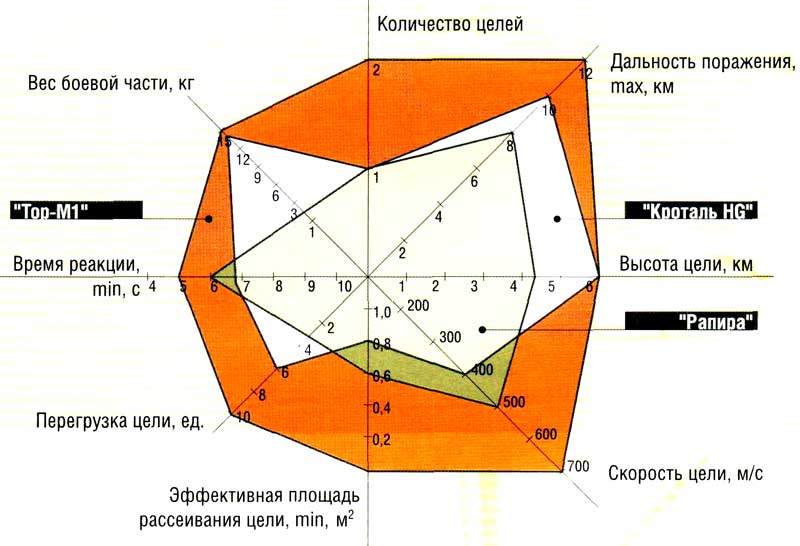
The closest foreign equivalent to the Tor, in function and operation, are systems like the British Rapier missile and French Crotale missile systems, which some consider to have somewhat less performance[11][12][13] than Tor (the other two systems being based on older equipment). All three systems are mobile and self-propelled, Tor using the 9A330 combat vehicle, which carries a crew of four (one driver, three operators), and acts as an autonomous Transporter, Launcher, And Radar unit, or TLAR (similar to but not a TELAR, as it does not erect the missile to a launch position). The 9A330 is based on the GM-355 chassis manufactured by MMZ, the Tor-M1 using the improved GM-5955.[14] It is equipped with NBC (nuclear, biological and chemical) protection. Like Rapier and Crotale, in addition to the tracked vehicle, there are also static and towed versions of the Tor, as well as a wheeled one. Mobility time is 3 minutes and it can be transported by any transport means (including aerial). The reaction time of the original Tor is 7–8 (standard) / 7–10 (if it is in motion) seconds.[5]
TLAR features
[edit]Arranged in a similar fashion to the previous 9K33 Osa (Russian: «Оса») and 9K22 Tunguska (Russian: «Тунгуска») air defense systems, Tor's TLAR features a turret with a top mounted target acquisition radar, and frontal tracking radar, with 8 ready to fire missiles stored vertically between the two radars. The target acquisition radar is an F band pulse doppler 3D radar, equipped with a truncated parabolic antenna, and a mechanically, later electronically, scanned in azimuth with a 32 degree sector view,[15] and has an average power output of 1.5 kW, which provides a maximum detection range of 25 kilometres (16 mi). For reference, a McDonnell Douglas F-15 at an altitude of 6 km has a detection probability of 0.8 at this range.[3] The electronic 'heart' of the system is a digital fire control system, which allows detection of up to 48 targets and the tracking of ten at any one time, and integrates IFF functionality; the IFF antenna being mounted above the search radar.[citation needed]
Radar
[edit]The target engagement radar is a G band/H band (later K band) pulse doppler radar with an (in azimuth) passive electronically scanned array antenna. The radar is classed as a thinned array (design using fewer elements) incorporating only 570 phase shifters and uses linear polarization.[15] The radar has an average power output of 0.6 kW providing a maximum detection range of 20 km/12 mi. An F-15 type aircraft had a detection probability of 0.8 at this range.[3] Originally Tor could only engage one target at a time, and with only two of its missiles. Later variants of the Tor system (Tor-M1 and M2E) incorporate additional fire control channels, as well as improved fire control computers, allowing the system to engage two (M1) and then four (M2E) targets, while simultaneously guiding up to four (M1) and then eight (M2E) missiles. There is also a small antenna on the top of the target engagement radar to communicate with missiles after launch.[citation needed] Together these radars carry the NATO reporting name "Scrum Half".[16] To reduce the dimensions of the vehicle, the target acquisition radar can be folded down horizontally when travelling, and the tracking radar can partially rotate away from vertical.[citation needed] To allow engagements in an ECM-heavy environment, the Tor missile system is equipped with an optical tracking system, complementing the main radar.[16]
Mobility
[edit]As a fully mobile system, the Tor is capable of acquiring and tracking targets while the TLAR is moving. Due to the interference with launch operations while in motion, missiles can be fired only when the system is stationary. Once set up, the reaction time (from target detection to engagement) is described as 5–8 seconds, depending on the variant; however, reaction time is somewhat longer (around 10 seconds) while in motion and firing in short halts. To facilitate this mode of operation, an auxiliary power unit (APU) is fitted so that the main engine can be shut down while the radar and missile system continue to operate when stationary, enabling long periods of readiness. The digital computers allowed for a higher degree of automation than any previous Soviet system of its type. Target threat classification is automatic and the system can be operated with little operator input, if desired.[citation needed]
Typical deployment
[edit]Typically, a battery of four Tor vehicles is accompanied by the mobile Ranzhir-M (Russian: "Ранжир-М") command center, which provides automatic interaction with the Tor, 9K33 Osa, 9K31 Strela-1, 2K22 Tunguska. It allows for efficient allocation of tasks between the individual Tor-M1 crews and allows each TLAR to be linked into a wider air defense system, thereby increasing target detection range and reducing reaction time.
Tor vehicles are accompanied by the mobile Polyana-D4, which provides automatic interaction with the Tor, Buk, 2K22 Tunguska, S-300V (integrates all functions of several different systems into a single whole + various air force aircraft + direct transfer of target designation).[17][18]
Tor-M1 receiving commands from Ranzhir-M / Polyana-D4 can shoot down targets in the range of 0–84 degrees.[5] Tor-M1 system (the time of creating the version, 1991[13]) can operate in a pair, then the angle of observation was 0–64 degrees (vertical).[5]
Combat vehicle of Tor missile system provides simultaneous detection of up to 48 targets.[4]
Missiles
[edit]| 9M330 | |
|---|---|
 Four 9M330 missiles in one of the two launching racks | |
| Type | Surface-to-air missile |
| Place of origin | Soviet Union |
| Service history | |
| In service | 1986–present |
| Used by | See list of operators |
| Production history | |
| Designer | Fakel |
| Designed | 1975 |
| Manufacturer | IEMZ Kupol |
| Produced | 1983 |
| Variants | 9M330, 9M331, 9M332, 9M338[19] |
| Specifications (9M331[20]) | |
| Mass | 167 kilograms (368 lb) |
| Length | 2,900 millimetres (110 in) |
| Diameter | 235 millimetres (9.3 in) |
| Wingspan | 650 millimetres (26 in) |
| Warhead | Frag-HE (fragmentation high explosives) |
| Warhead weight | 15 kilograms (33 lb) |
Detonation mechanism | RF Proximity |
| Propellant | Solid-fuel rocket |
Operational range | 12 kilometres (7.5 mi; 6.5 nmi)[citation needed] |
| Flight ceiling | 6,000 metres (20,000 ft) |
| Boost time | Cold launch ejection for 20 metres (66 ft) |
| Maximum speed | 850 metres per second (Mach 2.5) |
Guidance system | Radio command |
Steering system | Gas dynamic control system, with four control surfaces |
Launch platform | 9A331 combat vehicle |
| Transport | GM-569 tracked vehicle |
The rockets were developed for the interception of small, aggressively maneuvering targets.[4]
Weighing 167 kilograms (368 lb), the 9M330 missile is 3,000 millimetres (9.8 ft) long, carries a 15 kilograms (33 lb) warhead and has a peak speed of around Mach 2.8 (3,430 km/h; 2,130 mph). Using command guidance and radar controlled proximity fuzes, the missiles can maneuver at up to 30 g and engage targets flying at up to Mach 2 (2,500 km/h; 1,500 mph). Cold launched, the missiles are propelled out of the vehicle before the solid fuel rocket motor fires and the thrust vectoring system turns them toward their target. Missiles can also be fired against surface targets. Each missile is a sealed round, stored in two groups of four. Engagement range is up to 12 kilometres (7.5 mi; 6.5 nmi) with minimum range varying between 1,500–2,000 metres (4,900–6,600 ft), depending upon version and an effective altitude of 6–10,000 metres (20–32,808 ft).[citation needed]
A new 9M338 missile has been developed by Almaz Antey offering improved range and precision. Its smaller size also enables the modified Tor-M2 to be equipped with 16 missiles as opposed to the original 8.[19]
Variants
[edit]9K330 Tor
[edit]The project was given strict design specifications to meet; Tor had to provide extended detection and tracking of fast, low radar cross section targets and be capable of quickly and efficiently dealing with massed air raids, while providing a high degree of automation and integration with other air defence assets.[21] To meet these demanding specifications, the designers used a variety of new technologies, including advanced passive electronically scanned array radar for improved detection and tracking performance, enhanced digital information processing, and vertically launched missiles to improve reaction time and increase the number of readily available munitions. After testing and evaluation between December 1983 and December 1984, the land-based system was accepted into service on 19 March 1986.[22]
9K331 Tor-M1
[edit]"Tor-M1", introduced in 1991 with the 9M331 missile, with greatly improved missile accuracy[5] and the ability to engage two targets simultaneously, minimum range 1.5 km (0.93 mi), minimum height 10 metres (33 ft).[23]
Even while the Tor was being introduced into service, work started on improving the system, resulting in an enhanced version, the Tor-M1. Many improvements over the original system were made; these included the addition of a second fire control channel, allowing two targets to be engaged at once; as well as upgrades to the optical tracking system and computer equipment. ECM protection and warhead design were also modified, as was the ammunition handling system.[21] State tests, conducted between March and December 1989,[3] showed that the result was a system which could engage more targets in a shorter time frame with reaction times reduced by over a second and an increased probability of target destruction.[3] Further modifications occurred partly as a response of insight gained from the 1995 NATO bombing in Bosnia and Herzegovina resulting in the Tor-M1-1, or Tor-M1V, which offered improved network connectivity and ECM functions[3][21] as well as protection against countermeasures.
In 1993 Tor, in the test conditions reflecting targets employing defensive countermeasures, repeatedly downed small-sized rockets (similar to the much later and static complexes Iron Dome 1 target) with a 100% success rate.[24] In comparison, Tor-M2E achieved a 100% rate in 2009,[25] Tor-M2 a 100% rate in 2013 (10 km),[26] and Tor-M2 a 100% rate in 2014,[27] all in heavy ECM environments against four simultaneous small, high-speed targets.
9K332 Tor-M2E
[edit]
Upgrades have continued over the lifetime of the system, with developer Almaz Antey unveiling the next incarnation of the Tor missile system, the Tor-M2E, at the MAKS Airshow in 2007.[28]
This variant features:
- improved fire control radar coverage,
- four guidance channels, allowing up to four targets to be engaged simultaneously,
- protection against spoofing.[29]
Ammunition of the Tor-M2 includes 8 missiles 9M331 or 16 missiles 9M338 with increased altitude and range.[30] Tor-M2 missiles have a range of 16 km, maximum altitude of 10 km and maximum speed of 1000 m/s. The system is capable of short-stop firing, which takes 2–3 seconds for the system to go from motion to stationary and firing of the missile.[31][32]
The Tor-M2E is offered in either wheeled or tracked chassis and is equipped with a new digital computer system and all weather optical tracking system.[21] It is currently[as of?] produced at OJSC Izhevsk Electromechanical plant «Kupol».
- "Tor-M2E (9К332МE)" – with a 9А331МE tracked chassis mounting two 9M334 missile modules with four 9М9331 missiles.[33] Crew of 2. The system is fully automated.[34]
- "Tor-M2K (9К332МК)" – with a wheeled 9А331МК chassis developed by the Belarusian company «MZKT» mounting two 9M334 missile modules, each with four 9М9331 missiles.[35][36]
- "Tor-М2КМ (9К331МКМ)" – modular design (towed variant weight reduced to 15 tons), to accommodate various types of chassis. 9А331МК-1 TELAR mounting two 9M334 missile modules with four 9M9331 missiles. At MAKS-2013 this was shown on an Indian Tata chassis.[37][citation needed] The affected area expanded to height – 10 km, distance – 15.[38] Crew of 2. Chance to destroy any target 98% as a minimum.[clarification needed] Significantly improves the penetrating power of warhead fragments.[39] The system is fully automated.[34] Modules weighing 15 tons are installed on ships of the Russian Navy.[40]
Tor-M1-2U
[edit]"Tor-M1-2U" entered service at the end of 2012. This system is designed to destroy aircraft, helicopters, UAVs, missiles, and other precision guided weapons, flying at medium, low and very low altitudes in all weather. The system is able to engage four targets simultaneously at a height of up to 10 kilometers. Its crew consists of three people. [41][42] Deliveries are underway.[43] It can hit targets on the move,[44] at a speed of up to 25 km/h (includes all the necessary functions for independent fight).[45]
3K95 Kinzhal (naval variant)
[edit].JPEG)
The 3K95 "Kinzhal" (Russian: Кинжал – dagger) is the naval version of the Tor missile system developed by Altair and has the NATO reporting name SA-N-9 Gauntlet. Using the same 9M330 missile as the land based version, the system can be mounted on vessels displacing over 800 tonnes and is known to be installed on the Kuznetsov-class aircraft carrier, Kirov-class multimission cruisers, Udaloy-class anti-submarine destroyers and Neustrashimy-class frigates. The naval version of the later Tor-M1 is known as the "Yozh" (Russian: Ёж – hedgehog), while the export version of the Kinzhal is known as "Klinok" (Russian: Клинок – blade).
Despite starting testing earlier than its terrestrial counterpart, the naval variant, Kinzhal, had a more protracted development.[3] After an extended testing period using a Project 1124 Grisha-class corvette (including the engagement and destruction of four P-5 Pyatyorka (SSC-1a Shaddock) anti-ship missiles in 1986[46]) Kinzhal finally entered service in 1989.
Stored within rotary VLS modules, the missiles are clustered into launchers comprising three to six modules (32 (Neustrashimy), 64 (Udaloy) or 192 (Kuznetsov, Kirov) missiles) and mounted flush to the deck. Each module has up to eight missiles stored ready to fire; during firing the missile is cold launched using a gas catapult before the launcher brings the next round to a firing position.[47]

Fire control (FC) is handled by the 3R95 multi-channel FC system, (NATO reporting name Cross Swords), composed of two different radar sets, a G-band target acquisition radar (maximum detection range 45 km/28 mi,[47]) and a K band target engagement radar, that handles the actual prosecution of a target.
Using two top mounted, mechanically scanned, parabolic target acquisition radars, the fire control system provides a 360 degree field of view, as well as IFF. The target engagement radar is a passive electronically scanned array antenna of the reflection type mounted on the front of the fire control system with a 60 degree field of view.[46] Much like its land based sibling, the target engagement radar can track and guide eight missiles on up to four targets at once and is effective to a range of 1.5–12 km and an altitude of 10–6000 m.[47] The system is managed by a crew of 13.[47] Additional missile guidance antennae can be seen around the fire control system and the 3K95, like the upgraded Tor launchers, is equipped with a secondary infrared guidance system. The 3R95 can also provide fire control information for the vessels AK-630 close in weapons systems (CIWS) providing a second line of defence should anything penetrate the missile layer.[46]
Tor-M2KM
[edit]The Tor-M2 km is a self-contained fighting module version of the system that can be mounted in various locations. In October 2016, it was loaded onto the helipad of the Admiral Grigorovich frigate by means of an ordinary wharf crane and fixed in position with steel chains to fire at simulated cruise missiles while the ship was underway. This could give advanced SAM capabilities to vessels without the capacity to install the larger and heavier Kinzhal system; it can also be mounted on a truck, building roof, or any horizontal surface at least 2.5 m wide and 7.1 m long. The module weighs 15 tons and contains all equipment needed to operate without any external support. It can go from standby to full alert in 3 minutes and acquire 144 air targets while simultaneously tracking the 20 most dangerous ones marked for priority by the two-man crew. The Tor-M2 km missiles have a range of 15 km.[citation needed] In June 2022, it was installed on the helipad of the Vasily Bykov patrol boat. The system uses the new 9M331M surface-to-air missiles.[48] According to a Russian source, the system is being installed as of November 2023 on large landing ships of the Black Sea Fleet.[49]
Tor-M2DT
[edit]
The system is especially designed to be used for Arctic region at temperatures up to −50 degrees °C based on the chassis of the DT-30PM tracked all-terrain vehicle and is capable of detecting over 40 air targets, especially high-precision weapons, and to track and engage up to four of them simultaneously at a range of up to 12 km and altitudes up to 10 km with its 16 missiles even on the move. Its creation was completed in 2018 and the first delivery of 12 systems was held in November of the same year.[50][51][52] It was deployed in Ukraine in December 2022, with at least two systems being destroyed by Ukrainian artillery using M982 Excalibur shells by 3 February 2023 along with a DT-30.[53][54][55]
Tor-E2
[edit]JSC Rosoboronexport, part of the Rostec State Corporation, has started promoting the newest Tor-E2 SAM system developed and produced by the Almaz-Antey Air and Space Defence Concern in 2018. Tor-E2 combat vehicle is an independent, mobile, all-terrain fighting unit that provides detection and identification of air targets on the march and at the halt, target lock-on and engagement at the halt, from a short stop and on the move. A battery of the four-channel Tor-E2 SAM systems, consisting of four combat vehicles, can simultaneously engage up to 16 targets flying from any direction at a range of at least 15 km and an altitude of up to 12 km. Each vehicle carries 16 missiles, twice as many as the previous version of the Tor system. In addition, the two Tor-E2 combat vehicles can operate in the "link" mode, which enables them to exchange information about the air situation at different altitude ranges and coordinate joint engagement operations. In this mode, one of the combat vehicles, acting from an ambush, receives information from the other one and does not reveal itself until the launch of the missile. A command post can be attached to a battery of four Tor-E2 combat vehicles to control and coordinate the Tor combat vehicles and interact with the customer's air defense control system.[56]
HQ-17 (Chinese variant)
[edit]The HQ-17 is a Chinese development of the Tor-M1 system with a new chassis, IFF array, radar, and other electronics.[57]
In 1996, China ordered 14 Tor-M1 missile systems from Russia which were delivered under contract in 1997. In 1999, another contract for 13 Tor-M1 systems was signed between Russia and China. Delivery of the systems took place in 2000.[58]
FM-2000
[edit]The FM-2000 is a mobile short-range air-defence (SHORAD) system unveiled by China Aerospace Science and Industry Corporation at the 2018 Zhuhai Airshow and in service as of 2019.[citation needed] Its range is 15 km and engagement altitude is 10 km. It is carried on a 3 axle TEL.[59] It is a version of the HQ-17.[citation needed]
Dezful (Iranian variant)
[edit]The Dezful is an Iranian development of the Tor-M1 with upgrades that include installing a new thermal optical camera with the ability to operate day and night and replacing the older analog radio-electronic equipment with digital equivalents.[60] It has a range of 12 km and an altitude of 6 km
Combat history
[edit]Russo-Georgian War (2008)
[edit]In a press conference regarding the 2008 Russo-Georgian War, Russian defence ministry spokesperson Anatoliy Nogovitsyn speculated about the use of the Tor missile system by the Georgian Defence Forces against attacking Russian aircraft suggesting it as a possible cause of the loss of a Tu-22MR strategic bomber, shot down by Georgian air-defences while on a reconnaissance mission during the conflict.[61] Following analysis attributed the loss of the bomber to Georgian Buk-M1 system,[62] which Georgia obtained from Ukraine in 2007.[63]
Syrian War
[edit]Since 30 September 2015, Russian military forces have been directly involved in the Syrian Civil War. As part of the air defense, Tor-M2, along with the Pantsir-S1 point air defense system, has been deployed at the Khmeimim Air Base, allegedly, on multiple occasions proving to be superior to the Pantsir-S1 in countering UAV swarm attacks, the vehicles destroyed more than 45 improvised UAVs as of June 2020.[64][65]
On 9 April 2018, the Israeli Air Force reportedly destroyed a Tor system supplied by Iran along with a drone hangar at Syria's T-4 airbase. The system was not yet operational.[66]
Shoot-down of Ukraine International Airlines Flight 752
[edit]On 9 January 2020 it was reported by Newsweek that U.S. officials believed Ukraine International Airlines Flight 752 was shot down by an Iranian Tor-M1 missile, probably by accident.[67] Later that day, Canadian Prime Minister Justin Trudeau announced that there was credible allied and Canadian intelligence that an Iranian surface-to-air missile likely caused the loss of the Ukrainian airliner. He would not elaborate further on the intelligence.[68] Eliot Higgins of Bellingcat tweeted photographs of a Tor nose section with its distinctive canards, claimed to be taken at the crash site.[69][70] On 11 January 2020, Iran admitted that it had shot down the Ukrainian airliner due to human error but Iran didn't close the air space because of war situation,[71] and on 20 January, Iran's Civil Aviation Organization confirmed that "two Tor-M1 missiles [...] were fired at the aircraft."[72]
Worried about an Israeli strike, according to previous military intelligence, similar incidents happened before, with one in particular directly mentioning Iranian Revolutionary Guards Tor-M1 batteries firing a missile toward a civilian airliner by mistake in June 2007.[73]
2020 Nagorno-Karabakh War
[edit]On 9 November 2020, the Azerbaijan Ministry of Defence published a video showing the destruction of an Armenian Tor-M2 km system in the vicinity of Khojavend.[74] A drone tracked the vehicle as it parked inside a garage where it was subsequently struck by an IAI Harop "kamikaze" drone and multiple guided bombs.
2022 Russo-Ukrainian War
[edit]In 2022, Tor missiles are being used by the Russian armed forces during its invasion of Ukraine. Several systems were reportedly abandoned by the Russian army after being stuck in mud, some of them photographed by individuals.
On 29 September 2023, Ukrainian National Police recovered an undisclosed number of TOR missiles from a house in Brovary Raion, Kyiv Oblast. The missiles were believed to have been abandoned by Russian forces when they withdrew from the area in the spring of 2022. According to a Ukrainian official each missile was worth "about 30 million hryvnias (about $811,000).” The missiles were handed over to the Ukrainian Armed Forces.[75]
On 9 November 2023 Ukrainian forces claimed to have destroyed a Tor missile system using a first person view drone on the Kupiansk front.[76]
The Oryx website reports that Russia lost 60 different types of Tor systems during the war, as of October 3, 2024. The largest number, 30, is 9K332 Tor-M2 version.[77]
Operators
[edit]
Current
[edit] Algeria – Unknown number of M2K systems in service as of 2025[78]
 Armenia – Unknown number of systems in service as of 2025[79]
 Belarus – 21 Tor-M2E and 4 Tor-M2K systems in service as of 2025[80]
 China – 24 Tor-M1 as of 2025[81]
 Cyprus – 6 Tor-M1 as of 2025[82]
 Egypt – 10 Tor-M1 and 10+ Tor-M2E as of 2025[83]
 Greece – 21 Tor-M1 in service with the Army and 4 with the Air Force as of 2025[84]
 Iran – 29 Tor-M1 systems as of 2025[85]
 Libya - Several seen in a military parade in Benghazi in 2025 (in service of the Libyan National Army).[86]
 Russia – Estimated to have 120+ Tor M1/M2/M2U and 9 Tor M2DT in service as of 2025[87]
 Ukraine – Up to 6 systems in active service as of 2025[88]


Former
[edit] Artsakh − Seized by Azerbaijan after the 2023 Azerbaijani offensive in Nagorno-Karabakh.[89]
 East Germany Ordered as replacement for 2K21 Kub and 2K11 Krug. None delivered before Reunification.
 Georgia[90][91]
 India[92]
 Peru[92]
 Soviet Union – Passed on to successor states.


See also
[edit]References
[edit]- ^ "TOR M1 - Hellenic Air Force". Hellenic Air Force. Haf.gr. Retrieved 15 March 2022.
- ^ "Бублик" остроконечный (in Russian). RIA Novosti. 15 December 2005. Archived from the original on 7 October 2008. Retrieved 4 September 2008.
- ^ a b c d e f g h i "ЗЕНИТНЫЙ РАКЕТНЫЙ КОМПЛЕКС 9К330 "ТОР" (SA-15 Gauntlet)". Вестника ПВО (in Russian). 21 August 2007. Archived from the original on 17 August 2008. Retrieved 9 August 2008.
- ^ a b c "Российские зенитные ракетные комплексы "Тор" на международной авиационно- космической выставке "Аэрошоу Чайна – 2014"". dokwar.ru. Archived from the original on 29 March 2018. Retrieved 30 April 2018.
- ^ a b c d e "На вооружение войск ЮВО поступили новые ЗРС "Тор-М1-2У"". aftershock.su. Archived from the original on 6 November 2014. Retrieved 14 November 2014.
- ^ "Техника ПВО". russianguns.chat.ru/pvo.htm. Archived from the original on 1 October 2015. Retrieved 14 November 2014.
- ^ "Tor-M2U po raz pierwszy strzelał w marszu". konflikty.pl. 30 September 2015. Archived from the original on 1 October 2015. Retrieved 30 September 2015.
- ^ История. Алмаз-Антей (in Russian). 21 August 2007. Archived from the original on 16 September 2008. Retrieved 10 August 2008.
- ^ "Russian tech firm fine-tunes Tor air defense system to fight US-made HIMARS rockets".
- ^ Новости, Р. И. А. (28 February 2024). "Завод "Купол" начал модернизацию ЗРК "Тор"". РИА Новости (in Russian). Retrieved 30 March 2024.
- ^ "Количество целей" [Number of targets] (in Russian). Archived from the original on 6 November 2014. Retrieved 6 November 2014.
- ^ ""Бублики" вместо зонтика. Российская оборонка продолжает выпускать уникальное оружие". vpk.name. 9 January 2008. Archived from the original on 20 September 2017. Retrieved 30 April 2018.
- ^ a b "Зенитный ракетный комплекс 9К331 Тор-M1". Archived from the original on 6 November 2014. Retrieved 14 November 2014.
- ^ "GM-5955 Specifications". METROWAGONMASH. 11 August 2006. Archived from the original on 23 May 2007. Retrieved 10 August 2008.
- ^ a b Ganz, M.W.; Smith, J.K. (1996). "Russian microwave capabilities: A firsthand report". 1996 IEEE Aerospace Applications Conference. Proceedings. Vol. 4. pp. 67–76. doi:10.1109/AERO.1996.499403. ISBN 978-0-7803-3196-9. S2CID 123199495.
- ^ a b "[Actu] Le système anti-aérien Tor : actualités et développements futurs". Red Samovar. 14 April 2019.
- ^ "952 "-4"". Archived from the original on 15 July 2013. Retrieved 14 November 2014.
- ^ ""Поляна-Д4М1" (9С52М1), мобильная автоматизированная система управления зенитной ракетной бригадой (смешанной группировкой средств ПВО)". Archived from the original on 6 November 2014. Retrieved 14 November 2014.
- ^ a b Tamir Eshel (14 November 2013). "New Missile Enhances Russian TOR-M2 Air Defense Capabilities". Archived from the original on 15 November 2014. Retrieved 14 November 2014.
- ^ "9K331 Tor". Federation American Scientists. 3 September 2000. Archived from the original on 24 July 2008. Retrieved 13 July 2008.
- ^ a b c d Аналогов "Тору" не существует. ВОЕННО-ПРОМЫШЛЕННЫЙ КУРЬЕР (in Russian). ВПК-Медиа. 2007. Archived from the original on 6 June 2008. Retrieved 9 August 2008.
- ^ "Зенитный ракетный комплекс "Top"". Archived from the original on 6 November 2014. Retrieved 14 November 2014.
- ^ "Main defense product range - ?Almaz ? Antey? Corp". www.almaz-antey.ru. Archived from the original on 24 April 2013. Retrieved 6 June 2022.
- ^ "20 лет назад Вооруженные силы России потрясли мировое сообщество". 21 February 2013. Archived from the original on 6 November 2014. Retrieved 6 November 2014.
- ^ "ЗЕНИТНЫЙ РАКЕТНЫЙ КОМПЛЕКС "ТОР М2". AIR DEFENSE MISSILE COMPLEX TOR-M2". bastion-karpenko.narod.ru. Archived from the original on 6 November 2014. Retrieved 30 April 2018.
- ^ "ЗРК "Тор-М2" впервые показал свои боевые качества на полигоне в Полесье". rg.ru. 6 March 2014. Archived from the original on 1 May 2018. Retrieved 30 April 2018.
- ^ "ЗРК "Тор–М2КМ" показали стопроцентный результат на пусках в рамках тендера на экспорт". www.vz.ru. Archived from the original on 1 May 2018. Retrieved 30 April 2018.
- ^ ИЭМЗ "Купол" представит на "МАКС-2007" новую БМ ЗРС "ТОР-М2Э". ОАО "ИЭМЗ "Купол" (in Russian). 14 August 2007. Archived from the original on 5 March 2009. Retrieved 9 August 2008.
- ^ "Система ПВО малой дальности "Тор-М2Э"". Archived from the original on 12 March 2012. Retrieved 24 March 2012.
- ^ "ЗЕНИТНЫЙ РАКЕТНЫЙ КОМПЛЕКС "ТОР М2". AIR DEFENSE MISSILE COMPLEX TOR-M2". Archived from the original on 6 November 2014. Retrieved 14 November 2014.
- ^ "Создан высокоточный комплекс ПВО 'Тор-М2'". Archived from the original on 6 November 2014. Retrieved 14 November 2014.
- ^ "Разработчик: новейшая ракета для "Тор-М2" сбивает прямым попаданием". РИА Новости. 14 November 2013. Archived from the original on 6 November 2014. Retrieved 14 November 2014.
- ^ "Молодежная политика" (PDF). 20 September 2017. Archived from the original (PDF) on 20 September 2017. Retrieved 30 April 2018.
- ^ a b """ " ": ?". 20 June 2011. Archived from the original on 6 November 2014. Retrieved 14 November 2014.
- ^ "Купол" (PDF). www.kupol.ru. Archived from the original (PDF) on 2 November 2013.
- ^ "Вестник ПВО". pvo.guns.ru. Archived from the original on 1 November 2013.
- ^ "Advertising booklet of ADMS "Тор-М2КМ"" (PDF). Archived (PDF) from the original on 17 May 2017. Retrieved 22 May 2019.
- ^ "- .name". 6 May 2013. Archived from the original on 6 November 2014. Retrieved 14 November 2014.
- ^ "ЗРК семейства "Тор-М2"". 6 October 2013. Archived from the original on 6 November 2014. Retrieved 14 November 2014.
- ^ "ЗРК "Тор-М2КМ" в модульном исполнении". Archived from the original on 6 November 2014. Retrieved 14 November 2014.
- ^ "Войска ЮВО получили новые зенитно-ракетные системы "Тор-М1-2У"". РИА Новости. 27 November 2012. Archived from the original on 23 October 2014. Retrieved 14 November 2014.
- ^ "Antiaircraft troops in the South Military District fire "Tor" for the first time - Vestnik Kavkaza". 27 June 2011. Archived from the original on 22 October 2014. Retrieved 14 November 2014.
- ^ "Два зенитных ракетных дивизиона ВВО в Приморье перевооружены на ЗРК 'Тор-М2У' - Ракетная техника". rbase.new-factoria.ru. Archived from the original on 29 October 2017. Retrieved 30 April 2018.
- ^ "Концерн: "Алмаз-Антей" провел успешные стрельбы из ЗРК "Тор" в движении". tass.ru. Archived from the original on 29 October 2017. Retrieved 30 April 2018.
- ^ ntv.ru. "Минобороны опубликовало уникальные кадры экспериментальных ракетных пусков". НТВ. Archived from the original on 6 May 2018. Retrieved 30 April 2018.
- ^ a b c "КОРАБЕЛЬНЫЙ ЗЕНИТНЫЙ РАКЕТНЫЙ КОМПЛЕКС "КИНЖАЛ" (SA-N-9 GAUNTLET)". Вестника ПВО (in Russian). 12 December 2000. Archived from the original on 26 September 2008. Retrieved 14 August 2008.
- ^ a b c d "KLINOK Air Defence Missile System". Naval Systems Export Catalogue. Rosoboronexport. 2003. Archived from the original on 17 September 2008. Retrieved 14 August 2008.
- ^ "Russian patrol ship Vasily Bykov equipped with Tor-M2KM system". navyrecognition.com. 8 June 2022.
- ^ "Источник: черноморские БДК решили защитить комплексами "Тор-М2КМ"". Центральный Военно-Морской Портал (in Russian). 22 November 2023. Retrieved 24 November 2023.
- ^ "ЦАМТО / Новости / Военное представительство МО РФ завершило приемку первой серийной партии из 12 арктических комплексов "Тор-М2ДТ"". Archived from the original on 26 November 2018. Retrieved 26 November 2018.
- ^ "ЦАМТО / Новости / Олег Салюков в интервью «МК»: в этом году соединения и воинские части СВ получат более 2500 новых основных образцов ВВСТ". Archived from the original on 1 October 2018. Retrieved 3 October 2018.
- ^ "ЦАМТО / Новости / ИЭМЗ "Купол" досрочно поставил в войска новую партию ЗРК "Тор-М2"". Archived from the original on 24 November 2018. Retrieved 24 November 2018.
- ^ Dylan Malyasov (2 February 2023). "Russia lost its rare arctic air defense system in Ukraine". Retrieved 6 February 2023.
- ^ "Burning Like Hell! Ukraine Destroys Russia's 'Very Rare' TOR-M2DT Defense System; Kyiv Taunts By Saying 'Burned Brightly'". 4 February 2023. Retrieved 6 February 2023.
- ^ "Attack On Europe: Documenting Russian Equipment Losses During The Russian Invasion Of Ukraine". 24 February 2022. Retrieved 1 August 2023.
- ^ "Rosoboronexport Brings the Newest Tor-E2 SAM System to the World Market". Archived from the original on 20 September 2018. Retrieved 20 September 2018.
- ^ "HQ-17: A Classic Russian Missile With A New Chinese Twist". popsci.com. 24 April 2014. Archived from the original on 28 August 2017. Retrieved 30 April 2018.
- ^ "Russian Tor Missile System". Russia File Defence Brief. 8 December 2008. Archived from the original on 10 April 2015. Retrieved 13 July 2008.
- ^ "Janes | Latest defence and security news". Archived from the original on 10 November 2018. Retrieved 10 November 2018.
- ^ "سامانه پدافند هوایی متحرک دزفول را بیشتر بشناسید". iranpress.com. Retrieved 18 May 2025.
- ^ "Russia's Defence ministry spokesman press-conference (YouTube)". RussiaToday. 10 August 2008. Archived from the original on 4 August 2016. Retrieved 10 August 2008.
- ^ "Analysis: Georgia's Air Defence in the August War". 21 October 2008.
- ^ "Known Deliveries of Military Equipment to Georgia in 2000–2008". Moscow Defence Brief. Centre for Analysis of Strategies and Technologies. 2008. Archived from the original on 4 December 2008. Retrieved 15 January 2009.
- ^ "Russia deploys Tor-M2 to Syria - Jane's 360". www.janes.com. Archived from the original on 29 April 2018. Retrieved 30 April 2018.
- ^ "Can Russia's Pantsir Air-Defense System Handle Drone Swarms?". warisboring.com. 12 December 2018. Retrieved 17 January 2020.
- ^ Jones, Dion Nissenbaum and Rory (17 April 2018). "Israel Conferred With U.S. on Strike in Syria to Target Iranian War Gear". Wall Street Journal. ISSN 0099-9660. Archived from the original on 18 April 2018. Retrieved 9 September 2021.
- ^ Jamali, Naveed; Laporta, James; Da Silva, Chantal; O'Connor, Tom (9 January 2020). "Iranian Missile System Shot Down Ukraine Flight, Probably By Mistake, Sources Say". Newsweek.com. Newsweek. Retrieved 9 January 2020.
- ^ "Justin Trudeau says intelligence indicates that an Iranian missile took down the Ukrainian flight with 85 Canadians on board". Business Insider. 10 January 2020. Retrieved 10 January 2020.
- ^ @EliotHiggins (9 January 2020). "Tor anti-aircraft missile debris, supposedly from near the #PS752 crash site" (Tweet) – via Twitter.
- ^ "Iran plane crash: What's the evidence a missile shot down the Ukrainian plane?". BBC News Online. 10 January 2020.
- ^ "January 11 US-Iran news". 11 January 2020.
- ^ "Iran confirms it fired two missiles at Ukrainian plane". France 24. France Médias Monde. 21 January 2020. Retrieved 21 January 2020.
'Investigators... discovered that two Tor-M1 missiles... were fired at the aircraft,' Iran's Civil Aviation Organisation said in a preliminary report posted on its website late Monday.
- ^ Gordon, Michael R. (3 October 2012). "Wary of Israel, Iran is Said to Err in Strikes". The New York Times.
- ^ Archived at Ghostarchive and the Wayback Machine: "Cəbhənin Xocavənd istiqamətində düşmənin "Tor-M2KM" ZRK-sı vurulub". YouTube. 9 November 2020.
- ^ HOWARD ALTMAN (29 September 2023). "Stolen Surface-To-Air Missiles Found In Kyiv Garage". The War Zone. Retrieved 30 September 2023.
- ^ Dylan Malyasov (9 November 2023). "Ukraine's tiny drone blows up Russian Tor air defense system". Retrieved 10 November 2023.
- ^ Oryx team (3 October 2024). "Attack On Europe: Documenting Russian Equipment Losses During The Russian Invasion Of Ukraine". Retrieved 3 October 2024.
- ^ IISS 2025d, p. 330.
- ^ IISS 2025b, p. 168.
- ^ IISS 2025b, p. 173.
- ^ IISS 2025c, p. 242.
- ^ IISS 2025a, p. 79.
- ^ IISS 2025d, p. 336.
- ^ IISS 2025a, pp. 98−99.
- ^ IISS 2025d, p. 341.
- ^ "General Haftar scares Tripoli by revealing new advanced weapons to the world". Nova.News. 27 May 2025. Retrieved 28 May 2025.
- ^ IISS 2025b, p. 183.
- ^ IISS 2025b, p. 201.
- ^ Mitzer, Stijin; Oliemans, Joost. "Documenting Equipment Losses During The September 2023 Nagorno-Karabakh Conflict". Oryx. Retrieved 7 October 2023.
- ^ "Киев открещивается от поставок Грузии систем С-200 и "Тор"". Известия (in Russian). 12 August 2008. Archived from the original on 5 July 2015. Retrieved 20 May 2018.
- ^ "geo-army.ge". www.geo-army.ge. Archived from the original on 24 September 2015. Retrieved 30 April 2018.
- ^ a b O'Halloran & Foss 2002, p. 166.
Bibliography
[edit]- International Institute for Strategic Studies (11 February 2025). "Chapter Three: Europe". The Military Balance. 125 (1). Taylor & Francis: 52–151. doi:10.1080/04597222.2025.2445475. Retrieved 4 March 2025.
- International Institute for Strategic Studies (11 February 2025). "Chapter Four: Russia and Eurasia". The Military Balance. 125 (1). Taylor & Francis: 152–205. doi:10.1080/04597222.2025.2445476. Retrieved 4 March 2025.
- International Institute for Strategic Studies (11 February 2025). "Chapter Five: Asia". The Military Balance. 125 (1). Taylor & Francis: 206–311. doi:10.1080/04597222.2025.2445477. Retrieved 4 March 2025.
- International Institute for Strategic Studies (11 February 2025). "Chapter Six: Middle East and North Africa". The Military Balance. 125 (1). Taylor & Francis: 312–379. doi:10.1080/04597222.2025.2445478. Retrieved 4 March 2025.
- O'Halloran, James C.; Foss, Christopher F., eds. (2002). Jane's Land-Based Air Defense 2002-2003 (15th ed.). Janes Information Group. ISBN 978-0-7106-2437-6.
External links
[edit] Media related to Tor surface-to-air missile system at Wikimedia Commons
- Almaz-Antey, Tor Design Bureau
- Kupol, Tor Manufacturer
- Federation of American Scientists page Archived 24 July 2008 at the Wayback Machine
- Anti-Aircraft Missile System TOR-M1 Tutorial, includes technical description, specifications, and schematic, provided by the Ministry of Education and Science of the Russian Federation, Baltic State Technical University Voenmech