


Community hub
Recent from talks
Contribute something
Nothing was collected or created yet.
Yuzhno-Sakhalinsk
View on WikipediaYuzhno-Sakhalinsk (Russian: Ю́жно-Сахали́нск, IPA: [ˈjuʐnə səxɐˈlʲinsk] ⓘ, lit. 'South Sakhalin city') is a city and the administrative center of Sakhalin Oblast, Russia. It is located on Sakhalin Island in the Russian Far East, north of Japan.[10] Gas and oil extraction as well as processing are amongst the main industries on the island. The city was called Vladimirovka (Влади́мировка) from 1882 to 1905, then Toyohara (Japanese: 豊原市, Hepburn: Toyohara-shi) during its period of Imperial Japanese control from 1905 to 1946. As of the 2010 Census, its population was 181,728.[4]
Key Information


.svg)


History
[edit]Yuzhno-Sakhalinsk began as a small Russian settlement called Vladimirovka, founded by convicts in 1882.[2] The Treaty of Portsmouth in 1905, which brought an end to the Russo-Japanese War of 1904–1905, awarded the southern half of the Sakhalin Island to Japan. Vladimirovka was renamed Toyohara (meaning "bountiful plain"), and was the prefectoral capital of the Japanese Karafuto Prefecture.[11] During the Soviet–Japanese War within World War II, the city was recaptured by Soviet troops. Ownership of the city was transferred to the Soviet Union and it was renamed Yuzhno-Sakhalinsk. Town status was granted to it in 1946.[2]
-
 Early days of Vladimirovka
 -
 This Japanese D51 steam locomotive stands outside the Yuzhno-Sakhalinsk Railway Station
 -
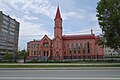 Catholic church in Yuzhno-Sakhalinsk


.JPG)
Administrative and municipal status
[edit].svg)
Yuzhno-Sakhalinsk is the administrative center of the oblast.[1] Within the framework of administrative divisions, it is, together with ten rural localities, incorporated as the city of oblast significance of Yuzhno-Sakhalinsk, an administrative unit with the status equal to that of the districts.[1] As a municipal division, the city of oblast significance of Yuzhno-Sakhalinsk is incorporated as Yuzhno-Sakhalinsk Urban Okrug.
Economy and infrastructure
[edit]Due to significant investment from oil companies like ExxonMobil and Shell, Yuzhno-Sakhalinsk has experienced substantial economic growth. Although this growth has primarily occurred in the northern part of the island, both companies maintain headquarters and residential complexes in the city of Yuzhno-Sakhalinsk itself. The demand for natural resources by the Japanese, Chinese, and South Koreans has ensured continued prosperity in the foreseeable future for the entire island.
There has been significant criticism, including from Presidential Envoy Kamil Iskhakov, that Sakhalin is not caring for its citizens. Despite sizable gas deposits and incoming investments from gas companies, the regional administration does not yet have plans for the installation of gas services on the island. However, several improvements in the city have been made and it continues to grow in various aspects every year.[12]
One of the very few remaining Japanese buildings in Yuzhno-Sakhalinsk now functions as the local museum. The building was designed in the Emperor's Crown Style by Japanese architect Yoshio Kaizuka, and completed in 1937.[13]
-
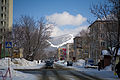 Central part of Yuzhno-Sakhalinsk
 -
 Yuzhno-Sakhalinsk museum during Japanese rule
 -
 Yuzhno-Sakhalinsk museum in 2012


Transportation
[edit]The city hosts the head office of Aurora Airline, subsidiary of Aeroflot. It is served by the Yuzhno-Sakhalinsk Airport. The city is also the hub for the island's narrow gauge railway network that underwent conversion to Russian broad gauge in August 2019.[14] In addition to railways, the town is also a hub for roadways, such as the A-391 (which travels south to Korsakov) and the A-392 (which travels west to Kholmsk).
Due to restrictions, foreigners wishing to leave Yuzhno-Sakhalinsk in order to travel to any other part of the Sakhalin Oblast and its internal and territorial waters are required to seek permission from the Federal Security Service (FSB) and the Border Guard. Scuba diving and recreating on the seacoast is permitted only in places defined by the Border Guard.[15]
-

-

-
 Airbus A319 of Aurora Airline
 -
 Toyohara Avenue


.JPG)
Education
[edit]Institutes of elementary and middle education included Sakhalin International School until its closure in March 2022.
Institutes of higher education in the city include Sakhalin State University and Yuzhno-Sakhalinsk Institute of Economics, Law and Informatics. There are also some branches of other universities:
- Yuzhno-Sakhalinsk institute (branch) of Russian State trade-economics university
- Branch of Far East State university of railways
- Branch of Modern Academy of the humanities
- Branch of The Pacific State economics university
- Branch of Russian economics academy named after G.V. Plekhanov
- Branch of Far East law institute
Sport
[edit]There exist numerous sport venues and clubs in Sakhalin. FC Sakhalin Yuzhno-Sakhalinsk, PSK Sakhalin, Vostok-65, Sakhalin Sharks, Sakhalin for football,[16] hockey, basketball,[17] youth hockey and volleyball[18] respectively. Mount Bolshevik provides the Gorny Vozdukh ("Mountain Air") ski resort which is qualified for international competitions.[19]
-
 PSK Sakhalin players in Crystal Ice Palace
 -
 Spartak Stadium of FC Sakhalin Yuzhno-Sakhalinsk
 -
 Gorny Vozdukh ski resort
 -
 Ski lifts of Gorny Vozdukh ski resort
 -
 Arena City Ice Palace


Media
[edit]Television
[edit]- 3 - 1TV Russia
- 5 - Rossiya-24 (Russia-24)
- 10- Rossiya-1 (Russia-1)
- 12 - ASTV (Alternative Sakhalin Television)
- 21 - The first multiplex digital TV DVB T2
- 23 - Che
- 27 - Domashny / OTV (Sakhalin Regional Television)
- 30 - NTV Russia
- 33 - STS
- 35 - Ren-TV / Echo of Sakhalin
- 43 - Match TV Russia (ex. Russia-2)
- 46 - Petersburg–Channel 5
- 49 - Rossiya-K (Russia-K)
- 51 - The second multiplex of digital TV DVB T2
Radio
[edit]- 87,9 Autoradio (plan)
- 88,3 Retro FM
- 88,9 Radio Record
- 89,9 Russian Radio
- 101,7 Radio Chanson
- 102,5 Europa Plus
- 102,9 Humor FM
- 103,5 Mayak
- 104,4 Love Radio
- 105,1 Radio Dacha (plan)
- 105,5 Radio ASTV
- 106,0 Radio Rossii
- 106,5 Dorognoe Radio
- 107,2 Vesti FM
Demographics
[edit]| Year | Pop. | ±% |
|---|---|---|
| 1959 | 85,510 | — |
| 1970 | 105,840 | +23.8% |
| 1979 | 139,861 | +32.1% |
| 1989 | 159,299 | +13.9% |
| 2002 | 175,085 | +9.9% |
| 2010 | 181,728 | +3.8% |
| 2021 | 181,587 | −0.1% |
| Source: Census data | ||
Population
[edit]Most residents are ethnic Russians, but there also exists a sizable population of Korean Russians. Of the 43,000 Sakhalin Koreans, half are estimated to live in Yuzhno-Sakhalinsk, comprising roughly 12% of the city's population. A smaller number of indigenous minorities, such as Ainu, Nivkhs and Oroks can be found.
Religion
[edit]The majority of the population are Russian Orthodox.
Geography
[edit]The city is located on the Susuya River. It is the largest city on the island, and the only one with more than 100,000 inhabitants. The straight-line distance to Moscow is 6,660 kilometers (4,140 mi).
Climate
[edit]The climate is humid continental (Köppen Dfb) with mild summers and cold winters. Maritime influences can be seen in that precipitation is much higher than in interior Russia and that summers are distinctly cooler than in Khabarovsk or Irkutsk, while winters are much milder. Summers are frequently foggy, reducing the amount of sunshine. Considering its southerly maritime position winters are very cold, albeit warmer than expected for surrounding inland areas affected by the Siberian High. Snowfall is more frequent than in those areas, due to said maritime influence bringing moisture to the coastline. Yuzhno-Sakhalinsk is relatively sunny compared to Hokkaido locations, but gloomy by the lower latitudes of the Russian Far East's standards.
| Climate data for Yuzhno-Sakhalinsk (1991–2020, extremes 1942–present) | |||||||||||||
|---|---|---|---|---|---|---|---|---|---|---|---|---|---|
| Month | Jan | Feb | Mar | Apr | May | Jun | Jul | Aug | Sep | Oct | Nov | Dec | Year |
| Record high °C (°F) | 4.3 (39.7) |
7.1 (44.8) |
13.0 (55.4) |
22.9 (73.2) |
29.6 (85.3) |
30.8 (87.4) |
34.4 (93.9) |
34.7 (94.5) |
29.0 (84.2) |
23.5 (74.3) |
18.1 (64.6) |
9.0 (48.2) |
34.7 (94.5) |
| Mean maximum °C (°F) | 0.8 (33.4) |
2.8 (37.0) |
6.8 (44.2) |
16.0 (60.8) |
23.7 (74.7) |
26.3 (79.3) |
28.0 (82.4) |
28.9 (84.0) |
25.9 (78.6) |
19.7 (67.5) |
12.4 (54.3) |
3.9 (39.0) |
29.8 (85.6) |
| Mean daily maximum °C (°F) | −6.0 (21.2) |
−4.8 (23.4) |
0.2 (32.4) |
6.9 (44.4) |
13.8 (56.8) |
17.7 (63.9) |
21.0 (69.8) |
22.3 (72.1) |
19.4 (66.9) |
12.5 (54.5) |
3.5 (38.3) |
−3.5 (25.7) |
8.6 (47.5) |
| Daily mean °C (°F) | −11.5 (11.3) |
−11.2 (11.8) |
−5.2 (22.6) |
1.7 (35.1) |
7.5 (45.5) |
11.9 (53.4) |
15.9 (60.6) |
17.3 (63.1) |
13.5 (56.3) |
6.7 (44.1) |
−1.2 (29.8) |
−8.5 (16.7) |
3.1 (37.6) |
| Mean daily minimum °C (°F) | −16.6 (2.1) |
−17.2 (1.0) |
−10.4 (13.3) |
−2.6 (27.3) |
2.7 (36.9) |
7.7 (45.9) |
12.3 (54.1) |
13.5 (56.3) |
8.7 (47.7) |
1.8 (35.2) |
−5.2 (22.6) |
−13.2 (8.2) |
−1.5 (29.3) |
| Mean minimum °C (°F) | −27.3 (−17.1) |
−27.3 (−17.1) |
−22.2 (−8.0) |
−10.4 (13.3) |
−2.6 (27.3) |
1.7 (35.1) |
6.6 (43.9) |
6.8 (44.2) |
0.6 (33.1) |
−5.3 (22.5) |
−14.8 (5.4) |
−22.5 (−8.5) |
−28.5 (−19.3) |
| Record low °C (°F) | −36.2 (−33.2) |
−34.8 (−30.6) |
−30.5 (−22.9) |
−19.5 (−3.1) |
−6.2 (20.8) |
−2.1 (28.2) |
1.3 (34.3) |
3.6 (38.5) |
−4.2 (24.4) |
−11.8 (10.8) |
−25.7 (−14.3) |
−33.5 (−28.3) |
−36.2 (−33.2) |
| Average precipitation mm (inches) | 56 (2.2) |
38 (1.5) |
52 (2.0) |
57 (2.2) |
66 (2.6) |
64 (2.5) |
92 (3.6) |
107 (4.2) |
102 (4.0) |
102 (4.0) |
75 (3.0) |
71 (2.8) |
882 (34.7) |
| Average rainy days | 0 | 0 | 2 | 10 | 17 | 17 | 20 | 19 | 19 | 19 | 9 | 2 | 135 |
| Average snowy days | 25 | 24 | 24 | 13 | 3 | 0 | 0 | 0 | 0 | 4 | 20 | 27 | 140 |
| Average relative humidity (%) | 81 | 79 | 76 | 75 | 76 | 83 | 85 | 86 | 83 | 79 | 80 | 82 | 80 |
| Average dew point °C (°F) | −15 (5) |
−14 (7) |
−9 (16) |
−2 (28) |
3 (37) |
9 (48) |
13 (55) |
15 (59) |
10 (50) |
3 (37) |
−4 (25) |
−11 (12) |
0 (32) |
| Mean monthly sunshine hours | 133.3 | 155.9 | 190.6 | 197.1 | 208.0 | 186.5 | 164.0 | 165.1 | 188.8 | 167.4 | 116.3 | 112.4 | 1,985.4 |
| Source 1: Pogoda.ru.net[20] | |||||||||||||
| Source 2: NOAA,[21] Time and Date (dewpoints 1985–2015)[22] Infoclimat [23] | |||||||||||||
Notable people
[edit]- Natalya Pechonkina (maiden name Burda, later Chistyakova); born July 15, 1946, Yuzhno-Sakhalinsk) is a Soviet athlete. She competed for the USSR in the 1968 Summer Olympics held in Mexico City in the 400 metres where she won the bronze medal.
- Alexander Godunov; born November 28, 1949, died May 18, 1995, was a Russian-American ballet dancer and film actor.
Twin towns and sister cities
[edit]Yuzhno-Sakhalinsk is twinned with:


References
[edit]Notes
[edit]- ^ a b c d e f g Law #25-ZO
- ^ a b c "Южно-сахалинск - Исторический словарь - Словари и Энциклопедии". Archived from the original on September 12, 2017. Retrieved June 5, 2016.
- ^ Сергей Надсадин вступил в должность мэра Южно-Сахалинска. astv.ru (in Russian). Archived from the original on December 27, 2015. Retrieved December 26, 2015.
- ^ a b Russian Federal State Statistics Service (2011). Всероссийская перепись населения 2010 года. Том 1 [2010 All-Russian Population Census, vol. 1]. Всероссийская перепись населения 2010 года [2010 All-Russia Population Census] (in Russian). Federal State Statistics Service.
- ^ "26. Численность постоянного населения Российской Федерации по муниципальным образованиям на 1 января 2018 года". Federal State Statistics Service. Retrieved January 23, 2019.
- ^ a b Law #524
- ^ "Об исчислении времени". Официальный интернет-портал правовой информации (in Russian). June 3, 2011. Retrieved January 19, 2019.
- ^ Почта России. Информационно-вычислительный центр ОАСУ РПО. (Russian Post). Поиск объектов почтовой связи (Postal Objects Search) (in Russian)
- ^ Телефонные коды Сахалина - Dialing codes of Sakhalin (in Russian)
- ^ "Where is Yuzhno-Sakhalinsk, Russia?". WorldAtlas. Retrieved September 25, 2018.
- ^ Amano, Naoki. "Sakhalin/Karafuto". Oxford University Press. Retrieved May 11, 2024.
- ^ "Сахалинская область заняла 7 место в рейтинге качества жизни" [Sakhalin Oblast took 7th place in the quality of life rating]. ASTV. January 24, 2025.
- ^ "Sakhalin Regional Museum".
- ^ "Российская колея по всему Сахалину: движение открыто".
- ^ Freedom of movement for foreigners on Sakhalin restricted
- ^ "О клубе".
- ^ "Суперлига. Сергей Гришаев назначен новым главным тренером "Сахалина"". January 27, 2017.
- ^ "Глава Сахалинской области просит допустить ВК "Сахалин" к участию в Суперлиге / Россия - Женская лига / VolleyballNews.ru: Все новости волейбола".
- ^ "Gorny Vozdukh (Mountain Air)".
- ^ "Weather and Climate-The Climate of Yuzhno-Sakhalinsk" (in Russian). Weather and Climate (Погода и климат). Retrieved November 3, 2021.
- ^ "Juzno–Sahalinsk (Yuzhno-Sakhalinsk) Climate Normals 1991–2020". National Oceanic and Atmospheric Administration. Retrieved November 3, 2021.
- ^ "Climate & Weather Averages in Yuzhno Sakhalinsk, Russia". Time and Date. Retrieved January 10, 2022.
- ^ "Climatologie de l'année à Yuzhno-Sakhalinsk" (in French). Infoclimat. Retrieved October 3, 2023.
- ^ Владивосток новости - РИА Дейта.RU. deita.ru (in Russian).
Sources
[edit]- Сахалинская областная Дума. Закон №25-ЗО от 23 марта 2011 г. «Об административно-территориальном устройстве Сахалинской области», в ред. Закона №62-ЗО от 27 июня 2013 г. «О внесении изменения в статью 10 Закона Сахалинской области "Об административно-территориальном устройстве Сахалинской области"». Вступил в силу 9 апреля 2011 г.. Опубликован: "Губернские ведомости", №55(3742), 29 марта 2011 г. (Sakhalin Oblast Duma. Law #25-ZO of March 23, 2011 On the Administrative-Territorial Structure of Sakhalin Oblast, as amended by the Law #62-ZO of June 27, 2013 On Amending Article 10 of the Law of Sakhalin Oblast "On the Administrative-Territorial Structure of Sakhalin Oblast". Effective as of April 9, 2011.).
- Сахалинская областная Дума. Закон №524 от 21 июля 2004 г. «О границах и статусе муниципальных образований в Сахалинской области», в ред. Закона №45-ЗО от 27 мая 2013 г. «О внесении изменения в Закон Сахалинской области "О границах и статусе муниципальных образований в Сахалинской области"». Вступил в силу 1 января 2005 г. Опубликован: "Губернские ведомости", №175–176(2111–2112), 31 июля 2004 г. (Sakhalin Oblast Duma. Law #524 of July 21, 2004 On the Borders and Status of the Municipal Formations in Sakhalin Oblast, as amended by the Law #45-ZO of May 27, 2013 On Amending the Law of Sakhalin Oblast "On the Borders and Status of the Municipal Formations in Sakhalin Oblast". Effective as of January 1, 2005.).
External links
[edit]
- Official website of Yuzhno-Sakhalinsk
- Yuzhno-Sakhalinsk: City's History in Architecture
- Yuzhno-Sakhalinsk Blizzard Photos[permanent dead link]
| International | |
|---|---|
| National | |
| Geographic | |
| Other | |
Yuzhno-Sakhalinsk
View on GrokipediaYuzhno-Sakhalinsk is the administrative center and largest city of Sakhalin Oblast, a federal subject of Russia in the Far East, situated on the southern portion of Sakhalin Island approximately 25 kilometers inland from the Sea of Okhotsk.[1][2] With a population of about 201,700 residents as of 2022, the city functions as the primary economic and transportation hub for the region, bolstered by its proximity to major offshore oil and natural gas fields developed through projects such as Sakhalin-2.[1][3]
Originally established in 1883 as the penal settlement Vladimirovka under Russian administration, the city was ceded to Japan following the Russo-Japanese War of 1904–1905 and renamed Toyohara, serving as the capital of Karafuto Prefecture until Japan's defeat in World War II in 1945, after which Soviet forces incorporated it and redesignated it Yuzhno-Sakhalinsk in 1946.[1][2] The city's temperate monsoon climate features cold winters with average January temperatures around -12.2°C and mild summers peaking at 17.3°C in August, alongside frequent seismic activity due to its position in a tectonically active zone.[1] Economically, Yuzhno-Sakhalinsk benefits from the oblast's substantial hydrocarbon reserves, which have elevated regional per capita GDP significantly above the national average, though the local economy also encompasses fishing, forestry, and emerging tourism centered on natural attractions and historical sites blending Russian and preserved Japanese-era architecture.[1][4]
Geography
Location and Physical Features
Yuzhno-Sakhalinsk is situated in the southern central part of Sakhalin Island, Sakhalin Oblast, Russian Federation, at geographic coordinates 46°57′N 142°44′E.[5] The city occupies the Susunai Lowland, a flat alluvial plain formed by ancient river deposits, named after the Ainu term "susunai" denoting an osier-bed river.[6] This lowland extends across southern Sakhalin, providing a relatively level terrain at elevations of 10–15 meters above sea level, contrasting with the surrounding rugged mountain systems. The Susunai Lowland is bordered by the East Sakhalin Mountains to the east and the West Sakhalin Mountains to the west, part of the island's dominant north-south trending orogenic belts that rise to over 1,000 meters in elevation nearby.[7] Small rivers, including tributaries of the Susunai River, traverse the plain, supporting the city's water resources and contributing to its hydrological features.[6] The urban area spans approximately 150 square kilometers, with development concentrated on the lowland while extending slightly into adjacent foothills, facilitating infrastructure like roads and railways amid the insular geography.[8] Sakhalin Island itself lies separated from the Eurasian mainland by the Tatar Strait, approximately 7–40 kilometers wide, underscoring the city's remote Pacific insular position.[9]
Climate and Environmental Conditions
Yuzhno-Sakhalinsk has a humid continental climate (Köppen Dfb), marked by pronounced seasonal variations with long, cold winters and short, cool summers influenced by its subarctic latitude and proximity to the Sea of Okhotsk. The average annual temperature is 2.6 °C, with extremes ranging from lows of -26 °C in winter to highs of 27 °C in summer. January averages -12.6 °C, featuring daytime highs around -6.7 °C and significant snowfall, while August, the warmest month, averages 17.3 °C with nighttime lows near 13.6 °C.[10][11][12] Precipitation averages 864 mm annually, occurring on about 135 days, with relatively even distribution but peaks in late summer from Pacific typhoons and winter snow accumulation exceeding 1 meter in depth. The city receives around 1.5 inches in the driest month (February) and up to 4.5 inches in August, contributing to humid conditions year-round. Fog is common in coastal areas, and strong winds accompany seasonal storms.[11][13] The region lies in a seismically active zone along the Pacific Ring of Fire, with Sakhalin Oblast experiencing approximately 447 earthquakes of magnitude 1 or greater per year, including frequent moderate events that can trigger landslides. Notable historical quakes include the 1995 Neftegorskoe event (Mw 7.6), which caused significant damage and displacement near oil fields, and the 2007 Mw 8.1 Kuril Islands earthquake affecting Sakhalin. Tsunami risks persist due to offshore subduction zones, though Yuzhno-Sakhalinsk's inland position mitigates direct wave impacts.[14][15] Environmental conditions are shaped by surrounding taiga forests, rivers, and coastal wetlands supporting biodiversity, but challenged by offshore oil and gas operations like Sakhalin II, which have led to documented oil spills impacting Pacific salmon populations and habitats. These projects threaten endangered species, including the western gray whale, through dredging, noise pollution, and potential ecosystem disruption, prompting protests from indigenous groups over traditional resource access. Efforts to address emissions include Sakhalin Oblast's 2025 carbon neutrality initiative, involving quotas and reductions among 35 companies, though critics question enforcement amid ongoing extraction.[8][16][17][18][19]History
Early Settlement and Indigenous Presence
The site of present-day Yuzhno-Sakhalinsk in southern Sakhalin Island was long inhabited by the Ainu, an indigenous people with ancestral ties to ancient Jomon-period populations of the Japanese archipelago and adjacent regions, including Sakhalin.[20][21] Archaeological and genetic data indicate Ainu occupation of southern Sakhalin for millennia, characterized by small, kin-based communities engaged in hunting marine mammals, fishing salmon runs, and gathering wild plants.[22] These groups, referred to as Enchiw in local Ainu dialects, maintained semi-sedentary lifestyles along coastal and riverine areas, with evidence of trade networks extending to Hokkaido and the Kuril Islands.[22] While Ainu dominated the south, interactions occurred with neighboring indigenous groups such as the Uilta (Oroks), a Tungusic-speaking people focused on reindeer herding in central and eastern Sakhalin, and the Nivkh (Gilyaks), who primarily occupied the northern island and Amur River estuary but ventured south for seasonal fishing and hunting.[20] Pre-colonial populations were sparse, with Ainu numbers in southern Sakhalin estimated in the hundreds to low thousands based on ethnographic accounts and limited archaeological site densities, reflecting the island's harsh subarctic environment and resource constraints.[20] European contact, beginning with Dutch explorer Maarten Gerritsz Vries's sighting of Sakhalin in 1643, introduced indirect influences, but systematic Russian reconnaissance only accelerated after 1800, mapping the island's contours amid imperial rivalries with Japan and China.[23] The first non-indigenous permanent settlement in the Yuzhno-Sakhalinsk area emerged in 1882 with the founding of Vladimirovka, a Russian penal outpost established near the existing Korsakov administrative post to house convicts, exiles, and overseers as part of broader colonization under the 1875 Treaty of Saint Petersburg, which formalized Russian sovereignty over the entire island.[6][8] This outpost, initially comprising rudimentary barracks and administrative structures, grew slowly amid Sakhalin's designation as a site for hard labor since 1869, with settlers relying on fishing, limited agriculture, and convict labor for infrastructure. Indigenous Ainu presence persisted in surrounding areas, though encroachment and disease began eroding traditional communities by the late 19th century.[20] By 1900, Vladimirovka's population numbered around 100-200, primarily Russians and other Europeans, setting the stage for further demographic shifts following the Russo-Japanese War.[6]Imperial Russian and Japanese Eras (19th-20th Century)
The settlement known as Vladimirovka was founded in 1882 as a convict village within the Russian Empire's penal colony on Sakhalin Island.[24] Established amid efforts to colonize and administer the remote territory, it functioned as a modest outpost for exiles and prisoners, reflecting Sakhalin's role as a harsh penal settlement.[25] By 1899, the island's total population stood at 31,884, with prisoners comprising 21,667 or approximately 68% of inhabitants, underscoring the dominance of forced labor in early development; Vladimirovka itself remained a small, underdeveloped hamlet with limited infrastructure.[25] Vladimirovka's growth was curtailed by the Russo-Japanese War (1904–1905), which ended with Japan's victory and the Treaty of Portsmouth on September 5, 1905, ceding southern Sakhalin (south of 50° N latitude) to Japan.[26] The Japanese promptly occupied the area, renaming the settlement Toyohara and integrating it into their colonial framework. In March 1907, Japan formalized control by establishing Karafuto Prefecture (Karafuto-chō), with Toyohara designated as the administrative capital.[27] Under Japanese rule, Toyohara transformed from a peripheral Russian outpost into a burgeoning colonial city, benefiting from systematic investment in resource extraction and urbanization. Authorities prioritized infrastructure such as railways, roads, and ports to facilitate timber, coal mining, and fisheries industries, which formed the economic backbone of Karafuto.[26] [28] The prefecture's population surged threefold from 105,899 in 1920 to 295,196 in 1930, fueled by incentives attracting Japanese settlers from the mainland; Toyohara, as the central hub, absorbed much of this expansion, developing administrative offices, schools, hospitals, and cultural sites including museums.[28] By the mid-1930s, Karafuto's overall population exceeded 300,000—roughly ten times the Russian-era figure—reflecting aggressive colonization policies amid escalating militarization.[29] This era marked Toyohara's peak as a planned Japanese-style urban center, though indigenous Ainu and remaining Russian populations faced marginalization in the drive for assimilation and exploitation.[28]World War II Aftermath and Soviet Incorporation
The Soviet Union declared war on Japan on August 8, 1945, in accordance with agreements reached at the Yalta Conference earlier that year, which stipulated the return of southern Sakhalin (Karafuto) to Soviet control upon Japan's defeat. Soviet forces, primarily from the 65th Army's 88th Rifle Division and supported by the 214th Tank Brigade, launched the invasion of southern Sakhalin on August 11, advancing from the northern Soviet-held portion of the island across the narrow Tym-Poronaysky Isthmus. Toyohara, the administrative capital of Japanese Karafuto Prefecture, fell to Soviet troops on August 24, 1945, without significant resistance, marking the effective end of organized Japanese defenses in the region. By August 25, Soviet units had secured the city and surrounding areas, capturing approximately 18,320 Japanese soldiers and officers across southern Sakhalin.[30][31] Following the occupation, southern Sakhalin was formally annexed by the Soviet Union and integrated into the Russian Soviet Federative Socialist Republic as Sakhalin Oblast, with Toyohara redesignated Yuzhno-Sakhalinsk serving as its administrative center by April 1946. The Potsdam Declaration of July 1945 implicitly endorsed this transfer by affirming Soviet territorial claims in the Kuril Islands and Sakhalin, though Japan contested the annexation of the southern Kurils; southern Sakhalin itself faced no immediate international challenge. Soviet authorities rapidly Russified the territory, retaining much of the Japanese-built infrastructure—such as railways, ports, and administrative buildings—while imposing centralized planning and resource extraction focused on coal, timber, and fisheries to support postwar reconstruction.[32] The Japanese population of southern Sakhalin, estimated at around 400,000 civilians and military personnel prior to the invasion, underwent forced repatriation amid initial Soviet efforts to detain and utilize them for labor in reconstruction projects. Official repatriation commenced after the U.S.-USSR Repatriation Agreement of November 1946, with the bulk of Japanese civilians and demobilized troops returning to Japan between 1947 and 1950, though delays, internments, and deaths from disease and hardship reduced the number who survived the process. Soviet policy also addressed the approximately 40,000-50,000 Korean residents—many conscripted by Japan for wartime labor—who were granted Soviet citizenship en masse in 1947, preventing their repatriation to Korea and integrating them into the local workforce, though this left a legacy of statelessness for some descendants until later reforms. Concurrently, Soviet settlers, primarily ethnic Russians, Ukrainians, and Belarusians from the mainland, were incentivized to migrate to the oblast, shifting the demographic composition toward Slavic majorities by the early 1950s and establishing Yuzhno-Sakhalinsk as a key hub for Soviet Far Eastern administration.[33][34][35]Post-Soviet Economic Transformation
Following the dissolution of the Soviet Union in 1991, Sakhalin Oblast, including Yuzhno-Sakhalinsk, underwent a sharp economic downturn characteristic of Russia's transition from central planning to a market system, with industrial production collapsing by over 30% in the early 1990s due to the loss of state subsidies, hyperinflation, and disruptions in supply chains for legacy sectors such as coal extraction and fisheries.[36] Unemployment surged, and traditional industries that had dominated the Soviet-era economy—accounting for much of the oblast's output—faced chronic underinvestment and declining demand, exacerbating poverty and out-migration from the region.[4] The turnaround began with the negotiation of production-sharing agreements (PSAs) for offshore hydrocarbon projects, including Sakhalin-II in 1994 and Sakhalin-I in 1995, which facilitated foreign direct investment from consortia led by companies like ExxonMobil, Shell, Mitsui, and Mitsubishi, injecting capital and technology into previously underdeveloped fields.[37] First oil production from Sakhalin-II's Phase 1 commenced in 1999 using the Molikpaq platform, enabling initial exports via tanker and marking the onset of a resource-led boom that reversed prior declines.[38] These projects shifted the oblast's economic base toward hydrocarbons, with oil and gas comprising 57.5% of industrial output by 2000 and escalating to 80% by 2006 amid rising global energy prices.[4] Yuzhno-Sakhalinsk, as the administrative center, benefited disproportionately as a service and logistics hub for the projects, hosting corporate offices, engineering firms, and expatriate workers, which spurred construction of pipelines, roads, and port facilities extending from the city southward.[3] The energy influx drove population growth from approximately 156,000 in 1990 to over 190,000 by 2010, fueled by in-migration of skilled labor and higher wages in extractive industries that outpaced national averages.[3] Completion of Sakhalin-II's Phase 2, including the world's largest LNG plant near Korsakov in 2009, further entrenched this transformation, generating substantial fiscal revenues through royalties and taxes that funded local infrastructure while heightening the region's dependence on volatile commodity cycles.[37]Governance and Administration
Municipal Structure and Local Government
Yuzhno-Sakhalinsk is organized as an urban municipal district within Sakhalin Oblast, where local self-government is exercised through a dual structure of the City Duma as the representative legislative body and the executive administration led by the mayor.[6] The City Duma holds powers to approve the municipal budget, enact local normative acts, represent resident interests, and oversee executive activities.[39] The City Duma comprises 25 deputies elected by direct vote of residents in single-mandate electoral districts for five-year terms, with the most recent elections occurring on September 6–8, 2024, for the seventh convocation.[40][41] Following the election, the Duma appoints the mayor, who heads the executive branch. Sergey Nadsadin has served as mayor since at least 2018, securing a third term unanimously on September 12, 2024.[42][43] The administration structure, approved annually by the City Duma, includes the mayor, first vice-mayors, and departments handling finance, property management, social policy, urban development, education, and other services essential to municipal operations.[44] For 2025, the framework emphasizes streamlined executive functions to support the city's role as the oblast capital.[45]Role as Oblast Capital and Administrative Functions
Yuzhno-Sakhalinsk functions as the administrative center of Sakhalin Oblast, serving as the seat for the oblast's executive, legislative, and judicial bodies. The Government of Sakhalin Oblast, the highest executive authority in the region, is headquartered in the city, where it manages regional policy execution, resource allocation, and coordination with federal entities across Sakhalin Island and the Kuril Islands district.[46] The governor, currently Valery Limarenko, operates from this base to oversee departments handling economy, education, healthcare, and infrastructure for the oblast's 18 municipalities and population of approximately 466,609 as of the 2021 census.[47] The Sakhalin Oblast Duma, the unicameral legislative assembly with 28 deputies elected for five-year terms, holds sessions in Yuzhno-Sakhalinsk, enacting regional laws on taxation, social services, and environmental regulation tailored to the oblast's remote insular geography and energy-dependent economy. Administrative centralization in the city facilitates efficient governance of dispersed territories, including oversight of northern resource extraction sites and southern urban hubs, with the oblast budget—totaling around 200 billion rubles in recent fiscal years—allocated primarily through city-based planning. Federal agencies, such as the regional prosecutor's office and arbitration courts, maintain branches here to enforce laws and resolve disputes affecting the entire oblast.[46] This role underscores Yuzhno-Sakhalinsk's strategic importance, concentrating over 40% of the oblast's population and economic activity, which enables streamlined decision-making amid logistical challenges like seasonal isolation and dependence on air and sea links. The city's infrastructure supports administrative operations, including the Government House complex, which symbolizes regional authority established post-1945 Soviet incorporation.[47]Demographics
Population Dynamics and Trends
The population of Yuzhno-Sakhalinsk experienced significant fluctuations tied to geopolitical shifts and economic developments. Following the Soviet annexation of southern Sakhalin in 1945, the city—renamed from Toyohara—saw rapid influxes of Russian and other Soviet settlers, displacing the prior Japanese population, leading to growth from a few thousand in the immediate postwar years to approximately 100,000 by the late 1970s through state-directed migration and industrialization efforts. By the 1989 census, the figure approached 150,000, driven primarily by internal Soviet migration to support resource extraction and administration in the Far East.[48] Post-Soviet economic collapse in the 1990s triggered out-migration from remote regions like Sakhalin, with Yuzhno-Sakhalinsk's population dipping to a low of 167,000 in 1994 amid hyperinflation, subsidy cuts, and reduced industrial activity.[48] Recovery began in the early 2000s, coinciding with the launch of major offshore energy projects such as Sakhalin-I and Sakhalin-II, which attracted skilled workers and expatriates, boosting the population to 181,728 by the 2010 census and peaking at 200,900 in 2018.[48] [49] This resurgence was almost entirely migration-driven, as natural population growth in the Russian Far East remained negative due to low fertility rates (around 1.5 births per woman) and high mortality from lifestyle factors and isolation.[49]| Year | Population (thousands) | Key Factor |
|---|---|---|
| 1994 | 167 | Post-Soviet out-migration[48] |
| 2010 | 181.7 | Energy sector stabilization[48] |
| 2018 | 200.9 | Peak influx from oil/gas projects[48] |
| 2024 | 187.0 | Slight decline post-pandemic and project maturation |
Ethnic Composition and Migration Patterns
The ethnic composition of Yuzhno-Sakhalinsk reflects broader patterns in Sakhalin Oblast, where ethnic Russians form the overwhelming majority. According to Rosstat data from the 2021 census, Russians comprise 86.5% of the oblast population (approximately 430,800 individuals out of 497,000), followed by Koreans at 5.3% (26,400), Ukrainians at 2%, and smaller shares for Tatars, Belarusians, and indigenous groups including Nivkhs (0.2%) and Evenks.[51] In the city itself, with a 2021 population of 181,587, the Russian proportion is comparably high, while Koreans are disproportionately concentrated as an urban minority, estimated at up to 12% locally due to historical clustering in the administrative center.[35] Other minorities, such as Tatars and Central Asians, have grown modestly from labor migration tied to the energy industry, though indigenous Ainu and Nivkhs remain marginal in the urban setting, numbering in the low hundreds oblast-wide.[27] Migration patterns have been defined by geopolitical shifts and economic incentives. Established as Toyohara in 1906 under Japanese rule, the settlement drew Japanese colonists and over 40,000 Korean laborers recruited from 1920s Korea for fisheries, logging, and mining, forming a non-indigenous base atop sparse Ainu and Nivkh presence.[27] Soviet forces captured southern Sakhalin in August 1945, triggering the repatriation of roughly 400,000 Japanese by 1947 and stranding Koreans, who were denied exit and later stateless until partial citizenship grants in the 1990s.[35] This vacuum spurred organized resettlement of over 100,000 Russians, Ukrainians, and others from Soviet heartlands through the 1950s, cementing Slavic majorities via state-directed colonization.[52] Post-Soviet dynamics shifted toward economic pull factors. The 1990s oil and gas boom, centered on Sakhalin-II and similar projects, reversed early transition-era out-migration, yielding net inflows that boosted Yuzhno-Sakhalinsk's population by 9% from 1991 to 1997—the highest among Russian northern oblast centers.[52] Koreans experienced selective outflows, with several thousand repatriating to South Korea since 1991 amid family reunifications, though community size stabilized around 25,000–35,000 oblast-wide due to low birth rates and retention for economic stability.[35] Recent trends show moderated growth from internal Russian migration and Asian labor imports, tempered by high living costs and remoteness, with the city's 2021 population reflecting sustained but slowing net gains primarily from oblast inflows.[49] Indigenous mobility remains limited, with rural-to-urban shifts minimal amid cultural assimilation pressures from dominant settler groups.[27]Religious Affiliations
Eastern Orthodoxy, affiliated with the Russian Orthodox Church, constitutes the predominant religious tradition in Yuzhno-Sakhalinsk, aligning with the ethnic Russian majority of the population. Key institutions include the Cathedral of the Nativity of Christ, completed in 2006 and standing at 81 meters tall, serving as the diocesan cathedral for the Sakhalin eparchy.[53] Other Orthodox sites encompass the Cathedral of the Resurrection of Christ and the Church of St. Nicholas, reflecting steady institutional presence despite varying levels of active participation.[54] Survey data indicate moderate Orthodox identification in the broader Sakhalin region, with a 2003 study by Sakhalin State University reporting 32 percent of respondents self-identifying as Orthodox Christians, up from 19.8 percent among believers in a 1997 survey.[55] Protestant denominations, including Pentecostals and Presbyterian groups, maintain notable activity, particularly among ethnic Korean communities; by 2003, Protestants accounted for 12 percent in the university survey and operated 71 of 121 registered religious organizations in the oblast, with over 3,000 adherents.[55][56] South Korean missionaries have supported ethnic Korean congregations since the early 2000s.[57] A small Roman Catholic presence exists under the Apostolic Prefecture of Yuzhno-Sakhalinsk, established for the island's Latin Rite faithful, with St. James Roman Catholic Church as the primary site.[54] Islam is practiced by a limited number, mainly ethnic Tatars and labor migrants from Central Asia, though specific contemporary figures remain sparse; historical data from the 1897 census highlight early Muslim settlement patterns among Sakhalin's diverse groups.[58] Indigenous spiritual practices, such as those of the Nivkh, persist marginally in urban settings but have largely integrated with Orthodoxy through historical Russian influence.[59] Overall, secularism prevails alongside these affiliations, consistent with post-Soviet trends in Russia's Far East.[60]Indigenous Communities and Cultural Preservation
The primary indigenous minorities of Sakhalin Oblast, including those with presence in Yuzhno-Sakhalinsk, are the Nivkh, Uilta (Orok), Evenki, and Nanai, whose traditional territories span the island's northern and southern regions.[61] These groups, numbering in the low thousands across the oblast as of the 2021 census, face demographic pressures from historical assimilation, urbanization, and intermarriage, with the Nivkh population alone declining to 3,842 self-identified individuals island-wide by that year.[62] In Yuzhno-Sakhalinsk, the oblast capital with a 2021 population of 188,489, indigenous residents form a small urban minority, often engaged in administrative roles, cultural advocacy, or migration-driven employment rather than traditional livelihoods like fishing and hunting, which predominate in rural districts.[63] Cultural preservation initiatives in Yuzhno-Sakhalinsk center on institutional and corporate-supported programs to counteract language loss—classified as endangered by UNESCO for all four groups—and erosion of folklore and traditions.[61] The Sakhalin Regional Museum, located in the city, maintains dedicated expositions on indigenous artifacts, ancient cultures, and ethnology, drawing from collections amassed since the Soviet era to document pre-colonial practices such as Nivkh bear ceremonies and Uilta reindeer herding.[64] Complementing this, the Sakhalin Indigenous Minorities Development Plan (SIMDP), operational since 2006 and funded by Sakhalin Energy, coordinates oblast-wide efforts including linguistic research, publication of folk literature in native scripts, and support for traditional economies, with administrative oversight and events hosted in Yuzhno-Sakhalinsk.[61] Annual activities under SIMDP, such as symposia on indigenous languages and youth conferences on mother-tongue usage, have been convened in the city, alongside productions like illustrated calendars and brochures promoting Nivkh vocabulary and customs.[65] These efforts reflect broader Russian federal policy prioritizing cultural retention for small-numbered indigenous peoples through legal frameworks like the 1999 law on guarantees of indigenous rights, though implementation relies heavily on private-sector partnerships amid limited state funding.[66] A Council of Authorized Representatives, comprising delegates from the four main groups, advises on SIMDP allocations, ensuring targeted grants for ethnocultural centers and exhibitions that have reached urban audiences in Yuzhno-Sakhalinsk, such as traveling displays on "The Power of Traditions."[67] Despite such measures, challenges persist, including intergenerational language shift— with fewer than 10% of youth fluent in native tongues—and tensions between preservation and economic development in the energy-dependent oblast.[65]Economy
Economic Overview and Growth Drivers
Yuzhno-Sakhalinsk functions as the primary economic center of Sakhalin Oblast, where the city's activities are inextricably linked to the oblast's resource-based economy, dominated by hydrocarbon extraction and processing. The Sakhalin Oblast's gross regional product reached an estimated 1.8 trillion rubles in 2024, reflecting sustained expansion fueled by energy exports. Gross value added per capita in the oblast stood at 3,538,862 rubles in 2023, up from 3,303,000 rubles the prior year, underscoring per capita productivity gains tied to high-value resource industries.[68][69] In 2021, the oblast's top exports included crude petroleum valued at $7.11 billion and petroleum gas at $2.53 billion, comprising the bulk of trade value and highlighting the extractive sector's outsized role.[70] Key growth drivers stem from major offshore projects like Sakhalin-1 and Sakhalin-2, which have fundamentally reshaped the regional economy since their inception, boosting production and infrastructure development. Oil output from these projects totaled 11.3 million tonnes in 2023, marking a 37% increase from 2022 levels, driven by stabilized operations and expanded capacity despite geopolitical pressures.[3][71] The energy sector's contributions extend to fiscal revenues, with historical inflows from consortia exceeding $1.3 billion annually to the oblast budget in peak periods, supporting public spending and indirectly bolstering urban services in Yuzhno-Sakhalinsk.[67] Sakhalin's 73 known oil and gas deposits, including substantial offshore reserves estimated at 14 billion barrels of oil and 96 trillion cubic feet of gas, provide a long-term foundation for output growth, with 76% of oil and 90% of gas resources located offshore.[4] As the oblast capital, Yuzhno-Sakhalinsk benefits from agglomeration effects, hosting 59% of the region's population in its urban cluster as of 2022, which amplifies service-sector employment in logistics, administration, and trade ancillary to extraction.[72] While hydrocarbons account for approximately 90% of the oblast's industrial output, ancillary drivers include fisheries exports like crustaceans ($330 million in 2021) and lignite coal ($764 million), processed and shipped via the city's ports and rail links.[70][73] Recent production stability and export orientation toward Asian markets have sustained GDP-like growth, though the city's economy remains vulnerable to commodity price volatility and external sanctions affecting investment.[71]Energy Industry Dominance
The offshore oil and gas sector, spearheaded by the Sakhalin-1 and Sakhalin-2 projects, forms the cornerstone of Yuzhno-Sakhalinsk's economic landscape, driving regional growth through extraction, processing, and export activities. Sakhalin-2, Russia's inaugural offshore LNG venture, initiated crude oil production in 1999 and commenced LNG shipments in 2009, establishing it as one of the world's largest integrated resource developments with substantial reserves of oil and natural gas.[3] Sakhalin-1 complements this by targeting northeastern offshore fields, yielding combined oil output of 11.3 million tonnes across both projects in 2023, a 37% increase from 2022 levels despite international sanctions.[71] These operations have elevated the energy industry's share of Sakhalin Oblast's industrial output from 57.5% in 2000 to approximately 80% by 2006, a trend sustained by ongoing production stability into the 2020s.[4] Fiscal contributions from these projects underscore their dominance, with Sakhalin-1 alone channeling over $1.3 billion into the oblast budget by the mid-2010s through taxes and royalties, funding infrastructure and public services in Yuzhno-Sakhalinsk as the administrative hub.[67] The sector's ripple effects include enhanced local revenues that support urban development, though federal redistributions—such as proposals to divert half of Sakhalin-2 proceeds—have occasionally strained regional allocations. In 2023, LNG exports from Sakhalin-2 primarily targeted Asian markets, with Japan comprising 57.5% of shipments, bolstering export revenues amid global energy demands.[74] Plans for a dedicated oil and gas industrial park in Yuzhno-Sakhalinsk aim to consolidate processing and logistics, further entrenching the city's role in supply chain operations.[75] Yuzhno-Sakhalinsk functions as the operational nerve center, hosting corporate offices, expatriate workforces, and annual events like the Sakhalin Oil and Gas Far Eastern Energy Forum, which convenes industry leaders to address technological and developmental priorities.[3] Employment in the sector provides skilled opportunities, including training programs that have integrated hundreds of local residents into technical roles since the early 2000s, though direct jobs remain limited relative to capital-intensive extraction.[76] Supporting infrastructure, such as the 225 MW Yuzhno-Sakhalinskaya-1 thermal power station, ensures energy reliability for project-related activities and urban demands.[77] While diversification initiatives persist, the energy sector's outsized influence persists, with production expansions like the delayed Sakhalin-3 project—targeting first gas in 2028—poised to amplify this reliance.[78]Diversification Efforts and Other Sectors
Despite the dominance of the energy sector, which accounts for over 60% of Sakhalin Oblast's gross regional product (GRP), regional authorities have pursued diversification into non-hydrocarbon industries to mitigate volatility from global oil and gas markets.[79] In 2024, the oblast's GRP reached an estimated 1.8 trillion rubles, with initiatives targeting fisheries, tourism, and light industry to bolster employment and revenue stability.[68] The fisheries sector remains a cornerstone of non-energy economic activity, contributing significantly to exports and local processing. Sakhalin Oblast's fishing industry, centered around pollock, herring, and crab, supports a substantial portion of Russia's Far East catch, which comprises about 60% of the national total.[80] Regional plans include commissioning eight new fishing vessels by 2030 under Russia's fleet renewal strategy, alongside over 200 billion rubles invested via quota auctions in Far East fisheries since inception.[81][82] In Yuzhno-Sakhalinsk, fish processing facilities employ thousands, with student brigades alone processing around 6,000 tonnes of herring in recent seasons, underscoring the sector's role in sustaining year-round operations beyond seasonal energy fluctuations.[83] Tourism development represents a targeted diversification avenue, leveraging the city's natural assets like mountains and coastal areas for ecotourism and winter sports. The Sakhalin regional government allocated 1.656 billion rubles for tourism infrastructure between 2017 and 2019, aiming to quadruple visitor numbers by 2030 through modern facilities and safety enhancements.[84][85] Efforts include promoting health tourism in Yuzhno-Sakhalinsk's mountainous terrain, educational programs for indigenous guides, and marketing to Asian markets, such as showcasing potential at Yuzhno-Sakhalinsk Airport to Chinese partners amid visa-free travel boosts.[86][87][88] Facilities like the Gorny Vozdukh ski resort attract domestic and international visitors, contributing to service-sector growth. Other sectors, including logistics, manufacturing, and healthcare, provide supplementary diversification. The oblast prioritizes industrial facilities for civil and sports infrastructure, with fishing-related investments generating over 4 billion rubles and 250 jobs in processing expansions as of September 2024.[68][89] However, these remain secondary to hydrocarbons, with limited manufacturing scale due to geographic constraints and high costs, though logistics hubs in Yuzhno-Sakhalinsk support trade flows.[68]Infrastructure and Transportation Networks
Yuzhno-Sakhalinsk functions as the central node for Sakhalin Oblast's transportation systems, encompassing air, rail, road, maritime, and pipeline networks that connect the island to the Russian mainland and beyond. These infrastructures facilitate passenger movement, freight logistics, and energy exports, with ongoing modernizations addressing geographic isolation and seasonal demands.[68] The primary aviation facility is Yuzhno-Sakhalinsk Airport (IATA: UUS, ICAO: UHSS), located 8 km southwest of the city center and serving as the region's international gateway. It features a 3,400 m concrete runway capable of handling medium-sized jets, one passenger terminal, two cargo terminals, and 16 aircraft stands. Domestic flights connect to Moscow, Vladivostok, Khabarovsk, and other cities, while international routes include limited services to Asia; a new passenger terminal opened in August 2023, expanding capacity to 1,600 passengers per hour and establishing it as the largest by area in Russia's Far East.[90][91][92] Rail services are provided by the Sakhalin Railway, a division of Russian Railways headquartered in Yuzhno-Sakhalinsk, operating a single main line spanning the island after full conversion from 1,067 mm Japanese narrow gauge to 1,520 mm Russian broad gauge completed in November 2020. The Yuzhno-Sakhalinsk station, with nine non-electrified tracks, handles passenger trains to Kholmsk, Nogliki, and other points, supporting daily services; mainland links depend on the Vanino-Kholmsk train ferry for rolling stock transfer. Freight operations prioritize timber, coal, and oil products.[93][94] Road networks include federal routes like the A-392 connecting Yuzhno-Sakhalinsk southward to Korsakov and northward toward the island's interior, though rugged terrain and weather constrain development. Intracity mobility relies on public buses along major avenues such as Lenin and Kommunistichesky, supplemented by extensive fixed-route minibuses (marshrutkas) for broader coverage; taxi services and private vehicles predominate due to limited mass transit.[68] Maritime infrastructure, while centered at nearby Korsakov Port, enables ferry passenger services to the mainland and Japan, with pipelines forming a critical network for Sakhalin-2 project hydrocarbons exported via dedicated terminals. Utility infrastructure includes the 455 MW Yuzhno-Sakhalinskaya-1 thermal power station, providing baseload electricity, alongside recent additions like a 25 MW gas turbine unit commissioned in 2024 to enhance reliability.[77][95]Society and Culture
Education System and Institutions
The education system in Yuzhno-Sakhalinsk aligns with Russia's federal structure, providing compulsory general education for 11 years from ages 6 or 7 through 17 or 18, encompassing preschool, primary (grades 1-4), basic secondary (grades 5-9), and upper secondary (grades 10-11) levels.[96] Local administration falls under the Department of Education of Yuzhno-Sakhalinsk and the Sakhalin Oblast Ministry of Education, which oversee curriculum standards emphasizing mathematics, sciences, languages, and vocational preparation tailored to regional needs like resource industries.[97] The city hosts 35 general education schools serving primary and secondary students, including specialized institutions such as Lyceum №1, Gymnasium №1 named after A.S. Pushkin, and Gymnasium №3, which focus on advanced academics in humanities, sciences, and foreign languages.[98][99] Cadet School №12 provides military-oriented training, while new facilities, including a planned large-scale school with 53 classes and capacity for over 1,200 students, address growing enrollment amid urban development as of 2025.[100] Private options like the Sakhalin International School offer English-medium primary education for expatriate and local families. Vocational secondary programs operate through affiliated colleges, preparing students for energy, fisheries, and technical sectors. Higher education centers on Sakhalin State University (SSU), established in 1998 from the former Yuzhno-Sakhalinsk Teachers' Training Institute and enrolling approximately 7,800 students across five institutes, two colleges, and branches, with about 3,800 in bachelor's and master's programs in fields like economics, pedagogy, philology, and oil/gas engineering.[101][102] SSU's Polytechnic College and Yuzhno-Sakhalinsk Teachers' Training College provide secondary vocational diplomas in technical and educational disciplines.[103] Specialized non-degree programs include a School 21 campus focused on programming and IT skills, located in a central business facility.[104] The Yuzhno-Sakhalinsk Institute of Economics, Law, and Informatics offers targeted degrees in those areas, though on a smaller scale.[105] Enrollment trends reflect Sakhalin's demographic shifts, with secondary graduates numbering around 2,600 oblast-wide in recent years, concentrated in the capital.[106]Sports, Recreation, and Public Health
Football enjoys significant popularity in Yuzhno-Sakhalinsk, with FC Sakhalin Yuzhno-Sakhalinsk competing in Russia's Second League Division B, Group 3, as of the 2024-2025 season.[107] The team plays home matches at Spartak Stadium, which has a capacity of 3,900 spectators.[108] Ice hockey is another prominent sport, supported by teams like PSK Sakhalin, which has participated in regional and Asian leagues; matches are hosted at facilities such as the Kristall Ice Palace (capacity 1,526) and Arena City Ice Complex (capacity 850, opened in 2012).[109][110] The Gorny Vozdukh ski resort, uniquely situated within city limits, serves as a key venue for winter sports, offering skiing and snowboarding across 23 km of slopes reaching an elevation of 745 m, the highest in Sakhalin Oblast.[111][112] Equipped with two gondola lifts, three chairlifts, and additional facilities like a snowpark, it operates year-round and attracts locals for alpine activities and a scenic cable car ride providing panoramic views.[113] In 2024, regional investments included a new sports center in Yuzhno-Sakhalinsk to enhance training infrastructure.[114] Recreational opportunities emphasize outdoor pursuits suited to the island's climate, including hiking, boating, and amusement rides in Gagarin Park, a central green space with paths, a lake, and seasonal events like concerts.[115] Nearby Aniva Bay provides coastal recreation, with areas suitable for fishing and beach activities along the Lyutoga River.[116] Public health in Yuzhno-Sakhalinsk benefits from these sports and recreational amenities, which promote physical activity amid the region's harsh winters and remote location. Air quality remains generally good, with recent AQI levels around 25, indicating low pollution.[117] Investments in multipurpose sports facilities, including adaptive centers, aim to improve community fitness and address environmental health influences from resource extraction.[114][118]Media Landscape
GTRK Sakhalin, part of Russia's state broadcaster VGTRK, serves as the primary television and radio outlet in Yuzhno-Sakhalinsk, airing local news, cultural programs, and federal content to the Sakhalin Oblast audience.[119] Regional programming includes coverage of oblast governance, economic activities in oil and gas, and community events, broadcast via multiple channels and Radio Russia frequencies.[119] ASTV, a prominent regional media holding, operates additional television channels, radio stations such as Radio ASTV, and integrated online services, emphasizing hyperlocal reporting on Yuzhno-Sakhalinsk weather disruptions, infrastructure projects, and social issues.[120] These outlets reach urban and rural populations across Sakhalin, with digital platforms like astv.ru providing real-time updates on oblast-wide developments, including energy sector milestones and public health alerts.[120] Print media features Sovetsky Sakhalin, a socio-political newspaper founded on May 1, 1925, published four times weekly in Yuzhno-Sakhalinsk and distributed throughout Sakhalin and the Kuril Islands, focusing on regional politics and daily affairs.[121] Gubernskie Vedomosti functions as the official gazette of the Sakhalin regional government and legislature, disseminating administrative decrees, budget reports, and policy announcements.[122] Sakhalin-specific editions of national publications, such as Komsomolskaya Pravda, offer supplementary online and print coverage of local crime, sports, and business news.[123] Russia's media regulatory body, Roskomnadzor, oversees content in Sakhalin outlets, enforcing laws that prohibit dissemination of information deemed to discredit the armed forces, enacted in March 2022 amid the Ukraine conflict, resulting in blocked independent sites and self-censorship on geopolitical topics.[124][125] Regional media, while covering local economic growth driven by LNG exports—reaching 11.5 million tons annually from Sakhalin-2 by 2023—generally align with federal priorities, prioritizing positive narratives on resource extraction and infrastructure over environmental critiques or opposition views.[124][125]Environmental and Geopolitical Challenges
Resource Extraction Impacts and Environmental Management
The Sakhalin-II project, a major offshore oil and gas development operational since 2009 with pipelines extending along Sakhalin's eastern coast toward terminals near Korsakov, has generated significant environmental pressures on the surrounding marine and coastal ecosystems, including those accessible from Yuzhno-Sakhalinsk. Construction activities, including dredging and pipeline trenching, dumped approximately one million tons of spoil into Aniva Bay, a critical salmon spawning area, leading to sediment plumes that disrupted benthic habitats and fish populations.[17] Seismic surveys and platform installation have produced underwater noise levels exceeding 200 decibels, correlating with observed displacements of western North Pacific gray whales from their primary feeding grounds off northeastern Sakhalin, where the population numbers fewer than 200 individuals.[126] These impacts extend to broader biodiversity, affecting species like Steller sea eagles and salmon fisheries that support regional food security.[127] Environmental management for Sakhalin-II includes mandatory Environmental Impact Assessments (EIAs) under Russian law and international financing conditions, with Sakhalin Energy implementing annual biodiversity monitoring surveys for protected species and habitats since 1995.[128] Mitigation measures encompass acoustic deterrents during seismic work, pipeline burial to minimize trawling damage, and zero-discharge policies for drilling fluids, though Independent Scientific Review Panels have criticized incomplete implementation, noting persistent risks to gray whale foraging from vessel traffic and potential oil spills in ice-covered waters.[126] Regional oversight from Yuzhno-Sakhalinsk-based authorities involves compliance enforcement via Rosprirodnadzor inspections, but enforcement gaps persist due to limited resources and project operator influence.[129] Oil spill risks remain elevated due to Sakhalin's seismic activity and harsh sub-Arctic conditions, with modeling indicating that a major release from platforms could contaminate 1,000 square kilometers of sea ice and prey habitats within days.[126] No large-scale extraction-related spills have occurred to date, though a February 2025 grounding of a Chinese bulk carrier off southwestern Sakhalin risked 800 tons of fuel leakage, prompting emergency pumping operations to avert marine contamination.[130] Sakhalin-I, involving Sakhalinmorneftegaz since Exxon's 2022 exit, faces similar vulnerabilities but reports stable operations post-2025 earthquakes without terminal leaks.[131] Ongoing efforts include a 2021-2025 zero-emissions pilot across Sakhalin Oblast, focusing on flaring reduction and renewable integration, though extraction volumes—peaking at 11 million tons of oil equivalent annually—continue to drive cumulative pressures.[73]Indigenous Rights Disputes and Benefit-Sharing Conflicts
Indigenous peoples in Sakhalin Oblast, primarily the Nivkh, Uilta (Oroks), Evenki, and smaller Ainu communities numbering around 2,000-3,000 individuals collectively, have faced disputes over land rights and resource access amid oil and gas development since the late 1990s.[132] Traditional livelihoods centered on salmon fishing, hunting, and reindeer herding have been disrupted by projects like Sakhalin-I and Sakhalin-II, which involve offshore platforms, pipelines, and LNG facilities affecting coastal ecosystems and migration routes.[133] Nivkh activists, in particular, have argued that construction activities, including dredging and pipeline routing, have led to fish stock declines and contamination, violating federal laws on indigenous small-numbered peoples' rights to traditional economic activities.[134] Major protests erupted in 2005, when Nivkh, Evenki, and Uilta representatives blocked roads with reindeer herds to oppose pipeline routes threatening sacred sites and fishing grounds, demanding consultation and compensation.[135] In January 2006, over 300 indigenous protesters blockaded Sakhalin Energy's LNG plant site under the Sakhalin-II project, halting operations and pressuring operators including Gazprom, Shell, and Mitsui for environmental assessments and benefit-sharing revisions.[133] These actions, coordinated via the Association of Indigenous Peoples of the North of Sakhalin Oblast, highlighted failures in free, prior, and informed consent, prompting international scrutiny from lenders like the European Bank for Reconstruction and Development.[132] In response, Sakhalin Energy implemented the Sakhalin Indigenous Minorities Development Plan (SIMDP) in 2006, a tripartite framework involving the company, regional authorities, and indigenous representatives to mitigate impacts and distribute benefits across the island.[136] The SIMDP funds infrastructure, cultural preservation, and economic diversification projects, such as fisheries support and education grants, totaling millions in annual investments, though critics contend it emphasizes procedural consultation over substantive revenue shares or veto rights.[67] Exxon Neftegas, operator of Sakhalin-I, adopted similar arrangements post-protests, including community investment funds, but disputes persist over enforcement amid Russia's centralized governance limiting indigenous autonomy.[137] Ongoing conflicts include a 2015 mass fish kill in indigenous fishing areas near project sites, attributed by Nivkh communities to untreated discharges, and broader complaints of uneven benefit distribution favoring urban Yuzhno-Sakhalinsk over remote villages. By 2024, reports documented persistent hardships, including poverty rates exceeding 30% among indigenous groups and cultural erosion from influxes of migrant workers, underscoring gaps between legal protections under Russia's 1999 federal law on small-numbered peoples and practical implementation.[138] While benefit-sharing has expanded procedural equity through dialogues, distributional outcomes remain contested, with indigenous leaders advocating for greater fiscal transparency and land-use vetoes akin to international standards.[67][139]Broader Geopolitical Context and Territorial Claims
The island of Sakhalin and the adjacent Kuril archipelago have been focal points of Russo-Japanese rivalry since the 19th century, with territorial control shifting through treaties and conflicts. Under the 1855 Treaty of Shimoda, the Kuril Islands were ambiguously divided, but the 1875 Treaty of St. Petersburg granted Japan the full chain in exchange for Russian acquisition of Sakhalin.[140] Following Japan's victory in the 1904–1905 Russo-Japanese War, the Treaty of Portsmouth (1905) ceded southern Sakhalin to Japan while northern Sakhalin remained Russian, establishing a divided administration until World War II.[141] In August 1945, Soviet forces invaded and occupied the entirety of Sakhalin and the Kuril Islands, incorporating them into the Russian SFSR as Sakhalin Oblast, with Yuzhno-Sakhalinsk serving as the administrative capital overseeing both Sakhalin proper and the disputed southern Kurils. Japan formally renounced claims to Sakhalin under the 1951 San Francisco Peace Treaty but maintains that the four southernmost Kuril Islands—Iturup (Etorofu), Kunashir (Kunashiri), Shikotan, and the Habomai group, known as the Northern Territories—were not legitimately transferred and remain Japanese territory illegally occupied by Russia.[142] Russia rejects these claims, asserting the islands' acquisition as lawful spoils of war under the 1945 Yalta Agreement and Potsdam Declaration, and administers them as the South Kuril District within Sakhalin Oblast.[143] The dispute impedes a formal peace treaty between Russia and Japan, despite intermittent negotiations, such as those under former Japanese Prime Minister Shinzo Abe's eight-point cooperation plan.[143] Yuzhno-Sakhalinsk, as the oblast's governance hub, facilitates Russian military reinforcements and infrastructure development on the Kurils, including a planned Pacific Fleet base on Matua Island, underscoring the islands' geostrategic value for defending Russia's Asia-Pacific interests amid tensions with NATO and regional powers.[144] In October 2025, Russia banned foreign vessels from waters near the disputed islands to assert control, while welcoming Japan's renewed interest in a peace treaty under Prime Minister Sanae Takaichi, though progress remains stalled by Russia's Ukraine invasion and Western sanctions on Moscow.[145][146] Broader geopolitical dynamics involve Sakhalin's hydrocarbon reserves, which attract Japanese investment via projects like Sakhalin-2 LNG despite the territorial impasse, balancing economic pragmatism against sovereignty assertions.[147] Russia leverages the Kurils for leverage in trilateral tensions with Japan and China, whose growing regional influence prompts Moscow to militarize the chain, while Japan views resolution as essential for energy security and alliance commitments with the United States.[148] No active claims extend to Sakhalin Island itself, where Russian sovereignty is uncontested, but the Kuril linkage elevates Yuzhno-Sakhalinsk's role in Moscow's Far East strategy.[141]International Ties
Sister Cities and Partnerships
Yuzhno-Sakhalinsk has established formal sister city partnerships with municipalities in Japan, China, South Korea, and Belarus, emphasizing cultural, educational, sporting, and economic exchanges given the city's location in Russia's Far East and its historical connections to the region.[149] These ties, initiated primarily in the late 20th century, facilitate regular delegations, joint events, and trade initiatives, though activities have been affected by geopolitical tensions.[150] The sister cities are as follows:| City | Country | Establishment Year |
|---|---|---|
| Asahikawa | Japan | 1967 |
| Hakodate | Japan | 1997 |
| Wakkanai | Japan | 2001 |
| Yanji | China | Pre-2015 |
| Ansan | South Korea | Pre-2015 |
| Grodno | Belarus | 2022 |
Economic Collaborations and Foreign Investments
Yuzhno-Sakhalinsk functions as the operational headquarters for key energy consortia in Sakhalin Oblast, channeling foreign investments into hydrocarbon extraction and related infrastructure. The Sakhalin-2 liquefied natural gas (LNG) project, managed by Sakhalin Energy Investment Company Ltd. based in the city, maintains ongoing collaborations with Japanese entities Mitsui & Co. (12.5% stake) and Mitsubishi Corporation (10% stake), despite the 2022 acquisition of Shell's former 27.5% share by Gazprom-controlled entities amid Western sanctions.[154][155] The Japanese government has backed these firms' continued participation to secure energy supplies, enabling sustained LNG output of approximately 10.2 million tonnes in 2024, down slightly from prior years due to maintenance and geopolitical factors.[154][156] The Sakhalin-1 oil and gas development, with its operator Sakhalin-1 LLC registered in Yuzhno-Sakhalinsk, has seen foreign involvement diminish following ExxonMobil's 2022 withdrawal of its 30% stake in response to Ukraine-related sanctions, leaving reserves of over 2.3 billion barrels of oil equivalent under primarily Russian control.[157][158] In August 2025, President Vladimir Putin issued a decree outlining conditions for foreign reacquisition of shares, prompting renewed interest from U.S., Indian, and Japanese investors to mitigate production delays and leverage the project's Chayvo, Odoptu, and Arkutun-Dagi fields.[158][159] Russia has expressed readiness for deeper U.S. discussions on reintegration, positioning the project as a potential bridge for selective post-sanction economic re-engagement.[160] Broader economic ties emphasize Asia-Pacific partnerships, with Sakhalin exports directed to Japan, South Korea, and other markets, supported by forums hosted in Yuzhno-Sakhalinsk such as the annual Oil and Gas conference that convenes international stakeholders.[3] A 2021 memorandum advanced carbon capture and storage collaboration with a Japanese firm, targeting emissions reduction in regional operations amid global energy transition pressures.[161] These initiatives underscore Yuzhno-Sakhalinsk's role in attracting targeted foreign capital, though sanctions have constrained broader inflows, prioritizing reliable partners like Japan over riskier Western re-entries.[162]Notable Residents
Elena Mayorova (1958–1997), a Soviet and Russian actress recognized for her roles in films such as The Pokrovsky Gate (1982) and Lost in Siberia (1991), was born in Yuzhno-Sakhalinsk on May 30, 1958.[163][164] Oleg Kagan (1946–1990), an internationally acclaimed Soviet violinist who collaborated with conductors like Herbert von Karajan and performed at major venues including Carnegie Hall, was born in Yuzhno-Sakhalinsk on July 22, 1946.[165] Amaliya Mordvinova (born Ludmila Paryngina, 1973), a Russian actress appearing in series like Balzac Age, or All Men Their... (2004–2007) and films including The Star (2002), was born in Yuzhno-Sakhalinsk in 1973.[166][163] Maryana Ro (born 1985), an actress and model known for roles in Russian cinema and her participation in beauty pageants, was born in Yuzhno-Sakhalinsk.[163]References
- https://en.wikivoyage.org/wiki/Yuzhno-Sakhalinsk