


Community hub
Recent from talks
Contribute something
Nothing was collected or created yet.
Kurilsk
View on Wikipedia
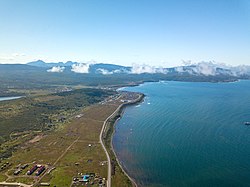
Kurilsk (Russian: Кури́льск; Japanese: 紗那村 Shana-mura) is a town and the administrative center of Kurilsky District of Sakhalin Oblast, Russia, located on the island of Iturup. Population: 2,070 (2010 census);[2] 2,233 (2002 census);[7] 2,699 (1989 Soviet census).[8]
Key Information


.png)
.png)


History
[edit]Ainu have been known to inhabit the present site of Kurilsk since the 2nd millennium BCE, with their settlement known as Shana, and under Russian rule as Syana (Сяна). The Ainu name is from San-nai (サン・ナイ), and it means "the settlement downstream of the swamp". Russian colonists first appeared on Iturup in the late 18th century, with the Japanese erecting a military post in 1800. Tensions between Russian and Japanese colonists in the area led to the Treaty of Shimoda, which saw the southern Kuril Islands officially placed under Japanese rule in 1855, remaining so until the end of World War II.
Under Japanese administration that ended in 1945, the village of Shana was the central settlement of the island. As of August 15, 1945, the population of the village was 1,001.[9]
In 1947, the village was given its present name and granted town status by the Soviets. All Japanese villagers were exiled; however, the Japanese do not recognize it to have been legally dissolved and the city office of Nemuro in Hokkaido takes care of its family registry.
Climate
[edit]Remarkably for its relatively southerly latitude, Kurilsk has a humid continental climate (Köppen Dfb) that almost qualifies as a subarctic climate owing to the powerful influence of the cold Oyashio Current which makes summers exceptionally cool. Unlike most subarctic climates, however, the winters are fairly mild and there is no permafrost. Precipitation, as with all the Kuril Islands, is very heavy owing to the influence of the Aleutian Low, though Kurilsk is a little less wet than Yuzhno-Kurilsk because of its westerly aspect which tends to shelter it from cyclonic storms originating over the Pacific. The climate actually resembles the subpolar oceanic climate of the Aleutian Islands more than the climate of interior Siberia, but the mean February temperature of −6.1 °C (21.0 °F) is well beyond the −3 °C (27 °F) threshold of oceanic climates.
| Climate data for Kurilsk | |||||||||||||
|---|---|---|---|---|---|---|---|---|---|---|---|---|---|
| Month | Jan | Feb | Mar | Apr | May | Jun | Jul | Aug | Sep | Oct | Nov | Dec | Year |
| Record high °C (°F) | 9.9 (49.8) |
9.8 (49.6) |
13.0 (55.4) |
21.6 (70.9) |
25.7 (78.3) |
25.6 (78.1) |
31.9 (89.4) |
30.2 (86.4) |
27.7 (81.9) |
24.7 (76.5) |
19.5 (67.1) |
13.4 (56.1) |
31.9 (89.4) |
| Mean maximum °C (°F) | 3.8 (38.8) |
3.0 (37.4) |
6.9 (44.4) |
14.9 (58.8) |
20.7 (69.3) |
22.4 (72.3) |
25.5 (77.9) |
26.4 (79.5) |
24.0 (75.2) |
18.9 (66.0) |
14.5 (58.1) |
8.0 (46.4) |
27.3 (81.1) |
| Mean daily maximum °C (°F) | −1.8 (28.8) |
−3.0 (26.6) |
−0.2 (31.6) |
5.3 (41.5) |
10.6 (51.1) |
13.9 (57.0) |
17.4 (63.3) |
19.8 (67.6) |
17.4 (63.3) |
12.9 (55.2) |
6.8 (44.2) |
1.2 (34.2) |
8.4 (47.0) |
| Daily mean °C (°F) | −4.5 (23.9) |
−6.1 (21.0) |
−3.4 (25.9) |
2.0 (35.6) |
6.6 (43.9) |
10.1 (50.2) |
13.8 (56.8) |
16.4 (61.5) |
13.9 (57.0) |
9.3 (48.7) |
3.7 (38.7) |
−1.4 (29.5) |
5.0 (41.1) |
| Mean daily minimum °C (°F) | −7.1 (19.2) |
−9.1 (15.6) |
−6.5 (20.3) |
−1.3 (29.7) |
2.5 (36.5) |
6.2 (43.2) |
10.1 (50.2) |
12.9 (55.2) |
10.3 (50.5) |
5.7 (42.3) |
0.6 (33.1) |
−4.0 (24.8) |
1.7 (35.1) |
| Mean minimum °C (°F) | −13.9 (7.0) |
−17.0 (1.4) |
−15.7 (3.7) |
−7.7 (18.1) |
−2.3 (27.9) |
0.6 (33.1) |
4.0 (39.2) |
6.5 (43.7) |
3.3 (37.9) |
−0.7 (30.7) |
−5.1 (22.8) |
−10.1 (13.8) |
−18.1 (−0.6) |
| Record low °C (°F) | −22.0 (−7.6) |
−27.4 (−17.3) |
−25.9 (−14.6) |
−16.1 (3.0) |
−6.5 (20.3) |
−2.8 (27.0) |
−0.8 (30.6) |
1.4 (34.5) |
0.2 (32.4) |
−4.5 (23.9) |
−9.4 (15.1) |
−17.0 (1.4) |
−27.4 (−17.3) |
| Average precipitation mm (inches) | 101.4 (3.99) |
65.1 (2.56) |
84.7 (3.33) |
77.9 (3.07) |
71.4 (2.81) |
51.7 (2.04) |
85.0 (3.35) |
109.7 (4.32) |
122.2 (4.81) |
133.5 (5.26) |
132.2 (5.20) |
116.0 (4.57) |
1,150.8 (45.31) |
| Average precipitation days (≥ 1 mm) | 18.7 | 12.7 | 11.8 | 9.3 | 9.1 | 7.5 | 9.8 | 8.3 | 10.3 | 13.8 | 17.0 | 19.6 | 147.9 |
| Source 1: Météo climat stats[10] | |||||||||||||
| Source 2: Météo Climat [11] | |||||||||||||
Administrative and municipal status
[edit]
Within the framework of administrative divisions, Kurilsk serves as the administrative center of Kurilsky District and is subordinated to it.[1] As a municipal division, the town of Kurilsk and six rural localities of Kurilsky District are incorporated as Kurilsky Urban Okrug.[3]
Economy
[edit]Kurilsk is a center for fishing and fish farming, particularly salmon. A tsunami warning station is also located in the town.
References
[edit]Notes
[edit]- ^ a b c d e Law #25-ZO
- ^ a b Russian Federal State Statistics Service (2011). Всероссийская перепись населения 2010 года. Том 1 [2010 All-Russian Population Census, vol. 1]. Всероссийская перепись населения 2010 года [2010 All-Russia Population Census] (in Russian). Federal State Statistics Service.
- ^ a b c Law #524
- ^ "Об исчислении времени". Официальный интернет-портал правовой информации (in Russian). June 3, 2011. Retrieved January 19, 2019.
- ^ Почта России. Информационно-вычислительный центр ОАСУ РПО. (Russian Post). Поиск объектов почтовой связи (Postal Objects Search) (in Russian)
- ^ Телефонные коды Сахалина - Dialing codes of Sakhalin Archived December 17, 2017, at the Wayback Machine (in Russian)
- ^ Federal State Statistics Service (May 21, 2004). Численность населения России, субъектов Российской Федерации в составе федеральных округов, районов, городских поселений, сельских населённых пунктов – районных центров и сельских населённых пунктов с населением 3 тысячи и более человек [Population of Russia, Its Federal Districts, Federal Subjects, Districts, Urban Localities, Rural Localities—Administrative Centers, and Rural Localities with Population of Over 3,000] (XLS). Всероссийская перепись населения 2002 года [All-Russia Population Census of 2002] (in Russian).
- ^ Всесоюзная перепись населения 1989 г. Численность наличного населения союзных и автономных республик, автономных областей и округов, краёв, областей, районов, городских поселений и сёл-райцентров [All Union Population Census of 1989: Present Population of Union and Autonomous Republics, Autonomous Oblasts and Okrugs, Krais, Oblasts, Districts, Urban Settlements, and Villages Serving as District Administrative Centers]. Всесоюзная перепись населения 1989 года [All-Union Population Census of 1989] (in Russian). Институт демографии Национального исследовательского университета: Высшая школа экономики [Institute of Demography at the National Research University: Higher School of Economics]. 1989 – via Demoscope Weekly.
- ^ Northern Territories Association. 北方領土の人口 (in Japanese). Retrieved April 7, 2007.
- ^ "Moyennes 1981-2010 Russie (Asie)" (in French). Retrieved November 1, 2019.
- ^ "Météo Climat stats for Kurilsk". Météo Climat. Retrieved November 1, 2019.
Sources
[edit]- Сахалинская областная Дума. Закон №25-ЗО от 23 марта 2011 г. «Об административно-территориальном устройстве Сахалинской области», в ред. Закона №62-ЗО от 27 июня 2013 г. «О внесении изменения в статью 10 Закона Сахалинской области "Об административно-территориальном устройстве Сахалинской области"». Вступил в силу 9 апреля 2011 г.. Опубликован: "Губернские ведомости", №55(3742), 29 марта 2011 г. (Sakhalin Oblast Duma. Law #25-ZO of March 23, 2011 On the Administrative-Territorial Structure of Sakhalin Oblast, as amended by the Law #62-ZO of June 27, 2013 On Amending Article 10 of the Law of Sakhalin Oblast "On the Administrative-Territorial Structure of Sakhalin Oblast". Effective as of April 9, 2011.).
- Сахалинская областная Дума. Закон №524 от 21 июля 2004 г. «О границах и статусе муниципальных образований в Сахалинской области», в ред. Закона №45-ЗО от 27 мая 2013 г. «О внесении изменения в Закон Сахалинской области "О границах и статусе муниципальных образований в Сахалинской области"». Вступил в силу 1 января 2005 г. Опубликован: "Губернские ведомости", №175–176(2111–2112), 31 июля 2004 г. (Sakhalin Oblast Duma. Law #524 of July 21, 2004 On the Borders and Status of the Municipal Formations in Sakhalin Oblast, as amended by the Law #45-ZO of May 27, 2013 On Amending the Law of Sakhalin Oblast "On the Borders and Status of the Municipal Formations in Sakhalin Oblast". Effective as of January 1, 2005.).
| International | |
|---|---|
| National | |
Kurilsk
View on GrokipediaGeography
Location and Physical Features
Kurilsk is the administrative center of Kurilsky District in Sakhalin Oblast, Russian Federation, situated on the western coast of Iturup Island, the largest in the southern Kuril Islands archipelago.[6] Iturup forms part of the Greater Kuril Ridge, separating the Sea of Okhotsk to the west from the Pacific Ocean to the east, and extends roughly 200 kilometers northeast-southwest with a maximum width of 27 kilometers.[6] The settlement occupies a low-lying coastal position near Busse Lagoon, at an elevation of approximately 30 meters above sea level.[7] The physical landscape of the Kurilsk area reflects the volcanic origins of the Kuril arc, characterized by rugged terrain dominated by a northeast-southwest trending chain of calc-alkaline volcanoes that constitute the island's central backbone.[7] The highest elevation on Iturup is Mount Stokap at 1,634 meters.[7] Several active volcanoes, including Baransky, Masha, and Kuchi-Baran, dot the island, contributing to ongoing geothermal activity with fumaroles and hot springs, while the surrounding slopes support dense coniferous forests and alpine tundra at higher altitudes.[8] The coastal vicinity features gravel beaches and occasional tectonic uplift features due to the region's position along the Pacific Ring of Fire subduction zone.[8]Environmental Risks
Kurilsk, situated on Iturup Island within the Kuril-Kamchatka subduction zone, is highly susceptible to earthquakes due to the region's intense tectonic activity, where the Pacific Plate subducts beneath the Okhotsk Plate.[9] Sakhalin Oblast, encompassing the Kuril Islands, has recorded at least seven earthquakes of magnitude 8.0 or greater since 1900, with the Kurilsky District experiencing frequent seismic events, including 28 quakes in a recent seven-day period reaching up to magnitude 5.1.[10][11] Tsunamis represent a critical secondary hazard, frequently triggered by offshore megathrust earthquakes in the area. The November 15, 2006, magnitude 8.3 earthquake south-southwest of Severo-Kurilsk generated tsunamis impacting coastal regions of the Kuril Islands, highlighting the vulnerability of low-lying settlements like Kurilsk.[12] The subduction zone's history includes events capable of producing basin-wide tsunamis, with paleoseismic records indicating recurrence intervals for great earthquakes on the order of centuries.[13][14] Volcanic activity further compounds risks, as the Kuril Islands feature at least 29 historically active volcanoes, with over 162 documented eruptions, several located on or near Iturup Island including the caldera-forming Vetrovoy volcano, which produced massive pumice tuffs approximately 20,000 years ago.[15] Eruptions can generate ashfall, pyroclastic flows, and lahars, exacerbating seismic vulnerabilities in a densely volcanic arc.[16] Climatic factors amplify these geological threats, with the region enduring severe conditions including long, stormy winters, foggy summers, annual precipitation of 760 to 1,020 mm, and persistent strong winds that promote coastal erosion and infrastructure strain.[17] The Kuril Islands rank among the world's most geologically hazardous locales, where overlapping earthquakes, tsunamis, and eruptions have historically disrupted human settlements.[18]History
Early Settlement and Indigenous Presence
The earliest archaeological evidence of human settlement in the Kuril Islands, including on Iturup Island where Kurilsk is situated, derives from the Yankito site cluster, radiocarbon dated to approximately 8000–7600 calibrated years before present (cal BP). This Neolithic-era occupation, identified through lithic tools such as microblades and scrapers, points to small groups of hunter-gatherers exploiting marine resources like seals and fish in a coastal environment, with no signs of permanent structures or agriculture.[19] Later prehistoric phases involved the Okhotsk culture, which reached the Kurils around the 5th–9th centuries AD, introducing maritime hunting technologies and pottery distinct from earlier Jōmon-derived traditions; these groups likely represented migratory populations from Sakhalin and the mainland, bridging to subsequent indigenous developments.[20] The Ainu, the primary indigenous ethnic group historically associated with the Kuril Islands, consolidated their presence by the late medieval period, with archaeological and ethnohistoric data indicating semi-sedentary villages focused on seasonal exploitation of salmon runs, sea mammals, and wild plants from roughly the 13th–15th centuries onward. Genetic and cultural continuity links them to Jōmon-period ancestors, though their distinct dialect and oral traditions in the Kurils reflect adaptation to island isolation; by the early 18th century, Russian explorers documented Ainu communities spanning the archipelago, numbering in the low thousands regionally but with sparse, kin-based settlements on Iturup.[21][22]Imperial Era and Japanese Control
The southern Kuril Islands, including Iturup (known to the Japanese as Etorofu), were assigned to Japan under the Treaty of Shimoda signed on February 7, 1855, which established the border between Russian and Japanese possessions midway between Iturup and Urup islands, granting Japan sovereignty over Iturup, Kunashir, Shikotan, and the Habomai islets.[23] This agreement followed exploratory contacts and aimed to formalize relations amid expanding imperial interests, with Japan viewing the islands as extensions of Hokkaido for strategic and resource purposes.[24] Japanese administration of Iturup began modestly in the late 19th century during the Meiji Restoration (1868–1912), as the government promoted settlement to secure the frontier against Russian encroachment and exploit marine resources. The island was incorporated into Hokkaido Prefecture, specifically under the Nemuro Subprefecture, with governance emphasizing fisheries development and infrastructure like ports and roads. Indigenous Ainu communities, long present on Iturup, underwent systematic assimilation from the 1890s onward, including mandatory Japanese education, name changes, and relocation to facilitate settler expansion, reducing Ainu autonomy and integrating them into the imperial economy often through fishing labor.[25][26] Shana (紗那村), the primary settlement on Iturup and precursor to modern Kurilsk, emerged as the island's administrative and economic hub, centered on fishing operations for cod, herring, and shellfish, supplemented by sulfur extraction from volcanic sites. Japanese colonization accelerated post-1905 Russo-Japanese War, drawing migrants from mainland Japan; by the 1930s, Iturup supported several villages with Shana hosting government offices, a hospital, and processing facilities, though its population remained modest at approximately 1,000 by August 1945 amid wartime constraints.[27] The era saw limited industrialization, with whaling stations and military outposts established in the 1930s to bolster defenses, reflecting Japan's imperial pivot toward Pacific expansion.[28]World War II and Soviet Annexation
The Soviet Union declared war on Japan on August 9, 1945, adhering to secret protocols of the Yalta Conference (February 1945), under which the Allied powers conceded the Kuril Islands to the USSR in return for its military intervention against Japan in the Pacific theater.[29] This followed the atomic bombings of Hiroshima (August 6) and Nagasaki (August 9), and preceded Japan's formal surrender announcement on August 15, though Soviet operations proceeded independently.[30] Soviet amphibious assaults on the Kuril chain commenced on August 18, 1945, with initial landings on northern islands like Shumshu, involving elements of the Kamchatka Front's 87th Rifle Corps and 355th Rifle Division, supported by Pacific Fleet naval forces.[30] Operations advanced southward amid sporadic Japanese resistance from the 91st Infantry Division and local garrisons, resulting in Soviet control over the archipelago by early September, despite Japan's capitulation on September 2 aboard USS Missouri.[31] Casualties included approximately 1,500 Soviet dead or missing and over 10,000 Japanese killed or captured across the campaign, with the islands' fortifications and terrain complicating logistics.[30] On Iturup (Etorofu), the southernmost major island and site of future Kurilsk, Soviet forces under the Petropavlovsk Naval Base command landed at Rubetsu Bay on August 28, 1945, securing key positions against Japanese defenders equipped with coastal artillery and infantry.[31] The occupation facilitated the deportation of Japanese civilians and military personnel, with systematic repatriation from the Kurils completed by mid-1947 per Soviet government directives, displacing around 17,000 inhabitants from southern islands including Iturup.[32] Administrative control shifted to Soviet civil authorities, establishing Iturup as part of Sakhalin Oblast by decree in early 1946, marking the islands' de facto annexation despite Japan's non-recognition of the territorial transfer.[32]Post-War Development
Following the Soviet invasion of the Kuril Islands in August and September 1945, which involved landings on Iturup and capture of Japanese forces, control over Kurilsk's site—previously a small Japanese settlement known as Shana—passed to Soviet authorities.[32] Japanese residents across the Kurils, numbering around 17,000, were repatriated to Japan by summer 1947 under Soviet government orders, clearing the way for administrative reorganization.[32] [33] Initial infrastructure efforts relied on Soviet military personnel and Japanese prisoners of war for construction, focusing on basic housing and facilities to support incoming settlers.[34] Soviet civil administration was established on April 11, 1946, with Kurilsk emerging as the administrative center of the newly formed Kurilsky District on Iturup under a June 5, 1946 decree of the Presidium of the Supreme Soviet of the RSFSR.[32] Resettlement drew primarily from Siberia, the Far East, and Ukraine, including demobilized servicemen and seasonal workers, leading to steady population growth; by 1959, the district's population reached 21,737, peaking at 29,500 in 1989 amid incentives like higher salaries.[32] [35] This influx supported the transition to Soviet governance, with rural and settlement councils formalized by October 1947.[32] Economic development emphasized fishing, leveraging the nutrient-rich waters around Iturup; state fish canneries and kolkhozes were constructed in the late 1950s, forming the backbone of local industry alongside limited agriculture on state farms.[32] [36] Military presence bolstered security but secondary to civilian efforts, with geothermal energy experiments and road building accelerating in later decades to address isolation.[32] [35] By the Soviet era's end, Kurilsk had evolved into a functional administrative and fishing hub, though harsh volcanic terrain and remoteness constrained broader industrialization.[34]Territorial Dispute
Russian Sovereignty Claims
Russia maintains that sovereignty over Kurilsk, located on Iturup Island in the Kuril archipelago, derives from the Yalta Agreement signed on February 11, 1945, by the leaders of the United States, United Kingdom, and Soviet Union, which explicitly provided for the handover of the Kuril Islands to the Soviet Union in exchange for its entry into the war against Japan.[37][29] The Soviet Union declared war on Japan on August 8, 1945—two days after the atomic bombing of Hiroshima and one day before Nagasaki—and proceeded to occupy the Kuril Islands, including Iturup, in the weeks following Japan's surrender on August 15, 1945, completing control by early September.[4] This occupation, Russia argues, fulfilled the wartime agreements and established lawful title, with the islands subsequently integrated into the Russian Soviet Federative Socialist Republic as part of Sakhalin Oblast by decree in 1947.[24] In Russia's legal position, the 1951 San Francisco Peace Treaty—signed by Japan, which renounced "all right, title, and claim to the Kurile Islands"—holds no applicability to Soviet or Russian sovereignty, as the Soviet Union refused to sign or ratify it due to disagreements over its terms, including the exclusion of Soviet territorial gains from World War II.[24][38] Russian authorities contend that Japan's renunciation in the treaty implicitly acknowledged the transfer of the islands under prior Allied accords like Yalta, and that continuous Soviet and post-Soviet administration, including the deportation of Japanese inhabitants by 1947 and resettlement with Russian civilians, consolidates de jure and de facto control.[4][39] The Russian government, through statements from the Kremlin and Foreign Ministry, consistently describes the Kuril Islands, including Kurilsk as the administrative center of Kurilsky District, as "inherent Russian territory" with no legitimate dispute, rejecting Japanese assertions as incompatible with the results of World War II.[40] This stance is reinforced by federal laws designating the islands as strategic territory, with ongoing infrastructure development—such as schools and military facilities on Iturup—serving as evidence of effective sovereignty exercised since 1945.[41] Russia has proposed joint economic activities on the islands without conceding territorial claims, viewing any transfer as a reversal of wartime victory rather than a negotiable issue.[42]Japanese Territorial Assertions
Japan maintains that Iturup Island (Etorofu in Japanese), on which Kurilsk is located, forms part of its inherent territory as one of the Four Northern Islands, distinct from the Kuril Islands chain ceded under the 1951 San Francisco Peace Treaty.[43] The Japanese government asserts that these islands—Etorofu, Kunashiri, Shikotan, and the Habomai group—were recognized as Japanese possessions under the 1855 Treaty of Shimoda, which established a boundary leaving the southernmost islands to Japan while assigning northern ones to Russia.[43] This treaty, Japan's first with Russia, delimited the Kurils without ambiguity on southern ownership, and subsequent agreements like the 1875 Treaty of Saint Petersburg reinforced Japanese control over Etorofu through territorial exchanges.[43] Japan contends that Soviet occupation of Etorofu and the other islands beginning August 28, 1945—after Japan's surrender to the Allies but prior to formal hostilities with the USSR—constituted an illegal seizure, violating the 1945 Potsdam Declaration's terms for Japan's surrender and lacking legal basis under international law.[44] The government argues that the Yalta Agreement's secret protocol, referenced by the USSR to justify the takeover, was non-binding on Japan and did not override prior treaties affirming Japanese sovereignty.[43] Furthermore, Japan emphasizes that the San Francisco Treaty, which renounced claims to the "Kurile Islands," explicitly excludes the Northern Territories, as these were not historically Russian-held and thus not encompassed in the cession; the USSR's non-signature to the treaty underscores this exclusion in Japanese legal interpretation.[43] In diplomatic assertions, Japan demands the return of Etorofu and the other islands as a prerequisite for concluding a peace treaty with Russia, a position reiterated in bilateral talks since the 1956 Soviet-Japanese Joint Declaration, which acknowledged the dispute's existence.[45] The Ministry of Foreign Affairs maintains that Russian administrative actions on Iturup, including settlement expansion around Kurilsk and military deployments, infringe on Japanese sovereignty and hinder negotiations aimed at resolving attribution through peaceful means.[43] Japan has protested specific developments, such as Russia's 2010s infrastructure projects on Etorofu, viewing them as faits accomplis that prejudice the islands' status.[45] Despite strained relations post-2022, Tokyo upholds its claim, prioritizing historical title and effective pre-1945 control over arguments of post-war acquisition.[45]Geopolitical Implications and Negotiations
The Kuril Islands, including Iturup where Kurilsk serves as the administrative center, hold significant strategic military value for Russia, functioning as a natural barrier shielding the Sea of Okhotsk and the primary base of its Pacific Fleet submarines at Vladivostok from potential threats in the Pacific Ocean.[4] Control over these islands enables Russia to project power in the Asia-Pacific region and counterbalance U.S.-aligned forces, particularly amid heightened tensions with Japan and its alliances.[46] Economically, the archipelago offers abundant fishing grounds, potential hydrocarbon reserves, and mineral deposits, which Russia has sought to exploit through development projects on Iturup to reinforce its sovereignty claims.[47] Negotiations between Russia and Japan over the southern Kuril Islands—Iturup, Kunashir, Shikotan, and the Habomai group—have remained deadlocked since the Soviet era, preventing a formal World War II peace treaty. In 1956, the Soviet Union proposed returning Shikotan and the Habomai Islands in exchange for a treaty, but Japan insisted on all territories, leading to a breakdown.[23] Renewed talks under Mikhail Gorbachev in the late 1980s and later during Shinzo Abe's tenure with Vladimir Putin from 2016 onward explored compromises based on the 1956 declaration, including joint economic activities, but yielded no resolution due to mutual distrust and Russia's emphasis on historical annexation rights under the 1945 Yalta Agreement.[48] Russia's militarization efforts since 2015, including new bases on Iturup and Matua islands, have intensified the dispute's geopolitical stakes, signaling Moscow's intent to integrate the islands irrevocably into its defense perimeter.[5] Japan's imposition of sanctions following Russia's 2022 invasion of Ukraine prompted Moscow to suspend peace treaty discussions and terminate a 1990s fishing agreement, further entrenching positions.[5] As of October 2025, while Japan expresses commitment to dialogue, Russia maintains the islands as non-negotiable territory and has restricted Japanese NGOs advocating for resolution, diminishing prospects for near-term concessions amid broader Indo-Pacific rivalries.[49][50][51]Demographics
Population Trends
The population of Kurilsk, established in 1947 as a Soviet administrative center on Iturup Island, experienced initial growth tied to post-war resettlement and resource development, reaching 1,500 residents by the 1959 census. A temporary decline to 1,200 occurred by 1970, potentially reflecting early settlement challenges or migration patterns, before rebounding to 1,600 in 1979 and peaking at 2,700 in the 1989 Soviet census amid broader Soviet-era industrialization in the Far East.[52] Following the Soviet Union's dissolution, economic contraction and reduced state support prompted out-migration, reducing the population to 2,233 in the 2002 Russian census and further to 2,070 in 2010. This downward trend reversed modestly in the subsequent decade, with estimates climbing to 2,530 by 2021 and stabilizing around 2,537 in 2023–2025, attributable in part to federal incentives for residency in the Kuril Islands, including subsidies and infrastructure investments since the mid-2010s that boosted overall regional population by about 2,500 people.[52][53][54]| Year | Population |
|---|---|
| 1959 | 1,500 |
| 1970 | 1,200 |
| 1979 | 1,600 |
| 1989 | 2,700 |
| 2002 | 2,233 |
| 2010 | 2,070 |
| 2021 | 2,530 |
| 2023 | 2,537 |
Ethnic and Cultural Composition
The population of Kurilsk is predominantly ethnic Russian, consistent with broader settlement patterns in Sakhalin Oblast following the Soviet expulsion of Japanese residents after 1945 and subsequent influx of Slavic migrants from the Russian mainland and Ukraine.[56] Specific to Iturup Island, where Kurilsk serves as the administrative center, ethnic Ukrainians reportedly comprise a substantial share, with estimates from Japanese analyses placing them at around 60% of residents, reflecting targeted Soviet-era relocations to bolster border regions.[57] [58] [17] Across Sakhalin Oblast, census data confirm Russians at 86-91%, Ukrainians at 2-3%, and smaller groups including Koreans (3-5%) and Tatars (1%), though district-level granularity for Kurilsky District remains limited in public records.[59] [56] Culturally, Kurilsk embodies Russian Far Eastern provincial life, characterized by Russian-language education, media, and Orthodox Christian practices, with community events tied to fishing seasons, naval commemorations, and state holidays like Victory Day. Ukrainian cultural elements, such as folk traditions or cuisine, may persist informally among that demographic but are not institutionally prominent. Indigenous Ainu heritage, once integral to the Kurils' pre-20th-century ethnoscape, survives only vestigially; post-annexation assimilation and displacement reduced Ainu numbers to negligible levels in modern Kurilsk, with no organized cultural revival evident locally.[1][60]Government and Administration
Administrative Structure
Kurilsk functions as the administrative center of Kurilsky District (Russian: Кури́льский райо́н), one of seventeen raions comprising Sakhalin Oblast, a federal subject of Russia formed on January 2, 1947, by decree incorporating the Kuril Islands following Soviet annexation.[56][61] The district spans approximately 5,146 km² across central Kuril Islands, including Iturup (Etorofu in Japanese), where Kurilsk is situated, and encompasses six rural localities alongside the town itself.[62] Administratively, Sakhalin Oblast oversees district operations through its governor and Sakhalin Regional Duma, the unicameral legislative body handling regional policy, budgeting, and oversight of remote insular territories like the Kurils.[56] Municipally, Kurilsky District operates as an urban okrug (городско́й окру́г), a unified municipal entity under Russian local self-government law, where the district boundaries align with municipal jurisdiction, eliminating separate rural or urban subdivisions for streamlined administration suited to the sparse, island-based population.[63] Kurilsk, granted town (посёлок городского типа with elevated status) designation, centralizes district governance, including executive functions delegated from oblast authorities, though effective control remains contested by Japan, which views the islands south of Urup as inherent territory excluded from Russian administrative purview per the 1951 San Francisco Treaty interpretations.[64] This structure supports federal priorities like resource development under special economic regimes, such as the Kuril Islands priority development area established in 2016.[65]Local Governance and Services
The Kurilsky Municipal District Administration functions as the primary executive authority for local governance in Kurilsk, overseeing administrative operations, policy implementation, and coordination with Sakhalin Oblast authorities. Konstantin Nikolaevich Istomin has served as head of the district since December 2024, supported by deputies including first deputy Il'dar Zufarovich Akhtariev.[66][67] The structure aligns with Russia's federal municipal framework, where the head leads executive functions while a council of deputies handles legislative aspects, though specific council composition details are managed through local elections every five years. Public services in Kurilsk emphasize essential provisions amid logistical constraints from the islands' isolation. Education is delivered via state-funded institutions, including a recently built secondary school serving primary and secondary levels, supplemented by preschool facilities to support family residency incentives.[68] Healthcare relies on regional oblast networks, with local outpatient clinics providing primary care, emergency response, and preventive services, though advanced treatments require evacuation to Sakhalin Island hubs; state programs ensure family medical coverage as part of broader settlement support.[68] Utilities and infrastructure services, including electricity, water supply, and waste management, are administered locally with federal subsidies, but face periodic disruptions from supply chain vulnerabilities, as evidenced by a gasoline shortage across the Kuril Islands in August 2025 that impacted transportation and heating. Housing maintenance and social welfare fall under the administration's purview, prioritizing upgrades for Soviet-era buildings to enhance habitability in the harsh subarctic climate.[69]Economy
Key Industries
The economy of Kurilsk is dominated by the fishing and seafood processing sector, which constitutes the primary source of employment and revenue for the settlement on Iturup Island. Local operations focus on harvesting and processing marine species including Pacific salmon, pollock, crab, and herring, with significant production of fish roe—a key export commodity popular in domestic markets.[2][70] Companies such as Kurilsky Rybak CJSC conduct fishing activities in the surrounding Sea of Okhotsk, supporting processing facilities that handle roe stripping and filleting.[71] Recent government initiatives have bolstered this industry through tax incentives and investment quotas, leading to the construction of new processing plants in the Kuril Islands, including facilities for pollock with capacities exceeding prior levels.[70][72] Aquaculture efforts, particularly salmon hatcheries like the Svetlana facility on Iturup, aim to enhance sustainable yields amid fluctuating wild stocks, with operations targeting broodstock breeding and release programs.[73] These activities remain constrained by the islands' remote location and harsh climate, limiting diversification into other sectors.[2]Resource Exploitation and Challenges
The fishing industry dominates resource exploitation in Kurilsk and surrounding Iturup Island, with the settlement serving as a hub for processing facilities that handle catches from the nutrient-rich waters of the Sea of Okhotsk and Pacific Ocean.[2] In 2017, Russia established a special economic development zone named "The Kurils" across the islands, offering tax incentives and infrastructure support to boost seafood production and attract investors, resulting in expanded fish processing capacity on Iturup.[74] By 2021, federal investments targeted the Kurils' fisheries complex, funding modern vessels and plants to process species like pollock, cod, and crab, which constitute the primary economic output for Kurilsk's approximately 2,000 residents.[75] Mineral resources offer untapped potential, particularly rhenium deposits associated with the Kudryavy volcano on Iturup, recognized as among the world's largest unique reserves of this rare metal used in superalloys for aerospace applications.[2] However, extraction remains minimal due to technological and infrastructural barriers, with broader Sakhalin Oblast efforts focusing on offshore oil and gas rather than onshore volcanic minerals on Iturup.[76] Volcanic activity across the island's dozen active peaks, including seismic risks and fumarole emissions, complicates any large-scale mining ventures.[7] Territorial disputes with Japan over Iturup severely hinder resource development, as the unresolved claim deters foreign investment and joint ventures that could modernize fisheries or exploit minerals, perpetuating economic isolation despite Russian incentives.[48] Logistical challenges from Kurilsk's remote location—accessible mainly by seasonal ferries or limited air links—exacerbate high operational costs, while overfishing pressures in the South Kuril zone have strained stocks, prompting calls for sustainable quotas amid intensive factory growth since 2000.[77] Environmental impacts, including potential pollution from processing waste and climate-driven shifts in fish migrations, further challenge long-term viability without robust regulation.[78]Climate and Natural Environment
Climatic Patterns
Kurilsk features a cold maritime climate with short, cool, wet summers and long, freezing, snowy winters, influenced by its island location in the North Pacific. Summers span about 2.9 months, from July 10 to October 8, when average daily high temperatures exceed 12°C (54°F), though conditions remain windy and mostly cloudy. Winters extend from December 17 to April 7, characterized by overcast skies, heavy snowfall, and extreme winds. The hottest month is August, with average highs of 16°C (61°F) and lows of 14°C (57°F); the coldest is February, with highs of -2°C (28°F) and lows of -5°C (23°F). Temperatures rarely fall below -9°C (15°F) or rise above 18°C (65°F). Average monthly temperatures are as follows:| Month | Average High (°C/°F) | Average Low (°C/°F) |
|---|---|---|
| January | -2 / 29 | -4 / 25 |
| February | -2 / 28 | -5 / 23 |
| March | -1 / 30 | -4 / 25 |
| April | 2 / 36 | 0 / 32 |
| May | 6 / 42 | 3 / 37 |
| June | 9 / 49 | 7 / 44 |
| July | 13 / 56 | 11 / 52 |
| August | 16 / 61 | 14 / 57 |
| September | 15 / 59 | 13 / 55 |
| October | 11 / 52 | 8 / 47 |
| November | 6 / 42 | 3 / 38 |
| December | 1 / 34 | -1 / 30 |
Biodiversity and Conservation
The Kuril Archipelago, including Iturup Island where Kurilsk is located, exhibits unusually high taxonomic diversity relative to its land area of approximately 15,600 square kilometers across 56 islands, driven primarily by southern biogeographic influences contributing more species than northern ones.[79] Iturup, the largest island in the Greater Kuril Chain at 6,720 square kilometers, features volcanic terrain, hot springs, mixed forests, and coastal ecosystems supporting diverse flora and fauna. Vascular plant surveys in the southern Kurils, encompassing Iturup, have documented ongoing discoveries, with recent expeditions identifying dozens of species new to regional checklists, including terrestrial herbs and shrubs adapted to acidic volcanic soils.[80] Faunal diversity includes 55 bird species in Iturup's forests, 41 in coastal marine habitats, and significant populations of marine mammals such as sea otters (Enhydra lutris), alongside terrestrial species like brown bears (Ursus arctos) and sable (Martes zibellina). Lichen flora on Iturup comprises at least 143 species, with six additions new to the Sakhalin Region as of 2022, reflecting adaptations to the island's humid, foggy Pacific and Okhotsk climates. Microbial communities in Iturup's terrestrial hot springs, exceeding 30 sites studied in 2024, reveal novel thermophilic bacteria and archaea, contributing to extremophile biodiversity in geothermal environments.[81][82][83] Conservation efforts focus on mitigating poaching and habitat pressures, with sea otter populations on the Kurils declining as of 2024 surveys, attributing losses partly to illegal hunting despite legal protections. The Kuril Islands Research and Conservation Initiative, established post-2020 expeditions, supports vessel-based monitoring and data collection for marine species amid limited access. Joint Russia-Japan ecosystem studies provide baseline data on Kuril biota, though geopolitical tensions constrain collaboration. Threats include resource extraction and invasive species, with no federally protected reserves directly encompassing Kurilsk, emphasizing the need for localized anti-poaching enforcement.[81][84][85]Infrastructure and Connectivity
Transportation Networks
Kurilsk's primary access relies on air and sea links due to its remote location on Iturup Island in the Kuril Archipelago. Iturup Airport (ITU/UHSI), located near the settlement, serves as the main aviation hub, accommodating fixed-wing aircraft for passenger and cargo flights.[86] Regular services connect Kurilsk to Yuzhno-Sakhalinsk on Sakhalin Island, operated by Aurora Airlines, with flight durations typically around 1.5 hours depending on weather conditions.[87] Additional routes include seasonal or occasional flights to Vladivostok, initiated in December 2023 to enhance connectivity to mainland Russia.[88] Maritime transport provides essential freight and passenger services, linking Iturup to Sakhalin's Korsakov port via ferries operated by Sakhalin-Kuriles. The Igor Farkhutdinov vessel runs routes between Sakhalin, Iturup, Kunashir, and Shikotan islands, with crossings lasting 18-36 hours and tickets available online or in person.[89] These services operate year-round but face severe disruptions in winter due to ice and storms, often rendering sea access unreliable or impossible for weeks.[2] Cargo ferries prioritize supplies like fuel and food, supporting the island's isolation from rail or highway networks to the Russian mainland. Road infrastructure on Iturup remains limited and rugged, suited to the volcanic terrain with no rail connections. A 60 km road links Kurilsk to other settlements like Reyneke and Bukhta Vetrovoe, with approximately 3.4 km paved and 2.7 km gravel-surfaced as of 2020, while much of the network consists of unpaved tracks maintained primarily for military and local use.[90] Vehicle travel is challenging due to frequent fog, rain, and seismic activity, with local transport relying on buses, taxis, or private cars for intra-island movement. Development programs aim to expand paved sections, but progress is slow amid environmental and logistical constraints.[91]Utilities and Modern Amenities
Kurilsk's utilities are primarily managed by the Municipal Unitary Enterprise "Zhilkomservice," which oversees housing-communal services, including energy supply to residents, budget institutions, and other entities.[92] The settlement relies on centralized systems for electricity, heating, and water, though remoteness necessitates periodic maintenance outages and backup diesel generators for critical facilities.[93] Electricity supply in the Kuril Islands, including Kurilsk on Iturup Island, draws from small diesel, hydroelectric, and geothermal power plants, with the first geothermal facility commissioned in 1993.[32] A solar power plant on Iturup began operations in February 2022, marking the Sakhalin Region's initial foray into solar generation to supplement diesel-dependent grids.[94] Investments totaling 7 billion rubles aim to nearly double the islands' energy capacity by 2026, addressing capacity constraints in remote areas like Kurilsk.[95] Heating is provided through a central district system operated by Zhilkomservice, with seasonal startup, hydraulic testing, and network filling conducted annually—for instance, system filling began on September 26, 2012, and pressure tests followed on September 27-28.[93] Geothermal resources on Iturup offer potential for expanded use, though current reliance includes boiler-based distribution prone to scheduled repairs. Water supply is centralized, with Zhilkomservice handling distribution and maintenance; disruptions occur for repairs, such as a cutoff from 9:00 to 13:00 on July 14, 2012.[93] Sources likely include local groundwater and surface water, adapted to the island's volcanic terrain, though specifics on treatment capacity remain limited in public records. Modern amenities include high-speed internet access established in 2019 via fiber-optic lines laid by Rostelecom across the Southern Kuril Islands, enhancing connectivity for homes and social facilities in Kurilsk.[96][97] Telecommunications services, including telephony, are supported by regional providers, though extreme weather and isolation can affect reliability.References
- https://commons.wikimedia.org/wiki/Category:Kurilsky_District