Hubbry Logo
search
logo
721312

Transmon

logo
Community Hub0 Subscribers
Read side by side
from Wikipedia
Eigenenergies (first three levels, ) of the qubit Hamiltonian as a function of the effective offset charge for different ratios . Energies are given in units of the transition energy , evaluated at the degeneracy point . The zero point of energy is chosen as the bottom of the level. The charge qubit (small , top) is normally operated at the "sweet spot" where fluctuations cause less energy shift and the anharmonicity is maximal. Transmon (large , bottom) energy levels are insensitive to fluctuations but the anharmonicity is reduced.

In quantum computing, and more specifically in superconducting quantum computing, a transmon is a type of superconducting charge qubit designed to have reduced sensitivity to charge noise. The transmon was developed by Jens Koch, Terri M. Yu, Jay Gambetta, Andrew Houck, David Schuster, Johannes Majer, Alexandre Blais, Michel Devoret, Steven M. Girvin, and Robert J. Schoelkopf at Yale University and Université de Sherbrooke in 2007.[1][2] Its name is an abbreviation of the term transmission line shunted plasma oscillation qubit; one which consists of a Cooper-pair box "where the two superconductors are also [capacitively] shunted in order to decrease the sensitivity to charge noise, while maintaining a sufficient anharmonicity for selective qubit control".[3]

A device consisting of four transmon qubits, four quantum buses, and four readout resonators fabricated by IBM and published in npj Quantum Information in January 2017.[4]

The transmon achieves its reduced sensitivity to charge noise by significantly increasing the ratio of the Josephson energy to the charging energy. This is accomplished through the use of a large shunting capacitor. The result is energy level spacings that are approximately independent of offset charge. Planar on-chip transmon qubits have T1 coherence times approximately 30 μs to 40 μs.[5] Recent work has shown significantly improved T1 times as long as 95 μs by replacing the superconducting transmission line cavity with a three-dimensional superconducting cavity,[6][7] and by replacing niobium with tantalum in the transmon device, T1 is further improved up to 0.3 ms.[8] These results demonstrate that previous T1 times were not limited by Josephson junction losses. Understanding the fundamental limits on the coherence time in superconducting qubits such as the transmon is an active area of research.

Comparison to Cooper-pair box

[edit]

The transmon design is similar to the first design of the charge qubit[9] known as a "Cooper-pair box"; both are described by the same Hamiltonian, with the only difference being the ratio. Here is the Josephson energy of the junction, and is the charging energy inversely proportional to the total capacitance of the qubit circuit. Transmons typically have (while for typical Cooper-pair-box qubits), which is achieved by shunting the Josephson junction with an additional large capacitor.

The benefit of increasing the ratio is the insensitivity to charge noise—the energy levels become independent of the offset charge across the junction; thus the dephasing time of the qubit is prolonged. The disadvantage is the reduced anharmonicity , where is the energy difference between eigenstates and . Reduced anharmonicity complicates the device operation as a two level system, e.g. exciting the device from the ground state to the first excited state by a resonant pulse also populates the higher excited state. This complication is overcome by complex microwave pulse design, that takes into account the higher energy levels, and prohibits their excitation by destructive interference. Also, while the variation of with respect to tend to decrease exponentially with , the anharmonicity only has a weaker, algebraic dependence on as . The significant gain in the coherence time outweigh the decrease in the anharmonicity for controlling the states with high fidelity.

Measurement, control and coupling of transmons is performed by means of microwave resonators with techniques from circuit quantum electrodynamics also applicable to other superconducting qubits. Coupling to the resonators is done by placing a capacitor between the qubit and the resonator, at a point where the resonator electromagnetic field is greatest. For example, in IBM Quantum Experience devices, the resonators are implemented with "quarter wave" coplanar waveguides with maximal field at the signal-ground short at the waveguide end; thus every IBM transmon qubit has a long resonator "tail". The initial proposal included similar transmission line resonators coupled to every transmon, becoming a part of the name. However, charge qubits operated at a similar regime, coupled to different kinds of microwave cavities are referred to as transmons as well.

Transmons as qudits instead of qubits

[edit]

Transmons have been explored for use as d-dimensional qudits via the additional energy levels that naturally occur above the qubit subspace (the lowest two states). For example, the lowest three levels can be used to make a transmon qutrit; in the early 2020s, researchers have reported realizations of single-qutrit quantum gates on transmons[10][11] as well as two-qutrit entangling gates.[12] Entangling gates on transmons have also been explored theoretically and in simulations for the general case of qudits of arbitrary d.[13]

See also

[edit]

References

[edit]
Revisions and contributorsEdit on WikipediaRead on Wikipedia
from Grokipedia
The transmon is a superconducting artificial atom used as a quantum bit (qubit) in quantum computing and circuit quantum electrodynamics (QED), consisting of a Josephson junction shunted by a large capacitor to form a weakly anharmonic nonlinear resonator. It operates by quantizing the charge and phase across the junction, with energy levels that can be controlled via microwave pulses for qubit manipulation.[1] Developed in 2007 as an improvement over the charge-sensitive Cooper pair box (CPB) qubit, the transmon achieves charge insensitivity by operating at a high ratio of Josephson energy EJE_J (typically 20–30 GHz) to charging energy ECE_C (around 0.35 GHz), exponentially suppressing sensitivity to charge noise while preserving sufficient anharmonicity (100–300 MHz) for selective qubit addressing.[2] This design eliminates the need for precise charge bias tuning at "sweet spots," enhancing scalability for multi-qubit systems compared to earlier superconducting qubits, which suffered from dephasing times limited to nanoseconds due to environmental fluctuations.[1] In practice, transmons are fabricated on silicon or sapphire substrates using planar superconducting circuits, often incorporating a superconducting quantum interference device (SQUID) loop for in-situ frequency tuning via external magnetic flux, with operating frequencies tunable in the 4–10 GHz microwave range.[1] Readout is typically performed dispersively through a coupled microwave resonator, enabling high-fidelity state detection.[1] By 2021, advanced transmon implementations achieved coherence times exceeding 300 μs.[3] As of 2025, further advancements have extended coherence times beyond 1 ms, supporting fault-tolerant quantum error correction and applications in quantum simulation, sensing, and information processing.[4]

Background

Superconducting Qubits

Superconducting qubits are artificial atoms implemented in solid-state circuits made from superconducting materials and Josephson junctions, which allow for the encoding of quantum information in discrete energy states.[5] These devices exploit the macroscopic quantum coherence of superconductors at millikelvin temperatures to mimic the behavior of natural atoms, but with the advantages of lithographic fabrication and tunability.[6] The Josephson junction, consisting of two superconductors separated by a thin insulating barrier, provides the essential nonlinearity required to create an anharmonic energy spectrum for qubit operations.[5] The basic operation of superconducting qubits relies on the quantization of electromagnetic oscillations in LC circuits, where the circuit's degrees of freedom—charge and flux—become operators in the quantum regime, leading to well-defined energy levels that encode the qubit states.[6] In the simplest case of a linear LC oscillator, the Hamiltonian is
H=Q22C+Φ22L, H = \frac{Q^2}{2C} + \frac{\Phi^2}{2L},
where QQ is the charge operator, Φ\Phi is the flux operator, CC is the capacitance, and LL is the inductance; this model yields equally spaced energy levels, but the addition of a Josephson junction introduces nonlinearity to select computational states.[6] Microwave pulses are used to drive transitions between these levels, enabling single- and multi-qubit gates essential for quantum computation.[7] Superconducting qubits gained prominence in the early 2000s as scalable quantum bits for quantum computing, following initial demonstrations of coherence in the late 1990s, due to their integration with planar microwave technology and potential for on-chip control.[5] This approach offers advantages over other qubit modalities, including fast gate times on the order of nanoseconds and compatibility with semiconductor fabrication processes. The transmon is a specific type of charge-based superconducting qubit designed for enhanced coherence.[7]

Cooper Pair Box

The Cooper pair box (CPB) is a foundational design for superconducting charge qubits, consisting of a small superconducting island connected to a larger superconducting reservoir via a single Josephson junction, with an additional gate capacitor coupled to the island for external control. The qubit states are encoded in the number of excess Cooper pairs residing on the isolated island, where each Cooper pair carries a charge of -2e. In the superconducting state, the island hosts a macroscopic quantum state characterized by the integer number operator n^\hat{n} of these pairs, and the Josephson junction enables coherent tunneling of Cooper pairs between the island and the reservoir. This setup was first experimentally realized and demonstrated to exhibit quantum coherence in 1999. The CPB operates in the charge regime, where the charging energy ECE_C significantly exceeds the Josephson coupling energy EJE_J (typically ECEJE_C \gg E_J), making the excess charge on the island the dominant degree of freedom. A gate voltage VgV_g applied through the gate capacitor with capacitance CgC_g induces an offset charge on the island, parameterized by the dimensionless gate charge ng=CgVg/(2e)n_g = C_g V_g / (2e). By tuning ngn_g to a degeneracy point (e.g., ng0.5n_g \approx 0.5), the energy levels of adjacent charge states, such as n=0|n=0\rangle and n=1|n=1\rangle, become nearly degenerate, allowing the formation of a quantum superposition ψ=α0+β1|\psi\rangle = \alpha |0\rangle + \beta |1\rangle through coherent tunneling mediated by the Josephson junction. This two-level system can then be manipulated via microwave pulses or voltage gates to perform quantum operations. A primary limitation of the CPB arises from its high sensitivity to charge noise, stemming from fluctuating background charges (e.g., trapped defects or impurities) that randomly shift ngn_g, causing rapid dephasing of the superposition states. This charge dispersion leads to short coherence times, typically less than 1 μs in early experiments, which severely restricts the fidelity of quantum operations and scalability. The energy levels of the CPB are described by quantizing the classical circuit Hamiltonian. The classical charging energy arises from the electrostatic energy stored on the island's total capacitance CΣ=CJ+CgC_\Sigma = C_J + C_g, where CJC_J is the Josephson junction capacitance, giving the charging term Ech=(2e(ngn))22CΣ=4EC(ngn)2E_{ch} = \frac{(2e (n_g - n))^2}{2 C_\Sigma} = 4 E_C (n_g - n)^2, with EC=e2/(2CΣ)E_C = e^2 / (2 C_\Sigma) as the charging energy and nn the number of excess Cooper pairs. The Josephson junction contributes a nonlinear inductive potential EJ(1cosϕ)E_J (1 - \cos \phi), where ϕ\phi is the superconducting phase difference across the junction and EJ=IcΦ0/(2π)E_J = I_c \Phi_0 / (2\pi) is the Josephson energy (IcI_c critical current, Φ0=h/(2e)\Phi_0 = h/(2e) flux quantum). Thus, the classical Hamiltonian is Hcl=4EC(ngn)2+EJ(1cosϕ)H_{cl} = 4 E_C (n_g - n)^2 + E_J (1 - \cos \phi). To quantize, treat the phase ϕ\phi and charge number nn as canonically conjugate variables satisfying [ϕ^,n^]=i[\hat{\phi}, \hat{n}] = i, analogous to position and momentum. In the charge basis n|n\rangle, the charging term is diagonal: n4EC(n^ng)2n=4EC(nng)2δn,n\langle n' | 4 E_C (\hat{n} - n_g)^2 | n'' \rangle = 4 E_C (n - n_g)^2 \delta_{n',n''}, while the Josephson term introduces off-diagonal coupling: nEJcosϕ^n=(EJ/2)(δn,n+1+δn,n1)\langle n' | -E_J \cos \hat{\phi} | n'' \rangle = -(E_J/2) (\delta_{n',n''+1} + \delta_{n',n''-1}), since cosϕ^=(ϕ^i+ϕ^i)/2\cos \hat{\phi} = (\hat{\phi}^i + \hat{\phi}^{-i})/2 and exp(iϕ^)n=n+1\exp(i \hat{\phi}) |n\rangle = |n+1\rangle. The full quantum Hamiltonian is therefore H^=4EC(n^ng)2EJcosϕ^\hat{H} = 4 E_C (\hat{n} - n_g)^2 - E_J \cos \hat{\phi}, with energy eigenvalues obtained by diagonalizing in the truncated charge basis (typically two levels near degeneracy). The constant shift EJE_J in the potential is often omitted as it does not affect dynamics. This model captures the anharmonicity essential for qubit control.

History

Invention

The transmon qubit was proposed in 2007 by Jens Koch, Andrew A. Houck, and colleagues at Yale University as a solution to the pronounced sensitivity to charge noise that plagued earlier superconducting charge qubits like the Cooper pair box (CPB).[2] This motivation stemmed from the CPB's operation in a regime where the Josephson energy EJE_J and charging energy ECE_C were comparable (EJECE_J \approx E_C), leading to rapid dephasing times on the order of nanoseconds due to fluctuating offset charges.[2][8] The core innovation of the transmon involved modifying the CPB circuit by adding a large shunt capacitance in parallel with the Josephson junction, which significantly increases the total capacitance and thereby reduces ECE_C (since EC=e2/2CE_C = e^2 / 2C), allowing operation in the regime where EJECE_J \gg E_C (typically ratios of 50 or higher).[2] This adjustment exponentially suppresses the charge dispersion of the energy levels— the variation in transition frequency with offset charge—while the anharmonicity decreases only as a weak power law, preserving sufficient qubit-photon coupling for circuit quantum electrodynamics applications.[2] The design was detailed in the seminal paper "Charge-insensitive qubit design derived from the Cooper pair box," published in Physical Review A (volume 76, issue 4, article 042319).[2] Theoretical predictions in the 2007 paper indicated that this reduced charge sensitivity could extend dephasing times (T2T_2) to hundreds of microseconds, a substantial improvement over the CPB's typical ~1 μs limit, by making the qubit nearly immune to 1/f charge noise.[2] Early experimental validation came in 2008, when the same Yale group fabricated and measured the first transmon devices, achieving relaxation times (T1T_1) of approximately 1.9 μs and dephasing times (T2T_2^*) up to 2.2 μs at the charge-insensitive sweet spot, confirming homogeneous broadening and a marked enhancement over prior CPB coherence limited to a few nanoseconds.[8] These results demonstrated the transmon's potential for scalable quantum computing architectures.

Key Milestones

Following the invention of the transmon qubit by researchers at Yale University in 2007, subsequent experimental efforts rapidly advanced its implementation in multi-qubit systems. Between 2008 and 2010, pioneering demonstrations of multi-qubit operations emerged, notably from the Yale team, which in 2009 realized a two-qubit superconducting processor using transmon qubits coupled via a microwave cavity bus, achieving entangling gates and quantum algorithms with fidelities exceeding 80%. Around the same period, the UC Santa Barbara group contributed to early scalable architectures by exploring capacitive coupling in superconducting qubits, laying groundwork for transmon-based two-qubit gates.[9] During the 2010s, major industry players adopted the transmon as the cornerstone of their quantum computing platforms; IBM integrated transmons into its early quantum processors starting around 2012, while Google began deploying them in scalable arrays by 2015, emphasizing fixed-frequency designs for improved control. A landmark achievement came in 2019 with Google's Sycamore processor, featuring 53 transmon qubits, which demonstrated quantum supremacy by completing a random circuit sampling task in 200 seconds—a computation estimated to take classical supercomputers 10,000 years. Key performance milestones included a 2016 record coherence time of approximately 100 μs for a transmon qubit coupled to a three-dimensional (3D) superconducting cavity, enabling more robust quantum operations. Integration of transmons with 3D cavities, first demonstrated around 2011, provided enhanced electromagnetic isolation from environmental noise, boosting coherence times and facilitating multi-qubit entanglement with reduced crosstalk. From 2023 to 2025, progress accelerated toward scalability; IBM outlined a roadmap targeting modular systems exceeding 4,000 transmon qubits by 2025 to enable error-corrected quantum utility.[10] In 2025, a Princeton University team led by Andrew Houck introduced a tantalum-on-silicon transmon design that achieved millisecond-scale coherence times—over 1,000 times the reliability of early transmons—through minimized dielectric loss in the high-resistivity silicon substrate.[4]

Theoretical Model

Circuit Quantization

The quantization of the transmon circuit involves treating the classical electrical network—a Josephson junction in parallel with a shunt capacitor—as a quantum mechanical system. The key variables are the gauge-invariant phase difference ϕ\phi across the junction and the conjugate charge QQ on the capacitor plates. These are promoted to operators ϕ^\hat{\phi} and Q^\hat{Q} satisfying the commutation relation [ϕ^,Q^]=i(2e)[\hat{\phi}, \hat{Q}] = i (2e), where 2e2e is the elementary charge of a Cooper pair, reflecting the discrete nature of charge transport in superconductors.[11] The Josephson junction introduces a nonlinear inductance through its characteristic relations: the supercurrent I=IcsinϕI = I_c \sin \phi and the voltage-phase relation V=(/2e)ϕ˙V = (\hbar / 2e) \dot{\phi}. This phase-dependent inductance LJ(ϕ)=(/2eIc)/cosϕL_J(\phi) = (\hbar / 2e I_c) / \cos \phi provides the anharmonicity necessary for selective addressing of qubit states, distinguishing the transmon from harmonic oscillators.[12] The quantum description begins with the classical Lagrangian for the circuit, formulated in terms of the phase ϕ\phi as the dynamical variable. For the shunted junction, the Lagrangian is
L=C2ϕ˙2+EJcosϕ, L = \frac{C}{2} \dot{\phi}^2 + E_J \cos \phi,
where CC is the total shunt capacitance, ϕ˙=dϕ/dt\dot{\phi} = d\phi / dt, and EJ=Ic/2eE_J = I_c \hbar / 2e is the Josephson energy scale. The first term captures the capacitive kinetic energy, while the second derives from the Josephson potential energy V(ϕ)=EJcosϕV(\phi) = -E_J \cos \phi, which combines with the quadratic charging contribution to form the effective potential landscape.[11] The conjugate momentum is the charge Q=L/ϕ˙=Cϕ˙Q = \partial L / \partial \dot{\phi} = C \dot{\phi}. The classical Hamiltonian follows from the Legendre transform H=Qϕ˙LH = Q \dot{\phi} - L, yielding
H=Q22CEJcosϕ. H = \frac{Q^2}{2C} - E_J \cos \phi.
Quantizing this expression gives the operator Hamiltonian
H^=Q^22CEJcosϕ^. \hat{H} = \frac{\hat{Q}^2}{2C} - E_J \cos \hat{\phi}.
Equivalently, defining the reduced charge operator n^=Q^/(2e)\hat{n} = \hat{Q} / (2e) with [ϕ^,n^]=i[\hat{\phi}, \hat{n}] = i, and the charging energy EC=e2/(2C)E_C = e^2 / (2C), the Hamiltonian becomes
H^=4ECn^2EJcosϕ^. \hat{H} = 4 E_C \hat{n}^2 - E_J \cos \hat{\phi}.
This framework maps the circuit to a quantum anharmonic oscillator, where the nonlinear cosine term perturbs the otherwise quadratic spectrum.[12]

Hamiltonian

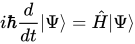
The effective Hamiltonian of the transmon qubit, derived from the quantization of its superconducting circuit, is given by
H=4EC(nng)2EJcosϕ, H = 4 E_C (n - n_g)^2 - E_J \cos \phi,
where ECE_C is the charging energy, EJE_J is the Josephson energy, ϕ\phi is the phase difference across the Josephson junction, nn is the number operator conjugate to ϕ\phi satisfying [ϕ,n]=i[ \phi, n ] = i, and ngn_g is the dimensionless gate-induced charge offset. In the regime of large Josephson coupling where EJ/EC1E_J / E_C \gg 1, perturbative analysis approximates the transmon as a weakly anharmonic oscillator. The lowest two energy levels form an effective two-level system with transition frequency ω018ECEJEC\omega_{01} \approx \sqrt{8 E_C E_J} - E_C and anharmonicity αEC\alpha \approx -E_C, where the negative anharmonicity enables selective addressing of qubit transitions. The charge dispersion, which quantifies the sensitivity of energy levels to fluctuations in ngn_g, is exponentially suppressed in this regime: ε(ng)e8EJ/EC2EC3/EJ\varepsilon(n_g) \approx e^{-\sqrt{8 E_J / E_C}} \sqrt{2 E_C^3 / E_J}. This term introduces a small periodic modulation to the energy spectrum, but its amplitude decreases rapidly with increasing EJ/ECE_J / E_C, rendering the transmon robust against charge noise. For higher energy levels, the Schrödinger equation associated with the Hamiltonian is [4EC(iddϕng)2EJcosϕ]ψ(ϕ)=Eψ(ϕ)[4 E_C (-i \frac{d}{d \phi} - n_g)^2 - E_J \cos \phi ] \psi(\phi) = E \psi(\phi). For ng=0n_g = 0, it reduces to a Mathieu equation $ -4 E_C \frac{d^2 \psi}{d \phi^2} - E_J \cos \phi , \psi = E \psi $. The solutions confirm the transmon's behavior as a weakly anharmonic oscillator, with level spacings approaching those of a harmonic oscillator while retaining sufficient anharmonicity for multi-level operations.

Design Principles

Shunt Capacitance

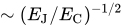
The shunt capacitance in the transmon qubit is a large capacitor connected in parallel with the Josephson junction, forming the primary modification from the Cooper pair box design. This configuration increases the total capacitance $ C_\Sigma = C_J + C_{sh} $, where $ C_J $ is the junction capacitance and $ C_{sh} $ is the shunt capacitance, thereby reducing the charging energy $ E_C = e^2 / (2 C_\Sigma) $ while the Josephson energy $ E_J $ remains fixed by the junction critical current.[11] The primary purpose is to suppress sensitivity to charge noise by operating in the regime where $ E_J \gg E_C $, exponentially diminishing the charge dispersion of energy levels.[11] Typically, $ C_{sh} \gg C_J $, with total capacitances $ C_\Sigma $ on the order of 70–100 fF, yielding $ E_J / E_C $ ratios of 50–100 that optimize charge insensitivity without excessive loss of qubit anharmonicity.[11] These ratios ensure the transmon's energy levels are nearly insensitive to offset charge fluctuations, a key improvement over charge qubits.[11] Geometrically, the shunt capacitance is realized on-chip using planar structures such as interdigital capacitors or coplanar waveguide segments, which provide the necessary fF-scale capacitance while minimizing the physical size of the Josephson junction to reduce extrinsic losses. These designs, often featuring finger-like or cross-shaped electrodes, allow for precise control of capacitance without increasing junction area, facilitating integration in scalable circuits.[13] A key trade-off arises with larger $ C_{sh} $: while it enhances noise immunity through reduced charge dispersion, it slightly diminishes the anharmonicity of the transmon's energy spectrum, which scales approximately as $ (E_J / E_C)^{-1/2} $, potentially complicating selective addressing of higher qubit levels for multi-photon operations.[11] Nonetheless, ratios above 50 maintain sufficient anharmonicity for practical qubit control.[11]

Josephson Junction Characteristics

The Josephson junction is the primary source of nonlinearity in the transmon qubit, contributing the inductive Josephson energy EJE_J that creates an anharmonic potential essential for distinguishing qubit states. This nonlinearity arises from the junction's characteristic cosine potential, which ensures that the energy spacing between the ground and first excited states differs from that between the first and second excited states, enabling precise control of the 0–1 transition without inadvertently populating higher levels.[11] The Josephson energy is defined as EJ=IcΦ02πE_J = \frac{I_c \Phi_0}{2\pi}, where IcI_c denotes the critical current of the junction and Φ0=h/(2e)\Phi_0 = h/(2e) is the magnetic flux quantum.[11] In standard transmon implementations, aluminum-based Al/AlOx_x/Al tunnel junctions are employed, featuring areas approximately 0.01 μ\mum2^2 to yield EJ/h10E_J/h \sim 10–30 GHz, with the oxide tunneling barrier typically around 1 nm thick to control the critical current density.[11] These specifications balance the desired anharmonicity while minimizing charge sensitivity in the transmon regime. For enhanced flexibility, variations incorporate a superconducting quantum interference device (SQUID) in place of a single junction, where two parallel Josephson junctions form a loop that allows EJE_J to be tuned via an applied magnetic flux threading the loop.[14] This flux-tunable configuration, with EJE_J modulated as EJ=EJ,maxcos(πΦ/Φ0)E_J = E_{J,\max} |\cos(\pi \Phi / \Phi_0)|, facilitates adjustable qubit frequencies or coupling strengths in multi-qubit systems.[11][14] The junction integrates with a shunt capacitance to set the overall circuit dynamics, prioritizing the nonlinear inductive response over linear capacitive effects.[11]

Fabrication

Materials and Structure

Transmon qubits are constructed using superconducting metals such as aluminum or niobium for the electrodes and interconnecting wiring, which provide low-resistance paths for supercurrents at millikelvin temperatures. The Josephson junctions at the core of the device typically employ an Al/AlO_x/Al trilayer structure, where the thin AlO_x tunnel barrier is formed by controlled oxidation of an aluminum layer, enabling weak-link superconductivity with critical currents on the order of microamperes.[15] These materials are chosen for their compatibility with standard microfabrication techniques and ability to maintain superconductivity below their critical temperatures (1.2 K for aluminum and 9.2 K for niobium). The overall structure adopts a planar geometry on a high-purity silicon substrate, which offers low dielectric losses compared to alternatives like sapphire. Superconducting ground planes flank the central conductor in a coplanar waveguide layout, minimizing unwanted modes and radiation losses. The transmon consists of two large superconducting islands forming the shunt capacitor, interconnected by the Josephson junction; one island is capacitively coupled to a nearby readout resonator for dispersive measurement. This design ensures the qubit's nonlinear inductance is shunted by a geometric capacitance, suppressing charge sensitivity. Typical dimensions include a Josephson junction width of approximately 100 nm to achieve the desired tunneling resistance, while the shunt capacitor pads extend to about 200 μm across, yielding a shunt capacitance C_sh of 50–100 fF that dominates the total charging energy.[16] The junction material properties directly influence the Josephson energy E_J, tuning the qubit's anharmonicity. Recent advances in 2025 have introduced tantalum-based films on high-resistivity silicon (>20 kΩ·cm) substrates for transmon fabrication, dramatically reducing bulk substrate losses relative to earlier tantalum-on-sapphire devices and enabling coherence times exceeding 1 ms—over three times longer than prior benchmarks.[17]

Manufacturing Process

The manufacturing process for transmon qubits begins with the preparation of a superconducting substrate, typically silicon or sapphire, followed by the deposition of ground plane materials such as niobium for low-loss transmission lines.[18] Electron-beam lithography is employed to define the nanoscale features of the Josephson junctions, using a bilayer resist stack like PMMA on copolymer to create suspended bridges that enable shadow evaporation.[19] This step achieves sub-100 nm resolution critical for junction dimensions around 100-200 nm².[20] The core of the junction formation involves double-angle evaporation in a high-vacuum chamber to deposit the aluminum electrodes. First, aluminum is evaporated at normal incidence to form the bottom electrode, followed by in-situ oxidation to create the AlOₓ tunnel barrier through exposure to diluted oxygen at controlled pressure (typically 0.001-0.1 mbar) and temperature. A second evaporation at an angled tilt (around 30-60°) deposits the top aluminum electrode, overlapping the bottom layer to complete the Al/AlOₓ/Al structure while defining the junction area via the shadow effect of the resist bridge.[19][20] This technique ensures precise control over critical current densities, adjustable via oxidation parameters to tune junction inductance.[20] Post-fabrication processing includes lift-off in solvents to remove excess metal and resist, followed by additional patterning steps for capacitors and interconnects using optical or electron-beam lithography and reactive ion etching. Wafers are then diced into chips using a protective resist coating to prevent damage, with subsequent cleaning via acetone, isopropanol, and oxygen plasma ashing.[18] Chips are wire-bonded or bump-bonded to interposer substrates for electrical connections, then packaged in shielded enclosures and mounted within dilution refrigerators operating below 20 mK to suppress thermal noise.[19][18] Yield challenges in transmon fabrication primarily stem from junction defects, such as pinholes or non-uniform oxidation, requiring defect rates below 1% for viable multi-qubit devices; this is achieved through optimized evaporation angles and thicknesses to minimize surface roughness below 1 nm RMS.[20] Shadow masks, often free-standing silicon structures, are used to avoid resist contamination and organic residues during metal deposition, improving reproducibility and reducing critical current variations to under 4%. For scalability, CMOS-compatible processes have enabled the production of chips with over 100 qubits, as demonstrated by Imec in 2024 with 300 mm wafer-scale fabrication yielding over 98% functional qubits across 400-device arrays through automated optical lithography and etching; IBM adopted 300 mm wafer fabrication in 2025, paving the way for thousand-qubit systems.[18]

Operation

Control and Readout

Control of transmon qubits is achieved by applying resonant microwave pulses to drive transitions between the qubit's energy levels, typically at frequencies around 5 GHz corresponding to the |0⟩ to |1⟩ transition. These pulses induce Rabi oscillations, enabling single-qubit operations such as π-pulses that coherently flip the qubit state from ground to excited or vice versa. In flux-tunable transmon designs, where the Josephson junction is replaced by a superconducting quantum interference device (SQUID), additional control is provided via DC flux lines that thread magnetic flux through the SQUID loop, allowing dynamic adjustment of the qubit frequency over a range of several hundred MHz to facilitate multi-qubit interactions or error mitigation. Readout of the transmon state relies on dispersive coupling to a high-quality-factor coplanar waveguide resonator, where the qubit's presence shifts the resonator's frequency in a state-dependent manner by a dispersive shift χ of approximately 10 MHz—the resonator frequency is higher when the qubit is in |0⟩ and lower when in |1⟩. This shift is detected through homodyne measurement of the microwave signal transmitted through or reflected from the resonator, with a probe tone applied near the resonator frequency (typically 6-7 GHz). The readout process is quantum nondemolition, preserving the qubit state during measurement, and achieves assignment fidelities exceeding 99% with integration times as short as 100 ns using optimized pulse shapes and cryogenic amplification. Characterization of control fidelity involves sequences such as Rabi experiments, where the duration of a microwave pulse is varied to observe coherent oscillations, and Ramsey experiments, which apply two π/2-pulses separated by a free-evolution period to assess phase stability. These sequences confirm high-fidelity operations with minimal errors from pulse imperfections. To mitigate the Purcell effect, where the qubit relaxes prematurely through the low-impedance readout resonator channel, high-impedance bandpass or low-pass Purcell filters are integrated into the readout line, suppressing emission at the qubit frequency while passing the higher-frequency resonator signal and extending qubit coherence during measurement.

Multi-Qubit Coupling

Multi-qubit coupling in transmon systems enables the implementation of entangling quantum gates essential for quantum circuits, primarily through capacitive, inductive, or resonator-mediated interactions between qubits.[6] Capacitive coupling connects adjacent transmons via a shared capacitor between their voltage antinodes, facilitating transverse exchange interactions that realize iSWAP gates, where excitations are swapped with an added π phase shift. The coupling strength $ g/2\pi $ typically ranges from 20 to 100 MHz, depending on the coupling capacitance and qubit geometry, allowing gate times on the order of tens of nanoseconds.[21][6] This fixed coupling is well-suited for nearest-neighbor connectivity in planar architectures but introduces always-on interactions that require careful pulse engineering to mitigate unwanted ZZ terms. Inductive coupling via a superconducting quantum interference device (SQUID) provides tunable interactions by flux-biasing the SQUID loop in a coupler element, modulating the effective mutual inductance between transmons and enabling control over ZZ interactions for controlled-phase (CZ) gates. The ZZ coupling strength can be tuned from near zero to several MHz by adjusting the flux through the SQUID, suppressing residual interactions when off and activating entangling operations on demand.[22][6] This approach reduces crosstalk in multi-qubit arrays by allowing selective activation, though it demands precise flux control to avoid decoherence from flux noise. Bus resonators mediate fixed-frequency coupling between transmons through capacitive connections to a common microwave resonator, enabling effective all-to-all qubit interactions via virtual photon exchange in the dispersive regime. Typical qubit-resonator coupling strengths $ g/2\pi $ are 100–200 MHz, supporting iSWAP-like gates without direct qubit-qubit overlap and facilitating scalable processor designs.[23][6] The resonator acts as a communication bus, with detunings ensuring low photon population during operations. Two-qubit gate fidelities in transmon systems routinely exceed 99%, achieved through optimized control pulses incorporating dynamical decoupling sequences like XY4 to suppress dephasing and ZZ crosstalk. Challenges persist in crosstalk suppression, particularly from spectator qubits inducing unwanted interactions, which dynamical decoupling mitigates by averaging out error channels during gate execution.[24][25]

Performance

Coherence and Decoherence

The coherence of transmon qubits is characterized by two primary timescales: the energy relaxation time T1T_1, which measures the decay from the excited state to the ground state, and the dephasing time T2T_2, which quantifies the loss of phase information. Typical T1T_1 values for transmon qubits now range from 100 to 300 μs (as of 2025), primarily limited by energy relaxation through dielectric losses in the capacitor structure.[26] Meanwhile, T2T_2 values are typically 50 to 150 μs (as of 2025), with dephasing often limited by residual low-frequency noise sources including 1/f charge and flux noise.[27] The main mechanism for T1T_1 decoherence is dielectric loss in the shunt capacitor, where energy dissipates through non-radiative processes quantified by the loss tangent tanδ106\tan \delta \approx 10^{-6}, often originating from material interfaces and amorphous dielectrics.[28] Additionally, two-level system (TLS) defects at metal-dielectric interfaces act as resonant absorbers, contributing significantly to both relaxation and dephasing by coupling to the qubit's electric field.[29] These TLS defects, typically atomic-scale fluctuators, lead to excess loss that scales with the qubit's surface participation.[30] Recent advancements have extended coherence times through material and processing innovations. In 2025, tantalum-based transmon designs achieved T1>200T_1 > 200 μs by minimizing surface oxides and substrate losses, with some devices reaching up to 1.68 ms via high-resistivity silicon substrates and optimized encapsulation.[31] As of November 2025, further improvements in tantalum-on-silicon designs have achieved coherence times up to 1.6 ms.[27] Surface treatments, such as noble metal coatings or etching protocols, have also reduced quasiparticle poisoning—a secondary relaxation channel from non-equilibrium quasiparticles—thereby enhancing overall T1T_1 stability.[32] Coherence times are measured using pulsed spectroscopy techniques. T1T_1 is extracted from exponential fits to the population decay after a π\pi-pulse excitation, while T2T_2 is determined from spin-echo experiments, where a π/2\pi/2-π\pi-π/2\pi/2 pulse sequence refocuses low-frequency noise, yielding the echo-limited coherence time T2,echoT_{2,\text{echo}}.[33] Pure dephasing rates are obtained by fitting Ramsey fringe decay envelopes to Gaussian or exponential models, isolating contributions from 1/f noise spectra.[34]

Noise Reduction

The transmon qubit's design fundamentally addresses charge noise, a dominant decoherence source in earlier superconducting charge qubits, by increasing the ratio of Josephson energy EJE_J to charging energy ECE_C (EJ/EC1E_J / E_C \gg 1), which exponentially suppresses the charge dispersion ε(ng)\varepsilon(n_g). This suppression, scaling as ε(ng)(1)n4ECn+1/4e8EJ/EC\varepsilon(n_g) \approx (-1)^n 4 E_C^{n+1/4} e^{- \sqrt{8 E_J / E_C}} for higher levels, reduces sensitivity to offset charge fluctuations ngn_g by orders of magnitude, enabling robust operation without precise tuning to charge sweet spots. Although primarily insensitive to flux due to its fixed-frequency architecture without an integrated SQUID loop, tunable transmon variants exhibit residual flux noise sensitivity on the order of 10510^{-5} to 106Φ0/Hz10^{-6} \Phi_0 / \sqrt{\mathrm{Hz}} at 1 Hz, which is mitigated through fixed-frequency designs that avoid flux-dependent frequency shifts. Dielectric losses from material interfaces and radiation losses via coupling to readout cavities are minimized in transmons through optimized capacitor geometries and large detunings from the cavity mode, yielding Purcell-enhanced decay rates κP<1\kappa_P < 1 kHz that do not significantly limit coherence. These noise reduction features collectively enable high-fidelity operations, with single-qubit gate fidelities routinely exceeding 99.9% in modern transmon implementations, compared to below 90% in early Cooper pair box devices plagued by charge noise.[35]

Comparisons

To Charge Qubits

The transmon qubit addresses key limitations of the charge-based Cooper pair box (CPB) by minimizing sensitivity to charge noise, a primary decoherence source in early superconducting qubits. In the CPB, qubit energy splitting depends strongly on the dimensionless gate charge offset $ n_g ,necessitatingoperationatthechargedegeneracypoint(, necessitating operation at the charge degeneracy point ( n_g = 1/2 $, or "sweet spot") to mitigate first-order charge fluctuations; deviations from this point cause rapid dephasing. The transmon, derived from the CPB but with a large shunt capacitance that increases $ E_J / E_C $ to values exceeding 50, suppresses the charge dispersion $ \varepsilon(n_g) $ exponentially, rendering it approximately $ 10^6 $ times smaller than in the CPB for typical parameters like $ E_J / E_C = 100 $. This insensitivity allows transmons to function effectively without precise per-qubit charge tuning, using a global bias voltage instead. This design shift enhances scalability, as CPB devices require individual electrostatic gates and fine-tuned $ n_g $ compensation to account for fabrication-induced variations in offset charge, complicating array integration. Transmons, by contrast, operate robustly over a broad range of $ n_g $ (e.g., variations of $ \Delta n_g \approx 0.1 $ cause negligible frequency shifts), tolerating process imperfections and simplifying control electronics for multi-qubit systems. Performance benefits are evident in coherence metrics: CPB qubits at the sweet spot achieve $ T_2 $ times of around 1 μs, constrained by residual charge noise, whereas transmons routinely exceed $ T_2 > 30 $ μs, supporting longer quantum gate sequences and easier coupling in arrays.[36][37] By 2010, these improvements had led major laboratories (e.g., Yale, IBM) to adopt the transmon as the preferred charge-based qubit, supplanting the CPB due to its superior noise resilience and fabrication tolerance.[6]

To Other Superconducting Qubits

The transmon qubit offers several advantages over flux qubits, particularly in coherence times and noise resilience. Flux qubits, which encode quantum information in circulating persistent currents within a superconducting loop interrupted by Josephson junctions, typically exhibit energy relaxation times (T1) on the order of 10–50 μs, whereas transmons achieve T1 values exceeding 100 μs due to their reduced sensitivity to charge noise and optimized design in the large charging energy regime.[6] However, transmons rely on capacitive coupling for qubit interactions, which can introduce crosstalk in dense arrays, while flux qubits enable direct magnetic flux control for tunable coupling, facilitating faster two-qubit gates in some configurations.[38] Compared to phase qubits, which operate as current-biased Josephson junctions with quantum states in the anharmonic potential wells of the tilted washboard, transmons mitigate issues related to thermal escape. Phase qubits are prone to macroscopic quantum tunneling or thermal activation over the potential barrier at finite temperatures, leading to reduced fidelity and coherence times below 10 μs in early implementations.[39] In contrast, the transmon's shunted design raises the plasma frequency and enhances anharmonicity (approximately -E_C, where E_C is the charging energy), suppressing such escape processes and enabling gate times below 20 ns with higher operational stability.[40] Hybrid superconducting qubits, such as gatemons, build on the transmon architecture by incorporating semiconductor nanowires or two-dimensional electron gases as the Josephson junction weak link, allowing electrostatic gate tunability instead of flux lines. This parametric amplification approach in gatemons preserves the transmon's charge insensitivity while adding compatibility with semiconductor fabrication for potential spin-photon interfaces, though it introduces additional disorder from material interfaces that limited early implementations to coherence times of order 1 μs.[41] Subsequent developments have improved coherence times in gatemons to several μs in optimized designs as of 2025.[42] In 2024, transmon-based designs, including hybrids, held nearly 62% of the superconducting qubit market share, driven by their adoption in scalable processors by leading firms.[43] Overall, the transmon's insensitivity to charge fluctuations, stemming from the exponential suppression of charge dispersion in the E_J >> E_C regime, facilitates denser two-dimensional planar layouts without isolated islands, supporting scalability toward systems exceeding 1,000 qubits.[44] This contrasts with flux or phase designs, which often require more complex three-dimensional wiring or flux lines that hinder planar integration and increase fabrication challenges for large-scale arrays.[45]

Applications

In Quantum Computing

Transmon qubits form the backbone of scalable quantum processors in superconducting quantum computing, primarily due to their robustness against charge noise and compatibility with planar fabrication techniques. These processors typically employ a two-dimensional grid architecture, where transmons are arranged in a lattice with nearest-neighbor coupling to enable efficient two-qubit gates via capacitive or inductive intermediaries. This layout minimizes crosstalk while supporting the connectivity needed for quantum algorithms, as demonstrated in early multi-qubit devices that scaled from tens to hundreds of qubits.[46][47] IBM has pioneered large-scale transmon-based processors, with the 2021 Eagle device featuring 127 fixed-frequency transmons in a heavy-hexagonal 2D lattice for improved connectivity over prior square grids. Building on this, the Heron r2 processor advanced to 156 tunable transmons as of 2025, incorporating cross-resonance gates and enhanced coherence to support deeper circuits for quantum utility demonstrations. In November 2025, IBM announced the Nighthawk processor with 120 qubits and advanced tunable couplers, aimed at improving connectivity and error correction for fault-tolerant computing. These architectures have enabled experiments in quantum simulation and optimization, showcasing transmons' role in pushing toward fault-tolerant computing.[48][49][50] In quantum algorithms, particularly surface code error correction, transmons enable the encoding of logical qubits across a large array of physical ones to suppress errors below fault-tolerance thresholds; for instance, a distance-17 code requires over 1,000 physical transmons per logical qubit to achieve logical error rates around 10^{-6} per cycle. By late 2024, IBM demonstrated entanglement of logical qubits using overlapping codes on their processors. These advances highlight transmons' suitability for error-corrected algorithms like quantum Fourier transforms and variational quantum eigensolvers.[51][52] Commercially, Google integrated transmons into its Bristlecone (72 qubits, 2018) and Sycamore (53 qubits, 2019) processors to achieve quantum advantage in random circuit sampling, with Sycamore's 2D grid demonstrating supremacy over classical supercomputers. In December 2024, Google announced the Willow processor, further advancing transmon-based systems. Rigetti Computing similarly relies on transmon qubits for its multi-chip systems, such as the 84-qubit Ankaa-2. While IonQ focuses on trapped-ion systems, hybrid approaches combining transmon-based superconducting chips with ion traps are under exploration for modular scalability. Transmons dominate superconducting quantum processors, comprising the majority—estimated at over 90%—of deployed multi-qubit chips due to their fabrication maturity and performance.[53][46] Scaling transmon processors faces challenges from wiring complexity, as increasing qubit counts demand dense interconnects that risk signal loss and thermal loading in cryogenic environments. This has been mitigated through co-design strategies, integrating qubit layouts with multiplexed control electronics and optimized routing algorithms to reduce coaxial lines and enable modular expansion beyond 100 qubits. Such approaches, including tunable couplers for dynamic connectivity, have supported the transition to quantum-centric supercomputing architectures.[54][55][56]

As Higher-Dimensional Systems

Transmons, originally designed as two-level qubits, can be extended to function as higher-dimensional quantum systems, or qudits, by utilizing their anharmonic ladder of energy levels beyond the ground and first excited states. This approach leverages the multilevel structure inherent to the transmon's weakly anharmonic potential, where transition frequencies between levels remain sufficiently distinct for selective addressing, enabling encoding of quantum information in dimensions d>2d > 2. For instance, fixed-frequency transmons with high ratios of Josephson energy to charging energy (EJ/ECE_J/E_C up to 325) have demonstrated usability up to d=12d = 12 levels, allowing individual resolution of transitions through microwave pulses.[57] The primary advantage of transmon qudits lies in their ability to access larger Hilbert spaces within a single physical device, potentially reducing the number of elements needed for complex quantum computations compared to arrays of two-level qubits. This compactness facilitates more efficient implementation of multi-qubit operations, such as emulating two-qubit gates via a four-level transmon qudit, which simplifies variational quantum algorithms by lowering circuit depth and resource overhead. Additionally, qudits enable enhanced error correction schemes, where higher-dimensional encoding can suppress logical error rates more effectively than binary codes, as demonstrated in experiments achieving break-even performance with qutrits (d=3d=3) and ququarts (d=4d=4) encoded in coupled transmon-cavity systems. However, these benefits come with trade-offs, including decreased anharmonicity in higher levels, which increases the risk of leakage errors during operations, and progressively shorter coherence times for excited states due to enhanced coupling to environmental modes.[57][58] Experimental realizations of transmon qudits have advanced through optimized designs and control techniques. In high-EJ/ECE_J/E_C transmons, relaxation times (T1T_1) range from approximately 64 μs for the lowest levels to 13 μs for the ninth level, with echo coherence times (T2ET_{2E}) approaching twice T1T_1 under dynamical decoupling. Gate fidelities for single-qudit operations remain high, with process infidelities below 3×1033 \times 10^{-3} across the lowest 10 levels, and error-per-Clifford metrics as low as 3.25×1043.25 \times 10^{-4} for 44 ns pulses. Readout fidelity for 10 states has reached 93.8% using multi-tone dispersive measurements combined with neural network classification on existing hardware. Early demonstrations include high-fidelity state transfer between transmon qudits mediated by a cavity, achieving 99.6% fidelity for d=3d=3 and scalability to d=5d=5 with 90.3% fidelity, relying on sequential resonant interactions and pulse shaping to avoid crosstalk.[57][57][59] To mitigate measurement challenges, where higher levels exhibit overlapping dispersive shifts in readout resonators, advanced protocols have been developed, such as single-frequency optimization to maximize state distinguishability or multi-frequency drives that probe subsets of levels separately. On IBM Quantum hardware, these strategies have improved average readout error rates by adapting drive frequencies beyond qubit-optimized defaults, enabling practical ququart operations like Toffoli gates via two-photon transitions with reduced calibration demands. Overall, transmon qudits represent a pathway to hardware-efficient quantum information processing, though ongoing efforts focus on suppressing leakage and extending coherence to higher dimensions for scalable applications.[59][60]

References

User Avatar
No comments yet.