Hubbry Logo
TreeshrewTreeshrewMain
Open search
Treeshrew
Community hub
Treeshrew
logo
8 pages, 0 posts
0 subscribers
Be the first to start a discussion here.
Treeshrew
Treeshrew
from Wikipedia

Treeshrews[1]
Temporal range: Middle Eocene – Recent
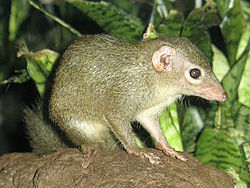
Tupaia sp.
CITES Appendix II (CITES)[2]
Scientific classification Edit this classification
Kingdom: Animalia
Phylum: Chordata
Class: Mammalia
Grandorder: Euarchonta
Order: Scandentia
Wagner, 1855
Families
Red: Tupaiidae, blue: Ptilocercidae, purple: both Tupaiidae and Ptilocercidae
The distribution and density of treeshrew species.

The treeshrews (also called tree shrews or banxrings[3]) are small mammals native to the tropical forests of South and Southeast Asia. They make up the entire order Scandentia (from Latin scandere 'to climb'),[4] which split into two families: the Tupaiidae (19 species, "ordinary" treeshrews), and the Ptilocercidae (one species, the pen-tailed treeshrew).

Though called 'treeshrews', and despite having previously been classified in Insectivora, they are not true shrews, and not all species live in trees. They are omnivores; among other things, treeshrews eat fruit. As fellow members of Euarchonta, treeshrews are closely related to primates, and have been used as an alternative to primates in experimental studies of myopia, psychosocial stress, and hepatitis.[5]

Description

[edit]
Dentition of Tupaia

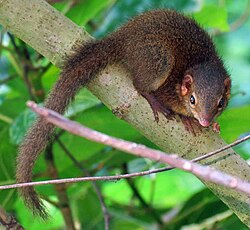
Treeshrews are slender animals with long tails and soft, greyish to reddish-brown fur. The terrestrial species tend to be larger than the arboreal forms, and to have larger claws, which they use for digging up insect prey. They have poorly developed canine teeth and unspecialised molars, with an overall dental formula of 2.1.3.33.1.3.3[6] They have a higher brain to body mass ratio than any other mammal, including humans,[7] but high ratios are not uncommon for animals weighing less than 1 kg (2 lb).

Treeshrews have good vision, which is binocular in the case of the more arboreal species.

Reproduction

[edit]

Female treeshrews have a gestation period of 45–50 days and give birth to up to three young in nests lined with dry leaves inside tree hollows. The young are born blind and hairless, but are able to leave the nest after about a month. During this period, the mother provides relatively little maternal care, visiting her young only for a few minutes every other day to suckle them.

Treeshrews reach sexual maturity after around four months, and breed for much of the year, with no clear breeding season in most species.[6]

Behavior

[edit]

Treeshrews live in small family groups, which defend their territory from intruders. Most are diurnal, although the pen-tailed treeshrew is nocturnal.

They mark their territories using various scent glands or urine, depending on the particular species.

Diet

[edit]

Treeshrews are omnivorous, feeding on insects, small vertebrates, fruit, and seeds. Among other things, treeshrews eat Rafflesia fruit.

The pen-tailed treeshrew in Malaysia is able to consume large amounts of naturally fermented nectar from flower buds of the bertam palm Eugeissona tristis (with up to 3.8% alcohol content) the entire year without it having any effects on behaviour.[8][9]

Treeshrews have also been observed intentionally eating foods high in capsaicin, a behavior unique among mammals other than humans. A single TRPV1 mutation reduces their pain response to capsaicinoids, which scientists believe is an evolutionary adaptation to be able to consume spicy foods in their natural habitats.[10]

Pitcher plants like the Nepenthes lowii, supplements its carnivorous diet with tree shrew droppings, which provides essential nitrogen in a mutualistic relationship. The plants facilitate this behavior by producing excess exudates on a leaf surface most easily reachable with the treeshrew's hindquarters above the opening of the pitcher.[11][12][13]

An upper pitcher of Nepenthes lowii
Pen-tailed treeshrew (1850 depiction of Ptilocercus lowii)

Taxonomy

[edit]

Treeshrews were moved from the order Insectivora into the order Primates because of certain internal similarities to primates (for example, similarities in the brain anatomy, highlighted by Sir Wilfrid Le Gros Clark), and classified as a "primitive prosimian", however they were soon split from the primates and moved into their own order. Taxonomists continue to refine the treeshrews' relations to primates and to other closely related clades.

Molecular phylogenetic studies have suggested that the treeshrews, with the primates and the flying lemurs (colugos), belong to the grandorder Euarchonta. According to this classification, the Euarchonta are sister to the Glires (lagomorphs and rodents), and the two groups are combined into the superorder Euarchontoglires.[14] However, the alternative placement of treeshrews as sister to both Glires and Primatomorpha cannot be ruled out.[15] Some studies place Scandentia as sister of the Glires, which would invalidate Euarchonta: it is this organization that is shown in the tree diagram below.[16][15]

Euarchontoglires

Scandentia (treeshrews)

Glires

Lagomorpha (rabbits, hares, pikas)

Rodentia (rodents)

Primatomorpha

Several other arrangements of these orders have been proposed in the past, and the above tree is only a well-favored proposal.[17] Although it is known that Scandentia is one of the most basal euarchontoglire clades, the exact phylogenetic position is not yet considered resolved: it may be a sister of Glires, Primatomorpha,[18] or Dermoptera, or separate from and sister to all other Euarchontoglires.[19][20] Shared short interspersed nuclear elements (SINEs) offer strong evidence for Scandentia belonging to the Euarchonta group:[21]

Euarchontoglires
Glires

Lagomorpha (rabbits, hares, pikas)

Rodentia (rodents)

Euarchonta

Scandentia (treeshrews)

Primatomorpha

Order Scandentia

[edit]

The 23 species are placed in four genera, which are divided into two families. The majority are in the "ordinary" treeshrew family, Tupaiidae, but one species, the pen-tailed treeshrew, is different enough to warrant placement in its own family, Ptilocercidae; the two families are thought to have separated 60 million years ago.[22] The former Tupaiidae genus Urogale was disbanded in 2011 when the Mindanao treeshrew was moved to Tupaia based on a molecular phylogeny.[22]

Family Tupaiidae
Family Ptilocercidae

Fossil record

[edit]

The fossil record of treeshrews is poor. The oldest putative treeshrew, Eodendrogale parva, is from the Middle Eocene of Henan, China, but the identity of this animal is uncertain. Other fossils have come from the Miocene of Thailand, Pakistan, India, and Yunnan, China, as well as the Pliocene of India. Most belong to the family Tupaiidae; one fossil species described from the Oligocene of Yunnan is thought to be closer to the pen-tailed treeshrew.[23]

Named fossil species include Prodendrogale yunnanica, Prodendrogale engesseri, and Tupaia storchi from Yunnan, Tupaia miocenica from Thailand, Palaeotupaia sivalicus from India[24] and Ptilocercus kylin from Yunnan.[23]

See also

[edit]

References

[edit]
Revisions and contributorsEdit on WikipediaRead on Wikipedia
from Grokipedia
Treeshrews are small, squirrel-like mammals comprising the order Scandentia, which includes two families—Tupaiidae (22 species in four genera) and Ptilocercidae (one species)—native exclusively to the tropical forests of South and Southeast Asia. Ranging in size from about 10 to 25 cm in head-body length with weights of 50–250 grams, they feature elongated, pointed snouts, sharp claws adapted for climbing, large eyes, and bushy tails often equal to or longer than the body. These traits support a versatile lifestyle blending arboreal, scansorial, and terrestrial locomotion across diverse forest strata. Phylogenetically, treeshrews represent an ancient mammalian lineage that diverged from other around 85 million years ago, with the split between the two families occurring around 60 million years ago and major radiations during the due to tectonic changes in . The family dominates in diversity, including genera such as Tupaia (common treeshrews), Dendrogale (smooth-tailed treeshrews), Urogale (Mindanao treeshrew), and Anathana (Madras treeshrew), while Ptilocercidae is limited to the nocturnal pen-tailed treeshrew (Ptilocercus lowii). Species distribution spans from southern and eastward through Indochina, the , and Sundaic islands like (a hotspot with multiple endemics) to the , often in rainforests up to 3,000 meters elevation, though some adapt to secondary forests, plantations, and habitats. Ecologically, most treeshrews are diurnal and solitary or form monogamous pairs, maintaining territories marked by and vocalizations, with home ranges of 0.5–2 hectares depending on sex and . They are primarily insectivorous, foraging for arthropods like beetles and using their keen and dexterous forepaws, supplemented by fruits, seeds, , and occasionally small vertebrates or eggs. Notable adaptations include symbiotic relationships, such as the northern treeshrew (Tupaia belangeri) defecating into pitcher plants after consuming , aiding . Reproduction varies but often involves year-round breeding with litters of 1–4 young after 30–50 day gestations; is minimal, with mothers nursing briefly every other day in some . Conservation challenges affect several species, with habitat loss from and threatening endemics like the Nicobar treeshrew (Tupaia nicobarica), classified as Endangered due to its restricted range under 1,200 km². Overall, treeshrews' unique position as a "living fossil" order highlights their role in understanding early placental , though many remain understudied in the wild.

Taxonomy and Phylogeny

Classification

Treeshrews constitute the entirety of the order Scandentia, a distinct mammalian order that diverged early from other placental mammals and encompasses two families: and Ptilocercidae. The order Scandentia was formally established in 1855 by Moritz Wagner to accommodate these squirrel-like climbers, separate from other groups. The larger family Tupaiidae comprises 20 species across four genera—Anathana (1 species), Dendrogale (2 species), Tupaia (16 species), and Urogale (1 species)—encompassing a range of arboreal and semi-terrestrial forms primarily found in Southeast Asian forests. In contrast, the family Ptilocercidae is monospecific, represented solely by Ptilocercus lowii, the pen-tailed treeshrew, which is distinguished by its unique naked, pencil-like tail adorned with elongated scales and hairs. This family highlights the limited diversity within Scandentia, with Ptilocercus lowii exhibiting more primitive traits compared to the more speciose Tupaiidae. The generic name Tupaia, which dominates the Tupaiidae, derives from the Malay word "tupai," meaning squirrel, reflecting the superficial resemblance of these animals to squirrels in appearance and arboreal habits, though they are unrelated to rodents (order Rodentia) or true shrews (family Soricidae). Historically, treeshrews were classified within the order but were reassigned to Scandentia in the following anatomical analyses that emphasized their unique skeletal and reproductive features, distinct from both insectivores and the to which they were briefly allied in the mid-20th century.

Evolutionary Relationships

Treeshrews, belonging to the order Scandentia, occupy a basal position within the superorder Euarchontoglires, forming part of the clade Euarchonta alongside primates (Primates) and colugos (Dermoptera). Molecular phylogenomic analyses, including those based on thousands of orthologous genes, consistently place Scandentia as the sister group to the combined Primates + Dermoptera lineage, with treeshrews exhibiting a closer affinity to primates than to Glires (rodents and lagomorphs). This positioning is supported by nuclear DNA data and genome-wide studies, which resolve Scandentia within Euarchonta despite some historical incongruence due to rapid evolutionary rates in treeshrew lineages. The divergence of Scandentia from the primate-colugo lineage occurred approximately 80-90 million years ago during the Late Cretaceous, predating the K-Pg boundary and reflecting early placental mammal diversification. Historically, treeshrews were misclassified within the order as "primitive prosimians" due to superficial anatomical similarities, such as arboreal adaptations and certain skeletal features, a view prominent from the through the mid-20th century. This placement persisted until the , when molecular and detailed anatomical evidence led to their recognition as a distinct order; key differences include the absence of a primate-like tooth comb, distinct brain structures lacking the expanded typical of , and unique reproductive and sensory traits. Reclassifications in the late and early , driven by comparative morphology and emerging genetic data, elevated Scandentia to independent ordinal status, emphasizing its role as a non-primate euarchontan. Recent taxonomic work, such as the description of Tupaia danghuytrihuynhi from , continues to refine our understanding of diversification within the order. The fossil record of treeshrews is sparse, with the earliest confirmed s dating to the early , approximately 34 million years ago, represented by the genus Ptilocercus (e.g., P. kylin) from sites in , . Earlier Eocene forms like Adapisoriculus from and have been tentatively linked to scandentians based on dental morphology, but their assignment remains debated due to fragmentary remains and potential convergence with other euarchontans. Diversification accelerated in the across , with genera such as Tupaia appearing in deposits from and , marking the radiation of modern tupaiid lineages; no unequivocal pre- scandentian s are confirmed, supporting an Asian origin for the order. This limited history underscores treeshrews' retention of primitive traits, including insectivory and , offering key insights into the early radiation of placental mammals and the ancestral euarchontan bauplan.

Physical Characteristics

Morphology

Treeshrews (order Scandentia) exhibit a range of body sizes across their two families, and Ptilocercidae, with head-body lengths typically measuring 10-25 and weights varying from 50-300 g depending on the species. For instance, the (Tupaia glis) has an average head-body length of 19.5 , a length of 16.5 , and a body weight of about 142 g, while the large treeshrew (Tupaia tana) reaches up to 300 g. Smaller species, such as the Bornean smooth-tailed treeshrew (Dendrogale melanura), weigh around 42.5 g with a head-body length of 11-15 . These dimensions reflect their to arboreal and scansorial lifestyles in tropical forests. Externally, treeshrews possess a slender, squirrel-like body form with a long, pointed muzzle (elongated rostrum) suited for probing crevices, large forward-facing eyes for enhanced , and prominent rounded ears. Their is soft and dense, typically grayish-brown to reddish on the dorsum with lighter underparts, as seen in T. glis where the pelage is dark brown above and orange-rufous below. Limbs are elongated with sharp, curved claws on all digits, facilitating climbing and grasping on branches and tree trunks. In the (Ptilocercus lowii), the body measures 13-14 cm in length with gray to light brown and a distinctive black eye mask. Tail morphology varies significantly between families: most Tupaiidae species have a bushy, equal to or longer than the body (up to 30 cm), aiding in balance during , whereas P. lowii features a naked, scaly with alternating black and white bands and distal plume-like tufts for sensory or display functions. Skeletally, treeshrews display a quadrupedal scansorial build with a flexible spine and strong hindquarters, enabling agile movement across varied substrates; the forelimbs show grasping adaptations with mobile fingers and toes. Dentally, treeshrews have 38-42 teeth with a formula of I 2/3, C 1/1, P 3/3, M 3/3, featuring small pointed upper incisors and canines, procumbent lower incisors forming a grooming , and dilambdodont molars with sharp cusps adapted for crushing exoskeletons. This supports their primarily faunivorous diet while allowing opportunistic omnivory.

Sensory Systems

Tree shrews possess a well-developed adapted to their diurnal lifestyle in forested environments, featuring large eyes that provide high for navigating dense foliage and detecting movement. Their retinas are heavily dominated by cones, with rods comprising less than 4% of photoreceptors, supporting based on short-wavelength-sensitive (SWS) and long-wavelength-sensitive (LWS) cone types, with a spectral neutral point around 505 nm. This enables discrimination of colors in the to yellow-red , aiding in and predator avoidance, while a wide binocular , approximately 55 degrees, enhances for arboreal locomotion. The is prominently expanded, occupying a substantial portion of the —estimated at around 70% in Tupaia glis—reflecting heavy reliance on vision over other senses, with multiple cortical areas (at least nine) processing form, motion, and disparity. The in tree shrews supports territorial and social functions through prominent , including the jugulosternal (chin) gland and abdominal glands, which produce odors used for marking territories and eliciting responses in conspecifics. While acute olfaction aids in locating and fruits, it is secondary to vision in these diurnal species, as evidenced by relatively smaller olfactory brain regions compared to nocturnal mammals; the accessory , involved in detection, shows moderate development relative to body size. Auditory capabilities are tuned for detecting subtle environmental cues, with sensitive hearing particularly effective at frequencies around 8 kHz for identifying rustling prey or predators in undergrowth. The vocal repertoire includes high-frequency chirps and trills, often in the 5-20 kHz range, used for communication, with behavioral thresholds extending up to 60 kHz in adults. Large, complete auditory bullae contribute to enhanced by amplifying and directing incoming sounds. Tree shrews exhibit a relatively large for their body mass, with an (EQ) of approximately 0.4-0.6, positioning them intermediately between insectivores and and facilitating integrated , particularly visual. This elevated EQ supports complex neural architectures, such as the expanded , underscoring their advanced sensory integration despite small overall body size.

Distribution and Habitat

Geographic Range

Treeshrews, comprising the order Scandentia, are native to the tropical regions of South and , with their distribution spanning from southern and eastward through , , Indochina (including , , and ), the , and extending to the Indonesian islands of , , , and the . Some species, such as the northern treeshrew (Tupaia belangeri), also occur in southern China and , but the group is absent from northern mainland China, , and . Individual species exhibit varied ranges, reflecting the group's adaptation to diverse island and continental habitats. The common treeshrew (Tupaia glis) has one of the broadest distributions, occurring from southern Myanmar and Thailand southward through the (including ) to and , often south of the Isthmus of Kra. In contrast, the Philippine treeshrew (Urogale everetti, also known as the Mindanao treeshrew) is strictly endemic to the island of in the southern , where it inhabits rainforests and montane forests. The pen-tailed treeshrew (Ptilocercus lowii) is more restricted, found in , the , northern , and northwestern . Biogeographic patterns underscore high species diversity within —a paleogeographic region encompassing the and the —where over 20 of the approximately 23 recognized treeshrew species occur, many as island endemics. This concentration of diversity is attributed to Pleistocene sea-level fluctuations, which repeatedly exposed and submerged land bridges, isolating populations and promoting through vicariance on islands like and . No treeshrew populations have been introduced outside their native ranges, confining the order to tropical forests.

Habitat Preferences

Treeshrews primarily occupy tropical rainforests, including both and types, spanning elevations from to 3,000 m. These habitats encompass the and canopy layers, where species exploit diverse vertical strata for movement and shelter. Some treeshrews also utilize secondary forests, agricultural plantations, and habitats, indicating a degree of flexibility in disturbed landscapes. Microhabitat preferences vary by species and lifestyle. Arboreal forms, such as those in the genus Dendrogale, favor high tree holes at 20–30 m above the ground, often in montane forests above 900 m . In contrast, more terrestrial species like Tupaia tana frequent the , using underground cavities at , rotten logs, or low above-ground nests constructed from fibers and dried leaves in hollows, vines, or dense undergrowth. Nests are typically lined with fibers and leaves for insulation, located in both primary and moderately logged forests at 200–900 m. Treeshrews demonstrate adaptability to moderate disturbance, persisting in edge habitats, , and areas with selective , though they are sensitive to extensive . Their use of diverse microhabitats, including thickets and streamside vegetation, supports this resilience in altered environments. Regarding conservation, most of the approximately 20 treeshrew species are classified as Least Concern by the due to their relatively wide distributions and adaptability. However, 4–5 species face heightened risks, including the Nicobar treeshrew (Tupaia nicobarica), listed as Vulnerable owing to its restricted range on the and ongoing habitat degradation. Primary threats include habitat loss from logging, conversion to plantations, and mining activities, which have fragmented their overall range across .

Behavior and Diet

Behavioral Patterns

Treeshrews exhibit primarily diurnal activity patterns, remaining active from dawn to dusk to forage and navigate their arboreal and terrestrial environments, though the (Ptilocercus lowii) is notably nocturnal. Their high metabolic rates demand substantial energy expenditure, often leading to periodic rests in constructed nests—typically woven from leaves and fibers in tree hollows or undergrowth—to recover during the hottest midday hours in tropical habitats. Locomotion in treeshrews is predominantly scansorial, characterized by agile and leaping between tree branches and trunks, facilitated by sharp claws and a bushy for balance. On the ground, they employ a quadrupedal , scurrying rapidly with the tail held upright for stability during short dashes. Pen-tailed treeshrews share similar adaptations but are more terrestrial at night, using their distinctive pennate tails for sensory feedback rather than gliding. Socially, treeshrews are generally solitary or form monogamous pairs that maintain overlapping but distinct territories, with minimal group interactions beyond mothers temporarily housing young in nests. Home ranges vary from approximately 0.8 to 3.4 hectares, defended vigorously against intruders of the same sex through scent marking via glandular secretions on the flanks and tail, as well as vocalizations such as chatters and screams during territorial disputes. Communication among treeshrews relies on a combination of vocal, visual, and olfactory signals to convey identity, , and threats. Vocalizations include species-specific chatter calls for and social signaling, often varying in intensity to indicate affect, alongside squeaks and loud disturbance calls produced when threatened. Visual displays feature rapid tail flicking, particularly accompanying calls to alert nearby individuals, while agonistic encounters involve aggressive chasing, lunging, and targeted at the opponent's hindquarters or flanks.

Foraging and Diet

Treeshrews exhibit an omnivorous diet primarily consisting of , with the proportion varying by and season. Common prey includes beetles (Coleoptera), ants (Formicidae), termites (Isoptera), caterpillars ( larvae), and earthworms (), supplemented occasionally by small vertebrates such as and birds' eggs, as well as fungi. Plant matter, including fruits, seeds, and , constitutes the remainder, often processed by sucking juices and ejecting pulp or seeds to avoid indigestible fibers. Their simplified digestive system, featuring a , long narrow , and rudimentary , supports rapid transit times of 20-60 minutes, enabling frequent meals to sustain their high metabolic rate. Foraging occurs primarily during daylight hours, with individuals engaging in bouts totaling 4-8 hours daily, actively in the forest understory and probing crevices, leaf litter, and with their elongated snouts and sharp claws. They employ a strategy, scanning foliage and ground surfaces for prey while moving deliberately rather than in rapid chases, and consume food on-site with minimal storage due to their fast requiring near-constant intake. Locomotion such as climbing and bounding facilitates access to arboreal and fruits. In fruit-rich periods, treeshrews may dedicate extended sessions to specific trees, repeatedly visiting to ingest pulp from small, soft fruits like figs. Dietary preferences vary across species; for instance, the pygmy treeshrew (Tupaia minor) maintains a more balanced omnivory with significant consumption alongside , while the large treeshrew (Tupaia tana) incorporates up to 28-30% matter, particularly figs, during peak seasons. The (Ptilocercus lowii) leans toward invertebrates like , , and beetles, augmented by fermented and fruits from specific such as bertam palms. These adaptations reflect and resource availability, with stricter insectivory in understory specialists. As insectivores, treeshrews play a key role in controlling arthropod populations in tropical forests, reducing pest numbers that affect vegetation and other wildlife. Certain species contribute to seed dispersal by consuming fruit pulp and defecating viable seeds away from parent trees, aiding forest regeneration, though they rarely handle large seeds.

Reproduction

Breeding and Gestation

Treeshrews exhibit diverse mating systems that vary by species and environmental context, often involving elements of promiscuity or polygyny. In species such as Tupaia glis, adult males maintain territories that overlap with one or more females, forming harems where the number of associated females is proportional to the male's range size; males defend these territories aggressively by chasing intruding males, thereby securing mating access. In contrast, Tupaia tana displays behavioral monogamy, with males and females forming stable pairs, yet genetic studies reveal a promiscuous component through high rates of extra-pair paternity, affecting approximately 50% of offspring. Male competition typically manifests through territorial displays and physical confrontations rather than elaborate courtship rituals, emphasizing dominance in securing mates. Breeding patterns in treeshrews are influenced by and resource availability, with females generally polyestrous. In equatorial regions, occurs year-round, though peaks may align with favorable conditions like abundance; for instance, in tropical T. glis, multiple cycles support 2-3 breeding attempts annually. In more seasonal habitats, such as those of T. belangeri, copulations concentrate from February to June, comprising about 60% of annual events in captivity, with minimal activity in late summer and fall; this leads to pup births primarily from March to August. Estrus cycles last 9-12 days in T. montana, facilitating repeated opportunities for within a year. Gestation durations range from 42 to 51 days across , reflecting adaptations to tropical lifestyles. In T. belangeri, pregnancy lasts 42-45 days, while in T. montana it extends to 49-51 days; T. glis falls within 41-45 days. sizes vary from 1 to 5 young, with species-specific averages of 2-3; for example, T. glis typically produces 2 offspring, and T. belangeri averages 3.04 embryos per female based on dissections. These parameters depend on nutritional status and habitat resources, with smaller in resource-poor conditions. Male involvement beyond is minimal in most treeshrew , limited to territorial guarding that may indirectly protect paired or females from rivals during receptive periods. No evidence of post-copulatory mate guarding or has been documented, aligning with the ' high-energy demands on females.

Development and Lifespan

Treeshrews give birth to altricial young that are blind, hairless, and weigh approximately 10-12 grams at birth. These offspring are typically born in nests constructed within holes or cavities, where they remain hidden during the mother's periods. Maternal care is exclusively provided by the female, who employs a "parked litter" strategy, leaving the young concealed in the nest while she forages independently and returns periodically to . Nursing sessions occur every 48 hours and last 10-15 minutes, during which the mother provides 5-15 grams of high-protein, low-carbohydrate ; this pattern continues for about 20-36 days until weaning. Females can produce multiple litters per year once the current young are weaned, supporting their high reproductive rate in tropical environments. Growth milestones in treeshrews progress rapidly postnatally. In species such as the (Tupaia glis) and northern treeshrew (T. belangeri), ears open around 10 days after birth, and eyes open at approximately 20 days. Young are weaned between 25 and 36 days, after which they leave the natal nest and become more mobile, often joining the parental territory. Independence is achieved by 2-3 months, with full separation from the family group occurring as juveniles establish their own ranges. is reached between 3 and 4 months of age in both sexes, enabling shortly thereafter. Juvenile mortality is high, often exceeding 50% due to predation by snakes and birds, as well as disease, which limits survival to adulthood. In the wild, treeshrews typically live 2-3 years, though some individuals may reach up to 6 years under favorable conditions; predation remains the primary cause of death. In captivity, lifespans extend significantly to 8-12 years, with the longest recorded at 12 years and 5 months, benefiting from protection from predators and consistent food availability.

References

Add your contribution
Related Hubs
User Avatar
No comments yet.