Hubbry Logo
Trema orientaleTrema orientaleMain
Open search
Trema orientale
Community hub
Trema orientale
logo
8 pages, 0 posts
0 subscribers
Be the first to start a discussion here.
Trema orientale
Trema orientale
from Wikipedia

Trema orientale
Scientific classification Edit this classification
Kingdom: Plantae
Clade: Tracheophytes
Clade: Angiosperms
Clade: Eudicots
Clade: Rosids
Order: Rosales
Family: Cannabaceae
Genus: Trema
Species:
T. orientale
Binomial name
Trema orientale
Synonyms[2]
List
    • Celtis commersonii Brongn.
    • Celtis glomerata Hochst.
    • Celtis guineensis Schumach. & Thonn.
    • Celtis laeta Salisb.
    • Celtis madagascariensis Bojer
    • Celtis orientalis L.
    • Celtis rigida Blume
    • Sponia affinis Planch.
    • Sponia africana Planch.
    • Sponia andaresa Comm. ex Lam.
    • Sponia argentea Planch.
    • Sponia bracteolata Hochst.
    • Sponia commersonii Decne. ex Planch.
    • Sponia glomerata Hochst.
    • Sponia guineensis (Schumach. & Thonn.) Planch.
    • Sponia hochstetteri Planch.
    • Sponia lucida Hassk.
    • Sponia nitens Hook.f. ex Planch.
    • Sponia orientalis (L.) Decne. ex Planch.
    • Sponia rigida (Blume) Decne. ex Planch.
    • Sponia scaberrima Miq.
    • Sponia strigosa Planch.
    • Sponia wightii Planch.
    • Trema affine (Planch.) Blume
    • Trema africanum (Planch.) Blume
    • Trema argenteum (Planch.) Blume
    • Trema bracteolatum (Hochst.) Blume
    • Trema burmanni Blume
    • Trema commersonii (Decne. ex Planch.) Blume
    • Trema glomeratum (Hochst.) Blume
    • Trema grevei Baill.
    • Trema griseum Baker
    • Trema guineense (Schumach. & Thonn.) Ficalho
    • Trema hochstetteri (Planch.) Engl.
    • Trema nitens (Hook.f. ex Planch.) Blume
    • Trema rigidum (Blume) Blume
    • Trema scaberrimum (Miq.) Blume
    • Trema sieberi Blume

Trema orientale (sometimes Trema orientalis) is a species of flowering tree in the hemp family, Cannabaceae.[2][4][5][6] It is known by many common names, including charcoal-tree,[6] Indian charcoal-tree,[6] pigeon wood,[7] Oriental trema,[8] and in Hawaii, where it has become naturalized, gunpowder tree,[9] or nalita.[10] It has a near universal distribution in tropical and warm temperate parts of the Old World, with a range extending from South Africa, through the Middle East, the Indian subcontinent and southern China to Southeast Asia and Australia.

Distribution

[edit]

Trema orientale is native to tropical and southern Africa (including Madagascar), Asia (the Arabian Peninsula, China, eastern Asia, tropical Asia) and Australia.[6]

Uses

[edit]

The wood is relatively soft, and burns easily and quickly when dry. The wood is suitable for paper and pulp production,[11][12] producing paper with good tensile strength and folding endurance.[11] The bark can be used for making string or rope, and used as waterproofing fishing-lines.[7][13] In India and Tanzania, the wood is used to make charcoal and is a good fire starter.[13]

Medicinal use

[edit]

The tree has various uses as an herbal medicine in a wide range of cultures.[7] The leaves and the bark are used to treat coughs, sore throats, asthma, bronchitis, gonorrhea, yellow fever, toothache, and as an antidote to general poisoning.[11][14] A bark infusion is reportedly drunk to control dysentery and a leaf decoction is used to deworm dogs.[11] In recent pharmacological studies, an aqueous extract from the bark has been shown to reduce blood sugar levels in an experimental animal model of diabetes mellitus, and may be useful for treating this disease.[15] Extracts from leaves of related species (Trema guineense and Trema micrantha) showed anti-inflammatory, anti-arthritic and analgesic activity in rodents,[16] suggesting that T. orientale could produce similar results.

Phytochemicals

[edit]

Trema orientalis has been reported to contain cannabinoids such as tetrahydrocannabinol (30 mg/kg-90 mg/kg avg), cannabinol (130 mg/kg-357 mg/kg avg) and cannabidiol (2 mg/kg-5 mg/kg avg). Identification was performed by comparing the retention time of HPLC and GC analysis.[17] However these results have not yet been independently replicated, and have been disputed.[18]

Ecology

[edit]

This species has a high ecological impact with at least 14 species of butterfly using it as a larval food plant.[7] Several species of birds eat the fruit or feed on the abundant insects which live in these trees. Pigeons and doves are often found in these trees where they eat the fruits or make their nests; giving the origin of the name 'Pigeon Wood'.[7] The leaves, pods and seeds are used as fodder for cattle, buffaloes and goats in the Philippines.[11][14] The leaves are also browsed by game animals and can be used as spinach. This tree is a fast-growing species found in previously disturbed areas and on forest margins. It is a pioneer species that can grow on poor soil and can be used to regenerate forest areas by providing shade and protection to saplings of forest hardwoods. T. orientale is nitrogen fixing and can thereby improve soil fertility for other plant species.[14]

[edit]

References

[edit]

Bibliography

[edit]
[edit]
Revisions and contributorsEdit on WikipediaRead on Wikipedia
from Grokipedia
Trema orientale (L.) Blume is a fast-growing shrub or tree belonging to the family, typically reaching heights of 8 to 18 meters with a short, often swollen bole, heavy branching, and a rounded to spreading crown. It features simple, alternate, papery leaves up to 14 cm long with finely toothed margins and rough texture, small unisexual greenish-white flowers in crowded inflorescences, and small, round, fleshy drupes that turn glossy black when ripe. Native to tropical and subtropical regions, this species is known by common names such as tree, tree, and pigeon wood. Widely distributed across the tropics, Trema orientale occurs in over 65 countries, primarily in (from to ) and (including , , and ), extending to parts of the Pacific and , where it thrives in lowland humid forests, riverbanks, disturbed areas, and poor soils at elevations up to 2,500 meters. It plays an important ecological role as a , rapidly colonizing clearings and aiding in and , though it can become invasive in introduced regions like and . The tree prefers full sun and moist, well-drained soils with a of 4.5 to 7.5, tolerating annual rainfall from 1,000 to 4,000 mm, and is intolerant of fire but regenerates vigorously through and prolific seeding. Trema orientale has significant economic and cultural value, with its wood used for , high-quality (historically for ), poles, and paper pulp due to its fine grain and tensile strength. The leaves and fruits serve as for , containing up to 18.9% crude protein, while the bark and leaves are employed in across and to treat ailments such as coughs, , dysentery, , and parasitic infections, supported by phytochemicals including , , and that exhibit , , and properties. Additionally, it provides shade in systems like and cocoa plantations, yields dyes from bark and leaves, and supports as a source, though its rapid growth requires management to prevent over-dominance in ecosystems.

Taxonomy and Nomenclature

Classification

Trema orientale is classified within the kingdom Plantae, phylum Tracheophyta, class Magnoliopsida, order Rosales, family Cannabaceae, genus Trema, and species T. orientale (L.) Blume. The species was first described by Carl Linnaeus as Celtis orientalis in Species Plantarum in 1753, based on specimens from Asia. It was later transferred to the genus Trema by Carl Ludwig Blume in Museum Botanicum volume 2, page 62, in 1856, reflecting a better understanding of its morphological and phylogenetic affinities. Within the Cannabaceae family, Trema orientale aligns with characteristic features such as dioecious habit, alternate simple leaves, and small, inconspicuous flowers arranged in clusters or catkins, which are typically wind-pollinated. The family encompasses genera like Cannabis and Humulus, known for similar reproductive strategies and inflorescence structures, and recent phylogenetic studies have placed Trema firmly within Cannabaceae based on molecular data confirming its close relation to these groups, distinguishing it from former placements in Ulmaceae.

Synonyms and Etymology

Trema orientale has several accepted synonyms, including Celtis orientalis L., Sponia orientalis (L.) Decne., and Trema orientalis (L.) Blume. The has historically been spelled as orientalis, but was corrected to orientale to conform to Latin grammatical rules, as the name Trema is derived from Greek and is neuter, requiring a neuter specific ending. The name Trema originates from the Greek word trêma, meaning "" or "," which refers to the pitted surface of the fruit's endocarp. The specific orientale comes from the Latin orientalis, denoting "eastern," in to the ' native range in . Common names for Trema orientale include Indian tree, pigeon wood, and Oriental trema, with "charcoal tree" alluding to traditional uses of its wood, though such applications are not detailed here. Historically, Trema orientale was classified under the genus Celtis within the family Ulmaceae due to morphological similarities with hackberries, such as leaf and fruit characteristics. In the late 20th century, phylogenetic studies incorporating molecular evidence, including plastome sequences, reclassified the genus Trema to the family Cannabaceae, reflecting its closer relation to genera like Cannabis and Humulus. This shift was formalized in classifications like those proposed by the Angiosperm Phylogeny Group in 2003 (APG II) and refined in subsequent updates.

Description and Biology

Morphology

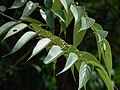
Trema orientale is a fast-growing or small to medium-sized that typically reaches heights of 5–18 m, featuring a short bole that may be basally swollen, heavy branching, and a rounded to spreading . The bark is smooth and gray, often marked by conspicuous lenticels and sometimes developing longitudinal fissures with age. Twigs are slender, spreading or drooping, and vary from sparsely to densely pubescent, with pubescence density differing among populations. The leaves are simple, alternate, and stipulate, arranged along the branches in two ranks; stipules are lanceolate, pubescent, and caducous, measuring 4–7 mm long. blades are elliptic to ovate-lanceolate, 6–15 cm long and 2–7 cm wide (juvenile leaves up to 15 × 9 cm), with a rounded to cordate and slightly asymmetric base, acuminate apex, and evenly serrate margins from near the base. The upper surface is scabrid and sparsely stiff-hairy with sunken veins, while the lower surface is pubescent to tomentose with prominent veins; petioles are 7–15 mm long and finely hairy. Flowers are small (2–3 mm long), greenish-cream, and unisexual (with rare bisexual ones), arranged in axillary cymes forming panicles 5–10 mm long and up to 5 cm across; the is functionally dioecious, with flowers predominant and or bisexual at the cyme apex. flowers feature 5 stamens, while flowers have a pubescent inferior 1–1.5 mm long and styles 0.5–1.2 mm long; tepals are 1–1.5 mm long. Fruits are small, ovoid-globose drupes, 3–5 in diameter, initially green or pink, maturing to purple or black with glabrous skin and fleshy mesocarp surrounding a single dull black ; they are dispersed primarily by birds. Morphological variations occur regionally, with the species behaving as in drier climates and in wetter ones, and twig pubescence ranging from sparse to dense depending on local populations.

Reproduction

Trema orientale produces unisexual flowers in axillary cymes and is typically monoecious but can be functionally dioecious in some populations. Flowers are pollinated by bees. Following pollination, fruits develop as small, fleshy drupes that ripen variably by locality, often from December to May in Indian populations, and are primarily dispersed by birds that consume the fruit and excrete viable seeds. Seeds of Trema orientale exhibit physical dormancy, resulting in naturally low germination rates of around 30% under standard conditions, though viability can reach up to 92% after three months of storage at ambient temperatures (28–30°C). Germination occurs in moist environments with high light intensity, typically taking 20–30 days in untreated seeds, but can be accelerated to 7–20 days with scarification treatments like sulfuric acid exposure, enabling rapid establishment as a pioneer species in disturbed habitats. This trait supports quick colonization, with trees reaching reproductive maturity in 2–3 years. Asexual reproduction in Trema orientale occurs through vegetative means, including propagation from stem cuttings and vigorous following disturbance, which allows for clonal regrowth from basal shoots and roots. These mechanisms enhance resilience and spread in favorable conditions, particularly after cutting or . The life cycle of Trema orientale is characteristic of a short-lived . It regenerates profusely via numerous seeds, with densities up to 370,000 per kg, supporting population persistence.

Distribution and Habitat

Native Range

Trema orientale is native to tropical and southern Africa, where it occurs across a broad expanse from in eastward through countries such as , , , and the Democratic Republic of Congo, extending southward to , including the higher rainfall areas of , Mpumalanga, KwaZulu-Natal, and provinces but absent south of the Kei River. This species is also widespread in ; introduced and naturalized in the , thriving in elevations ranging from up to approximately 2,100 meters. In Asia, Trema orientale has a native distribution spanning the Arabian Peninsula, including Oman, Saudi Arabia, and Yemen, and extending through southern China (provinces such as Fujian, Guangdong, Guangxi, and Guizhou), the Indian subcontinent (India, Bangladesh, Nepal, Bhutan, and Sri Lanka), and tropical and eastern Asia, encompassing Indonesia (Borneo, Java, Lesser Sunda Islands, Maluku, Sulawesi, Sumatra), the Philippines, Myanmar, Thailand, Vietnam, Malaysia, and southern Japan. Its range reaches the Pacific region, including the Bismarck Archipelago, Caroline Islands, and Solomon Islands. Within Australia, Trema orientale is native to northern and eastern , from southward to , primarily in coastal and subtropical zones. The species has maintained a stable and widespread distribution across these regions since prehistoric times, with no major range contractions documented in the scientific literature; it is currently assessed as Least Concern on the due to its extensive occurrence and adaptability as a .

Introduced Range and Habitat Preferences

Trema orientale has been introduced and naturalized in several regions outside its native range, including the , subtropical in the United States, and Island. In Hawaii, it was introduced before 1870 and has become widely naturalized across all main islands, often planted for its wood but now considered invasive due to its rapid spread. Similarly, in , it is naturalized in disturbed areas and rated as having high invasion risk by the University of Florida's Institute of Food and Agricultural Sciences (UF/IFAS). In , it exhibits moderate to high invasiveness, colonizing disturbed habitats aggressively. The species prefers disturbed sites such as forest edges, riverbanks, roadsides, clearings, pastures, and abandoned farmlands in its introduced ranges. It thrives in well-drained soils ranging from heavy clay to light sand, tolerating moderate and but not waterlogging. While it can establish on poor, exposed soils, it favors fertile, moist conditions for optimal growth. Trema orientale is adaptable to subtropical and tropical climates, both wet and dry, with mean annual temperatures of 20–27°C and rainfall between 1000–2000 mm, though it shows tolerance to a broader range of 800–2500 mm once established. It is drought-tolerant after rooting and occurs from to altitudes of 2500 m, often exceeding 1000 m in . Its fast growth and ability to colonize denuded areas contribute to its invasive potential in Pacific island ecosystems.

Ecology

Ecological Role

Trema orientale serves as a key in tropical ecosystems, rapidly colonizing disturbed areas such as clearings, flood-damaged riverbanks, and denuded soils to initiate . Its fast growth and prolific seed production enable it to establish quickly in high-light environments, stabilizing bare ground and paving the way for more shade-tolerant species to follow in regenerating forests. This role is particularly vital in recovery, where it contributes to the transition from early successional stages to climax communities. The species enhances primarily through the accumulation of in its litter, rather than direct fixation, thereby improving nutrient availability for subsequent without being a true nitrogen-fixer. Its mulch acts as an organic amendment in systems, boosting and supporting microbial activity in nutrient-poor substrates. Additionally, the extensive root system of T. orientale prevents on slopes and riverbanks by binding soil particles and reducing runoff in vulnerable, disturbed habitats. In terms of biodiversity support, T. orientale provides an early canopy layer that shelters plants during forest regeneration, fostering complexity in recovering ecosystems. It is also integrated into systems as a shade provider and , promoting diverse growth in plantations such as and cocoa. This functional role aids in maintaining ecological balance by facilitating the establishment of other in transitional landscapes. The rapid growth rate of T. orientale, reaching harvestable sizes in 3-4 years with annual height increments of approximately 1-2 meters, enables quick accumulation and contributes significantly to in regenerating areas. This fast buildup supports early carbon storage in pioneer-dominated successional forests, enhancing overall carbon dynamics before slower-growing species take over.

Interactions with Other Species

Trema orientale exhibits various interspecies interactions that influence its ecological dynamics. Pollination occurs primarily through insects, with bees serving as key pollinators for its small, unisexual flowers that bloom from December to February in many regions. Seed dispersal is facilitated by birds, which consume the fleshy, black drupes (4-6 mm in diameter) ripening between December and May; this ornithochory enhances germination rates, as seeds passing through avian digestive systems exhibit high viability and are often deposited up to 175 meters from the parent tree. The common name "pigeon wood" reflects the preference of pigeons and other frugivorous birds for these fruits, underscoring the plant's reliance on avian vectors for propagation. As a food source, Trema orientale supports herbivores across taxa. Its leaves, pods, and seeds provide fodder for livestock, including , buffaloes, and , with foliage offering approximately 18.9 g of crude protein per 100 g dry matter in the ; however, high and content limits direct , necessitating for optimal use. , such as browsing mammals, also consume the foliage, contributing to its role in supporting local fauna in disturbed habitats. Additionally, the plant serves as a larval host for several species, particularly in the family ; for instance, it supports the Slate Flash (Rapala manea) and other lycaenids in , providing essential nutrition during larval development. Symbiotic relationships further define Trema orientale's interactions. The species forms arbuscular mycorrhizal associations with fungi, which enhance nutrient uptake—particularly —in nutrient-poor soils like mine spoils, promoting growth and tolerance to environmental stresses. There is evidence of potential allelopathic effects from its bark and leaf extracts, which can inhibit or delay germination and growth in certain crops and weeds, possibly mediated by exudates that suppress competing vegetation. In terms of competition, Trema orientale acts as a in , rapidly colonizing clearings, flood-damaged riverbanks, and denuded soils where it outcompetes grasses and herbaceous plants in high-light, early-stage environments due to its fast growth rate. However, as succession progresses, it is typically overshadowed by larger, late-successional trees that dominate the canopy, reflecting its transient role in habitat recovery.

Uses

Economic and Traditional Uses

Trema orientale is valued for its wood, which serves as a source of and in tropical regions of and . The species grows rapidly and coppices effectively, yielding substantial quantities of that is commonly harvested from natural stands or plantations. Its is particularly prized for its quality, often used in local economies and even in the production of and due to its consistent burn properties. In addition, the wood is utilized in manufacturing panel products, poles, and pulp for , where it demonstrates good tensile strength and folding endurance, making it suitable for papermaking industries in these regions. The inner bark of Trema orientale provides strong fibers that are traditionally processed into ropes, strings, twine, and cords for various practical applications. In and other East African communities, these fibers are employed to create waterproof lines and nets, with the bark often rubbed onto ropes to blacken and preserve them against . This use highlights the plant's role in supporting local and crafting economies, where the fibrous bark offers a durable, locally sourced alternative to synthetic materials. Leaves of Trema orientale are a nutritious for , containing 15-20% crude protein on a basis, and are fed to , buffaloes, , and other ruminants either fresh or as . In the and parts of , the foliage, along with pods and seeds, is routinely incorporated into animal diets to enhance during dry seasons. Agriculturally, the tree is widely planted as a shade provider in and cocoa plantations across and , offering protection from excessive sunlight without competing aggressively with crops, and its leaf contributes to improvement in systems. In traditional practices, dry leaves and wood of Trema orientale are used as and fire-sticks in some Central and East African communities, facilitating fire-starting in rituals and daily activities, as reflected in local ethnobotanical derived from this utility. The bark also yields dyes—black from the bark and coffee-colored from the leaves—for cultural and practical coloring in crafts.

Medicinal Uses

In various African and Asian systems, bark decoctions of Trema orientale are commonly prepared and administered to alleviate coughs, , and , often as a gargle, , or oral drink. Leaf poultices, typically made by crushing fresh leaves and applying them directly to the , are used to treat wounds and skin infections, promoting through their purported qualities. Pharmacological studies have demonstrated that aqueous extracts of the stem bark exhibit hypoglycemic effects in streptozotocin-induced diabetic models, with a dosage-dependent reduction in blood glucose levels reaching up to 29.67% at 75 mg/kg body weight after 5 hours of administration. These extracts also show activity, particularly in models of acute and chronic inflammation in mice, supporting their traditional application for respiratory conditions such as and . Additional traditional applications include the use of bark infusions for and eye infections, where diluted preparations are applied topically or ingested to combat gastrointestinal and ocular ailments. In , crude extracts from the bark and wood demonstrate properties against parasites in such as sheep and goats, with extracts showing comparable to standard treatments in larval migration assays. Recent analyses (as of 2023) have identified cannabinoids such as (CBD), (THC), and (CBN) in Trema orientale, suggesting potential new medicinal applications leveraging the known , , and neuroprotective properties of these compounds, though further clinical studies are needed. Preparations typically involve boiling 10-20 g of dried bark in 500-1000 mL of water for 15-30 minutes to yield a , taken orally 1-2 times daily for respiratory or antidiabetic purposes; leaf poultices use 50-100 g of fresh material applied externally. Overuse may lead to mild , with studies indicating an LD50 greater than 2 g/kg in , emphasizing the need for moderated, short-term application under traditional guidance.

Phytochemistry

Chemical Composition

Trema orientale contains cannabinoids, including (THC), (CBD), and (CBN), primarily identified in inflorescences from Asian samples. THC levels range from 30.12 mg/kg to 89.96 mg/kg across regions in , with higher concentrations in northern samples (70.17–89.96 mg/kg) compared to southern ones (30.12–38.13 mg/kg); CBD was detected at lower levels (2.00–5.22 mg/kg) only in southern regions, while CBN was present throughout at 51.63–357.46 mg/kg. These compounds were detected using gas chromatography-mass spectrometry (GC-MS), (TLC), and (HPLC). Flavonoids and phenolic compounds are prominent in the stem and bark of T. orientale. Key flavonoids include (+)-catechin, (−)-epicatechin, and (−)-ampelopsin F, isolated from methanol extracts of the stem. Phenolics such as trans-4-hydroxycinnamic acid, 3,4-dihydroxybenzoic acid, and ρ-hydroxybenzoic acid occur in the stem and bark, with tannins contributing to the plant's astringent properties and present in moderate quantities in the stem bark and seeds. These were identified through extraction and chromatographic analysis in studies on African and Asian specimens. Other classes in T. orientale encompass terpenoids, , and alkaloids. Terpenoids such as , simiarenol, simiarenone, and trematol are found in the stem bark and leaves, while occur in the fruits, stem bark, and seeds. Alkaloids are reported as abundant across plant parts, though specific structures remain less characterized. Volatile oils in the leaves include tetradecanal (33.3%), hexadecanoic acid (19.5%), and farnesylacetone (5.6%), contributing to the plant's aroma, as determined by GC-MS analysis. These classes were confirmed via qualitative screening and isolation from various extracts. Phytochemical concentrations in T. orientale vary by plant part and environmental factors. yields are higher in inflorescences from northern tropical regions compared to southern ones, influenced by geographic and climatic differences. and terpenoids tend to be more concentrated in young leaves and bark, with overall levels affected by conditions and seasonal growth.

Pharmacological Properties

Trema orientale exhibits notable anti-diabetic activity, primarily attributed to its , which inhibit the alpha-glucosidase enzyme . Ethanolic leaf extracts demonstrate an value of 368.81 μg/mL for alpha-glucosidase inhibition, indicating potential to manage postprandial in type-2 diabetes by delaying carbohydrate digestion. In animal models, aqueous stem bark extracts at 300 mg/kg reduce blood glucose levels by approximately 30% in streptozotocin-induced diabetic rats after 5 hours, suggesting hypoglycemic effects possibly through insulin sensitization mechanisms. The plant's contribute to and properties. Phenolics from methanolic extracts inhibit carrageenan-induced in Wistar rats by 25-41% at doses of 200-400 mg/kg, demonstrating dose-dependent activity comparable to standard agents. Bark and extracts show efficacy, with lipophilic fractions exhibiting minimum inhibitory concentrations (MIC) of 0.031-0.125 mg/mL against and , highlighting potential against Gram-positive and Gram-negative pathogens. Lipophilic extracts of Trema orientale inflorescences contain low levels of cannabinoids, including (THC) up to 90 mg/kg, (CBD) up to 5 mg/kg, and (CBN) up to 357 mg/kg. These low THC concentrations may contribute to mild effects observed in leaf extracts, which reduce acetic acid-induced writhing in mice by up to 50% at 250-500 mg/kg, though psychoactive potential remains unverified due to sub-therapeutic levels. Potential neuroprotective effects via CB1 receptor modulation are hypothesized based on presence but lack direct empirical support in this species. Toxicity studies indicate a favorable safety profile, with oral LD50 values exceeding 2 g/kg body weight in for methanolic leaf and stem bark extracts, and no major reported in available assays. However, caution is advised for pregnant individuals, as methanolic root bark extracts at 1-4 mg/mL induce contractions in isolated non-pregnant , suggesting uterine potential that could pose risks during gestation.

References

Add your contribution
Related Hubs
User Avatar
No comments yet.