Hubbry Logo
Triatomic moleculeTriatomic moleculeMain
Open search
Triatomic molecule
Community hub
Triatomic molecule
logo
8 pages, 0 posts
0 subscribers
Be the first to start a discussion here.
Triatomic molecule
Triatomic molecule
from Wikipedia
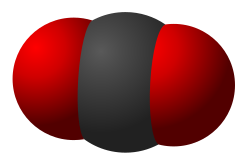
Carbon dioxide

Triatomic molecules are molecules composed of three atoms, of either the same or different chemical elements. Examples include H2O, CO2 (pictured), HCN, O3 (ozone) and NO2.

Molecular vibrations

[edit]

The vibrational modes of a triatomic molecule can be determined in specific cases.

Symmetric linear molecules

[edit]

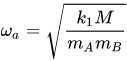
A symmetric linear molecule ABA can perform:

  • Antisymmetric longitudinal vibrations with frequency
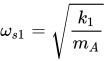
  • Symmetric longitudinal vibrations with frequency
  • Symmetric transversal vibrations with frequency
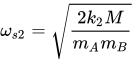
In the previous formulas, M is the total mass of the molecule, mA and mB are the masses of the elements A and B, k1 and k2 are the spring constants of the molecule along its axis and perpendicular to it.

Types

[edit]

Homonuclear

[edit]
Ozone, O3
Trihydrogen cation, H3+

Homonuclear triatomic molecules contain three of the same kind of atom. That molecule will be an allotrope of that element.

Ozone, O3 is an example of a triatomic molecule with all atoms the same. Triatomic hydrogen, H3, is unstable and breaks up spontaneously. H3+, the trihydrogen cation is stable by itself and is symmetric. 4He3, the helium trimer is only weakly bound by van der Waals force and is in an Efimov state.[1] Trisulfur (S3) is analogous to ozone.

Geometry

[edit]

All triatomic molecules may be classified as possessing either a linear, bent, or cyclic geometry.[further explanation needed]

Linear

[edit]

Linear triatomic molecules owe their geometry to their sp or sp3d hybridised central atoms. Well-known linear triatomic molecules include carbon dioxide (CO2) and hydrogen cyanide (HCN).

Xenon difluoride (XeF2) is one of the rare examples of a linear triatomic molecule possessing non-bonded pairs of electrons on the central atom.

Bent

[edit]

Cyclic

[edit]

References

[edit]
[edit]
Revisions and contributorsEdit on WikipediaRead on Wikipedia
from Grokipedia
A triatomic molecule is a chemical entity consisting of exactly three atoms chemically bonded together, where the atoms may be identical (homonuclear, such as in , O₃) or of different elements (heteronuclear, such as in , CO₂, or , H₂O). These molecules represent a fundamental class in molecular chemistry, bridging simple diatomic species and more complex polyatomics, and they exhibit diverse structures and properties that influence their roles in atmospheric processes, biological systems, and industrial applications. Triatomic molecules adopt one of two primary geometries: linear or bent, determined by the distribution and bonding around the central atom according to valence shell electron pair repulsion (. Linear triatomic molecules, such as CO₂ and (N₂O), feature a straight arrangement of atoms with the central atom typically sp-hybridized and no lone pairs occupying the valence shell, resulting in a bond angle of 180°. In contrast, bent triatomic molecules, like H₂O (with a bond angle of approximately 104.5°) and (SO₂, ~119°), possess one or two lone pairs on the central atom, leading to angular structures that deviate from linearity due to electron repulsion. These geometric distinctions profoundly affect molecular polarity, reactivity, and spectroscopic signatures. In terms of dynamics, triatomic molecules possess a specific number of vibrational that govern their absorption and behaviors, essential for identification in spectroscopic . Non-linear (bent) triatomic molecules have 3N - 6 = 3 vibrational modes, encompassing and vibrations, as seen in H₂O with symmetric stretch, asymmetric stretch, and scissoring modes. Linear triatomic molecules, however, exhibit 3N - 5 = 4 vibrational modes, including two degenerate modes in addition to symmetric and asymmetric stretches, as exemplified by CO₂, where the symmetric stretch is -inactive due to . These properties make triatomic molecules key subjects in studies and practical applications, from monitoring to understanding chemistry.

Fundamentals

Definition and Characteristics

A triatomic molecule is defined as a molecular structure consisting of exactly three atoms bonded together, forming a single molecular unit. Triatomic molecules exhibit general characteristics rooted in their , which total 3N where N=3, yielding 9 overall. These comprise 3 translational , 2 rotational degrees for linear configurations or 3 for nonlinear ones, and the remainder as vibrational modes—specifically 3N-5=4 for linear or 3N-6=3 for nonlinear molecules. The , whether linear, bent, or cyclic, influences the number of rotational degrees of freedom and thus the distribution of vibrational modes. In terms of atomic connectivity, triatomic molecules typically feature two bonds linking the three atoms in a chain-like arrangement, though or delocalized bonding can occur in certain cases, distributing across the structure. Triatomic molecules occur in gases, liquids, and solids, playing roles in natural processes such as those in Earth's atmosphere and various chemical reactions.

Comparison to Mono- and Diatomic Molecules

Monatomic molecules, exemplified by noble gases such as helium (He), consist of a single atom with no intramolecular bonds. These simplest molecular entities exhibit only three translational degrees of freedom, allowing motion in three-dimensional space without rotational or vibrational contributions due to their lack of internal structure. Diatomic molecules, formed by two atoms like nitrogen (N₂) or oxygen (O₂), introduce a single chemical bond that enables more dynamic behavior. They possess three translational degrees of freedom, two rotational degrees of freedom perpendicular to the bond axis, and one vibrational mode, consistent with the general formula 3N-5 for N=2 atoms. Key characterizing parameters include the equilibrium bond length, typically on the order of 1 Å, and the dissociation energy, which quantifies the energy required to break the bond, such as 9.8 eV for N₂. Triatomic molecules, with three atoms, exhibit significantly greater structural and behavioral complexity compared to their mono- and diatomic counterparts, primarily due to the increased number of possible bonding interactions. This complexity permits isomerism, where distinct molecular forms with identical atomic composition but different connectivity arise, as seen in the hydrogen cyanide (HCN) and hydrogen isocyanide (HNC) pair, where the N≡C-H and H-N≡C arrangements differ by approximately 0.65 eV in energy. The potential for varied shapes—linear or nonlinear—further enhances their diversity, allowing access to multidimensional potential energy surfaces that support photochemical processes like photoisomerization and selective bond breaking, which are absent in the simpler, one-dimensional surfaces of diatomics. In the broader context of chemical evolution, triatomic molecules act as an intermediary between basic diatomic gases and the intricate polyatomic systems central to organic chemistry, with species like H₂O and CO₂ facilitating key atmospheric and prebiotic reactions. Unlike the uniform homonuclear diatomics such as O₂, triatomics span homonuclear (e.g., O₃) and heteronuclear varieties, amplifying property variations.

Classification

Homonuclear Triatomic Molecules

Homonuclear triatomic molecules consist of three atoms of the same bonded together. The most well-known example is (O₃), a bent molecule with three oxygen atoms, which plays a crucial role in by absorbing ultraviolet radiation. Other homonuclear triatomics, such as S₃ (), exist but are typically unstable and observed only under specific conditions like in gas-phase clusters or low-temperature matrices. These molecules are less common than heteronuclear ones due to the challenges in forming stable three-atom chains from identical elements without external stabilization.

Heteronuclear Triatomic Molecules

Heteronuclear triatomic molecules consist of three atoms derived from two or more distinct chemical elements, resulting in structures where the constituent atoms differ in or isotopic composition. Prominent examples include (H₂O), which features two atoms bonded to one oxygen atom, and (CO₂), comprising one carbon atom bonded to two oxygen atoms. These molecules exhibit greater structural diversity compared to their homonuclear counterparts due to the varying bonding preferences and sizes of the different atoms involved. The presence of atoms with differing electronegativities in heteronuclear triatomic molecules often leads to unequal electron sharing, generating bond polarity and overall molecular dipole moments. For instance, in H₂O, the oxygen atom's higher (3.44 on the Pauling scale) compared to (2.20) creates partial negative charge on oxygen and partial positive charges on the hydrogens, yielding a net dipole moment of approximately 1.85 . This polarity facilitates intermolecular interactions such as hydrogen bonding, where the partially positive of one H₂O molecule attracts the partially negative oxygen of another, contributing to water's high boiling point and cohesive properties essential for biological systems. In contrast, symmetric heteronuclear molecules like CO₂ possess no net dipole moment despite polar bonds, due to the linear arrangement canceling out individual bond dipoles. Due to the asymmetry introduced by different atoms, heteronuclear triatomic molecules can exhibit isomerism, including positional or tautomerism where the connectivity of atoms varies while maintaining the same molecular formula. A classic example is (HCN) and its (HNC), both linear triatomic species with the formula HCN but differing in atom arrangement—H-C≡N versus H-N≡C—leading to distinct chemical reactivities and stabilities, with HNC being metastable relative to HCN. Such isomerism arises from the ability of different central atoms to form stable bonds, influencing spectroscopic and thermodynamic properties. Heteronuclear triatomic molecules are far more prevalent in natural environments and synthetic processes than homonuclear ones, owing to the abundance of mixed-element compounds in Earth's chemistry and . (H₂O) dominates as the most ubiquitous, serving as the for life, while CO₂ plays a central role in atmospheric and photosynthetic cycles. In biochemistry, these molecules often act as key intermediates; for example, HCN is implicated in prebiotic synthesis pathways, and species like NO₂ or SO₂ influence atmospheric and enzymatic processes. Their commonality stems from the versatility of covalent bonding between diverse elements, enabling widespread occurrence in gases, liquids, and solids. Synthetically, heteronuclear triatomic molecules form through various reactions, including , where carbon-based fuels react with oxygen to produce CO₂ and H₂O as primary products (e.g., C + O₂ → CO₂). Acid-base neutralization also yields H₂O (H⁺ + OH⁻ → H₂O), while other routes like the reaction of with produce species such as HClO. These processes highlight the accessibility of heteronuclear triatomics in and industrial settings, often driven by exothermic energetics and kinetic favorability. Many, such as H₂O and SO₂, adopt bent geometries when central atoms have lone pairs, enhancing their reactivity in solution.

Geometry

Linear Geometry

A linear triatomic molecule features three atoms arranged collinearly, with the central atom bonded to two terminal atoms such that the bond angle is exactly 180°. This straight-line configuration minimizes repulsions around the central atom, resulting in a highly symmetric structure./10%3A_Chemical_Bonding_II-Valance_Bond_Theory_and_Molecular_Orbital_Theory/10.02%3A_VSEPR_Theory-_The_Five_Basic_Shapes) The Valence Shell explains this geometry through the AX2 electron domain model, where the central atom is surrounded by two bonding pairs and zero lone pairs. In this arrangement, the bonding pairs repel each other equally and adopt opposite positions to achieve maximum separation. For instance, in (CO2), the central carbon atom forms two double bonds with oxygen atoms, yielding the symmetric O=C=O structure./10%3A_Chemical_Bonding_II-Valance_Bond_Theory_and_Molecular_Orbital_Theory/10.02%3A_VSEPR_Theory-_The_Five_Basic_Shapes) In symmetric linear triatomic molecules, the two bond lengths are typically identical due to equivalent bonding interactions. The CO2 molecule exemplifies this, with each C-O bond measuring 116.3 pm, shorter than a standard single C-O bond owing to the partial double-bond character. This geometry enhances stability by reducing steric repulsion between the terminal atoms, a factor particularly pronounced in molecules with central atoms from the second period, such as or carbon, where compact atomic sizes and absence of d-orbitals favor linear alignment over bent forms. Symmetric linear triatomic molecules possess D∞h point group , characterized by an infinite rotation axis along the molecular axis, perpendicular C2 axes, and a horizontal mirror plane bisecting the central atom. This high leads to degenerate vibrational and rotational modes, influencing spectroscopic properties. Heteronuclear linear variants, like (HCN), may adopt C∞v instead, lacking the inversion center present in homonuclear cases.

Bent Geometry

Bent geometry in triatomic molecules describes a V-shaped or angular arrangement where the central atom forms bonds with two terminal atoms at an angle less than 180°, typically ranging from 90° to 120°. This configuration arises primarily in molecules classified under the AX₂E or AX₂E₂ notations of the Valence Shell Electron Pair Repulsion (VSEPR) theory, where A is the central atom, X represents bonding pairs to terminal atoms, and E denotes lone pairs on the central atom. For AX₂E (one lone pair), the electron pair geometry is trigonal planar, resulting in a bent molecular shape with a bond angle slightly less than 120°; for AX₂E₂ (two lone pairs), the electron pair geometry is tetrahedral, yielding a bent shape with a bond angle less than 109.5°. The bent structure is predominantly caused by the electrostatic repulsion between lone pairs and bonding pairs of s on the central atom, which favors geometries that maximize separation of these electron domains. Lone pair-lone pair repulsions are particularly strong, further compressing the bond angle compared to the ideal electron pair arrangement. A representative example is (H₂O), where the central oxygen atom has two lone pairs (AX₂E₂), leading to an H-O-H bond angle of 104.5° due to the greater spatial demand of the lone pairs, which occupy more volume than bonding pairs. This distortion contrasts with linear triatomic molecules lacking such lone pairs. In terms of atomic orbital involvement, the central atom in bent triatomic molecules typically undergoes sp³ hybridization, blending one s and three p orbitals to form four equivalent sp³ hybrid orbitals arranged in a tetrahedral fashion around the nucleus. However, the repulsion from lone pairs occupying two of these orbitals reduces the bond angle below the tetrahedral ideal of 109.5°, often increasing the p-character in the bonding hybrids to better accommodate the compressed geometry. For H₂O, the hybrid orbitals exhibit approximately 80% p-character and 20% s-character in the bonding positions, contributing to the observed 104.5° angle. The inherent asymmetry of bent geometry results in a net dipole moment, as the individual bond do not cancel out vectorially, creating a separation of partial positive and negative charges. This polarity is crucial for properties such as solubility in polar through dipole-dipole interactions and enhanced reactivity in processes like hydrogen bonding, where the dipole facilitates intermolecular attractions. For instance, the dipole moment of H₂O (approximately 1.85 D) enables its universal solvent behavior and participation in biochemical reactions. Bent geometries are commonly observed in heteronuclear triatomic molecules with central atoms from period, such as oxygen in H₂O or in NO₂, owing to their configurations (e.g., oxygen's 2s²2p⁴ allowing two s after bonding). These elements readily form such structures due to moderate and availability of valence orbitals for accommodation.

Cyclic Geometry

Cyclic geometry in triatomic molecules refers to a configuration where the three atoms occupy the vertices of a , resulting in bond angles of approximately 60° and forming a closed ring structure, often denoted in simplified VSEPR-like notation as AX3 for symmetric cases. This arrangement contrasts with the more common linear or bent geometries and is characterized by high due to the compressed bond angles, which deviate substantially from the ideal 109.5° for sp³-hybridized atoms or 120° for sp²-hybridized systems, leading to elevated reactivity and instability in many cases. The (H₃⁺) serves as the archetypal example of a stable cyclic triatomic species, exhibiting an equilateral triangular structure with all H-H bond lengths of about 0.87 Å and bond angles of exactly 60°. This ion belongs to the D_{3h} , reflecting its high , and its equilibrium geometry has been confirmed through high-level calculations and spectroscopic observations in interstellar environments. The stability of H₃⁺ arises from delocalized three-center two-electron (3c-2e) σ-bonding, which mitigates some strain effects and imparts σ-, as evidenced by ring-current maps showing diatropic circulation consistent with 2π-electron aromaticity in the plane of the . Neutral cyclic triatomic molecules are exceedingly rare owing to the pronounced angle strain and lack of stabilizing delocalization typical in ions like H₃⁺, often requiring heavy main-group elements or low temperatures for transient existence. A notable experimental example is the 16-electron cyclic phosphorus-sulfur-nitrogen molecule (cyc-PSN), observed via matrix isolation , which features a triangular core with P-S, S-N, and N-P bond lengths around 2.0–2.2 and exhibits moderate stability under cryogenic conditions due to partial multiple . Theoretical studies predict similar cyclic isomers for species like (c-O₃), but these are metastable with half-lives on the order of seconds at 200 K, primarily decomposing via oxygen tunneling rather than overcoming high strain barriers.

Bonding and Electronic Structure

Valence Bond Theory Applications

In , triatomic molecules form bonds through the overlap of atomic orbitals from the constituent atoms, primarily creating localized bonds along the molecular axis. For linear triatomic molecules, such as (CO₂), the central atom undergoes sp hybridization, where one s and one p orbital mix to form two equivalent sp hybrid orbitals that overlap with p orbitals on the terminal atoms to form two bonds. The remaining two unhybridized p orbitals on the central carbon each overlap with p orbitals on the oxygen atoms to form two pi bonds, resulting in a total of 2 for each C-O linkage (one + one pi per bond). For bent or cyclic triatomic molecules, sp² hybridization predominates on the central atom, as seen in (SO₂), where the atom's sp² hybrid orbitals form one to each oxygen and accommodate a , while the unhybridized p orbital participates in pi bonding. However, SO₂ requires structures to describe the delocalization of the pi electrons, with two major contributors featuring a to one oxygen and a to the other, interchanging to equalize bond lengths. Similarly, (O₃) exhibits in valence bond descriptions, with two equivalent structures showing a and a between the oxygen atoms, reflecting partial double-bond character in both O-O linkages due to electron delocalization. This linear geometry in molecules like CO₂ facilitates the sp hybridization essential for its symmetric bonding. Despite its success in picturing localized bonds and hybridization, valence bond theory struggles with highly delocalized electron systems in triatomics, where resonance structures become numerous and inadequate, often requiring for a more accurate depiction of bonding.

Molecular Orbital Theory Applications

Molecular orbital theory applies the linear combination of atomic orbitals (LCAO) method to triatomic molecules, forming molecular orbitals through symmetry-adapted combinations of atomic orbitals from the central and terminal atoms, resulting in sigma (σ) orbitals from head-on overlaps and pi (π) orbitals from sideways overlaps. This approach accounts for the delocalized nature of electrons across the molecule, using point group symmetry (e.g., D_{∞h} for linear or C_{2v} for bent geometries) to classify orbitals and ensure proper interactions. For linear triatomic molecules like CO_2, the MO energy levels feature filled bonding sigma and pi orbitals, along with empty antibonding pi* orbitals, which contribute to the molecule's stability by maximizing electron density in bonding regions while leaving antibonding regions unoccupied. A simplified energy ordering for the valence molecular orbitals in linear triatomics like CO₂ is given by: 3σg(bonding/non-bonding, O 2s),2σu(non-bonding, O 2s),4σg(bonding, σ),1πu(bonding, π, degenerate),1πg(non-bonding, π, degenerate),\begin{align*} &3\sigma_g &\text{(bonding/non-bonding, O 2s)}, \\ &2\sigma_u &\text{(non-bonding, O 2s)}, \\ &4\sigma_g &\text{(bonding, σ)}, \\ &1\pi_u &\text{(bonding, π, degenerate)}, \\ &1\pi_g &\text{(non-bonding, π, degenerate)}, \end{align*} with the lowest unoccupied molecular orbital being 5σu5\sigma_u (antibonding σ). The highest occupied molecular orbital (HOMO) to lowest unoccupied molecular orbital (LUMO) energy gap determines reactivity in triatomic molecules; in bent NO_2, degenerate non-bonding orbitals lead to a narrow HOMO-LUMO gap, facilitating its radical behavior and high reactivity. Molecular orbital theory excels at describing electron delocalization in resonant systems like O_3, where pi electrons spread across all three oxygen atoms in bonding and non-bonding orbitals, providing greater stability than the localized resonance structures of valence bond theory. In heteronuclear triatomics, orbital asymmetry causes uneven MO energy splitting, further influencing electronic properties.

Molecular Vibrations

Vibrational Modes in Linear Molecules

Linear triatomic molecules possess 4 vibrational degrees of freedom, determined by the general formula 3N53N - 5 for linear systems where N=3N = 3 atoms. These modes consist of two stretching vibrations and a pair of degenerate bending vibrations, arising from the atomic displacements along the molecular axis and perpendicular to it. The symmetric stretching mode, denoted ν1\nu_1, involves simultaneous extension and contraction of both bonds without altering the bond lengths differently, while the asymmetric stretching mode, ν3\nu_3, features one bond lengthening as the other shortens. The bending mode, ν2\nu_2, is doubly degenerate, allowing motion in two perpendicular planes, and contributes two equivalent modes due to the cylindrical symmetry. In the point group DhD_{\infty h}, characteristic of symmetric linear triatomics like CO2_2, these modes are classified by their irreducible representations: ν1\nu_1 transforms as Σg+\Sigma_g^+, ν3\nu_3 as Σu+\Sigma_u^+, and ν2\nu_2 as Πu\Pi_u. Symmetry analysis dictates their spectroscopic activity; infrared (IR) activity requires a change in the molecular dipole moment, active for Σu+\Sigma_u^+ and Πu\Pi_u modes, whereas Raman activity stems from changes, active for Σg+\Sigma_g^+ modes. In cases with a center of inversion, the is enforced, preventing modes of gg symmetry from being IR active. Thus, for CO2_2, the symmetric stretch ν1\nu_1 (around 1330 cm1^{-1}) is Raman active but IR inactive due to no net dipole change, the asymmetric stretch ν3\nu_3 (around 2350 cm1^{-1}) is IR active, and the degenerate bend ν2\nu_2 (around 667 cm1^{-1}) is both IR and Raman active. These normal mode frequencies emerge from the potential energy surface, typically modeled harmonically for qualitative understanding, where the molecule oscillates about equilibrium without anharmonicity effects dominating at low energies. Experimental assignment relies on IR absorption spectroscopy for dipole-active modes and Raman scattering for polarizability-active ones, often complemented by computational symmetry predictions to confirm mode symmetries. For instance, CO2_2's spectrum clearly distinguishes these modes, with the inactive ν1\nu_1 observed solely in Raman spectra, highlighting the role of symmetry in spectroscopic selection rules.

Vibrational Modes in Nonlinear Molecules

Nonlinear triatomic molecules possess 3N - 6 = 3 vibrational , resulting in three normal modes: typically two stretching modes (symmetric and asymmetric) and one bending mode. These modes are all potentially (IR) active, as they can change the molecular dipole moment in the absence of high symmetry restrictions. In the harmonic approximation, the vibrational for stretching modes is given by νˉ=12πckμ,\bar{\nu} = \frac{1}{2\pi c} \sqrt{\frac{k}{\mu}},
Add your contribution
Related Hubs
User Avatar
No comments yet.