Hubbry Logo
FieldfareFieldfareMain
Open search
Fieldfare
Community hub
Fieldfare
logo
8 pages, 0 posts
0 subscribers
Be the first to start a discussion here.
Fieldfare
Fieldfare
from Wikipedia

Fieldfare
Temporal range: Calabrian–present[a]
Scientific classification Edit this classification
Kingdom: Animalia
Phylum: Chordata
Class: Aves
Order: Passeriformes
Family: Turdidae
Genus: Turdus
Species:
T. pilaris
Binomial name
Turdus pilaris
  Nonbreeding
  Breeding
  Year-round

The fieldfare (Turdus pilaris) is a member of the thrush family Turdidae. It breeds in woodland and scrub in northern Europe and across the Palearctic. It is strongly migratory, with many northern birds moving south during the winter. It is a very rare breeder in the British Isles, but winters in large numbers in the United Kingdom, Southern Europe, North Africa and the Middle East. It is omnivorous, eating a wide range of molluscs, insects and earthworms in the summer, and berries, grain and seeds in the winter.

Fieldfares often nest in small colonies, possibly for protection from predators. The nest is built in a tree where five or six eggs are laid. The chicks are fed by both parents and leave the nest after a fortnight (a period of two weeks). There may be two broods in southern parts of the range but only one further north. Migrating birds and wintering birds often form large flocks, often in the company of redwings.

The fieldfare is 25 cm (10 in) long, with a grey crown, neck and rump, a plain brown back, dark wings and tail and white underwings. The breast and flanks are heavily spotted. The breast has a reddish wash and the rest of the underparts are white. The sexes are similar in appearance but the females are slightly more brown. The male has a simple chattering song and the birds have various guttural flight and alarm calls.

Taxonomy

[edit]

Nearly 90 species of medium to large thrushes are in the genus Turdus, characterised by rounded heads, longish, pointed wings, and usually melodious songs. Although two European thrushes, the song thrush and mistle thrush, are early offshoots from the Eurasian lineage of Turdus thrushes after they spread north from Africa, the fieldfare is descended from ancestors that had colonised the Caribbean islands from Africa and subsequently reached Europe from there.[3]

The fieldfare was described by the Swedish naturalist Carl Linnaeus in his landmark 1758 10th edition of Systema Naturae under its current scientific name.[4] Linnaeus specified the type locality as Europe but this was restricted to Sweden by the German ornithologist Ernst Hartert in 1910.[5][6] The name Turdus pilaris comes from two separate Latin words for 'thrush'.[7] No subspecies are recognised.[8]

The English common name fieldfare dates back to at least the 11th century. The Old English word feldefare perhaps meant 'traveller through the fields',[9] but it has also been suggested it may derive from Old English fealu fearh, 'grey piglet', related to an old Welsh name for the species socen lwyd with the same meaning.[10]

Description

[edit]

The fieldfare is easily recognisable with its slate-grey head, nape and rump, dark brown back, blackish tail and boldly speckled breast. In flight, its white under wing-coverts and axillaries are conspicuous. The harsh flight call "tsak tsak" is also distinctive.[11]

The forehead and crown of the male are bluish-grey and each feather has a central brownish-black band. The lores and under-eye regions are black and there are faint, pale streaks above the eyes. The ear-coverts, nape, hind neck and rump are bluish-grey, usually with a white streak near the shaft of each rump feather. The scapulars and mantle feathers are dark chestnut-brown with dark central streaks and pale tips. There are fourteen tail feathers each with a pointed tip, the outer two slightly shorter than the others giving a rounded tail. They are brownish-black, with inconspicuous darker bars visible in some lights. The outer edge of each tail feather is fringed with grey near the base and the outer pair of feathers have a narrow white border on the inner edge. The chin, throat and upper breast are creamy-buff with bold streaks and speckles of brownish-black. The lower breast is creamy-white with a diminishing buff tinge and fewer speckles and the belly is similarly creamy-white, with the speckles restricted to the uppermost parts. The primaries are brownish-black with the leading edge fringed grey and the inner edge of the outer feathers grey near the base whereas the inner feathers are fringed with brown near the base. The secondaries are similar but fringed with chestnut-brown on the leading edge. The upper wing-coverts are brownish-black and similar to the outer primaries in their margin colouration. The axillaries and under wing-coverts are white and the under tail-coverts have dark greyish-brown bases and margins and white centres and tips. The beak is strong, with a slight curve and a notch near the tip. It is orange-yellow in winter, with the upper mandible somewhat brownish and both mandible tips brownish-black. In the summer both mandibles of the male's beak are yellow. The irises are dark brown and the legs and feet are brown. The average adult length is 25 cm (9.8 in), the winglength is 14.5 cm (5.7 in) and the tarsal length 3.5 cm (1.4 in).[12] Wingspan ranges from 39 to 42 cm and weight ranges from 80 to 140 g.[13]

The female is very similar to the male but the upper parts are somewhat more brownish and the feathers on the crown have narrower black central stripes. The throat and breast are paler with fewer, smaller markings. The beak is similar to the male's winter beak. The juvenile are a duller colour than the adults with pale coloured streaks on the feathers that have dark streaks in the adult. The young assume their adult plumage after their first moult in the autumn.[12]

The call is mostly uttered in flight and is a harsh "tsak tsak tsuk". The same sound, but softer, is made more conversationally when individuals gather in trees. When angry or alarmed they emit various warning sounds reminiscent of the mistle thrush (Turdus viscivorus). The male has a rather feeble song that he sings in the breeding season. It is a mixture of a few phrases like those of the common blackbird (Turdus merula) interspersed with whistles, guttural squeaks and call notes. This is sung on the wing and also from a tree and a subdued version of this song with more warbling notes is sung by a group of birds at communal roosts.[12]

Distribution and habitat

[edit]
Fieldfares in winter

The fieldfare is a migratory species with a palearctic distribution. It breeds in northern Norway, northern Sweden, Finland, Belgium, Germany, Switzerland, Austria, the Czech Republic, Slovakia, Hungary, Poland and Siberia as far east as Transbaikal, the Aldan River and the Tian Shan Mountains in North West China. Its winter range extends through western and southern Europe to North Africa, though it is uncommon in the Mediterranean region. Eastern populations migrate to Anatolia, Lebanon, Iran and Northwest India, and occasionally Northeast India. It is a vagrant to Iceland, Greenland, Spitsbergen, the Canary Islands, the Balearic Islands, Madeira, Corsica, Sardinia, Sicily, the United States, Malta and Cyprus.[12]

The flight of the fieldfare is slow and direct. It takes several strong beats then closes its wings briefly before flapping on. It is highly gregarious, quite shy and easily scared in the winter and bold and noisy in the breeding season. When a group is in a tree they all tend to face in the same direction, keeping up a constant chatter.[14] When foraging on the ground, often in association with redwings, the group works its way up wind, each bird pausing every so often to stand erect and gaze around before resuming feeding. When alarmed they fly off down wind and the feeding group reforms elsewhere.[14] In woodland they do not skulk in the undergrowth as do blackbirds or song thrushes, instead they perch in the open on bushes and high branches. They roost socially, sometimes in overgrown hedges and shrubberies but usually on the ground. Common sites are in rough grass among bushes or clumps of rushes, in young plantations, on stubble and in the furrows of ploughed fields.[12]

Habitat

[edit]

In the summer, the fieldfare frequents mixed woodland of birch, alder, pine, spruce and fir, often near marshes, moorland or other open ground. It does not avoid the vicinity of humans and can be seen in cultivated areas, orchards, parks and gardens. It also inhabits open tundra and the slopes of hills above the tree line. In the winter, groups of fieldfares are chiefly found in open country, agricultural land, orchards and open woodland. They are nomadic, wandering wherever there is an abundance of berries and insects. Later in the year, they move on to pastureland and cultivated fields.[11]

Migration

[edit]

Migration southwards from the breeding range starts in October but the bulk of birds arrive in the United Kingdom in November. Some of these are still on passage and carry on into continental Europe but others remain. The passage-migrants return in April and they and the resident migrants depart from the United Kingdom mostly by early May.[12]

Behaviour and ecology

[edit]

Food and feeding

[edit]

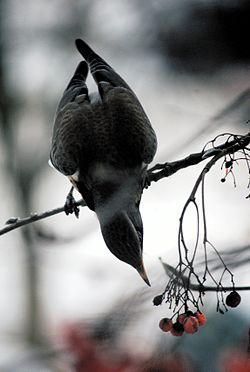
The fieldfare is omnivorous. Animal food in the diet includes snails and slugs, earthworms, spiders and insects such as beetles and their larvae, flies and grasshoppers. When berries ripen in the autumn these are taken in great number. Hawthorn, holly, rowan, yew, juniper, dog rose, Cotoneaster, Pyracantha and Berberis are all relished. Later in the winter windfall apples are eaten, swedes attacked in the field and grain and seeds eaten.[12] When these are exhausted, or in particularly harsh weather, the birds may move to marshes or even the foreshore where molluscs are to be found.[11]

Breeding

[edit]

The breeding season starts in May in Poland but further north in Scandinavia may not start until early July. The female fieldfare builds a cup-shaped nest with no attempt at concealment. The location is often in woodland but may be in a hedgerow, garden, among rocks, in a pile of logs, in a hut or on the ground.[12] Fieldfares usually nest in close proximity to others of the same species. The adults will defend the nest aggressively by dropping faeces on the predators and nesting gregariously may offer protection from predators. The nest is built of dried grasses and weeds with a few twigs and a little moss, with a lining of mud and an inner lining of fine grasses. There are usually five to six eggs in a clutch, but occasionally three, four, seven or eight eggs are laid. The eggs vary in size from 28.8 by 20.9 to 33.5 by 23.4 millimetres (1.13 in × 0.82 in to 1.32 in × 0.92 in) and are variable in colour. Many are pale blue speckled with fine brown dots and resemble those of the common blackbird. Others are bright blue, with or without larger red-brown splotches. Incubation starts before all the eggs are laid and lasts for thirteen to fourteen days. The female does all or most of the incubation. The chicks are altricial and both parents bring food to them. They are usually ready to leave the nest after fourteen to sixteen days and there may be two broods in the season, especially in the southern parts of the breeding range.[12]

Status and conservation

[edit]

The fieldfare has an extensive range, estimated at 10 million square kilometres (3.8 million square miles), and a large population, including an estimated forty two to seventy two million individuals in Europe. There are thought to be up to twenty million individuals in Russia and the global population is estimated to be between forty-four and ninety-six million individuals. The population size appears to be stable and the bird is not believed to approach the thresholds for the population decline criteria of the IUCN Red List of Threatened Species (i.e., declining more than 30% in ten years or three generations), and is therefore evaluated as being of "least concern".[2]

In the United Kingdom, at the extreme edge of the fieldfare's breeding range, only a handful of pairs breed. It is therefore classified by the RSPB as a Red List species as of January 2013.[15]

Footnotes

[edit]

References

[edit]
[edit]
Revisions and contributorsEdit on WikipediaRead on Wikipedia
from Grokipedia
The fieldfare (Turdus pilaris) is a medium-sized thrush in the family Turdidae, notable for its striking featuring a slate-grey head and rump, chestnut-brown wings and back, a black-streaked ish breast, and a bold bill with a dark tip. Measuring 22–27 cm in length, with a of 39–42 cm and weight of 80–130 g, it is a gregarious and highly migratory that forms large flocks during winter, often numbering in the thousands. Native to the Palearctic region, the fieldfare breeds across boreal forests, mixed woodlands, scrublands, and even urban parks and gardens from eastward to and northern , typically at elevations up to 2,000 m. It is a full migrant, with northern populations traveling south to winter in open lowlands, agricultural fields, orchards, and hedgerows across southern and , the (where up to 680,000 individuals may overwinter), , and the , occasionally appearing as a vagrant in . During the breeding season from to , it nests colonially in trees, constructing cup-shaped nests of grass, , and mud lined with softer materials, and lays clutches of 5–6 pale blue eggs speckled with brown; the female incubates the eggs for 13–14 days, with both parents sharing chick-rearing, fledging occurring after 12–16 days. Omnivorous in diet, the fieldfare feeds primarily on invertebrates such as earthworms, insects, and snails during summer, shifting to berries (from rowan, hawthorn, and juniper), seeds, and fallen fruit in autumn and winter, often foraging in noisy, chattering flocks on the ground. Its vocalizations include a sharp "chack-chack" alarm call and a varied song of whistles, clicks, and warbles delivered from a prominent perch. With a global population estimated at 27–53 million mature individuals and a stable trend, the species is classified as Least Concern by the IUCN, though it faces minor localized threats from habitat loss and severe weather events.

Taxonomy and nomenclature

Taxonomy

The fieldfare (Turdus pilaris) is a species within the thrush family Turdidae, belonging to the order Passeriformes. The binomial name was established by in his in 1758. It is classified in the genus Turdus, a diverse group of 86 thrush species distributed nearly worldwide across all continents except . Within the genus Turdus, the fieldfare is part of the Palearctic , closely related to species such as the (Turdus iliacus) and the Eurasian blackbird (Turdus merula), with which it forms a strongly supported monophyletic group based on genomic analyses of ultraconserved elements. The (Turdus philomelos) represents an earlier-diverging lineage within the same genus, sharing a common Eurasian ancestry. The fieldfare is considered primarily monotypic, with the nominate subspecies Turdus pilaris pilaris occurring across its breeding range in the northern Palearctic. Although some regional variants have been proposed, such as T. p. glacioborealis from , these are not widely recognized in major taxonomic authorities. The evolutionary history of the fieldfare is embedded in the broader Turdus lineage, which originated in during the , with the Palearctic clade diverging approximately 5.7 million years ago. Subsequent diversification and adaptations to northern Palearctic conditions, including cold-tolerant behaviors and ranges, were shaped by Pleistocene glacial cycles, which drove range contractions and expansions in northern latitudes. evidence indicates the species' presence in the Palearctic since the .

Etymology

The common name "fieldfare" derives from the Old English term feldware, which translates to "traveller of the fields," reflecting the bird's habit of foraging in open fields, particularly during winter. This name has been in use since at least the 11th century, emphasizing the species' migratory movements across open landscapes in search of food. The scientific binomial Turdus pilaris was established by Carl Linnaeus in the 10th edition of Systema Naturae in 1758. The genus name Turdus originates from the Latin word for "thrush," a longstanding designation for birds in this group. The specific epithet pilaris stems from a Latinized form related to pilus (hair), but it actually arose from a linguistic confusion in earlier nomenclature: it misinterprets the Greek trichas (thrush) as trikhas (hairy), possibly evoking the bird's fluffy plumage or nest lining. Linnaeus's description formalized the name based on earlier European observations, though the species was known under vernacular terms in regional languages prior to binomial standardization.

Physical characteristics

Morphology

The fieldfare (Turdus pilaris) is a large member of the thrush family, measuring 22–27 cm in length, with a of 39–42 cm and a body mass of 80–140 g. Males are slightly larger than females, averaging about 3% greater in weight, though overall in structure remains minimal with no pronounced differences in proportions or features. This species exhibits a robust build characteristic of the genus Turdus, featuring strong, sturdy legs suited for and on the ground or snow-covered surfaces. The eyes are dark brown. The legs are brown to blackish in coloration, providing stability during upright hopping and probing movements. Relative to other Turdus species, the fieldfare has a moderately proportioned tail that aids in balance but is not elongated like that of the (Turdus viscivorus). The bill is straight and conical, yellowish overall with a dark tip, adapted for probing soft to extract and for handling berries and fruits. This structure reflects the bird's opportunistic feeding strategy, combining ground-based extraction with arboreal fruit consumption.

Plumage and variation

The adult fieldfare exhibits distinctive characterized by a pale grey head and rump, a chestnut-brown mantle and back, and a blackish tail. The underparts are cream-colored with bold black streaks on the breast and flanks, while the underwing coverts are . Males and females are nearly identical in plumage, though subtle differences exist, such as males having blacker tail feathers and broader crown stripes compared to the darker brown tails and narrower stripes in females. Juveniles possess duller overall coloration, with a brownish-grey head and neck, and more extensive spotting rather than streaking on the underparts. They undergo a partial post-juvenile moult in late summer to autumn, replacing body feathers, lesser and median wing coverts, and some inner greater coverts, gradually acquiring adult-like by the first winter, though retained juvenile greater coverts remain shorter and duller with white tips. There is no major seasonal variation in plumage, as adults complete a full post-breeding moult in late summer, renewing feathers without significant color shifts, though breeding individuals may appear slightly brighter due to fresher . Individual variation is limited, with low polymorphism overall; some birds show paler or darker tones, and a variable peachy-buff wash on the breast, but there is no notable geographic variation in coloration across the species' range.

Distribution and habitat

Breeding range

The fieldfare (Turdus pilaris) has a broad breeding distribution across the Palearctic, primarily in northern and , extending eastward through to and northern . Its core range encompasses , , the , and much of , reaching as far east as the Altai and , the Aldan Basin, Transbaikalia, and northern . The southern limit in Europe generally lies around 50°N, from northern and through and the , though breeding occurs sporadically further south in suitable habitats. Population densities are highest in the boreal forests of Fennoscandia and western Russia, where optimal conditions support 10–20 pairs per km² on average, though fluctuations can reach up to 63 pairs per km² in subalpine birch forests of central Norway. These densities reflect the species' preference for colonial nesting in open woodland edges, contributing to an estimated 11.5–22.4 million breeding pairs in Europe alone. The breeding range has expanded southward in during the , attributed to and changing land use, with established populations now in countries like the , , , and , and increased breeding records in since the 1980s. The overall range and population are considered stable based on assessments up to 2024, with no significant contractions observed over the past three generations. Rare breeding attempts occur outside the core range, such as occasional pairs in the and isolated sites in .

Winter range and migration

The fieldfare (Turdus pilaris) is a strongly migratory , with northern populations initiating southward movements from their breeding grounds as early as and typically arriving in wintering areas by October. Return migration to breeding territories generally occurs between March and April, with most individuals departing winter quarters by late April. These patterns reflect a response to seasonal changes in food availability and weather, driving the ' post-breeding dispersal from high-latitude forests. The winter range of the fieldfare spans a broad latitudinal gradient, with western European breeding populations primarily wintering in western and southern Europe—including the , , Iberia, and other parts of —as well as . Eastern populations, originating from and farther east, migrate to southern , including and parts of , with occasional vagrants reaching northwest and . Migratory routes are predominantly overland through central and for western birds, often involving large, loose flocks numbering in the thousands that travel during both day and night. Navigation relies on a combination of visual landmarks and magnetic cues, enabling precise orientation over distances of thousands of kilometers, with average flight speeds of 40-50 km/h typical for thrushes during migration. In years of poor crops, such as low rowanberry yields, the species exhibits irruptive movements beyond normal ranges, resulting in vagrant individuals reaching ; notable records include sightings in and along the East Coast.

Habitat preferences

The Fieldfare (Turdus pilaris) selects breeding habitats in open boreal forests dominated by and , along with edges and farmland featuring scattered trees, particularly favoring areas with rowan and for structural support in nesting and seasonal food availability. These environments often include scrublands, forest clearings, parks, and gardens, extending into alpine heathland and tundra scrub at higher latitudes where suitable persists. In , breeding occurs up to altitudes of approximately 1,500 m, typically near the in subalpine zones. During the non-breeding season, Fieldfares shift to more open lowland habitats, including orchards, hedgerows bordering berry bushes, grassy fields, cultivated farmlands, edges, and peripheries, which provide accessible foraging grounds. The species demonstrates tolerance for urban margins, such as parks and gardens, but consistently avoids dense interiors, preferring mixed landscapes that balance cover and openness. Microhabitat requirements emphasize elevated nesting sites 2–10 m above ground in tree forks or against trunks, often in birches or , to deter ground predators while allowing proximity to foraging areas with low ground cover like meadows or clearings. These preferences support year-round adaptability to cold climates, as the Fieldfare's migratory strategy enables exploitation of seasonal resources in temperate to zones, with populations showing resilience to harsh winters through in sheltered edges.

Behavior and ecology

Foraging and diet

The fieldfare's diet is omnivorous and undergoes pronounced seasonal shifts, reflecting the availability of food resources in its breeding and wintering grounds. During the summer breeding season, the diet consists primarily of , including earthworms, beetles, snails, slugs, and insect larvae, which provide essential proteins for adults and nestlings. In contrast, winter emphasizes plant material, with berries from rowan, hawthorn, and comprising the bulk of intake, supplemented by fallen fruits, grains, and opportunistic such as earthworms when snow cover permits access to soil. Foraging occurs mainly on the ground, where fieldfares probe and scratch through soil, leaf litter, or short grass to extract , often in large flocks that enhance detection of food patches and provide vigilance against predators. In winter, communal flocks strip berries from bushes and hedgerows en masse, sometimes transitioning to aerial pursuits for flying insects during milder conditions. These social strategies allow efficient exploitation of transient resources, with berries serving as a high-energy source that supports fat accumulation for migration. Fieldfares occasionally raid agricultural areas, consuming apples in orchards or grains in arable fields and stubbles, which can lead to minor conflicts with farmers during periods of food scarcity. Such interactions are more common in harsh winters when natural berry crops are depleted.

Breeding biology

The fieldfare's breeding season typically spans May to June in its northern range, though it can extend from early to late at lower latitudes, influenced by local and food availability. Pairs form monogamous bonds, with males establishing territories through displays and before nest-building begins. Nesting occurs in loose of 5-20 pairs, providing communal defense against predators such as corvids and mustelids, which enhances overall reproductive output in central colony positions. The nest is a bulky, untidy constructed primarily from twigs, grasses, , , and leaves, often cemented with for stability and lined with finer materials like , rootlets, animal , or soft grass to insulate the eggs. It is typically placed in forks or branches 2-10 meters above ground, though occasionally on cliffs, ground ledges, or even buildings in human-modified habitats. The female constructs the nest over several days, with the male assisting by providing materials. Clutches consist of 5-6 pale blue eggs, each about 3 cm long and speckled with fine brown or reddish spots for camouflage. Incubation begins after the third or fourth egg is laid and lasts 12-14 days, performed almost exclusively by the female while the male supplies food. Upon hatching, the semi-altricial chicks are fed a diet rich in invertebrates by both parents for 14-16 days until fledging; the young remain dependent on parental provisioning for an additional 10-15 days post-fledging. Breeding success varies with colony size and predation pressure, with approximately 40-50% of nests successful in defended groups, yielding an average of about 2 young fledged per pair annually, or 4-5 from successful nests. Second broods occur commonly in southern populations under favorable conditions.

Vocalizations

The fieldfare's song is delivered primarily by males during the breeding season, consisting of a tuneless, chattering medley of scratchy squeaks, chuckles, wheezes, trills, and chitters interspersed with harsh notes. This vocalization, often performed from exposed treetops, serves to advertise ownership and attract mates, with phrases typically lasting a few seconds in a repetitive pattern. The song's structure shows contextual variation, becoming louder and more elaborate within defended breeding territories compared to non-breeding periods. The ' most distinctive call is a harsh, rattling "chack-chack-chack" or "shak-shak-shak," frequently uttered in flight or to alert flocks to aerial predators, prompting evasive maneuvers among group members. For ground-based threats, fieldfares emit a softer "quok" warning note, which signals caution without drawing undue attention. During migration, a "huii-huit" call maintains flock cohesion over long distances. In social flocks, individuals use subtle, throaty contact calls such as a low "chuck" or chuckling chatter to coordinate foraging and movement without alarming others. For defense, particularly around nests, fieldfares produce agitated calls—intensified versions of the alarm "chack"—to rally nearby birds in coordinated attacks on intruders like , enhancing collective protection of breeding sites. These vocal signals integrate with visual displays in breeding contexts but remain a primary means of acoustic communication year-round.

Conservation

Global status

The fieldfare (Turdus pilaris) is classified as Least Concern on the , reflecting its large global range spanning and , and stable population numbers with no evidence of significant decline over recent generations. The global population is estimated at 27.1–52.6 million mature individuals, equivalent to approximately 12–23 million breeding pairs, based on breeding range extent and density assessments across its Palearctic distribution. This abundance supports its secure status, as the occupies diverse habitats and exhibits high reproductive output, with no widespread population reductions observed in monitoring data from 2018 onward. Potential threats to the fieldfare include , which could induce shifts in breeding and migration patterns, such as advanced arrival dates and shortened breeding seasons in response to warming temperatures; however, the bird's broad adaptability and opportunistic help buffer against major impacts. and trade for , pets, and occur at low levels globally, with regulated exploitation not posing a substantial to the overall due to its size and resilience. Historical events like severe winters have occasionally affected local subpopulations, including the extirpation of the in southern in the , but these have not led to range-wide declines. Conservation measures for the fieldfare include protection under Annex II of the EU Birds Directive, which permits sustainable hunting while requiring habitat safeguards and population monitoring across member states. International monitoring efforts, such as systematic breeding bird surveys coordinated through programs like those of , track population trends and inform , ensuring the species' continued stability without the need for targeted recovery actions at a global scale. In , the Fieldfare's breeding population remains stable, particularly in core areas like , where it continues to occupy suitable woodland and scrub habitats without significant fluctuations over recent decades. Wintering populations in the fluctuate annually based on berry crop availability in breeding areas, with no long-term decline indicated in recent monitoring. This is classified as Red Listed in the UK and as of 2025 due to declines in its rare breeding population, despite global stability. Key threats contributing to regional concerns include agricultural intensification, which has led to the loss of hedgerows and other berry-bearing vegetation essential for winter foraging. Climate change further exacerbates this by altering berry production cycles, with warmer conditions often resulting in earlier ripening and scarcity during peak winter months. Additionally, occasional mortality from poisoning occurs when birds ingest pesticide-treated seeds during ground foraging, a risk documented in studies of seed-eating thrushes. Conservation efforts in the UK, led by organizations like the RSPB, focus on long-term monitoring through programs to track wintering numbers and habitat use. Initiatives to preserve traditional orchards and hedgerows aim to bolster berry availability, while recent wetter winters in the 2020s have shown signs of localized recovery by increasing abundance as an alternative food source. As a vagrant, Fieldfare sightings occur occasionally in , primarily in eastern regions, though no breeding has been confirmed.

References

Add your contribution
Related Hubs
User Avatar
No comments yet.