


Community hub
Recent from talks
Contribute something
Nothing was collected or created yet.
VMFA-121
View on Wikipedia | This article includes a list of general references, but it lacks sufficient corresponding inline citations. (January 2024) |
| Marine Fighter Attack Squadron 121 | |
|---|---|
 VMFA-121 insignia | |
| Active | 24 June 1941 - present |
| Country |  United States of America United States of America |
| Branch |  United States Marine Corps United States Marine Corps |
| Type | Fighter/Attack |
| Role | Close air support Air interdiction Aerial reconnaissance |
| Part of | Marine Aircraft Group 12 1st Marine Aircraft Wing III Marine Expeditionary Force |
| Garrison/HQ | Marine Corps Air Station Iwakuni, Japan |
| Nicknames | Green Knights Combat (Call Sign) |
| Mottos | "Have Gun Will Travel", "No Flinch, No Respect" |
| Tail Code | VK |
| Mascot | Ralphie |
| Engagements | |
| Commanders | |
| Commanding Officer | LtCol. Zachary K. Everhart |
| Executive Officer | Maj Martin P. Stage |
| Sergeant Major | SgtMaj Victor M. Martinez |
| Aircraft flown | |
| Attack | AD-2 Skyraider A-4 Skyhawk A-6 Intruder |
| Fighter | F4F Wildcat F4U Corsair F8F Bearcat F9F-8B Cougar F/A-18D Hornet F-35B Lightning II |
Marine Fighter Attack Squadron 121 (VMFA-121), also known as the "Green Knights", is a United States Marine Corps aircraft squadron operating the F-35B Lightning II. The squadron is based at Marine Corps Air Station Iwakuni, Japan and falls under the command of Marine Aircraft Group 12 (MAG-12) and the 1st Marine Aircraft Wing (1st MAW). Their tail code is VK and their radio call sign is "Combat".
History
[edit]World War II
[edit]
Marine Fighting Squadron 121 (VMF-121) was activated on 24 June 1941. The Green Knights began combat operations flying the F4F Wildcat and later the F4U Corsair as charter members of the Cactus Air Force and throughout the Battle of Guadalcanal arriving in October 1942. The squadron also fought from the forward air bases of Espírito Santo, Turtle Bay, Bougainville, and Emirau. On 15 September 1944, the Green Knights landed on Peleliu and fought there until 25 July 1945. They returned to the United States to be deactivated on 9 September 1945.[1] During the Pacific War, VMF-121 produced fourteen fighter aces, more than any other squadron, including Medal of Honor recipient, Major Joseph J. Foss. VMF-121 downed 208 Japanese aircraft[2] (165 flying Wildcats and another 44 flying Corsairs) in aerial combat.
After World War II, the squadron was reactivated in the United States at Naval Air Station Glenview, Illinois where the squadron's designation was changed to Marine Attack Squadron 121 (VMA-121) on 15 May 1951.[3] During this time they flew a variety of aircraft including the F4U Corsair, F8F Bearcat and A-1 Skyraider.
Korean War
[edit]
In mid 1951, VMA-121 received orders to activate its reserve members and departed NAS Glenview for Marine Corps Air Station El Toro, California. After completion of training in the Skyraider, the squadron was transported aboard the carrier USS Sitkoh Bay to Yokosuka, Japan to begin final preparations for a combat deployment to the Republic of Korea. In June 1953 they also set a then Marine record for a single day's ordnance delivery when 16 AD-2 Skyraiders dropped 156 tons of bombs during the attack on the Sui-ho Dam.[4]
VMA-121 deployed to K-6 Airfield at Pyongtaek, Republic of Korea on 19 October 1951, and conducted their first strike on 27 October. Their mission was to conduct strike missions in support of infantry operations. The squadron dropped more bomb tonnage during the Korean War than any other Navy or Marine Corps squadron, devastating enemy airfields, supply dumps, bridges, and railroad yards.
During the Korean War the Squadron insignia depicted Al Capp's "WolfGirl" from the comic strip Li'l Abner. The "Wolf Raiders" of VMA-121 remained in South Korea for several years after the Korean Armistice Agreement was signed in 1953. Returning to MCAS El Toro in 1957, the squadron assumed its role in the Unit Deployment Program with scheduled rotations to Japan and traded in its AD Skyraider aircraft and joined the jet age with the F9F-8B. The Cougar equipped with the LABS system for loft bombing, was the first aircraft flown by the squadron capable of delivering nuclear weapons.
In late 1958, the Squadron traded the Cougars for brand new A-4 Skyhawks. Spending most of the next year at the likes of NAAS Fallon, MCAS Yuma, and NOTS China Lake, the "Green Knights" became the first squadron to complete the entire special weapons delivery syllabus. During November 1962, the "Green Knights" deployed in their new A-4s to NAS Cecil Field in Jacksonville, Florida in response to the Cuban Missile Crisis.
Vietnam War
[edit]In August 1966, under the command of LtCol Donald Stiver, the Green Knights ferried their A-4E Skyhawks to MCAS Iwakuni, Japan and after preparatory training in Japan and Okinawa, began combat operations from Chu Lai Air Base, South Vietnam in December, 1966. In May 1967 VMA-121 shattered the old ordnance record for Marine Attack Squadrons by delivering over 1750 tons of ordnance in combat operations. After six months of combat operations, the squadron rotated back to MCAS Iwakuni, Japan and Naha Air Base, Okinawa before returning to Chu Lai for another combat tour in September 1967. During the first six months of that deployment, VMA-121 supported 118 major operations.
In early 1969, the squadron was reconstituted at MCAS Cherry Point, North Carolina and newly designated as VMA(AW)-121 to reflect the squadron's transition to the all-weather attack mission with the Grumman A-6 Intruder. The Green Knights were now capable of acquiring and destroying surface targets in any weather, day or night, with a wide variety of air-to-ground ordnance. The squadron participated in a 13-month deployment to MCAS Iwakuni as a member of 1st MAW. While stationed in Japan, the squadron participated in training exercises at Cubi Point Philippines and Team Sprit in Yechon, Korea. The Green Knights returned to El Toro in June 1978, and the commanding officer was Lt. Col. "WALDO" Adams.
In 1982 the squadron was awarded the Meritorious Unit Commendation (MUC) for achieving 43,000 accident free flight hours. This Commendation spanned from years previously flown in Vietnam without an accident. The award was issued while the squadron was deployed to Iwakuni, Japan and the commanding officer Lt. Col. "JACK" Rippy.
On 11 November 1985, operational control of VMA(AW)-121 was transferred to Commander, Carrier Airwing Two attached to the USS Ranger. In July 1987, under the command of LtCol. Joe "Java" Weston, the squadron deployed aboard the Ranger on a six-month WestPAC/Indian Ocean cruise. Arriving on Gonzo Station in the North Arabian Sea, the squadron participated in Operation Earnest Will, the escorting of reflagged Kuwaiti tankers.
In February 1989, the squadron once again set sail aboard the Ranger for another WestPAC/Indian Ocean cruise under the command of Pete "NODAC" Jacobs. Upon return to MCAS El Toro in August 1989, operational control of VMA(AW)-121 was transferred back to Commander, 3rd Marine Aircraft Wing (3rd MAW).
The Gulf War & the 1990s
[edit]On 8 December 1989, the squadron was redesignated as Marine Fighter Attack Squadron (All Weather) ONE TWO ONE (VMFA(AW)-121), becoming the first Marine Corps F/A-18D Hornet night attack squadron. Slightly over one year later, the squadron deployed in support of Operation Desert Storm. During the Desert Storm Air Campaign, the squadron flew 557 sorties and 1,655.5 combat hours (more than any other Navy or Marine Corps tactical jet squadron).
Returning to MCAS El Toro following the cessation of hostilities, the Green Knights resumed the unit deployment rotation and relocated to Marine Corps Air Station Miramar, California during August 1994 when custody of that installation was transferred from the Navy (as NAS Miramar) to the Marine Corps pursuant to BRAC action that also closed MCAS El Toro. The Green Knights made three deployments to the Western Pacific before returning to combat over Iraq in March 2000. During this 2000 deployment, the squadron flew 287 sorties in support of Operation Southern Watch (OSW) while based at Ahmad al-Jaber Air Base, Kuwait, providing much-needed operational tempo (OPTEMPO) relief to active duty USAF, Air Force Reserve and Air National Guard A-10 Thunderbolt II fighter squadrons that had been manning the OSW mission at Al Jaber since the end of the first Gulf War.
Global War on Terror and beyond
[edit]In April 2002, the squadron deployed with six aircraft to Kyrgyzstan, followed by the remaining six aircraft and personnel a month later. The squadron flew more than 900 combat sorties over Afghanistan in support of Operation Enduring Freedom, returning to MCAS Miramar in October 2002.
Only 3 months after returning from Kyrgyzstan, the Green Knights deployed to Al Jaber Air Base, Kuwait. From February to May 2003, the squadron flew more than 750 combat sorties over Iraq in support of Operation Southern Watch and Operation Iraqi Freedom, and returned to MCAS Miramar on 12 May.
In March 2005, the squadron deployed as part of the Unit Deployment Program to MCAS Iwakuni, Japan. The squadron returned to MCAS Miramar on 15 September 2005.
In February 2007, the squadron deployed to Al Asad Air Base, Iraq in support of Operation Iraqi Freedom 06–08.
The squadron deployed as part of the Unit Deployment Program to Marine Corps Air Station Iwakuni, Japan from September 2008 to March 2009, March 2010 to September 2010, and January 2012 to July 2012.
On 17 August 2011, an F/A-18D from VMFA(AW)-121 crashed into the Pacific Ocean approximately 85 miles southwest of San Diego. Both pilot and WSO ejected safely.
F-35B Lightning II Joint Strike Fighter era
[edit]On 28 September 2012, LtCol. Jeff Scott took command of the Green Knights from LtCol. Michael Waterman, marking the end of the F/A-18D Hornet's tenure in VMFA(AW)-121 and ushering in the fifth-generation stealth fighter era. This change of command officially moved the squadron from MAG-11 at MCAS Miramar to MAG-13 at MCAS Yuma. On 20 November, VMFA(AW)-121 was officially redesignated VMFA-121, accepting delivery of the first three F-35B aircraft becoming the first operational F-35B squadron in the Marine Corps Operating Forces and the first operational F-35 squadron in any service.[5]
On 9 January 2017, VMFA-121 permanently departed Marine Corps Air Station Yuma, Arizona transferring to Marine Corps Air Station Iwakuni, Japan.
On 18 January 2017, VMFA-121 arrived at MCAS Iwakuni, Japan as the first forward deployed permanent F-35B squadron.
On 24 April 2018, an F-35B belonging to the squadron made an emergency landing at Fukuoka airport.[6][7][8][9]
On 29 September 2020, an F-35B crashed in California after having a midair collision with a KC-130 from VMGR-152.
On 25 March 2025, an F-35B made an emergency landing at Kochi airport in Kochi, Japan.
Squadron aces
[edit]
|
|
Aircraft losses
[edit]Gallery
[edit]-
 VMF-121 F4F-4s at Guadalcanal
 -
 Capt. Joe Foss, VMF-121 Medal of Honor recipient
 -
 VMA-121 AD-2 Skyraider, Korea
 -
 Plaque located at Camp Mujuk, Korea that commemorates LtCol. Alfred Nelson Gordon, CO of VMA-121 who died during the Korean War
 -
 VMA-121 F9F-8 Cougar at MCAS El Toro, 1958
 -
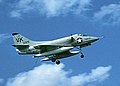 An A4D-2 after a wave-off from USS Coral Sea in 1960/61.
 -
 An A-4E from VMA-121 landing at Chu Lai, March 1967.
 -
 A-6 Intruder of VMA(AW)-121
 -
 VMFA(AW)-121 Hornet damaged during the Gulf War in 1991
 -
 F/A-18D CAG Bird Of VMFA(AW)-121
 -
 A VMFA-121 F-35B at MCAS Yuma, in 2013


-121_in_flight_on_23_November_1981_(6364507).jpg)


See also
[edit]Citations
[edit] This article incorporates public domain material from websites or documents of the United States Marine Corps.

- ^ "Former 'Green Knights' reunite after 60 years". Archived from the original on 22 June 2011. Retrieved 16 February 2010.
- ^ Sherrod History, p. 430.
- ^ "United States Marine Corps Muster Rolls - 1949-1953" (PDF). NARA. United States Marine Corps. p. 24. Retrieved 23 November 2023.
- ^ Mersky USMC Aviation, p. 144-5.
- ^ "Lockheed Martin Delivers Three F-35Bs To The U.S. Marine Corps"
- ^ "US F-35 fighter makes emergency landing in Fukuoka". NHK. 24 April 2017. Retrieved 27 April 2018.
- ^ Bolinger, James (25 April 2018). "Marine Corps F-35B stealth fighter makes emergency landing at Japanese air base". Stars and Stripes. Retrieved 27 April 2017.
- ^ "U.S. F-35 makes emergency landing". The Japan News. 25 April 2018. Archived from the original on 27 April 2018. Retrieved 27 April 2018.
- ^ "Marine Corps F-35B fighter jet makes emergency landing at Japanese air base". 25 April 2018. Retrieved 27 April 2018.
- ^ "MAG-12 Command Chronology for the Month of November 1966" (PDF). recordsofwar.com. United States Marine Corps. 9 December 1966. p. 7. Retrieved 30 December 2024.
References
[edit]- Bibliography
- Crowder, Michael J. (2000). United States Marine Corps Aviation Squadron Lineage, Insignia & History - Volume One - The Fighter Squadrons. Paducah, KY: Turner Publishing Company. ISBN 1-56311-926-9.
- Doll, Thomas (1996). Marine Fighting Squadron One-Twenty-One (VMF121). Carrollton, Texas: Squadron/Signal Publishing, Inc. ISBN 0-89747-369-8.
- Mersky, Peter B. (1983). U.S. Marine Corps Aviation – 1912 to the Present. Nautical and Aviation Publishing Company of America. ISBN 0-933852-39-8.
- Rottman, Gordon L. (2002). U.S. Marine Corps World War II Order of Battle – Ground and Air Units in the Pacific War. Westport, Connecticut: Greenwood Press. ISBN 0313319065.
- Sherrod, Robert (1952). History of Marine Corps Aviation in World War II. Washington, D.C.: Combat Forces Press. ISBN 0-89201-048-7. OCLC 1261876.
{{cite book}}: ISBN / Date incompatibility (help)
External links
[edit]
- Official website Retrieved on 2022-01-07.
- VMFA-121 Green Knight at Seaforces.org Retrieved on 2022-01-07.
- Joe J. Foss, Medal of Honor – Joe Foss estate artifacts restored, preserved and displayed at Historical Registry. Retrieved on 2022-01-07.
- The Bent Prop Project: The Swamp Corsair Retrieved on 2022-01-07.
- Video of a VMFA(AW)-121 F/A-18D aerial refueling
| Leadership |
|  | |||
|---|---|---|---|---|---|
| Major commands | |||||
| Auxiliary | |||||
| Structure | |||||
| Personnel and training |
| ||||
| Uniforms and equipment | |||||
| History and traditions |
| ||||


VMFA-121
View on GrokipediaUnit Overview
Lineage
Marine Fighting Squadron 121 (VMF-121) was established on June 24, 1941. During World War II, the squadron was assigned to Marine Aircraft Group 23 (MAG-23). VMF-121 was deactivated on September 9, 1945. The squadron was reactivated as VMF-121 on July 1, 1946, at Naval Air Station Glenview, Illinois. It was redesignated Marine Attack Squadron 121 (VMA-121) on May 15, 1951. During the Korean War, VMA-121 was attached to Marine Aircraft Group 33 (MAG-33). The squadron was redesignated Marine All Weather Attack Squadron 121 (VMA(AW)-121) on February 14, 1969. VMA(AW)-121 was redesignated Marine All Weather Fighter Attack Squadron 121 (VMFA(AW)-121) on December 8, 1989. On November 20, 2012, the squadron was redesignated Marine Fighter Attack Squadron 121 (VMFA-121) and reassigned to Marine Aircraft Group 13. Reassigned to Marine Aircraft Group 12 (MAG-12), 1st Marine Aircraft Wing, on January 9, 2017, following permanent relocation to Marine Corps Air Station Iwakuni, Japan. VMFA-121 is currently assigned to Marine Aircraft Group 12 (MAG-12), 1st Marine Aircraft Wing. The squadron has remained active with no further deactivations as of 2025.Nicknames and Insignia
VMFA-121's primary nickname, the "Green Knights," dates to the squadron's activation as VMF-121 on June 24, 1941, during World War II, symbolizing its aggressive combat role in the Pacific theater. The moniker evokes medieval chivalry and resilience, aligning with the squadron's early exploits, including its contributions to air superiority missions where pilots downed numerous enemy aircraft. The squadron adopted its motto, Have Gun Will Travel, in the post-Korean War era, reflecting its readiness for rapid deployment and strike operations across conflicts. This phrase, inspired by a popular 1950s television series, underscores the bold and mobile tactics employed by Green Knights aviators, from night attacks to all-weather strikes. The current insignia depicts a dark green knight figure, often shown charging on horseback with a raised sword, set against a blue background to represent the skies, and was formalized in the 1960s following the squadron's transition to jet aircraft. Earlier patches evolved significantly: World War II-era designs incorporated Grumman F4F Wildcat silhouettes amid Pacific island motifs, while the Korean War version featured a "Wolf Girl" character from Al Capp's Li'l Abner comic strip, tying into the temporary "Wolf Raiders" moniker for its AD Skyraider close air support role. By 2015, with the transition to the F-35B Lightning II, the insignia received subtle modernizations, including sharper digital embroidery for uniformity on stealth aircraft tails marked with the "VK" code. As of 2025, the Green Knights insignia appears prominently on flight suits, squadron ball caps, and official correspondence, while aircraft markings feature the knight emblem on vertical stabilizers alongside the U.S. Marine Corps globe and anchor, reinforcing unit pride and heritage in forward-deployed operations.Historical Periods
World War II
Marine Fighting Squadron 121 (VMF-121) was activated on June 24, 1941, at Marine Corps Air Station Quantico, Virginia, as part of the 1st Marine Aircraft Group, equipped with F4F Wildcat fighters.[5] The squadron conducted initial training at Quantico before reassignment in August 1941 to the 1st Marine Aircraft Group 11 and relocation to Camp Mitchell, New Bern, North Carolina, where pilots honed skills in fighter tactics and carrier operations in preparation for Pacific deployment. By early 1942, elements of the squadron had moved westward for advanced training, including time at Naval Air Station North Island, California, focusing on long-range ferry flights and combat simulations with the F4F-4 variant.[15] In October 1942, VMF-121 deployed to the Pacific Theater aboard the escort carrier USS Copahee (CVE-12), launching 20 F4F-4 Wildcats on a 3.2-hour ferry flight to Henderson Field on Guadalcanal to relieve VMF-223 as part of the Cactus Air Force.[16] The squadron immediately engaged in the defense of Henderson Field, flying bomber escort, close air support, and intercept missions against Japanese forces during the intense Guadalcanal campaign, contributing to the Allied effort to secure supply lines to Australia and New Zealand.[5] Operations intensified through late 1942 and into 1943 as part of the island-hopping strategy in the Solomon Islands, with VMF-121 basing from Espiritu Santo and Turtle Bay to conduct strikes and patrols that disrupted Japanese reinforcements.[5] Key engagements included aerial battles over Rabaul, where squadron pilots provided cover for Allied raids on the Japanese stronghold, and support for the Bougainville invasion in November 1943, operating from forward bases to neutralize enemy airfields and shipping.[5] At its peak during these campaigns, VMF-121 maintained a strength of approximately 20-24 aircraft, flying numerous sorties in air superiority roles that resulted in 165 confirmed Japanese aircraft destroyed with the Wildcat.[16] The squadron participated in the Cactus Air Force during its Guadalcanal service, operating under harsh conditions at Henderson Field.[5] In late 1943, VMF-121 transitioned to the F4U Corsair, beginning operations with the new fighter during patrols over Rendova in June and achieving its first victories in subsequent Solomon Islands actions, though it also suffered initial losses to anti-aircraft fire and enemy interceptors.[16] The Corsair enabled higher-speed engagements, leading to 43 additional Japanese aircraft downed by war's end, with the squadron continuing missions from Bougainville and later Emirau through 1944.[5] After the Japanese surrender, VMF-121 returned to the United States and was deactivated on September 9, 1945, at Marine Corps Air Station Miramar, California, concluding its World War II service.Korean War
Following its deactivation at the end of World War II, VMF-121 was reactivated on 1 July 1946 at Naval Air Station Glenview, Illinois, as part of the Marine Air Reserve Training Command. The squadron conducted reserve training flights during the late 1940s, operating aircraft such as the F4U Corsair, which built on the unit's World War II experience with propeller-driven fighters. By 1950, as tensions rose on the Korean Peninsula, the squadron had equipped with F4U-4B Corsairs and was preparing for potential active duty mobilization.[17][7] In response to the outbreak of the Korean War in June 1950, the reserve status of VMF-121 ended on 1 May 1951 when it was redesignated Marine Attack Squadron 121 (VMA-121) and relocated to Marine Corps Air Station El Toro, California. The squadron transitioned to the Douglas AD Skyraider, a robust attack aircraft optimized for close air support with its capacity to carry over 8,000 pounds of bombs, rockets, and napalm. VMA-121 deployed to Korea in October 1951 aboard the escort carrier USS Sitkoh Bay, arriving at K-6 Airfield in Pyongtaek on 19 October; it conducted its initial combat strike on 27 October against enemy positions. As part of Marine Aircraft Group 33 (MAG-33), 1st Marine Aircraft Wing, the squadron focused on close air support for ground troops and interdiction of North Korean and Chinese supply lines.[17][5][7] From bases including K-6 and forward airstrips near the front lines, VMA-121 flew over 5,000 combat sorties by September 1952, delivering devastating strikes in support of operations such as the defense of outposts along the Main Line of Resistance and attacks on logistical targets near the Yalu River. The squadron earned the nickname "Heavy Haulers" for its record-breaking bomb tonnage—more than any other U.S. Navy or Marine Corps unit in the war—including a single-day high of 156 tons on the Sui-ho Dam in June 1953 during pre-armistice operations. Key missions involved armed reconnaissance, bridge bombings, and patrols to enforce the armistice after July 1953, often under intense anti-aircraft fire from Chinese and North Korean forces. The squadron transitioned to the F9F-2 Panther jet in September 1952 while in Korea, introducing the squadron to jet-powered close air support.[5][4][7][18] The squadron sustained 17 aircraft losses to enemy action during its Korean service, alongside pilot casualties such as Major Charles Warner Buntin, who went missing in action over North Korea in 1952. VMA-121 remained in theater for post-armistice stabilization, operating from South Korean bases until its return to the United States in 1957, contributing to the 1st Marine Aircraft Wing's overall effort that logged more than 120,000 sorties. The unit's insignia during the war featured Al Capp's "Wolf Girl" from the Li'l Abner comic strip, symbolizing its aggressive "Wolf Raiders" reputation among adversaries.[1][19][20]Vietnam War
In August 1966, VMA-121, known as the Green Knights, deployed to South Vietnam as the first Marine Corps squadron equipped with the Douglas A-4E Skyhawk, ferrying its aircraft from MCAS Iwakuni, Japan, to Chu Lai Air Base after a brief stopover.[7] The squadron's arrival marked a significant expansion of Marine fixed-wing attack capabilities in I Corps, where it immediately began conducting combat missions in support of ground operations during the escalating conflict.[21] Over the initial six months, VMA-121 flew thousands of sorties, supporting 118 major operations and delivering close air support—often within dangerously close ranges to friendly forces, a tactic dubbed "Danger Close" by allied units.[5] These missions focused on interdicting enemy supply lines, suppressing anti-aircraft fire, and providing immediate firepower for Marine infantry engaged with North Vietnamese Army and Viet Cong forces.[4] The squadron's A-4E Skyhawks proved highly effective in the tactical environment of southern I Corps, participating in Operation Rolling Thunder by striking targets in North Vietnam and Laos while prioritizing ground support in South Vietnam. In May 1967 alone, VMA-121 set a Marine record with 1,234 combat sorties, contributing to the interdiction of enemy logistics along the Ho Chi Minh Trail.[1] Roles included escorting strike packages from other Marine and Air Force units, suppressing surface-to-air missile sites with rocket and bomb attacks, and delivering precision ordnance in contested areas. The Green Knights' operations emphasized rapid response and low-altitude tactics, leveraging the A-4's agility for close air support missions that saved countless lives on the ground. For its performance during this period, the squadron earned the Navy Unit Commendation, recognizing its sustained combat effectiveness and minimal losses despite intense enemy fire.[22] Returning to the United States in early 1967 for refit and rotation, VMA-121 redeployed to Chu Lai in 1968 for a second combat tour, where it amassed 18,690 sorties over 21,862 flight hours and delivered 24,277 tons of ordnance.[23] A pivotal contribution came during the Siege of Khe Sanh from January to July 1968, when the squadron provided critical close air support to the encircled Marine garrison, dropping napalm and high-explosive bombs within 75 meters of friendly positions to repel North Vietnamese assaults.[21] These missions, flown under hazardous weather and heavy anti-aircraft fire, helped sustain the defenders until relief forces arrived, exemplifying the squadron's role in one of the war's most grueling battles. By the end of the deployment in early 1969, VMA-121 had transitioned out of Vietnam, returning to MCAS Cherry Point, North Carolina, where it shifted focus to training and conventional attack operations with upgraded A-4 variants.[5] Following Vietnam, the squadron transitioned to the A-6 Intruder in early 1969 and was redesignated VMA(AW)-121. The squadron's Vietnam service underscored the A-4 Skyhawk's versatility in multi-role attack duties, building on its earlier jet experience from the Korean War.Gulf War and 1990s
In late 1989, VMFA-121 was redesignated as VMFA(AW)-121 and transitioned to the F/A-18D Hornet, becoming the first Marine Corps squadron to operate the two-seat night attack variant, with initial training and qualification conducted at MCAS El Toro, California.[1] The squadron achieved full operational capability with the aircraft by mid-1990, emphasizing night vision goggle operations, forward air control, and precision strikes to prepare for potential combat roles.[24] As tensions escalated following Iraq's invasion of Kuwait, VMFA(AW)-121 deployed a detachment to the Persian Gulf theater, arriving at King Abdul Aziz Naval Base in Jubayl, Saudi Arabia, on January 11, 1991, just days before the start of Operation Desert Storm.[24] Operating primarily from Shaikh Isa Air Base in Bahrain, the squadron flew its first combat sortie on January 27, 1991, in a Marine-configured night attack aircraft.[24] During the 43-day air campaign, VMFA(AW)-121 completed 557 sorties and logged 1,655.5 combat hours—the highest total for any U.S. Navy or Marine Corps tactical jet squadron—flying night armed reconnaissance, battlefield interdiction, and close air support missions in support of I Marine Expeditionary Force objectives.[7] These operations included forward air control (Fast FAC) roles using the F/A-18D's FLIR and laser designators to guide strikes on Iraqi ground forces, such as armored personnel carriers, artillery positions, and troop concentrations near Al Wafra and Al Jaber Airfield in the Kuwait Theater of Operations.[25] By the third week of the campaign, the squadron conducted three to four nightly reconnaissance sorties to detect and target enemy activity with high precision, often within 100 meters, contributing to the degradation of Iraqi command and control infrastructure.[25] Following the ceasefire in late February 1991, VMFA(AW)-121 returned to MCAS El Toro and shifted focus to post-war contingency operations throughout the 1990s, including enforcement of the southern no-fly zone over Iraq under Operation Southern Watch to prevent Iraqi aggression against Shiite populations and monitor compliance with UN resolutions.[5] The squadron conducted multiple Western Pacific deployments as part of the Unit Deployment Program, honing interoperability with allied forces while maintaining readiness for regional crises.[1] In 1994, amid Base Realignment and Closure actions stemming from 1993 decisions, the squadron relocated from MCAS El Toro to MCAS Miramar, California, to consolidate Marine aviation assets on the West Coast.[5] This move supported ongoing training evolutions and positioned the unit for rapid response to emerging threats in the post-Cold War era.Global War on Terror
Following the terrorist attacks of September 11, 2001, VMFA-121 was placed on a 96-hour prepare-to-deploy alert and subsequently participated in the initial phases of Operation Enduring Freedom. The squadron deployed to Marine Corps Air Station Iwakuni, Japan, under the Unit Deployment Program from September 2001 to March 2002, conducting more than 900 combat sorties over Afghanistan to provide close air support, armed reconnaissance, and interdiction missions against Taliban and al-Qaeda targets.[1][7] The squadron returned to Marine Corps Air Station Miramar, California, in October 2002, having logged thousands of flight hours in harsh environmental conditions.[1] In support of the 2003 invasion of Iraq, VMFA-121 forward-deployed to Al Jaber Air Base in Kuwait from February to May, flying over 750 combat sorties during Operations Southern Watch and Iraqi Freedom. Operating F/A-18D Hornets from expeditionary airstrips, the squadron delivered precision strikes on Iraqi military infrastructure, command centers, and Republican Guard units, contributing to the rapid advance of coalition ground forces toward Baghdad.[1][7] Building on its F/A-18 Hornet operations from the 1990s, the squadron integrated upgrades such as the AN/AAS-38 Nite Hawk targeting pod for enhanced night vision capabilities and compatibility with precision-guided munitions like the Joint Direct Attack Munition (JDAM) and Laser JDAM, enabling all-weather strikes with minimal collateral damage.[5] VMFA-121 returned to combat in Iraq during the 2007 troop surge, deploying to Al Asad Air Base from February to August in support of Operation Iraqi Freedom 06-08. The squadron flew hundreds of sorties providing close air support to Marine and Army units in Al Anbar Province, including operations against insurgent strongholds in Fallujah and Ramadi, where persistent overhead surveillance and targeted munitions drops disrupted enemy movements and protected ground troops during urban counterinsurgency efforts.[1][7] These missions emphasized the squadron's role in the shift toward counterinsurgency tactics, differing from the high-intensity conventional warfare of earlier conflicts.[5] By the mid-2010s, following Unit Deployment Program rotations to MCAS Iwakuni in 2008, 2010, and 2011—which included training and contingency operations in the Western Pacific—VMFA-121 shifted focus to stateside-based training at MCAS Miramar. This period marked the squadron's preparation for the divestiture of its F/A-18D fleet and transition to new platforms, with the last Hornet detachment departing in 2012 amid ongoing Global War on Terror commitments.[1][7]F-35B Transition and Modern Operations
VMFA-121 received its first F-35B Lightning II aircraft in November 2012 at Marine Corps Air Station Yuma, Arizona, marking the squadron's initial step into fifth-generation fighter operations.[3] By 2013, the unit had conducted short takeoff and vertical landing (STOVL) operations with six aircraft, building toward full integration of the stealth multirole platform.[26] The squadron achieved initial operational capability (IOC) on July 31, 2015, with 10 F-35Bs equipped with Block 2B software, enabling combat-ready missions from Yuma.[27] On January 9, 2017, VMFA-121 commenced its permanent relocation from Yuma to Marine Corps Air Station Iwakuni, Japan, arriving on January 18 as the first forward-deployed F-35B squadron. This move integrated the unit into the 1st Marine Aircraft Wing, enhancing U.S. Marine Corps presence in the Indo-Pacific.[28] Shortly after, in September 2017, VMFA-121 hosted Japan Air Self-Defense Force (JASDF) personnel from the Third Air Wing for F-35A training and interoperability briefings, fostering bilateral expertise on the platform's maintenance and operations.[29] Continued collaboration included joint F-35 talks during bilateral integration training at Misawa Air Base in August 2021 and refueling exercises with JASDF during Keen Sword 25 in October 2024.[30][31] In recent years, VMFA-121 has participated in key exercises demonstrating the F-35B's versatility in the Pacific theater. During Korea Flying Training (KFT) 24 from April 15 to 26, 2024, at Kunsan Air Base, Republic of Korea, the squadron conducted large-scale tactical missions to improve U.S.-ROK interoperability. The unit also executed hot loading procedures during an expeditionary advanced base operations (EABO) exercise in Okinawa in January 2023, loading ordnance onto F-35Bs at Kadena Air Base to simulate rapid rearming in austere environments.[32] Aviation safety remained a priority, with standardized procedures emphasized in ongoing training, including ordnance loading drills in September 2024.[33] On June 16, 2025, the squadron held a change of command ceremony at Iwakuni, transitioning leadership to continue its operational tempo.[34] VMFA-121's F-35B operations support Pacific deterrence through stealth-enabled missions and STOVL capabilities tailored for expeditionary settings. The squadron's aircraft leverage low-observable technology for penetrating contested airspace, while STOVL features allow operations from amphibious ships and forward bases, as demonstrated in 2025 deployments reinforcing Indo-Pacific alliances.[35] In May 2025, another F-35B squadron (VMFA-211) deployed to MCAS Iwakuni, bolstering U.S. Marine Corps F-35B presence in Japan amid regional tensions, including alongside VMFA-121 in distributed maritime operations.[36]Notable Personnel and Achievements
Squadron Aces
During World War II, VMFA-121 (then designated VMF-121) achieved unparalleled success in aerial combat during the Solomon Islands campaign, producing 17 fighter aces—pilots credited with five or more confirmed aerial victories—more than any other Marine Corps squadron. These aces primarily flew Grumman F4F Wildcats early in the war, transitioning to Vought F4U Corsairs as the squadron supported operations from bases like Guadalcanal and Espiritu Santo. Their tactics emphasized the aircraft's superior diving speed and maneuverability in "boom and zoom" attacks, where pilots would gain altitude advantage before diving on Japanese formations, often A6M Zeros, to avoid prolonged dogfights. This approach contributed to the squadron's overall tally of 209 enemy aircraft destroyed in air-to-air combat.[37] The most renowned ace was Captain Joseph J. Foss, who commanded "Foss's Flying Circus," a detachment of VMF-121 pilots on Guadalcanal from October 1942 to January 1943. Foss achieved 26 confirmed victories, using coordinated section tactics to outflank superior numbers. His leadership and marksmanship earned him the Medal of Honor, in addition to the Distinguished Flying Cross for extraordinary heroism in aerial combat. Other standout aces included Major Joseph H. Reinburg with 7 victories over the Solomons, employing high-altitude intercepts to disrupt Japanese bomber raids, and First Lieutenant William P. Marontate with 13 kills, focusing on low-level strafing runs combined with air superiority patrols.[38][39][37]| Ace Name | Victories | Primary Aircraft | Key Feats |
|---|---|---|---|
| Capt. Joseph J. Foss | 26 | F4F Wildcat | Led Guadalcanal intercepts; 6 kills in one mission (Jan. 7, 1943) |
| 1st Lt. William P. Marontate | 13 | F4F Wildcat | Multiple low-level engagements over Bougainville |
| Capt. Thomas H. Mann, Jr. | 9 | F4F Wildcat | Shared kills in VMF-121/224 rotations; Solomons patrols |
| Lt. Col. Donald K. Yost | 8 | F4U Corsair (2 kills) | Commanded squadron; high-altitude bomber interceptions |
| Capt. Gregory K. Loesch | 8.5 | F4F Wildcat | Shared victory in group tactics over Guadalcanal |
| Maj. Joseph H. Reinburg | 7 | F4F Wildcat | Disrupted Japanese raids; awarded Distinguished Flying Cross |
| 2nd Lt. Joseph L. Narr | 7 | F4F Wildcat | Early Solomons victories in defensive patrols |
| 1st Lt. Roger A. Haberman | 6.5 | F4F Wildcat | Shared kills using dive tactics |
| Maj. Perry L. Shuman | 6 | F4U Corsair | Corsair transitions; awarded Distinguished Flying Cross |
| 1st Lt. William B. Freeman | 6 | F4F Wildcat | Guadalcanal dogfights; awarded Distinguished Flying Cross |
| Maj. Francis E. Pierce, Jr. | 6 | F4F Wildcat | Escort missions for bombers |
| Capt. Robert M. Baker | 5 | F4F Wildcat | Initial Guadalcanal arrivals |
| 2nd Lt. Cecil J. Doyle | 5 | F4F Wildcat | Rookie ace in intense early battles |
| Lt. Col. Leonard K. Davis | 5 | F4F Wildcat | Veteran leadership in patrols |
| Capt. Kenneth M. Ford | 5 | F4U Corsair | Late-war Corsair kills |
| Capt. Ernest A. Powell | 5 | F4F Wildcat | Support for ground operations |
| Capt. Donald C. Owen | 5 | F4F Wildcat | Routine superiority missions |
Commanders and Decorations
VMFA-121 has been led by a series of commanding officers who guided the squadron through major conflicts and transitions, with selections emphasizing operational leadership and impact. Notable among them is Major S. S. Jack, who assumed command on 24 June 1941 as the squadron was activated amid rising tensions leading into World War II.[5] During the squadron's early Pacific campaigns, Major Joseph N. Renner served as commanding officer from March 1943.[42] In the Vietnam era, Lieutenant Colonel Donald Stiver commanded VMA-121 starting in August 1966, overseeing the squadron's ferry of A-4E Skyhawks to Japan for training before deploying to South Vietnam in October 1966, where it conducted close air support and interdiction missions.[7] Lieutenant Colonel William D. Shippen later took command for the 1967-1968 cruise, directing over 10,000 combat sorties from bases like Chu Lai, contributing to the squadron's high mission tempo against North Vietnamese forces.[43] More recently, Colonel Richard M. Rusnok Jr. led VMFA-121 from March 2017 to April 2019, managing the squadron's F-35B integration and forward-deployed operations from MCAS Iwakuni, Japan.[44] Lieutenant Colonel Adam F. Perlin commanded from June 2023 to June 2025, navigating the squadron through advanced F-35B training and Indo-Pacific exercises before relinquishing command. The current commanding officer, Lieutenant Colonel Zachary Everhart, assumed leadership on 16 June 2025, focusing on sustaining operational readiness in the region.[45] The squadron's unit decorations reflect its sustained excellence across conflicts, totaling over 15 awards including campaign streamers. VMFA-121 earned two Presidential Unit Citations: one for World War II service in the Solomon Islands in 1942, recognizing extraordinary heroism in downing 209 enemy aircraft, and another for Vietnam operations from 1966-1967, honoring outstanding combat performance amid intense ground support missions. It received a Navy Unit Commendation for Korean War contributions, where VMA-121 dropped more bomb tonnage than any other Navy or Marine squadron, targeting enemy infrastructure.[5] Additional Navy Unit Commendations were awarded for Gulf War service in 1991 and other deployments, while Meritorious Unit Citations recognize Global War on Terror efforts, including Operation Iraqi Freedom patrols exceeding 1,000 hours.[1]| Award | Periods/Criteria | Source |
|---|---|---|
| Presidential Unit Citation (2) | WWII (Solomon Islands, 1942; 209 enemy aircraft downed); Vietnam (1966-1967; 10,000+ sorties) | |
| Navy Unit Commendation (5) | Korean War (1951-1953; record bomb tonnage); Gulf War (1990-1991; Desert Storm missions); others for post-2000 ops | [1] |
| Meritorious Unit Citation (4) | Global War on Terror (e.g., OIF 2003; 1,000+ flight hours); safety milestones like 43,000 accident-free hours (1982) | [1] |
Equipment and Operations
Aircraft Flown
VMFA-121 has operated a diverse array of aircraft since its activation, evolving from radial-engine fighters of World War II to advanced fifth-generation stealth platforms. The squadron's primary aircraft types number six, encompassing fighters that supported its core mission, while interim attack variants filled roles during transitions; upgrades and variants were implemented throughout service periods to enhance capabilities such as avionics, weaponry, and engine performance.[5][6] The Grumman F4F Wildcat served as the squadron's inaugural fighter from 1941 to 1945, a single-seat, low-wing monoplane featuring a Pratt & Whitney R-1830-76 14-cylinder radial engine delivering 1,200 horsepower and a maximum speed of 318 mph at 19,400 feet. Armed with six .50-caliber machine guns, it provided essential carrier-based interception during early Pacific campaigns, with the squadron downing 165 enemy aircraft in this type.[5][46] Transitioning in 1943, the Vought F4U Corsair became a mainstay until around 1951, renowned for its inverted gull-wing design that allowed a large four-blade propeller, powered by a Pratt & Whitney R-2800 Double Wasp 18-cylinder radial engine producing 2,000 horsepower and reaching speeds up to 417 mph at 20,000 feet. The squadron achieved 44 aerial victories in the Corsair during World War II, leveraging its six .50-caliber machine guns and bomb racks for both air-to-air and ground-attack roles.[5][47] Postwar, from 1945 to 1951 as a reserve unit, VMFA-121 flew the Grumman F8F Bearcat, a compact high-performance fighter with a Pratt & Whitney R-2800-34W radial engine generating 2,250 horsepower and a top speed of 455 mph, emphasizing superior climb rate and maneuverability over the earlier Hellcat. Equipped with four 20mm cannons, it represented a bridge to jet propulsion but saw limited active service.[5][48] During the Korean War era from 1951 to 1957, the squadron redesignated as VMA-121 and operated the Douglas AD Skyraider (later A-1), a robust single-engine attack aircraft powered by a Wright R-3350-26W 18-cylinder radial engine of 2,700 horsepower, attaining 322 mph while carrying up to 8,000 pounds of ordnance including bombs, rockets, and torpedoes. Notable for its long loiter time and durability, it enabled the squadron to drop record bomb tonnage in support of ground forces.[5][49] The Grumman F9F-8B Cougar marked the squadron's entry into jet aviation from 1957 to 1958, a swept-wing development of the earlier Panther with a Pratt & Whitney J48-P-8A turbojet providing 7,250 pounds of thrust and a maximum speed of 650 mph at sea level. Capable of low-altitude nuclear delivery using the Low Altitude Bombing System, it featured four 20mm cannons and underwing stores, qualifying the squadron as the first Marine unit for such missions.[5][50] From 1958 to 1969, the Douglas A-4 Skyhawk served as a lightweight attack jet, powered by a single Pratt & Whitney J52-P-408 turbojet engine yielding 11,200 pounds of thrust and a top speed exceeding 670 mph, with a compact delta-wing design allowing three underwing pylons for up to 5,000 pounds of munitions plus two 20mm cannons. Variants included avionics upgrades for night operations, supporting the squadron's Vietnam-era strikes.[5][51] The Grumman A-6 Intruder was operated from 1969 to 1989, a twin-engine all-weather attack platform with two Pratt & Whitney J52-P-8B turbojets each producing 9,300 pounds of thrust for a combined 18,600 pounds, achieving 644 mph and a 1,000-mile combat radius while carrying 18,000 pounds of ordnance. The squadron pioneered the Target Recognition Attack Multi-sensor (TRAM) pod variant for precision bombing in adverse conditions, including radar and infrared targeting.[5][52] Redesignated VMFA(AW)-121 in 1989, the squadron flew the McDonnell Douglas F/A-18D Hornet until 2013, a twin-engine multirole fighter with two General Electric F404-GE-402 turbofans delivering 17,700 pounds of thrust each (35,400 pounds total with afterburner), supersonic at over 1,190 mph (Mach 1.8), and equipped with a 20mm cannon, AIM-9 Sidewinders, AGM-65 Mavericks, and up to 17,000 pounds of external stores. Night-attack variants featured advanced radar and forward-looking infrared for all-weather operations.[5][53] Since 2013, VMFA-121 has transitioned to the Lockheed Martin F-35B Lightning II, the first operational Marine Corps STOVL stealth fighter with a Pratt & Whitney F135-PW-600 turbofan engine providing 43,000 pounds of thrust including a lift fan system for vertical landing, reaching Mach 1.6 (over 1,200 mph) and integrating sensor fusion from active electronically scanned array radar, electro-optical targeting, and distributed aperture systems for 360-degree situational awareness. This fifth-generation aircraft supports internal carriage of two AIM-120 missiles and two 2,000-pound bombs in stealth configuration.[5][54]Bases and Deployments
VMFA-121, originally designated VMF-121, was activated on June 24, 1941, at Marine Corps Air Station Quantico, Virginia, before relocating to the West Coast for training and early operations. During World War II, the squadron conducted combat missions from forward bases in the Pacific theater, including Henderson Field on Guadalcanal from October 1942 to early 1943, as well as Espírito Santo Island, Turtle Bay on Espiritu Santo, Bougainville, and Emirau in the Solomon Islands chain. Following the war's end in 1945, the squadron was deactivated briefly before reactivation in 1946 at Naval Air Station Glenview, Illinois.[5][16] In the Korean War era, VMA-121 (redesignated as a Marine Attack Squadron) was reactivated in mid-1951 at Marine Corps Air Station El Toro, California, and deployed to the theater, operating from the escort carrier USS Sicily (CVE-118) for initial strikes starting in July 1951 and later from Pohang Air Base (K-1) on the east coast of South Korea through 1953. The squadron returned to MCAS El Toro in 1957, where it participated in the Unit Deployment Program with rotations to Japan.[55] During the Vietnam War, the squadron, then as VMFA-121, supported operations from bases including Marine Corps Air Station Iwakuni, Japan, in 1966; Naha Air Base, Okinawa, later that year; and Chu Lai Air Base, South Vietnam, in 1966 and again in 1968 for close air support missions. It was reconstituted at MCAS Cherry Point, North Carolina, in early 1969 after these deployments. In the post-Vietnam Cold War period through the 1990s, VMFA-121 was primarily based at MCAS El Toro and later MCAS Miramar, California, conducting multiple carrier deployments—over 15 in total—with carriers such as USS Ticonderoga (CVA-14) in the 1960s, USS Coral Sea (CV-43 in the 1970s and 1980s, and USS Ranger (CV-61 in 1989 for Western Pacific and Indian Ocean operations; it also rotated to MCAS Iwakuni for a year-long deployment in 1977–1978 and forward stations in Europe (Sardinia, Spain, Norway, Denmark, Germany) and Asia (Philippines, Korea, Taiwan). For the Gulf War, the squadron deployed to Al Jaber Air Base, Kuwait, from August 1990 to March 1991 in support of Operations Desert Shield and Desert Storm.[5][7] In the Global War on Terror, VMFA-121 supported Operation Enduring Freedom with a 2002 deployment to Ganci Air Base, Kyrgyzstan, from April to October, flying over 900 sorties in Afghanistan before returning to MCAS Miramar. It followed with a March 2003 deployment to Al Jaber Air Base, Kuwait, launching more than 750 combat sorties over Iraq for Operations Southern Watch and Iraqi Freedom until May. The squadron returned to Al Asad Air Base, Iraq, in February 2007 for Operation Iraqi Freedom 06-08 as part of the Unit Deployment Program. From 2008 to 2010, it conducted additional Unit Deployment Program rotations to MCAS Iwakuni, Japan.[5][7] Transitioning to the F-35B Lightning II, VMFA-121 relocated to Marine Corps Air Station Yuma, Arizona, on March 21, 2013, under Marine Aircraft Group 13, 3rd Marine Aircraft Wing, achieving initial operational capability on July 31, 2015. On January 9, 2017, the squadron permanently transferred to MCAS Iwakuni, Japan, under Marine Aircraft Group 12, 1st Marine Aircraft Wing, becoming the first operational F-35B squadron forward-deployed in the Pacific. In April 2024, VMFA-121 conducted a forward exercise deployment to Kunsan Air Base, South Korea, for Korea Flying Training 24, enhancing interoperability with U.S. Air Force assets. In 2025, VMFA-121 conducted hot loading exercises with VMFA-242 in Okinawa, Japan, and hosted a change of command ceremony as of September 2025.[1][56][14][57]Incidents and Losses
Combat Losses
During World War II, VMF-121 suffered several combat losses while operating F4F Wildcats and F4U Corsairs against Japanese forces in the Pacific theater. On October 17, 1942, Lt. Wiley H. Craft was shot down by Japanese Zeros over Guadalcanal and listed as missing in action (MIA).[16] Additional losses included Lt. Oscar Mortimer Bate, Jr., who bailed out safely from his damaged Wildcat on October 25 and November 12, 1942, after engagements with enemy aircraft; Capt. David C. Andre, who survived a crash on December 23, 1942; and three Corsairs lost on June 30, 1943, during operations near the Solomon Islands, resulting in two pilots (Lt. Foxworth and Capt. Gordon) declared MIA and one (Capt. Baron) surviving.[16] On July 18, 1943, Lt.(jg) William C. Rhodes went MIA in his Corsair during an escort mission for B-24 bombers, likely due to Japanese fighters or antiaircraft artillery (AAA).[58] These incidents accounted for at least eight aircraft lost to enemy action, with four pilots KIA or MIA.[16] In the Korean War, VMA-121, flying AD Skyraiders, incurred multiple combat losses primarily to ground fire and AAA while supporting close air support missions. Notable incidents included 1st Lt. George W. Bunn, killed in action on January 29, 1952, when his AD-2 caught fire after being hit by AAA; Capt. Edgar Cameron, MIA on August 5, 1952, after his AD-3 was struck by automatic weapons fire; and 1st Lt. Carl J. Evans, KIA on September 30, 1952, from AAA damage to his AD-2.[59] Other combat-related losses involved 1st Lt. Daniel G. Melendrez, KIA on October 15, 1952, when AAA severed his AD-2's tail section; 1st Lt. James J. Parkman, killed on May 6, 1952, after his AD-2 was hit by AAA and crashed into a ridge; and Capt. Vernon J. Gravning, rescued on February 18, 1953, after ditching his AD-2 possibly due to AAA damage and a fuel leak.[59] Further cases included hits by small arms fire, such as Capt. Hugo V. Scarsheim's bailout on May 25, 1952, and 1st Lt. Howard J. Schuckler's emergency landing on August 17, 1952; as well as AAA strikes leading to ditches or crashes on dates including June 6, 1952 (rescued), October 27, 1952 (recovered), February 10, 1953 (rescued), and June 27, 1953 (recovered).[59] 1st Lt. Richard D. Seagoe made a wheels-up landing on July 24, 1952, after ground fire caused an oil leak in his AD-3.[59] These enemy-inflicted incidents totaled at least 17 aircraft losses, including during the Battle of Hwachon in 1951, with several pilots KIA or MIA.[59] VMFA-121's predecessor, VMA-121, operating A-4E Skyhawks in the Vietnam War, experienced combat losses mainly to AAA and ground fire during close air support and interdiction missions. On May 30, 1967, 1st Lt. Michael W. Thoennes was killed when his A-4E (BuNo 150032) was hit by automatic weapons fire near Hiep Duc.[23] Maj. Charles F. Wallace died on August 28, 1967, after AAA struck his A-4E (BuNo 150038) near the Demilitarized Zone.[23] On June 9, 1968, 1st Lt. Walter R. Schmidt was shot down by ground fire near the A Shau Valley in his A-4E (BuNo 151080), captured as a prisoner of war with a broken leg.[23] Capt. Daniel Luster perished on September 26, 1968, when hostile fire downed his A-4E (BuNo 150094) near Tam Ky.[23] Earlier losses included Maj. H.J. Alwan, MIA on February 27, 1967, near Quang Ngai (possible enemy action); and Maj. D. Campbell, killed on July 27, 1968, during a napalm run near Ha Tan.[23] For example, in 1968, a wingman to Maj. Anderson was shot down, contributing to the squadron's tally of 22 aircraft lost to surface-to-air missiles (SAMs), MiGs, and ground fire.[23] During the Gulf War, VMFA(AW)-121's F/A-18D Hornets sustained combat damage but no fatalities or total losses. On January 17, 1991, an F/A-18D from the squadron was hit by an SA-7 infrared-guided MANPADS, causing significant damage but allowing the crew to return safely.[60] A second Hornet was damaged by AAA on February 21, 1991, but repaired without loss of aircraft.[61] In the Global War on Terror, VMFA-121 recorded one combat incident in Iraq on April 2004, when an F/A-18 Hornet was damaged by an RPG strike; the pilot was rescued unharmed.[5] No combat losses were recorded during Operations Enduring Freedom, Iraqi Freedom after 2004, or F-35B operations through 2025.Non-Combat Incidents
On August 10, 2011, an F/A-18D Hornet (BuNo 165681) from VMFA(AW)-121 experienced a malfunction during a training flight, leading to loss of contact approximately 60 miles southwest of San Diego, California. The aircraft crashed into the Pacific Ocean about 35 miles west of Ensenada, Mexico. Both the pilot and weapons systems officer ejected safely and were rescued by the U.S. Coast Guard after several hours in the water; they were treated for minor injuries but recovered fully. The incident was classified as a non-combat mishap, with the aircraft destroyed and the cause attributed to an undetermined onboard failure.[62] During a routine takeoff on May 7, 2019, at Marine Corps Air Station Iwakuni, Japan, an F-35B Lightning II from VMFA-121 struck a bird on the runway, prompting the pilot to abort the departure immediately. The ingestion caused extensive damage to the engine and airframe, resulting in over $2 million in repair costs and classifying the event as a Class A mishap under Marine Corps safety standards. No personnel were injured, and the aircraft was returned to service after maintenance. This incident highlighted ongoing challenges with wildlife hazards at forward-deployed bases.[63] On September 29, 2020, an F-35B Lightning II (BuNo 169294) assigned to VMFA-121 collided mid-air with a KC-130J Hercules from VMGR-352 during an aerial refueling exercise over Southern California. The contact occurred at approximately 16,000 feet, damaging the F-35B's wing and causing it to crash near Naval Air Facility El Centro. The pilot ejected safely with minor injuries and was recovered by rescue forces. The KC-130J sustained minor wing damage but landed safely at Naval Air Station Lemoore. The mishap was investigated as a non-combat training accident, with preliminary findings pointing to a positioning error during refueling; both aircraft were repaired following the incident.[64] An F-35B Lightning II from VMFA-121 made an emergency precautionary landing at Kadena Air Base, Okinawa, Japan, on December 1, 2022, due to a suspected electrical malfunction encountered during routine operations from Marine Corps Air Station Iwakuni. While the aircraft landed without incident, the nose landing gear collapsed during subsequent towing on the ramp, causing the jet to settle nose-down and sustain minor structural damage. The pilot was unharmed, and the event was deemed a non-combat ground mishap; the aircraft underwent repairs and resumed flying duties shortly thereafter.[65]References
- https://commons.wikimedia.org/wiki/File:F-18A_VMFAW-121_SA-7_damage1991.jpg