


Community hub
0 subscribers8 pages, 0 posts
Recent from talks
All channels
Be the first to start a discussion here.
Be the first to start a discussion here.
Be the first to start a discussion here.
Be the first to start a discussion here.
Contribute something
Welcome to the community hub built to collect knowledge and have discussions related to Vainakh languages.
Nothing was collected or created yet.
Vainakh languages
View on Wikipediafrom Wikipedia
| Vainakh | |
|---|---|
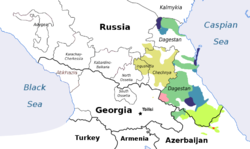
| Geographic distribution | Central Caucasus |
| Linguistic classification | Northeast Caucasian
|
| Subdivisions | |
| Language codes | |
| Glottolog | chec1244 |

The Vainakh (also spelled Veinakh) languages are a dialect continuum that consists of the Chechen and Ingush languages, spoken mainly in the Russian republics of Chechnya and Ingushetia, as well as in the Chechen diaspora. Together with Bats, they form the Nakh branch of the Northeast Caucasian languages family.[1]
See also
[edit]References
[edit]The proposed North Caucasian language family comprises the Northeast and Northwest Caucasian language families. | |||||||||||||||||||||||||||||||||||||||
| Northwest (Pontic) |
|  | |||||||||||||||||||||||||||||||||||||
| Northeast (Caspian) |
| ||||||||||||||||||||||||||||||||||||||
Italics indicate extinct languages | |||||||||||||||||||||||||||||||||||||||
| Caucasian (areal) |
|  | ||||||||||||||||||||||||||
|---|---|---|---|---|---|---|---|---|---|---|---|---|---|---|---|---|---|---|---|---|---|---|---|---|---|---|---|---|
| Indo- European |
| |||||||||||||||||||||||||||
| Turkic |
| |||||||||||||||||||||||||||
| Others | ||||||||||||||||||||||||||||
| ||||||||||||||||||||||||||||
Vainakh languages
View on Grokipediafrom Grokipedia
Classification
Position in the Northeast Caucasian family
The Northeast Caucasian language family, also known as Nakh-Dagestanian, is divided into two primary branches: the Nakh branch and the Daghestanian branch, with the latter encompassing over two dozen languages spoken mainly in Dagestan.[1][7] The Vainakh languages—Chechen and Ingush—constitute the core of the Nakh branch, which is indigenous to the North Caucasus and includes a small number of closely related tongues.[1] In standard classifications, such as Glottolog, Vainakh is grouped under the code chec1244 within the broader Nakh-Dagestanian family.[8] The Nakh branch also includes Batsbi (or Tsova-Tush), a more divergent and critically endangered language spoken by fewer than 1,600 people (estimates as of 2023 range from 500 to 1,600) in Georgia's Kakheti region, with active use now limited to older generations, which is not mutually intelligible with Chechen or Ingush despite shared Nakh ancestry.[1][9][10] Comparative linguistics establishes the genetic unity of the Northeast Caucasian family through shared innovations, including ejective consonants in the phonemic inventory and ergative-absolutive alignment in case marking.[1][7] These features, reconstructed for Proto-Nakh-Dagestanian, support Nakh and Daghestanian as sister branches diverging from a common ancestor.[11] The separation of the Nakh branch from the rest of the Northeast Caucasian family is dated to approximately 5,000–6,000 years ago, corresponding to the 4th millennium BCE during the Neolithic period in the Caucasus (estimates as of 1997).[12] This timeline aligns with archaeological evidence of early human settlement in the region, predating later migrations that influenced the area's linguistic diversity.[12]Internal structure
The Vainakh languages, comprising Chechen and Ingush, are best understood as a dialect continuum rather than two fully distinct languages, characterized by gradual variations across geographical regions and high levels of mutual intelligibility among speakers. This continuum links northern Chechen dialects, such as those in the lowland plains, through transitional varieties to southern Ingush forms in the mountainous areas, forming a chain without sharp boundaries or intermediate subgroups. Chechen and Ingush function as closely related "twin" languages within this setup, sharing a common Proto-Vainakh ancestor and exhibiting no separate branches between them, though they are standardized as separate literary languages due to political and cultural factors.[13][1][14] Lexical similarity between Chechen and Ingush exceeds 80%, often reaching around 90% in basic vocabulary, which supports their high mutual intelligibility, estimated as considerable or partial, especially with widespread passive bilingualism among speakers. Boundaries within the continuum are marked by lexical and phonological isoglosses, such as differences in vocabulary for highland versus lowland dialects— for instance, terms for local flora or terrain may vary regionally— and phonetic shifts like vowel mergers or consonant realizations that distinguish peripheral varieties. These isoglosses reflect a north-to-south cline, with lowland Chechen influencing standard forms and highland Ingush preserving more conservative features.[14][13][1] Batsbi (also known as Bats or Tsova-Tush), while part of the broader Nakh branch, is excluded from the Vainakh proper due to lower mutual intelligibility (around 50-60% lexical similarity) and distinct innovations, including retention of certain ejectives and a unique tone system with mobile stress. This separation underscores the Vainakh continuum's internal cohesion, as Batsbi speakers do not share the "Vainakh" ethnolinguistic identity. The following table illustrates near-identity in basic Vainakh vocabulary compared to Batsbi divergence, drawn from Swadesh-list cognates:| English | Chechen | Ingush | Batsbi | Notes |
|---|---|---|---|---|
| Water | xi | xiy | xi | Cognate across Nakh; Proto-Nakh *xi. |
| Father | daa | daa | dad | Cognate across Nakh; Proto-Nakh *daada. |
| See | ga-n | g-o | d=ag-ar | Vainakh cognates from Proto-Nakh *ag-; Batsbi shows prefixal variation. |
| Ashes | yuq' | yoq' | yop'q' | Full Nakh cognate; Proto-Nakh *yobq'. |
| Belly | gay ~ geː | čeː | gaga-ʔŏ | Vainakh partial match; Batsbi closer to proto-form. |
Historical development
Origins and proto-language
The Proto-Nakh language is the reconstructed common ancestor of the Vainakh languages (Chechen and Ingush) and the more divergent Batsbi language, forming the Nakh branch of the Northeast Caucasian family. Linguistic reconstructions, drawing on comparative phonology, morphology, and lexicon across these languages, indicate that Proto-Nakh emerged in the North Caucasus during the late 4th to early 2nd millennium BCE, associated with the formation of early Nakh-speaking communities. Key works by linguists such as Johanna Nichols have detailed consonant correspondences and pronominal systems, while Peter Schrijver has reconstructed the vowel inventory as consisting of five short vowels (i, u, e, o, a) and a long aː, with alternations reflecting an ergative alignment in nominal forms.[11][16][17] Archaeological evidence links early Proto-Nakh speakers to Neolithic and Bronze Age cultures in the central and northern Caucasus, particularly the Kura-Araxes culture (ca. 3400–2000 BCE), known for its spread across the South Caucasus and adjacent regions with advanced pottery, metallurgy, and fortified settlements. This culture's material remains, including settlements along the Kura and Araxes rivers, align with hypothesized homelands for Northeast Caucasian speakers, suggesting that Proto-Nakh communities participated in these networks of trade and migration. Further correlations appear with the contemporaneous Maykop culture in the North Caucasus, where burial mounds and metalwork indicate cultural continuity with later Nakh-Daghestanian groups. These links are supported by distributional patterns of artifacts and toponyms preserving potential Nakh roots in the region.[17][18] Historical linguistics points to possible connections between Proto-Nakh speakers and ancient tribes mentioned in classical sources, such as the Gargareans (or Gargars) described by Strabo, Pliny the Elder, and Plutarch in the 1st–2nd centuries CE as warlike highlanders in the central Caucasus. The term "Gargareans" may relate to Vainakh ethnonyms like Ingush gargare ("kinsfolk") or Chechen gergera, though these etymological ties remain debated due to limited direct evidence from ancient texts. Toponyms in the North Caucasus, such as those incorporating Nakh roots for geographical features (e.g., river names with da "water"), further suggest continuity from prehistoric populations, potentially extending to interactions with neighboring groups like the Dargins in Daghestan, as inferred from shared substrate vocabulary.[17] The divergence of Proto-Nakh is estimated to have produced the Vainakh continuum (leading to Chechen and Ingush) and the separate Batsbi branch around the late 1st millennium BCE to early 1st millennium CE, based on glottochronological analysis of lexical retention rates and phonological innovations like vowel umlaut in Vainakh versus retention in Batsbi. This split reflects migrations and cultural differentiation in the Caucasus, with Batsbi speakers shifting eastward into modern Georgia. A hallmark reconstructed feature from this period is the development of an ergative case system, where transitive subjects are marked distinctly from intransitive subjects and objects (absolutive), as seen in Proto-Nakh nominal endings like -a for ergative and zero-marking for absolutive, influencing verb agreement and spatial cases. This system, inherited from deeper Northeast Caucasian levels, underscores the language's typological profile amid regional interactions.[19][16][20]Modern standardization
The earliest written records of the Vainakh languages, Chechen and Ingush, date to the 19th century, when scholars and religious figures produced texts in Arabic script, primarily for religious and poetic purposes, as evidenced by surviving gravestones and manuscripts.[21] These writings reflected the influence of Islam on Vainakh society following its adoption in the region during the 18th and 19th centuries, though no standardized orthography existed at the time. In the mid-19th century, Russian military engineer and linguist Peter Uslar contributed significantly by compiling the first grammatical descriptions of Chechen, published in 1887, and proposing a Cyrillic-based alphabet to facilitate Russian administration after the annexation of the Caucasus.[22] Uslar's work marked an early attempt at codification but saw limited adoption among Vainakh speakers, who continued relying on Arabic for literacy until the Soviet period. During the Soviet era, standardization accelerated with the creation of a unified Chechen-Ingush literary language in the 1930s, following the establishment of the Chechen-Ingush Autonomous Soviet Socialist Republic in 1934.[12] Initial efforts in the 1920s introduced Latin-based alphabets for both languages—Chechen in 1922 and Ingush shortly after—to promote literacy and align with Bolshevik indigenization policies, though these were short-lived.[1] By 1938, Soviet authorities mandated a switch to Cyrillic scripts, standardizing orthographies based primarily on the lowland dialects of each language while maintaining some unity for administrative purposes; this system was enforced through education and publishing, producing the first widespread literature in Vainakh tongues.[1] The 1944 deportation of Vainakh peoples to Central Asia disrupted these developments, suppressing native language use in favor of Russian, but upon the republic's restoration in 1957, distinct orthographies for Chechen and Ingush were further refined to reflect linguistic differences, supported by Soviet linguists who documented grammar and lexicon for pedagogical materials.[12] Post-Soviet developments saw continued reliance on Cyrillic, with minor reforms in the 1990s in both Chechnya and Ingushetia to address dialectal variations and improve representation of sounds, amid debates over reviving Latin scripts to symbolize cultural independence.[1] In 1992, the de facto independent Chechen Republic of Ichkeria under President Dzhokhar Dudayev officially adopted a new Latin alphabet, implemented in newspapers and books from 1993, as a rejection of Russian influence, though its use was limited by ongoing conflict.[23] The Chechen wars of the 1990s and 2000s profoundly impacted language policy, disrupting education and leading to low Chechen literacy rates—estimated at 10-15% among adults—due to school closures, displacement, and prioritization of Russian for survival and integration.[24] These conflicts also spurred diaspora communities in Europe and Turkey to maintain Vainakh usage through informal networks and media, preserving oral traditions amid policy instability in the homeland.[25]Phonological features
Consonants
The Vainakh languages, comprising Chechen and Ingush, feature a rich consonant inventory typically numbering 28–30 phonemes in their core systems, though this expands to around 40 when including geminates, aspirates, and dialectal variants.[26] This inventory is characteristic of the Nakh branch within the Northeast Caucasian family, with a high proportion of obstruents including ejectives, uvulars, and pharyngeals.[13] Ejectives such as /pʼ/, /tʼ/, /kʼ/, and /qʼ/ are prominent, often realized with slight aspiration in initial position, while uvular stops and fricatives like /q/, /qʼ/, /χ/, and /ʁ/ contribute to the guttural quality typical of the region.[1] Pharyngeal consonants, including the fricative /ħ/ and approximant /ʕ/, further distinguish the system, appearing in both languages but with varying realizations.[26] Labialized consonants, such as /kʷ/, /qʷ/, and /χʷ/, are phonemic and occur in native words, adding to the complexity of the inventory.[13] The following table illustrates a representative consonant chart for Vainakh languages, based on shared phonemes across Chechen and Ingush (with minor variations noted); symbols follow standard IPA conventions.| Labial | Dental/Alveolar | Postalveolar | Palatal | Velar | Uvular | Pharyngeal | Glottal | |
|---|---|---|---|---|---|---|---|---|
| Stops (voiceless) | p | t | k | q | ʡ | |||
| Stops (voiced) | b | d | g | |||||
| Ejectives | pʼ | tʼ | kʼ | qʼ | ||||
| Affricates (voiceless) | ts | tʃ | ||||||
| Affricates (voiced) | dz | dʒ | ||||||
| Affricates (ejective) | tsʼ | tʃʼ | ||||||
| Fricatives (voiceless) | f/v* | s | ʃ | x | χ | ħ | h | |
| Fricatives (voiced) | z | ʒ | ɣ | ʁ | ʕ | |||
| Nasals | m | n | ||||||
| Laterals | l | |||||||
| Rhotic | r | |||||||
| Approximants | w | j |
Vowels and prosody
The Vainakh languages feature vowel systems that vary between Chechen and Ingush. Ingush has a basic inventory of five monophthongs (/i, e, a, o, u/), while Chechen has a richer system with up to 26 contrastive vowels, including front rounded vowels (/y, ø/) and low front (/æ/), back rounded (/ɔ/), plus length and pharyngealized variants.[26][1] Some analyses include a sixth central high vowel /ɨ/ or schwa /ə/ as phonemic in certain contexts.[13] Vowel length is contrastive, distinguishing short and long variants (e.g., /a/ vs. /aː/ in Chechen mala 'to drink' vs. maal 'drinks'), with long vowels often realized as tense or diphthongized in open syllables.[1][13] Pharyngealization, a feature interacting with adjacent consonants, exerts a limited harmony-like effect by centralizing non-low vowels (e.g., /i/ to [ɨ] or /e/ to [ə]) and lowering /a/ near pharyngeal consonants in suffixes.[13][27] Stress in Vainakh languages is predominantly fixed on the initial syllable of a phonological word, marking an innovation from the mobile stress of Proto-Nakh, and is realized primarily through pitch raising rather than intensity.[1][16] This initial stress influences vowel quality, leading to reduction or centralization of unstressed vowels (e.g., to schwa [ə] in non-initial positions) and occasional deletion in rapid speech.[13] In compounds and cliticized forms, secondary stress may appear on subsequent elements, creating a layered prosodic structure.[13] Intonation patterns include rising-falling contours in yes/no questions, often triggered by interrogative clitics like Ingush =ii, which assign high tone.[13] Certain morphemes bear a limited tonal system with high or rise-fall pitch, functioning as pitch accents in marked grammatical contexts such as the imperfect tense (e.g., Ingush môlar 'used to drink' with high tone vs. flat mälâr 'drank').[28] Dialectal variations introduce subtle pitch accent elements, particularly in highland varieties where stress interacts with phrasal declination.[29] Prosodic phenomena encompass phrasal sandhi processes, such as vowel elision or schwa deletion in compounds and clitic groups (e.g., Ingush neaq'a=t'y [neaq't'] 'dog=and'), which streamline syllable structure across word boundaries.[13] Focus marking can trigger gemination of postvocalic consonants, enhancing prosodic prominence (e.g., Ingush dwaixxa 'real hot' from dwai-xa).[26] These features contribute to a "sawtooth" phrasal prosody, with right-to-left grouping into binary stress units and overall pitch declination across utterances.[30]Grammatical features
Nominal system
The nominal system of Vainakh languages, comprising Chechen and Ingush, is characterized by an ergative-absolutive alignment, where the absolutive case marks both the subject of intransitive verbs and the object of transitive verbs, while the ergative marks the subject of transitive verbs.[13][1] Nouns inflect for eight to ten cases, varying by language, including the absolutive (unmarked, -Ø), ergative (-o or variants like -uo), and genitive (-i or -a), with additional spatial and relational cases such as dative (-na), allative (-ga), instrumental (-ca), lative (-x), and comparative (-l), and in Chechen, additional cases like inessive (-ahw) and ablative (-ara).[13][1] For example, in Ingush, the noun sag 'person' appears as sag (absolutive), saguo (ergative), and sagii (genitive), while in Chechen, v1o 'man' takes v1o (absolutive), v1a (ergative), and v1i (genitive).[13][1] This case system handles core grammatical relations, with oblique cases expressing direction, location, instrumentality, and comparison.[13] Number is marked on nouns through suffixes distinguishing singular (unmarked) from plural, primarily via the suffix -ash (or variants like -azh in Ingush), though some nouns use -ii or suppletive forms.[13][1] For instance, Ingush kuotam 'hen' becomes kuotamazh in the plural, and Chechen kor 'window' yields koraš 'windows'.[13][1] A dual number exists in some dialects, particularly for humans, but is marginal in standard varieties.[13] Plural marking interacts with case, often regularizing oblique forms across the paradigm.[1] Vainakh nouns lack inherent gender marking, but feature a system of four noun classes—masculine (v-), feminine (j-), plural or certain inanimates (d-), and non-human or round objects (b-)—that trigger agreement on adjectives, verbs, and some pronouns via class prefixes.[13][1] Human nouns typically select v- (masculine) or j- (feminine) prefixes in singular, with d- for plurals, as in Ingush voaqqa sag 'old man' (v- agreement) or jy for feminine, while non-human nouns use b-, d-, or secondary j-/v-, exemplified by Chechen d.waaixa 'hot' with d- for inanimates.[13][1] This agreement system reflects a combination of semantic animacy and grammatical class assignment, with d- as default for most inanimates.[1] Declension patterns differentiate animate from inanimate nouns, with animates showing more distinct case forms, particularly in ergative and oblique cases, while inanimates often simplify or merge endings.[13][1] Kinship terms exhibit irregular stems and plurals, such as Ingush daa 'father' (dative deana) or jisha 'sister' (plural jizharii), and Chechen lom 'lion' (animate, augmented to loьm-an in genitive).[13][1] These irregularities often involve stem alternations or unique suffixes, especially for inalienable kin relations.[13] Possession distinguishes inalienable (e.g., body parts, kin) from alienable (e.g., owned objects), with inalienable typically expressed via the genitive case directly, as in Ingush sagii daa 'person's father'.[13][1] Alienable possession also employs the genitive, as in Chechen Ahьmadin машина 'Ahmad's car', or relational nouns and possessive constructions, such as Ingush saguo hama 'person's thing' or gender-sensitive forms like vowaga 'son' varying by possessor.[13][1] Reflexive genitives may reinforce inalienable ties, particularly with pronouns.[1]Verbal system
The verbal system in Vainakh languages, comprising Chechen and Ingush, is characterized by complex inflectional morphology that encodes tense, aspect, mood, and agreement primarily through prefixes, suffixes, and stem alternations. Verbs are conjugated according to classes defined by patterns of ablaut and prefixation, typically numbering four to five main classes in simplified analyses, though more detailed classifications identify up to 16 ablaut patterns based on vowel and consonant alternations in stems across tenses. These classes often involve gender prefixes (v- for masculine, j- for feminine, d- for plural or mixed human, b- for non-human or certain plurals) that indicate agreement with the absolutive argument, reflecting the languages' ergative alignment. For instance, in Ingush, the verb stem for "read" alternates as d.iesh (present) to diishar (past), prefixed according to class and agreement.[13] Tense-aspect categories form a multilayered system organized into series such as the simultaneous (present-oriented), narrative (past-oriented), and future series, with core distinctions including present, imperfect (durative or habitual), aorist (perfective past), and perfect (resultative). The present series often uses synthetic forms for ongoing or habitual actions, while past tenses distinguish witnessed (direct evidence) from non-witnessed or narrative forms via ablaut or auxiliaries; for example, in Chechen, the witnessed past "v-ax-ira" (he went, masculine) contrasts with non-witnessed "v-ax-na." Aspect is marked through stem changes or periphrastic constructions with auxiliaries like "be" or "have," emphasizing imperfective (e.g., progressive) versus perfective actions. Future tenses are analytic, combining main verbs with auxiliaries such as Ingush "iecagjy" (will do). Evidentiality is integrated into the aspect system, with non-witnessed forms signaling reported or inferred events, a feature shared across Nakh-Daghestanian but prominent in Vainakh.[1][13][31] Moods include the indicative for factual statements, imperative for commands (with singular/plural forms and polite variants via suffixes like -na in Chechen), conditional for hypotheticals (using converbs or auxiliaries like -ie in Ingush), and optative/subjunctive for wishes or unrealized possibilities. Evidential moods extend to reported speech, often via specialized past forms. Negation is primarily prefixal, with forms like Chechen ca- or Ingush va-/my- preceding the verb stem (e.g., Chechen "ca v-ödu" for "I don't go"), and special prohibitive suffixes or particles for imperatives (e.g., Ingush my= for "don't"). In some contexts, negation triggers stem changes or analytic constructions.[1][13][31] Agreement is ergative, with verbs indexing the gender and number of the absolutive argument (intransitive subject or transitive object) via the aforementioned prefixes, and occasionally the ergative subject in poly-personal constructions for certain tenses or moods. This system links to the nominal gender categories, where verbs reflect the class (masculine, feminine, plural, or non-human) of the relevant noun. Person agreement appears in suffixes for imperatives or certain finite forms, but is less pervasive than gender marking. For example, in Ingush, "d-ieshar" agrees in d- (plural) with a plural absolutive subject. While Chechen and Ingush share this framework, Ingush exhibits more extensive analytic periphrases for complex tenses.[13][1][31]Lexicon and vocabulary
Core lexicon
The core lexicon of the Vainakh languages—Chechen and Ingush—exhibits significant continuity from Proto-Nakh, the reconstructed ancestor shared with Batsbi, reflecting a conservative vocabulary in basic semantic domains. This inherited stock forms the foundation of everyday communication, with many roots preserved across the family despite phonetic shifts and regional innovations. Linguistic reconstructions from comparative Nakh etymological databases highlight shared forms in Swadesh-style basic vocabulary, underscoring the unity of the group.[14] Representative examples from body parts illustrate this retention: the Proto-Nakh term for "head," *korta, appears as korta in both Chechen and Ingush, and kort in Batsbi. Similarly, "ear" derives from *larik' (Chechen lerg, Ingush lerg, Batsbi larq'), "eye" from *bʕarik' (Chechen bʕärg, Ingush bʕarg, Batsbi bʕarq'), and "hand" from *ko (Chechen kʉg, Ingush kulg, Batsbi ko). Numbers also show strong cognates, such as "one" *c̦ħa (Chechen cħaʔ, Ingush caʔ, Batsbi cħa), "two" *ši (Chechen šiʔ, Ingush šiʔ, Batsbi ši), "three" *q̇o (Chechen q̇oʔ, Ingush qoʔ, Batsbi qo), "four" *di (Chechen diʔ, Ingush diʔ, Batsbi d-ʕiv), and "five" *pxi (Chechen pxiʔ, Ingush pxiʔ, Batsbi pxi). Nature terms further demonstrate continuity, including "water" *xi (Chechen xi, Ingush xii, Batsbi xi), "sun" *malx (Chechen malx, Ingush malx, Batsbi matx), and "earth" *latta (Chechen latta, Ingush lätta, Batsbi latt). These cognates, drawn from annotated Swadesh lists, reveal a core vocabulary resistant to replacement, with Batsbi forms often preserving archaic features like final consonants.[14][32] Vainakh semantic fields emphasize social and cultural priorities, particularly in kinship and pastoralism, shaped by highland clan structures. Kinship terminology is notably rich and differentiated, with distinct terms for maternal and paternal relatives to reflect teip (clan) affiliations; for instance, Chechen uses devaša for "paternal uncle" and nenavaša for "maternal uncle," deyša for "paternal aunt" and nenayiša for "maternal aunt," while paternal cousins are devašin (male) or devašin yol (female). Such specificity extends to broader relative categories, preserving Proto-Nakh roots for core family roles like "mother" *nana (Chechen nana, Ingush nana) and "father" *da (Chechen da, Ingush da). Pastoral vocabulary, tied to the mountainous Caucasus environment, includes terms for livestock and terrain that evoke a herding lifestyle, such as Proto-Nakh *ħul for "sheep" (Chechen šul, Ingush šul, Batsbi ħul) and *taam for "mountain" (Chechen taam, Ingush taam), reflecting the centrality of transhumance in Vainakh culture.[33][14] Word formation in the core lexicon relies on compounding and derivational suffixes, enabling expressive derivations from native roots. Compounding juxtaposes elements to create new terms, often for concrete concepts; examples include Chechen tsierakiema "steamboat" (from *tsie "fire" + *kema "boat") and khalk-khietuoran "political-mass work" (from "people" + "mass" + "work"). Place names frequently employ this process, such as compounds denoting landscape features like "black mountain" in toponymic forms (e.g., tsara-taam structures in regional nomenclature). Derivational suffixes add nuances like diminution, with the Proto-Nakh *-ik' (Vainakh *-iga) forming small or endearing variants, as in *t'ulik' "small feather" (Chechen t'ulga, Ingush t'ulga from *t'ul "feather"). These mechanisms maintain lexical productivity without heavy reliance on external borrowings.[34][14] Archaic Proto-Nakh roots endure in domains linked to traditional lifeways, particularly agriculture and warfare, attesting to the antiquity of Vainakh material culture. Agricultural terms include *ʔaːrł- "to thresh" (reconstructed across Nakh, with reflexes in Chechen and Ingush verbal forms for grain processing) and *fuw "seed" (Chechen hu, Ingush gi, Batsbi huw), preserving practices from early farming in the Caucasus. Warfare vocabulary retains roots like *wač- "to fight" (Chechen vač, Ingush vač, Batsbi wač), reflecting the martial traditions of highland societies. Cognates with Batsbi, such as *c'er "knife" (Chechen c'er, Ingush c'er, Batsbi c'er) for tools used in both domains, illustrate the branch's deep continuity, with Batsbi often conserving uvular and pharyngeal sounds lost in Vainakh.[35][14]Influences and borrowings
The Vainakh languages, comprising Chechen and Ingush, exhibit a lexicon shaped by extensive contact with neighboring linguistic traditions, resulting in borrowings from Arabic, Russian, Turkish/Ottoman, Persian, and Georgian sources. These influences reflect historical processes such as the adoption of Islam, Soviet-era administration, trade routes, and regional interactions in the Caucasus.[36] Arabic loanwords entered the Vainakh lexicon primarily through the spread of Islam from the 18th century onward, contributing religious and cultural terms that are now deeply embedded. Examples include namaz (prayer), kitab (book, often in a religious sense), and amma (but, used in coordination). These borrowings, documented in studies of Chechen, number in the hundreds and are particularly prevalent in domains like faith and daily rituals, with integration occurring via morphological adaptation to Vainakh noun classes and verb conjugations.[37][36] Russian emerged as a dominant source during the 19th and 20th centuries under imperial and Soviet rule, introducing terms for modern technology, governance, and urban life; representative examples are avtomobil (automobile) and okno (window), which have been phonologically adjusted to fit Vainakh sound patterns, such as the substitution of Russian /f/ with aspirated /pʰ/ in initial positions. Ottoman Turkish influences, stemming from historical trade and migration in the 16th–19th centuries, added vocabulary related to commerce and daily goods, like çay (tea). Meanwhile, Persian loans, often mediated through Turkic or direct medieval contacts (3rd–11th centuries), and Georgian borrowings from early interactions in the South Caucasus, impacted abstract and administrative concepts, including terms for numbers (e.g., Persian-derived units) and governance.[1][38][39] Borrowings in Vainakh languages typically undergo phonological and morphological integration to align with native structures, such as assignment to gender classes or suffixation, while calques—literal translations of foreign phrases—facilitate the expression of complex ideas without direct adoption. This process is evident in older layers, where loans like Arabic religious terms are fully nativized and indistinguishable from core vocabulary in everyday use. In contrast, recent Russian influences, especially in urban settings, often manifest as code-mixing rather than full integration, with bilingual speakers incorporating Russian elements fluidly in speech.[40][41] Estimates indicate that borrowings comprise 10–15% of the modern Vainakh lexicon overall, rising to higher proportions in technical and specialized domains like science and administration, though native core terms in basic kinship, nature, and daily activities largely resist replacement.[39]Chechen
Dialects and varieties
The Chechen language exhibits notable dialectal differentiation, primarily divided into Lowland (Orehwo mott or Plains Chechen) and Highland (Goahwo mott or Mountain Chechen) varieties, reflecting the geographic diversity of the Chechen Republic from northern plains to southern mountains. The standard literary form is based on the Lowland variety, particularly the central plains speech around Grozny, which serves as the norm for education, media, and official use due to its accessibility and historical development during Soviet standardization.[1][42] Lowland dialects, including subgroups like Nashxo, Melx, Terex, and Vedjenx, show influences from neighboring Turkic and Russian languages, with more loanwords and a richer vowel system. Highland varieties, such as Itum-Qala (Shatoi), Galgai, and Himoi, are more conservative, featuring a smaller vowel inventory (e.g., retention of schwa in some) and adaptations to mountainous environments, including distinct prosodic features and lexical terms for terrain and flora. Peripheral varieties like Akkin (along the Ingush border) and Kistin (in Georgia) display transitional traits bridging Chechen and Ingush, with gradual shifts in consonants (e.g., uvular realizations) and shared vocabulary. These 7–10 main varieties form the northern end of the Vainakh dialect continuum, with high mutual intelligibility overall, though highland forms may require adjustment for full comprehension in standard contexts.[1][42] Historically, Chechen dialects were primarily oral until the 19th century, with literary development accelerating in the 20th century alongside script reforms: Arabic in the 1910s–1920s, Latin in 1923–1934, and Cyrillic since 1934 to align with Soviet policies and promote literacy.[43]Usage and status
Chechen has approximately 1.5 million native speakers as of the 2020s, the vast majority in the Chechen Republic in Russia, where Chechens form the ethnic majority (about 95% of the population).[43][44] As a co-official language alongside Russian in Chechnya, Chechen is used in administration, local media including television and radio, and education from primary through secondary levels, though higher education is predominantly in Russian.[44][43] The language is classified as vulnerable by UNESCO, facing challenges from Russian dominance in urban areas, migration, and intergenerational transmission gaps, but maintains vitality through community use and official support. In August 2025, a proposed reduction in school instruction hours for Chechen (from five to one per week) sparked concern, but by September 2025, authorities clarified that total hours would remain unchanged, preserving educational access.[45][46] Chechens have a significant diaspora, larger than Ingush, in Jordan (over 10,000 speakers maintaining bilingual Chechen-Arabic use), Turkey, Georgia, and other Russian regions, where language preservation occurs via cultural associations and media. Post-1990s policies, including the 2007 Law on State Languages in Chechnya, promote its role in public life; digital tools like online dictionaries, apps, and social media content have expanded since the 2010s.[44][46]Ingush
Dialects and varieties
The Ingush language exhibits limited dialectal differentiation, with regional varieties primarily reflecting geographic and sociolinguistic influences rather than sharp boundaries. The standard literary form is based on the Nazran variety, spoken in the central plains of Ingushetia around the city of Nazran, which serves as the linguistic norm for education, media, and official use. This variety represents the lowland speech patterns that emerged as dominant due to urbanization and administrative centralization in the region.[13] Mountain varieties, associated with highland communities in central and eastern Ingushetia, show minor phonological and lexical differences from the Nazran norm, such as variations in vowel harmony and prosodic features adapted to local environments. The Orstkhoy variety, spoken by the Orstkhoy subgroup in border areas with Chechnya along the Assa and Fortanga rivers, displays specific peculiarities that bridge Ingush and Chechen speech patterns, including transitional consonant shifts and lexical items tied to shared cultural practices. These 4–5 varieties collectively form the southern end of the Vainakh continuum, a dialect chain linking Ingush to Chechen through gradual isoglosses in phonology (e.g., realizations of uvular fricatives) and lexicon (e.g., terms for regional flora and terrain).[47][48] Mutual intelligibility between Ingush varieties and southern Chechen dialects is near-complete, facilitated by widespread passive bilingualism and overlapping features within the continuum, though Ingush maintains a distinct literary norm. Historically, prior to the 1930s, Ingush existed primarily as unwritten oral varieties without a unified standard; the modern form developed alongside the introduction of writing systems, starting with Arabic script in 1917, shifting to Latin in 1923, and adopting Cyrillic in 1938 to support literacy and administrative needs in the Soviet era.[49]Usage and status
As of the 2021 Russian census, there are approximately 516,000 ethnic Ingush in Russia, the vast majority residing in the Republic of Ingushetia, where they form the ethnic majority and most are native speakers.[50] As a co-official language alongside Russian in Ingushetia, Ingush is employed in administration, local media such as radio broadcasts, and education from primary school through university level.[51][52][13] The language maintains stable vitality overall, though it faces threats from urbanization, out-migration, and the dominance of Russian in urban and professional settings; UNESCO classifies it as vulnerable.[53][52][54] Beyond Ingushetia, Ingush speakers form a smaller diaspora compared to Chechens, primarily in other regions of Russia and Turkey, where language maintenance occurs through community cultural events.[55] Language policies supporting Ingush emerged in the 1990s and 2000s, including the 1994 Constitution of Ingushetia, which recognizes it as a state language, and Law 12-RZ on state languages, promoting its use in official administration; in recent years, digital resources such as online dictionaries, grammars, text corpora, and Bible translations have begun to emerge to aid preservation. In 2025, the Ingush Independence Committee advocated for support from major IT companies to include Ingush in translation functions, furthering digital preservation efforts.[56][57][58][59][60]Writing systems
Chechen orthography
The Chechen language employs a modified version of the Cyrillic script, which has been the standard orthography since 1938. This system includes the 33 letters of the Russian alphabet plus the palochka Ӏ to accommodate unique phonemes, for a total of 34 letters. Additional characters include Аь for the near-open front unrounded vowel /æ/, while digraphs such as Кх for the aspirated voiceless velar plosive /kʰ/ and Хь for the voiceless pharyngeal fricative /ħ/ represent other sounds; the palochka Ӏ denotes the glottal stop /ʔ/ and is used in digraphs for ejective consonants, such as ЦӀ for the ejective alveolar affricate /tsʼ/ and ЧӀ for the ejective postalveolar affricate /tʃʼ/, to represent the language's complex consonant inventory.[1][43][23] Historically, Chechen writing shifted from an Arabic-based script, introduced alongside Islam in the 16th century, to a Latin alphabet between 1925 and 1938 as part of Soviet latinization policies. The transition to Cyrillic in 1938 marked a standardization effort aligned with broader Russification, adapting the script to better fit Chechen phonology through the added letters. This Cyrillic orthography replaced earlier Latin and Arabic systems, which had limited adequacy for the language's sounds.[43][1] Orthographic conventions in Chechen Cyrillic emphasize simplicity, with stress typically unmarked since it predictably falls on the first syllable in native words, though borrowed terms may retain original stress patterns. Vowel length, which is phonemically contrastive, is indicated by doubling the vowel letter, such as аа for /a:/, rather than using diacritics, leading to occasional ambiguities in representation for learners. The system prioritizes the lowland dialect as the literary standard, smoothing dialectal variations in spelling.[1][42] In 1992, during the brief period of Chechen independence under the Ichkerian government, a reform introduced a new Latin-based orthography to replace Cyrillic, aiming for cultural de-Russification and easier international compatibility; however, following the Second Chechen War and the government's defeat, Cyrillic was reinstated as the official script by 2000. Digital encoding of Chechen text faces challenges in Unicode, particularly with the palochka Ӏ (U+04BC), which requires specific font support and can cause display issues in legacy systems or when combined in digraphs, complicating online and computational use.[43][23] Literacy in Chechen is promoted through school curricula in the Republic of Chechnya, where it holds co-official status with Russian, though many speakers are more literate in Russian due to bilingual education.[24]Ingush orthography
The Ingush orthography employs a modified version of the Cyrillic script, which was officially adopted in 1938, replacing the Latin alphabet used from 1923 to 1937. This system was initially unified with Chechen orthography in 1934 under the Latin script, acknowledging the shared Vainakh linguistic heritage, before transitioning to Cyrillic during Soviet standardization efforts. Post-Soviet developments have included minor adjustments to align more closely with the Nazran dialect, which forms the basis of the standard literary language.[61][13] The script comprises the 33 letters of the standard Russian Cyrillic alphabet, supplemented by additional characters to represent Ingush-specific phonemes. Notable among these is the letter Ӏ (palochka), used for the glottal stop /ʔ/, while ejective consonants are denoted with the palochka following the base letter (e.g., кӀ for /kʼ/). Pharyngealized or emphatic consonants, such as /pʕ/ and /tʕ/, are conveyed through digraphs like pw and tw. The orthography does not distinguish vowel length through dedicated diacritics or symbols, relying instead on contextual inference from syllable structure and morphology. Letters such as ё, щ, ъ, ы, and ь appear exclusively in Russian loanwords and proper names, maintaining phonetic fidelity to Ingush sounds in native vocabulary.[62][13][51] Conventions in Ingush orthography share similarities with Chechen but incorporate dialect-specific adaptations, particularly for distinctions like /ɡ/ (a voiced velar stop) versus /ʁ/ (a voiced uvular fricative), which vary across regional varieties without a uniform standardization. The system is largely conservative, preserving etymological forms over contemporary pronunciation; for instance, the schwa /ə/ is consistently written as a even when elided in speech, and restressed schwas may appear as y (e.g., in vy or jy). This approach prioritizes morphological transparency but can complicate phonetic reading, as artificial voicing in affixes (e.g., wa- written as wo) reflects historical rather than current usage. No explicit marking for consonant gemination occurs, though it arises contextually in focus constructions (e.g., derriga for emphatic "far").[13] The orthography presents challenges due to fewer printed materials and resources compared to Chechen, which benefits from a larger speaker population and more extensive literary tradition. Digital writing often depends on adaptations of Russian keyboards, limiting easy input of unique symbols like Ӏ and requiring workarounds for pharyngealized digraphs; Unicode support for the palochka can cause display issues similar to Chechen. Literacy in Ingush is promoted through school curricula in the Republic of Ingushetia, where it holds co-official status with Russian; instruction occurs as a core subject, supplemented by voluntary extracurricular programs and recent mandatory state examinations to bolster proficiency.[13][12]Sociolinguistic status
Speaker demographics
The Vainakh languages, comprising Chechen and Ingush, are spoken by approximately 2.2 million people worldwide (as of 2021), with Chechen accounting for around 1.8 million speakers and Ingush for about 400,000. These figures are derived from ethnic population estimates in the 2021 Russian census, where over 97% of ethnic Chechens and Ingush report their respective languages as a first language (based on prior censuses).[63] In primary regions, Chechen has about 1.4 million speakers concentrated in the Republic of Chechnya (population 1.51 million as of 2021), where ethnic Chechens form 96.4% of the residents. Ingush is spoken by roughly 400,000–450,000 people primarily in the Republic of Ingushetia (population 510,000 as of 2021 census), home to about 473,000 ethnic Ingush (total ethnic Ingush in Russia: 517,000). Significant minorities exist in neighboring areas, including around 93,000 Chechens in Dagestan (as of 2021 census) and small Ingush communities there, as well as Kist (Ingush-related) speakers numbering about 5,700 in Georgia's Pankisi Gorge.[64] Language retention is higher among youth, with rural areas showing stronger proficiency due to family and social use, while urban youth exhibit a shift toward Russian dominance.[65] Gender distribution among speakers is generally balanced within core regions, though male speakers predominate in diaspora communities owing to labor migration patterns.[66] Proficiency remains robust in rural highland areas but declines in urban settings, where Russian serves as the primary medium for education and daily interaction.[67] The global Vainakh diaspora exceeds 500,000 individuals (as of recent estimates in the 2020s), primarily in Turkey (over 100,000 Chechens), Jordan (around 50,000), and Europe (50,000–60,000 Chechens, mainly in Germany and France), with varying degrees of first-language maintenance influenced by assimilation and community networks (higher in tight-knit Middle Eastern communities, lower among second-generation speakers in urban Europe).[68][69] L1 use is higher in tight-knit communities but lower among second-generation speakers in urban European contexts.Language preservation efforts
The Russian Federation supports the preservation of Vainakh languages through bilingual education programs in schools across the Chechen Republic and Republic of Ingushetia, where Chechen and Ingush are taught alongside Russian as state languages of their respective republics.[65] In the Chechen Republic, the 2006 Law on Languages mandates the use of Chechen in official spheres, including education and administration, while targeted government programs since the early 2000s have funded language development initiatives, such as the establishment of Chechen Language Day to promote cultural awareness.[70] Similarly, Ingushetia has implemented policies under the federal framework to integrate Ingush into public life, though recent adjustments to instructional hours have sparked debates on balancing native language education with Russian proficiency requirements.[45] Non-governmental organizations and academic institutions have contributed significantly through documentation and digital resources. The Endangered Languages Documentation Programme (ELDP) has funded projects on Chechen and Ingush, including grants for phonological and morphosyntactic analysis led by linguists like Johanna Nichols, resulting in comprehensive dictionaries and grammatical resources that aid learners and researchers.[71] Nichols' Chechen-English dictionary project, initiated in the early 2000s, digitized over 6,000 vocabulary entries to counteract language loss amid conflict and migration, while similar efforts have produced online Ingush grammar tools accessible via university platforms.[72] Digital learning apps, though limited, have emerged for basic Vainakh vocabulary, supported by academic collaborations to make materials available to diaspora communities.[73] Cultural initiatives play a vital role in transmission, with media outlets like the Vainakh State Television and Radio Company broadcasting programs in Chechen and Ingush to reach wide audiences and reinforce daily usage.[74] Literature festivals and folklore collections, such as those documenting the heroic epics of the Chechens and Ingush, are promoted through regional events to engage younger generations in oral traditions and storytelling.[75] These efforts emphasize the role of nazms (religious songs) and legends in cultural identity, helping to pass down linguistic nuances from elders to youth. Preservation addresses challenges like Russianization and declining native proficiency by establishing immersion-style programs in select schools, where Vainakh languages form the medium of instruction for cultural subjects, countering the dominance of Russian in urban settings.[24] In the diaspora, online communities on platforms like Facebook and WhatsApp facilitate language practice among Vainakh speakers abroad, particularly in Jordan and Europe, where users share folklore and vocabulary to maintain ties to heritage.[76] Outcomes include a rise in youth literacy rates in Vainakh languages since the 2010s, attributed to expanded school curricula and media exposure, with surveys indicating improved proficiency among schoolchildren in the republics.[65] Documentation projects have archived endangered dialects, such as peripheral Ingush varieties, preserving audio recordings and texts for future revitalization.[52]References
- https://en.wiktionary.org/wiki/Reconstruction:Proto-Nakh/daada
- https://en.wiktionary.org/wiki/Appendix:Nakh_Swadesh_lists