


Community hub
Recent from talks
Contribute something
Nothing was collected or created yet.
Water distribution system
View on Wikipedia
A water distribution system is a part of water supply network with components that carry potable water from a centralized treatment plant or wells to consumers to satisfy residential, commercial, industrial and fire fighting requirements.[3][4]
Definitions
[edit]Water distribution network is the term for the portion of a water distribution system up to the service points of bulk water consumers or demand nodes where many consumers are lumped together.[5] The World Health Organization (WHO) uses the term water transmission system for a network of pipes, generally in a tree-like structure, that is used to convey water from water treatment plants to service reservoirs, and uses the term water distribution system for a network of pipes that generally has a loop structure to supply water from the service reservoirs and balancing reservoirs to consumers.[6]
Components
[edit]
A water distribution system consists of pipelines, storage facilities, pumps, and other accessories.[7]
Pipelines laid within public right of way called water mains are used to transport water within a distribution system. Large diameter water mains called primary feeders are used to connect between water treatment plants and service areas. Secondary feeders are connected between primary feeders and distributors. Distributors are water mains that are located near the water users, which also supply water to individual fire hydrants.[8] A service line is a small diameter pipe used to connect from a water main through a small tap to a water meter at user's location. There is a service valve (also known as curb stop) on the service line located near street curb to shut off water to the user's location.[9]
Storage facilities, or distribution reservoirs, provide clean drinking water storage (after required water treatment process) to ensure the system has enough water to service in response to fluctuating demands (service reservoirs), or to equalize the operating pressure (balancing reservoirs). They can also be temporarily used to serve fire fighting demands during a power outage. The following are types of distribution reservoirs:
- Underground storage reservoir or covered finished water reservoir: An underground storage facility or large ground-excavated reservoir that is fully covered. The walls and the bottom of these reservoirs may be lined with impermeable materials to prevent ground water intrusion.[10]
- uncovered finished water reservoir: A large ground-excavated reservoir that has adequate measures or lining to prevent surface water runoff and ground water intrusion but does not have a top cover. This type of reservoir is less desirable as the water will not be further treated before distribution and is susceptible to contaminants such as bird waste, animal and human activities, algal bloom, and airborne deposition.[10]
- Surface reservoir (also known as ground storage tank and ground storage reservoir): A storage facility built on the ground with the wall lined with concrete, shotcrete, asphalt, or membrane. A surface reservoir is usually covered to prevent contamination. They are typically located in high elevation areas that have enough hydraulic head for distribution. When a surface reservoir at ground level cannot provide a sufficient hydraulic head to the distribution system, booster pumps will be required.[4][11]
- Water tower (also known as elevated surface reservoir): An elevated water tank. A few common types are spheroid elevated storage tank, a steel spheroid tank on top of a small-diameter steel column; composite elevated storage tank, a steel tank on a large-diameter concrete column; and hydropillar elevated storage tanks, a steel tank on a large-diameter steel column. The space within the large column below the water tank can be used for other purposes such as multi-story office space and storage space. A main concern for using water towers in the water distribution system is the aesthetic of the area.[11][12]
- Standpipe: A water tank that is a combination of ground storage tank and water tower. It is slightly different from an elevated water tower in that the standpipe allows water storage from the ground level to the top of the tank. The bottom storage area is called supporting storage, and the upper part which would be at the similar height of an elevated water tower is called useful storage.[4]
- Sump: This is a contingency water storage facility that is not used to distribute water directly. It is typically built underground in a circular shape with a dome top above ground. The water from a sump will be pumped to a service reservoir when it is needed.[12]
Storage facilities are typically located at the center of the service locations. Being at the central location reduces the length of the water mains to the services locations. This reduces the friction loss when water is transported over a water main.[4]
- Storage facilities
-
 Underground storage reservoir
 -
 Uncovered finished water reservoir
 -
 Ground storage tank
 -
 Spheroid elevated storage tank
 -
 Composite elevated storage tank
 -
 Hydropillar elevated storage tank
 -
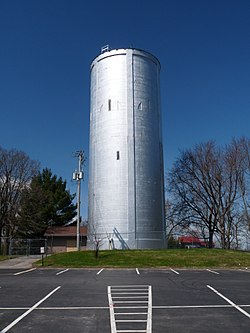 Standpipe


Topologies
[edit]In general, a water distribution system can be classified as having a grid, ring, radial or dead end layout.[13]
A grid system follows the general layout of the road grid with water mains and branches connected in rectangles. With this topology, water can be supplied from several directions, allowing water circulation and redundancy if a section of the network has broken down. Drawbacks of this topology include difficulty sizing the system.[13]
A ring system has a water main for each road, and there is a sub-main branched off the main to provide circulation to customers. This topology has some of the advantages of a grid system, but it is easier to determine sizing.[13]
A radial system delivers water into multiple zones. At the center of each zone, water is delivered radially to the customers.[13]
A dead end system has water mains along roads without a rectangular pattern. It is used for communities whose road networks are not regular. As there are no cross-connections between the mains, water can have less circulation and therefore stagnation may be a problem.[13]
System Integrity
[edit]The integrity of the systems are broken down into physical, hydraulic, and water quality.[3]
Physical integrity includes concerns regarding the ability of the barriers to prevent contamination from external sources into the water distribution system. The deterioration can be caused by physical or chemical factors.[3]
Hydraulic integrity is an ability to maintain adequate water pressure inside the pipes throughout the distribution system. It also includes the circulation and length of time that the water travels within a distribution system, which impacts the effectiveness of disinfectants.[3]
Water quality integrity is the control of degradation as the water travels through a distribution system. The impact of water quality can be caused by physical or hydraulic factors. Water quality degradation can also take place within the distribution system, such as microorganism growth, nitrification, and internal corrosion of the pipes.[3]
Network analysis and optimization
[edit]Analyses are performed to assist in design, operation, maintenance and optimization of water distribution systems. There are two main types of analyses: hydraulic and water quality behavior as it flows through a water distribution system.[14] Optimizing the design of water distribution networks is a complex task. However, a large number of methods have already been proposed, mainly based on metaheuristics.[15] Employing mathematical optimization techniques can lead to substantial construction savings in these kinds of infrastructures.[16]
Hazards
[edit]Hazards in water distribution systems can be in the forms of microbial, chemical and physical.[6]
Most microorganisms are harmless within water distribution systems. However, when infectious microorganisms enter the systems, they form biofilms and create microbial hazards to the users. Biofilms are usually formed near the end of the distribution where the water circulation is low. This supports their growth and makes disinfection agents less effective. Common microbial hazards in distribution systems come from contamination of human faecal pathogens and parasites which enter the systems through cross-connections, breaks, water main works, and open storage tanks.[6]
Chemical hazards are those of disinfection by-products, leaching of piping materials and fittings, and water treatment chemicals.[6]
Physical hazards include turbidity of water, odors, colors, scales which are buildups of materials inside the pipes from corrosions, and sediment resuspension.[6]
There are several bodies around the world that create standards to limit hazards in the distribution systems: NSF International in North America; European Committee for Standardization, British Standards Institution and Umweltbundesamt in Europe; Japanese Standards Association in Asia; Standards Australia in Australia; and Brazilian National Standards Organization in Brazil.[6]
Lead service lines
[edit]Lead contamination in drinking water can be from leaching of lead that was used in old water mains, service lines, pipe joints, plumbing fittings and fixtures. According to WHO, the most significant contributor of lead in water in many countries is the lead service line.[6]
Maintenance
[edit]Internal corrosion control
[edit]Water quality can deteriorate due to corrosion of metal pipe surfaces and connections in distribution systems. Pipe corrosion shows in water as color, taste and odor, any of which may cause health concerns.[17]
Health issues relate to releases of trace metals such as lead, copper or cadmium into the water. Lead exposure can cause delays in physical and mental development in children. Long term exposure to copper may cause liver and kidney damage. High or long term exposure of cadmium may cause damage to various organs. Corrosion of iron pipes causes rusty or red water. Corrosion of zinc and iron pipes can cause metallic taste.[17]
Various techniques can be used to control internal corrosion, for example, pH level adjustment, adjustment of carbonate and calcium to create calcium carbonate as a pipe surface coating, and applying a corrosion inhibitor. For example, phosphate products that form films over pipe surfaces is a type of corrosion inhibitor. This reduces the chance of leaching of trace metals from the pipe materials into the water.[18]
Hydrant flushing
[edit]
Hydrant flushing is the scheduled release of water from fire hydrants or special flushing hydrants to purge iron and other mineral deposits from a water main. Another benefit of using fire hydrants for water main flushing is to test whether water is supplied to fire hydrants at adequate pressure for fire fighting. During hydrant flushing, consumers may notice rust color in their water as iron and mineral deposits are stirred up in the process.[19]
Water main renewals
[edit]After water mains are in service for a long time, there will be deterioration in structural, water quality, and hydraulic performance. Structural deterioration may be caused by many factors. Metal-based pipes develop internal and external corrosion, causing the pipe walls to thin or degrade. They can eventually leak or burst. Cement-based pipes are subject to cement matrix and reinforced steel deterioration. All pipes are subject to joint failures. Water quality deterioration includes scaling, sedimentation, and biofilm formation. Scaling is the formation of hard deposits on the interior wall of pipes. This can be a by-product of pipe corrosion combined with calcium in the water, which is called tuberculation. Sedimentation is when solids settle within the pipes, usually at recesses between scaling build-ups. When there is a change in the velocity of water flow (such as sudden use of a fire hydrant), the settled solids will be stirred up, causing water to be discolored. Biofilms can develop in highly scaled and thus rough-surfaced pipes where bacteria are allowed to grow, as the higher the roughness of the interior wall, the harder it is for disinfectant to kill the bacteria on the surface of the pipe wall. Hydraulic deterioration that affects pressures and flows can be a result of other deterioration that obstructs the water flow.[20]
When it is time for water main renewal, there are many considerations in choosing the method of renewal. This can be open-trench replacement or one of the pipeline rehabilitation methods. A few pipeline rehabilitation methods are pipe bursting, sliplining, and pipe lining.[20]
- Water main renewal methods
-
 Open-trench water main replacement
 -
 Feed hydrant supplies water to a temporary bypass piping
 -
 Service connection of a temporary bypass piping
 -
 Temporary fire hydrant
.jpg)


When an in-situ rehabilitation method is used, one benefit is the lower cost, as there is no need to excavate along the entire water main pipeline. Only small pits are excavated to access the existing water main. The unavailability of the water main during the rehabilitation, however, requires building a temporary water bypass system to serve as the water main in the affected area.[21] A temporary water bypass system (known as temporary bypass piping[22]) should be carefully designed to ensure an adequate water supply to the customers in the project area. Water is taken from a feed hydrant into a temporary pipe. When the pipe crosses a driveway or a road, a cover or a cold patch should be put in place to allow cars to cross the temporary pipe. Temporary service connections to homes can be made to the temporary pipe. Among many ways to make a temporary connection, a common one is to connect the temporary service connection to a garden hose. The temporary pipe should also add temporary fire hydrants for fire protection.[23]
As water main work can disturb lead service lines, which can result in elevated lead levels in drinking water, it is recommended that when a water utility plans a water main renewal project, it should work with property owners to replace lead service lines as part of the project.[24]
See also
[edit]
- Water supply network
- District heating for hot water distribution system
References
[edit]- ^ "Drinking Water Distribution Systems". United States Environmental Protection Agency. Retrieved 20 October 2019.
- ^ "City, S&WB Host Preview of New Water Towers at Carrollton Water Plant". City of New Orleans. 25 May 2017. Retrieved 20 October 2019.
- ^ a b c d e Drinking water distribution systems : assessing and reducing risks. National Academies Press. 2006. doi:10.17226/11728. ISBN 978-0-309-10306-0. Retrieved 6 October 2019.
- ^ a b c d "Water Distribution Networks CE370" (PDF). King Fahd University of Petroleum and Minerals. Retrieved 6 October 2019.
- ^ Bhave, Pramod R.; Gupta, Rajesh (2006). Analysis of water distribution networks. Alpha Science International. p. 4. ISBN 9781842653593.
- ^ a b c d e f g Organization, World Health (2014). Water safety in distribution systems (PDF). World Health Organization. ISBN 9789241548892. Archived from the original (PDF) on 22 October 2015. Retrieved 7 October 2019.
- ^ "Water Distribution". Britannica Encyclopedia. Retrieved 6 October 2019.
- ^ Rowett, Anthony Jr. "From Hoselines to Hydrants: Understanding Water Supply". Firehouse. Retrieved 7 October 2019.
- ^ "Glossary". Mueller Water Products. Retrieved 7 October 2019.
- ^ a b Uncovered Finished Water Reservoirs Guidance Manual. DIANE Publishing. 1999. ISBN 9781428903067. Retrieved 29 November 2020.
- ^ a b Water Storage Feasibility Study Charter Township of Commerce (PDF). Giffels-Webster Engineers, Inc. 14 June 2011. pp. 6–8. Retrieved 29 November 2020.
- ^ a b Module 1 Basics of Water Supply System - Training Module for Local Water and Sanitation Management (PDF). CEPT University. 2012. pp. 8–9. Retrieved 29 November 2020.
- ^ a b c d e Adeosun, O. Oyedele (9 September 2014). "Water Distribution System Challenges And Solutions". Water Online. Retrieved 6 October 2019.
- ^ Mala-Jetmarova, Helena; Barton, Andrew; Bagirov, Adil (April 2015). "A history of water distribution systems and their optimisation". Water Science and Technology: Water Supply. 15 (2): 224–235. doi:10.2166/ws.2014.115.
- ^ De Corte, Annelies; Sörensen, Kenneth (2013). "Optimisation of gravity-fed water distribution network design: A critical review". European Journal of Operational Research. 228 (1): 1–10. doi:10.1016/j.ejor.2012.11.046. ISSN 0377-2217.
- ^ Aragones, David G.; Calvo, Gabriel F.; Galan, Alvaro (2021). "A heuristic algorithm for optimal cost design of gravity-fed water distribution networks. A real case study". Applied Mathematical Modelling. 95: 379–395. doi:10.1016/j.apm.2021.02.015. ISSN 0307-904X. S2CID 233936874.
- ^ a b Internal Corrosion Control in Water Distribution Systems (M37). American Water Works Association. 12 January 2011. pp. 2–9. ISBN 9781613001172. Retrieved 6 October 2019.
- ^ The Use of Phosphates in Water Treatment for Corrosion Control & Sequestration (PDF). Carus Corporation. 13 April 2017. Retrieved 7 October 2019.
- ^ "Hydrant Flushing Facts & Frequently Asked Questions". City of St. Charles. Retrieved 6 October 2019.[permanent dead link]
- ^ a b Rehabilitation of water mains (PDF) (Third ed.). American Water Works Association. 2014. ISBN 9781583219706. Retrieved 14 October 2019.
- ^ "Local Water System Assistance Program (LWSAP) For Member Communities Massachusetts Water Resources Authority". Massachusetts Water Resources Authority. Retrieved 14 October 2019.[permanent dead link]
- ^ "ITEM C660.5X: Temporary Bypass Piping" (PDF). Monroe County, New York. Retrieved 14 October 2019.[permanent dead link]
- ^ Cement Mortar Water Main Cleaning & Lining (PDF). Terrace Construction. Archived from the original (PDF) on 2019-10-14. Retrieved 2019-10-14.
- ^ Communicating About Lead Service Lines: A Guide for Water Systems Addressing Service Line Repair and Replacement (PDF). American Water Works Association. 2014. Retrieved 13 October 2019.
Water distribution system
View on GrokipediaDefinitions and Fundamentals
Core Definitions
A water distribution system consists of the infrastructure and appurtenances that convey treated potable water from production facilities, such as treatment plants or wells, to consumers while maintaining adequate pressure, flow rates, and quality for domestic, commercial, industrial, and firefighting uses.[1][3] These systems typically include a network of pipelines, storage facilities, pumps, valves, meters, hydrants, and service connections designed to minimize losses and ensure reliability.[2][7] Transmission mains are large-diameter pipes, often 12 inches or greater, that transport bulk water volumes over long distances from sources or treatment plants to intermediate storage or primary distribution points, operating under higher pressures to overcome elevation changes and friction losses.[8] Distribution mains, smaller than transmission lines but still sizable (typically 6 to 12 inches), form the branching network within urban or suburban areas to deliver water to neighborhoods or zones, balancing supply demands with hydraulic efficiency.[9] Service lines, or laterals, connect mains to individual customer meters or buildings, usually ranging from 3/4 to 2 inches in diameter, and include corporation stops, curb valves, and meter installations to isolate user connections.[10] Storage reservoirs and tanks maintain system pressure, equalize peak demands against average supply rates, and provide reserves for emergencies or fire flow, categorized as elevated tanks for gravity feed, ground-level covered reservoirs, or standpipes depending on topography and capacity needs.[1] Pumps, often centrifugal types stationed at booster or lift facilities, compensate for head losses and elevate water to higher elevations, ensuring minimum pressures of 20 to 40 psi at service connections under normal conditions.[2] Valves, including gate, check, and pressure-reducing types, control flow direction, isolate sections for maintenance, and regulate pressures to prevent surges or leaks.[8] Fire hydrants serve as outlets for high-volume flows during emergencies, typically spaced 300 to 500 feet apart in grids to achieve response times under 5 minutes.[7]Scale and Global Importance
Water distribution systems form one of the most extensive engineered infrastructures globally, delivering potable water to urban and rural populations through networks of pipes, storage facilities, and treatment connections. As of 2022, approximately 73% of the world's population, or about 5.8 billion people out of an estimated 8 billion, had access to safely managed drinking water services, which predominantly rely on piped systems located on premises and protected from contamination.[11] These systems vary widely in scale, with developed nations maintaining networks often exceeding millions of kilometers per country—for instance, individual large cities or regions feature tens of thousands of kilometers of piping—while global totals remain unaggregated but underpin daily water needs for billions.[12] The global importance of these systems lies in their role as a foundational public health safeguard, preventing widespread waterborne diseases such as cholera, diarrhea, dysentery, hepatitis A, and typhoid, which are transmitted through contaminated supplies lacking reliable distribution.[11] Effective distribution mitigates intrusion risks from deteriorating infrastructure, which can elevate pathogen entry and gastrointestinal illness rates estimated at 15-50% attributable to distribution issues in vulnerable networks.[13] Economically, robust systems support urbanization, agriculture, industry, and overall growth by enabling reliable supply; underinvestment contributes to productivity losses, with global needs projected at up to $7 trillion by 2030 to meet sustainable development goals and avert crises affecting 2 billion without safe access.[14] [15] Challenges persist due to aging pipes prone to breaks and contamination, particularly in low-income regions where only partial coverage exacerbates inequities, yet expansions from 2015 to 2024 added access for 961 million, raising safely managed coverage to 74%.[16] Prioritizing maintenance and expansion is causal to reducing health burdens and unlocking economic potential, as reliable distribution directly correlates with lower disease incidence and higher societal productivity.[17]Historical Evolution
Ancient Origins to Pre-Industrial Systems
The earliest known urban water distribution systems emerged in the Indus Valley Civilization around 2500 BCE, where cities like Mohenjo-Daro featured a network of approximately 700 wells supplying fresh water to both private households and public facilities such as the Great Bath, a large public pool measuring 12 meters by 7 meters.[18] These systems relied on deep, brick-lined wells and covered drains to convey water and wastewater, demonstrating centralized planning for potable supply and sanitation in a population of tens of thousands, though primarily gravity-based without pressurized pipes.[19] In the Minoan civilization on Crete during the Bronze Age (circa 2000–1450 BCE), water distribution advanced with terracotta pipes, cisterns for rainwater harvesting, and spring-fed channels delivering water to palaces like Knossos, where drainage systems included sloped conduits and settling tanks to manage flow and sediment.[20] These technologies supported multi-story buildings with running water for bathing and flushing, using gravity to transport water from sources up to several kilometers away, marking an early integration of collection, storage, and conveyance in arid Mediterranean conditions.[21] Ancient Persian engineers developed qanats by around 700 BCE, subterranean tunnels tapping aquifers and channeling groundwater via gravity over distances up to 70 kilometers with minimal evaporation, supplying oases and cities during the Achaemenid Empire and later refined in the Islamic Golden Age (8th–13th centuries CE).[22] This passive system, featuring vertical shafts for maintenance, enabled sustainable distribution in hyper-arid regions, influencing water management from Iran to North Africa and Spain, where it supported urban growth without surface aqueducts.[23] The Romans achieved the most extensive pre-industrial networks, constructing 11 aqueducts between 312 BCE and 226 CE to supply Rome with up to 1 million cubic meters of water daily, serving over 1 million inhabitants through a combination of open channels, covered conduits, and lead pipes distributing to public fountains, baths, and private villas.[24] The Aqua Appia (312 BCE), Rome's first, spanned 16 kilometers mostly underground, while later systems like the Aqua Claudia (completed 52 CE) reached 69 kilometers with elevated arcades crossing valleys, prioritizing gravity flow at gradients as low as 1:5000 to maintain pressure and quality.[25] In ancient China, systems like the Dujiangyan irrigation project (initiated 256 BCE) diverted rivers via weirs and channels to distribute water across 5,300 square kilometers, while urban examples in Pingliangtai (circa 2000 BCE) used interconnected ceramic pipes for drainage and supply, though urban potable distribution remained localized via wells and canals until Han Dynasty (206 BCE–220 CE) enhancements in Chang'an integrated river intakes with conduits for imperial and residential use.[26] These gravity-reliant setups focused on flood control and agriculture but laid foundations for later urban conveyance.[27] Following the fall of Rome, European distribution regressed to wells, rivers, and rudimentary conduits, with medieval cities like London sourcing water from distant springs via wooden pipes (e.g., Tyburn system supplying Cheapside by the 13th century), limited to elite or public fountains due to contamination risks and maintenance challenges.[28] In contrast, Islamic engineers during the Golden Age expanded qanats and built surface aqueducts, such as those in Córdoba (10th century), combining Persian subsurface tech with Roman-inspired arches to convey spring water to reservoirs and mosques, sustaining populations in arid zones through precise surveying and anti-siltation designs.[29] Pre-industrial systems globally thus emphasized gravity conveyance from natural sources, with pipes and channels scaling to urban demands only where topography and governance permitted, often prioritizing public over private access to mitigate scarcity and disease.[30]Industrial Era Advancements
The Industrial Revolution, spanning roughly from the mid-18th to late 19th century, drove transformative changes in water distribution due to explosive urban growth and factory demands, shifting systems from localized, gravity-reliant setups to pressurized, centralized networks serving millions. In Britain, where industrialization began earliest, cities like London saw population surges from under 1 million in 1800 to over 6.5 million by 1900, overwhelming traditional sources and necessitating robust infrastructure to deliver potable water amid rising contamination from sewage and industry.[31] Engineers prioritized scalable materials and mechanical pumping to maintain flow under pressure, enabling distribution over distances exceeding prior limits of wooden or lead pipes, which often leaked or burst under load. This era marked the transition to engineered mains capable of withstanding 50-100 psi, far beyond ancient aqueducts' reliance on topography.[32] Cast-iron pipes emerged as a cornerstone advancement, offering superior tensile strength and corrosion resistance compared to wooden logs or lead, which degraded rapidly in acidic or pressurized conditions. Though prototyped as early as 1455 in Germany for sporadic use, systematic adoption accelerated post-1664 with the Versailles installation—the first full-scale cast-iron system—paving the way for industrial scalability. By 1746, London's Chelsea Water Works laid extensive cast-iron mains from the Thames, spanning miles and reducing breakage rates that plagued earlier materials; production scaled via sand-molding techniques, yielding pipes up to 48 inches in diameter by the 1820s. In the United States, Philadelphia installed cast-iron replacements for deteriorated spruce logs in the 1810s, while New York followed in 1799, with networks expanding to 100 miles of mains by mid-century. These pipes' longevity—often exceeding 100 years—facilitated branching topologies, though joints remained a vulnerability until flanged designs improved sealing.[33][32][34] Steam-powered pumping revolutionized elevation and volume constraints, supplanting water wheels and manual lifts with reliable, high-capacity engines. Thomas Newcomen's 1712 atmospheric engine, initially for mine dewatering, adapted for urban supply by condensing steam to create vacuum-driven pistons lifting 10-20 gallons per stroke; James Watt's 1769 refinements boosted efficiency to 5-10 times, consuming less coal while delivering 1,000-2,000 gallons per minute. London's private water companies, such as the Grand Junction Waterworks established in 1815, deployed multiple Watt engines to pump 20-30 million gallons daily from Thames intakes to service reservoirs, distributing via cast-iron grids to households and industries. By the 1830s, over a dozen such firms operated in the metropolis, with steam stations like those of the Southwark Company achieving heads of 100-150 feet, enabling multi-story building supplies previously unfeasible. This mechanization, though fuel-intensive, causal enabled industrial output by ensuring consistent pressure, though early systems suffered intermittent supply until storage tanks buffered demand.[35][31][36]20th Century Standardization and Expansion
In the early 20th century, standardization of water distribution systems advanced through the establishment of uniform specifications for materials and construction practices, addressing inconsistencies in prior ad hoc designs. The American Water Works Association (AWWA) played a central role, adopting its inaugural standard in 1908 for cast-iron pipe and special castings, which specified dimensions, testing, and quality for bell-and-spigot pit-cast pipes used in mains.[37] Cast iron became the predominant material for its longevity—often exceeding 100 years—and corrosion resistance when coated, while reinforced concrete and steel emerged for larger transmission mains to handle higher pressures and spans.[38] These standards facilitated interoperability and reliability, reducing failure rates in expanding urban grids. Complementary guidelines for disinfection, such as those formalized later under AWWA C651, ensured pathogen control during installation and maintenance.[39] Expansion accelerated amid rapid urbanization and public health crises, with over 3,000 public water systems operational in the United States by 1900, primarily serving cities through local gravity-fed or pumped networks.[40] Filtration advancements, including rapid sand filters with coagulation from the 1910s, and widespread chlorination starting in 1915, drastically cut waterborne diseases like typhoid—reducing incidence nearly 100-fold by the 1940s compared to 1910 levels—enabling safer, broader distribution without frequent boil advisories.[40] Urban coverage neared universality by the 1920s, with typhoid death rates dropping from 40 per 100,000 in large cities around 1900 to about 2 per 100,000 by 1920, attributable to extended piping and treatment integration.[41] Federal oversight began with the U.S. Public Health Service's 1914 bacteriological standards, promoting consistent quality across systems.[40] Mid-century shifts introduced ductile iron pipe in the 1940s, a magnesium-treated variant of cast iron offering superior flexibility and impact resistance for seismic-prone or trenched installations, with AWWA standard C151 issued in 1965 to codify manufacturing requirements like minimum wall thicknesses for pressure classes.[42] Post-World War II suburbanization drove massive infrastructure growth, extending mains to new developments and incorporating elevated storage tanks for pressure regulation; community water systems proliferated to serve dispersed populations, reflecting a transition from dense urban cores to regional networks.[40] By 1950, these expansions had integrated groundwater pumping and larger reservoirs, supporting industrial and residential demands amid population booms, though aging cast-iron legacies from early builds began surfacing maintenance challenges.[38]Core Components
Pipes, Materials, and Fittings
Pipes in water distribution systems transport treated water from sources to consumers, typically buried underground to protect against damage and contamination. Common diameters for urban water mains range from 6 to 16 inches, while service lines to individual properties are usually ¾ to 1 inch in diameter.[43][44] Materials selection prioritizes durability, corrosion resistance, hydraulic efficiency, and compliance with standards such as those from the American Water Works Association (AWWA).[45] Ductile iron pipes, often cement-lined for corrosion protection, dominate large-diameter mains due to their high strength and ability to withstand external loads and internal pressures up to 350 psi.[46] High-density polyethylene (HDPE) pipes, standardized under AWWA C901 for service lines with PE4710 material, offer flexibility, joint integrity, and resistance to corrosion, making them suitable for trenchless installation and areas prone to ground movement.[47] Polyvinyl chloride (PVC) pipes provide lightweight construction and low friction for smoother flow, but their rigidity limits use in high-load or seismic zones.[48] Steel pipes, reinforced and coated, serve high-pressure transmission lines, while prestressed concrete cylinder pipes handle diameters over 24 inches in stable soils.[49]| Material | Advantages | Disadvantages | Common Applications |
|---|---|---|---|
| Ductile Iron | High tensile strength, impact resistance, longevity over 100 years with proper lining | Susceptible to corrosion without coatings, heavier weight increases installation costs | Primary mains in urban areas[46] |
| HDPE | Corrosion-proof, flexible for earthquake-prone areas, fusion-welded joints prevent leaks | Lower stiffness requires bedding support, potential for permeation by organics | Service lines, repairs, flexible networks[47][50] |
| PVC | Low cost, smooth interior reduces pumping energy, easy handling | Brittle under impact or freeze-thaw cycles, limited pressure ratings | Secondary distribution in low-risk soils[48] |
| Steel | Weldable for custom lengths, high pressure capacity | Prone to external corrosion unless protected, higher maintenance | Transmission mains, industrial feeds[49] |