


Community hub
Recent from talks
Contribute something
Nothing was collected or created yet.
Waxworm
View on Wikipedia | This article needs additional citations for verification. (February 2012) |


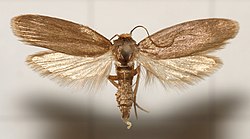
Waxworms are the caterpillar larvae of wax moths, which belong to the family Pyralidae (snout moths). Two closely related species are commercially bred – the lesser wax moth (Achroia grisella) and the greater wax moth (Galleria mellonella). They belong to the tribe Galleriini in the snout moth subfamily Galleriinae. Another species whose larvae share that name is the Indianmeal moth (Plodia interpunctella), though this species is not available commercially.
The adult moths are sometimes called "bee moths", but, particularly in apiculture, this can also refer to Aphomia sociella, another Galleriinae moth which also produces waxworms, but is not commercially bred.
Waxworms are medium-white caterpillars with black-tipped feet and small, black or brown heads.
In the wild, they live as nest parasites in bee colonies and eat cocoons, pollen, and shed skins of bees, and chew through beeswax, thus the name. Beekeepers consider waxworms to be pests.[1] Galleria mellonella (the greater wax moths) will not attack the bees directly, but feed on the wax used by the bees to build their honeycomb. Their full development to adults requires access to used brood comb or brood cell cleanings—these contain protein essential for the larvae's development, in the form of brood cocoons. The destruction of the comb will spill or contaminate stored honey and may kill bee larvae or be the cause of the spreading of honey bee diseases.
When kept in captivity, they can go a long time without eating, particularly if kept at a cool temperature. Captive waxworms are usually raised on a mixture of cereal grain, bran, and honey.
Waxworms as a food source
[edit]Waxworms are a commonly used food for many insectivorous animals and plants in captivity. These larvae are grown extensively for use as food for humans, as well as live food for terrarium pets and some pet birds, mostly due to their high fat content, their ease of breeding, and their ability to survive for weeks at low temperatures. They are recommended for use as a treat rather than a staple food, due to their relative lack of nutrients when compared to crickets and mealworms.[2] Their high fat and food energy (caloric) density can also contribute to obesity in captive animals if they are fed waxworms too often,[3] especially in animals with a low metabolism, such as reptiles.
Most commonly, they are used to feed reptiles such as bearded dragons (species in the genus Pogona), the neon tree dragon (Japalura splendida), geckos, brown anoles (Anolis sagrei), turtles such as the three-toed box turtle (Terrapene carolina triunguis), and chameleons. They can also be fed to amphibians such as Ceratophrys frogs, newts such as Strauch's spotted newt (Neurergus strauchii), and salamanders such as axolotls. Small mammals such as the domesticated hedgehog can also be fed with waxworms, while birds such as the greater honeyguide can also appreciate the food. They can also be used as food for captive predatory insects reared in terraria, such as assassin bugs in the genus Platymeris, and are also occasionally used to feed certain kinds of fish in the wild, such as bluegills (Lepomis macrochirus).
Waxworms as bait
[edit]Waxworms may be store-bought or raised by anglers.[4] Anglers and fishing bait shops often refer to the larvae as "waxies". They are used for catching some varieties of panfish, members of the sunfish family (Centrarchidae), green sunfish (Lepomis cyanellus) and can be used for shallow-water fishing with the use of a lighter weight. They are also used for fishing some members of the family Salmonidae, masu salmon (Oncorhynchus masou), white-spotted char (Salvelinus leucomaenis), and rainbow trout (Oncorhynchus mykiss).
Uses
[edit]Fishing
[edit]Anglers use waxworms usually provided by commercial suppliers to catch trout. Waxworms are popular bait for anglers in Japan. Anglers throw handfuls into the "swim" they are targeting, attracting the trout to the area. The angler then uses the largest or most attractive waxworms on the hook, hoping to be irresistible to the fish.
Waxworms as an alternative to mammals in animal research
[edit]Waxworms can replace mammals in certain types of scientific experiments with animal testing, especially in studies examining the virulence mechanisms of bacterial and fungal pathogens.[5] Waxworms prove valuable in such studies because the innate immune system of insects is strikingly similar to that of mammals.[6] Waxworms survive well at human body temperature and are large enough in size to allow straightforward handling and accurate dosing. Additionally, the considerable cost savings when using waxworms instead of small mammals (usually mice, hamsters, or guinea pigs) allows testing throughput that is otherwise impossible. Using waxworms, it is now possible to screen large numbers of bacterial and fungal strains to identify genes involved in pathogenesis or large chemical libraries with the hope of identifying promising therapeutic compounds. The later studies have proved especially useful in identifying chemical compounds with favorable bioavailability.[7][8]
Biodegradation of plastic
[edit]Two species of waxworm, Galleria mellonella and Plodia interpunctella have both been observed eating and digesting polyethylene plastic (plastivory). The waxworms metabolize polyethylene plastic films into ethylene glycol, a compound which biodegrades rapidly.[9] This unusual ability to digest matter classically thought of as non-edible may originate with the waxworm's ability to digest beeswax as a result of gut microbes that are essential in the biodegradation process.[10] Two strains of bacteria, Enterobacter asburiae and Bacillus sp, isolated from the guts of Plodia interpunctella waxworms, have been shown to decompose polyethylene in laboratory testing.[11][12] In a test with a 28-day incubation period of these two strains of bacteria on polyethylene films, the films' hydrophobicity decreased. In addition, damage to the films' surface with pits and cavities (0.3–0.4 μm in depth) was observed using scanning electron microscopy and atomic-force microscopy.
Placed in a polyethylene shopping bag, about 100 Galleria mellonella waxworms consumed almost 0.1 g (0.0035 oz) of the plastic over the course of 12 hours in laboratory conditions.[13]
A non-peer reviewed research study in 2020 questioned the ability of G. mellonella caterpillars to digest and biologically degrade polyethylene.[14]
See also
[edit]References
[edit]- ^ Victoria, Department of Environment and Primary Industries. "Wax Moth - A Pest of Combs and Honey Bee Products". agriculture.vic.gov.au. Archived from the original on 2017-04-27. Retrieved 2017-04-26.
- ^ Finke, Mark D. (November 2015). "Complete nutrient content of four species of commercially available feeder insects fed enhanced diets during growth: Complete Nutrient Content of Four Species of Feeder Insects". Zoo Biology. 34 (6): 554–564. doi:10.1002/zoo.21246. PMID 26366856.
- ^ Hernandez-divers, Stephen J.; Cooper, John E. (2006). "Hepatic Lipidosis". Reptile Medicine and Surgery (Second ed.). W.B. Saunders. pp. 806–813. doi:10.1016/B0-72-169327-X/50060-2. ISBN 978-0-7216-9327-9.
- ^ "Use for Waxworms" Archived 2014-12-22 at the Wayback Machine. Retrieved 22 December 2014
- ^ Antunes, Luísa C. S.; Imperi, Francesco; Carattoli, Alessandra; Visca, Paolo (2011). Adler, Ben (ed.). "Deciphering the Multifactorial Nature of Acinetobacter baumannii Pathogenicity". PLOS ONE. 6 (8) e22674. Bibcode:2011PLoSO...622674A. doi:10.1371/journal.pone.0022674. PMC 3148234. PMID 21829642.
- ^ Kavanagh, Kevin; Reeves, Emer P. (2004). "Exploiting the potential of insects for in vivo pathogenicity testing of microbial pathogens". FEMS Microbiology Reviews. 28 (1): 101–12. doi:10.1016/j.femsre.2003.09.002. PMID 14975532.
- ^ Aperis, G; Burgwynfuchs, B; Anderson, C; Warner, J; Calderwood, S; Mylonakis, E (2007). "Galleria mellonella as a model host to study infection by the Francisella tularensis live vaccine strain". Microbes and Infection. 9 (6): 729–34. doi:10.1016/j.micinf.2007.02.016. PMC 1974785. PMID 17400503.
- ^ Serrano, I.; Verdial, C.; Tavares, L.; Oliveira, M. (2023). "The Virtuous Galleria mellonella Model for Scientific Experimentation". Antibiotics. 12 (3): 505. doi:10.3390/antibiotics12030505. PMC 10044286. PMID 36978373.
- ^ "Could These Tiny Plastic-Eating Caterpillars Hold The Answer To Our Trash Problem? - Hydration Anywhere". hydrationanywhere.com. Archived from the original on 2017-04-26. Retrieved 2017-04-25.
- ^ Hunt, Katie (4 March 2020). "These plastic-chomping caterpillars can help fight pollution". CNN. Retrieved 2020-03-05.
- ^ Yang, Jun; Yang, Yu; Wu, Wei-Min; Zhao, Jiao; Jiang, Lei (2014-12-02). "Evidence of Polyethylene Biodegradation by Bacterial Strains from the Guts of Plastic-Eating Waxworms". Environmental Science & Technology. 48 (23): 13776–13784. Bibcode:2014EnST...4813776Y. doi:10.1021/es504038a. ISSN 0013-936X. PMID 25384056.
- ^ Nuwer, Rachel. "A Worm's Gut Could Help Dispose of Plastic Trash". Smithsonian. Retrieved 2017-04-25.
- ^ Bombelli, Paolo; Howe, Christopher J.; Bertocchini, Federica (2017-04-24). "Polyethylene bio-degradation by caterpillars of the wax moth Galleria mellonella". Current Biology. 27 (8): R292 – R293. Bibcode:2017CBio...27.R292B. doi:10.1016/j.cub.2017.02.060. hdl:10261/164618. ISSN 0960-9822. PMID 28441558.
- ^ Raupen der Wachsmotte haben Plastik zum Fressen gern: Fraunhofer LBF untersucht Abbauprozess (Waxworms love to eat plastic: Fraunhofer LBF investigates biodegradation), Fraunhofer LBF press information, June 9th, 2020, https://www.lbf.fraunhofer.de/de/presse/presseinformationen/kunststoffrecycling-raupen-der-wachsmotte-fressen-plastik.html
| Aspects of insects in culture |
| ||||||||||||||
|---|---|---|---|---|---|---|---|---|---|---|---|---|---|---|---|
| Pioneers |
| ||||||||||||||
| Concerns | |||||||||||||||
| Categories, templates | |||||||||||||||

Waxworm
View on GrokipediaWaxworms are the larvae of the greater wax moth, Galleria mellonella, a lepidopteran species in the family Pyralidae whose plump, cream-colored caterpillars primarily consume beeswax, honey, and pollen stores within honeybee hives.[1][2] The species exhibits holometabolous development, progressing through egg, larval, pupal, and adult stages, with larvae tunneling through comb material and producing silk webbing and frass as they feed, often devastating weakened colonies.[1][2] While notorious as secondary pests that exploit stressed apiaries rather than directly killing bees, waxworms have emerged as versatile tools in applied contexts, including live bait for fishing and feeder insects for reptiles and birds due to their soft bodies and nutritional profile.[1] Their gut microbiota and immune responses have positioned them as non-mammalian models for studying bacterial and fungal infections, bridging invertebrate and vertebrate pathology.[1] A defining discovery involves their enzymatic capacity to oxidize and depolymerize polyethylene plastics—demonstrated by larvae rapidly degrading PE films into ethylene glycol—offering insights into microbial and salivary mechanisms for bioremediation of persistent pollutants.[3][4] This biodegradation trait, potentially driven by hexamerin storage proteins and associated enzymes rather than full metabolism, underscores waxworms' unexpected role in addressing plastic waste challenges.[5]
Taxonomy and Biology
Species Classification
Waxworms are the larval stage of the greater wax moth, Galleria mellonella (Linnaeus, 1758), a cosmopolitan species in the family Pyralidae.[6][7] The binomial name was established by Carl Linnaeus in his 1758 Systema Naturae.[7] This species is the primary referent for the term "waxworm" in commercial, scientific, and pet trade contexts, though the larvae of the lesser wax moth, Achroia grisella Fabricius (1794), are occasionally also designated as such.[8][9] The taxonomic classification of G. mellonella is as follows:| Rank | Taxon |
|---|---|
| Kingdom | Animalia |
| Phylum | Arthropoda |
| Class | Insecta |
| Order | Lepidoptera |
| Family | Pyralidae |
| Genus | Galleria |
| Species | G. mellonella |
Physical and Physiological Characteristics
Waxworms, the larval stage of the greater wax moth Galleria mellonella, possess an eruciform (caterpillar-like) body morphology classified as polypod and peripneustic, featuring nine pairs of spiracles for respiration.[1] The body consists of a distinct head, three thoracic segments, and ten abdominal segments, with the overall form being cylindrical and tapered posteriorly.[1] Newly hatched first-instar larvae measure 1–3 mm in length with a yellowish head, while mature larvae attain lengths of 20–30 mm and diameters of 5–7 mm before pupation.[8] [2] Early instar larvae exhibit a creamy white coloration, transitioning to grayish tones in later stages, with a dark brown head capsule and white ventral surface.[11] The head bears two pairs of short, protruding setae on the parietals, resembling tiny horns, and body segments carry 2–7 pairs of short setae.[1] Thoracic legs are conspicuous and functional for locomotion, while the larva constructs protective silk tunnels using spinnerets associated with modified salivary glands.[12] Spiracles are positioned on the thorax and first eight abdominal segments, facilitating tracheal gas exchange in the open circulatory system typical of insect larvae.[1] Physiologically, the digestive system is specialized for consuming beeswax and associated hive materials, incorporating a midgut with proteinases, esterases, and lipases for hydrolyzing lipids and hydrocarbons, augmented by symbiotic gut bacteria that enhance polymer degradation.[13] [14] Salivary glands produce enzymes capable of initiating oxidative breakdown of recalcitrant substrates, as demonstrated in studies on polyethylene depolymerization.[15] The hemocoel-based circulatory system distributes nutrients and hemocytes, supporting a robust innate immune response involving melanization and antimicrobial peptides, though this is secondary to core metabolic adaptations for wax catabolism.[16] Larvae can enter diapause under stress, halting development via reduced neurosecretory activity in the brain.[17]Life Cycle and Natural Diet
The waxworm refers to the larval stage of the greater wax moth, Galleria mellonella, a holometabolous insect with a life cycle comprising egg, larval, pupal, and adult stages.[1] Female adults lay clusters of eggs directly on honeycomb or hive debris within beehives, with hatching occurring in 3 to 5 days at temperatures of 29 to 35°C.[11] The total life cycle duration ranges from 30 to 90 days, influenced by environmental factors such as temperature (optimal at 25–33°C), humidity, and food availability.[12] [18] Upon hatching, larvae—known as waxworms—undergo 5 to 8 instars while feeding and growing, with the larval period lasting from approximately 17 days at warmer temperatures (e.g., 5.7 to 24°C averages) to several weeks under optimal conditions around 27–29°C.[19] [20] Mature larvae spin silken cocoons and enter the pupal stage, which averages 25.4 days at 27–29°C and 88–91% relative humidity.[20] Pupae develop into short-lived adults (typically 1–2 weeks), which mate and oviposit before dying; adult females can produce 300–600 eggs per individual.[21] The lesser wax moth, Achroia grisella, exhibits a similar four-stage cycle but with a shorter average duration of about 49 days on beeswax compared to 62 days for G. mellonella.[22] In natural settings, waxworm larvae primarily infest honeybee colonies as parasites, deriving their diet from hive materials including beeswax, honey, pollen, shed bee skins, and cocoons.[23] [24] This diet enables them to tunnel through comb, digesting the lipid-rich beeswax via specialized gut enzymes and symbiotic bacteria.[14] Adult moths consume minimal nectar or none, focusing energy on reproduction rather than feeding.[21] Both G. mellonella and A. grisella larvae exploit these resources similarly, though the greater wax moth targets larger comb sections more aggressively.[25]Ecology and Habitat
Natural Occurrence
The greater wax moth (Galleria mellonella), whose larvae are known as waxworms, is native to the Palearctic region, encompassing parts of Europe, Asia, and North Africa, where it has long been associated with honeybee colonies.[2] The species has a broad native distribution but exhibits invasive characteristics even within this range due to its adaptability and dependence on bee hives for reproduction.[2] Through human-mediated spread via global beekeeping, G. mellonella has become cosmopolitan, occurring on all continents except Antarctica as of records up to 2022.[26] It has been documented in at least 27 African countries, 9 Asian countries, 5 North American countries, 3 Latin American countries, and numerous others in Europe and Oceania.[1] This expansion correlates directly with the presence of managed or feral honeybee (Apis mellifera or A. cerana) populations, as the moth does not thrive independently of such hosts.[8] In natural settings, waxworms inhabit bee nests or abandoned hives, where larvae tunnel through wax combs, feeding on beeswax, pollen, honey, and cocoon silk while avoiding direct consumption of adult bees or extensive brood.[8] Adults are nocturnal fliers, active in warm seasons, and favor temperate to subtropical climates, with peak infestations in regions like the southern United States where conditions support rapid development.[11] The species' ecology is tightly linked to hive disturbances, thriving in weakened or unmanaged colonies rather than healthy, defended ones.[27]Interactions with Beekeeping
The larvae of the greater wax moth (Galleria mellonella), known as waxworms, primarily interact with beekeeping as opportunistic pests that infest weakened honey bee (Apis mellifera) colonies and stored hive equipment.[28] These larvae feed destructively on beeswax, pollen, honey bee cocoons, and larval remains, creating extensive tunnels and silken galleries within combs that render frames unusable for bees and beekeepers.[25][29] In active hives, infestations typically occur only after primary stressors like varroa mite infestations, queenlessness, or nutritional deficits compromise colony defenses, as healthy, populous colonies actively remove wax moth eggs and young larvae.[28][29] Adult greater wax moths lay eggs preferentially in hives with uncapped brood or exposed combs, with females capable of depositing up to 300 eggs per oviposition cycle, leading to rapid larval proliferation in vulnerable apiaries.[30] The resulting damage reduces honeycomb integrity, lowers yields of marketable bee products, and can transmit secondary pathogens through contaminated frass, further stressing colonies.[25] Waxworms do not directly kill bees but signal underlying hive weakness, often finishing off already declining colonies by destroying structural comb.[29] The lesser wax moth (Achroia grisella) exhibits similar but less severe interactions, targeting brood cells more aggressively in some cases.[28] Beekeepers mitigate these interactions by prioritizing colony health through regular inspections, mite control, and adequate nutrition to maintain defensive behaviors against moths.[28] For stored combs and supers, freezing at -7°C (20°F) for at least 4.5 hours kills all life stages, while chemical fumigants like paradichlorobenzene crystals provide effective prophylaxis without residues in wax when applied correctly to sealed equipment.[28] Emerging integrated pest management strategies, such as larval entrapment lures combined with biocontrol agents, show promise for apiary-wide suppression, reducing reliance on broad-spectrum treatments.[30] In strong apiaries, wax moths serve an ecological role by scavenging abandoned hive debris, but unchecked infestations can lead to substantial economic losses from discarded equipment.[25]