


Community hub
Recent from talks
Contribute something
Nothing was collected or created yet.
MSN TV
View on Wikipedia | This article needs additional citations for verification. (May 2023) |
MSN TV (formerly WebTV) was a web access product consisting of a thin client device that used a television for display (instead of using a computer monitor), and the online service that supported it. The original WebTV device design and service were developed by WebTV Networks, Inc., a company started in 1995. The WebTV product was announced in July 1996 and later released on September 18, 1996. In April 1997, the company was purchased by Microsoft Corporation and in July 2001, was rebranded to MSN TV and absorbed into MSN.
Key Information


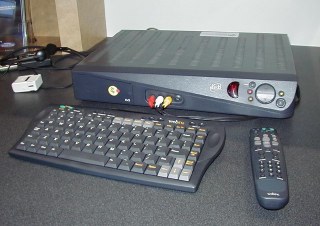
While most thin clients developed in the mid-1990s were positioned as diskless workstations for corporate intranets, WebTV was positioned as a consumer product, primarily targeting those looking for a low-cost alternative to a computer for Internet access. The WebTV and MSN TV devices allowed a television set to be connected to the Internet, mainly for web browsing and e-mail. The WebTV/MSN TV service, however, also offered its own exclusive services such as a "walled garden" newsgroup service, news and weather reports, storage for user bookmarks (Favorites), IRC (and for a time, MSN Chat) chatrooms, a Page Builder service that let WebTV users create and host webpages that could later be shared to others via a link if desired, the ability to play background music from a predefined list of songs while surfing the web, dedicated sections for aggregated content covering various topics (entertainment, romance, stocks, etc.), and a few years after Microsoft bought out WebTV, integration with MSN Messenger and Hotmail. The setup included a thin client in the form of a set-top box, a remote, a network connection using dial-up, or with the introduction of Rogers Interactive TV and the MSN TV 2, the option to use broadband, and a wireless keyboard, which was sold optionally up until the 2000s.
The MSN TV service lasted for 18 years, shutting down on September 30, 2013, and allowing subscribers to migrate their data well before that date arrived.
The original WebTV network relied on a Solaris backend network[1] and telephone lines to deliver service to customers via dial-up, with "frontend servers" that talk directly to boxes using a custom protocol, the WebTV Protocol (WTVP), to authenticate users and deliver content to boxes. For the MSN TV 2, however, a completely new service based on IIS servers and regular HTTP/HTTPS services was used.
History
[edit]Concept
[edit]I've been working to create an interactive television my entire life. I always knew it was a way of bringing computers to average people.
— Steve Perlman[2]
Co-founder Steve Perlman is credited with the idea for the device. He first combined computer and television as a high-school student when he decided his home PC needed a graphics display. He went on to build software for companies such as Apple and Atari. While working at General Magic, the idea of bringing TVs and computers together resurfaced.
One night, Perlman was browsing the web and came across a Campbell's soup website with recipes. He thought that the people who might be interested in what the site had to offer were not using the web.[3][4] It occurred to him that if the television audience was enabled by a device to augment television viewing with receiving information or commercial offers through the television, then perhaps the web address could act as a signal and the television cable could be the conduit.
Early history
[edit]A Silicon Valley startup, WebTV Networks was founded in July 1995. Perlman brought along co-founders Bruce Leak and Phil Goldman shortly after conceiving the basic concept.[3] The company operated out of half of a former BMW car dealership building on Alma Street in Palo Alto, California, which was being used for storage by the Museum of American Heritage. WebTV had been able to obtain the space for very low rent, but it was suboptimal for technology development.[3]
Before incorporation, the company referred to itself as Artemis Research to disguise the nature of its business. The info page of its original website[5] explained that it was studying "sleep deprivation, poor diet and no social life for extended periods on humans and dwarf rabbits". The dwarf rabbit reference was an inside joke among WebTV's engineers – Phil Goldman's pet house rabbit Bowser (inspiration for the General Magic logo) was often found roaming the WebTV building late into the night while the engineers were working—although WebTV actually received inquiries from real research groups conducting similar studies and seeking to exchange data.[3][6]
The company hired many engineers and a few business development employees early on, having about 30 total employees by October 1995. Two early employees of Artemis were from Apple Inc: Andy Rubin, creator of the Android cell phone OS, and Joe Britt. Both men would later be founders of Danger, Inc. (originally Danger Research).
WebTV Networks' business model was to license a reference design to consumer electronics companies for a WebTV Internet Terminal, a set-top box that attached to a telephone line and automatically connected to the Internet through a dial-up modem. The consumer electronics companies' income was derived from selling the WebTV set-top box.[3] WebTV's income was derived from operating the WebTV Service, the Internet-based service to which the set-top boxes connected and for which it collected a fee from WebTV subscribers. The service provided features such as HTML-based email, and proxied websites, which were reformatted by the service before they were sent to set-top box, to make them display more efficiently on a television screen.[3]
WebTV closed its first round of financing, US$1,500,000, from Marvin Davis in September 1995, which it used to develop its prototype set-top box, using proprietary hardware and firmware. The company also used the financing to develop the online service that the set-top boxes connected to. WebTV leveraged their limited startup funds by licensing a reference design for the appliance to Sony and Philips. Eventually other companies would also become licensees and WebTV would profit on the monthly service fees.
Announcement
[edit]By the spring of 1996 WebTV Networks employed approximately 70 people, many of them finishing their senior year at nearby Stanford University, or former employees of either Apple Computer or General Magic. WebTV had started negotiating with Sony to manufacture and distribute the WebTV set-top box, but negotiations had taken much longer than WebTV had expected, and WebTV had used up its initial funding. Steve Perlman liquidated his assets, ran up his credit cards and mortgaged his house to provide bridge financing while seeking additional venture capital. Because Sony had insisted upon exclusive distribution rights for the first year, WebTV had no other distribution partner in place, and just before WebTV was to close venture capital financing from Brentwood Associates, Sony sent WebTV a certified letter stating it had decided not to proceed with WebTV. It was a critical juncture for WebTV, because the Brentwood financing had been predicated on the expectation of a future relationship with Sony, and if Brentwood had decided to not proceed with the financing after being told that Sony had backed out, WebTV would have gone bankrupt and Perlman would have lost everything. Brentwood decided to proceed with the financing despite losing Sony's involvement, and further financing from Paul Allen's Vulcan Ventures soon followed.[3][7]
WebTV then proceeded to close a non-exclusive WebTV set-top box distribution deal with Philips, which provided competitive pressure causing Sony to change its mind, to resume its relationship with WebTV and also to distribute WebTV.[3][7]
The company Igor Software Laboratories, founded by Steve Hales and Jim Nitchals, licensed its SoundMusicSys engine to WebTV, allowing it to play music in formats such as MIDI. Igor contracted three additional musicians to create original music and sound effects for the device: Brian Salter, Michael Pukish and Peter Drescher.[8] In addition to Igor, Thomas Dolby's audio technology company Beatnik (then known as Headspace) also composed music for the device. This led to Beatnik acquiring Igor and its SoundMusicSys engine, which later became the Beatnik Audio Engine.[9] Dolby considered the usage of sequenced audio to be saving physical space within the devices, while satisfying the needs of television viewers wanting audio to accompany the internet.[10]
WebTV was announced on July 10, 1996, generating a large wave of press attention as not only the first television-based use of the World Wide Web, but also as the first consumer-electronics device to access the World Wide Web without a personal computer.[3][7] After the product's announcement, the company closed additional venture financing, including investments from Microsoft Corporation, Citicorp, Seagate Technology, Inc., Times Mirror Company, and other companies.[3][11]
The launch
[edit]
WebTV was launched on September 18, 1996, within one year after its first round of financing, with WebTV set-top boxes in stores from Sony and Philips, and WebTV's online service running from servers in its tiny office, still based in the former BMW dealership.[3]
The initial price for the WebTV set-top box was US$349 for the Sony version and US$329 for the Philips version, with a wireless keyboard available for about an extra US$50. The monthly service fee initially was US$19.95 per month for unlimited Web surfing and e-mail.[6][7]
There was little difference between the first Sony and the Philips WebTV set-top boxes, except for the housing and packaging. The WebTV set-top box had very limited processing and memory resources, housing a 112 MHz R4640 MIPS CPU, 2 megabytes of RAM, 2 megabytes of ROM, and 1 megabyte of Flash memory. The device relied upon a connection through a 33.6 kbit/s dialup modem to connect to the WebTV Service, where powerful servers provide back-end support to the WebTV set-top boxes to provide a full Web-browsing and email experience to the subscribers.[7]
Initial sales were slow. By April 1997, WebTV had only 56,000 subscribers,[7] but the pace of subscriber growth accelerated after that, achieving 150,000 subscribers by Autumn 1997,[12] about 325,000 subscribers by April 1998[13] and about 800,000 subscribers by May 1999.[14][15] WebTV achieved profitability by Spring 1998, and grossed over US$1.3 billion in revenue through its first 8 years of operation. In 2005 WebTV was still grossing US$150 million per year in revenue with 65% gross margin.[7]
WebTV briefly classified as a weapon
[edit]Because WebTV utilized strong encryption, specifically the 128-bit encryption (not SSL) used to communicate with its proprietary service, upon launch in 1996, WebTV was classified as "munitions" (a military weapon) by the United States government and was therefore barred from export under United States security laws at the time.[16] Because WebTV was widely distributed in consumer electronic stores under the Sony and Philips brands for only US$325, its munitions classification was used to argue that the US should no longer consider devices incorporating strong encryption to be munitions, and should permit their export. Two years later, in October 1998, WebTV obtained a special exemption permitting its export, despite the strong encryption, and shortly thereafter, laws concerning export of cryptography in the United States were changed to generally permit the export of strong encryption.[17]
Microsoft takes notice
[edit]In February 1997, in an investor meeting with Microsoft, Steve Perlman was approached by Microsoft's Senior Vice President for Consumer Platforms Division, Craig Mundie. Despite the fact that the initial WebTV sales had been modest, Mundie expressed that Microsoft was impressed with WebTV and saw significant potential both in WebTV's product offering and in applying the technology to other Microsoft consumer and video product offerings. Microsoft offered to acquire WebTV, build a Microsoft campus in Silicon Valley around WebTV, and establish WebTV as a Microsoft division to develop television-based products and services, with Perlman as the division's president.[3][7]
Discussions proceeded rapidly, involving Bill Gates, then CEO of Microsoft, personally. Gates called Perlman at his home on Easter Sunday in March 1997, and Perlman described to Gates WebTV's next generation products in development, which would be the first consumer devices to incorporate hard disks, including the WebTV Plus, and the WebTV Digital Video Recorders. Gates' interest was piqued, and negotiations between Microsoft and WebTV rapidly proceeded to closure, with both sides working around the clock to get the deal done.[3][7] Negotiation time was so short that the hour lost due to the change to Daylight Saving Time the night before the planned announcement, which the parties had neglected to factor into their schedule, almost left them without enough time to finish the deal.[3]
On April 6, 1997, 20 months after WebTV's founding, and only six weeks after negotiations with Microsoft began, during a scheduled speech at the National Association of Broadcasters conference in Las Vegas, Nevada, Craig Mundie announced that Microsoft had acquired WebTV. The acquisition price was US$503 million, but WebTV was so young a company that most of the employees' stock options had yet to be vested. As such, the vested shares at the time of the announcement amounted to US$425 million, and that was the acquisition price announced.[3][11] Each of the three founders received $64 million from the sale.[18]
Subsequent to the acquisition, WebTV became a Silicon Valley–based division of Microsoft, with Steve Perlman as its president. The WebTV division began developing most of Microsoft's television-based products, including the first satellite Digital Video Recorders (the DishPlayer for EchoStar's Dish Network and UltimateTV for DirecTV), Microsoft's cable TV products, the Xbox 360 hardware, and Microsoft's Mediaroom IPTV platform.[7][19][20]
In May 1999, America Online announced that it was going to compete directly with Microsoft in delivering Internet over television sets by introducing AOL TV.[15]
In June 1999, Steve Perlman left Microsoft and started Rearden, a business incubator for new companies in media and entertainment technology.[19]
MSN TV rebranding
[edit]In July 2001, six years after WebTV's founding, Microsoft rebranded WebTV as MSN TV.[21] Contracts were terminated with all other licensed manufacturers of the WebTV hardware except RCA, leaving them as the sole manufacturer of further hardware. Promotion of the WebTV brand ended.
In later years, the number of consumers using dialup access had dropped and as the Classic and Plus clients were restricted to dialup access, their subscriber count began to drop. Because the WebTV client was subsidized hardware, the company had always required individual subscriptions for each box, but with the subsidies ended, MSN started offering free use of MSN TV boxes to their computer users who subscribed to MSN as an incentive not to depart for discount dialup ISPs.
Broadband MSN TV
[edit]In 2001, Rogers Cable partnered with Microsoft to introduce "Rogers Interactive TV" in Canada. The service enabled Rogers' subscribers to access the Web via their TV sets, create their own websites, shop online, chat, and access e-mail. This initiative was the first broadband implementation of MSN TV.
In late 2004, Microsoft introduced MSN TV 2. Codenamed the "Deuce", it was capable of broadband access, and it introduced a revamped user interface and new capabilities. These include offline viewing of media (so long as a user had already logged in prior), audio and video streaming (broadband only), Adobe Reader, support for viewing Microsoft Office documents (namely Microsoft Word), Windows Media Player, the ability to access Windows computers on a home network to function as a media player, and even the ability the use of a mouse. MSN TV 2 also later introduced features originally seen in the first generation of MSN TV, such as its Beatnik MIDI engine and the ability to play background music while surfing the web. MSN TV 2 used a different online service from the original WebTV/MSN TV, but it offered many of the same services, such as chatrooms, instant messaging, weather, news, aggregated "info centers", and newsgroups, and like that service, still required a subscription to use. For those with broadband, the fee was US$99 yearly.
For inexpensive devices, the cost of licensing the operating system is substantial. For Microsoft, however, it would be actualizing a sunk cost, and when Microsoft released the MSN TV 2 model, they adopted standard PC architecture and used a customized version of Windows CE as the operating system. This allowed MSN TV 2 to more easily and inexpensively keep current.
Discontinuation
[edit]By late 2009, MSN TV hardware was no longer being sold by Microsoft, although service continued for existing users for the next four years. Attempting to go to the "Buy MSN TV" section on the MSN TV website at the time resulted in the following message being shown:
"Sorry, MSN TV hardware is no longer available for purchase from Microsoft. Microsoft continues to support the subscription service for existing WebTV and MSN TV customers."[22]
On July 1, 2013, an email was sent out to subscribers stating that the MSN TV service would be shutting down on September 30, 2013.[23] During that time, subscribers were advised to convert any accounts on the first-generation service to Microsoft accounts and to migrate any favorites and other data they had on their MSN TV accounts to SkyDrive. Once September 30, 2013 finally arrived, the WebTV/MSN TV service fully closed. Existing customers were offered MSN Dial-Up Internet Access accounts with a promotion. Customer service was available for non-technical and billing questions until January 15, 2014.[23]
Technology
[edit]Set-top box
[edit]Since the WebTV set-top box was a dedicated web-browsing appliance that did not need to be based on a standard operating system, the cost of licensing one could be avoided. All WebTV and original MSN TV boxes featured a 32-bit MIPS RISC CPU, boot ROM, storage, RAM, and a smart card reader, which was not significantly utilized. The web browser that ran on the set-top boxes was developed in-house, but compatible with both Netscape Navigator and Microsoft Internet Explorer standards. The WebTV set-top boxes leveraged the service's server-side caching proxy which reformatted and compressed web pages before sending them to the box, a feature generally unavailable to dial-up ISP users at the time and as such, had to be developed by WebTV Networks. Given the fact that WebTV's thin client software was stored in non-volatile memory, upgrades could be downloaded from the WebTV service onto set-top boxes over a phone line, as well as over the air via satellite broadcast on satellite units. The set-top boxes were also designed so that at a specified time, it would check to see if there was any email waiting for the user. If there was, it would illuminate a red LED on the front of the box so the consumer would know it was worth connecting to read their email.[24]
The first WebTV Classic set-top boxes from Sony and Philips in 1996 had a 33.6k modem, 2 MB of RAM, 2 MB of boot ROM, and 2 MB of flash ROM. They also contained an ASIC named FIDO, designed by WebTV Networks and manufactured by NEC, which handled graphics processing that was capable of video output to NTSC and, reportedly, PAL, as well as handling system logic for IR and controlling the LEDs on the front of the box.[25] Future models would start using 56k modems and introduce increased RAM and storage capacity.
A second model, the WebTV Plus, was introduced a year after the release of the original boxes. This model featured a TV tuner and composite inputs to allow watching television from the set-top box. The television feed could be viewed in full screen, in a PIP (Picture-In-Picture) window, or used to capture video stills as a JPEG that could then be uploaded to a WebTV/MSN TV discussion post, email, or a "scrapbook" on a user's account for later use. WebTV Plus also allowed one to schedule a VCR in a manner like TiVo allowed several years later. The Plus upgraded to a 167 MHz R4640 processor, included a 56k modem, support for ATVEF, a technology that allowed users to download special script-laden pages to interact with television shows, and in original models, had a Seagate 1.1 GB hard drive for storage in place of the flash memory chips used in the previous Classic models, mainly in order to accommodate large nightly downloads of television schedules. WebTV Plus also introduced a new ASIC into the hardware to allow the new TV-based features to be possible and enhance the set top box's graphical capabilities.[26] Named "Solo", it was announced to have support for 3-D transformations, compositing, on-the-fly image decompression, anti-aliasing, and translucency.[27] The enhanced graphics capabilities of the Solo also allowed WebTV Networks to experiment with the idea of making WebTV Plus a platform for video gaming alongside web browsing, which currently only has confirmation in the form of first hand accounts from people who worked for or collaborated with WebTV Networks to develop games for it, and a leak that occurred in August 1998 where the WebTV hacking scene discovered a games section on an internal WebTV server that offered options to download WebTV Plus ports of Doom and You Don't Know Jack.[28] Two revisions of the Solo ASIC are known to have been used in the WebTV Plus throughout its lifespan: SOLO1 and SOLO3, the latter mainly being used in the New Plus revision of the model.[29]
Around Fall 1998, plans for a "Derby" revision of the WebTV Plus were announced, which was rumored to have a faster CPU and more memory. Circa late 1998 or early 1999, only one Derby unit was produced by Sony as a silent revision of their INT-W200 Plus model, but no substantial changes were made to the hardware outside of the CPU being upgraded with no change in clock speed, and the modem being changed to a softmodem. As chip prices dropped, later versions of the Plus used an M-Systems DiskOnChip flash ROM instead, alongside increasing RAM capacity to 16 MB.
In Japan, WebTV had a small run starting around December 1997, with a couple "Classic" Japanese units being released at launch, which came with hard drives, the same amount of RAM as an Old Plus, and two times more boot ROM than American Classic and Old Plus units. In the Spring of 1999, Japanese WebTV subscribers also had the option of utilizing Sega's Dreamcast video game console, which came with a built-in modem, to access the WebTV service. This was possible as Sega and Microsoft collaborated to create a port of the WebTV technology on the Dreamcast, using the Windows CE abstraction layer supported on the console and what's believed to be a version of the Internet Explorer 2.0 browser engine.[30] The Japanese service ended some time in March 2002.
As an ease-of-use design consideration, WebTV early on decided to reformat pages rather than have users doing sideways scrolling. As entry-level PCs evolved from VGA resolution of 640x480 to SVGA resolution of 800x600, and web site dimensions followed suit, reformatting the PC-sized web pages to fit the 560-pixel width of a United States NTSC television screen became less satisfactory. The WebTV browser also translated HTML frames as tables in order to avoid the need for a mouse. When the MSN TV 2 released, Microsoft had decided to forgo reformatting pages and added sideways scrolling as well as the ability to resize text on web pages with buttons on the MSN TV keyboard.
Satellite boxes
[edit]Starting in the late 90s, WebTV Networks produced reference designs of models incorporating a disk-based personal video recorder and a satellite tuner for EchoStar's Dish Network[31] and for DirecTV.[32] These would be named the DishPlayer and UltimateTV respectively.
DishPlayer launched in late 1999 and was touted as "the world's first interactive satellite TV receiver". The DishPlayer is the first satellite-based DVR from Dish Network, and used a hard disk to allow users to record shows for later viewing. It could simultaneously play back video while recording as well. DishPlayer users could also control playback of programs recorded onto the set top box. DishPlayer made use of software and hardware developed by WebTV Networks to provide the user interface and features. Because of this, it was also capable of connecting to the WebTV Plus service, allowing it to browse the internet, send e-mail, and access other WebTV services. DishPlayer was also the only WebTV-based box to officially have games released for it, which were downloaded and updated over satellite.[33] Three games were offered on the DishPlayer: Doom, You Don't Know Jack (a port of the Netshow version), and Solitaire.[34] Two models of the DishPlayer were released: the 7100 and 7200, which had 8.6 GB and 17.6 GB of hard disk space respectively. EchoStar stopped selling DishPlayer boxes in 2001, but the boxes still worked with Dish Network service well into the mid-2000s.
UltimateTV was a satellite-based DVR made for DirecTV that made use a dual satellite tuner to allow a user to watch or record two shows at once. It would take advantage of new hardware to achieve this, using an upgraded version of the Solo ASIC named SOLO2. This version of the ASIC has the ability to process several video streams at the same time and included a digital-to-analog converter (DAC) to allow digital content to be displayed on analog television sets.[35] While the user interface and internet service for UltimateTV are similar to WebTV/MSN TV's, the UltimateTV software now uses Windows CE as its underlying OS as opposed to a custom one like the standard WebTV and MSN TV firmware used. This Windows CE–based OS would be used as the framework for the original Microsoft TV platform. In 2001, EchoStar sued Microsoft for failing to support the WebTV DishPlayer.[36] EchoStar subsequently sought to acquire DirecTV and was the presumptive acquirer, but EchoStar was ultimately blocked by the Federal Communications Commission.[37] While EchoStar's lawsuit against Microsoft was in process, DirecTV (presumptively acquired and controlled by EchoStar) dropped UltimateTV (thus ending Microsoft's satellite product initiatives) and picked TiVo's DirecTV product as its only Digital Video Recorder offering.
Security
[edit]Hackers eventually figured out ways to exploit the service's security with vulnerable URLs, resulting in access to internal sections of the production WebTV service such as "Tricks," which hosted several pages designed to troubleshoot the WebTV box and service; the ability to remotely change the settings of a subscriber's box; or even remotely performing actions on any account, including deleting them, which the service did not verify on whether the requests were coming from the account holder or not. Hackers also found a way to connect to internal WebTV services and discovered WebTV content that was previously unknown to the public, including a version of Doom for WebTV Plus units that could be downloaded from one of these services at one point.[citation needed]
WebTV/MSN TV was also victim to a virus written in July 2002 by 43 year old David Jeansonne, which changed the local dial-up access number on victims' boxes to 911. This number would be dialled the next time the WebTV/MSN TV box had to dial in. It was sent to 18 MSN TV users through an attachment in an email, and disguised itself by showing an interface for a "tool" that could change the colors and fonts of the MSN TV user interface. It was supposedly forwarded to 3 other users by some of the initial victims, making the total victim count 21. At least 10 of the victims reported having the police show up at their homes as a result of their boxes dialing 911. There are also claims of the virus having the ability to mass-mail itself, although this was not properly confirmed at the time the virus was prevalent. Jeansonne was eventually arrested in February 2004, and pled guilty on the charges of intentionally causing damage to computers and causing a threat to public safety. He was subsequently sentenced to serve six months in prison, followed by six months of home detention, as well as paying restitution to Microsoft.[38] [39]
Protocols
[edit]With the first generation of the WebTV/MSN TV service, the main protocol used for the majority of service communication was WTVP, or the WebTV Protocol.[40] WTVP is a TCP-based protocol that is essentially a proprietary version of HTTP 1.0 with the ability to serve both standard web content and specialized service content to WebTV/MSN TV users. It also introduced its own protocol extensions, which include but aren't limited to 128-bit RC4-based message encryption, ticket-based authorization, proprietary challenge–response authentication to both verify clients logging in to the service and to supply them session keys used for message encryption, and persistent connections. This protocol was supported by all WebTV and original MSN TV clients and the Sega Dreamcast release of WebTV up until the September 2013 discontinuation of the entire service (March 2002 for those in Japan).
Another protocol used by the original service is dubbed "Mail Notify", a UDP-based protocol that would track online clients and send periodic datagrams directly to clients to notify them of new e-mail. Its existence has only been confirmed in a leaked Microsoft document.[40]
WebTV/MSN TV client hardware
[edit]Models
[edit]Confirmed
[edit]| Brand | Model | Type | Connectivity | RAM | ROM | Storage | CPU | Latest Firmware Version | Notes |
|---|---|---|---|---|---|---|---|---|---|
| Sony | INT-W100 | Classic | V.34 modem | 2 MB | 2 MB | 2 MB (Flash ROM) | R4640 @ 112 MHz | 2.5.9.1mpeg 2.5.9.1print |
Model originally used R4640 CPU from IDT. By late 1998, WebTV switched CPU manufacturers for the Classic from IDT to NKK. |
| Philips Magnavox | MAT960 | Classic | V.34 modem | 2 MB | 2 MB | 2 MB (Flash ROM) | R4640 @ 112 MHz | 2.5.9.1mpeg 2.5.9.1print |
Model originally used R4640 CPU from IDT. By late 1998, WebTV switched CPU manufacturers for the Classic from IDT to NKK. |
| Sony | INT-W200 | Plus | V.90 modem | 8 MB | 2 MB | 1.1 GB (HDD) | R4640 @ 167 MHz | 2.9.1 | |
| Philips Magnavox | MAT972 | Plus | V.90 modem | 8 MB | 2 MB | 1.1 GB (HDD) | R4640 @ 167 MHz | 2.9.1 | Believed to have had a Derby (softmodem) revision made around 1998 |
| Samsung | SIS-100 | Plus | V.90 | 8 MB | 2 MB | 1.1 GB (HDD) | R4640 @ 167 MHz | 2.9.1 | |
| Mitsubishi | WB-2000 | Plus | V.90 | 8 MB | 2 MB | 1.1 GB (HDD) | R4640 @ 167 MHz(?) | 2.9.1 | |
| Sony | INT-WJ200 | Classic (Japan) | V.90 | 8 MB | 4 MB | 1.1 GB (HDD)[41] | R4640 @ 167 MHz[41] | ??? | Has an extra set of composite inputs, but its purpose is unknown as stock firmware does not have the TV Home screen |
| Fujitsu | F993000 | Possibly Classic model (contains hard drive) | ??? | ??? | ??? | ??? | ??? | ??? | Has an extra set of composite inputs |
| Panasonic (Matsushita) | TU-WE100 | Plus (Japan) | V.90 modem | 16 MB | 4 MB | 1.1 GB (HDD) | RM5230 @ 167 MHz | ??? | Used a Seagate ST31013A hard drive |
| Sony | INT-W200 | Derby Plus | V.90 softmodem | 8 MB | 2 MB | 1.1 GB (HDD) | RM5230 @ 167 MHz | 2.9.1 | The Derby revision of INT-W200 was quietly released circa late 1998, with the only major difference from the original revision being its use of a softmodem in place of a hardware modem. To determine if an INT-W200 box is a Derby model, the CPU should be an RM5230 and the technical information screen on the box will report a softmodem |
| Echostar | DishPlayer 7100 | DISH tuner | V.90 softmodem | 16 MB | 4 MB | 8.6 GB | RM5230 @ 167 MHz | ||
| Echostar | DishPlayer 7200 | DISH tuner | V.90 softmodem | 16 MB | 4 MB | 17.6 GB | RM5230 @ 167 MHz | ||
| Sony | INT-WJ300 | Plus (Japan) | V.90[42] | 8 MB[42] | 4 MB | 1.08 GB (HDD)[42] | RM5230(?) @ 167 MHz | ??? | |
| Sony | INT-W150 | New Classic | V.90 softmodem | 8 MB | 2 MB | 2 MB(?) (DiskOnChip) | R5230 @ 150 MHz | 2.9.1 | |
| Philips Magnavox | MAT965 | New Classic | V.90 softmodem | 8 MB | 2 MB | 2 MB(?) (DiskOnChip) | RM5230 @ 150 MHz | 2.9.1 | |
| RCA | RW2100 | New Classic | V.90 softmodem | 8 MB | 2 MB | 2 MB(?) (DiskOnChip) | R5230 @ 150 MHz | 2.9.1 | |
| RCA | RW2110 | New Plus | V.90 softmodem | 16 MB | 2 MB | 8 MB(?) (DiskOnChip) | R5230 @ 167 MHz | 2.9.1 | |
| Sony | INT-W250 | New Plus | V.90 softmodem | 16 MB | 2 MB | 8 MB(?) (DiskOnChip) | R5230 @ 167 MHz | 2.9.1 | |
| Philips Magnavox | MAT976 | New Plus | V.90 softmodem | 16 MB | 2 MB | 8 MB(?) (DiskOnChip) | RM5230 @ 167 MHz | 2.9.1 | |
| RCA | RM2100 | MSN TV (New Classic) | V.90 softmodem | 8 MB | 2 MB | 4 MB(?) (DiskOnChip) | RM5230 @ 150 MHz | 2.9.1 | |
| RCA | DWD490RE | UltimateTV | V.90 softmodem | 32 MB | 2 MB | 40 GB (HDD) | RM5231 @ 250 MHz | ||
| RCA | DWD495RG | UltimateTV | ??? | ??? | ??? | 80 GB (HDD) | ??? | ||
| Sony | SAT-W60 | UltimateTV | V.90 softmodem | 32 MB | 2 MB | 40 GB (HDD) | RM5231 @ 250 MHz | ||
| RCA | RM4100 | MSN TV 2 | V.90, Ethernet, Wi-Fi (via supported USB wireless adapters) | 128 MB | ??? | 64 MB (CompactFlash) | Intel Celeron @ 733 MHz | 5.6.7021.0 | |
| KVH Industries | TracNet 100 | MSN TV 2 | EVDO | ??? | ??? | ??? | ??? |
Not Confirmed
[edit]| Brand | Model | Type | Connectivity | RAM | ROM | Storage | CPU speed | CPU | Latest Firmware Version | Notes |
|---|---|---|---|---|---|---|---|---|---|---|
| Mitsubishi | WB-2001 | Plus | V.90 | 8 MB | 2 MB | 1.1 GB (HDD) | 167 MHz | R4640 | 2.9.1 | Listed on official Microsoft WebTV site in 2000,[43] but no substantial evidence confirming its existence is currently available. |
| RCA | RM4100 (2) | MSN TV 2 | V.90/Ethernet | 256 MB | ??? | ??? | 733 MHz | Celeron |
Hacking attempts
[edit]In February 2006, Chris Wade analyzed the proprietary BIOS of the MSN TV 2 set top box, and created a sophisticated memory patch which allowed it to be flashed and used to boot Linux on it.[44] An open-source solution to enabling TV output on the MSN TV 2 and similar devices was made available in 2009.[45] There were also recorded attempts to make use of unused IDE pins on the MSN TV 2's motherboard and supply a hard drive, most likely to add extra storage beyond the 64 MB given by the default CompactFlash storage.[46]
See also
[edit]References
[edit]- ^ Greely, J. (2013-07-07). "WebTV finally shuts down".
- ^ Cade Metz. "25 Years of PC Magazine: Year Fifteen 1996." Archived 2009-03-24 at the Wayback Machine July 11, 2007
- ^ a b c d e f g h i j k l m n o Fortgang, Ron S.; Sebenius, James K. (1999-04-19), "Steve Perlman and WebTV (A & B)", Harvard Business Review
- ^ Hof, Robert D. (1997-03-24), "WebTV: Hello, Couch Potatoes", BusinessWeek, archived from the original on 2013-01-10, retrieved 2007-10-19
{{citation}}: CS1 maint: bot: original URL status unknown (link) - ^ Artemis Research, archived from the original on January 31, 2014, retrieved 22 December 2015
- ^ a b Wildstrom, Stephen H. (1996-09-16), "A Web-surfing Box for Peanuts", BusinessWeek, archived from the original on 2013-01-18, retrieved 2009-12-21
{{citation}}: CS1 maint: bot: original URL status unknown (link) - ^ a b c d e f g h i j Livingston, Jessica (2007), Founders at Work: Stories of Startups Early Days, Academic Press, pp. 173–90
- ^ Salter, Brian (November 1, 2005). "Background and History". Brian Salter. Archived from the original on July 15, 2007. Retrieved December 4, 2007.
- ^ "PRESS RELEASE: HEADSPACE INC. PARTNERS WITH WEBTV". Headspace. July 10, 1996. Archived from the original on June 5, 1997. Retrieved December 4, 2021.
- ^ "Dolby blinds the Net with sonic science". BBC News. May 27, 1998. Retrieved December 5, 2021.
- ^ a b "Form S-4 Registration Statement, Registrants Microsoft Corporation and WebTV Networks, Inc.", Securities and Exchange Commission, 1997-05-02
- ^ Metz, Cade (2007-07-11), "25 Years of PC Magazine: Year Fifteen – 1996", PC Magazine, archived from the original on 2009-03-24, retrieved 2017-09-04
- ^ Mundie, Craig (1998-04-07), "National Association of Broadcasters Conference" (speech transcript), Presspass, Microsoft
- ^ "WebTV Networks Launches Next-Generation WebTV Classic and Plus Products; Provides Free Service Upgrade" (press release), Presspass, Microsoft, 1999-06-02
- ^ a b Richtel, Matt (1999-05-12), "America Online Challenges Microsoft's WebTV", New York Times
- ^ Markoff, John (1996-11-08), "U.S. Classifies a Device to Surf the Web as a Weapon", New York Times, archived from the original on 2010-10-07
- ^ "WebTV Granted First License to Export Highest-Level Encryption". Microsoft Stories. Microsoft. 5 October 1998. Archived from the original on 2020-09-20.
- ^ Wallack, Todd (2003-12-30). "Phil Goldman -- entrepreneur, WebTV founder". December 30, 2003 : San Francisco Chronicle. Retrieved 2006-12-08.
- ^ a b "Steve Perlman Biography". Rearden. Retrieved 2009-12-20.
- ^ Takahashi, Dean (2006), The Xbox 360 Uncloaked: The Real Story Behind Microsoft's Next-Generation Video Game Console, SpiderWorks/Lulu Press, pp. 60–69, ISBN 0-9777842-1-5
- ^ "WebTV Internet Service Renamed MSN TV Service" (press release), Presspass, Microsoft, 2001-07-18
- ^ MSN TV: Buy MSN TV, archived from the original on 2010-03-24
- ^ a b MSN TV: Closure FAQ Archived 2013-07-09 at the Wayback Machine. Webtv.com. Retrieved on 2013-08-23.
- ^ "Technical Specifications". Retrieved 24 May 2023.
- ^ "Consumer Multimedia Semiconductors and Applications Worldwide" (PDF). Dataquest. p. 88.
- ^ Morrison, Gale B. (29 September 1997). "WebTV Trumpets Latest Advances". Electronic News. p. 53. Retrieved 18 August 2023.
- ^ "Online Extras - WebTV browser specs". Computing Japan Online. August 1999.
- ^ "Doom on the WebTV Plus". WebTV MsnTV Secret Pics.
- ^ "Solo". WebTV Wiki.
- ^ "WebTV for Dreamcast – Sega Retro". 2 October 2022.
- ^ "The DishPlayer Experience". Net4TV Voice. Net4TV. 29 August 1999. Archived from the original on December 2, 2000.
- ^ "RCA's Personal TV Play". Net4TV Voice. Net4TV. 16 July 2000. Archived from the original on February 28, 2002.
- ^ "EchoStar To Offer New Personal Television Services for DISHPlayer - World's First Combination Internet/Satellite TV Receiver". 1999-07-19.
- ^ "The DishPlayer Experience: Part 3 - The TV Side". Net4TV Voice. 29 August 1999. Archived from the original on December 2, 2000.
- ^ "Microsoft to Make Chips for WebTV, Newspaper Reports". Electronics Weekly. 24 August 2000.
- ^ Chart beat bonus, Billboard, archived from the original on November 3, 2012
- ^ EchoStar's DirecTV bid blocked by FCC, MarketWatch, 10 October 2002
- ^ Kevin Poulsen (26 February 2004). "Alleged WebTV 911 hacker charged with cyberterrorism". SecurityFocus. Archived from the original on July 20, 2008. Retrieved 2 October 2021.
- ^ "Louisiana Man Sentenced to Six Months in Prison for Sending Virus Prompting 9-1-1 Calls". GovTech. July 28, 2010.
- ^ a b "Challenges to Building Scalable Services". Microsoft Secrets. Archived from the original on 2019-09-15.
- ^ a b "Q&A;" (in Japanese). 9 January 1998. Archived from the original on 1998-02-05. Retrieved 13 July 2021.
- ^ a b c "webtv WebTVハードの主な仕様" (in Japanese). Archived from the original on 2000-06-20. Retrieved 13 July 2021.
- ^ "Plus Specifications". WebTV. Archived from the original on 2000-10-18.
- ^ Msntv2 Linux port, archived from the original on 2011-09-21
- ^ Set-Top-Linux, archived from the original on 2009-07-31
- ^ Shadyman (27 January 2007). "MSNTV2 Close-up". Error: Access Denied. Retrieved 20 July 2021.
External links
[edit]- MSN TV Webpage at archive.today (archived 2013-01-11).
- WebTV MsnTV Secret Pics / HackTV, MattMan69
- GNU/Linux on the MSN TV 2, toc2rta, archived from the original on 2007-06-24, retrieved 2020-03-21.
- MSN TV 2 Internet & Media Player (review), The gadgeteer, 9 January 2006
- "WebTV/MSNTV Upgrades", Nytak (list), Tripod
MSN software and services | |
|---|---|
| Current services | |
| Rebranded | |
| Divested by Microsoft | |
| Discontinued | |


MSN TV
View on GrokipediaMSN TV was an interactive television service developed by Microsoft that delivered Internet access, email, and other online content to users via dedicated set-top boxes connected to standard televisions, bypassing the need for a personal computer.[1][2]
Originally launched in 1996 as WebTV Networks, the platform aimed to bring early adopters online through television interfaces and dial-up connections, achieving initial success with affordable hardware priced around $300 including service.[1]
Microsoft acquired WebTV in 1997 for $425 million in cash and stock, integrating it into its broader digital media strategy before rebranding the service as MSN TV in 2001 to align with its online portal ecosystem.[3][4][5]
At its peak, MSN TV served about 1.1 million subscribers, representing an early foray into connected TV experiences that influenced later devices, though it faced limitations from slow dial-up speeds and competition from broadband-enabled PCs.[6]
The service was discontinued on September 30, 2013, as Microsoft shifted focus to modern platforms like Xbox, amid the rise of smart TVs and integrated streaming options that rendered the proprietary hardware obsolete.[1][7]
History
Founding of WebTV Networks
WebTV Networks was established in June 1995 by Steve Perlman, Bruce Leak, and Phil Goldman, former colleagues from Apple Computer, in Mountain View, California.[4][8] Perlman, serving as the primary visionary, had developed the core concept of providing internet access through television sets via a low-cost set-top box as early as March 1995, drawing on his prior experience in multimedia and communications at companies including General Magic and Apple.[9] The founders sought to democratize online content by leveraging existing television hardware, bypassing the need for expensive personal computers and targeting mass-market consumers with dial-up connectivity integrated into living room entertainment systems.[10] To protect the nascent technology during development, the company initially operated under the covert name Artemis Research, conducting early trials and prototype work without public disclosure.[10] This secretive phase allowed the team to refine hardware and software architectures focused on rendering web pages optimized for TV screens, including adaptations for remote control navigation and limited bandwidth constraints typical of mid-1990s modems.[11] By late 1995, WebTV had secured initial venture funding, including $1.5 million from investor Marvin Davis, to accelerate prototyping of the set-top device that would connect standard televisions to the internet.[12]Microsoft Acquisition and Early Integration
Microsoft announced its agreement to acquire WebTV Networks, Inc., on April 6, 1997, for approximately $425 million in cash and stock, marking one of the company's largest acquisitions at the time.[4][13] The move was intended to accelerate the delivery of Internet content and digital broadcasting services directly to consumer televisions, combining WebTV's set-top box hardware and subscription model with Microsoft's software expertise in areas such as Windows CE operating system components and Internet Explorer browser technology.[4][2] The acquisition was finalized on August 1, 1997, after clearance from the U.S. Department of Justice, with no significant antitrust concerns raised.[3][13] WebTV Networks was structured to operate as an independent subsidiary in Palo Alto, California, retaining its approximately 400 employees and leadership under co-founder and CEO Steve Perlman, who reported to Microsoft senior vice president Craig Mundie.[4][13] This setup allowed for continued independent development while aligning with Microsoft's broader strategy to converge personal computing, television, and online services.[4] Early integration efforts emphasized technology synergy rather than immediate operational overhaul, with Microsoft incorporating elements of its Internet protocols and user interface standards into WebTV's platform to enhance browsing and content delivery.[4] In September 1997, Microsoft unveiled an upgraded version of the WebTV system, featuring improved hardware and service capabilities that built upon the pre-acquisition model while introducing refinements informed by Microsoft's software ecosystem.[14] The subsidiary subsequently spearheaded development of Microsoft-affiliated TV products, including early explorations into satellite-based digital video recording, positioning WebTV as a key arm for the company's consumer electronics initiatives in the late 1990s.[15]Product Launch and Initial Market Entry
WebTV Networks released its inaugural set-top box on September 18, 1996, marking the product's entry into the consumer market. The device enabled internet access, email, and basic web browsing directly through a television set using a standard phone line for dial-up connectivity, controlled via a wireless keyboard and remote.[16][17] Initial hardware units were produced by manufacturing partners Sony and Philips, with retail prices ranging from $330 to $350. A required subscription service cost $19.95 per month for unlimited web surfing and email, positioning the offering as an affordable alternative to personal computers for households seeking online capabilities.[16][18] Demand exceeded expectations at launch, prompting Sony to accelerate its release schedule by one month to meet consumer interest. The product targeted non-PC owners, particularly older demographics or families preferring television-based interaction over desktop computing, and was distributed through major retailers. Early reception highlighted its innovative approach to democratizing internet access, though performance was constrained by 28.8 kbps modem speeds and the limitations of TV display resolution for text-heavy content.[18] By 1998, WebTV had amassed approximately 400,000 subscribers, reflecting steady initial market penetration in the nascent internet TV segment despite competition from traditional PC adoption. Microsoft's pending acquisition, announced shortly after launch, provided additional resources for scaling infrastructure and content partnerships, though the core product entry predated the deal.[19]Rebranding to MSN TV and Broadband Shift
In July 2001, Microsoft rebranded its WebTV Internet service as MSN TV to deepen integration with the broader MSN ecosystem, including services like MSN Messenger and Hotmail, amid efforts to streamline operations and compete more effectively with rivals such as AOLTV.[20][21] The change aligned the platform under the MSN brand, which by then served over 230 million unique users worldwide, while retaining the core set-top box hardware and dial-up connectivity model that had defined WebTV since its 1996 launch.[20] Despite the rebranding, MSN TV initially remained tethered to narrowband dial-up access, limiting its appeal as broadband adoption grew in households during the early 2000s. This constraint persisted until October 2004, when Microsoft unveiled MSN TV 2 (codenamed "Deuce"), a revised set-top box explicitly designed for broadband connectivity via an integrated Ethernet port, alongside support for dial-up as a fallback.[22][23] Priced at $199.95, the device featured a 733 MHz Intel Celeron processor, 128 MB RAM, and 64 MB flash memory, enabling not only faster web browsing and email but also new media playback capabilities, such as streaming PC-based photos, music, and videos to televisions.[23][22] The broadband shift with MSN TV 2 represented a strategic pivot to address the platform's obsolescence in a market increasingly dominated by high-speed internet, though subscription fees remained tiered—$21.95 monthly or $199.95 annually for dial-up access, with premium broadband plans requiring separate ISP arrangements.[24] This upgrade aimed to reposition MSN TV as a hybrid internet and media adapter, but it arrived late relative to surging demand for always-on connectivity, contributing to tepid uptake amid competition from cable modems and emerging smart TVs.[22]Operational Challenges and Decline
Following the rebranding to MSN TV in 2001 and the shift to broadband connectivity with the MSN TV 2 model, the service encountered persistent technical limitations that hindered user experience and adoption. The platform's low-resolution display often rendered websites incompatibly, resulting in scaled-down images, broken layouts, and suboptimal functionality compared to PC-based browsing.[17] Input via remote control proved inefficient for tasks like typing, exacerbating usability issues in an era of advancing personal computing interfaces.[17] Security vulnerabilities also plagued the system, stemming from reliance on proprietary URLs for administrative functions, which exposed it to exploits despite encryption efforts.[12] Market dynamics further compounded these operational hurdles. As affordable personal computers proliferated and broadband internet became widespread by the early 2000s, demand for a dedicated TV set-top box waned, with consumers preferring versatile devices over specialized hardware.[6] Intense competition from emerging alternatives, including digital video recorders like TiVo and later smart TV integrations, eroded MSN TV's niche, rendering it increasingly obsolete.[25] Subscriber numbers dwindled as the mobile revolution—driven by smartphones and tablets—shifted internet access patterns away from stationary TV setups toward portable, high-resolution screens.[26] Internally, Microsoft reallocated resources, splitting the MSN TV team and redirecting key engineers to the Xbox division, which prioritized gaming and media streaming over legacy internet services.[27] This refocus aligned with broader strategic pivots toward integrated ecosystems like Xbox, amid declining relevance for MSN TV's model. By 2013, with a shrinking user base and unsustainable operations, Microsoft announced the service's termination, effective September 30, 2013, after notifying subscribers via email on July 1.[7][1] The shutdown marked the end of an 18-year run, reflecting how rapid technological evolution outpaced the platform's iterative updates.[25]Discontinuation in 2013
Microsoft announced the discontinuation of the MSN TV service in July 2013, with the shutdown effective on September 30, 2013.[7] [28] The company notified subscribers via email and its website, stating it had made the "difficult decision" to end the service after 16 years since the original WebTV acquisition, while committing to assist customers in transitioning data and services.[29] [1] The closure aligned with Microsoft's strategic pivot toward integrated platforms like Xbox for internet-connected TV experiences, amid broader industry shifts including competition from emerging smart TV technologies and devices from rivals such as Apple.[1] [30] By 2013, MSN TV's dial-up and early broadband model had become obsolete relative to advancing web standards and native streaming capabilities in modern televisions and consoles, contributing to its declining viability.[25] Subscribers retained access until the final date, after which the service infrastructure was decommissioned, marking the end of one of the earliest consumer internet TV experiments.[31]Technology and Architecture
Set-Top Box Design and Connectivity
The original WebTV set-top boxes, launched in 1996, featured a compact design resembling a small external modem, housing a MIPS-based processor clocked at 112 MHz, 2 MB of RAM, 2 MB of ROM, and 2 MB of EEPROM optimized for low power consumption and cost efficiency as thin clients reliant on server-side processing.[32][33] These units connected to televisions via composite RCA audio and video outputs and to the internet through a built-in 33.6 kbps V.34bis modem via an RJ-11 telephone jack, enabling dial-up access while supporting call-waiting via proprietary Lineshare technology.[34][12] Subsequent first-generation models, including the WebTV Plus introduced in 1997, upgraded to a 167 MHz MIPS R4000 processor and 8 MB of RAM, incorporating a cable-ready 3-in-1 tuner and a K56 Flex modem for improved dial-up speeds up to 56 kbps, while retaining the core ports for TV output and phone connectivity.[35] The design emphasized simplicity, with no local hard drive or extensive input devices, relying instead on infrared remote controls for navigation, though some variants added IR blaster ports for cable box integration.[36] With the rebranding to MSN TV and the release of the MSN TV 2 in 2004, the hardware shifted to an x86 architecture using a 733 MHz Intel Celeron CPU, 128 MB of RAM, and 64 MB of flash storage, packaged in a larger white chassis measuring 11.75 inches wide by 9 inches deep by 2.375 inches high and weighing 4.45 pounds.[37][22] Connectivity expanded to include a 10/100 Mbps Ethernet port for broadband access via DSL or cable modems, alongside retained options for 56k dial-up and two USB 1.1 ports supporting compatible Wi-Fi adapters from manufacturers like Netgear and Linksys.[37][38] TV connections supported both composite RCA (included cables) and optional S-Video outputs, with setup involving direct attachment to available television inputs and selection of the preferred network method during initial registration.[37]Software Protocols and User Interface
The original WebTV and MSN TV 1 set-top boxes relied on the WebTV Protocol (WTVP), a proprietary TCP-based extension of HTTP 1.0 tailored for low-bandwidth dial-up access and client-server interactions.[39][12] WTVP maintained core HTTP elements like methods (GET, POST, HELP, SECURE), headers, and status codes while adding features such as persistent connections, ticket-based authentication viawtv-ticket headers, RC4 encryption activated through the SECURE method, and LZPF compression for data efficiency.[39] These extensions enabled secure session keys obtained during headwaiter login processes and supported service-specific URLs (e.g., wtv-XXX:/) for accessing MSN TV backend services like email and messaging, with human-readable line-separated requests delimited by CRLF on the client side.[39]
MSN TV 2, introduced in October 2004, shifted to a customized Windows CE operating system (upgrading to CE 5.0 in firmware version 1.2, build 6214), incorporating standard web protocols including HTTP/HTTPS for content retrieval and XML for structured service communications with IIS-hosted servers.[24][40] Security relied on SSLv3 in earlier firmware (e.g., 4.2.5128) and TLSv1 in later updates (e.g., 5.6.7021), facilitating broadband connectivity and integration with home networks without the proprietary constraints of WTVP.[24] This architecture allowed for broader compatibility with Windows Media formats and USB peripherals, though it retained custom firmware for TV-specific optimizations.
The user interface emphasized remote control navigation in a "10-foot UI" paradigm, rendering web content via a custom browser engine adapted for television screens with large fonts and simplified layouts to accommodate non-computer users.[41][42] First-generation devices featured a lean, proprietary browser focused on core functions like web surfing, email, and instant messaging, with ongoing usability testing to refine elements such as button placements and privacy controls.[42] MSN TV 2 enhanced this with a TV-optimized version of Internet Explorer 6, ditching on-screen keyboards in favor of USB or PS/2 physical keyboards, mice, or remotes for input; it supported up to 11 user profiles with alphabetical favorites sorting, fade-in page transitions, and integrated media playback for Windows Media-compatible content from USB drives or network shares.[24][37]
Security Features and Encryption
MSN TV, originally developed as WebTV, utilized proprietary 128-bit encryption for client-server communications, separate from standard SSL protocols, to secure data transmission over dial-up or broadband connections.[12] This encryption strength prompted the U.S. government to classify WebTV hardware as a munition under export controls upon its 1996 launch, restricting international sales due to concerns over strong cryptography proliferation.[43] In June 1997, WebTV introduced support for 80-bit Fortezza encryption cards to enable secure e-commerce transactions, with cards distributed lacking the key escrow mandates previously imposed on similar technologies.[44] By October 1998, following regulatory approval, WebTV became the first product granted a U.S. export license permitting unrestricted 128-bit encryption deployment for any user or application in markets including Japan and the United Kingdom.[43] Subsequent iterations, such as MSN TV 2 released in 2001, incorporated Secure Sockets Layer (SSL) support to facilitate encrypted online banking and shopping sessions compliant with emerging internet security standards.[37] The service's WTVP protocol included a SECURE variant analogous to HTTPS, layering encryption atop standard HTTP exchanges between set-top boxes and backend servers to protect user sessions.[39] Despite these measures, vulnerabilities persisted, including risks from unpatched firmware and reliance on proprietary protocols that limited third-party auditing.[12]Hardware Models
Confirmed Production Models
The confirmed production models of MSN TV set-top boxes were primarily manufactured by RCA following Microsoft's termination of partnerships with Philips and Sony in 2001, focusing on dial-up connectivity with optional broadband upgrades via the service. The RCA RM2100, branded as MSN TV Classic, served as the standard entry-level model, equipped with a V.90 modem, 8 MB RAM, 2 MB ROM, 4 MB DiskOnChip flash storage, and a 150 MHz RM5230 MIPS processor for rendering web content on televisions.[15][36] This model supported core MSN TV features like email, browsing, and service-specific applications but lacked integrated storage for advanced media handling. In collaboration with DirecTV, RCA produced UltimateTV variants for integrated satellite television and internet, including the DWD490RE with a 40 GB hard drive and V.90 modem alongside a 250 MHz RM5231 processor, and the DWD495RG upgrade featuring an 80 GB drive for enhanced DVR capabilities such as recording and 30-hour TiVo-like storage.[45] These models, released around 2001-2002, combined MSN TV's thin-client architecture with DirecTV tuners but faced compatibility issues with certain providers due to proprietary encryption.[15] The RCA RM4100, introduced as MSN TV 2 in October 2004, marked a hardware evolution with broadband support via Ethernet, an optional Wi-Fi adapter, Intel Celeron processor at 733 MHz, 128 MB RAM, 64 MB CompactFlash storage, USB ports for media playback, and composite/S-Video outputs, enabling streaming from PCs and compatibility with high-speed connections up to home networks.[46][24] Priced at approximately $100 with a $10 monthly fee, it targeted users seeking improved performance over classic models, though production ceased as the service declined.[37]| Model | Manufacturer | Type | Key Specifications | Release Period |
|---|---|---|---|---|
| RM2100 | RCA | MSN TV Classic | V.90 modem, 8 MB RAM, 150 MHz RM5230 CPU, DiskOnChip storage | 2001 onward |
| DWD490RE | RCA | UltimateTV (DirecTV) | V.90 modem, 40 GB HDD, 250 MHz RM5231 CPU, satellite tuner | 2001-2002 |
| DWD495RG | RCA | UltimateTV (DirecTV) | V.90 modem, 80 GB HDD, 250 MHz RM5231 CPU, satellite tuner | 2002 |
| RM4100 | RCA | MSN TV 2 | Ethernet/Wi-Fi, 733 MHz Celeron, 128 MB RAM, USB/CompactFlash | 2004-2010 |