


Community hub
Recent from talks
Contribute something
Nothing was collected or created yet.
Kinect
View on Wikipedia
 | |
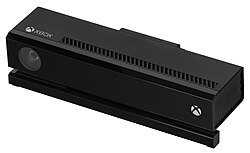
 Kinect for Xbox One | |
| Developer | Microsoft |
|---|---|
| Type | Motion controller |
| Generation | Seventh and eighth |
| Release date | Xbox 360
Windows
|
| Lifespan | 2010–2017 |
| Discontinued | Windows
|
| Units sold | 35 million (as of October 25, 2017)[10] |
| Camera | 640×480 pixels @ 30 Hz (RGB camera) 640×480 pixels @ 30 Hz (IR depth-finding camera)[11] |
| Connectivity | USB 2.0 (type-A for original model; proprietary for Xbox 360 S) |
| Platform | Xbox 360 Xbox One Windows (Windows 7 onwards) |
| Best-selling game | Kinect Adventures |
| Predecessor | Xbox Live Vision |
| Successor | Azure Kinect |
Kinect is a discontinued line of motion sensing input devices produced by Microsoft and first released in 2010. The devices generally contain RGB cameras, and infrared projectors and detectors that map depth through either structured light or time of flight calculations, which can in turn be used to perform real-time gesture recognition and body skeletal detection, among other capabilities. They also contain microphones that can be used for speech recognition and voice control.
Kinect was originally developed as a motion controller peripheral for Xbox video game consoles, distinguished from competitors (such as Nintendo's Wii Remote and Sony's PlayStation Move) by not requiring physical controllers. The first-generation Kinect was based on technology from Israeli company PrimeSense, and unveiled at E3 2009 as a peripheral for Xbox 360 codenamed "Project Natal". It was first released on November 4, 2010, and would go on to sell eight million units in its first 60 days of availability. The majority of the games developed for Kinect were casual, family-oriented titles, which helped to attract new audiences to Xbox 360, but did not result in wide adoption by the console's existing, overall userbase.
As part of the 2013 unveiling of Xbox 360's successor, Xbox One, Microsoft unveiled a second-generation version of Kinect with improved tracking capabilities. Microsoft also announced that Kinect would be a required component of the console, and that it would not function unless the peripheral is connected. The requirement proved controversial among users and critics due to privacy concerns, prompting Microsoft to backtrack on the decision. However, Microsoft still bundled the new Kinect with Xbox One consoles upon their launch in November 2013. A market for Kinect-based games still did not emerge after the Xbox One's launch; Microsoft would later offer Xbox One hardware bundles without Kinect included, and later revisions of the console removed the dedicated ports used to connect it (requiring a powered USB adapter instead). Microsoft ended production of Kinect for Xbox One in October 2017.
Kinect has also been used as part of non-game applications in academic and commercial environments, as it was cheaper and more robust than other depth-sensing technologies at the time. While Microsoft initially objected to such applications, it later released software development kits (SDKs) for the development of Microsoft Windows applications that use Kinect. In 2020, Microsoft released Azure Kinect as a continuation of the technology integrated with the Microsoft Azure cloud computing platform. Part of the Kinect technology was also used within Microsoft's HoloLens project. Microsoft discontinued the Azure Kinect developer kits in October 2023.[12][13]
History
[edit]| 2006 | PrimeSense technology shown at GDC |
|---|---|
| 2007 | |
| 2008 | |
| 2009 | "Project Natal" announced |
| 2010 | Kinect for Xbox 360 released |
| 2011 | Non-commercial SDK released |
| Commercial SDK released | |
| 2012 | Kinect for Windows released |
| 2013 | Kinect for Xbox One released with console |
| 2014 | Kinect 2 for Windows released |
| 2015 | |
| 2016 | |
| 2017 | Discontinuation of Kinect for Xbox hardware |
| 2018 | |
| 2019 | |
| 2020 | Azure Kinect released |
| 2021 | |
| 2022 | |
| 2023 | Discontinuation of Azure Kinect |
Development
[edit]The origins of the Kinect started around 2005, at a point where technology vendors were starting to develop depth-sensing cameras. Microsoft had been interested in a 3D camera for the Xbox line earlier but because the technology had not been refined, had placed it in the "Boneyard", a collection of possible technology they could not immediately work on.[14]
In 2005, Israeli company PrimeSense was founded by mathematicians and engineers to develop the "next big thing" for video games, incorporating cameras that were capable of mapping a human body in front of them and sensing hand motions. They showed off their system at the 2006 Game Developers Conference, where Microsoft's Alex Kipman, the general manager of hardware incubation, saw the potential in PrimeSense's technology for the Xbox system. Microsoft began discussions with PrimeSense about what would need to be done to make their product more consumer-friendly: not only improvements in the capabilities of depth-sensing cameras, but a reduction in size and cost, and a means to manufacturer the units at scale was required. PrimeSense spent the next few years working at these improvements.[14]
Nintendo released the Wii in November 2006. The Wii's central feature was the Wii Remote, a handheld device that was detected by the Wii through a motion sensor bar mounted onto a television screen to enable motion controlled games. Microsoft felt pressure from the Wii, and began looking into depth-sensing in more detail with PrimeSense's hardware, but could not get to the level of motion tracking they desired. While they could determine hand gestures, and sense the general shape of a body, they could not do skeletal tracking. A separate path within Microsoft looked to create an equivalent of the Wii Remote, considering that this type of unit may become standardized similar to how two-thumbstick controllers became a standard feature.[14] However, it was still ultimately Microsoft's goal to remove any device between the player and the Xbox.[14]
Kudo Tsunoda and Darren Bennett joined Microsoft in 2008, and began working with Kipman on a new approach to depth-sensing aided by machine learning to improve skeletal tracking. They internally demonstrated this and established where they believed the technology could be in a few years, which led to the strong interest to fund further development of the technology; this has also occurred at a time that Microsoft executives wanted to abandon the Wii-like motion tracking approach, and favored the depth-sensing solution to present a product that went beyond the Wii's capabilities. The project was greenlit by late 2008 with work started in 2009.[14]
The project was codenamed "Project Natal" after the Brazilian city Natal, Kipman's birthplace. Additionally, Kipman recognized the Latin origins of the word "natal" to mean "to be born", reflecting the new types of audiences they hoped to draw with the technology.[15] Much of the initial work was related to ethnographic research to see how video game players' home environments were laid out, lit, and how those with Wiis used the system to plan how Kinect units would be used. The Microsoft team discovered from this research that the up-and-down angle of the depth-sensing camera would either need to be adjusted manually, or would require an expensive motor to move automatically. Upper management at Microsoft opted to include the motor despite the increased cost to avoid breaking game immersion. Kinect project work also involved packaging the system for mass production and optimizing its performance. Hardware development took around 22 months.[14]
During hardware development, Microsoft engaged with software developers to use Kinect. Microsoft wanted to make games that would be playable by families since Kinect could sense multiple bodies in front of it. One of the first internal titles developed for the device was the pack-in game Kinect Adventures developed by Good Science Studio that was part of Microsoft Studios. One of the game modes of Kinect Adventures was "Reflex Ridge", based on the Japanese Brain Wall game where players attempt to contort their bodies in a short time to match cutouts of a wall moving at them. This type of game was a key example of the type of interactivity they wanted with Kinect, and its development helped feed into the hardware improvements.[14] Another development was Project Milo, a prototype game developed by Lionhead Studios led by Peter Molyneux where the player could interact with a virtual avatar through motion controls and voice recognition. Lionhead had developed the project based on original capabilities of the Kinect, but according to Molyneux, Microsoft had found that a consumer-grade version of the Kinect would cost thousands of dollars, so they scaled back the device and refocused the role of games for the Kinect to be more casual games as seen on the Wii. As a result, Project Milo no longer fit Microsoft's portfolio and was cancelled.[16]
Nearing the planned release, there was a problem of widespread testing of Kinect in various room types and different bodies accounting for age, gender, and race among other factors, while keeping the details of the unit confidential. Microsoft engaged in a company-wide program offering employees to take home Kinect units to test them. Microsoft also brought other non-gaming divisions, including its Microsoft Research, Microsoft Windows, and Bing teams to help complete the system. Microsoft established its own large-scale manufacturing facility to bulk product Kinect units and test them.[14]
Introduction
[edit].jpg)
Kinect was first announced to the public as "Project Natal" on June 1, 2009, during Microsoft's press conference at E3 2009; film director Steven Spielberg joined Microsoft's Don Mattrick to introduce the technology and its potential.[14][17] Three demos were presented during the conference—Microsoft's Ricochet and Paint Party, and Lionhead Studios' Milo & Kate created by Peter Molyneux—while a Project Natal-enabled version of Criterion Games' Burnout Paradise was shown during the E3 exhibition.[18][19] By E3 2009, the skeletal mapping technology was capable of simultaneously tracking four people,[20][21][22][23] with a feature extraction of 48 skeletal points on a human body at 30 Hz.[23][24] Microsoft had not committed to a release date for Project Natal at E3 2009, but affirmed it would be after 2009, and likely in 2010 to stay competitive with the Wii and the PlayStation Move (Sony Interactive Entertainment's own motion-sensing system using hand-held devices).[25]

In the months following E3 2009, rumors that a new Xbox 360 console associated with Project Natal emerged, either a retail configuration that incorporated the peripheral,[26][27] or as a hardware revision or upgrade to support the peripheral.[28][29] Microsoft dismissed the reports in public and repeatedly emphasized that Project Natal would be fully compatible with all Xbox 360 consoles. Microsoft indicated that the company considered Project Natal to be a significant initiative, as fundamental to Xbox brand as Xbox Live,[25] and with a planned launch akin to that of a new Xbox console platform.[30] Microsoft's vice president Shane Kim said the company did not expect Project Natal would extend the anticipated lifetime of the Xbox 360, which had been planned to last ten years through 2015, nor delay the launch of the successor to the Xbox 360.[21][31]
Following the E3 2009 show and through 2010, the Project Natal team members experimentally adapted numerous games to Kinect-based control schemes to help evaluate usability. Among these games were Beautiful Katamari and Space Invaders Extreme, which were demonstrated at Tokyo Game Show in September 2009.[32] According to Tsunoda, adding Project Natal-based control to pre-existing games involved significant code alterations, and made it unlikely that existing games could be patched through software updates to support the unit.[33] Microsoft also expanded its draw to third-party developers to encourage them to develop Project Natal games. Companies like Harmonix and Double Fine quickly took to Project Natal and saw the potential in it, and committed to developing games for the unit, such as the launch title Dance Central from Harmonix.[14]
Although its sensor unit was originally planned to contain a microprocessor that would perform operations such as the system's skeletal mapping, Microsoft reported in January 2010 that the sensor would no longer feature a dedicated processor. Instead, processing would be handled by one of the processor cores of Xbox 360's Xenon CPU.[34] Around this time, Kipmen estimated that the Kinect would only take about 10 to 15% of the Xbox 360's processing power.[35] While this was a small fraction of the Xbox 360's capabilities, industry observers believed this further pointed to difficulties in adapting pre-existing games to use Kinect, as the motion-tracking would add to a game's high computational load and exceed the Xbox 360's capabilities. These observers believed that instead the industry would develop games specific to the Kinect features.[34]
Kinect for Xbox 360 marketing and launch
[edit].jpg)
During Microsoft's E3 2010 press conference, it was announced that Project Natal would be officially branded as Kinect, and be released in North America on November 4, 2010.[36] Xbox Live director Stephen Toulouse stated that the name was a portmanteau of the words "kinetic" and "connection", key aspects of the Kinect initiative.[37][38] Microsoft and third-party studios exhibited Kinect-compatible games during the E3 exhibition.[39] A new slim revision of the Xbox 360 was also unveiled to coincide with Kinect's launch, which added a dedicated port for attaching the peripheral;[40] Kinect would be sold at launch as a standalone accessory for existing Xbox 360 owners, and as part of bundles with the new slim Xbox 360. All units included Kinect Adventures as a pack-in game.[41][42]
Microsoft continued to refine the Kinect technology in the months leading to the Kinect launch in November 2010. By launch, Kipman reported they had been able to reduce the Kinect's use of the Xbox 360's processor from 10 to 15% as reported in January 2010 to a "single-digit percentage".[43]
Xbox product director Aaron Greenberg stated that Microsoft's marketing campaign for Kinect would carry a similar scale to a console launch;[42] the company was reported to have budgeted $500 million on advertising for the peripheral, such as television and print ads, campaigns with Burger King[44] and Pepsi,[45] and a launch event in New York City's Times Square on November 3 featuring a performance by Ne-Yo.[46] Kinect was launched in North America on November 4, 2010;[2] in Europe on November 10, 2010;[1] in Australia, New Zealand, and Singapore on November 18, 2010;[4][47][48] and in Japan on November 20, 2010.[49]
Kinect for Xbox One and decline
[edit]The Kinect release for the Xbox 360 was estimated to have sold eight million units in the first sixty days of release, earning the hardware the Guinness World Record for the "Fastest-Selling Consumer Electronics Device".[14] Over 10 million had been sold by March 2011.[14] While seemingly successful, its launch titles were primarily family-oriented games (which could be designed around Kinect's functionality and limitations), which may have drawn new audiences, but did not have the selling power of major franchises like Battlefield and Call of Duty—which were primarily designed around the Xbox 360 controller. Only an estimated 20% of the 55 million Xbox 360 owners had purchased the Kinect.[14] The Kinect team recognized some of the downsides with more traditional games and Kinect, and continued ongoing development of the unit to be released as a second-generation unit, such as reducing the latency of motion detection and improving speech recognition. Microsoft provided news of these changes to the third-party developers to help them anticipate how the improvements can be integrated into the games.[14]
Concurrent with the Kinect improvements, Microsoft's Xbox hardware team had started planning for the Xbox One around mid-2011. Part of early Xbox One specifications was that the new Kinect hardware would be automatically included with the console, so that developers would know that Kinect hardware would be available for any Xbox One, and hoping to encourage developers to take advantage of that.[14] The Xbox One was first formally announced on May 23, 2013, and shown in more detail at E3 2013 in June. Microsoft stated at these events that the Xbox One would include the updated Kinect hardware and it would be required to be plugged in at all times for the Xbox One to function. This raised concerns across the video game media: privacy advocates argued that Kinect sensor data could be used for targeted advertising, and to perform unauthorized surveillance on users. In response to these claims, Microsoft reiterated that Kinect voice recognition and motion tracking can be disabled by users, that Kinect data cannot be used for advertising per its privacy policy, and that the console would not redistribute user-generated content without permission.[50][51][52][53][54][55] Several other issues with the Xbox One's original feature set had also come up, such as the requirement to be always connected to the Internet, and created a wave of consumer backlash against Microsoft.[14]
Microsoft announced in August 2013 that they had made several changes to the planned Xbox One release in response to the backlash. Among these was that the system would no longer require a Kinect unit to be plugged in to work, though it was still planned to package the Kinect with all Xbox One systems. However, this also required Microsoft to establish a US$500 price-point for the Xbox One/Kinect system at its November 2013 launch, US$100 more than the competing PlayStation 4 launched in the same time frame, which did not include any motion-sensing hardware.[14] In the months after the Xbox One release, Microsoft decided to launch a Kinect-less Xbox One system in March 2014 at the same price as the PlayStation 4, after considering that the Kinect for Xbox One had not gotten the developer support, and sales of the Xbox One were lagging due to the higher price tag of the Kinect-bundled system. Richard Irving, a program group manager that oversaw Kinect, said that Microsoft had felt that it was more important to give developers and consumers the option of developing for or purchasing the Kinect rather than forcing the unit on them.[14]
The removal of Kinect from the Xbox One retail package was the start of the rapid decline and phase-out of the unit within Microsoft. Developers like Harmonix that had been originally targeting games to use the Xbox One had put these games on hold until they knew there was enough of a Kinect install base to justify release, which resulted in a lack of games for the Kinect and reducing any consumer drive to buy the separate unit.[14] Microsoft became bearish on the Kinect, making no mention of the unit at E3 2015 and announcing at E3 2016 that the upcoming Xbox One hardware revision, the Xbox One S, would not have a dedicated Kinect port; Microsoft offered a USB adapter for the Kinect, provided free during an initial promotional period after the console's launch.[56] The more powerful Xbox One X also lacked the Kinect port and required this adapter.[57] Even though developers still released Kinect-enabled games for the Xbox One, Microsoft's lack of statements related to the Kinect during this period led to claims that the Kinect was a dead project at Microsoft.[58][59]
Microsoft formally announced it would stop manufacturing Kinect for Xbox One on October 25, 2017.[10] Microsoft eventually discontinued the adapter in January 2018, stating that they were shifting to manufacture other accessories for the Xbox One and personal computers that were more in demand. This is considered by the media to be the point where Microsoft ceased work on the Kinect for the Xbox platform.[14][57]
Non-gaming applications and Kinect for Windows
[edit]While the Kinect unit for the Xbox platform had petered out, the Kinect was being used in academia and other applications since around 2011. The functionality of the unit along with its low US$150 cost was seen to be an inexpensive means to add depth-sensing to existing applications, offsetting the high cost and unreliability of other 3D camera options at the time. In robotics, Kinect's depth-sensing would enable robots to determine the shape and approximate distances to obstacles and maneuver around them.[60] Within the medical field, the Kinect could be used to monitor the shape and posture of a body in a quantifiable manner to enable improved health-care decisions.[61]
Around November 2010, after the Kinect's launch, scientists, engineers, and hobbyists had been able to hack into the Kinect to determine what hardware and internal software it had used, leading to users finding how to connect and operate the Kinect with Microsoft Windows and OS X over USB, which has unsecured data from the various camera elements that could be read. This further led to prototype demos of other possible applications, such as a gesture-based user interface for the operating system similar to that shown in the film Minority Report, as well as pornographic applications.[62][63] This mirrored similar work to hack the Wii Remote a few years earlier to use its low-cost hardware for more advanced applications beyond gameplay.[64]
Adafruit Industries, having envisioned some of the possible applications of the Kinect outside of gaming, issued a security challenge related to the Kinect, offering prize money for the successful development of an open source software development kit (SDK) and hardware drivers for the Kinect, which came to be known as Open Kinect.[65] Adafruit named the winner, Héctor Martín, by November 10, 2010,[66][67] who had produced a Linux driver that allows the use of both the RGB camera and depth sensitivity functions of the device.[68][69] It was later discovered that Johnny Lee, a core member of Microsoft's Kinect development team, had secretly approached Adafruit with the idea of a driver development contest and had personally financed it.[70] Lee had said of the efforts to open the Kinect that "This is showing us the future...This is happening today, and this is happening tomorrow." and had engaged Adafruit with the contest as he been frustrated with trying to convince Microsoft's executives to explore the non-gaming avenue for the Kinect.[71]
Microsoft initially took issue with users hacking into the Kinect, stating they would incorporate additional safeguards into future iterations of the unit to prevent such hacks.[62] However, by the end of November 2010, Microsoft had turned on their original position and embraced the external efforts to develop the SDK.[72] Kipman, in an interview with NPR, said
The first thing to talk about is, Kinect was not actually hacked. Hacking would mean that someone got to our algorithms that sit inside of the Xbox and was able to actually use them, which hasn't happened. Or, it means that you put a device between the sensor and the Xbox for means of cheating, which also has not happened. That's what we call hacking, and that's what we have put a ton of work and effort to make sure doesn't actually occur. What has happened is someone wrote an open-source driver for PCs that essentially opens the USB connection, which we didn't protect, by design, and reads the inputs from the sensor. The sensor, again, as I talked earlier, has eyes and ears, and that's a whole bunch of noise that someone needs to take and turn into signal.
— Alex Kipman, speaking formally on NPR's Science Friday[73][72]
PrimeSense along with robotics firm Willow Garage and game developer Side-Kick launched OpenNI, a not-for-profit group to develop portable drivers for the Kinect and other natural interface (NI) devices, in November 2010. Its first set of drivers named NITE were released in December 2010.[74][75] PrimeSense had also worked with Asus to develop a motion sensing device that competes with the Kinect for personal computers. The resulting product, the Wavi Xtion, was released in China in October 2011.[76][77]
Microsoft announced in February 2011 that it was planning on releasing its own SDK for the Kinect within a few months, and which was officially released on June 16, 2011, but which was limited to non-commercial uses.[78][79] The SDK enabled users to access the skeletal motion recognition system for up to two persons and the Kinect microphone array, features that had not been part of the prior Open Kinect SDK.[80] Commercial interest in Kinect was still strong, with David Dennis, a product manager at Microsoft, stating "There are hundreds of organizations we are working with to help them determine what's possible with the tech".[81] Microsoft launched its Kinect for Windows program on October 31, 2011, releasing a new SDK to a small number of companies, including Toyota, Houghton Mifflin, and Razorfish, to explore what was possible.[81] At the 2012 Consumer Electronics Show in January, Microsoft announced that it would release a dedicated Kinect for Windows unit along with the commercial SDK on February 1, 2012. The device included some hardware improvements, including support for "near mode" to recognize objects about 50 centimetres (20 in) in front of the cameras. The Kinect for Windows device was listed at US$250, US$100 more than the original Kinect since Microsoft had considered the Xbox 360 Kinect was subsidized through game purchases, Xbox Live subscriptions, and other costs.[71] At the launch, Microsoft stated that more than 300 companies from over 25 countries were working on Kinect-ready apps with the new unit.[82]
With the original announcement of the revised Kinect for Xbox One in 2013, Microsoft also confirmed it would have a second generation of Kinect for Windows based on the updated Kinect technology by 2014.[83] The new Kinect 2 for Windows was launched on July 15, 2014, at a US$200 price.[84] Microsoft opted to discontinue the original Kinect for Windows by the end of 2014.[85] However, in April 2015, Microsoft announced they were also discontinuing the Kinect 2 for Windows, and instead directing commercial users to use the Kinect for Xbox One, which Microsoft said "perform identically". Microsoft stated that the demand for the Kinect 2 for Windows demand was high and difficult to keep up while also fulfilling the Kinect for Xbox One orders, and that they had found commercial developers successfully using the Kinect for Xbox One in their applications without issue.[86]
With Microsoft's waning focus on Kinect, PrimeSense was bought by Apple, Inc. in 2013, which incorporated parts of the technology into its Face ID system for iOS devices.[87][88]
Though Kinect had been cancelled, the ideas of it helped to spur Microsoft into looking more into accessibility for Xbox and its games. According to Phil Spencer, the head of Xbox at Microsoft, they received positive comments from parents of disabled and impaired children who were happy that Kinect allowed their children to play video games. These efforts led to the development of the Xbox Adaptive Controller, released in 2018, as one of Microsoft's efforts in this area.[89]
Integrating Kinect with Microsoft Azure
[edit]Microsoft had abandoned the idea of Kinect for video games, but still explored the potential of Kinect beyond that. Microsoft's Director of Communications Greg Sullivan stated in 2018 that "I think one of the things that is beginning to be understood is that Kinect was never really just the gaming peripheral...It was always more."[90] Part of Kinect technology was integrated into Microsoft's HoloLens, first released in 2016.[91]
Microsoft announced that it was working on a new version of a hardware Kinect model for non-game applications that would integrate with their Azure cloud computing services in May 2018. The use of cloud computing to offload some of the computational work from Kinect, as well as more powerful features enable by Azure such as artificial intelligence would improve the accuracy of the depth-sensing and reduce the power demand and would lead to more compact units, Microsoft had envisioned.[92] The Azure Kinect device was released on June 27, 2019, at a price of US$400, while the SDK for the unit had been released in February 2019.[93]
Sky UK announced a new line of Sky Glass television units to launch in 2022 that incorporate the Kinect technology in partnership with Microsoft. Using the Kinect features, the viewer will be able to control the television through motion controls and audio commands, and supports social features such as social viewing.[94]
Microsoft announced that the Azure Kinect hardware kit will be discontinued in October 2023, and will refer users to third party suppliers for spare parts.[95]
Technology
[edit]Fundamentals
[edit]

The depth and motion sensing technology at the core of the Kinect is enabled through its depth-sensing. The original Kinect for Xbox 360 used structured light for this: the unit used a near-infrared pattern projected across the space in front of the Kinect, while an infrared sensor captured the reflected light pattern. The light pattern is deformed by the relative depth of the objects in front it, and mathematics can be used to estimate that depth based on several factors related to the hardware layout of the Kinect. While other structure light depth-sensing technologies used multiple light patterns, Kinect used as few as one as to achieve a high rate of 30 frames per second of depth sensing. Kinect for Xbox One switched over to using time of flight measurements. The infrared projector on the Kinect sends out modulated infrared light which is then captured by the sensor. Infrared light reflecting off closer objects will have a shorter time of flight than those more distant, so the infrared sensor captures how much the modulation pattern had been deformed from the time of flight, pixel-by-pixel. Time of flight measurements of depth can be more accurate and calculated in a shorter amount of time, allowing for more frames-per-second to be detected.[96]
Once Kinect has a pixel-by-pixel depth image, Kinect uses a type of edge detection here to delineate closer objects from the background of the shot, incorporating input from the regular visible light camera. The unit then attempts to track any moving objects from this, with the assumption that only people will be moving around in the image, and isolates the human shapes from the image. The unit's software, aided by artificial intelligence, performs segmentation of the shapes to try to identify specific body parts, like the head, arms, and hands, and track those segments individually. Those segments are used to construct a 20-point skeleton of the human body, which then can be used by game or other software to determine what actions the person has performed.[97]
Kinect for Xbox 360 (2010)
[edit]

Kinect for Xbox 360 was a combination of Microsoft built software and hardware. The hardware included a range chipset technology by Israeli developer PrimeSense, which developed a system consisting of an infrared projector and camera and a special microchip that generates a grid from which the location of a nearby object in 3 dimensions can be ascertained.[98][99][100] This 3D scanner system called Light Coding[101] employs a variant of image-based 3D reconstruction.[102][103]
The Kinect sensor is a horizontal bar connected to a small base with a motorized pivot and is designed to be positioned lengthwise above or below the video display. The device features an "RGB camera, depth sensor and microphone array running proprietary software",[104] which provide full-body 3D motion capture, facial recognition and voice recognition capabilities. At launch, voice recognition was only made available in Japan, United Kingdom, Canada and United States. Mainland Europe received the feature later in spring 2011.[105] Currently voice recognition is supported in Australia, Canada, France, Germany, Ireland, Italy, Japan, Mexico, New Zealand, United Kingdom and United States. The Kinect sensor's microphone array enables Xbox 360 to conduct acoustic source localization and ambient noise suppression, allowing for things such as headset-free party chat over Xbox Live.[106]
The depth sensor consists of an infrared laser projector combined with a monochrome CMOS sensor, which captures video data in 3D under any ambient light conditions.[106][20] The sensing range of the depth sensor is adjustable, and Kinect software is capable of automatically calibrating the sensor based on gameplay and the player's physical environment, accommodating for the presence of furniture or other obstacles.[24]
Described by Microsoft personnel as the primary innovation of Kinect,[21][107][108] the software technology enables advanced gesture recognition, facial recognition and voice recognition.[22] According to information supplied to retailers, Kinect is capable of simultaneously tracking up to six people, including two active players for motion analysis with a feature extraction of 20 joints per player.[109] However, PrimeSense has stated that the number of people the device can "see" (but not process as players) is only limited by how many will fit in the field-of-view of the camera.[110]
Reverse engineering[111] has determined that the Kinect's various sensors output video at a frame rate of ≈9 Hz to 30 Hz depending on resolution. The default RGB video stream uses 8-bit VGA resolution (640 × 480 pixels) with a Bayer color filter, but the hardware is capable of resolutions up to 1280x1024 (at a lower frame rate) and other colour formats such as UYVY. The monochrome depth sensing video stream is in VGA resolution (640 × 480 pixels) with 11-bit depth, which provides 2,048 levels of sensitivity. The Kinect can also stream the view from its IR camera directly (i.e.: before it has been converted into a depth map) as 640x480 video, or 1280x1024 at a lower frame rate. The Kinect sensor has a practical ranging limit of 1.2–3.5 m (3.9–11.5 ft) distance when used with the Xbox software. The area required to play Kinect is roughly 6 m2, although the sensor can maintain tracking through an extended range of approximately 0.7–6 m (2.3–19.7 ft). The sensor has an angular field of view of 57° horizontally and 43° vertically, while the motorized pivot is capable of tilting the sensor up to 27° either up or down. The horizontal field of the Kinect sensor at the minimum viewing distance of ≈0.8 m (2.6 ft) is therefore ≈87 cm (34 in), and the vertical field is ≈63 cm (25 in), resulting in a resolution of just over 1.3 mm (0.051 in) per pixel. The microphone array features four microphone capsules[112] and operates with each channel processing 16-bit audio at a sampling rate of 16 kHz.[109]
Because the Kinect sensor's motorized tilt mechanism requires more power than the Xbox 360's USB ports can supply,[113] the device makes use of a proprietary connector combining USB communication with additional power. Redesigned Xbox 360 S models include a special AUX port for accommodating the connector,[114] while older models require a special power supply cable (included with the sensor)[112] that splits the connection into separate USB and power connections; power is supplied from the mains by way of an AC adapter.[113]
Kinect for Windows (2012)
[edit]Kinect for Windows is a modified version of the Xbox 360 unit which was first released on February 1, 2012, alongside the SDK for commercial use.[71][115] The hardware included better components to eliminate noise along the USB and other cabling paths, and improvements in the depth-sensing camera system for detection of objects at close range, as close as 50 centimetres (20 in), in the new "Near Mode".[71]
The SDK included Windows 7 compatible PC drivers for Kinect device. It provided Kinect capabilities to developers to build applications with C++, C#, or Visual Basic by using Microsoft Visual Studio 2010 and included the following features:
- Raw sensor streams: Access to low-level streams from the depth sensor, color camera sensor, and four-element microphone array.
- Skeletal tracking: The capability to track the skeleton image of one or two people moving within Kinect's field of view for gesture-driven applications.
- Advanced audio capabilities: Audio processing capabilities include sophisticated acoustic noise suppression and echo cancellation, beam formation to identify the current sound source, and integration with Windows speech recognition API.
- Sample code and Documentation.[116]
In March 2012, Craig Eisler, the general manager of Kinect for Windows, said that almost 350 companies are working with Microsoft on custom Kinect applications for Microsoft Windows.[117]
In March 2012, Microsoft announced that next version of Kinect for Windows SDK would be available in May 2012. Kinect for Windows 1.5 was released on May 21, 2012. It adds new features, support for many new languages and debut in 19 more countries.[118][119]
- Kinect for Windows 1.5 SDK would include 'Kinect Studio' a new app that allows developers to record, playback, and debug clips of users interacting with applications.[120]
- Support for new "seated" or "10-joint" skeletal system that will let apps track the head, neck, and arms of a Kinect user—whether they're sitting down or standing; which would work in default and near mode.
- Support for four new languages for speech recognition – French, Spanish, Italian, and Japanese. Additionally it would add support for regional dialects of these languages along with English.[121]
- It would be available in Hong Kong, South Korea, and Taiwan in May and Austria, Belgium, Brazil, Denmark, Finland, India, the Netherlands, Norway, Portugal, Russia, Saudi Arabia, Singapore, South Africa, Sweden, Switzerland and the United Arab Emirates in June.[122]
Kinect for Windows SDK for the first-generation sensor was updated a few more times, with version 1.6 released October 8, 2012,[123] version 1.7 released March 18, 2013,[124] and version 1.8 released September 17, 2013.[125]
Kinect for Xbox One (2013)
[edit]An upgraded iteration of Kinect was released on November 22, 2013, for Xbox One. It uses a wide-angle time-of-flight camera, and processes 2 gigabits of data per second to read its environment. The new Kinect has greater accuracy with three times the fidelity over its predecessor and can track without visible light by using an active IR sensor. It has a 60% wider field of vision with a minimum working distance of 0.91 metres (3.0 ft) away from the sensor, compared to 1.83 metres (6.0 ft) for the original Kinect,[126] and can track up to 6 skeletons at once. It can also detect a player's heart rate, facial expression, the position and orientation of 25 individual joints (including thumbs), the weight put on each limb, speed of player movements, and track gestures performed with a standard controller. The color camera captures 1080p video that can be displayed in the same resolution as the viewing screen, allowing for a broad range of scenarios. In addition to improving video communications and video analytics applications, this provides a stable input on which to build interactive applications. Kinect's microphone is used to provide voice commands for actions such as navigation, starting games, and waking the console from sleep mode.[127][128] The recommended player's height is at least 40 inches, which roughly corresponds to children of 4+1⁄2 years old and up.[129][130]
All Xbox One consoles were initially shipped with Kinect included.[55] In June 2014, bundles without Kinect were made available,[131] along with an updated Xbox One SDK allowing game developers to explicitly disable Kinect skeletal tracking, freeing up system resources that were previously reserved for Kinect even if it was disabled or unplugged.[131][132] As interest in Kinect waned in 2014, later revisions of the Xbox One hardware, including the Xbox One S and Xbox One X, dropped the dedicated Kinect port, requiring users to purchase a USB 3.0 and AC adapter to use the Kinect for Xbox One.[133][134]
A standalone Kinect for Xbox One, bundled with a digital copy of Dance Central Spotlight, was released on October 7, 2014.[135]
Considered a market failure compared to the Kinect for Xbox 360, the Kinect for Xbox One product was discontinued by October 25, 2017. Production of the adapter cord also ended by January 2018.[9]
Kinect 2 for Windows (2014)
[edit]Released on 15 July 2014, Kinect 2 for Windows is based on the Kinect for Xbox One and considered a replacement of the original Kinect for Windows. It was also repackaged as "Kinect for Windows v2". It is nearly identical besides the removal of Xbox branding, and included a USB 3.0/AC adapter. It released alongside version 2.0 of the Windows SDK for the platform. The MSRP was US$199.[84][8][136][86] Microsoft considers the Kinect 2 for Windows equivalent in performance to the Xbox One version.
In April 2015, having difficulty in keeping up manufacturing demand for the Kinect for Xbox One, this edition was discontinued. Microsoft directed commercial users to use the Xbox One version with a USB adapter instead.[86][137][8][136][138]
Azure Kinect (2019)
[edit]On May 7, 2018, Microsoft announced a new iteration of Kinect technology designed primarily for enterprise software and artificial intelligence usage. It is designed around the Microsoft Azure cloud platform, and is meant to "leverage the richness of Azure AI to dramatically improve insights and operations".[139][140] It has a smaller form factor than the Xbox iterations of Kinect, and features a 12-megapixel camera, a time-of-flight depth sensor also used on the HoloLens 2, and seven microphones. A development kit was announced in February 2019.[141][142]
Software
[edit]Kinect-enabled features on the Xbox operating system
[edit]Requiring at least 190 MB of available storage space,[143] Kinect system software allows users to operate Xbox 360 Dashboard console user interface through voice commands and hand gestures. Techniques such as voice recognition and facial recognition are employed to automatically identify users. Among the applications for Kinect is Video Kinect, which enables voice chat or video chat with other Xbox 360 users or users of Windows Live Messenger. The application can use Kinect's tracking functionality and Kinect sensor's motorized pivot to keep users in frame even as they move around. Other applications with Kinect support include ESPN, Zune Marketplace,[143] Netflix, Hulu Plus[144] and Last.fm.[145] Microsoft later confirmed that all forthcoming applications would be required to have Kinect functionality for certification.[146]
The Xbox One originally shipped in bundles with the Kinect; the original Xbox One user interface software had similar support for Kinect features as the Xbox 360 software, such as voice commands, user identification via skeletal or vocal recognition, and gesture-driven commands, though these features could be fully disabled due to privacy concerns.[147] However, this had left the more traditional navigation using a controller haphazard. In May 2014, when Microsoft announced it would be releasing Xbox One systems without a Kinect, the company also announced plans to alter the Xbox One system software to remove Kinect features.[148] Kinect support in the software was fully removed by November 2015.[149]
Video games
[edit]Xbox 360 games that require Kinect are packaged in special purple cases (as opposed to the green cases used by all other Xbox 360 games), and contain a prominent "Requires Kinect Sensor" logo on their front cover. Games that include features utilizing Kinect, but do not require it for standard gameplay, have "Better with Kinect Sensor" branding on their front covers.[150]
Kinect launched on November 4, 2010, with 17 titles.[151] Third-party publishers of available and announced Kinect games include, among others, Ubisoft, Electronic Arts, LucasArts, THQ, Activision, Konami, Sega, Capcom, Namco Bandai and MTV Games. Along with retail games, there are also select Xbox Live Arcade titles which require the peripheral.
KinectShare.com
[edit]KinectShare.com was a website where players could upload video game pictures, videos, and achievements, from their Xbox 360.[152] It was released alongside the Kinect in November 2010. A blog was released on the website in October 2011, showcasing official Kinect news, which was discontinued after July 2012.[153] It was used by multiple Kinect games, including Dance Central 2, Kinect Adventures!, Kinect Fun Labs, Kinect Rush: A Disney–Pixar Adventure, Kinect Sports, and Kinect Sports: Season Two.[154] The website was shut down in June 2017, a few months prior to the discontinuation of the Kinect, redirecting to Xbox.com.[152] The KinectShare feature on the Xbox 360 was shut down on July 28, 2017.[citation needed]
Kinect Fun Labs
[edit]At E3 2011, Microsoft announced Kinect Fun Labs: a collection of various gadgets and minigames that are accessible from Xbox 360 Dashboard. These gadgets includes Build A Buddy, Air Band, Kinect Googly Eyes, Kinect Me, Bobblehead, Kinect Sparkler, Junk Fu[155] and Avatar Kinect.[156][157][158]
Non-video game uses of Kinect
[edit]
Numerous developers are researching possible applications of Kinect that go beyond the system's intended purpose of playing games, further enabled by the release of the Kinect SDK by Microsoft.[159]
For example, Philipp Robbel of MIT combined Kinect with iRobot Create to map a room in 3D and have the robot respond to human gestures,[160] while an MIT Media Lab team is working on a JavaScript extension for Google Chrome called depthJS that allows users to control the browser with hand gestures.[161] Other programmers, including Robot Locomotion Group at MIT, are using the drivers to develop a motion-controller user interface similar to the one envisioned in Minority Report.[162] The developers of MRPT have integrated open source drivers into their libraries and provided examples of live 3D rendering and basic 3D visual SLAM.[163] Another team has shown an application that allows Kinect users to play a virtual piano by tapping their fingers on an empty desk.[164] Oliver Kreylos, a researcher at University of California, Davis, adopted the technology to improve live 3-dimensional videoconferencing, which NASA has shown interest in.[165]
Alexandre Alahi from EPFL presented a video surveillance system that combines multiple Kinect devices to track groups of people even in complete darkness.[166] Companies So touch and Evoluce have developed presentation software for Kinect that can be controlled by hand gestures; among its features is a multi-touch zoom mode.[167] In December 2010, the free public beta of HTPC software KinEmote was launched; it allows navigation of Boxee and XBMC menus using a Kinect sensor.[168] Soroush Falahati wrote an application that can be used to create stereoscopic 3D images with a Kinect sensor.[169]
In human motion tracking, Kinect might suffer from occlusion which is when some human body joints are occluded and cannot be tracked accurately by Kinect's skeletal model.[170] Therefore, fusing its data with other sensors can provide a more robust tracking of the skeletal model. For instance, in a study, an Unscented Kalman filter (UKF) was used to fuse Kinect 3D position data of shoulder, elbow, and wrist joints to those obtained from two inertial measurement units (IMUs) placed on the upper and lower arm of a person.[171] The results showed an improvement of up to 50% in the accuracy of the position tracking of the joints. In addition to solving the occlusion problem, as the sampling frequency of the IMUs was 100 Hz (compared to ~30 Hz for Kinect), the improvement of skeletal position was more evident during fast and dynamic movements.
Kinect also shows compelling potential for use in medicine. Researchers at the University of Minnesota have used Kinect to measure a range of disorder symptoms in children, creating new ways of objective evaluation to detect such conditions as autism, attention-deficit disorder and obsessive-compulsive disorder.[172] Several groups have reported using Kinect for intraoperative, review of medical imaging, allowing the surgeon to access the information without contamination.[173][174] This technique is already in use at Sunnybrook Health Sciences Centre in Toronto, where doctors use it to guide imaging during cancer surgery.[175] At least one company, GestSure Technologies, is pursuing the commercialization of such a system.[176]
NASA's Jet Propulsion Laboratory (JPL) signed up for the Kinect for Windows Developer program in November 2013 to use the new Kinect to manipulate a robotic arm in combination with an Oculus Rift virtual reality headset, creating "the most immersive interface" the unit had built to date.[177]
Reception
[edit]Kinect for Xbox 360
[edit]| Publication | Score |
|---|---|
| Computer and Video Games | 8.8/10[178] |
| Game Informer | 8/10[179] |
| IGN | 7.5/10[180] |
| CNET | 3.5/5[181] |
| Engadget | 6/10[182] |
| USA Today |   [183] [183] |
| TechRadar |  [184] [184] |
| The Washington Post | [185] |
| PC Magazine | 4/5[186] |
| Game Guru | 9/10 [187] |
| Tech Shout | 9.2/10 [188] |
Upon its release, the Kinect garnered generally positive opinions from reviewers and critics. IGN gave the device 7.5 out of 10, saying that "Kinect can be a tremendous amount of fun for casual players, and the creative, controller-free concept is undeniably appealing", though adding that for "$149.99, a motion-tracking camera add-on for Xbox 360 is a tough sell, especially considering that the entry level variation of Xbox 360 itself is only $199.99".[180] Game Informer rated Kinect 8 out of 10, praising the technology but noting that the experience takes a while to get used to and that the spatial requirement may pose a barrier.[179] Computer and Video Games called the device a technological gem and applauded the gesture and voice controls, while criticizing the launch lineup and Kinect Hub.[178]
CNET's review pointed out how Kinect keeps players active with its full-body motion sensing but criticized the learning curve, the additional power supply needed for older Xbox 360 consoles and the space requirements.[181] Engadget, too, listed the large space requirements as a negative, along with Kinect's launch lineup and the slowness of the hand gesture UI. The review praised the system's powerful technology and the potential of its yoga and dance games.[182] Kotaku considered the device revolutionary upon first use but noted that games were sometimes unable to recognize gestures or had slow responses, concluding that Kinect is "not must-own yet, more like must-eventually own."[189] TechRadar praised the voice control and saw a great deal of potential in the device whose lag and space requirements were identified as issues.[184] Gizmodo also noted Kinect's potential and expressed curiosity in how more mainstream titles would utilize the technology.[190] Ars Technica's review expressed concern that the core feature of Kinect, its lack of a controller, would hamper development of games beyond those that have either stationary players or control the player's movement automatically.[191]
The mainstream press also reviewed Kinect. USA Today compared it to the futuristic control scheme seen in Minority Report, stating that "playing games feels great" and giving the device 3.5 out of 4 stars.[183] David Pogue from The New York Times predicted players will feel a "crazy, magical, omigosh rush the first time you try the Kinect." Despite calling the motion tracking less precise than Wii's implementation, Pogue concluded that "Kinect’s astonishing technology creates a completely new activity that’s social, age-spanning and even athletic."[192] The Globe and Mail titled Kinect as setting a "new standard for motion control." The slight input lag between making a physical movement and Kinect registering it was not considered a major issue with most games, and the review called Kinect "a good and innovative product," rating it 3.5 out of 4 stars.[193]
Kinect for Xbox One
[edit]Although featuring improved performance over the original Kinect, its successor has been subject to mixed responses. In its Xbox One review, Engadget praised Xbox One's Kinect functionality, such as face recognition login and improved motion tracking, but said that while the device was "magical", "every false positive or unrecognized [voice] command had us reaching for the controller."[194] The Kinect's inability to understand some accents in English was criticized.[195] Writing for Time, Matt Peckham described the device as being "chunky" in appearance, but that the facial recognition login feature was "creepy but equally sci-fi-future cool", and that the new voice recognition system was a "powerful, addictive way to navigate the console, and save for a few exceptions that seem to be smoothing out with use". However, its accuracy was found to be affected by background noise, and Peckham further noted that launching games using voice recognition required that the full title of the game be given rather than an abbreviated name that the console "ought to semantically understand", such as Forza Motorsport 5 rather than "Forza 5".[196]
Prior to Xbox One's launch, privacy concerns were raised over the new Kinect; critics showed concerns the device could be used for surveillance, stemming from the originally announced requirements that Xbox One's Kinect be plugged in at all times, plus the initial always-on DRM system that required the console to be connected to the internet to ensure continued functionality. Privacy advocates contended that the increased amount of data which could be collected with the new Kinect (such as a person's eye movements, heart rate, and mood) could be used for targeted advertising. Reports also surfaced regarding recent Microsoft patents involving Kinect, such as a DRM system based on detecting the number of viewers in a room, and tracking viewing habits by awarding achievements for watching television programs and advertising. While Microsoft stated that its privacy policy "prohibit[s] the collection, storage, or use of Kinect data for the purpose of advertising", critics did not rule out the possibility that these policies could be changed prior to the release of the console. Concerns were also raised that the device could also record conversations, as its microphone remains active at all times. In response to the criticism, a Microsoft spokesperson stated that users are "in control of when Kinect sensing is On, Off or Paused", will be provided with key privacy information and settings during the console's initial setup, and that user-generated content such as photos and videos "will not leave your Xbox One without your explicit permission."[50][51][52][53] Microsoft ultimately decided to reverse its decision to require Kinect usage on Xbox One, but the console still shipped with the device upon its launch in November 2013.[55]
Sales
[edit]While announcing Kinect's discontinuation in an interview with Fast Co. Design on October 25, 2017, Microsoft stated that 35 million units had been sold since its release.[10] 24 million units of Kinect had been shipped by February 2013.[197] Having sold 8 million units in its first 60 days on the market, Kinect claimed the Guinness World Record of being the "fastest selling consumer electronics device".[198][199][200][201] According to Wedbush analyst Michael Pachter, Kinect bundles accounted for about half of all Xbox 360 console sales in December 2010 and for more than two-thirds in February 2011.[202][203] More than 750,000 Kinect units were sold during the week of Black Friday 2011.[204][205]
Other motion controllers
[edit]Kinect competed with several motion controllers on other home consoles, such as Wii Remote, Wii Remote Plus and Wii Balance Board for the Wii and Wii U, PlayStation Move and PlayStation Eye for the PlayStation 3, and PlayStation Camera for the PlayStation 4.
While the Xbox 360 Kinect's controller-less nature enabled it to offer a motion-controlled experience different from the wand-based controls of the Wii and PlayStation Move, this has occasionally hindered developers from developing certain motion-controlled games that could target all three seventh-generation consoles and still provide the same experience regardless of console. Examples of seventh-generation motion-controlled games that were released on Wii and PlayStation 3, but had a version for Xbox 360 cancelled or ruled out from the start, due to issues with translating wand controls to the camera-based movement of the Kinect, include Dead Space: Extraction,[206] The Lord of the Rings: Aragorn's Quest[207] and Phineas and Ferb: Across the 2nd Dimension.[208]
Awards
[edit]- The machine learning work on human motion capture within Kinect won the 2011 MacRobert Award for engineering innovation.[209]
- Kinect Won T3's "Gadget of the Year" award for 2011.[210] It also won the "Gaming Gadget of the Year" prize.[211]
- 'Microsoft Kinect for Windows Software Development Kit' was ranked second in "The 10 Most Innovative Tech Products of 2011" at Popular Mechanics Breakthrough Awards ceremony in New York City.[212][213]
- Microsoft Kinect for Windows won Innovation of the Year in the 2012 Seattle 2.0 Startup Awards.[214]
See also
[edit]References
[edit]- ^ a b "Kinect gets UK release date". BBC. August 17, 2010. Archived from the original on August 19, 2010. Retrieved August 17, 2010.
It will hit the shelves on 10 November, five days after the US.
- ^ a b "Microsoft Xbox 360 Kinect Launches November 4". Gizmodo. June 14, 2010. Archived from the original on September 9, 2017. Retrieved September 9, 2017.
- ^ "Ya llegaron a Colombia los videojuegos que no necesitan controles" [They've arrived in Colombia: controller-free video games] (in Spanish). Caracol TV. November 14, 2010. Archived from the original on July 27, 2011. Retrieved November 14, 2010.
- ^ a b "Xbox 360′s Kinect given release date for Australia". September 1, 2010. Archived from the original on September 3, 2010. Retrieved September 3, 2010.
- ^ "Microsoft to launch Kinect in Japan in November". The Economic Times. September 8, 2010. Archived from the original on January 14, 2012. Retrieved October 20, 2010.
- ^ "Starting February 1, 2012: Use the Power of Kinect for Windows to Change the World - Kinect for Windows Blog - Site Home - MSDN Blogs". Blogs.msdn.com. January 9, 2012. Archived from the original on March 11, 2012. Retrieved March 12, 2012.
- ^ "Microsoft isn't selling Kinect for Windows anymore". Engadget. April 3, 2015. Archived from the original on December 2, 2017. Retrieved December 1, 2017.
- ^ a b c "Achievement Unlocked: 10 Years – Thank You, Xbox 360". Xbox Wire. April 20, 2016. Archived from the original on February 16, 2017. Retrieved July 4, 2016.
- ^ a b Yin-Poole, Wesley (October 25, 2017). "Kinect officially dead". Eurogamer. Archived from the original on October 25, 2017. Retrieved October 25, 2017.
- ^ a b c Reisinger, Don (October 25, 2017). "Microsoft Has Finally Killed the Kinect Xbox Sensor". Fortune. Archived from the original on December 2, 2017. Retrieved December 1, 2017.
- ^ Microsoft (2012). "Kinect for Windows SDK 1.6 Programming Guide". Microsoft. Archived from the original on March 13, 2013. Retrieved February 16, 2013.
- ^ "Microsoft's Azure Kinect Developer Kit Technology Transfers to Partner Ecosystem". TECHCOMMUNITY.MICROSOFT.COM. Retrieved November 10, 2023.
- ^ Peters, Jay (August 21, 2023). "Microsoft kills Kinect again". The Verge. Retrieved November 10, 2023.
- ^ a b c d e f g h i j k l m n o p q r s t Hester, Blake (January 14, 2020). "All the money in the world couldn't make Kinect happen". Polygon. Archived from the original on January 15, 2020. Retrieved January 16, 2020.
- ^ Tolito, Stephan (June 1, 2009). "Why Xbox 360 New Controller Is Called 'Natal'". Kotaku. Archived from the original on August 2, 2020. Retrieved January 17, 2020.
- ^ Roberts, Samuel (May 22, 2025). "Peter Molyneux recalls how Project Milo, the Kinect game with revolutionary promise, died a death". GamesIndustry.biz. Retrieved May 22, 2025.
- ^ "E3 2010: Project Natal is "Kinect"". IGN. June 13, 2010. Archived from the original on December 4, 2010. Retrieved March 18, 2011.
- ^ "E3 2009: Microsoft Press Conference Live Blog". IGN. June 1, 2009. Archived from the original on January 20, 2012. Retrieved June 1, 2009.
- ^ Dunham, Jeremy (June 2, 2009). "E3 2009: I've Played Natal and it Works". IGN. Archived from the original on December 3, 2010. Retrieved March 18, 2011.
- ^ a b Totilo, Stephen (June 5, 2009). "Microsoft: Project Natal Can Support Multiple Players, See Fingers". Kotaku. Gawker Media. Archived from the original on October 16, 2012. Retrieved June 6, 2009.
- ^ a b c Takahashi, Dean (June 2, 2009). "Microsoft games exec details how Project Natal was born". VentureBeat. Archived from the original on June 6, 2009. Retrieved June 6, 2009.
The companies are doing a lot of great work with the cameras. But the magic is in the software. It's a combination of partners and our own software.
- ^ a b Dudley, Brier (June 3, 2009). "E3: New info on Microsoft's Natal -- how it works, multiplayer and PC versions". Brier Dudley's Blog. The Seattle Times. Archived from the original on June 11, 2009. Retrieved June 3, 2009.
We actually built a software platform that was what we wanted to have as content creators. And then [asked], 'OK, are there hardware solutions out there that plug in?' But the amount of software and the quality of software are really the innovation in Natal.
- ^ a b Gibson, Ellie (June 5, 2009). "E3: Post-Natal Discussion". Eurogamer. Eurogamer Network. pp. 1–2. Archived from the original on June 8, 2009. Retrieved June 9, 2009.
Essentially we do a 3D body scan of you. We graph 48 joints in your body and then those 48 joints are tracked in real-time, at 30 frames per second. So several for your head, shoulders, elbows, hands, feet...
- ^ a b Wilson, Mark; Buchanan, Matt (June 3, 2009). "Testing Project Natal: We Touched the Intangible". Gizmodo. Gawker Media. Archived from the original on January 26, 2012. Retrieved June 6, 2009.
- ^ a b Takahashi, Dean (June 2, 2009). "Microsoft games exec details how Project Natal was born". VentureBeat. Archived from the original on June 6, 2009. Retrieved June 6, 2009.
- ^ French, Michael (November 11, 2009). "Natal launch details leak from secret Microsoft tour". MCV. Intent Media. Archived from the original on November 12, 2009. Retrieved November 11, 2009.
November 2010 release, 5m units global ship, 14 games, and super-low sub-£50 price [...] Microsoft is planning to manufacture 5m units for day one release, with a mix of console and camera plus solus SKUs expected. [...] The device should cost under £100,00 when sold solo. The somewhat confirmed price is stated to be at 150$ (USD)when sold alone this is 50$ higher than the original 99$ projected price. [...] Another even says the camera could even retail for just £30.
- ^ Channell, Mike (October 3, 2009). "Mark Rein Interview". Xbox 360: The Official Xbox Magazine. Future Publishing. Archived from the original on January 14, 2023. Retrieved October 11, 2009.
And you know, I think they said they were going to ship Natal with every Xbox when they actually launch the thing, so everybody will have one.
- ^ Brightman, James (August 21, 2009). "Xbox 360 Slim? Analysts Weigh In". IndustryGamers. pp. 1–2. Archived from the original on December 24, 2009. Retrieved September 2, 2009.
- ^ Kennedy, Sam (June 12, 2009). "Rumor: Xbox Natal is Actually Microsoft's Next Console". 1UP.com. UGO Entertainment. Archived from the original on October 1, 2009. Retrieved June 19, 2009.
- ^ Graft, Kris; Sheffield, Brandon (June 16, 2009). "Microsoft's Future Begins Now: Shane Kim Speaks". Gamasutra. Think Services. p. 3. Archived from the original on June 19, 2009. Retrieved June 20, 2009.
- ^ "Generation When?". Edge Online. Future plc. June 18, 2009. p. 2. Archived from the original on January 5, 2011. Retrieved June 22, 2009.
Since the NES, every five years or so a distinct new wave of technology has washed across the industry, bringing with it new power and functions to a market galvanised by the promise of faster, better, more.
- ^ Crecente, Brian (September 25, 2009). "Playing Space Invaders, Katamari Damacy on Natal". Kotaku. Gawker Media. Archived from the original on September 26, 2009. Retrieved September 26, 2009.
- ^ Chester, Nick (September 25, 2009). "TGS 09: Patching older 360 games to work with natal not possible". Destructoid. Archived from the original on September 26, 2009. Retrieved September 26, 2009.
- ^ a b Elliott, Phil (January 7, 2010). "Microsoft drops internal Natal chip". GamesIndustry.biz. Archived from the original on December 31, 2010. Retrieved March 18, 2011.
- ^ Barras, Colin (January 7, 2010). "Microsoft's body-sensing, button-busting controller". New Scientist. Archived from the original on January 14, 2012. Retrieved March 18, 2011.
- ^ Snider, Mike (June 16, 2010). "Microsoft Kinect gets into motion as E3 confab kicks off". USA Today. Archived from the original on March 16, 2012. Retrieved June 15, 2010.
- ^ Plunkett, Luke (June 13, 2010). "Project Natal Officially Renamed "Kinect", More Games Revealed". Kotaku. Archived from the original on January 14, 2020. Retrieved January 17, 2020.
- ^ Bramwell, Tom (June 14, 2010). "MS man: Kinect "perfect name" for Natal". Eurogamer. Archived from the original on August 3, 2020. Retrieved January 17, 2020.
- ^ Stuart, Keith (June 18, 2010). "E3 2010: hands off with Kinect". The Guardian. Archived from the original on August 3, 2020. Retrieved January 17, 2020.
- ^ Chen, Brian X. (June 14, 2010). "Microsoft Releases New, Slimmer Xbox 360". Wired. Archived from the original on August 8, 2020. Retrieved January 17, 2020.
- ^ Purchese, Robert (September 8, 2010). "£300 Kinect 250GB bundle confirmed". Eurogamer. Archived from the original on September 11, 2010. Retrieved September 8, 2010.
- ^ a b "4GB Xbox 360 official, $300 Kinect bundle coming". GameSpot. Archived from the original on October 10, 2021. Retrieved October 10, 2021.
- ^ Pearson, Dan (November 3, 2010). "Kipman: Kinect CPU use down to single-digits | News". Gamesindustry.biz. Archived from the original on November 6, 2010. Retrieved November 4, 2010.
- ^ Goldman, Tom (November 2, 2010). "Greasy Fingers Don't Matter With Kinect". The Escapist. Archived from the original on November 5, 2010. Retrieved January 25, 2011.
- ^ "Microsoft to spend $500M on Kinect marketing - Report". GameSpot. Archived from the original on October 10, 2021. Retrieved October 10, 2021.
- ^ Purchese, Robert (November 4, 2010). "Did Kinect's Times Square launch go well?". Eurogamer. Archived from the original on October 10, 2021. Retrieved October 10, 2021.
- ^ Lian, Jotham. "Kinect launches Nov 18 with StarHub tie-up". ChannelNewsAsia.com. Archived from the original on October 10, 2010. Retrieved October 10, 2010.
- ^ "New Zealand Kinect Launch Date confirmed!". September 17, 2010. Archived from the original on December 10, 2010. Retrieved September 17, 2010.
- ^ "Xbox Kinect Japanese launch date". September 14, 2010. Archived from the original on September 19, 2010. Retrieved September 17, 2010.
- ^ a b Crecente, Brian (June 5, 2013). "Privacy concerns threaten to overshadow Microsoft's new console". Polygon. Vox Media. Archived from the original on October 6, 2018. Retrieved June 10, 2013.
- ^ a b Sottek, T.C. (May 27, 2013). "Microsoft may award achievements for watching TV and ads by monitoring you with Kinect". The Verge. Vox Media. Archived from the original on June 7, 2013. Retrieved June 10, 2013.
- ^ a b McWhertor, Michael (June 6, 2013). "Kinect on Xbox One will not record or upload your conversations, Microsoft says". Polygon. Vox Media. Archived from the original on June 9, 2013. Retrieved June 10, 2013.
- ^ a b Greenwald, Will (May 22, 2013). "Hello Xbox One, Goodbye Freedom". PC Magazine. Ziff Davis. Archived from the original on May 22, 2013. Retrieved May 23, 2013.
- ^ Schreier, Jason (August 12, 2013). "Kinect No Longer Mandatory For Xbox One (But Will Still Come With It) [UPDATE]". Kotaku. Univision Communications. Archived from the original on September 6, 2013. Retrieved August 23, 2013.
- ^ a b c Anthony, Sebastian (August 13, 2013). "Xbox One no longer requires Kinect, but it'll still come in the box, and you'll still pay $500". ExtremeTech. Ziff Davis. Archived from the original on September 10, 2013. Retrieved September 5, 2013.
- ^ Sarkar, Samit (June 13, 2016). "Xbox One S console has no Kinect port, requires USB adapter". Polygon. Archived from the original on January 15, 2020. Retrieved January 17, 2020.
- ^ a b Gartenberg, Chaim (January 2, 2018). "Microsoft has discontinued the Kinect Adapter for newer Xbox One consoles". The Verge. Archived from the original on November 14, 2019. Retrieved January 17, 2020.
- ^ Plante, Chris (June 17, 2015). "Kinect isn't dead: Microsoft has unannounced Kinect games in development". The Verge. Archived from the original on April 1, 2020. Retrieved January 17, 2020.
- ^ Webster, Andrew (July 13, 2016). "Kinect is almost dead, but it finally has a killer app". The Verge. Archived from the original on April 1, 2020. Retrieved January 17, 2020.
- ^ Tanz, Jason (June 28, 2011). "Kinect Hackers Are Changing the Future of Robotics". Wired. Vol. 19, no. 7. Archived from the original on February 6, 2020. Retrieved January 17, 2020.
- ^ Pöhlmann, Stefanie; Harkness, Elaine; Taylor, Christopher; Astley, Susan (December 9, 2016). "Evaluation of Kinect 3D Sensor for Healthcare Imaging". Journal of Medical and Biological Engineering. 36 (6): 857–870. doi:10.1007/s40846-016-0184-2. PMC 5216096. PMID 28111534.
- ^ a b Peckham, Matt (November 12, 2010). "Kinect Hack Makes Microsoft Angry, Deny its Existence". PC World. Archived from the original on August 3, 2020. Retrieved January 17, 2020.
- ^ Giles, Jim (November 23, 2010). "Inside the race to hack the Kinect". New Scientist. Archived from the original on December 3, 2020. Retrieved December 4, 2020.
- ^ Lee, Johnny Chung (July 15, 2008). "Hacking the Nintendo Wii Remote". IEEE Pervasive Computing. 7 (3): 39–45. doi:10.1109/MPRV.2008.53. S2CID 11121544.
- ^ Carmody, Tom (November 4, 2010). "Adafruit Offers $1000 Bounty for Open-Source Kinect Drivers". Wired. Archived from the original on July 30, 2014.
- ^ "Adafruit Contest Winner Announcement". November 10, 2010. Archived from the original on November 11, 2010. Retrieved November 11, 2010.
- ^ "Me gusta trastear" [I like to tinker]. El País (in Spanish). November 11, 2010. Archived from the original on January 14, 2023. Retrieved November 15, 2010.
- ^ "OpenKinect's libfreenect". GitHub. January 16, 2020. Archived from the original on November 27, 2010. Retrieved November 15, 2010.
- ^ "Open Source Kinect contest has been won". hackaday.com. November 11, 2010. Archived from the original on November 13, 2010. Retrieved November 11, 2010.
- ^ Terdiman, Daniel (February 21, 2011). "Kinect developer claims credit for hack bounty idea". cNET.com. Archived from the original on February 16, 2012. Retrieved February 23, 2011.
- ^ a b c d Carmody, Tim (January 11, 2012). "Microsoft bets big on Kinect for Windows, but splits its community". Ars Technica. Archived from the original on August 31, 2019. Retrieved January 17, 2020.
- ^ a b Carmody, Tim (November 22, 2011). "How Microsoft Learned to Stop Worrying and Love Open Kinect". Wired. Archived from the original on August 3, 2020. Retrieved January 17, 2020.
- ^ "Microsoft: Kinect wasn't hacked, USB port left open 'by design'". techflash.com. November 20, 2010. Archived from the original on November 28, 2010. Retrieved November 29, 2010.
- ^ Orland, Kyle (December 10, 2010). "Kinect 3D Tech Company PrimeSense Releases Open Source PC/Mac Drivers". Gamasutra. Archived from the original on August 3, 2020. Retrieved January 17, 2020.
- ^ Mitchell, Richard (December 10, 2010). "PrimeSense releases open source drivers, middleware for Kinect". Joystiq. Archived from the original on June 21, 2013. Retrieved December 11, 2010.
- ^ "PrimeSense Teams Up with ASUS to Bring Intuitive PC Entertainment to the Living Room with WAVI Xtion". Business Wire. January 3, 2011. Archived from the original on January 6, 2011. Retrieved January 3, 2011.
- ^ Matthews, Lee (September 7, 2011). "Asus Wavi Xtion motion controller goes on sale in China next month". geek.com. Archived from the original on February 27, 2015. Retrieved February 26, 2015.
- ^ Thorson, Tor (February 22, 2011). "PC Kinect SDK due this spring". GameSpot. Archived from the original on August 3, 2020. Retrieved January 17, 2020.
- ^ Isaac, Mike (June 17, 2011). "Microsoft Releases Xbox Kinect SDK, Hackers Get to Work". Wired. Archived from the original on August 13, 2020. Retrieved January 17, 2020.
- ^ Orland, Kyle (April 13, 2011). "Kinect PC SDK To Include Full Skeleton Tracking, Directional Microphone Support". Gamasutra. Archived from the original on August 3, 2020. Retrieved January 17, 2020.
- ^ a b "Microsoft's Commercial Kinect Partners, Panasonic's Record $5.5 Billion Loss, Anonymous Threatens To Expose Mexican Cartel". Fast Company. October 31, 2011. Archived from the original on January 3, 2012. Retrieved March 12, 2012.
- ^ Greene, Jay (February 1, 2012). "Microsoft debuts Kinect for Windows, commercial SDK | Microsoft - CNET News". News.cnet.com. Archived from the original on July 3, 2013. Retrieved June 15, 2013.
- ^ Silbert, Sarah (May 23, 2013). "Microsoft: next-gen Kinect sensor for Windows to launch in 2014". Engadget. Archived from the original on October 30, 2019. Retrieved January 17, 2020.
- ^ a b Machkovech, Sam (June 3, 2014). "Kinect v2 comes to the PC on July 15 for $199". Ars Technica. Archived from the original on August 2, 2020. Retrieved January 17, 2020.
- ^ Dent, Steve (December 31, 2014). "Wave goodbye to Microsoft's original Kinect for Windows". Engadget. Archived from the original on February 14, 2019. Retrieved January 17, 2019.
- ^ a b c Protalinski, Emil (April 2, 2015). "Microsoft stops producing Kinect for Windows v2 sensor, will focus on Kinect for Xbox One and Windows apps". Venture Beat. Archived from the original on August 4, 2020. Retrieved January 17, 2020.
- ^ Buckley, Sean (November 17, 2013). "Report: Apple buys PrimeSense, co-creators of the original Kinect". Engadget. Archived from the original on November 12, 2020. Retrieved November 4, 2020.
- ^ Cooper, Daniel (November 4, 2020). "Ten years on, Kinect's legacy goes beyond Xbox". Engadget. Archived from the original on November 4, 2020. Retrieved November 4, 2020.
- ^ Tolito, Stephen (November 16, 2021). "Xbox chief Phil Spencer reflects on 20 years of Xbox". Axios. Archived from the original on November 15, 2021. Retrieved November 16, 2021.
- ^ Cranz, Alex (May 10, 2018). "Microsoft Kinect Refuses to Die". Gizmodo. Archived from the original on December 24, 2019. Retrieved January 17, 2020.
- ^ Mcbride, Sarah (May 23, 2016). "With HoloLens, Microsoft aims to avoid Google's mistakes". Reuters. Archived from the original on May 24, 2016. Retrieved May 23, 2016.
- ^ Liao, Shannon (May 7, 2018). "Microsoft is moving Kinect to the cloud". The Verge. Archived from the original on January 13, 2020. Retrieved January 17, 2020.
- ^ Ranger, Steve (February 27, 2019). "What is Microsoft's Azure Kinect DK?". ZDNet. Archived from the original on March 7, 2020. Retrieved January 17, 2020.
- ^ Warren, Tom (October 7, 2021). "Microsoft Kinect is back, thanks to Sky's new all-in-one TVs". The Verge. Archived from the original on October 7, 2021. Retrieved October 7, 2021.
- ^ "Microsoft kills Kinect again". August 21, 2023.
- ^ Sarbolandi, Hamed; Lefloch, Damien; Kolb, Andreas (May 21, 2015). "Kinect Range Sensing: Structured-Light versus Time-of-Flight Kinect". Computer Vision and Image Understanding. 139: 1–20. arXiv:1505.05459. Bibcode:2015arXiv150505459S. doi:10.1016/j.cviu.2015.05.006. S2CID 4588438.
- ^ Forbes, Ron; Dayal, Arjun (December 29, 2010). "How You Become the Controller". Microsoft. Archived from the original on January 11, 2011.
- ^ ""MIT" The 50 most innovative companies 2011, MIT technological review". MIT Technology Review. Archived from the original on February 26, 2018. Retrieved February 24, 2018.
- ^ Takahashi, Dean (September 5, 2009), "How many vendors does it take to make Microsoft's Project Natal game control system?", Venture Beat, archived from the original on January 11, 2010, retrieved January 8, 2010
- ^ Press, MS (March 31, 2010). "PrimeSense Supplies 3-D-Sensing Technology to Project Natal for Xbox 360". MsPress. p. MsPress. Archived from the original on June 20, 2010. Retrieved March 31, 2010.
- ^ "© 2010 PrimeSense Ltd. | FAQ". Primesense.com. Archived from the original on March 6, 2012. Retrieved March 16, 2011.
- ^ mirror2image (November 30, 2010). "How Kinect depth sensor works – stereo triangulation?". Mirror2image.wordpress.com. Archived from the original on February 12, 2011. Retrieved March 16, 2011.
{{cite web}}: CS1 maint: numeric names: authors list (link) - ^ "» Kinect Hacking 103: Looking at Kinect IR Patterns". Futurepicture. November 17, 2010. Archived from the original on March 17, 2012. Retrieved March 16, 2011.
- ^ Totilo, Stephen (January 7, 2010). "Natal Recognizes 31 Body Parts, Uses Tenth of Xbox 360 "Computing Resources"". Kotaku, Gawker Media. Archived from the original on June 10, 2010. Retrieved November 25, 2010.
- ^ "Microsoft: Kinect doesn't listen in mainland Europe till spring". September 1, 2010. Archived from the original on November 8, 2010. Retrieved September 1, 2010.
- ^ a b ""Project Natal" 101". Microsoft. June 1, 2009. Archived from the original on January 21, 2012. Retrieved June 2, 2009.
- ^ Bramwell, Tom (June 3, 2009). "E3: MS execs: Natal not derived from 3DV". Eurogamer. Eurogamer Network. Archived from the original on June 6, 2009. Retrieved June 5, 2009.
- ^ Lee, Johnny (June 1, 2009). "Project Natal". Procrastineering. Archived from the original on June 11, 2009. Retrieved June 6, 2009.
- ^ a b "Play.com (UK) : Kinect : Xbox 360 - Free Delivery". Play.com. Archived from the original on March 25, 2010. Retrieved July 2, 2010.
This information is based on specifications supplied by manufacturers and should be used for guidance only.
- ^ "Kinect: The company behind the tech explains how it works". Joystiq. June 19, 2010. Archived from the original on February 26, 2011. Retrieved March 21, 2011.
- ^ "OpenKinect Protocol Documentation". Archived from the original on March 15, 2013. Retrieved January 10, 2013.
- ^ a b "Kinect for Xbox 360". Microsoft Store. Microsoft. Archived from the original on June 18, 2010. Retrieved July 7, 2010.
Array of 4 microphones supporting single speaker voice recognition
- ^ a b "Project Natal & Its Instruction Manual(!) In The Wild". Kotaku. April 20, 2010. Archived from the original on May 27, 2010. Retrieved May 27, 2010.
- ^ "Original Xbox 360 requires separate power connection for Kinect". Joystiq. June 14, 2010. Archived from the original on June 16, 2010. Retrieved June 14, 2010.
- ^ "Starting February 1, 2012: Use the Power of Kinect for Windows to Change the World". Archived from the original on February 10, 2018. Retrieved February 24, 2018.
- ^ "About the Kinect for Windows SDK - Microsoft Research". Archived from the original on October 20, 2011. Retrieved October 19, 2011.
- ^ "Can Kinect Make Windows Cool Again?". Businessweek. March 8, 2012. Archived from the original on March 12, 2012. Retrieved March 12, 2012.
- ^ Albanesius, Chloe (March 27, 2012). "Kinect for Windows 1.5 Coming in May". PC Magazine. Archived from the original on October 8, 2017. Retrieved September 2, 2017.
- ^ Albanesius, Chloe (May 21, 2012). "Kinect for Windows 1.5 Released With Facial, Skeletal Tracking". PC Magazine. Archived from the original on August 12, 2017. Retrieved September 2, 2017.
- ^ Tom Warren (March 27, 2012). "Kinect for Windows 1.5 will feature '10-joint' skeletal tracking and four new speech recognition languages". The Verge. Archived from the original on May 16, 2013. Retrieved June 15, 2013.
- ^ Gorman, Michael (March 27, 2012). "Kinect for Windows version 1.5 to be released in May". Engadget.com. Archived from the original on May 31, 2013. Retrieved June 15, 2013.
- ^ "What's Ahead: A Sneak Peek - Kinect for Windows Product Blog - Site Home - MSDN Blogs". Blogs.msdn.com. March 26, 2012. Archived from the original on April 29, 2013. Retrieved June 15, 2013.
- ^ "Kinect for Windows releases SDK update and launches in China". Archived from the original on December 3, 2013. Retrieved February 24, 2018.
- ^ "The latest Kinect for Windows SDK is here". Archived from the original on December 3, 2013. Retrieved February 24, 2018.
- ^ "Updated SDK, with HTML5, Kinect Fusion improvements, and more". Archived from the original on November 24, 2013. Retrieved February 24, 2018.
- ^ Yam, Marcus (November 20, 2013). "Xbox One Review: Unifying Your Living Room Experience". Tom's Hardware. Retrieved March 21, 2024.
- ^ "Microsoft's new Kinect is official: larger field of view, HD camera, wake with voice". May 21, 2013. Archived from the original on June 7, 2013. Retrieved February 24, 2018.
- ^ Dave Tach (May 21, 2013). "Kinect is always listening on Xbox One, but privacy is a 'top priority' for Microsoft". Polygon. Archived from the original on June 7, 2013. Retrieved May 22, 2013.
- ^ "The Kid-Friendly Guide to Kinect". Channel 9. Archived from the original on November 13, 2018. Retrieved November 13, 2018.
- ^ "Kinect and your kids: What works, what won't". msnbc.com. November 10, 2010. Archived from the original on November 15, 2018. Retrieved November 13, 2018.
- ^ a b Crecente, Brian (May 9, 2014). "Microsoft: Dropping Kinect could free up extra processing power in Xbox One". Polygon. Archived from the original on December 15, 2014. Retrieved May 9, 2014.
- ^ Thurrott, Paul. "Explaining the Performance Improvements in the June Xbox One XDK Update". Supersite for Windows. Penton. Archived from the original on December 4, 2014. Retrieved July 1, 2014.
- ^ "Microsoft ends free Kinect adapter promotion for Xbox One S owners". Polygon. Vox Media. April 5, 2017. Archived from the original on April 5, 2017. Retrieved April 5, 2017.
- ^ Sarkar, Samit (January 2, 2018). "Microsoft discontinues Xbox One Kinect adapter". Polygon. Archived from the original on January 3, 2018. Retrieved January 2, 2018.
- ^ "Standalone Xbox One Kinect Launching October 7 for $150 With Dance Central". GameSpot. Archived from the original on December 13, 2014. Retrieved December 16, 2014.
- ^ a b "The Kinect for Windows v2 sensor and free SDK 2.0 public preview are here". Microsoft. July 15, 2014. Archived from the original on March 13, 2018. Retrieved March 12, 2018.
- ^ "Microsoft has a Kinect for Windows v2 sensor". Eurogamer.net. Archived from the original on May 8, 2018. Retrieved May 8, 2018.
- ^ "Microsoft stops producing Kinect for Windows v2 sensor, will focus on Kinect for Xbox One and Windows apps". VentureBeat. April 2, 2015. Archived from the original on May 8, 2018. Retrieved May 8, 2018.
- ^ "Kinect gets another shot at Microsoft Build". CNET. May 7, 2018. Archived from the original on May 7, 2018. Retrieved May 8, 2018.
- ^ "Microsoft is moving Kinect to the cloud". The Verge. Archived from the original on May 8, 2018. Retrieved May 8, 2018.
- ^ Warren, Tom (February 24, 2019). "Microsoft shrinks Kinect into a $399 cloud-powered PC peripheral". The Verge. Archived from the original on February 24, 2019. Retrieved February 24, 2019.
- ^ Warren, Tom (February 25, 2019). "A closer look at Microsoft's new Kinect sensor". The Verge. Archived from the original on February 26, 2019. Retrieved February 26, 2019.
- ^ a b "Xbox.com: Kinect". Xbox.com. Microsoft. Archived from the original on September 12, 2010. Retrieved September 18, 2010.
- ^ "Netflix and Hulu Plus with Kinect coming this spring to Xbox 360". Engadget. January 5, 2011. Archived from the original on September 24, 2011. Retrieved October 19, 2011.
- ^ Robinson, Blake (November 4, 2010). "Last.fm Gesture Controls for Xbox Kinect". Mashable.com. Archived from the original on October 14, 2011. Retrieved October 19, 2011.
- ^ Narcisse, Evan (December 8, 2011). "Wave Hello: Microsoft's Requiring Kinect Functionality for All Future Apps Built for Xbox 360". Kotaku.com. Archived from the original on March 15, 2012. Retrieved March 12, 2012.
- ^ Orland, Kyle (November 8, 2013). "Hands-on with the Xbox One: Kinect, interface, and OS impressions". Ars Technica. Archived from the original on August 3, 2020. Retrieved January 17, 2020.
- ^ Gilbert, Ben (May 13, 2014). "The Xbox One price drop isn't just to boost sales, says Microsoft". Engadget. Archived from the original on February 9, 2019. Retrieved January 17, 2020.
- ^ Maiberg, Emanual (November 10, 2015). "Another Nail in Kinect's Coffin: Xbox One Update Removes Gesture Tracking". Vice. Archived from the original on February 11, 2020. Retrieved January 17, 2020.
- ^ Dixon, Gwynne (July 6, 2010). "Some Games Are "Better With Kinect", Others "Require" It News". TotalVideoGames. Archived from the original on July 9, 2010. Retrieved July 2, 2010.
- ^ Van Camp, Jeffrey (October 19, 2010). "Microsoft reveals Kinect launch games". digitaltrends.com. Archived from the original on March 14, 2012. Retrieved December 9, 2010.
- ^ "KinectShare Blog". blog.kinectshare.com. July 26, 2012. Archived from the original on March 5, 2014. Retrieved December 24, 2024.
- ^ Robinson, Martin (June 6, 2011). "Kinect Fun Labs unveiled". Eurogamer. Retrieved December 24, 2024.
- ^ "Free Kinect Videogame Junk Fu Now Available". Electronic Theatre. February 20, 2012. Archived from the original on February 23, 2012. Retrieved March 12, 2012.
- ^ Nosowitz, Dan (June 7, 2011). "Microsoft Gives the Kinect an App Store and Voice-Controlled Live TV | Popular Science". Popular Science. Popsci.com. Archived from the original on September 11, 2011. Retrieved October 19, 2011.
- ^ "Kinect Fun Labs - Xbox.com". marketplace.xbox.com. Xbox. June 6, 2011. Archived from the original on October 26, 2011. Retrieved October 19, 2011.
- ^ Terrones, Terry (August 29, 2011). "Kinect Fun Labs Review from". GamePro. Archived from the original on December 2, 2011. Retrieved October 19, 2011.
- ^ Zhang, Zhengyou (April 27, 2012). "Microsoft Kinect Sensor and Its Effect". IEEE MultiMedia. 19 (2): 4–10. doi:10.1109/MMUL.2012.24. S2CID 8629444.
- ^ Wortham, Jenna (November 21, 2010). "With Kinect Controller, Hackers Take Liberties". The New York Times. Archived from the original on September 6, 2011. Retrieved November 25, 2010.
- ^ Doug (December 30, 2019). "depthJS". GitHub. Archived from the original on May 3, 2011. Retrieved March 9, 2011.
- ^ Savov, Vlad (December 9, 2010). "Kinect finally fulfills its Minority Report destiny (video)". Engadget. Archived from the original on December 10, 2010. Retrieved December 9, 2010.
- ^ "Kinect and MRPT | The Mobile Robot Programming Toolkit". Mrpt.org. Archived from the original on December 13, 2010. Retrieved March 16, 2011.
- ^ Newton, James (December 6, 2010). "Become Tom Hanks in Big with Kinect's Giant Piano Hack". KINECTaku.com. Archived from the original on December 8, 2010. Retrieved December 6, 2010.
- ^ Newton, Casey (January 10, 2011). "Microsoft's Xbox Kinect beyond hackers, hobbyists". San Francisco Chronicle. Archived from the original on January 10, 2011. Retrieved January 10, 2011.
- ^ Bonvin, Didier (January 17, 2020). "Connecting Kinects for Group Surveillance". Archived from the original on December 23, 2010. Retrieved December 26, 2010.
- ^ "Control your PowerPoint and PDF presentations with Kinect". PRLog.org. December 2, 2010. Archived from the original on September 4, 2011. Retrieved December 8, 2010.
- ^ Protalinski, Emil (December 24, 2010). "KinEmote brings Kinect to Boxee and XBMC on Windows". TechSpot. Archived from the original on December 27, 2010. Retrieved December 26, 2010.
- ^ "Kinect 3D Photo Capture Tool 0.7 Released". Archived from the original on March 10, 2011. Retrieved March 4, 2011.
- ^ Shum, Hubert; Ho, Edmond; Jiang, Yang; Takagi, Shu (2013). "Real-Time Posture Reconstruction for Microsoft Kinect". IEEE Transactions on Cybernetics. 43 (5): 1357–1369. doi:10.1109/TCYB.2013.2275945. PMID 23981562. S2CID 14124193.
- ^ Atrsaei, Arash; Salarieh, Hassan; Alasty, Aria (2016). "Human arm motion tracking by orientation-based fusion of inertial sensors and Kinect using unscented Kalman filter". Journal of Biomechanical Engineering. 138 (9). doi:10.1115/1.4034170. PMID 27428461.
- ^ "Minnesota University Team Adapts Kinect for Medical Use". Softpedia. March 15, 2011. Archived from the original on March 17, 2011. Retrieved May 23, 2011.
- ^ M., Glenn (December 27, 2010). "Medical practice finds use for Kinect hack". QuickJump Gaming Network. Archived from the original on December 30, 2010. Retrieved May 23, 2011.
- ^ "radRounds". Xbox Kinect-based radiology & medical image exploration. Archived from the original on August 5, 2014. Retrieved December 4, 2011.
- ^ "Doctors use Xbox Kinect in cancer surgery". CHealth. March 22, 2011. Archived from the original on July 8, 2012. Retrieved May 23, 2011.
- ^ "GestSure Technologies". Archived from the original on April 2, 2012. Retrieved December 4, 2011.
- ^ Lee, Nicole (December 24, 2013). "NASA's JPL maneuvers a robot arm with Oculus Rift and Kinect 2, points to more immersive space missions". Web. Archived from the original on March 20, 2014. Retrieved March 19, 2014.
- ^ a b Ingham, Tim (November 4, 2010). "Kinect Review". Computer and Video Games. Archived from the original on November 6, 2010. Retrieved November 4, 2010.
- ^ a b Gonzalez, Annette (November 4, 2010). "Kinect Hardware Review: Wave Of The Future". Game Informer. Archived from the original on November 6, 2010. Retrieved November 4, 2010.
- ^ a b Lowe, Scott (November 4, 2010). "Microsoft Kinect Review". IGN. Archived from the original on November 7, 2010. Retrieved November 4, 2010.
- ^ a b Bakalar, Jeff (November 4, 2010). "Xbox 360 Kinect Review". CNET. Archived from the original on January 14, 2023. Retrieved November 4, 2010.
- ^ a b Miller, Ross (November 4, 2010). "Kinect for Xbox 360 review". Engadget. AOL. Archived from the original on November 5, 2010. Retrieved November 4, 2010.
- ^ a b Molina, Brett (November 4, 2010). "We play Kinect..." USA Today. Archived from the original on November 4, 2010. Retrieved November 4, 2010.
- ^ a b "Microsoft Kinect review". TechRadar. November 4, 2010. Archived from the original on November 8, 2010. Retrieved November 8, 2010.
- ^ Harris, Ron (November 4, 2010). "Microsoft Kinect review". The Washington Post. Archived from the original on November 7, 2010. Retrieved November 10, 2010.
- ^ Wilson, Jeffrey L. (November 4, 2010). "Microsoft Kinect for Xbox 360". PCMag.com. Archived from the original on November 7, 2010. Retrieved November 10, 2010.
- ^ "Microsoft Kinect Review: The beginning of hassle-free gaming | Game Guru". Gameguru.in. February 4, 2011. Archived from the original on August 9, 2011. Retrieved March 16, 2011.
- ^ "Microsoft Kinect for Xbox 360 Review: Controller-free gaming at its best". TechShout. February 5, 2011. Archived from the original on August 12, 2020. Retrieved March 16, 2011.
- ^ Totilo, Stephen (November 3, 2010). "Review: Kinect". Kotaku. Gawker Media. Archived from the original on November 5, 2010. Retrieved November 3, 2010.
- ^ Chen, Jason (November 4, 2010). "Xbox Kinect Review: It's a Brand New Console". Gizmodo. Archived from the original on November 5, 2010. Retrieved November 4, 2010.
- ^ "Buy a house, clean your floor, move your butt: Ars reviews Kinect". Ars Technica. November 4, 2010. Archived from the original on August 10, 2011. Retrieved June 14, 2017.
- ^ Pogue, David (November 4, 2010). "Kinect Pushes Users Into a Sweaty New Dimension". The New York Times. Archived from the original on July 13, 2017. Retrieved November 4, 2010.
- ^ Sapieha, Chad (November 4, 2010). "Microsoft's Kinect sets new standard for motion control". The Globe and Mail. Toronto. Archived from the original on November 9, 2010. Retrieved November 4, 2010.
- ^ Gilbert, Ben (November 20, 2013). "Xbox One review: a fast and powerful work in progress". Engadget. Archived from the original on December 10, 2014. Retrieved December 16, 2014.
- ^ "The Point : Can Kinect Understand Weird Accents?". YouTube. November 27, 2013. Archived from the original on November 14, 2021.
- ^ Peckham, Matt. "Xbox One Review: Microsoft's Ambitious One-Stop Shop". Time. Archived from the original on April 2, 2015. Retrieved April 5, 2015.
- ^ Epstein, Zach (February 12, 2013). "MICROSOFT SAYS XBOX 360 SALES HAVE SURPASSED 76 MILLION UNITS, KINECT SALES TOP 24 MILLION". BGR.com. Archived from the original on February 15, 2013. Retrieved February 15, 2013.
- ^ Alexander, Leigh (March 9, 2011). "Microsoft: Kinect Hits 10 Million Units, 10 Million Games". Gamasutra. Archived from the original on March 11, 2011. Retrieved March 10, 2011.
- ^ Ingham, Tim (March 9, 2011). "Kinect cruises past 10m sales barrier". CVG. Archived from the original on March 11, 2011. Retrieved March 10, 2011.
- ^ "Kinect Confirmed As Fastest-Selling Consumer Electronics Device". Guinnessworldrecords.com. Archived from the original on March 11, 2011. Retrieved March 10, 2011.
- ^ Stevens, Tim (March 9, 2011). "Microsoft sells 10 million Kinects, 10 million Kinect games". Engadget. Archived from the original on March 12, 2011. Retrieved March 10, 2011.
- ^ Brightman, James (January 14, 2011). "Microsoft's Xbox 360 Kinect Bundles Outsold Move Bundles By 5:1". Industrygamers.com. Archived from the original on January 16, 2011. Retrieved January 14, 2011.
- ^ Brightman, James (March 11, 2011). "Kinect Bundles Outsold PS3 Move Bundles 5:1 in February". Industrygamers.com. Archived from the original on March 14, 2011. Retrieved March 11, 2011.
- ^ "Xbox 360 records the biggest week in Xbox history". MajorNelson.com. November 29, 2011. Archived from the original on December 1, 2011. Retrieved November 29, 2011.
- ^ "Xbox 360 sees biggest sales week in its 7-year history". VentureBeat. November 29, 2011. Archived from the original on February 18, 2012. Retrieved March 12, 2012.
- ^ Yin-Poole, Wesley (September 28, 2010). "Critics "validated" Wii Dead Space". Eurogamer. Archived from the original on October 1, 2010. Retrieved June 26, 2021.
- ^ "The Lord of the Rings: Aragorn's Quest Interview: Steve Pritchard". GameSpot. June 17, 2010. Archived from the original on January 16, 2023. Retrieved February 28, 2015.
- ^ Crecente, Brian (June 29, 2011). "Thank Ratchet and Clank for This Wonderful Disney Game". Kotaku. Gawker Media. Archived from the original on October 18, 2012. Retrieved January 16, 2023.
- ^ "Kinect team scoop the $50,000 Macrobert Award". Professional Engineering. June 7, 2011. Archived from the original on August 8, 2014. Retrieved July 31, 2014.
- ^ "Gadget of the Year | T3 Gadget Awards 2011". T3. Future plc. Archived from the original on February 22, 2014. Retrieved October 13, 2011.
- ^ "Gaming Gadget of the Year | T3 Gadget Awards 2011". T3. Future plc. Archived from the original on October 18, 2011. Retrieved October 13, 2011.
- ^ "The 10 Most Innovative Tech Products of 2011". Popular Mechanics. Archived from the original on March 17, 2012. Retrieved March 12, 2012.
- ^ "Kinect for Windows SDK Beta Makes It Big in the Big Apple". Microsoft Research Connections Blog. Blogs.MSDN.com. October 13, 2011. Archived from the original on March 13, 2012. Retrieved March 12, 2012.
- ^ "Revealed: The winners of the Seattle 2.0 Startup Awards". May 4, 2012. Archived from the original on February 25, 2018. Retrieved February 24, 2018.
External links
[edit]
- Official website for Xbox + Kinect
- Official website for Kinect for Windows
| Main projects |
| ||||||||||||||
|---|---|---|---|---|---|---|---|---|---|---|---|---|---|---|---|
| MSR Labs applied research |
| ||||||||||||||

| Hardware | |
|---|---|
| Accessories | |
| System software | |
| Xbox Live | |
| Games | |
| Related | |

Kinect
View on GrokipediaHistory
Development Origins
The development of the Kinect sensor originated as an internal Microsoft project codenamed Natal in mid-2007, prompted by Xbox senior vice president Don Mattrick's call for a revolutionary shift in gaming input away from handheld controllers to enable more intuitive, full-body interaction.[2] Alex Kipman, Microsoft's incubation director for the Xbox 360 and a native of Natal, Brazil, who had joined the company in 2001, spearheaded the effort, drawing on his prior work in embedded systems and user interface innovations.[2] The initiative built on earlier conceptual discussions, such as Bill Gates' 2007 remarks at the D5 conference about leveraging cameras for object-based game controls, amid growing competition from Nintendo's Wii motion controls.[1] By 2008, the team under Kipman integrated depth-sensing technology from Israeli startup PrimeSense, which provided a structured light-based camera capable of real-time 3D mapping without wearable markers, addressing challenges like tracking multiple users and environmental interference.[2] This was combined with Microsoft Research's probabilistic machine learning algorithms for skeletal tracking, facial recognition, and voice processing, aiming to handle up to 1,023 body variables simultaneously.[2] A pivotal milestone occurred on August 18, 2008, when Kipman demonstrated a prototype—assembled with Scotch-taped sensors—to Microsoft executives, securing approval and resources for further incubation despite initial skepticism about feasibility.[2] Rumors of Microsoft's motion-sensing ambitions surfaced publicly in April 2008 via reports of a Wii rival in development with studio Rare, followed by May 2009 speculation about a "sensor bar" for full-body detection, setting the stage for the project's formal unveiling.[1] Project Natal emphasized controller-free experiences, social play, and accessibility, with over 1,000 development kits shipped to game studios post-announcement to foster ecosystem growth.[1] The choice of PrimeSense's chip over alternatives like time-of-flight sensors reflected a focus on cost-effective, consumer-grade accuracy derived from computer vision advancements rather than high-end military-derived lidar.[2]Xbox 360 Launch and Initial Marketing
Microsoft first publicly demonstrated the technology behind Kinect at the Electronic Entertainment Expo (E3) on June 1, 2009, under the codename Project Natal, showcasing controller-free full-body motion capture and voice recognition for Xbox 360 gaming and entertainment.[10] The demo featured interactive experiences like the paddle-ball game Ricochet, where players used body movements to control on-screen actions, and a conversational AI demo with a virtual child named Milo, emphasizing natural user interaction without peripherals.[11] On June 13, 2010, ahead of E3 2010, Microsoft officially branded the device as Kinect and confirmed its North American launch for November 4, 2010, positioning it as a revolutionary sensor for motion and voice control.[12] Pricing was announced on July 20, 2010, at $149.99 for the standalone sensor, with a holiday bundle including a 4GB Xbox 360 console priced at $299.99 to appeal to new users.[13] The launch event emphasized broad accessibility, with the device shipping to retailers nationwide on the release date amid high anticipation for holiday sales.[14] Initial marketing efforts scaled to match a major console release, featuring extensive television commercials, online promotions, and experiential events like a Cirque du Soleil-produced showcase to highlight Kinect's "controller-free" ethos with the tagline "You are the controller."[15] Campaigns targeted families and casual audiences, promoting inclusive gaming experiences through bundled titles like Kinect Adventures! and Kinect Sports, while partnerships with advertisers such as Chevrolet integrated Kinect into promotional demos starting November 4.[16] Microsoft invested heavily in hype-building narratives around transformative entertainment, though early demos raised technical feasibility questions among developers regarding precision and latency in real-world applications.[2]Xbox One Integration and Bundling
The Xbox One, released on November 22, 2013, featured deep integration of the Kinect v2 sensor into its operating system, enabling core functionalities such as automatic user recognition, voice commands for navigation and media control, and gesture-based interactions with the dashboard.[17][18] Initially, the Kinect was mandatory for console operation, required to remain connected and powered on to access features like "Hey Cortana" precursors and biometric login, which Microsoft positioned as enhancing user experience through seamless, hands-free control.[19][20] At launch, every Xbox One console was bundled with the Kinect sensor as a standard inclusion, contributing to the system's $499 price point and reflecting Microsoft's strategy to promote motion and voice computing as central to the platform's identity.[21] This bundling faced criticism for inflating costs and raising privacy concerns over the sensor's always-on audio and video monitoring capabilities, which were integral to system authentication and targeted advertising features.[17] In response to public backlash, Microsoft announced on August 23, 2013—prior to launch—that the console would function without the Kinect actively connected, though the sensor remained bundled and certain features were disabled if unplugged.[18][20] Bundling policies shifted further in May 2014 amid competitive pressures from the lower-priced PlayStation 4, with Microsoft introducing a Kinect-free Xbox One variant priced at $399, available starting June 9, 2014, allowing consumers to purchase the console without the sensor or buy it separately for $149.99 later that year.[22][23] This unbundling correlated with a reported doubling of Xbox One sales in subsequent months, attributed to the reduced price and removal of the mandatory peripheral, which had deterred some buyers wary of its utility and implications.[24][25] Post-unbundling, Kinect remained optional for enhanced features like improved voice accuracy and body-tracking in supported games, but its absence did not impair basic console operations.[26]Post-Xbox Decline and Windows Pivot
Following the launch of the Xbox One in November 2013, which initially bundled the Kinect sensor and raised the console's price to $499 compared to the PlayStation 4's $399, Microsoft faced criticism over the mandatory integration and perceived lack of essential gaming utility.[21] In response, on May 13, 2014, the company announced a strategic reversal, decoupling Kinect from the Xbox One by introducing a $399 SKU without the sensor starting June 9, 2014, while offering Kinect as an optional $100 add-on with an "always-on" privacy mode toggle.[21] This shift addressed consumer backlash against the higher cost and privacy concerns but signaled waning consumer demand for Kinect in gaming contexts, as total unit sales across Xbox 360 and Xbox One reached approximately 29 million by late 2017, far short of initial projections exceeding 60 million.[27] Kinect's Xbox trajectory further declined with the release of the slimmer Xbox One S in August 2016 and Xbox One X in November 2017, where the sensor required a separate USB adapter for compatibility rather than native integration, reflecting reduced emphasis on motion controls amid competition from traditional controllers and emerging VR alternatives.[28] Microsoft ceased manufacturing the Kinect sensor entirely in October 2017, allowing only existing retail stock to deplete while committing to ongoing software support for Xbox users, a move attributed to insufficient developer investment in Kinect-specific titles and failure to sustain a dedicated motion-gaming ecosystem.[29] Amid this Xbox retrenchment, Microsoft pivoted toward Windows and PC ecosystems, building on the Kinect for Windows SDK first released in beta form in June 2011 to enable gesture, voice, and depth-sensing applications beyond gaming.[30] By 2014, with SDK version 1.8, developers could create commercial Windows Store apps leveraging the Xbox One-era Kinect v2 sensor via USB connectivity, focusing on fields like robotics, healthcare, and human-computer interaction rather than consumer entertainment.[31] This redirection consolidated development around the Xbox One sensor for PC use, discontinuing standalone "Kinect for Windows v2" hardware production by late 2016 to streamline resources toward software tools and API enhancements for enterprise and research adoption.[32] The pivot underscored Kinect's viability in data-driven, non-gaming contexts, where its infrared depth mapping and skeletal tracking proved valuable for prototyping AI and machine learning integrations on Windows platforms.[33]Azure Kinect Development and End
Microsoft developed the Azure Kinect Developer Kit (DK) as an evolution of prior Kinect technologies, shifting focus toward enterprise and research applications in computer vision, AI model training, and integration with Azure cloud services.[34] The device was unveiled on February 24, 2019, at Mobile World Congress in Barcelona, featuring a 1-megapixel time-of-flight depth camera, 12-megapixel RGB camera, seven-microphone array, and inertial measurement unit, priced at $399 upon release.[35] [36] The accompanying software development kit (SDK) became available in February 2019, enabling developers to access sensor data streams and build applications for Windows and Linux environments.[37] Full hardware availability followed on June 27, 2019, positioning the kit as a tool for advanced perceptual computing rather than consumer gaming.[36] The Azure Kinect DK supported multiple modes for depth sensing, including narrow and wide field-of-view options with ranges up to 5.46 meters, and facilitated synchronization of multiple units for large-scale deployments, addressing limitations in earlier Kinect models like infrared interference.[38] Microsoft emphasized its compatibility with Azure AI services for tasks such as body tracking, gesture recognition, and speech processing, with the SDK providing open-source components under MIT licensing to encourage broad adoption in robotics, healthcare, and industrial applications.[34] Development efforts built on internal Kinect expertise, including contributions from teams behind HoloLens, to deliver higher precision and modularity compared to Xbox-oriented predecessors.[39] In August 2023, Microsoft announced the end of production for the Azure Kinect DK, with hardware discontinuation effective October 2023, citing a strategic pivot away from dedicated depth-sensing hardware amid broader industry shifts toward integrated smartphone and embedded sensors.[40] [41] Existing units remained supported through partner ecosystems for procurement and spare parts, while the SDK received a final update to version 1.4.1 in July 2024, though active maintenance had tapered since 2020.[42] [43] This closure mirrored earlier Kinect declines, attributed to insufficient developer and enterprise uptake relative to alternatives like LiDAR-equipped mobile devices, without official quantification of sales or adoption metrics from Microsoft.[41]Technology
Sensing Fundamentals
The Kinect sensor integrates depth perception, color imaging, and audio acquisition to enable full-body tracking and environmental interaction without physical controllers. Depth sensing forms the core capability, augmented by a visible-light camera for texture mapping and a microphone array for voice input, collectively processing data at video frame rates to support real-time applications.[44] In the first-generation Kinect for Xbox 360, depth is derived using structured light triangulation. An infrared (IR) projector emits a pseudorandom pattern of laser-generated speckles across the field of view, illuminating the scene up to approximately 8 meters. An IR-sensitive CMOS camera captures the deformed pattern, and proprietary algorithms compare distortions against a pre-calibrated reference to compute per-pixel disparities, yielding depth maps at 640×480 resolution and 30 frames per second via geometric triangulation. This approach relies on the baseline separation between projector and camera for parallax-based ranging, with accuracy degrading at edges or under strong ambient IR interference.[45][46][44] Later iterations, such as the Kinect for Xbox One and Azure Kinect Developer Kit, shift to time-of-flight (ToF) depth sensing for improved range and resolution. An IR emitter projects amplitude-modulated near-IR light (typically at 850 nm wavelength), and a synchronized sensor array measures the phase difference between emitted and reflected signals across each pixel. Depth is calculated as , where is the speed of light, is the phase shift, and is the modulation frequency (around 100 MHz for sub-millimeter precision over 0.5–5 meter ranges). This direct ranging method supports higher frame rates (up to 30 Hz at 512×424 resolution) and wider fields of view (70° horizontal by 60° vertical), though it introduces multipath artifacts in reflective scenes.[47][48] The RGB camera, a 1-megapixel CMOS sensor in early models, captures color images at 640×480 pixels and 30 Hz, aligned with depth data for hybrid RGB-D output via on-sensor registration. Audio sensing employs a linear array of four MEMS microphones spaced for beamforming, enabling acoustic source localization within ±60° azimuth and suppression of up to 20 dB ambient noise through delay-and-sum processing and echo cancellation. This configuration supports far-field voice recognition at distances exceeding 3 meters.[44][49]Kinect v1 Hardware (Xbox 360 Era)
The Kinect v1 sensor for the Xbox 360 consists of a horizontal bar housing multiple imaging and audio components, mounted on a base with a motorized tilt mechanism allowing adjustment of up to ±27 degrees for optimal player detection.[50] The device measures approximately 9.4 inches in length, 2.7 inches in height (without base), and 2.7 inches in depth, weighing about 0.75 pounds.[50] It connects to the Xbox 360 via a proprietary connector on slim models or USB 2.0 on original consoles, drawing power solely from the host without an internal power supply.[51] Central to its functionality is the depth-sensing system, which employs structured light technology developed by PrimeSense. An infrared (IR) projector emits a pattern of speckled dots onto the scene, captured by a monochrome CMOS IR camera to compute depth maps via triangulation, enabling 3D reconstruction without relying on time-of-flight methods.[44][52] The IR camera operates at 640×480 resolution and 30 frames per second (fps), with a field of view of 58 degrees horizontal by 45 degrees vertical, supporting depth ranging from 0.4 to 4 meters, though accuracy diminishes beyond 3.5 meters.[53] This system is powered by a PrimeSense system-on-chip (SoC) that handles initial signal processing for both depth and RGB data streams.[52] Complementing the depth sensor is a color RGB camera with 640×480 resolution at 30 fps and a 24-bit color depth, providing a visible-light video feed with a matching field of view to the IR camera for fusion into RGB-depth (RGBD) images.[53][54] Audio capture is managed by a linear array of four spatially separated microphones, spaced to enable beamforming for voice isolation, acoustic source localization, and noise suppression, supporting features like headset-free Xbox Live chat.[54][44] All sensor data is processed on the Xbox 360's hardware, with the Kinect providing raw streams via USB for skeletal tracking and gesture recognition implemented in software.[52]Kinect v2 Hardware (Xbox One and Windows)
The Kinect v2 sensor, integrated with the Xbox One console launched on November 22, 2013, and released separately for Windows as the Kinect for Windows v2 in July 2014, employs time-of-flight (ToF) technology for depth sensing, a shift from the structured light method in the Kinect v1.[55] This hardware upgrade enables higher precision in motion tracking, supporting up to six users with 25 joint skeletons each.[56] Key components include a 1080p color camera capturing at 1920 × 1080 resolution and 30 frames per second (fps), an infrared (IR) depth sensor providing 512 × 424 resolution at 30 fps, and an IR projector for illumination.[48][57] The depth sensor operates over a field of view (FOV) of 70° horizontal by 60° vertical, with an effective range from 0.5 to 4.5 meters.[48] A four-microphone array facilitates voice recognition with noise isolation.[58] The sensor requires a USB 3.0 port for operation, demanding a dedicated controller on Windows systems, alongside a dual-core 3.1 GHz processor, 4 GB RAM, and Windows 8 or later (64-bit).[59][55] Physically, it measures approximately 249 × 67 × 71 mm and weighs 1.378 kg, larger than its predecessor to accommodate the advanced optics.[60] The Xbox One and Windows v2 variants are functionally identical in sensing capabilities, differing primarily in cabling and adapters for compatibility.[61] Compared to Kinect v1, the v2 offers doubled color resolution, finer depth granularity via ToF (reducing edge artifacts), and improved low-light performance, though it sacrifices some flexibility in frame rates due to custom sensors.[62][63] These enhancements support more accurate body and facial tracking, essential for Xbox One's gesture-based interface and Windows developer applications.[64]Azure Kinect Developer Kit Specifications
The Azure Kinect Developer Kit (DK) integrates a time-of-flight depth camera, 12-megapixel RGB camera, inertial measurement unit (IMU), and seven-microphone array into a single USB-connected device optimized for AI and computer vision development.[65] It supports configurable modes for depth sensing with narrow or wide fields of view (FOV), enabling applications from close-range precision to broader scene capture.[65] The device measures 103 × 39 × 126 mm and weighs 440 g, with factory calibration for sensor alignment accessible via the Azure Kinect Sensor SDK.[65]Depth Camera
The depth camera employs time-of-flight technology using an infrared emitter and sensor to compute distances, with operational ranges varying by mode and influenced by target reflectivity.[65] It offers five modes: NFOV unbinned (higher resolution, narrower FOV), NFOV 2×2 binned (reduced resolution for extended range), WFOV 2×2 binned (wide FOV for short-range), WFOV unbinned (wide FOV high resolution), and passive IR (no emitter, for ambient infrared capture).[65] Frame rates reach up to 30 fps in most modes, dropping to 15 fps maximum in WFOV unbinned.[65]| Mode | FOV (H×V) | Resolution (pixels) | Range (m) | Max FPS |
|---|---|---|---|---|
| NFOV Unbinned | 75°×65° | 640×576 | 0.5–3.86 | 30 |
| NFOV 2×2 Binned | 75°×65° | 320×288 | 0.5–5.46 | 30 |
| WFOV 2×2 Binned | 120°×120° | 512×512 | 0.25–2.88 | 30 |
| WFOV Unbinned | 120°×120° | 1024×1024 | 0.25–2.21 | 15 |
| Passive IR | 120°×120° | 1024×1024 | N/A | 30 |
Color (RGB) Camera
The RGB camera uses a 12 MP CMOS sensor with rolling shutter, supporting resolutions from 720p to 4K and formats including MJPEG, uncompressed, or NV12.[65] It aligns color data with depth for synchronized streams, with FOV of 90° horizontal and 59° vertical in 16:9 aspect or 74.3° vertical in 4:3.[65] Maximum frame rates are 30 fps for most resolutions, limited to 15 fps at 4096×3072.[65]| Resolution (HxV pixels) | Aspect Ratio | Max FPS |
|---|---|---|
| 3840×2160 | 16:9 | 30 |
| 2560×1440 | 16:9 | 30 |
| 1920×1080 | 16:9 | 30 |
| 1280×720 | 16:9 | 30 |
| 4096×3072 | 4:3 | 15 |
| 2048×1536 | 4:3 | 30 |