Hubbry Logo
YellowjacketYellowjacketMain
Open search
Yellowjacket
Community hub
Yellowjacket
logo
8 pages, 0 posts
0 subscribers
Be the first to start a discussion here.
Yellowjacket
Yellowjacket
from Wikipedia

Yellowjacket
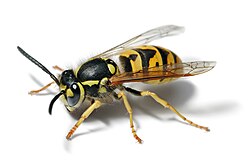
Vespula germanica
Vespula germanica
Scientific classificationEdit this classification
Kingdom: Animalia
Phylum: Arthropoda
Class: Insecta
Order: Hymenoptera
Family: Vespidae
Subfamily: Vespinae
Genera known as yellowjackets

Yellowjacket or yellow jacket is the common name in North America for predatory social wasps of the genera Vespula and Dolichovespula. Members of these genera are known simply as "wasps" in other English-speaking countries. Most of these are black and yellow like the eastern yellowjacket (Vespula maculifrons) and the aerial yellowjacket (Dolichovespula arenaria); some are black and white like the bald-faced hornet (Dolichovespula maculata). Some have an abdomen with a red background color instead of black. They can be identified by their distinctive markings, their occurrence only in colonies, and a characteristic, rapid, side-to-side flight pattern prior to landing. All females are capable of stinging. Yellowjackets are important predators of pest insects.[1]

Identification

[edit]
Face of a southern yellowjacket (Vespula squamosa)

Yellowjackets may be confused with other wasps, such as hornets and paper wasps such as Polistes dominula. A typical yellowjacket worker is about 12 mm (0.47 in) long, with alternating bands on the abdomen; the queen is larger, about 19 mm (0.75 in) long (the different patterns on their abdomens help separate various species).

Yellowjacket stinger in its sheath in a scanning electron microscope

Yellowjackets are sometimes mistakenly called "bees" (as in "meat bees"), given that they are similar in size and general coloration to honey bees. In contrast to honey bees, yellowjackets have yellow or white markings, are not covered with tan-brown dense hair on their bodies, and do not have the flattened, hairy pollen-carrying hind legs characteristic of honey bees (although they are capable of pollination).[2]

Yellowjackets have lance-like stingers with small barbs, and typically sting repeatedly,[1] though occasionally a stinger becomes lodged and pulls free of the wasp's body; the venom, like most bee and wasp venoms, is primarily dangerous to only those humans who are allergic or are stung many times. All species have yellow or white on their faces. Their mouthparts are well-developed with strong mandibles for capturing and chewing insects, with probosces for sucking nectar, fruit, and other juices. Yellowjackets build nests in trees, shrubs, or in protected places such as inside man-made structures, or in soil cavities, tree stumps, mouse burrows, etc. They build them from wood fiber they chew into a paper-like pulp. Many other insects exhibit protective mimicry of aggressive, stinging yellowjackets; in addition to numerous bees and wasps (Müllerian mimicry), the list includes some flies, moths, and beetles (Batesian mimicry).

Yellowjackets' closest relatives, the hornets, closely resemble them but have larger heads, seen especially in the large distance from the eyes to the back of the head.[1]

Life cycle and habits

[edit]
Vespula squamosa queen
Yellowjacket eating an apple
Yellowjacket wasps can be very aggressive if disturbed. Here the ground was pounded next to their nest starting an ongoing disturbance--with sound.
Yellowjacket wasps are disturbed, but not enough to swarm around their nest entrance—with sound. The response is down to one wasp after seven minutes.
Yellow jacket wasp catches green bottle fly to feed its larvae, followed by the final catch in slow motion. rabbit carrion is four days old.
Yellowjacket wasps using a stone as a landmark to navigate to their nest entrance. When the stone moved, they continued for a time to return orienting with the stone.
Yellowjacket response when a leaf blocks their entrance--with sound.
Very late in season, nearly every morning is too cold for the yellowjackets to forage. In another several weeks all are dead—except the new queens sheltering somewhere else.

Yellowjackets are social hunters living in colonies containing workers, queens, and males (drones). Colonies are annual with only inseminated queens overwintering. Fertilized queens are found in protected places such as in hollow logs, stumps, under bark, leaf litter, soil cavities, and man-made structures. Queens emerge during the warm days of late spring or early summer, select a nest site, and build a small paper nest in which they lay eggs. After eggs hatch from the 30 to 50 brood cells, the queen feeds the young larvae for about 18 to 20 days. Larvae pupate, then emerge later as small, infertile females called workers. Workers in the colony take over caring for the larvae, feeding them with chewed-up meat or fruit. By midsummer, the first adult workers emerge and assume the tasks of nest expansion, foraging for food, care of the queen and larvae, and colony defense.

From this time until her death in the autumn, the queen remains inside the nest, laying eggs. The colony then expands rapidly, reaching a maximum size of 4,000–5,000[3] workers and a nest of 10,000–15,000 cells in late summer. The species V. squamosa, in the southern part of its range, may build much larger perennial colonies populated by dozens of queens, tens of thousands of workers, and hundreds of thousands of cells. At peak size, reproductive cells are built with new males and queens produced. Adult reproductives remain in the nest fed by the workers. New queens build up fat reserves to overwinter. Adult reproductives leave the parent colony to mate. Males die quickly after mating, while fertilized queens seek protected places to overwinter. Parent colony workers dwindle, usually leaving the nest to die, as does the founding queen. Abandoned nests rapidly decompose and disintegrate during the winter. They can persist as long as they are kept dry, but are rarely used again. In the spring, the cycle is repeated; weather in the spring is the most important factor in colony establishment.

The adult yellowjacket diet consists primarily of sugars and carbohydrates, such as fruits, flower nectar, and tree sap. Larvae feed on proteins derived from insects, meats, and fish. Workers collect, chew, and condition such foods before feeding them to the larvae. Many of the insects collected by the workers are considered pest species, making the yellowjacket beneficial to agriculture.[4] Larvae, in return, secrete a sugary substance for workers to eat; this exchange is a form of trophallaxis. As insect sources of food diminish in late summer, larvae produce less for workers to eat. Foraging workers pursue sources of sugar outside the nest including ripe fruits and human garbage.[4]

Notable species

[edit]

Nest

[edit]
Two-year yellowjacket nest, with a one-gallon (3.8-liter) container for size reference. Collected in Alabama, USA, 2007. Dimensions approximately 18 inches by 24 inches by 12 inches (46 cm by 61 cm by 30 cm).

Dolichovespula species such as the aerial yellowjacket, D. arenaria, and the bald-faced hornet, tend to create exposed aerial nests. This feature is shared with some true hornets, which has led to some naming confusion.

Vespula species, in contrast, build concealed nests, usually underground.

Yellowjacket nests usually last for only one season, dying off in winter. The nest is started by a single queen, called the "foundress". Typically, a nest can reach the size of a basketball by the end of a season. In parts of Australia, New Zealand, the Pacific Islands, and southern coastal areas of the United States, the winters are mild enough to allow nest overwintering. Nests that survive multiple seasons become massive and often possess multiple egg-laying queens.[5][6]

In the United States

[edit]
Yellowjacket wasp at fermenting fruit harassed to leave by aggressive ant

The German yellowjacket (V. germanica) first appeared in Ohio in 1975, and has now become the dominant species over the eastern yellowjacket. It is bold and aggressive and can sting repeatedly and painfully. It will mark aggressors and pursue them. It is often confused with Polistes dominula, another invasive species in the United States, due to their very similar pattern. The German yellowjacket builds its nests in cavities—not necessarily underground—with the peak worker population in temperate areas between 1000 and 3000 individuals between May and August. Each colony produces several thousand new reproductives after this point through November.

The eastern yellowjacket builds its nests underground, also with the peak worker population between 1000 and 3000 individuals, similar to the German yellowjacket. Nests are built entirely of wood fiber and are completely enclosed except for a small entrance at the bottom. The color of the paper is highly dependent on the source of the wood fibers used. The nests contain multiple, horizontal tiers of combs within. Larvae hang within the combs.[citation needed]

In the southeastern United States, where southern yellowjacket (Vespula squamosa) nests may persist through the winter, colony sizes of this species may reach 100,000 adult wasps.[5] The same kind of nest expansion has occurred in Hawaii with the invasive western yellowjacket (V. pensylvanica).[7]

[edit]

The yellowjacket's most visible place in US sporting culture is as a mascot, most famously with the Georgia Tech Yellow Jackets, represented by the mascot Buzz. Other college and university examples include Allen University, the American International College, Baldwin-Wallace University, Black Hills State University, Cedarville University, Defiance College, Graceland University, Howard Payne University, LeTourneau University, Montana State University Billings, Northern Vermont University-Lyndon, Randolph-Macon College, University of Rochester, University of Wisconsin–Superior, West Virginia State University, and Waynesburg University.[citation needed]

Though not specified by the team, the mascot of the Columbus Blue Jackets, named "Stinger," closely resembles a yellowjacket. In the years since its original yellow incarnation, the mascot's color has been changed to light green, seemingly combining the real insect's yellow and the team's blue.[8]

In the United Kingdom the rugby union team Wasps RFC traditionally used a yellowjacket as their club emblem.

The Marvel Comics character Yellowjacket, who is based on the insect, is one of the various identities adopted by Hank Pym, who is most commonly known as Ant-Man. In addition to being able to fly, emit bio-electrictry inspired by a yellowjacket's sting, and shrink down to insect size, Yellowjacket can also control the insect and uses them to aid him in various ways.

The television series, Yellowjackets, features a girls’ soccer team which gets stranded in the wilderness and resorts to extreme measures to survive. Their mascot is a Yellowjacket, and the theme song features images of the insect as well.

Note that yellowjacket is often spelled as two words (yellow jacket) in popular culture and even in some dictionaries. The proper entomological spelling, according to the Entomological Society of America, is as a single word (yellowjacket).[9]

References

[edit]
[edit]
Revisions and contributorsEdit on WikipediaRead on Wikipedia
from Grokipedia
Yellowjackets are social wasps belonging to the genera Vespula and Dolichovespula in the family Vespidae, known for their distinctive black-and-yellow banded abdomens and predatory behavior on other insects. These wasps, often mistaken for bees due to their similar size (about ½ inch long) and coloration, are hairless and construct papery nests from chewed wood fibers, typically located underground, in wall voids, or aerially in trees. Widespread in North America, with both native and introduced species from their native Holarctic range, yellowjackets form annual colonies led by a single queen, with workers foraging for protein-rich prey and carbohydrates, making them both beneficial predators and occasional nuisances at human gatherings due to their attraction to sweets and meats. Their aggressive defense of nests, armed with stingers that can be used repeatedly, contributes to their reputation as one of the most troublesome wasp species in urban and suburban environments. Yellowjackets play an ecological role by controlling pest insect populations, preying on flies, caterpillars, and other arthropods, which helps maintain balance in gardens and natural areas. Colonies begin in spring when queens emerge from to establish nests, growing to thousands of workers by late summer before declining in fall, with only fertilized queens overwintering to start new colonies. Common species in the United States include the western yellowjacket () and the German yellowjacket (), an introduced from that has spread widely since the mid-20th century. While their stings cause painful reactions in most people, they can trigger severe allergic responses in sensitive individuals, prompting recommendations for avoidance and professional nest removal when necessary.

Taxonomy

Classification

Yellowjackets belong to the order , family , and subfamily . The primary genera are (primarily ground-nesting species) and (primarily aerial-nesting species), which together encompass approximately 45 species worldwide, with Vespula including about 26 species and Dolichovespula comprising 19 species. Phylogenetically, the yellowjacket genera and form a that is sister to the genera Vespa and Provespa within the , based on multilocus analyses supporting the of each genus. These wasps originated in the , with the genus estimated to have diverged around 25 million years ago during the . Key subgenera include Vespula s.str. (e.g., V. vulgaris) within Vespula and Dolichovespula s.str. (e.g., D. sylvestris) within Dolichovespula, reflecting morphological and ecological distinctions such as nesting habits.

Etymology and nomenclature

The common name "yellowjacket" for these wasps derives from their characteristic black-and-yellow striped coloration, which resembles the yellow-banded jackets worn as outerwear in the 19th century. The term first appeared in English around 1800, with the earliest documented use in 1796 by American architect Benjamin Henry Latrobe, who referred to the insects in his writings. Scientific nomenclature for yellowjackets was established by in his 1758 work , where he classified several species under the genus , including Vespa vulgaris, now recognized as Vespula vulgaris, the common yellowjacket. Over time, the genus was separated from Vespa to distinguish these smaller social wasps from the larger hornets, reflecting refinements in taxonomic classification based on morphological differences. Nomenclature varies regionally, with "yellowjacket" primarily used in to denote in the genera and . In , these same are commonly called "wasps," such as the "common wasp" () or "German wasp" (), leading to occasional confusion with true hornets ( spp.), which are larger and belong to a distinct genus. This terminological overlap arises from shared vespid family traits but highlights the North American specificity of the "yellowjacket" label.

Physical characteristics

Morphology

Yellowjackets possess a classic hymenopteran , comprising a distinct head, , and connected by a narrow petiole that forms a slender . The body is typically hard and shiny with minimal , and the transparent wings fold lengthwise along the sides when at rest. Colonies consist of three castes—, workers, and males—with morphological variations primarily in size and abdominal patterning. are the largest, measuring 18–20 mm in length, while workers range from 8–13 mm and males from 12–15 mm. Females of all castes, including queens and workers, are equipped with a stinger derived from a modified, slightly barbed ovipositor located at the abdomen's posterior end, enabling repeated stinging without loss of the apparatus. Queens exhibit enlarged ovaries within their broader abdomens, supporting extensive egg production, whereas workers possess robust mandibles adapted for chewing and processing materials. These anatomical adaptations distinguish the castes functionally within the colony structure. Sexual dimorphism is evident between males and females: males lack a stinger entirely and possess seven abdominal segments compared to six in females, along with slightly longer antennae. The head in males may appear proportionally broader due to these features. Coloration typically features alternating black and yellow bands on the abdomen, though patterns vary by species and caste—for instance, workers often show thicker black bands with narrower yellow interspaces, while some species, such as the blackjacket (Vespula consobrina), display white markings instead of yellow.

Identification features

Yellowjackets are readily identifiable by their slender, smooth, hairless bodies marked with alternating black and yellow bands, typically measuring ⅜ to ⅝ inch in length for workers, with queens slightly larger. Unlike the fuzzy, rounded bodies of bees, yellowjackets exhibit a shiny, wasp-like appearance without pollen baskets on their legs, and their flight is characterized by rapid, direct patterns rather than the straighter, more leisurely paths of bees. Distinguishing yellowjackets from involves noting their smaller size and narrower yellow bands compared to the broader, more robust bodies and wider markings of hornets, such as the larger bald-faced hornet (⅝ to ¾ inch) with distinctive white facial markings instead of yellow. wasps, while also slender with a narrow waist, can be differentiated by their longer, dangling legs during flight and often less vivid yellow coloration, lacking the compact, ground-oriented flight of yellowjackets. Additionally, yellowjacket antennae consist of 12 segments in females and 13 in males, appearing elbowed and geniculate, aiding in close-range identification from other . Yellowjackets are subjects of Batesian mimicry by certain hoverflies, such as those in the genus Spilomyia, which imitate their black-and-yellow coloration and hovering behavior to deter predators, though these mimics can be distinguished by their single pair of wings (versus two in wasps), short antennae, and fly-like compound eyes. This mimicry often leads to confusion in the field, emphasizing the importance of observing wing count and antennal structure for accurate differentiation.

Life cycle

Reproduction

Yellowjacket reproduction follows an annual cycle characteristic of temperate vespine wasps, with a single queen responsible for all colony reproduction. In late summer and early autumn, the queen shifts egg-laying to produce new queens and males from fertilized and unfertilized eggs, respectively; these reproductives emerge and engage in nuptial flights away from the nest for . New queens typically mate with multiple males in a polyandrous fashion, with effective paternity ranging from 1.5 to 3.8 males depending on the , allowing them to acquire and store sufficient sperm in spermathecae for lifelong use without remating. Males die shortly after mating, while fertilized queens seek sheltered overwintering sites such as leaf litter or bark crevices, entering until spring. Upon emergence in spring as temperatures rise, overwintering —known as foundresses—initiate solitary colony founding by selecting a nest site, often in burrows or aerial cavities, and constructing an initial paper comb from chewed wood fibers. During the foundress phase, lasting approximately 2 to 3 weeks, the queen lays 20 to 50 eggs in the first brood cells, tends the hatching larvae by regurgitating masticated prey, and oversees their development into the first sterile female workers. This phase ends when workers emerge and assume foraging, nest expansion, and brood care duties, enabling the queen to devote her energy exclusively to oviposition. Throughout the colony's growth phase in summer, workers remain reproductively sterile, focusing on rearing siblings while the queen lays thousands of eggs—potentially supporting colonies of up to 5,000 individuals—to sustain expansion. By autumn, as resources dwindle, the queen produces the next generation of reproductives, ensuring the cycle's continuation through the surviving mated queens; the old queen, workers, and males perish with the first frosts, and the nest is abandoned.

Developmental stages

Yellowjackets undergo complete , progressing through distinct , larval, pupal, and adult stages as part of their hymenopteran life cycle. The stage involves the queen laying individual s, each measuring approximately 2–3 mm in length, singly into hexagonal cells of the paper comb nest. Incubation lasts 5–8 days under typical colony conditions, after which the eggs hatch into larvae. Larvae are legless, grub-like, and entirely dependent on workers for via trophallaxis, where regurgitated liquids rich in carbohydrates and proteins from prey are provided. They undergo five instars, molting as they grow, with the stage spanning about 15 days before the mature spins a silken cocoon to seal the cell for pupation. During the pupal stage, the encased undergoes , lasting 8–18 days, culminating in eclosion where the chews through the cocoon and to emerge. The full cycle from to worker typically requires 28–48 days, though this shortens for workers produced early in the season. Seasonally, development shifts in autumn to prioritize males and new , which require larger cells and slightly longer pupal durations compared to workers. Only inseminated survive winter in , hibernating in protected sites, while all other castes perish. Temperature profoundly influences developmental rates, with optimal brood development occurring at 25–30°C; rates accelerate within this range but slow below 20°C or above 35°C, potentially reducing viability. Colonies actively thermoregulate nests to maintain internal temperatures around 31°C for efficient larval and pupal progression.

Behavior and ecology

Social organization

Yellowjackets exhibit a eusocial system typical of vespid wasps, consisting of , workers, and males, each with specialized roles that ensure survival and reproduction. The queen serves as the sole reproductive female, focusing on egg-laying after initial nest establishment, while suppressing worker reproduction through pheromonal signals to maintain her dominance. Workers, comprising approximately 95% of the population, are sterile females responsible for , brood care, nest maintenance, and guarding against intruders. Males, produced toward the end of the season, exist primarily to mate with new from other colonies and perish soon after. Communication within yellowjacket colonies relies heavily on chemical signals, particularly , to coordinate activities and maintain social order. pheromones, released from the venom gland during stinging, recruit nestmates to defend the by marking intruders and inciting aggressive responses. Nest-entrance pheromones accumulate over time to returning foragers to the colony site, though yellowjackets do not employ persistent foraging trails like . Additionally, dominance hierarchies emerge among workers, especially in late summer when queen pheromone suppression weakens; higher-ranking workers may lay unfertilized eggs that develop into males, though these are often policed and removed by other workers to favor queen-produced offspring. Colony size dynamics reflect the queen's central role in growth and regulation, beginning with a single overwintered queen who initiates the nest in spring. As workers emerge, the colony expands rapidly, peaking at 1,000 to 5,000 individuals by mid-summer, with the queen's pheromones inhibiting worker ovarian development to prioritize collective labor over individual . In most , colonies are annual and monogynous, though some, like in warmer regions, can become perennial and polygynous with multiple queens cooperating.

Foraging and diet

Yellowjackets exhibit distinct dietary preferences that differ between adults and larvae, reflecting their roles within the . Adult workers primarily consume carbohydrates, sourcing them from , juices, and human-provided sweets such as sodas and sugary foods. They are particularly attracted to garbage, areas, and outdoor food sources, where scavenging becomes more prevalent in late summer and fall as colony demands shift toward energy-rich resources to support reproductive castes. This opportunistic feeding on sweets helps sustain the high-energy needs of and nest maintenance activities. In contrast, yellowjacket larvae require a protein-rich diet to support rapid growth, consisting mainly of masticated , , and other arthropods captured or scavenged by adult workers. Workers chew and condition the prey into a paste before feeding it to the larvae, who in return produce nutrient-laden salivary secretions—rich in sugars—that adults solicit by stimulating the larvae. This trophallactic exchange provides carbohydrates to the adults, fostering a mutualistic relationship essential for . Foraging yellowjackets typically travel up to 1.6 kilometers from the nest in search of , though shorter distances of around 400 meters are more common. They rely on a combination of visual landmarks and olfactory cues, such as food odors and chemical attractants, to locate and return to profitable sites. Activity peaks during midday hours when temperatures are optimal, aligning with diurnal patterns that maximize efficiency.

Defense mechanisms

Yellowjackets possess a retractable modified into a stinging apparatus in females, which allows them to deliver through repeated stings without the stinger becoming barbed or lodged, unlike in honeybees. The primarily consists of low-molecular-weight compounds such as , which acts as a disruptor, and kinins like wasp kinin peptides that contribute to the venom's potency in subduing threats or prey. This stinging mechanism enables workers and queens to mount prolonged defensive responses against intruders near the nest. A key component of yellowjacket defense is their alarm behavior, triggered when a worker perceives a and releases an alarm from the venom gland or Dufour's gland. In species like the (Vespula maculifrons) and southern yellowjacket (V. squamosa), the primary alarm is N-3-methylbutylacetamide, which volatilizes to alert and recruit nearby nestmates, often leading to coordinated mass attacks on the perceived danger. This -mediated recruitment enhances colony-level defense, with disturbed wasps marking the target to guide reinforcements. Beyond stinging and pheromones, yellowjackets employ physical defenses including biting with powerful mandibles to grasp and tear at intruders, particularly when flight is restricted. Their agile flight capabilities allow for rapid evasion of predators or repositioning during confrontations, aided by strong wings that enable quick maneuvers. Nests are often camouflaged with surrounding materials like , leaves, or structural elements to blend into the environment, reducing detectability by potential threats. Aggression levels peak in late fall as food resources dwindle and colonies focus on survival, prompting more proactive defensive postures.

Nests

Types and locations

Yellowjackets construct two primary nest types—aerial and subterranean—distinguished largely by genus, with species favoring exposed above-ground sites and species preferring underground locations. These differences reflect adaptations to and resource availability, as aerial nests are typically enveloped for weather resistance while ground nests leverage insulation. Aerial nests, built predominantly by Dolichovespula species such as the baldfaced hornet () and aerial yellowjacket (), are suspended from trees, shrubs, building eaves, or attics. These nests feature a papery outer enclosing multiple horizontal combs, with a single entrance hole usually at the bottom for access and defense. They often reach diameters exceeding 30 cm, providing shelter for colonies of up to several hundred workers at peak season. In contrast, ground nests are characteristic of species, including the ( maculifrons) and German yellowjacket (), excavated in soil, abandoned burrows, or similar subterranean cavities. These nests typically have a single entrance leading to umbrella-shaped combs layered horizontally within a protective paper envelope, which may extend 20–30 cm in diameter and depth. Such structures support larger colonies, sometimes housing thousands of individuals by late summer. Variations include rare cavity nests in wall voids, hollow trees, or building interiors, utilized by both genera when suitable sites are available, though less common for . Some species, like V. germanica, may establish nests in insulated attics that persist across seasons, unlike the annual cycle of most colonies. Nest sizes can exceptionally exceed 1 meter in diameter for certain species in favorable conditions.

Construction process

Yellowjacket nests are built using a papery material created by workers who chew wood fibers, often from dead or weathered sources, and mix them with to form a malleable pulp. This pulp is molded into thin sheets and hexagonal cells, with the choice of weathered wood contributing to the nest's grayish tone for subtle blending into surroundings. The construction begins in spring when the fertilized queen initiates the process by fabricating the first small consisting of a few hexagonal cells, in which she lays eggs and tends the emerging larvae until the first workers hatch. Once workers emerge, they assume the labor-intensive roles of nest building, expanding the initial by adding successive layers of hexagonal cells arranged in multiple vertical tiers to accommodate growing brood. Workers also construct a protective outer around the combs, forming a completely enclosed sphere or pear-shaped structure with a single small entrance hole at the bottom, which provides insulation and defense against predators. Nest maintenance involves ongoing repairs and expansions by workers, who chew and apply additional pulp to mend damage from or intrusions, ensuring structural integrity as the colony grows to thousands of individuals. Most yellowjacket colonies undergo annual rebuilding, with the old nest abandoned in fall as workers, males, and the founding queen perish in cold , leaving fertilized new to overwinter and start fresh nests the following spring; however, rare perennial nests persist in mild climates like the , where colonies can survive multiple years without full die-off.

Distribution

Global range

Yellowjackets, encompassing the genera Vespula and Dolichovespula, are native to the Holarctic region, with distributions spanning temperate and boreal zones across , , and . Vespula species predominantly occupy temperate lowland and woodland areas, while Dolichovespula species are more common in cooler, forested environments, including and montane habitats. Several yellowjacket species have been introduced beyond their native ranges through human-mediated dispersal. , originating from , northern Africa, and temperate , was first recorded in in 1959, in in 1945, and in in the 1970s. , native to similar Holarctic areas, has established populations in , particularly from central and southward to , with introductions occurring in the late 20th century. These wasps favor diverse habitats such as forests, meadows, and urban settings, where they construct nests in soil, cavities, or aerial structures. They occur across a broad altitudinal gradient, from to over 3,000 meters in mountainous temperate regions like the and European Alps. Yellowjackets are confined to temperate climates, with limited success in subtropical or tropical zones due to and constraints.

Regional variations

In , yellowjackets display notable regional adaptations tied to habitat diversity, with several species occupying specific ecological niches. The yellowjacket (Vespula atropilosa) is prevalent in prairie grasslands and open woodlands of central and western regions, where it constructs subterranean nests suited to the open terrain and seasonal vegetation cycles. Similarly, the common aerial yellowjacket () thrives in western arid and desert-like environments, including higher elevations in states like and , favoring aerial nests in shrubs and rock crevices to exploit sparse but protected nesting sites. European yellowjacket populations vary by climate and geography, with Vespula vulgaris dominating in temperate areas such as the and , where it forms large colonies in urban and rural settings. In Mediterranean regions, this species exhibits pronounced seasonal patterns, with extended colony activity into late autumn due to milder winters, allowing for prolonged foraging and higher worker survival rates compared to . In , yellowjacket diversity includes species adapted to forested and mountainous terrains, such as Vespula flaviceps in , which builds nests in tree hollows and is known for its role in local ecosystems through predation on forest .

Invasive populations

The German yellowjacket (), native to , has established invasive populations across the southern hemisphere, primarily arriving through human-mediated transport such as ships and aircraft between the 1930s and 1970s. In , it was first detected in 1945 near Hamilton, likely transported in aircraft crates during , and rapidly spread nationwide by the 1970s. Similarly, in , the species arrived in in 1959 and has since colonized southeastern regions, while in southern , it invaded ( and ) around 1978–1980, possibly via cargo ships from . These introductions have enabled V. germanica to thrive in temperate climates with mild winters, outcompeting native wasps and for resources like carbohydrates and proteins in disturbed habitats such as urban areas and agricultural lands. The spread of V. germanica is facilitated by human activities, including and travel, which transport founding queens over long distances, followed by natural dispersal through flight and nest establishment in favorable, often anthropogenically altered environments. Once introduced, populations expand quickly due to the species' high reproductive rate and adaptability, with queens capable of founding colonies in a wide range of microhabitats, from forests to suburbs. In and , invasive V. germanica disrupts native ecosystems by outcompeting indigenous pollinators and predators, reducing through aggressive foraging that monopolizes food sources like honeydew in beech forests. Ecologically, V. germanica exerts significant predation pressure on , including bees, , and even chicks, leading to declines in populations and altered trophic dynamics; for instance, in Argentine , it has been observed preying on neotropical nestlings, contributing to local extinctions. This predation and disrupt services, as the wasps target flower-visiting , indirectly affecting plant reproduction in invaded areas. Economically, the impacts are substantial, particularly in , where V. germanica causes approximately $58 million in foregone honeydew production (as of 2015), with additional costs from hive losses and management estimated at $8.8 million annually (as of 2015), plus broader economic losses to apiculture and native . In and , similar effects on apiculture and native impose ongoing management burdens. Efforts to control these populations include targeted baiting and emerging biological agents, such as parasitic flies; as of 2024, releases of the Volucella inanis have begun in New Zealand's targeting related invasive wasps.

Human interactions

Stings and health impacts

Yellowjacket primarily consists of a complex mixture of proteins, enzymes, and peptides, including phospholipase A1, , and the major Ves v 5 (antigen 5), which contribute to its toxic and allergenic properties. Peptides such as mastoparan, a degranulating agent, induce pain and inflammation by promoting release and cellular responses. These components, along with smaller bioactive molecules, enable the to disrupt cellular membranes and trigger immune activation. A single yellowjacket sting typically causes immediate local effects, including sharp pain, redness, swelling, and itching at the site, resulting from the venom's inflammatory peptides and enzymes. These symptoms usually peak within minutes and subside over several hours to days, though larger local reactions involving significant swelling may persist longer. Multiple stings, common due to yellowjackets' aggressive defense behavior, can lead to systemic reactions such as , , , abdominal cramping, and in severe cases, anaphylactic shock characterized by , , and . Health risks from yellowjacket stings are generally low for most individuals, but allergic reactions occur in approximately 1-3% of the , with higher of Hymenoptera-induced reported in adults (up to 3%) compared to children (around 1%). Sensitization rates to , including yellowjackets, are higher, ranging from 9% to 42% in adults. These allergens, particularly Ves v 5, provoke IgE-mediated , leading to in sensitized people. Risk factors include prior stings and occupational exposure, such as in beekeepers, where systemic reactions to Hymenoptera stings can reach 14-43% due to frequent encounters. Fatalities are rare, with an average of approximately 83 deaths annually (2018–2023) from all hornet, wasp, and stings, often linked to untreated . Standard treatment for severe reactions involves epinephrine administration to counteract systemic effects, while is recommended for individuals with a history of systemic allergic reactions to prevent future .

Pest control methods

Prevention of yellowjacket infestations begins with reducing attractants and limiting access to potential nesting sites. Homeowners and facility managers should seal cracks, crevices, and entry points in structures, such as walls, foundations, and roofs, to prevent from establishing nests indoors during spring. Additionally, removing sources like uncovered garbage, , and sugary spills is essential, as yellowjackets are drawn to protein and carbohydrate-rich materials, particularly in late summer; using tightly lidded trash containers and prompt cleanup minimizes activity. Trapping is another preventive measure, with commercial traps baited using heptyl butyrate lures proving effective for capturing workers and early-season , especially for like the western yellowjacket; these should be placed at least 20 feet from human activity areas to avoid drawing closer. For established nests, removal techniques focus on targeted applications to minimize human exposure. Insecticidal aerosols or sprays, such as those containing pyrethroids, can be applied directly into nest entrances from a safe distance, ideally at night when yellowjackets are less active and inside the , allowing the product to penetrate deeply. Insecticidal dusts, including formulations like (Delta Dust) or silica combined with pyrethrins, are particularly effective for ground or wall-void nests, as they cling to entering wasps and spread throughout the via contact; a duster facilitates precise application. Biological controls, such as parasitic including ichneumonid wasps (e.g., Bareogonalos canadensis) and tachinid flies that target yellowjacket larvae, have been explored but show limited success due to low rates and challenges in field deployment. Integrated pest management (IPM) for yellowjackets emphasizes monitoring and a combination of strategies to achieve long-term control while reducing use. stations equipped with protein or lures mixed with low-toxicity insecticides allow for early detection and targeted reduction of colonies, with placement in early spring helping to suppress queen activity. Regular monitoring involves observing patterns during daylight to locate nests, followed by and exclusion as first lines of defense before escalating to chemical treatments. While do-it-yourself (DIY) methods can be suitable for small, accessible nests, they carry significant risks of multiple stings due to pheromones triggering defensive attacks; professional is recommended for large or hard-to-reach nests, such as those in attics or underground, to ensure safety and efficacy.

Ecological benefits

Yellowjackets fulfill an important predatory role in ecosystems by preying on a variety of pest , thereby helping to regulate their populations and maintain ecological balance. Workers actively hunt for live arthropods such as flies, caterpillars, , and beetles, masticating the prey to feed the protein-demanding larvae back at the nest. This foraging behavior provides natural , particularly beneficial in agricultural settings where yellowjackets target crop-damaging species like caterpillars and , reducing the need for chemical interventions. Quantitative assessments underscore the scale of their predation; for instance, studies in estimate that colonies of social wasps, including species, collectively consume approximately 2.12 pounds (0.96 kg) of insects per 2.47 acres annually, demonstrating their substantial contribution to across landscapes. In exceptional cases, large perennial colonies have been documented consuming over 200 kg of prey in a single season, equivalent to millions of individual , though typical annual colonies process thousands of prey items to support brood development. This predatory activity not only curbs pest outbreaks but also aids in , recycling nutrients in and habitats. In addition to predation, yellowjackets offer a minor but supportive role in pollination through their nectar-feeding habits, visiting flowers for carbohydrates and incidentally transferring pollen between plants. While less effective than bees due to their smoother bodies, which adhere less pollen, this activity contributes to the pollination of various wildflowers and supports biodiversity in forest ecosystems where other pollinators may be scarce. Yellowjackets also function as indicator species, exhibiting sensitivity to habitat alterations such as heavy metal pollution, which allows researchers to monitor . For example, the common yellowjacket () accumulates contaminants like , , , , , and lead in its body tissues, with higher concentrations near industrial sources and phenotypic changes such as reduced markings observed in polluted areas; these traits make them effective bioindicators for assessing degradation.

Cultural significance

Yellowjackets have appeared in various literary works as symbols of annoyance and intrusion. In Henry David Thoreau's 1854 book , the author describes swarms of wasps—likely including species akin to yellowjackets—invading his cabin during autumn, settling on windows and walls in search of shelter, which he portrays as a persistent disruption to his solitary life despite acknowledging their resilience against the elements. In Native American folklore, yellowjackets feature prominently in Shasta myths, such as the tale "Coyote and the Yellow-Jackets," where the figure encounters a powerful swarm of yellowjackets near a salmon-drying site, leading to a confrontation that highlights themes of cunning, danger, and the insects' formidable collective strength. In film, yellowjackets and related wasps often serve as antagonistic forces. The 1959 horror movie , directed by , depicts a cosmetics executive who ingests wasp to reverse aging, only to transform into a murderous, wasp-like monster, embodying fears of scientific hubris and insect aggression. In the , the 2015 film introduces Yellowjacket as the supervillain alias of , whose advanced suit incorporates yellowjacket-inspired flight capabilities and stinger weapons, positioning the insect as a symbol of ruthless technological menace. More recently, the Showtime television series Yellowjackets (2021–2026), created by , draws on yellowjacket imagery as a for the instincts and social breakdown among a group of high school girls stranded after a plane crash, with the show's title evoking ' aggressive swarming behavior to underscore themes of and primal savagery.

Symbolic uses

Yellowjackets, the for certain species of wasps in the genera Vespula and Dolichovespula, have been adopted as symbols in various real-world contexts, particularly evoking themes of aggression, teamwork, and tenacity. In sports, the yellowjacket serves as a for several collegiate athletic programs, representing fierce competitiveness and collective spirit. The Georgia Institute of Technology's athletic teams, known as the Yellow Jackets since 1905, trace their nickname to a suggestion by football coach , who sought a more dynamic identity than "Techs" to inspire players and fans in the American South. This enduring symbol has been embodied by the costumed Buzz since 1972, reinforcing the insect's association with speed and stinging determination in university traditions. Similarly, the University of Wisconsin-Superior's athletic teams are the Yellowjackets, with mascot Buzz symbolizing predatory energy and community pride in the Midwest. Beyond academia, yellowjackets appear in military emblems, where their aggressive nature aligns with unit identities. The 361st Fighter Group of the U.S. Army Air Forces adopted the "Yellowjackets" moniker during , featuring the wasp in their insignia to denote swift, relentless aerial assaults. In commercial branding, yellowjackets iconize products emphasizing high energy and intensity. The Stacker2 Yellow Jacket energy shots, launched as a caffeine-infused supplement line, incorporate the wasp's to convey rapid, sustained vitality without sugar or calories, appealing to consumers seeking performance boosts. Regionally, in the U.S. —where yellowjackets are prevalent— the symbolizes resilience amid adversity, as seen in cultural narratives tying its persistent to human endurance in challenging environments like Georgia's landscapes. Among some Native American traditions, yellowjackets represent industriousness and protection; Cherokee lore describes the giant yellowjacket U'lagu as a creator figure who introduced fish and game through diligent effort, while Nez Perce stories, such as the Ant and Yellowjacket , depict it in conflicts over resources, highlighting themes of and the consequences of fighting. These symbolic uses underscore the yellowjacket's broader cultural resonance as a of unyielding communal strength.

References

Add your contribution
Related Hubs
User Avatar
No comments yet.