Hubbry Logo
Yitzhak NavonYitzhak NavonMain
Open search
Yitzhak Navon
Community hub
Yitzhak Navon
logo
8 pages, 0 posts
0 subscribers
Be the first to start a discussion here.
Yitzhak Navon
Yitzhak Navon
from Wikipedia

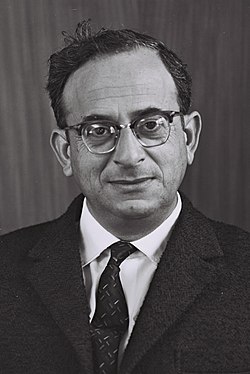
Yitzhak Rachamim Navon (Hebrew: יִצְחָק נָבוֹן‎‎; 9 April 1921 – 6 November 2015[1]) was an Israeli politician, diplomat, playwright, and author. He served as the president of Israel between 1978 and 1983 as a member of the centre-left Alignment party. He was the first Israeli president born in Jerusalem and the first Sephardi Jew to serve in that office.

Key Information

Biography

[edit]
Yitzhak Navon (left) and his brother Victor in Jerusalem, 1929

Navon was born in Jerusalem in what was then the British Mandate for Palestine to Yosef and Miryam Navon, a descendant of a Sephardi Jewish family of rabbis, and had ancestry in Jerusalem going back centuries. On his father's side, he was descended from Sephardi Jews who settled in Turkey after the expulsion of the Jews from Spain in 1492. His ancestors, the Baruch Mizrahi family, immigrated from Turkey to Jerusalem in 1670. On his mother's side, he was descended from the renowned Moroccan-Jewish kabbalist rabbi Chaim ibn Attar, who immigrated to Israel and settled in Jerusalem in 1742.

In 1924, the Navon family moved from Jaffa Road to the Ohel Moshe neighbourhood in Nachlaot. In 1932, they moved to Sheikh Badr near the western entrance to Jerusalem, relocating to Mekor Baruch in 1936.[2]

He attended the Doresh Tziyon and Takhemoni elementary schools and the Hebrew University high school.[1]

Navon studied Arabic and Islamic studies at the Hebrew University of Jerusalem. He taught Hebrew literature for several years. He was fluent in Arabic, Hebrew, Ladino, French and English.

Navon was a member of the Haganah's Arab Intelligence Unit and worked undercover in Jerusalem. During the war, he listened to wiretapped conversations of the British Army. Later he was sent by the Israeli foreign service to Uruguay and Argentina to track down Nazis.

Navon was married to Ofira Navon née Resnikov, who died of cancer in 1993. Navon died in Jerusalem at the age of 94 on 6 November, 2015.[3][1]

Yitzhak Navon with his family, 1934

Political career

[edit]

In 1951, Navon became the political secretary of Israel's first prime minister, David Ben-Gurion. The following year he was appointed Ben-Gurion's bureau chief. He remained in this position under Prime Minister Moshe Sharett. His judgment was crucial to advice the government received during the Suez Crisis and Lavon Affair.

In 1963 Ben-Gurion resigned as prime minister and Navon became a civil service department head at the Ministry of Education and Culture. Navon began a long campaign fighting illiteracy in Israel, which affected about 12% of the Jewish population.

It's a shame and disgrace that more than 200,000 adults in Israel do not know how to read or write in any language, and we must do everything possible to erase this stain from us.[1]

Navon ordered the mobilisation of hundreds of female soldiers serving compulsory national service to teach illiterate adults to read and write Hebrew. Two years later, Navon was elected to the Knesset as a member of Ben-Gurion's Rafi. The new party which had dared challenge the Mapai establishment was driven by 'modernization and scientification'; it merged into the Israeli Labor Party (part of the Alignment) in 1968.[4] But the labour elite of which Navon was one, would in the future dictate the Left's agenda. Navon served as deputy speaker of the Knesset and chairman of the Knesset Committee on Foreign and Defense Affairs.

President of Israel (1978–83)

[edit]
President Navo meeting with Christian leaders before Christmas and the christian New Year. In the background is an Israeli relief made of basalt ash.

On 19 April 1978, Navon was elected by the Knesset to serve as the fifth President of Israel. The race was uncontested and Navon received 86 votes in the 120-member Knesset with 23 members casting blank votes. He assumed office on 29 May 1978 and was the first president with small children to move into Beit HaNassi, the presidential residence in Jerusalem. His wife, Ofira, was active in promoting the welfare of Israeli children.

Navon with his wife Ofira and David Ben-Gurion

As a president, Navon met with Egyptian president Anwar Sadat and was influential in the peace talks. According to Haaretz newspaper, he achieved more in one visit than five by Israel's Prime Minister.

Although the Israeli presidency is a ceremonial office, Navon was an outspoken advocate of a judicial commission of inquiry to probe Israel's role in the Sabra and Shatila massacre perpetrated by Lebanese Falangists in 1982.

Minister of education

[edit]
President Yitzhak Navon lighting Hanukkah menorah

In 1983, Navon turned down the opportunity to run for a second term of office. Instead he returned to politics, the only Israeli ex-president to do so. When the polls showed that Navon was more popular than Labor chairman Shimon Peres, Peres was pressured to step aside and allow Navon to take over the party leadership. Navon's fluency in the Arabic language made him especially popular among Arab and Mizrahi voters. But Navon did not accept the chairmanship. In 1984, he was elected to the Knesset and served as minister of education and culture from 1984 to 1990. Navon was Minister of Education during the first Intifada. During the summer of 1989 there were riots and protests. Jerusalem parents appealed to Navon by petition, to reopen their schools. Navon a socialistic Jew was impressed by the legal implications: "This action is immoral and ineffective and will cause irreversible damage in the long and short run to Palestinian children and to our own." As the violence escalated moderates suffered at the hands of extremists.[5]

Remaining in the Knesset until 1992, he briefly left politics. Navon emerged from retirement to chair a Commission of Inquiry on Israeli medical authorities' controversial practice of discarding blood donated by Israelis of Ethiopian origin due to concerns about AIDS transmission.[6]

Literary career

[edit]
The funeral of Yitzhak Navon

Navon wrote two musicals based on Sephardic folklore: Romancero Sefardi (1968) and Bustan Sefardi ("Sephardic Garden" 1970), which were successfully performed at Habimah, Israel's national theater in Tel Aviv. He is also the author of The Six Days and the Seven Gates (1979), a modern legend of the reunification of Jerusalem, first published in Hebrew by Shikmona Publishing Company and later translated into English.

Awards and recognition

[edit]

In 2003, the Spanish government granted Navon an award at Herzliya.[1]

The Jerusalem - Yitzchak Navon Station in central Jerusalem, Israel, is named after Navon and honors his history in the country.[7] Shortly before his death, he was placed honorary last 120th spot on the Zionist Union list on 2015 Israeli legislative election.

References

[edit]

Bibliography

[edit]
[edit]
Revisions and contributorsEdit on WikipediaRead on Wikipedia
from Grokipedia
Yitzhak Navon (9 April 1921 – 7 November 2015) was an Israeli politician, diplomat, author, and playwright who served as the fifth from 1978 to 1983. Born in to a family of Sephardi rabbis with deep roots in the city, Navon was the first president of Sephardi origin and the first born within the territory of the modern State of Israel. A longtime member of the Labor Party, he began his public career in the Haganah's Arabic department during the pre-state period and later served as a close political secretary to and . Navon's tenure as president emphasized national unity, particularly bridging the cultural and ethnic divides between Ashkenazi and Sephardi , and he actively promoted Ladino language and heritage through his writings and compositions, including the acclaimed play Bustan Sephardi. Prior to his presidency, he was a member from 1965 to 1978, acting as deputy speaker and chairing the Foreign Affairs and Defense Committee, roles in which he influenced policy amid pivotal events like the . After leaving office, he returned to the and served as Minister of Education and Culture from 1984 to 1990, where he defended core educational policies such as compulsory schooling against proposed reforms. Widely respected for his integrity and efforts toward social cohesion, Navon avoided major controversies and was remembered as a unifying figure in Israeli politics.

Early Life and Formative Influences

Family Heritage and Childhood in Jerusalem

Yitzhak Navon was born on April 9, 1921, in during the British Mandate period, to and Miryam Navon, as the youngest of nine children, of whom only four survived infancy. His family resided in Beit Musayof in the Nachlaot neighborhood, a close-knit Sephardic community where his sister Mazal later described the environment as a " for children" fostering a sense of among residents. The Navon family traced its Sephardic roots to Spanish Jews expelled in 1492, who initially settled in the before migrating to , with the paternal line arriving around 1670 and the maternal side in 1742. This longstanding presence in the city, spanning over three centuries by Navon's birth, positioned the family among Jerusalem's veteran Sephardic clans known for producing rabbis and community leaders. Navon's upbringing immersed him in Jerusalem's traditional Sephardic , including Ladino language and religious observance, within a household emphasizing scholarly and communal values inherited from rabbinical forebears. His father's family, in particular, embodied this heritage, having maintained continuous residence in the since the 17th century amid the challenges of Ottoman and Mandate rule.

Education and Early Professional Roles

Navon received his early education in Jerusalem's Jewish community schools, attending the Doresh Tziyon and Takhemoni elementary institutions before progressing to the Hebrew University Secondary School, where he completed his high school studies. He then enrolled at the , earning a degree in , , and , with additional coursework in and Islamic culture that equipped him with linguistic and cultural expertise relevant to intercommunal relations in . Following graduation, Navon pursued a career in education as a teacher in schools, specializing in instruction and contributing to local pedagogical efforts amid the pre-state period's challenges.

Pre-State Zionist Activism

Service in the

Navon joined the , the primary Jewish paramilitary organization in , in 1946 at the age of 25, leveraging his fluency in and familiarity with 's Old City from his youth. He initially worked as a teacher before dedicating himself to the organization's intelligence efforts amid rising tensions leading to the 1947 UN Partition Plan and subsequent civil war. From 1946 to 1948, Navon served in the 's Arab Department in , eventually heading its Arab Intelligence Unit, where he conducted undercover operations to gather information on Arab military preparations and leadership activities. During the 1948 Arab-i War (known in as the War of Independence), he directed the interception of Arab telephone communications, analyzing wiretapped conversations to relay enemy plans and movements to command, contributing to defensive strategies in under siege. His role focused on human and rather than direct combat, reflecting the 's emphasis on against superior Arab forces backed by irregular militias and invading armies. Navon's service ended with the establishment of the Israel Defense Forces in May 1948, as units were integrated into the new national army, though his intelligence work continued informally into the war's truce phases. This period honed his understanding of Arab perspectives and regional dynamics, skills he later applied in diplomacy and politics.

Ties to Founding Leaders

Navon's involvement in the 's Arab Intelligence Unit from 1946 to 1948 positioned him within the pre-state Zionist leadership structures, though direct personal ties to founding figures like emerged shortly after Israel's independence. In 1951, following diplomatic postings in and , he served as political secretary to , Israel's first foreign minister and a key architect of the state's , for two years. This role, secured with Sharett's endorsement, facilitated his transition to Ben-Gurion's inner circle. From 1951 onward, Navon acted as Ben-Gurion's political secretary and, by 1952, as his bureau chief, maintaining this close advisory position for 11 years until Ben-Gurion's retirement from public life in 1963. The relationship was marked by mutual trust, shared intellectual pursuits including literature, and frequent travels, forging a lasting friendship between the young Navon and Israel's founding . These early associations with Ben-Gurion and Sharett underscored Navon's alignment with the party's foundational ethos and propelled his ascent in Israeli politics.

Rise in Israeli Politics

Knesset Membership and Party Involvement

Navon aligned with David Ben-Gurion's Rafi party in 1965, reflecting his loyalty to the former prime minister amid ideological splits from , and was elected to the (1965–1969) that year. He retained his seat through subsequent elections, serving continuously until 1978 across the Sixth, Seventh (1969–1973), Eighth (1973–1977), and Ninth (1977–1981) , resigning midway through the latter to assume the presidency. Within the Knesset, Navon held roles emphasizing his expertise in security and diplomacy; he served as a deputy speaker starting in the Sixth Knesset and chaired the and Security Committee during the Eighth Knesset. Following Rafi's merger with and to form the Israel Labor Party in 1968, Navon integrated into the new entity, participating in its Alignment electoral bloc for broader leftist coalitions. His parliamentary tenure focused on defense oversight and Zionist advocacy, including concurrent chairmanship of the Zionist General Council from 1965.

Pre-Presidency Government Positions

In 1951, following Israel's War of Independence, Yitzhak Navon was appointed political secretary to Foreign Minister , leveraging his prior experience in Arab affairs during the period. The following year, in 1952, he transitioned to the Prime Minister's Office as political secretary and bureau chief to , managing key administrative and advisory functions during Ben-Gurion's first and second terms as prime minister. Navon retained influential roles in the Prime Minister's Office through subsequent leadership changes, serving as director under both Ben-Gurion (upon his return in 1955) and after Ben-Gurion's 1963 resignation. This period, spanning approximately 1952 to 1963, positioned him at the center of executive decision-making on domestic and security matters. Upon leaving the Prime Minister's Office in 1963, Navon joined the Ministry of Education as director of its cultural division, where he oversaw programs promoting , , and until his election to the in 1965. In this capacity, he advanced initiatives to integrate Sephardic cultural elements into national , reflecting his personal heritage.

Presidency of Israel (1978–1983)

Election and Inauguration

Yitzhak Navon was elected as the fifth by the on April 19, 1978, succeeding whose term concluded on May 29 of that year. The vote reflected broad consensus across political lines, with Navon, a longtime Labor Party member, receiving support despite the Likud-led government's recent ascension to power following the 1977 elections. His selection underscored efforts to represent Israel's Sephardic Jewish majority, which had historically felt marginalized in leadership roles dominated by Ashkenazi figures. Navon's presidency commenced with his inauguration ceremony on May 29, 1978, at the in , where he took the before assembled lawmakers and dignitaries. In his inaugural address, he emphasized national unity, , and bridging ethnic divides within Israeli society, drawing on his roots and fluency in to signal outreach to diverse communities. The event marked a symbolic shift, as Navon became the first president of Sephardic (Oriental Jewish) descent, a development viewed by contemporaries as a deliberate step toward inclusivity in the ceremonial but influential office.

Key Domestic Initiatives

During his , Yitzhak Navon emphasized social cohesion, leveraging the office's to address ethnic and socioeconomic divides within . As the first president of Sephardic descent, he symbolized the inclusion of in national leadership, advocating for greater recognition of their to mitigate tensions between Ashkenazi and Sephardic communities. This included promoting Sephardic traditions through public engagements and his own literary works, which highlighted Ladino folklore and aimed to foster pride and unity among diverse Jewish populations. Navon directed significant attention to Israel's peripheral regions and development towns, where many disadvantaged and immigrant communities resided. He prioritized efforts to integrate these groups, advance their socioeconomic conditions, and build public trust in state institutions, viewing such outreach as essential for national resilience. To this end, he undertook over 300 trips across the country, visiting remote areas to engage directly with residents and encourage mutual responsibility among ethnic and religious groups. The President's Residence under Navon became a hub for inclusivity, hosting more than 300,000 visitors from varied backgrounds, including citizens and minority religious communities, to promote and harmony. He advocated for equal rights and opportunities for Israel's sector, striving to enhance cooperation between Jewish and populations while urging civilized discourse to reduce . These initiatives, though symbolic given the presidency's ceremonial nature, underscored Navon's commitment to internal equity over partisan agendas.

Foreign Policy Engagements

During his , Navon played a ceremonial yet symbolically significant role in the signing ceremonies of the on March 26, 1979, delivering speeches in to underscore Israel's commitment to reconciliation and drawing on his cultural affinity for traditions to foster goodwill. His fluency in , acquired from his Jerusalem upbringing in a Sephardic family, was leveraged to communicate directly with Egyptian audiences, enhancing the diplomatic atmosphere amid the treaty's implementation challenges. In October 1980, Navon undertook the first official by an Israeli president to an country, traveling to at the invitation of President to strengthen bilateral ties post-treaty; he addressed Egyptian hosts in , emphasizing mutual understanding and cultural bridges between the nations. This engagement highlighted Navon's personal background as a native speaker, positioning him as a conduit for dialogue in a period of fragile peace. Navon conducted official working visits to the , including trips in November 1982—where he visited and engaged with American Jewish communities—and January 1983, during which he met President to affirm the enduring strategic alliance between and the U.S. These interactions symbolized the close bilateral friendship, with Reagan publicly noting the historical ties linking the two nations in joint statements. In response to the September 1982 in , Navon pressed for an independent commission of inquiry, leading to the establishment of the on September 28, 1982, which investigated Israeli indirect responsibility and carried international repercussions for Israel's military involvement in the region. The commission's findings, released in February 1983, attributed partial accountability to Israeli leaders, prompting resignations and shaping global perceptions of Israel's conduct in . Navon's broader approach to emphasized , informed by his Sephardic heritage and advocacy for Arabic language education in as a tool for regional comprehension, though his presidential influence remained largely non-executive and focused on symbolic gestures rather than negotiations.

Post-Presidency Public Service

Return as Minister of Education and Culture

Following the end of his presidency in 1983, Yitzhak Navon declined a second term and returned to active politics by winning election to the as a Labor Party member in July 1984. In the formed by that September, Navon was appointed Minister of Education and Culture, also serving as during parts of his tenure. Navon's ministerial service spanned from to May , covering the Peres and subsequent Shamir governments amid Israel's rotation agreement. As a former teacher and Sephardic cultural advocate with prior experience leading adult Hebrew literacy efforts in the , expectations centered on his ability to bridge ethnic divides in , given his Mizrahi background and presidential emphasis on cultural integration. Navon outlined four primary educational goals: instilling values of truth, honesty, and respect for others; preserving national and ; fostering and tolerance; and promoting Jewish-Arab coexistence. Among initiatives he advanced was the Special Education Law of 1988, which mandated free and appropriate public for all children with disabilities, expanding access and resources previously limited by institutional capacity. He also supported programs emphasizing Sephardic Jewish traditions in curricula to counter historical Ashkenazi dominance, aligning with his lifelong advocacy for cultural equity. In his later memoirs, Navon reflected that resuming partisan politics after the presidency had been an error, as it diminished the unifying role he had cultivated and exposed him to factional conflicts within Labor and the coalition. His tenure ended with his resignation from the Knesset in 1990, marking his withdrawal from electoral politics.

Later Political and Civic Activities

Following his resignation from the Ministry of Education and Culture in 1992, Navon focused on civic leadership in cultural preservation and social initiatives. He served as the inaugural chairman of the National Authority for Ladino, established by Israeli law in 1996 to safeguard the Ladino language, literature, and Sephardic Jewish heritage amid declining native speakers. Under his guidance, the authority promoted publications, educational programs, and media in Ladino, including the quarterly journal Aki Yerushalayim. Navon also chaired the board of Neot Kedumim, a biblical landscape reserve spanning 250 hectares in Israel's Sharon region, dedicated to restoring ancient , agricultural terraces, and water systems referenced in Jewish texts to foster and . In parallel, he led the Jerusalem Rubin Academy of and as chairman, supporting its programs in classical and traditional arts training for over 1,000 students annually and hosting public performances to bridge cultural divides. As honorary chairman of the Abraham Fund Initiatives, Navon advocated for Jewish-Arab coexistence through grants and community projects, emphasizing shared civic values over ethnic separation in Israeli society. These roles underscored his commitment to integrating Sephardic traditions and promoting unity, as evidenced by his frequent public addresses until health declined in his later years.

Literary and Cultural Output

Principal Works and Publications

Navon authored the libretto for two musical plays drawing on Sephardic , Sephardic Romancero (1968) and Bustan Sephardi (translated as "Sephardic " or "Spanish ," 1970), which celebrated traditional Ladino ballads and narratives from Jewish communities in the and their . These works were performed in and internationally, contributing to greater public awareness of Sephardic amid its underrepresentation in Israeli during the mid-20th century. In , Navon published Sheshet ha-Yamim ve-Shivat ha-She'arim ("The Six Days and the Seven Gates," 1976), a reflective account linking the 1967 to the historical and spiritual significance of Jerusalem's gates, blending personal wartime experiences with biblical and historical analysis. This book, issued by Shikmona Publishing, underscored his interest in Israel's security milestones and Judeo-Sephardic ties to the land. Later publications included his autobiography Kol HaDerekh ("All the Way," Hebrew edition circa 2015), compiled from personal writings and interviews, detailing his political career, cultural , and roots in Jerusalem's Sephardic community. The Yitzhak Navon Center has also edited and released collections of his speeches, essays, and journals, such as a Burmese journal from his diplomatic travels, emphasizing his introspective and cross-cultural perspectives.

Advocacy for Sephardic Traditions

Navon, born into a family of who spoke Ladino as their primary language, drew deeply from his cultural heritage in his literary and public endeavors. His immersion in Sephardic traditions from childhood informed his efforts to preserve and elevate them amid 's predominantly Ashkenazi cultural landscape. He authored two musical plays rooted in Sephardic folklore: Romancero Sefardi (1968), which adapted traditional ballads and narratives, and Bustan Sephardi (1970), evoking Spanish-Jewish poetic gardens through song and story. These works, performed widely in , highlighted Ladino poetry and oral histories to foster appreciation for Sephardic expressive forms. Beyond literature, Navon advocated for the integration and recognition of Sephardic and Mizrahi customs in Israeli society, viewing them as vital to national cohesion. During his presidency (1978–1983), he commemorated Sephardic heritage through public initiatives that bridged ethnic divides, emphasizing shared Jewish roots while countering marginalization of non-Ashkenazi traditions. His fluency in Ladino and Arabic enabled personal engagement with communities from Muslim-majority countries, endearing him to Sephardic and Mizrahi Jews who felt culturally underrepresented. Post-presidency, he endorsed cultural preservation efforts, including support for International Ladino Day in 2013, which promotes the endangered Sephardic language and customs annually in Jerusalem and beyond. Navon's legacy in this domain persists through institutions like the Yitzhak Navon Center, which showcases Sephardic and Mizrahi arts, music, and values to educate younger generations and address historical social gaps. These activities reflected his belief in as essential for Israel's unity, prioritizing empirical preservation of traditions over assimilationist pressures.

Personal Life and Later Years

Family and Personal Relationships

Yitzhak Navon was born on April 9, 1921, in to Joseph and Miriam Navon, members of a longstanding Sephardic Jewish family with roots tracing back to rabbis who settled in the region in the . His paternal ancestors were Spanish Jews who arrived in from in 1670, while his maternal lineage settled there in 1742. The couple resided in Beit Musayof and had nine children, though five died in infancy, leaving Navon with limited surviving siblings, including a brother named Victor. In 1963, Navon married Ofira Resnikov, a clinical psychologist born on January 1, 1936, who specialized in rehabilitation work with children facing disabilities and advocated for . The couple had two children: a daughter, Naama, and a son, . Ofira Navon passed away on August 22, 1993, at age 57 from . Following Ofira's death, Navon remarried in 2008 to Shafir, a developmental , whom he had met several years prior. Shafir survived him after his death in 2015. Navon maintained close ties with his children, who later contributed to preserving his legacy through public and cultural initiatives.

Death and Immediate Aftermath

![The funeral of Yitzhak Navon](./assets/The_funeral_of_Yitzhak_Navon_(2) Yitzhak Navon died on 6 November 2015 in at the age of 94. His family announced the death without specifying a cause, though reports indicated he had suffered from a long illness in his final years. He was survived by his son, , and daughter, Na'ama. Navon's body lay in state at the on the morning of 8 November 2015, allowing public mourning before a later that day on . The ceremony, attended by thousands including President and other dignitaries, featured eulogies praising Navon's role in bridging cultural divides and advancing Sephardic heritage in . He was buried in the national cemetery for state leaders, alongside his first wife, , who had succumbed to cancer in 1993. The immediate aftermath saw widespread tributes across Israeli media and political circles, with figures from across the spectrum lauding his unifying influence and dedication to and . No major controversies arose in the proceedings, reflecting Navon's broad respect as a statesman.

Ideological Stance and Legacy

Core Political Views

Navon identified with socialist Zionism, emphasizing social solidarity, Jewish immigration to , and the establishment of a model society as a "." As a longtime member of the Labor Party—serving in the from 1965 to 1978 and again from 1984 to 1990—he supported policies aimed at reducing socioeconomic inequalities, bolstering education, and aiding large families, reflecting the party's center-left orientation. His early involvement in Zionist youth movements, starting with at age 12 before shifting to due to disagreements with leadership, underscored a commitment to mainstream over revisionist variants. On , Navon advocated comprehensive with Israel's neighbors, believing it would yield economic, social, and diplomatic benefits, as expressed in his 2001 statement: "I hope that our relationships with our neighbors will soon change as well, and that we may march forward on the road to ." During his presidency (1978–1983), he praised Egyptian President Anwar Sadat's efforts and warned against jeopardizing the 1979 Israel-Egypt treaty, which he saw as a model for future accords, including potential negotiations over the and Gaza amid Labor's platform openness to territorial compromises with . Fluent in and attuned to through his Sephardic heritage, he rejected anti- sentiment as unnecessary to Israeli identity, promoting instead pragmatic coexistence without territorial expansionism. Domestically, Navon prioritized national unity over internal divisions, viewing ethnic tensions—particularly between Ashkenazi and Sephardic/Mizrahi Jews—as more perilous than external threats, as he noted in 1983 amid rising Sephardic grievances. Drawing from Sephardic traditions that integrate faith with , he urged tolerance across secular-religious lines and introduced and into Jewish schools as education minister (1984–1990) to cultivate mutual understanding. His advocacy bridged Jewish-Arab communities, secular and orthodox groups, and socioeconomic classes, fostering programs like high school trips to and cultural initiatives to instill democratic values and reduce radicalism.

Achievements Versus Criticisms

Navon's presidency from May 29, 1978, to May 5, 1983, emphasized national unity amid ethnic divisions between Sephardic and , positioning him as a bridge-builder in a society marked by immigrant tensions from and the . His extensive tours of peripheral settlements, development towns, and minority villages aimed to empower marginalized communities, fostering a sense of inclusion for disadvantaged groups. As the first Sephardic Jew and native to hold the office, he symbolized Sephardic assertiveness, countering historical Ashkenazi dominance in leadership roles. In , Navon's October 1980 to marked the first by an Israeli president post-Camp David Accords, reinforcing bilateral peace ties through diplomatic engagement and cultural exchanges. Domestically, his ceremonial role amplified advocacy for social cohesion, equal rights in the sector, and inter-ethnic , influencing public discourse on shared Israeli identity. Returning to as Minister of and from 1984 to 1990—the only ex-president to do so—Navon prioritized cultural integration and educational access, though specific policy impacts included navigating debates over curriculum boundaries in mixed Jewish- contexts. His literary works and public advocacy further elevated Sephardic traditions, contributing to broader societal recognition of diverse heritages. Criticisms of Navon were limited, reflecting his reputation for moral restraint and broad appeal across political spectrums. As in , he opposed the Jibril Agreement's release of 1,150 Palestinian prisoners for three Israeli soldiers, arguing it incentivized and undermined —a stance aligning with views but diverging from some Labor Party pragmatists. In his later reflections, Navon critiqued deficiencies in for Israeli and diaspora children, decrying inadequate emphasis on heritage and values in curricula. During his , he avoided overt political interventions, which some observers viewed as overly passive amid rising internal divisions, though this restraint preserved institutional neutrality. No major scandals or policy failures marred his record, with contemporaries noting his diplomatic listening and aversion to partisan controversy. Overall, Navon's legacy endures as one of unifying leadership, with detractors primarily from ideological fringes questioning his moderate or perceived softness on exchanges.

References

Add your contribution
Related Hubs
User Avatar
No comments yet.