


Community hub
Recent from talks
Contribute something
Nothing was collected or created yet.
Rigel
View on Wikipedia
  | |
| Observation data Epoch J2000 Equinox J2000 | |
|---|---|
| Constellation | Orion |
| Pronunciation | /ˈraɪdʒəl/[1] or /-ɡəl/[2] |
| A | |
| Right ascension | 05h 14m 32.27210s[3] |
| Declination | −08° 12′ 05.8981″[3] |
| Apparent magnitude (V) | 0.13 to 0.12[4] (0.05–0.18)[5] |
| BC | |
| Right ascension | 05h 14m 32.049s[6] |
| Declination | −08° 12′ 14.78″[6] |
| Apparent magnitude (V) | 6.67[7] (7.5/7.6)[8] |
| Characteristics | |
| A | |
| Evolutionary stage | Blue supergiant |
| Spectral type | B8 Ia[9] |
| U−B color index | −0.66[10] |
| B−V color index | −0.03[10] |
| Variable type | Alpha Cygni[11] |
| BC | |
| Evolutionary stage | Main sequence |
| Spectral type | B9V + B9V[12] |
| Astrometry | |
| A | |
| Radial velocity (Rv) | 17.8±0.4[13] km/s |
| Proper motion (μ) | RA: +1.31[3] mas/yr Dec.: +0.50[3] mas/yr |
| Parallax (π) | 3.78±0.34 mas[3] |
| Distance | 848±65 ly (260±20 pc)[14] |
| Absolute magnitude (MV) | −7.84[9] |
| BC | |
| Radial velocity (Rv) | 17.8±0.4[13] km/s |
| Proper motion (μ) | RA: −0.034[15] mas/yr Dec.: −0.017[15] mas/yr |
| Parallax (π) | 3.2352±0.0553 mas[15] |
| Distance | 1,010 ± 20 ly (309 ± 5 pc) |
| Orbit[12] | |
| Primary | A |
| Companion | BC |
| Period (P) | 24,000 yr |
| Orbit[7] | |
| Primary | Ba |
| Companion | Bb |
| Period (P) | 9.860 days |
| Eccentricity (e) | 0.1 |
| Semi-amplitude (K1) (primary) | 25.0 km/s |
| Semi-amplitude (K2) (secondary) | 32.6 km/s |
| Orbit[12] | |
| Primary | B |
| Companion | C |
| Period (P) | 63 yr |
| Details | |
| A | |
| Mass | 21±3[16] M☉ |
| Radius | 74.1+6.1 −7.3[17] R☉ |
| Luminosity (bolometric) | 120,000+25,000 −21,000[18] L☉ |
| Surface gravity (log g) | 1.75±0.10[19] cgs |
| Temperature | 12,100±150[19] K |
| Metallicity [Fe/H] | −0.06±0.10[9] dex |
| Rotational velocity (v sin i) | 25±3[19] km/s |
| Age | 8±1[9] Myr |
| Ba | |
| Mass | 3.84[12] M☉ |
| Bb | |
| Mass | 2.94[12] M☉ |
| C | |
| Mass | 3.84[12] M☉ |
| Other designations | |
| β Orionis, ADS 3823, STF 668, BU 555,[8] H II 33,[20] CCDM J05145-0812, WDS J05145-0812[21] | |
| A: Rigel, Algebar, Elgebar, 19 Orionis, HD 34085, HR 1713, HIP 24436, SAO 131907, BD−08°1063, FK5 194 | |
| B: Rigel B, GCRV 3111 | |
| Database references | |
| SIMBAD | Rigel |
| Rigel B | |
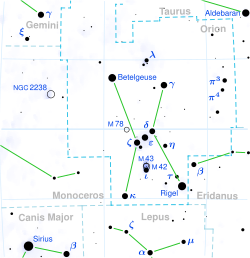
Rigel is a blue supergiant star in the equatorial constellation of Orion. It has the Bayer designation β Orionis, which is Latinized to Beta Orionis and abbreviated Beta Ori or β Ori. Rigel is the brightest and most massive component – and the eponym – of a star system of at least four stars that appear as a single blue-white point of light to the naked eye. This system is located at a distance of approximately 850 light-years (260 pc).
A star of spectral type B8Ia, Rigel is calculated to be anywhere from 61,500 to 363,000 times as luminous as the Sun, and 18 to 24 times as massive, depending on the method and assumptions used. Its radius is more than seventy times that of the Sun, and its surface temperature is 12,100 K. Due to its stellar wind, Rigel's mass-loss is estimated to be ten million times that of the Sun. With an estimated age of seven to nine million years, Rigel has exhausted its core hydrogen fuel, expanded, and cooled to become a supergiant. It is expected to end its life as a Type II supernova, leaving a neutron star or a black hole as a final remnant, depending on the initial mass of the star.
Rigel varies slightly in brightness, its apparent magnitude ranging from 0.05 to 0.18. It is classified as an Alpha Cygni variable due to the amplitude and periodicity of its brightness variation, as well as its spectral type. Its intrinsic variability is caused by pulsations in its unstable atmosphere. Rigel is generally the seventh-brightest star in the night sky and the brightest star in Orion, though it is occasionally outshone by Betelgeuse, which varies over a larger range.
A triple-star system is separated from Rigel by an angle of 9.5 arc seconds. It has an apparent magnitude of 6.7, making it 1/400th as bright as Rigel. Two stars in the system can be seen by large telescopes, and the brighter of the two is a spectroscopic binary. These three stars are all blue-white main-sequence stars, each three to four times as massive as the Sun. Rigel and the triple system orbit a common center of gravity with a period estimated to be 24,000 years. The inner stars of the triple system orbit each other every 10 days, and the outer star orbits the inner pair every 63 years. A much fainter star, separated from Rigel and the others by nearly an arc minute, may be part of the same star system.
Nomenclature
[edit]
In 2016, the International Astronomical Union (IAU) included the name "Rigel" in the IAU Catalog of Star Names.[22][23] According to the IAU, this proper name applies only to the primary component A of the Rigel system. The system is listed variously in historical astronomical catalogs as H II 33, Σ 668, β 555, or ADS 3823. For simplicity, Rigel's companions are referred to as Rigel B,[23] C, and D;[24][25] the IAU describes such names as "useful nicknames" that are "unofficial".[23] In modern comprehensive catalogs, the whole multiple star system is known as WDS 05145-0812 or CCDM 05145–0812.[8][26]
The designation of Rigel as β Orionis (Beta Orionis) was made by Johann Bayer in 1603. The "beta" designation is commonly given to the second-brightest star in each constellation, but Rigel is almost always brighter than α Orionis (Betelgeuse).[27] Astronomer James B. Kaler has speculated that Rigel was designated by Bayer during a rare period when it was outshone by the variable star Betelgeuse, resulting in the latter star being designated "alpha" and Rigel designated "beta".[24] Bayer did not strictly order the stars by brightness, instead grouping them by magnitude.[28] Rigel and Betelgeuse were both considered to be of the first magnitude class, and in Orion the stars of each class are thought to have been ordered north to south.[29] Rigel is included in the General Catalogue of Variable Stars, but since it already has a Bayer designation it has no separate variable star designation.[30]
Rigel has many other stellar designations taken from various catalogs, including the Flamsteed designation 19 Orionis (19 Ori), the Bright Star Catalogue entry HR 1713, and the Henry Draper Catalogue number HD 34085. These designations frequently appear in the scientific literature,[12][16][31] but rarely in popular writing.[25][32]
Observation
[edit]
Rigel is an intrinsic variable star with an apparent magnitude ranging from 0.05 to 0.18.[5] It is typically the seventh-brightest star in the celestial sphere, excluding the Sun, although occasionally fainter than Betelgeuse.[32] It is fainter than Capella, which may also vary slightly in brightness.[33] Rigel appears slightly blue-white and has a B-V color index of −0.06.[34] It contrasts strongly with reddish Betelgeuse.[35]
Culminating every year at midnight on 12 December, and at 9:00 pm on 24 January, Rigel is visible on winter evenings in the Northern Hemisphere and on summer evenings in the Southern Hemisphere.[27] In the Southern Hemisphere, Rigel is the first bright star of Orion visible as the constellation rises.[36] Correspondingly, it is also the first star of Orion to set in most of the Northern Hemisphere. The star is a vertex of the "Winter Hexagon", an asterism that includes Aldebaran, Capella, Pollux, Procyon, and Sirius. Rigel is a prominent equatorial navigation star, being easily located and readily visible in all the world's oceans (the exception is the area north of the 82nd parallel north).[37]
Spectroscopy
[edit]Rigel's spectral type is a defining point of the classification sequence for supergiants.[38][39] The overall spectrum is typical for a late B class star, with strong absorption lines of the hydrogen Balmer series as well as neutral helium lines and some of heavier elements such as oxygen, calcium, and magnesium.[40] The luminosity class for B8 stars is estimated from the strength and narrowness of the hydrogen spectral lines, and Rigel is assigned to the bright supergiant class Ia.[41] Variations in the spectrum have resulted in the assignment of different classes to Rigel, such as B8 Ia, B8 Iab, and B8 Iae.[16][42]
As early as 1888, the heliocentric radial velocity of Rigel, as estimated from the Doppler shifts of its spectral lines, was seen to vary. This was confirmed and interpreted at the time as being due to a spectroscopic companion with a period of about 22 days.[43] The radial velocity has since been measured to vary by about 10 km/s around a mean of 21.5 km/s.[44]
In 1933, the Hα line in Rigel's spectrum was seen to be unusually weak and shifted 0.1 nm towards shorter wavelengths, while there was a narrow emission spike about 1.5 nm to the long wavelength side of the main absorption line.[45] This is now known as a P Cygni profile after a star that shows this feature strongly in its spectrum. It is associated with mass loss where there is simultaneously emission from a dense wind close to the star and absorption from circumstellar material expanding away from the star.[45]
The unusual Hα line profile is observed to vary unpredictably. It is a normal absorption line around a third of the time. About a quarter of the time, it is a double-peaked line, that is, an absorption line with an emission core or an emission line with an absorption core. About a quarter of the time it has a P Cygni profile; most of the rest of the time, the line has an inverse P Cygni profile, where the emission component is on the short wavelength side of the line. Rarely, there is a pure emission Hα line.[44] The line profile changes are interpreted as variations in the quantity and velocity of material being expelled from the star. Occasional very high-velocity outflows have been inferred, and, more rarely, infalling material. The overall picture is one of large looping structures arising from the photosphere and driven by magnetic fields.[46]
Variability
[edit]
Rigel has been known to vary in brightness since at least 1930. The small amplitude of Rigel's brightness variation requires photoelectric or CCD photometry to be reliably detected. This brightness variation has no obvious period. Observations over 18 nights in 1984 showed variations at red, blue, and yellow wavelengths of up to 0.13 magnitudes on timescales of a few hours to several days, but again no clear period. Rigel's color index varies slightly, but this is not significantly correlated with its brightness variations.[47]
From analysis of Hipparcos satellite photometry, Rigel is identified as belonging to the Alpha Cygni class of variable stars,[48] defined as "non-radially pulsating supergiants of the Bep–AepIa spectral types".[33] In those spectral types, the 'e' indicates that it displays emission lines in its spectrum, while the 'p' means it has an unspecified spectral peculiarity. Alpha Cygni type variables are generally considered to be irregular[49] or have quasi-periods.[50] Rigel was added to the General Catalogue of Variable Stars in the 74th name-list of variable stars on the basis of the Hipparcos photometry,[51] which showed variations with a photographic amplitude of 0.039 magnitudes and a possible period of 2.075 days.[52] Rigel was observed with the Canadian MOST satellite for nearly 28 days in 2009. Milli-magnitude variations were observed, and gradual changes in flux suggest the presence of long-period pulsation modes.[18]
Mass loss
[edit]From observations of the variable Hα spectral line, Rigel's mass-loss rate due to stellar wind is estimated be (1.5±0.4)×10−7 solar masses per year (M☉/yr)—about ten million times more than the mass-loss rate from the Sun.[53] More detailed optical and K band infrared spectroscopic observations, together with VLTI interferometry, were taken from 2006 to 2010. Analysis of the Hα and Hγ line profiles, and measurement of the regions producing the lines, show that Rigel's stellar wind varies greatly in structure and strength. Loop and arm structures were also detected within the wind. Calculations of mass loss from the Hγ line give (9.4±0.9)×10−7 M☉/yr in 2006-7 and (7.6±1.1)×10−7 M☉/yr in 2009–10. Calculations using the Hα line give lower results, around 1.5×10⁻⁷ M☉/yr. The terminal wind velocity is 300 km/s.[54] It is estimated that Rigel has lost about three solar masses (M☉) since beginning life as a star of 24±3 M☉ seven to nine million years ago.[9]
Distance
[edit]
Rigel's distance from the Sun is somewhat uncertain, different estimates being obtained by different methods. Old estimates placed it 166 parsecs (or 541 light years) away from the Sun.[55] The 2007 Hipparcos new reduction of Rigel's parallax is 3.78±0.34 mas, giving a distance of 863 light-years (265 parsecs) with a margin of error of about 9%.[3] Rigel B, usually considered to be physically associated with Rigel and at the same distance, has a Gaia Data Release 3 parallax of 3.2352±0.0553 mas, suggesting a distance around 1,000 light-years (310 parsecs). However, the measurements for this object may be unreliable.[15]
Indirect distance estimation methods have also been employed. For example, Rigel is believed to be in a region of nebulosity, its radiation illuminating several nearby clouds. Most notable of these is the 5°-long IC 2118 (Witch Head Nebula),[56][57] located at an angular separation of 2.5° from the star,[56] or a projected distance of 39 light-years (12 parsecs) away.[24] From measures of other nebula-embedded stars, IC 2118's distance is estimated to be 949 ± 7 light-years (291 ± 2 parsecs).[58]
Rigel is an outlying member of the Orion OB1 association, which is located at a distance of up to 1,600 light-years (500 parsecs) from Earth. It is a member of the loosely defined Taurus-Orion R1 Association, somewhat closer at 1,200 light-years (360 parsecs).[31][59] Rigel is thought to be considerably closer than most of the members of Orion OB1 and the Orion Nebula. Betelgeuse and Saiph lie at a similar distance to Rigel, although Betelgeuse is a runaway star with a complex history and might have originally formed in the main body of the association.[42]
Stellar system
[edit]| Rigel | |||||||||||||||
| Separation = 9.5″ Period = 24,000 y | |||||||||||||||
| Ba | |||||||||||||||
| Separation = 0.58 mas Period = 9.860 d | |||||||||||||||
| Bb | |||||||||||||||
| Separation = 0.1″ Period = 63 y | |||||||||||||||
| C | |||||||||||||||
Hierarchical scheme for Rigel's components[12]
The star system of which Rigel is a part has at least four components. Rigel (sometimes called Rigel A to distinguish from the other components) has a visual companion, which is likely a close triple-star system. A fainter star at a wider separation might be a fifth component of the Rigel system.
William Herschel discovered Rigel to be a visual double star on 1 October 1781, cataloguing it as star 33 in the "second class of double stars" in his Catalogue of Double Stars,[20] usually abbreviated to H II 33, or as H 2 33 in the Washington Double Star Catalogue.[8] Friedrich Georg Wilhelm von Struve first measured the relative position of the companion in 1822, cataloguing the visual pair as Σ 668.[60][61] The secondary star is often referred to as Rigel B or β Orionis B. The angular separation of Rigel B from Rigel A is 9.5 arc seconds to its south along position angle 204°.[8][62] Although not particularly faint at visual magnitude 6.7, the overall difference in brightness from Rigel A (about 6.6 magnitudes or 440 times fainter) makes it a challenging target for telescope apertures smaller than 15 cm (6 in).[7]
At Rigel's estimated distance, Rigel B's projected separation from Rigel A is over 2,200 astronomical units (AU). Since its discovery, there has been no sign of orbital motion, although both stars share a similar common proper motion.[57][63] The pair would have an estimated orbital period of 24,000 years.[12] Gaia Data Release 3 (DR3) contains a probably unreliable parallax for Rigel B, placing it at about 1,010 light-years (309 parsecs), further away than the Hipparcos distance for Rigel, but similar to the Taurus-Orion R1 association. There is no parallax for Rigel in Gaia DR3. The Gaia DR3 proper motions for Rigel B and the Hipparcos proper motions for Rigel are both small, although not quite the same.[15]
In 1871, Sherburne Wesley Burnham suspected Rigel B to be a binary system, and in 1878, he resolved it into two components.[64] This visual companion is designated as component C (Rigel C), with a measured separation from component B that varies from less than 0.1″ to around 0.3″.[8][64] In 2009, speckle interferometry showed the two almost identical components separated by 0.124″,[65] with visual magnitudes of 7.5 and 7.6, respectively.[8] Their estimated orbital period is 63 years.[12] Burnham listed the Rigel multiple system as β 555 in his double star catalog[64] or BU 555 in modern use.[8]
Component B is a double-lined spectroscopic binary system, which shows two sets of spectral lines combined within its single stellar spectrum. Periodic changes observed in relative positions of these lines indicate an orbital period of 9.86 days. The two spectroscopic components Rigel Ba and Rigel Bb cannot be resolved in optical telescopes but are known to both be hot stars of spectral type around B9. This spectroscopic binary, together with the close visual component Rigel C, is likely a physical triple-star system,[63] although Rigel C cannot be detected in the spectrum, which is inconsistent with its observed brightness.[7]
In 1878, Burnham found another possibly associated star of approximately 13th magnitude. He listed it as component D of β 555,[64] although it is unclear whether it is physically related or a coincidental alignment. Its 2017 separation from Rigel was 44.5″, almost due north at a position angle of 1°.[8] Gaia DR2 finds it to be a 12th magnitude sunlike star at approximately the same distance as Rigel.[66] Likely a K-type main-sequence star, this star would have an orbital period of around 250,000 years, if it is part of the Rigel system.[24]
A spectroscopic companion to Rigel was reported on the basis of radial velocity variations, and its orbit was even calculated, but subsequent work suggests the star does not exist and that observed pulsations are intrinsic to Rigel itself.[63]
Physical characteristics
[edit]
Rigel is a blue supergiant that has exhausted the hydrogen fuel in its core, expanded and cooled as it moved away from the main sequence across the upper part of the Hertzsprung–Russell diagram.[5][67] When it was on the main sequence, its effective temperature would have been around 30,000 K.[68] Rigel's complex variability at visual wavelengths is caused by stellar pulsations similar to those of Deneb. Further observations of radial velocity variations indicate that it simultaneously oscillates in at least 19 non-radial modes with periods ranging from about 1.2 to 74 days.[18]
Estimation of many physical characteristics of blue supergiant stars, including Rigel, is challenging due to their rarity and uncertainty about how far they are from the Sun. As such, their characteristics are mainly estimated from theoretical stellar evolution models.[69] Its effective temperature can be estimated from the spectral type and color to be around 12,100 K.[19] A mass of 21±3 M☉ at an age of 8±1 million years has been estimated by comparing evolutionary tracks, while atmospheric modeling from the spectrum gives a mass of 24±8 M☉.[9]
Although Rigel is often considered the most luminous star within 1,000 light-years of the Sun,[27][32] its energy output is poorly known. Using the Hipparcos distance of 860 light-years (264 parsecs), the estimated relative luminosity for Rigel is about 120,000 times that of the Sun (L☉),[18] but another distance of 1,170 ± 130 light-years (360 ± 40 parsecs) suggests an even higher luminosity of 219,000 L☉.[9] Other calculations based on theoretical stellar evolutionary models of Rigel's atmosphere give luminosities anywhere between 83,000 L☉ and 363,000 L☉,[31] while summing the spectral energy distribution from historical photometry with the Hipparcos distance suggests a luminosity as low as 61,515±11,486 L☉.[17] A 2018 study using the Navy Precision Optical Interferometer measured the angular diameter as 2.526 mas. After correcting for limb darkening, the angular diameter is found to be 2.606±0.009 mas, yielding a radius of 74.1+6.1
−7.3 R☉.[17] An older measurement of the angular diameter gives 2.75±0.01 mas,[70] equivalent to a radius of 78.9 R☉ at 264 pc.[18] These radii are calculated assuming the Hipparcos distance of 264 pc; adopting a distance of 360 pc leads to a significantly larger size.[54] Older distance estimates were mostly far lower than modern estimates, leading to lower radius estimates; a 1922 estimate by John Stanley Plaskett gave Rigel a diameter of 25 million miles, or approximately 28.9 R☉, smaller than its neighbor Aldebaran.[71]
Due to their closeness to each other and ambiguity of the spectrum, little is known about the intrinsic properties of the members of the Rigel BC triple system. All three stars seem to be near equally hot B-type main-sequence stars that are three to four times as massive as the Sun.[12]
Evolution
[edit]Stellar evolution models suggest the pulsations of Rigel are powered by nuclear reactions in a hydrogen-burning shell that is at least partially non-convective. These pulsations are stronger and more numerous in stars that have evolved through a red supergiant phase and then increased in temperature to again become a blue supergiant. This is due to the decreased mass and increased levels of fusion products at the surface of the star.[68]
Rigel is likely to be fusing helium in its core.[11] Due to strong convection of helium produced in the core while Rigel was on the main sequence and in the hydrogen-burning shell since it became a supergiant, the fraction of helium at the surface has increased from 26.6% when the star formed to 32% now. The surface abundances of carbon, nitrogen, and oxygen seen in the spectrum are compatible with a post-red supergiant star only if its internal convection zones are modeled using non-homogeneous chemical conditions known as the Ledoux Criteria.[68]
Rigel is expected to eventually end its stellar life as a Type II supernova.[11] It is one of the closest known potential supernova progenitors to Earth,[18] and would be expected to have a maximum apparent magnitude of around −11 (about the same brightness as a quarter Moon or around 300 times brighter than Venus ever gets).[5] The supernova would leave behind either a black hole or a neutron star.[11]
Etymology and cultural significance
[edit]
The earliest known recording of the name Rigel is in the Alfonsine tables of 1521. It is derived from the Arabic name Rijl Jauzah al Yusrā, "the left leg (foot) of Jauzah" (i.e. rijl meaning "leg, foot"),[73] which can be traced to the 10th century.[74] "Jauzah" was a proper name for Orion; an alternative Arabic name was رجل الجبار rijl al-jabbār, "the foot of the great one", from which stems the rarely used variant names Algebar or Elgebar. The Alphonsine tables saw its name split into "Rigel" and "Algebar", with the note, et dicitur Algebar. Nominatur etiam Rigel.[b][75] Alternate spellings from the 17th century include Regel by Italian astronomer Giovanni Battista Riccioli, Riglon by German astronomer Wilhelm Schickard, and Rigel Algeuze or Algibbar by English scholar Edmund Chilmead.[73]
With the constellation representing the mythological Greek huntsman Orion, Rigel is his knee or (as its name suggests) foot; with the nearby star Beta Eridani marking Orion's footstool.[27] Rigel is presumably the star known as "Aurvandil's toe" in Norse mythology.[76] In the Caribbean, Rigel represented the severed leg of the folkloric figure Trois Rois, himself represented by the three stars of Orion's Belt. The leg had been severed with a cutlass by the maiden Bįhi (Sirius).[77] The Lacandon people of southern Mexico knew it as tunsel ("little woodpecker").[78]
Rigel was known as Yerrerdet-kurrk to the Wotjobaluk koori of southeastern Australia, and held to be the mother-in-law of Totyerguil (Altair). The distance between them signified the taboo preventing a man from approaching his mother-in-law.[79] The indigenous Boorong people of northwestern Victoria named Rigel as Collowgullouric Warepil.[80] The Wardaman people of northern Australia know Rigel as the Red Kangaroo Leader Unumburrgu and chief conductor of ceremonies in a songline when Orion is high in the sky. Eridanus, the river, marks a line of stars in the sky leading to it, and the other stars of Orion are his ceremonial tools and entourage. Betelgeuse is Ya-jungin "Owl Eyes Flicking", watching the ceremonies.[81]
The Māori people of New Zealand named Rigel as Puanga, said to be a daughter of Rehua (Antares), the chief of all stars.[82] Its heliacal rising presages the appearance of Matariki (the Pleiades) in the dawn sky, marking the Māori New Year in late May or early June. The Moriori people of the Chatham Islands, as well as some Maori groups in New Zealand, mark the start of their New Year with Rigel rather than the Pleiades.[83] Puaka is a southern name variant used in the South Island.[84]
In Japan, the Minamoto or Genji clan chose Rigel and its white color as its symbol, calling the star Genji-boshi (源氏星), while the Taira or Heike clan adopted Betelgeuse and its red color. The two powerful families fought the Genpei War; the stars were seen as facing off against each other and kept apart only by the three stars of Orion's Belt.[85][86][87]
In modern culture
[edit]The MS Rigel was originally a Norwegian ship, built in Copenhagen in 1924. It was requisitioned by the Germans during World War II and sunk in 1944 while being used to transport prisoners of war.[88] Two US Navy ships have borne the name USS Rigel.[89][90][91] The SSM-N-6 Rigel was a cruise missile program for the US Navy that was cancelled in 1953 before reaching deployment.[92]
The Rigel Skerries are a chain of small islands in Antarctica, renamed after originally being called Utskjera. They were given their current name as Rigel was used as an astrofix.[93] Mount Rigel, elevation 1,910 m (6,270 ft), is also in Antarctica.[94]
See also
[edit]Notes
[edit]- ^ Al-Sufi's book was translated into Latin and other European languages. Al-Sufi himself planned the figures, two for each constellation: one shows how they appear to an observer looking up toward the heavens; the other how they appear to the observer looking down upon a celestial globe.[72]
- ^ lit."... and it is called Algebar. It is also named Rigel."
References
[edit]- ^ Kunitzsch, Paul; Smart, Tim (2006). A Dictionary of Modern star Names: A Short Guide to 254 Star Names and Their Derivations (2nd rev. ed.). Cambridge, Massachusetts: Sky Pub. ISBN 978-1-931559-44-7.
- ^ Upton, Clive; Kretzschmar, William A. Jr. (2017). The Routledge Dictionary of Pronunciation for Current English (2nd ed.). Routledge. p. 1150. ISBN 978-1-138-12566-7.
- ^ a b c d e f van Leeuwen, F. (2007). "Validation of the new Hipparcos reduction". Astronomy and Astrophysics. 474 (2): 653–664. arXiv:0708.1752. Bibcode:2007A&A...474..653V. doi:10.1051/0004-6361:20078357. S2CID 18759600.
- ^ Ducati, J. R. (2002). "VizieR On-line Data Catalog: Catalogue of Stellar Photometry in Johnson's 11-color system". CDS/ADC Collection of Electronic Catalogues. 2237. Bibcode:2002yCat.2237....0D.
- ^ a b c d Guinan, E. F.; Eaton, J. A.; Wasatonic, R.; Stewart, H.; Engle, S. G.; McCook, G. P. (2010). "Times-Series Photometry & Spectroscopy of the Bright Blue Supergiant Rigel: Probing the Atmosphere and Interior of a SN II Progenitor". Proceedings of the International Astronomical Union. 5: 359. Bibcode:2010HiA....15..359G. doi:10.1017/S1743921310009798.
- ^ a b Epchtein, N.; et al. (March 1997). "The deep near-infrared southern sky survey (DENIS)". The Messenger. 87: 27–34. Bibcode:1997Msngr..87...27E.
- ^ a b c d Sanford, Roscoe F. (1942). "The Spectrographic Orbit of the Companion to Rigel". The Astrophysical Journal. 95: 421. Bibcode:1942ApJ....95..421S. doi:10.1086/144412.
- ^ a b c d e f g h i Mason, Brian D.; Wycoff, Gary L.; Hartkopf, William I.; Douglass, Geoffrey G.; Worley, Charles E. (2001). "The 2001 US Naval Observatory Double Star CD-ROM. I. The Washington Double Star Catalog". The Astronomical Journal. 122 (6): 3466–3471. Bibcode:2001AJ....122.3466M. doi:10.1086/323920.
- ^ a b c d e f g Przybilla, N.; Butler, K.; Becker, S. R.; Kudritzki, R. P. (2006). "Quantitative spectroscopy of BA-type supergiants". Astronomy and Astrophysics. 445 (3): 1099–1126. arXiv:astro-ph/0509669. Bibcode:2006A&A...445.1099P. doi:10.1051/0004-6361:20053832. S2CID 118953817.
- ^ a b Nicolet, B. (1978). "Photoelectric photometric Catalogue of homogeneous measurements in the UBV System". Astronomy and Astrophysics Supplement Series. 34: 1–49. Bibcode:1978A&AS...34....1N.
- ^ a b c d Moravveji, Ehsan; Moya, Andres; Guinan, Edward F. (2012). "Asteroseismology of the nearby SN-II Progenitor: Rigel. Part II. ε-mechanism Triggering Gravity-mode Pulsations?". The Astrophysical Journal. 749 (1): 74–84. arXiv:1202.1836. Bibcode:2012ApJ...749...74M. doi:10.1088/0004-637X/749/1/74. S2CID 119072203.
- ^ a b c d e f g h i j k Tokovinin, A. A. (1997). "MSC – a catalogue of physical multiple stars". Astronomy & Astrophysics Supplement Series. 124: 75–84. Bibcode:1997A&AS..124...75T. doi:10.1051/aas:1997181. S2CID 30387824.
- ^ a b Gontcharov, G. A. (2006). "Pulkovo Compilation of Radial Velocities for 35 495 Hipparcos stars in a common system". Astronomy Letters. 32 (11): 759–771. arXiv:1606.08053. Bibcode:2006AstL...32..759G. doi:10.1134/S1063773706110065. S2CID 119231169.
- ^ De Almeida, E S G.; Hugbart, M.; Domiciano De Souza, A.; Rivet, J-P; Vakili, F.; Siciak, A.; Labeyrie, G.; Garde, O.; Matthews, N.; Lai, O.; Vernet, D.; Kaiser, R.; Guerin, W. (2022). "Combined spectroscopy and intensity interferometry to determine the distances of the blue supergiants P Cygni and Rigel". Monthly Notices of the Royal Astronomical Society. 515 (1): 1–12. arXiv:2204.00372. Bibcode:2022MNRAS.515....1D. doi:10.1093/mnras/stac1617.
- ^ a b c d e Vallenari, A.; et al. (Gaia collaboration) (2023). "Gaia Data Release 3. Summary of the content and survey properties". Astronomy and Astrophysics. 674: A1. arXiv:2208.00211. Bibcode:2023A&A...674A...1G. doi:10.1051/0004-6361/202243940. S2CID 244398875. Gaia DR3 record for this source at VizieR.
- ^ a b c Shultz, M.; Wade, G. A.; Petit, V.; Grunhut, J.; Neiner, C.; Hanes, D.; MiMeS Collaboration (2014). "An observational evaluation of magnetic confinement in the winds of BA supergiants". Monthly Notices of the Royal Astronomical Society. 438 (2): 1114. arXiv:1311.5116. Bibcode:2014MNRAS.438.1114S. doi:10.1093/mnras/stt2260. S2CID 118557626.
- ^ a b c Baines, Ellyn K.; Armstrong, J. Thomas; Schmitt, Henrique R.; Zavala, R. T.; Benson, James A.; Hutter, Donald J.; Tycner, Christopher; van Belle, Gerard T. (2017). "Fundamental parameters of 87 stars from the Navy Precision Optical Interferometer". The Astronomical Journal. 155 (1): 16. arXiv:1712.08109. Bibcode:2018AJ....155...30B. doi:10.3847/1538-3881/aa9d8b. S2CID 119427037.
- ^ a b c d e f g Moravveji, Ehsan; Guinan, Edward F.; Shultz, Matt; Williamson, Michael H.; Moya, Andres (2012). "Asteroseismology of the nearby SN-II Progenitor: Rigel. Part I. The MOST High-precision Photometry and Radial Velocity Monitoring". The Astrophysical Journal. 747 (1): 108–115. arXiv:1201.0843. Bibcode:2012ApJ...747..108M. doi:10.1088/0004-637X/747/2/108. S2CID 425831.
- ^ a b c d Przybilla, N. (2010). "Mixing of CNO-cycled matter in massive stars". Astronomy and Astrophysics. 517: A38. arXiv:1005.2278. Bibcode:2010A&A...517A..38P. doi:10.1051/0004-6361/201014164. S2CID 55532189.
- ^ a b Herschel, Mr.; Watson, Dr. (1 January 1782). "Catalogue of Double Stars. By Mr. Herschel, F. R. S. Communicated by Dr. Watson, Jun". Philosophical Transactions of the Royal Society of London. 72: 112–162 [128]. Bibcode:1782RSPT...72..112H. doi:10.1098/rstl.1782.0014. S2CID 186209247. Archived (PDF) from the original on 3 May 2019. Retrieved 23 January 2020.
Read January 10, 1782
- ^ "bet Ori". SIMBAD. Centre de données astronomiques de Strasbourg. Retrieved 13 February 2019.
- ^ "IAU Catalog of Star Names". International Astronomical Union (IAU). Archived from the original on 7 July 2018. Retrieved 28 July 2016.
- ^ a b c Mamajek, Eric E.; et al. (2018). "Division C: Working Group on Star Names". In Benvenuti, Piero (ed.). Transactions IAU:Volume XXXA: Reports on Astronomy 2015–2018 (PDF). Cambridge, UK: Cambridge University Press. Archived (PDF) from the original on 23 August 2019.
- ^ a b c d Kaler, James B. (26 September 2009). "Rigel". Stars. Archived from the original on 22 April 2019. Retrieved 1 February 2019.
- ^ a b Garfinkle, Robert A. (1997). Star-hopping: your Visa to Viewing the Universe. Cambridge, United Kingdom: Cambridge University Press. pp. 70–71. ISBN 978-0-521-59889-7.
- ^ Dommanget, J.; Nys, O. (1994). "Catalogue des composantes d'etoiles doubles et multiples (CCDM) premiere edition – Catalogue of the components of double and multiple stars (CCDM) first edition". Communications de l'Observatoire Royal de Belgique. 115: 1. Bibcode:1994CoORB.115....1D.
- ^ a b c d Schaaf, Fred (2008). The Brightest Stars: Discovering the Universe through the Sky's Most Brilliant Stars. Hoboken, New Jersey: Wiley. pp. 159–162, 257. Bibcode:2008bsdu.book.....S. ISBN 978-0-470-24917-8.
- ^ Ridpath, Ian (1989). "Bayer's Uranometria and Bayer letters". Star Tales. Cambridge, United Kingdom: Lutterworth Press. ISBN 978-0-7188-2695-6.
- ^ Moore, Patrick (1996). Brilliant Stars. London: Cassell. ISBN 978-0-304-34903-6.
- ^ "Nomenclature of Variable Stars". British Astronomical Association. Archived from the original on 30 September 2016. Retrieved 11 February 2019.
- ^ a b c Markova, N.; Prinja, R. K.; Markov, H.; Kolka, I.; Morrison, N.; Percy, J.; Adelman, S. (2008). "Wind structure of late B supergiants. I. Multi-line analyses of near-surface and wind structure in HD 199 478 (B8 Iae)". Astronomy and Astrophysics. 487 (1): 211. arXiv:0806.0929. Bibcode:2008A&A...487..211M. doi:10.1051/0004-6361:200809376. S2CID 18067739.
- ^ a b c Burnham, Robert (1978) [1966]. Burnham's Celestial Handbook, Volume Two: An Observer's Guide to the Universe Beyond the Solar System. New York: Dover Publications. pp. 1299–1301. ISBN 978-0-486-23568-4.
- ^ a b Samus, N. N.; Kazarovets, E. V.; Durlevich, O. V.; Kireeva, N. N.; Pastukhova, E. N. (2017). "General Catalogue of Variable Stars". Astronomy Reports. 5.1. 61 (1): 80–88. Bibcode:2017ARep...61...80S. doi:10.1134/S1063772917010085. S2CID 125853869.
- ^ "The Colour of Stars". Australia Telescope, Outreach and Education. Commonwealth Scientific and Industrial Research Organisation. 21 December 2004. Archived from the original on 18 March 2012. Retrieved 28 June 2014.
- ^ Universe: The Definitive Visual Guide. London: Dorling Kindersley Limited. 1 October 2012. p. 233. ISBN 978-1-4093-2825-4.
- ^ Ellyard, David; Tirion, Wil (2008) [1993]. The Southern Sky Guide (3rd ed.). Port Melbourne, Victoria: Cambridge University Press. pp. 58–59. ISBN 978-0-521-71405-1.
- ^ Kerigan, Thomas (1835). Moore's Navigation Improved: Being the Theory and Practice of Finding the Latitude, the Longitude, and the Variation of the Compass, by the Fixed Stars and Planets. To which is Prefixed, the Description and Use of the New Celestial Planisphere. London: Baldwin and Cradock. p. 132.
- ^ Morgan, W. W.; Abt, Helmut A.; Tapscott, J. W. (1978). Revised MK Spectral Atlas for stars earlier than the sun. Williams Bay: Yerkes Observatory, University of Chicago, and Kitt Peak National Observatory. Bibcode:1978rmsa.book.....M.
- ^ Morgan, W. W.; Roman, Nancy G. (1950). "Revised Standards for Supergiants on the System of the Yerkes Spectral Atlas". The Astrophysical Journal. 112: 362. Bibcode:1950ApJ...112..362M. doi:10.1086/145351.
- ^ Abetti, Giorgio (1963). Solar research. New York: Macmillan. p. 16.
- ^ Morgan, William Wilson; Keenan, Philip Childs; Kellman, Edith (1943). An atlas of stellar spectra, with an outline of spectral classification. Chicago, Illinois: University of Chicago Press. Bibcode:1943assw.book.....M.
- ^ a b Bally, J. (2008). "Overview of the Orion Complex". Handbook of Star Forming Regions: 459. arXiv:0812.0046. Bibcode:2008hsf1.book..459B.
- ^ Plaskett, J. S. (1909). "The spectroscopic binary beta Orionis". The Astrophysical Journal. 30: 26. Bibcode:1909ApJ....30...26P. doi:10.1086/141674.
- ^ a b Morrison, N. D.; Rother, R.; Kurschat, N. (2008). Hα line profile variability in the B8Ia-type supergiant Rigel (β Ori). Clumping in Hot-Star Winds. p. 155. Bibcode:2008cihw.conf..155M.
- ^ a b Struve, O. (1933). "An Emission Line of Hydrogen in the Spectrum of Rigel". The Astrophysical Journal. 77: 67. Bibcode:1933ApJ....77...67S. doi:10.1086/143448.
- ^ Israelian, G.; Chentsov, E.; Musaev, F. (1997). "The inhomogeneous circumstellar envelope of Rigel (β Orionis A)". Monthly Notices of the Royal Astronomical Society. 290 (3): 521–532. Bibcode:1997MNRAS.290..521I. doi:10.1093/mnras/290.3.521.
- ^ Guinan, E. F.; McCook, G. P.; Harris, W. T.; Speranzini, D.; Wacker, S. W. (1985). "Light, Color, and H-alpha Line Variations of Rigel". Information Bulletin on Variable Stars. 2762: 1. Bibcode:1985IBVS.2762....1G.
- ^ Waelkens, C.; Aerts, C.; Kestens, E.; Grenon, M.; Eyer, L. (1998). "Study of an unbiased sample of B stars observed with Hipparcos: the discovery of a large amount of new slowly pulsating B star". Astronomy and Astrophysics. 330: 215–221. Bibcode:1998A&A...330..215W.
- ^ "Variable Star Type Designations in VSX". AAVSO. Archived from the original on 5 October 2017. Retrieved 26 April 2019.
- ^ Van Genderen, A. M.; Bovenschen, H.; Engelsman, E. C.; Goudfrooy, P.; Van Haarlem, M. P.; Hartmann, D.; Latour, H. J.; Ng, Y. K.; Prein, J. J.; Van Roermund, F. H. P. M.; Roogering, H. J. A.; Steeman, F. W. M.; Tijdhof, W. (1989). "Light variations of massive stars (alpha Cygni variables). IX". Astronomy and Astrophysics Supplement Series. 79: 263. Bibcode:1989A&AS...79..263V.
- ^ Kazarovets, E. V.; Samus, N. N.; Durlevich, O. V.; Frolov, M. S.; Antipin, S. V.; Kireeva, N. N.; Pastukhova, E. N. (1999). "The 74th Special Name-list of Variable Stars". Information Bulletin on Variable Stars. 4659: 1. Bibcode:1999IBVS.4659....1K.
- ^ Lefèvre, L.; Marchenko, S. V.; Moffat, A. F. J.; Acker, A. (2009). "A systematic study of variability among OB-stars based on HIPPARCOS photometry". Astronomy & Astrophysics. 507 (2): 1141–1201. Bibcode:2009A&A...507.1141L. doi:10.1051/0004-6361/200912304.
- ^ Chesneau, O.; Dessart, L.; Mourard, D.; Bério, Ph.; Buil, Ch.; Bonneau, D.; Borges Fernandes, M.; Clausse, J. M.; Delaa, O.; Marcotto, A.; Meilland, A.; Millour, F.; Nardetto, N.; Perraut, K.; Roussel, A.; Spang, A.; Stee, P.; Tallon-Bosc, I.; McAlister, H.; Ten Brummelaar, T.; Sturmann, J.; Sturmann, L.; Turner, N.; Farrington, C.; Goldfinger, P. J. (2010). "Time, spatial, and spectral resolution of the Hα line-formation region of Deneb and Rigel with the VEGA/CHARA interferometer". Astronomy and Astrophysics. 521: A5. arXiv:1007.2095. Bibcode:2010A&A...521A...5C. doi:10.1051/0004-6361/201014509. S2CID 10340205.
- ^ a b Chesneau, O.; Kaufer, A.; Stahl, O.; Colvinter, C.; Spang, A.; Dessart, L.; Prinja, R.; Chini, R. (2014). "The variable stellar wind of Rigel probed at high spatial and spectral resolution". Astronomy and Astrophysics. 566: A125. arXiv:1405.0907. Bibcode:2014A&A...566A.125C. doi:10.1051/0004-6361/201322894. S2CID 118404460.
- ^ Galaxy v23n06 (1965 08).
- ^ a b Guieu, S.; et al. (2010). "Spitzer Observations of IC 2118". The Astrophysical Journal. 720 (1): 46–63. arXiv:1007.0241. Bibcode:2010ApJ...720...46G. doi:10.1088/0004-637X/720/1/46. S2CID 119262311.
- ^ a b Jedicke, Peter; Levy, David H. (1992). "Regal Rigel". The New Cosmos. Waukesha, Wisconsin: Kalmbach Books. pp. 48–53.
- ^ Kounkel, Marina; et al. (2018). "The APOGEE-2 Survey of the Orion Star-forming Complex. II. Six-dimensional Structure". The Astronomical Journal. 156 (3): 22. arXiv:1805.04649. Bibcode:2018AJ....156...84K. doi:10.3847/1538-3881/aad1f1. S2CID 119509277. 84.
- ^ Racine, R. (1968). "Stars in reflection nebulae". The Astronomical Journal. 73: 233. Bibcode:1968AJ.....73..233R. doi:10.1086/110624.
- ^ Struve, Friedrich Georg Wilhelm (1827). Catalogus novus stellarum duplicium et multiplicium maxima ex parte in Specula Universitatis Caesareae Dorpatensis per magnum telescopium achromaticum Fraunhoferi detectarum. Dorpati Livonorum: J.C. Schuenmann.
- ^ Webb, T. W. (1917). Celestial Objects for Common Telescopes. London: Longmans, Green and Co. p. 218. Archived from the original on 4 April 2016. Retrieved 7 March 2019.
- ^ Bakich, Michael E. (2010). 1,001 Celestial Wonders to See Before You Die. New York: Springer. p. 434. Bibcode:2010ocws.book.....B. ISBN 978-1441917775. Archived from the original on 1 February 2019. Retrieved 1 February 2019.
- ^ a b c Pourbaix, D.; et al. (2004). "SB9: The ninth catalogue of spectroscopic binary orbits". Astronomy and Astrophysics. 424 (2): 727–732. arXiv:astro-ph/0406573. Bibcode:2004A&A...424..727P. doi:10.1051/0004-6361:20041213. S2CID 119387088.
- ^ a b c d Burnham, S.W. (1900). "A General Catalogue of the Double Stars discovered by S. W. Burnham from 1871 to 1899, arranged in order of Right Ascension". Publications of the Yerkes Observatory. 1: 59–60. Bibcode:1900PYerO...1....1B.
- ^ Mason, Brian D.; Hartkopf, William I.; Gies, Douglas R.; Henry, Todd J.; Helsel, John W. (2009). "The High Angular Resolution Multiplicity of Massive Stars". The Astronomical Journal. 137 (2): 3358. arXiv:0811.0492. Bibcode:2009AJ....137.3358M. doi:10.1088/0004-6256/137/2/3358. S2CID 119268845.
- ^ Brown, A. G. A.; et al. (Gaia collaboration) (August 2018). "Gaia Data Release 2: Summary of the contents and survey properties". Astronomy & Astrophysics. 616. A1. arXiv:1804.09365. Bibcode:2018A&A...616A...1G. doi:10.1051/0004-6361/201833051. Gaia DR2 record for this source at VizieR.
- ^ Seeds, Michael A.; Backman, Dana (2015). Foundations of Astronomy. Boston, Massachusetts: Cengage Learning. p. 274. ISBN 978-1-305-56239-4.
- ^ a b c Georgy, Cyril; Saio, Hideyuki; Meynet, Georges (2014). "The puzzle of the CNO abundances of α Cygni variables resolved by the Ledoux criterion". Monthly Notices of the Royal Astronomical Society: Letters. 439: L6–L10. arXiv:1311.4744. Bibcode:2014MNRAS.439L...6G. doi:10.1093/mnrasl/slt165. S2CID 118557550.
- ^ Demarque, P.; Guenther, D. B.; Li, L. H.; Mazumdar, A.; Straka, C. W. (August 2008). "YREC: the Yale rotating stellar evolution code". Astrophysics and Space Science. 316 (1–4): 31–41. arXiv:0710.4003. Bibcode:2008Ap&SS.316...31D. doi:10.1007/s10509-007-9698-y. ISBN 978-1402094408. S2CID 14254892.
- ^ Aufdenberg, J. P.; et al. (2008). "Limb Darkening: Getting Warmer". In Richichi A.; Delplancke F.; Paresce F.; Chelli A. (eds.). The Power of Optical/IR Interferometry. Eso Astrophysics Symposia. Vol. 1. Berlin: Springer. pp. 71–82. Bibcode:2008poii.conf...71A. doi:10.1007/978-3-540-74256-2_8. ISBN 978-3-540-74253-1.
- ^ Plaskett, J. S. (1922). "The Dimensions of the Stars". Publications of the Astronomical Society of the Pacific. 34 (198): 79–93. Bibcode:1922PASP...34...79P. doi:10.1086/123157. ISSN 0004-6280. JSTOR 40668597.
- ^ Langermann, Y. Tzvi (2018). "Mathematics, Astronomy, and Astrology". In Casagrande-Kim, Roberta; Thrope, Samuel; Ukeles, Raquel (eds.). Romance and Reason: Islamic Transformations of the Classical Past. Princeton, New Jersey: Princeton University Press. pp. 92–93. ISBN 978-0-691-18184-4.
- ^ a b Allen, Richard Hinckley (1963) [1899]. Star Names: Their Lore and Meaning (Reprint ed.). New York: Dover Publications Inc. pp. 312–313. ISBN 978-0-486-21079-7.
{{cite book}}: ISBN / Date incompatibility (help) - ^ Kunitzsch, Paul (1959). Arabische Sternnamen in Europa (in German). Wiesbaden: Otto Harrassowitz. p. 46.
- ^ Kunitzsch, P. (1986). "The Star Catalogue Commonly Appended to the Alfonsine Tables". Journal for the History of Astronomy. 17 (2): 89–98. Bibcode:1986JHA....17...89K. doi:10.1177/002182868601700202. S2CID 118597258.
- ^ Cleasby, Richard; Vigfusson, Gudbrand (1874). An Icelandic-English Dictionary. Oxford, United Kingdom: Clarendon Press.
- ^ Taylor, Douglas (1946). "Notes on the Star Lore of the Caribbees". American Anthropologist. 48 (2): 215–222. doi:10.1525/aa.1946.48.2.02a00030. JSTOR 663691.
- ^ Milbrath, Susan (1999). Star Gods of the Maya: Astronomy in Art, Folklore, and Calendars. Austin, Texas: University of Texas Press. p. 39. ISBN 978-0-292-75226-9.
- ^ Mudrooroo (1994). Aboriginal mythology : an A-Z spanning the history of aboriginal mythology from the earliest legends to the present day. London: HarperCollins. p. 142. ISBN 978-1-85538-306-7.
- ^ Hamacher, Duane W.; Frew, David J. (2010). "An Aboriginal Australian Record of the Great Eruption of Eta Carinae". Journal of Astronomical History & Heritage. 13 (3): 220–234. arXiv:1010.4610. Bibcode:2010JAHH...13..220H. doi:10.3724/SP.J.1440-2807.2010.03.06. S2CID 118454721.
- ^ Harney, Bill Yidumduma; Cairns, Hugh C. (2004) [2003]. Dark Sparklers (Revised ed.). Merimbula, New South Wales: Hugh C. Cairns. pp. 139–140. ISBN 978-0-9750908-0-0.
- ^ Parker, Janet; Mills, Alice; Stanton, Julie (2007). Mythology: Myths, Legends and Fantasies. New York: Struik Publishers. p. 419. ISBN 978-1-77007-453-8. Archived from the original on 2 January 2014. Retrieved 3 November 2016.
- ^ Kelley, David H.; Milone, Eugene F. (2011). Exploring Ancient Skies: A Survey of Ancient and Cultural Astronomy. New York: Springer. p. 341. ISBN 978-1-4419-7623-9.
- ^ Best, Elsdon (1922). Astronomical Knowledge of the Maori: Genuine and Empirical. Wellington, New Zealand: Dominion Museum. pp. 39–40. Archived from the original on 4 November 2012. Retrieved 16 November 2012.
- ^ Renshaw, Steve; Ihara, Saori (October 1999). "Yowatashi Boshi; Stars that Pass in the Night". Renshaw Works. Retrieved 16 June 2020.
- ^ "Akira Matsumura (1988). 大辞林 [Daijirin] (in Japanese). Tokyo: Sanseidō. ISBN 978-4-385-14001-8.
- ^ Nojiri, Hōei (2002). Shin seiza jyunrei. Tokyo: Chuokoron-Shinsha. p. 19. ISBN 978-4-12-204128-8.
- ^ "MS. Rigel". Minnehallen (The Memorial Hall) (in Norwegian). Archived from the original on 4 February 2019. Retrieved 5 January 2019.
- ^ Silverstone, Paul H. (1968). U.S. Warships of World War II. Garden City, New York: Doubleday & Company. p. 283.
- ^ "NH 1874 USS RIGEL (AD-13), 1922-46". Naval History and Heritage Command. Archived from the original on 18 May 2019. Retrieved 14 June 2020.
- ^ Yenne, Bill (2018). The Complete History of U.S. Cruise Missiles. Forest Lake, Minnesota: Specialty Press. p. 69. ISBN 978-1-58007-256-4.
- ^ "Antarctica Detail: ID 12640". U.S. Geological Survey. U.S. Department of the Interior. Archived from the original on 2 February 2019. Retrieved 2 February 2019.
- ^ "Antarctica Detail: ID 12639". U.S. Geological Survey. U.S. Department of the Interior. Archived from the original on 5 November 2020. Retrieved 2 February 2019.
External links
[edit]
- NASA Astronomy Picture of the Day: Rigel and the Witch Head Nebula (15 January 2018)
- NASA Astronomy Picture of the Day: A Blazing Fireball between the Orion Nebula and Rigel (16 November 2015)
- December double star of the month – beta Orionis Astronomical Society of Southern Africa
- My Favorite Double Star AAVSO
| Stars |
| ||||||||||||
|---|---|---|---|---|---|---|---|---|---|---|---|---|---|
| |||||||||||||
| Star clusters |
| ||||||||||||
| Nebulae |
| ||||||||||||
| Galaxies |
| ||||||||||||
| |||||||||||||
| |||||||||||||


Rigel
View on GrokipediaIdentification and Nomenclature
Nomenclature
Rigel holds the Bayer designation Beta Orionis (β Orionis), assigned by the German astronomer Johann Bayer in his 1603 star atlas Uranometria, where Greek letters were used to label stars in each constellation primarily according to their apparent brightness, with beta indicating the second-brightest in Orion.[12] In the Flamsteed system, introduced by English Astronomer Royal John Flamsteed and published posthumously in 1725 as part of Historia Coelestis Britannica, Rigel is designated 19 Orionis, reflecting a numerical ordering of stars within constellations based on their right ascension.[13] Rigel is cataloged in several key 20th-century astronomical surveys, including the Henry Draper Catalogue (HD 34085), which provided spectroscopic classifications for over 225,000 stars when published between 1918 and 1924; the Harvard Revised Photometry (HR 1713), a magnitude catalog from the early 1900s; and the Hipparcos Catalogue (HIP 24436), released in 1997 as the first precise astrometric survey from space.[14] While Beta Orionis serves as the formal systematic name in astronomical nomenclature, "Rigel" has become the predominant proper name in both scientific and popular contexts, originating from traditional Arabic stellar designations but persisting through widespread adoption in modern references.[15] The 17th- and 18th-century catalogs by Bayer and Flamsteed established enduring conventions for stellar identification, enabling consistent referencing across subsequent surveys and facilitating the integration of Rigel into comprehensive databases like those from the International Astronomical Union.Etymology and Historical Names
The name "Rigel" derives from the Arabic phrase Rijl Jauzāʾ al-Yusra, meaning "the left leg of the central one" or "left foot of Jauzāʾ" (the Arabic name for Orion), where rijl specifically denotes "foot" or "leg."[16] This designation reflects the star's position as the left foot of the hunter figure in the Orion constellation, as documented in medieval Arabic astronomical texts.[17] The term entered European astronomy through Latin translations of Arabic works during the medieval period, with the first recorded use in English appearing in the 1590s as "Rigel Algeuze," a partial transliteration that later simplified to "Rigel."[16] Earlier variants include "Algebar" or "Elgebar," derived from Arabic terms for Orion's foot, which appeared in European poetry and star catalogs before the 16th century. In ancient Greek astronomy, Rigel was referenced without a proper name in Ptolemy's Almagest (2nd century CE) as the prominent star marking the left knee or foot of the Orion figure, part of a detailed catalog of 48 constellations. Beyond Arabic traditions, Rigel holds names in other cultures tied to its role in Orion. In Chinese astronomy, it is known as 参宿七 (Cān Xiù Qī), the seventh star of the Shēn (Participation) asterism, which encompasses Orion's key stars extending from the belt.[18] In Hindu lore, it appears as part of the hunter's foot in the Mrigavyādha (Deer Hunter) constellation, symbolizing the pursuit in Vedic star myths.[19] In various Native American traditions, Rigel forms part of a hunter's figure or an arrow in myths depicting Orion's pursuits.[20]Position and Observational Properties
Location and Visibility
Rigel occupies equatorial coordinates of right ascension 05h 14m 32.3s and declination -08° 12' 06" (epoch J2000.0).[8] These coordinates place it in the southern portion of the constellation Orion, near the celestial equator, allowing visibility from both hemispheres for much of the year. With an apparent visual magnitude of 0.13, Rigel ranks as the seventh-brightest star in the night sky, surpassed only by Sirius, Canopus, Arcturus, Alpha Centauri, Vega, and Capella.[21] This brilliance makes it a prominent naked-eye object, shining with a striking blue-white hue that distinguishes it from the constellation's other notable stars. As the brightest member of Orion, Rigel represents the hunter's left foot in classical mythology, anchoring the lower left of the figure formed by the constellation's key stars.[8] In the Northern Hemisphere, Rigel achieves optimal visibility during winter evenings, when it rises in the southeast shortly after sunset around November and climbs high in the southern sky by midnight.[22] By December through February, it remains prominent until dawn, though it dips below the horizon earlier in spring. Its position contributes to larger winter asterisms, aligning visually with the Winter Triangle—formed by Betelgeuse in Orion, Sirius in Canis Major, and Procyon in Canis Minor—to create a striking pattern low in the southeastern sky.[23] For amateur observers, Rigel is straightforward to locate by extending an imaginary line downward from the three stars of Orion's Belt (Alnitak, Alnilam, and Mintaka), which point directly toward it.[24] Even in moderately light-polluted areas, its intensity ensures easy detection without optical aid. Binoculars enhance the view by resolving Rigel's faint visual companions, including a seventh-magnitude secondary separated by about 9 arcseconds, offering a rewarding double-star observation for beginners.[25]Spectroscopy and Classification
Rigel is classified as a B8Ia supergiant, characterized by prominent absorption lines of neutral helium and strong Balmer series lines of hydrogen in its optical spectrum, which indicate a high effective temperature around 12,000 K. These features place it firmly within the B spectral class, where helium lines reach significant strength while hydrogen lines remain prominent before weakening toward hotter O-type stars. The "Ia" luminosity class denotes its supergiant status, evidenced by broad line profiles due to low surface gravity and an extended atmosphere. Key spectral diagnostics include enhancements in nitrogen abundance, a signature of CNO cycle processing and convective mixing that brings processed material to the surface in massive evolved stars like Rigel. Ionized metal lines, particularly from Si III near 4552 Å and Si IV in the ultraviolet, are also prominent and used to refine the subtype, with Si III weakening at later B subtypes while Si IV strengthens with temperature. These metallic features, along with lines from C II and O II, contribute to line blanketing that affects the overall spectral energy distribution. The classification traces back to early spectroscopic observations by Angelo Secchi in the 1860s, who identified Rigel as a blue-white star with sharp absorption lines, assigning it to his Type II class alongside stars like Vega and Sirius. This early recognition of its hot nature was later refined in the Harvard classification system developed by Annie Jump Cannon around 1901, where Rigel received the B designation based on the relative strengths of hydrogen and helium lines in photographic spectra.[26] Rigel's projected rotational velocity is measured at km/s, indicating moderate rotation for a supergiant, which broadens spectral lines without excessive equatorial speeds that might disrupt its envelope.[27] Atmospheric modeling employs hybrid non-LTE techniques built on LTE model atmospheres, such as those from Kurucz grids, to account for deviations from local thermodynamic equilibrium in the extended layers, where line formation occurs under non-uniform conditions and reveals inconsistencies in LTE predictions for UV fluxes and line profiles.Variability and Pulsations
Rigel exhibits intrinsic photometric variability characteristic of an α Cygni-type variable star, with brightness fluctuations arising from non-radial pulsations in its extended envelope.[27] These variations typically span a full amplitude of approximately 0.13 magnitudes in the V-band, ranging from about 0.05 to 0.18 mag, as observed across multiple photometric datasets.[28] The star's pulsational behavior is semi-regular, lacking strict periodicity but showing dominant modes that contribute to the overall instability of its atmosphere. High-precision space-based photometry from the MOST satellite has revealed at least 19 significant pulsation modes, with periods ranging from 1.21 to 74.7 days and photometric amplitudes between 1.1 and 6.8 mmag.[27] Earlier Hipparcos observations confirmed this variability, detecting fluctuations consistent with the shorter-period modes, though with lower precision due to the satellite's design for brighter stars.[28] Theoretical models attribute these pulsations primarily to the ε-mechanism operating in the hydrogen-burning shell, exciting low-order gravity modes (periods ~1–21 days) and higher-order pressure modes (periods ~21–127 days), which align with the observed range.[29] Supporting evidence for these pulsations comes from high-resolution spectroscopic observations, which show systematic line profile variations in lines such as Hα, indicative of velocity fields in the stellar atmosphere driven by non-radial oscillations.[30] Ground-based surveys like the All Sky Automated Survey (ASAS) have captured longer-term trends in Rigel's light curve, suggesting possible cycles around several months potentially linked to deep convective processes or interactions within the stellar system, though these remain tentative.[31] Gaia Data Release 3 photometry (based on observations from 2014 to 2017), reinforces the multi-periodic nature of the variability, with statistical parameters highlighting the need for multi-epoch observations to account for these fluctuations in precise measurements.[32] Such variability complicates absolute photometry of Rigel, often requiring corrections from contemporaneous datasets to achieve accurate flux determinations.Mass Loss and Stellar Winds
Rigel's stellar wind is characterized by a mass-loss rate of approximately , with estimates ranging from to based on near-infrared interferometric observations and radiative transfer modeling of Hα and Brγ line profiles over multiple epochs.[33] Earlier determinations from ultraviolet P Cygni profiles in resonance lines such as Mg II yielded higher values around , while radio continuum free-free emission measurements indicate , assuming a fully ionized wind.[34] These variations highlight the wind's time-dependent nature, with changes of about 20% detected between observational epochs separated by roughly one year.[33] The wind reaches a terminal velocity of approximately 230–300 km s, as inferred from the blue-shifted absorption in UV Mg II resonance lines and confirmed through non-local thermodynamic equilibrium modeling.[33] Acceleration occurs gradually, with the wind's velocity law extending the acceleration zone to 10–20 stellar radii, consistent with the extended line-forming region observed in high-resolution spectroscopy of Hα, where emission wings extend to velocities indicating a hot, optically thin component.[30][33] The primary driving mechanism for Rigel's wind is radiation pressure exerted on spectral lines, as described by the Castor–Abbott–Klein (CAK) theory, where momentum transfer from continuum photons to ions via numerous ultraviolet resonance lines accelerates the outflow.[35] This process is likely enhanced by the star's pulsations, which may modulate the wind base density and trigger episodic mass ejections, though the exact coupling remains under study.[36] Wind clumping, with volume-filling factors implying overdensities by factors of 2–3, reduces the effective mass-loss rate derived from smooth-wind models by a similar amount, as clumped structures alter emission measures in radio and optical diagnostics.[33] Recent high-angular-resolution studies, including spectro-interferometry with the VLTI in the 2010s and intensity interferometry combined with spectroscopy in the 2020s, have resolved asymmetries in the wind structure, manifesting as azimuthal perturbations and time-variable differential phases that suggest large-scale instabilities or co-rotating features extending to several stellar radii.[33][37] Post-2015 ultraviolet and radio data continue to refine these models, indicating ongoing variability in the wind's ionization and geometry beyond earlier datasets.[37]Stellar System
Primary Star
The primary component of the Rigel system, designated Rigel A or Aa, is a luminous blue supergiant star of spectral type B8Ia that dominates the system's visual appearance. No inner binary orbit has been resolved for this component through direct imaging or spectroscopy, though radial velocity variations observed over multiple years suggest the possibility of an undetected close companion influencing its pulsational behavior.[27] Stellar evolution models indicate that Rigel Aa is currently in a post-main-sequence phase dominated by core helium burning, with a surrounding hydrogen-burning shell. The core features a convective region extended by overshooting from the helium-burning zone, while the extended envelope remains largely radiative, facilitating efficient energy transport outward. These models further reveal approximately 10% depletion of central hydrogen abundance, consistent with the star's transition from core hydrogen exhaustion to shell burning.[38][39] Interferometric observations have resolved surface features on Rigel Aa, including granulation patterns arising from shallow convective motions in the outer layers. Using the CHARA Array, measurements yield a limb-darkened angular diameter of approximately 0.0035 arcseconds, allowing detection of these convective cells that contribute to the star's variability. Recent interferometric studies in the 2020s have also imaged polar brightening effects, attributed to rotational distortion and temperature gradients across the stellar surface.[40][33] Rigel Aa exhibits slow rotation, with an equatorial rotation period estimated at around 3 months, inferred from variability timescales in its stellar wind and line profiles. The star possesses a weak surface magnetic field, with strengths below 1 gauss, insufficient to significantly influence its wind dynamics or produce observable spot modulations.[33][27]Companion Stars
The Rigel system contains a prominent companion subsystem designated as component B, gravitationally bound to the primary through shared proper motions confirmed by Gaia Data Release 3 observations. Component B is a main-sequence B9V spectroscopic binary (Ba and Bb) with an apparent visual magnitude of 6.7 and an angular separation of 9.5 arcseconds from Rigel A, equivalent to roughly 2,200 AU at the system's estimated distance of 260 parsecs.[41] This companion was first resolved visually by astronomer Friedrich Georg Wilhelm Struve in 1831 using a refractor telescope at the Dorpat Observatory.[42] The Ba and Bb components form a close spectroscopic binary with an orbital period of approximately 9.9 days.[41] Rigel C, a B9V main-sequence star with apparent magnitude ~7.6, forms a close visual triple with the B subsystem, separated from Rigel B by 0.1–0.3 arcseconds (~25–80 AU). Rigel C was resolved from Rigel B in 2009 through high-resolution observations revealing relative motion.[41] A 2022 study using Gaia DR3 data and stellar modeling estimates the system distance at 848 ± 64 light-years.[43] Spectral analyses indicate that the companions are young stars, with ages around 8–10 million years based on their main-sequence positions and lithium abundances, consistent with co-eval formation with the primary within the Orion OB1 association.[42] Hubble Space Telescope imaging surveys have probed for additional faint companions beyond the BC subsystem, revealing potential low-mass candidates such as a magnitude 13 star at ~44.5 arcseconds but lacking confirmation of physical association due to limited proper motion data.[44]System Dynamics
The Rigel system is a hierarchical quadruple star configuration, with the primary blue supergiant (Rigel Aa) orbited by the distant companion subsystem consisting of the spectroscopic binary Rigel Ba/Bb and the visual companion Rigel C. The Ba and Bb components form a close spectroscopic binary with an orbital period of approximately 9.9 days, as determined from periodic variations in their spectral lines.[41] This short-period orbit is detected solely through spectroscopy, as the components are too close for direct resolution. Rigel C orbits the Ba/Bb pair with a separation of 0.1–0.3 arcseconds (~25–80 AU), implying an orbital period of about 63 years based on Kepler's third law and the combined mass of the inner binary.[41] The entire Rigel BC subsystem orbits the primary Aa at an average separation of approximately 2,200 AU (corresponding to 9.5 arcseconds at the system's distance), with an estimated orbital period of around 24,000 years.[42] This long-period orbit remains incomplete in astrometric observations, as the system's age is insufficient to have completed even a fraction of one revolution since formation; current position and proper motion data provide only a snapshot of the relative geometry. Historical astrometric measurements suggest no significant relative motion between Aa and the BC subsystem over the past century, consistent with the expected slow orbital evolution.[45] The system exhibits a common proper motion of μ_α = +1.31 mas/yr and μ_δ = +0.50 mas/yr, shared by the primary and the BC subsystem, confirming their gravitational binding rather than a chance alignment.[41] Data from Gaia DR3 have refined these proper motions to higher precision, reducing uncertainties and strengthening evidence for co-motion, though slight differences (on the order of 0.1 mas/yr) between Aa and B hint at subtle orbital curvature that could further constrain the outer orbit in future releases. Note that Gaia parallaxes for the bright primary are unreliable due to saturation effects.[32] Rigel's hierarchical structure—characterized by a tight inner binary (Ba/Bb) embedded in a wider triple (with C) that in turn orbits the distant primary—promotes dynamical stability by minimizing close encounters that could lead to ejections. N-body simulations of analogous hierarchical quadruple systems demonstrate that such configurations remain stable over gigayears, with perturbation energies damped by the large semi-major axis ratios (typically >10 for the outer orbits), preventing chaotic interactions.[46] Due to the substantial separations (minimum ~25 AU for inner subsystems and >2,000 AU for the outer), tidal interactions between components are negligible, exerting no measurable influence on the primary's rotation or envelope structure. Similarly, accretion of the primary's strong stellar wind onto the BC subsystem is insignificant, as the wind's terminal velocity (~1,000 km/s) and radial dilution over thousands of AU result in mass transfer rates below 10^{-12} M_⊙/yr, far too low to affect the companions' evolution.[45] Recent analyses incorporating Gaia DR3 astrometry (2022) have tightened constraints on the relative positions and velocities within the system, enabling more accurate mass estimates for the outer orbit and ruling out unbound scenarios. However, the spectroscopic binary status of the primary Aa remains unresolved; early 20th-century observations suggested a possible close companion with a period of several years, but modern high-resolution spectra show no confirmed radial velocity variations, leaving this aspect an active area of research.[47]Physical Characteristics
Distance and Parallax
The distance to Rigel is determined primarily through trigonometric parallax measurements, with the most recent independent confirmation coming from combined spectroscopy and intensity interferometry, yielding 260 ± 20 pc (848 ± 65 ly).[43] This value aligns closely with the revised Hipparcos parallax of 3.78 ± 0.34 mas, equivalent to 265 ± 24 pc. Due to Rigel's extreme brightness (G ≈ 0.13 mag), it saturates Gaia's detectors, preventing reliable parallax measurements from the mission's Data Release 3 (2022); thus, Hipparcos remains the benchmark astrometric reference.[43] The fundamental relation for distance (in parsecs) from parallax (in arcseconds) is , with error propagation approximated by . Historical efforts highlight the challenges: the original 1997 Hipparcos catalogue reported mas, implying a distance of 237 ± 46 pc that underestimated Rigel's luminosity and conflicted with spectroscopic models. Subsequent reanalysis with improved orbital and attitude data revised the parallax downward, supporting distances around 260 pc and resolving prior inconsistencies. Ground-based long-baseline intensity interferometry provides an alternative validation, confirming distances near 250 pc by modeling the star's angular diameter and spectral energy distribution.[43] Key uncertainties stem from low interstellar extinction along the line of sight ( mag) and the influence of Rigel's close companions, which shift the measured parallax from the primary's true position to the system's photocenter.[43] Bayesian frameworks incorporating multi-wavelength photometry address these by prior-constraining the distance distribution. This precise distance is essential for scaling angular measurements to physical sizes, enabling accurate assessments of Rigel's radius and luminosity.[43] As of 2025, ongoing refinements from anticipated Gaia Data Release 4 may incorporate enhanced bright-star processing, though current interferometric results show no significant deviation from Hipparcos-era values.Size, Mass, and Temperature
Rigel's radius is estimated at 78 ± 4 solar radii (R⊙), derived primarily from long-baseline optical interferometry measurements of its angular diameter combined with parallax-based distance determinations. Observations with the CHARA Array using the FLUOR beam combiner yielded a limb-darkened angular diameter of 2.75 ± 0.01 milliarcseconds (mas) in the K-band.[27][48] Complementary measurements from the VLTI with the IONIC interferometer confirm a similar value of approximately 2.76 mas.[49] These angular sizes, when converted to physical dimensions using a distance of about 264 parsecs, establish the star's large extent as a hallmark of its supergiant status.[27] The mass of Rigel's primary component is estimated to range from 18 to 21 solar masses (M⊙), obtained by matching observed spectroscopic properties to stellar evolutionary models and isochrones. This range arises from comparisons with Geneva and other post-main-sequence tracks for B-type supergiants, accounting for factors like rotation and mass loss.[27][50] Atmospheric modeling further supports a value around 21 ± 3 M⊙ when calibrated against pulsation data and surface abundances.[29] Rigel's effective temperature is 12,100 ± 200 K, determined through non-local thermodynamic equilibrium (non-LTE) spectral synthesis fitting to ultraviolet and optical line profiles, particularly of hydrogen, helium, and metals. This hot temperature classifies it as a blue supergiant and is consistent with blackbody approximations to its spectral energy distribution.[51] The associated surface gravity is low, with log g ≈ 1.8 (in cgs units), reflecting the star's expanded envelope and low mean density typical of evolved massive stars.[51] Such parameters are interconnected via the relation for radius from angular measurements, where the physical radius R follows from R = (θ d)/2, with θ the angular diameter and d the distance, or alternatively through spectral fitting that integrates temperature and gravity constraints.[27]Luminosity and Surface Gravity
Rigel's bolometric luminosity is 120,000 ± 20,000 L⊙, determined by integrating its spectral energy distribution across ultraviolet to infrared wavelengths using non-local thermodynamic equilibrium model atmospheres. This immense energy output underscores its status as one of the most luminous stars in the solar neighborhood, far exceeding the Sun's output by five orders of magnitude. The absolute visual magnitude, corrected for interstellar extinction, is approximately M_V = -7.8, reflecting its intrinsic brightness in the V-band after accounting for distance and dust absorption effects.[27] Surface gravity for Rigel is characterized by log g = 1.75 ± 0.1 cm/s², a low value typical of supergiants due to their expanded envelopes. This parameter is derived from the broadening of spectral line wings, analyzed through detailed fitting with hybrid non-LTE spectral synthesis models that incorporate atmospheric stratification and line formation physics. Energy transport within Rigel's envelope occurs primarily through radiative processes, where photons diffuse outward from the interior.[29] These luminosity and gravity estimates rely on flux measurements from Johnson UBV optical photometry and 2MASS near-infrared surveys, combined with parallax-based distance determinations.[27] The derived quantities incorporate inputs such as effective temperature and stellar radius from spectroscopic analyses.Stellar Evolution
Current Evolutionary Stage
Rigel is currently a core helium-burning supergiant in the post-main-sequence phase of its evolution, with an age of approximately 8 to 10 million years, following a brief excursion toward the red supergiant region during its early post-main-sequence development.[52] This stage places it on the Hertzsprung-Russell diagram among luminous blue supergiants, where it has expanded significantly after exhausting core hydrogen fuel. The primary nuclear process in Rigel's core is the triple-alpha reaction, fusing three helium nuclei to form carbon, which in turn initiates further helium burning to produce oxygen. Surrounding the inert helium core is a hydrogen-burning shell dominated by the CNO cycle, processing carbon, nitrogen, and oxygen isotopes. The star's surface composition reflects this internal nucleosynthesis, showing enhanced nitrogen abundances with an observed N/C ratio of 2.0, indicative of material dredged up from deeper layers during prior evolutionary phases.[53] Evolutionary models computed using the MESA code reproduce Rigel's position on the Hertzsprung-Russell diagram with an initial zero-age main-sequence mass of around 19 M⊙ and solar metallicity, implying a current mass of about 18 M⊙ after losing approximately 1 M⊙ through stellar winds.[29] Similarly, Geneva evolution tracks and rotational models suggest initial masses near 20–25 M⊙, aligning with Rigel's parameters during core helium burning and accounting for moderate mass loss and rotational effects that influence the blue supergiant loop.[54][55] Key indicators of this phase include Rigel's high luminosity of around 120,000 L⊙ and the observed nitrogen enhancement, which distinguish it from main-sequence counterparts and confirm the extent of convective mixing.[53] Additionally, the star exhibits pulsations driven by the ε-mechanism in helium-burning layers and partial ionization zones in the envelope, providing data for asteroseismic modeling that constrains core structure and composition in 2020s studies.[56]Past and Future Evolution
Rigel formed approximately 8 to 10 million years ago within the Orion OB1 association, originating from the gravitational collapse of a massive molecular cloud in the Orion molecular cloud complex. This star-forming region, one of the nearest sites of ongoing massive star birth, provided the dense gas reservoir necessary for the rapid formation of high-mass stars like Rigel.[57][45] In its early evolutionary history, Rigel spent roughly 3 million years on the main sequence, where core hydrogen fusion powered its luminosity as an O-type star with an initial mass estimated at 20–25 solar masses based on various models. Following hydrogen exhaustion, it underwent rapid expansion and cooling, ascending to the supergiant phase; evolutionary tracks indicate a possible excursion into the red supergiant regime before looping back to its current blue supergiant state due to enhanced mass loss and mixing processes.[29][55] Looking ahead, Rigel is projected to deplete its core helium reserves in about 0.3 million years, triggering further contraction and the ignition of heavier elements until iron core formation leads to a core-collapse Type II supernova. This cataclysmic event will eject outer layers at high velocities, leaving a compact remnant of 1.4 to 2 solar masses—most likely a neutron star, though a black hole remains possible if convective overshooting or fallback increases the core mass. Stellar evolution models, including those computed with the Modules for Experiments in Stellar Astrophysics (MESA) code, forecast escalating mass loss rates that could transition Rigel into a Wolf-Rayet phase characterized by strong stellar winds and exposed helium-burning layers. However, uncertainties persist due to potential binary interactions with its detected companions (Rigel B, C, and D), whose orbits have been refined by Gaia astrometry; such interactions might induce mass transfer or envelope stripping, deviating from single-star predictions, and current simulations inadequately incorporate these multi-body dynamics.[29][27][58]Role in Orion Association
Rigel is classified as an outlying member of the Orion OB1 association, a large grouping of young, massive O- and B-type stars formed within the Orion Molecular Cloud Complex.[42] It is associated with the OB1b subgroup, which encompasses the stars of Orion's Belt and extends southward toward Rigel, sharing an approximate age of 8–10 million years with coeval massive stars in the region.[59][41] The star's kinematics indicate it may be a runaway from the core of the association, having been dynamically ejected early in its life, which explains its current position displaced from the denser OB1 subgroups. Its proper motion and radial velocity are consistent with motion away from the primary cluster, as evidenced by isolated distribution patterns identified in recent astrometric data.[59] Rigel's powerful ultraviolet radiation significantly influences the surrounding interstellar medium, contributing to the heating and photoionization of gas in the Orion region alongside other massive stars, which ionize emission structures such as Barnard's Loop, a vast arc encompassing much of the constellation.[60] This photoionization contributes to the heating and expansion of superbubbles in the region, providing critical feedback that can trigger or suppress subsequent episodes of star formation within the association.[60] As one of the brightest and nearest massive stars in Orion, Rigel anchors the distance ladder for the OB1 association, enabling precise calibration of parallaxes and aiding investigations into the dynamics and evolution of young stellar populations.[61] Data from Gaia DR3 have enhanced this role by mapping the association's 3D structure, revealing a distinct "Rigel group" with unique kinematic signatures that highlight its separation from the main body.[59]Cultural and Modern Significance
Mythology and Cultural Importance
In Greek and Roman mythology, Rigel marks the left foot (or sometimes knee) of Orion, the legendary hunter and giant placed among the stars by the gods after his death, often in pursuit of the Pleiades or slain by a scorpion sent by Gaia. This positioning ties Rigel to tales of heroic pursuit, strength, and cosmic retribution, with the constellation embodying the hunter's eternal vigil in the winter sky.[62] The star's name originates from the Arabic phrase Rijl Jauzāʾ al-Yusra, meaning "the left foot of al-Jauzāʾ" (the central figure or giant, referring to Orion), reflecting its role in medieval Islamic astronomy as part of the lunar mansion al-Jauzāʾ.[8] Among Indigenous cultures, Rigel holds seasonal significance. In Māori tradition, it is Puanga, whose pre-dawn rising in late May or early June signals the Māori new year, guiding planting, fishing, and community gatherings as a marker of winter's approach and renewal.[63] In several Aboriginal Australian groups, such as those in the Great Victoria Desert, the Orion constellation—including Rigel as the hunter's foot—appears in stories of Nyeeruna the hunter chasing the Yugarilya sisters (Pleiades), intertwined with the Emu in the Sky formed by dark Milky Way clouds, symbolizing interconnected land-sky lore and survival knowledge.[64] Rigel's brightness made it essential for navigation in multiple traditions. Polynesian wayfinders, including Hawaiian navigators, called it Puana and used its position in the Orion figure (Ka Hei-Hei o Kāne) to estimate latitude and direction during long ocean voyages, rising to the left of west for orientation. In medieval European seafaring, Rigel served as a reliable winter guide, prominent in the northern hemisphere's cold-season sky alongside other navigational stars, helping sailors track southerly bearings when Polaris was less useful. Symbolically, across these cultures, Rigel evokes strength and endurance, representing the hunter's power in Orion and the harsh beauty of winter nights.[65]Representation in Modern Culture
Rigel has been prominently featured in modern art as a symbol of celestial brilliance. In Vincent van Gogh's iconic 1889 painting The Starry Night, the swirling night sky over Saint-Rémy-de-Provence includes depictions of prominent stars, contributing to the work's turbulent, luminous atmosphere.[66] This portrayal underscores Rigel's role as a visual anchor in artistic representations of the winter sky, emphasizing its bluish-white intensity against the canvas's dynamic blues and yellows. In educational and symbolic contexts, Rigel serves as a key example of a blue supergiant in planetarium presentations worldwide. At institutions like the American Museum of Natural History's Hayden Planetarium, Rigel is highlighted in exhibits such as "Scales of the Universe" to illustrate stellar evolution and scale, where its immense size—capable of engulfing Mercury's orbit if placed at the Sun's position—is projected to demonstrate the diversity of supergiant stars.[67] Such shows often use Rigel to engage audiences with concepts of stellar life cycles, positioning it as Orion's foot in constellation narratives. Rigel appears frequently in 20th- and 21st-century science fiction, often as a navigational or systemic reference point. In the Star Trek franchise, the Rigel system—centered on a star analogous to the real Rigel—serves as a major hub in the Alpha and Beta Quadrants, home to diverse species like the Orions and featuring planets such as Rigel VII, which is explored in episodes of Star Trek: Strange New Worlds for its class M environment and cultural significance.[68] More recently, in Robin C.M. Duncan's 2024 novel The Rigel Redemption, Rigel anchors a solar system-spanning mystery involving advanced technology and interstellar politics, reflecting its enduring appeal as a backdrop for speculative narratives.[69] In popular media, Rigel is a staple in astronomical visualizations and entertainment. NASA's Astronomy Picture of the Day (APOD) has featured Rigel multiple times, such as in 2022 imagery pairing it with the Witch Head Nebula to showcase its role in illuminating nearby cosmic dust clouds, often incorporated into documentaries on stellar neighborhoods. Similarly, in the video game Elite Dangerous, players can explore a procedurally generated model of the Rigel system, accurately depicting its blue supergiant primary and companions based on real astronomical data, allowing immersive navigation through its hypothetical planetary bodies.[70] Contemporary astronomical outreach and cultural events further highlight Rigel. Although no exoplanets have been confirmed around it, Rigel was observed during NASA's Transiting Exoplanet Survey Satellite (TESS) mission, where its overwhelming brightness created detectable artifacts in southern sky panoramas, aiding studies of stellar interference in exoplanet detection.[71] In New Zealand, Rigel—known as Puanga to Māori communities—plays a central role in the annual Matariki mā Puanga celebrations, marking the Māori New Year with dawn ceremonies, kapa haka performances, and community festivals that honor its rising alongside the Pleiades, blending indigenous astronomy with modern cultural revival.[63]References
- https://apod.[nasa](/page/NASA).gov/apod/ap241031.html