


Community hub
0 subscribers8 pages, 0 posts
Recent from talks
All channels
Be the first to start a discussion here.
Be the first to start a discussion here.
Be the first to start a discussion here.
Be the first to start a discussion here.
Contribute something
Welcome to the community hub built to collect knowledge and have discussions related to 1760.
Nothing was collected or created yet.
from Wikipedia
| Years |
|---|
| Millennium |
| 2nd millennium |
| Centuries |
| Decades |
| Years |

| 1760 by topic |
|---|
| Arts and science |
| Countries |
| Lists of leaders |
| Birth and death categories |
| Establishments and disestablishments categories |
| Works category |
| Gregorian calendar | 1760 MDCCLX |
| Ab urbe condita | 2513 |
| Armenian calendar | 1209 ԹՎ ՌՄԹ |
| Assyrian calendar | 6510 |
| Balinese saka calendar | 1681–1682 |
| Bengali calendar | 1166–1167 |
| Berber calendar | 2710 |
| British Regnal year | 33 Geo. 2 – 1 Geo. 3 |
| Buddhist calendar | 2304 |
| Burmese calendar | 1122 |
| Byzantine calendar | 7268–7269 |
| Chinese calendar | 己卯年 (Earth Rabbit) 4457 or 4250 — to — 庚辰年 (Metal Dragon) 4458 or 4251 |
| Coptic calendar | 1476–1477 |
| Discordian calendar | 2926 |
| Ethiopian calendar | 1752–1753 |
| Hebrew calendar | 5520–5521 |
| Hindu calendars | |
| - Vikram Samvat | 1816–1817 |
| - Shaka Samvat | 1681–1682 |
| - Kali Yuga | 4860–4861 |
| Holocene calendar | 11760 |
| Igbo calendar | 760–761 |
| Iranian calendar | 1138–1139 |
| Islamic calendar | 1173–1174 |
| Japanese calendar | Hōreki 10 (宝暦10年) |
| Javanese calendar | 1685–1686 |
| Julian calendar | Gregorian minus 11 days |
| Korean calendar | 4093 |
| Minguo calendar | 152 before ROC 民前152年 |
| Nanakshahi calendar | 292 |
| Thai solar calendar | 2302–2303 |
| Tibetan calendar | ས་མོ་ཡོས་ལོ་ (female Earth-Hare) 1886 or 1505 or 733 — to — ལྕགས་ཕོ་འབྲུག་ལོ་ (male Iron-Dragon) 1887 or 1506 or 734 |

Wikimedia Commons has media related to 1760.

1760 (MDCCLX) was a leap year starting on Tuesday of the Gregorian calendar and a leap year starting on Saturday of the Julian calendar, the 1760th year of the Common Era (CE) and Anno Domini (AD) designations, the 760th year of the 2nd millennium, the 60th year of the 18th century, and the 1st year of the 1760s decade. As of the start of 1760, the Gregorian calendar was 11 days ahead of the Julian calendar, which remained in localized use until 1923.
Events
[edit]January–March
[edit]- January 9 – Battle of Barari Ghat: Afghan forces defeat the Marathas.
- January 22 – Seven Years' War – Battle of Wandiwash, India: British general Sir Eyre Coote is victorious over the French under the Marquis de Bussy-Castelnau.[1]
- January 28 – Benning Wentworth creates the New Hampshire Grant of Pownal, Vermont.
- February 15 – The British Royal Navy ship HMS Royal Katherine runs aground off Bolt Head in England, with the loss of 699 lives.
- February 21–26 – Seven Years' War: Battle of Carrickfergus in the north of Ireland – A force of French troops, under the command of privateer François Thurot, captures and holds the town and castle of Carrickfergus before retiring; the force is defeated (and Thurot killed) in the naval Battle of Bishops Court in the Irish Sea on February 28.[2]
- February 27 – Seven Years' War: French and Indian War & Anglo-Cherokee War – Cherokee natives attack a North Carolina militia stationed at Fort Dobbs, in the western part of the province. The attack is repelled by the militia, under the command of General Hugh Waddell.
- March 20 – The Great Fire of Boston, Massachusetts, destroys 349 buildings and marks the biggest conflagration in the American colonies up to this time.[3]
April–June
[edit]- April 3 – Great Britain and Prussia agree to begin peace negotiations to end the Seven Years' War.[4]
- April 7 – 'Tacky's War', a slave rebellion, begins in Jamaica and lasts for 18 months. During the uprising, 60 white residents are killed and more than 400 black rebels die in the suppression of the revolt. Another 500 are deported to British Honduras.[5]
- April 10 – France's Minister of the Navy Nicolas René Berryer finally receives permission to send ships to assist French forces at Quebec, and a fleet of six ships under the command of Captain François Chenard de la Giraudais of the French frigate Machault departs Bordeaux, albeit too late to prevent the loss of New France to the British.[6]
- April 11 – The Burmese Army, under the command of King Alaungpaya, reaches the outskirts of Siam's capital, Ayutthaya, but then retreats rather than laying siege to the city.[7]
- April 12 – Two of six French ships run into a British blockade led by Britain's Admiral Edward Boscawen. Of the remaining four, one sinks before it can reach North America.[6]
- April 20 – France's Marshal François Gaston de Lévis departs from Montreal up the St. Lawrence River with 7,000 troops on a plan to retake Quebec City from the British.[8]
- April 22 – Belgian entertainer Joseph Mervin is said to have given the first demonstration of roller skates, in a performance at the Carlisle House in London, but the stunt ends in disaster.[9]
- April 26 – Marshal Lévis and his troops land at Saint-Augustin-de-Desmaures, adjacent to Quebec City, and prepares to lay siege to the British occupying force.[8]
- April 27 – British Army Brigadier General James Murray marches a force of 3,500 men toward Saint-Augustin to confront Marshal Lévis and the French Army.[8]
- April 28 – British defenders and the French Army clash at the Battle of Sainte-Foy to determine the future control of Quebec. General Murray is forced to retreat after the British suffer 259 deaths and 845 wounded, while the French under Marshal Lévis suffer 193 deaths and 640 wounded.[10]
- April 29 – Representatives of the remaining Penobscot Indian tribes in Maine and New Brunswick make peace with the British at Fort Pownal in Newfoundland.[11]
- April 30 – Swiss mathematician Daniel Bernoulli presents a paper at the French Academy of Sciences in Paris in which "a mathematical model was used for the first time to study the population dynamics of infectious disease."[12]
- May 11 – King Alaungpaya of Burma dies during a retreat from Ayutthaya after stopping at the village of Kinywa while en route to Martaban. His son Naungdawgyi becomes the new King of Burma.[7]
- May 16 – Three British Royal Navy ships under the command of Commodore Robert Swanton on HMS Vanguard arrive to break the siege of Quebec before Marshal Lévis can recapture the city from the British.
- May 17 – Captain Giraudais's French fleet reaches the Gaspé Peninsula of northeast Quebec and captures seven British merchant ships, but Giraudais learns that the British have already preceded him up the St. Lawrence River and diverts to Chaleur Bay at Newfoundland.[6]
- June 4 – Expulsion of the Acadians: New England planters arrive to claim land in Nova Scotia taken from the Acadians.
- June 11 – Robert Rogers and his Rangers launch a strike from Lake Champlain against French military posts along the Richelieu River – they strike at Fort Sainte Thérèse and destroy the settlement.
- June 19 – The British create Cumberland County and Lincoln County in Maine.[11]
- June 22 – Britain's Captain John Byron, commanding HMS Fame, locates France's Captain Giraudais but runs aground on June 25 before it can attack.[6]
July–September
[edit]- July 3 – A lightning strike causes a major fire at Portsmouth Royal Dockyard in England.[13][14]
- July 8 – Seven Years' War: French and Indian War – Battle of Restigouche: The British defeat French forces, in the last naval battle in New France.
- July 19 – A formal request is made to the Spanish government, to allow the founding of the later city of Mayagüez, Puerto Rico.
- July 31 – Seven Years' War: Battle of Warburg – The Anglo-Hanoverian army of Ferdinand of Brunswick storms Warburg, with a heroic role being played by the English commander Lord Granby.
- August 21 – The church (later cathedral) of Our Lady of Candlemas of Mayagüez (Puerto Rico) is founded, establishing the basis for the founding of the city in the following month.
- August 30 – Seven Years' War: Battle of Legnica – By a series of brilliant maneuvers, Frederick the Great manages to defeat the Austrian army of Marshal Laudon before it can unite with that of Marshal Daun.
- September 8 – Seven Years' War: Jeffery Amherst and his British troops capture Montreal from the French, effectively bringing Canada completely under British control.[15]
- September 18 – The town (later city) of Mayagüez, Puerto Rico, is founded.
October–December
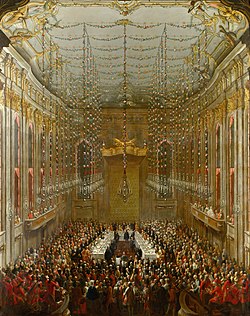
[edit]- October 5 – The wedding of Princess Isabella of Parma and Prince Joseph of Austria takes place at Hofburg Palace's Redoute Hall (Redoutensaele), at the former imperial palace in Vienna.[16]
- October 9 – Seven Years' War: Russian troops enter Berlin.
- October 16 – Seven Years' War: Battle of Kloster-Kamp – Ferdinand of Brunswick is beaten back from the Rhine by a French army.
- October 25 – George II of Great Britain and Ireland dies; his 22-year-old grandson George, Prince of Wales, succeeds to the throne as King George III and reigns for 59 years until his death on January 29, 1820.
- November 3 – Seven Years' War: Battle of Torgau – In another extremely hard battle, Frederick defeats Daun's Austrians, who withdraw across the Elbe.
- November 29 – French Army Colonel François-Marie Picoté de Belestre formally surrenders Detroit to British Army Major Robert Rogers, and the British Union Jack is raised over Fort Detroit.[17]
- December 4 – For the first time since the surrender of Fort Detroit by France, British authorities meet nearby at a Native American council house with delegates from various Indian tribes that had fought as allies of the French Army, such as the Wyandot and Ottawa Indians, and with tribes that had formerly been allies of the British. The European and Native American representatives open the peace conference with the presentation by the Indians to the British of a wampum belt, and the pronouncement from the principal chief that "The ancient friendship is now renewed, and I wash the blood off the earth that had been shed during the present war, that you may bury the war hatchet in the bottomless pit."[18]
- December 6 – The siege of Pondicherry, a stronghold of France in India, is begun by British Army Lieutenant General Eyre Coote. The French commander, General Thomas Lally, is finally forced to surrender Pondicherry to the British on January 15, 1761.[19]
- December 18 – In the wake of Tacky's War by African-born rebels, the Assembly of the British colony of Jamaica outlaws the African religious practice of obeah, with penalties ranging from banishment from the colony to execution. The legislation specifically bans use of contraband associated with obeah, including "animal blood, feathers, parrots' beaks, dogs' teeth, alligators' teeth, broken bottles, grave dirt, rum, and eggshells".[20]
Date unknown
[edit]- Abbé Charles-Michel de l'Épée opens a school for deaf education in Paris which becomes the Institut National de Jeunes Sourds de Paris, the world's first free school for the deaf; Thomas Braidwood establishes Braidwood's Academy for the Deaf and Dumb in Edinburgh, the first school for the deaf in Britain.
- Western countries pay 3,000,000 ounces of silver for Chinese goods.
- approximate date – Abu Dhabi is founded.[21]
Births
[edit]- January 11 – Zofia Potocka, Greek slave courtesan, agent for Russia and Polish noble (d. 1822)
- March 1 – François Nicolas Leonard Buzot, French Revolutionary leader (suicide 1794)
- March 5 – Marie-Adélaïde de La Touche-Limouzinière, French aristocrat, counter-revolutionary and combatant in the War of the Vendée (d. 1794)
- March 10 – Leandro Fernández de Moratín, Spanish dramatist, translator and neoclassical poet (d. 1828)
- March 28 – Thomas Clarkson, English abolitionist (d. 1846)[22]
- April 16 – Sigismund Friedrich Hermbstädt, German pharmacist, chemist (d. 1833)
- April 30 – Joseph Souham, French general (d. 1837)
- May 10 – Johann Peter Hebel, German poet (d. 1826)
- May 28 – Alexandre, Vicomte de Beauharnais, French politician, general (d. 1794)
- May 29 – Charlotte Slottsberg, Swedish ballerina (d. 1800)
- June 12 – Jean-Baptiste Louvet de Couvrai, French novelist, playwright, journalist, politician and diplomat (d. 1797)
- June 16 – Louise Contat, French actress (d. 1813)
- July 13 – István Pauli (Pável), Hungarian Slovene priest, writer (d. 1829)
- August 3 – Jacques Réattu, French artist 9d. (1833)
- August 22 – Pope Leo XII, (b. Annibale Francesco Clemente Melchiore Girolamo Nicola Sermattei della Genga), Italian priest (d. 1829)
- September 14 – Luigi Cherubini, Italian composer (d. 1842)
- September 21 – Olof Swartz, Swedish botanist (d. 1818)
- September 30 – Michele Cachia, Maltese architect and military engineer (d. 1839)
- October 7 (bapt.) – Fredrica Löf, Swedish actress (d. 1813)
- October 17 – Claude Henri de Rouvroy, comte de Saint-Simon, French economist, political theorist (d. 1825)
- October 27 – August von Gneisenau, Prussian field marshal (d. 1831)
- October 31? – Hokusai, born Katsushika Tokitarō, Japanese Edo period artist, ukiyo-e painter and printmaker (died 1849)

- November 13 – Jiaqing Emperor of China (d. 1820)
- November 21 – Joseph Plumb Martin, American Revolutionary soldier and narrative author (d. 1850)
- November 24 – Fabian Wrede, Swedish field marshal (d. 1824)
- November 28 – Maria Teresa Poniatowska, Polish noblewoman (d. 1834)
- December 17 – Deborah Sampson, first American female soldier (d. 1827)
- date unknown
- Adam Gillies, Lord Gillies, Scottish judge (d. 1842)
- Emma Jane Greenland, English painter, writer, singer (d. 1843)
- Clelia Durazzo Grimaldi, Italian botanist (d. 1830)
- Moscho Tzavela, Greek-Souliote heroine (d. 1803)
- probable date – Lemuel Francis Abbott, English portrait painter (d. 1802)
Deaths
[edit]- February 22 – Anna Magdalena Bach, accomplished German singer, second wife of Johann Sebastian Bach (b. 1701)
- April 3 – John Rous, Royal Navy officer during King George's War and the Seven Years' War (b. 1702)
- April 6 – Charlotte Charke, British actor and writer (b. 1713)
- April 10 – Jean Lebeuf, French historian (b. 1687)
- April 11 – Prince Moritz of Anhalt-Dessau, German general (b. 1712)
- April 18 – Mary Alexander, influential colonial-era merchant in New York City (b. 1693)
- May 5 – Laurence Shirley, 4th Earl Ferrers, English murderer (hanged) (b. 1720)
- May 9 – Nicolaus Ludwig Zinzendorf, German religious and social reformer (b. 1700)
- May 10 – Christoph Graupner, German composer (b. 1683)
- May 15 – King Alaungpaya of Burma (b. 1711)
- May 22 – Israel ben Eliezer aka Baal Shem Tov, Polish-born mystical rabbi, founder of Hasidic Judaism (b. 1698)
- May 30 – Joanna Elisabeth of Holstein-Gottorp, German duchess (b. 1712)
- June 13 – Antoine Court, French Huguenot minister (b. 1696)
- July 13 – Conrad Weiser, Pennsylvania's ambassador to the Iroquois Confederacy (b. 1696)
- August 27 – Smart Lethieullier, English antiquary (b. 1701)
- September 11 – Louis Godin, French astronomer (b. 1704)
- September 17 – George Bowes, English coal proprietor, Member of Parliament (b. 1701)
- October 15 – Nicolas d'Assas, captain of the French regiment of Auvergne (b. 1733)

- October 25 – King George II of Great Britain (b. 1683)
- November 30 – Friederike Caroline Neuber, German actress (b. 1697)
References
[edit]- ^ Williams, Hywel (2005). Cassell's Chronology of World History. London: Weidenfeld & Nicolson. pp. 320. ISBN 0-304-35730-8.
- ^ Rodger, N. A. M. (2006). The Command of the Ocean: A Naval History of Britain, 1649–1815. London: Penguin Books; National Maritime Museum. p. 283. ISBN 0-14-102690-1.
- ^ "Fires, Great", in The Insurance Cyclopeadia: Being an Historical Treasury of Events and Circumstances Connected with the Origin and Progress of Insurance, Cornelius Walford, ed. (C. and E. Layton, 1876) p54
- ^ Basil Williams, The Life of William Pitt, Volume 2 (Frank Cass & Co., 1913, reprinted by Routledge, 2014) p80
- ^ Candace Ward, Desire and Disorder: Fevers, Fictions, and Feeling in English Georgian Culture (Bucknell University Press, 2007) p179
- ^ a b c d "Machault", in Warships of the World to 1900, ed. by Lincoln P. Paine (Houghton Mifflin Harcourt, 2000) pp99-100
- ^ a b William J. Topich and Keith A. Leitich, The History of Myanmar (ABC-CLIO, 2013) pp38-39
- ^ a b c Paul Williams, Frontier Forts Under Fire: The Attacks on Fort William Henry (1757) and Fort Phil Kearny (1866) (McFarland, 2017) p101
- ^ William Hartston, The Encyclopedia of Useless Information (Sourcebooks, 2007)
- ^ Raymond B. Blake, et al., Conflict and Compromise: Pre-Confederation Canada (University of Toronto Press, 2012) p104
- ^ a b Federal Writers Project, Maine: A Guide 'Down East (Houghton Mifflin, 1937) p37
- ^ Charles Roberts, Ordinary Differential Equations: Applications, Models, and Computing (CRC Press, 2011) pp139-140
- ^ "Portsmouth Dockyard". Battleships-Cruisers.co.uk. Retrieved September 27, 2011.
- ^ "Chronology Of Events In Portsmouth – 1700-1799". History In Portsmouth. Archived from the original on August 22, 2011. Retrieved September 27, 2011.
- ^ Palmer, Alan; Palmer, Veronica (1992). The Chronology of British History. London: Century Ltd. p. 222. ISBN 0-7126-5616-2.
- ^ "wedding-supper". Archived from the original on March 6, 2014. Retrieved August 22, 2016.
- ^ Bill Loomis, On This Day in Detroit History (Arcadia Publishing, 2016) p188
- ^ "1763 in Native American Country", by Ulrike Kirchberger, in Decades of Reconstruction: Postwar Societies, State-Building and International Relations from the Seven Years War to the Cold War", ed. by Ute Planert and James Retallack (Cambridge University Press, 2017) p72
- ^ "Carnatic Wars", in Wars That Changed History: 50 of the World's Greatest Conflicts, ed. by Spencer C. Tucker (ABC-CLIO, 2015) p222
- ^ Rebecca Shumway, Trevor R. Getz, Slavery and its Legacy in Ghana and the Diaspora (Bloomsbury, 2017) p76
- ^ "The story of Abu Dhabi". Retrieved July 21, 2020.
- ^ "BBC - History - Thomas Clarkson". www.bbc.co.uk. Retrieved March 17, 2022.
from Grokipedia
1760 marked a pivotal transition in British monarchy with the death of King George II on 25 October, leading to the immediate accession of his grandson George III as the new sovereign of Great Britain and Ireland.[1] This year also saw critical advances for Britain in the Seven Years' War, including the capture of Montreal by British forces on 8 September, which effectively ended French colonial control in North America east of the Mississippi River.[2] In Europe, Prussian King Frederick the Great secured a hard-fought victory over Austrian forces at the Battle of Torgau on 3 November, sustaining his kingdom's resistance amid the ongoing global conflict.[3] Elsewhere, the birth of the future Jiaqing Emperor on 13 November took place as the Qing Dynasty reached its greatest territorial extent under the Qianlong Emperor, foreshadowing dynastic continuity.[4] These events underscored 1760 as a year of monarchical change, imperial expansion, and military endurance shaping the geopolitical landscape of the 18th century.
The Jiaqing Emperor (Yongyan), born November 13, 1760, at the Old Summer Palace in Beijing, succeeded his father Qianlong as the seventh emperor of the Qing dynasty in 1796, reigning amid efforts to curb corruption and internal rebellions during a period of dynastic decline.[52][53] Artists
Katsushika Hokusai, born in October 1760 in Edo (modern Tokyo) to an artisan family, emerged as a leading ukiyo-e printmaker and painter, producing over 30,000 works including the iconic series Thirty-six Views of Mount Fuji, which influenced global art through their innovative composition and depiction of everyday Japanese life.[54][55] Reformers and Abolitionists
Thomas Clarkson, born March 28, 1760, in Wisbech, Cambridgeshire, England, became a central figure in the British campaign against the slave trade, conducting firsthand investigations into slave ship conditions and compiling statistical evidence on mortality rates—such as 1 in 7 deaths during the Middle Passage—that bolstered parliamentary arguments leading to the 1807 Slave Trade Act.[56][57]
Events
January–March
On January 22, 1760, British forces commanded by Sir Eyre Coote engaged and defeated a larger French army led by Thomas Arthur Lally at the Battle of Wandiwash, located near modern Vandavasi in Tamil Nadu, India. This land battle, integral to the Seven Years' War's Asian theater, pitted roughly 2,100 British and allied sepoys against approximately 4,000 French troops and Indian auxiliaries; the French suffered over 500 killed and wounded alongside 200 prisoners, while British losses totaled fewer than 200.[5] [6] Coote's disciplined infantry formations and effective use of cavalry outmaneuvered Lally's disorganized advance, exploiting French supply shortages and internal command disputes that had eroded their operational cohesion since prior defeats like Plassey in 1757.[6] The victory directly facilitated British territorial consolidation in the Carnatic region, as pursuing forces under Coote captured Arcot on February 10 and other forts, severing French lines to their Pondicherry enclave and compelling Lally's retreat. This outcome stemmed from Britain's sustained naval superiority in the Indian Ocean, which ensured reinforcements and supplies reached Coote despite French privateer disruptions, whereas French naval commitments in Europe diverted resources and left colonial garrisons vulnerable. By March, these gains had neutralized French field armies in southern India, shifting momentum toward British dominance and foreshadowing the 1761 siege of Pondicherry that ended organized French resistance on the subcontinent.[5] [6] In Europe, Prussian armies under Frederick II undertook limited winter maneuvers from January to March, primarily reinforcing garrisons and reallocating depleted units from 1759 campaigns while avoiding pitched battles amid harsh weather. Coalition forces—Austrian, Russian, and Swedish—likewise paused major offensives, concentrating instead on logistical buildup for spring invasions; Prussian scouts reported Austrian concentrations exceeding 100,000 near Silesia by late March, but Frederick's preemptive redeployments to Saxony and Silesia preserved operational flexibility without significant losses. These static postures yielded no decisive battlefield results but empirically sustained Prussian viability against numerical disadvantages, bolstered by British subsidies that offset fiscal exhaustion from prior years' attrition.April–June
In the North American theater of the Seven Years' War, French forces under Chevalier de Lévis launched an offensive against the British-held city of Quebec on April 28, engaging approximately 3,900 British troops commanded by General James Murray in the Battle of Sainte-Foy.[7] The French, numbering around 7,000-8,000 including Canadian militia and Indigenous allies, achieved a tactical victory through superior numbers and aggressive maneuvers on snowy terrain, inflicting heavy casualties—over 1,000 British wounded or killed compared to about 700 French losses—marking it as one of the bloodiest engagements after the Plains of Abraham.[8] Despite this success, Lévis lacked siege artillery and sufficient supplies to assault Quebec's fortifications, and by early May, arriving British naval reinforcements under Admiral Saunders delivered 2,000 fresh troops and provisions, compelling the French to retreat toward Montreal on May 9 amid deteriorating weather and logistics constraints.[9] This sequence effectively consolidated British control over Quebec, preventing a French reconquest and shifting momentum toward the eventual capitulation of New France later in the year.[7] In the European theater, Allied forces subsidized by Britain, including Hanoverian, Brunswicker, and Prussian contingents under Prince Ferdinand of Brunswick, clashed with invading French armies on May 16 at the Battle of Kloster-Camp near Warburg in Westphalia.[10] Ferdinand's approximately 50,000 troops repelled a French probe led by the Duc de Broglie, involving around 40,000 men, through coordinated infantry and cavalry assaults that disrupted French supply lines and forced a withdrawal after several hours of combat, with Allied losses estimated at 1,500 versus 1,200 French.[11] This defensive victory halted a French thrust toward Hanover, preserving key British-allied territories in northwestern Germany and buying time for reinforcements amid ongoing Prussian commitments elsewhere.[12] Amid these military actions, Austrian and Russian commanders positioned forces for a summer offensive into Prussian-held Silesia, with Ernst Gideon von Laudon maneuvering corps toward the region by late spring to support Marshal Daun's main army, though decisive clashes awaited July engagements.[11] Prussian King Frederick II, focused on securing Saxony after winter operations, redeployed units to counter these threats, emphasizing fortified positions and rapid marches to disrupt enemy concentrations without committing to open battle prematurely.[13] These troop movements underscored the attritional nature of the central European front, where logistical strains and coalition coordination challenges limited aggressive advances in the April-June period.[11]July–September
On July 15–16, forces under Prince Ferdinand of Brunswick repelled a major French offensive at the Battle of Vellinghausen in Westphalia, part of the ongoing Seven Years' War campaigns in western Germany. The Allied army, comprising Prussian, Hanoverian, British, and other German contingents totaling around 50,000 men, faced approximately 92,000 French troops divided under marshals Victor-François, duc de Broglie, and Charles de Rohan, prince de Soubise. French attacks faltered due to poor coordination and supply disruptions, allowing Ferdinand to maintain defensive positions on high ground and inflict disproportionate losses. Allied casualties numbered about 1,400, including 434 British, while French losses reached 5,000, with Broglie's command suffering 4,700 and Soubise's 300; this outcome stemmed from Allied artillery superiority and French infantry exhaustion after prolonged marches.[14] The victory at Vellinghausen stalled French momentum in the Rhine theater, exposing vulnerabilities in their extended lines and forcing a retreat that preserved Allied control over key supply routes into the autumn. Broglie's failure to achieve a breakthrough highlighted causal factors such as inadequate reconnaissance and divided command, which prevented envelopment of Ferdinand's flanks despite numerical superiority. British reinforcements, including light infantry tactics honed from prior engagements, played a critical role in holding sectors against repeated assaults, contributing to the battle's tactical stalemate favoring the defenders.[14] In North America, British colonial forces under General Jeffery Amherst converged on New France, leading to the capitulation of Montreal on September 8 and the effective collapse of French authority in Canada. Amherst's army of approximately 17,000 regulars, provincials, and Native allies advanced from Lake Ontario and the upper St. Lawrence, linking with expeditions from Lake Champlain under William Haviland and from Quebec under James Murray, outnumbering French defenders led by Governor Pierre François de Rigaud, marquis de Vaudreuil, and General François-Gaston de Lévis. The French garrison, reduced to about 2,000 regulars supplemented by militia, faced encirclement without viable relief, as prior defeats at Quebec in 1759 had depleted reserves and morale. Vaudreuil surrendered unconditionally, with over 3,000 French soldiers and officials capitulating, alongside civilian populations totaling around 70,000 under British terms that permitted retention of personal property but mandated cession of military stores.[15][16] This surrender marked the culmination of British amphibious and overland operations that severed French logistics, with verifiable casualty data from preceding skirmishes—such as minor engagements along the St. Lawrence yielding under 100 British losses—underscoring the asymmetry driven by naval dominance and superior manpower mobilization. Terms included protections for Catholic practices but enforced territorial transfer east of the Mississippi, reflecting empirical realities of French isolation rather than negotiated parity. Ancillary conflicts in the Ohio Valley saw sporadic French-allied Indigenous raids repelled, with British forts like Fort Pitt reporting negligible territorial shifts but confirming the broader erosion of French influence through attrition.October–December
King George II of Great Britain died on October 25, 1760, at Kensington Palace in London, aged 76, from an aortic aneurysm that caused sudden collapse while using a commode.[17] His grandson, George III, who had been heir apparent since 1751, immediately acceded to the throne upon the moment of death, as dictated by British constitutional practice where the succession occurs instantaneously without need for formal election or delay.[18] The transition proceeded without notable political instability, as George III's advisors, including Lord Bute, managed the proclamation and early governance smoothly amid ongoing war efforts.[19] On November 3, 1760, Prussian forces under Frederick the Great engaged Austrian troops led by Leopold von Daun at the Battle of Torgau near the Elbe River during the Seven Years' War, with Prussia launching a frontal assault across difficult terrain to disrupt Austrian supply lines.[20] Despite achieving tactical victory by forcing the Austrians to withdraw—capturing 49 guns and preventing encirclement—the Prussians suffered approximately 16,670 casualties from killed and wounded, while Austrians incurred around 15,500 total losses including prisoners, rendering the outcome strategically marginal as both sides retained operational capacity.[20] [21] Frederick himself was wounded multiple times, highlighting the battle's attritional nature over decisive maneuver, which exhausted Prussian reserves without altering the broader war's balance.[21] In North America, on November 29, 1760, French commandant François-Marie Picoté de Belestre surrendered Fort Pontchartrain du Détroit to British Major Robert Rogers and his Rangers without resistance, following the prior capitulation of New France at Montreal.[22] [23] This transfer marked the effective British control over key western outposts, securing fur trade routes and eliminating French presence in the Great Lakes region amid the French and Indian War's conclusion on the continent.[22] On December 7, the city of Maturín was founded in present-day Venezuela.[24]Date unknown
In Britain, incremental engineering improvements to the Newcomen atmospheric steam engine, including the adoption of larger cylinders reaching diameters of up to 6 feet, enabled deeper coal mining operations and supported rising fuel demands for proto-industrial activities by the early 1760s.[25] These refinements, driven by practical experience in collieries rather than radical redesigns, contributed to modest efficiency gains over the engine's original 1712 form, laying groundwork for subsequent innovations amid expanding domestic coal output.[25] The Lancashire cotton sector, bolstered by imports from Egypt and India, operated as a small-scale industry in 1760, employing handloom weavers and foreshadowing mechanization through embryonic water-powered mills, though production volumes remained limited compared to woolens.[25] Philip Embury, an Irish Palatine Methodist lay preacher, immigrated to New York City in 1760 with relatives including Barbara and Paul Heck, establishing a foothold for Methodism among immigrant communities through carpentry work and eventual preaching to small groups.[26] This migration reflected broader patterns of economic displacement in Ireland, prompting settlement in urban colonial hubs without immediate organized religious infrastructure.[27]Historical significance
Geopolitical shifts
The surrender of Montreal on September 8, 1760, marked the effective collapse of French military control over New France, as British forces under Jeffery Amherst, totaling approximately 18,000 troops from three converging armies, compelled the capitulation of French Governor Pierre François de Rigaud, Marquis de Vaudreuil-Cavagnal, and his remaining garrison of about 2,500 regulars amid a three-pronged encirclement.[28] This outcome stemmed from Britain's naval dominance, which isolated French reinforcements and supplies, enabling the consolidation of British authority over roughly 70,000 French-speaking inhabitants and the strategic St. Lawrence River valley, precursor to the 1763 cession of Canada east of the Mississippi—encompassing over 200,000 square miles of contested territory critical for fur trade and continental expansion.[12] In the Caribbean, British forces maintained control over Guadeloupe, seized in 1759, further eroding French colonial footholds and shifting naval power balances toward London, as French squadrons suffered repeated defeats that prevented resupply.[12] In Europe, the Battle of Torgau on November 3, 1760, represented a pyrrhic but pivotal Prussian success, where Frederick II's army of 38,000 inflicted heavier casualties on the Austrian-led coalition under Leopold von Daun—Prussian losses exceeded 16,000 killed and wounded against Austrian figures around 17,000—halting an advance that threatened Berlin and preserving Prussia's precarious independence against a coalition outnumbering it threefold.[29] Despite Frederick's personal wounding and the battle's mutual exhaustion, the tactical edge prevented the dismemberment of Prussian territories, underscoring the resilience enabled by disciplined infantry maneuvers over coalition numerical superiority, and staving off immediate partition schemes by Austria, Russia, and Saxony.[20] These developments accelerated the erosion of French geopolitical stature, as the Montreal capitulation liquidated over 3,000 French troops and irregulars into British custody without battle, compounded by naval losses that left France unable to contest British colonial seizures, thereby prioritizing empirical military reversals over any purported cultural or strategic advantages in overseas administration.[28] The quantifiable depletion— including the forfeiture of North American strongholds garrisoned since the 1600s—reflected systemic vulnerabilities in French logistics and alliance cohesion, diminishing Paris's capacity to project power amid mounting debts and diverted European commitments.[12]Long-term impacts
The expulsion of French forces from much of North America following key 1760 campaigns, such as the capture of Montreal on September 8, diminished the primary external threat to British colonial settlements, fostering conditions for demographic and economic expansion in the ensuing decades; colonial population grew from approximately 1.6 million in 1760 to over 2.5 million by 1775, supported by reduced frontier warfare and access to former French territories east of the Mississippi.[28][30] However, the war's financial toll—Britain's national debt rising from £75 million in 1756 to £133 million by 1763—necessitated revenue measures like the Sugar Act of 1764 and Stamp Act of 1765, which imposed duties on colonial trade and legal documents to offset defense costs that had secured these gains, thereby straining imperial finances without immediate equivalent contributions from the protected territories.[31][32] George III's ascension on October 25, 1760, following George II's death, reinforced the Hanoverian dynasty's continuity amid prior instability, as the young king's English birth and initial resolve to govern personally—dismissing favorites like Lord Bute by 1762—contributed to a perception of restored monarchical vigor, evidenced by parliamentary stability in the early 1760s despite ministerial turnover.[18] His 59-year reign until 1820 demonstrated administrative competence in the first two decades, overseeing naval reforms and colonial administration that underpinned Britain's emergence as Europe's preeminent power, though porphyria-induced mental episodes from 1788 onward devolved effective rule to the Prince Regent, highlighting vulnerabilities in long-term personal governance.[18] Protracted hostilities culminating in 1760, including naval blockades and continental engagements, induced mutual exhaustion that facilitated the Treaty of Paris on February 10, 1763, wherein France relinquished Canada and territories east of the Mississippi to Britain, while Spain ceded Florida, yielding empirical advantages like control over 80% of North America's temperate lands and eliminating French rivalry in the interior, which stabilized trade routes and resource extraction for generations.[33][12] These territorial consolidations, rather than mere imperial overreach, provided a framework for sustained British dominance, with the treaty's terms reflecting strategic leverage from 1760 victories rather than ideological concessions, though the associated debt servicing—consuming over half of annual revenues—prompted fiscal policies that tested colonial loyalties without negating the net security benefits.[33][31]Cultural and scientific developments
Scientific advancements
In 1760, Scottish chemist Joseph Black made a key empirical observation in the study of heat, noting that when equal masses of different substances at varying temperatures are mixed, the resulting temperature change is inversely proportional to their capacities to absorb heat, thus establishing the foundational principle of specific heat capacity through quantitative experiments on substances like water, mercury, and metals.[34] This work, derived from precise calorimetric measurements rather than prior theoretical assumptions, enabled later distinctions between sensible and latent heat, advancing thermodynamic understanding grounded in observable data.[35] In medicine, Austrian physician Leopold Auenbrugger introduced the diagnostic method of percussion, involving controlled tapping on the chest to produce sounds indicative of underlying densities and fluid accumulations in the thorax, based on years of clinical observations correlating auditory responses with postmortem findings.[36] This non-invasive technique, detailed in his 1761 publication but developed through 1760 experiments on cadavers and patients, marked an early shift toward empirical physical diagnosis over speculative humoral theory, though its adoption was delayed until later translations.[36] Geologist John Michell proposed a causal model for earthquakes, attributing them to frictional slips between subterranean strata under accumulated strain, informed by detailed analysis of seismic wave propagation and damage patterns from events like the 1755 Lisbon quake, as outlined in his 1760 paper.[37] This mechanistic explanation, rooted in observable geological features and rudimentary wave analogies, presaged modern fault dynamics by emphasizing physical forces over supernatural attributions.[37] Astronomical records from observatories, including Greenwich, continued systematic tracking of stellar positions and celestial events, culminating in publications of data from 1750–1760 that refined positional astronomy through repeated meridian transits and clock-corrected timings.[38] These observations supported ongoing empirical calibrations for navigation and ephemerides, independent of speculative cosmologies.Technological and industrial progress
In Britain, the Newcomen atmospheric steam engine, operational since 1712, continued to drive industrial applications such as dewatering coal mines, with fuel efficiency limited by the need to alternately heat and cool the cylinder, consuming up to 30 pounds of coal per horsepower-hour due to reliance on external atmospheric pressure for piston return. By 1760, around 100 such engines were in use across Britain, powering equivalent to the work of several thousand horses but highlighting the causal need for better condensation to minimize heat loss and boost output metrics. Scottish instrument-maker James Watt initiated examinations of these engines in the early 1760s while at the University of Glasgow, identifying inefficiencies in the single-cylinder design that wasted 75-80% of input energy as heat, laying groundwork for separate condensers to enhance thermodynamic efficiency.[39] Metallurgical progress advanced through expanded coke-smelting of iron ore, building on Abraham Darby I's 1709 method that replaced charcoal to avoid deforestation constraints, allowing blast furnaces to operate at higher temperatures and produce pig iron at scales unattainable with wood fuel. Under Abraham Darby II's management at Coalbrookdale until his death in 1763, output increased verifiably, with the foundry casting larger pots and cylinders—up to 1 ton capacity—via improved furnace linings and bellows mechanics that sustained 1,200-1,500°C blasts, marking early mechanized steps toward Britain's iron production surge from 25,000 tons annually in 1760 to over 68,000 by 1788. Concurrently, processes like potting and stamping emerged in the 1760s to convert brittle pig iron into malleable wrought iron by reheating and hammering, reducing impurities through oxidation and enabling applications in machinery components with greater tensile strength.[40][39] In textiles, pre-mechanized production relied on handlooms augmented by John Kay's 1733 flying shuttle, which doubled weaving speed to 2-3 yards per minute for skilled operators but exacerbated yarn shortages, prompting empirical trials in roller spinning techniques that presaged 1760s breakthroughs like the spinning jenny by increasing thread output per worker from 1-2 pounds weekly to multiples thereof through basic gearing. This bottleneck drove proto-industrial clustering in Lancashire, where water-powered mills began aggregating spinners, yielding verifiable productivity gains of 20-30% in yarn supply by mid-decade via coordinated cottage networks.[41] Military technology evolved amid the Seven Years' War, with British forces refining light artillery for field mobility; Prussian and allied innovations emphasized oblique-order tactics paired with 3- and 6-pounder bronze guns, which fired 1-2 pound shot at 1,000-yard ranges with 10-15% improved accuracy over heavier pieces through lighter carriages reducing recoil by 20-30%, as evidenced by battlefield data from engagements like Leuthen (1757) influencing 1760 deployments. Naval advancements included early development of the carronade by Scotland's Carron Iron Works, a stubby 24-32 pounder gun using 4-5 pounds of powder for short-range broadsides—doubling projectile mass over standard cannons at half the weight (under 1 ton)—to enhance ship-to-ship lethality in close-quarters combat, with prototypes tested amid wartime demands for faster reloading and deck stability.[42][43]Arts and cultural milestones
In music, Niccolò Piccinni's opera buffa La buona figliuola (also known as La Cecchina), with libretto by Carlo Goldoni adapted from Samuel Richardson's Pamela, premiered on February 6 at the Teatro delle Dame in Rome, drawing large audiences through its comic depiction of social ascent and running in productions until 1773.[44][45] The work's success, funded by aristocratic subscribers and theater patrons, exemplified the era's preference for light-hearted operas over heavier seria forms, with its arias and ensembles reflecting contemporary Italian elite tastes amid ongoing continental conflicts.[46] In literature, Charles Johnstone's satirical novel Chrysal, or the Adventures of a Guinea, narrated from the perspective of a gold coin exposing corruption among British elites, appeared in 1760 and achieved commercial success with five editions in its first three years, critiquing patronage systems and moral decay without overt political allegiance.[47][48] Similarly, enslaved poet Jupiter Hammon published "An Evening Thought: Salvation by Christ, with Penitential Cries" on December 25, a broadside poem emphasizing evangelical themes, recognized as the first printed literary work by an African American and distributed via limited colonial networks rather than broad elite sponsorship.[49][50] Visual arts saw commissions tied to shifting royal patronage following George III's accession in January, though major works like coronation portraits emerged later; Thomas Gainsborough's Portrait of Ann Ford (later titled Nymph in a Landscape), completed in 1760, captured rococo informality in its depiction of a musician amid pastoral elements, appealing to emerging middle-class buyers beyond court circles.[51] These outputs, often reliant on private or institutional funding amid wartime fiscal strains, prioritized accessible entertainment and moral reflection over grandiose state propaganda.Notable individuals
Births
Monarchs and RulersThe Jiaqing Emperor (Yongyan), born November 13, 1760, at the Old Summer Palace in Beijing, succeeded his father Qianlong as the seventh emperor of the Qing dynasty in 1796, reigning amid efforts to curb corruption and internal rebellions during a period of dynastic decline.[52][53] Artists
Katsushika Hokusai, born in October 1760 in Edo (modern Tokyo) to an artisan family, emerged as a leading ukiyo-e printmaker and painter, producing over 30,000 works including the iconic series Thirty-six Views of Mount Fuji, which influenced global art through their innovative composition and depiction of everyday Japanese life.[54][55] Reformers and Abolitionists
Thomas Clarkson, born March 28, 1760, in Wisbech, Cambridgeshire, England, became a central figure in the British campaign against the slave trade, conducting firsthand investigations into slave ship conditions and compiling statistical evidence on mortality rates—such as 1 in 7 deaths during the Middle Passage—that bolstered parliamentary arguments leading to the 1807 Slave Trade Act.[56][57]