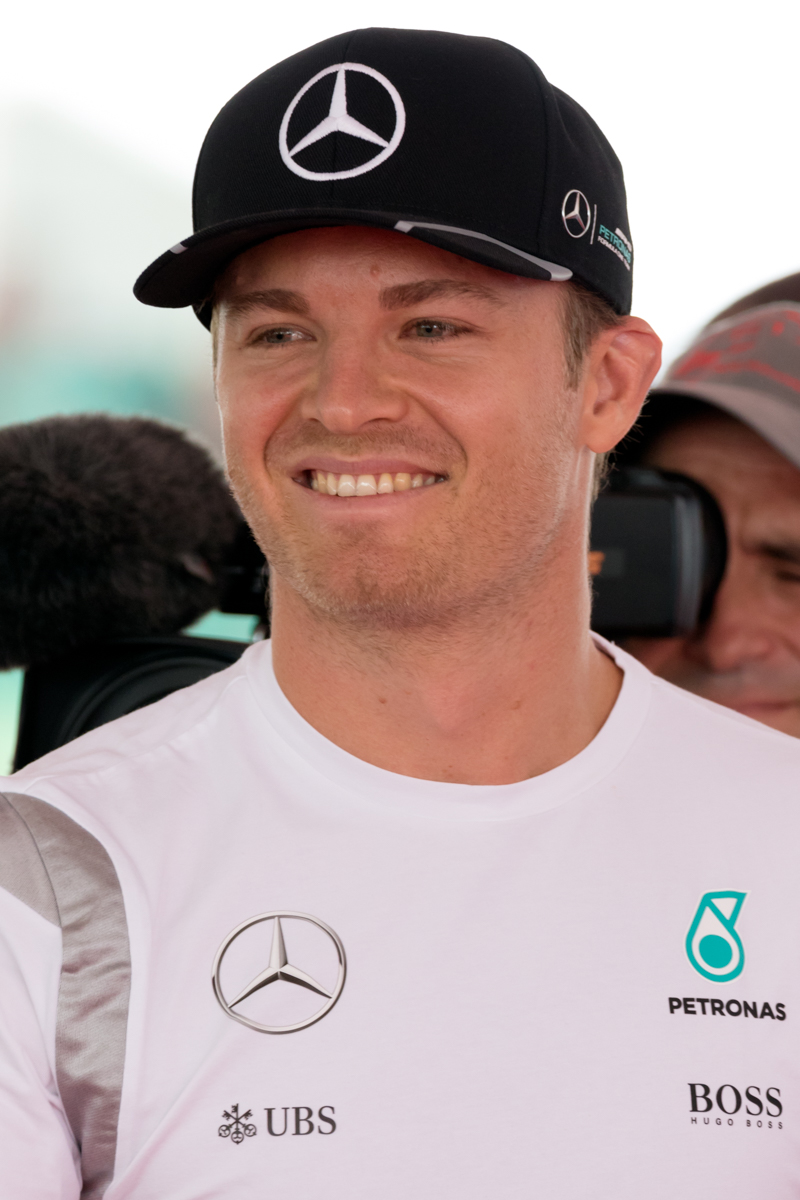

2016 Formula One World Championship
View on Wikipedia
The 2016 FIA Formula One World Championship was the 70th season of the Fédération Internationale de l'Automobile (FIA)'s Formula One motor racing. It featured the 67th Formula One World Championship, a motor racing championship for Formula One cars which is recognised by the sport's governing body, the FIA, as the highest class of competition for open-wheel racing cars. Teams and drivers took part in twenty-one Grands Prix—making for the longest season in the sport's history to that point—starting in Australia on 20 March and finishing in Abu Dhabi on 27 November as they competed for the World Drivers' and World Constructors' championships.[1]


The 2016 season saw the grid expand to twenty-two cars with the addition of the Haas F1 Team entry.[2] Renault returned to the sport as a constructor after a four-year absence following their takeover of Lotus prior to the start of the season.[3] The calendar similarly expanded, with the return of the German Grand Prix. The European Grand Prix was also revived, with the event visiting a new circuit in Azerbaijan's capital city, Baku.[1]
Nico Rosberg won his only World Drivers' Championship title in the final race of the season. With nine wins and seven other podiums, Rosberg beat teammate and defending World Champion Lewis Hamilton by five points, despite Hamilton winning more races than Rosberg throughout the season. In doing so, Rosberg followed the success of his father in 1982 - becoming the second son of a champion to become champion himself, a feat previously achieved by Damon Hill in 1996 and the third title winner for Mercedes. Rosberg announced his retirement from the sport shortly after winning the title, effectively ending the on-track Silver War between the Mercedes duo.
In the World Constructors' Championship, Mercedes successfully defended their title for the second consecutive year with a then-record points tally of 765 points, beating Red Bull Racing by 297 points. Ferrari finished third overall, a further seventy points behind.[4]
As of 2026, this is the last championship for a German driver. This was the last season to be held during Bernie Ecclestone's tenure as Chief Executive of the Formula One Group. Ecclestone would be removed from his role on 23 January 2017 after nearly 40 years in the job following Liberty Media's purchase of the sport from CVC Capital Partners.[5] It was the final full season for 2009 World Champion Jenson Button, who would only make one more Grand Prix appearance at the 2017 Monaco Grand Prix. Renault also returned as a full works manufacturer team for the first time in over six years.[6]
Entries
[edit]The following teams and drivers took part in the 2016 Formula One World Championship. All teams competed with tyres supplied by Pirelli.


Free practice drivers
[edit]Five drivers drove in free practice sessions in place of regular drivers.
| Constructor | Practice drivers | |||||
|---|---|---|---|---|---|---|
| No. | Driver name | Rounds | ||||
| Force India-Mercedes | 34 |  Alfonso Celis Jr. Alfonso Celis Jr.
|
2, 4, 9, 14, 18, 21 | |||
| Haas-Ferrari | 50 |  Charles Leclerc Charles Leclerc
|
10–12, 20 | |||
| Manor-Mercedes | 42 |  Jordan King Jordan King
|
18, 21 | |||
| Renault | 46 45 |
 Sergey Sirotkin Sergey Sirotkin Esteban Ocon Esteban Ocon
|
4, 20 5, 10–12 | |||
| Source:[14] | ||||||
Team changes
[edit]


Several team changes took place before the season began. Haas F1 Team, a team formed by NASCAR Sprint Cup Series team owner Gene Haas, joined the Formula One grid, becoming the first American team to compete since the unrelated Haas Lola team competed in 1986.[16][N 2] The team used power units supplied by Ferrari and a chassis developed by Dallara.[18][19] Dallara had last participated in Formula One as the chassis manufacturer for HRT in 2010.[20] Renault returned to Formula One as a full factory-supported team after they purchased Lotus from Genii Capital,[21] the venture capital firm they had originally sold the same team to in 2010, and supplied engines to up until the end of 2014. Lotus's participation in the 2016 season was in question pending the resolution of a High Court case brought against the team by HM Revenue and Customs over unpaid PAYE tax.[22][23]
Both Red Bull Racing and Scuderia Toro Rosso underwent changes regarding their power unit supply. The former formally ended their nine-year partnership with engine supplier Renault at the end of the 2015 season,[24] with the team citing the lack of performance from the Renault Energy-F1 2015 engine as a leading factor in the change.[25] The team continued using Renault engines, but they were rebadged as TAG Heuer. Team principal Christian Horner named Renault's partnership with Mario Illien and his company Ilmor as a reason for staying with the manufacturer.[26] Meanwhile, Scuderia Toro Rosso returned to using Ferrari power units, as they had done prior to the start of 2014, after Renault announced that they would no longer supply customer engines.[12][27] The team used the type 060 power unit used by Ferrari teams in 2015[28] after Ferrari received approval from the World Motor Sport Council to supply year-old engines.[29]
Marussia applied for their team name to be changed to Manor Racing, a request granted in January 2016.[30] The team adopted the formal name of "Manor Racing MRT" and switched from Ferrari to Mercedes power,[31] with the team upgrading to a 2016-specification engine after having used a year-old Ferrari engine in 2015.[32] The team underwent a management reshuffle following the resignation of team principal John Booth and sporting director Graeme Lowdon.[33]
Sauber underwent a change in ownership in the week prior to the Hungarian Grand Prix, with the team being purchased by Longbow Finance. Despite the acquisition and the retirement of team founder Peter Sauber, the team continued to use the Sauber identity.[34]
Driver changes
[edit]

.jpg)

The driver line-ups saw a couple of changes prior to the 2016 season and three more while the season was underway. Romain Grosjean left Lotus at the end of the 2015 season.[35] He signed with the newly formed Haas F1 Team for 2016,[36][37] where he was joined by former Sauber driver Esteban Gutiérrez. Gutiérrez returned to competition after spending a season as Ferrari's test and reserve driver.[38]
After having taken over the Lotus team, Renault introduced a new driver-line up. Jolyon Palmer, the 2014 GP2 Series champion, made his race debut in Melbourne.[39] Palmer had previously made regular free practice appearances with the team when it was known as Lotus in 2015.[40] Despite originally having signed a contract with Lotus for 2016,[41] Pastor Maldonado announced he would not be driving for Renault after his sponsors were unable to fulfil their contractual obligations to the team.[42] He was replaced by Kevin Magnussen, who was released by McLaren when they chose not to renew his contract after he entered a single race for the team in 2015.[43][44]
Manor did not retain their 2015 drivers either, opting to sign two rookies for its 2016 campaign: reigning Deutsche Tourenwagen Masters champion Pascal Wehrlein and GP2 Series regular Rio Haryanto, who became the first and, as of 2026, only Indonesian driver to race in the championship.[45] Will Stevens and Roberto Merhi—who drove for the team when it competed as Marussia—were not retained by the team. Both moved to the FIA World Endurance Championship with Manor Motorsport,[46][47][N 3] while Alexander Rossi, who also raced for the team in 2015, was moved to a test and reserve role while he joined the IndyCar Series.[48][49]
Mid-season changes
[edit]After suffering broken ribs and a pneumothorax injury as a result of an accident during the Australian Grand Prix, Fernando Alonso was ruled out of the Bahrain Grand Prix as a precaution after medical exams.[50] McLaren reserve driver and reigning GP2 Series champion Stoffel Vandoorne made his Formula One debut, replacing Alonso.[51][52] Alonso returned to his seat for the Chinese Grand Prix two weeks later. Daniil Kvyat and Max Verstappen traded places ahead of the Spanish Grand Prix, with Verstappen promoted to Red Bull Racing and Kvyat returning to Scuderia Toro Rosso.[53] Red Bull explained the decision to swap their drivers as being made to relieve pressure on Kvyat following criticism for his role in a first-lap accident in the Russian Grand Prix, and to ease ongoing tension between Verstappen and teammate Carlos Sainz Jr. at Toro Rosso.[54] Rio Haryanto lost his race seat after the German Grand Prix, when his sponsors were unable to meet their financial obligations to the team.[55] He stayed with the team, filling a testing and reserve role.[56] His race seat was filled by 2015 GP3 Series champion and Renault test driver Esteban Ocon, who made his Formula One debut with MRT at the Belgian Grand Prix.[57]
Calendar
[edit]
The following twenty-one Grands Prix took place in 2016.[1]


Calendar changes
[edit]
There were a few revisions to the calendar from the previous season. The European Grand Prix returned to the calendar after a three-year absence. The race was moved from its previous home in Valencia to a brand-new street circuit in Baku, the capital of Azerbaijan. It was the first Grand Prix held in Azerbaijan.[58][59][60][61] The German Grand Prix returned to the calendar as well, taking place at the Hockenheimring. The event had been cancelled in 2015 when a venue could not be secured.[62] The circuit had previously hosted the race in 2014 as part of their agreement with the Nürburgring to alternate between venues, with the Hockenheimring hosting the race every even-numbered year.[63]
Three races were contracted for 2016 but did not feature on the calendar.[1] The Grand Prix of America was set to be held for the first time at the Port Imperial Street Circuit in New Jersey, in accordance with a fifteen-year contract.[64][65] The race was originally scheduled to debut in 2013, but was delayed for the fourth consecutive year.[65] The Indian Grand Prix was removed from the calendar after the 2013 race, following a dispute over taxation. After several failed attempts at reviving the race in 2014 and 2015, the event's return was deferred until the 2016 season;[66] however, it was once again left off the final calendar for the season.[1] In 2006, Formula One Management had signed a seven-year contract to run the Korean Grand Prix at the Korea International Circuit beginning in 2010. However, the event was discontinued in 2014, and was omitted from the calendar for the third consecutive season in 2016.[67]
Rule changes
[edit]General changes
[edit]The FIA and Formula One Management were granted greater power to change the Sporting and Technical regulations and to make decisions affecting the governance of the sport.[68] From the Monaco race weekend onwards, the FIA allowed drivers to choose alternative helmet designs for one race weekend per season,[69] a practice previously prohibited as drivers were required to wear the same design to make them more recognisable to spectators and television audiences.[70]
Technical
[edit]Cars were required to be designed with a separate wastegate for exhaust gases to pass through in a bid to increase the noise of the cars following criticism since the introduction of the 2014 generation of engines.[71] The FIA also opted to increase the number of tokens available for power unit development starting in 2016. While the initial plans would have given manufacturers fifteen tokens for the season, the number was raised to thirty-two, the same number as 2014, in order to allow struggling manufacturers such as Renault and Honda to improve their development. This decision also allowed further development on parts that were initially planned to be closed off, including the upper and lower crankcase, valve drive, crankshaft, air-valve system and ancillaries drive.[72]
Sporting regulations
[edit]Schedule
[edit]Starting in 2016, the number of pre-season tests were reduced from three to two.[73] The FIA formally increased the maximum events allowed in a season from 20 to 21 to accommodate the calendar's approval.[74]
Tyres
[edit]Tyre supplier Pirelli introduced a fifth dry tyre compound known as "ultrasoft",[75] with the manufacturer stating that they would only be available on street circuits.[76] Pirelli further changed their approach to tyre supply in 2016, bringing three dry compounds to races instead of two. The compounds are made public two weeks before each event.[77][78] Pirelli assigns two "choice" compounds, and a third set (the softest available regardless of Pirelli's selection) are given to teams reaching Q3. Drivers select their remaining ten tyre sets for the event between the three compounds and must use two dry compounds during the race.[74]
Penalties
[edit]The stewards were given greater powers in enforcing track limits, with drivers required to stay between the white lines marking the edges of the circuit, except in cases of driver error.[71] Any driver who caused the start of a race to be aborted would have been required to start the race from pit lane at the restart.[71] The procedure for issuing gearbox penalties was amended as well, so that penalties were applied in the order that they were awarded, bringing the system in line with the wider grid penalty system.[71]
Safety improvements
[edit]The usage of the Virtual Safety Car system was expanded to practice sessions as well to avoid the unnecessary use of red flags and session stoppages.[77] The rules governing the use of the drag reduction system, which is deactivated when under Virtual Safety Car periods and full-course yellow flags, were also amended. Drivers were now allowed to make use of the device as soon as a Virtual Safety Car period has ended;[77] while they previously had to wait two laps before the system was reactivated.[79]
Qualifying
[edit]The qualifying process was heavily revised two weeks before the season began. The three-period format first introduced in 2006 was retained, but with a progressive "knock-out" style of elimination.[80] However, following widespread criticism of the format at the opening rounds,[81][82][83] the format was abandoned after two races, and the system used between 2006 and 2015 re-introduced at the Chinese Grand Prix.[84]
Other
[edit]The stewards' powers to monitor pit-to-car communications were broadened for the 2016 season, with race control able to monitor the radio feeds for each driver in real time and consult with engineering advisors to further monitor the content in a bid to crack down on driver coaching and the use of coded messages.[85] Following a series of controversial penalties at the British and Hungarian Grands Prix and extended debate over the application of the rules, however, the FIA relaxed the restrictions on radio-communication which were introduced at the start of the season; starting with the German Grand Prix, applying them to the formation lap only.[86]
The process new drivers go through in order to qualify for a superlicence was changed as well,[87] with additional restrictions—including the requirement that drivers complete eighty percent of two seasons from a series outside a recognised points-paying championship[88]—put in place as part of the wider FIA Global Pathway.[89][90] The new points system was retroactively applied, with all results for all eligible drivers automatically qualifying for superlicence points.[88] The changes were introduced following the controversy which surrounded Max Verstappen qualifying for a superlicence at the age of sixteen after a single season competing in European Formula 3.[89]
Season report
[edit]Pre-season
[edit]
For the second year in a row, Hamilton decided not to exercise his option of switching his car number to 1, as was his prerogative as reigning World Champion, and would instead race with his career number 44.[15] A pre-season tyre test was held at Circuit Paul Ricard in France in January, conducted by Pirelli to evaluate their wet weather tyres.[91] The first pre-season team test was held a month later at the Circuit de Catalunya.[92] Ferrari were fastest on three of the four testing days,[93][94][95] with Nico Hülkenberg topping the time sheets for Force India on the third day.[96] A second test, also in Barcelona, was conducted on 1–4 March.[92] Ferrari ended the two tests with the best time set overall on the newly introduced ultra-soft tyres, while Mercedes covered the most distance in testing, almost 5,000 km (3,100 mi).[97][98] The second four days of testing also saw the teams examine a proposed feature for driver head protection, dubbed the "halo".[99]
Opening rounds
[edit]The season started with the Australian Grand Prix, and featured the newly introduced elimination-style qualifying format.[100] This format was heavily criticized by teams, drivers, fans and the press, which led to a review of the format before the next race.[101] The race ended with a 1–2 finish for Mercedes with Nico Rosberg taking victory from Lewis Hamilton in second.[102] Sebastian Vettel and Ferrari finished on the last remaining step of the podium.[103] Teammate Kimi Räikkönen retired with a suspected turbo failure on lap 21.[103] On lap 16, whilst attempting to overtake Esteban Gutiérrez in the new Haas F1 car at turn three, Fernando Alonso crashed at high speed into the outside barrier before barrel-rolling and landing upside-down against the barrier.[104] Gutiérrez ended up in the gravel trap with terminal rear tyre damage, and quickly went over to Alonso who managed to exit his cockpit unaided.[104] Due to the huge amount of debris caused by the accident the race was red flagged, with the cars subsequently lining up in the pitlane.[105] Romain Grosjean finished sixth in the other Haas and they became the first brand new team to score points in their inaugural race since Toyota did so in 2002.[106]

At the next race in Bahrain, Alonso was ruled out of taking part on medical grounds and was later revealed to have suffered broken ribs and a pneumothorax as a result of the previous race's collision, and was replaced by rookie Stoffel Vandoorne.[107] Following the widespread criticism of the new qualifying format, the teams voted to abandon it and revert to the system used in 2015.[108] However, in the week before the race weekend, the sport's Strategy Working Group over-ruled the teams in order to keep the elimination style for 2016.[101] After qualifying, the system once again came under heavy fire with Hamilton securing pole position ahead of Rosberg and Vettel.[109][110] The race saw Rosberg take his second consecutive victory of 2016 followed by Räikkönen and Hamilton, respectively.[111] The Ferrari of Sebastian Vettel and the Renault of Jolyon Palmer retired before the race started with engine and hydraulics failures, respectively.[112] Following a first-lap collision with Hamilton, Valtteri Bottas was penalised and given two points on his licence.[113]
At the next Grand Prix in China, the elimination style qualifying format was permanently dropped in favour of the previous format used between 2006 and 2015.[114] This yielded Nico Rosberg's first pole position of the year after Hamilton suffered a number of setbacks both in qualifying and during the race itself, eventually finishing in seventh place, with his teammate taking his third consecutive victory of the 2016 season.[115][116] The race finished with no retirements, a feat that has only been achieved six times.[117] The next race in Russia featured a number of incidents on the first lap with Vettel and Kvyat getting involved. Kvyat hit Vettel twice forcing him to retire.[118] Rosberg won the race with his teammate Lewis Hamilton finishing second after starting 10th and Rosberg achieved his first grand slam and extended his championship lead going into the European races.[119]
European rounds
[edit]
Before the race in Spain, Daniil Kvyat and Max Verstappen swapped places with Kvyat going to Toro Rosso and Verstappen to Red Bull.[120] The start of the race saw Hamilton and Rosberg collide, handing the lead to Daniel Ricciardo.[121] The race also saw the youngest race winner as Max Verstappen won the Grand Prix, defending against Kimi Räikkönen after Red Bull committed Ricciardo to an additional pit stop.[121]
At the next round in Monaco, Ricciardo took the first pole position of his career.[122] Helped by the race starting behind the safety car he held the lead for 33 laps, but was unable to convert it to a win after his team made a costly error during his pit-stop.[123] As a result, Lewis Hamilton inherited the lead and went on to win the race, his first of the season.[123] Ricciardo finished second ahead of Sergio Pérez.[123] Hamilton then went on to win the Canadian Grand Prix despite losing the lead to Sebastian Vettel at the start, reclaiming the position with a one-stop strategy while Vettel and Ferrari committed to two stops.[124] Valtteri Bottas finished third, his first podium of the season.[124] Rosberg won the returning European Grand Prix with his second grand slam of the season and of his career, ahead of Sebastian Vettel and Sergio Pérez, while Hamilton finished fifth after struggling with a software issue that limited his engine's ability to harvest energy.[125]
Hamilton took pole position at the next round in Austria while Rosberg started sixth after a grid penalty.[126] The two drivers followed opposing strategies to be first and second after the pit stops, with Hamilton on the preferred racing tyre gradually catching Rosberg.[127] The two made contact as Hamilton tried to pass Rosberg on the final lap; Hamilton won the race, while Rosberg broke his front wing and finished fourth behind Verstappen and Räikkönen.[128] A stewards' inquiry found that Rosberg had caused an avoidable collision, and handed him a ten-second penalty, though the race result was not affected.[127] Hamilton reduced the deficit to Rosberg to a single point at the next round in Great Britain, where difficult conditions saw the drivers contend with a drying circuit and varying grip levels. Hamilton established an early lead, while Rosberg and Verstappen fought over second place.[129] Rosberg prevailed, but suffered a critical fault with his gearbox late in the race.[130] Mercedes instructed him to reset the gearbox and to avoid using seventh gear or else risk a catastrophic failure, which prompted an investigation by the stewards for providing him with assistance.[131] Rosberg was ultimately penalised for the radio call, having ten seconds added to his race time, which demoted him to third behind Verstappen.[129]

Lewis Hamilton took the championship lead from Nico Rosberg at the next round in Hungary, leading another Mercedes 1–2 finish to gain a six-point lead in the Drivers' Championship standings.[132] The Grand Prix was marked by controversy: Rosberg secured pole position on a drying circuit in qualifying after McLaren's Fernando Alonso spun in front of him necessitating a double waved yellow flag.[133] Although race stewards confirmed that Rosberg had slowed, he nevertheless secured pole with his lap time.[134] The race saw Jenson Button fall afoul of new restrictions on pit-to-car communications that demanded that any car with an issue serious enough to require the intervention of the team be pitted or retired.[135] Button reported a brake issue—which was later revealed to be a faulty sensor—and was penalised for unauthorised assistance.[133]
Following penalties for Rosberg and Button for unauthorised pit-to-car communications in the previous races, the FIA repealed all regulations for the next round in Germany.[136] Hamilton further consolidated his championship lead, beating Rosberg off the line at the start; for his part, Rosberg was caught by the Red Bulls of Daniel Ricciardo and Max Verstappen and was unable to pass them.[137] Rosberg's race was further complicated by a time penalty for an aggressive pass on Verstappen that forced the Red Bull driver wide.[137] However, Hamilton remained pessimistic about his position as championship leader, as with nine races left in the season, he was anticipating grid penalties for exceeding his engine allocation.[138]
With Mercedes opting to take a series of grid penalties to build up a stockpile of components, Hamilton was forced to start the next race in Belgium from the back of the grid.[139] He took advantage of first-lap contact between Vettel, Räikkönen and Verstappen to work his way through the field before a heavy accident involving Kevin Magnussen at Eau Rouge forced the race to be temporarily stopped.[140] When the race resumed, Nico Rosberg led the race until the chequered flag, while Hamilton ultimately finished third after being unable to catch Daniel Ricciardo.[141] Further down the order, Verstappen was subject to increasing criticism over his driving tactics after being caught in several incidents with Räikkönen and Sergio Pérez, while Esteban Ocon finished sixteenth on debut for MRT.[142][140]
Rosberg reduced Hamilton's championship lead to two points at the next round in Italy, taking advantage of a slow start by Hamilton to establish an early lead that went unchallenged through the race.[143] Hamilton dropped as low as fifth at the start, recovering to fourth in the opening laps and got ahead of the Ferraris of Vettel and Räikkönen by making one pit-stop less.[143] Vettel went on to finish third—his first podium finish in five races—with Räikkönen fourth as the team introduced upgrades to the type 061 power unit in the hopes of recovering second place in the World Constructors' Championship from Red Bull.[144]
Return to Asia
[edit]
Rosberg reclaimed the championship lead in Singapore, qualifying on pole while Hamilton was forced to settle for third after struggling with mechanical issues and driving errors.[145] A late pit stop during the race by Mercedes saw Hamilton pass Kimi Räikkönen for third which he held until the end of the race. Red Bull Racing decided to pit Daniel Ricciardo from second to prevent coming under threat from Hamilton.[146] Rosberg decided to stay out because his lead over Ricciardo was not large enough to pit and stay ahead, but was able to hold on to first place to take the win.[146] Ricciardo made late efforts to catch Rosberg from 27 seconds behind, but could not quite catch him, finishing 0.6 seconds behind at the chequered flag. With Hamilton finishing third, Rosberg turned a two-point deficit into an eight-point lead.[147]
Mercedes's streak of ten consecutive wins came to an end in Malaysia.[148] Hamilton established an early lead, but retired sixteen laps from the end of the race when his engine failed, leaving Daniel Ricciardo in control of the race.[148] Nico Rosberg was turned around by Sebastian Vettel in a first corner accident that eliminated Vettel and forced Rosberg to work his way up through the field.[149] Ricciardo raced Max Verstappen for the lead when Hamilton's retirement triggered a Virtual Safety Car, prompting Red Bull to pit both drivers at the same time.[148] On fresher tyres, Ricciardo was able to withstand pressure from Verstappen to win his first race since the 2014 Belgian Grand Prix.[149] Nico Rosberg finished third despite having ten seconds added to his race time for contact with Kimi Räikkönen, extending his championship lead to twenty-three points.[149]
Rosberg further extended his championship lead to thirty-three points in Japan, starting the race from pole and winning it.[150] Meanwhile, Hamilton suffered a poor start, slipping from second on the grid to eighth by the end of the first lap.[151] He was forced to run a race of recovery, using pit strategy to reclaim third place going into the final phase of the race, but was unable to pass Max Verstappen, and finished third.[150] The result secured Mercedes's third consecutive World Constructors' Championship title.[151]
Championship conclusion
[edit]
With the championship leaving Asia for the Americas, Hamilton gradually started to erode Rosberg's championship lead.[152] Mercedes scored a 1–2 finish in the United States, with Rosberg taking advantage of a Virtual Safety Car triggered by Max Verstappen to take second place from Daniel Ricciardo.[152] Hamilton led another Mercedes 1–2 in Mexico, with the race overshadowed by a late incident that saw Verstappen run wide and cut part of the circuit, triggering an angry radio message from Sebastian Vettel.[153] Vettel inherited third place when Verstappen was penalised, only to be penalised himself for dangerous driving when defending against Ricciardo.[153] The final amended results saw Ricciardo finish third, ahead of Verstappen and Vettel.[154] Treacherous weather conditions saw the Brazilian Grand Prix subject to several race stoppages—most notably after Kimi Räikkönen crashed on the main straight—but when racing resumed, Mercedes took another 1–2 finish.[155] Hamilton won the race ahead of Rosberg for the third time in as many races, with Max Verstappen completing the podium.[156]
Going into the final round at Abu Dhabi, Rosberg led Hamilton by twelve points.[157] That meant that if Hamilton won the race, Rosberg needed to finish third to win the championship. Hamilton secured pole ahead of Rosberg and led from the start.[158] In the closing laps of the race, he slowed down in attempt to allow other drivers to catch and pass Rosberg, despite repeated instructions from Mercedes not to risk losing the race to Sebastian Vettel, who used pit strategy to bring himself into contention and was quickly catching up.[159] Hamilton went on to win the race, while Rosberg secured his maiden Drivers' Championship title with second place.[160]
Five days after winning the title, Rosberg announced his immediate retirement from the sport at the FIA Prize Giving Ceremony in Vienna. He was the first reigning champion to do so since Alain Prost in 1993.[161]
Results and standings
[edit]
Grands Prix
[edit]Scoring system
[edit]
Points were awarded to the top ten classified finishers in every race, using the following structure:[164]
| Position | 1st | 2nd | 3rd | 4th | 5th | 6th | 7th | 8th | 9th | 10th |
|---|---|---|---|---|---|---|---|---|---|---|
| Points | 25 | 18 | 15 | 12 | 10 | 8 | 6 | 4 | 2 | 1 |
In the event of a tie, a count-back system was used as a tie-breaker, with a driver's best result used to decide the standings.[N 4]
World Drivers' Championship standings
[edit]
|
| ||||||||||||||||||||||||||||||||||||||||||||||||||||||||||||||||||||||||||||||||||||||||||||||||||||||||||||||||||||||||||||||||||||||||||||||||||||||||||||||||||||||||||||||||||||||||||||||||||||||||||||||||||||||||||||||||||||||||||||||||||||||||||||||||||||||||||||||||||||||||||||||||||||||||||||||||||||||||||||||||||||||||||||||||||||||||||||||||||||||||||||||||||||||||||||||||||||||||||||||||||||||||||||||||||||||||||||||||||||||||||||||||||||||||||||||||||||||||||||||||||||||||||||||||||||||||||||||||||||||||||||||||||||||||||||||||||||||||||||||||||||||||||||||||||||||||||||||||||||||||||||||||||||||||||||||||||||||||||||||||||||||||||||||||||||||||||||||||||||||||||||
Notes:
- † – Drivers did not finish the Grand Prix, but were classified as they completed more than 90% of the race distance.
World Constructors' Championship standings
[edit]In the event of a tie, a count-back system was used as a tie-breaker, with a constructor's best result used to decide the standings.[N 4]
|
| |||||||||||||||||||||||||||||||||||||||||||||||||||||||||||||||||||||||||||||||||||||||||||||||||||||||||||||||||||||||||||||||||||||||||||||||||||||||||||||||||||||||||||||||||||||||||||||||||||||||||||||||||||||||||||||||||||||||||||||||||||||||||||||||||||||||||||||||||||||||||||||||||||||||||||||||||||||||||||||||||||||||||||||||||||||||||||||||||||||||||||||||||||||||||||||||||||||||||||||||||||||||||||||||||||||||||||||||||||||||||||||||||||||||||||||||||||||||||||||||||||||||||||||||||||||||||||||||||||||||||||||||||||||||||||||||||||||||||||||||||||||||||||||||||||||||||||||||||||||||||||
Notes:
- † – Drivers did not finish the Grand Prix, but were classified as they completed more than 90% of the race distance.
- The standings are sorted by best result, rows are not related to the drivers. In case of tie on points, a certain position is achieved determines the outcome.
See also
[edit]Footnotes
[edit]- ^ Red Bull Racing used Renault R.E.16 power units. For sponsorship purposes, these engines were rebadged as "TAG Heuer".[10]
- ^ An American-registered constructor known as US F1 was accepted to the grid in 2010, but the team collapsed before the start of that season.[17]
- ^ Although the Manor Motorsport team shares a name with Manor Racing and was established by former Manor Racing personnel, the two teams are separate entities.
- ^ a b In the event that two or more drivers or constructors achieved the same best result an equal number of times, their next-best result would be used, and so on. If two or more or constructors would have achieved equal results an equal number of times, the FIA would have nominated the winner according to such criteria as it thought fit.[164]
References
[edit]- ^ a b c d e f "FIA confirms 2016 calendar". Formula1.com. Formula One World Championship Limited. 2 December 2015. Archived from the original on 3 December 2015. Retrieved 2 December 2015.
- ^ Noble, Jonathan (2 September 2014). "Gene Haas changes the name of his new Formula 1 team". Autosport. Haymarket Media Group. Archived from the original on 23 January 2018.
- ^ a b c "Formula 1 Teams". Formula1.com. Formula One World Championship Limited. Archived from the original on 29 February 2016. Retrieved 29 February 2016.
- ^ "Rosberg wins in Japan as Mercedes seal constructors' crown". Formula1.com. Formula One World Championship Limited. 9 October 2016. Archived from the original on 10 October 2016. Retrieved 9 October 2016.
- ^ "Bernie Ecclestone removed as Liberty Media completes $8bn takeover". BBC Sport. 23 January 2017. Archived from the original on 8 June 2023. Retrieved 27 February 2024.
- ^ "Formula 1: Renault announce return for 2016 season". BBC Sport. 3 December 2015. Archived from the original on 13 July 2024. Retrieved 23 April 2025.
- ^ a b c "Bourne Identity". Haas F1 Team. 11 March 2016. Archived from the original on 17 September 2016. Retrieved 16 September 2016.
- ^ a b c d "Mercedes-Benz F1 W07 Hybrid Completes First Laps at Silverstone". Daimler. 19 February 2016. Archived from the original on 8 April 2018.
- ^ "Introducing the McLaren-Honda MP4-31". mclaren.com. McLaren Honda. Archived from the original on 29 February 2016. Retrieved 29 February 2016.
- ^ "Red Bull to run TAG Heuer-badged Renault engines in 2016". Formula1.com. Formula One World Championship Limited. 4 December 2015. Archived from the original on 1 March 2017. Retrieved 1 March 2017.
- ^ "R.E.16". Renault Sport. Archived from the original on 29 February 2016. Retrieved 29 February 2016.
- ^ a b "STR11" (in Italian). Scuderia Toro Rosso. Archived from the original on 19 August 2016. Retrieved 16 September 2016.
- ^ "Ferrari fastest as pre-season testing concludes at Barcelona". 4 March 2016. Archived from the original on 7 March 2016. Retrieved 7 March 2016.
- ^ a b Official entry lists:
- "2016 Australian Grand Prix – Entry List" (PDF). FIA.com. Fédération Internationale de l'Automobile. 17 March 2016. Archived from the original on 17 March 2016.
- "2016 Bahrain Grand Prix – Entry List" (PDF). FIA.com. Fédération Internationale de l'Automobile. 31 March 2016. Archived from the original on 31 March 2016.
- "2016 Chinese Grand Prix – Entry List" (PDF). FIA.com. Fédération Internationale de l'Automobile. 14 April 2016. Archived from the original on 14 April 2016.
- "2016 Russian Grand Prix – Entry List" (PDF). FIA.com. Fédération Internationale de l'Automobile. 28 April 2016. Archived from the original on 29 April 2016.
- "2016 Spanish Grand Prix – Entry List" (PDF). FIA.com. Fédération Internationale de l'Automobile. 12 May 2016. Archived from the original on 12 May 2016.
- "2016 Monaco Grand Prix – Entry List" (PDF). FIA.com. Fédération Internationale de l'Automobile. 25 May 2016. Archived from the original on 3 June 2016. Retrieved 17 January 2026.
- "2016 Canadian Grand Prix – Entry List" (PDF). FIA.com. Fédération Internationale de l'Automobile. 9 June 2016. Archived from the original on 17 June 2016.
- "2016 European Grand Prix – Entry List" (PDF). FIA.com. Fédération Internationale de l'Automobile. 16 June 2016. Archived from the original on 25 June 2016.
- "2016 Austrian Grand Prix – Entry List" (PDF). FIA.com. Fédération Internationale de l'Automobile. 30 June 2016. Archived from the original on 19 September 2020.
- "2016 British Grand Prix – Entry List" (PDF). FIA.com. Fédération Internationale de l'Automobile. 7 July 2016. Archived from the original on 7 July 2016.
- "2016 Hungarian Grand Prix – Entry List" (PDF). FIA.com. Fédération Internationale de l'Automobile. 21 July 2016. Archived from the original on 24 January 2022.
- "2016 German Grand Prix – Entry List" (PDF). FIA.com. Fédération Internationale de l'Automobile. 28 July 2016. Archived from the original on 29 April 2025.
- "2016 Belgian Grand Prix – Entry List" (PDF). FIA.com. Fédération Internationale de l'Automobile. 25 August 2016. Archived from the original on 1 September 2016.
- "2016 Italian Grand Prix – Entry List" (PDF). FIA.com. Fédération Internationale de l'Automobile. 1 September 2016. Archived from the original on 19 September 2020.
- "2016 Singapore Grand Prix – Entry List" (PDF). FIA.com. Fédération Internationale de l'Automobile. 15 September 2016. Archived from the original on 23 September 2016.
- "2016 Singapore Grand Prix – Entry List" (PDF). FIA.com. Fédération Internationale de l'Automobile. 15 September 2016. Archived from the original on 23 September 2016.
- "2016 Malaysian Grand Prix – Entry List" (PDF). FIA.com. Fédération Internationale de l'Automobile. 29 September 2016. Archived from the original on 4 October 2016.
- "2016 Japanese Grand Prix – Entry List" (PDF). FIA.com. Fédération Internationale de l'Automobile. 6 October 2016. Archived from the original on 29 April 2025.
- "2016 United States Grand Prix – Entry List" (PDF). FIA.com. Fédération Internationale de l'Automobile. 20 October 2016. Archived from the original on 21 October 2016.
- "2016 Mexican Grand Prix – Entry List" (PDF). FIA.com. Fédération Internationale de l'Automobile. 27 October 2016. Archived from the original on 24 September 2020.
- "2016 Brazilian Grand Prix – Entry List" (PDF). FIA.com. Fédération Internationale de l'Automobile. 10 November 2016. Archived from the original on 29 April 2025.
- "2016 Abu Dhabi Grand Prix – Entry List" (PDF). FIA.com. Fédération Internationale de l'Automobile. 24 November 2016. Archived from the original on 29 April 2025.
- ^ a b "2016 Final F1 Entry List". fia.com. FIA. Archived from the original on 19 February 2016. Retrieved 19 February 2016.
- ^ "Haas confirms debut will be in 2016". ESPN. 4 June 2014. Archived from the original on 6 June 2014. Retrieved 4 June 2014.
- ^ Noble, Jonathan; Rencken, Dieter (3 February 2010). "Team US F1 shuts down operation". Autosport. Haymarket Media Group. Archived from the original on 4 March 2010. Retrieved 24 October 2015.
- ^ "Ferrari power unit for Haas F1 Team". Ferrari. Ferrari. 3 September 2014. Archived from the original on 4 September 2014.
- ^ "Dallara starts work on 2016 Haas Formula One car". 23 January 2015. Archived from the original on 26 June 2015. Retrieved 25 June 2015.
- ^ Noble, Jonathan (12 June 2009). "Fifteen teams lodged F1 entries". Autosport. Haymarket Media Group. Archived from the original on 24 September 2015. Retrieved 25 October 2015.
- ^ Parkes, Ian (3 December 2015). "Renault confirms works Formula 1 return with Lotus takeover". Autosport. Haymarket Media Group. Archived from the original on 8 December 2015. Retrieved 4 December 2015.
- ^ Baldwin, Alan (25 September 2017). "Ecclestone hopes Renault come to the party". Reuters. Archived from the original on 11 April 2018. Retrieved 11 April 2018.
- ^ Esler, William (28 September 2015). "Renault signs a letter of intent to buy a controlling stake in Lotus". Sky Sports F1. BSkyB. Archived from the original on 29 September 2015. Retrieved 28 September 2015.
- ^ "Red Bull secures F1 engine deal for 2016 season, Christian Horner confirms". abc.net.au. Australian Broadcasting Corporation. 27 November 2015. Archived from the original on 8 December 2015. Retrieved 28 November 2015.
- ^ "Red Bull will quit F1 if they don't get a competitive engine in 2016". Sky Sports. 18 September 2015. Archived from the original on 20 September 2015. Retrieved 18 February 2015.
- ^ Barretto, Lawrence (4 December 2015). "Red Bull announces it will have TAG Heuer-branded F1 engine in 2016". Autosport. Haymarket Media Group. Archived from the original on 4 December 2015. Retrieved 4 December 2015.
- ^ "Toro Rosso hush on engine talks". Fox Sports Asia. Fox Sports. 19 September 2015. Archived from the original on 29 September 2015. Retrieved 21 September 2015.
- ^ "Toro Rosso to use 2015-spec Ferrari engines next season". Formula1.com. Formula One World Championship Limited. Archived from the original on 30 June 2016. Retrieved 27 May 2016.
- ^ "FIA Announces World Motor Sport Council Decisions". Fédération Internationale de l'Automobile. 3 December 2015. Archived from the original on 11 April 2017.
- ^ "Former Marussia F1 team to compete as Manor Racing in 2016". Autosport. Haymarket Media Group. 19 January 2016. Archived from the original on 19 January 2016. Retrieved 19 January 2016.
- ^ Galloway, James (1 October 2015). "Mercedes to supply Manor with engines from 2016 season". Sky Sports F1. BSkyB. Archived from the original on 3 October 2015. Retrieved 1 October 2015.
- ^ Anderson, Ben; Noble, Jonathan (20 February 2015). "Manor F1 team agrees to use 2014 Ferrari engines". Autosport. Haymarket Media Group. Archived from the original on 22 February 2015. Retrieved 24 October 2015.
- ^ Adam, Mitchell (15 November 2015). "Manor F1 team hires ex-McLaren man Dave Ryan as racing director". Autosport. Haymarket Media Group. Archived from the original on 11 April 2018.
- ^ "Longbow Finance S.A. will acquire Sauber Holding AG". Sauber F1 Team. 20 July 2016. Archived from the original on 17 October 2017.
- ^ "Haas F1 Team Selects Grosjean as Driver". 29 September 2015. Archived from the original on 1 October 2015. Retrieved 30 September 2015.
- ^ Parkes, Ian (29 September 2015). "Haas Formula 1 team announces Romain Grosjean as first driver". Autosport. Haymarket Media Group. Archived from the original on 30 September 2015. Retrieved 29 September 2015.
- ^ "Lotus von Grosjean-Abgang kalt erwischt – Steigt Palmer auf?" [Lotus stunned by Grosjean exit – Will Palmer step up?]. Motorsport-total.com. Axel Springer Auto Verlag GmbH. 25 September 2015. Archived from the original on 25 September 2015. Retrieved 25 September 2015.
- ^ Elizalde, Pablo (31 October 2015). "Haas F1 announces Gutierrez for 2016". Autosport. Haymarket Media Group. Archived from the original on 31 October 2015. Retrieved 31 October 2015.
- ^ "Move On Up! – Jolyon Palmer announced as race driver for 2016". Lotus F1 Team. 23 October 2015. Archived from the original on 26 October 2015. Retrieved 23 October 2015.
- ^ Barretto, Lawrence (29 October 2015). "Lotus to run Jolyon Palmer in practice at rest of 2015 Grands Prix". Autosport. Haymarket Media Group. Archived from the original on 4 November 2015. Retrieved 4 November 2015.
- ^ "Lotus F1 team confirms Pastor Maldonado for 2016 season". 20 September 2015. Archived from the original on 4 March 2016. Retrieved 4 February 2016.
- ^ Edmondson, Laurence (1 February 2016). "Pastor Maldonado confirms F1 exit". ESPN. Archived from the original on 2 February 2016. Retrieved 2 February 2016.
- ^ "Renault launch 2016 car with Kevin Magnussen alongside Jolyon Palmer". Sky Sports F1. BSkyB. 4 February 2016. Archived from the original on 19 March 2016. Retrieved 6 March 2016.
- ^ "Driver Kevin Magnussen leaving McLaren-Honda F1 team". Autoweek. Crain Communications, LLC. 6 October 2015. Archived from the original on 18 October 2015. Retrieved 18 October 2015.
- ^ Barretto, Lawrence (18 February 2016). "Rio Haryanto gets second Manor Formula 1 seat for 2016 season". Autosport. Haymarket Media Group. Archived from the original on 18 February 2016. Retrieved 18 February 2016.
- ^ "Ex-Formula 1 driver Will Stevens moves to Manor WEC LMP2 team". Autosport. Haymarket Media Group. 29 February 2016. Archived from the original on 1 July 2017.
- ^ "Ex-Manor F1 driver Roberto Merhi joins reborn team in WEC LMP2". Autosport. Haymarket Media Group. 30 March 2016. Archived from the original on 1 July 2017.
- ^ Reiman, Samuel (23 February 2016). "Alexander Rossi confirmed at Andretti". Fox Sports. Archived from the original on 14 March 2016. Retrieved 23 February 2016.
- ^ Barretto, Lawrence (9 March 2016). "Andretti IndyCar driver Alexander Rossi to act as Manor F1 reserve". Autosport. Haymarket Media Group. Archived from the original on 9 March 2016. Retrieved 9 March 2016.
- ^ "Fernando Alonso out of Bahrain F1 Grand Prix due to broken ribs, injured lung in Australian crash". abc.net.au. Australian Broadcasting Corporation. 31 March 2016. Archived from the original on 7 April 2016. Retrieved 1 April 2016.
- ^ Elizalde, Pablo (31 March 2016). "Alonso will not race in the Bahrain GP". motorsport.com. Archived from the original on 31 March 2016. Retrieved 31 March 2016.
- ^ "Vandoorne: I maximised my opportunity". www.formula1.com. Archived from the original on 6 April 2016. Retrieved 10 April 2016.
- ^ "New line-up for Spain". redbullracing.com. Red Bull Racing. 5 May 2016. Archived from the original on 8 May 2016. Retrieved 5 May 2016.
- ^ "Marko: Verstappen promotion to ease pressure". speedcafe.com. 6 May 2016. Archived from the original on 27 August 2017. Retrieved 6 May 2016.
- ^ Morlidge, Matt (10 August 2016). "Esteban Ocon steps up to replace Rio Haryanto at Manor". Sky Sports F1. BSkyB. Archived from the original on 10 August 2016. Retrieved 10 August 2016.
- ^ Freeman, Glenn (11 August 2016). "Rio Haryanto accepts Manor F1 reserve driver offer after losing seat". Autosport. Haymarket Media Group. Archived from the original on 27 August 2017.
- ^ Barretto, Lawrence (10 August 2016). "Manor F1 team replaces Rio Haryanto with Esteban Ocon". Autosport. Haymarket Media Group. Archived from the original on 10 August 2016. Retrieved 10 August 2016.
- ^ Orujova, Nigar (30 October 2015). "Baku City Circuit unveils logo". Azernews. Archived from the original on 7 November 2015. Retrieved 7 November 2015.
- ^ Walker, Kate (5 December 2015). "Analysis: Azerbaijan's plan to make the F1 race pay off". Motor Sport. Archived from the original on 8 December 2015. Retrieved 9 December 2015.
- ^ Galloway, James. "F1 expansion continues with Azerbaijan to join the calendar in 2016". Sky Sports. Archived from the original on 27 July 2014. Retrieved 28 July 2014.
- ^ "The F1 Ticket Store". Formula1.com. Formula One World Championship Limited. Archived from the original on 4 December 2015. Retrieved 5 December 2015.
- ^ "German Grand Prix F1 race coming back to Hockenheim in 2016". Autoweek. 10 May 2015. Archived from the original on 12 July 2015. Retrieved 11 July 2015.
- ^ "Hockenheim tickets set to go on sale". GPUpdate.net. JHED Media BV. 30 July 2015. Archived from the original on 23 August 2015.
- ^ "New Jersey Formula One race shelved until at least 2016". autoweek.com. 28 July 2014. Archived from the original on 30 January 2015. Retrieved 28 July 2014.
- ^ a b Sylt, Christian (24 December 2013). "New Jersey Grand Prix organizers in breach of contract says Ecclestone". Auto Week. Archived from the original on 8 June 2014. Retrieved 28 July 2014.
- ^ "Indian Grand Prix must wait until at least 2016, says Bernie Ecclestone". The Guardian. 6 March 2014. Archived from the original on 18 March 2014.
- ^ "Korean GP dropped from F1 calendar". PlanetF1. 7 January 2015. Archived from the original on 5 February 2015. Retrieved 1 February 2015.
- ^ "Ecclestone, Todt awarded new F1 powers". speedcafe.com. 3 December 2015. Archived from the original on 5 December 2015. Retrieved 3 December 2015.
- ^ Parkes, Ian; Anderson, Ben (26 May 2016). "Formula 1 drivers now allowed one helmet livery change per season". Autosport. Haymarket Media Group. Archived from the original on 27 May 2016. Retrieved 27 May 2016.
- ^ Noble, Jonathan (18 February 2015). "F1 helmet design changes in-season to be banned". Autosport. Haymarket Media Group. Archived from the original on 27 May 2016. Retrieved 27 May 2016.
- ^ a b c d "Engine, exhaust changes to make cars louder for 2016 season". Sky Sports F1. BSkyB. 30 September 2015. Archived from the original on 3 October 2015. Retrieved 2 October 2015.
- ^ Parkes, Ian (2 December 2015). "FIA clears Ferrari/Toro Rosso Formula 1 engine deal for 2016". Autosport. Haymarket Media Group. Archived from the original on 2 December 2015. Retrieved 2 December 2015.
- ^ "Standing restarts among 2015 rule changes". ESPN. 26 June 2014. Archived from the original on 5 February 2016. Retrieved 28 July 2014.
- ^ a b "FIA announces Motor Sport Council decisions". FIA. 2 December 2015. Archived from the original on 29 February 2016. Retrieved 29 February 2016.
- ^ Saunders, Nate (23 October 2015). "Pirelli asks fans to decide 'ultra-soft' compound colour". Archived from the original on 7 July 2017.
- ^ Elizalde, Pablo (24 November 2015). "Pirelli 'ultrasoft' will only be used on street circuits". Motorsport. Motorsport.com, Inc. Archived from the original on 27 November 2015. Retrieved 23 February 2015.
- ^ a b c Parkes, Ian (2 December 2015). "F1 teams to get more choice between Pirelli dry compounds in 2016". Autosport. Haymarket Media Group. Archived from the original on 11 April 2016. Retrieved 3 December 2015.
- ^ Parkes, Ian (3 December 2015). "F1 tyre choices to be kept secret until two weeks before GPs in 2016". Autosport. Haymarket Media Group. Archived from the original on 4 December 2015. Retrieved 4 December 2015.
- ^ "Drag Reduction System". Formula1.com. Formula One World Championship Limited. Archived from the original on 2 October 2015. Retrieved 3 December 2015.
- ^ "FIA announces World Motorsport Council decisions". FIA. 4 March 2016. Archived from the original on 4 December 2016. Retrieved 4 March 2016.
- ^ Lines, Chris (19 March 2016). "F1 qualifying format slammed as Hamilton wins Australia pole". Associated Press. Port Phillip: AP Sports. Associated Press. Archived from the original on 19 March 2016. Retrieved 19 March 2016.
- ^ Weaver, Paul (19 March 2016). "F1 qualifying universally condemned as Lewis Hamilton grabs Melbourne pole". The Guardian. Port Phillip. Archived from the original on 19 March 2016. Retrieved 19 March 2016.
- ^ Morlidge, Matthew (19 March 2016). "New qualifying format slammed as 'unacceptable' and 'embarrassing'". Sky Sports. BSkyB. Archived from the original on 19 March 2016. Retrieved 19 March 2016.
- ^ Pugmire, Jerome (7 April 2016). "FIA agrees on F1 reverting back to 2015 qualifying format". Associated Press. Paris: AP Sports. Associated Press. Archived from the original on 24 April 2016. Retrieved 16 April 2016.
- ^ Parkes, Ian (18 March 2016). "Formula 1 radio coaching had been 'intolerable' - FIA's Whiting". Autosport. Haymarket Media Group. Archived from the original on 11 April 2018.
- ^ Parkes, Ian (28 July 2016). "Formula 1's radio restrictions to be lifted from German GP". Autosport. Haymarket Media Group. Archived from the original on 3 August 2016.
- ^ "Formula 1 superlicence system to be reviewed". Racer.com. Racer Media & Marketing, Inc. 12 September 2014. Archived from the original on 13 September 2014. Retrieved 13 September 2014.
- ^ a b "Supercars added to F1 Superlicence system". speedcafe.com. 29 June 2016. Archived from the original on 29 January 2020. Retrieved 29 June 2016.
- ^ a b "New Super Licence points system from 2016". Formula1.com. Formula One World Championship Limited. 6 January 2015. Archived from the original on 8 January 2015. Retrieved 6 January 2015.
- ^ "About Formula 4". formula4.com.au. Confederation of Australian Motor Sport. Archived from the original on 26 October 2015. Retrieved 25 October 2015.
- ^ Parkes, Ian. "F1 news: Pirelli begins wet weather Formula 1 test at Paul Ricard". Autosport. Haymarket Media Group. Archived from the original on 25 January 2016. Retrieved 25 January 2016.
- ^ a b "F1 in 2016: Schedule and calendar, driver line-ups and test dates". Sky Sports F1. BSkyB. 3 February 2016. Archived from the original on 5 February 2016. Retrieved 5 February 2016.
- ^ Parkes, Ian (22 February 2016). "Barcelona F1 test: Sebastian Vettel and Ferrari top day one". Autosport. Haymarket Media Group. Archived from the original on 25 February 2016. Retrieved 25 February 2016.
- ^ Barretto, Lawrence (23 February 2016). "Barcelona F1 test: Sebastian Vettel fastest again on day two". Autosport. Haymarket Media Group. Archived from the original on 25 February 2016. Retrieved 25 February 2016.
- ^ Barretto, Lawrence (25 February 2016). "Kimi Raikkonen tops final day of first 2016 Barcelona F1 test". Autosport. Haymarket Media Group. Archived from the original on 25 February 2016. Retrieved 25 February 2016.
- ^ Parkes, Ian (24 February 2016). "Barcelona F1 testing: Force India's Hulkenberg on top, Haas second". Autosport. Haymarket Media Group. Archived from the original on 25 February 2016. Retrieved 25 February 2016.
- ^ Collantine, Keith (4 March 2016). "Ferrari remain on top as pre-season testing ends". F1Fanatic. Archived from the original on 12 March 2016. Retrieved 17 March 2016.
- ^ Collantine, Keith (11 March 2016). "Mercedes's daunting test form shows they intend to dominate again". F1Fanatic. Archived from the original on 17 March 2016. Retrieved 17 March 2016.
- ^ Parkes, Ian; Adam, Mitchell (3 March 2016). "Kimi Raikkonen tests F1's halo head protection system on Ferrari". Autosport. Haymarket Media Group. Archived from the original on 17 March 2016. Retrieved 17 March 2016.
- ^ Anderson, Ben (11 March 2016). "FIA releases Formula 1's new qualifying rules before Australian GP". Autosport. Haymarket Media Group. Archived from the original on 17 March 2016. Retrieved 17 March 2016.
- ^ a b Parkes, Ian (24 March 2016). "F1 gives elimination qualifying system reprieve for the Bahrain GP". Autosport. Haymarket Media Group. Archived from the original on 25 March 2016.
- ^ "Nico Rosberg wins incident-packed Australian GP". BBC Sport. 20 March 2016. Archived from the original on 29 November 2016. Retrieved 1 December 2016.
- ^ a b "Rosberg wins drama-filled Melbourne race". Formula1.com. Formula One World Championship Limited. 20 March 2016. Archived from the original on 7 November 2017.
- ^ a b Benson, Andrew (22 March 2016). "Fernando Alonso's F1 crash: Would the halo have trapped him?". BBC Sport. Archived from the original on 27 March 2016.
- ^ "Race red flagged after Alonso/Gutiérrez clash". GPUpdate.net. JHED Media BV. 20 March 2016. Archived from the original on 2 May 2017.
- ^ "Sixth place 'a win' for Haas - Grosjean". Formula1.com. Formula One World Championship Limited. 20 March 2016. Archived from the original on 30 November 2017. Retrieved 30 November 2017.
- ^ Barretto, Lawrence; Beer, Matt (31 March 2016). "Lung and rib injuries cause of Fernando Alonso missing Bahrain GP". Autosport. Haymarket Media Group. Archived from the original on 30 November 2017.
- ^ Parkes, Ian (20 March 2016). "F1 team heads agree unanimously to revert to old qualifying format". Autosport. Haymarket Media Group. Archived from the original on 27 March 2016.
- ^ Morlidge, Matthew (3 April 2016). "2016 Bahrain Grand Prix: Conclusions from qualifying". Sky Sports F1. BSkyB. Archived from the original on 3 April 2016.
- ^ Lines, Chris (2 April 2016). "Hamilton edges Rosberg to take pole position at Bahrain GP". Sakhir: AP Sports. Associated Press. Archived from the original on 3 April 2016.
- ^ "Bahrain GP: Nico Rosberg wins after Lewis Hamilton collision". BBC Sport. 3 April 2016. Archived from the original on 29 November 2016. Retrieved 1 December 2016.
- ^ Hughes, Mark (4 April 2016). "Twenty Bahrain Grand Prix facts". Motor Sport Magazine. Archived from the original on 8 April 2016.
- ^ "2016 Bahrain Grand Prix – Stewards' decision Document 35". FIA.com. Fédération Internationale de l'Automobile. 3 April 2016. Archived from the original on 23 April 2018.
- ^ Parkes, Ian (7 April 2016). "F1 reverts to old qualifying format from Chinese Grand Prix". Autosport. Haymarket Media Group. Archived from the original on 8 April 2016.
- ^ "Qualifying - Rosberg beats Ricciardo to pole in Shanghai". Formula1.com. Formula One World Championship Limited. 16 April 2016. Archived from the original on 1 December 2017.
- ^ "Lewis Hamilton battles back as Rosberg win Chinese Grand Prix". BBC Sport. 17 April 2016. Archived from the original on 3 December 2016. Retrieved 1 December 2016.
- ^ "Full house – the rare occasions every car has finished". Formula1.com. Shanghai: Formula One World Championship Limited. 22 April 2016. Archived from the original on 23 April 2016. Retrieved 22 April 2016.
- ^ Johnson, Daniel (1 May 2016). "Sebastian Vettel and Daniel Ricciardo demand Daniil Kvyat apologises after ruining Russian GP". The Telegraph. Archived from the original on 18 May 2016.
- ^ "Lewis Hamilton battles back as Nico Rosberg wins Russian Grand Prix". BBC Sport. 1 May 2016. Archived from the original on 3 December 2016. Retrieved 1 December 2016.
- ^ "Red Bull drop Daniil Kvyat and replace him with Max Verstappen". The Guardian. 5 May 2016. Archived from the original on 18 May 2016.
- ^ a b Benson, Andrew (15 May 2016). "Lewis Hamilton & Nico Rosberg crash as Max Verstappen wins in Spain". BBC Sport. Barcelona. Archived from the original on 3 September 2017.
- ^ Pugmire, Jerome (28 May 2016). "Ricciardo all smiles at Monaco GP, Hamilton woes continues". Auto Racing. Monaco: AP Sports. Archived from the original on 28 October 2017.
- ^ a b c Benson, Andrew (31 May 2016). "Lewis Hamilton wins epic Monaco Grand Prix over Daniel Ricciardo". BBC Sport. Monaco. Archived from the original on 31 May 2016.
- ^ a b Benson, Andrew (12 June 2016). "Lewis Hamilton wins Canadian GP after tense fight with Sebastian Vettel". BBC Sport. Archived from the original on 3 December 2016.
- ^ Barretto, Lawrence (19 June 2016). "Nico Rosberg rebuilds Formula 1 points lead with dominant Baku win". Autosport. Haymarket Media Group. Archived from the original on 13 November 2017.
- ^ Richard, Giles (2 July 2016). "Lewis Hamilton takes pole at Austrian F1 Grand Prix amid the showers". The Guardian. Spielberg, Austria. Archived from the original on 4 July 2016.
- ^ a b Benson, Andrew (3 July 2016). "Lewis Hamilton wins Austrian Grand Prix after Nico Rosberg collision". BBC Sport. Archived from the original on 14 May 2017.
- ^ Fisher, Ben (3 July 2016). "F1: Lewis Hamilton wins Austrian Grand Prix at Red Bull Ring – as it happened". The Guardian. Archived from the original on 6 July 2016.
- ^ a b Benson, Andrew (10 July 2016). "Lewis Hamilton wins fourth British Grand Prix of his career". BBC Sport. Archived from the original on 13 July 2016.
- ^ Meagher, Gerard (10 July 2016). "F1: Lewis Hamilton wins British Grand Prix – as it happened". The Guardian. Archived from the original on 10 July 2016. Retrieved 10 July 2016.
- ^ Freeman, Glenn; Barretto, Lawrence (10 July 2016). "F1 news: Nico Rosberg certain Mercedes' British GP radio didn't break rules". Autosport. Haymarket Media Group. Archived from the original on 18 July 2016.
- ^ Benson, Andrew (24 July 2016). "Hungarian Grand Prix: Lewis Hamilton wins to take lead in Drivers' Championship". BBC Sport. Archived from the original on 16 May 2017.
- ^ a b Hughes, Mark (25 July 2016). "2016 Hungarian Grand Prix report". Motor Sport Magazine. Archived from the original on 11 November 2017.
- ^ Parkes, Ian (23 July 2016). "F1 news: Nico Rosberg keeps Hungarian GP pole after yellow flag probe". Autosport. Haymarket Media Group. Archived from the original on 26 July 2016.
- ^ Parkes, Ian (21 July 2016). "F1 news: F1 radio ban: FIA tightens rules on messages before Hungarian GP". Autosport. Haymarket Media Group. Archived from the original on 6 December 2017.
- ^ Parkes, Ian (28 July 2016). "Formula 1's radio restrictions to be lifted from German GP". Autosport. Haymarket Media Group. Archived from the original on 2 June 2017.
- ^ a b Hughes, Mark (1 August 2016). "2016 German Grand Prix". Motor Sport Magazine. Archived from the original on 11 November 2017.
- ^ Benson, Andrew (31 July 2016). "Lewis Hamilton takes fourth win in a row". BBC Sport. Archived from the original on 3 December 2016.
- ^ Barretto, Lawrence (27 August 2016). "F1 news: Belgian GP: Hamilton to start at the back following further penalty". Autosport. Haymarket Media Group. Archived from the original on 29 August 2016.
- ^ a b Hughes, Mark (29 August 2017). "2016 Belgian Grand Prix". Motor Sport Magazine. Archived from the original on 4 November 2016. Retrieved 6 December 2017.
- ^ Benson, Andrew (28 August 2016). "Lewis Hamilton finishes third from Belgian GP back row, Nico Rosberg wins". BBC Sport. Archived from the original on 17 May 2017.
- ^ "Vettel plans to talk to Verstappen over conduct". GPUpdate.net. JHED Media BV. 29 August 2016. Archived from the original on 23 February 2017.
- ^ a b Benson, Andrew (4 September 2016). "Lewis Hamilton battles to second as Nico Rosberg wins Italian Grand Prix". BBC Sport. Archived from the original on 3 December 2016.
- ^ Barretto, Lawrence (5 September 2016). "F1 news: Ferrari's latest F1 engine upgrade 'not magic', Raikkonen says". Autosport. Haymarket Media Group. Archived from the original on 6 December 2017.
- ^ Anderson, Ben (17 September 2016). "F1 news: Nico Rosberg claims Singapore GP pole ahead of Daniel Ricciardo". Autosport. Haymarket Media Group. Archived from the original on 6 December 2017.
- ^ a b Hughes, Mark (19 September 2016). "2016 Singapore Grand Prix". Motor Sport Magazine. Archived from the original on 11 November 2017.
- ^ Benson, Andrew (18 September 2016). "Nico Rosberg holds off Daniel Ricciardo in Singapore, with Lewis Hamilton third". BBC Sport. Archived from the original on 10 May 2017.
- ^ a b c Barretto, Lawrence (2 October 2016). "Daniel Ricciardo wins F1 Malaysian GP as Lewis Hamilton retires". Autosport. Haymarket Media Group. Archived from the original on 9 October 2016.
- ^ a b c Benson, Andrew (2 October 2016). "Lewis Hamilton out in Malaysia as Daniel Ricciardo wins". BBC Sport. Archived from the original on 3 December 2016.
- ^ a b Hughes, Mark (10 October 2016). "2016 Japanese Grand Prix". Motor Sport Magazine. Archived from the original on 11 November 2017.
- ^ a b Benson, Andrew (9 October 2016). "Lewis Hamilton battles to third as Nico Rosberg wins in Japan". BBC Sport. Archived from the original on 17 May 2017.
- ^ a b Benson, Andrew (23 October 2016). "Lewis Hamilton takes 50th win at United States GP". BBC Sport. Archived from the original on 31 May 2017.
- ^ a b Hughes, Mark (31 October 2016). "2016 Mexican Grand Prix". Motor Sport Magazine. Archived from the original on 6 November 2016.
- ^ Benson, Andrew (30 October 2016). "Lewis Hamilton wins Mexican Grand Prix to keep title chase alive". BBC Sport. Archived from the original on 28 April 2017. Retrieved 1 December 2016.
- ^ Barretto, Lawrence (13 November 2016). "F1 news: Lewis Hamilton wins rain-hit, interrupted Brazilian Grand Prix". Autosport. Motorsport Network. Archived from the original on 19 November 2016.
- ^ Benson, Andrew (13 November 2016). "Lewis Hamilton keeps F1 title race alive with Brazilian Grand Prix win". BBC Sport. Archived from the original on 7 January 2017.
- ^ Barretto, Lawrence (17 November 2016). "Nico Rosberg unsure how to approach F1 title-deciding Abu Dhabi GP". Autosport. Motorsport Network. Archived from the original on 4 May 2017.
- ^ "Abu Dhabi GP: Lewis Hamilton wins the battle but loses the war". Sky Sports F1. BSkyB. 27 November 2016. Archived from the original on 6 December 2017.
- ^ Hughes, Mark (28 November 2016). "2016 Abu Dhabi Grand Prix". Motor Sport Magazine. Archived from the original on 11 November 2017.
- ^ Benson, Andrew (27 November 2016). "Nico Rosberg wins F1 title as Lewis Hamilton wins in Abu Dhabi". BBC Sport. Archived from the original on 3 November 2017.
- ^ "Nico Rosberg retires: World champion quits Formula 1 five days after title win". BBC Sport. 2 December 2016. Archived from the original on 2 December 2016. Retrieved 12 October 2017.
- ^ "2016". ChicaneF1. Archived from the original on 24 October 2021. Retrieved 21 November 2021.
- ^ "Formula One Results 2016". Motorsport Stats. Archived from the original on 21 November 2021. Retrieved 21 November 2021.
- ^ a b "2015 Formula one Sporting Regulations". FIA.com. FIA. 10 July 2015. Archived from the original on 6 December 2015. Retrieved 29 August 2015.
- ^ "2016 Formula One World Championship - Drivers' Championship". Fédération Internationale de l'Automobile. Archived from the original on 27 November 2016. Retrieved 27 November 2016.
- ^ "2016 Formula One World Championship - Constructors' Championship". Fédération Internationale de l'Automobile. Archived from the original on 27 November 2016. Retrieved 27 November 2016.

External links
[edit]2016 Formula One World Championship
View on GrokipediaBackground and Entries
Teams and Constructors
The 2016 Formula One World Championship featured 11 constructor teams, each adhering to the hybrid power unit regulations introduced in 2014, with evolutions focused on improving energy recovery systems and thermal efficiency while maintaining the 1.6-liter V6 turbocharged configuration. These teams operated from bases primarily in Europe, reflecting the sport's historical concentration of technical expertise, and were led by experienced principals overseeing chassis development, partnerships, and compliance with FIA standards.[9] The season marked the entry of the American-based Haas team as the first U.S. constructor in 30 years, while Manor Racing emerged from administration proceedings in late 2015, securing new partnerships to stabilize operations.[10] Engine suppliers played a pivotal role, with four manufacturers providing power units: Mercedes supplied its PU106C Hybrid to four teams, emphasizing refinements in the MGU-H for better heat management; Ferrari's 058 unit powered three teams with updates to the turbocharger for enhanced responsiveness; Honda's RA616H, in its second F1 season, featured combustion chamber redesigns and intake improvements for McLaren; and Renault's RE16 delivered to Red Bull and its works team, incorporating energy store optimizations despite reliability challenges.[11] Chassis designs varied, with most teams retaining core aerodynamics from 2015 but incorporating minor tweaks to front wings and sidepods to exploit the wider tire compounds introduced by Pirelli.[12] The following table summarizes the 11 teams, their chassis, power units, base locations, and team principals for the 2016 season:| Team | Chassis | Power Unit | Base Location | Team Principal |
|---|---|---|---|---|
| Mercedes AMG Petronas | F1 W07 Hybrid | Mercedes PU106C Hybrid | Brackley, England | Toto Wolff |
| Scuderia Ferrari | SF16-H | Ferrari 058 | Maranello, Italy | Maurizio Arrivabene |
| Red Bull Racing | RB12 | Renault RE16 | Milton Keynes, England | Christian Horner |
| Williams Martini Racing | FW38 | Mercedes PU106C Hybrid | Grove, England | Claire Williams |
| Force India | VJM09 | Mercedes PU106C Hybrid | Silverstone, England | Vijay Mallya |
| McLaren Honda | MP4-31 | Honda RA616H | Woking, England | Ron Dennis |
| Scuderia Toro Rosso | STR11 | Ferrari 058 | Faenza, Italy | Franz Tost |
| Sauber F1 Team | C35 | Ferrari 058 | Hinwil, Switzerland | Monisha Kaltenborn |
| Renault Sport F1 | RS16 | Renault RE16 | Enstone, England | Frédéric Vasseur |
| Haas F1 Team | VF-16 | Ferrari 058 | Banbury, England (HQ in Kannapolis, USA) | Günther Steiner |
| Manor Racing | MRT05 | Mercedes PU106C Hybrid | Dinnington, England | John Booth |
Drivers and Line-ups
The 2016 Formula One season commenced with 11 teams fielding 22 race drivers, drawn from 13 nationalities, marking a blend of established champions and emerging talents. Among the notable rookies making their full-season debuts were Pascal Wehrlein, Rio Haryanto, Jolyon Palmer, and Esteban Gutiérrez, bringing fresh dynamics to the grid.[16] The primary driver pairings at the season's outset were as follows:| Team | Driver 1 | Number | Nationality | Driver 2 | Number | Nationality |
|---|---|---|---|---|---|---|
| Mercedes | Lewis Hamilton | 44 | British | Nico Rosberg | 6 | German |
| Ferrari | Sebastian Vettel | 5 | German | Kimi Räikkönen | 7 | Finnish |
| Red Bull Racing | Daniel Ricciardo | 3 | Australian | Daniil Kvyat | 26 | Russian |
| Williams | Valtteri Bottas | 77 | Finnish | Felipe Massa | 19 | Brazilian |
| Force India | Sergio Pérez | 11 | Mexican | Nico Hülkenberg | 27 | German |
| Toro Rosso | Carlos Sainz Jr. | 55 | Spanish | Max Verstappen | 33 | Dutch |
| McLaren | Fernando Alonso | 14 | Spanish | Jenson Button | 22 | British |
| Renault | Jolyon Palmer | 30 | British | Kevin Magnussen | 20 | Danish |
| Sauber | Marcus Ericsson | 9 | Swedish | Felipe Nasr | 12 | Brazilian |
| Manor | Pascal Wehrlein | 94 | German | Rio Haryanto | 88 | Indonesian |
| Haas | Romain Grosjean | 8 | French | Esteban Gutiérrez | 21 | Mexican |
Changes from 2015 Season
The 2016 Formula One season saw the introduction of Haas F1 Team as the grid's newest entrant, marking the first American constructor in the sport since the Haas Lola team competed in 1986.[20] Founded by industrialist Gene Haas, the team entered as a customer squad utilizing Ferrari power units, gearboxes, and hydraulic systems under a multi-year technical partnership that provided significant support for its debut campaign.[21] This arrangement allowed Haas to focus resources on chassis development while leveraging Ferrari's expertise, positioning the team to compete effectively from the outset.[22] Off-season driver market activity was relatively subdued compared to previous years, with several key figures securing extensions or confirmations to maintain continuity across teams. Fernando Alonso continued with McLaren-Honda into 2016 after his return from Ferrari in 2014, partnering the returning Jenson Button, who extended his contract for another season despite speculation about a potential sabbatical.[23] Nico Hülkenberg signed a two-year extension with Force India, committing to the team through 2017 and building on his consistent performances from the prior campaign.[24] Similarly, Valtteri Bottas remained at Williams alongside Felipe Massa, with the team opting for stability by retaining the Finnish driver for a third consecutive year.[25] The pre-season period featured no major driver retirements, allowing teams to build on established line-ups without significant disruptions from high-profile exits. This arrangement underscored Renault's emphasis on developing young talent amid their return as a works team. Mid-season adjustments introduced notable changes to the driver roster, beginning with a high-profile swap at Red Bull ahead of the Spanish Grand Prix (Round 5), where Max Verstappen was promoted from Toro Rosso to replace Daniil Kvyat, who demoted to the junior team in exchange.[26] The move, prompted by Kvyat's inconsistent form and on-track incidents, propelled Verstappen to his maiden victory in Spain and altered the season's competitive dynamics.[27] At McLaren, Fernando Alonso missed the Bahrain Grand Prix (Round 2) due to injuries sustained in a crash during the Australian opener, with reserve driver Stoffel Vandoorne stepping in for his Formula One debut and scoring the team's first points of the year in 10th place.[28] Further down the grid, Manor underwent a lineup change from the Belgian Grand Prix (Round 13) onward, replacing Rio Haryanto with Esteban Ocon due to funding issues, while Pascal Wehrlein continued as the lead driver; Wehrlein also fulfilled Mercedes-mandated free practice obligations, participating in several FP1 sessions to gain mileage for the engine supplier.[29]Calendar and Logistics
Race Schedule
The 2016 Formula One World Championship featured a 21-race calendar that ran from 20 March to 27 November, encompassing a total duration of 253 days and covering circuits across five continents.[30] This schedule provided the structural timeline for the drivers' and constructors' championships, with each event typically spanning a weekend of practice, qualifying, and the main race.[3] The races were designed to approximate a minimum distance of 305 kilometers, adjusted by lap counts based on each circuit's length, ensuring competitive endurance while adhering to FIA regulations. Notable among the venues was the debut of the Baku City Circuit, a 6.003-kilometer street track in Azerbaijan that hosted the European Grand Prix in Round 8, marking the country's first time staging a Formula One event.[31] The full race schedule is detailed below:| Round | Grand Prix | Date | Circuit | Location | Laps |
|---|---|---|---|---|---|
| 1 | Australian | 20 Mar | Albert Park Circuit | Melbourne, Australia | 57 |
| 2 | Bahrain | 3 Apr | Bahrain International Circuit | Sakhir, Bahrain | 57 |
| 3 | Chinese | 17 Apr | Shanghai International Circuit | Shanghai, China | 56 |
| 4 | Russian | 1 May | Sochi Autodrom | Sochi, Russia | 53 |
| 5 | Spanish | 15 May | Circuit de Barcelona-Catalunya | Montmeló, Spain | 66 |
| 6 | Monaco | 29 May | Circuit de Monaco | Monte Carlo, Monaco | 78 |
| 7 | Canadian | 12 Jun | Circuit Gilles Villeneuve | Montreal, Canada | 70 |
| 8 | European | 19 Jun | Baku City Circuit | Baku, Azerbaijan | 51 |
| 9 | Austrian | 3 Jul | Red Bull Ring | Spielberg, Austria | 71 |
| 10 | British | 10 Jul | Silverstone Circuit | Silverstone, UK | 52 |
| 11 | Hungarian | 24 Jul | Hungaroring | Mogyoród, Hungary | 70 |
| 12 | German | 31 Jul | Hockenheimring | Hockenheim, Germany | 67 |
| 13 | Belgian | 28 Aug | Circuit de Spa-Francorchamps | Stavelot, Belgium | 44 |
| 14 | Italian | 4 Sep | Autodromo Nazionale Monza | Monza, Italy | 53 |
| 15 | Singapore | 18 Sep | Marina Bay Street Circuit | Singapore | 61 |
| 16 | Malaysian | 2 Oct | Sepang International Circuit | Sepang, Malaysia | 56 |
| 17 | Japanese | 9 Oct | Suzuka International Racing Course | Suzuka, Japan | 53 |
| 18 | United States | 23 Oct | Circuit of the Americas | Austin, USA | 56 |
| 19 | Mexican | 30 Oct | Autódromo Hermanos Rodríguez | Mexico City, Mexico | 71 |
| 20 | Brazilian | 13 Nov | Autódromo José Carlos Pace | São Paulo, Brazil | 71 |
| 21 | Abu Dhabi | 27 Nov | Yas Marina Circuit | Abu Dhabi, UAE | 55 |
Calendar Modifications
The 2016 Formula One World Championship calendar underwent significant modifications from the 2015 schedule, expanding to a record 21 races from 19 to accommodate new markets and returning events while optimizing global logistics.[30] The most notable addition was the inaugural European Grand Prix at the Baku City Circuit in Azerbaijan, held as Round 8 on 19 June, introducing a challenging 6.003 km street circuit that combined high-speed straights with tight urban sections.[30][32] This event filled a slot originally considered for an additional Russian race but was repurposed to promote F1 in the Caucasus region, enhancing the season's geographic diversity without requiring a split in the Russian Grand Prix commitment.[33] The German Grand Prix also returned after its 2015 cancellation, scheduled as Round 12 at the Hockenheimring on 31 July.[30] The previous year's absence stemmed from financial disputes, as neither Hockenheim nor the Nürburgring could secure sufficient promoter funding amid high hosting fees and declining attendance, leading to a last-minute FIA confirmation of the race's removal in March 2015.[34] Its reinstatement at Hockenheim, with reduced ticket prices to boost fan turnout, restored a key European fixture and supported the championship's historical ties to Germany, home to major manufacturers like Mercedes and BMW.[35] Several races were reshuffled to improve flow and reduce logistical strain on teams and freight. The Russian Grand Prix relocated from a late-season position (Round 15 in October 2015) to Round 4 on 1 May 2016 at Sochi Autodrom, clustering it with early flyaway events in Australia, Bahrain, and China for more efficient transcontinental shipping.[36] The Malaysian Grand Prix shifted from an opening flyaway slot (Round 2 in March 2015) to Round 16 on 2 October, aligning it sequentially with Singapore (Round 15) and Japan (Round 17) to minimize back-and-forth travel across Asia and the Pacific.[37][38] The Indian Grand Prix, absent since 2013 due to persistent taxation disputes, lack of government backing, and insufficient promoter interest, remained off the calendar, preventing any potential revival amid bureaucratic hurdles.[39] These changes emphasized logistical efficiency, incorporating six back-to-back weekends—such as Canada followed by Baku, Austria by Great Britain, and Hungary by Germany—to limit long-haul flights and freight costs, though they intensified the season's physical demands on personnel.[30] The European segment featured a dense cluster, with consecutive races at the Red Bull Ring (Austria, 3 July) and Silverstone (Britain, 10 July), followed two weeks later by the Hungaroring (24 July), forming a near-triple-header that tested team adaptability while capitalizing on regional proximity.[40] Overall, the revisions balanced expansion with sustainability, starting the season two weeks earlier in mid-March to avoid clashing with major global events and concluding in late November.[36]Regulatory Framework
Technical Regulations
The 2016 Formula One technical regulations introduced several modifications aimed at balancing performance enhancements, reliability improvements, and safety considerations while accommodating the expanded 21-race calendar. These changes built upon the hybrid power unit era established in 2014, focusing on easing development restrictions and refining operational rules without overhauling the core chassis or aerodynamic philosophy. Key updates included adjustments to power unit allocations and development tokens, minor safety-oriented aerodynamic tweaks, and stricter controls on in-car communications to emphasize driver autonomy.[41][42] A significant update to power unit regulations was the increase in the seasonal allowance from four to five units per driver, necessitated by the addition of a race and intended to minimize grid penalties for exceedances. This adjustment reduced the risk of frequent component changes late in the season, promoting more consistent competition. Additionally, the development token system was refined, granting manufacturers 32 tokens for in-season modifications to power unit components, with allocations prioritizing reliability and cost control over raw performance gains; new entrants like Honda received extra tokens to aid integration. Hybrid elements saw targeted refinements, including eased restrictions on energy recovery system (ERS) deployment areas and exhaust system alterations—such as mandating a separate wastegate pipe fixed by the FIA—to boost acoustic output by approximately 5 decibels without compromising thermal efficiency, which hovered around 47% for leading units.[43][44][42] Aerodynamic regulations received subtle tweaks for safety and visibility. Front wing endplate designs were refined for better airflow management. Rear wing specifications remained largely unchanged, maintaining a focus on drag reduction, though teams like Ferrari explored minor profile adjustments for better airflow management under the car. These changes prioritized incremental gains in stability over radical redesigns, preserving the 1.8-meter car width and contributing to lap time improvements of around 2-3 seconds since the 2014 hybrid introduction.[41][44] Chassis specifications maintained the minimum weight at 691 kg (excluding fuel and driver), to accommodate enhanced safety features like tougher lateral impact testing standards and an increase in the surface area of lateral protections around the cockpit from 33,000 mm² to 35,750 mm² to enhance head protection. The fuel flow rate stayed capped at 100 kg/h, ensuring continuity in resource management, while hybrid refinements extended to ERS integration, allowing better energy harvesting from braking and exhaust gases for more consistent power delivery. No alterations were made to tire widths, keeping front and rear dimensions at 245 mm and 305 mm respectively, though Pirelli introduced an expanded compound selection for strategic variety.[45][42][46] Radio communication rules were tightened to ban team instructions on car adjustments or driving techniques during races, enforcing Article 20.1 of the sporting regulations that requires drivers to operate alone and unaided. Permitted transmissions were limited to safety warnings, critical mechanical alerts, or pit stop directives, aiming to highlight individual skill and reduce reliance on engineering input; violations, such as those seen in early-season incidents, resulted in warnings or fines. This shift addressed criticisms of over-assistance in the hybrid era, though it sparked debate on practicality during high-stakes moments.[47][41] Refinements to the Virtual Safety Car (VSC) procedure, carried over and adjusted from 2015, enabled faster neutralization of incidents and shorter stoppage durations. VSC periods were extended to practice sessions for efficiency, with DRS automatically re-enabled immediately afterward to resume normal racing flow. These updates improved procedural reliability without altering core safety protocols.[48][44]Sporting and Safety Rules
The 2016 Formula One World Championship introduced several modifications to the sporting regulations aimed at enhancing race strategy, fairness, and safety. A notable change was the qualifying format, which adopted an elimination-style system for the early races. In this setup, Q1 lasted 18 minutes with all cars participating, eliminating the slowest seven (or equivalent based on entries) every 90 seconds after the initial seven minutes; Q2 ran for 15 minutes with the remaining cars, eliminating another seven; and Q3 spanned 12 minutes for the top ten to determine the pole position.[49] This format was trialed at the Australian and Bahrain Grands Prix but faced criticism for causing confusion and bunching in the pit lane, leading the FIA to revert to the traditional aggregate-time format from the Chinese Grand Prix onward via World Motor Sport Council approval.[50] Tire allocation and usage rules were updated to provide teams with greater flexibility while promoting strategic variety. Pirelli remained the sole supplier, offering three dry-weather compounds per event instead of two, from which teams selected their preferences. Each driver received 13 sets of dry-weather tires per race weekend, an increase from the previous limit, including four intermediates and three full wets for variable conditions. Regulations mandated the use of at least two different dry compounds during the race (unless weather intervened), with two sets nominated by Pirelli for race use and one softer set reserved exclusively for Q3 participants, who were required to start the race on their fastest Q2 tires under dry conditions.[51][52] Penalty structures emphasized consistency and deterrence for mechanical excesses and on-track infractions. For power unit components, drivers were limited to five of each major element (e.g., engines, turbochargers, MGU-H, MGU-K) and four for the energy store and control electronics across the season; exceeding this incurred a 10-place grid drop for the first additional unit, five places for the next, and a pit-lane start thereafter. Gearbox changes before the mandatory six consecutive events triggered a five-place penalty. On-track penalties were standardized, with five-second time additions for minor offenses like track limit violations or unsafe releases, and 10-second additions for more serious issues such as causing a collision, applicable during or post-race as determined by stewards. Accumulating three reprimands in a season resulted in a 10-place grid penalty.[53] Safety enhancements focused on driver protection and circuit compliance. The FIA initiated trials for cockpit protection devices amid growing concerns over debris impacts, with Red Bull Racing testing its transparent "aeroscreen" concept—a windshield-like canopy integrated with side bars—during free practice at the Russian Grand Prix, marking an early alternative to the halo structure developed in parallel. Track limits enforcement was strengthened through clarified regulations requiring drivers to use the defined track at all times, with violations penalized via drive-throughs, stop-go penalties, or time additions; at select circuits like Hungary, electronic sensors and radar detectors were deployed at specific corners (e.g., Turns 4 and 11) to automate monitoring and reduce subjective judgments.[54][55] Operational rules maintained core standards for race integrity. The minimum race distance was set at 305 km (or 260 km for Monaco), requiring completion of at least 90% of the winner's laps for classification, with a two-hour limit extendable to four hours if interrupted. DRS zones, enabling adjustable rear wings for overtaking, were predefined per circuit and activated only after lap two or following safety car periods, provided the pursuing car was within one second. Additionally, regulations under Article 27.1 prohibited external assistance, including radio communications that coached drivers on car handling or strategy, though this rule faced backlash for limiting safety-related instructions and was relaxed mid-season to permit essential team-driver dialogue.[53][56] The superlicence requirements were further tightened to address precocious promotions like Max Verstappen's, requiring drivers to accumulate at least 40 points in the previous three seasons of FIA-sanctioned series and meet minimum age criteria, aiming to ensure maturity and experience.[1]Pre-Season Preparations
Testing and Development
The pre-season testing for the 2016 Formula One World Championship took place over two four-day sessions at the Circuit de Barcelona-Catalunya in Spain, running from 22 to 25 February and from 1 to 4 March. These eight days allowed teams to assess car setups, power unit performance, and aerodynamic components ahead of the season opener in Australia, with a focus on reliability and race simulations under dry conditions primarily. Mercedes demonstrated superior endurance by leading the overall mileage, completing 1,294 laps equivalent to 6,024 kilometers across both tests, which underscored the W07 Hybrid's robust engineering and minimal downtime. Ferrari also performed strongly in long-run simulations, accumulating 891 laps or 4,148 kilometers with the SF16-H, providing valuable data on tire wear and fuel efficiency.[57][58][58] Reliability challenges were evident for several teams, particularly McLaren-Honda, where repeated engine failures restricted running and exposed ongoing power unit integration issues from their partnership revival. Drivers Fernando Alonso and Jenson Button managed only 710 laps in total for the team (3,305 kilometers), with Alonso completing 331 laps and Button 376, far below rivals due to multiple stoppages that halted development on chassis setups and aerodynamics. Similarly, Renault's RS16 suffered a power unit malfunction on day two of the first test, cutting short Jolyon Palmer's session after 42 laps and highlighting persistent deficits in output compared to Mercedes and Ferrari, estimated at around 50 horsepower even after winter upgrades. These setbacks limited data collection on straight-line speed and hybrid deployment, forcing both teams to prioritize fixes over performance optimization.[58][59][60] Key developments included Mercedes' refinements to their seamless gearshift system, which contributed to their high mileage and consistent lap times without reported transmission glitches, enhancing driveability in high-load scenarios. Red Bull focused on aerodynamic evaluations, testing a revised front wing on the RB12 during the second session to improve airflow management and downforce balance, with aero sensors deployed to measure wake effects in real-time. Overall, the sessions offered a preview of the season's competitive hierarchy, with Mercedes and Ferrari emerging as frontrunners while customer teams grappled with power unit limitations.[61][62][63]Team Launches and Expectations
The 2016 Formula One season's pre-season period was marked by a series of team car unveilings, beginning with Renault's initial presentation of the RS16 on February 3 in Paris, followed by Red Bull's livery reveal for the RB12 on February 17 in London. Ferrari unveiled the SF16-H online on February 19, emphasizing ambitious hybrid innovations to challenge the status quo. Mercedes debuted the W07 Hybrid with a shakedown at Silverstone on February 19 and a full online launch on February 21, while McLaren revealed the MP4-31 digitally on the same day. Williams introduced the FW38 at its Grove factory on February 22, coinciding with the first pre-season test in Barcelona, where newcomers Haas presented the VF-16 and Manor (formerly Marussia) showed its updated chassis. Sauber delayed its C35 unveiling until March 1 in Barcelona, reflecting a compressed timeline due to regulatory changes and testing constraints.[64][65][66] Team announcements underscored ambitious goals amid evolving regulations, with Mercedes targeting a third consecutive constructors' title through refined power unit efficiency and aerodynamic gains on the W07. Ferrari aimed to end its win drought from 2015 by prioritizing race pace over qualifying simulations, with technical director James Allison highlighting "very ambitious" powertrain upgrades. As the grid's newest entrant, Haas expressed optimism for mid-field competitiveness from the outset, leveraging its Ferrari engine partnership and outsourcing strategy to minimize development risks, as team principal Guenther Steiner noted the VF-16's focus on reliability for a strong debut. Red Bull sought to close the gap to Mercedes with the TAG Heuer-badged RB12, emphasizing chassis upgrades, while backmarkers like Sauber and Manor prioritized survival and incremental progress amid financial pressures.[57][67][68] Expert predictions largely favored Mercedes dominance, with analysts forecasting another constructors' sweep due to their pre-season mileage and reliability edge, though Ferrari was tipped as the primary challenger for multiple victories. Red Bull was viewed as a consistent podium contender, particularly on high-downforce circuits, while Haas garnered attention as a potential surprise package capable of points in its rookie year. Pundits saw midfield battles intensifying among Williams, Force India, and Toro Rosso, with Manor and Sauber expected to fight for survival rather than breakthroughs.[69][70] Sponsorship developments added flair to the launches, including Petronas' continued title partnership with Mercedes, extending its long-term commitment to the team's hybrid program. Williams highlighted the ongoing Martini Racing livery, a staple since 2013 that evoked the team's historic racing heritage while complying with alcohol advertising restrictions via alternative designs in select markets. New additions like Richard Mille's luxury watch branding on McLaren and Haas underscored emerging luxury alignments, while Red Bull integrated AT&T on the RB12 to bolster its American market presence.[71][72] Drivers voiced measured optimism during launches, with Lewis Hamilton emphasizing his intense rivalry with teammate Nico Rosberg on the W07, stating it would drive Mercedes to greater heights in pursuit of a fourth title. Rosberg echoed the competitive dynamic, focusing on consistency to counter Hamilton's pace. Sebastian Vettel expressed confidence in Ferrari's resurgence with the SF16-H, declaring the team ready to "fight at the front" after a promising off-season, aiming to deliver wins for the Scuderia faithful.[73][74]Season Narrative
Opening Rounds (Australia to China)
The 2016 Formula One season commenced with the Australian Grand Prix at Albert Park in Melbourne on March 20, marking the debut of the Haas team and featuring 21 cars on the grid due to Manor Racing initially fielding only one driver. Nico Rosberg secured pole position for Mercedes and converted it into a commanding victory, leading a 1-2 finish ahead of teammate Lewis Hamilton, while Sebastian Vettel claimed third for Ferrari after a late charge past Red Bull's Daniel Ricciardo. The race highlighted Mercedes' early superiority, with the team lapping comfortably clear of the opposition, though reliability concerns emerged elsewhere as Renault's Kevin Magnussen retired early and McLaren-Honda endured power unit issues. Stoffel Vandoorne made an impressive Formula One debut for McLaren, substituting for the injured Fernando Alonso and finishing tenth to score the team's first point of the season. Haas, in its maiden race, impressed with Romain Grosjean's sixth-place finish, while Esteban Gutiérrez retired on lap 16. In Bahrain on April 3, Hamilton exacted revenge on his teammate by winning from pole, fending off Rosberg's challenge after overtaking him at the start to lead a Mercedes 1-2, with Ferrari's Kimi Räikkönen rounding out the podium in third. Rosberg had dominated qualifying but lost the lead immediately, underscoring the intra-team rivalry that would define the early season. Ricciardo finished fourth for Red Bull, followed by Grosjean's strong fifth for Haas, as Mercedes continued its flawless podium record across the opening rounds. McLaren-Honda's struggles persisted, with Alonso finishing 15th and Jenson Button 16th amid ongoing reliability woes, though the team avoided major penalties. The race saw 22 cars for the first time, with Rio Haryanto joining Manor, but backmarkers like Sauber and Manor lagged significantly, emphasizing the performance gap at the front. The Chinese Grand Prix in Shanghai on April 17 saw Rosberg restore his championship lead with a dominant win from pole, pulling away to finish 37 seconds clear of Vettel's second place for Ferrari, while Red Bull's Daniil Kvyat secured third after a strategic battle with teammate Ricciardo, who ended fourth. Hamilton, starting from 22nd due to a five-place grid penalty carried over from a Bahrain gearbox change, recovered to seventh but was hampered by a spin and traffic. Räikkönen's fifth for Ferrari and Williams' Felipe Massa's sixth completed the points, as Mercedes maintained its 100% podium sweep through the opening three races despite Hamilton's retirement threat. McLaren-Honda faced further setbacks, with Alonso retiring due to a power unit failure and Button finishing 13th, compounded by Alonso's earlier 10-second time penalty in the race for causing a collision. Haas continued its solid debut form with Grosjean in eighth, but the midfield battle intensified with Force India's Nico Hülkenberg claiming the fastest lap. These opening rounds established Mercedes' unchallenged pace, with Rosberg and Hamilton combining for all podiums and amassing 117 of the possible 150 driver points, far outstripping Ferrari's 74 and Red Bull's 51. Reliability plagued several outfits, notably McLaren-Honda, which scored just one point and suffered multiple retirements, while Haas exceeded expectations with consistent top-10 finishes. After China, Rosberg led the drivers' championship with 68 points to Hamilton's 49, Vettel third on 39, and Ricciardo fourth on 36; in constructors, Mercedes held 117 points ahead of Ferrari's 74 and Red Bull's 51.European Rounds (Bahrain to Hungary)
The European phase of the 2016 Formula One season, spanning from the Bahrain Grand Prix to the Hungarian Grand Prix, showcased escalating intra-team tensions at Mercedes between title protagonists Lewis Hamilton and Nico Rosberg, punctuated by unexpected victories from midfield challengers and the demanding nature of high-speed European circuits. Following a strong start for Rosberg with wins in the opening rounds, Hamilton mounted a comeback, securing poles in two of the nine events and leveraging superior one-lap pace to challenge his teammate's championship lead. This period also highlighted regulatory shifts, including a partial radio communications ban introduced from the Spanish Grand Prix onward, which aimed to reduce team instructions but sparked debates over driver autonomy and safety messaging. Tire strategy and management emerged as critical factors, particularly on twisty tracks like Monaco, where variable weather amplified the challenges of compound selection and degradation control. The Bahrain Grand Prix, held under floodlights at the Sakhir circuit, saw Hamilton win from second on the grid after overtaking polesitter Rosberg at the start, leading a Mercedes 1-2 with Rosberg second and Räikkönen third for Ferrari. Rosberg had dominated qualifying but lost the lead immediately, underscoring the intra-team rivalry, while Räikkönen's podium marked Ferrari's best result of the early season, capitalizing on Mercedes' internal battle. Red Bull's Daniel Ricciardo recovered to fourth despite early traffic issues. The race underscored the desert track's demands for thermal management and overtaking, with 22 of 24 cars finishing under the 57-lap distance.[75] In Russia at Sochi Autodrom, Rosberg extended his winning streak to four by dominating from pole, leading every lap in a processional affair disrupted only by Hamilton's recovery from 10th on the grid—due to an MGU-K failure in qualifying—to second place, narrowing the championship gap to 27 points. Ferrari showed promise with Raikkönen third and Sebastian Vettel fifth, but a hydraulic issue sidelined Vettel briefly, highlighting reliability concerns for the Scuderia. The event's tight layout limited passing, emphasizing qualifying prowess, as Hamilton later noted the circuit's "processional nature" favored front-runners. Max Verstappen's promotion from Toro Rosso to Red Bull ahead of the Spanish Grand Prix injected fresh excitement, as the 18-year-old Dutchman delivered a stunning debut victory at Circuit de Barcelona-Catalunya, becoming the youngest winner in F1 history by holding off Raikkönen after starting fourth. Verstappen capitalized on Mercedes' double retirement—Hamilton from a turbo failure and Rosberg from electrical issues—while Ferrari's strategic tire calls faltered, leaving Vettel sixth. The race introduced the radio ban, which prohibited non-essential messages, leading to early controversies over teams' inability to relay tire degradation data clearly, though it did not directly impact the outcome here. Monaco's street circuit tested tire management amid a wet-dry thriller, where Ricciardo claimed his maiden pole with a lap just 0.043 seconds shy of the record, only for a botched 14-second pit stop to drop him to second behind Hamilton, who nursed worn ultrasoft tires over the final 20 laps to secure victory by 0.6 seconds. The new ultrasoft compound debuted effectively in the principality's low-grip conditions, but rain in the middle stint forced intermediate tire switches, amplifying strategy risks—Raikkönen spun early on wets, recovering to fifth. Post-race, Ricciardo expressed frustration over the pit error, calling it a "team mistake that haunted" his season, while the radio restrictions drew criticism for limiting guidance on tire warm-up in variable conditions. Hamilton dominated qualifying in Canada at Circuit Gilles Villeneuve, taking pole and converting it to his fifth win there by fending off Vettel's late charge on fresher mediums, with the Ferrari driver just 0.5 seconds adrift at the flag after a bold one-stop strategy. Rosberg finished fourth after a penalty for pit-lane speeding, but the race featured intense wheel-to-wheel action, including Verstappen's bold defense against Raikkönen. Tire wear on the abrasive track favored Mercedes' pace, though Hamilton praised the "tight battle" with Vettel, who closed a 25-second gap in the final 20 laps. The inaugural European Grand Prix in Baku provided Rosberg a comeback win from pole, leading all 51 laps on the high-speed street circuit, beating Vettel by 4.9 seconds despite late safety car periods triggered by Grosjean's brake failure and Perez's clash with Massa. Hamilton, starting 10th after qualifying woes, fought to fifth but lost power late, extending Rosberg's lead to 24 points. The track's long straights and 2.2km home stretch highlighted top-speed differentials, with Red Bull struggling on traction out of slow corners. At Austria's Red Bull Ring, Hamilton seized victory with a daring last-lap overtake on Rosberg, who received a 10-second penalty—later adjusted—for causing a collision at Turn 4, dropping to fourth while Hamilton held off Verstappen for his third win of the season. The 71-lap duel on the short, undulating circuit tested brake cooling and tire preservation, with Ferrari's Raikkönen third after a strong recovery. The incident fueled Mercedes' intra-team rivalry, with Rosberg protesting the move as "wrong" on radio, amid ongoing debates over the ban's enforcement on safety-related communications. Hamilton's home triumph at Silverstone came in a rain-affected British Grand Prix, where he started from pole and navigated changing conditions to win by 8.3 seconds over Verstappen, who impressed with aggressive overtakes on intermediates before slicks. Rosberg crashed out in qualifying, starting 10th and finishing eighth, further eroding his lead to just one point. The event exemplified European weather variability, with tire management key—Hamilton's switch to full wets early allowed him to pull away, while the radio ban led to Rosberg's post-crash penalty for an expletive-laden message criticizing marshals. Hamilton capped the phase with a controlled Hungarian Grand Prix win at the Hungaroring, launching from second to overtake polesitter Rosberg at the start and building a 1.4-second lead, marking his fifth victory there and first championship lead of the season by six points. Verstappen charged from 11th—after a qualifying red flag—to second late, showcasing Red Bull's race pace, while Ferrari lagged with Vettel fourth. The tight, Monaco-like layout demanded precise tire conservation on ultrasofts, with Hamilton noting the "demanding" overtaking battles in the early laps. Rosberg's championship advantage, once 43 points, had evaporated through Hamilton's qualifying edge and resilient drives, setting up a tense mid-season.Mid-Season Races (Belgium to Mexico)
The mid-season phase of the 2016 Formula One World Championship, spanning Rounds 13 through 19 from Belgium to Mexico, intensified the drivers' title battle between Mercedes teammates Lewis Hamilton and Nico Rosberg, marked by mechanical setbacks, on-track collisions, and strategic missteps that swung momentum decisively toward Rosberg.[76] This period saw Red Bull's resurgence, particularly through Max Verstappen's aggressive driving, while backmarker teams like Manor demonstrated incremental progress amid persistent reliability challenges for the frontrunners. Safety incidents, including high-speed crashes and marshal exposures, prompted scrutiny of procedures, though no major regulatory changes occurred mid-season.[77] The Belgian Grand Prix at Spa-Francorchamps highlighted the escalating intra-team rivalry when Hamilton, starting from the pit lane due to exceeding his power unit allocation and incurring a 30-place grid penalty, collided with Verstappen at the narrow La Source hairpin on the opening lap.[78] The incident, triggered as Verstappen moved left to defend while Hamilton surged from the back, damaged both cars but allowed Rosberg to lead unchallenged for his fourth consecutive victory, narrowing Hamilton's championship lead to just five points.[79] Hamilton recovered impressively to third place behind Daniel Ricciardo, showcasing Mercedes' pace despite the setback, while the race's dry conditions favored clean strategies over the circuit's notorious weather variability.[80] Force India's Nico Hülkenberg added to midfield competitiveness with a fourth-place finish, underscoring backmarker improvements in tire management.[78] At the Italian Grand Prix in Monza, Rosberg converted pole position into a dominant win, his fifth in six races, as Ferrari's home crowd anticipated a stronger showing from Sebastian Vettel, who started third but settled for the same position after a conservative strategy.[81] Hamilton, recovering from a qualifying error, finished second but voiced frustration over Mercedes' setup compromises that limited his overtaking attempts.[82] The race proceeded without major incidents, emphasizing the track's high-speed layout and the importance of qualifying, with Rosberg extending his lead to seven points over Hamilton.[83] Red Bull's Verstappen endured a challenging weekend, finishing fifth after early traffic issues, but his pace hinted at the team's growing threat on power-sensitive circuits.[84] The Singapore Grand Prix's night race under lights amplified strategic depth on the tight Marina Bay street circuit, where Rosberg secured victory by defending against a late charge from Ricciardo, who closed within two seconds over the final laps.[85] A dramatic safety car deployment early on, following a multi-car incident involving Hülkenberg and others at Turn 1, nearly exposed a marshal crossing the track prematurely, raising concerns over trackside safety protocols.[77] Hamilton finished third, maintaining pressure on Rosberg, but the race widened the German's advantage to 19 points as Mercedes' reliability held firm.[86] Pascal Wehrlein of Manor capitalized on the chaos for a 10th-place finish, marking the backmarkers' best result since Austria and highlighting improved racecraft despite limited resources.[85] In Malaysia at Sepang, Verstappen claimed his second career win for Red Bull, leading a team 1-2 with Ricciardo after Hamilton's dominant lead evaporated due to an engine failure on lap 41, just as he pulled away from Rosberg.[87] A minor first-lap contact between Hamilton and Rosberg at Turn 2, where Hamilton's aggressive move clipped Rosberg's sidepod, contributed to early tire wear but did not result in penalties, fueling debates on intra-team aggression.[88] Rosberg salvaged third, extending his championship lead to 34 points, while the incident underscored the psychological toll of the title fight.[89] Ferrari's Vettel spun and crashed out on lap 5, retiring from the race (DNF) and amplifying the team's mid-season frustrations.[87] The Japanese Grand Prix at Suzuka saw Rosberg further solidify his position with a controlled victory from pole, fending off Verstappen, who started second and pressured early before settling for runner-up.[90] Hamilton, hampered by a sluggish start from third that dropped him to eighth, fought back to third but lost 10 points to Rosberg, whose lead ballooned to 44 with four races remaining.[91] No major safety incidents marred the event, though Vettel's three-place grid penalty for impeding in Malaysia carried over, affecting Ferrari's strategy.[90] The race emphasized Suzuka's demanding layout, where Red Bull's chassis balance shone, signaling their resurgence as title spoilers.[92] Hamilton reignited his championship hopes at the United States Grand Prix in Austin, dominating from pole to victory and reducing Rosberg's lead to 26 points with a flawless drive on the Circuit of the Americas.[93] Rosberg followed in second after a rare error at Turn 13 allowed Hamilton through, while Verstappen completed the podium in third for Red Bull, with Ricciardo fourth amid a clean race marred only by a late clash between Williams' Felipe Massa and McLaren's Fernando Alonso, which drew no penalties.[94] Verstappen's third place came despite a botched pit stop, highlighting Red Bull's operational inconsistencies.[95] The event's processional nature contrasted earlier chaos, focusing attention on the title's mathematical closure possibilities.[96] Closing the mid-season at the Mexican Grand Prix in Mexico City, Hamilton secured another commanding win from pole, chipping Rosberg's lead to 19 points as the Briton maximized points with three races left. A chaotic first corner saw Verstappen aggressively defend against Ricciardo, earning a 10-second penalty that dropped him from third to fifth, promoting Ricciardo to third and Vettel to fourth, while Rosberg maintained second without incident.[97] Vettel, frustrated by backmarker traffic and a strategy call, unleashed an expletive-filled radio tirade at race director Charlie Whiting during the final laps, later apologizing but escaping punishment. The race's high altitude challenged engine cooling, but no major safety breaches occurred, though Vettel's outburst spotlighted driver frustrations in a compressed schedule. Manor's Esteban Ocon showed promise in his debut, finishing 14th and contributing to the backmarkers' incremental gains in reliability.[98]Asian and American Finale (Brazil to Abu Dhabi)
Heavy rain defined the Brazilian Grand Prix at Interlagos on November 13, turning the race into a chaotic test of skill and strategy. Hamilton dominated from pole, navigating the downpour to claim his first win at the historic circuit, finishing 11.2 seconds ahead of Rosberg in second, who faced intense pressure from Verstappen in the closing laps.[99] Verstappen delivered a standout performance, charging from 16th on the grid—after a qualifying red flag—to third place with a series of bold passes, including on Räikkönen and Ricciardo, under treacherous conditions that saw multiple drivers aquaplaning off track.[99] The Interlagos deluge highlighted tire management challenges, with Sauber enduring a dismal outing, failing to score as their uncompetitive C35 chassis struggled in the wet, contributing to their season total of just two points and foreshadowing severe financial and performance woes into 2017.[4] Force India, by contrast, maintained reliability, with Pérez in fourth bolstering their fourth-place constructors' finish.[4] Rosberg's P2 reduced his lead to five points, setting up a dramatic finale where he needed at least a third-place finish—or equivalent points—to clinch the title if Hamilton won.[99] The season concluded at the Yas Marina Circuit for the Abu Dhabi Grand Prix on November 27, where Hamilton converted pole into victory, his 10th win of the year, but it was Rosberg who sealed the drivers' championship with second place, finishing 16.5 seconds behind to end the year with 385 points to Hamilton's 380.[7] Vettel rounded out the podium for Ferrari in third, capitalizing on a one-stop strategy, while the race featured tense moments including a safety car after Jenson Button's retirement.[7] Mercedes wrapped up the constructors' title with 765 points, their third straight dominance.[4] In a stunning post-race twist, Rosberg announced his immediate retirement from Formula One on December 2, just five days after his triumph, citing mental and physical exhaustion from the intense intra-team rivalry, leaving Mercedes scrambling for a replacement.[100]Results and Analysis
Grand Prix Outcomes
The 2016 Formula One World Championship featured 21 Grands Prix, with Mercedes-AMG Petronas securing victory in 19 of them—10 for Lewis Hamilton and 9 for Nico Rosberg—demonstrating their overwhelming dominance throughout the season.[101] The season saw only two non-Mercedes winners: Max Verstappen in Spain and Daniel Ricciardo in Malaysia. Pole positions were almost exclusively Mercedes, with 20 out of 21, the exception being Ricciardo in Monaco. Fastest laps were more varied, with Mercedes claiming 15.[102][103]| Grand Prix | Date | Pole Position | Winner | Fastest Lap | Notes |
|---|---|---|---|---|---|
| Australian | 20 March | Nico Rosberg (Mercedes) | Nico Rosberg (Mercedes) | Lewis Hamilton (Mercedes) | Dry race, 58 laps; podium: Rosberg, Hamilton, Vettel (Ferrari). |
| Bahrain | 3 April | Nico Rosberg (Mercedes) | Nico Rosberg (Mercedes) | Lewis Hamilton (Mercedes) | Dry, 57 laps; podium: Rosberg, Hamilton, Perez (Force India). |
| Chinese | 17 April | Nico Rosberg (Mercedes) | Nico Rosberg (Mercedes) | Nico Rosberg (Mercedes) | Dry, 56 laps; podium: Rosberg, Hamilton, Ricciardo (Red Bull). |
| Russian | 1 May | Nico Rosberg (Mercedes) | Nico Rosberg (Mercedes) | Nico Rosberg (Mercedes) | Dry, 53 laps; podium: Rosberg, Hamilton, Massa (Williams). |
| Spanish | 15 May | Lewis Hamilton (Mercedes) | Max Verstappen (Red Bull) | Daniil Kvyat (Toro Rosso) | Dry, 66 laps; podium: Verstappen, Räikkönen (Ferrari), Hamilton; first non-Mercedes win. |
| Monaco | 29 May | Daniel Ricciardo (Red Bull) | Lewis Hamilton (Mercedes) | Lewis Hamilton (Mercedes) | Dry, 78 laps; podium: Hamilton, Ricciardo, Vettel. |
| Canadian | 12 June | Lewis Hamilton (Mercedes) | Lewis Hamilton (Mercedes) | Nico Rosberg (Mercedes) | Dry, 70 laps; podium: Hamilton, Rosberg, Vettel. |
| European (Azerbaijan) | 19 June | Nico Rosberg (Mercedes) | Nico Rosberg (Mercedes) | Nico Rosberg (Mercedes) | Dry with incidents, 51 laps; podium: Rosberg, Vettel, Pérez; finished under safety car after late crashes. |
| Austrian | 3 July | Lewis Hamilton (Mercedes) | Lewis Hamilton (Mercedes) | Max Verstappen (Red Bull) | Dry, 71 laps; podium: Hamilton, Verstappen, Räikkönen; last-lap Rosberg-Hamilton collision dropped Rosberg to 4th. |
| British | 10 July | Lewis Hamilton (Mercedes) | Lewis Hamilton (Mercedes) | Max Verstappen (Red Bull) | Dry, 52 laps; podium: Hamilton, Rosberg, Verstappen. |
| Hungarian | 24 July | Lewis Hamilton (Mercedes) | Lewis Hamilton (Mercedes) | Max Verstappen (Red Bull) | Dry, 70 laps; podium: Hamilton, Kvyat (Toro Rosso), Verstappen. |
| German | 31 July | Nico Rosberg (Mercedes) | Lewis Hamilton (Mercedes) | Lewis Hamilton (Mercedes) | Wet/dry, 67 laps; podium: Hamilton, Räikkönen, Verstappen; Hamilton started 14th due to qualifying issue. |
| Belgian | 28 August | Lewis Hamilton (Mercedes) | Nico Rosberg (Mercedes) | Nico Rosberg (Mercedes) | Dry, 44 laps; podium: Rosberg, Hamilton, Ricciardo. |
| Italian | 4 September | Lewis Hamilton (Mercedes) | Nico Rosberg (Mercedes) | Lewis Hamilton (Mercedes) | Dry, 53 laps; podium: Rosberg, Hamilton, Ricciardo. |
| Singapore | 18 September | Nico Rosberg (Mercedes) | Nico Rosberg (Mercedes) | Daniel Ricciardo (Red Bull) | Dry, 61 laps; podium: Rosberg, Ricciardo, Verstappen; only night race. |
| Malaysian | 2 October | Daniel Ricciardo (Red Bull) | Daniel Ricciardo (Red Bull) | Nico Rosberg (Mercedes) | Dry, 56 laps; podium: Ricciardo, Verstappen, Rosberg. |
| Japanese | 9 October | Nico Rosberg (Mercedes) | Nico Rosberg (Mercedes) | Nico Rosberg (Mercedes) | Dry, 53 laps; podium: Rosberg, Verstappen, Hamilton; Mercedes dominant in dry conditions, constructors' title clinched. |
| United States | 23 October | Lewis Hamilton (Mercedes) | Lewis Hamilton (Mercedes) | Max Verstappen (Red Bull) | Dry, 56 laps; podium: Hamilton, Rosberg, Ricciardo. |
| Mexican | 30 October | Lewis Hamilton (Mercedes) | Lewis Hamilton (Mercedes) | Lewis Hamilton (Mercedes) | Dry, 71 laps; podium: Hamilton, Rosberg, Verstappen. |
| Brazilian | 13 November | Lewis Hamilton (Mercedes) | Lewis Hamilton (Mercedes) | Nico Rosberg (Mercedes) | Wet, 71 laps; podium: Hamilton, Rosberg, Verstappen; heavy rain affected strategies. |
| Abu Dhabi | 27 November | Nico Rosberg (Mercedes) | Lewis Hamilton (Mercedes) | Nico Rosberg (Mercedes) | Dry, 55 laps; podium: Hamilton, Rosberg, Verstappen; season finale under lights. |
Championship Standings
The points scoring system for the 2016 Formula One World Championship remained unchanged from previous seasons, awarding 25, 18, 15, 12, 10, 8, 6, 4, 2, and 1 points to the top ten finishers in each Grand Prix, with an additional point for the fastest lap if the driver finished in the top ten.World Drivers' Championship Standings
The final Drivers' Championship was decided in the season-ending Abu Dhabi Grand Prix, where Nico Rosberg clinched his first and only world title by a margin of five points over teammate Lewis Hamilton. Rosberg demonstrated remarkable consistency across the 21 races, securing nine victories and leading the championship from the opening round in Australia through to the finale, while Hamilton mounted a late surge with ten wins but was hampered by multiple grid penalties from exceeding power unit component limits. Below is the complete final standings:| Position | Driver | Nationality | Team | Points |
|---|---|---|---|---|
| 1 | Nico Rosberg | Germany | Mercedes | 385 |
| 2 | Lewis Hamilton | United Kingdom | Mercedes | 380 |
| 3 | Daniel Ricciardo | Australia | Red Bull Racing | 256 |
| 4 | Sebastian Vettel | Germany | Ferrari | 212 |
| 5 | Max Verstappen | Netherlands | Red Bull Racing | 204 |
| 6 | Kimi Räikkönen | Finland | Ferrari | 186 |
| 7 | Sergio Pérez | Mexico | Force India | 101 |
| 8 | Valtteri Bottas | Finland | Williams | 85 |
| 9 | Nico Hülkenberg | Germany | Force India | 72 |
| 10 | Fernando Alonso | Spain | McLaren | 54 |
| 11 | Felipe Massa | Brazil | Williams | 53 |
| 12 | Carlos Sainz Jr. | Spain | Toro Rosso | 46 |
| 13 | Romain Grosjean | France | Haas | 29 |
| 14 | Daniil Kvyat | Russia | Toro Rosso | 25 |
| 15 | Jenson Button | United Kingdom | McLaren | 21 |
| 16 | Kevin Magnussen | Denmark | Renault | 7 |
| 17 | Felipe Nasr | Brazil | Sauber | 2 |
| 18 | Jolyon Palmer | United Kingdom | Renault | 1 |
| 18 | Pascal Wehrlein | Germany | Manor | 1 |
| 18 | Stoffel Vandoorne | Belgium | McLaren | 1 |
| 21 | Esteban Gutiérrez | Mexico | Haas | 0 |
| 21 | Marcus Ericsson | Sweden | Sauber | 0 |
| 21 | Esteban Ocon | France | Manor | 0 |
| 21 | Rio Haryanto | Indonesia | Manor | 0 |
World Constructors' Championship Standings
Mercedes dominated the Constructors' Championship, amassing a record 765 points and securing victory in 19 of the 21 races, far outpacing their rivals and defending their title with ease. Red Bull Racing finished second, benefiting from strong performances by Ricciardo and Verstappen, while Ferrari rounded out the podium despite internal challenges. The full standings are as follows:| Position | Constructor | Points |
|---|---|---|
| 1 | Mercedes | 765 |
| 2 | Red Bull Racing | 468 |
| 3 | Ferrari | 398 |
| 4 | Force India | 173 |
| 5 | Williams | 138 |
| 6 | McLaren | 76 |
| 7 | Toro Rosso | 63 |
| 8 | Haas | 29 |
| 9 | Renault | 8 |
| 10 | Sauber | 2 |
| 11 | Manor | 1 |