


Community hub
Recent from talks
Contribute something
Nothing was collected or created yet.
First Win
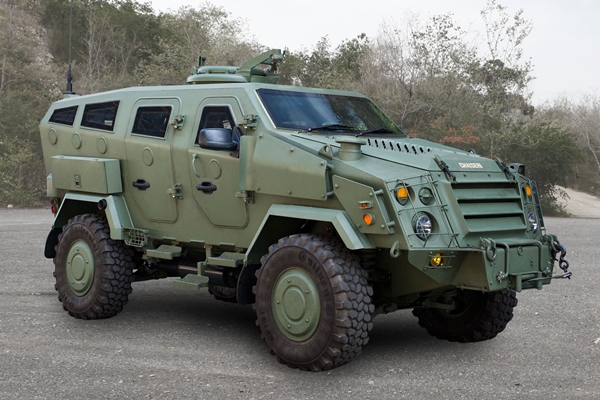
View on WikipediaThe First Win is a Thai Mine-Resistant Ambush Protected Vehicle with an all-welded steel monocoque V-hull produced by Thai defense contractor Chaiseri. The First Win is designed to provide high level protection against a variety of battlefield threats, including mines and improvised explosive devices.[1] Gross vehicle weight is about 9 tonnes (20,000 lb) and it can carry up to 10 troops plus the driver.
Key Information


Chaiseri hopes to export the First Win to foreign customers.[2]
History
[edit]The Royal Thai Army announced a first batch order of 21 First Wins in 2014.[3] Five additional First Wins are being negotiated for acquisition.[4] The Thai Ministry of Justice has ordered 18 First Wins[4] for the Department of Special Investigation.[5] The Royal Thai Police announced in 2016 that a requirement for a First Win acquisition with the Cummins 250 hp diesel engine instead of the 300 hp engine.[6]
In 2017, Chaiseri has shown the First Win 2 in Defense and Security 2017.[7]
In 2021, Chaiseri sold the First Win to Bhutan for use in peacekeeping operations.[8]
On May 19, 2022, Chaiseri is offering the First Win to fulfill Philippine requirements for MRAP-type vehicles.[9]
Design
[edit]
A 7.62mm or .50 machine gun can be mounted on the roof, while firing ports allow use of small arms from inside. Remote Weapon System can also be installed upon requirement.[citation needed]
The First Win is powered by a Cummins diesel engine (300HP in the original configuration, 250HP in the E version) coupled with an Allison 3000 SP automatic transmission (Allison 2500 SP in the E version., providing maximum road speed of up to 100 km/h. The vehicle comes standard with powered steering, independent suspensions and run-flat tires. Ballistic protection is up to STANAG 4569 Level 2 and mine protection to Level 3B under the hull center[10] and Level 4A under any station.
Variants
[edit]The following are manufactured by Chaiseri:[11][12]
- First Win: The original model. Known as First Win Armored Multi-Purpose Vehicle.
- First Win II: Model developed from First Win ICV. To offer in the Royal Thai Navy 4x4 Armored Multi-Purpose Vehicle procurement project. And it's the same model that was exported to the Malaysian Army.
- First Win AAV (Armored Ambulance Vehicle): First shown at Bangkok International Motor Show 2021 same as First Win AFV. Developed from First Win II.
- First Win ACV (Armored Command Vehicle)
- First Win AFV (Armored Fighting Vehicle): First shown at Bangkok International Motor Show 2021. It is a wheeled armored vehicle used for tactical 4 x 4 combat or other missions. It is strong enough to withstand local conditions. With an attack and put a bomb Able to operate in the area quickly and safely. Can be modified to Armored personnel carrier (APC), Infantry Fighting Vehicle (IFV), Reconnaissance Vehicle (RV) and Armored Ambulance.
- First Win AIFV (Armored Infantry Fighting Vehicle): Model that won the Royal Thai Air Force light armored vehicle procurement project. Developed from First Win AFV.
- First Win ALV (Armored Light Vehicle): Can carry personnel with maneuverability in limited terrain. It is robust enough to withstand the operating conditions in an area of operation where there are armed attacks and improvised explosive devices. Can be equipped with a variety of weapons, including anti-tank guided weapons.
- First Win Anti-Riot: Used by the Royal Thai Police with a remote control weapon system turret on top. Has a capacity of eight occupants.
- First Win APCV (Armored Personnel Carrier Vehicle): First shown at Defense & Security 2015, with a lengthened body to accommodate more occupants.
- First Win ATV (Armored Tactical Vehicle): It is an Armored Vehicle used in reconnaissance missions, Operating in risk areas. The engine was moved to the rear of the car. For a curved frontal armor design to reflect projectiles fired from the front. reduce the direct impact.
- First Win ATV II: Slightly different on the front of the car from the First Win ATV.
- First Win AWAV (Armored Wheel Amphibious Vehicle): The engine is moved backwards just like the First Win ATV. And install two waterjet propulsion units on the back as well as installing a wave shield in front in order to be able to drive on water. But it is still a prototype and will continue to be tested.
- First Win-E: A more compact variant with gross vehicle weight of 10 tons, comparable to the HMMWV.
- First Win IFV (Infantry Fighting Vehicle): Equipped with automatic armed turrets can fire from inside the car. Developed from First Win II.
- First Win RV (Reconnaissance Vehicle): Introduced in 2019 at the 2019 Navy Training, it equipped M134 on top of a vehicle. And proposed to the Royal Thai Army to consider as a reconnaissance vehicle for infantry. Developed from First Win II.
- First Win MPV (Multipurpose Vehicle): Unveiled at Defense & Security 2022 show in Bangkok.
- AV4 Lipanbara: License built by DefTech for Malaysian Armed Forces and Royal Malaysian Police. 200 vehicle planned. It was renamed as Lipanbara by Malaysian Prime Minister Najib Razak when he visited the Deftech pavilion during Defence Services Asia 2016.[13] The vehicle is named after a poisonous centipede found in Malaysia.[citation needed] AV4 Lipanbara was customized to fulfill the requirement of Malaysian Army standard. This included the installation of 300 hp engine, upgrade and strengthened armored protection up to STANAG 4569 level 3 and the fitted of M134D-H Mini-gun.[14]
- Hanuman: Version made by Indonesia.[9]
Operators
[edit]
 Thailand:
- Royal Thai Army - 21 First Wins ordered in March 2012.[15] About 50 ordered in 2013. RTA's source has indicate interest in the smaller First Win-E. Other 200 confirmed ordered, at least 18 per year will be delivered.
- Royal Thai Navy - 6 First Win II, with the first 2 being delivered in 2020 and the other 4 in 2021, Used by the Royal Thai Marine Corps.
- Royal Thai Air Force - 2 First Win AIFV, Test to evaluate the use by Special Operations Regiment (Thailand)
- Department of Special Investigation - 18 First Wins ordered in October 2015.[4][5]
- Department of Corrections - 3 First Win adapted version for transporting prisoners.
- Office of the Narcotics Control Board - 3 First Win adapted version for the anti-narcotics mission.
- Internal Security Operations Command - 10 purchased.[16]
 Malaysia:
- Malaysian Army - 20 in service from 200 planned.[14] First six units will be built by Chaiseri at its facilities in Pathum Thani Province and delivered to Malaysia in the first quarter of 2016. The remaining vehicles will be produced under license by Malaysia's DRB-Hicom Defence Technologies (DefTech), designation of the vehicle was AV4 Lipanbara.[17][18]
 Indonesia:
- Indonesian Army - Unknown number in service. First unveiled at Indonesian Army Anniversary 2019.[19]
 Bhutan:
- 15 with First Win Command, First Win II, First Win ATV and First Win Ambulance, to be used in the United Nations Peacekeeping Mission under the United Nations Multidimensional Integrated Stabilization Mission (MINUSCA) at Central African Republic and elsewhere around the world.[20]
- 10 FW ATVs delivered to the Royal Bhutan Police on May 27, 2024.[21][22]


Potential operators
[edit] Pakistan:
- On October 11, 2024, Islamabad signed a memorandum of understanding with the Thai government, in order to acquire 100 Chaiseri First Win vehicles, designed for protection against ambushes and IEDs. These mine-resistant vehicles are set to enhance the Pakistan Army’s ability to operate in difficult environments, marking a significant step in the defence cooperation between Thailand and Pakistan.[23]

Cancelled orders
[edit] Philippines:
- Clark International Airport Authority - First Wins ordered in 2015.[11] It's been reported in 2017 that the order was officially cancelled due to budget reasons.[7]

References
[edit]- ^ "Chaiseri Defence Vehicle present for the first time at IDEX". Army Recognition. 23 February 2011. Archived from the original on 23 September 2015. Retrieved 4 November 2014.
- ^ "New life, extended life - IDEX 2013 - IHS Jane's". Archived from the original on 30 March 2013. Retrieved 4 November 2014.
- ^ "Thailand; Army orders First Win MRAPS". Archived from the original on 4 November 2014. Retrieved 4 November 2014.
- ^ a b c "A strong niche player - Eurosatory 2012 - IHS Jane's". Archived from the original on 13 April 2014. Retrieved 4 November 2014.
- ^ a b "Protected mobility- VEHICLES SLOW TO ACCELERATE IN ASIA". Archived from the original on 14 June 2013. Retrieved 4 November 2014.
- ^ "Thailand's First Win for Malaysia" (PDF). Archived from the original (PDF) on 9 July 2017.
- ^ a b "D&S 2017: Chaiseri looks to the next generation - LWI - Land Warfare - Shephard Media". www.shephardmedia.com. Archived from the original on 15 November 2017. Retrieved 23 April 2018.
- ^ "Bhutan gains First Win with UN | Shephard".
- ^ a b "DTI and Chaiseri fom Thailand to export First Win MRAP armored vehicle to the Philippines | Defense News May 2022 Global Security army industry | Defense Security global news industry army year 2022 | Archive News year". 19 May 2022.
- ^ "Internal Server Error" (PDF).
- ^ a b "First Win 4x4 multipurpose armoured vehicle". Army Recognition. Archived from the original on 7 March 2017.
- ^ "Thai Defence Company Chaiseri unveils armoured personnel carrier variant of its First Win vehicle". Army Recognition. 4 November 2015. Archived from the original on 15 March 2016. Retrieved 29 July 2016.
- ^ "Editorial: Wars and inventions". MOTORME.MY. 22 April 2016. Archived from the original on 14 August 2017.
- ^ a b Administrator (19 April 2016). "Deftech of Malaysia unveils new Lipanbara 4x4 HMAV High Mobility Armoured Vehicle at DSA 2016 11904163 - DSA 2016 Official Online Show Daily News - Defence security military exhibition 2016 daily news category". www.armyrecognition.com. Archived from the original on 30 December 2017. Retrieved 23 April 2018.
- ^ Administrator. "D&S2012: ชัยเสรีพร้อมส่งมอบรถเกราะ First Win ให้กองทัพบกไทย". www.thaiarmedforce.com. Archived from the original on 3 September 2017. Retrieved 23 April 2018.
- ^ "'Unwanted' vehicles to be used in UN mission". Bangkok Post.
- ^ DefTech. "DefTech AV4". Archived from the original on 24 May 2015. Retrieved 17 May 2015.
- ^ "Armored Cars: Deftech AV4". 21stcenturyasianarmsrace.com. 14 May 2016. Archived from the original on 23 December 2017. Retrieved 23 April 2018.
- ^ "First Win 4x4: Tampil Perdana di HUT TNI Ke-74, Inilah Rantis MRAP Terbaru Kopassus". 3 October 2019.
- ^ "ภาพการทดสอบ First Win 4×4 จำนวน 15 คันของภูฎาน ลูกค้าต่างชาติรายที่ 3". www.thaiarmedforce.com. 19 November 2021. Retrieved 19 November 2021.
- ^ "Thailand Delivers 10 Chaiseri First Win 4X4 Armored Tactical Vehicles".
- ^ "Made-in-Thailand armoured vehicles, pistols delivered to Bhutan". 27 May 2024.
- ^ Fretay, Halna du. "Pakistan Enters into an Agreement with Thailand for 100 Chaiseri First Win MRAP Vehicles". armyrecognition.com. Retrieved 8 June 2025.
External links
[edit]- Chaiseri Metal and Rubber Co., Ltd. Archived 14 September 2015 at the Wayback Machine
| Domestic manufacturers | |
|---|---|
| Foreign companies with operations | |
| Defunct companies | |
| Components | |
| Related topics | |

