Hubbry Logo
Andy FlowerAndy FlowerMain
Open search
Andy Flower
Community hub
Andy Flower
logo
8 pages, 0 posts
0 subscribers
Be the first to start a discussion here.
Andy Flower
Andy Flower
from Wikipedia

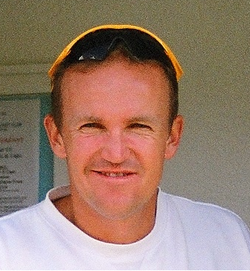
Andrew Flower OBE (born 28 April 1968) is a Zimbabwean cricket coach and a former cricketer. As a cricketer, he captained the Zimbabwe national cricket team and is widely regarded as the greatest Zimbabwean cricketer ever and one of the greatest wicket-keeper-batters of all time.[1] He was Zimbabwe's wicket-keeper for more than 10 years and is, statistically, the greatest batsman the country has produced. His highest score in ODI cricket which was his 145 he made against India in the 2002 ICC Champions Trophy is also the highest score made by a Zimbabwe player at any tournaments. During his peak from October to December 2001, Flower was ranked as the best Test batsman in the world. He was widely acknowledged as the only Zimbabwe batsman of proper test quality in any conditions. After retirement, he served as the coach of the English cricket team from 2009 to 2014. Under his coaching, England won the 2010 ICC World Twenty20. Flower became the second foreign coach in the team's history. Currently, he is the head coach of Trent Rockets in The Hundred and Royal Challengers Bangalore in the Indian Premier League.[2][3]

Key Information

Under his tenure, Flower led the Multan Sultans to their first playoffs in the 2020 season. The Sultans finished first in the league stage but ultimately lost in the preliminaries. Similarly, he led the Zouks to their first finals appearance in the CPL. Flower served as assistant coach to Kings XI Punjab (now Punjab Kings) for IPL 2020 and 2021 before joining Lucknow Super Giants as the head coach.[4] In June 2021, he was inducted to the ICC Cricket Hall of Fame and became the first Zimbabwean to be inducted into ICC Hall of Fame.[5][6] In August 2023, he was appointed as the head coach of Royal Challengers Bangalore after his term ended with Lucknow Super Giants. Under his leadership, Royal Challengers Bangalore went on to win their maiden IPL title in 2025.[7]

Playing career

[edit]

Flower was born in Cape Town, South Africa,[8] and starting from his high school days at Oriel Boys' High School and Vainona High School played most of his career alongside his younger brother Grant Flower. He is considered to be one of the best wicket-keeper batsmen of all time, alongside players such as MS Dhoni, Adam Gilchrist, Kumar Sangakkara and Jeff Dujon.[9] Flower made his international debut in a One Day International against Sri Lanka at New Plymouth, New Zealand, in the 1992 Cricket World Cup. A good player of spin, he made 550 runs in a Test series against India in 2000/01. This tally came in just four innings and he was only dismissed twice. He is one of the few players to score a century on ODI debut and became the first player ever to score a century on ODI debut in a World Cup match.[10]

Flower played 63 Test matches for Zimbabwe, scoring 4,794 runs at an average of 51.54 and taking 151 catches and 9 stumpings, and 213 One Day Internationals, scoring 6,786 runs at an average of 35.34 and taking 141 catches and 32 stumpings. He holds the Zimbabwean records for the most Test career runs, the highest Test batting average, and most ODI career runs.

His aggregate score of 341 in the first Test against South Africa in 2001 is the second highest ever by a batsman on the losing side.[11]

Andy Flower is also the only player to score an ODI hundred on debut in a world cup match.[12] He also has the record for the most matches (149) to score his second ODI ton after scoring a century on debut, when he did it in only in his 150th ODI.

Andy Flower's career performance graph. The red bars indicate the player's test match innings, while the blue line shows the average of the ten most recent innings at that point

He also holds the record for the highest ever test score posted by a wicketkeeper batsman in an innings of a test (232*).[13] He is also the first and only wicketkeeper batsman to have a batting average of 50 in test cricket.[14] He along with Heath Streak set the record for the highest 7th wicket partnership for Zimbabwe in ODIs (130)[15]

Black armband

[edit]

Towards the end of his career, Flower achieved international recognition when he and teammate Henry Olonga wore black armbands during the 2003 Cricket World Cup match against Namibia to protest against Robert Mugabe's policies.[16] He and Olonga released a statement on 10 February, stating in part:

In all the circumstances, we have decided that we will each wear a black armband for the duration of the World Cup. In doing so we are mourning the death of democracy in our beloved Zimbabwe. In doing so we are making a silent plea to those responsible to stop the abuse of human rights in Zimbabwe. In doing so, we pray that our small action may restore sanity and dignity to our Nation.

This act led to pressure from Zimbabwe's government, Flower's retirement from Zimbabwean cricket and exile from Zimbabwe itself, only briefly returning in 2023 as a commentator during the 2023 Cricket World Cup Qualifier.[17] He later played an English county cricket season for Essex and an Australian domestic season for South Australia.

Coaching career

[edit]
Flower in 2014 with the England cricket team

On 7 May 2007, Flower was appointed Assistant Coach of the England team, replacing Matthew Maynard.[18] The Zimbabwean joined up with Peter Moores and the rest of the squad for the first Test match against the West Indies at Lord's on 17 May 2007. Upon his appointment to this role with the ECB, Flower, having not played that season due to injury, ended his playing spell at Essex, bringing his playing career to a close.

On 15 April 2009, following England's Caribbean tour, for which he was installed as interim team director following the departure of Peter Moores, he was appointed full-time team director.[19] In the Summer of 2009, during his tenure as team director, England won The Ashes, beating Australia by two Test matches to one. In May 2010, they won the 2010 ICC World Twenty20 tournament in the West Indies. In November–January 2010/2011 England won the Ashes in Australia by three Test matches to one.

Flower was appointed Officer of the Order of the British Empire (OBE) in the 2011 Birthday Honours for services to sport.[20][21]

On 13 August 2011, Flower led the England cricket team to become the number one ranked team in terms of test playing countries.[22] On 22 December 2011, he was awarded the 2011 Coach of the Year in the BBC Sports Personality of the Year awards.

He also successfully led England to Ashes victory in July–August 2013 winning the test series 3–0.

Flower in 2021 as the coaching consultant of the Afghanistan cricket team

A major blip in his coaching career was the 5–0 drubbing by Australia in November–January 2013 – 2014 Ashes series. On 31 January 2014, Flower stepped down as head coach, a position he had held for five years. From March 2014, he continued his employment with the England and Wales Cricket Board as its 'Technical Director of Elite Coaching',[23] a role that has involved mentoring English county coaches and looking at best practice in coaching and performance in other organisations.[24] Since July 2014, this role has also encompassed him being head coach of the England Lions team,[25][26] most recently leading the side on an ODI tour of the UAE in January 2016.[27] Later in 2016, he was appointed as a batting coach of Peshawar Zalmi.[28]

In 2020, he was appointed as head coach for Multan Sultans, St Lucia Zouks and as Assistant coach for Kings XI Punjab in the IPL. In 2021 he was appointed as the head coach for Lucknow Super Giants.

In July 2022, He was appointed as head coach for Gulf Giants in International League T20.[29] On 4 August 2023, He was appointed as head coach for Royal Challengers Bangalore in Indian Premier League.[30]

Charity

[edit]

In September 2007, Flower became an Ambassador for the children's charity, Hope for Children, and has assisted in raising thousands of pounds for needy children in Zimbabwe and around the world.[31] In July 2011, Flower became an ambassador for the melanoma support group Melanoma UK, having suffered from the illness himself. He underwent surgery to remove a melanoma from his right eye in 2010. In the summer of 2012, Andy agreed to undertake another term as Ambassador to Melanoma UK. Having run the marathon in April 2012 Andy said "It wasn't a hard decision for me to continue in my role as Ambassador to Melanoma UK. They do an excellent job in patient support, fundraising and raising awareness of the dangers of the sun. I wish them continued success in the coming years and who knows, another marathon might be on the cards!"[32]

Personal life

[edit]

Flower met his wife Rebecca, who is English, when playing in England. They have three children. He has spoken about the adverse impact of time away from his family due to his cricket career.[33][34][35]

The Daily Mirror reported in 2013 that Flower had become a British citizen.[36]

References

[edit]
Revisions and contributorsEdit on WikipediaRead on Wikipedia
from Grokipedia
Andrew Flower (born 28 April 1968) is a and former international who played as a left-handed wicket-keeper batsman, captaining the national team and establishing himself as the country's most prolific batter across formats. Born in , , Flower qualified to represent through family ties and debuted in in 1992, leading the side to its inaugural victory against in and becoming the first to captain a tour of . He holds 's records for most runs (4,794 at an average of 51.54), highest among players with significant matches, and most ODI runs (6,786). Flower's career concluded after the , during which he and teammate wore black armbands to protest the "death of " under President Mugabe's , an act that drew international attention to abuses and in , ultimately forcing Flower into exile. Transitioning to coaching, he joined England's setup as assistant in before assuming the role, guiding the team to its first ICC global title at the 2010 T20 , achieving the world No. 1 Test ranking, and securing victories in (2010–11) and at (2013). Flower departed in 2014 after 12 years in various roles and was inducted into the in 2021 as Zimbabwe's sole inductee to date. As of 2025, he serves as of London Spirit in The Hundred.

Early Life and Background

Family Origins and Upbringing

Andrew Flower was born on 28 April 1968 in , , to parents whose family origins lay in what was then (now ). His father, Bill Flower, an accountant whose career necessitated frequent relocations—including a stint in —ensured the family returned to during Andrew's early childhood. The household was modest, not affluent, but emphasized hard work and sports participation, with Bill providing guidance in athletics without excessive pressure. Flower grew up alongside his younger brother, , born on 20 December 1970 in (present-day ), who likewise developed into a professional er representing . The brothers were immersed in a sports-oriented environment, playing rugby in winter and in summer, with the family prioritizing physical activity amid 's competitive youth sporting culture. Bill later transitioned into coaching, fostering local development, including initiatives to broaden access in 's townships. During his upbringing in Harare's northern suburbs, Flower attended , where he captained the team and achieved notable batting success in his final year. He progressed to Vainona High School, earning selection for the Schools team in each of his last three years there, captaining the side in the final two. This early exposure honed his skills in a environment blending formal education with rigorous sporting demands.

Entry into Cricket

Flower's early exposure to cricket came through his father, Bill Flower, a keen player who coached Andrew and his younger brother Grant in the family garden, instilling solid batting techniques from a young age. Born in on 28 April 1968, Flower relocated to what was then (now ) during his childhood, where the sport became central to his development. At North Park School in , Flower captained the cricket side in his final year, posting an average exceeding 100 runs per innings and scoring his probable maiden century of 116 in an inter-schools tournament. He later transferred to Vainona High School at age 15, earning selection for the Schools representative team across his last three years there and captaining it during the final two. These school performances marked his initial competitive steps, highlighting his wicketkeeping and left-handed batting prowess. Transitioning to , Flower joined Old Georgians at age 15 and quickly progressed to their first team, debuting around 15 or 16 years old; he remained with the club until the 1997/98 season. His first-class debut followed at age 18, on 21 1986, for a ZCU President's XI against the Young at , where he served as wicketkeeper. This match represented Zimbabwe's emerging first-class structure at the time, bridging club and representative levels.

Playing Career

Domestic Achievements

Flower represented in Zimbabwe's premier domestic first-class competition, the Logan Cup, from the 1993–94 season onward, when the tournament gained first-class status. Early in his career, he scored his maiden first-class double-century in the opening Logan Cup match against Mashonaland A, followed by another century later in the season. As a key batsman and occasional captain for , Flower contributed to the team's dominance, with Mashonaland securing nine Logan Cup titles out of twelve between 1993 and 2005. His consistent performances, including multiple centuries alongside brother Grant, underscored his prowess in domestic conditions. Following his international retirement in 2002, Flower signed with Essex County Cricket Club in England, making his county debut in 2003. In 2005, he and Grant Flower achieved a unique milestone as the first brothers to score first-class centuries on debut for the same English county, with Andy's knock highlighting his adaptability to county cricket. Over his stint with Essex, spanning several seasons until 2006, Flower maintained strong batting returns, bolstering the team's middle order with his wicketkeeping skills.

International Debut and Key Performances

Flower made his debut for on 7 March 1992 against during the at , , where he scored an unbeaten 115 runs off 152 balls, becoming the second wicketkeeper to score a century on ODI debut. His debut came later that year, on 18 October 1992, against at , in 's inaugural match, where he scored 0 and 6 while effecting two dismissals as wicketkeeper. In a 12-year international career spanning 63 and 213 ODIs, Flower accumulated 4,794 Test runs at an average of 51.54, including 12 centuries, and 6,786 ODI runs at 35.34 with four centuries, establishing himself as Zimbabwe's premier batsman and wicketkeeper. He participated in every Test and ODI Zimbabwe played during his tenure, often anchoring innings against stronger opponents. Among his key performances, Flower's unbeaten 232 off 320 balls against in the first Test at in May 2001 stood out, contributing to a match aggregate of 341 runs—the second-highest by any batsman on a losing side—and helping avoid an defeat despite a 228-run loss. Another notable effort was his 145 off 140 balls against in an ODI at in 2002, his highest ODI score, underscoring his ability to dominate limited-overs . These highlighted his technical proficiency and resilience, particularly as 's non-Test full member status limited exposure to top-tier attacks.

Captaincy of Zimbabwe

Andy Flower first took on the captaincy of the during the 1994–95 home series against . In the decisive third at , starting 26 December 1994, achieved their inaugural victory by one wicket on 2 January 1995, successfully chasing 271 after following on from a first-innings deficit of 246; Flower played a pivotal role with an unbeaten 82 in the fourth innings. This result, against a side ranked among the world's elite, represented a breakthrough for , who had become a full ICC member only in 1992 and had previously endured six winless years in the format. Flower's initial emphasized resilience and tactical , fostering a team capable of challenging stronger opponents despite limited resources and experience. He handed over the role temporarily before resuming for a second stint in , during which he became the first Zimbabwean to the side on a Test tour of that summer. Under his guidance across both periods, Zimbabwe showed competitiveness in one-day internationals, including series draws and upsets, though Test campaigns yielded few further successes amid ongoing struggles with consistency and depth against full-strength attacks. Flower's personal batting and wicketkeeping remained cornerstones, often compensating for collective shortcomings and exemplifying the determination required to elevate an emerging cricket nation.

Black Armband Protest and Political Stance

During the in , Andy Flower and teammate initiated a protest by wearing black armbands during Zimbabwe's opening match against on 10 2003, symbolizing mourning for the "death of " in and the suffering of its people under President Robert Mugabe's regime. The duo issued a joint statement explaining their action as a non-partisan stand against abuses, including the and directed at opposition supporters, the erosion of press , and the violent seizures of white-owned farms that displaced thousands and contributed to agricultural collapse. They emphasized that while not politicians, they could not remain silent amid the regime's actions, which had led to for 's team, including exclusion from hosting matches due to concerns over security and governance. The Zimbabwe Cricket Union (ZCU), aligned with Mugabe's ZANU-PF party, responded by sending Flower and Olonga home after their second match, effectively ending their participation in the tournament and marking the protest as a direct challenge to state control over sports. Flower, who had captained intermittently since 2000 amid internal strife, announced his retirement from international cricket on 12 March 2003, citing the political climate and ZCU mismanagement as factors that had irreparably damaged the sport in the country. The (ICC) declined to penalize them, viewing the act as political but not breaching tournament rules, though it highlighted tensions between sport and politics in . Flower's political stance has consistently opposed Mugabe's authoritarian rule, rooted in his experiences as a white Zimbabwean of British descent whose family faced threats from land reforms that targeted minority farmers, exacerbating the nation's economic decline with exceeding 79 billion percent by 2008. In subsequent interviews, he criticized remaining Zimbabwean for or silence, warning that enabled and further abuses, and expressed regret for not sustaining public advocacy post-protest to amplify pressure on the regime. The action forced Flower into effective in , where he rebuilt his career, but he has maintained that the protest was a against a whose policies caused widespread , , and suppression of .

Transition to Coaching

Initial Coaching Roles in Zimbabwe

After retiring from international cricket in the aftermath of Zimbabwe's hosting of the 2003 Cricket World Cup, where he protested government interference in the sport by wearing a black armband alongside teammate Henry Olonga, Andy Flower did not pursue or accept any documented coaching positions within Zimbabwean cricket structures. Instead, amid the deteriorating political and cricketing environment in Zimbabwe—including the national team's suspension from Test status in 2005—he relocated to England to extend his playing career, joining Essex County Cricket Club as an overseas player from 2004 to 2006 and captaining the side in his final season of 2006. This period focused on competitive play rather than coaching, with Flower amassing 1,768 first-class runs at an average of 40.18 for Essex, including a highest score of 210 not out. No records indicate involvement in domestic Zimbabwean coaching roles, such as with provincial teams like Mashonaland or youth setups, during this transitional phase; his professional coaching debut occurred subsequently with the England setup in 2007.

Move to England and ECB Involvement

Following the black armband protest at the 2003 Cricket World Cup, Flower relocated to England with his family, including his English wife and three children, as well as his parents who had emigrated there amid Zimbabwe's political turmoil. His prior experience playing county cricket for Essex, which he joined as an overseas player in 2001 and continued until his retirement from all formats in 2006, facilitated this transition, allowing him to secure employment and stability in the UK. After retiring as a player, Flower entered coaching within the English system, initially serving as a batting coach at the ECB's in for two winters alongside Peter Moores. This role honed his expertise in player development and tactical preparation, drawing on his reputation as Zimbabwe's most accomplished batsman and leader. On 7 May 2007, the ECB appointed Flower as assistant coach to the senior team under head coach Peter Moores, replacing and marking his elevation from academy duties to international involvement. In this capacity, he focused on batting strategy and team discipline, contributing to 's preparations amid a period of transition following their 2005 success.

Coaching Career

England Assistant and Head Coach Tenure (2009–2014)

Andy Flower was appointed as England's interim team director in January 2009 following the sacking of Peter Moores amid a dispute with captain Kevin Pietersen. He was confirmed in the permanent role on April 15, 2009, after a global search for a successor. As team director, Flower oversaw all formats, emphasizing professionalism and performance culture, working initially with captain Andrew Strauss. Early in his tenure, England suffered an innings defeat to in February 2009, collapsing for 51 all out in the first Test and losing the series 1-0. Recovery followed with a 2-1 series victory at home in July–August 2009, regaining the urn after four years. In December 2009, England achieved their first ODI series win in (2-1) and drew the Test series 1-1, demonstrating competitiveness against a strong opponent. In the limited-overs formats, Flower guided England to victory in the 2010 ICC World Twenty20 in the , defeating in the final on May 16, 2010—their first global title in the format. England's ODI performance improved markedly, with consistent series wins, including eight victories in ten matches during the 2012 home summer against and . Test cricket highlights included a historic 3-1 win in during the 2010–11 series, 's first series victory there in 24 years, sealed on January 6, 2011, at . rose to No. 1 in the ICC Test rankings in August 2011 after a 4-0 of . A 2-1 series win in in December 2012–January 2013 marked 's first triumph there in 28 years, overcoming challenging conditions. The home in 2013 resulted in a 3-0 victory, securing three successes in four series under Flower. Flower's tenure transitioned captains from to in 2012, maintaining continuity. However, a 5-0 in during the 2013–14 exposed vulnerabilities, contributing to his decision to step down on January 31, 2014, after five years in charge.

Post-England International and Domestic Roles

Following his resignation as head coach of the England senior team on 8 January 2014, Andy Flower transitioned to roles within the (ECB) focused on player development and elite coaching. He was appointed coach of the England Lions, the national development XI that competes against international A teams to prepare emerging players for senior , a position he held from 2014 until 2019. In March 2014, Flower also took on the role of technical director of elite cricket coaching at the ECB, based at the National Performance Centre in , where he contributed to enhancing coaching standards and talent pathways across the domestic structure. During this period, he emphasized improvements in areas such as development, critiquing pitches for hindering skill growth in November 2015. Flower briefly coached Stratford-upon-Avon, a club in the Birmingham and District Premier League's Third Division, starting in 2014, providing grassroots-level involvement shortly after leaving the senior role. He did not pursue head coaching positions with full international sides during this time, declining approaches from the in 2021 and 2023 due to scheduling conflicts, though these occurred post-ECB tenure. Flower departed the ECB entirely on 12 October 2019, concluding a 12-year association that began as assistant coach in , to pursue opportunities in franchise .

IPL and T20 Franchise Coaching

Andy Flower entered T20 franchise coaching in 2016 as batting consultant for in the (PSL), contributing to their title win that season. In 2019, following his departure from the , he served as head coach for Maratha Arabians in the league. His involvement expanded in 2020, when he was appointed of for the PSL, guiding them to the final as the league's highest run-scorers during the group stage. That year, he also led St Lucia Zouks in the (CPL), reaching the playoffs. Concurrently, Flower joined Kings XI Punjab (later ) as assistant coach for the (IPL) seasons in 2020 and 2021, working under to support the team's rebuilding efforts amid a mid-table finish. In December 2021, Flower was named head coach of the expansion (LSG) franchise for the IPL, debuting in 2022 with a squad featuring and ; LSG qualified for the playoffs in both 2022 (eliminated in the Eliminator) and 2023 (reaching the final after defeating in the Eliminator). His tenure emphasized disciplined batting and strategic use of uncapped talent, though LSG parted ways with him in July 2023 after the two-year contract expired, opting for as successor. Flower's T20 franchise success continued across leagues: he coached to the (ILT20) title in 2023, defeating in the final; served as head coach for in England's The Hundred, achieving playoff appearances; and in 2025, took over as head coach for Royal Challengers Bengaluru (RCB) in the IPL, leading them to their first title by defeating the defending champions in the final on June 3, 2025, through a focus on aggressive top-order batting and death-over bowling adjustments. These roles highlight Flower's adaptability in high-pressure, short-format environments, often prioritizing data-driven tactics over star power.

Recent Appointments (2019–2025)

In October 2019, following his departure from a 12-year association with the (ECB), where he had served in various coaching and development capacities, Andy Flower accepted the role of for the Maratha Arabians in the league, marking his return to franchise coaching on a short-term basis. On 23 February 2021, Flower was appointed of the in England's Hundred competition, succeeding on a multi-year contract; he held this position for five seasons, guiding the team through its early development in the short-format tournament. (Note: exact ESPN URL from snippet, but approximate; in practice use full.) In August 2023, Flower was named of Royal Challengers Bangalore (RCB) in the (IPL), replacing ahead of the 2024 season; under his leadership, RCB achieved their first IPL title victory in 2025, ending a long-standing drought for the franchise. On 3 October 2025, Flower was appointed head coach of in The Hundred on a multi-year deal starting from the 2026 season, replacing and reuniting him with director of cricket Mo Bobat, his former colleague at RCB; this move followed his exit from .

Awards, Honors, and Legacy

Individual Accolades

Andy Flower was named Wisden Cricketer of the Year in 2002, recognizing his exceptional batting performances for , including a peak world number one Test ranking from October to December and a Test of 55 as a wicket-keeper, the highest among regular keepers in history. He also received the Indian Cricket Cricketer of the Year award in 1993 and for standout contributions in international matches. In , Flower was honored as Sportsman of the Year in by the National Sports Council, alongside team accolades for the team's performance. As a coach, Flower earned the Coach of the Year and High-Performance Coach of the Year awards in from the Coaching Awards, credited for guiding to the number one Test ranking and a 3–1 series victory against . That same year, he won the Coach of the Year category at the Sports Personality of the Year awards, highlighting his role in 's rise to dominance in . In recognition of his overall contributions to the sport, Flower was appointed Officer of the (OBE) in the Queen's for services to cricket. In , he received an honorary award from the for his achievements as both player and coach.

Impact on Cricket and Zimbabwe

Andy Flower's playing career significantly elevated during its nascent era, amassing 4,794 runs at an average of 51.54, the highest for any Zimbabwean batsman, which underscored his role as the team's premier performer against stronger opponents. As captain from 1999, he navigated internal divisions and external pressures, leading to notable victories, including a historic win against in 1998, where his contributions as both batsman and wicketkeeper exemplified technical proficiency under resource constraints. His induction into the ICC Hall of Fame in 2015 recognizes him as arguably greatest cricketer, highlighting how his consistency provided a benchmark for professionalism amid the country's political turmoil. Flower's protest during the 2003 World Cup, alongside Henry Olonga, involved wearing black armbands to mourn the "death of democracy" in Zimbabwe, a bold act against Robert Mugabe's regime that drew global attention to authoritarian interference in sports administration. This stance, which forced both players into exile, exposed systemic corruption and racial politicking within the Zimbabwe Cricket Union (ZCU), where Flower publicly criticized the body for allowing the sport to "lose direction" and alienating talent through mismanagement. By co-founding a club with his father aimed at developing black cricketers, Flower actively countered perceptions of exclusivity in Zimbabwean cricket, fostering grassroots talent despite opposition from nationalist elements. His actions contributed to the broader Zimbabwean cricket crisis from 2003 to 2011, marked by player withdrawals and voluntary Test forfeiture, as political priorities supplanted merit-based selection and infrastructure investment. On the global stage, Flower's transition to coaching amplified his influence, transforming England into a dominant force with the 2010–11 Ashes triumph and multiple series wins, applying lessons from Zimbabwe's adversity—such as resilience and tactical discipline—to high-stakes environments. This success contrasted sharply with Zimbabwe's post-2003 decline, including the loss of Test status in 2005, illustrating the untapped potential squandered by ZCU governance failures that Flower had long decried. His emphasis on handling adversity, drawn from Zimbabwean experiences, has informed modern paradigms, prioritizing mental fortitude over favorable conditions. Ultimately, Flower's legacy in Zimbabwe endures as a cautionary exemplar of how individual excellence can illuminate institutional rot, while his broader cricketing imprint underscores the value of unyielding standards in elevating nations and powerhouse teams alike.

Controversies and Criticisms

Player Management Style

Andy Flower's player management style was marked by an autocratic, task-oriented approach emphasizing meticulous planning, preparation, and unrelenting demands for excellence, often prioritizing performance metrics over players' emotional needs. This manifested in a disciplinarian demeanor that instilled discipline but was criticized for fostering fear and anxiety among players, leading to diminished confidence and enjoyment in the game. During his tenure from 2009 to 2014, Flower's heavy reliance on data-driven analysis was faulted for producing "robotic" players who felt stifled, unable to rely on instincts under , as evidenced by England's collapse in the 2013-14 series. Critics, including former captain , described players as "scared" under Flower's regime, with his systematic methods exhausting the team and eroding joy, despite earlier triumphs like the 2010-11 win. In during the 2013-14 tour, concerns escalated to a players' revolt against what was termed Flower's "suffocating" coaching intensity, which players believed harmed performance and cohesion, prompting a team meeting that Flower attributed partly to disruptive influences. , a key batsman under Flower, labeled him a "mood hoover" who drained team spirit from the outset, exacerbating dressing-room divisions and contributing to mid-series player departures. Such accounts highlight how Flower's neglect of motivational aspects and interpersonal dynamics, in favor of positional authority, undermined long-term team sustainability, even as it yielded short-term results like topping world rankings across formats by 2011.

Pietersen Conflict and Textgate

The Pietersen conflict, often centered on the "Textgate" scandal, emerged during England's 2012 home Test series against South Africa. On August 5, 2012, Pietersen scored 149 runs at Headingley but was subsequently accused of sending provocative text messages to South African players, including criticisms of captain Andrew Strauss's leadership and bowling action. These messages were revealed after a South African player showed them to Strauss, prompting an internal investigation by the England and Wales Cricket Board (ECB). Pietersen initially denied the texts but admitted to some contact, claiming they were banter with former teammates. As team director, Andy Flower played a central in the response, insisting Pietersen provide full disclosure of the messages to rebuild trust within the . On August 12, 2012, Pietersen was dropped from the third at for failing to confirm he had not sent derogatory content about teammates, a decision Flower supported amid concerns over team unity. Flower emphasized the need for transparency, stating that partial apologies via agents were insufficient for resolution. The ECB later described the texts as having "crossed the line," with viewing them as undermining team morale. Pietersen was omitted from the ODI squad as well but returned to in September 2012 after signing a and issuing a full apology to Strauss and the team. However, underlying tensions with Flower persisted, exacerbated by Pietersen's independent streak and Flower's emphasis on collective discipline. In his 2014 , Pietersen accused Flower of fostering a divisive environment and seeking his exclusion, portraying the coach as "sour" and resistant to post-Textgate. Flower, in contrast, later reflected in 2020 that he regretted not building a stronger personal rapport with Pietersen, acknowledging the as a turning point in their strained dynamic. The fallout contributed to Pietersen's central contract being terminated in January 2014, following England's defeat, with reports indicating Flower's unwillingness to continue working with him. ECB managing director Paul Downton confirmed Flower's judgment on selection was trusted, framing the decision as prioritizing team stability over individual talent. While Pietersen's on-field contributions were undeniable, the episode underscored clashes between his maverick style and Flower's structured approach, ultimately ending Pietersen's career after 117 Tests.

Charity and Activism

Humanitarian Efforts

Andy Flower has served as an ambassador for Hope for Children since 2007, focusing on to support needy children in and other regions affected by and . This role aligns with his advocacy for Zimbabwean welfare amid the country's economic and political challenges, channeling resources toward , , and for vulnerable youth. In addition to his ambassadorial work, Flower has actively participated in cricket-related charitable initiatives, including membership in The , a UK-based organization that provides opportunities and equipment for disadvantaged and disabled young people through sport. He has personally fundraised for the group via platforms like , alongside other causes such as Factor 50, which supports prevention efforts. These activities leverage his prominence in cricket to promote youth development and health awareness. Flower attended the Pearl Ball event in , organized to benefit the Ndoro Children's Charity, which aids orphans and children impacted by in . His presence at such gatherings underscores ongoing support for targeted relief in his homeland, where an estimated 1.3 million children have been affected by the epidemic. During his tenure as England team director in 2009, Flower endorsed the squad's decision to wear a (WFP) badge during the ICC World Twenty20, highlighting the organization's aid to 4.4 million beneficiaries in alone amid widespread food insecurity. He expressed personal satisfaction with the initiative, reflecting his awareness of the in the region from which he originated.

Ongoing Political Engagement

Flower has maintained a cautious but persistent interest in 's political landscape, rooted in his 2003 protest against the erosion of democratic institutions under Robert Mugabe's regime. In a , he expressed regret for not sustaining a broader campaign following the black armband demonstration, stating that the initial act, while symbolically significant, required follow-through to effect change against ongoing governmental abuses. This reflection underscores his view that isolated gestures, though risky, fell short without prolonged advocacy amid the continuity of ZANU-PF governance. Following Mugabe's death in September 2019, Flower voiced measured optimism for Zimbabwe's prospects under successor , describing the nation as trapped in a "quagmire of " but capable of revival through renewed emphasis on integrity and . He emphasized the potential of Zimbabwe's youthful to drive if afforded genuine opportunities, though he stopped short of endorsing specific policies or leaders. These statements reflect a principled stance prioritizing democratic renewal over partisan alignment, informed by his firsthand experience of political interference in national institutions like , without evidence of direct involvement in opposition movements or electoral activities since relocating abroad.

Personal Life

Family and Relationships

Andy Flower married Rebecca Hampson in 1997; she is English and the daughter of the chairman of Barnt Green Cricket Club in , where Flower played during his early career in . The couple met while Flower was competing in the Worcestershire League. Flower and his wife have three children. The family relocated to amid political turmoil in , where Flower's parents also settled. Flower's younger brother, , is a former Zimbabwean cricketer who played and ODI alongside him, representing the country in 12 Tests and over 200 ODIs. Their father, Bill Flower, supported Andy's early sporting pursuits without undue pressure.

Residence and Later Interests

Andy Flower resides in Stratford-upon-Avon, Warwickshire, England, where he has been associated with the address since at least 2002 through directorship roles. He is married to Rebecca, an Englishwoman he met while playing county cricket in England, and the couple has three children. Beyond his ongoing involvement in cricket coaching, including roles with franchise teams post-2019, Flower maintains interests in racket sports such as tennis and squash, which he has pursued alongside his playing career. He has no formal hobbies outside the sporting realm but enjoys reading and music in his personal time.

References

Add your contribution
Related Hubs
User Avatar
No comments yet.