


Community hub
Recent from talks
Contribute something
Nothing was collected or created yet.
Apple headphones
View on Wikipedia


Apple Inc. has produced and sold headphones since 2001, available for standalone purchase and bundled with iPhone (until 2020) and iPod (until 2022) products. Apple's current product line consists of EarPods (wired earbuds available with a 3.5mm headphone, Lightning connector, and USB-C), AirPods and AirPods Pro (wireless Bluetooth earbuds), and AirPods Max (wireless Bluetooth over-ear headphones). The idea for modern Apple headphones, specifically the AirPods, came from a team led by Bart André, Jonathan Ive, and Richard Howarth, under the vision of Steve Jobs.
Wired headphones
[edit]Classic round earbuds
[edit]
Apple's original earphones shipped with the original iPod, released on October 23, 2001. They were never given a formal name and were referred to variously as "iPod headphones"[1] and "the iPod's earbud-style headphones".[2] They were bundled with two pairs of foam covers.[3] The second generation added a plastic slider to allow the user to limit the gap between the wires. The third generation were redesigned with a slightly longer strain relief, a slightly smaller speaker grill, and the left/right marking being moved from the outside to the inside.
iPhone Stereo Headset
[edit]The iPhone Stereo Headset was introduced in 2007 and was bundled with the original iPhone and iPhone 3G, and featured a control capsule in-line with the left earbud's wire with a microphone and a single button, actuated by squeezing the unit, which can be programmed to control calls, presentations, music and video playback, launch Siri, or take pictures with the Camera application. There was also a version without the microphone that was more rare. There have been many reports of moisture problems with the remote/mic.[4]
iPod In-Ear Headphones
[edit]iPod In-Ear Headphones were introduced in January 2004 as premium headphones compared to those bundled with iPods, and were available for $39. They included three different sized plastic caps, and Apple claimed improved sound quality and bass response. They were discontinued in 2008.[5]
Apple Earphones with Remote and Mic
[edit]Apple Earphones with Remote and Mic were introduced in 2009 and were bundled with the iPhone 3GS, iPhone 4, iPhone 4S, the third-generation iPod Touch, and sold independently.[6] They expanded on the iPhone Stereo Headset by adding two other buttons dedicated to volume control. A variant without a microphone shipped only with the third-generation iPod shuffle.
Apple In-Ear Headphones
[edit]Apple In-Ear Headphones[7][8] were introduced on September 9, 2008, intended as a premium option compared to Apple's bundled earbuds. Like the regular earbuds they have a remote control and microphone built-in. They add silicone ear tips and dual balanced armature drivers advertised as "engineered for superior acoustic accuracy, balance, and clarity".[7] The remote and protective case was redesigned on September 12, 2012, with the remote matching that of EarPods. Apple has since removed them from their online store.
EarPods
[edit]
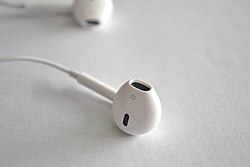
EarPods were introduced in September 2012 alongside the iPhone 5 and replaced Apple’s earlier circular earbuds. EarPods are characterised by an asymmetric, contoured design intended to better fit the human ear and improve comfort and sound performance.[9] The EarPods are available in three connector options: 3.5mm headphone, Lightning and USB-C. EarPods were previously bundled with various iPhone models from 2012 to 2020.
3.5mm Headphone Jack Adapter
[edit]
iPhone models from the iPhone 7 to the iPhone X also shipped with a Lightning-to-3.5mm headphone jack adapter, enabling customers to connect 3.5mm headphones to a Lightning port. Thanks to an iOS update (iOS 10.3), it is backwards compatible, meaning it can be used with any previous device with a Lightning port (from iPhone 5 onwards). It is no longer included as of the iPhone XS and iPhone XR, but remains available for purchase from Apple and third-party retailers.[citation needed]
Since 2024, the Lightning-to-3.5mm headphone jack adapter has been discontinued in favor of transitioning from the Lightning connector to the USB-C connector[10]
A USB-C-to-3.5mm headphone jack adapter was introduced in 2018 alongside the third-generation iPad Pro, which uses the USB-C connector.[11] It is also intended for use with the iPhone 15 series and later, which also use the USB-C connector.[12]
Wireless headphones
[edit]iPhone Bluetooth Headset
[edit]
The iPhone Bluetooth Headset was introduced in 2007 priced at $129 and later reduced to $99. It was discontinued in 2009. It was designed for phone calls only and could not be used for listening to music. The integration included showing an icon for the headset and its battery level. It was bundled with a "Travel Cable" that charged it and a 30-pin iPhone simultaneously, and a docking station called the iPhone Dual Dock that could charge it and an original iPhone was also available.[5][13]
AirPods
[edit]
AirPods were announced alongside the iPhone 7 and were released on December 16, 2016.[14][15] They are wireless earbud-style headphones with microphones, dual accelerometers, IR sensors used to pause music if they are not in the user's ears, and motion touch sensors that are used to activate controls. They are advertised as having a battery life of five hours, and come with a charging case that gives them a total of 24 hours of battery life. The original case is charged by Lightning, and in 2019 a second case was introduced with Qi charging. AirPods are compatible with iPhones, iPads, Apple Watches, Macs, the 6th generation iPod Touch, and the 7th generation iPod Nano, but automatic pairing with an iCloud account requires macOS Sierra, iOS 10, and watchOS. They are also compatible with devices on other platforms that support Bluetooth, but it limits the AirPods' functionality.[16][17]
On September 9, 2024, following the announcement of the fourth-generation AirPods, and all-new advanced hearing aid features for AirPods Pro 2 and the updated AirPods Max with USB-C port,[18] all the devices of the AirPods product line have been transitioned from the proprietary Lightning port to the universal USB-C port, making both the second-generation AirPods, third-generation AirPods and the original AirPods Max with Lightning port discontinued.[19]
AirPods Pro
[edit]
AirPods Pro were released on October 30, 2019 as a premium option compared to AirPods. They feature the same H1 chip found on the second-generation AirPods, and boast a slimmer design, control by pressing the force sensor on the stems instead of double tapping on the ear pieces, active noise cancellation, adaptive EQ, IPX4 water resistance, a new charging case with Qi standard, and include silicone tips.[20]
On September 23, 2022, the AirPods Pro 2 was released. They feature the H2 chip, added swiping control for adjusting the volume, major improvement on the active noise cancellation, an increased battery life, the U1 chip that supports Find My tracking, built-in speaker for locating and status updates, added compatibility with the Apple Watch charger (in addition to the Qi standard wireless charging and wired Lightning connector charging), lanyard loop added to the side of the charging case and added extra-small silicone tip size (in addition to large, medium and small silicon tip sizes).[21]
On September 22, 2023, alongside the launch of the iPhone 15 models and iPhone 15 Pro models, the updated AirPods Pro 2 features the improved IP54 dust resistance, added the support for lossless audio with the Apple Vision Pro, and a charging case with USB-C port instead of a Lightning port.[22]
On September 9, 2024, following the announcement of the fourth-generation AirPods and the updated AirPods Max with USB-C port, Apple announced the all-new advanced hearing health features for the AirPods Pro 2.[23]
AirPods Max
[edit]
AirPods Max, released on December 15, 2020, are wireless Bluetooth over-ear headphones. They feature two H1 chips, active noise cancellation and transparency mode, a Digital Crown and on-head detection.[24][25][26][27]
On September 9, 2024, AirPods Max replaced the Lightning port with a USB-C port.[28]
Technical specifications
[edit]| Comparative technical specifications of all AirPods models | ||||||||||||||||||||||||||||||||||||||||||||||||||||||||||||||||||||||||||||||||||||||||||||||||||||||||||||||||||||||||||||||||||||||||||||||||||||||||||||||||||||||||||||||||||||||||||||||||||||||||||||||||||||||||||||
|---|---|---|---|---|---|---|---|---|---|---|---|---|---|---|---|---|---|---|---|---|---|---|---|---|---|---|---|---|---|---|---|---|---|---|---|---|---|---|---|---|---|---|---|---|---|---|---|---|---|---|---|---|---|---|---|---|---|---|---|---|---|---|---|---|---|---|---|---|---|---|---|---|---|---|---|---|---|---|---|---|---|---|---|---|---|---|---|---|---|---|---|---|---|---|---|---|---|---|---|---|---|---|---|---|---|---|---|---|---|---|---|---|---|---|---|---|---|---|---|---|---|---|---|---|---|---|---|---|---|---|---|---|---|---|---|---|---|---|---|---|---|---|---|---|---|---|---|---|---|---|---|---|---|---|---|---|---|---|---|---|---|---|---|---|---|---|---|---|---|---|---|---|---|---|---|---|---|---|---|---|---|---|---|---|---|---|---|---|---|---|---|---|---|---|---|---|---|---|---|---|---|---|---|---|---|---|---|---|---|---|---|---|---|---|---|---|---|---|---|---|
| ||||||||||||||||||||||||||||||||||||||||||||||||||||||||||||||||||||||||||||||||||||||||||||||||||||||||||||||||||||||||||||||||||||||||||||||||||||||||||||||||||||||||||||||||||||||||||||||||||||||||||||||||||||||||||||
In popular culture
[edit]Apple's white earbuds are prominently featured in the majority of their distinctive "silhouette style" iPod advertisements.[39][40] Most often as a dancing black figure in [silhouette] with a starkly contrasted white earbuds and cord while holding a white iPod.[39] The background is usually another bright colour so the iPod and headphones clearly stand out compared to the rest of the image.[40]
See also
[edit]
References
[edit]- ^ Apple – iPod. 30 September 2002.
- ^ Apple – iPod. 5 June 2003.
- ^ "Apple iPod shuffle 2G Review". IT Pro. November 4, 2006. Archived from the original on January 7, 2018. Retrieved January 6, 2018.
- ^ Apple Earphones with Remote and Mic Lowest Ratings Archived April 25, 2009, at the Wayback Machine
- ^ a b Steeber, Michael (March 19, 2018). "Revisiting the forgotten history of obscure Apple accessories". 9to5Mac. Archived from the original on March 25, 2021. Retrieved October 6, 2019.
- ^ "Compatibility of Apple wired headset models with iPhone, iPad, and iPod models". Apple Support. September 9, 2016. Archived from the original on June 9, 2016.
- ^ a b Apple In-Ear Headphones with Remote and Mic, Apple Store
- ^ Apple In-Ear Headphones with Remote and Mic, Amazon.com
- ^ "Hands on: Apple's new EarPods headphones". Macworld. Archived from the original on September 13, 2024. Retrieved February 11, 2026.
- ^ "Apple Seemingly Discontinuing Lightning to Headphone Jack Adapter Introduced Alongside iPhone 7". MacRumors. November 17, 2024. Archived from the original on January 9, 2025. Retrieved January 9, 2025.
- ^ Mayo, Benjamin (October 30, 2018). "Apple now sells a USB-C to 3.5mm dongle as iPad Pro drops headphone jack – 9to5Mac". 9to5Mac. Archived from the original on May 13, 2025. Retrieved February 7, 2026.
- ^ Mickle, Tripp (September 12, 2023). "Apple Unveils iPhone 15 and Switches to USB-C Charger". The New York Times. Archived from the original on August 23, 2025. Retrieved February 7, 2026.
- ^ tech.co.uk staff (November 13, 2007). "Apple iPhone Bluetooth headset review". TechRadar. Archived from the original on April 13, 2021. Retrieved October 6, 2019.
- ^ "Apple – Press Info – Apple Reinvents the Wireless Headphone with AirPods". www.apple.com. Archived from the original on March 31, 2017. Retrieved October 3, 2016.
- ^ Adi Robertson (December 13, 2016). "Apple's wireless AirPods are now on sale". The Verge. Archived from the original on December 14, 2016. Retrieved December 14, 2016.
- ^ Ashley Carman (September 7, 2016). "Apple AirPods are truly wireless earbuds". The Verge. Archived from the original on November 8, 2020. Retrieved August 30, 2017.
- ^ Ina Fried (September 7, 2016). "Apple's AirPods do use Bluetooth and they don't require an iPhone 7". Recode. Archived from the original on April 1, 2019. Retrieved April 23, 2017.
- ^ "Apple introduces AirPods 4 and a hearing health experience with AirPods Pro 2". Apple Newsroom. Archived from the original on January 9, 2025. Retrieved January 9, 2025.
- ^ Gogia, Kanika (January 2, 2025). "20 Products Apple Silently Discontinued in 2024". Beebom. Archived from the original on January 9, 2025. Retrieved January 9, 2025.
- ^ "AirPods Pro Review -TekClue". November 9, 2020. Archived from the original on February 25, 2021. Retrieved December 21, 2020.
- ^ "Apple announces the next generation of AirPods Pro". Apple Newsroom. Archived from the original on September 7, 2022. Retrieved January 9, 2025.
- ^ "Apple upgrades AirPods Pro (2nd generation) with USB-C charging". Apple Newsroom. Archived from the original on January 21, 2025. Retrieved January 9, 2025.
- ^ "Apple introduces AirPods 4 and a hearing health experience with AirPods Pro 2". Apple Newsroom. Retrieved January 9, 2025.
- ^ Welch, Chris (December 8, 2020). "Apple announces $549 AirPods Max noise-canceling headphones, coming December 15th". The Verge. Archived from the original on December 8, 2020. Retrieved December 8, 2020.
- ^ "Apple Announces AirPods Max Over-Ear Headphones With Noise Cancellation, Priced at $549". www.macrumors.com. December 8, 2020. Archived from the original on December 8, 2020. Retrieved December 8, 2020.
- ^ Sherr, Ian. "Apple announces $549 AirPods Max over-ear headphones, preorders today, launch Dec. 15". CNET. Archived from the original on December 8, 2020. Retrieved December 8, 2020.
- ^ Keith, Jeremy. "Consideringapple". Archived from the original on February 11, 2024. Retrieved September 23, 2023.
- ^ "Apple introduces AirPods 4 and a hearing health experience with AirPods Pro 2". Apple Newsroom. Archived from the original on January 9, 2025. Retrieved January 9, 2025.
- ^ "Vintage and obsolete products". Apple.
- ^ Included for comparison purposes
- ^ a b c "iPhone Bluetooth Headset – Specs, Release Date, and Original Price". August 14, 2020.
- ^ "Identify your AirPods". Apple Support. Retrieved September 16, 2024.
- ^ a b c d e f g h i j "Device Selection (AirPods)". AppleDB. Retrieved October 3, 2024.
- ^ "AirPods (1st generation) – Technical Specifications". support.apple.com. Retrieved April 2, 2020.
- ^ "What's the difference between AirPods 1 and AirPods 2?". iMore. January 22, 2020. Retrieved April 2, 2020.
- ^ "Set up AirPods Max with your Mac and other Bluetooth devices". Apple Support. Retrieved July 11, 2021.
- ^ a b "Get started with AirPods (3rd generation)". support.apple.com. Retrieved March 22, 2022.
- ^ "About firmware updates for AirPods". Apple Support. Apple Inc. April 2, 2024. Retrieved May 21, 2024.
- ^ a b Segall, Ken. Insanely Simple, The Obsession That Drives Apple's Success.
- ^ a b "The iPod Silhouettes" Archived July 9, 2014, at the Wayback Machine, The Pop History Dig
Apple headphones
View on GrokipediaHistory
Early wired models
Apple's entry into the headphone market began with the introduction of its classic white earbuds, bundled with the original iPod portable music player launched on October 23, 2001. These earbuds featured a simple, round bud design connected via a 3.5mm stereo mini-jack, emphasizing portability and ease of use, and became an iconic symbol that helped popularize personal audio devices by associating sleek white aesthetics with digital music consumption.[15][16] They had an impedance of 32 ohms and a frequency response of 20Hz to 20kHz, suitable for the iPod's output.[17] The iPod, including the earbuds, retailed for $399 at launch.[15] In 2004, Apple released the iPod In-Ear Headphones as its first noise-isolating option, featuring silicone eartips in multiple sizes for a secure fit and improved passive noise reduction compared to the standard earbuds. These headphones incorporated higher-fidelity drivers for enhanced sound clarity and bass response, with the same 32-ohm impedance and 20Hz-20kHz frequency response.[17][18] Priced at $39, they targeted users seeking better isolation during commutes or workouts.[19] The iPhone Stereo Headset, introduced in June 2007 alongside the first iPhone, marked Apple's initial foray into wired headphones with integrated voice functionality, including an inline remote for play/pause and call management, plus a built-in microphone for hands-free calls. This design retained the familiar white earbud style but added the microphone on the cable for seamless iPhone integration, with 32-ohm impedance and 20Hz-20kHz frequency response.[20][17] Bundled with the iPhone at $29 for replacements, it laid the groundwork for multifunctional wired audio accessories.[20] In September 2008, Apple introduced the In-Ear Headphones with Remote and Mic as a premium option, featuring dual balanced armature drivers per earpiece—one for bass and one for mids/highs—for superior acoustic accuracy, balance, and clarity. These included silicone eartips in multiple sizes for noise isolation, an inline remote with microphone for media controls and calls, and a carrying case, while maintaining 32-ohm impedance and 20Hz-20kHz frequency response.[17] Priced at $79, they were announced alongside new iPod models and appealed to audiophiles seeking detailed sound in a compact form. Building on this, the Apple Earphones with Remote and Mic arrived in June 2009, bundled with the iPhone 3GS and third-generation iPod touch, introducing volume control buttons to the inline remote alongside the microphone, which served as an early precursor to voice assistant compatibility like Siri. These maintained the 32-ohm impedance and 20Hz-20kHz frequency response, with a focus on reliable call quality and basic media controls.[22][17] They were priced at $29 as a standalone purchase.[22] By 2012, Apple redesigned its standard earbud lineup with the EarPods, released on September 12 alongside the iPhone 5, featuring an open-ear design with improved ergonomics to better fit the human ear for enhanced comfort and sound delivery. The inline remote was updated for greater durability, retaining the microphone, 32-ohm impedance, and 20Hz-20kHz frequency response.[23][17] Priced at $29 and bundled with the iPhone 5, these represented a major evolution in Apple's core wired earbuds.[23]Transition to wireless era
Apple's initial foray into wireless headphones came with the iPhone Bluetooth Headset in 2007, a mono Bluetooth device primarily designed for phone calls rather than music playback, featuring limited audio quality and a battery life of up to 5.5 hours of talk time.[24] This headset paired automatically with the original iPhone via a proprietary dock but suffered from short range and lack of support for stereo audio streaming, marking an early but constrained experiment in wireless audio accessories.[25] The company's strategic pivot accelerated in 2014 with its $3 billion acquisition of Beats Electronics, which brought expertise in consumer wireless audio and helped Apple integrate advanced Bluetooth technologies into its ecosystem while laying groundwork for future Apple-branded products.[26] Between 2014 and 2016, Apple filed several patents related to true wireless stereo (TWS) earbuds, including designs for untethered earpieces with improved noise cancellation, biometric integration, and magnetic detachment for hybrid wired-wireless use, reflecting intensive R&D to overcome synchronization and battery challenges in fully cord-free audio.[27][28] By 2016, development hurdles such as seamless device pairing were addressed through the introduction of Apple's custom W1 chip, which enabled effortless iCloud-synced connections across iOS devices and reduced latency in wireless audio transmission.[2] This innovation coincided with a bold cultural shift, exemplified by the iPhone 7's removal of the 3.5mm headphone jack, a decision Apple framed as a courageous step toward wireless audio to free up space for better battery life and water resistance while pushing consumers toward Bluetooth alternatives.[29] The transition drew from core audio drivers refined in earlier wired models to ensure comparable sound fidelity in wireless formats. AirPods were announced at Apple's September 2016 keynote as the culmination of this era, featuring the W1 chip for instant pairing and up to five hours of battery life per charge, though the stem-like design and $159 price sparked widespread initial skepticism about practicality and aesthetics.[2][30] Despite early mockery, the product achieved rapid adoption, with cumulative sales surpassing 100 million units by 2019, solidifying Apple's dominance in the TWS market.[31]Design and technology
Audio technologies
Apple headphones incorporate custom high-excursion drivers paired with high dynamic range amplifiers to deliver powerful bass, accurate mids, and crisp highs across models. For instance, AirPods Max utilize a 40-mm Apple-designed dynamic driver with a dual neodymium ring magnet motor, achieving less than 1% total harmonic distortion at maximum volume throughout the audible frequency range.[32] Decibels are a logarithmic scale, meaning that 80 dB, which corresponds to approximately 50-60% on the iOS volume slider, represents far less than half the sound intensity of the maximum volume (typically 100-110 dB). This ensures perceptual evenness in volume adjustment but highlights the non-linear relationship between slider position and actual acoustic power.[33][34] Adaptive EQ employs computational audio processing to automatically tune the frequency response based on the headphone's fit and seal against the user's ears, optimizing low and mid-frequencies using data from inward-facing microphones. This ensures consistent sound quality tailored to individual ear geometry without manual adjustments.[35][36] Active Noise Cancellation (ANC) debuted in 2019 with the original AirPods Pro, powered by the H1 chip and a combination of outward-facing microphones to detect environmental noise and inward-facing microphones to monitor sound within the ear canal, generating anti-phase signals to neutralize unwanted audio.[37][38] The system evolved in the 2022 AirPods Pro 2 via the H2 chip, delivering up to twice the noise reduction of the predecessor through enhanced algorithms and microphone sensitivity.[7] In the 2025 AirPods Pro 3, ANC achieves up to twice the effectiveness of the Pro 2, with added heart rate sensing for workout tracking in the Fitness app.[39][6] AirPods Pro 3 also introduce clinical-grade hearing aid functionality for users with mild to moderate hearing loss. This includes a Hearing Aid mode that amplifies environmental sounds in Transparency mode, a built-in Hearing Test accessible via the Health app on compatible iPhones, and Media Assist to customize media audio based on individual hearing profiles. These features, FDA-cleared as of September 2025, enhance accessibility and integrate with Apple's health ecosystem.[6][40] Transparency mode leverages the microphone array to allow ambient sounds into the earbuds while minimizing wind noise and distortion, promoting natural environmental interaction. For example, the Beats Studio Pro offer a decent Transparency mode that allows ambient sounds without adaptive switching capabilities. In contrast, the AirPods Pro 3 feature best-in-class Adaptive Audio and Transparency mode, described as natural and seamless in blending environmental sounds with audio playback. Adaptive Audio builds on this by intelligently blending ANC and Transparency in real time, using dual beamforming microphones to analyze surroundings and adjust noise levels dynamically for balanced immersion.[38][41][42] Spatial Audio creates a three-dimensional soundstage with dynamic head tracking, relying on built-in gyroscopes and accelerometers to anchor audio to the user's head movements and maintain spatial positioning relative to the device. This feature supports Dolby Atmos for immersive playback, introduced in 2021 and compatible with select content on Apple devices.[43][44] Computational audio enhancements include Voice Isolation, which employs beamforming microphones and the H2 chip to isolate the user's voice during calls by suppressing background noise and reverb for clearer transmission. AirPods Max further support Lossless Audio at up to 24-bit/48 kHz resolution via a wired USB-C connection, enabled by a 2025 firmware update that preserves original recording fidelity.[36][45] Battery performance provides up to 6 hours of listening per charge for standard earbud models, extending to 20-30 hours total with the charging case; Pro variants with ANC offer up to 8 hours per charge. Charging transitioned from Lightning to USB-C ports starting in 2023, with MagSafe wireless compatibility retained for convenience.[7][46][47]Ecosystem integration and controls
Apple's headphones, especially the AirPods series, are engineered for deep integration with iOS, iPadOS, macOS, and watchOS devices, utilizing proprietary chips to facilitate seamless connectivity and intuitive controls. Starting with the W1 chip in 2016, AirPods introduced one-tap pairing by simply opening the charging case near an iPhone, automatically syncing across all devices signed into the same Apple ID without manual Bluetooth setup. A US patent, No. 12,001,753, granted on June 4, 2024, describes a headphone charging case with a touchscreen display and graphical user interfaces for interacting with and controlling headphones, indicating potential future enhancements to case-based controls and integration.[48] This was advanced by the H1 chip in 2019, enabling hands-free "Hey Siri" activation and quicker pairing times, while the H2 chip from 2022 enhances these with even faster audio handoffs and on-device processing for privacy. Automatic device switching, powered by these chips, allows headphones to transition effortlessly between devices—for instance, from an iPhone to a Mac during a call—based on the active audio source, requiring no user intervention. User controls are model-specific yet unified through iOS customization. On standard AirPods, capacitive touch surfaces on the stems handle play/pause, track navigation, and Siri summoning via taps or double-taps, with options to remap actions in the Settings app under Bluetooth or Accessibility. AirPods Pro and AirPods Max incorporate a force sensor on the stem for pressing to control playback, answer calls, or cycle between Active Noise Cancellation, Transparency, and Adaptive Audio modes, all adjustable per earbud side via iOS Settings for personalized gestures like volume adjustment or skipping tracks. These mechanisms ensure intuitive operation without physical buttons, adapting to user preferences through software. Find My network integration provides robust tracking, with Precision Finding available since 2021 on models featuring the U1 Ultra Wideband chip in the charging case, offering directional arrows and distance indicators on compatible iPhones to pinpoint lost headphones within feet. Separation alerts, enabled by default, notify users via iPhone if AirPods are left behind, leveraging the vast Apple device network for crowd-sourced location data while prioritizing privacy through end-to-end encryption. Firmware updates, delivered wirelessly when connected to an Apple device, introduce new features like the 2024 iOS 18 addition of head gestures—nodding yes or shaking no to respond to Siri announcements on AirPods Pro 2 and later—along with audio routing to Apple Watch for independent listening during workouts. Accessibility enhancements broaden usability, including Live Listen, which streams microphone audio from an iPhone or iPad to AirPods as a hearing aid alternative in distant or noisy settings, configurable in the Control Center. Mono audio combines left and right channels into one for users with hearing in a single ear, adjustable in Settings > Accessibility > Audio & Visual, ensuring balanced sound without stereo separation. Users can also check and adjust audio balance for equal left/right sound by going to Settings > Accessibility > Audio/Visual > Balance on iPhone or iPad, ensuring the slider is centered.[49] In 2024, USB-C adoption standardized charging across AirPods models and enabled wired listening on AirPods Max via USB-C to 3.5 mm adapters for lossless audio, while USB-C EarPods and dongles support direct analog connections on USB-C iPhones.Wired headphones
Legacy earbuds and headsets
Prior to the EarPods, Apple's wired earbuds originated in 2001 with the launch of the iPod, featuring simple white round designs bundled as standard accessories. These evolved over the years, incorporating inline volume controls around 2005 and microphones for calls with the first iPhone in 2007, becoming cultural icons through Apple's advertising campaigns. By 2012, Apple introduced the EarPods alongside the iPhone 5, marking a significant redesign from previous round earbuds with a contoured shape that follows the geometry of the ear for improved comfort and stability.[4][50] These wired earbuds featured an inline remote and microphone for controlling music playback, adjusting volume, and handling calls, along with enhanced cable durability through strain relief to reduce breakage at connection points.[50] The open-ear design, which positions the speaker outside the ear canal, promotes situational awareness by allowing ambient sounds to remain audible, distinguishing it from sealing in-ear models.[51] In response to the removal of the 3.5 mm headphone jack on the iPhone 7 in 2016, Apple launched EarPods with a Lightning connector variant and the Lightning to 3.5 mm Headphone Jack Adapter. The adapter incorporates a built-in digital-to-analog converter (DAC) chip, enabling support for high-resolution audio playback up to 24-bit/48 kHz on compatible iOS devices. This transition addressed compatibility for existing 3.5 mm headphones while integrating with Apple's ecosystem. Following the 2016 shift toward wireless audio, Apple discontinued development of new wired headphone models, with the EarPods serving as the last major iteration in this category. EarPods continued to be bundled with entry-level iPhone models in select markets until their removal from U.S. packaging starting with the iPhone 12 in 2020, though they remained available for separate purchase as a budget wired option. The EarPods utilize a 3.5 mm TRRS connector for stereo audio and microphone functionality, paired with a 1.2-meter cable length for portability.[51] Their frequency response spans 20 Hz to 20 kHz, delivering balanced sound suitable for everyday listening, though the inline remote experiences partial compatibility issues on non-Apple devices like Android phones, where controls may not fully integrate.[52] The rise of wireless alternatives led to a sharp decline in wired headphone adoption, with wireless technologies holding over 65% share globally by 2025.[53]EarPods and accessories
The EarPods represent Apple's final major iteration of wired earbuds, introduced on September 12, 2012, alongside the iPhone 5, as a replacement for the previous circular earbuds design.[54] These open-ear headphones were offered in two initial variants: one with a 3.5 mm headphone jack for broad compatibility across devices and another with a Lightning connector for seamless integration with iOS devices, enabling direct audio output without adapters.[55] The Lightning version was updated in 2016 with the iPhone 7 launch, coinciding with the removal of the 3.5 mm jack, and includes compliance with EU regulations limiting headphone volume to 85 dB to protect hearing, enforced through iOS software settings.[56] The 3.5 mm EarPods remained available for ongoing use with non-Apple devices and were bundled with iPhones from their introduction through the iPhone 11 series, but starting with the iPhone 12 in 2020, Apple ceased including them in the box in most markets to reduce packaging waste, except where legally required.[54] Both variants feature a built-in remote and microphone on the cable for volume control, playback, and calls, prioritizing simplicity in the wired ecosystem. The EarPods with Lightning Connector offer advantages including affordability at $19 with no charging required, superior microphone and call quality owing to the absence of Bluetooth compression, comfort for extended wear through the open ergonomic design that enables awareness of surroundings, clear sound suitable for casual listening with good vocal clarity and volume range, no latency, convenient inline controls for playback, volume, and calls, and a reliable wired connection free from dropouts or interference.[57][58] Key design elements include tangle-resistant round cables made of flexible material that minimize knots compared to earlier designs.[59] Acoustically, the EarPods adopt an open-fit design molded to the average human ear shape, positioning drivers closer to the eardrum without silicone tips; this allows better bass response through exterior vents that reduce air resistance and create resonances, improving low-end reproduction over prior round-bud models.[60] Despite these design improvements, the EarPods, particularly the Lightning connector variant, have faced criticism for several limitations inherent to wired headphones. The cable can still tangle during use, restricting movement and potentially getting in the way, despite the tangle-resistant material.[61] The Lightning connector occupies the device's charging port, preventing simultaneous charging without an adapter, which is a notable inconvenience for users of port-limited iPhones.[62] The open design results in poor noise isolation, allowing ambient noise to interfere and causing sound leakage, while the bass response is considered weak compared to sealed earbuds.[58] Durability concerns include cables fraying over time, a common issue with Lightning cables leading to potential failures.[63] Compatibility is limited to Apple devices with Lightning ports, requiring adapters for USB-C equipped devices like newer iPhones, and the audio quality lacks the detail, dynamics, and authority of premium alternatives, making it suitable primarily for casual listening.[58][62] Accessories for EarPods include third-party clip-on ear hooks, such as adjustable rubber loops from brands like EARBUDi, introduced around 2013 to secure the buds during activity by looping over the ears.[64] Replacement cables are available through repair services or third-party vendors, often requiring soldering for the inline remote and microphone, while general cleaning can be done with soft cloths and minimal water to maintain the acoustic mesh.[65] As of 2025, EarPods are sold separately by Apple for $19 across 3.5 mm, Lightning, and USB-C connector variants, with the USB-C model introduced in September 2023 to match the iPhone 15 series' port switch.[66] This USB-C variant provides a direct wired backup option for USB-C equipped iPhones, such as the iPhone 15 series and later, eliminating the need for adapters.[66] This lineup extends compatibility via adapters like the Lightning to 3.5 mm dongle, bridging older EarPods with modern devices.[54] Since 2018, Apple has emphasized environmental sustainability in its audio products, incorporating more recyclable materials like rare earth elements in components and expanding the Apple GiveBack program to facilitate free recycling of headphones at stores or online, contributing to broader goals of zero waste and material recovery.[67] This partially fulfills headphone recycling initiatives by enabling disassembly and reuse of metals, though full circularity remains a work in progress.[68]Wireless headphones
AirPods standard series
The AirPods standard series represents Apple's entry-level true wireless earbuds, emphasizing seamless integration with its ecosystem, open-ear design for comfort, and iterative enhancements in audio performance and battery efficiency. Introduced in 2016, the lineup has evolved through four generations, focusing on core features like effortless pairing and basic sound tuning without advanced noise cancellation, distinguishing it from premium variants. These earbuds prioritize everyday usability for iPhone users, with each iteration building on the previous to improve fit, connectivity, and longevity. The first-generation AirPods, announced on September 7, 2016, and released in December, marked Apple's debut in true wireless stereo earbuds, powered by the custom W1 chip for quick device switching and low-latency audio. They offered up to 5 hours of listening time on a single charge, extending to 24 hours total with the included charging case, and launched at a price of $159. Unlike later models, the initial version had no official IP rating for sweat or water resistance, though it proved durable for light daily use. The second-generation AirPods, released in March 2019, introduced the H1 chip, which enabled hands-free "Hey Siri" activation and faster pairing, while maintaining the 5-hour listening time and up to 24 hours total battery life with the case. An optional wireless charging case was available, enhancing convenience for users with compatible Qi chargers, and the overall design remained similar to the first generation for broad compatibility, with no official IP rating. In October 2021, the third-generation AirPods debuted with a redesigned, shorter stem for a more contoured open-ear fit, Spatial Audio with dynamic head tracking for immersive sound, and MagSafe compatibility for the charging case. They provided up to 6 hours of listening per charge and 30 hours total with the case, earned an IPX4 rating for sweat and water resistance on both the earbuds and charging case, and launched at $179. The fourth-generation AirPods, announced in September 2024, refined the open-ear design with a mesh canopy over the earpiece for improved comfort and airflow, powered by the H2 chip for enhanced call quality via beamforming microphones and Voice Isolation. The base model starts at $129, while the higher variant at $179 adds basic Active Noise Cancellation adapted for open-ear use, delivering up to 5 hours of listening (4 hours with ANC) and 30 hours total battery life with the USB-C case. Both variants feature an IP54 rating for dust, sweat, and water resistance on the earbuds and charging case. Across generations, AirPods feature true wireless stereo connectivity via Bluetooth, allowing independent left and right earbud operation without a neckband, and automatic pausing/resuming of audio through built-in infrared optical sensors that detect when an earbud is removed. Battery life has progressively improved, reaching up to 30 hours total in the latest 2025-available models when including the case. Durability has also improved with the addition of official IP ratings starting from the third generation (IPX4 for sweat and water resistance on earbuds and case) and advancing to IP54 in the fourth generation (dust, sweat, and water resistance on earbuds and case). These enhancements provide better protection against everyday exposure like sweat, rain, and dust, though the resistance is not permanent, diminishes over time, and the earbuds are not waterproof or suited for water sports, submersion, or high-impact activities.[9] Since launch, the series has driven substantial market success as part of Apple's AirPods lineup.AirPods Pro series
The AirPods Pro series represents Apple's premium in-ear wireless earbuds, emphasizing active noise cancellation (ANC) and advanced audio features tailored for professional-grade listening. Introduced as a step up from the standard AirPods, the Pro line incorporates silicone ear tips for a secure seal, enabling enhanced noise isolation and immersive sound. Priced at $249 since its debut, the series has evolved across three generations, each building on the previous with improvements in chip technology, battery life, health-oriented functionalities, and durability.[37] The first-generation AirPods Pro launched in October 2019, featuring in-ear silicone tips in small, medium, and large sizes, along with ANC and Transparency mode for situational awareness. Powered by the H1 chip, these earbuds offered Adaptive EQ for personalized sound tuning and achieved an IPX4 rating for sweat and water resistance. A key design element was the vent system for pressure equalization, which reduces discomfort during extended wear by allowing air to flow between the ear canal and the outside environment.[37][69] In September 2022, Apple released the second-generation AirPods Pro, upgrading to the H2 chip for up to twice the noise cancellation effectiveness of the original model and introducing touch-based volume control on the stem. These earbuds added Precision Finding via the U1 chip in the case for easier location tracking, with total battery life reaching up to 30 hours including the case. An update in September 2023 switched the charging case to USB-C, upgraded the rating to IP54 for dust, sweat, and water resistance for both earbuds and case, while maintaining the $249 price.[70][71] The third-generation AirPods Pro arrived in September 2025, incorporating best-in-class Adaptive Audio that dynamically blends ANC and Transparency modes based on environmental noise for a natural and seamless experience, alongside heart-rate detection during workouts for fitness tracking. These models gained FDA approval for hearing aid functionality, providing clinical-grade amplification for users with mild to moderate hearing loss, and featured improved drivers supporting lossless audio playback. The earbuds and charging case are rated IP57 for dust, sweat, and water resistance, including immersion up to 1 meter for 30 minutes. Continuing the series' focus on fit, they include XS to L silicone tips, with an iOS-based Ear Tip Fit Test to verify seal quality for optimal ANC performance. Each bud houses three microphones, along with sensors, to enable personalized Spatial Audio with dynamic head tracking, enhancing immersion for music and calls.[6][72][46][73][74] Over the generations, Apple has progressively improved the durability of the AirPods Pro series through higher IP ratings for dust, sweat, and water resistance. The first-generation AirPods Pro have an IPX4 rating (sweat and water resistant, no dust protection). The second-generation model, after the switch to a USB-C charging case, upgraded to IP54 (dust, sweat, and water resistant for both earbuds and case). The third-generation model further advanced to IP57 (dust, sweat, and water resistant for both earbuds and case, with immersion up to 1 meter for 30 minutes). These upgrades provide better protection against everyday elements like sweat during workouts, light rain, and dust, though none of the models are fully waterproof, they are not intended for water sports, swimming, showering, or high-impact activities, and resistance is not permanent and can diminish over time.[9][46] By 2025, the AirPods Pro series has strengthened Apple's position in the premium true wireless stereo (TWS) earbuds market, driven by its seamless integration with Apple's ecosystem and innovative health features like hearing assistance and biometric sensing, which have been widely praised in industry analyses. Safety considerations for users with pacemakers or implantable cardioverter-defibrillators (ICDs) include potential interference from the magnets and radios in the charging case; Apple recommends maintaining at least 15 cm (6 inches) distance from the medical device.[75] Regarding electromagnetic field (EMF) exposure from Bluetooth, there is no consistent evidence of cancer, brain tumors, or other health issues, as Bluetooth EMF is non-ionizing and significantly weaker than cell phone radiation; devices comply with FCC SAR limits, and consensus from the FCC, FDA, and WHO indicates no credible risks at low exposure levels.[10][11][76] As a higher-end option compared to the budget-oriented standard AirPods, the Pro models prioritize sealed in-ear design for superior noise management and audio fidelity.[77]Beats wireless headphones
Apple's wireless headphones also include the Beats lineup, acquired in 2014, offering diverse options with bass-heavy sound and sport-oriented designs integrated with Apple's ecosystem via H1 or H2 chips. Current models as of 2025 include the Beats Studio Pro over-ear headphones featuring balanced sound with sparkle, active noise cancellation, a decent Transparency mode without adaptive switching, up to 40 hours of battery life, support for spatial audio, and lossless audio via USB-C, the true wireless Beats Solo Buds for compact everyday use, and the on-ear Beats Solo 4 with up to 50 hours of playback, all supporting fast pairing and spatial audio where applicable.[8][78][79] To perform a factory reset on the Beats Solo Buds to clear previous connections and resolve pairing issues, place both earbuds in the charging case and leave the case open. Press and hold the button above the “b” logo on both earbuds for at least 10 seconds. After the reset, re-pair by placing the earbuds in the open case, pressing and holding the button on either earbud until a tone plays, then connect via your device's Bluetooth settings.[80][81]AirPods Max
The AirPods Max are Apple's premium over-ear wireless headphones, introduced on December 8, 2020, and released on December 15, 2020, at a starting price of $549.[32] They feature a distinctive design with a breathable knit mesh canopy for the headband, anodized aluminum ear cups, and acoustically engineered memory foam cushions wrapped in breathable mesh for comfort during extended wear.[82] Weighing 384.8 grams (13.6 ounces), the headphones incorporate 40mm dynamic drivers with dual neodymium ring magnet motors, delivering high-fidelity audio with adaptive EQ that automatically tunes sound based on the fit and seal.[35] Key features include pro-level active noise cancellation (ANC) powered by eight dedicated outward-facing microphones, capable of reducing up to 40 dB of low-frequency noise such as airplane rumble, alongside transparency mode for environmental awareness.[35][83] Computational audio enhancements, including personalized spatial audio with dynamic head tracking, use inward-facing microphones and dual H1 chips (one per ear cup) to create an immersive, three-dimensional listening experience tailored to the user's head and ear shape.[35] The Digital Crown, inspired by the Apple Watch, provides precise controls for volume, playback, track skipping, and Siri activation, while a dedicated noise control button toggles between ANC and transparency modes.[32] Battery life offers up to 20 hours of listening or talk time on a single charge with ANC and spatial audio enabled, with a quick 5-minute charge yielding about 1.5 hours of playback.[35] The included Smart Case uses magnets to detect when the headphones are stored, immediately entering a low-power mode that preserves battery charge by minimizing power draw—followed by an ultra-low power mode after 18 hours of inactivity to further extend standby time.[84] This accessory, weighing 134.5 grams (4.74 ounces), covers only the ear cups for a compact profile, reducing overall power consumption significantly during storage.[35] In September 2024, Apple updated the AirPods Max with a USB-C charging port for broader compatibility, introduced fresh colors including midnight, starlight, blue, orange, and purple, and retained the original H1 chips without hardware changes to the audio system.[85] A subsequent firmware update in March 2025, paired with iOS 18.4 and compatible operating systems, enabled wired lossless audio support at 24-bit/48 kHz resolution and ultra-low latency audio when connected via USB-C, enhancing fidelity for professional music production and high-resolution playback without Bluetooth compression.[45] Critically, the AirPods Max have been lauded for their balanced, authentic sound signature with rich bass, clear mids, and detailed highs, making them suitable for audiophiles and music creators seeking high-fidelity performance within the Apple ecosystem.[86] However, reviewers have frequently criticized the $549 price as excessive compared to competitors like the Sony WH-1000XM6 or Bose QuietComfort Ultra, which offer similar ANC and battery life at lower costs, alongside concerns over the headphones' weight and lack of a power switch.[85] By 2025, the AirPods Max contributed to Apple's strong position in the premium wireless headphone market, with overall AirPods sales reaching 66 million units in 2024, underscoring their cultural impact despite the premium pricing.[87]Reception and impact
Critical reviews
The original AirPods, released in 2016, received mixed reviews from critics who praised their seamless integration with Apple's ecosystem and effortless convenience but criticized the sound quality for lacking depth in bass and struggling with fit issues. The Verge awarded them a 7.6/10, noting that while the earbuds "sound great, even better than EarPods" with noticeable bass in tracks like Childish Gambino's "Me and Your Mama," the audio experience suffered when they slipped out of the ear, leading to a tinny overall profile. Convenience was a standout, with the W1 chip enabling "a breeze" of pairing and automatic device switching across iOS devices, though it was less intuitive on Android. Battery life also earned high marks, delivering the promised five hours per charge plus additional full days from the case, with quick 15-minute top-ups.[88] The AirPods Pro, introduced in 2019, marked a significant improvement and garnered widespread acclaim for introducing active noise cancellation (ANC) to Apple's earbuds lineup, earning CNET's high praise as a top true-wireless choice with an 8.7/10 score. Reviewers highlighted the effective ANC for reducing ambient noise like jet engines or office chatter, though it was noted as not quite matching full-size over-ear models in low-frequency blocking. Sound isolation benefited from the new silicone ear tips, which provided a secure fit for more users and enhanced bass response, averaging around 4.5/5 across major outlets for overall noise reduction and audio clarity in noisy environments. The design was lauded for comfort, sweat resistance, and superior call quality, making them a versatile upgrade over the standard AirPods.[89] AirPods Max, Apple's 2020 over-ear headphones, impressed critics with premium build quality but faced deductions for ergonomics, scoring 8/10 from Wired for their "noticeably higher build quality than peers" featuring milled aluminum and magnetic ear cups that are user-repairable. Sound was a highlight, described as the "best-sounding wireless headphones" tested, with clear highs, punchy bass, and excellent ANC supporting Spatial Audio. However, the 385g weight was criticized for potential fatigue during extended wear despite comfortable mesh padding, and the lack of foldability was a notable drawback, with the slim "bra-like" case offering limited protection. Battery life shone at 20 hours with ANC enabled, aligning with Apple's claims.[90] More recent models continued to refine Apple's offerings, with the AirPods 4 (2024) praised for delivering strong value at $129, earning a 4/5 from PCMag for their "impressive bass response and crisp highs" in an open-ear design, marking a game-changer for sub-bass in non-sealed buds. The AirPods Pro 3 (2025) received 4.5/5 from TechRadar, with accolades for upgraded health features like heart-rate monitoring via a new PPG sensor that tracks over 50 workout types and integrates with the Health app, alongside ANC twice as effective as the prior generation, creating a "wall of silence." Critics noted ecosystem lock-in as a persistent issue, with limited functionality like seamless switching or battery checks on non-Apple devices, and no support for codecs like aptX. Aggregate scores from major reviews place wireless models in the 80-90% range, while legacy wired options like EarPods hovered around 70% due to dated audio fidelity.[91][92] Across reviews, common themes emerge in Apple's headphones: exceptional battery life, often exceeding five hours per charge with cases providing 24-30 hours total, consistently praised for reliability in daily use. Sound quality excels in integration and clarity but draws comparisons to competitors like Sony's WF-1000XM5 series, where Apple's open soundstage offers natural spaciousness yet sometimes lacks the customizable bass depth or immersive staging of Sony's tuned profiles.[93][94]Market influence and culture
Apple's AirPods have significantly influenced the true wireless stereo (TWS) earbuds market, capturing approximately 23% of global shipments in Q1 2025 and solidifying Apple's dominance in the category.[95] This market leadership stems from the 2016 launch, which popularized TWS technology and ignited industry-wide growth, compelling competitors like Samsung to rapidly expand their wireless offerings to keep pace.[96] The premium pricing strategy, often dubbed the "Apple tax" for the perceived markup tied to ecosystem integration, has become a cultural meme critiquing the cost of Apple's convenience.[97] Sales milestones underscore this economic impact, with AirPods generating over $18 billion in revenue in 2023 alone, surpassing the annual earnings of companies like Nintendo and positioning the line as Apple's third-largest hardware category behind iPhone and Mac.[98] Apple's 2014 acquisition of Beats Electronics amplified this success by leveraging hip-hop culture through high-profile endorsements from artists like Dr. Dre and LeBron James, infusing Apple's audio products with street cred and broadening appeal in fashion and music scenes.[99] Culturally, AirPods have evolved into a status symbol, their distinctive white design frequently referenced in media as "white earbuds" to denote affluence and modernity among millennials and Gen Z.[100] Early parodies, such as Conan O'Brien's 2016 spoof ad exaggerating the ease of losing the tiny devices, highlighted their quirky ubiquity while cementing their place in pop humor.[101] This cultural footprint extends to fashion, where custom protective cases—adorned with patterns, engravings, or brand collaborations—have transformed the charging case into a personalized accessory, blending tech with personal style.[102] Despite their influence, AirPods have sparked controversies around sustainability and privacy. The non-replaceable lithium-ion batteries, which typically last 2-3 years before significant degradation, contribute to e-waste as users discard entire units rather than repair them, exacerbating electronic waste issues.[103] In 2023, the European Union's push for expanded right-to-repair rules spotlighted AirPods' glued components and lack of user-serviceable parts, pressuring manufacturers like Apple to improve repairability and reduce planned obsolescence.[104] Privacy concerns have also emerged, particularly with the Live Listen feature enabling iPhones to use AirPods as remote microphones, raising fears of unintended eavesdropping or unauthorized audio capture.[105] In broader media portrayals, AirPods symbolize the pervasive tech dependency critiqued in documentaries like The Social Dilemma (2020), where wireless earbuds exemplify constant connectivity and its societal toll, though the film focuses more on social media algorithms than audio devices specifically.[106]References
- https://www.[engadget](/page/Engadget).com/2008-09-09-apple-introduces-79-in-ear-headphones.html