Hubbry Logo
Art punkArt punkMain
Open search
Art punk
Community hub
Art punk
logo
8 pages, 0 posts
0 subscribers
Be the first to start a discussion here.
Art punk
Art punk
from Wikipedia

Art punk (also known as avant-punk or experimental punk) is a subgenre of punk rock influenced by art school culture in which artists go beyond the genre's rudimentary three-chord garage rock conventions, incorporating more complex song structures, esoteric influences and a more sophisticated sound and image.[1] While retaining punk's simplicity and rawness, art punk draws more from avant-garde music, literature and abstract art than other punk subgenres, often intersecting with the more experimental branches of the post-punk scene. Subsequently, attracting opposing audiences to that of the angry, working-class ones that surrounded the original punk rock scene.[2]

Characteristics

[edit]

In the rock music of the 1970s, the "art" descriptor was generally understood to mean either "aggressively avant-garde" or "pretentiously progressive".[3] Musicologists Simon Frith and Howard Horne described the band managers of the 1970s punk bands as "the most articulate theorists of the art punk movement", with Bob Last of Fast Product identified as one of the first to apply art theory to marketing, and Tony Wilson's Factory Records described as "applying the Bauhaus principle of the same 'look' for all the company's goods".[4] Wire's Colin Newman described art punk in 2006 as "the drug of choice of a whole generation".[5][6]

Music critic Simon Reynolds in his book, Rip It Up and Start Again,[7] attributed the rise of avant-garde alternative rock movements like art punk and post-punk in the late 1970s to British art school culture:

Especially in Britain, art schools have long functioned as a state-subsidized bohemia, where working-class youths too unruly for a life of labor mingle with slumming bourgeois kids too wayward for a middle-management career.

Author Gavin Butt[8] writes that:

People went to art school to be in a band. That was even the principle principal reason they went […] this was because art school was a place where you could get a local authority grant, have the costs of your tuition paid for by the government, and have three years to do whatever you wanted.

Artists often utilized angular guitar riffs, intricate rhythms, and a wide array of influences equal to that of post-punk which included but was not limited to krautrock, dub, funk, free jazz and glam.[9]

Additionally, post-punk and art punk are not mutually exclusive and frequently intersect. Although, some artists such as Patti Smith have been described as "art punk" with no relation to the post-punk scene.[10] Art punk is defined as a more avant-garde and artier form of punk music, blending poetry, literary and abstract influences and general art school culture with the genre. British post-punk bands such as Wire, Gang of Four, Pere Ubu, Delta 5 and the Raincoats have been described as "art punk" by Louder, who define art punk as "bands obsessed with the form of their music, of avoiding ‘rockist' clichés and aiming for something more avant-garde and challenging".[11]

Art punk is often marked by well-read musicians with middle-class sensibilities, bookish lyrics, art school backgrounds, and a stripped-back fashion style that rejects punk fashion clichés (as seen with bands like Talking Heads, the Fall and Wire).[7]

History

[edit]

Forerunners

[edit]
Brian Eno on AVRO's television program TopPop, April 1974

During the late 1950s to early 1960s, members of the Beatles, the Rolling Stones, the Kinks, the Who, 10cc, the Move, the Yardbirds and Pink Floyd attended and drew avant-garde ideas from art school, which they incorporated into a traditional rock and roll framework. These musical developments later led to the emergence of art rock.[12][13] Art punk drew influences from art rock bands like the Velvet Underground.[14][15] Pitchfork attributes Mayo Thompson,[16] Captain Beefheart,[17] and Lou Reed[18] as "the primary oracle for a generation of art punks".[16] While experimental rock artists such as the Residents,[19] Frank Zappa,[20] Monks[21] and Germany's krautrock movement would also prove influential to the genre.[22][23]

By the early 1970s, the influential English art rock band Roxy Music[24] emerged, singer Bryan Ferry had briefly attended art school,[25] while keyboardist Brian Eno, drew influences from Germany's krautrock scene, alongside frequent collaborator David Bowie, who would also collaborate with Iggy Pop,[26] on his solo album The Idiot, and released the influential Berlin Trilogy.[27] Brian Eno released influential art rock albums such as Here Come the Warm Jets and Taking Tiger Mountain (By Strategy), and later produced for art punk bands like Television, Devo and Talking Heads as well as the No New York compilation album.

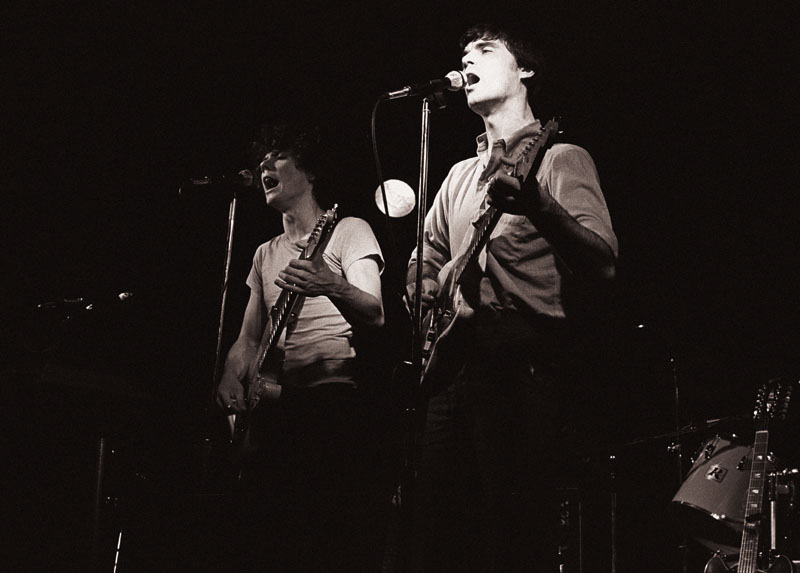
Talking Heads performing in 1978 with Harrison (left), Frantz (middle) and Byrne (right).

1970s–1980s: Origins

[edit]

During the early-to-mid 1970s, New York City artists such as Television, Patti Smith, Richard Hell and the Voidoids and Talking Heads would emerge from the burgeoning early NYC punk scene, performing at local clubs like CBGB and Max's Kansas City. Their music blended the raw energy of early punk with influences from poetry as well as local art and avant-garde scenes, contrasting with what would become the standard rudimentary punk sound associated with British pub rock and American acts like the New York Dolls, Heartbreakers, Dead Boys and Ramones.[7]

Talking Heads, originally known as "the Artistics," formed while studying at the Rhode Island School of Design in 1975.[28] In Ohio, bands such as Devo, Mirrors, the Styrenes, Electric Eels,[29] and Pere Ubu would form, blending garage rock and proto-punk with avant-garde experimentation.[30] Additionally, Oklahoma band Debris' who merged the Stooges with Beefheart, acid rock and early Roxy Music have been described as a "proto-art-punk band".[31] Other early art punk groups were often formed at art schools or composed primarily of musicians who had studied at art schools.[32][7]

In 1975, Patti Smith released her debut album Horses produced by John Cale previously of the Velvet Underground. The album was retroactively described by AllMusic as "essentially the first art punk album".[10] Subsequently, retrospective reviews cited Television’s debut album Marquee Moon as "jazzy art punk,"[33] and Talking Heads as graduating from an "art punk jangle to maximalist post-modern funk orchestra".[34]

In the UK, the post-punk scene often intersected with art punk, bands such as the Fall, the Raincoats, Public Image Ltd and Magazine being attributed the label interchangeably with post-punk.[11] Author Gavin Butt linked art education as a "really important part of the cultural ecology" of Leeds-based bands such as Delta 5, Gang of Four, Scritti Politti and the Mekons.[35]

New York City punk pioneers Television were later labeled a pioneering art punk band

However, Simon Reynolds[7] cites that not all bands in the British post-punk scene had gone to art school:

Some accused these experimentalists of merely lapsing back into the art rock elitism that punk originally aimed to destroy […] Of course, not everyone in postpunk attended art school, or even college. Self-educated […] figures like John Lydon or Mark E. Smith […] fit the syndrome of the anti-intellectual intellectual.

By late 1977, English band Wire released their debut album Pink Flag, marking the start of a string of highly influential records—including Chairs Missing and 154 that would go on to define and lay the groundwork for art punk and broader alternative music.[36][37] Other bands such as Swell Maps whose debut single "Read About Seymour" gained cult success after being played on the John Peel show, blended DIY sensibilities with more experimental and artier influences. Their albums A Trip to Marineville and Jane from Occupied Europe, later became staple art punk releases.[38]

By the early 1980s, bands such as the Feelies came to further define the genre, with their debut album "Crazy Rhythms" being described as "oddball art punk".[39] Followed by, Kansas band the Embarrassment described as "Midwest art-punk heroes", who blended the nerdy sound of Jonathan Richman's The Modern Lovers with the quirky, cerebral style of Talking Heads.[40] Audiences noted that "they looked more like nerds than punks", resulting in the band being retrospectively assessed as a template for geek rock.[41][42] In England, the band Cardiacs made avant-prog and post-punk influenced art rock, with the Guardian describing the song R.E.S. as an "art-punk Bohemian Rhapsody".[43]

Subsequently, groups such as the Slits, Alternative TV, Au Pairs, the Flying Lizards and the Pop Group would further develop the art punk sound, crafting songs that blended abstract lyrics and avant-garde music with punk and post-punk elements, whilst bands such as Half Japanese,[44] the Birthday Party, and Blurt incorporated a noise rock influence.[45][46] Later, the New York no wave scene also saw brief intersections with art punk, evinced by artists like James Chance and the Contortions, Rosa Yemen, Mars, Theoretical Girls, the Static, A Band, Teenage Jesus and the Jerks, and most notably Sonic Youth.

Californian punk bands such as MX-80 Sound and the Minutemen took influences from jazz, blending intricate rhythms, and unconventional song structures to create a more experimental and cerebral form of punk.

The scene also took form internationally, Anna Szemere traces the beginnings of the Hungarian art-punk subculture to 1978, when punk band the Spions performed three concerts which drew on conceptualist performance art and Antonin Artaud's Theatre of Cruelty, with neo-avant-garde/anarchist manifestos handed out to the audience.[47]

Late 1980s–1990s

[edit]

In Ireland, the band Stump drew influence from Captain Beefheart and Pere Ubu further developing the sound of art punk into the late '80s, as they were featured on the NME's infamous C86 cassette compilation, alongside other art punk groups such as the Manchester-based band bIG*fLAME.[48]

By the late 1980s to early 1990s, Scottish bands like Country Teasers and Dog Faced Hermans emerged from the scene, with the latter forming in art school. They continued the legacy of experimental and art-driven punk, though they were preceded by the Fire Engines a few years earlier.[49] Subsequently, American band Thinking Fellers Union Local 282 blended the sound of experimental art punk with that of indie rock.[50][51]

The Guardian described Parquet Courts as "agitated art-punk".[52]

2000s–2010s

[edit]

In the early 2000s, the post-punk revival scene briefly revived the art punk sound with bands like the Rapture, and the Yeah Yeah Yeahs, the latter being labeled by the Guardian as "New York's favourite art-punk rockers".[53][54]

During the 2010s, Canadian groups such as Preoccupations, Ought and Women, alongside American bands like Protomartyr and Parquet Courts. While Australian band Tropical Fuck Storm, Danish band Iceage and Britain's Gilla Band continued to develop the art-punk sound. Additionally, the egg punk scene pioneered by Indiana-based punk trio the Coneheads,[55] and later proliferated by groups like Uranium Club[56] and Snõõper who incorporated art-punk elements.[57]

By the late 2010s and early 2020s, a new wave of UK and Irish post-punk bands began to gain popularity. Originally emerging out of Brixton's Windmill scene, terms such as "crank wave" and "post-Brexit new wave" were used to describe these bands,[58][59] who blended the more experimental sides of post-punk with post-rock, no wave and other art-based influences, some of these bands include Squid,[60] Parquet Courts,[61] Dry Cleaning, Fat White Family, Shame, Black Country, New Road, Idles and Yard Act.[62]

See also

[edit]

References

[edit]

Bibliography

[edit]
Revisions and contributorsEdit on WikipediaRead on Wikipedia
from Grokipedia
Art punk is a subgenre of that emerged in the late 1970s and early 1980s, distinguished by its experimental and sensibilities, blending the raw aggression and DIY ethos of punk with influences from , , and visual/performance arts to challenge musical conventions and reject commercialism. Pioneered in the scenes of , particularly at iconic venues like , art punk emphasized unconventional song structures, dissonant instrumentation, abstract lyrics, and a focus on artistic individuality over mainstream accessibility. This movement arose as a reaction to the perceived limitations of raw , drawing inspiration from proto-punk acts like and incorporating elements of , urban realism, and theatricality to expand the genre's boundaries. Central to art punk's development were influential bands that embodied its innovative spirit, including the , whose poetic and romantic fusion of punk with literary influences debuted at and contrasted the era's typical machismo-driven sound. contributed angular funk rhythms, elements, and intellectual lyrics, evolving from minimalist art punk to broader global explorations that influenced subsequent acts like . British and American groups such as Wire, with their unorthodox minimalism; , known for politically charged angular ; , featuring complex compositions; and , blending art-rock guitar explorations with garage punk energy, further defined the subgenre's diversity and experimental edge. These artists, active in the mid-to-late 1970s, performed at key spots like and , fostering a scene that prioritized self-invention and boundary-pushing over formulaic rebellion. Art punk's legacy lies in its role as a bridge to and , promoting creativity and attitudes that continue to resonate in modern indie and . By integrating , performance, and interdisciplinary elements, it transformed punk from a strictly musical revolt into a broader cultural , influencing , zines, and expressions while maintaining the genre's core emphasis on and immediacy.

Definition and Characteristics

Core Musical Features

Art punk's core musical features emphasize experimentation and innovation, diverging from punk rock's conventional simplicity through atypical song structures that incorporate dissonance, irregular rhythms, and noise elements. Drawing influences from , , dub, and industrial sounds, artists crafted fractured compositions that subverted traditional verse-chorus formats, often featuring tape loops and angular guitar lines to evoke unease and intellectual engagement. For example, Pere Ubu's early work, such as their 1978 debut The Modern Dance, utilized techniques, harsh found sounds, and unpredictable synth turnarounds alongside ramshackle organs and garage-style guitars to create a sense of disorientation and raw invention. Instrumentation in art punk expanded punk's basic trio setup by incorporating synthesizers, unconventional percussion, and atonal motifs, fostering polyrhythmic complexity and textural depth. Talking Heads exemplified this in Remain in Light (1980), where funk-infused basslines by Tina Weymouth intertwined with layered polyrhythms inspired by African music, augmented by chicken-scratch guitars and expansive percussion, all under Brian Eno's production to blend punk's urgency with global grooves. This approach prioritized rhythmic interplay over linear progression, resulting in hypnotic, groove-oriented tracks that challenged rock's normative structures. Art punk often rejected punk's raw for progressive complexity, though some bands retained stripped-down elements while adding intellectual layers, as in Wire's (1977), which featured dissonant, minimalist riffs across 21 concise tracks that allowed space for instrumental interplay and subversive hooks. Production evolved from the ' lo-fi DIY ethos—marked by , feedback, and minimal overdubs to capture live energy—to more refined experimental techniques in later works, enabling intricate layering without losing punk's edge.

Aesthetic and Ideological Aspects

Art punk's visual style diverged from mainstream punk's leather-and-studs clichés, drawing heavily on training to embrace abstract graphics, techniques, and ironic fashion that subverted consumerist norms. Influenced by movements like Dada's chaotic and the Situationist International's —reappropriating commercial imagery for critique—artists and musicians rejected polished aesthetics in favor of raw, DIY visuals that highlighted absurdity and intellectual provocation. Performative elements further embodied this ethos through theatricality and multimedia integration, often choreographed to expose social awkwardness and alienation. Talking Heads exemplified this with frontman David Byrne's ironic adoption of oversized gray suits during their 1983-1984 tours, as seen in the film Stop Making Sense, where the exaggerated tailoring—designed by Gail Blacker using stiff canvas—contrasted sharply with Byrne's spasmodic, deliberately clumsy dances, satirizing corporate uniformity and pop spectacle. Similarly, Pere Ubu's late-1970s concerts incorporated cinematic and theatrical staging, treating performances as dense "data units" of narrative-driven chaos that blended avant-garde experimentation with garage rock energy. Ideologically, art punk emphasized and to critique and capitalist alienation, extending Dada's anti-bourgeois irreverence and the Situationists' assault on the "" of everyday life. Bands like channeled Marxist theory in their 1979 album Entertainment!, with lyrics in tracks like "Damaged Goods" dissecting the transactional of relationships and labor, while the album's artwork repurposed imagery to expose and class divides. This anti-commercial stance positioned art punk as a philosophical challenge to aesthetic norms, prioritizing self-expression and identity formation over market appeal. The DIY ethos permeated visual and , extending to handmade album art and zines that democratized creativity. ' self-titled 1979 debut captured this through its raw production in squats, where band members self-tought instruments and embraced amateur aesthetics, reflecting punk's "art without permission" philosophy in every aspect from cover design to recording.

Historical Development

Early Influences (Pre-1970s)

The emergence of art rock in the 1960s provided key precursors to art punk through innovative experimentation that prioritized artistic expression over commercial conventions. Bands like exemplified this shift with their noise-driven soundscapes and unconventional structures, as heard on their debut album (1967), which featured John Cale's droning viola and Lou Reed's tuning to create raw, dissonant textures. Produced by for a modest $3,000 budget, the album captured the downtown New York art scene's interdisciplinary ethos, blending rock with visual and performance elements. Reed's lyrics, drawing from beat writers like and , explored taboo subjects such as addiction and sexuality with poetic candor, establishing a literary foundation for later punk's intellectual edge. Avant-garde movements of the 1950s and 1960s further shaped these developments by challenging musical norms and embracing chance and indeterminacy. Composer John Cage's chance music, exemplified in works like 4'33" (1952), emphasized environmental sounds and listener perception over composer control, influencing rock musicians to reject rigid structures in favor of spontaneous expression. Cale, a co-founder, brought these ideas directly from his studies with Cage and , incorporating minimalist drones and techniques into rock contexts. Similarly, the movement, inspired by Cage's teachings at , promoted performative, anti-institutional art through events that blurred music, , and everyday actions, fostering punk's later disdain for and embrace of accessible disruption. These influences permeated the 1960s scene, encouraging bands to integrate noise and conceptualism as tools for cultural critique. As a transitional force in the early 1970s, Brian Eno's work with fused glam aesthetics with experimentation, laying conceptual groundwork for art punk's hybridity. Emerging from London's system, Eno manipulated tape loops and synthesizers to create textured, non-linear soundscapes on 's debut album (), drawing from Cage's indeterminacy and Young's sustained tones. His production techniques, emphasizing ambient layering over traditional song forms, influenced experimental rock's shift toward process-oriented composition. Ties to literary and visual arts reinforced art punk's intellectual underpinnings, with beat poetry's raw confessionalism and pop art's ironic consumerism providing ideological templates. Ginsberg's Howl (1956) inspired Reed's unflinching narratives, promoting poetry as a vehicle for social rebellion. Warhol's pop art, through his Factory collaborations and multimedia Exploding Plastic Inevitable shows with the Velvet Underground, elevated everyday imagery to critique mass culture, mirroring punk's subversive visual strategies. These cross-disciplinary links underscored art punk's roots in a broader rejection of artistic hierarchies.

1970s Foundations

The art punk genre emerged in the mid-1970s amid the burgeoning punk scenes of New York and , where musicians fused raw punk energy with avant-garde influences from , visual art, and experimental noise. In New York, the district's club became a pivotal venue, opening in 1973 and quickly evolving into a hub for underground acts despite its initial focus on and bluegrass sounds. , a and performer from the downtown arts scene, debuted there in February 1975 with her band, blending spoken-word and rock in performances that marked a departure from traditional punk aggression. Her debut album , released in November 1975 and produced by , incorporated Rimbaud-inspired lyrics into tracks like the extended "Gloria," establishing her as a foundational figure in art punk's poetic dimension and cementing 's role in the genre's birth. Television, another CBGB regular since securing a residency in 1974, further defined the New York scene with their intricate, interplay-driven guitar work that elevated punk beyond basic structures. Formed in 1973, the band drew from the club's overlapping poetry and rock circles, releasing their debut Marquee Moon in February 1977 on , featuring extended solos by and Richard Lloyd that blended punk's urgency with sophistication. This album's subtle, thought-provoking approach transcended conventional punk, influencing subsequent developments while highlighting the scene's artistic depth. Across the Atlantic, London's art punk scene coalesced in 1977 amid the broader punk explosion, with bands incorporating eclectic and experimental elements into the genre's raw template. Wire, comprising art school alumni from institutions like and Colleges, released their debut in December 1977 on EMI's Harvest label, recorded at with a focus on minimalist precision and Dadaist brevity across 21 tracks in under 36 minutes. Influenced by figures like and , Wire rejected punk's sloppy ethos for arty, conceptual songwriting, as seen in their live appearances at The Roxy club earlier that year. Similarly, Swell Maps, an experimental Birmingham outfit inspired by the punk surge, began live performances and recordings in 1977, channeling noisy, improvisational chaos in early sessions that foreshadowed their DIY innovations. Key events amplified these foundations: Smith's 1975 CBGB shows and subsequent U.S. tour following Horses spread art-infused punk aesthetics, bridging poetry slams and rock venues. The 1977 UK punk outbreak, fueled by releases like Pink Flag and live circuits, adapted artistic elements into the movement, exemplified by The Slits' formation in 1976 and their early reggae-punk hybrids in 1977 performances, which challenged punk's monochromatic sound with dub rhythms and feminist improvisation. These developments often stemmed from art school-educated musicians, such as Wire's members, who subverted punk's predominant working-class narrative by emphasizing conceptual experimentation and middle-class intellectualism in albums and gigs.

1980s Developments

In the 1980s, art punk matured through deeper integrations with post-punk, emphasizing experimental structures and social critique. Gang of Four's Solid Gold (1981) exemplified this evolution with its angular funk rhythms and dissonant guitar work, blending rhythmic precision with political lyricism to push art punk's boundaries beyond raw punk energy. Similarly, Pere Ubu extended their industrial experiments from The Modern Dance (1978) into the decade, incorporating tape manipulation and avant-garde dissonance that influenced art punk's noise-oriented branches. The genre expanded across the and , fostering diverse scenes that highlighted feminist and surrealist elements. ' Odyshape (1981) advanced feminist art punk through unconventional instrumentation and themes of autonomy, drawing from 's DIY ethos to challenge gender norms in music. In the and , bands like Stump contributed surrealist flair to the art punk landscape, merging quirky lyrics with arrangements in a vein. Key events underscored art punk's global underground momentum, particularly in urban dissident contexts. New York City's no-wave movement in the early 1980s amplified avant-garde noise, with DNA's spastic free-jazz-infused tracks rejecting punk's conventions for raw, anti-melodic expression. In Hungary, the art punk underground from 1978 onward served as a dissident outlet under late socialism, where groups like Orfeo and Inconnu fused radical artistic and political experimentation to critique state control. This period also marked a shift toward independent labels and cassette culture, enabling broader dissemination of art punk's fringes. Mission of Burma's Vs. (1982), released on the indie Ace of Hearts label, captured this transition with its intense post-punk collages, while the era's DIY cassette networks—peaking in post-punk circles from 1978 to 1984—facilitated underground trading and experimentation among global artists.

1990s to 2010s

In the 1990s, art punk persisted in underground indie rock scenes, blending lo-fi experimentation with noisy, avant-garde elements that echoed earlier post-punk influences. San Francisco's Thinking Fellers Union Local 282 exemplified this through their raw, eclectic sound on the 1992 album Mother of All Saints, which mixed tight pop structures with spontaneous lo-fi chaos and unconventional instrumentation, establishing them as pioneers of fringe rock artistry. Similarly, New York-based Chavez contributed to the U.S. underground with their angular noise rock, as heard on their 1995 debut Ride the Fader, which fused mathy riffs and dynamic shifts in a manner that aligned with art punk's emphasis on innovation over commercial appeal. These acts maintained the genre's DIY ethos amid the decade's grunge and alternative dominance, often operating on the margins of indie labels like Matador Records. The 2000s saw a notable revival of art punk through the resurgence, particularly in New York City's burgeoning indie scene, where bands infused with experimental edges and ideological critique. emerged as key figures in this movement with their 2003 debut , delivering "art-damaged" rock that combined raw energy, sexual urgency, and fuzzy textures, influencing the broader garage revival. Concurrently, Gang Gang Dance pushed psychedelic boundaries in their 2000s output, drawing from art-punk roots to create tribal, modernist soundscapes that blended ambient electronics with feral improvisation, as on their 2008 album Saint Dymphna. This era's NYC indie boom, alongside London's parallel explosion, revitalized art punk by integrating it into mainstream indie circuits, fostering cross-pollination with acts like and . By the 2010s, art punk evolved further in indie and post-punk contexts, emphasizing witty minimalism and darker synth explorations while retaining underground vitality. Brooklyn's Parquet Courts captured this with their 2012 breakthrough Light Up Gold, a collection of concise, snarky tracks that merged post-punk brevity with art-punk verve, critiquing modern life through raucous energy. Canada's Preoccupations (formerly Viet Cong) added brooding intensity, incorporating dark synth-punk on albums like their 2016 self-titled release, where themes of futility were underscored by gritty, instrumental post-punk jams reminiscent of art-punk's existential roots. The decade's festival integrations, such as Primavera Sound's inclusion of post-punk revival acts like The Fall and emerging indie experimentalists, helped elevate art punk from niche venues to broader European stages, bridging analog traditions with digital-era accessibility. In the , art punk has seen a resurgence through bands blending mathematical complexity and urgency, exemplified by the group . Their 2021 debut album features jagged rhythms, krautrock-infused grooves, and experimental textures that evoke the genre's roots while incorporating and electronic elements. Similarly, Nottingham's Do Nothing has contributed quirky, groove-oriented tracks across releases like the 2020 EP Zero Dollar Bill and the 2023 album Snake Sideways, marked by surreal lyrics, spindly basslines, and a blend of angularity with flair. On the experimental front, the California-based maintained their prolific output with SORCS 80 in 2024, a synth-heavy record that fuses punk energy with brass sections and sampler-driven abstraction, pushing the boundaries of the genre's noise and psychedelic leanings. The from 2020 to 2022 accelerated the role of streaming platforms and in art punk's DIY ecosystem, enabling direct artist-to-fan distribution without traditional labels. Bands leveraged and for immediate releases and virtual performances, sustaining underground scenes amid venue closures. Virtual events, such as DIY livestreams and online festivals, became vital for ; for instance, punk-adjacent acts participated in pandemic-era streams that raised funds and maintained momentum, adapting the genre's to digital formats. Contemporary trends emphasize hybrid fusions, where art punk intersects with and electronic subgenres. Minneapolis's Uranium Club exemplifies this raw energy in their 2024 album Infants Under the Bulb, incorporating saxophone-driven chaos and absurdist narratives into structures that border on . By 2025, these evolutions continue with veteran reunions and charged new works; , active through tours and releases, have sustained their no-wave influence into fresh performances, while extended their politically incisive art punk via Crawler (2021) and subsequent output, inspiring a wave of socially aware hybrids.

Global Perspectives

European Scenes Beyond the UK

In during the 1980s and 1990s, art punk intertwined with DIY ethos through bands like , who formed in late 1987 in as a collective of non-musicians including family and friends, adopting a punk-like approach to blend Latin, rai, and folk elements into infectious, experimental . Their debut album Mlah (1988) exemplified this fusion, incorporating influences with raw, improvisational energy that challenged mainstream norms in the French underground scene. Across , art punk served as a vehicle for dissident expression amid communist repression. In , Spions emerged as the first punk band of the , forming in the late and embodying through satirical performances that mocked Soviet authority, such as wearing Russian military uniforms with punk hairstyles while posing as KGB agents to subvert Western media expectations. Exiled from in May 1978 due to police surveillance, passport confiscations, and denied exit visas, the band relocated to France, releasing Russian Way of Life and Total Czecho-Slovakia (1979) as a of totalitarian life, highlighting art punk's role in political exile and cultural defiance. In , the exemplified underground resistance from the into the , evolving from a licensed cover band formed in 1968—drawing on and influences—into an unlicensed outfit after their permit was revoked in for refusing state-approved material. Their arrests in 1976, including 27 musicians charged with "organized disturbance of the peace," galvanized dissidents like , inspiring the 1977 human rights manifesto and contributing to the cultural momentum behind the 1989 through cacophonous, jazz-inflected performances that rejected communist cultural controls. Germany's post-Wall underground in the late 1980s and early 1990s fostered art punk through squats like , occupied in 1990 by artists in Berlin's district to prevent demolition of the abandoned building, transforming it into a censorship-free commune housing nearly 100 international creators in studios, a theater, and event spaces that hosted multimedia punk performances and subcultural gatherings. This hub amplified the raw, anti-establishment spirit of Berlin's punk scene, serving as the city's second-most visited art site until its 2012 eviction and embodying art punk's emphasis on communal, improvisational rebellion. In from the onward, experimental art punk thrived within the boom, as seen in Afterhours, founded in the 1980s by Manuel Agnelli and reaching prominence with Hai Paura del Buio? (1997), which merged hardcore, , folk, and pop into brooding, introspective soundscapes that pushed boundaries beyond conventional rock structures. This evolution reflected 's vibrant scene, where bands like Afterhours contributed to art punk's conceptual depth by exploring existential themes through noisy, genre-defying compositions. Scandinavia's 2010s art punk scene revived raw intensity in with , formed in 2008 in by teenage musicians from the local milieu, debuting with the abrasive New Brigade (2011) before expanding into multifaceted art punk on albums like Plowing Into the Field of Love (2014) and Beyondless (2018), incorporating flourishes and ecstatic arrangements while retaining punk's aggressive core. 's trajectory underscored the Danish underground's hyperlocal influence, blending hardcore roots with broader artistic experimentation to sustain art punk's vitality into the 2020s.

Scenes in Asia, Latin America, and Africa

In , art punk emerged as a vibrant underground force in during the 1980s, characterized by raw, politically charged experimentation that blended punk's aggression with and elements. Bands like , formed in 1980 by activist Michiro Endo, exemplified this through their incendiary performances and socialist-themed lyrics, pushing against societal norms in a context of economic boom and cultural repression. Their sound, rooted in but infused with chaotic , influenced subsequent generations by prioritizing shock value and fervor over commercial polish. By the 2020s, Japanese art punk evolved into hybrid forms, with acts like Yuragi fusing shoegaze's dreamy textures and dynamic shifts with atmospheres, creating immersive soundscapes that echoed the genre's experimental ethos. This contemporary iteration reflects ongoing innovation, blending silence and distortion to explore themes of isolation and resilience. The DIY ethic that took hold in during the post-martial law late 1990s and 2000s further solidified 's adaptation, where abandoned buildings hosted livehouses and squats for bands experimenting with punk's boundaries amid rapid urbanization. In , art punk took root through cultural hybridity, notably in Brazil's Manguebeat movement, which merged punk's raw energy with , drums, and regional to critique . Pioneers & Nação Zumbi embodied this fusion, combining hardcore rock's dissonance with rhythms and alfaia percussion to produce a politically urgent sound that challenged Recife's and cultural marginalization. Their experiments, as analyzed in scholarly accounts, represented a "coexistentialism" that integrated metaphors—like roots—with punk's rebellious drive, influencing broader n expressions of resistance. In during the , the scene flourished around hubs like El Chopo market, where DIY punk collectives traded records and hosted performances that infused art punk with local anarcho and sensibilities, fostering a countercultural response to neoliberal policies. Into the , n DIY collectives have intensified their role amid political unrest, using punk's aesthetics to empower youth through grassroots shows and zines that address authoritarianism and social instability across the region. African art punk scenes have often intertwined with anti-colonial and struggles, particularly in South Africa's 1980s underground, where multiracial bands defied apartheid's laws through defiant performances. National Wake, formed in around 1979, pioneered this by blending punk's speed and dissonance with and , creating music that explicitly condemned state violence and promoted unity in an era of bans and police raids. Their existence as an integrated group was itself an act of rebellion, influencing later African punk by demonstrating art's potential as a tool for prefiguring post-apartheid society.

Diversity and Inclusion

Gender and Feminist Contributions

Art punk has been profoundly shaped by women's contributions that challenged patriarchal structures within the genre, beginning in the 1970s with figures like Patti Smith, whose poetry-infused punk performances defied traditional gender norms and elevated female voices in a male-dominated scene. Smith's debut album Horses (1975) blended raw punk energy with literary influences, positioning her as a pioneer who blurred lines between feminine and masculine expression, inspiring subsequent generations of female artists. Similarly, the all-female band The Raincoats emerged in 1977, releasing their self-titled debut album in 1979, which featured experimental sounds and DIY ethos that directly confronted male dominance in punk by prioritizing collaborative, unconventional song structures over conventional rock hierarchies. Their work emphasized emotional vulnerability and rhythmic innovation, creating space for women to explore punk beyond aggressive stereotypes. In the 1980s and , the movement intersected with art punk through bands like , whose performances incorporated confrontational visuals and lyrics addressing and empowerment, infusing punk with feminist activism that extended artistic experimentation into political performance. 's raw, art-punk-inflected sound on albums like Pussy Whipped (1993) used noise and repetition to subvert audience expectations, fostering a space for women to reclaim agency in live settings. In the UK, Huggy Bear advanced this with surreal, abstract feminist expressions in the , blending collage-like aesthetics and chaotic energy on releases like Taking the Rough with the Smooch (1993), which critiqued heteronormativity through disjointed narratives and visual art zines. These acts highlighted art punk's potential as a medium for feminist disruption, merging sonic experimentation with direct calls for gender equity. The 2000s and 2010s saw continued evolution with artists like of , whose visceral, theatrical style on albums such as (2003) embodied feminist rebellion through primal vocals and gender-fluid visuals, establishing her as a leader in art punk's revival. 's performances challenged rock's by embracing chaotic , influencing a wave of women-led bands. In the 2020s, has carried this forward with queer-feminist noise punk, continuing with albums like Love Me Forever (2022) and Earthkeeper (2025), where vocalist Ashrita Kumar addresses intersectional identity and resistance through aggressive, melodic riffs evolving into heavier hardcore elements that prioritize marginalized voices in punk. Events like Ladyfest, launched in 2000 as a DIY feminist inspired by , have sustained these contributions by providing platforms for women and non-binary artists to showcase art punk experimentation, with over 150 iterations worldwide fostering community and visibility. Central to these feminist interventions are themes of bodily and anti-patriarchy, often explored through and visuals that and . X-Ray Spex's (1978), fronted by , exemplifies this with songs like "Oh Bondage Up Yours!" that use satirical saxophones and vivid imagery to reject beauty standards and advocate , marking a seminal feminist statement in art punk's early years. Styrene's biracial perspective added layers to these critiques, amplifying punk's role in dismantling patriarchal control over women's bodies.

Racial and Ethnic Representation

Art punk, emerging from the experimental fringes of the punk scene, has historically featured limited racial and ethnic diversity among its practitioners, with the genre largely dominated by white artists in key scenes like New York and . This underrepresentation mirrors broader punk dynamics, where Black and other minority musicians faced barriers despite foundational influences from , , and on the genre's sonic experimentation. However, pivotal contributions from artists of color have enriched art punk's ethos, particularly through fusion of punk's raw energy with ethnic musical traditions. In the late 1970s New York scene—a cornerstone of art punk—the Black sisters Renee, Valerie, Deborah, and Marie Scroggins (performing as ESG, an acronym from their birthstones—emerald and sapphire—and the goal of gold) from the pioneered minimalist that blended rhythms with funk grooves. Their 1981 debut EP, produced by , captured raw, repetitive basslines and percussion that influenced subsequent and experimental acts, establishing ESG as a seminal "eighties art band" despite initial obscurity. Similarly, in , Basement 5, an all-Black collective formed in 1978, fused dub with punk's angularity and synth experimentation on their 1980 album 1965–1980, addressing Thatcher-era racial tensions through politically charged futurism. These acts challenged the genre's homogeneity by integrating ethnic sounds into art punk's framework. Later iterations of art punk saw increased visibility for artists of color, particularly in the 2000s . , a Brooklyn-based ensemble with Black vocalists and , debuted in 2003 with experimental that layered noise, soul, and punk aggression, earning acclaim for tracks like "Wolf Like Me" from their 2006 album . , led by Nigerian-British singer , further diversified the scene with their 2004 self-titled debut, merging art-punk angularity with electronic and elements to critique identity and urban alienation. Contemporary acts like , fronted by Black musician Franklin James Fisher, continue this legacy through noise-infused that confronts racial injustice, as heard on their 2015 debut album. Similarly, in the 2020s, , a Black British duo, has advanced this with fusion on their album Humble as the Sun (2024), confronting racial injustice through experimental beats and raw lyricism. These examples underscore a gradual shift toward greater ethnic inclusion, driven by artists who expand art punk's boundaries with culturally rooted innovation.

References

Add your contribution
Related Hubs
User Avatar
No comments yet.