


Community hub
Recent from talks
Contribute something
Nothing was collected or created yet.
Global surface temperature
View on Wikipedia

Global surface temperature (GST) is the average temperature of Earth's surface at a given time. It is a combination of sea surface temperature and the near-surface air temperature over land, weighted by their respective areas. Temperature data comes mainly from weather stations and satellites. To estimate data in the distant past, proxy data can be used for example from tree rings, corals, and ice cores.[1] Observing the rising GST over time is one of the many lines of evidence supporting the scientific consensus on climate change, which is that human activities are causing climate change. Alternative terms for the same concept are global mean surface temperature (GMST) or global average surface temperature.
Series of reliable temperature measurements in some regions began in the 1850—1880 time frame (this is called the instrumental temperature record). The longest-running temperature record is the Central England temperature data series, which starts in 1659. The longest-running quasi-global records start in 1850.[3] For temperature measurements in the upper atmosphere a variety of methods can be used. This includes radiosondes launched using weather balloons, a variety of satellites, and aircraft.[4] Satellites can monitor temperatures in the upper atmosphere but are not commonly used to measure temperature change at the surface. Ocean temperatures at different depths are measured to add to global surface temperature datasets. This data is also used to calculate the ocean heat content.
GMST is often further aggregated by year or month. Through 1940, the average annual GMST increased, but was relatively stable between 1940 and 1975. Since 1975, it has increased by roughly 0.15 °C to 0.20 °C per decade, to at least 1.1 °C (1.9 °F) above 1880 levels.[5] The current annual GMST is about 15 °C (59 °F),[6] though monthly temperatures can vary almost 2 °C (4 °F) above or below this figure.[7]
The global average and combined land and ocean surface temperature show a warming of 1.09 °C (range: 0.95 to 1.20 °C) from 1850–1900 to 2011–2020, based on multiple independently produced datasets.[8]: 5 The trend is faster since the 1970s than in any other 50-year period over at least the last 2000 years.[8]: 8 Within that upward trend, some variability in temperatures happens because of natural internal variability (for example due to El Niño–Southern Oscillation).
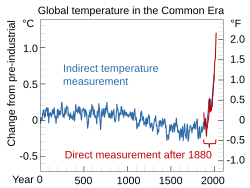
The global temperature record shows the changes of the temperature of the atmosphere and the oceans through various spans of time. There are numerous estimates of temperatures since the end of the Pleistocene glaciation, particularly during the current Holocene epoch. Some temperature information is available through geologic evidence, going back millions of years. More recently, information from ice cores covers the period from 800,000 years ago until now. Tree rings and measurements from ice cores can give evidence about the global temperature from 1,000-2,000 years before the present until now.[9]
Definition
[edit]
The IPCC Sixth Assessment Report defines global mean surface temperature (GMST) as the "estimated global average of near-surface air temperatures over land and sea ice, and sea surface temperature (SST) over ice-free ocean regions, with changes normally expressed as departures from a value over a specified reference period".[10]: 2231
Put simply, the global surface temperature (GST) is calculated by averaging the temperature at the surface layer of the ocean (sea surface temperature) and over land (surface air temperature).
In comparison, the global mean surface air temperature (GSAT) is the "global average of near-surface air temperatures over land, oceans and sea ice. Changes in GSAT are often used as a measure of global temperature change in climate models."[10]: 2231
Global temperature can have different definitions. There is a small difference between air and surface temperatures.[11]: 12
Temperature data from 1850 to the present time
[edit]Total warming and trends
[edit]Changes in global temperatures over the past century provide evidence for the effects of increasing greenhouse gases. When the climate system reacts to such changes, climate change follows. Measurement of the GST is one of the many lines of evidence supporting the scientific consensus on climate change, which is that humans are causing warming of Earth's climate system.
The global average and combined land and ocean surface temperature, show a warming of 1.09 °C (range: 0.95 to 1.20 °C) from 1850–1900 to 2011–2020, based on multiple independently produced datasets.[8]: 5 The trend is faster since the 1970s than in any other 50-year period over at least the last 2000 years.[8]: 8
Most of the observed warming occurred in two periods: around 1900 to around 1940 and around 1970 onwards;[12] the cooling/plateau from 1940 to 1970 has been mostly attributed to sulfate aerosol.[13][14]: 207 Some of the temperature variations over this time period may also be due to ocean circulation patterns.[15]
Land air temperatures are rising faster than sea surface temperatures. Land temperatures have warmed by 1.59 °C (range: 1.34 to 1.83 °C) from 1850–1900 to 2011–2020, while sea surface temperatures have warmed by 0.88 °C (range: 0.68 to 1.01 °C) over the same period.[8]: 5
For 1980 to 2020, the linear warming trend for combined land and sea temperatures has been 0.18 °C to 0.20 °C per decade, depending on the data set used.[16]: Table 2.4
It is unlikely that any uncorrected effects from urbanisation, or changes in land use or land cover, have raised global land temperature changes by more than 10%.[17]: 189 However, larger urbanisation signals have been found locally in some rapidly urbanising regions, such as eastern China.[16]: Section 2.3.1.1.3

Global warming affects all parts of Earth's climate system.[19] Global surface temperatures have risen by 1.1 °C (2.0 °F). Scientists say they will rise further in the future.[20][21] The changes in climate are not uniform across the Earth. In particular, most land areas have warmed faster than most ocean areas. The Arctic is warming faster than most other regions.[22] Night-time temperatures have increased faster than daytime temperatures.[23] The impact on nature and people depends on how much more the Earth warms.[24]: 787
Scientists use several methods to predict the effects of human-caused climate change. One is to investigate past natural changes in climate.[25] To assess changes in Earth's past climate scientists have studied tree rings, ice cores, corals, and ocean and lake sediments.[26] These show that recent temperatures have surpassed anything in the last 2,000 years.[27] By the end of the 21st century, temperatures may increase to a level last seen in the mid-Pliocene. This was around 3 million years ago.[28]: 322 At that time, mean global temperatures were about 2–4 °C (3.6–7.2 °F) warmer than pre-industrial temperatures. The global mean sea level was up to 25 metres (82 ft) higher than it is today.[29]: 323 The modern observed rise in temperature and CO2 concentrations has been rapid. Even abrupt geophysical events in Earth's history do not approach current rates.[30]: 54
Methods
[edit]The instrumental temperature record is a record of temperatures within Earth's climate based on direct measurement of air temperature and ocean temperature. Instrumental temperature records do not use indirect reconstructions using climate proxy data such as from tree rings and marine sediments.[31]
Global record from 1850 onwards
[edit]

The period for which reasonably reliable instrumental records of near-surface land temperature exist with quasi-global coverage is generally considered to begin around 1850.[3] Earlier records exist, but with sparser coverage, largely confined to the Northern Hemisphere, and less standardized instrumentation. (The longest-running temperature record is the Central England temperature data series, which starts in 1659).
The temperature data for the record come from measurements from land stations and ships. On land, temperatures are measured either using electronics sensors, or mercury or alcohol thermometers which are read manually, with the instruments being sheltered from direct sunlight using a shelter such as a Stevenson screen. The sea record consists of ships taking sea temperature measurements, mostly from hull-mounted sensors, engine inlets or buckets, and more recently includes measurements from moored and drifting buoys. The land and marine records can be compared.
Data is collected from thousands of meteorological stations, buoys and ships around the globe. Areas that are densely populated tend to have a high density of measurement points. In contrast, temperature observations are more spread out in sparsely populated areas such as polar regions and deserts, as well as in many regions of Africa and South America.[32] In the past, thermometers were read manually to record temperatures. Nowadays, measurements are usually connected with electronic sensors which transmit data automatically. Surface temperature data is usually presented as anomalies rather than as absolute values.
Land and sea measurement and instrument calibration is the responsibility of national meteorological services. Standardization of methods is organized through the World Meteorological Organization (and formerly through its predecessor, the International Meteorological Organization).[33]
Most meteorological observations are taken for use in weather forecasts. Centers such as European Centre for Medium-Range Weather Forecasts show instantaneous map of their coverage; or the Hadley Centre show the coverage for the average of the year 2000. Coverage for earlier in the 20th and 19th centuries would be significantly less. While temperature changes vary both in size and direction from one location to another, the numbers from different locations are combined to produce an estimate of a global average change.
Satellite and balloon temperature records (1950s–present)
[edit]Weather balloon radiosonde measurements of atmospheric temperature at various altitudes begin to show an approximation of global coverage in the 1950s. Since December 1978, microwave sounding units on satellites have produced data which can be used to infer temperatures in the troposphere.
Several groups have analyzed the satellite data to calculate temperature trends in the troposphere. Both the University of Alabama in Huntsville (UAH) and the private, NASA funded, corporation Remote Sensing Systems (RSS) find an upward trend. For the lower troposphere, UAH found a global average trend between 1978 and 2019 of 0.130 degrees Celsius per decade.[34] RSS found a trend of 0.148 degrees Celsius per decade, to January 2011.[35]
In 2004 scientists found trends of +0.19 degrees Celsius per decade when applied to the RSS dataset.[36] Others found 0.20 degrees Celsius per decade up between 1978 and 2005, since which the dataset has not been updated.[37]
The most recent climate model simulations give a range of results for changes in global-average temperature. Some models show more warming in the troposphere than at the surface, while a slightly smaller number of simulations show the opposite behaviour. There is no fundamental inconsistency among these model results and observations at the global scale.[38]
The satellite records used to show much smaller warming trends for the troposphere which were considered to disagree with model prediction; however, following revisions to the satellite records, the trends are now similar.
Global surface and ocean datasets
[edit]The methods used to derive the principal estimates of global surface temperature trends are largely independent from each other and include:
- The National Oceanic and Atmospheric Administration (NOAA) maintains the Global Historical Climatology Network (GHCN-Monthly) data base containing historical temperature, precipitation, and pressure data for thousands of land stations worldwide.[39] Also, NOAA's National Climatic Data Center (NCDC)[40] of surface temperature measurements maintains a global temperature database since 1880.[41]
- HadCRUT is a collaboration between the University of East Anglia's Climatic Research Unit and the Hadley Centre for Climate Prediction and Research.
- NASA's Goddard Institute for Space Studies maintains GISTEMP.
- More recently the Berkeley Earth Surface Temperature dataset was started. It is now one of the datasets used by IPCC and WMO in their assessments.
These datasets are updated frequently, and are generally in close agreement with each other.
Absolute temperatures v. anomalies
[edit]Records of global average surface temperature are usually presented as anomalies rather than as absolute temperatures. A temperature anomaly is measured against a reference value (also called baseline period or long-term average).[42] Usually it is a period of 30 years. For example, a commonly used baseline period is 1951-1980. Therefore, if the average temperature for that time period was 15 °C, and the currently measured temperature is 17 °C, then the temperature anomaly is +2 °C.
Temperature anomalies are useful for deriving average surface temperatures because they tend to be highly correlated over large distances (of the order of 1000 km).[43] In other words, anomalies are representative of temperature changes over large areas and distances. By comparison, absolute temperatures vary markedly over even short distances. A dataset based on anomalies will also be less sensitive to changes in the observing network (such as a new station opening in a particularly hot or cold location) than one based on absolute values will be.
The Earth's average surface absolute temperature for the 1961–1990 period has been derived by spatial interpolation of average observed near-surface air temperatures from over the land, oceans and sea ice regions, with a best estimate of 14 °C (57.2 °F).[44] The estimate is uncertain, but probably lies within 0.5 °C of the true value.[44] Given the difference in uncertainties between this absolute value and any annual anomaly, it's not valid to add them together to imply a precise absolute value for a specific year.[45]
Siting of temperature measurement stations
[edit]The U.S. National Weather Service Cooperative Observer Program has established minimum standards regarding the instrumentation, siting, and reporting of surface temperature stations.[46] The observing systems available are able to detect year-to-year temperature variations such as those caused by El Niño or volcanic eruptions.[47]
Another study concluded in 2006, that existing empirical techniques for validating the local and regional consistency of temperature data are adequate to identify and remove biases from station records, and that such corrections allow information about long-term trends to be preserved.[48] A study in 2013 also found that urban bias can be accounted for, and when all available station data is divided into rural and urban, that both temperature sets are broadly consistent.[49]
Warmest periods
[edit]Warmest years
[edit]

The warmest years in the instrumental temperature record have occurred in the last decade (i.e. 2012-2021). The World Meteorological Organization reported in 2021 that 2016 and 2020 were the two warmest years in the period since 1850.[51]
Each individual year from 2015 onwards has been warmer than any prior year going back to at least 1850.[51] In other words: each of the seven years in 2015-2021 was clearly warmer than any pre-2014 year.
The year 2023 was 1.48 °C hotter than the average in the years 1850-1900 according to the Copernicus Climate Change Service. It was declared as the warmest on record almost immediately after it ended and broke many climate records.[52][53]
There is a long-term warming trend, and there is variability about this trend because of natural sources of variability (e.g. ENSO such as 2014–2016 El Niño event, volcanic eruption).[54] Not every year will set a record but record highs are occurring regularly.
While record-breaking years can attract considerable public interest,[55] individual years are less significant than the overall trend.[56][57] Some climatologists have criticized the attention that the popular press gives to warmest year statistics.[58][56]
Based on the NOAA dataset (note that other datasets produce different rankings[59]), the following table lists the global combined land and ocean annually averaged temperature rank and anomaly for each of the 10 warmest years on record.[60] For comparison: IPCC uses the mean of four different datasets and expresses the data relative to 1850–1900.[citation needed] Although global instrumental temperature records begin only in 1850, reconstructions of earlier temperatures based on climate proxies, suggest these recent years may be the warmest for several centuries to millennia, or longer.[16]: 2–6
| Rank | Year | Anomaly °C | Anomaly °F |
|---|---|---|---|
| 1 | 2024 | 1.29 | 2.23 |
| 2 | 2023 | 1.17 | 2.11 |
| 3 | 2016 | 1.00 | 1.80 |
| 4 | 2020 | 0.98 | 1.76 |
| 5 | 2019 | 0.95 | 1.71 |
| 6 | 2015 | 0.93 | 1.67 |
| 7 | 2017 | 0.91 | 1.64 |
| 8 | 2022 | 0.86 | 1.55 |
| 9 | 2021 | 0.84 | 1.51 |
| 10 | 2018 | 0.82 | 1.48 |
Warmest decades
[edit]
Numerous drivers have been found to influence annual global mean temperatures. An examination of the average global temperature changes by decades reveals continuing climate change: each of the last four decades has been successively warmer at the Earth's surface than any preceding decade since 1850. The most recent decade (2011-2020) was warmer than any multi-centennial period in the past 11,700 years.[16]: 2–6
The following chart is from NASA data of combined land-surface air and sea-surface water temperature anomalies.[61]
| Years | Temperature anomaly, °C (°F) from 1951 to 1980 mean | Change from previous decade, °C (°F) |
|---|---|---|
| 1880–1889 | −0.274 °C (−0.493 °F) | N/A |
| 1890–1899 | −0.254 °C (−0.457 °F) | +0.020 °C (0.036 °F) |
| 1900–1909 | −0.259 °C (−0.466 °F) | −0.005 °C (−0.009 °F) |
| 1910–1919 | −0.276 °C (−0.497 °F) | −0.017 °C (−0.031 °F) |
| 1920–1929 | −0.175 °C (−0.315 °F) | +0.101 °C (0.182 °F) |
| 1930–1939 | −0.043 °C (−0.077 °F) | +0.132 °C (0.238 °F) |
| 1940–1949 | 0.035 °C (0.063 °F) | +0.078 °C (0.140 °F) |
| 1950–1959 | −0.02 °C (−0.036 °F) | −0.055 °C (−0.099 °F) |
| 1960–1969 | −0.014 °C (−0.025 °F) | +0.006 °C (0.011 °F) |
| 1970–1979 | −0.001 °C (−0.002 °F) | +0.013 °C (0.023 °F) |
| 1980–1989 | 0.176 °C (0.317 °F) | +0.177 °C (0.319 °F) |
| 1990–1999 | 0.313 °C (0.563 °F) | +0.137 °C (0.247 °F) |
| 2000–2009 | 0.513 °C (0.923 °F) | +0.200 °C (0.360 °F) |
| 2010–2019 | 0.753 °C (1.355 °F) | +0.240 °C (0.432 °F) |
| 2020–2029 (incomplete) | 1.028 °C (1.85 °F) | +0.275 °C (0.50 °F) |
Factors influencing global temperature
[edit]
Factors that influence global temperature include:
- Greenhouse gases trap outgoing radiation warming the atmosphere which in turn warms the land (greenhouse effect).
- El Niño–Southern Oscillation (ENSO): El Niño generally tends to increase global temperatures. La Niña, on the other hand, usually causes years which are cooler than the short-term average.[62] El Niño is the warm phase of the El Niño–Southern Oscillation (ENSO) and La Niña the cold phase. In the absence of other short-term influences such as volcanic eruptions, strong El Niño years are typically 0.1 °C to 0.2 °C warmer than the years immediately preceding and following them, and strong La Niña years 0.1 °C to 0.2 °C cooler. The signal is most prominent in the year in which the El Niño or La Niña phase ends, with global average temperatures typically rising by 0.1 °C to 0.2 °C during strong El Niño years, and falling by a similar margin during strong La Niña events, in the absence of other short-term influences such as volcanic eruptions.[63]
- Aerosols and volcanic eruptions: Aerosols diffuse incoming radiation generally cooling the planet. On a long-term basis, aerosols are primarily of anthropogenic origin, but major volcanic eruptions can produce quantities of aerosols which exceed those from anthropogenic sources over periods of time up to a few years. Volcanic eruptions which are sufficiently large to inject significant quantities of sulfur dioxide into the stratosphere can have a significant global cooling effect for one to three years after the eruption. This effect is most prominent for tropical volcanoes as the resultant aerosols can spread over both hemispheres. The largest eruptions of the last 100 years, such as the Mount Pinatubo eruption in 1991 and Mount Agung eruption in 1963-1964, have been followed by years with global mean temperatures 0.1 °C to 0.2 °C below long-term trends at the time.[citation needed]
- Land use change like deforestation can increase greenhouse gases through burning biomass. Albedo can also be changed.
- Incoming solar radiation varies very slightly, with the main variation controlled by the approximately 11-year solar magnetic activity cycle.
Robustness of evidence
[edit]There is a scientific consensus that climate is changing and that greenhouse gases emitted by human activities are the primary driver.[64] The scientific consensus is reflected, for example, by the Intergovernmental Panel on Climate Change (IPCC), an international body which summarizes existing science, and the U.S. Global Change Research Program.[64]
Other reports and assessments
[edit].png)
The U.S. National Academy of Sciences, both in its 2002 report to President George W. Bush, and in later publications, has strongly endorsed evidence of an average global temperature increase in the 20th century.[66]
The preliminary results of an assessment carried out by the Berkeley Earth Surface Temperature group and made public in October 2011, found that over the past 50 years the land surface warmed by 0.911 °C, and their results mirrors those obtained from earlier studies carried out by the NOAA, the Hadley Centre and NASA's GISS. The study addressed concerns raised by skeptics (more often: climate change deniers).[67][68] Those concerns included urban heat island effects and apparently poor station quality,[67] and the "issue of data selection bias"[67] and found that these effects did not bias the results obtained from these earlier studies.[67][69][70][71]

Internal climate variability and global warming
[edit]One of the issues that has been raised in the media is the view that global warming "stopped in 1998".[72][73] This view ignores the presence of internal climate variability.[73][74] Internal climate variability is a result of complex interactions between components of the climate system, such as the coupling between the atmosphere and ocean.[75] An example of internal climate variability is the El Niño–Southern Oscillation (ENSO).[73][74] The El Niño in 1998 was particularly strong, possibly one of the strongest of the 20th century, and 1998 was at the time the world's warmest year on record by a substantial margin.
Cooling over the 2007 to 2012 period, for instance, was likely driven by internal modes of climate variability such as La Niña.[76] The area of cooler-than-average sea surface temperatures that defines La Niña conditions can push global temperatures downward, if the phenomenon is strong enough.[76] The slowdown in global warming rates over the 1998 to 2012 period is also less pronounced in current generations of observational datasets than in those available at the time in 2012. The temporary slowing of warming rates ended after 2012, with every year from 2015 onwards warmer than any year prior to 2015, but it is expected that warming rates will continue to fluctuate on decadal timescales through the 21st century.[77]: Box 3.1
Related research
[edit].png)
Trends and predictions
[edit]Each of the seven years in 2015-2021 was clearly warmer than any pre-2014 year, and this trend is expected to be true for some time to come (that is, the 2016 record will be broken before 2026 etc.).[81][82] A decadal forecast by the World Meteorological Organisation issued in 2021 stated a probability of 40% of having a year above 1.5 C in the 2021-2025 period.[83]
Global warming is very likely to reach 1.0 °C to 1.8 °C by the late 21st century under the very low GHG emissions scenario. In an intermediate scenario global warming would reach 2.1 °C to 3.5 °C, and 3.3 °C to 5.7 °C under the very high GHG emissions scenario.[8]: SPM-17 These projections are based on climate models in combination with observations.[84]: TS-30
Regional temperature changes
[edit]The changes in climate are not expected to be uniform across the Earth. In particular, land areas change more quickly than oceans, and northern high latitudes change more quickly than the tropics. There are three major ways in which global warming will make changes to regional climate: melting ice, changing the hydrological cycle (of evaporation and precipitation) and changing currents in the oceans.
Temperature estimates from prior to 1850
[edit]The global temperature record shows the fluctuations of the temperature of the atmosphere and the oceans through various spans of time. There are numerous estimates of temperatures since the end of the Pleistocene glaciation, particularly during the current Holocene epoch. Some temperature information is available through geologic evidence, going back millions of years. More recently, information from ice cores covers the period from 800,000 years ago until now. A study of the paleoclimate covers the time period from 12,000 years ago. Tree rings and measurements from ice cores can give evidence about the global temperature from 1,000-2,000 years ago. The most detailed information exists since 1850, when methodical thermometer-based records began. Modifications on the Stevenson-type screen were made for uniform instrument measurements around 1880.[9]
Tree rings and ice cores (from 1,000–2,000 years before present)
[edit]Proxy measurements can be used to reconstruct the temperature record before the historical period. Quantities such as tree ring widths, coral growth, isotope variations in ice cores, ocean and lake sediments, cave deposits, fossils, ice cores, borehole temperatures, and glacier length records are correlated with climatic fluctuations. From these, proxy temperature reconstructions of the last 2000 years have been performed for the northern hemisphere, and over shorter time scales for the southern hemisphere and tropics.[85][86][87]
Geographic coverage by these proxies is necessarily sparse, and various proxies are more sensitive to faster fluctuations. For example, tree rings, ice cores, and corals generally show variation on an annual time scale, but borehole reconstructions rely on rates of thermal diffusion, and small scale fluctuations are washed out. Even the best proxy records contain far fewer observations than the worst periods of the observational record, and the spatial and temporal resolution of the resulting reconstructions is correspondingly coarse. Connecting the measured proxies to the variable of interest, such as temperature or rainfall, is highly non-trivial. Data sets from multiple complementary proxies covering overlapping time periods and areas are reconciled to produce the final reconstructions.[87][88]

Proxy reconstructions extending back 2,000 years have been performed, but reconstructions for the last 1,000 years are supported by more and higher quality independent data sets. These reconstructions indicate:[87]
- global mean surface temperatures over the last 25 years have been higher than any comparable period since AD 1600, and probably since AD 900
- there was a Little Ice Age centered on AD 1700
- there was a Medieval Warm Period centered on AD 1000, but this was not a global phenomenon.[89]
Indirect historical proxies
[edit]As well as natural, numerical proxies (tree-ring widths, for example) there exist records from the human historical period that can be used to infer climate variations, including: reports of frost fairs on the Thames; records of good and bad harvests; dates of spring blossom or lambing; extraordinary falls of rain and snow; and unusual floods or droughts.[90] Such records can be used to infer historical temperatures, but generally in a more qualitative manner than natural proxies.[citation needed]
Recent evidence suggests that a sudden and short-lived climatic shift between 2200 and 2100 BCE occurred in the region between Tibet and Iceland, with some evidence suggesting a global change. The result was a cooling and reduction in precipitation. This is believed to be a primary cause of the collapse of the Old Kingdom of Egypt.[91]
Paleoclimate (from 12,000 years before present)
[edit]
Many estimates of past temperatures have been made over Earth's history. The field of paleoclimatology includes ancient temperature records. As the present article is oriented toward recent temperatures, there is a focus here on events since the retreat of the Pleistocene glaciers. The 10,000 years of the Holocene epoch covers most of this period, since the end of the Northern Hemisphere's Younger Dryas millennium-long cooling. The Holocene Climatic Optimum was generally warmer than the 20th century, but numerous regional variations have been noted since the start of the Younger Dryas.
Ice cores (from 800,000 years before present)
[edit]
 |
Even longer term records exist for few sites: the recent Antarctic EPICA core reaches 800 kyr; many others reach more than 100,000 years. The EPICA core covers eight glacial/interglacial cycles. The NGRIP core from Greenland stretches back more than 100 kyr, with 5 kyr in the Eemian interglacial. Whilst the large-scale signals from the cores are clear, there are problems interpreting the detail, and connecting the isotopic variation to the temperature signal.[citation needed] [92]
Ice core locations
[edit]
The World Paleoclimatology Data Center (WDC) maintains the ice core data files of glaciers and ice caps in polar and low latitude mountains all over the world.
Ice core records from Greenland
[edit]As a paleothermometry, the ice core in central Greenland showed consistent records on the surface-temperature changes.[94] According to the records, changes in global climate are rapid and widespread. Warming phase only needs simple steps, however, the cooling process requires more prerequisites and bases.[95] Also, Greenland has the clearest record of abrupt climate changes in the ice core, and there are no other records that can show the same time interval with equally high time resolution.[94]
When scientists explored the trapped gas in the ice core bubbles, they found that the methane concentration in Greenland ice core is significantly higher than that in Antarctic samples of similar age, the records of changes of concentration difference between Greenland and Antarctic reveal variation of latitudinal distribution of methane sources.[96] Increase in methane concentration shown by Greenland ice core records implies that the global wetland area has changed greatly over past years.[97] As a component of greenhouse gases, methane plays an important role in global warming. The variation of methane from Greenland records makes a unique contribution for global temperature records undoubtedly.[citation needed]
Ice core records from Antarctica
[edit]The Antarctic ice sheet originated in the late Eocene, the drilling has restored a record of 800,000 years in Dome Concordia, and it is the longest available ice core in Antarctica. In recent years, more and more new studies have provided older but discrete records.[98] Due to the uniqueness of the Antarctic ice sheet, the Antarctic ice core not only records the global temperature changes, but also contains huge quantities of information about the global biogeochemical cycles, climate dynamics and abrupt changes in global climate.[99]
By comparing with current climate records, the ice core records in Antarctica further confirm that polar amplification.[100] Although Antarctica is covered by the ice core records, the density is rather low considering the area of Antarctica. Exploring more drilling stations is the primary goal for current research institutions.[citation needed]
Ice core records from low-latitude regions
[edit]The ice core records from low-latitude regions are not as common as records from polar regions, however, these records still provide much useful information for scientists. Ice cores in low-latitude regions are usually from high altitude areas. The Guliya record is the longest record from low-latitude, high altitude regions, which spans over 700,000 years.[101] According to these records, scientists found the evidence which can prove the Last Glacial Maximum (LGM) was colder in the tropics and subtropics than previously believed.[102] Also, the records from low-latitude regions helped scientists confirm that the 20th century was the warmest period in the last 1000 years.[101]
Geologic evidence (millions of years)
[edit]
On longer time scales, sediment cores show that the cycles of glacials and interglacials are part of a deepening phase within a prolonged ice age that began with the glaciation of Antarctica approximately 40 million years ago. This deepening phase, and the accompanying cycles, largely began approximately 3 million years ago with the growth of continental ice sheets in the Northern Hemisphere. Gradual changes in Earth's climate of this kind have been frequent during the existence of planet Earth. Some of them are attributed to changes in the configuration of continents and oceans due to continental drift.[citation needed]
See also
[edit]


- Atmospheric reanalysis – Scientific procedure for the creation of meteorological data sets
- Carbon dioxide in Earth's atmosphere – Atmospheric constituent and greenhouse gas
- Climate variability and change – Change in the statistical distribution of climate elements for an extended period
- Heat wave – Prolonged period of excessively hot weather
- Dendroclimatology – Science of determining past climates from trees
- Temperature anomaly – Difference of a temperature from a reference value
- Temperature record of the last 2,000 years – Temperature trends in the Common Era
- Warming stripes – Data visualization graphics depicting trends of annual temperature changes
- Ocean heat content – Energy stored by oceans
References
[edit]- ^ a b PAGES 2k Consortium (2019). "Consistent multidecadal variability in global temperature reconstructions and simulations over the Common Era". Nature Geoscience. 12 (8): 643–649. Bibcode:2019NatGe..12..643P. doi:10.1038/s41561-019-0400-0. ISSN 1752-0894. PMC 6675609. PMID 31372180.
- ^ "Global Annual Mean Surface Air Temperature Change". NASA. Retrieved 23 February 2020.
- ^ a b Brohan, P.; Kennedy, J. J.; Harris, I.; Tett, S. F. B.; Jones, P. D. (2006). "Uncertainty estimates in regional and global observed temperature changes: a new dataset from 1850". J. Geophys. Res. 111 (D12): D12106. Bibcode:2006JGRD..11112106B. CiteSeerX 10.1.1.184.4382. doi:10.1029/2005JD006548. S2CID 250615.
- ^ "Remote Sensing Systems". www.remss.com. Retrieved 19 May 2022.
- ^ World of change: Global Temperatures Archived 2019-09-03 at the Wayback Machine The global mean surface air temperature for the period 1951-1980 was estimated to be 14 °C (57 °F), with an uncertainty of several tenths of a degree.
- ^ "Solar System Temperatures". National Aeronautics and Space Administration (NASA). 4 September 2023. Archived from the original on 1 October 2023. (link to NASA graphic)
- ^ "Tracking breaches of the 1.5 °C global warming threshold". Copernicus Programme. 15 June 2023. Archived from the original on 14 September 2023.
- ^ a b c d e f IPCC (2021). "Summary for Policymakers" (PDF). The Physical Science Basis. Contribution of Working Group I to the Sixth Assessment Report of the Intergovernmental Panel on Climate Change. ISBN 978-92-9169-158-6.
- ^ a b NOAA National Centers for Environmental Information, Monthly Global Climate Report for Annual 2022, published online January 2023, Retrieved on July 25, 2023 from https://www.ncei.noaa.gov/access/monitoring/monthly-report/global/202213.
- ^ a b IPCC, 2021: Annex VII: Glossary [Matthews, J.B.R., V. Möller, R. van Diemen, J.S. Fuglestvedt, V. Masson-Delmotte, C. Méndez, S. Semenov, A. Reisinger (eds.)]. In Climate Change 2021: The Physical Science Basis. Contribution of Working Group I to the Sixth Assessment Report of the Intergovernmental Panel on Climate Change [Masson-Delmotte, V., P. Zhai, A. Pirani, S.L. Connors, C. Péan, S. Berger, N. Caud, Y. Chen, L. Goldfarb, M.I. Gomis, M. Huang, K. Leitzell, E. Lonnoy, J.B.R. Matthews, T.K. Maycock, T. Waterfield, O. Yelekçi, R. Yu, and B. Zhou (eds.)]. Cambridge University Press, Cambridge, United Kingdom and New York, NY, USA, pp. 2215–2256, doi:10.1017/9781009157896.022.
- ^ IPCC (2018). "Summary for Policymakers" (PDF). Global Warming of 1.5 °C. An IPCC Special Report on the impacts of global warming of 1.5 °C above pre-industrial levels and related global greenhouse gas emission pathways, in the context of strengthening the global response to the threat of climate change, sustainable development, and efforts to eradicate poverty. pp. 3–24.
- ^ "IPCC AR5 Chapter 2 page 193" (PDF). Archived (PDF) from the original on 21 November 2016. Retrieved 28 January 2016.
- ^ Houghton, ed. (2001). "Climate Change 2001: Working Group I: The Scientific Basis – Chapter 12: Detection of Climate Change and Attribution of Causes". IPCC. Archived from the original on 11 July 2007. Retrieved 13 July 2007.
- ^ "Ch 6. Changes in the Climate System". Advancing the Science of Climate Change. 2010. doi:10.17226/12782. ISBN 978-0-309-14588-6.
- ^ Swanson, K.L.; Sugihara, G.; Tsonis, A.A. (22 September 2009). "Long-term natural variability and 20th century climate change". Proc. Natl. Acad. Sci. U.S.A. 106 (38): 16120–3. Bibcode:2009PNAS..10616120S. doi:10.1073/pnas.0908699106. PMC 2752544. PMID 19805268.
- ^ a b c d Gulev, S. K., P. W. Thorne, J. Ahn, F. J. Dentener, C. M. Domingues, S. Gerland, D. Gong, D. S. Kaufman, H. C. Nnamchi, J. Quaas, J. A. Rivera, S. Sathyendranath, S. L. Smith, B. Trewin, K. von Shuckmann, R. S. Vose, 2021, Changing State of the Climate System (Chapter 2) Archived 2 March 2022 at the Wayback Machine. In: Climate Change 2021: The Physical Science Basis. Contribution of Working Group I to the Sixth Assessment Report of the Intergovernmental Panel on Climate Change [Masson-Delmotte, V., P. Zhai, A. Pirani, S. L. Connors, C. Péan, S. Berger, N. Caud, Y. Chen, L. Goldfarb, M. I. Gomis, M. Huang, K. Leitzell, E. Lonnoy, J. B. R. Matthews, T. K. Maycock, T. Waterfield, O. Yelekçi, R. Yu and B. Zhou (eds.)]. Cambridge University Press. In Press.
- ^ IPCC, 2013: Climate Change 2013: The Physical Science Basis. Contribution of Working Group I to the Fifth Assessment Report of the Intergovernmental Panel on Climate Change Archived 2 March 2019 at the Wayback Machine [Stocker, T.F., D. Qin, G.-K. Plattner, M. Tignor, S.K. Allen, J. Boschung, A. Nauels, Y. Xia, V. Bex and P.M. Midgley (eds.)]. Cambridge University Press, Cambridge, United Kingdom and New York, NY, USA, 1535 pp.
- ^ "GISS Surface Temperature Analysis (v4)". NASA. Retrieved 12 January 2024.
- ^ Kennedy, John; Ramasamy, Selvaraju; Andrew, Robbie; Arico, Salvatore; Bishop, Erin; Braathen, Geir (2019). WMO statement on the State of the Global Climate in 2018. Geneva: Chairperson, Publications Board, World Meteorological Organization. p. 6. ISBN 978-92-63-11233-0. Archived from the original on 12 November 2019. Retrieved 24 November 2019.
- ^ "Summary for Policymakers". Synthesis report of the IPCC Sixth Assessment Report (PDF). 2023. A1, A4.
- ^ State of the Global Climate 2021 (Report). World Meteorological Organization. 2022. p. 2. Archived from the original on 18 May 2022. Retrieved 23 April 2023.
- ^ Lindsey, Rebecca; Dahlman, Luann (28 June 2022). "Climate Change: Global Temperature". climate.gov. National Oceanic and Atmospheric Administration. Archived from the original on 17 September 2022.
- ^ Davy, Richard; Esau, Igor; Chernokulsky, Alexander; Outten, Stephen; Zilitinkevich, Sergej (January 2017). "Diurnal asymmetry to the observed global warming". International Journal of Climatology. 37 (1): 79–93. Bibcode:2017IJCli..37...79D. doi:10.1002/joc.4688.
- ^ Schneider, S.H., S. Semenov, A. Patwardhan, I. Burton, C.H.D. Magadza, M. Oppenheimer, A.B. Pittock, A. Rahman, J.B. Smith, A. Suarez and F. Yamin, 2007: Chapter 19: Assessing key vulnerabilities and the risk from climate change. Climate Change 2007: Impacts, Adaptation and Vulnerability. Contribution of Working Group II to the Fourth Assessment Report of the Intergovernmental Panel on Climate Change, M.L. Parry, O.F. Canziani, J.P. Palutikof, P.J. van der Linden and C.E. Hanson, Eds., Cambridge University Press, Cambridge, UK, 779-810.
- ^ Joyce, Christopher (30 August 2018). "To Predict Effects Of Global Warming, Scientists Looked Back 20,000 Years". NPR. Archived from the original on 29 December 2019. Retrieved 29 December 2019.
- ^ Overpeck, J.T. (20 August 2008), NOAA Paleoclimatology Global Warming – The Story: Proxy Data, NOAA Paleoclimatology Program – NCDC Paleoclimatology Branch, archived from the original on 3 February 2017, retrieved 20 November 2012
- ^ The 20th century was the hottest in nearly 2,000 years, studies show Archived 25 July 2019 at the Wayback Machine, 25 July 2019
- ^ Nicholls, R.J., P.P. Wong, V.R. Burkett, J.O. Codignotto, J.E. Hay, R.F. McLean, S. Ragoonaden and C.D. Woodroffe, 2007: Chapter 6: Coastal systems and low-lying areas. Climate Change 2007: Impacts, Adaptation and Vulnerability. Contribution of Working Group II to the Fourth Assessment Report of the Intergovernmental Panel on Climate Change, M.L. Parry, O.F. Canziani, J.P. Palutikof, P.J. van der Linden and C.E. Hanson, Eds., Cambridge University Press, Cambridge, UK, 315-356.
- ^ Oppenheimer, M., B.C. Glavovic , J. Hinkel, R. van de Wal, A.K. Magnan, A. Abd-Elgawad, R. Cai, M. Cifuentes-Jara, R.M. DeConto, T. Ghosh, J. Hay, F. Isla, B. Marzeion, B. Meyssignac, and Z. Sebesvari, 2019: Chapter 4: Sea Level Rise and Implications for Low-Lying Islands, Coasts and Communities. In: IPCC Special Report on the Ocean and Cryosphere in a Changing Climate [H.-O. Pörtner, D.C. Roberts, V. Masson-Delmotte, P. Zhai, M. Tignor, E. Poloczanska, K. Mintenbeck, A. Alegría, M. Nicolai, A. Okem, J. Petzold, B. Rama, N.M. Weyer (eds.)]. Cambridge University Press, Cambridge, UK and New York, NY, USA, pp. 321–445. doi:10.1017/9781009157964.006.
- ^ Allen, M.R., O.P. Dube, W. Solecki, F. Aragón-Durand, W. Cramer, S. Humphreys, M. Kainuma, J. Kala, N. Mahowald, Y. Mulugetta, R. Perez, M.Wairiu, and K. Zickfeld, 2018: Chapter 1: Framing and Context. In: Global Warming of 1.5 °C. An IPCC Special Report on the impacts of global warming of 1.5 °C above pre-industrial levels and related global greenhouse gas emission pathways, in the context of strengthening the global response to the threat of climate change, sustainable development, and efforts to eradicate poverty [Masson-Delmotte, V., P. Zhai, H.-O. Pörtner, D. Roberts, J. Skea, P.R. Shukla, A. Pirani, W. Moufouma-Okia, C. Péan, R. Pidcock, S. Connors, J.B.R. Matthews, Y. Chen, X. Zhou, M.I. Gomis, E. Lonnoy, T. Maycock, M. Tignor, and T. Waterfield (eds.)]. Cambridge University Press, Cambridge, UK and New York, NY, USA, pp. 49-92. doi:10.1017/9781009157940.003.
- ^ "What Are "Proxy" Data?". NCDC.NOAA.gov. National Climatic Data Center, later called the National Centers for Environmental Information, part of the National Oceanic and Atmospheric Administration. 2014. Archived from the original on 10 October 2014.
- ^ "GCOS - Deutscher Wetterdienst - CLIMAT Availability". gcos.dwd.de. Retrieved 12 May 2022.
- ^ Guide to the Global Observing System (PDF). WMO. 2007. ISBN 978-9263134882.
- ^ "Global Temperature Report: January 2019" (PDF). UAH.
- ^ "RSS / MSU and AMSU Data / Description". Archived from the original on 23 November 2012. Retrieved 26 February 2011.
- ^ "Archived copy" (PDF). Archived from the original (PDF) on 14 March 2011. Retrieved 4 March 2011.
{{cite web}}: CS1 maint: archived copy as title (link) - ^ "index of CCSP". www2.atmos.umd.edu.
- ^ "Temperature Trends in the Lower Atmosphere – Understanding and Reconciling Differences" (PDF). Archived (PDF) from the original on 4 March 2016. Retrieved 29 January 2016.
- ^ "GHCN-Monthly Version 2". NOAA. Retrieved 13 July 2007.
- ^ "NCDC State of the Climate Global Analysis, April 2010". Archived from the original on 16 June 2010. Retrieved 15 June 2010.
- ^ "Global Surface Temperature Anomalies". National Climatic Data Center. Retrieved 16 June 2010.
- ^ CMB and Crouch, J. (17 September 2012). "Global Surface Temperature Anomalies: Background Information – FAQ 1". NOAA NCDC.
- ^ Hansen, J.E. (20 November 2012). "Data.GISS: GISS Surface Temperature Analysis (GISTEMP)". New York, NY, USA: NASA GISS.. Website curator: Schmunk, R.B.
- ^ a b Jones PD, New M, Parker DE, Martin S, Rigor IG (1999). "Surface air temperature and its changes over the past 150 years". Reviews of Geophysics. 37 (2): 173–199. Bibcode:1999RvGeo..37..173J. doi:10.1029/1999RG900002.
- ^ "Data.GISS: GISTEMP — the Elusive Absolute Surface Air Temperature".
- ^ "NOAA National Weather Service Cooperative Observer Program: Proper Siting". Archived from the original on 5 July 2007. Retrieved 12 July 2007.
- ^ Trends in the Lower Atmosphere: Steps for Understanding and Reconciling Differences. Archived 3 February 2007 at the Wayback Machine Thomas R. Karl, Susan J. Hassol, Christopher D. Miller, and William L. Murray, editors, 2006. A Report by the Climate Change Science Program and the Subcommittee on Global Change Research, Washington, DC.
- ^ Peterson, Thomas C. (August 2006). "Examination of potential biases in air temperature caused by poor station locations". Bull. Amer. Meteor. Soc. 87 (8): 1073–89. Bibcode:2006BAMS...87.1073P. doi:10.1175/BAMS-87-8-1073. S2CID 122809790.
- ^ Hausfather, Zeke; Menne, Matthew J.; Williams, Claude N.; Masters, Troy; Broberg, Ronald; Jones, David (30 January 2013). "Quantifying the effect of urbanization on U.S. Historical Climatology Network temperature records". Journal of Geophysical Research. 118 (2): 481–494. Bibcode:2013JGRD..118..481H. doi:10.1029/2012JD018509.
- ^ "Mean Monthly Temperature Records Across the Globe / Timeseries of Global Land and Ocean Areas at Record Levels for October from 1951-2023". NCEI.NOAA.gov. National Centers for Environmental Information (NCEI) of the National Oceanic and Atmospheric Administration (NOAA). November 2023. Archived from the original on 16 November 2023. (change "202310" in URL to see years other than 2023, and months other than 10=October)
- ^ a b World Meteorological Organization (2021). "The State of the Global Climate 2020". library.wmo.int. Retrieved 17 January 2024.
- ^ Poynting, Mark; Rivault, Erwan (9 January 2023). "2023 confirmed as world's hottest year on record". BBC. Retrieved 17 January 2024.
- ^ "Scientists confirm 2023 was hottest year on record, 1.48 °C warmer than pre-industrial level". Asia News Network. 10 January 2024. Retrieved 17 January 2024.
- ^ "2016: one of the warmest two years on record" (Press release). Met Office of the United Kingodom. 18 January 2017. Retrieved 20 January 2017.
- ^ "Climate change: Data shows 2016 likely to be warmest year yet". BBC News Online. 18 January 2017. Retrieved 19 January 2017.
- ^ a b Potter, Sean; Cabbage, Michael; McCarthy, Leslie (19 January 2017). "NASA, NOAA Data Show 2016 Warmest Year on Record Globally" (Press release). NASA. Retrieved 20 January 2017.
- ^ Brumfiel, Geoff (18 January 2017). "U.S. Report Confirms 2016 Was The Hottest Year On Record". NPR. Retrieved 20 January 2017.
- ^ Schmidt, Gavin (22 January 2015). "Thoughts on 2014 and ongoing temperature trends". RealClimate. Retrieved 4 September 2015.
- ^ "2017 was second hottest year on record, after sizzling 2016 - report". Reuters. 4 January 2018. Archived from the original on 4 January 2018.
- ^ "Global Climate Report – Annual 2020". NOAA. Retrieved 14 January 2021.
- ^ "Data.GISS: GISS Surface Temperature Analysis (GISTEMP v4)". data.giss.nasa.gov. Retrieved 17 March 2022.
- ^ "NOAA National Climatic Data Center, State of the Climate: Global Analysis for Annual 2014". NOAA. Retrieved 21 January 2015.
- ^ "Global Temperature Report for 2024". Berkeley Earth. 15 February 2025. Retrieved 8 May 2025.
- ^ a b "Joint-statement on climate change by leaders of 18 scientific organizations" (PDF). Washington DC, USA: American Association for the Advancement of Science. 21 October 2009. Archived from the original (PDF) on 6 August 2013. Joint-statement by leaders of 18 scientific organizations: American Association for the Advancement of Science, American Chemical Society, American Geophysical Union, American Institute of Biological Sciences, American Meteorological Society, American Society of Agronomy, American Society of Plant Biologists, American Statistical Association, Association of Ecosystem Research Centers, Botanical Society of America, Crop Science Society of America, Ecological Society of America, Natural Science Collections, Alliance Organization of Biological Field Stations, Society for Industrial and Applied Mathematics, Society of Systematic Biologists, Soil Science Society of America, University Corporation for Atmospheric Research
- ^ Walsh, J.; et al., Figure 6: Short-term Variations Versus Long-term Trend, in: D. Is the global temperature still increasing? Isn't there recent evidence that it is actually 1 cooling?, in: Appendix I: NCA Climate Science – Addressing Commonly Asked Questions from A to Z (PDF), archived from the original (PDF) on 12 January 2013, in NCADAC 2013 p. 1065 Archived 19 January 2022 at the Wayback Machine
- ^ "Understanding and Responding to Climate Change – Highlights of National Academies Reports" (PDF). United States National Academies. 2005. Archived from the original (PDF) on 11 June 2007. Retrieved 13 July 2007.
- ^ a b c d "Cooling the Warming Debate: Major New Analysis Confirms That Global Warming Is Real". Science Daily. 21 October 2011. Retrieved 22 October 2011.
- ^ see also: PBS (10 January 2007). "Interviews – James Hansen: Hot Politics: FRONTLINE: PBS". PBS.. "(...) The 1990s is the real appearance of the science skeptics. How much did they come after you? I actually don't like the word "skeptics" for them; I think it's better to call them "contrarians", because skepticism is part of science; all scientists are skeptics (...)"
- ^ Ian Sample (20 October 2011). "Global warming study finds no grounds for climate sceptics' concerns". The Guardian. Retrieved 22 October 2011.
- ^ Richard Black (21 October 2011). "Global warming 'confirmed' by independent study". BBC News. Retrieved 21 October 2011.
- ^ "Climate change: The heat is on". The Economist. 22 October 2011. Retrieved 22 October 2011.
- ^ e.g., see Carter, B. (9 April 2006). "There IS a problem with global warming... it stopped in 1998". The Daily Telegraph.
- ^ a b c Edited quote from public-domain source: Scott, M. (31 December 2009). "Short-term Cooling on a Warming Planet, p.1". ClimateWatch Magazine. NOAA. Introduction. Archived from the original on 19 February 2013. Retrieved 22 September 2012.
- ^ a b Met Office, Fitzroy Road (14 September 2009). "Global warming set to continue". UK Met Office. Archived from the original on 27 October 2012.
- ^ Albritton, D.L.; et al. (2001). Houghton, J.T.; et al. (eds.). Box 1: What drives changes in climate? in: Technical Summary, in: Climate Change 2001: The Scientific Basis. Contribution of Working Group I to the Third Assessment Report of the Intergovernmental Panel on Climate Change. Cambridge University Press.
- ^ a b Edited quote from public-domain source: Scott, M. (31 December 2009). "Short-term Cooling on a Warming Planet, p.3". ClimateWatch Magazine. NOAA. Deciphering Natural Variability.
- ^ Eyring, V., N. P. Gillett, K. M. Achuta Rao, R. Barimalala, M. Barreiro Parrillo, N. Bellouin, C. Cassou, P. J. Durack, Y. Kosaka, S. McGregor, S. Min, O. Morgenstern, Y. Sun, 2021, Human Influence on the Climate System (chapter 3). In: Climate Change 2021: The Physical Science Basis. Contribution of Working Group I to the Sixth Assessment Report of the Intergovernmental Panel on Climate Change Archived 10 April 2022 at the Wayback Machine [Masson-Delmotte, V., P. Zhai, A. Pirani, S. L. Connors, C. Péan, S. Berger, N. Caud, Y. Chen, L. Goldfarb, M. I. Gomis, M. Huang, K. Leitzell, E. Lonnoy, J. B. R. Matthews, T. K. Maycock, T. Waterfield, O. Yelekçi, R. Yu and B. Zhou (eds.)]. Cambridge University Press. In Press.
- ^ Hawkins, Ed (21 July 2019). "#ShowYourStripes / Temperature changes around the world (1901-2018)". Climate Lab Book. Archived from the original on 2 August 2019. (Direct link to image).
- ^ Amos, Jonathan (21 June 2019). "The chart that defines our warming world / Is this the simplest way to show what is meant by global warming? The chart below organises all the countries of the world by region, time and temperature. The trend is unmistakeable". BBC. Archived from the original on 29 June 2019. (Link to png image)
- ^ Hawkins, Ed (4 December 2018). "2018 visualisation update / Warming stripes for 1850-2018 using the WMO annual global temperature dataset". Climate Lab Book. Archived from the original on 17 April 2019.
LICENSE / Creative Commons License / These blog pages & images are licensed under a Creative Commons Attribution-ShareAlike 4.0 International License.
(Direct link to image). - ^ "2021 one of the seven warmest years on record, WMO consolidated data shows". World Meteorological Organization.
- ^ "WMO update: 50:50 chance of global temperature temporarily reaching 1.5°C threshold in next five years". World Meteorological Organization.
- ^ World Meteorological Organization. "WMO Global Annual to Decadal Climate Update Target years: 2021 and 2021-2025". World Meteorological Organization e-Library. World Meteorological Organization. Retrieved 18 February 2025.
- ^ Arias, P.A., N. Bellouin, E. Coppola, R.G. Jones, G. Krinner, J. Marotzke, V. Naik, M.D. Palmer, G.-K. Plattner, J. Rogelj, M. Rojas, J. Sillmann, T. Storelvmo, P.W. Thorne, B. Trewin, K. Achuta Rao, B. Adhikary, R.P. Allan, K. Armour, G. Bala, R. Barimalala, S. Berger, J.G. Canadell, C. Cassou, A. Cherchi, W. Collins, W.D. Collins, S.L. Connors, S. Corti, F. Cruz, F.J. Dentener, C. Dereczynski, A. Di Luca, A. Diongue Niang, F.J. Doblas-Reyes, A. Dosio, H. Douville, F. Engelbrecht, et al., 2021: Technical Summary. In Climate Change 2021: The Physical Science Basis. Contribution of Working Group I to the Sixth Assessment Report of the Intergovernmental Panel on Climate Change Archived 21 July 2022 at the Wayback Machine [Masson-Delmotte, V., P. Zhai, A. Pirani, S.L. Connors, C. Péan, S. Berger, N. Caud, Y. Chen, L. Goldfarb, M.I. Gomis, M. Huang, K. Leitzell, E. Lonnoy, J.B.R. Matthews, T.K. Maycock, T. Waterfield, O. Yelekçi, R. Yu, and B. Zhou (eds.)]. Cambridge University Press. In Press.
- ^ J.T. Houghton; et al., eds. (2001). "Figure 1: Variations of the Earth's surface temperature over the last 140 years and the last millennium.". Summary for policy makers. IPCC Third Assessment Report - Climate Change 2001 Contribution of Working Group I. Intergovernmental Panel on Climate Change. Archived from the original on 13 November 2016. Retrieved 12 May 2011.
- ^ J.T. Houghton; et al., eds. (2001). Chapter 2. Observed climate variability and change. Climate Change 2001: Working Group I The Scientific Basis. Intergovernmental Panel on Climate Change. Archived from the original on 9 March 2016. Retrieved 12 May 2011.
- ^ a b c National Research Council (U.S.). Committee on Surface Temperature Reconstructions for the Last 2,000 Years Surface temperature reconstructions for the last 2,000 years (2006), National Academies Press ISBN 978-0-309-10225-4
- ^ Mann, Michael E.; Zhang, Zhihua; Hughes, Malcolm K.; Bradley, Raymond S.; Miller, Sonya K.; Rutherford, Scott; Ni, Fenbiao (2008). "Proxy-based reconstructions of hemispheric and global surface temperature variations over the past two millennia". Proceedings of the National Academy of Sciences. 105 (36): 13252–13257. Bibcode:2008PNAS..10513252M. doi:10.1073/pnas.0805721105. PMC 2527990. PMID 18765811.
- ^ "The Climate Epochs That Weren't". State of the Planet. 24 July 2019. Retrieved 27 November 2021.
- ^ O.Muszkat, The outline of the problems and methods used for research of the history of the climate in the Middle Ages, (in polish), Przemyśl 2014, ISSN 1232-7263
- ^ The Fall of the Egyptian Old Kingdom Hassan, Fekri BBC June 2001
- ^ "Ice Core Data for Antarctic and Arctic". Climate Data Information.
- ^ Team, NCEI GIS (14 December 2018). "Paleoclimatology Data". National Centers for Environmental Information (NCEI). Retrieved 12 August 2024.
- ^ a b Alley, R. B. (15 February 2000). "Ice-core evidence of abrupt climate changes". Proceedings of the National Academy of Sciences. 97 (4): 1331–1334. Bibcode:2000PNAS...97.1331A. doi:10.1073/pnas.97.4.1331. ISSN 0027-8424. PMC 34297. PMID 10677460.
- ^ Severinghaus, Jeffrey P.; Sowers, Todd; Brook, Edward J.; Alley, Richard B.; Bender, Michael L. (January 1998). "Timing of abrupt climate change at the end of the Younger Dryas interval from thermally fractionated gases in polar ice". Nature. 391 (6663): 141–146. Bibcode:1998Natur.391..141S. doi:10.1038/34346. ISSN 0028-0836. S2CID 4426618.
- ^ Webb, Robert S.; Clark, Peter U.; Keigwin, Lloyd D. (1999), "Preface", Mechanisms of Global Climate Change at Millennial Time Scales, vol. 112, Washington, D. C.: American Geophysical Union, pp. vii–viii, Bibcode:1999GMS...112D...7W, doi:10.1029/gm112p0vii (inactive 12 July 2025), ISBN 0-87590-095-X, retrieved 18 April 2021
{{citation}}: CS1 maint: DOI inactive as of July 2025 (link) - ^ Chappellaz, Jérôme; Brook, Ed; Blunier, Thomas; Malaizé, Bruno (30 November 1997). "CH4and δ18O of O2records from Antarctic and Greenland ice: A clue for stratigraphic disturbance in the bottom part of the Greenland Ice Core Project and the Greenland Ice Sheet Project 2 ice cores". Journal of Geophysical Research: Oceans. 102 (C12): 26547–26557. Bibcode:1997JGR...10226547C. doi:10.1029/97jc00164. ISSN 0148-0227.
- ^ Higgins, John A.; Kurbatov, Andrei V.; Spaulding, Nicole E.; Brook, Ed; Introne, Douglas S.; Chimiak, Laura M.; Yan, Yuzhen; Mayewski, Paul A.; Bender, Michael L. (11 May 2015). "Atmospheric composition 1 million years ago from blue ice in the Allan Hills, Antarctica". Proceedings of the National Academy of Sciences. 112 (22): 6887–6891. Bibcode:2015PNAS..112.6887H. doi:10.1073/pnas.1420232112. ISSN 0027-8424. PMC 4460481. PMID 25964367.
- ^ Brook, Edward J.; Buizert, Christo (June 2018). "Antarctic and global climate history viewed from ice cores". Nature. 558 (7709): 200–208. Bibcode:2018Natur.558..200B. doi:10.1038/s41586-018-0172-5. ISSN 0028-0836. PMID 29899479. S2CID 49191229.
- ^ Cuffey, Kurt M.; Clow, Gary D.; Steig, Eric J.; Buizert, Christo; Fudge, T. J.; Koutnik, Michelle; Waddington, Edwin D.; Alley, Richard B.; Severinghaus, Jeffrey P. (28 November 2016). "Deglacial temperature history of West Antarctica". Proceedings of the National Academy of Sciences. 113 (50): 14249–14254. Bibcode:2016PNAS..11314249C. doi:10.1073/pnas.1609132113. ISSN 0027-8424. PMC 5167188. PMID 27911783.
- ^ a b Thompson, L. G. (2004), "High Altitude, Mid- and Low-Latitude Ice Core Records: Implications for Our Future", Earth Paleoenvironments: Records Preserved in Mid- and Low-Latitude Glaciers, Developments in Paleoenvironmental Research, vol. 9, Dordrecht: Kluwer Academic Publishers, pp. 3–15, doi:10.1007/1-4020-2146-1_1, ISBN 1-4020-2145-3
- ^ Thompson, L. G.; Mosley-Thompson, E.; Davis, M. E.; Lin, P. -N.; Henderson, K. A.; Cole-Dai, J.; Bolzan, J. F.; Liu, K. -b. (7 July 1995). "Late Glacial Stage and Holocene Tropical Ice Core Records from Huascaran, Peru". Science. 269 (5220): 46–50. Bibcode:1995Sci...269...46T. doi:10.1126/science.269.5220.46. ISSN 0036-8075. PMID 17787701. S2CID 25940751.
- ^ Lisiecki, Lorraine E.; Raymo, Maureen E. (January 2005). "A Pliocene-Pleistocene stack of 57 globally distributed benthic d18O records" (PDF). Paleoceanography. 20 (1): PA1003. Bibcode:2005PalOc..20.1003L. doi:10.1029/2004PA001071. hdl:2027.42/149224. S2CID 12788441.
- Supplement: Lisiecki, L. E.; Raymo, M. E. (2005). "Pliocene-Pleistocene stack of globally distributed benthic stable oxygen isotope records". Pangaea. doi:10.1594/PANGAEA.704257.
- ^ Petit, J. R.; Jouzel, J.; Raynaud, D.; Barkov, N. I.; Barnola, J. M.; Basile, I.; Bender, M.; Chappellaz, J.; Davis, J.; Delaygue, G.; Delmotte, M.; Kotlyakov, V. M.; Legrand, M.; Lipenkov, V.; Lorius, C.; Pépin, L.; Ritz, C.; Saltzman, E.; Stievenard, M. (1999). "Climate and Atmospheric History of the Past 420,000 years from the Vostok Ice Core, Antarctica". Nature. 399 (6735): 429–436. Bibcode:1999Natur.399..429P. doi:10.1038/20859. S2CID 204993577.
External links
[edit]- Hadley Centre: Global temperature data
- NASA's Goddard Institute for Space Studies (GISS) — Global Temperature Trends.
- GISS Surface Temperature Analysis (GISTEMP)
- Google Earth interface for CRUTEM4 land temperature data


Global surface temperature
View on GrokipediaConceptual Foundations
Definition and Physical Basis
Global surface temperature, commonly termed global mean surface temperature (GMST), constitutes the area-weighted average of near-surface air temperatures over continental land masses and sea surface temperatures (SST) over oceanic regions, where near-surface air temperature is measured approximately 2 meters above the ground or sea level.[8] This composite metric approximates the thermal conditions experienced at Earth's interface with the atmosphere, with land stations typically housed in ventilated shelters to minimize direct solar exposure and ensure representative sampling of the planetary boundary layer.[9] SST, in contrast, captures the temperature of the uppermost ocean layer (typically the top few meters), derived from measurements via ship intakes, buoys, or drifting platforms that sense skin or bulk water properties.[10] Physically, GMST reflects the equilibrium state of the surface-atmosphere system, where temperature emerges from the local balance of radiative, conductive, convective, and latent heat fluxes. Incoming solar shortwave radiation, absorbed after accounting for albedo (Earth's planetary average around 0.30), heats the surface, which then emits longwave infrared radiation according to the Stefan-Boltzmann law (proportional to T^4, where T is temperature in Kelvin).[11] The atmosphere, acting as a partial blanket via greenhouse gases, reduces the effective outgoing flux, elevating surface temperatures above the value expected from simple radiative equilibrium (approximately 255 K without atmosphere, versus observed ~288 K). Non-radiative processes, including evaporation (latent heat flux, dominant over oceans) and sensible heat transfer, further distribute energy, linking surface temperature to broader tropospheric dynamics and ocean heat uptake.[8] This metric's physical significance lies in its sensitivity to perturbations in Earth's energy budget: positive imbalances (e.g., from increased greenhouse forcing) manifest as rising GMST, as excess energy accumulates in the surface and near-surface layers before deeper mixing. Empirical reconstructions confirm GMST's responsiveness to such forcings, with transient climates showing deviations from steady-state equilibrium due to thermal inertia, particularly from oceans storing ~90% of excess heat.[11] Uncertainties arise from heterogeneous measurement physics—e.g., land air temperatures influenced by local microclimates versus SST's dependence on sensor depth—but the core principle remains the conservation of energy at the planetary scale.[12]Absolute Temperatures Versus Anomalies
Global surface temperature records predominantly report anomalies—deviations from a spatially resolved baseline average, such as the 1951–1980 or 1961–1990 periods—rather than absolute temperatures, which are direct measurements of air temperature near the surface, typically expressed in degrees Celsius.[13][14] Absolute global mean surface air temperature (GMST) estimates place the 20th-century average at approximately 13.9°C (57°F), with recent years like 2023 reaching about 15.1°C when adding observed anomalies to this baseline; however, such absolute values carry uncertainties of roughly 0.5°C due to sparse historical coverage, particularly over oceans and polar regions, and local microclimate heterogeneities.[11][14][15] Anomalies are computed by subtracting the long-term local mean from contemporaneous measurements at each station or grid point, then averaging these deviations globally, which preserves the signal of uniform warming while damping noise from absolute spatial gradients, such as those between coastal and inland sites or elevations differing by mere kilometers.[14][16] This method exploits the physical fact that climate forcings like greenhouse gases induce coherent, latitude-dependent anomalies across diverse baselines, whereas absolute temperatures exhibit sharp, non-climatic variations (e.g., urban heat islands or valley inversions) that inflate global averaging errors by factors exceeding 1°C regionally.[14][16] Datasets like NASA GISS, HadCRUT, and NOAA thus prioritize anomalies to enhance signal-to-noise ratios, enabling detection of trends as small as 0.1°C per decade amid natural variability.[13][16] The preference for anomalies facilitates homogenization and interpolation in regions with incomplete data, as relative deviations correlate more robustly across grids than absolutes, reducing artifacts from station relocations or instrumental shifts that might otherwise bias absolute means by 0.5–2°C locally.[14][16] For instance, Berkeley Earth provides both anomaly series and absolute estimates, confirming that anomaly-based trends align closely with absolute reconstructions where data permit, though absolute GMST remains elusive pre-1900 due to sampling gaps exceeding 70% over land and sea.[15][17] Critics, including some analyses of raw versus adjusted data, argue that anomaly framing may underemphasize absolute cold extremes in polar or high-altitude contexts, but empirical validations show anomalies better predict widespread phenomena like heatwave frequency, as they normalize for baseline climatologies without introducing systematic offsets.[18][14] While anomalies do not directly indicate habitability thresholds—Earth's absolute GMST hovers near 14–15°C, far above freezing despite polar colds below -50°C—their use underscores causal focus on radiative imbalances driving net energy accumulation, rather than static thermal states subject to definitional ambiguities in surface definitions (e.g., air versus skin temperature).[11][14] Mainstream datasets from NASA, NOAA, and ECMWF consistently apply this approach, with intercomparisons revealing anomaly trends converging within 0.05°C per decade since 1880, though absolute baselines vary by up to 0.3°C across products due to differing reference periods and coverage assumptions.[13][17] This methodological choice, rooted in statistical efficiency for trend detection, has held under scrutiny from independent reanalyses, prioritizing empirical change signals over absolute precision where the latter's errors dominate.[16][14]Measurement Methods and Data Sources
Land Surface Stations and Networks
Land surface air temperature is primarily measured at fixed weather stations using liquid-in-glass or electronic thermometers housed within Stevenson screens, standardized enclosures designed to minimize exposure to direct solar radiation, precipitation, and ground heat while permitting natural ventilation. These screens are typically painted white, feature louvered sides for airflow, and are positioned 1.2 to 1.5 meters above the ground surface, often oriented with openings facing north-south in the Northern Hemisphere to reduce radiative heating. Thermometers record air temperature at approximately 2 meters height, representing near-surface conditions rather than skin temperature of the ground itself.[19][14] The Global Historical Climatology Network (GHCN), maintained by the National Centers for Environmental Information (NCEI) under NOAA, serves as a primary global archive for land surface observations, compiling daily and monthly summaries from over 100,000 stations across more than 180 countries and territories. The daily dataset (GHCNd) includes maximum, minimum, and mean temperatures from these stations, with records extending back to the 18th century in some locations, though comprehensive global coverage improves after 1950. The monthly version (GHCNm), version 4 as of 2023, aggregates mean temperatures from over 25,000 stations, prioritizing long-term records for climate monitoring. GHCN data are sourced from national meteorological services, cooperative observer networks, and historical archives, with ongoing updates from approximately 25,000 active stations.[20][21][22] Other significant networks include the International Surface Temperature Initiative (ISTI) databank, which curates monthly mean, maximum, and minimum temperatures from around 40,000 global stations, emphasizing data rescue and integration for enhanced spatial coverage. Regional subsets, such as the U.S. Historical Climatology Network (USHCN), provide denser sampling in specific countries, with over 1,200 long-record stations in the United States alone. Station density is highest in Europe, North America, and parts of Asia, with sparser coverage in remote areas like the Arctic, Sahara, and southern oceans-adjacent lands, necessitating interpolation for global products.[23][24] Quality control in these networks involves checks for outliers, duplicate records, and instrumentation consistency, though raw data from stations often require subsequent homogenization to address non-climatic influences like station relocations or equipment changes. Many stations operate under World Meteorological Organization (WMO) standards, ensuring comparable measurements, but variability in siting—ranging from rural to urban environments—introduces challenges in representing unaltered climate signals.[20][25]Ocean Surface Observations
Ocean surface temperature (SST) observations primarily derive from ship-based measurements, buoys, and satellites, forming the bulk of data for global temperature reconstructions given oceans' coverage of approximately 71% of Earth's surface.[26] Prior to the mid-20th century, SSTs were predominantly recorded via buckets hauled from ships, with early methods using insulated canvas buckets that minimized evaporative cooling, followed by uninsulated wooden or metal buckets introducing a cool bias of up to 0.3–0.5°C due to heat loss during hauling and exposure.[27] [28] These bucket measurements, often taken at varying times of day, required adjustments for systematic underestimation relative to true skin temperatures, with field comparisons showing canvas buckets cooling less than metal ones by about 0.2°C on average. The shift to steamships from the late 19th century introduced engine room intake (ERI) measurements, where seawater drawn for cooling was sampled from pipes, typically yielding warmer readings by 0.2–0.5°C compared to simultaneous bucket data due to frictional heating and sensor depth.[29] [27] This transition, accelerating post-1940, created time-dependent biases necessitating corrections in datasets; misclassification of ERI as bucket data can inflate variance and skew trends, while unresolved adjustments contribute to uncertainties exceeding 0.1°C regionally in early records.[30] [28] World War II-era observations, often from military vessels, exhibit a warm anomaly potentially linked to increased ERI use and daytime sampling biases, though coverage sparsity complicates attribution.[31] Post-1950, moored and drifting buoys proliferated, providing more consistent near-surface measurements with reduced instrumental biases, supplemented by voluntary observing ships using insulated buckets or automated intakes calibrated against buoys. Satellite infrared radiometry, operational since the 1960s (e.g., AVHRR instruments from 1979), measures skin SST (top ~10 micrometers) but requires bulk SST adjustments for deeper mixing, with global coverage improving resolution to 0.25° grids yet introducing cloud contamination errors up to 0.5°C.[32] The ARGO array, deployed from 2000, contributes surface data via floats but primarily profiles subsurface layers, aiding validation rather than direct surface sampling.[33] Key datasets integrate these observations: the International Comprehensive Ocean-Atmosphere Data Set (ICOADS) compiles raw marine reports from 1662–present, underpinning gridded products like NOAA's Extended Reconstructed SST (ERSST v5, 1854–present) and the UK Met Office's HadSST.4 (1850–present), which apply bias corrections for measurement metadata and infill sparse regions via optimal interpolation.[26] [33] [34] Historical coverage remains uneven, with pre-1940 data concentrated in northern hemisphere shipping lanes and southern ocean gaps exceeding 50% unsampled, inflating uncertainties to 0.3–0.5°C basin-wide before 1900 and 0.1°C globally post-1950.[28] [34] Debates persist over adjustment magnitudes, with some analyses indicating early-20th-century cold biases in uncorrected records due to unaccounted bucket cooling or deck measurement delays.[35] HadSST.4 quantifies these via ensemble perturbations, estimating total uncertainty at ~0.05°C per decade for recent trends but higher (~0.2°C) in sparse eras.[34]Integration into Global Datasets
Global surface temperature datasets integrate measurements from land-based weather stations, which record near-surface air temperatures, with ocean observations primarily consisting of sea surface temperatures (SSTs) from ships, buoys, and floats. Land data sources include networks like the Global Historical Climatology Network (GHCN), while ocean data draw from archives such as the International Comprehensive Ocean-Atmosphere Data Set (ICOADS) and products like Extended Reconstructed SST (ERSST).[33][36] These disparate measurements are harmonized through quality control procedures, including outlier detection and bias adjustments for instrument changes or measurement methods, such as transitions from bucket to engine-room intake SST readings.[37] The integration process begins with homogenizing individual station and observation series to remove non-climatic discontinuities, followed by spatial interpolation onto a common grid, typically 5° × 5° or 2° × 2° latitude-longitude cells. For each grid cell, temperatures are estimated from nearby observations using methods like inverse distance weighting or kriging, with greater smoothing radii (e.g., up to 1200 km in NASA's GISTEMP) applied in data-sparse regions like the Arctic to extrapolate values.[13][38] Over land-ocean interfaces, hybrid values are computed by weighting land air temperatures and SSTs according to the fractional coverage of each surface type within the cell, ensuring continuity.[36] Global or hemispheric means are then derived by area-weighting the gridded anomalies—deviations from a reference period like 1961–1990—rather than absolute temperatures, to mitigate biases from uneven station densities and elevation effects. Datasets such as HadCRUT5 merge CRUTEM5 land air temperatures with HadSST4 SSTs without extensive infilling in polar gaps, yielding coverage of about 80–90% of Earth's surface post-1950, while others like NOAA's MLOST or GISTEMP incorporate more aggressive gap-filling to achieve near-global estimates.[39][37][40] Variations in these approaches, including the degree of extrapolation over sea ice or uninstrumented areas, contribute to inter-dataset differences of up to 0.1–0.2°C in recent global trends, though core land-ocean series show high correlation.[17][41]Major Instrumental Records (1850–Present)
Construction of Global Time Series
Global surface temperature time series are constructed by merging land air temperature records from thousands of meteorological stations with sea surface temperature (SST) measurements from ships, buoys, and other marine platforms, then computing spatially averaged anomalies relative to a reference period.[42] Land data typically derive from networks like the Global Historical Climatology Network-Monthly (GHCN-M), comprising over 10,000 stations with records spanning 1850 to present, while SST data come from datasets such as Extended Reconstructed SST (ERSST) or HadSST, incorporating adjustments for measurement biases like bucket types in early ship observations.[40][2] Station records undergo quality control to flag outliers and homogenization to correct non-climatic jumps from instrument changes or site relocations, often using pairwise comparison algorithms.[43] Anomalies are preferred over absolute temperatures to mitigate biases from varying station elevations and local baselines, calculated by subtracting long-term monthly means (e.g., 1961–1990) from observations at each grid cell.[44] Data are interpolated onto latitude-longitude grids, typically 5° × 5° or finer, using methods like nearest-neighbor assignment, inverse-distance weighting, or kriging to estimate values in data-sparse regions.[6] Global and hemispheric means are then derived via area-weighted averages, applying cosine(latitude) factors to account for decreasing grid cell areas toward the poles; coverage was limited to about 50% of the globe before 1900, primarily Northern Hemisphere land and Atlantic SSTs, improving to near-complete post-1950 with Argo floats and satellite-calibrated buoys.[43][45] Prominent datasets vary in interpolation and infilling approaches. HadCRUT5, produced by the UK Met Office Hadley Centre and University of East Anglia, combines CRUTEM5 land anomalies with HadSST.4 SSTs on a 5° × 5° grid, averaging only observed grid cells without spatial infilling in its primary realization to avoid introducing bias, though an ensemble of 100 variants samples uncertainty including parametric infilling.[43] NASA's GISTEMP v4 employs GHCN-M v4 land data and ERSST v5 SSTs, smoothing anomalies within a 1200 km radius to fill gaps on an effectively 2° × 2° grid, yielding higher estimates in polar regions due to extrapolated Arctic warming.[40] NOAA's GlobalTemp v6 merges homogenized GHCN-Daily land data with ERSST v5, using an AI-based quantile mapping and kriging hybrid for gap-filling since 1850, enhancing coverage in underrepresented areas like the Southern Hemisphere.[45] Berkeley Earth's method aggregates over 39,000 station records via kriging on a 1° × 1° grid, merging with infilled SSTs for a land-ocean product that emphasizes statistical independence from prior datasets.[6] These differences in handling sparse data—e.g., no infill versus kriging or smoothing—affect trend estimates by up to 0.1°C per decade in recent periods, particularly where observations are absent.[17]Observed Trends and Record Periods
Instrumental records of global surface temperature anomalies, commencing around 1850, indicate a long-term warming trend of approximately 1.1°C to 1.5°C relative to the 1850–1900 baseline, with the bulk of this increase occurring since the mid-20th century.[46][15][11] The linear rate of warming averages about 0.06°C per decade over the full period, accelerating to roughly 0.18–0.20°C per decade since 1975, influenced by factors including greenhouse gas concentrations and natural variability such as El Niño events.[11][47] Decadal analyses reveal progressive elevation in average temperatures, with the 2010s and 2020s marking the highest anomalies in the record; for instance, the 2011–2020 decade averaged around 0.9–1.0°C above the pre-industrial baseline across major datasets like NASA GISTEMP, NOAA GlobalTemp, and HadCRUT5.[48][39] The recent warming spike, particularly evident in 2023 and 2024, has been described as exceeding prior trends, partly attributable to a strong El Niño phase transitioning into neutral conditions.[15] The period from 2015 to 2024 encompasses the ten warmest years on record in the instrumental era, surpassing all prior years by margins of 0.2–0.4°C in annual anomalies.[49][11] Specifically, 2023 established a new record with anomalies of 1.2–1.5°C above 1850–1900 levels, followed by 2024 as the warmest year, reaching 1.47–1.55°C above the same baseline according to NASA, WMO, and Copernicus assessments.[50][49][51] HadCRUT5 data corroborates this, reporting 2024 at 1.53°C (range 1.45–1.62°C) above pre-industrial.[52] This consecutive record-breaking sequence aligns across datasets including Berkeley Earth, which notes 2024's definitive exceedance of 2023 by a measurable margin.[15]| Year | Anomaly Above 1850–1900 Baseline (°C) | Dataset Examples |
|---|---|---|
| 2023 | 1.2–1.5 | NOAA, NASA, HadCRUT5[53][46] |
| 2024 | 1.47–1.55 | NASA, WMO, Copernicus, Berkeley Earth[50][49][15] |
Inter-Dataset Variations
Major global surface temperature datasets, including HadCRUT5 from the UK Met Office, NASA's GISTEMP v4, NOAA's GlobalTemp v5, and Berkeley Earth's surface temperature record, exhibit broadly consistent long-term warming trends of approximately 1.1°C from the late 19th century to the present, but diverge in their estimates due to methodological differences.[17] These variations arise primarily from disparities in spatial coverage, data infilling practices, sea surface temperature (SST) processing, and the number of underlying station records.[17] [15] A key source of inter-dataset discrepancy is the handling of data-sparse regions, particularly the Arctic, where rapid warming has occurred but observational coverage remains limited. HadCRUT5 employs minimal spatial interpolation, reporting data only for grid cells with direct observations, which results in lower global mean estimates compared to datasets that infill gaps using statistical methods.[17] For example, GISTEMP v4 uses kriging to extrapolate temperatures into polar regions, while Berkeley Earth applies high-resolution (1° × 1°) gridding with extensive infilling based on over 37,000 station records, leading to higher warming attributions in underrepresented areas.[17] This contributes to trend differences, such as approximately 0.9°C warming in HadCRUT versus 1.1°C in GISTEMP and Berkeley Earth for the period 1991–2010 relative to 1901–1920.[17] Differences in SST datasets further amplify variations, as oceans cover about 70% of Earth's surface. NOAA's GlobalTemp relies on ERSSTv5, while HadCRUT uses HadSST4 and Berkeley Earth incorporates HadSST3, with noted biases in pre-1940 ocean measurements affecting baselines.[17] [15] These choices yield discrepancies exceeding 0.1°C in recent global anomalies, particularly since the 1980s.[15] NOAA adopts a moderate infilling approach at 5° × 5° resolution, positioning its estimates intermediately between HadCRUT's conservative figures and the higher values from GISTEMP and Berkeley Earth.[17] In recent years, these methodological distinctions manifest in specific anomaly rankings and magnitudes. For 2024, Berkeley Earth reported a global anomaly of 1.62 ± 0.06°C above the 1850–1900 baseline, deeming it the warmest year on record, while GISTEMP, NOAA GlobalTemp, and HadCRUT showed slightly cooler values but concurred on the record status.[15] Despite such short-term variances, the datasets demonstrate high year-to-year correlation and ensemble averages that reinforce the overall warming signal, with spread typically within ±0.05°C for annual means post-1950.[17] Intercomparisons highlight that while infilling enhances completeness, it introduces uncertainty in extrapolated regions, underscoring the need for continued evaluation against independent observations.[17]Uncertainties and Controversies in Modern Records
Data Adjustments and Homogenization Practices
Homogenization of surface temperature data involves statistical corrections to raw station records to mitigate non-climatic inhomogeneities, such as instrument changes, station moves, time-of-observation biases, and land-use alterations. These practices detect abrupt shifts or "breakpoints" in time series by comparing a target station's data to those of nearby reference stations, assuming shared climatic signals but differing non-climatic influences. Automated algorithms, like the pairwise homogenization approach, quantify offsets at detected breakpoints and apply additive adjustments to align segments, preserving the underlying climate variability. [57] Major datasets employ variant methods. NOAA's Global Historical Climatology Network monthly version 4 (GHCNm v4) uses an enhanced Pairwise Homogenization Algorithm (PHA1) that accounts for temporal correlations in climate signals during breakpoint detection and adjustment, applied to over 27,000 land stations since 1880.[21] [58] NASA's GISTEMP builds on GHCNm data with additional urban heat island (UHI) corrections, derived by contrasting urban stations against rural baselines and applying latitude-dependent offsets to recent decades.[40] HadCRUT5 incorporates homogenized land data from CRUTEM5, which refines neighbor-based adjustments with improved spatial interpolation to handle sparse coverage.[41] Berkeley Earth's land record uses a Bayesian hierarchical model to estimate breakpoints and trends simultaneously across all stations, minimizing pairwise dependencies and incorporating metadata sparingly.[59] Despite aims to enhance reliability, peer-reviewed evaluations reveal limitations. In European GHCNm records, adjustments frequently contradicted documented station history metadata, with over 50% of corrections opposing expected physical changes (e.g., warming adjustments for documented cooling biases), leading to inflated regional trends up to 0.2°C per century.[60] Homogenization's reliance on proximate stations introduces "urban blending," where rural series inherit UHI contamination from urban neighbors, evidenced in U.S. and Japanese networks where adjusted rural trends warmed 0.1–0.3°C more than isolated rural subsets post-1950.[61] [62] Net effects on global trends vary by dataset and period but generally amplify warming. Raw land data from 1950–2016 exhibit trends ~10% lower than homogenized versions across NOAA, GISS, and HadCRUT; for instance, U.S. adjustments since 1930s add ~0.4°C to centennial warming by cooling pre-1940 records.[63] [64] Proponents attribute this to correcting underreported early biases, yet critics, citing inconsistent breakpoint validations, contend it systematically enhances apparent 20th-century acceleration without proportional raw-data support.[65] [61] Independent raw-data audits, such as Berkeley Earth's initial unadjusted analyses, confirmed similar directional influences, though refined methods reduced discrepancies to <0.05°C globally.[6]Urban Heat Island Effects and Station Quality
The urban heat island (UHI) effect describes the phenomenon where urban areas exhibit higher temperatures than nearby rural areas due to human-induced alterations like concrete surfaces, reduced evapotranspiration, and anthropogenic heat emissions.[66] This localized warming can bias surface temperature measurements if weather stations are situated in urbanizing environments without sufficient corrections.[67] In global land temperature datasets, which depend on sparse networks of surface stations often colocated with population centers, UHI introduces a potential upward trend bias, as urbanization expands around fixed observation sites over time.[68] Efforts to quantify UHI's impact on global trends yield varying estimates. A meta-analysis of long-term urban and rural station pairs worldwide found urban stations warming at 0.19°C per decade from 1950–2009, compared to 0.14°C per decade in rural areas, attributing the 0.05°C per decade difference primarily to UHI, which accounts for about 29% of the observed urban warming signal.[69] Globally, this effect is diluted because urban stations comprise a minority of the network, but analyses suggest it may contribute 10–50% to reported land warming trends in affected datasets, depending on adjustment methods.[67] Homogenization algorithms, intended to remove such non-climatic jumps, have been criticized for inadvertently blending urban signals into rural records, potentially propagating rather than mitigating the bias.[61] Station quality exacerbates UHI influences through suboptimal siting, where thermometers are exposed to artificial heat sources like asphalt, air conditioning exhaust, or pavement. The SurfaceStations.org project surveyed 82.5% of U.S. Historical Climatology Network (USHCN) stations using the U.S. Climate Reference Network (CRN) criteria, rating ideal rural exposures as class 1–2 and poor urban/obstructed sites as class 4–5; results indicated 89% of stations rated class 3 or worse, with many adjacent to heat-emitting infrastructure.[70] Peer-reviewed examination of these data found poor siting associated with overestimated minimum temperature trends (by up to 0.1°C per decade) but no overall inflation of U.S. mean trends after pairwise comparisons and instrument adjustments.[71] [72] Contrasting reanalyses contend that such adjustments undercorrect for siting biases, with poor-quality stations (CRN 3–5) displaying 50% greater maximum temperature warming than class 1–2 sites over 1979–2000, implying uncorrected U.S. trends could be overstated by 0.2–0.5°C per century.[73] Similar deficiencies likely affect international networks contributing to global datasets like GHCN, where metadata on exposure changes is often incomplete, leading to reliance on automated homogenization that may not fully isolate microclimate artifacts.[74] Enhanced quality controls, including rural-only subsets or satellite-calibrated proxies, are proposed to better delineate climatic signals from siting-induced noise.[75]Coverage Gaps and Sampling Biases
Global surface temperature datasets exhibit substantial coverage gaps, especially in historical records and underrepresented regions like the poles, Southern Hemisphere, and remote oceans, which can introduce sampling biases affecting trend estimates.[76][13] Land station networks, such as the Global Historical Climatology Network (GHCN), show dense concentrations in the Northern Hemisphere—accounting for over 90% of stations in some analyses—while the Southern Hemisphere hosts fewer than 7% or around 270 rural stations, leaving large continental interiors and Antarctica sparsely sampled.[77][78] This asymmetry results in greater reliance on interpolation for Southern Hemisphere land areas, potentially biasing hemispheric averages if unsampled regions deviate from observed patterns.[79] Early instrumental records prior to 1880 suffer from poor spatial coverage and data quality, limiting reliable global reconstructions, as station counts were minimal and unevenly distributed.[13] In the early 20th century, gaps in polar and oceanic regions were pronounced, with datasets like HadCRUT4 averaging less than full global coverage—around 84% in recent decades but lower earlier—excluding areas of amplified warming such as the Arctic, which could underestimate recent trends by not accounting for faster polar temperature rises.[79][76] Coverage biases arise when unsampled areas are not climatically representative; for instance, historical shipping-route-dominated sea surface temperature observations left Southern Ocean expanses unmonitored until mid-20th-century expansions and later ARGO floats, introducing potential cool biases if those gaps warmed differently from sampled paths.[80][81] To mitigate gaps, datasets vary in approach: HadCRUT4 avoids infilling, preserving raw coverage but risking bias from omitted regions, whereas GISTEMP and NOAA employ kriging or full spatial completion, which quantify coverage uncertainties—contributing up to 0.15°C in 19th-century global means—but rely on assumptions of spatial covariance that may amplify errors if violated in heterogeneous warming patterns.[82][80] These methods highlight trade-offs, with non-infilled series potentially understating post-1970 warming due to polar exclusions, while infilled ones address biases but introduce model dependencies, as evidenced by trend divergences across products.[83][76] Overall, coverage limitations contribute significantly to uncertainty ensembles, emphasizing the need for caution in interpreting pre-1950 trends where sampling density was lowest.[84]Comparisons with Independent Observations
Satellite Microwave Sounding Units
Satellite microwave sounding units (MSUs), deployed on NOAA polar-orbiting satellites starting with TIROS-N in December 1978, measure microwave emissions from atmospheric oxygen molecules at frequencies around 50-60 GHz, enabling inference of temperatures across vertical layers including the lower troposphere (TLT), mid-troposphere (TMT), and stratosphere.[85] The TLT metric, most comparable to surface air temperatures, derives from a weighted combination of MSU channel 2 (peaking at ~4 km altitude) with contributions from channels 1 and 3, capturing a bulk average from near-surface to about 8-10 km, with reduced sensitivity near the surface itself.[86] Successor advanced MSUs (AMSUs) from 1998 onward extended the record with additional channels, but processing challenges persist, including corrections for orbital decay (altering local observation times), diurnal drift, and inter-satellite calibration biases due to instrument variations across 16+ platforms.[87] Prominent datasets include the University of Alabama in Huntsville (UAH) and Remote Sensing Systems (RSS) products, which apply distinct algorithms to raw brightness temperatures. UAH version 6.1 emphasizes empirical adjustments for drift and uses a principal component reconstruction for homogeneity, yielding a global TLT trend of +0.16 °C per decade from January 1979 through June 2025.[88] RSS, prioritizing model-based corrections and NOAA-14 as a reference, produces a higher global TLT trend of approximately +0.21 °C per decade over the same baseline, though tropical trends in both remain subdued at +0.18 °C/decade (UAH) and +0.20 °C/decade (RSS).[89] A third NOAA STAR dataset aligns closely with RSS globally but shows methodological differences in limb effect and cloud corrections.[87] When compared to surface records like NOAA's global land-ocean index (+0.19 °C/decade since 1979) or NASA GISS (+0.20 °C/decade), satellite TLT trends indicate similar or slightly lower warming, diverging from climate model projections that anticipate 20-50% amplification in the troposphere relative to the surface under CO2 forcing, particularly in the tropics where observed amplification is near unity or absent.[90] UAH data highlight a post-2000 slowdown in tropospheric warming (+0.10 °C/decade globally), contrasting surface persistence, while RSS tracks surface rates more closely but still underperforms model ensembles in upper-tropospheric amplification.[91] Explanations for discrepancies invoke uncorrected satellite biases (e.g., uncoupled stratospheric leakage in early MSU channels cooling TLT estimates by ~0.05 °C/decade), natural modes like ENSO or multidecadal oscillations, and potential surface record overestimation from urbanization or homogenization.[92][93] Independent radiosonde validations partially support satellites over models in the tropics, underscoring unresolved tensions despite convergence efforts like homogenized reanalyses.[94] These observations provide a uniform global vantage, untainted by sparse Arctic coverage or station siting issues in surface data, but highlight ongoing needs for cross-validation amid processing sensitivities.[95]Radiosonde and Reanalysis Products
Radiosonde observations, obtained from weather balloons launched twice daily at approximately 1,000 global stations, measure temperature profiles from near the surface up to the stratosphere, providing direct in situ data independent of surface station networks.[96] Key homogenized datasets include RAOBCORE, RICH, HadAT2, and RATPAC, which apply adjustments for instrument changes, time-of-observation biases, and station moves to estimate global tropospheric trends.[97] From 1979 to 2018, these datasets indicate a global lower tropospheric warming of approximately 0.13–0.18 °C per decade, with mid-tropospheric trends slightly lower at 0.10–0.15 °C per decade, showing consistency among adjusted products but with uncertainties of ±0.05 °C per decade due to sparse coverage in the Southern Hemisphere and over oceans.[98] In the tropics (20°S–20°N), radiosonde records reveal warming rates comparable to or slightly below surface estimates, contrasting with climate model projections of 1.2–2.0 times greater upper-tropospheric amplification relative to the surface.[99] [100] Reanalysis products, such as ECMWF's ERA5 (covering 1940–present at 31 km resolution and 137 vertical levels) and NASA's MERRA-2, assimilate radiosonde, satellite, and surface observations into numerical models to generate gridded estimates of atmospheric temperatures, filling spatial gaps where direct measurements are absent.[101] [102] ERA5 reports global tropospheric warming trends of about 0.15–0.20 °C per decade from 1979 to 2022, aligning closely with radiosonde-derived values in the lower and mid-troposphere but exhibiting model-influenced smoothing in data-sparse regions.[103] These products benefit from improved assimilation techniques over predecessors like ERA-Interim, reducing biases in upper-air temperatures by up to 1 K in the tropics, though they retain dependencies on input observation quality and model physics.[104] Validation against independent radiosonde profiles shows ERA5 overestimating lower-tropospheric variability by 0.5–1 K in some seasons but capturing long-term trends within observational error bars.[105] Comparisons between radiosonde/reanalysis tropospheric trends and surface records (e.g., HadCRUT, GISTEMP) highlight a persistent observational discrepancy: post-1979 global surface warming exceeds lower-tropospheric rates by 0.02–0.05 °C per decade, particularly in the tropics where surface trends reach 0.18 °C per decade against 0.12–0.15 °C per decade aloft.[106] [99] This "surface-troposphere warming disparity" has been attributed to potential inhomogeneities in surface data, natural variability modes like ENSO, or unadjusted radiosonde cooling biases, though adjustments in datasets like RATPAC reduce but do not eliminate the gap.[107] [108] Reanalysis products bridge some differences by incorporating surface data, yielding tropospheric trends more aligned with surfaces (within 0.03 °C per decade), but their model components introduce circularity when validating against assimilated inputs.[109] Empirical evidence from these independent upper-air records thus supports tropospheric warming but underscores challenges in reconciling vertical amplification patterns with surface observations and model expectations, with tropical discrepancies persisting despite homogenization efforts.[110] [111]Discrepancies and Reconciliation Attempts
Discrepancies between surface temperature records and independent observations, particularly satellite-derived lower tropospheric temperatures, have persisted since the advent of Microwave Sounding Unit (MSU) and Advanced Microwave Sounding Unit (AMSU) measurements in late 1978. Surface datasets, such as HadCRUT5, GISS, and NOAA, report linear warming trends of approximately 0.18–0.19 °C per decade from 1979 to 2024, reflecting adjustments for station changes, urban heat islands, and sparse coverage. In contrast, the University of Alabama in Huntsville (UAH) satellite record indicates a lower trend of +0.15 °C per decade over the same period (January 1979–January 2025), emphasizing global bulk air temperatures less prone to local biases like urbanization. The Remote Sensing Systems (RSS) dataset, however, shows higher trends post-2017 version 4 updates—approximately 0.21 °C per decade—due to revised corrections for diurnal drift and orbital decay, sometimes exceeding surface estimates by 5% in the lower troposphere. These variances exceed estimated uncertainties in some cases, with inter-satellite differences (e.g., UAH vs. RSS) often larger than those among surface records. A prominent discrepancy appears in the tropical mid-to-upper troposphere, where climate models project amplification of surface warming by a factor of 1.5–2 due to moist convection and greenhouse gas forcing, yet satellite and radiosonde observations frequently show weaker or near-surface-equivalent trends, particularly from 1979–2000. This "missing hotspot" has fueled debate, as early analyses (e.g., 2006 U.S. Climate Change Science Program report) highlighted larger observed surface-troposphere trend differences than model simulations or natural variability alone could explain. Radiosonde datasets, such as RAOBCORE and RICH, partially align more closely with UAH than surface records in the tropics, suggesting potential overestimation in surface adjustments or under-sampling of high-altitude cooling. Coverage gaps in surface data over oceans and polar regions amplify mismatches, as satellites provide near-complete global sampling without reliance on ship-buoy transitions or extrapolated land grids. Reconciliation efforts have focused on methodological harmonization and uncertainty quantification. Statistical reconciliations, including reanalysis products like ERA5, demonstrate that trends converge within ±0.05 °C per decade after applying consistent bias corrections for radiosonde instrument changes and satellite stratospheric contamination. A 2022 Lawrence Livermore National Laboratory analysis attributed lingering model-observation gaps to unmodeled internal variability, such as multidecadal ocean oscillations, which can mask forced trends over 40-year spans. Updated satellite processing—e.g., RSS's inclusion of AMSU-A channel 5 for better lower-troposphere isolation—has narrowed some gaps, aligning RSS more with surface data, though UAH maintains conservative adjustments yielding cooler trends. Peer-reviewed syntheses emphasize that while absolute discrepancies persist (e.g., 0.03–0.06 °C per decade), they fall within combined observational errors from measurement physics differences: surface records capture near-ground air (1–2 m), while satellites average thicker atmospheric layers with varying lapse rates. Ongoing controversies highlight sensitivity to adjustment choices, with critics noting that iterative dataset versions (e.g., multiple RSS iterations increasing trends by up to 140% in subsets) underscore the non-unique nature of homogenization, potentially introducing systematic offsets favoring model concordance over raw empirical signals.Pre-Instrumental Reconstructions
Proxy Data Techniques
Proxy data techniques reconstruct past surface temperatures using indirect environmental indicators preserved in natural archives, as direct instrumental measurements are unavailable prior to the mid-19th century. These proxies, such as tree rings, ice cores, and sediments, capture climatic signals through physical, chemical, or biological responses to temperature variations, often calibrated against overlapping instrumental records via statistical regression or principal component analysis to estimate historical anomalies. Multi-proxy ensembles combine multiple indicators to enhance robustness and reduce individual biases, as demonstrated in global databases compiling hundreds of records from diverse archives.[112][113] Dendrochronology analyzes annual growth rings in trees, where ring width and maximum density primarily reflect summer temperatures in extratropical regions, with denser rings indicating cooler conditions due to shorter growth seasons. Calibration involves correlating ring metrics with local meteorological data, though proxies may diverge from temperatures post-1960 in some boreal forests, potentially due to CO2 fertilization or drought stress confounding signals.[114][115] Ice cores from Greenland and Antarctica provide high-resolution proxies via stable water isotopes; the ratio of δ18O or δD in precipitated snow inversely correlates with formation temperature, as lighter isotopes preferentially evaporate in warmer source regions and fractionate during colder condensation. Boron isotopes or trapped air bubbles further refine estimates, extending records over 800,000 years, though diffusion and firn densification introduce smoothing at millennial scales.[116][117] Marine and lacustrine sediments yield sea surface and continental temperature proxies through geochemical tracers, including Mg/Ca ratios in planktonic foraminifera shells, which increase with calcification temperature, and the alkenone unsaturation index (U^K'_37) from haptophyte algae, calibrated empirically to reflect growth-season seawater temperatures. Pollen assemblages and chironomid remains in lake sediments infer air temperatures via species distributions tied to thermal tolerances. These ocean-focused proxies dominate deep-time reconstructions but require corrections for diagenesis and salinity effects.[117][116] Corals and speleothems offer tropical and cave-based records; coral skeletons record Sr/Ca or δ18O variations linked to sea surface temperatures, while speleothem δ18O reflects drip water composition influenced by cave air temperature and precipitation sources. Borehole thermometry measures subsurface heat diffusion anomalies to invert geothermal gradients for ground surface temperatures over centuries.[116] Uncertainties arise from proxy-specific sensitivities to non-temperature factors like precipitation or seasonality, incomplete global coverage favoring hemispheres with accessible archives, and statistical errors in calibration dominated by unexplained variance. Validation against withheld instrumental data and ensemble methods quantify errors, often ±0.2–0.5°C for millennium-scale reconstructions, with greater divergence in pre-industrial variability among datasets highlighting methodological sensitivities.[118][119][120]Holocene and Millennial-Scale Variability
The Holocene epoch, beginning around 11,700 years before present at the end of the Younger Dryas, displays a general cooling trend in proxy-based global surface temperature reconstructions, with an estimated decline of approximately 0.5 °C from the Holocene Thermal Maximum (HTM, circa 10,000–6,000 years BP) to the late Holocene.[121] This trend, evident in marine sediment proxies like alkenones and terrestrial indicators such as pollen, primarily reflects decreasing Northern Hemisphere summer insolation due to orbital precession, though annual global means remain debated owing to seasonal biases in records.[121] The HTM featured regionally elevated temperatures, particularly in summer hemispheres, exceeding modern levels in mid-to-high latitudes by 1–2 °C in some areas, driven by peak insolation and minimal ice cover.[122] Millennial-scale variability overlays this long-term decline, characterized by quasi-periodic cold excursions akin to Bond cycles, occurring roughly every 1,000–1,500 years and linked to fluctuations in North Atlantic ice-rafting and ocean circulation.[123] Nine such events are documented in Holocene records, primarily from the North Atlantic realm, with temperature perturbations of about ±0.2 °C observed in North American continental proxies like pollen-inferred temperatures.[124] These cycles, subtler than glacial Dansgaard-Oeschger events, correlate with reduced thermohaline circulation and possibly solar forcing minima, manifesting in synchronized cooling across ocean and land proxies including ice cores and varved sediments.[125] Reconstructions vary by proxy type and spatial emphasis; marine-focused stacks like Marcott et al. emphasize late Holocene cooling, while pollen-based terrestrial records indicate early Holocene warming stabilizing around 3,000 years BP.[122] Data assimilation approaches integrating multiple proxies yield spatially resolved fields confirming overall cooling punctuated by these oscillations, with amplitudes diminishing toward the present.[126] The Holocene temperature conundrum arises from this proxy cooling conflicting with model-predicted annual warming from greenhouse gases and ice melt, highlighting potential underestimation of orbital influences or proxy seasonal skews in empirical data.[121]Deep-Time Paleoclimate Estimates
Deep-time paleoclimate estimates for global surface temperatures rely primarily on marine proxies archived in sedimentary records spanning the Phanerozoic Eon (541 million years ago to present). Key methods include oxygen isotope (δ¹⁸O) analysis of foraminiferal calcite and belemnite guards, which inversely correlates with temperature after accounting for ice volume effects, as well as Mg/Ca ratios in foraminifera for calcification temperature.[127] Additional organic proxies such as the UK³⁷ index from alkenones produced by haptophyte algae and TEX₈₆ from membrane lipids of Thaumarchaeota provide sea surface temperature (SST) estimates, calibrated via modern core-top samples but extrapolated cautiously to ancient oceans with differing biota and chemistry.[127] Clumped isotope (Δ₄₇) thermometry, measuring the abundance of ¹³C-¹⁸O bonds in carbonates, offers a direct temperature proxy independent of δ¹⁸O seawater composition, though it requires pristine samples unaffected by diagenesis.[127] These proxies indicate substantial variability in global mean surface temperatures over deep time, with reconstructions showing a range of 11°C to 36°C across the Phanerozoic, far exceeding modern values of approximately 15°C.[128] During greenhouse intervals like the Cretaceous (145–66 Ma) and early Eocene (56–34 Ma), mean temperatures likely exceeded 20–25°C, supported by equatorial-tropical SSTs of 30–35°C and polar regions remaining ice-free with temperatures above 0°C year-round.[129] The Paleocene-Eocene Thermal Maximum (PETM, ~56 Ma) exemplifies rapid warming, with benthic foraminiferal records showing a 5–8°C global increase over ~10,000 years, linked to massive carbon releases but complicated by ocean circulation changes.[130] For the Cenozoic Era specifically, the astronomically tuned CENOGRID composite of benthic δ¹⁸O and δ¹³C from deep-sea cores delineates a stepwise cooling from Eocene hothouse conditions (deep-ocean temperatures ~8–10°C) to the Oligocene-Miocene coolhouse and Pleistocene icehouse phases, with thresholds tied to Antarctic glaciation around 34 Ma.[130] PhanSST, a database aggregating over 150,000 SST proxy data points, reinforces latitudinal gradients consistent with modeled greenhouse climates, though with hemispheric asymmetries due to continental drift.[131] Uncertainties in these estimates stem from proxy calibration assumptions, such as constant seawater δ¹⁸O despite variable ice sheets, potential microbial influences on TEX₈₆, and diagenetic overprinting that can bias carbonates toward cooler apparent temperatures.[127] Spatial biases favor low-latitude marine sites, underrepresenting continental interiors where temperatures could deviate significantly due to paleogeography, volcanism, and solar luminosity variations (increasing ~0.4% per 100 Ma).[129] Independent validations, like fossil assemblage distributions and leaf margin analyses for terrestrial proxies, broadly align with marine data but highlight equability—reduced seasonality—in warm epochs, underscoring the role of non-greenhouse forcings like ocean gateways (e.g., Drake Passage) in modulating heat transport.[127] Despite these limitations, convergence across proxies affirms that deep-time warmth episodes systematically correlate with reconstructed CO₂ levels exceeding 1,000 ppm, though causal attribution requires disentangling from tectonic and orbital drivers.[128][130]Influencing Factors and Attribution
Natural Climate Forcings and Cycles
Natural climate forcings encompass external drivers such as variations in solar irradiance, volcanic aerosol injections, and Earth's orbital parameters, which modulate incoming solar radiation and atmospheric composition over diverse timescales. These forcings induce global surface temperature anomalies ranging from interannual cooling episodes to millennial-scale shifts, with magnitudes typically on the order of 0.1–1°C depending on the event's intensity and duration.[132][133] Orbital variations, known as Milankovitch cycles, operate on timescales of 23,000 to 100,000 years through changes in eccentricity, axial tilt (obliquity), and precession, altering seasonal insolation contrasts and driving glacial-interglacial transitions with temperature swings of 4–6°C globally. Currently, these cycles suggest a gradual cooling trajectory over millennia, insufficient to explain centennial warming.[134] Solar activity exhibits an approximately 11-year cycle tied to sunspot numbers and total solar irradiance (TSI) fluctuations of about 1 W/m², correlating with global temperature variations of roughly 0.1°C, primarily through stratospheric and tropospheric responses. Longer-term grand minima, such as the Maunder Minimum (1645–1715), coincided with reduced TSI and regional cooling during the Little Ice Age, estimated at 0.3–0.6°C in Northern Hemisphere reconstructions, though volcanic and oceanic factors amplified the effect. Projections for a hypothetical modern grand solar minimum indicate potential global cooling of 0.09–1°C, but empirical models suggest limited offsetting of contemporary trends due to the small radiative forcing amplitude (∼0.2 W/m²).[135][136][137] Volcanic eruptions provide episodic negative forcings via sulfur dioxide emissions forming stratospheric sulfate aerosols that reflect sunlight, yielding global cooling of 0.2–0.5°C for 1–3 years post-eruption in major events like Mount Pinatubo (1991), which reduced temperatures by approximately 0.5°C. Larger super-eruptions could induce 1–1.5°C cooling for several years, though historical records indicate underestimation in climate projections by up to twofold due to aerosol microphysics and residence time. These effects are transient, with recovery as aerosols settle, contrasting persistent forcings.[138][139][140] Internal climate cycles, arising from ocean-atmosphere interactions without net external forcing, generate multidecadal to interannual temperature variability. The El Niño-Southern Oscillation (ENSO) dominates short-term fluctuations, with strong El Niño phases elevating global surface temperatures by 0.1–0.2°C for 6–18 months via altered heat release from the Pacific, as evident in the 2023 warming spike primarily attributed to ENSO amplification.[141] The Pacific Decadal Oscillation (PDO) and Atlantic Multidecadal Oscillation (AMO) modulate longer baselines, with positive PDO/AMO phases contributing 0.1–0.3°C to global means over decades through sea surface temperature patterns influencing atmospheric circulation. These modes explain much of the observed interdecadal variability but exhibit amplitudes insufficient to account for the post-1950 upward trend exceeding 0.6°C.[142][143] Combined, these natural elements produce oscillatory patterns in global temperatures, with spectral analyses revealing peaks at ENSO (2–7 years), solar (11 years), volcanic (irregular), PDO/AMO (20–60 years), and Milankovitch (tens of millennia) scales. Empirical assessments indicate that while natural variability accounts for fluctuations up to 0.3°C on decadal scales, its net contribution to centennial changes is modulated by forcing imbalances.[144][145]Anthropogenic Contributions
Human emissions of carbon dioxide (CO₂), primarily from fossil fuel combustion, cement production, and land-use changes such as deforestation, have increased atmospheric concentrations from approximately 280 parts per million (ppm) pre-industrially to 422.8 ppm in 2024, exerting a radiative forcing of about 2.16 watts per square meter (W/m²) relative to 1750.[146] This forcing arises from CO₂'s absorption of outgoing longwave infrared radiation, trapping heat in the atmosphere and contributing the majority of the net anthropogenic positive forcing estimated at 2.72 W/m² (with a range of 1.96 to 3.48 W/m²) since pre-industrial times. Attribution studies, employing optimal fingerprinting techniques on observed temperature patterns, indicate that this greenhouse gas forcing accounts for roughly 1.0 to 1.2°C of the observed global surface warming since 1850–1900, with total human influence assessed at 1.07°C (likely range 0.8–1.3°C) as of the early 21st century.[147] [148] Methane (CH₄) and nitrous oxide (N₂O), emitted from agriculture, fossil fuel extraction, and industrial processes, add further positive forcings of 0.54 W/m² and 0.21 W/m², respectively, enhancing the greenhouse effect through their potent infrared absorption properties. These non-CO₂ gases collectively contribute about 0.5°C to anthropogenic warming, though their shorter atmospheric lifetimes compared to CO₂ result in less cumulative impact over centuries.[147] Halocarbons, synthetic gases from refrigeration and aerosols, provide an additional 0.45 W/m² forcing, amplifying the total well-mixed greenhouse gas effect. Anthropogenic aerosols, including sulfates from fossil fuel burning and black carbon from biomass combustion, exert a net negative forcing of approximately -1.3 W/m² (range -2.0 to -0.6 W/m²), primarily through scattering of incoming solar radiation and cloud brightening, which has partially offset greenhouse warming by about 0.4–0.7°C globally since the mid-20th century.[149] Declining aerosol emissions in regions with pollution controls, such as Europe and North America since the 1980s, have reduced this cooling mask, contributing to accelerated warming rates in recent decades by unmasking underlying greenhouse forcing.[150] [151] Land-use changes, including urbanization and deforestation, contribute a smaller but positive forcing of about 0.2 W/m² through reduced surface albedo (darker surfaces absorbing more sunlight) and decreased evapotranspiration, leading to local and regional surface warming of 0.1–0.5°C in affected areas; globally, these effects add modestly to the anthropogenic signal but are dwarfed by atmospheric forcings. Urban heat islands, driven by replacement of vegetated land with impervious surfaces, elevate measured land surface temperatures by up to 1–2°C in cities, though adjustments in global datasets mitigate their influence on large-scale trends.[152] [153] Overall, detection and attribution analyses confirm that combined anthropogenic forcings explain the bulk of post-1950 warming, exceeding natural variability from solar irradiance and volcanic activity, which have been near-zero or negative over this period.[147]Debates on Causal Dominance
Attribution studies, primarily from bodies like the Intergovernmental Panel on Climate Change (IPCC), assert that anthropogenic greenhouse gas emissions, particularly carbon dioxide (CO₂), dominate observed global surface temperature increases since the mid-20th century, accounting for approximately 1.1°C of warming relative to 1850–1900 levels, with natural forcings contributing minimally or offsetting effects.[154] These conclusions rely on detection and attribution methods, such as optimal fingerprinting, which compare modeled responses to forcings against observations, claiming that internal variability alone cannot explain post-1950 trends.[155] However, critiques highlight flaws in these methodologies, including over-reliance on general circulation models (GCMs) that exhibit systematic biases, such as overpredicting warming rates and failing to replicate observed variability without ad hoc adjustments.[156] A key debate centers on the early 20th-century warming (roughly 1910–1940), which saw surface temperatures rise by about 0.4–0.5°C before significant anthropogenic CO₂ increases, attributed by some to natural factors like enhanced solar irradiance, reduced volcanic activity, and ocean circulation changes rather than human emissions.[157] Proponents of anthropogenic dominance argue this period reflects internal variability superimposed on emerging forcing, but skeptics contend it undermines claims of CO₂ as the primary driver, as similar magnitudes of warming occurred without comparable emission rises, and mid-century cooling (1940–1970) coincided with aerosol increases yet aligns with natural cycles like the Atlantic Multidecadal Oscillation (AMO).[158] Empirical analyses of natural fluxes show human CO₂ emissions constitute less than 4% of annual global carbon cycling, dwarfed by oceanic and biospheric exchanges, challenging the hypothesis that incremental anthropogenic additions causally dominate temperature via radiative forcing.[159] Further contention arises over the relative roles of natural variability versus forcings in late-20th-century trends, with studies estimating that unforced internal modes, such as El Niño-Southern Oscillation (ENSO) and Pacific Decadal Oscillation (PDO), account for up to 50% of multidecadal variance, reducing the attributable anthropogenic fraction when rigorously quantified beyond model ensembles.[160] Critics of IPCC assessments note inadequate integration of these modes in attribution frameworks, leading to overstated confidence in CO₂ dominance, as evidenced by GCMs' inability to hindcast observed pauses (e.g., 1998–2013 hiatus) without invoking unverified mechanisms like increased heat uptake in deep oceans.[161] Peer-reviewed dissent argues the anthropogenic model overlooks saturation effects in CO₂ absorption bands and the dominant role of water vapor in tropospheric warming, rendering equilibrium climate sensitivity estimates (often 2–4.5°C per CO₂ doubling) empirically unsubstantiated.[162] While surveys of peer-reviewed literature report over 99% agreement on human causation, such consensus metrics often exclude or marginalize papers emphasizing natural drivers, reflecting institutional pressures in academia where funding and publication biases favor alarmist narratives over null hypotheses of variability.[163] Independent reassessments conclude that natural processes, including solar modulation and geomagnetic influences, better explain centennial-scale trends when unadjusted data are used, with anthropogenic signals emerging only after methodological interventions like homogenization that amplify warming in surface records.[159] These debates underscore unresolved tensions between model-derived attributions and direct empirical tests, such as the absence of predicted tropical tropospheric amplification in radiosonde and satellite data.[164]Robustness of the Evidence Base
Consistency Across Multiple Lines
![Comparison of global average temperature anomalies from NASA GISS, HadCRUT, NOAA, Japan Meteorological Agency, and Berkeley Earth datasets][float-right] Multiple independent analyses of global surface temperature records demonstrate strong consistency in the observed long-term warming trend. Datasets from the United Kingdom's HadCRUT, the United States' National Oceanic and Atmospheric Administration (NOAA), NASA's Goddard Institute for Space Studies (GISS), Japan's Meteorological Agency (JMA), and Berkeley Earth all report a global temperature increase of approximately 1.1 to 1.2°C since the late 19th century, with recent years like 2024 marking the warmest on record across these records.[17][15][49] These datasets employ varying methodologies, including differences in station coverage, homogenization procedures, and sea surface temperature incorporation, yet their global mean anomaly time series exhibit high correlation, particularly for decadal and longer timescales. For instance, Berkeley Earth's land-ocean temperature record, developed independently with a focus on addressing potential biases like urban heat island effects, aligns closely with HadCRUT5, GISTEMP, and NOAA's GlobalTemp in both trend magnitude and variability.[59][43] Discrepancies, such as those arising from sparse polar coverage in HadCRUT versus infilled estimates in others, primarily affect regional rather than global trends and do not alter the overall warming signal.[17] The World Meteorological Organization's assessment of six international datasets further underscores this robustness, confirming 2024's global mean surface temperature at about 1.55°C above pre-industrial levels, with all sources converging on record-breaking warmth.[49] Independent validations, including reanalyses and ensemble approaches like the Dynamically Consistent ENsemble of Temperature (DCENT), replicate the primary datasets' trends when compared against observational records.[165] This convergence across diverse data processing pipelines and institutions supports the reliability of the anthropogenic warming attribution embedded in these records.[166]Responses to Methodological Critiques
Critiques of global surface temperature datasets often focus on the potential for urban heat island (UHI) effects to inflate trends, the validity of homogenization adjustments, and biases from station siting or sparse coverage. Analyses addressing UHI demonstrate that its global influence is minimal, as urban areas constitute a small fraction of land surface (approximately 3%) and datasets either exclude urban stations or adjust them using rural baselines. The Berkeley Earth Surface Temperature (BEST) project, which examined data from over 39,000 stations, estimated that unadjusted UHI contributes less than 0.05°C per decade to land trends, accounting for under 25% of the observed warming rate, with rural-only subsets yielding comparable global trends of about 1.5°C per century since 1880. Independent rural station comparisons, such as those using U.S. Historical Climatology Network sites classified by population density, confirm warming rates of 0.7–1.0°C per century in non-urban areas, aligning with overall dataset estimates after weighting for oceanic dominance (70% of Earth's surface). Homogenization adjustments, which correct for non-climatic discontinuities like station moves or instrument upgrades, have been justified through pairwise comparisons with neighboring records and metadata validation, reducing rather than creating artificial warming in many cases. Raw data frequently exhibit cooling biases from factors such as shifts to afternoon observations or transitions from liquid-in-glass to electronic thermometers, which underreport minima; post-adjustment series show improved consistency across datasets like NOAA's Global Historical Climatology Network (GHCN) and BEST. BEST's automated kriging-based method, designed to minimize selection bias, produced trends (1.03°C per century land-only since 1950) nearly identical to adjusted NOAA and NASA records, indicating that adjustment procedures do not systematically exaggerate long-term rises. Cross-validation against unadjusted proxies like borehole temperatures and satellite-derived sea surface records further supports the necessity of these corrections, as raw land data alone underestimates hemispheric warming. Concerns over station siting quality and geographic coverage, including the Surface Stations project findings of up to 96% non-compliant U.S. sites near artificial heat sources, are mitigated by spatial interpolation techniques and the demonstrated insensitivity of trends to subsetting high-quality stations. BEST's analysis of station quality metrics (e.g., elevation representativeness and proximity to settlements) found that excluding poorly sited locations alters the post-1960 trend by less than 0.05°C per decade, with early-century coverage gaps (pre-1900, <1,000 stations globally) addressed via hemispheric weighting and ocean assimilation yielding robust agreement across HadCRUT, GISTEMP, and BEST series (all ~0.8–1.0°C per century since 1880).[167] Multiple independent reconstructions, including those incorporating Arctic buoys and ship data, corroborate that these methodological choices do not drive the observed acceleration in warming since the mid-20th century, as trends persist in ocean-heavy composites unaffected by land biases.[39][40]Implications for Long-Term Trends
The instrumental record indicates a long-term warming trend of approximately 0.06°C per decade since 1850, equating to a total increase of about 1.1°C relative to pre-industrial levels.[11] This multi-decadal rise, evident across datasets from NASA, NOAA, and Berkeley Earth, persists despite decadal-scale fluctuations driven by phenomena such as El Niño-Southern Oscillation (ENSO).[46][168] The consistency of this trend across independent measurement networks underscores its robustness, implying that global surface temperatures will likely continue to elevate under sustained anthropogenic greenhouse gas concentrations, potentially reaching or exceeding 1.5°C above pre-industrial averages within the next few years on a five-year running basis.[169] Analyses of trend acceleration reveal limited evidence for a structural shift in the warming rate beyond the post-1970s period in most surface temperature time series, with recent highs attributable more to internal variability than a fundamental change in the long-term trajectory.[170] Periods of slower warming, such as the 1998–2013 "hiatus," highlight how natural oscillations can temporarily obscure the underlying trend, cautioning against overinterpreting short-term records for long-term projections.[170] Attribution studies, drawing on radiative forcing assessments, attribute the majority of this centennial-scale warming to human activities, particularly CO2 emissions, though uncertainties in aerosol effects and solar variability persist.[171] For future decades, the implications hinge on emission pathways and feedback mechanisms; equilibrium climate sensitivity estimates range from 1.5–4.5°C per CO2 doubling, suggesting 2–5°C additional warming by 2100 under high-emission scenarios, modulated by potential negative feedbacks like cloud adjustments not fully captured in models.[172] Empirical observations of the trend's stability amid varying natural forcings imply resilience to short-term drivers but vulnerability to cumulative anthropogenic influences, with paleo-contextual comparisons indicating current rates exceed typical Holocene variability.[170] Debates on causal dominance underscore the need for refined detection-attribution methods to disentangle human from natural contributions in projecting centennial trends.[173]References
- https://science.[nasa](/page/NASA).gov/earth/measuring_global_temperature/
- https://www.[climate](/page/Climate).gov/news-features/understanding-climate/climate-change-global-temperature
- https://science.[nasa](/page/NASA).gov/climate-change/evidence/
- https://data.giss.[nasa](/page/NASA).gov/gistemp/
- https://www.[nasa](/page/NASA).gov/news-release/temperatures-rising-nasa-confirms-2024-warmest-year-on-record/