


Community hub
Recent from talks
Contribute something
Nothing was collected or created yet.
Azimuth
View on Wikipedia

An azimuth (/ˈæzəməθ/ ⓘ; from Arabic: اَلسُّمُوت, romanized: as-sumūt, lit. 'the directions')[1] is the horizontal angle from a cardinal direction, most commonly north, in a local or observer-centric spherical coordinate system.
Mathematically, the relative position vector from an observer (origin) to a point of interest is projected perpendicularly onto a reference plane (the horizontal plane); the angle between the projected vector and a reference vector on the reference plane is called the azimuth.
When used as a celestial coordinate, the azimuth is the horizontal direction of a star or other astronomical object in the sky. The star is the point of interest, the reference plane is the local area (e.g. a circular area with a 5 km radius at sea level) around an observer on Earth's surface, and the reference vector points to true north. The azimuth is the angle between the north vector and the star's vector on the horizontal plane.[2]
Azimuth is usually measured in degrees (°), in the positive range 0° to 360° or in the signed range -180° to +180°. The concept is used in navigation, astronomy, engineering, mapping, mining, and ballistics.
Etymology
[edit]The word azimuth is used in all European languages today. It originates from medieval Arabic السموت (al-sumūt, pronounced as-sumūt), meaning "the directions" (plural of Arabic السمت al-samt = "the direction"). The Arabic word entered late medieval Latin in an astronomy context and in particular in the use of the Arabic version of the astrolabe astronomy instrument. Its first recorded use in English is in the 1390s in Geoffrey Chaucer's A Treatise on the Astrolabe. The first known record in any Western language is in Spanish in the 1270s in an astronomy book that was largely derived from Arabic sources, the Libros del saber de astronomía commissioned by King Alfonso X of Castile.[3]
In astronomy
[edit]In the horizontal coordinate system, used in celestial navigation, azimuth is one of the two coordinates.[4] The other is altitude, sometimes called elevation above the horizon. It is also used for satellite dish installation (see also: sat finder). In modern astronomy azimuth is nearly always measured from the north.
In navigation
[edit]
In land navigation, azimuth is usually denoted alpha, α, and defined as a horizontal angle measured clockwise from a north base line or meridian.[5][6] Azimuth has also been more generally defined as a horizontal angle measured clockwise from any fixed reference plane or easily established base direction line.[7][8][9]
Today, the reference plane for an azimuth is typically true north, measured as a 0° azimuth, though other angular units (grad, mil) can be used. Moving clockwise on a 360 degree circle, east has azimuth 90°, south 180°, and west 270°. There are exceptions: some navigation systems use south as the reference vector. Any direction can be the reference vector, as long as it is clearly defined.
Quite commonly, azimuths or compass bearings are stated in a system in which either north or south can be the zero, and the angle may be measured clockwise or anticlockwise from the zero. For example, a bearing might be described as "(from) south, (turn) thirty degrees (toward the) east" (the words in brackets are usually omitted), abbreviated "S30°E", which is the bearing 30 degrees in the eastward direction from south, i.e. the bearing 150 degrees clockwise from north. The reference direction, stated first, is always north or south, and the turning direction, stated last, is east or west. The directions are chosen so that the angle, stated between them, is positive, between zero and 90 degrees. If the bearing happens to be exactly in the direction of one of the cardinal points, a different notation, e.g. "due east", is used instead.
True north-based azimuths
[edit]| Direction | Azimuth |
|---|---|
| N | 0° |
| NNE | 22.5° |
| NE | 45° |
| ENE | 67.5° |
| E | 90° |
| ESE | 112.5° |
| SE | 135° |
| SSE | 157.5° |
| Direction | Azimuth |
|---|---|
| S | 180° |
| SSW | 202.5° |
| SW | 225° |
| WSW | 247.5° |
| W | 270° |
| WNW | 292.5° |
| NW | 315° |
| NNW | 337.5° |
In geodesy
[edit]
We are standing at latitude , longitude zero; we want to find the azimuth from our viewpoint to Point 2 at latitude , longitude L (positive eastward). We can get a fair approximation by assuming the Earth is a sphere, in which case the azimuth α is given by



A better approximation assumes the Earth is a slightly-squashed sphere (an oblate spheroid); azimuth then has at least two very slightly different meanings. Normal-section azimuth is the angle measured at our viewpoint by a theodolite whose axis is perpendicular to the surface of the spheroid; geodetic azimuth (or geodesic azimuth) is the angle between north and the ellipsoidal geodesic (the shortest path on the surface of the spheroid from our viewpoint to Point 2). The difference is usually negligible: less than 0.03 arc second for distances less than 100 km.[10]
Normal-section azimuth can be calculated as follows:[citation needed]
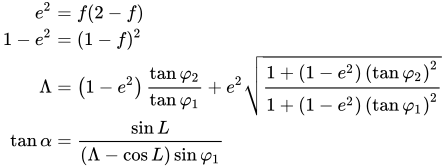
where f is the flattening and e the eccentricity for the chosen spheroid (e.g., 1⁄298.257223563 for WGS84). If φ1 = 0 then
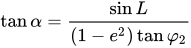
To calculate the azimuth of the Sun or a star given its declination and hour angle at a specific location, modify the formula for a spherical Earth. Replace φ2 with declination and longitude difference with hour angle, and change the sign (since the hour angle is positive westward instead of east).[citation needed]
In cartography
[edit]
The cartographical azimuth or grid azimuth (in decimal degrees) can be calculated when the coordinates of 2 points are known in a flat plane (cartographical coordinates):

Remark that the reference axes are swapped relative to the (counterclockwise) mathematical polar coordinate system and that the azimuth is clockwise relative to the north. This is the reason why the X and Y axis in the above formula are swapped. If the azimuth becomes negative, one can always add 360°.
The formula in radians would be slightly easier:

Note the swapped in contrast to the normal atan2 input order.


The opposite problem occurs when the coordinates (X1, Y1) of one point, the distance D, and the azimuth α to another point (X2, Y2) are known, one can calculate its coordinates:
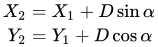
This is typically used in triangulation and azimuth identification (AzID), especially in radar applications.
Map projections
[edit]There is a wide variety of azimuthal map projections. They all have the property that directions (the azimuths) from a central point are preserved. Some navigation systems use south as the reference plane. However, any direction can serve as the plane of reference, as long as it is clearly defined for everyone using that system.

Related coordinates
[edit]Right ascension
[edit]If, instead of measuring from and along the horizon, the angles are measured from and along the celestial equator, the angles are called right ascension if referenced to the Vernal Equinox, or hour angle if referenced to the celestial meridian.
Polar coordinate
[edit]In mathematics, the azimuth angle of a point in cylindrical coordinates or spherical coordinates is the anticlockwise angle between the positive x-axis and the projection of the vector onto the xy-plane. A special case of an azimuth angle is the angle in polar coordinates of the component of the vector in the xy-plane, although this angle is normally measured in radians rather than degrees and denoted by θ rather than φ.
Other uses
[edit]For magnetic tape drives, azimuth refers to the angle between the tape head(s) and tape.
In sound localization experiments and literature, the azimuth refers to the angle the sound source makes compared to the imaginary straight line that is drawn from within the head through the area between the eyes.
An azimuth thruster in shipbuilding is a propeller that can be rotated horizontally.
See also
[edit]- Altitude (astronomy)
- Angular displacement
- Angzarr (⍼)
- Azimuthal quantum number
- Azimuthal equidistant projection
- Azimuth recording
- Bearing (navigation)
- Clock position
- Course (navigation)
- Inclination
- Longitude
- Latitude
- Magnetic declination
- Panning (camera)
- Relative bearing
- Sextant
- Solar azimuth angle
- Sound Localization
- Zenith
| Part of a series on |
| Astrodynamics |
|---|
 |
References
[edit]- ^ The singular form of the noun is Arabic: السَّمْت, romanized: as-samt, lit. 'the direction'.
- ^ "azimuth". Dictionary.com Unabridged (Online). n.d.
- ^ "Azimuth" at New English Dictionary on Historical Principles; "azimut" at Centre National de Ressources Textuelles et Lexicales; "al-Samt" at Brill's Encyclopedia of Islam; "azimuth" at EnglishWordsOfArabicAncestry.wordpress.com Archived January 2, 2014, at the Wayback Machine. In Arabic the written al-sumūt is always pronounced as-sumūt (see pronunciation of "al-" in Arabic).
- ^ Rutstrum, Carl, The Wilderness Route Finder, University of Minnesota Press (2000), ISBN 0-8166-3661-3, p. 194
- ^ U.S. Army, Map Reading and Land Navigation, FM 21-26, Headquarters, Dept. of the Army, Washington, D.C. (7 May 1993), ch. 6, p. 2
- ^ U.S. Army, Map Reading and Land Navigation, FM 21-26, Headquarters, Dept. of the Army, Washington, D.C. (28 March 1956), ch. 3, p. 63
- ^ U.S. Army, ch. 6 p. 2
- ^ U.S. Army, Advanced Map and Aerial Photograph Reading, Headquarters, War Department, Washington, D.C. (17 September 1941), pp. 24–25
- ^ U.S. Army, Advanced Map and Aerial Photograph Reading, Headquarters, War Department, Washington, D.C. (23 December 1944), p. 15
- ^ Torge & Müller (2012) Geodesy, De Gruyter, eq.6.70, p.248
Further reading
[edit]- Rutstrum, Carl, The Wilderness Route Finder, University of Minnesota Press (2000), ISBN 0-8166-3661-3
External links
[edit]
- . Encyclopædia Britannica (11th ed.). 1911.
- . Collier's New Encyclopedia. 1921.


| International | |
|---|---|
| National | |
| Other | |


Azimuth
View on GrokipediaFundamentals
Definition
In spherical coordinate systems, azimuth is defined as the azimuthal angle, typically denoted as or depending on the convention, which measures the rotation around the polar axis from a reference direction in the horizontal plane.[10] It represents the horizontal angle from a fixed reference line—often the positive x-axis in mathematical contexts or geographic north in applied settings—to the projection of a point or line onto the equatorial plane, measured clockwise from 0° to 360° (or 0 to radians).[11] This full-circle measurement ensures a unique direction without the ambiguities of quadrant-based systems, such as those used in traditional surveying bearings that divide the circle into four 90° sectors.[12] Mathematically, in spherical coordinates , where is the radial distance, serves as the azimuthal angle (in some engineering conventions), while denotes the polar or inclination angle from the zenith. Azimuth thus captures the longitudinal position in the horizontal plane, distinct from elevation or altitude angles, which measure the vertical deviation from the horizon (e.g., from 0° at the zenith to 90° at the horizon). For visualization, azimuth can be illustrated as the angle swept by the projection of a radial vector onto the xy-plane from the reference axis, emphasizing its role in defining planar orientation within three-dimensional space.[13] Azimuth is expressed in either degrees or radians, with the conversion given by . This standardization to a 360° circle originated in ancient astronomical and navigational practices, later formalized in modern coordinate systems to provide unambiguous directional references, such as bearings in navigation.Etymology
The term "azimuth" originates from the Arabic phrase as-sumūt, the plural form of as-samt, meaning "the directions" or "the paths."[14][15] This Arabic root entered European languages through Medieval Latin azimutus and Old French azimut, reflecting the transmission of astronomical knowledge during the medieval period.[16] The word was introduced to English in the late 14th century via astronomical texts, with its earliest recorded use appearing in Geoffrey Chaucer's A Treatise on the Astrolabe (c. 1391), where it is spelled "Azimuthz" in reference to divisions on the horizon.[14][17] Over subsequent centuries, the spelling evolved from variants like "azimut" and "azymut" to the standardized modern form "azimuth," while pronunciation shifted to /ˈæzɪməθ/ in contemporary English.[15][14] Like azimuth, the related astronomical term "zenith" shares the same Arabic root samt ("direction" or "path"), deriving specifically from samt ar-rās ("the direction of the head"), and entered European vocabulary through similar medieval translations.[18][19] This common etymological heritage underscores the profound influence of Arabic scholarship on Western astronomical terminology during the Middle Ages.[15]Coordinate Systems
Spherical and Polar Coordinates
In two-dimensional polar coordinates, a point in the plane is defined by a radial distance from the origin and an azimuthal angle , which measures the direction from the positive x-axis to the point, typically in a counterclockwise manner. This system provides an intuitive way to describe positions in a flat plane using distance and orientation, with the azimuthal angle serving as the key directional component. The coordinates relate to Cartesian systems via and .[20][21] Extending to three dimensions, spherical coordinates incorporate the polar system's azimuthal angle alongside a radial distance from the origin and a polar angle measured from the positive z-axis, where acts as the longitude-like azimuth in the xy-plane and as the latitude-like inclination. The full transformation equations from spherical to Cartesian coordinates are: Here, specifically denotes the azimuthal angle from the positive x-axis to the projection of the point onto the xy-plane. This framework is foundational for parameterizing points on spheres, enabling precise location descriptions on curved surfaces like the Earth in geodetic applications or celestial bodies in astronomical contexts.[22][23][24][25] Azimuth's interpretation can vary by convention, particularly regarding the reference direction and plane, leading to potential ambiguities that are resolved by explicitly defining the reference plane—such as the horizontal plane for local azimuth in navigation or observation. In these systems, azimuth fundamentally captures the horizontal angular position relative to a chosen baseline, ensuring consistency across applications.[26]Relation to Other Angles
Azimuth is defined as the horizontal angle measured clockwise from a reference direction, typically true north, spanning 0° to 360°. In contrast, a bearing represents the direction of a line relative to the north-south meridian but is commonly expressed in the quadrantal system, where the angle is measured from either north or south toward east or west, limited to 0° to 90° within each quadrant (e.g., N45°E or S30°W). This quadrantal convention allows bearings to be more compact for lines not far from cardinal directions, though they can be converted to azimuth by adding the appropriate quadrant offset (e.g., a bearing of S30°W corresponds to an azimuth of 240°). In some surveying practices, particularly older or regional conventions, bearings may be measured from south as the primary reference, emphasizing meridional alignment. The reciprocal of a bearing, or back bearing, is obtained by adding or subtracting 180° and adjusting the quadrant, mirroring how azimuth reciprocals are simply offset by 180° modulo 360°. Although both azimuth and longitude quantify angular displacement in an east-west sense, they differ fundamentally in scope and reference frame: longitude is a global, geocentric coordinate that measures the angular distance east or west from the Prime Meridian along the equator, ranging from 0° to 180° east or west, whereas azimuth is a local, observer-centric horizontal angle from north at a specific point on Earth's surface. In the context of spherical coordinates, the azimuthal angle—often denoted φ—serves as the mathematical analog to longitude, projecting the position onto the equatorial plane from a reference meridian. This geometric similarity underscores azimuth's role as a localized version of longitude's directional principle, but without the fixed global datum. Azimuth pertains exclusively to the horizontal plane, distinguishing it from altitude (or elevation), which measures the vertical angular height of an object above the horizon, ranging from 0° at the horizon to 90° at the zenith. These two angles complement each other in the horizontal coordinate system, also known as the alt-azimuth system, where azimuth provides the compass direction and altitude the elevation, enabling precise localization of objects relative to an observer's horizon. Unlike azimuth's planar rotational measure, altitude introduces a vertical dimension, preventing direct equivalence. Geometrically, azimuth shares conceptual ties with the argument of a complex number in mathematics, where the argument arg(z) is the counterclockwise angle from the positive real axis to the line representing z = x + iy in the complex plane, analogous to an azimuthal angle in polar coordinates but oriented from east rather than north. Similarly, in wave mechanics, the phase angle describes the azimuthal shift in oscillatory patterns, echoing azimuth's role as a directional angular parameter in periodic or rotational contexts.Astronomy
Celestial Observations
In celestial observations, azimuth serves as the horizontal angular coordinate in the alt-azimuth (alt-az) system, measured clockwise from true north along the horizon to the vertical circle passing through the celestial object, enabling precise pointing of telescopes from an observer's location on Earth.[27] This system is fundamental for locating stars, planets, and other objects relative to the local horizon and zenith. Alt-azimuth telescope mounts, which allow rotation about two perpendicular axes—one vertical for azimuth (horizontal movement) and one horizontal for altitude (vertical movement)—facilitate intuitive tracking of these objects by mimicking natural up-down and left-right motions.[13] Such mounts are mechanically simple and stable, making them suitable for both visual and short-exposure imaging observations where field rotation is manageable.[28] To determine an object's azimuth, astronomers first compute its altitude using the observer's latitude , the object's declination , and local hour angle (the angular distance from the meridian, derived from sidereal time and right ascension), via the formula , where is altitude.[27] Azimuth is then calculated from , with the result adjusted to the range 0° to 360° using the atan2 function to resolve the correct quadrant; alternatively, the cosine component provides , combined with the sine for full direction.[27] These computations, often performed with software or ephemerides, allow observers to predict and adjust for an object's position as Earth rotates, essential for aligning telescopes accurately. In amateur astronomy, azimuth plays a key role in star finding and planetary tracking, as enthusiasts use alt-az mounts on portable telescopes to sweep the sky intuitively without complex alignments, relying on star charts or apps that provide real-time azimuth and altitude coordinates.[29] For instance, locating Jupiter might involve setting the mount to its predicted azimuth of approximately 180° (due south) at culmination from mid-northern latitudes, then fine-tuning altitude. Historically, before the widespread adoption of equatorial mounts in the 19th century, observatories relied on alt-azimuth instruments for meridian and non-meridian observations, such as measuring stellar positions with transit circles or azimuth instruments that required manual rate corrections to compensate for Earth's rotation. This approach dominated early professional setups, like those at the Royal Observatory Greenwich, where alt-az mounts enabled foundational catalogs of celestial positions despite tracking challenges.[30]Comparison to Right Ascension
Right ascension (RA) is a key component of the equatorial coordinate system in astronomy, measuring the angular distance eastward along the celestial equator from the vernal equinox, typically expressed in hours, minutes, and seconds ranging from 0 to 24 hours.[6] Unlike azimuth, which is a local horizontal coordinate measured clockwise from true north (0° to 360°) relative to an observer's horizon, RA provides a fixed, global reference tied to Earth's rotation and the stars' apparent motion.[31] Converting between azimuth-altitude (local) and right ascension-declination (equatorial) coordinates is complex due to the differing reference frames: azimuth depends on the observer's location and time, while RA remains constant for a celestial object.[32] The transformation requires knowledge of the local sidereal time (LST), which accounts for Earth's rotation relative to the stars, along with the observer's latitude; formulas involve spherical trigonometry to compute hour angle from LST and RA, then derive azimuth and altitude.[27][33] Azimuth is primarily used in alt-azimuth telescope mounts for straightforward pointing in visual observations, as it aligns directly with horizontal and vertical motions.[34] In contrast, RA is essential for equatorial mounts, star catalogs, and deep-sky surveys, enabling precise tracking of objects as Earth rotates without constant adjustments.[32] Historically, early astronomical observations favored azimuth-based systems for their simplicity in meridian sightings, but the 18th and 19th centuries saw a shift to equatorial coordinates, driven by advancements in instrumentation like the meridian circle and the invention of the German equatorial mount around 1824, which facilitated accurate stellar cataloging and long-exposure photography.[35][36] This transition standardized RA for professional astronomy by the mid-19th century.[34]Navigation and Geodesy
Navigation Techniques
In navigation, azimuth serves as a fundamental measure for determining direction relative to true north during travel on Earth's surface, enabling accurate orientation and path planning. True azimuth refers to the horizontal angle measured clockwise from true north to the direction of a target or intended course, providing a geodetic reference independent of local magnetic influences. In contrast, magnetic azimuth is measured from magnetic north, the direction indicated by a compass needle, and requires correction for magnetic declination—the angular difference between true north and magnetic north, which varies by location and over time—to convert to true azimuth. For instance, if declination is 10° east, a magnetic azimuth of 90° would be corrected to a true azimuth of 100° by adding the declination value. This correction is essential for precise navigation, as uncorrected magnetic readings can lead to significant deviations in course.[37] Celestial navigation employs azimuth computations to establish direction from observations of heavenly bodies, such as the sun or stars, when terrestrial references are unavailable. The true azimuth of a celestial body can be calculated using the formula: where is the declination of the body, is the observer's latitude, and is the computed altitude (sextant altitude corrected for atmospheric refraction, dip, and index error). This formula derives from the spherical trigonometry of the navigational triangle formed by the pole, zenith, and celestial body, allowing navigators to determine the body's bearing from true north at the time of observation. Sign conventions must be applied based on hemisphere and local hour angle to resolve the azimuth between 0° and 360°; for example, in northern latitudes with local hour angle less than 180°, the result is subtracted from 360°. Such computations, historically performed with tables or logarithms, provide a reliable backup for verifying position and direction in remote or electronic-denied environments.[38] Azimuth plays a central role in dead reckoning, a technique for estimating current position by advancing a known prior position using recorded courses, speeds, and times, without external fixes. Here, the true course—expressed as the azimuth of the intended path—is plotted on nautical charts to project the vessel's or vehicle's track line, accounting for leeway, currents, and wind effects to refine the estimated position. For example, if a ship maintains a true course azimuth of 045° at 10 knots for 2 hours, the dead reckoning position advances approximately 20 nautical miles along that bearing from the last known fix. This method relies on accurate azimuth inputs from compasses, gyroscopes, or celestial sights to maintain plot integrity on charts scaled in latitude and longitude. (Note: Using a reliable mirror of Bowditch Ch. 7 via maritime archive.) In modern navigation, GPS systems integrate real-time azimuth updates through the course over ground (COG) parameter, which represents the instantaneous true azimuth of the velocity vector derived from successive position fixes. GPS receivers compute COG by differencing latitude and longitude coordinates over short time intervals, providing continuous directional data typically accurate to within 0.5° under good satellite geometry and at sufficient speeds (e.g., 10 knots or higher).[39] This integration enhances dead reckoning by fusing GPS-derived azimuth and speed over ground with inertial sensors, reducing cumulative errors in prolonged voyages.Geodetic Measurements
In geodetic measurements, the grid azimuth represents the direction of a line relative to the grid north of a map projection, obtained by adjusting the true geodetic azimuth to account for the angular difference known as the meridian convergence angle. This convergence arises from the projection's geometry and is approximately given by the formula , where is the longitude of the point, is the central meridian longitude, and is the latitude (with angles in radians for the small-angle approximation).[9] East of the central meridian, convergence is positive, causing grid north to rotate clockwise relative to geodetic north, while the reverse occurs to the west; this adjustment ensures consistency in coordinate systems like the Universal Transverse Mercator (UTM). Azimuth plays a pivotal role in geodetic triangulation networks, where it orients the entire system by defining the initial direction from a reference station to an adjacent one, enabling the computation of latitudes, longitudes, and subsequent lines through angle measurements. A precisely measured baseline provides the scale for the network, with its azimuth often determined astronomically at a Laplace station to correct for deflections of the vertical and propagate accurate orientations across the triangles.[40] This method has historically supported large-scale mapping, such as the U.S. Coast and Geodetic Survey's networks, by minimizing orientation errors over extensive areas.[41] On the reference ellipsoid, which approximates Earth's oblateness with a flattening factor of about 1/298, azimuth computations incorporate corrections to spherical assumptions, as geodesics on the ellipsoid exhibit slight curvature differences affecting forward and reverse azimuths between points. These corrections, typically on the order of seconds of arc for long distances, are derived using series expansions or numerical methods to maintain sub-meter accuracy in global positioning systems. International standards for azimuth computation in geodetic work, as outlined by the International Federation of Surveyors (FIG), emphasize the use of consistent reference frames like the International Terrestrial Reference Frame (ITRF) for datum orientation, including azimuth specifications at initial points to ensure interoperability in global networks. FIG guidelines recommend traceable calibrations and adherence to ISO standards for instrumentation to achieve the required precision in these calculations.[42]Cartography
Azimuthal Projections
Azimuthal projections are a class of map projections that preserve the azimuth, or true direction, of features from a designated central point on the Earth's surface, typically rendering meridians as straight lines radiating outward from that point. These projections are particularly useful for polar regions or point-specific mapping, where maintaining directional accuracy from the center is paramount, though they often involve trade-offs in other properties such as area or shape preservation. Developed historically for navigational and astronomical purposes, they trace their origins to ancient cartographers like Ptolemy in the 2nd century AD, with significant refinements by Gerardus Mercator in the 16th century, who adapted azimuthal techniques for polar charts to complement his more famous cylindrical projection.[43] The azimuthal equidistant projection exemplifies this family by preserving both distances and directions from the central point, making it ideal for measuring great-circle routes originating there. In this projection, the radial distance from the center is directly proportional to the angular distance from the center, typically where is the Earth's radius (or a scaling factor), and the coordinates are given by and , with as the azimuthal angle from a reference direction (often north). Unlike conformal projections, it does not preserve local shapes or angles, and area distortion increases radially outward, but it avoids the infinite extent at the antipode seen in some variants. This projection has been employed in polar maps of the Arctic and Antarctic, as well as in the design of the United Nations flag, which centers the world on the North Pole.[43] Variants like the stereographic and gnomonic projections build on the azimuthal framework with distinct emphases. The stereographic projection is conformal, preserving angles and thus local shapes, achieved through a perspective projection from the antipodal point on the sphere; its forward formulas for a sphere involve and , where is the angular distance, leading to circular representations of meridians and parallels in polar aspects. In contrast, the gnomonic projection prioritizes navigational utility by mapping all great circles as straight lines, using for the radial distance, but it sacrifices conformality and becomes unusable beyond 90° from the center due to asymptotic behavior. Widely adopted in aviation for plotting shortest paths, the gnomonic projection facilitates route planning when paired with other charts, such as Mercator's for rhumb lines.[43][44] These projections balance properties like equidistance, conformality, or equal-area (as in the Lambert azimuthal equal-area variant, though not detailed here) against increasing distortion away from the center, a trade-off inherent to azimuthal designs influenced by Mercator's emphasis on practical utility over global fidelity. Applications extend to modern satellite imagery, where azimuthal equidistant and stereographic forms aid in orthographic views of polar ice caps and orbital tracking, as developed in USGS conic adaptations for Landsat missions. Such uses underscore their enduring role in geodetic visualization, particularly for hemispheric or regional extents where central azimuth preservation outweighs peripheral inaccuracies.[43]Grid Azimuths
Grid azimuths represent the adaptation of azimuth measurements to the rectangular grid systems imposed by map projections, ensuring consistent directional orientation on flat maps where true north varies due to the Earth's curvature. In projected coordinate systems, grid north is defined by the vertical axis of the projection grid, typically aligned with the central meridian, differing from true north—the direction toward the geographic North Pole—by the grid convergence angle. This adjustment is essential for applications requiring precise alignment between map features and real-world directions, such as in surveying and engineering where directions are plotted directly on grid coordinates.[43] The relationship between grid and true azimuths is given by the formula , where denotes the meridian convergence or grid convergence angle, representing the angular difference between the grid north and true north at a specific location. This convergence arises from the projection's distortion, particularly in transverse Mercator-based systems, and is positive when grid north lies west of true north (east of the central meridian) and negative otherwise. For instance, in the Southern Hemisphere, convergence values can reach several degrees away from the central meridian, necessitating local computation for accuracy.[45][46] In the Universal Transverse Mercator (UTM) system, grid azimuths are widely employed to standardize directions across 6-degree zones, facilitating interoperability in military operations and civil engineering projects. Military applications include tactical mapping and navigation, where UTM grid azimuths enable precise targeting and coordinate exchanges without meridian-specific adjustments, as outlined in U.S. Department of Defense standards. For civil engineering, such as in U.S. Army Corps of Engineers surveys for infrastructure like dams and river diversions, grid azimuths support traverse networks and site layouts, ensuring compliance with third-order accuracy (1:10,000) by incorporating convergence corrections during data collection with total stations or GPS. The UTM scale factor of 0.9996 at the central meridian further minimizes linear distortions, making grid azimuths reliable for zones spanning up to 800 km in width.[47][48][49] Geographic Information System (GIS) software automates the conversion between grid and true azimuths, enhancing efficiency in mapping workflows. Tools like the Calculate Grid Convergence Angle in ArcGIS Pro compute for feature centroids based on the projected coordinate system, populating fields with decimal-degree values for rotation adjustments, such as aligning spatial map series to true north. This process uses the projection engine to derive convergence from latitude and longitude, supporting inputs in geographic, arithmetic, or graphic conventions, and is essential for integrating legacy data or multi-zone projects without manual trigonometric calculations.[50] In large-scale mapping, errors in grid azimuths arise primarily from varying convergence across extended areas, leading to angular distortions that can exceed 1% in scale and shape away from the central meridian, as quantified by Tissot's indicatrix where , with and as principal scale factors. Such discrepancies accumulate in polyconic or equidistant projections over zones larger than 100 km, potentially causing misalignment in traverses or feature placements by several arcseconds. Mitigation strategies include confining maps to narrow UTM zones to limit convergence variation to under 3 degrees, applying conformal projections like transverse Mercator to preserve angles locally, and using scale reduction factors (e.g., 0.9996 in UTM) alongside automated GIS corrections to achieve sub-meter positional accuracy. Additionally, stable media like plastic bases reduce material-induced errors exceeding 1% in paper maps, while least-squares adjustments in survey software propagate convergence consistently across datasets.[43]Other Applications
In Physics and Engineering
In electromagnetics, the azimuthal angle, often denoted as θ or φ in cylindrical coordinates, describes the angular variation around the axis of cylindrical waveguides, influencing the propagation of electromagnetic modes. For azimuthally propagating waves in metallic cylindrical cavities, the fields depend on this angle through exponential factors e^{∓j ν θ}, where ν is the azimuthal mode index that determines the number of wavelengths around the circumference and affects the cutoff frequencies and dispersion relations of the modes. Specifically, for transverse electric (TE) modes, the longitudinal magnetic field component is given by where is the Bessel function of the first kind, is the cutoff wavenumber, ρ and z are radial and axial coordinates, and h is the cavity height; the dispersion relation follows , with as the roots of the derivative of the Bessel function , and a_0 the radius. Similar forms apply to transverse magnetic (TM) modes, with and roots of . These azimuthal dependencies enable the design of waveguides for specific mode confinement and propagation, such as in microwave cavities where the lowest TE mode cutoff is around 3.33 GHz for typical dimensions. In radar and antenna engineering, azimuth defines the horizontal angular direction of the radar beam relative to a reference, typically north, measured clockwise from the horizontal projection of the line of sight. This angle, denoted θ_az, is essential for beam steering and scanning in systems like phased-array antennas, where electronic control adjusts phase shifts across elements to direct the beam: the progressive phase difference β = (2π d / λ) sin(θ_az), with d as element spacing and λ the wavelength, determines the scan direction and maintains gain. In synthetic aperture radar (SAR) applications, θ_az quantifies the beam's orientation for target resolution. Azimuth scans thus enable precise bearing estimation and tracking by sweeping the beam across θ_az to detect echoes and resolve angular positions.[51] In quantum mechanics, the azimuthal quantum number l (also known as the orbital angular momentum quantum number) characterizes the magnitude of an electron's orbital angular momentum in atomic orbitals, with the magnetic quantum number m_l specifying the z-component projection L_z = m_l ħ, where ħ = h / 2π and m_l takes integer values from -l to +l (0 ≤ l ≤ n-1, n principal quantum number). These numbers arise from the spherical harmonic solutions to the Schrödinger equation in spherical coordinates, where the azimuthal part of the wavefunction is e^{i m_l φ}, reflecting the rotational symmetry around the z-axis and allowing 2l + 1 possible orientations for each subshell. They thus dictate the spatial distribution and magnetic properties of electrons, influencing atomic spectra and chemical bonding without altering the energy in hydrogen-like atoms. In acoustics, human sound localization in the azimuthal plane relies on interaural cues, specifically interaural time differences (ITD) and interaural level differences (ILD), which arise from the spatial separation of the ears and the head's shadowing effect. ITD, the delay in sound arrival between ears (up to ~650 μs for azimuths near 90°), dominates for low frequencies (<1.5 kHz) by encoding phase differences, while ILD, the intensity disparity (up to 20 dB), is prominent for high frequencies (>1.5 kHz) due to acoustic shadowing. These cues are processed in the brainstem's superior olivary complex to compute azimuth, achieving localization errors as low as 1°-2° in the horizontal plane, though performance degrades in reverberant environments or with elevated sources.In Surveying and Artillery
In land surveying, azimuth serves as a fundamental measure for determining the direction of survey lines in traverse networks, where horizontal angles are observed using a theodolite to establish precise positional control. A theodolite, equipped with a telescope and graduated circles, measures these angles with accuracies typically better than 5 seconds of arc, allowing surveyors to compute azimuths clockwise from north (0° to 360°) relative to known control points. In a closed traverse, which forms a polygon returning to the starting point, azimuths of successive legs are calculated by adding measured interior angles to the back azimuth of the previous line, enabling error checks through angular closure against the theoretical sum of (n-2) × 180° for n sides; this method ensures the network's geometric integrity for boundary delineation and topographic mapping.[52][53] Modern total stations enhance this process by integrating electronic distance measurement (EDM) with theodolite functions, capturing both azimuth and slope distance in a single setup to derive three-dimensional coordinates. The instrument measures horizontal azimuth via its theodolite component and distance up to 5 km with millimeter-level precision using phase-shift EDM, then applies trigonometric reductions—such as ΔX = distance × sin(azimuth) and ΔY = distance × cos(azimuth), adjusted for vertical angle—to compute easting, northing, and elevation relative to a datum like UTM. This capability supports efficient 3D positioning in traverse networks, reducing fieldwork time for applications like construction staking and cadastral surveys while maintaining line-of-sight requirements for accuracy.[54] In artillery, azimuth defines the horizontal direction from the gun to the target, expressed in mils (one mil equaling 1/6400 of a circle), and is critical for aligning firing units during engagement. Firing azimuth is determined from target coordinates and weapon position, often via fire direction centers using systems like the Advanced Field Artillery Tactical Data System (AFATDS), with corrections applied for environmental factors to achieve first-round accuracy. Wind corrections adjust azimuth for crosswind components perpendicular to the trajectory, computed as deflection mils to shift the aiming point and counteract drift, while elevation corrections account for air density, muzzle velocity variations, and gun height, indirectly influencing azimuth through ballistic tables that refine the overall firing solution.[55][56] The historical development of azimuth in artillery fire control accelerated during World War II, particularly in coast defense systems, where base end stations used azimuth-reading telescopes for triangulation to locate targets precisely. By mid-war, integrations of radar and analog gun data computers automated azimuth and elevation computations, incorporating wind and drift corrections to improve hit probabilities against moving naval threats; for instance, depression position finders measured azimuth and range simultaneously, feeding data into plotting rooms for real-time adjustments. These advancements marked a shift from manual open-sight aiming to centralized, instrumented control, enhancing defensive effectiveness in theaters like the Pacific.[57] U.S. Army standards for azimuth in gunnery, as outlined in FM 3-09, emphasize its role in establishing the azimuth of fire—the orientation direction in mils for a unit's position—to ensure common directional control across batteries via methods like reciprocal laying or aiming circles. Accuracy tolerances include ±3 mils for deflection on firing charts, with survey or GPS providing the baseline for 1-mil precision at 1,000 m range to minimize lateral deviation; meteorological data integration further refines corrections, supporting predicted fire requirements for rapid target engagement in operations.[55]References
- https://science.[nasa](/page/NASA).gov/learn/basics-of-space-flight/chapter2-2/
- https://en.wiktionary.org/wiki/azimuth
- https://en.wikisource.org/wiki/The_Complete_Works_of_Geoffrey_Chaucer/Volume_3/A_Treatise_on_the_Astrolabe