Hubbry Logo
Aztec sun stoneAztec sun stoneMain
Open search
Aztec sun stone
Community hub
Aztec sun stone
logo
8 pages, 0 posts
0 subscribers
Be the first to start a discussion here.
Aztec sun stone
Aztec sun stone
from Wikipedia

19°25′34″N 99°11′15″W / 19.42611°N 99.18750°W / 19.42611; -99.18750

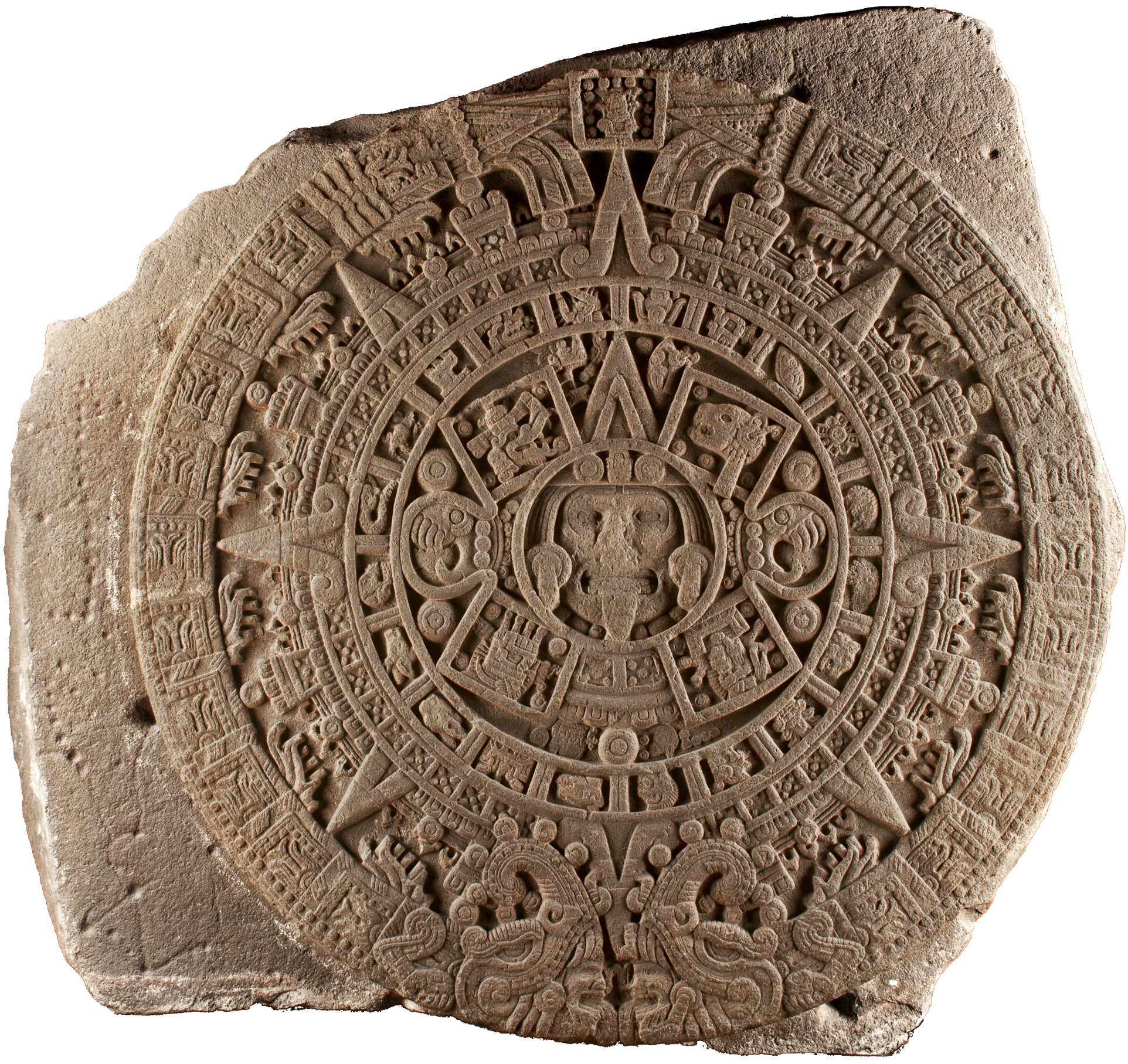
The Aztec sun stone (Spanish: Piedra del Sol) is a late post-classic Mexica sculpture housed in the National Anthropology Museum in Mexico City, and is perhaps the most famous work of Mexica sculpture.[1][2] It measures 3.6 metres (12 ft) in diameter and 98 centimetres (39 in) thick, and weighs 24,590 kg (54,210 lb).[3] Shortly after the Spanish conquest, the monolithic sculpture was buried in the Zócalo, the main square of Mexico City. It was rediscovered on 17 December 1790 during repairs on the Mexico City Cathedral.[2][4] Following its rediscovery, the sun stone was mounted on an exterior wall of the cathedral, where it remained until 1885.[5] Early scholars initially thought that the stone was carved in the 1470s, though modern research suggests that it was carved some time between 1502 and 1521.[6]

Key Information

History

[edit]

The monolith was carved by the Mexica at the end of the Mesoamerican Postclassic Period. Although the exact date of its creation is unknown, the name glyph of the Aztec ruler Moctezuma II (Moctezuma Xocoyotzin) in the central disc dates the monument to his reign between 1502 and 1520.[7] There are no clear indications about the authorship or purpose of the monolith, although there are certain references to the construction of a huge block of stone by the Mexicas in their last stage of splendor. According to Diego Durán, the emperor Axayácatl "was also busy in carving the famous and large stone, very carved where the figures of the months and years, days and weeks were sculpted".[8] Juan de Torquemada described in his Monarquía indiana how Moctezuma ordered a large rock to be brought from Tenanitla, today San Ángel, to Tenochtitlan, but on the way it fell on the bridge of the Xoloco neighborhood.[9]

The parent rock from which it was extracted comes from the Xitle volcano, and could have been obtained from San Ángel or Xochimilco.[10] The geologist Ezequiel Ordóñez in 1893 determined such an origin and ruled it as olivine basalt. It was probably dragged by thousands of people from a maximum of 22 kilometers to the center of Mexico-Tenochtitlan.[10]

After the conquest, it was transferred to the exterior of the Templo Mayor, to the west of the then Palacio Virreinal and the Acequia Real, where it remained uncovered, with the relief upwards for many years.[9] According to Durán, Alonso de Montúfar, Archbishop of Mexico from 1551 to 1572, ordered the burial of the Sun Stone so that "the memory of the ancient sacrifice that was made there would be lost".[9]

Towards the end of the 18th century, the viceroy Juan Vicente de Güemes initiated a series of urban reforms in the capital of New Spain. One of them was the construction of new streets and the improvement of parts of the city, through the introduction of drains and sidewalks. In the case of the then so-called Plaza Mayor, sewers were built, the floor was leveled and areas were remodeled. It was José Damián Ortiz de Castro, the architect overseeing public works, who reported the finding of the sun stone on 17 December 1790. The monolith was found half a yard (about 40 centimeters) under the ground surface and 60 meters to the west of the second door of the viceregal palace,[9] and removed from the earth with a "real rigging with double pulley".[9] Antonio de León y Gama came to the discovery site to observe and determine the origin and meaning of the monument found.[9] According to Alfredo Chavero,[11] it was Antonio who gave it the name of Aztec Calendar, believing it to be an object of public consultation. León y Gama said the following:

... On the occasion of the new paving, the floor of the Plaza being lowered, on December 17 of the same year, 1790, it was discovered only half a yard deep, and at a distance of 80 to the West from the same second door of the Royal Palace, and 37 north of the Portal of Flowers, the second Stone, by the back surface of it.

— León y Gama, as cited by Chavero[11]

Reproduction of the Aztec Sun Stone.

León y Gama himself interceded before the canon of the cathedral in order that the monolith found would not be buried again due to its perceived pagan origin (for which it had been buried almost two centuries before).[12] León y Gama argued that in countries like Italy there was much that was invested in rescuing and publicly showcasing monuments of the past.[12] It is noteworthy that, for the spirit of the time, efforts were made to exhibit the monolith in a public place and also to promote its study.[12] León y Gama defended in his writings the artistic character of the stone, in competition with arguments of authors like Georges-Louis Leclerc, Comte de Buffon, who gave lesser value to those born in the American continent, including their artistic talent.[12]

The monolith was placed on one side of the west tower of the Metropolitan Cathedral on 2 July 1791. There it was observed by, among others, Alexander von Humboldt, who made several studies of its iconography.[9] Mexican sources alleged that during the Mexican–American War, soldiers of the United States Army who occupied the plaza used it for target shooting, though there is no evidence of such damage to the sculpture.[9] General Winfield Scott contemplated taking it back to Washington D.C. as a war trophy, if the Mexicans did not make peace.[13]

In August 1885, the stone was transferred to the Monolith Gallery of the Archaeological Museum on Moneda Street, on the initiative of Jesús Sánchez, the museum's director.[9] Through documents from the time, it is known that popular animosity resulted from the "confinement" of a public city icon.[9]

Aztec Calendar Stone, also called Stone of the Sun. National Museum, Mexico City, Mexico. (Photographed in Cathedral tower before, (1886). New York State Archives (Digital Collections)

In 1964 the stone was transferred to the National Museum of Anthropology, where the stone presides over the Mexica Hall of the museum.

Before the discovery of the monolith of Tlaltecuhtli, deity of the earth, with measurements being 4 by 3.57 meters high, it was thought that the sun stone was the largest Mexica monolith in dimensions.

Physical description and iconography

[edit]
Detail of the two innermost circles of the monolith

The sculpted motifs that cover the surface of the stone refer to central components of the Mexica cosmogony. The state-sponsored monument linked aspects of Aztec ideology such as the importance of violence and warfare, the cosmic cycles, and the nature of the relationship between gods and man. The Aztec elite used this relationship with the cosmos and the bloodshed often associated with it to maintain control over the population, and the sun stone was a tool in which the ideology was visually manifested.[14]

A diagram of the sun stone with the major symbolism labeled

Central disk

[edit]

In the center of the monolith is often believed to be the face of the solar deity, Tonatiuh,[15] which appears inside the glyph for "movement" (Nahuatl: Ōllin), the name of the current era. Some scholars have argued that the identity of the central face is of the earth monster, Tlaltecuhtli, or of a hybrid deity known as "Yohualtecuhtli" who is referred to as the "Lord of the Night". This debate on the identity of the central figure is based on representations of the deities in other works as well as the role of the sun stone in sacrificial context, which involved the actions of deities and humans to preserve the cycles of time.[16] The central figure is shown holding a human heart in each of his clawed hands, and his tongue is represented by a stone sacrificial knife (Tecpatl).

Four previous suns or eras

[edit]

The four squares that surround the central deity represent the four previous suns or eras, which preceded the present era, "Four Movement" (Nahuatl: Nahui Ōllin). The Aztecs changed the order of the suns and introduced a fifth sun named "Four Movement" after they seized power over the central highlands.[17] Each era ended with the destruction of the world and humanity, which were then recreated in the next era.

  • The top right square represents "Four Jaguar" (Nahuatl: Nahui Ōcēlotl), the day on which the first era ended, after having lasted 676 years, due to the appearance of monsters that devoured all of humanity.
  • The top left square shows "Four Wind" (Nahuatl: Nahui Ehēcatl), the date on which, after 364 years, hurricane winds destroyed the earth, and humans were turned into monkeys.
  • The bottom left square shows "Four Rain" (Nahuatl: Nahui Quiyahuitl). This era lasted 312 years, before being destroyed by a rain of fire, which transformed humanity into turkeys.
  • The bottom right square represents "Four Water" (Nahuatl: Nahui Atl), an era that lasted 676 years and ended when the world was flooded and all the humans were turned into fish.

The duration of the ages is expressed in years, although they must be observed through the prism of Aztec time. In fact the common thread of figures 676, 364 and 312 is that they are multiples of 52, and 52 years is the duration of one Aztec "century", and that is how they can express a certain amount of Aztec centuries. Thus, 676 years are 13 Aztec centuries; 364 years are 7, and 312 years are 6 Aztec centuries.

Placed among these four squares are three additional dates, "One Flint" (Tecpatl), "One Rain" (Atl), and "Seven Monkey" (Ozomahtli), and a Xiuhuitzolli, or ruler's turquoise diadem, glyph. It has been suggested that these dates may have had both historical and cosmic significance, and that the diadem may form part of the name of the Mexica ruler, Moctezuma II.[18]

First ring

[edit]

The first concentric zone or ring contains the signs corresponding to the 20 days of the 18 months and five nemontemi of the Aztec solar calendar (Nahuatl: xiuhpohualli). The monument is not a functioning calendar, but instead uses the calendrical glyphs to reference the cyclical concepts of time and its relationship to the cosmic conflicts within the Aztec ideology.[19] Beginning at the symbol just left of the large point in the previous zone, these symbols are read counterclockwise. The order is as follows:

1. cipactli – crocodile, 2. ehécatl – wind, 3. calli – house, 4. cuetzpallin – lizard, 5. cóatl – serpent, 6. miquiztli – skull/death, 7. mázatl – deer, 8. tochtli – rabbit, 9. atl – water, 10. itzcuintli – dog, 11. ozomatli – monkey, 12. malinalli – herb, 13. ácatl – cane, 14. océlotl – jaguar, 15. cuauhtli – eagle, 16. cozcacuauhtli – vulture, 17. ollín – movement, 18. técpatl – flint, 19. quiahuitl – rain, 20. xóchitl – flower [20]

Image Nahuatl name Pronunciation English translation Direction
Cipactli [siˈpáktɬi] Crocodile
Alligator
Caiman
Crocodilian monster
Dragon
East
Ehēcatl [eʔˈéːkatɬ] Wind North
Calli [ˈkáɬːi] House West
Cuetzpalin [kʷetsˈpálin̥] Lizard South
Cōātl [ˈkóːwaːtɬ] Serpent
Snake
East
Miquiztli [miˈkístɬi] Death North
Mazātl [ˈmásaːtɬ] Deer
Animal
West
Tōchtli [ˈtóːtʃtɬi] Rabbit South
Ātl [ˈaːtɬ] Water East
Itzcuīntli [itsˈkʷíːn̥tɬi] Dog North
Image Nahuatl name Pronunciation English translation Direction
Ozomahtli [oso˕ˈmáʔtɬi] Monkey West
Malīnalli [maliːˈnáɬːi] Grass South
Ācatl [ˈáːkatɬ] Reed East
Ocēlōtl [oːˈséːloːtɬ] Ocelot
Jaguar
North
Cuāuhtli [ˈkʷáːʍtɬi] Eagle West
Cōzcacuāuhtli [ko˕ːskaˈkʷáːʍtɬi] Vulture South
Ōlīn [ˈóliːn̥] Movement
Quake
Earthquake
East
Tecpatl [ˈtékpatɬ] Flint
Flint knife
North
Quiyahuitl [kiˈjáwitɬ] Rain West
Xōchitl [ˈʃó˕ːtʃitɬ] Flower South

Second ring

[edit]

The second concentric zone or ring contains several square sections, with each section containing five points. Directly above these square sections are small arches that are said to be feather ornaments. Directly above these are spurs or peaked arches that appear in groups of four.[20] There are also eight angles that divide the ring into eight parts, which likely represent the sun's rays placed in the direction of the cardinal points.

Third and outermost ring

[edit]

Two fire serpents, Xiuhcoatl, take up almost this entire zone. They are characterized by the flames emerging from their bodies, the square shaped segments that make up their bodies, the points that form their tails, and their unusual heads and mouths. At the very bottom of the surface of the stone, are human heads emerging from the mouths of these serpents. Scholars have tried to identify these profiles of human heads as deities, but have not come to a consensus.[20] One possible interpretation of the two serpents is that they represent two rival deities who were involved in the creation story of the fifth and current "sun", Queztalcoatl and Tezcatlipoca. The tongues of the serpents are touching, referencing the continuity of time and the continuous power struggle between the deities over the earthly and terrestrial worlds.[21]

Some of the edge region is visible in this photograph

In the upper part of this zone, a square carved between the tails of the serpents represents the date Matlactli Omey-Ácatl ("13-reed"). This is said to correspond to 1479, the year in which the Fifth Sun emerged in Teotihuacan during the reign of Axayácatl, and at the same time, indicating the year in which this monolithic sun stone was carved.[20]

Edge of stone

[edit]

The edge of the stone measures approximately 20 cm (8 inches) and contains a band of a series of dots as well as what have been said to be flint knives. This area has been interpreted as representing a starry night sky.[20]


History of interpretations

[edit]
External videos
video icon The Sun Stone (The Calendar Stone), 6:28, Smarthistory at Khan Academy, on YouTube. Narrated by Dr. Beth Harris and Dr. Lauren Kilroy-Ewbank.

From the moment the Sun Stone was discovered in 1790, many scholars have worked at making sense of the stone's complexity. This provides a long history of over 200 years of archaeologists, scholars, and historians adding to the interpretation of the stone.[22] Modern research continues to shed light or cast doubt on existing interpretations as discoveries such as further evidence of the stone's pigmentation.[23] As Eduardo Matos Moctezuma stated in 2004:[20]

In addition to its tremendous aesthetic value, the Sun Stone abounds in symbolism and elements that continue to inspire researchers to search deeper for the meaning of this singular monument.

— Eduardo Matos Moctezuma, The Aztec Calendar and Other Solar Monuments

The earliest interpretations of the stone relate to what early scholars believed was its use for astrology, chronology, or as a sundial. In 1792, two years after the stone's unearthing, Mexican scholar Antonio de León y Gama wrote one of the first treatises on Mexican archaeology on the Aztec calendar and Coatlicue.[24] He correctly identified that some of the glyphs on the stone are the glyphs for the days of the month.[22] Alexander von Humboldt also wanted to pass on his interpretation in 1803, after reading Leon y Gama's work. He disagreed about the material of the stone but generally agreed with Leon y Gama's interpretation. Both of these men incorrectly believed the stone to have been vertically positioned, but it was not until 1875 that Alfredo Chavero correctly wrote that the proper position for the stone was horizontal. Roberto Sieck Flandes in 1939 published a monumental study entitled How Was the Stone Known as the Aztec Calendar Painted? which gave evidence that the stone was indeed pigmented with bright blue, red, green, and yellow colors, just as many other Aztec sculptures have been found to have been as well. This work was later to be expanded by Felipe Solís and other scholars who would re-examine the idea of coloring and create updated digitized images for a better understanding of what the stone might have looked like.[20] It was generally established that the four symbols included in the Ollin glyph represent the four past suns that the Mexica believed the earth had passed through.[25]

Another aspect of the stone is its religious significance. One theory is that the face at the center of the stone represents Tonatiuh, the Aztec deity of the sun. It is for this reason that the stone became known as the "Sun Stone." Richard Townsend proposed a different theory, claiming that the figure at the center of the stone represents Tlaltecuhtli, the Mexica earth deity who features in Mexica creation myths.[22] Modern archaeologists, such as those at the National Anthropology Museum in Mexico City, believe it is more likely to have been used primarily as a ceremonial basin or ritual altar for gladiatorial sacrifices, than as an astrological or astronomical reference.[5]

Yet another characteristic of the stone is its possible geographic significance. The four points may relate to the four corners of the earth or the cardinal points. The inner circles may express space as well as time.[26]

Lastly, there is the political aspect of the stone. It may have been intended to show Tenochtitlan as the center of the world and therefore, as the center of authority.[27] Townsend argues for this idea, claiming that the small glyphs of additional dates amongst the four previous suns—1 Flint (Tecpatl), 1 Rain (Atl), and 7 Monkey (Ozomahtli)—represent matters of historical importance to the Mexica state. He posits, for example, that 7 Monkey represents the significant day for the cult of a community within Tenochtitlan. His claim is further supported by the presence of Mexica ruler Moctezuma II's name on the work. These elements ground the Stone's iconography in history rather than myth and the legitimacy of the state in the cosmos.[28]

Connections to Aztec ideology

[edit]

The methods of Aztec rule were influenced by the story of their Mexica ancestry, who were migrants to the Mexican territory. The lived history was marked by violence and the conquering of native groups, and their mythic history was used to legitimize their conquests and the establishment of the capital Tenochtitlan. As the Aztecs grew in power, the state needed to find ways to maintain order and control over the conquered peoples, and they used religion and violence to accomplish the task.[29]

The state religion included a vast canon of deities that were involved in the constant cycles of death and rebirth. When the gods made the sun and the earth, they sacrificed themselves in order for the cycles of the sun to continue, and therefore for life to continue. Because the gods sacrificed themselves for humanity, humans had an understanding that they should sacrifice themselves to the gods in return. The Sun Stone's discovery near the Templo Mayor in the capital connects it to sacred rituals such as the New Fire ceremony, which was conducted to ensure the earth's survival for another 52-year cycle, and human heart sacrifice played an important role in preserving these cosmic cycles.[29] Human sacrifice was not only used in religious context; additionally, sacrifice was used as a military tactic to frighten Aztec enemies and remind those already under their control what might happen if they opposed the Empire. The state was then exploiting the sacredness of the practice to serve its own ideological intentions. The Sun Stone served as a visual reminder of the Empire's strength as a monumental object in the heart of the city and as a ritualistic object used in relation to the cosmic cycles and terrestrial power struggles.[30]

Modern use

[edit]
Mexican Amate paper craft on Aztec sun stone

The sun stone image is displayed on the obverse of the Mexican 20-peso gold coin, which has a gold content of 15 grams (0.4823 troy ounces) and was minted from 1917 to 1921 and restruck with the date 1959 from the mid-1940s to the late 1970s. Different parts of the sun stone are represented on the current peso coins, with each denomination having a different section.

Currently, the image is present on the 10-peso coin as part of the New Peso coin family lauchned in 1992. Originally having .925 silver centers and aluminum bronze rings, this was changed in 1996 where new coins were introduced with base metal replacing the silver center.

The sun stone image also has been adopted by modern Mexican and Mexican American/Chicano culture figures, and is used in folk art and as a symbol of cultural identity.[31]

In 1996, sportswear manufacturer ABA Sport, in partnership with the Mexico national football team, employed a depiction of the sun stone image on its home, away and third match kits, with the shirts assigned the green (home), white (away) and red (third) colors of the Mexican flag respectively. The kit was featured until the 1998 World Cup.

Elvis Presley had a jumpsuit made with the Aztec Sun Stone which he used in the last years of his concerts and used it in his Elvis in Concert TV performance in June 19-21, 1977, and in his last live performance on stage on June 26, 1977. The suit is commonly referred to as the Mexican Sundial suit.

Impact of Spanish colonization

[edit]

After the conquest of the Aztec Empire by the Spanish in 1521 and the subsequent colonization of the territory, the prominence of the Mesoamerican empire was placed under harsh scrutiny by the Spanish. The rationale behind the bloodshed and sacrifice conducted by the Aztec was supported by religious and militant purposes, but the Spanish were horrified by what they saw, and the published accounts twisted the perception of the Aztecs into bloodthirsty, barbaric, and inferior people.[32] The words and actions of the Spanish, such as the destruction, removal, or burial of Aztec objects like the Sun Stone supported this message of inferiority, which still has an impact today. The Aztec capital of Tenochtitlan was covered by the construction of Mexico City, and the monument was lost for centuries until it was unearthed in 1790.[21] The reemergence of the Sun Stone sparked a renewed interest in Aztec culture, but since the Western culture now had hundreds of years of influence over the Mexican landscape, the public display of the monument next to the city's main cathedral sparked controversy. Although the object was being publicly honored, placing it in the shadow of a Catholic institution for nearly a century sent a message to some people that the Spanish would continue to dominate over the remnants of Aztec culture.[33]

Another debate sparked by the influence of the Western perspective over non-Western cultures surrounds the study and presentation of cultural objects as art objects. Carolyn Dean, a scholar of pre-Hispanic and Spanish colonial culture discusses the concept of "art by appropriation", which displays and discusses cultural objects within the Western understanding of art. Claiming something as art often elevates the object in the viewer's mind, but then the object is only valued for its aesthetic purposes, and its historical and cultural importance is depleted.[34] The Sun Stone was not made as an art object; it was a tool of the Aztec Empire used in ritual practices and as a political tool. By referring to it as a "sculpture"[34] and by displaying it vertically on the wall instead of placed horizontally how it was originally used,[21] the monument is defined within the Western perspective and therefore loses its cultural significance. The current display and discussion surrounding the Sun Stone is part of a greater debate on how to decolonize non-Western material culture.

Other sun stones

[edit]

There are several other known monuments and sculptures that bear similar inscriptions. Most of them were found underneath the center of Mexico City, while others are of unknown origin. Many fall under a category known as temalacatl, large stones built for ritual combat and sacrifice. Matos Moctezuma has proposed that the Aztec Sun Stone might also be one of these.[35]

Temalacatls

[edit]
Sacrificial stone or Cuauhxicalli of Tizoc

The Stone of Tizoc's upward-facing side contains a calendrical depiction similar to that of the subject of this page. Many of the formal elements are the same, although the five glyphs at the corners and center are not present. The tips of the compass here extend to the edge of the sculpture. The Stone of Tizoc is currently located in the National Anthropology Museum in the same gallery as the Aztec Sun Stone.

The Stone of Motecuhzoma I is a massive object approximately 12 feet in diameter and 3 feet high with the 8 pointed compass iconography. The center depicts the sun deity Tonatiuh with the tongue sticking out.[36]

The Philadelphia Museum of Art has another.[37] This one is much smaller, but still bears the calendar iconography and is listed in their catalog as "Calendar Stone". The side surface is split into two bands, the lower of which represents Venus with knives for eyes; the upper band has two rows of citlallo star icons.[36]

A similar object is on display at the Yale University Art Gallery, on loan from the Peabody Museum of Natural History.[38][39] The sculpture, officially known as Aztec Calendar Stone in the museum catalog but called Altar of the Five Cosmogonic Eras,[36] bears similar hieroglyphic inscriptions around the central compass motif but is distinct in that it is a rectangular prism instead of cylindrical shape, allowing the artists to add the symbols of the four previous suns at the corners.[36] It bears some similarities to the Coronation Stone of Moctezuma II, listed in the next section.

Calendar iconography in other objects

[edit]

The Coronation Stone of Moctezuma II (also known as the Stone of the Five Suns) is a sculpture measuring 55.9 x 66 x 22.9 cm (22 x 26 x 9 in[40]), currently in the possession of the Art Institute of Chicago. It bears similar hieroglyphic inscriptions to the Aztec Sun Stone, with 4-Movement at the center surrounded by 4-Jaguar, 4-Wind, 4-Rain, and 4-Water, all of which represent one of the five suns, or "cosmic eras". The year sign 11-Reed in the lower middle places the creation of this sculpture in 1503, the year of Motecuhzoma II's coronation, while 1-Crocodile, the day in the upper middle, may indicate the day of the ceremony.[40] The date glyph 1-Rabbit on the back of the sculpture (not visible in the image to the right) orients Motecuhzoma II in the cosmic cycle because that date represents "the beginning of things in the distant mythological past."[40]

The Throne of Montezuma uses the same cardinal point iconography[41] as part of a larger whole. The monument is on display at the National Museum of Anthropology alongside the Aztec Sun Stone and the Stone of Tizoc. The monument was discovered in 1831 underneath the National Palace[42] in Mexico City and is approximately 1 meter square at the base and 1.23 meters tall.[41] It is carved in a temple shape, and the year at the top, 2-House, refers to the traditional founding of Tenochtitlan in 1325 CE.[41]

The compass motif with Ollin can be found in stone altars built for the New Fire ceremony.[36] Another object, the Ceremonial Seat of Fire which belongs to the Eusebio Davalos Hurtado Museum of Mexica Sculpture,[36] is visually similar but omits the central Ollin image in favor of the Sun.

The British Museum possesses a cuauhxicalli which may depict the tension between two opposites, the power of the sun (represented by the solar face) and the power of the moon (represented with lunar iconography on the rear of the object). This would be a parallel to the Templo Mayor with its depictions of Huitzilopochtli (as one of the two deities of the temple) and the large monument to Coyolxauhqui.[36]

Circular Cuauhxicalli
This ritual object bears Sun Stone motifs
MaterialBasalt
Present locationBritish Museum, London, United Kingdom
Map
The Throne of Montezuma
Map
Coronation stone of Motecuhzoma II

See also

[edit]

Notes and references

[edit]
[edit]
Revisions and contributorsEdit on WikipediaRead on Wikipedia
from Grokipedia

The Aztec Sun Stone, known in Spanish as the Piedra del Sol and sometimes misidentified as the Calendar Stone, is a massive circular monolith approximately 3.6 meters in diameter and weighing over 24 tons, carved during the reign of between 1502 and 1520 CE. At its center dominates the snarling face of the sun god Tonatiuh, clutching a human heart in each clawed hand, symbolizing the deity's demand for sacrificial blood to sustain the cosmos, surrounded by concentric bands featuring the 20 day s of the tonalpohualli divinatory cycle, , and motifs evoking the ' myth of five successive suns or world eras ending in cataclysm. Likely intended as a temalacatl or ceremonial for offerings rather than a practical timekeeping device, the monument encapsulates cosmological beliefs in cyclical time, divine agency in creation and destruction, and the precarious balance maintained through . Discovered in December 1790 during repaving of City's central plaza (the ), the stone had been buried face-down shortly after the 1521 Spanish conquest of , possibly to conceal it from Christian . Relocated multiple times, including brief display on the Metropolitan Cathedral's tower, it now resides in City's National Museum of Anthropology, where scholarly interpretations continue to debate its precise function amid varying readings, though its role in affirming imperial ideology and solar theology remains central.

Discovery and Provenance

Excavation in 1790

The Aztec Sun Stone was discovered on December 17, 1790, during leveling and excavation works in Mexico City's Zócalo, the principal plaza adjacent to the Metropolitan Cathedral. Laborers unearthed the massive basalt slab, buried roughly 40 centimeters underground, while preparing the site for paving and infrastructure improvements. The extraction proved arduous owing to the stone's dimensions and weight, exceeding 24 tons, necessitating manual techniques including levers, ropes, and coordinated teams of workers with period-appropriate tools. Mexican astronomer and antiquarian Antonio de León y Gama promptly examined the artifact upon its unearthing, recognizing the carved glyphs as emblematic of Aztec calendrical and astronomical knowledge. In his contemporary accounts, León y Gama posited the stone's function as a monumental representation of timekeeping, linking its motifs to indigenous solar and cyclical concepts rather than mere decorative sculpture.

Post-Discovery Relocations and Preservation Efforts

Following its rediscovery on December 17, 1790, during sewer works in 's , the Aztec Sun Stone was promptly embedded into the western tower of the Metropolitan Cathedral under orders from Vicente de Güemes Padilla Horcasitas y Aguayo, Count of Revillagigedo. This placement allowed public viewing and scholarly examination, marking an early preservation effort amid post-colonial interest in indigenous artifacts. The stone remained exposed on the cathedral's exterior for 95 years, enduring environmental exposure and political upheavals including Mexico's independence in 1821 and subsequent instability, yet suffering no major documented damage from vandalism during this period. In August 1885, amid urban redevelopment pressures and to safeguard the artifact from further deterioration, President authorized its relocation to the National 's Galería de Monolitos. Military engineers executed the removal using ropes, levers, and manpower to detach the approximately 24-ton from the wall, followed by a laborious transport via wooden rollers and carts through city streets to the at Moneda 13. This operation, witnessed by astonished residents, underscored the era's rudimentary yet determined preservation and shifted the stone to a controlled indoor environment. The stone's final major relocation occurred on August 17, 1964, coinciding with the inauguration of the new National Museum of Anthropology in Chapultepec Park. To mitigate fracture risks during transit, engineers reinforced the artifact on a custom and cement platform towed by heavy machinery, completing the 5-kilometer journey in 75 minutes without incident. This modern engineering approach, involving seismic considerations and structural assessments, exemplified advanced 20th-century preservation strategies tailored to the monolith's mass and fragility, ensuring its protection amid Mexico's growing initiatives.

Current Location and Accessibility

The Aztec Sun Stone, or Piedra del Sol, resides in the National Museum of Anthropology in , having been transferred there in 1964 upon the museum's opening, where it anchors the Hall as the centerpiece exhibit. The 24-ton monolith is positioned horizontally at eye level within a purpose-built enclosure to facilitate detailed viewing while protecting it from direct handling or environmental stressors. Public accessibility is high, with the museum drawing approximately 3.7 million visitors in 2024, the majority passing through the Aztec section to observe the stone amid its cosmological carvings. Entry requires standard admission (around 100 MXN for adults, with concessions for students and seniors), and the site supports wheelchair access via ramps and elevators, though crowds can limit close-up inspection during peak hours. To mitigate wear from foot traffic and humidity fluctuations, the display employs barriers and climate controls, supplemented by high-resolution digital scans available online for remote scholarly analysis and 3D-printed replicas produced from photogrammetric models. Conservation protocols emphasize non-invasive monitoring of the basalt's surface integrity, addressing gradual from historical exposure and subtle cracking patterns observed in assessments, alongside spectroscopic examinations revealing faint traces of original mineral-based pigments degraded by . These efforts, conducted periodically by INAH specialists, prioritize stability over restoration to preserve the artifact's authentic while ensuring long-term public stewardship.

Physical Characteristics

Material, Dimensions, and Weight

The Aztec Sun Stone is a monolithic carved from olivine basalt, a dense sourced from regional quarries in the Basin of . This material's composition, primarily , , and minerals, provides a Mohs rating of 6 to 7, contributing to the artifact's endurance through burial, excavation, and relocation. The disk measures 3.58 meters in diameter and 98 centimeters in thickness. Its weight is estimated at 24 metric tons, reflecting the substantial volume of the roughly circular form with a slightly convex profile on the carved face. These dimensions were determined through direct measurement following its 1790 discovery and subsequent conservation efforts at the National Museum of Anthropology.

Carving Techniques and Evidence of Pigmentation

The Aztec Sun Stone was sculpted from a massive using labor-intensive techniques typical of stoneworking, which predated widespread metal tool use and relied on lithic implements for both rough shaping and fine detailing. Artisans initially pecked the surface with harder stone hammers or mauls to remove bulk material, followed by grinding with or abrasives to smooth contours and create low-relief designs up to 30 cm deep in places. Precision incising of glyphs and undercuts, observable in the stone's intricate hieroglyphs and facial features, was achieved with sharp blades and flint chisels, whose hardness (around 5-6 on the ) enabled controlled scoring and flaking on basalt without deformation, as evidenced by microscopic striations and edge wear patterns on comparable sculptures analyzed archaeologically. Scientific examinations of the monument, including pore analysis and spectroscopic methods applied to monumental sculptures, have identified minute traces of original pigments adhering to the surface, suggesting selective polychromy to accentuate motifs against the dark stone. Red hues derived from (mercuric sulfide) appear in sacrificial and solar elements, consistent with Mesoamerican practices where this was applied as a powder or binder-mixed paste for emphasis, while other residues indicate possible use of mineral-based and whites, though degradation from burial and exposure has erased most visible color. These findings, from post-2000 archaeometric studies, contrast with areas showing no pigmentation, implying the stone's natural tone served as a base for symbolic highlighting rather than full coverage. Commissioned during the reign of (r. 1502–1520), the Sun Stone's execution demanded coordinated efforts from specialized sculptors at Tenochtitlan's imperial workshops, with the depth and density of carvings—spanning over 3 meters in diameter and incorporating thousands of glyphs—indicating a multi-year project involving teams rotating through phases of quarrying, transport, and finishing under state oversight.

Condition and Restoration History

The Aztec Sun Stone exhibits multiple cracks and fractures resulting from mechanical stresses during its 1790 extraction from beneath Mexico City's Plaza Mayor and from seismic activity while mounted on the exterior of the Metropolitan Cathedral between 1790 and 1885, a period that included notable earthquakes such as those in 1845 and 1858. Prolonged burial prior to rediscovery, spanning approximately 250 years face-down after the Spanish conquest, resulted in adhesion to its exposed surfaces, contributing to surface irregularities that required subsequent removal efforts. Following its relocation to the National Museum in under Leopoldo Batres, initial 19th- and early 20th-century interventions focused on basic stabilization, including surface cleanings to address adhered burial sediments and rudimentary fillings for visible cracks, though some early repairs employed materials later deemed incompatible with the substrate. By the mid-20th century, conservation practices evolved toward minimal intervention, with cleanings and crack fillings using lime-based or compatible mortars to enhance structural integrity without altering original features, as emphasized in INAH protocols for prehispanic stone artifacts. A comprehensive restoration project proposed in the early was ultimately postponed to prioritize authenticity over extensive aesthetic enhancements, reflecting debates in Mexican archaeology on balancing preservation with historical integrity. Contemporary assessments by the confirm the stone's stability in the controlled climate of the National Museum of Anthropology, with negligible ongoing degradation due to regulated , , and seismic monitoring.

Iconographic Elements

Central Motif: Tonatiuh and Sacrificial Imagery

The central motif of the Aztec Sun Stone features the snarling face of Tonatiuh, the Fifth Sun deity, characterized by protruding fangs and a depicted as a , or flint knife, emblematic of blood sacrifice and the extraction of human hearts to sustain the sun's movement. This knife-tongue motif recurs in Aztec to signify ritual flaying and offerings, underscoring the deity's demand for vital fluids to propel cosmic order. Encircling the face are Tonatiuh's clawed hands, each gripping a human heart, symbolizing the capture and consumption of sacrificial essences that fuel the sun's daily traversal and avert catastrophe. These elements convey the deity's predatory ferocity, aligning with conceptualizations of solar vitality derived from ritual violence rather than benevolence. Integrated into the design are the glyphs for 4 Olin (Four Movement), denoting the Fifth Sun era's prophesied destruction by earthquakes, positioned amid the Ollin (movement) symbol formed by the surrounding motifs. This date glyph evokes the cyclical peril of the current age, where tectonic upheaval would terminate the world unless perpetually deferred through offerings. While predominant scholarly consensus identifies the central figure as Tonatiuh, alternative interpretations propose it as , the earth monster, or a hybrid form, based on stylistic comparisons with other monuments; however, the solar attributes and sacrificial apparatus strongly support the sun god attribution. The motif's realism in depicting divine aggression reflects Aztec causal views on renewal, wherein is countered by imposed violence to maintain equilibrium.

Inner Ring: The Four Previous Suns and Their Destructions

The inner ring of the Aztec Sun Stone comprises four rectangular cartouches extending from the central motif, each encapsulating the hieroglyphic name of a prior cosmic era, denoted by the numeral nahui (four) combined with a day glyph representing the dominant element or deity of that age. These symbols align with accounts in codices and annals, such as the Anales de Cuauhtitlan and the Historia de los Mexicanos por sus pinturas, which detail sequential cataclysms ending each era, underscoring a cosmology of inevitable dissolution followed by godly reconfiguration to initiate renewal. The upper-left cartouche depicts Nahui Ocelotl (Four Jaguar), featuring the ocelotl (jaguar) head prefixed by the nahui sign, signifying the first sun ruled by , where inhabitants—often described as giants—were devoured by jaguars in a terrestrial upheaval. This destruction motif reflects the era's brevity, estimated at 676 years in some calendrical reckonings, emphasizing predation as the causal agent of collapse before Quetzalcoatl's intervention birthed the subsequent age. Adjacent, the upper-right cartouche illustrates Nahui Ehecatl (Four Wind), marked by the Ehecatl-Quetzalcoatl conch-shell lip with nahui, evoking the second sun's governance under Quetzalcoatl, terminated by hurricanes that transformed humans into monkeys while scattering debris across the landscape. This aerial catastrophe, lasting approximately 676 years per correlated tonalpohualli cycles, illustrates wind's dominion in unraveling fragile human orders, necessitating divine arson to forge the next sun. The lower-left panel signifies Nahui Quiahuitl (Four Rain), combining the quiahuitl () or fiery dart glyph with nahui, tied to the third sun under Tlaloc or , extinguished by a deluge of flaming rocks or pyroclastic rain that incinerated the earth, sparing only avian survivors. Enduring roughly 312 years, this igneous precipitation exemplifies volcanic forces as the terminal mechanism, prompting godly sacrifice to avert perpetual stasis. Finally, the lower-right cartouche represents Nahui Atl (Four Water), with the atl (water) droplet glyph and nahui, denoting the fourth sun overseen by Chalchiuhtlicue, culminating in a global flood that submerged humanity, leaving fish as the sole remnants. Spanning 676 years in traditional counts, this aqueous annihilation highlights inundation's role in cyclical reset, with skeletal figures in codices underscoring the era's barren outcome prior to the fifth sun's emergence. These glyphs' anthropomorphic and elemental motifs corroborate post-conquest transcriptions like those in Sahagún's (Book 7), where parallel destruction narratives affirm the stone's encoding of inherited oral traditions, though interpretations vary on exact sequencing due to discrepancies across manuscripts. The progression from beastly predation to elemental furies posits catastrophes as inherent to cosmic mechanics, demanding ritual propitiation to sustain progression.

Outer Rings: Calendrical Glyphs, Cosmic Beasts, and Day Signs

The ring immediately surrounding the inner motifs features the twenty day glyphs of the tonalpohualli, the 260-day ritual calendar cycle, arranged sequentially in counterclockwise order beginning with Cipactli (crocodile) at the top. These glyphs represent the core symbolic units of Aztec time reckoning, each paired with one of thirteen numerals in practice to generate the full 260-day count, though numerals are absent here. Four of the glyphs—Calli (house), Tochtli (rabbit), Acatl (reed), and Tecpatl (flint knife)—function as year bearers, positioned to align with the directional extremities of the central Nahui Ollin motif, demarcating the 52-year cycle endpoints.
PositionDay GlyphNahuatl Name
1CrocodileCipactli
2WindEhecatl
3HouseCalli
4LizardCuetzpalin
5SerpentCoatl
6DeathMiquiztli
7DeerMazatl
8RabbitTochtli
9WaterAtl
10DogItzcuintli
11MonkeyOzomahtli
12GrassMalinalli
13ReedAcatl
14JaguarOcelotl
15EagleCuauhtli
16VultureCozcacuauhtli
17MovementOllin
18FlintTecpatl
19RainQuiahuitl
20FlowerXochitl
Encircling this calendrical band lies the outermost ring, dominated by two Xiuhcoatl fire serpents whose coiled, flame-adorned bodies form a cosmic frame, their tails converging at the top near a date glyph for 13 Reed (the presumed carving date, corresponding to circa 1521 CE). These serpents, characterized by starry nasal ornaments, segmented forms emitting fire motifs, and open jaws revealing faces of solar deities such as Tonatiuh or Xiuhtecuhtli, embody the destructive and regenerative forces bounding time cycles. Interwoven with dual-headed serpent elements in the composition, they link to the bearers of cosmic periods, with the overall arrangement reflecting alignments observable in Aztec astronomy, such as solar directional markers tied to solstice positions via the year-bearer placements. The glyphs and serpents thus delineate the perpetual motion of days and eras, grounded in long-term celestial tracking.

Peripheral Edge: Architectural and Symbolic Features

The peripheral edge of the Aztec Sun Stone exhibits an irregular protruding border along significant portions of its circumference, likely designed for mounting the monument onto a platform or for handling during ceremonies. This architectural feature suggests the stone's integration into temple structures, such as a mōmōztli platform with staircases aligned to the four cardinal directions or flush embedding into a stucco floor surface. Symbolic elements on the rim incorporate and reed motifs, evoking themes of prowess and calendrical renewal that align with Aztec temple contexts. Subtle fire motifs, including flames emanating from the curving Xiuhcoatl serpents at the outer perimeter, emphasize solar radiance and cosmic destruction. Complementary symbols appear as minor iconographic details, highlighting the dualistic balance of elemental forces in Mesoamerican cosmology. The edge's rough, uncarved stone areas have sparked debate among scholars; Hermann Beyer proposed they resulted from an interrupted carving process necessitating redesign as a shallow , while others, including George Stuart, contend the unfinished appearance was deliberate to the monument's form. Such projections and raw surfaces may indicate production constraints, though prevails in interpretations favoring symbolic completeness over workshop haste.

Cosmological and Ritual Function

Integration with Aztec Five Suns Mythology

The central cartouche of the Aztec Sun Stone depicts Tonatiuh, the sun god presiding over the Fifth Sun, designated Nahui Ollin ("Four Movement"), representing the present era fated to end in earthquakes that will consume humanity. This era follows four antecedent worlds, each extinguished by catastrophe after the gods' repeated attempts at creation, as detailed in pre-conquest and early colonial Nahuatl texts such as the Historia de los Mexicanos por sus pinturas. The inner ring encircling Tonatiuh illustrates these prior destructions through glyphs: Nahui Ocelotl (Four Jaguar) for the first sun devoured by jaguars; Nahui Ehecatl (Four Wind) for the second, scattered by hurricanes; Nahui Quiahuitl (Four Rain) for the third, obliterated by fire rain; and Nahui Atl (Four Water) for the fourth, inundated by floods. In Aztec ontology, the failure of previous suns stemmed from imbalances in divine creation, culminating in the Fifth Sun's inception via the gods' on a pyramidal hearth at , where their blood ignited the current celestial body. This act imposed a reciprocal obligation on humans to furnish blood—extracted through heart excision—to nourish Tonatiuh and prevent the stars from descending to devour the earth. The Sun Stone's , with Tonatiuh's claws grasping human hearts amid tongues of flame, visually codifies this exigency, distilling the cyclical into a monumental diagram that underscores the precariousness of the current age. This mythological schema, preserved in codices like the Codex Chimalpopoca (also known as the Legend of the Suns), served as an explanatory matrix for Aztec worldview, framing historical migrations and imperial conquests as imperatives to secure sacrificial victims and thereby perpetuate cosmic stability. Empirical analysis of the stone's carvings aligns with textual accounts from these sources, revealing a coherent synthesis of destruction motifs that justified militaristic policies, including engineered conflicts known as xochiyaoyotl ("flowery wars") to harvest captives, without reliance on unsubstantiated ritual embellishments. Such integration reflects a pragmatic causal logic wherein mythological necessity propelled societal structures geared toward endless renewal through violence. The , or toxiuhmolpialli, marked the conclusion of each 52-year cycle in the Aztec xiuhpohualli (solar year count), aligning the 365-day civil calendar with the 260-day ritual tonalpohualli to form the full calendar round. This ritual, performed to avert the potential destruction of the Fifth Sun era, involved the systematic extinguishing of all household and temple fires across the empire, leaving communities in ritual darkness for the final night. then ascended a sacred mountain—often Huixachtlan—and kindled a new fire using a traditional on the breast cavity of a selected captive, symbolizing the ignition of cosmic vitality and the reaffirmation of the sun's daily passage. The Aztec Sun Stone's directly evokes this cyclic renewal, with its central depiction of Tonatiuh grasping human hearts and its surrounding rings enumerating the destructions of prior solar ages, reinforcing the precariousness of the current era and the necessity of periodic regeneration. The outer calendrical bands, featuring the 20 day signs intertwined with cosmic serpents and deities, mirror the temporal structure of the 52-year bundle, where failure to renew could halt celestial motions, as empirically observed in the midnight culmination of the cluster signaling the cycle's end. Historical codices and archaeological deposits, such as burned effigies from ritual sites, corroborate the ceremony's timing with these glyphs, positioning the monument as a monumental of the toxiuhmolpialli's cosmological imperative. The most recent documented performance occurred in 1507 CE (2 Reed year), verified through correlation of indigenous annals with European records, after which Spanish prohibitions curtailed the practice. This event, preceding the empire's fall by over a decade, underscores the ritual's role in sustaining observable solar and stellar regularities, with the Sun Stone's design—carved circa 1427–1479 under or —serving as a preemptive ideological anchor for such renewals amid fears of empirical cosmic stagnation.

Role in Human Sacrifice Practices

The central face of Tonatiuh on the Aztec sun stone, depicted with claws clutching human hearts, symbolizes the god's demand for sacrificial offerings to sustain solar motion in Aztec cosmology. Priests extracted victims' hearts using knives during rituals, offering the still-beating organs to Tonatiuh atop temple structures, as the stone's imagery evokes the techcatl (sacrificial ) where such extractions occurred. Ethnohistoric records from describe ceremonies involving the sun stone where captives were sacrificed to "feed" the sun, with blood channeled to mimic cosmic nourishment. Aztecs held a causal view that human blood propelled Tonatiuh's daily traverse, averting the sun's "death" and world-ending stagnation, as detailed in Bernardino de 's accounts of native informants who linked heart offerings to preventing solar eclipses or failure to rise. This belief, rooted in the Fifth Sun's fragility, necessitated thousands of annual sacrifices empire-wide, with victims primarily war captives selected for ritual purity. Durán and , drawing from indigenous testimonies despite their missionary contexts, report that blood from these rites was smeared on temple idols, reinforcing the stone's role in visualizing Tonatiuh's perpetual hunger. Archaeological excavations at the Templo Mayor yield evidence of mass heart extractions, including cuauhxicalli vessels for holding organs and skull racks (tzompantli) displaying thousands of crania from sacrificial victims, aligning with the stone's thematic emphasis on solar sustenance through violence. Dedications of the Templo Mayor, such as in 1487, involved estimates of over 20,000 sacrifices per Spanish chroniclers and corroborated native codices, where blood flows were intended to invigorate Tonatiuh and maintain imperial order. These practices extended terror as a mechanism of subjugation, compelling tributary states to supply captives under threat of similar fates, thus linking the stone's iconography to Aztec political dominance. While some modern interpretations minimize scale citing potential exaggeration in conquest-era sources, osteological and codical evidence affirms sacrifices in the thousands annually to uphold the solar cycle.

Debates on Practical Use: Altar, Monument, or Divinatory Tool

Scholars have proposed that the Aztec Sun Stone may have served as a sacrificial , drawing parallels to cuauhxicalli— vessels designed to receive human hearts during rituals—due to its basin-like central depression and potential for containing sacrificial remains. This interpretation posits ritual wear patterns on the stone's surface as evidence of repeated use in heart extractions or depositions atop the , aligning with Aztec practices of feeding the sun god through blood offerings. However, the absence of organic residues, such as blood or tissue traces from its excavated context, and the lack of comparable erosion depths compared to confirmed cuauhxicalli undermine this view, supporting instead its role as a static erected around 1502–1520 CE under for cosmological propaganda rather than practical deposition. The stone's calendrical glyphs have fueled hypotheses of its use as a divinatory tool, with correlations between day signs and cosmic beasts potentially aiding in interpretation tied to the tonalpohualli's 260-day cycle for ritual timing. Yet, direct evidence for such functionality is absent, including no inscriptions or archaeological indicators of portable manipulation, and the omission of xiuhmolpilli markers for the 52-year cycle renewal ceremonies precludes it from serving as an operational device. A analysis by Ximena Chávez Balot interpreted the central Tonatiuh motif as depicting the sun god's death throes during a , evidenced by skeletal jaws and starry motifs evoking nocturnal , challenging prior views of the figure as a symbol of unyielding solar vitality and implying urgency in averting cosmic catastrophe. This contrasts with traditional readings emphasizing eternal renewal, though pigmentation traces—revealing original vivid colors like reds and blues applied in and —suggest enhanced visibility in dynamic ceremonies, favoring interpretive flexibility over rigid monumental stasis.

Scholarly Interpretations

Early European and Post-Conquest Analyses

Following the Spanish conquest of the in 1521, early European chroniclers, particularly Franciscan friars, documented indigenous cosmological and ritual practices through surviving codices and informant testimonies, often interpreting solar motifs and calendrical systems as corrupted pagan rites influenced by demonic forces. , in his compiled between 1540 and 1585, described Aztec solar worship intertwined with human sacrifices to sustain the sun's movement, framing these as idolatrous deviations requiring Christian conversion to justify colonial domination. Similar accounts by contemporaries like emphasized the centrality of blood offerings in Aztec temporal cycles, yet subordinated empirical observation to theological condemnation, attributing ritual excesses to satanic deception rather than cultural causality. The systematic destruction of Aztec codices—estimated at thousands burned by Spanish officials in the decades post-conquest—severely curtailed access to unfiltered indigenous records, compelling analysts to reconstruct cosmology from oral survivals and partial artifacts, which disproportionately highlighted calendrical mechanics over sacrificial and divinatory functions. This evidentiary gap, compounded by conquest-era incentives to demonize native religion for evangelization, skewed interpretations toward viewing Aztec artifacts as mere astrological tools devoid of profound ritual agency. The Piedra del Sol's rediscovery on December 17, 1790, during paving in Mexico City's Plaza Mayor prompted Creole scholar Antonio de León y Gama to publish Descripción histórica y cronológica de las dos piedras in 1792, positing the monument as a comprehensive delineating time divisions, cosmic eras, and historical events based on deciphered glyphs and limited remnants. León y Gama's analysis, reliant on indigenous collaborators and fragmented pre-Hispanic sources, correctly identified central solar but underemphasized potential altar-like sacrificial roles, reflecting persistent post-conquest prioritization of intellectual over sanguinary aspects amid incomplete data. Such early Creole efforts, while advancing empirical description beyond friarly bias, still operated within a colonial framework wary of glorifying vanquished heathen practices.

19th- and 20th-Century Decipherments

In the early , Prussian explorer examined the sun stone during his 1803 visit to and published engravings alongside interpretations in his multivolume Vues des Cordillères et Monuments des Peuples Indigènes de l'Amérique (1810–1813), positing it as a calendrical encoding Aztec cosmic cycles and the tonalamatl's 260-day structure, with concentric rings symbolizing temporal layers rather than mere astronomical tools. Humboldt's work rejected purely utilitarian views like sundials, instead emphasizing indigenous mythological content, though it retained romantic elements of diffusion from Asian or Egyptian traditions prevalent in European scholarship. Mid-century, French abbé Charles Étienne Brasseur de Bourbourg contributed by cross-referencing the stone's glyphs with Nahuatl chronicles and pictorial manuscripts, such as those in the Codex Vaticanus A, to link outer ring day signs (e.g., calli for house, tochtli for rabbit) to the ritual 260-day count and inner motifs to solar deities, advancing recognition of the monument's role in tonalamatl divination over speculative astrology. These efforts built on linguistic decipherments of Nahuatl terms for time (tonalli) and eras, shifting focus from isolated symbolism to integrated calendrical function grounded in native texts preserved post-conquest. Twentieth-century progress accelerated with Mexican archaeologist Alfonso Caso, who in works like The Aztecs: People of the Sun (original Spanish 1942; English 1958) decoded the four rectangular era glyphs flanking the central face as destructions of prior suns—jaguar-mawed (oцелotl), hurricane (ehecatl), fire-rain (quiahuitl), and flood (atl)—corroborating them against codices like the Aubin and Florentine for the Five Suns doctrine. Integration with Templo Mayor stratigraphic excavations from the 1940s onward, culminating in systematic digs by the 1970s, confirmed the stone's Tenochtitlan provenance and late postclassic dating (ca. 1502–1521, tied to Moctezuma II's regnal glyph), via associated ceramics and phase correlations rather than direct radiocarbon on the basalt. This empirical anchoring supplanted 19th-century diffusionist hypotheses of Old World derivation, affirming autonomous Mesoamerican iconographic evolution through comparative glyph analysis across sites like Teotihuacan and Tollan.

Modern Research: Eclipse Interpretations and Material Studies

In 2017, archaeoastronomer Susan Milbrath of the analyzed the Aztec Sun Stone's , proposing that its central face represents Tonatiuh, the sun god, in a state of -induced death, with the protruding tongue symbolizing from ritual sacrifice and surrounding elements evoking a sky during totality. This view draws empirical support from alignments between the stone's 4 Olin (4 Movement) glyphs—marking the Fifth Sun's earthquake destruction in Aztec lore—and historical solar eclipses, such as those potentially observable in central around the monument's estimated carving date of circa 1520. Milbrath's peer-reviewed study in Ancient Mesoamerica emphasizes verifiable astronomical correlations over prior assumptions of a triumphant , highlighting motifs like the jaguar maw and skeletal features akin to those in depictions of solar obscurations. Recent scholarship extends these astronomical ties to ritual contexts. In 2024, anthropologist Rubén G. Mendoza linked the Sun Stone to the of 1507 AD, the last pre-conquest xiuhmolpilli cycle renewal, arguing the monument encodes cosmogonic renewal motifs from the , including fire-kindling on a sacrificial victim's chest to avert cosmic collapse. Mendoza posits the central 4 Olin emblem as a for channeling teotl (divine energy), with the stone functioning as a "Turquoise Hearth"—a symbolic bundle of 52-year cycles adorned in beads, per Nahua texts—facilitating the ritual extraction and redistribution of solar vitality. This interpretation relies on archival records of the 1507 event, conducted under , where priests ignited new fire atop the to bind calendar rounds and prevent the stars' eternal fall. Material examinations complement these readings by revealing usage traces. Petrographic analysis confirms the stone's andesitic sourced from regional quarries, with surface pitting and micro-abrasions indicating repeated handling or offerings rather than mere static , as evidenced by comparative wear patterns on other Mesoamerican monoliths. Non-destructive imaging, including 3D laser scanning conducted in the 2010s by Mexico's National Institute of Anthropology and History, detects subtle layering beneath carvings, suggesting phased construction or resurfacing, which challenges views of the stone as a purely commemorative slab and supports its active role in ceremonies tied to solar perturbations. These findings prioritize empirical residue over speculative functions, underscoring the artifact's integration of astronomical prediction with sacrificial mechanics.

Comparative Context

Similar Artifacts in Mesoamerica

Pre-Aztec precedents for the Sun Stone's cosmological stone carving appear in Olmec-influenced sites like Chalcatzingo in Morelos, Mexico, dating to the Middle Formative period (ca. 700–500 BCE). Bas-relief carvings there portray solar deities, such as a jaguar figure symbolizing the setting sun pursuing an eagle dancer and a reborn solar god emerging from a two-headed serpent, with elements like sun rays and underworld motifs that parallel later Aztec solar iconography, including the fire serpent Xiuhcoatl. These rock-cut monuments, executed directly on basalt cliffs, demonstrate early Mesoamerican emphasis on solar cycles in durable stone media, though lacking the Sun Stone's intricate calendrical layering. Teotihuacan's Classic period (ca. 100 BCE–550 CE) artifacts and architecture further illustrate shared solar symbolism across central Mexico, with motifs encircling disk-like solar representations in temple carvings and murals, as seen in associations with the . Unlike the monolithic Aztec example, Teotihuacan examples consist of smaller stone elements and architectural integrations rather than freestanding disks, underscoring regional continuity in motifs like the —symbolizing dynamic solar forces—without evidence of direct stylistic diffusion. Postclassic contemporaries, including and related groups in regions like and , produced smaller temalacatls: circular stones for ritual combat and , often bearing solar disks with banded designs. A notable example from , , features a central solar disk surrounded by repeating motifs akin to the Sun Stone's tonalpohualli day signs, but scaled for portability or use rather than monumental display. No identical large-scale replicas exist outside Aztec contexts, with post-Conquest codices depicting simplified solar wheels and motifs that preserve conceptual parallels but omit the Sun Stone's 3.6-meter diameter and 24-ton execution, affirming its uniqueness while motifs like feathered serpents evidence endogenous cultural evolution across .

Broader Aztec Solar and Calendrical Iconography

Tonatiuh, the Fifth Sun deity, recurs prominently in Aztec monumental art and painted codices, often portrayed as an eagle in descent clutching human hearts amid skeletal motifs. Reliefs at the , such as those depicting Tonatiuh with a knife as tongue and symbols on his back, emphasize his dynamic motion sustained by offerings. Similar appears in codices and sculptures, linking the sun's trajectory to imperial conquest and renewal. Solar disks, emblematic of Tonatiuh with four projecting rays and central calendrical numerals, adorn warrior shields in and featherwork, symbolizing the sun's invigorating force. These motifs, incorporating for celestial radiance, reinforced martial prowess by associating fighters with the sun god's domain. Such designs proliferated across military regalia, integrating solar veneration into battlefield tactics and elite status displays. Calendrical elements, including the xihuitl year glyph and tonalpohualli day signs, integrate with solar motifs in diverse media like turquoise-inlaid stones and codex margins, marking temporal cycles tied to astronomical events. Aztec priests employed empirical observations of solar transits and Venus alignments to refine these systems, embedding them in ritual architecture and manuscript bindings for divinatory and agricultural purposes. Sacrifice permeates solar across reliefs, codices, and , with Tonatiuh's claws invariably grasping hearts and knives poised for extraction, reflecting the doctrinal necessity of to propel the sun against devouring forces. This motif underscores the Aztec conception of cosmic equilibrium dependent on human victims, evidenced in temple carvings and warrior attire where solar emblems pair with symbols.

References

Add your contribution
Related Hubs
User Avatar
No comments yet.