


Community hub
Recent from talks
Contribute something
Nothing was collected or created yet.
Baldoyle
View on Wikipedia
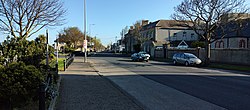
Baldoyle (Irish: Baile Dúill) is a coastal suburb of Dublin, Ireland, it was developed from a former fishing village.
Key Information


Baldoyle is also a civil parish in the barony of Coolock within the traditional County Dublin.[1]
Location and access
[edit]
Baldoyle is located northeast of the city, and borders Donaghmede, which was formed from its western part, Portmarnock, Sutton and Bayside. It can be accessed from the coast road from Dublin to Howth, which includes a cycle track, from Sutton Cross via Station Road, or from Donaghmede, or Portmarnock.
Baldoyle is served by Dublin Bus and Irish Rail, the latter currently via the Sutton and Bayside stations on the Howth Branch of the DART, and by Clongriffin station on the Northern Branch, which is also the Dublin-Belfast main line. The railway line functions as the western boundary of the area.
Baldoyle is also served by Dublin Bus routes H1 (Baldoyle to City Centre) and H2 (Malahide to City Centre via Portmarnock)
Areas neighbouring Baldoyle are Sutton, Bayside, Portmarnock and Donaghmede, including Clongriffin.
Geography
[edit]Baldoyle is mostly level coastal plains, with the Mayne River passing under the railway line through a bridge structure known as the "Red Arches" and crossing in its northern parts, and coming to the sea. This river takes in the Grange Stream from Donaghmede, and other tributaries, notably the Seagrange Park Stream from the south and a small tributary from the Clongriffin estate to the west. The Mayne has, and some of its tributaries had, a history of flooding.[2] A boy drowned in 1993 in the Seagrange Park Stream, when it was being culverted. This stream had once run south to the sea at Kilbarrack Road but was diverted to the Mayne.[3]
A major townland of Baldoyle, encompassing much of what is now Donaghmede, is Grange, indicating that it was previously farmland.[citation needed]
Etymology
[edit]The district name derives from baile meaning "town" and dubh-ghaill meaning "dark (-haired) stranger", the name given by the Gaels to the Danes to distinguish them from the Norwegians or "fair (-haired) strangers" (finn-ghaill) who first settled in Ireland in 841–842. While it is sometimes rendered as "Doyle's town" with reference to the personal name Doyle which itself derives from dubh-ghaill, there is no evidence for this usage.[4][5]
Features and Development
[edit]Baldoyle village today has a coastal main street, with a Roman Catholic church, a community hall, a modern county library branch with sea views, and some shops and pubs. Slightly inland, among the older suburban houses, is a small shopping precinct containing a Lidl supermarket, a football club, another Roman Catholic church, and other amenities. On the approach from the coast road is a well-known pub, the Elphin.[citation needed]
Many businesses in the area are represented by the Howth Sutton Baldoyle Chamber of Commerce.
Baldoyle Industrial Estate
[edit]On Grange Road towards Donaghmede is a light industrial estate, with more than forty businesses and the local An Post sorting and delivery office. Businesses located there include major generic pharmaceuticals player Mylan, the largest tenant of the estate, Irish Papers, Grange Builders Providers, Ferrum Trading Co Ltd Steel Stockholders, Poolbeg Press, Curtis & Lees, Ireland's Eye Knitwear, Grange Electrical Wholesalers, Baldoyle Print and Forest Tosara, producers of Sudocrem (invented in Dublin).[citation needed]
Housing developments
[edit]In the 20th and 21st centuries, Baldoyle has been at the centre of a large housebuilding programme, with the former racecourse having been sold to developers. The new developments have begun, as "The Coast", facing a new local centre at the northern edge of Donaghmede, Clongriffin. Clongriffin Dart station opened in April 2010 serving Baldoyle and racecourse developments such as "The Coast", and northern Donaghmede.[citation needed]
Parks
[edit]Seagrange Park is a public park that includes a modern playground and sports pitches. A new public park was to be built on part of the former racecourse lands, including a wildlife or nature park, and while this is still pending, a community garden is maintained on part of those lands.[citation needed]
Christian Brothers
[edit]Among the local residents are the retired members of the Congregation of Christian Brothers, whose retirement home, St. Patricks, is located in the town. There is a graveyard where approx 1000 members of the Christian Brothers are buried. St. Josephs, Baldoyle was formerly the site of the Christian Brothers Training School.
Education
[edit]In the centre of the village is a secondary school for girls, St. Mary's, while further inland is a large co-educational secondary school, Pobalscoil Neasáin. There is a co-educational primary school, St. Laurence's National School, catering for children aged 4–12, and with junior and senior buildings. Formerly St. Peter and Paul's BNS and St. Mary's GNS, the schools amalgamated at the beginning of the 2013/2014 school year to become St. Laurence's National School. Junior Infants to 2nd Class pupils attend the junior school in the Grange Road campus (the former girls' school), while 3rd Class to 6th Class pupils attend the senior school in the Brookstone Road campus (the former boys' school). Both buildings are within minutes of each other. Also in the village area is a special needs primary school run by St. Micheals house.[citation needed]
Religion
[edit]Baldoyle is a parish in the Howth deanery of the Roman Catholic Archdiocese of Dublin.[6]
History
[edit]
Baldoyle with its sheltered waterside location, was a Viking base for many years, eventually razed by an attack by the King of Leinster in 1012. However, it remained under Danish control under the arrival of the Anglo-Normans, when the last Danish chieftain, Hamund McTorkaill, was overthrown. The lands of Baldoyle were later presented to the Priory of All Hallows, which had been founded by Diarmaid mac Murchadha in 1150, on the site that is now Trinity College Dublin. The monks built the Grange Church, now known as Grange Abbey, which now lies in Donaghmede. By the 1500s, the area owned by the Priory at Baldoyle included gardens, arable land, pasture, a meadow, a copse, a warren, and woodland. The Priory lost the lands in 1536, during the dissolution of the monasteries when Henry VIII granted the lands to the Dublin Corporation. By 1630, Grange Abbey was in ruins, but the associated graveyard was used into the 1700s.[5]
During the 1600s, there was an hostelry or inn in Baldoyle, which is recounted in one of the oldest hunting songs recorded from Ireland concerning Michael St Lawrence and a hunting party who went to Baldoyle after a day of hunting. The manuscript of the song is held in the Sloan manuscripts of the British Museum. During the 1700s, Jonathan Swift was a frequent visitor to Baldoyle, who had a number of friends who lived in the area, including at Grange House.[5]
A description of Baldoyle from Lewis's Topographical Dictionary of Ireland (Dublin, 1837) gives a useful summary of what was then a substantial rural fishing village:
The village is pleasantly situated on an inlet or creek of the Irish Sea, to the north of the low isthmus that connects Howth, with the mainland: it comprises about 200 houses, and is much frequented in summer for sea-bathing. Some of the inhabitants are engaged in the fishery, which at the commencement of the present century employed nine wherries belonging to this place, averaging seven or eight men each; at present nearly 100 men are so, engaged. Sir W. de Windsor, lord-justice of Ireland, held a parliament here in 1369. The creek is formed between the mainland and the long tract of sand on the north of Howth, at the point of which, near that port, a white buoy is placed; it is fit only for small craft. The manor was granted to the priory of All Saints, Dublin, by Diarmit, the son of Murchard, King of Leinster, who founded that house in 1166.
The parliament mentioned above was held at Grange Church,[5] which was partly restored in the late 20th century[citation needed] after a period of neglect.[5] At that time the area had a population of 1208, of whom 1009 lived in the village, and the lands belonged entirely to Dublin Corporation. There were three "big houses" viz Grange Lodge, Donaghmede House and Talavera, a police station and a coast guard base, and both a parish school and a hedge school, and at least one holy well.
At the turn of the 20th century, Baldoyle was still primarily a fishing village, with 9 fishing wherries. The small harbour also received coal shipments. At this time, Baldoyle was also a popular bathing spot, and attracted visitors. James Warren, allegedly Ireland's oldest man, died in Baldoyle in 1887 at age 167.[5]
The new district of Donaghmede, comprising perhaps six major housing development areas and a commercial and social core, was "carved out" of Baldoyle's inland lands, along with a little of Coolock, and some places often described as part of Raheny, in the 1960s and 1970s; it now has a population considerably greater than that of Baldoyle.
Baldoyle Racecourse
[edit]
For most of the 20th century, Baldoyle was well known for its racecourse, which was one of three in the Dublin metropolitan area (and for a period the only one). Open land in the village had been an informal venue for horse races in the early nineteenth century, and annual race meetings at the site were proposed in 1842 at the same time as the closure of the Howth Park Racecourse in nearby Sutton and Howth.[7] A new enclosed course was opened in May 1874, which continued in regular use for almost a century, until it was closed in August 1972 due to financial difficulties related to the potential costs of necessary renovations.[8]
The year after closure, on 31 October 1973, one of the most spectacular and audacious escapes from an Irish prison took place when three of the Provisional IRA's key personnel were airlifted to freedom in a hijacked helicopter from Mountjoy Prison. The helicopter touched down at the disused racecourse where the IRA members escaped in waiting cars.[citation needed]
For several years during the 1960s, Baldoyle Racecourse became the destination for annual sponsored charity walks, which were intended to raise funds for the Central Remedial Clinic.[citation needed]
Sport
[edit]Football
[edit]Baldoyle is home to Baldoyle United FC, with teams in the NDSL, MGL and Leinster Senior League, and principal facilities at Brookstone Road. Games are also played at Racecourse Park and Seagrange Road, Baldoyle. There were for a short period two clubs, Baldoyle United and Grange United, which merged in 2015.[9] A combined name, Baldoyle Grange United, was announced for the senior team but the remaining activity was continued as simple Baldoyle United. Since 2017 all teams play as Baldoyle United FC.[citation needed]
Baldoyle United has over 25 teams at schoolboy, schoolgirl and adult levels. In 2016 it won the FAI Community Club of the Year and also Fingal County Council's Community Group of the Year.[citation needed]
GAA
[edit]Na Dubh Ghall are the local GAA club and have teams across all age groups catering for both girls and boys, and play at Racecourse Park.[10][citation needed]
Badminton
[edit]Baldoyle has a dedicated badminton centre on Grange Road, one of the two centres of Leinster Badminton, with eight courts. There is an active local club, Baldoyle District Badminton Club, based there, and it is also used substantially by several other clubs, including two from Raheny.[11]
Notable people
[edit]- Robbie Brady, Irish international association footballer[citation needed]
- Nicky Byrne, singer[citation needed]
- James Chambers footballer for Bethlehem Steel[citation needed]
- Edward Fitz-Symon of Grange Abbey, Elizabethan judge[citation needed]
- Erica-Cody, Irish R&B singer-songwriter[citation needed]
- Willie Nolan, Irish golfer, Willie Nolan Road in Baldoyle takes his name.[12]
- Jennifer Zamparelli, Irish comedian and television presenter[citation needed]
See also
[edit]References
[edit]- ^ Placenames Database of Ireland - Baldoyle civil parish
- ^ Doyle, Joseph W. (September 2013). Ten Dozen Waters: The Rivers and Streams of County Dublin (8th ed.). Dublin: Rath Eanna Research. p. 8. ISBN 978-0-9566363-7-9.
- ^ Yeates, Padraig (23 June 1993). "Residents angry at failure of floods safety valve". The Irish Times.
- ^ Irish Names of Places, Vol. I., p. 350, and Mervyn Archdall's Monasticon Hibernicum, edited by Cardinal Moran; Vol. II, p. 21, note; Dublin: W. B. Kelly, 1873
- ^ a b c d e f Wrenn, Jimmy (1982). The Villages of Dublin. Dublin: Tomar Publishing Enterprises. pp. 4–5, 20.
- ^ Official website Archived 7 February 2015 at the Wayback Machine - Baldoyle parish
- ^ "Baldoyle Races". Freeman's Journal. 13 June 1842. Retrieved 27 January 2015 – via British Newspaper Archive.
- ^ Hurley, Michael (Spring 2006). "Baldoyle as a Racecourse Village". Dublin Historical Record. 59 (1): 65–80. JSTOR 30101607.
- ^ Baldoyle United and Grange United to Merge, 3 Jul 2015
- ^ Na Dubh Ghall - Pitch Locator
- ^ Baldoyle Badminton Centre
- ^ "New home view: Putt down roots on the green".
External links
[edit]
Baldoyle
View on GrokipediaBaldoyle is a coastal suburb of Dublin in Fingal, Ireland, situated on an inlet of the Irish Sea north of the Howth Peninsula.[1][2] With a population of 8,096 in the 2022 census, it spans an area of 2.676 square kilometers and functions primarily as a residential community.[3] Originally a fishing village, Baldoyle has expanded into a bustling town featuring retail areas, industrial estates, and public parks like Seagrange Park, while maintaining access to coastal walks and sea views.[2] Adjacent Baldoyle Bay, an estuarine system fed by the Mayne and Sluice rivers and separated from the open sea by sand dunes, holds ecological significance as a Ramsar wetland site and Special Protection Area under EU directives, supporting wintering populations of migratory waterbirds such as Brent geese and golden plover.[4] The bay contributes to the broader Dublin Bay UNESCO Biosphere Reserve, valued for its salt marshes, mudflats, and role in flood control and erosion protection.[5] Historically, the area traces Viking incursions to 898 AD, with later developments including a racecourse and the Church of St. Laurence O'Toole, reflecting its evolution from maritime settlement to modern suburbia.[6][7]
Geography and Environment
Location and Topography
Baldoyle is a coastal locality situated in Fingal, County Dublin, Ireland, approximately 11 kilometers northeast of Dublin city center.[8] The area lies along the Irish Sea coast, bordered by Baldoyle Bay to the east, a tidal estuary extending from Portmarnock in the north to the Howth Peninsula in the southeast.[9] Geographic coordinates place it at roughly 53.40° N latitude and 6.13° W longitude.[10] The topography of Baldoyle consists primarily of low-lying coastal plains, with elevations averaging 1 to 2 meters above sea level and rarely exceeding 7 meters.[11] [12] This flat terrain is shaped by estuarine influences, including small rivers like the Mayne and Sluice that feed into Baldoyle Bay, an inlet separated from the open sea by a sand dune peninsula.[4] The landscape's gentle slopes and proximity to the coast contribute to its vulnerability to tidal and fluvial dynamics, while inland areas transition to slightly undulating ground near the Dublin-Wicklow Mountains foothills, though remaining predominantly level within the locality.[9]Baldoyle Bay and Ecological Significance
Baldoyle Bay is an estuarine inlet on the east coast of Ireland, spanning approximately 2.5 km² and characterized by extensive intertidal mudflats, saltmarshes, and coastal habitats that support diverse marine and avian life.[13] Designated as a Special Area of Conservation (SAC, site code 000199) under the EU Habitats Directive since 1997, the bay preserves representative examples of Annex I habitats, including embryonic shifting dunes, fixed dunes with Hippophae rhamnoides, and Salicornia mudflats, which foster nutrient cycling and sediment stabilization essential for coastal ecosystem resilience.[14] Its inner estuary was established as a Statutory Nature Reserve in 1988 to protect these features from anthropogenic disturbance.[15] The bay holds particular ornithological value as a Special Protection Area (SPA, site code 004016) under the EU Birds Directive, serving as a critical wintering site for migratory waterfowl and waders along the East Atlantic Flyway.[16] It regularly supports over 20,000 non-breeding waterbirds, providing high-quality foraging grounds on mudflats rich in invertebrates such as polychaete worms and mollusks, which sustain species including light-bellied brent goose (Branta bernicla hrotula), Eurasian wigeon (Mareca penelope), and dunlin (Calidris alpina).[17] Key wintering populations include oystercatcher (Haematopus ostralegus), grey plover (Pluvialis squatarola), and curlew (Numenius arquata), with roosting sites on saltmarshes mitigating tidal exposure risks.[18] Ecologically, the bay contributes to the broader Dublin Bay Biosphere Reserve, designated by UNESCO in 2015, where it functions as a buffer zone enhancing connectivity between terrestrial and marine environments.[19] Its habitats also buffer coastal erosion and filter pollutants from adjacent urban runoff, maintaining water quality for juvenile fish and shellfish nurseries.[20] Conservation efforts, guided by National Parks and Wildlife Service objectives, emphasize maintaining favorable conditions for these features amid pressures from recreation and development, with monitoring data indicating stable bird assemblages despite fluctuating annual counts influenced by weather patterns.[17]Climate and Coastal Features
Baldoyle exhibits a temperate oceanic climate (Köppen Cfb), moderated by its proximity to the Irish Sea, resulting in mild winters and cool summers with limited temperature extremes. Annual mean temperatures average approximately 10°C, with winter lows rarely falling below 3°C and summer highs peaking around 19°C.[21] Precipitation totals about 731 mm per year, distributed across roughly 191 rainy days, with December recording the highest monthly average at 76 mm and February and July the lowest at 50 mm each.[22] The coastal setting amplifies maritime influences, including frequent westerly winds, high humidity, and occasional sea fog, which temper diurnal and seasonal variations more than inland areas. These patterns align with broader eastern Irish trends, where annual sunshine averages 1,400-1,500 hours, though overcast conditions predominate due to Atlantic weather systems.[21] Coastal features center on Baldoyle Bay, a shallow estuarine inlet spanning about 2.5 km², separated from the open Irish Sea by a prominent sand dune peninsula that acts as a natural barrier. The bay's geomorphology includes extensive intertidal mudflats and sandflats exposed during low tide, alongside saltmarsh habitats and localized eelgrass (Zostera) beds that facilitate sediment trapping and nutrient cycling.[4] Fed by the small Mayne and Sluice rivers, the system experiences semi-diurnal tides driving water exchange through a narrow inlet, fostering dynamic sediment dynamics prone to natural erosion and accretion.[15] This low-lying configuration renders the coastline vulnerable to storm surges and gradual sea-level adjustments, though no major historical inundations have been documented beyond typical estuarine fluctuations.History
Origins and Etymology
The name Baldoyle derives from the Irish Baile Dubh Ghaill, meaning "town of the dark foreigner" or "town of the black stranger," a Gaelic designation for Danish Vikings to differentiate them from the lighter-haired Norwegian Vikings (fionn ghaill).[23][24] This nomenclature underscores the locality's foundational ties to Scandinavian settlement patterns along Dublin's northern coast, where Danes established coastal strongholds for raiding and trade.[25] Archaeological and annalistic evidence points to Baldoyle's origins as a Viking outpost in the late 9th century, with the earliest documented Norse activity in the area recorded in 898 AD during a sortie from their Dublin base.[6] The site's sheltered bay facilitated maritime operations, enabling persistent Viking presence until suppression by Leinster forces under native Irish kings.[25] Subsequent Gaelic reassertion integrated the settlement into Irish territorial structures, evidenced by medieval land grants and ecclesiastical foundations, though Norse linguistic imprints endured in the placename.[7]Pre-20th Century Development
In the aftermath of the Dissolution of the Monasteries in 1539, the lands of Baldoyle, previously part of the Priory of All Hallows, were surrendered by the last prior, Walter Hankoke, and subsequently granted to the Dublin Corporation in recognition of its loyalty during the Geraldine rebellion; the corporation in turn leased them to Sir Edward Fitzsimons, who received the Grange of Baldoyle and over 220 acres.[6] The parish church, originally established as a chapel in the 12th century, was repaired in 1609 by local figures Thomas Fitzsimons and Michael Aspoll but had become ruinous by 1630, reflecting the broader decline of ecclesiastical structures under Reformation pressures.[7] [6] Catholic worship persisted covertly, with the formation of the Baldoyle, Howth, and Kinsaley parish in 1614 and the construction of a mass house in Baldoyle by James Begg in 1662, underscoring the resilience of local religious practice amid penal restrictions.[7] By the 18th century, Baldoyle remained a modest coastal settlement, with limited documented infrastructural growth, though its proximity to Dublin facilitated seasonal use for sea-bathing among urban visitors.[26] Land ownership patterns stabilized under entities like the Dublin Corporation, which continued paying an annual crown rent of £4.4.0¾, while agricultural and fishing activities formed the economic base.[6] The early 19th century marked modest advancements, including the rebuilding of the Roman Catholic chapel in 1831 under Fr. William Young on the site of the earlier thatched mass house, featuring a Tuscan portico, turret, dome, and cross, which served the united parishes of Baldoyle, Howth, Kinsealy, and Kilbarrack.[7] [27] According to the 1831 census, the parish population stood at 1,208, with approximately 1,009 residents in the village of around 200 houses, where about 100 men were employed in an expanding fishery that had grown from nine wherries (each crewed by 7-8 men).[26] Two-thirds of the land was arable, cultivated in standard crops, with improving agricultural practices; notable residences included Donaghmede (owned by Mrs. King), Talavera (Capt. N. Furnace), and Grange Lodge (W. Allen, Esq.), alongside the ruins of the ancient church at the Grange and a holy well at Donaghmede frequented on St. John’s Eve.[26] Plans for the Drogheda or Grand Northern Trunk railway to traverse the grange indicated emerging connectivity ambitions by the 1830s.[26]20th Century Expansion and Racecourse Era
During the early 20th century, Baldoyle Racecourse underwent infrastructure improvements, including the construction of a new main stand in 1913 to accommodate growing crowds for flat and jumps racing events.[28] The course, situated on flat seaside terrain, hosted regular meetings that drew enthusiasts from Dublin, contributing to local economic activity through betting, vendors, and transient visitors, though permanent residential expansion remained modest in this fishing village turned suburban outpost.[29] By the mid-century, the racecourse solidified Baldoyle's regional prominence as one of three key Dublin-area venues, with fixtures like the Metropolitan Plate steeplechase attracting competitors and spectators amid Ireland's post-independence horse racing culture.[30] A notable incident occurred on June 2, 1940, when rival animal gangs clashed violently during a meeting, leading gardaí to recover weapons including sticks, knuckledusters, and a sword, highlighting the era's undercurrents of organized crime tied to racing and livestock markets.[30] Community facilities indirectly benefited, such as the 1928-1929 construction of the local parish hall funded partly by racecourse tote proceeds and volunteer labor.[31] The racecourse's final meeting on August 26, 1972, marked the end of its operational era, after which the 18-hectare site faced rezoning pressures for housing amid Dublin's suburban sprawl, though significant residential development awaited subsequent decades. Throughout the century, Baldoyle's population hovered in the low thousands, with growth constrained by its coastal-rural character and reliance on seasonal racing rather than industrial or commuter-driven expansion.[32]Post-2000 Growth and Housing Controversies
Following the closure of Baldoyle Racecourse in the late 20th century, the site and adjacent lands in the Stapolin area became focal points for residential expansion, with Fingal County Council unveiling plans in October 2000 for up to 4,000 new dwellings on the former racecourse to address housing demand in north Dublin.[33] Construction of housing schemes commenced in the mid-2000s amid Ireland's Celtic Tiger economic boom, transforming parts of the area from underutilized greenfield sites into suburban estates, though the global financial crisis halted much of this momentum by 2008.[34] The 2002 Stapolin Village Masterplan outlined a framework for mixed-use development, emphasizing sustainable urban growth adjacent to existing Baldoyle infrastructure, including roads and public services.[35] Post-2010 recovery saw renewed proposals for high-density apartments under Ireland's Strategic Housing Development (SHD) mechanism, aimed at accelerating urban infill to meet national housing targets, but these sparked significant local opposition. In 2021, a proposed SHD for 1,221 apartments faced legal challenges from residents citing inadequate consideration of construction-related carbon emissions, potential overdevelopment, and strain on local amenities.[36] An Bord Pleanála refused permission in March 2023 for a 1,180-unit scheme in Baldoyle-Stapolin, determining that the density would exacerbate traffic congestion, privacy losses from overlooking adjacent low-rise homes, and insufficient wastewater capacity, despite the applicant's arguments for compliance with zoning objectives.[37][38] Earlier in December 2022, the High Court granted objectors leave to appeal another SHD approval, highlighting procedural flaws in assessing site-specific impacts.[39] These disputes reflect broader tensions between rapid densification and infrastructure lags in coastal suburbs like Baldoyle, where proposals often prioritize volume over integration with existing one- and two-storey neighborhoods. While some projects advanced, such as approval in July 2024 for an 11-storey block of 104 apartments with balconies, critics argued it undermined residential character without commensurate upgrades to schools, roads, or public transport.[40] In March 2025, the Land Development Agency acquired a site with permission for 1,931 affordable homes, signaling continued pressure for expansion but raising fresh concerns over affordability verification and long-term sustainability in an area with limited commercial cores.[41] Resident groups have emphasized that while housing shortages are acute, unchecked high-rises risk environmental degradation near Baldoyle Bay and diminished quality of life, as evidenced in planning inspectorate reports documenting privacy invasions and visual dominance.[42]Demographics and Society
Population Trends and Composition
The population of Baldoyle electoral division, as defined by Ireland's Central Statistics Office (CSO), has exhibited consistent growth since the late 20th century, reflecting broader suburban expansion in northern Dublin. In 1996, the population stood at 5,942; it increased to 7,050 by 2006, 7,524 by 2011, and reached 8,096 in the 2022 census.[3] This trajectory equates to an overall increase of about 36% over 26 years, driven primarily by residential development and proximity to Dublin city center, though growth moderated post-2011 amid Ireland's economic recovery from the 2008 financial crisis.| Census Year | Population | Change from Previous |
|---|---|---|
| 1996 | 5,942 | - |
| 2006 | 7,050 | +18.7% |
| 2011 | 7,524 | +6.7% |
| 2022 | 8,096 | +7.6% |