Hubbry Logo
BeauceronBeauceronMain
Open search
Beauceron
Community hub
Beauceron
logo
8 pages, 0 posts
0 subscribers
Be the first to start a discussion here.
Beauceron
Beauceron
from Wikipedia
Beauceron
Beauceron
Other namesBerger de Beauce
Beauce Sheep Dog
Beauce Dog
Bas Rouge
OriginFrance
Traits
Height Males 65–70 cm (26–28 in)
Females 61–68 cm (24–27 in)
Coat Short, smooth and thick double coat
Colour Black and tan or occasionally a harlequin pattern
Kennel club standards
Société Centrale Canine standard
Fédération Cynologique Internationale standard
Dog (domestic dog)

The Beauceron (French pronunciation: [bosʁɔ̃] ) is a herding dog breed originating from the plains of Central France. The Beauceron is also known as Berger de Beauce (French pronunciation: [bɛʁʒe bos], sheepdog from Beauce) or Bas Rouge (French pronunciation: [ba ʁuʒ], red-stockings).

Description

[edit]

Appearance

[edit]
A harlequin (left) and a black and tan (right) Beauceron

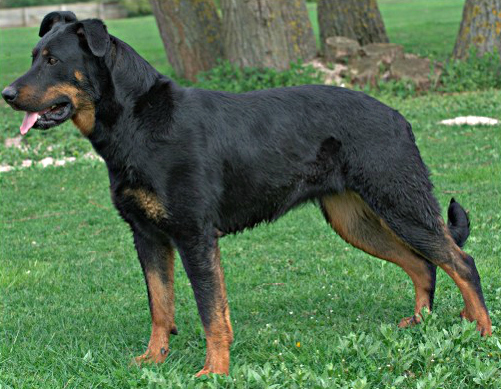
This breed stands 61 to 70 cm (24 to 27.5 in) in height and weighs 30 to 45 kg (66 to 99 lb) The Beauceron has a hard outer coat and a woolly undercoat that grows thick in cold weather, especially if the dog sleeps outdoors. Its standard colouring is black and tan (the latter colour referred to in French as rouge ecureuil, squirrel-red) or, less frequently, grey, black and tan called harlequin. Other colours, such as the once prevalent tawny, grey or grey/black, are now banned by the breed standard. The harlequin coats should have more black than gray with no white. In the black and tan dogs the tan markings should appear in two dots above the eyes, on the sides of the muzzle, fading off to the cheeks, but do not reach the underside of the ears. Also on the throat, under the tail and on the legs and the chest. Tan markings on the chest should appear as two spots but a chest plate is acceptable. Ear cropping is no longer allowed in most countries.

Double dewclaws are a characteristic of the Beauceron.

The Beauceron is unusual in having a double dewclaw. In order to be shown, a Beauceron must have double dewclaws that form well-separated "thumbs" with nails on each rear leg; anything less will result in disqualification from dog shows. The Beauceron's double dew claws are connected by bone (unlike most breeds) and some dogs are even able to flex each one individually.[1][2][3] The Beauceron has no breed-specific health problems.[4]

Characteristics

[edit]
A Beauceron
Beauceron with cropped ears

The Beauceron is known in France as a guard dog, a helper around the farm (herding sheep or cattle), and/or a ring sport dog (primarily protection training). This athletic, healthy and long-lived breed has been bred to be intelligent, calm, gentle, and fearless.[5] Adults are typically suspicious of strangers and are excellent natural guard dogs. If not well trained, they can be aggressive.[6] They do best when raised within the family but they can sleep outside, the better to act as guards (their weatherproof coats make them ideal kennel users even in the coldest winters). They have a double smooth coat that is short.[7] They are eager learners and can be trained to a high level. However, their physical and mental development is slow relative to other similar breeds (e.g. German and other large shepherds): they are not mentally or physically mature until the age of about three years, so their training should not be rushed. Several five- or ten-minute play-training exercises per day in the early years can achieve better results than long or rigorous training sessions.[citation needed]

History

[edit]

The breed originated as a herding dog in France. It was first mentioned in 1587, and named as the "Berger de Beauce" in 1809. The first breed club was formed in 1911. During WWII, it was employed as a military dog. In modern France, it is used as a guard or police dog, and as of 1989 was still a popular sheep dog.[6][8]

See also

[edit]

References

[edit]

Bibliography

[edit]
[edit]
Revisions and contributorsEdit on WikipediaRead on Wikipedia
from Grokipedia
The Beauceron is a large, muscular breed originating from the Beauce region of , renowned for its endurance, intelligence, and protective instincts while serving as a versatile in guarding livestock and property. Developed over centuries as one of 's oldest breeds, the Beauceron traces its roots to the late 1500s, when it was used by shepherds to manage large flocks of sheep and across vast plains without tiring, often by day and guarding against predators at night. The breed was formally documented in agricultural reports as early as 1809 and officially standardized in 1889, distinguishing it from similar French herders like the , with the recognizing it in 2007. Physically imposing yet balanced, Beaucerons stand 24 to 27.5 inches tall at the shoulder, with males typically larger and weighing 70 to 110 pounds, featuring a solid, athletic build that conveys nobility and alertness. Their coat is short, dense, and coarse—most commonly , though patterns of gray, black, and tan are permitted—with distinctive double dewclaws on the hind legs and a naturally . In temperament, the Beauceron is frank, self-assured, and gentle with family, yet fearless and reserved toward strangers, making it an excellent guardian without undue or timidity. Highly intelligent and eager to please, this breed excels in obedience training and tasks but requires experienced owners due to its independent thinking and need for firm, consistent leadership. As a high-energy , Beaucerons demand at least 1-2 hours of vigorous daily exercise, such as running, , or work, to prevent boredom-related behaviors like excessive barking or destructiveness. Grooming is low-maintenance, involving weekly brushing to control shedding and occasional baths, though their protective double coat repels dirt effectively. Generally robust with a lifespan of 10-12 years, the breed is prone to and bloat, necessitating regular veterinary check-ups and a diet tailored to large, active dogs. Today, Beaucerons remain valued in roles like search-and-rescue, police work, and as devoted family companions for those with active lifestyles and ample space.

History

Origins

The earliest documented reference to a dog resembling the Beauceron appears in a French manuscript dated 1587, describing large, robust s used in the agricultural plains of central . These s were noted for their strength and vigilance, essential for managing in the expansive, open landscapes of the Beauce region southwest of . From the 16th to the 18th centuries, the Beauceron served as a vital in rural , primarily sheep and while simultaneously guarding them against predators such as wolves and human threats like thieves. In the vast farmlands of central , these dogs were indispensable to shepherds and farmers, patrolling large flocks over long distances and using their keen intelligence to make independent decisions in the field. Their protective instincts ensured the safety of homesteads and herds, contributing to the agricultural economy of the era. The Beauceron originated distinctly in the flat plains of the Beauce region, setting it apart from similar breeds like the , which developed in the more wooded and rugged terrain of and featured a long, protective coat suited to underbrush. Early records referred to the breed as the Berger de Beauce (Beauce Shepherd), highlighting its herding roots, or Bas Rouge (red stocking), a nickname derived from its characteristic tan markings on the feet and legs that resemble reddish stockings. This foundational development in pre-industrial rural laid the groundwork for the breed's later standardization in the .

Modern Development

The Beauceron began to emerge as a distinct in the mid-19th century, with its first separate occurring at the inaugural French in in 1863, where it was presented as the de Beauce alongside other regional shepherds. This event marked a shift from its informal roles to formal recognition within canine circles, highlighting its short coat and robust build as differentiating traits from longer-haired varieties like the . By the late , efforts to standardize French dogs gained momentum, culminating in the founding of the first dedicated club, the Club Français des Bergers (French Shepherd Dog Club), in 1897 under the leadership of Emmanuel Boulet. This organization focused on distinguishing and preserving regional types, including the Beauceron, and laid the groundwork for its official , which was formalized in the early through the Société Centrale Canine and later refined by the Club des Amis du Beauceron established in 1911. These developments emphasized the breed's utility in herding and guarding, ensuring to maintain its physical and working qualities. During and , the Beauceron proved invaluable to the French military, serving in roles such as messenger dogs to relay communications across battlefields, guardians of supplies and troops, and detectors of mines and explosives amid hazardous conditions. Their intelligence, endurance, and fearlessness made them ideal for these demanding tasks, contributing significantly to wartime operations despite the breed's near decimation by conflict's end. In the post-World War II era, the Beauceron underwent a deliberate revival, rebuilt primarily from around 50 surviving specimens selected for their adherence to type and working ability, which helped restore population numbers and genetic diversity. This effort was bolstered by dedicated breeders and clubs, leading to broader international acknowledgment: the Fédération Cynologique Internationale (FCI) recognized the breed on November 25, 1963, while the American Kennel Club (AKC) admitted it to its Foundation Stock Service in 1998 and granted full recognition in the Herding Group effective June 27, 2007. These milestones solidified the Beauceron's status as a versatile working breed beyond France.

Description

Physical Appearance

The Beauceron is a well-balanced, solid of substantial , exhibiting a muscular yet athletic build that conveys strength and endurance without heaviness or coarseness. Its overall conformation presents a harmonious , with a straight topline and a body proportioned for and power, emphasizing functional capabilities. Males stand 25.5 to 27.5 inches (65-70 cm) at the , while females measure 24 to 26.5 inches (61-66 cm); heights outside these limits are disqualifying faults. The breed's weight typically ranges from 70 to 110 pounds (32-50 kg), supporting a robust frame that prioritizes lean muscle over excessive bulk. The is short, dense, and double-layered, featuring a harsh, waterproof outer coat and a fine, downy undercoat that is mouse-gray and barely visible. The primary color is , with tan markings on the eyebrows, muzzle, throat, chest, legs, and under tail; a harlequin variant displays a mottled pattern of . Non-standard colors, such as solid black or liver, are disqualifying. Distinctive structural traits include naturally retained double dewclaws on the hind legs, which are well-developed and fused to the foot for enhanced traction, serving as a hallmark. The ears are set high and may be cropped to an upright carriage or left natural as half-pricked or drop ears, neither converging nor diverging. A shaggy coat or absence of double hind dewclaws also constitutes a disqualification. The is fluid and effortless, with a faulty movement, such as stiffness or lack of extension, deemed a serious fault.

Temperament

The Beauceron exhibits core traits of , calmness, fearlessness, , and protectiveness, underpinned by a natural guarding that is firm but not overly aggressive. This approaches situations with a frank and self-assured demeanor, displaying a gentle character while remaining vigilant. Their protective nature stems from historical roles in guarding and property, making them devoted companions to their family without unwarranted hostility toward others. Proper from puppyhood is essential, as Beaucerons tend to be reserved with strangers and may show wariness toward unfamiliar dogs, though they are generally gentle and affectionate with family members, including children, when well-socialized. Early exposure helps mitigate potential aloofness, fostering a balanced that integrates well into dynamics. Their extends to forming strong bonds with known individuals, enhancing their role as sensitive family protectors. Beaucerons possess a high energy level and strong drive, necessitating ample mental and physical stimulation to prevent , which can lead to destructive behaviors if unmet; however, they remain composed and not in indoor settings. Their spirited yet levelheaded energy suits active lifestyles, with daily exercise supporting their endurance derived from a muscular build adapted for prolonged work. In terms of trainability, Beaucerons are highly responsive to confident, experienced handlers, owing to their intelligence and eagerness to please, though an independent streak can manifest as stubbornness without consistent, firm leadership. This working breed thrives under structured guidance that respects their autonomy, yielding obedient and versatile performance. Due to their herding heritage, Beaucerons excel in compatibility with livestock, demonstrating natural aptitude for managing and protecting animals calmly and effectively; conversely, they are not ideal for novice owners or confined small living spaces, requiring knowledgeable stewardship and ample room to channel their robust instincts.

Health and Lifespan

Common Health Concerns

The Beauceron, as a large breed, is susceptible to several orthopedic and genetic health issues, though it is generally considered robust compared to many similar-sized dogs. , a malformation of the hip joint leading to instability, pain, limping, and eventual , affects approximately 1.1% of evaluated Beaucerons based on current Orthopedic Foundation for Animals (OFA) data from 284 dogs (as of 2025). Screening through OFA or PennHIP evaluations is recommended for breeding stock to identify and mitigate this heritable condition. Gastric dilatation-volvulus (GDV), commonly known as bloat, poses a significant due to the breed's deep-chested conformation, potentially causing rapid , unproductive retching, and shock if untreated. Prevention strategies include feeding divided meals throughout the day and avoiding vigorous exercise immediately after eating. Elbow dysplasia, involving abnormal development of the elbow , and associated cruciate ligament tears, often linked to rapid growth in large breeds, has an incidence of approximately 3.2% in Beaucerons according to recent OFA statistics from 1,106 evaluations (as of 2024). Symptoms include lameness, swelling, and instability, with management options such as surgery, , or joint supplements. Additional concerns include (DCM), a heart condition causing weakened and potential ; (PRA), an inherited eye disorder leading to gradual vision loss; and , which results in lethargy, weight gain, and skin issues due to insufficient thyroid hormone production. Non-syndromic congenital , caused by a recessive CDH23 missense variant, leads to bilateral in affected puppies. The breed's average lifespan is 10-12 years, influenced by these factors. Genetic testing is advised for conditions such as cystinuria, a disorder causing kidney stones from impaired amino acid reabsorption. Responsible breeders utilize DNA tests from providers like Embark or OFA to screen for these and reduce prevalence in future generations.

Care and Maintenance

The Beauceron, as a large and athletic herding breed, benefits from a high-protein diet to maintain its muscular physique and support daily energy demands. Veterinary experts recommend a formulation containing 25-30% protein from quality sources such as meat or fish, tailored to the dog's life stage—puppies require higher levels for growth, while adults focus on maintenance. Portion control is crucial to avoid obesity, a common risk in large breeds; an average adult Beauceron weighing 70-110 pounds (32-50 kg) typically consumes 3-4 cups of kibble daily, equivalent to 400-700 grams of premium croquettes depending on weight, activity level, and sterilization status—for example, 450-550 grams for an average active male, 350-500 grams if sterilized or sedentary, and up to 700 grams if highly active—divided into two meals (e.g., 40% in the morning and 60% in the evening) to prevent gastric torsion, with adjustments based on activity, age, and metabolism as advised by a veterinarian to maintain ideal weight where ribs are palpable but not visible. Alternatives such as BARF or homemade diets are possible with balanced supplements, but consulting a veterinarian for precision is recommended. Fresh water should always be available, and treats limited to 10% of caloric intake to ensure nutritional balance. Exercise is essential for the Beauceron's physical and mental well-being, given its working heritage and high stamina. Owners should provide a minimum of 1-2 hours of vigorous daily activity, such as brisk walks, running, , or simulated tasks, to prevent boredom-induced behaviors like excessive barking or . Splitting sessions into morning and evening routines helps meet these needs while accommodating the breed's preference for varied outdoor environments, ensuring and joint health without overexertion in puppies or seniors. Grooming the Beauceron is relatively straightforward due to its short, dense double coat, which offers natural protection but sheds seasonally. Weekly brushing with a medium-bristle or rubber grooming mitt removes and distributes skin oils, while daily sessions during shedding periods minimize household mess. Monthly baths using a mild suffice unless the becomes soiled, and routine checks of ears for , teeth for plaque, and nails for overgrowth are recommended to maintain hygiene. The breed's characteristic double dewclaws on the hind legs, which are functional and attached by bone, require regular trimming to avoid snagging or injury during activity. To support the Beauceron's typical 10-12 year lifespan, proactive measures include annual veterinary check-ups for early detection of issues, consistent weight monitoring to reduce strain on joints, and supplementation with or chondroitin for breeds susceptible to . Environmentally, these dogs need ample yard for free movement and , ideally fenced to suit their guardian instincts, though they adapt to suburban homes with active owners. Despite the insulating double coat, protection from extreme cold—such as sweaters or limited outdoor time—is advisable in harsh winters to prevent chilling.

Roles and Training

Traditional Uses

The Beauceron was primarily developed as a in the plains of northern , where it managed large flocks of sheep and across vast open terrains. These dogs excelled at driving and protecting , moving them between pastures while warding off predators like wolves, all with a quiet demeanor that minimized disturbance to the animals. Known for their efficient, bark-free style, Beaucerons used an intense "eye" stare to direct stock movement, relying on posture and presence rather than noise to maintain control. In addition to herding, the Beauceron served as a natural guardian of farms and homesteads throughout rural . These dogs deterred intruders and predators through vigilant posture and silent alerting, barking only when necessary to signal threats, which made them reliable protectors of property and families. Their protective instincts were honed over centuries, ensuring the safety of and homesteads in isolated areas. Historically, Beaucerons also supported hunting efforts in French forests, tracking large game such as and stag with their strength, , and keen scenting abilities. Originating from early types used for pursuing big game like boar and , they leveraged their robust build to navigate dense woodlands and assist hunters in retrieval and pursuit. Before the breed's unification in the late , regional variations existed between the de Beauce type, suited to on the flatter, open plains of the Beauce near , and the Berger de type, which was more oriented toward guarding in the wooded and marshy Brie area. These distinctions, first noted in 1809 by Abbé Rozier, reflected adaptations to local terrains, with Beauce dogs emphasizing mobility for large-scale and Brie dogs focusing on protective work in denser environments.

Contemporary Applications

In contemporary settings, Beaucerons continue to serve in police and roles, particularly in , where their versatility in , detection of explosives and narcotics, and duties is valued for its low-profile appearance and strong . The breed's ability to follow commands, track scents, and navigate complex environments makes it suitable for these applications, though it is less common than breeds like the due to its size. In the United States, Beaucerons are occasionally employed in similar tasks, leveraging their intelligence and loyalty. Beaucerons also excel in operations, particularly in urban and wilderness scenarios, where their athleticism, endurance, and keen aid in tracking and . Organizations in and utilize the breed for these tasks, noting its calm demeanor under pressure and ability to handle rough terrain. Notable examples include certified SAR Beaucerons deployed in recovery missions, highlighting the breed's adaptability to modern emergency needs. Since their full recognition by the American Kennel Club (AKC) in the Herding Group in 2007, Beaucerons have gained prominence in competitive dog sports, including herding trials, obedience, agility, rally, and Schutzhund (now known as IPO). They compete successfully in AKC events, with achievements such as Master Agility Champion titles and placements in national obedience championships, demonstrating their speed, precision, and trainability. The American Beauceron Club tracks versatility awards across these disciplines, underscoring the breed's all-around performance capabilities. As family guardians, Beaucerons are popular in households seeking protection without excessive aggression, provided they receive proper to balance their natural protectiveness with family integration. Their loyalty and wariness of strangers make them effective watchdogs, often alerting owners to potential threats while remaining gentle with children and familiar individuals when trained. This role emphasizes their transition from working dogs to versatile companions in modern homes. Training Beaucerons for these applications relies on positive reinforcement methods, such as rewards and praise, combined with firm, consistent leadership to channel their independence and high energy. Early exposure to various stimuli, including obedience classes and socialization from puppyhood, is essential to prevent behavioral issues, though the breed's intelligence allows for rapid progress in short, focused sessions. Novice owners may face challenges due to the Beauceron's strong-willed nature, often requiring experienced guidance to establish clear boundaries.

References

Add your contribution
Related Hubs
User Avatar
No comments yet.