Hubbry Logo
BlockshipBlockshipMain
Open search
Blockship
Community hub
Blockship
logo
8 pages, 0 posts
0 subscribers
Be the first to start a discussion here.
Contribute something
Blockship
Blockship
from Wikipedia
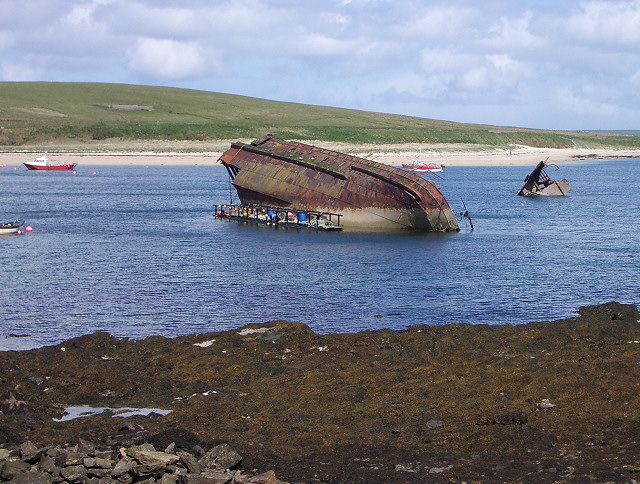
The wreck of SS Reginald, a blockship sunk in Weddell Bay in the Orkney Islands, Scotland in 1915
Cruiser Reina Mercedes, sunk by its own crew in the Spanish-American War, blocking access to the port of Santiago de Cuba.

A blockship is a ship deliberately sunk to prevent a river, channel, or canal from being used as a waterway. It may either be sunk by a navy defending the waterway to prevent the ingress of attacking enemy forces, as in the case of HMS Hood at Portland Harbour in 1914; or it may be brought by enemy raiders and used to prevent the waterway from being used by the defending forces, as in the case of the three old cruisers HMS Thetis, Iphigenia and Intrepid scuttled during the Zeebrugge raid in 1918 to prevent the port from being used by the German navy.

An early use was in 1667, during the Dutch Raid on the Medway and their attempts to do likewise in the Thames during the Second Anglo-Dutch War, when a number of warships and merchant ships commandeered by the Royal Navy were sunk in those rivers to attempt to stop the attacking forces.

An even earlier use are the six 11th century Skuldelev ships in Roskilde Fjord, sunk to protect Roskilde from northern Vikings. They are now on display in the Viking Ship Museum.[1][2][3]

The above is the principal and enduring meaning of 'block ship', but in the mid-19th century the term blockships was applied to two groups of mobile sea batteries developed by the Royal Commission on Coast Defence. The first batch of four was obtained from around 1845 by converting old sailing 74-gun two-deckers, all of them Vengeur-class ships of the line, into floating batteries, equipped with a steam/screw propulsion system. Also called "steam guardships",[4] these conversions involved cutting down to a single deck, with ballast removed, and a jury rig installed with a medium 450-horsepower (340 kW) engine for speeds of 5.8–8.9 knots (10.7–16.5 km/h; 6.7–10.2 mph). These ships, converted in 1846, were Blenheim, Ajax, Hogue and Edinburgh. Although these ships were intended for coast defence some of them were used offensively, notably in the Baltic Campaign of 1854 and 1855, where they were an integral part of the British fleet. A second batch of five were similarly obtained from around 1855 by converting other elderly 74-gun ships; these were Russell, Cornwallis, Hawke, Pembroke and Hastings.

The most recent known use of blockships in warfare was during the annexation of Crimea by the Russian Federation. On 6 March 2014, the Russian Navy towed and scuttled the decommissioned cruiser Ochakov at the entrance to Donuzlav Bay in western Crimea, to prevent remaining Ukrainian navy vessels from leaving port.[5] Less than 24 hours later, on 7 March, another blockship, the former Black Sea Fleet rescue/diving support vessel BM-416 was scuttled near Ochakov.

See also

[edit]

Notes

[edit]

Further reading

[edit]
[edit]
Revisions and contributorsEdit on WikipediaRead on Wikipedia
from Grokipedia
A blockship is a vessel deliberately sunk to obstruct a critical waterway, such as a harbor entrance, river, or canal, in order to deny passage to enemy ships and trap naval forces in port. This naval tactic has been employed for defensive purposes by navies throughout history to hinder enemy movements and protect strategic assets. The use of blockships dates back centuries, with one of the earliest recorded instances occurring in 1667 during the Raid on the Medway, when British forces scuttled ships to block the River Medway against a Dutch fleet incursion. In the , Union forces deployed blockships in to impede Confederate naval operations. During , the tactic saw prominent application in the British raid on in 1918, where three blockships—HMS , , and Intrepid—were scuttled to temporarily seal the canal entrance used by German U-boats, though the blockage was cleared by the Germans within days. Blockships were also sunk at entrances to to fortify the Royal Navy's main base against submarine threats. In , blockships served both offensive and protective roles; British and Allied forces used them to obstruct entrances to German-occupied ports, while obsolete vessels were scuttled off beaches in 1944 to form breakwaters for the Mulberry artificial harbors, sheltering during the D-Day invasion. More recently, in 2014, Russian forces sank two obsolete ships in a Crimean port to block the Ukrainian Navy's escape, enabling their subsequent capture. Today, the strategy remains relevant in modern naval planning, with potential applications in contested chokepoints using inexpensive, expendable vessels enhanced by autonomous systems or explosives.

Fundamentals

Definition

A blockship is a vessel deliberately sunk to obstruct a waterway, such as a harbor, river, channel, or canal, thereby rendering it unusable for navigation. This tactic is employed in naval warfare to deny access to strategic passages, preventing the movement of enemy vessels or, in some cases, friendly forces if capture is imminent. Key characteristics of blockships include their intentional , typically executed by the ship's crew through methods like opening seacocks to flood the hull, using explosives, or filling the vessel with prior to sinking. These ships can encompass a range of types, including active warships, merchant vessels, or obsolete hulls that are otherwise decommissioned, with the primary objective being to create a physical barrier rather than to inflict direct destruction on approaching forces. The scale and permanence of the obstruction depend on the vessel's size and the waterway's configuration, often requiring significant effort to clear afterward. Blockships differ from related naval denial methods, such as mines or booms, by providing a large-scale, enduring physical impediment composed of the sunken hull itself, as opposed to devices or temporary barriers like chains or nets. Additionally, while refers broadly to the deliberate sinking of a ship—often to prevent capture—blockships are distinguished by their specific intent to block , rather than merely denying the vessel to the enemy without obstructing the .

Strategic Purposes

Blockships serve primarily defensive purposes in by obstructing critical waterways to deny enemy forces access to harbors, rivers, or channels, thereby preventing ingress into protected areas and safeguarding strategic assets from or . This tactic reduces the operational mobility of adversary fleets, delaying their deployment and allowing defending forces time to reinforce positions or evacuate key . Additionally, blockships can protect friendly ports from capture by rendering them unusable to invaders through deliberate , ensuring that seized vessels or facilities do not bolster enemy logistics. In offensive contexts, blockships enable attackers to trap enemy naval assets in confined spaces, such as ports or , by sinking vessels across exits to immobilize fleets and disrupt supply lines following amphibious assaults. This approach forces adversaries to divert resources toward clearance operations, weakening their overall and creating opportunities for follow-on strikes. The psychological dimension amplifies these effects, as the sudden denial of sea mobility can demoralize enemy commanders and erode confidence in defended waterways. Broader tactical integration positions blockships as complements to traditional naval maneuvers, such as blockades or raids, where they enhance control over sea lanes by combining with mines, sensors, or unmanned systems to multiply disruptions across multiple chokepoints. Over time, their purpose has evolved from harbor defenses in earlier eras to a core element of modern amphibious and hybrid operations, leveraging cost-effective obsolete hulls and advanced for sustained, low-risk denial of maritime domains.

Historical Development

Medieval and Early Modern Periods

The earliest documented use of blockships dates to the late Viking Age in Scandinavia, where they served as a defensive measure against naval incursions. Around 1070, five vessels were deliberately scuttled in the narrow Peberrenden channel of Roskilde Fjord, near Skuldelev in Denmark, to form a barrier protecting the inland town of Roskilde from sea raids by hostile fleets. These ships, excavated in 1962 using an innovative iron cofferdam technique, represent a diverse cross-section of Viking maritime capabilities: Skuldelev 1, an ocean-going cargo ship approximately 16 meters long built for long-distance trade; Skuldelev 2, a robust warship or longship over 30 meters in length with 30 rowing benches for up to 60-70 warriors; Skuldelev 3, a versatile coastal trader around 22 meters; Skuldelev 5, a smaller longship suitable for riverine or inshore warfare; and Skuldelev 6, a modest 8-meter fishing or utility boat. The strategic placement of this mixed fleet—combining military, commercial, and local vessels—demonstrates how communities repurposed available ships to create an effective underwater obstacle, a tactic born from the constant threats posed by Viking-era naval mobility in Northern European waters. This practice evolved through the medieval period as a rudimentary form of harbor defense in Scandinavian and Baltic regions, where narrow fjords and rivers amplified the utility of sunken barriers amid ongoing raids and territorial disputes. By the early modern era, with the advent of gunpowder weaponry and larger sailing fleets, blockships assumed roles in broader naval conflicts across Northern Europe. A prominent example occurred during the Second Anglo-Dutch War, in the Dutch Raid on the Medway of June 1667, when English forces hastily scuttled over 30 vessels—including merchantmen, warships, and possibly some captured prizes—in the Medway and Thames rivers to obstruct the advancing Dutch fleet led by Michiel de Ruyter. These blockships, supplemented by an iron chain across the river, aimed to prevent the Dutch from reaching the vulnerable Chatham Dockyard, where much of the Royal Navy lay at anchor; however, the defenses proved inadequate as Dutch fireships and boarding parties breached the obstacles, resulting in the burning or capture of several capital ships like HMS Royal Charles. This incident underscored the tactic's limitations against determined attackers but highlighted its emergence as a standard expedient in gunpowder-era naval warfare, particularly in estuarine environments where maneuverability was constrained. The development of blockships in this period reflected broader shifts from oar-powered raiding to sail- and cannon-armed engagements, with Northern European powers adapting the concept for both static defense and temporary denial of waterways. While primarily defensive, such uses occasionally incorporated offensive elements, as seen in the raid's aftermath, where damaged hulks further complicated salvage and pursuit efforts.

19th Century Conflicts

During the , blockships continued to serve as a defensive naval tactic in major conflicts, particularly as navies transitioned from sail to propulsion and incorporated ironclad designs, allowing for more deliberate operations in key harbors. One prominent example occurred during the , where the Union Navy employed the Stone Fleet to obstruct Confederate ports. The Stone Fleet consisted of aging merchant vessels, primarily ships from ports like New Bedford, purchased by the U.S. Navy in late 1861 to serve as blockships. These ships, totaling 45 across two groups—25 in the first fleet and 20 in the second—were loaded with stones to weigh them down and ensure they sank effectively upon . The first fleet was deliberately sunk in the main channel of , , in December 1861, aiming to prevent Confederate blockade runners from accessing the port and supplying the South. The second fleet followed in January 1862, targeting Maffitt's Channel to further seal the harbor entrance. Despite these efforts, the operation achieved only partial success, as strong tides and currents dispersed the wrecks, allowing some navigation through the channels and limiting the blockade's long-term impact. In the (1853–1856), Russian forces used blockships to defend the strategic against Anglo-French assaults. Anticipating the Allied landing in September 1854, the scuttled several warships, including five old battleships and two frigates, at the harbor entrance on to block access and protect their remaining fleet from bombardment. This tactic, involving at least seven vessels sunk in the main channel, secured the inner harbor for over a year during the prolonged , though it ultimately could not prevent the city's fall in September 1855. The demonstrated limited but effective use of obsolete ships in a defensive role amid the war's emphasis on shore batteries and infantry engagements. Chinese forces employed junks as blockships defensively during the (1839–1842) to obstruct river approaches. The marked a tactical evolution in blockship deployment, integrating them with emerging technologies like ironclads and steam engines for more precise operations. In the , while the Stone Fleet relied on traditional wooden sailing ships, concurrent developments such as the steam-powered ironclad highlighted a shift toward mechanized vessels capable of towing blockships into position or conducting hybrid blockade strategies. This transition enabled navies to plan scuttlings with greater accuracy, using steam propulsion to navigate treacherous channels and iron hulls for resilience in contested waters, foreshadowing industrialized naval warfare.

World War I

During , blockships played a crucial role in the Royal Navy's defensive strategies against German submarine threats, particularly in securing key harbors and anchorages. Early in the conflict, obsolete vessels were scuttled to obstruct narrow channels, drawing on precedents from 19th-century where ships were similarly sunk to deny access to enemy forces. This approach was rapidly implemented to protect vital naval bases from incursions, emphasizing harbor denial over offensive operations. One of the first such measures occurred on 4 November 1914, when the pre-dreadnought battleship HMS Hood (launched in 1891) was deliberately scuttled at the southern entrance to Portland Harbour, Dorset, to block the South Ship Channel and prevent submarine attacks on anchored shipping. The 14,150-ton vessel, already obsolete and removed from active service in 1911, was towed into position and sunk upside down in approximately 15-18 meters of water, with its keel protruding near the surface at low tide. This early defensive action underscored the urgency of countering German underwater threats as the war escalated, though the wreck has since deteriorated and diving is prohibited. At , the Grand Fleet's primary anchorage in the Islands, multiple blockships were sunk between 1914 and 1918 to seal entrances against following initial vulnerabilities exposed in late 1914. Old colliers and merchant vessels, such as Thames, Argyle, Reinfeld, Teeswood, , Pontos, and Urmston Grange, were purchased by the Admiralty and scuttled in strategic barriers like Kirk Sound, Skerry Sound, Water Sound, and Burra Sound, often in depths of 12-18 meters. These obstructions, combined with anti-submarine nets and booms, effectively fortified the base, preventing any successful penetration despite early German attempts, and allowed the Grand Fleet to operate securely throughout the war. By 1918, over a dozen such vessels had been deployed, transforming the natural harbor into an impregnable stronghold. The most prominent blockship operation of the war was the Zeebrugge Raid on 23 April 1918, a daring British assault aimed at denying German U-boats access to the Bruges Canal by scuttling obsolete cruisers at the Belgian port's entrance. Three concrete-filled cruisers—HMS Thetis, Intrepid, and Iphigenia (each around 3,600 tons)—were tasked with ramming into the canal under cover of smokescreen and gunfire support from HMS Vindictive and other vessels. Intrepid successfully sank across the channel at a 15-degree angle after ramming the viaduct, while Iphigenia exploded and settled at 25 degrees nearby; however, Thetis grounded prematurely 300 yards short due to a submerged obstruction, limiting her blocking effect. The raid inflicted over 500 British casualties (176 killed, 412 wounded, 49 missing) but only partially succeeded, delaying rather than halting U-boat operations as German forces cleared passages within days (e.g., submarines UB-16 and A-43 transited by late April). Despite the incomplete blockade, the action boosted Allied morale and demonstrated innovative amphibious tactics against submarine bases.

World War II

During , blockships played a critical role in across multiple theaters, with the Allies and employing hundreds of obsolete merchant vessels and warships to deny key harbors and support amphibious operations. Early in the conflict, the sinking of by German submarine U-47 on October 14, 1939, in exposed vulnerabilities in the anchorage's defenses, prompting the British to reinforce blockship barriers. Additional vessels, including the SS Cape Ortegal sunk in Skerry Sound, were deliberately scuttled to close gaps exploited by the , enhancing protection for the Royal Navy's base until permanent were constructed by 1945. One of the most daring applications occurred during Operation Chariot, the on March 28, 1942, aimed at crippling the Normandie dry dock in the German-occupied port of , the only Atlantic facility capable of repairing large warships like the battleship Tirpitz. The obsolete HMS Campbeltown, a former U.S. vessel (ex-USS Buchanan), was modified with 4.5 tons of delayed-action explosives in her forward magazine and rammed into the dock gates at high speed under heavy fire. The charge detonated about eight hours later, destroying the gates and rendering the dock unusable for major repairs until after the war's end in 1945, despite German salvage efforts. German of their own ships cluttered waterways at ports like Brest, a major base, amid repeated RAF bombing and commando operations that disrupted repairs. The largest-scale deployment came during the on June 6, 1944, where approximately 65 obsolete ships formed the five breakwaters off the invasion beaches to shelter and enable rapid unloading of supplies. Codenamed "Corncobs," these blockships included merchant vessels like the SS Corchester (sunk off ) and concrete caissons, with 2 off comprising about 20 ships and 1 off using 10, creating artificial harbors that facilitated the discharge of 17,000 vehicles and millions of tons of materiel despite storm damage later that month. In the Pacific theater, Japanese forces employed blockships defensively on occupied islands to impede Allied advances, dozens of vessels in harbors like in early 1945 to block shipping lanes and deny the port to U.S. liberation forces. Overall, the industrialized use of hundreds of blockships—primarily outdated —across these operations underscored their tactical value in denying enemy access and supporting invasions, often at minimal additional cost beyond preparation and towing.

Post-1945 Examples

Following , the employment of blockships in naval operations became infrequent, largely supplanted by advancements in missile technology, air power, and anti-access/area-denial (A2/AD) capabilities that rendered physical port obstructions less practical for major fleets. However, blockships retained utility in asymmetric or scenarios, where low-cost, improvised measures could immobilize smaller naval forces in confined waters. In the 1971 Indo-Pakistani War, Pakistani forces scuttled ships in harbor to deny access to Indian naval forces. A prominent post-1945 example occurred during Russia's 2014 annexation of , part of its broader strategy against . On March 5-6, 2014, the Russian towed and scuttled two decommissioned vessels at the narrow entrance to Donuzlav Bay, a key anchorage for the Ukrainian Navy's Southern Naval Base near . The first was the Kara-class Ochakov (displacement approximately 8,500 tons, length 186 meters), decommissioned in 2011 and previously slated for scrapping; it was flooded and exploded to sink across the channel, creating an immediate barrier. The second vessel, the BM-416-class firefighting and diving support ship (displacement 30-40 tons), was scuttled the following day to reinforce the blockage, ensuring Ukrainian warships could not access the . This action trapped eight Ukrainian vessels, including the corvette Ternopil and several smaller craft, preventing their escape or reinforcement and facilitating Russian seizure of the base by March 27. The operation exemplified blockships' role in rapid, deniable territorial control, delaying Ukrainian response for weeks until the wrecks were partially cleared in October 2014. While the Crimea incident marked the most documented post-war use of blockships, their overall decline stems from the dominance of precision-guided munitions and aerial surveillance, which allow forces to neutralize ports remotely without risking assets in close proximity. Traditional blockades, including , are now seen as temporary expedients—effective for days or weeks in confined areas but vulnerable to , explosives, or alternative routing—reducing their appeal in high-intensity conflicts. As of November 2025, blockship tactics remain relevant in planning for contested chokepoints, though no major combat deployments have occurred since 2014.

Tactics and Implementation

Ship Selection and Preparation

Blockships have historically been selected from a variety of vessel types based on operational needs, including obsolete warships, vessels, and purpose-built structures. Obsolete warships, such as World War I-era destroyers, were often chosen for their robust and ability to withstand ramming maneuvers while carrying significant payloads. For instance, during the 1942 , the Royal Navy selected HMS Campbeltown, a transferred U.S. , due to its size and resemblance to a German , enabling it to approach enemy defenses undetected. Merchant vessels, particularly aging whalers, provided an economical option when large numbers were required; in the American Civil War's Stone Fleet operation of 1861, the U.S. Navy purchased 45 old whaling ships from ports for their seaworthiness over long voyages despite their obsolescence. Purpose-built concrete hulks, like the Phoenix caissons developed for World War II's Mulberry harbours, offered durability in harsh conditions; these units, weighing up to 6,000 tons, were engineered specifically for submersion to form breakwaters. Preparation of selected ships involved modifications to ensure stability, controlled sinking, and mission success. Ballasting was a key step to maintain equilibrium during transit and positioning; for the Stone Fleet, ships were loaded with stones at a cost of 50 cents per ton, filling holds to promote rapid submersion upon , while unnecessary gear was removed and sold to streamline the vessels. Explosive installations were common for warships intended to post-impact; HMS 's bow was packed with 24 depth charges totaling five tons, secured with and fitted with delayed-action fuses set for 8-10 hours, a design by Lieutenant Nigel Tibbits to destroy the target dock after the crew evacuated. Structural alterations enhanced functionality, such as reinforcing bows for or reducing draft for shallow approaches— had two funnels removed, the remaining angled, armor plating added to vital areas, and extraneous equipment stripped. For readiness, crews drilled on procedures like opening sea valves or removing plugs; Stone Fleet vessels received minimal repairs, including tar-sealed seams and a single 5-inch hole plugged with wood, along with one anchor and basic sails retained. Phoenix caissons underwent watertight fabrication in factories by 200,000 workers, using over a million tons of , before being floated and towed into position. Crew training emphasized precision, with St. Nazaire raiders undergoing intensive rehearsals for explosive arming and evacuation under fire. Selection criteria prioritized availability, dimensions for effective channel obstruction, and adaptation to environmental factors. Availability often dictated choices, favoring surplus or decommissioned vessels to minimize costs—the declining whaling industry's mothballed ships were readily obtainable for the Stone Fleet amid wartime urgency. Size was critical for blocking width; larger hulls like Campbeltown's 312-foot length ensured substantial impediments, while Phoenix caissons' varying dimensions (up to 200 feet long) allowed tailored placement in tidal zones. Environmental suitability influenced designs, such as tide-resistant features in concrete hulks to withstand currents and waves, or ballasting in merchant ships to counter shifting sands in harbors like Charleston.

Deployment Methods

Deployment of blockships involves precise operational maneuvers to position and sink vessels in targeted waterways, often under hostile conditions to maximize obstruction of naval or commercial traffic. These methods evolved from early 20th-century naval tactics, emphasizing speed, deception, and synchronization with environmental factors like tides to ensure effective blockage. Sinking techniques primarily rely on crew-initiated scuttling or explosive charges to rapidly flood and submerge the vessel. Crews often open sea cocks or hatches to allow water ingress, as seen in World War I blockship operations where obsolete cruisers were deliberately holed after positioning. Remote explosives provide a more controlled and destructive option, such as the delayed-fuse depth charges installed in HMS Campbeltown during the 1942 St. Nazaire raid, which detonated hours after ramming to shatter the Normandie dry dock gates. In ramming scenarios, like the same raid, the blockship is driven directly into critical infrastructure at high speed—Campbeltown struck at 19 knots—combining kinetic impact with onboard ordnance for enhanced disruption. Tidal timing is crucial for these techniques, with deployments synchronized to high tide for deeper penetration and to prevent premature grounding, as in the Zeebrugge raid where blockships approached at midnight on a flood tide to navigate the canal entrance effectively. Positioning tactics focus on covert advancement and alignment to avoid detection and ensure optimal blockage. Blockships are frequently towed into proximity by support vessels, such as destroyers pulling cruisers to within 17 miles of the target before independent navigation, as employed in the 1918 Zeebrugge operation. Under cover of darkness or smokescreens, they proceed with fire support from escorts; during St. Nazaire, navigated the shallow estuary disguised as a German torpedo boat, relying on enemy searchlights for final guidance amid intense gunfire. Tugs play a key role in precise alignment within channels, holding vessels steady for , exemplified by their use in Mulberry harbor construction where tugs positioned blockships before explosive sinking to form breakwaters. Challenges in deployment include countering environmental drift, guaranteeing hull breaches for swift submersion, and integrating with broader operations like raids. Strong tidal currents can cause unintended drift, as experienced at Zeebrugge where a 3-knot tide and fouled nets displaced HMS Thetis 300 yards from the intended site. Ensuring rapid sinking requires pre-prepared breaches or reliable explosives, but variable conditions like wind shifts can compromise smokescreens and expose the approach, heightening risks from enemy fire. Coordination with invasions or diversions demands tight timing; in St. Nazaire, shallow waters and defensive barrages led to the loss of support launches and crew, yet the blockship's positioning succeeded through navigational precision.

Offensive vs. Defensive Roles

Blockships have traditionally fulfilled defensive roles when naval authorities deliberately scuttle their own vessels to obstruct strategic waterways, thereby denying adversaries access to key harbors and preventing incursions into protected areas. This proactive measure transforms obsolete or surplus ships into barriers that complicate enemy navigation, particularly against or raiding forces seeking to exploit vulnerabilities in home waters. For instance, such tactics have been employed to seal off entrances to major anchorages, ensuring the of fleet concentrations while minimizing the risk of capture or repurposing by invaders. In contrast, offensive applications of blockships involve attackers sacrificing or capturing vessels to trap fleets within ports, effectively neutralizing their mobility following a raid or amphibious operation. By positioning scuttled ships in narrow channels, the attacking force can immobilize docked warships, turning a potential pursuit asset into a liability and disrupting the defender's ability to . This approach integrates blockships with broader strategies, such as raids on bases, to achieve long-term of access. Hybrid scenarios emerge in transitional contexts, where blockships provide temporary obstructions during retreats or prolonged sieges, blending defensive preservation with offensive disruption. Over the , their employment evolved from static harbor fortifications—sunk by defenders to hold ground—into dynamic tools for attackers, enabling rapid post-raid closures that exploit momentary control of contested waters. Deployment methods, such as controlled under fire, underscore this shift toward tactical flexibility in fluid engagements.

Effectiveness and Legacy

Advantages and Limitations

Blockships offer several advantages as a naval tactic, primarily due to their low cost when utilizing surplus or obsolete vessels, which can be acquired and prepared at a fraction of the expense of constructing new defensive . This approach allows navies to repurpose decommissioned ships effectively, transforming potentially useless assets into immediate physical barriers that obstruct narrow channels, harbors, or rivers, thereby denying enemy access to strategic waterways. Additionally, the deployment of blockships provides psychological deterrence by signaling a commitment to deny passage, potentially discouraging enemy advances without direct confrontation. In shallow waters, these sunken vessels exhibit durability against salvage efforts, as their positioning complicates or explosive removal, prolonging the obstruction. Despite these benefits, blockships have notable limitations that restrict their long-term utility. Their temporary nature is a primary drawback, as obstructions can be cleared through , explosives, or , often within days to weeks, allowing determined adversaries to restore access relatively quickly. During placement, blockships are highly vulnerable to air attacks or detection by , which can lead to premature sinking or interception before they reach the target area. Environmental factors further undermine reliability, with currents, , or potentially shifting wrecks and reducing the blockage's effectiveness over time. In comparative terms, blockships prove more reliable than booms in narrow channels, where physical ship hulls provide a sturdier, less easily breached barrier than floating or chained obstructions. However, they are less flexible than naval mines, which offer persistent, relocatable threats without the logistical demands of vessel navigation and .

Notable Impacts on Warfare

The in April 1918, where British forces scuttled blockships in the harbor canal, partially obstructed access for German surface vessels and submarines, contributing to the Allied naval blockade's effectiveness by limiting sorties from Flemish bases for several weeks until alternative channels were cleared. Although the blockage was not permanent, it disrupted German naval operations at a critical juncture, supporting the broader strategy that starved of resources and hastened the war's end. In , the on March 28, 1942, saw HMS Campbeltown—modified as a blockship and packed with explosives—ram and explode in the Normandie dry dock, rendering it inoperable for the remainder of the conflict and denying German battleships like the Tirpitz a key Atlantic repair facility. This neutralization forced major German surface units to rely on distant German ports, easing pressure on Allied convoys and bolstering success in the by reducing threats from capital ships. Similarly, during the in June 1944, approximately 60 obsolete ships were sunk as blockships to form breakwaters off Utah, Omaha, , Juno, and Sword beaches, creating sheltered areas that protected supply operations from rough seas and enabled the rapid offloading of more than 2 million tons of in the first 100 days. These temporary harbors sustained the Allied bridgehead, facilitating swift advances across the Western Front and contributing to the by September 1944. Blockship operations in both world wars influenced post-war naval doctrines, particularly in strategies for port denial and amphibious support, as evidenced by their inclusion in U.S. Joint Publication 3-02 on amphibious operations, which references historical tactics for creating protected anchorages during assaults. This legacy shaped planning for rapid denial of enemy harbors in potential conflicts, integrating blockships into modern manuals on to counter threats like anti-access/area-denial systems.

Modern Relevance and Archaeology

In contemporary , blockship tactics retain strategic value for denying access to ports and trapping enemy fleets, as demonstrated during Russia's 2014 annexation of , where two obsolete vessels, including the Ochakov, were deliberately sunk to block Donuzlav Bay near and immobilize much of Ukraine's . This approach echoes historical uses but adapts to modern contexts of rapid, deniable operations blending military and irregular forces. Amid escalating tensions in maritime chokepoints, such as the —through which 20% of global liquids flowed as of 2024—blockships could theoretically complement threats of or seizure to disrupt shipping, though no such deployments have occurred there to date. Archaeological studies of blockship sites provide critical insights into and shipbuilding across eras, with the 11th-century Skuldelev ships in Denmark's Fjord serving as a prime example; these five Viking vessels, ranging from cargo carriers to warships, were scuttled with stone ballast to barricade the channel against northern invaders, revealing advanced clinker-built construction techniques and maritime trade networks upon their 1962 excavation. Similarly, the blockships of in , —sunk during both world wars to seal entrances against submarines—form accessible dive sites at depths under 6 meters, preserving wooden superstructures and offering evidence of wartime adaptations like filling, while geophysical surveys highlight the challenges of mapping these shallow, debris-strewn wrecks amid strong currents and protected status. The environmental legacy of blockship wrecks underscores future implications for , as many hulks continue to leak and munitions; an estimated 20 million tonnes of remain trapped in global wrecks, with degradation by seabed microbes releasing pollutants like and explosives that alter local ecosystems, prompting ongoing assessments and remediation efforts to mitigate risks from these "ticking time bombs."

References

Add your contribution
Related Hubs
Contribute something
User Avatar
No comments yet.