Recent from talks
Nothing was collected or created yet.
Bobby Hamilton
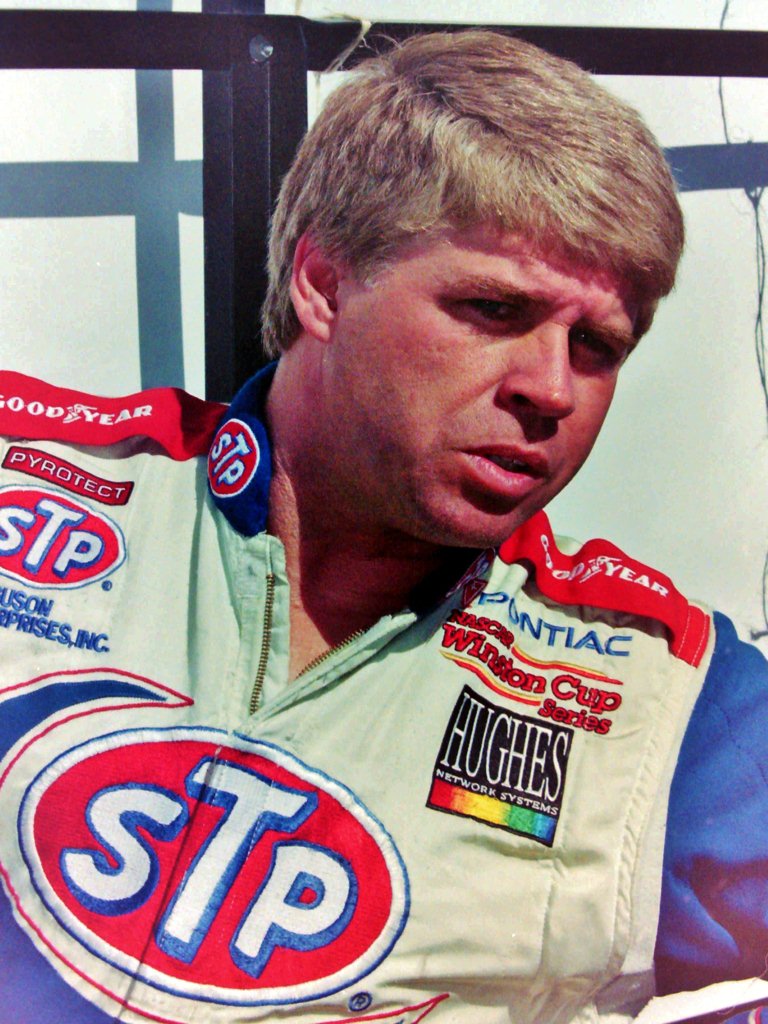
View on WikipediaCharles Robert Hamilton Sr. (May 29, 1957 – January 7, 2007) was an American stock car racing driver and racing team owner. A driver and owner in the NASCAR Craftsman Truck Series circuit and the winner of the 2004 NASCAR Craftsman Truck Series championship, Hamilton owned Bobby Hamilton Racing. Hamilton's son, Bobby Hamilton Jr., was also a NASCAR driver.
Key Information
Hamilton may be best remembered for two of his Winston Cup Series wins. His first career victory at the 1996 Dura Lube 500 at Phoenix was the first win for the No. 43 Petty car since Richard Petty's last win in 1984.[1] He also had a memorable win at the Talladega 500 in April 2001 driving the No. 55 car for owner Andy Petree. The entire 500-mile race was run caution-free and was under intense scrutiny from both NASCAR and the media at large, being the first superspeedway race run since the death of Dale Earnhardt at the 2001 Daytona 500 two months earlier. A physically and mentally exhausted Hamilton slumped to the ground after exiting his car and was given oxygen from a tank before giving the standard post-race Victory Lane interview while sitting on the ground, leaning against the drivers door.
Early life
[edit]Born in Nashville, Tennessee, Hamilton lost his custodial parents to illness when he was thirteen years old (Grandfather Preacher Hamilton, car builder and crew chief for Marty Robbins at the old Nashville Fairgrounds Speedway, and Grandmother Annie Mae Hamilton) who had raised him from early childhood. Hamilton quit school at the age of fourteen[2] and began his racing career at Nashville Speedway USA, now Fairgrounds Speedway, racing on the weekly circuit at the legendary track, where he won back to back Late Model Stock Car Championships in 1987 and 1988. In 1988, Hamilton won an unprecedented four races, in three different divisions, in one night, at Nashville Fairground Speedway. Hamilton began to be noticed within the NASCAR ranks after racing in a special four-car "Superstar Showdown" at Nashville in 1988 against Cup Series drivers Sterling Marlin, Darrell Waltrip, and Bill Elliott.
NASCAR career
[edit]Days of Thunder
[edit]Hamilton broke into the Winston Cup ranks in a very unusual way. He was asked to drive one of the "movie cars" for the 1990 film Days of Thunder, qualifying fifth in the movie car at the 1989 Autoworks 500 in Phoenix, in a car that was not intended to be competitive.[3] The car was a No. 51 Exxon-sponsored Chevrolet, portrayed in the movie as being driven by Rowdy Burns.
1988–1994
[edit]Hamilton made his NASCAR debut in the Busch Series in 1988 at Charlotte Motor Speedway driving the No. 16 Filmar Racing Chevrolet, finishing fourteenth. He competed in the next race at Rockingham and finished twentieth. He drove full-time in the Busch Series in 1989 driving the No. 8 Lighting & Fans Buick for FILMAR Racing, finishing eleventh in points, and winning his only career Busch race at Richmond International Raceway. He made his Winston Cup debut in a "Days of Thunder" car owned by Hendrick Motorsports. He led five laps but finished 32nd after an engine failure. He matched his 11th-place points finish in 1990 with Filmar Racing, when he was picked up by Tri-star Motorsports to run Winston Cup full-time beginning in 1991, driving the No. 68 Country Time Lemonade Oldsmobile, posting four Top 10 finishes and narrowly defeating Ted Musgrave for Rookie of the Year.
In 1992, he had two top-tens and finished 25th in points. He began 1993 with Tri-Star but was released early in the season. He spent the rest of the season in the Cup and Busch Series, posting two top-tens for Akins-Sutton Motorsports. Hamilton also made five Busch Series starts in the No. 05 Key Motorsports Chevrolet. In 1994, he joined SABCO Racing to driving the No. 40 Kendall Motor Oil Pontiac Grand Prix. He had just one top-ten finish and left at the end of the season.
1995–2002
[edit]

For the 1995 season, Hamilton moved to Petty Enterprises to drive the No. 43 STP Pontiac. He posted ten top-tens and moved up to fourteenth in the final standings. The next season, he finished a career-best ninth in the points standings and won his first race at Phoenix, the first for Petty Enterprises since 1983.[4] He also formed his own Craftsman Truck Series team and began competing in the series part-time. He won at Rockingham in 1997, but departed the team after falling to sixteenth in points.
He then signed with Morgan-McClure Motorsports in 1998 and in their eighth race together, he won from the pole, leading 378 of 500 laps at Martinsville Speedway. He ended the season, finishing tenth in the points. He had another ten top-ten finishes in 2000 and finished that season off thirtieth in points. He left for Andy Petree Racing to drive the No. 55 Square D Chevy. He won his final Cup career race at Talladega and finished eighteenth in points. He posted three top-tens in 2002 but suffered a broken shoulder late in the season, causing him to miss several races.
Although his Cup Series run in 2000 was not successful, he made history regardless as he joined Ken Schrader, Terry Labonte, and Mark Martin as one of the drivers to, at that point, win a race in each of NASCAR's top-three series when he won a Craftsman Truck Series race at Martinsville.
Craftsman Truck Series
[edit]Due to the injury, as well as an unstable financial situation at Petree Racing, Hamilton left the Winston Cup Series for the Truck Series driving for his own team, taking the Square D sponsorship with him. Driving the No. 4 Dana Dodge Ram Hamilton picked up two wins in his first year on the circuit and finished 6th in points. The following season, he picked up four wins and clinched the championship, marking the first time since Alan Kulwicki's championship in 1992 that an owner-driver won a NASCAR championship. He switched to the No. 04 in 2005.
In 2005, he started his Truck series season with a bizarre finish. He led the final laps of the 2005 Dodge Dealers 250 at Daytona International Speedway when Jimmy Spencer got by with a few laps left and the white flag flew just before a crash occurred in turn 1. During the accident, Hamilton passed Spencer for the lead. Due to the scoring-loop rules, before the accident it was initially believed that Spencer won. Spencer drove to victory circle, but not long afterward it was determined that Hamilton won; Hamilton was at the final scoring loop as he was in the lead.
Hamilton later won at Mansfield and went on his way to another sixth place points finish.
He drove the No. 18 Fastenal Dodge for the first three races in 2006, but was diagnosed with cancer and never raced again, with his son finishing out the season.
Illness and death
[edit]On March 17, 2006, Hamilton announced that he had been diagnosed with head and neck cancer.[5] He took part in the Craftsman Truck Series race that night, before starting therapy the following Monday.
Kyle Busch paid tribute to Hamilton two months later for the Truck race at Lowe's Motor Speedway by driving a truck painted to resemble the Rowdy Burns car in Days of Thunder, complete with the No. 51 and "Rowdy" decals, a tribute that Busch continues today in late model and truck racing.
Hamilton returned to the track for the race at Kentucky Speedway, overseeing his team's operations. Knowing he would not be well enough to drive in 2007, he hired Ken Schrader to drive his No. 18 Fastenal-sponsored Dodge for the full 2007 schedule while Hamilton continued his cancer treatment. Hamilton died on January 7, 2007, at his home in Mt. Juliet, Tennessee, with his family by his side.[6]
Motorsports career results
[edit]NASCAR
[edit](key) (Bold – Pole position awarded by qualifying time. Italics – Pole position earned by points standings or practice time. * – Most laps led.)
Cup Series
[edit]Daytona 500
[edit]| Year | Team | Manufacturer | Start | Finish |
|---|---|---|---|---|
| 1991 | Tri-Star Motorsports | Oldsmobile | 20 | 10 |
| 1992 | 22 | 32 | ||
| 1993 | Ford | 27 | 27 | |
| 1994 | SABCO Racing | Pontiac | 23 | 12 |
| 1995 | Petty Enterprises | Pontiac | 25 | 18 |
| 1996 | 39 | 20 | ||
| 1997 | 39 | 15 | ||
| 1998 | Morgan-McClure Motorsports | Chevrolet | 22 | 12 |
| 1999 | 16 | 29 | ||
| 2000 | 37 | 43 | ||
| 2001 | Andy Petree Racing | Chevrolet | 35 | 8 |
| 2002 | 32 | 32 |
Busch Series
[edit]Craftsman Truck Series
[edit]International Race of Champions
[edit](key) (Bold – Pole position. * – Most laps led.)
| International Race of Champions results | ||||||||
|---|---|---|---|---|---|---|---|---|
| Season | Make | 1 | 2 | 3 | 4 | Pos. | Points | Ref |
| 2005 | Pontiac | DAY 3 |
TEX 5 |
RCH 12 |
ATL 10 |
7th | 34 | [45] |
References
[edit]- ^ Fleischman, Bill; Al Pearce (1999). The Unauthorized NASCAR Fan Guide 1998-99. Visible Ink Press. p. 115. ISBN 1-57859-111-2.
- ^ Tennessean.com
- ^ "Victory Lane in Memory Lane: Bobby Hamilton and Phoenix". SB Nation. February 23, 2011. Retrieved May 18, 2019.
- ^ "Memorable Moments: Phoenix". NASCAR. November 7, 2013. Retrieved November 7, 2013.
- ^ Smithson, Ryan (March 19, 2006). "Hamilton: I have cancer". NASCAR. Turner Sports Interactive, Inc. Archived from the original on March 19, 2006.
- ^ Woody, Larry. Friends, drivers mourn death of Hamilton[permanent dead link]. The Tennessean. Retrieved January 7, 2007.
- ^ "Bobby Hamilton – 1989 NASCAR Winston Cup Series Results". Racing-Reference. NASCAR Digital Media, LLC. Retrieved April 6, 2023.
- ^ "Bobby Hamilton – 1990 NASCAR Winston Cup Series Results". Racing-Reference. NASCAR Digital Media, LLC. Retrieved April 6, 2023.
- ^ "Bobby Hamilton – 1991 NASCAR Winston Cup Series Results". Racing-Reference. NASCAR Digital Media, LLC. Retrieved April 6, 2023.
- ^ "Bobby Hamilton – 1992 NASCAR Winston Cup Series Results". Racing-Reference. NASCAR Digital Media, LLC. Retrieved April 6, 2023.
- ^ "Bobby Hamilton – 1993 NASCAR Winston Cup Series Results". Racing-Reference. NASCAR Digital Media, LLC. Retrieved April 6, 2023.
- ^ "Bobby Hamilton – 1994 NASCAR Winston Cup Series Results". Racing-Reference. NASCAR Digital Media, LLC. Retrieved April 6, 2023.
- ^ "Bobby Hamilton – 1995 NASCAR Winston Cup Series Results". Racing-Reference. NASCAR Digital Media, LLC. Retrieved April 6, 2023.
- ^ "Bobby Hamilton – 1996 NASCAR Winston Cup Series Results". Racing-Reference. NASCAR Digital Media, LLC. Retrieved April 6, 2023.
- ^ "Bobby Hamilton – 1997 NASCAR Winston Cup Series Results". Racing-Reference. NASCAR Digital Media, LLC. Retrieved April 6, 2023.
- ^ "Bobby Hamilton – 1998 NASCAR Winston Cup Series Results". Racing-Reference. NASCAR Digital Media, LLC. Retrieved April 6, 2023.
- ^ "Bobby Hamilton – 1999 NASCAR Winston Cup Series Results". Racing-Reference. NASCAR Digital Media, LLC. Retrieved April 6, 2023.
- ^ "Bobby Hamilton – 2000 NASCAR Winston Cup Series Results". Racing-Reference. NASCAR Digital Media, LLC. Retrieved April 6, 2023.
- ^ "Bobby Hamilton – 2001 NASCAR Winston Cup Series Results". Racing-Reference. NASCAR Digital Media, LLC. Retrieved April 6, 2023.
- ^ "Bobby Hamilton – 2002 NASCAR Winston Cup Series Results". Racing-Reference. NASCAR Digital Media, LLC. Retrieved April 6, 2023.
- ^ "Bobby Hamilton – 2005 NASCAR Nextel Cup Series Results". Racing-Reference. NASCAR Digital Media, LLC. Retrieved April 6, 2023.
- ^ "Bobby Hamilton – 1988 NASCAR Busch Series Results". Racing-Reference. NASCAR Digital Media, LLC. Retrieved April 6, 2023.
- ^ "Bobby Hamilton – 1989 NASCAR Busch Series Results". Racing-Reference. NASCAR Digital Media, LLC. Retrieved April 6, 2023.
- ^ "Bobby Hamilton – 1990 NASCAR Busch Series Results". Racing-Reference. NASCAR Digital Media, LLC. Retrieved April 6, 2023.
- ^ "Bobby Hamilton – 1991 NASCAR Busch Series Results". Racing-Reference. NASCAR Digital Media, LLC. Retrieved April 6, 2023.
- ^ "Bobby Hamilton – 1992 NASCAR Busch Series Results". Racing-Reference. NASCAR Digital Media, LLC. Retrieved April 6, 2023.
- ^ "Bobby Hamilton – 1993 NASCAR Busch Series Results". Racing-Reference. NASCAR Digital Media, LLC. Retrieved April 6, 2023.
- ^ "Bobby Hamilton – 1995 NASCAR Busch Series Results". Racing-Reference. NASCAR Digital Media, LLC. Retrieved April 6, 2023.
- ^ "Bobby Hamilton – 1996 NASCAR Busch Series Results". Racing-Reference. NASCAR Digital Media, LLC. Retrieved April 6, 2023.
- ^ "Bobby Hamilton – 1999 NASCAR Busch Series Results". Racing-Reference. NASCAR Digital Media, LLC. Retrieved April 6, 2023.
- ^ "Bobby Hamilton – 2001 NASCAR Busch Series Results". Racing-Reference. NASCAR Digital Media, LLC. Retrieved April 6, 2023.
- ^ "Bobby Hamilton – 2004 NASCAR Busch Series Results". Racing-Reference. NASCAR Digital Media, LLC. Retrieved April 6, 2023.
- ^ "Bobby Hamilton – 2005 NASCAR Busch Series Results". Racing-Reference. NASCAR Digital Media, LLC. Retrieved April 6, 2023.
- ^ "Bobby Hamilton – 1996 NASCAR Craftsman Truck Series Results". Racing-Reference. NASCAR Digital Media, LLC. Retrieved April 6, 2023.
- ^ "Bobby Hamilton – 1997 NASCAR Craftsman Truck Series Results". Racing-Reference. NASCAR Digital Media, LLC. Retrieved April 6, 2023.
- ^ "Bobby Hamilton – 1998 NASCAR Craftsman Truck Series Results". Racing-Reference. NASCAR Digital Media, LLC. Retrieved April 6, 2023.
- ^ "Bobby Hamilton – 1999 NASCAR Craftsman Truck Series Results". Racing-Reference. NASCAR Digital Media, LLC. Retrieved April 6, 2023.
- ^ "Bobby Hamilton – 2000 NASCAR Craftsman Truck Series Results". Racing-Reference. NASCAR Digital Media, LLC. Retrieved April 6, 2023.
- ^ "Bobby Hamilton – 2001 NASCAR Craftsman Truck Series Results". Racing-Reference. NASCAR Digital Media, LLC. Retrieved April 6, 2023.
- ^ "Bobby Hamilton – 2002 NASCAR Craftsman Truck Series Results". Racing-Reference. NASCAR Digital Media, LLC. Retrieved April 6, 2023.
- ^ "Bobby Hamilton – 2003 NASCAR Craftsman Truck Series Results". Racing-Reference. NASCAR Digital Media, LLC. Retrieved April 6, 2023.
- ^ "Bobby Hamilton – 2004 NASCAR Craftsman Truck Series Results". Racing-Reference. NASCAR Digital Media, LLC. Retrieved April 6, 2023.
- ^ "Bobby Hamilton – 2005 NASCAR Craftsman Truck Series Results". Racing-Reference. NASCAR Digital Media, LLC. Retrieved April 6, 2023.
- ^ "Bobby Hamilton – 2006 NASCAR Craftsman Truck Series Results". Racing-Reference. NASCAR Digital Media, LLC. Retrieved April 6, 2023.
- ^ "Bobby Hamilton – 2005 IROC Results". Racing-Reference. NASCAR Digital Media, LLC. Retrieved August 3, 2023.
External links
[edit]- Official Website
- Bobby Hamilton driver statistics at Racing-Reference
- Bobby Hamilton at Find a Grave
Bobby Hamilton
View on GrokipediaEarly life
Childhood and family background
Charles Robert Hamilton Sr., known as Bobby Hamilton, was born on May 29, 1957, in Donelson, a suburb of Nashville, Tennessee.[5] He was raised primarily by his grandparents following the separation of his parents—his father, Bud Hamilton, a racer and alcoholic, and his mother—when Bobby was just 18 months old.[5] His grandfather, Charles "Preacher" Hamilton, a prominent local mechanic and racer, played a pivotal role in introducing him to the world of motorsports and building cars, fostering an early exposure to dirt tracks and the Southern racing culture.[5] Growing up in a working-class family amid the socioeconomic challenges of the rural South, Hamilton faced significant hardships. At age 13, after his grandfather's death from a heart attack and the subsequent failure of the family business, he became effectively homeless, dropping out of school two weeks into the eighth grade and sleeping in cars or trucks while surviving on meager meals like "meal gravy"—a mixture of cornmeal and water.[5] To make ends meet, he took on manual labor jobs, including construction work and roles as a mechanic, which honed his automotive skills and built his resilience despite dangerous encounters, such as a near-fatal incident while working as a repo man where he was shot at with a .44 Magnum, the bullet parting his hair.[5][1] Hamilton's family life later included marriage and fathering a son, Charles Robert "Bobby" Hamilton Jr., born January 8, 1978, who would follow in his footsteps as a professional racer.[1][6] He was married to Lori Hamilton at the time of his death, reflecting a personal life intertwined with the demands of his racing pursuits.[1]Entry into racing
Bobby Hamilton's entry into motorsports began in his youth, influenced by his family's deep roots in Tennessee's local racing community. Growing up in Nashville, he was introduced to the sport by his grandfather, Charles "Preacher" Hamilton, a prominent mechanic and dirt track racer in the area who built race cars for competitors. At age 11, around 1968, Hamilton began learning to drive under Preacher's guidance, powersliding in a modified 1949 Ford equipped with a flathead engine on local Tennessee tracks. He started competing in dirt track races around age 13 after dropping out of school, transitioning to more regular participation by age 15 after meeting Johnny Spicer, a local racer connected to his grandfather.[5] By his mid-teens, Hamilton had immersed himself in the regional racing scene, honing his skills through amateur short-track events in the late 1970s and early 1980s. Taken in by the Spicer family, which provided stability as he pursued driving and mechanical work, he competed in weekly divisions at tracks like Nashville Fairgrounds Speedway, an asphalt short track, where he raced in classes such as Pure Stock and Limited Sportsman, building experience against regional competitors. These grassroots efforts, supported by his family's longstanding involvement in Nashville's racing culture, sharpened his abilities in stock car handling and race strategy.[5][7][8] Hamilton's breakthrough came in the mid-1980s with his first professional opportunities in lower divisions. Driving for small, independent teams on the Tennessee short-track circuit, he secured consistent finishes and gained visibility in amateur series, transitioning from dirt to pavement racing. Key influences like Preacher Hamilton and Johnny Spicer mentored him on car preparation and competitive tactics, propelling him toward higher-level stock car events; by 1984, he was competing in Pure Stock at Nashville Fairgrounds, laying the foundation for his 1987 track championship win there. This success in regional events marked his shift from local enthusiast to emerging professional, setting the stage for national exposure without yet entering NASCAR's major series.[5][7][8]NASCAR driving career
Early involvement and Days of Thunder
Bobby Hamilton transitioned from local dirt track racing to the national NASCAR stage through his unexpected role in the 1990 film Days of Thunder, directed by Tony Scott.[1] Hamilton was hired as a stunt driver by Hendrick Motorsports to operate the #51 Exxon-sponsored Chevrolet, providing real-race footage that was incorporated into the movie's high-speed sequences.[1][9] His contributions included executing authentic driving maneuvers during actual NASCAR events, such as leading 5 laps in the 1989 Autoworks 500 at Phoenix before an engine failure ended his run, which added realism to the film's depiction of stock car competition.[1][10][11] This involvement created valuable networking opportunities within the NASCAR community, introducing Hamilton to prominent team owners and drivers like Rick Hendrick and Bill Elliott, which facilitated his entry into professional racing circles.[1][4] Hamilton made his NASCAR Cup Series debut on November 5, 1989, driving the #51 car in the Autoworks 500 at Phoenix International Raceway, marking the beginning of a limited schedule in the series over the next few years.[1]Cup Series: 1988–1994
Bobby Hamilton made his NASCAR Cup Series debut in 1989 at the Autoworks 500 at Phoenix International Raceway, driving the No. 51 Chevrolet for Hendrick Motorsports, a car tied to his earlier involvement in the film Days of Thunder that provided his initial entry into top-level competition; he qualified fifth but finished 32nd after an engine failure.[12][2] His schedule remained part-time in 1990 with three starts in the No. 68 Pontiac, split between Diamond Ridge Racing and TriStar Motorsports, where he struggled with mechanical issues, posting finishes of 39th, 28th, and 40th.[13] In 1991, Hamilton transitioned to a full-time role with TriStar Motorsports in the No. 68 Oldsmobile, competing in 28 of 29 races and earning Rookie of the Year honors with four top-10 finishes, including a career-best sixth at the AC Delco 500 at Rockingham Speedway.[14][15][16] His results highlighted growing consistency, with 12 top-20 finishes amid the demands of adapting to superspeedways like Daytona and Talladega, where he navigated intense drafting battles to secure mid-pack positions.[16] Hamilton continued full-time with TriStar in 1992, driving the No. 68 Oldsmobile for 29 starts and achieving two top-10s, though his average finish dipped to 22nd due to ongoing equipment limitations.[17] Funding challenges intensified in 1993, leading to a reduced 15-start schedule across multiple teams: eight races with TriStar in the No. 68 Ford, two with Akins-Sutton Motorsports in the No. 38 Chevrolet, and five with Moroso Performance Products in the No. 20 Chevrolet, yielding one top-10 (10th at the Miller Genuine Draft 400 at Michigan) but frequent mechanical retirements.[18] In 1994, Hamilton joined Sabco Racing full-time in the No. 40 Pontiac for 30 starts, establishing himself as a reliable mid-pack competitor with one top-10 (ninth at the Save Mart 300k at Sonoma) and 10 top-20 finishes, despite persistent struggles with funding that limited car competitiveness on intermediate tracks.[19][20]Cup Series: 1995–2002
In 1995, Bobby Hamilton joined Petty Enterprises as the full-time driver of the No. 43 STP-sponsored Pontiac in the NASCAR Winston Cup Series, marking a significant step in his career after earlier stints with other teams.[21] He achieved four top-five finishes and ten top-ten results that season, finishing 14th in the final points standings and helping to stabilize the team during a period of transition following Richard Petty's retirement from driving.[22] Hamilton's tenure with Petty Enterprises peaked in 1996 when he secured his first Cup Series victory at the Dura Lube 500 in Phoenix International Raceway, leading the final 30 laps to end a 12-year winless drought for the No. 43 car since Richard Petty's last triumph in 1984.[23] This win, supported by the long-standing STP sponsorship that provided crucial funding and visibility, propelled him to ninth in the points standings, with three top fives and 11 top tens overall. The following year, in 1997, Hamilton added another victory at the AC Delco 400 in Rockingham Speedway, where he dominated the late stages to secure the checkered flag, contributing to six top-five finishes and eight top tens while finishing 16th in points.[23] These successes under Richard Petty's ownership highlighted Hamilton's reliability on intermediate tracks, though the team faced internal challenges, including shifting dynamics after Kyle Petty's partial return to the organization in the No. 42 car, which strained resources amid broader financial pressures in the late 1990s.[24] After departing Petty Enterprises following the 1997 season due to the team's ongoing struggles to secure consistent performance beyond sporadic wins, Hamilton moved to Morgan-McClure Motorsports in 1998, driving the No. 4 Kodak Chevrolet.[21] He promptly won the Goody's Headache Powder 500 at Martinsville Speedway from the pole position, leading 378 laps in a dominant performance that marked the team's only Cup victory.[25][26] Hamilton remained with Morgan-McClure through 2000, posting consistent results with one top five and ten top tens in 1999, though the team grappled with equipment limitations that limited further wins. In 2001, Hamilton joined Andy Petree Racing to pilot the No. 55 Quality Care Chevrolet, where his expertise in restrictor-plate racing shone at superspeedways.[21] He claimed his fourth career victory at the Winston 500 in Talladega Superspeedway, surging from the pack in the final laps of a caution-free race to edge out the field by a narrow margin, demonstrating his skill in drafting and pack racing on the 2.66-mile oval.[27] This triumph, his only win that year, was accompanied by three top fives and seven top tens, finishing 18th in points. The 2002 season with Petree saw three top-ten finishes but no victories, as Hamilton ended 32nd in the standings amid team adjustments. Over the 1995–2002 period, Hamilton recorded four wins, 20 top-five finishes, and 59 top-ten results across 253 starts, establishing himself as a dependable mid-pack contender known for opportunistic drives, particularly at restrictor-plate tracks like Talladega and Daytona.[21] His contributions during the Petty years revitalized the iconic No. 43 program temporarily, bolstered by STP's enduring partnership, though persistent organizational hurdles post-Kyle Petty's fluctuating involvement contributed to the eventual driver changes.[23]Xfinity Series participation
Bobby Hamilton made his NASCAR Xfinity Series debut on October 8, 1988, at Charlotte Motor Speedway, driving the No. 16 Chevrolet for his own Filmar Racing team and finishing 14th after starting 23rd. He ran a part-time schedule that year with two starts, followed by a full 28-race campaign in 1989 driving the No. 8 Buick for FILMAR Racing, where he earned 11th in the final points standings with four top-5 finishes.[28] In 1990, Hamilton shifted to the No. 32 Chevrolet for Tri-Star Motorsports, completing another near-full schedule of 31 races and again placing 11th in points with seven top-5 results that season.[29] Throughout the 1990s, Hamilton's Xfinity participation remained selective and supplemental to his primary Cup Series commitments, often with teams affiliated to his Cup operations such as Morgan-McClure Motorsports and Petty Enterprises; he logged 3 to 7 starts annually from 1991 to 1999, primarily on shorter ovals and road courses like Richmond and Watkins Glen International.[30] His most notable achievement came on September 9, 1989, when he captured his sole Xfinity victory in the Commonwealth 200 at Richmond International Raceway, starting 29th and leading the final 30 laps. This win highlighted his proficiency on short tracks, where he posted multiple top-10 finishes across his career. Over 86 starts spanning 1988 to 2005, Hamilton secured 11 top-5 finishes and 22 top-10s, with an average finish of 19.1, frequently using these races to refine setups and build momentum ahead of Cup events on similar layouts.[30] His efforts on road courses, including a career-best eighth-place finish at Watkins Glen in 1993 driving for Tri-Star, demonstrated adaptability in mixed-field competition despite limited opportunities.Craftsman Truck Series career
Hamilton made his debut in the NASCAR Craftsman Truck Series in 1996, competing in occasional races over the next several years while primarily focusing on higher divisions.[31] His early Truck Series appearances included two starts in 1996, followed by sporadic participation—two races in 1997, three in 1998, five each in 1999, 2000, and 2001, and two in 2002—allowing him to gain familiarity with the series' unique demands, such as the heavier vehicles and tighter racing lines.[31] In 2003, Hamilton transitioned to full-time competition in the Truck Series, driving the No. 4 Dodge for his newly established team, Bobby Hamilton Racing.[31] He recorded 25 starts that season, securing two victories and finishing sixth in the points standings, which built momentum for the following year.[31] The 2004 season marked the pinnacle of Hamilton's Truck Series career, as he clinched the championship with 25 starts, four wins, and 12 top-five finishes.[32] His victories came at Atlanta Motor Speedway in the Easycare Vehicle Service Contracts 200, Memphis Motorsports Park in the O'Reilly 200, Kentucky Speedway in the Built Ford Tough 225, and Nashville Superspeedway in the Toyota Tundra 200.[32] This title made Hamilton the first driver-owner to win the series championship since its inception in 1995, while also delivering Dodge its inaugural Truck Series crown.[33] His success was bolstered by consistent performances, including multiple podiums that helped him edge out competitors in the final standings.[32]Team ownership
Founding Bobby Hamilton Racing
Bobby Hamilton co-founded Bobby Hamilton Racing in 1996 alongside his longtime friend and racing associate Chuck Spicer, as well as Lori Hamilton, Mac Bailey, Mark Melling, Clay Campbell, Stacy Compton, and Joey Arrington, marking his transition from full-time driver to owner-operator while continuing his NASCAR commitments.[2] The venture began as a modest, after-hours endeavor amid the early development of NASCAR's Craftsman Truck Series, allowing Hamilton to build a competitive entity without immediately abandoning his Winston Cup schedule. Headquartered in Mount Juliet, Tennessee—a Nashville suburb close to Hamilton's roots—the team prioritized entry into the Truck Series, leveraging the series' growing popularity to establish a foothold in stock car racing ownership.[2] Initial operations focused on assembling basic infrastructure, including securing chassis and developing shop facilities, which presented logistical hurdles typical of startup teams in the era's resource-constrained environment. By drawing on Hamilton's established reputation and earnings from Cup racing, the operation laid groundwork for expansion, though detailed financial specifics from the founding phase remain limited in public records. The team gradually scaled up, with Hamilton shifting to full-time competition in the Truck Series in 2003 after departing Andy Petree Racing, thereby enabling Bobby Hamilton Racing to field entries more consistently and compete at a higher level.[2] This evolution transformed the small outfit into a viable Truck Series contender, supported by key sponsorships such as Square D, which joined in 2003 to back Hamilton's No. 4 entry.[34]Key operations and drivers
Bobby Hamilton Racing primarily focused on the NASCAR Craftsman Truck Series, fielding multiple full-time entries including the No. 4, No. 8, and No. 18 Dodge trucks during the early 2000s, while making occasional appearances in the Cup Series and Xfinity Series.[35][36][37] The team operated from a base in Tennessee, expanding its logistics through key sponsorship agreements and technical alliances to support competitive operations.[38] Prominent drivers under the team included Hamilton's son, Bobby Hamilton Jr., who competed in the No. 18 truck from 2003 to 2005, achieving 22 starts and contributing to the team's development efforts.[39] Other notable pilots were Chad Chaffin in the No. 18 (2003–2004), who secured two poles, Bill Lester in the No. 8 (2003), and Chase Montgomery, who drove both the No. 8 and No. 18 in 2004–2005.[36][35][37] In the No. 4 truck, drivers like Erin Crocker and Timothy Peters handled part-time schedules in 2005.[37] The team's pinnacle achievement came in 2004, when Hamilton himself clinched the Craftsman Truck Series owner's championship with the No. 4 entry, marking Dodge's first title in the series and featuring four wins, 12 top-five finishes, and a 46-point edge over runner-up Dennis Setzer.[40] Additional successes included multiple victories and pole positions across entries, such as Chaffin's poles at Kansas and Michigan in 2003.[41][42] Sponsorship played a crucial role in the team's growth, with Square D serving as primary backer for the No. 4 from 2003–2004, Dickies on the No. 18, and Gladiator Garage Works on the No. 8.[35] By 2005, deals expanded to include Bailey's Cigarettes on select No. 4 races, Cheerios/Betty Crocker, and Easy Care Vehicle Service Contracts on the No. 8, enabling fuller schedules.[37][38] Logistically, the team forged a technical alliance with HT Motorsports for the latter half of 2004, providing engine and chassis support to enhance performance.[43] In higher series, Bobby Hamilton Racing made sporadic outings, such as fielding the No. 57 Dodge for Bobby Hamilton Jr. in one Cup Series race in 2000 and limited Xfinity entries to nurture talent.[44]Other racing endeavors
International Race of Champions
Bobby Hamilton earned an invitation to the 2005 Crown Royal International Race of Champions (IROC) series as the reigning NASCAR Craftsman Truck Series champion, highlighting his success in stock car racing. The IROC format emphasized driver skill over equipment differences by using identical Pontiac Firebird Trans Am race cars on oval tracks, drawing elite competitors from diverse series such as NASCAR's Cup and Busch divisions, the Indy Racing League, Champ Car, and the World of Outlaws sprint car series. Hamilton demonstrated strong adaptability to this equalized setup, showcasing his versatility beyond NASCAR's variable car configurations. In the season-opening event at Daytona International Speedway, Hamilton secured a career-best third-place finish, trailing winner Mark Martin and runner-up Martin Truex Jr. after a competitive 40-lap race. He followed with a solid fifth-place result at Texas Motor Speedway, where Champ Car driver Sébastien Bourdais dominated from the pole to victory, and Hamilton held off challengers in the closing laps. At Richmond International Raceway, Hamilton placed 12th in a tight contest won by Mark Martin by a mere 0.021 seconds over Kurt Busch. The season concluded at Atlanta Motor Speedway, where Hamilton was caught in a last-lap incident—tapped by Sebastien Bourdais after contact from Scott Pruett—sending him into the wall and resulting in a poor finish.[45][46][47] Over his four IROC starts, Hamilton recorded no wins but earned respect for his consistent efforts against motorsports icons like five-time IROC champion Mark Martin and two-time NASCAR Cup champion Matt Kenseth, underscoring his competitive prowess in this prestigious all-star format.[48][46]Additional motorsports activities
Later in his career, Hamilton participated in charity-focused exhibition racing to support causes close to his Nashville roots. In 2006, he helped organize and take part in the "Craftsman For A Cure" go-kart exhibition event at NASCAR SpeedPark in Concord, North Carolina, featuring top NASCAR drivers that raised over $66,000 for the American Cancer Society and Victory Junction Gang Camp.[49]Illness, death, and legacy
Diagnosis and health struggle
In February 2006, Bobby Hamilton was diagnosed with head and neck cancer after a malignant tumor was discovered in his neck when post-dental surgery swelling failed to subside.[50][51] He initially kept the diagnosis private to continue competing in the NASCAR Craftsman Truck Series, where he had been the 2004 champion. Hamilton raced in the season's opening three events—at Daytona International Speedway in February, Auto Club Speedway in Fontana the following week, and Atlanta Motor Speedway on March 17—before publicly disclosing his condition prior to the Atlanta start.[52][9] Following the announcement at Atlanta, Hamilton stepped away from driving to focus on treatment, handing the No. 4 Dodge truck to his son, Bobby Hamilton Jr.[53] His regimen began shortly thereafter with six rounds of chemotherapy and radiation therapy administered at facilities in Nashville and Houston.[54][51] The treatments, completed by June 7, 2006, caused severe side effects including significant weight loss, extreme fatigue, temporary loss of voice, a persistent sore throat, and the need for a feeding tube during a six-day hospital stay to manage nutrition and medications.[55][54] The health struggle imposed a profound emotional burden on Hamilton and those around him. During the Atlanta race start, he openly shared his emotional response to contemplating his uncertain future amid the cancer battle.[54] His son described the period as an intense emotional journey, marked by personal worry for his father's well-being alongside the pressures of stepping into the racing role.[55] The diagnosis also affected the operations at Bobby Hamilton Racing, his team, as he temporarily withdrew from active involvement to prioritize recovery.[51] By August 2006, Hamilton had regained enough strength to return to the team shop in Mount Juliet, Tennessee, resuming oversight of daily activities despite ongoing recovery challenges.[51]Passing and immediate tributes
Bobby Hamilton died on January 7, 2007, at the age of 49 from complications of head and neck cancer at his home in Mount Juliet, Tennessee.[50][56][57] A public visitation was held on January 9, 2007, from 5 p.m. to 8 p.m. at Hermitage Funeral Home in Old Hickory, Tennessee, with the family requesting donations to the American Cancer Society or Victory Junction Gang Camp in lieu of flowers.[56] A private funeral service followed on January 10, 2007.[58] The Hamilton family issued a statement expressing their grief and resolve: "He will be greatly missed as a husband, a father, a grandfather, an owner and a friend... We will continue on in his honor."[56] They highlighted his unyielding determination throughout his cancer battle, noting how he maintained his characteristic fighting spirit until the end.[59] The NASCAR community responded swiftly with tributes. At the 2007 Daytona 500 on February 18, NASCAR honored Hamilton—alongside broadcaster Benny Parsons, who had died weeks earlier—with a moment of silence and special tribute stickers on the majority of race cars.[60][61] Fans initiated a black armband campaign (armbandforbobby.com) worn during Speedweeks at Daytona to commemorate him.[56] In early-season Craftsman Truck Series races, Bobby Hamilton Racing fielded entries with memorial decals, and drivers like Ron Hornaday Jr. dedicated performances to Hamilton's memory.[59]Enduring impact on NASCAR
Following Bobby Hamilton's death in January 2007, Bobby Hamilton Racing continued operations through the 2007 Craftsman Truck Series season, with his son, Bobby Hamilton Jr., taking over driving duties for the No. 4 entry and competing in select NASCAR Cup Series events as well.[62] The team fielded trucks for drivers including Bobby Jr. and others in 2007 and 2008, but financial challenges led to the cessation of operations later that year, marking the end of a decade-long effort that exemplified the driver-owner model in NASCAR's lower tiers.[63] Bobby Jr., who had debuted in NASCAR's Xfinity Series in 1998 and achieved five wins there, extended the family legacy by racing full-time in the Cup Series from 2005 to 2006 for his father's team before transitioning to part-time roles and later ARCA competition in 2014. Hamilton's tenure as a driver-owner significantly influenced the Craftsman Truck Series' growth, particularly through his success in establishing a competitive, self-funded operation that highlighted the viability of owner-drivers in the series. As the 2004 series champion with his own team, he demonstrated how perseverance and mechanical ingenuity could elevate smaller outfits, contributing to the Truck Series' expansion as a developmental platform for talent and business models in the 2000s. His approach inspired subsequent generations of owner-drivers by showing that strategic partnerships, like those with Dodge, could yield championships without massive corporate backing, helping solidify the series' reputation for accessibility and innovation.[64] Posthumously, Hamilton received induction into the Nashville Fairgrounds Speedway Hall of Fame in 2009, recognizing his 27 premier division wins and two Late Model Stock Car championships (1987 and 1988) at the track where he honed his skills.[65] In modern restrictor-plate racing discussions, his 2001 Talladega 500 victory— the first caution-free superspeedway race following Dale Earnhardt's death—remains a benchmark for endurance and strategy, with 2021 retrospectives highlighting it as a pivotal moment in NASCAR's safety evolution and pack racing dynamics.[5] Hamilton's broader legacy endures as a symbol of perseverance in NASCAR, rising from a homeless teenager who quit school early to a four-time Cup Series winner and Truck Series champion despite limited resources and health battles. In 2020s reflections, such as those marking the 20th anniversary of his Talladega triumph, he is celebrated for embodying the grit of underdog drivers who shaped the sport's blue-collar ethos, influencing ongoing narratives about resilience amid adversity.[66] In 2024, driver Thad Moffitt honored Hamilton with a throwback paint scheme on his Truck Series entry at Darlington Raceway.[67]Motorsports career results
NASCAR Cup Series
Bobby Hamilton competed in the NASCAR Cup Series from 1989 to 2005, accumulating 371 starts, 4 wins, 5 poles, 20 top-5 finishes, and 67 top-10 finishes across his career.[68] His victories came with Petty Enterprises in 1996 and 1997, Morgan-McClure Motorsports in 1998, and Andy Petree Racing in 2001, showcasing his versatility on ovals of varying lengths.[69] The table below provides a year-by-year breakdown of his Cup Series participation, including races entered, wins, best finish, and earnings.| Year | Races Entered | Wins | Best Finish | Earnings |
|---|---|---|---|---|
| 1989 | 1 | 0 | 32nd | $3,075 |
| 1990 | 3 | 0 | 35th | $13,065 |
| 1991 | 28 | 0 | 4th | $259,105 |
| 1992 | 29 | 0 | 2nd | $367,065 |
| 1993 | 15 | 0 | 7th | $142,740 |
| 1994 | 30 | 0 | 6th | $514,520 |
| 1995 | 31 | 0 | 2nd | $804,505 |
| 1996 | 31 | 1 | 1st | $1,151,235 |
| 1997 | 32 | 1 | 1st | $1,478,843 |
| 1998 | 33 | 1 | 1st | $2,089,556 |
| 1999 | 34 | 0 | 4th | $2,019,255 |
| 2000 | 34 | 0 | 5th | $1,619,775 |
| 2001 | 36 | 1 | 1st | $2,527,310 |
| 2002 | 31 | 0 | 3rd | $2,196,956 |
| 2005 | 3 | 0 | 32nd | $277,015 |
| Date | Track | Race Name | Margin of Victory |
|---|---|---|---|
| October 27, 1996 | Phoenix International Raceway | Dura Lube 500 | 0.489 seconds |
| October 27, 1997 | North Carolina Speedway (Rockingham) | ACDelco 400 | 0.941 seconds |
| April 20, 1998 | Martinsville Speedway | Goody's Headache Powder 500 | 6.376 seconds |
| April 22, 2001 | Talladega Superspeedway | Talladega 500 | 0.163 seconds |
NASCAR Xfinity Series
Bobby Hamilton competed in the NASCAR Xfinity Series from 1988 to 2005, accumulating 86 starts, 1 win, 11 top-five finishes, and 22 top-ten finishes, with an average finishing position of 19.1.[71] His participation often overlapped with his NASCAR Cup Series schedule, particularly in the late 1980s and early 1990s when he raced full seasons in the second-tier series.[72] Hamilton's most active years were 1989 and 1990, when he ran nearly full schedules. In 1989, he made 28 starts, securing his lone victory along with 4 top fives and 6 top tens. The following year, 1990, saw him in 31 races, yielding 7 top fives and 14 top tens, highlighting a strong sophomore campaign. He returned sporadically thereafter, with notable activity in 1993 (7 starts, 1 top ten) and 2005 (5 starts, 1 top ten), but no further victories or poles across his career.[71] His sole Xfinity Series win came on September 9, 1989, in the Commonwealth 200 at Richmond International Raceway, where he started 29th, led 30 laps—including the final 30—and finished first in the No. 8 Filmar Racing Oldsmobile, marking his first national series triumph.[73][74]| Year | Top Finish | Track | Position | Laps Led |
|---|---|---|---|---|
| 1989 | Commonwealth 200 | Richmond | 1st | 30 |
| 1989 | Fay's 150 | Nashville | 2nd | 3 |
| 1989 | AC-Delco 200 | Myrtle Beach | 3rd | 0 |
| 1989 | All Pro Auto Parts 200 | Rockingham | 3rd | 4 |
| 1990 | Mountain Dew 400 | Martinsville | 5th | 0 |
| 1990 | Alan Turner Freightliner 200 | Lanier | 4th | 0 |
| 1990 | K-Mart 400 | Charlotte | 5th | 0 |
NASCAR Craftsman Truck Series
Bobby Hamilton competed in the NASCAR Craftsman Truck Series from 1996 to 2006, accumulating 102 starts, 10 wins, 5 poles, 33 top-5 finishes, and 54 top-10 finishes over his career.[76] He secured the 2004 series championship driving for his own team, Bobby Hamilton Racing, marking a significant achievement as an owner-driver in the series.[77] Hamilton's early involvement in the Truck Series was part-time, with sporadic appearances yielding limited success: in 1996 and 1997, he made four starts combined, earning one pole but no wins; by 1999–2002, he added 17 starts across those years, securing his first two victories in 2000 and 2001 while posting occasional top-10 results.[76] His career shifted to full-time competition starting in 2003, when he ran all 25 races for Bobby Hamilton Racing, notching two wins, 10 top-5s, and an 18th-place points finish of sixth overall. The pinnacle of Hamilton's Truck Series tenure came in 2004, a season of dominance where he started all 25 races, won four times, achieved 12 top-5 finishes and 16 top-10s, led 415 laps, and clinched the championship with 3,766 points—finishing 143 points ahead of runner-up Todd Bodine—without a single DNF.[77] In 2005, he remained competitive with 25 starts, two wins, six top-5s, and a sixth-place points finish, before scaling back to three starts in 2006 with no top-10 results.[76]| Year | Races | Wins | Top 5s | Top 10s | Poles | Points Rank |
|---|---|---|---|---|---|---|
| 1996 | 2 | 0 | 0 | 0 | 1 | 86 |
| 1997 | 2 | 0 | 1 | 2 | 0 | 61 |
| 1998 | 3 | 0 | 0 | 0 | 0 | 69 |
| 1999 | 5 | 0 | 1 | 1 | 1 | 36 |
| 2000 | 5 | 1 | 1 | 2 | 1 | 42 |
| 2001 | 5 | 1 | 2 | 3 | 0 | 38 |
| 2002 | 2 | 0 | 0 | 0 | 0 | 66 |
| 2003 | 25 | 2 | 10 | 18 | 1 | 6 |
| 2004 | 25 | 4 | 12 | 16 | 0 | 1 |
| 2005 | 25 | 2 | 6 | 12 | 1 | 6 |
| 2006 | 3 | 0 | 0 | 0 | 0 | 49 |
| Date | Track | Race Name |
|---|---|---|
| March 13 | Atlanta | Easycare 200 |
| June 12 | Memphis | O'Reilly 200 |
| July 17 | Kentucky | Built Ford Tough 225 |
| August 27 | Nashville | Toyota Tundra 200 |
