Hubbry Logo
search
logo
1905020

Bomber stream

logo
Community Hub0 Subscribers
Read side by side
from Wikipedia
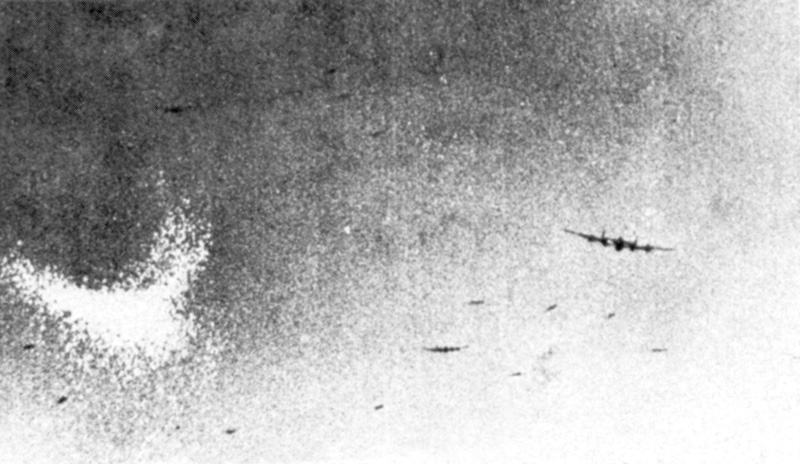
A Lancaster within the bomber stream dropping chaff — the crescent-shaped white cloud on the left of the picture

The bomber stream was a saturation attack tactic developed by the Royal Air Force (RAF) Bomber Command to overwhelm the nighttime German aerial defences of the Kammhuber Line during World War II.

The Kammhuber Line consisted of three layers of zones of about 32 km (17 nmi) long (north–south) and 20 km (11 nmi) wide (east–west). In each zone there were two German night fighter aircraft receiving ground-directed guidance from the Himmelbett controller within their zone. While the Himmelbett control center could only handle two fighters, this was adequate for dealing with the RAF Bomber Command tactic of sending its night bombers individually, with each bomber plotting its own route to the target, to avoid flak concentrations.

A map of part of the Kammhuber Line showing the 'belt' and nightfighter 'boxes' through which the bomber stream flew

At the urging of British scientific military strategist R. V. Jones, Bomber Command reorganized their attacks into streams carefully positioned to fly right down the middle of a cell.[1] The introduction of the GEE navigation system allowed the RAF bombers to fly a long, tight, formation in the dark—a 'stream of bombers' flying a common route at the same speed to and from the target, each aircraft being allotted a height band and a time slot in a bomber stream to minimize the risk of formation collision.

In one of the first applications of statistical operational research, the RAF estimated the number of bombers likely to be lost to enemy night fighters and flak, and how many would be lost through collisions. Minimizing the former demanded a densely packed stream, as the controllers of a night fighter flying a defensive 'box' could only direct a maximum of six potential interceptions per hour, and the flak gunners could not concentrate on all the available targets at once.

A typical bomber stream of 600 to 700 aircraft was on average 8 or 10 miles (13 or 16 km) broad, and 4,000 to 6,000 feet (1,200 to 1,800 m) deep.[2]

The bomber stream allowed a bombing raid to be completed in a shorter time, further overwhelming the defensive tactics of the German forces. The earlier RAF tactic of sending bombers on individual routes meant that it could take four hours before all its planes would pass over their target; the bomber stream reduced this window to 90 minutes.[3]

The first use of the bomber stream was the first 1,000 bomber raid against Cologne on the night of 30–31 May 1942.[3]

The tactic proved successful and was used until the last days of the war, when centrally-organised German air defences had ceased to exist.

See also

[edit]

References

[edit]

Further reading

[edit]
Revisions and contributorsEdit on WikipediaRead on Wikipedia
from Grokipedia
The bomber stream was a night-time saturation bombing tactic devised by the Royal Air Force Bomber Command during the Second World War to enable large formations of heavy bombers to penetrate and overwhelm the German Luftwaffe's integrated air defense system, known as the Kammhuber Line.[1] This involved routing individual aircraft from dispersed bases to converge at a predetermined point, forming a concentrated column typically 70 miles long and 4,000 feet deep, which saturated radar-guided night fighters, flak concentrations, and searchlights within defensive "boxes," thereby increasing the proportion of bombers reaching their targets.[1][2] Introduced amid high early-war losses from scattered raids, the stream relied on precise timing, altitude assignments, and navigation aids like Gee, supplemented by countermeasures such as Window chaff to jam ground radars.[2][1] The tactic's debut occurred during Operation Millennium, the first 1,000-bomber raid on Cologne on 30–31 May 1942, which demonstrated its potential by concentrating bomb tonnage on the target area and straining German civil defenses, though overall Bomber Command losses remained severe at around 4–5% per sortie due to collisions, flak, and fighters.[1] Initially effective in reducing interception rates by overloading the Himmelbett system of paired fighters per box, the bomber stream facilitated the area bombing campaign under Air Chief Marshal Arthur Harris, aiming to disrupt industrial production and civilian morale through firestorms in cities like Hamburg and Dresden.[2] German adaptations, including "Zahme Sau" free-ranging fighters equipped with airborne radar like Lichtenstein, eventually eroded its advantages by the latter war years, prompting further RAF innovations in electronic warfare and pathfinder marking.[1] Despite controversies over the ethical and strategic merits of indiscriminate bombing—yielding high aircrew casualties totaling over 55,000 killed—the stream's role in sustaining pressure on the Reich's war economy underscored its contribution to Allied victory, albeit at immense human cost.[3][2]

Historical Development

Pre-War RAF Bombing Doctrine

The interwar doctrine of the Royal Air Force (RAF), heavily influenced by Air Marshal Hugh Trenchard, emphasized strategic bombing as the service's primary offensive role, independent of army or naval operations. Trenchard, drawing from World War I experiences, advocated for unescorted bomber operations targeting enemy morale and infrastructure to shatter the will to fight, positing that bombers could penetrate defenses by maintaining steady courses at high altitudes where fighters would struggle to intercept.[4][5] This approach, formalized in RAF manuals such as Air Publication 1300, assumed bombers' defensive armament and formation flying would suffice against aerial threats, obviating the need for long-range fighter escorts due to technological constraints on fighter range and performance.[4] Pre-war planning centered on daylight precision bombing to strike specific industrial and military targets, enabled by devices like the Course Setting Bomb Sight (CSBS) introduced in the 1930s, which compensated for wind drift but required visual aiming and steady flight paths.[6] Formations typically consisted of tight "boxes" or waves of 3 to 9 aircraft for mutual gunnery support, with larger raids deploying multiple such groups spread across routes to maximize pressure on defenses while minimizing detection risks.[4] However, inherent limitations— including bombsight inaccuracies at speeds over 200 mph and altitudes above 10,000 feet, coupled with rudimentary navigation via dead reckoning and radio beams—often resulted in dispersed arrivals over targets, exacerbating errors and reducing concentration.[6] As an alternative amid growing doubts about daylight viability, the RAF conducted night bombing trials in the 1930s, such as during annual air exercises, where heavier bombers like the Vickers Virginia were tested for sustained area attacks under cover of darkness to evade fighters.[7] These experiments highlighted navigation challenges, including reliance on moonlight and basic directional aids, leading to even greater scattering without advanced pathfinding, yet doctrine retained a preference for daylight operations under the assumption that precision strikes could decisively impair enemy production.[4] This foundational emphasis on dispersed, self-reliant formations, rooted in optimistic assessments of bomber survivability and aiming technology, underscored the tactical rigidities that later prompted adaptations like concentrated streams.[5]

Early War Challenges and Adaptations

Following unsustainable losses in daylight raids during 1939 and 1940, RAF Bomber Command shifted primarily to night operations by mid-1940, as unescorted bombers proved vulnerable to Luftwaffe fighters equipped with superior numbers and tactics.[8] Early night raids employed dispersed formations in loose waves, intended to complicate German defenses, but this approach exacerbated navigation errors from reliance on dead reckoning, resulting in "creep-back" where trailing aircraft released bombs prematurely due to fatigue, uncertainty, or flak encounters, stretching attacks over 20-30 miles and diluting impact while prolonging exposure.[9] German countermeasures intensified these vulnerabilities; by July 1940, the Kammhuber Line—a coordinated network of radar stations (Freya for detection, Würzburg for tracking) and searchlight boxes—enabled efficient vectoring of night fighters into Himmelbett zones, raising RAF attrition from under 2% per sortie between June 1940 and February 1941 to around 3.5% thereafter as defenses matured.[9] [10] Poor bombing accuracy compounded the issue, with postwar analysis confirming 49% of bombs dropped from May 1940 to May 1941 fell in open country, far from targets, due to navigational drift and lack of precise aids.[11] The Butt Report, compiled by David B. Butt and released on 18 August 1941 at the behest of Lord Cherwell, empirically exposed these failings through examination of reconnaissance photographs from over 100 raids between June and July 1941, finding that only one-third of bombers claiming to have attacked their targets released within 5 miles, with rates dropping to one-tenth over the Ruhr and even lower over central Germany.[12] [13] This data-driven assessment, prioritizing photographic evidence over crew reports, underscored systemic inaccuracies from dead reckoning errors and cloud-obscured aiming, prompting doctrinal scrutiny and a pivot toward area bombing strategies, though initial responses focused on technological fixes rather than tactical concentration.[14] Transitional adaptations emerged in early 1942, including the operational debut of the Gee hyperbolic navigation system on 8-9 March, which provided ground-based radio signals for improved positioning over Britain and western Europe, enabling larger formations to converge more accurately without full stream compression.[15] Complementary efforts involved selective use of experienced crews as informal markers, precursors to formalized pathfinder units, yet raids remained dispersed, sustaining high losses until integrated with route saturation tactics later that year.[16] These measures mitigated some navigational shortfalls but failed to overwhelm evolving German radar-guided intercepts, highlighting the empirical necessity for massed, time-compressed assaults to saturate defenses.[9]

Formal Adoption in 1942

The Area Bombing Directive, issued on 14 February 1942, marked a pivotal shift for RAF Bomber Command, authorizing attacks on German built-up areas to disrupt industrial output and civilian morale through concentrated destruction rather than precision strikes on specific targets.[17] This policy, approved by the British War Cabinet amid mounting evidence of ineffective night bombing accuracy due to visibility limitations and defensive losses, aligned with the appointment of Air Chief Marshal Sir Arthur Harris as Commander-in-Chief on 22 February 1942.[18] Harris, a proponent of strategic area bombing, prioritized tactics enabling massed operations to achieve overwhelming scale, viewing dispersed formations as vulnerable to attrition.[19] The bomber stream tactic emerged from this context as the formal doctrinal response, concentrating hundreds of aircraft into a linear formation along a predetermined narrow corridor to exploit the limitations of the German Kammhuber Line's Himmelbett zones—fixed sectors each patrolled by limited night fighters guided by ground radar.[20] Operational research within Bomber Command modeled defense saturation mathematically, determining that routing 500 or more bombers through a 30-50 mile wide path, timed to traverse critical points in 20-30 minutes, would overload interceptors and flak prediction systems, which relied on sequential engagements rather than mass handling.[9] This approach contrasted with prior scattered raids, reducing exposure time across the defense belt while minimizing mid-air collisions via strict altitude and timing slots.[20] Harris strongly advocated the stream over area dispersal, arguing it preserved bomber numbers for sustained pressure on Germany, as dispersed flights invited higher proportional losses from the numerically superior Luftwaffe night defenses.[21] Formal adoption crystallized in early 1942 planning for raids exceeding 1,000 aircraft, integrating pathfinder marking with stream compression to ensure bomb loads saturated targets before defenses could fully respond.[9] This rationale, grounded in empirical loss data from 1941 raids showing vulnerability to radar-directed fighters, positioned the stream as essential for viable area bombing under nighttime conditions.[20]

Tactical Implementation

Formation and Routing Procedures

The bomber stream was organized as a linear concentration of heavy bombers, typically numbering several hundred aircraft, flying in loose, staggered echelons along a narrow corridor rather than a tight combat box formation. This arrangement prioritized defensive saturation over mutual protection, with aircraft maintaining separation of several hundred yards laterally and vertically to reduce collision risks during blackout conditions, where navigation lights were extinguished to evade visual detection.[22][23] Aircraft departed from bases at precisely timed intervals, calculated to ensure the entire stream compressed into a temporal window of approximately one hour over the target, as opposed to the multi-hour dispersal of earlier independent routing tactics that exposed bombers to prolonged defensive interception. Cruising altitudes were standardized between 18,000 and 23,000 feet, depending on load and weather, to exploit thinner air for efficiency while staying above most flak bursts, with all units adhering to a common altitude band to prevent vertical straggling.[24][25] Routing followed pre-planned tracks incorporating multiple dog-leg turns—abrupt course alterations of 30 to 90 degrees—to deceive German night fighter controllers into vectoring interceptors toward decoy headings or away from the true penetration corridor. These paths avoided predictable straight-line approaches that aligned with known radar coverage zones, such as the Kammhuber Line's predictive boxes, thereby concentrating the stream's passage through narrower, less defended gaps.[26][27] Cohesion was preserved through strict adherence to briefed waypoints, with radio silence enforced as standard operating procedure to minimize emissions detectable by German direction-finding systems, supplemented by dead-reckoning navigation and occasional visual references from ground features or early-arriving markers. Cruising speeds were uniformized at around 200 miles per hour indicated airspeed, adjusted for wind and load variations, to keep slower or damaged aircraft from falling behind and becoming isolated targets, as stragglers faced disproportionately higher loss rates due to opportunistic fighter attacks.[23][28]

Integration with Support Systems

The Pathfinder Force, formed on 15 August 1942 under the command of Air Commodore Don Bennett and headquartered at RAF Wyton, served as a specialized marking unit within RAF Bomber Command to enable precise target illumination for bomber streams.[29][30] Pathfinders, drawn from elite crews, flew in the leading elements of the stream to deploy Target Indicators (TIs)—250-pound pyrotechnic flares that burst into bright red, green, or yellow markers visible from up to 20 miles away—creating a concentrated aiming point over the objective.[31] This visual guidance system ensured the main force maintained tight formation and bombing density without relying on individual aircraft navigation, which often led to dispersion in earlier dispersed tactics.[32] Complementing TIs, the H2S centimetric ground-mapping radar, fitted to Pathfinder Lancasters from early 1943, allowed crews to identify urban and coastal outlines through cloud cover, refining approach paths and marker placement to sustain stream cohesion toward the target.[33] Simultaneously, the Oboe blind-navigation system, operational from late 1942, equipped select Pathfinder Mosquitoes with ground-based radio signals for hyperbolic fixes accurate to within 50 yards at 200 miles range, directing TI releases for lead markers and preventing lateral drift in the stream's corridor.[34] From its first combat use on 24 July 1943 against Hamburg, Window—strips of metallized paper cut to half-wavelength resonance for German 50 MHz radars—provided electronic countermeasures to shield stream penetration.[35] Deployed in synchronized salvos by dedicated support aircraft or stream elements at intervals of 10-20 seconds over a 10-mile front, Window generated swarms of false echoes on Freya early-warning and Würzburg fire-control radars, delaying detection and fighter interception until the stream had passed the Kammhuber Line's outer belts.[23] This jamming veil preserved the stream's integrity by minimizing early warnings that could prompt defensive scrambling and force evasive maneuvers, allowing sustained concentration on the marked target area.[36]

Scale and Coordination in Large Raids

Scaling bomber streams to 500–1,000 aircraft demanded extensive logistical adaptations, including airfield infrastructure expansions in eastern England to handle increased aircraft parking, runway extensions, and fuel storage for heavy bombers like the Lancaster and Halifax. By mid-1942, these enhancements enabled the simultaneous launch of over 1,000 sorties from dispersed bases, with staggered takeoffs to prevent congestion and facilitate stream formation.[8][37] Command and control for such operations were directed from RAF Bomber Command Headquarters at High Wycombe, which coordinated contributions from operational groups including Nos. 1, 3, 4, and 5 Groups, each managing squadrons across multiple airfields. Synchronization involved precise timing signals relayed via radio-telegraphy, ensuring groups converged into a single, narrow stream over the North Sea at designated altitudes and speeds to maintain cohesion over long distances.[38][39] Crew briefings emphasized operational precision, incorporating detailed route overlays, wind drift forecasts from the Meteorological Office, and alternate diversion procedures for cloud cover or icing conditions. Training regimens focused on night formation flying and inter-aircraft spacing—typically 200–300 feet vertically and lateral offsets—to mitigate collision hazards in dense streams, with repeated simulations yielding procedural familiarity that supported the execution of raids without disproportionate non-combat attrition.[40]

Key Operations

Operation Millennium (1942)

Operation Millennium, launched on the night of 30–31 May 1942, represented the Royal Air Force Bomber Command's inaugural application of the bomber stream tactic on a grand scale, dispatching 1,047 aircraft—primarily Wellingtons, Halifaxes, Stirlings, and Lancasters—against Cologne's industrial districts along the Rhine. The formation emphasized a narrow, timed corridor to compress the attack into roughly 90 minutes, aiming to saturate the Kammhuber Line's radar-guided defenses and concentrate firepower while minimizing exposure to flak batteries and night fighters. This approach drew from prior experiments but scaled up dramatically, with crews including trainees from Operational Training Units to achieve the requisite numbers.[41][42] Of the dispatched force, approximately 868 bombers successfully bombed the target area, releasing 1,455 tons of high-explosive and incendiary ordnance, which ignited widespread fires and demolished or damaged around 250 factories alongside extensive civilian infrastructure. German civil authorities reported 469 deaths and over 5,000 injuries, with the raid's intensity disrupting utilities and transportation but yielding limited long-term industrial paralysis due to dispersed targeting and navigational inaccuracies inherent in night operations. RAF casualties totaled 41 aircraft lost—22 over or near Cologne, mainly to flak (16) and night fighters (4)—equating to roughly 3.9% of the sortie rate, a marked improvement over earlier raids where dispersed formations suffered higher proportional attrition from vectored interceptors.[43][44][41] The operation's immediate aftermath validated the stream's core premise of defensive overload, as post-mission debriefs highlighted reduced per-aircraft vulnerability through sheer volume, though German records indicated some radar plotting succeeded against the tail-end formations. In Britain, the raid elevated public and governmental confidence in strategic bombing's viability, countering skepticism after the command's high 1941 losses and prompting media portrayals of decisive prowess. On the German side, it spurred Luftwaffe reallocations toward expanded night fighter production and training, underscoring the tactic's psychological strain on defenders despite the raid's modest material disruption relative to tonnage expended.[42][41]

Berlin Raids and Subsequent Applications

The Battle of Berlin, spanning November 1943 to March 1944, marked a demanding test of the bomber stream tactic against a remote target deep in German territory, requiring extended flight times and fuel loads that strained aircraft performance. RAF Bomber Command launched 19 major raids, typically deploying streams of 400 to 800 heavy bombers—predominantly Lancasters—stretched over 70 to 100 miles to saturate defenses and minimize early detection by ground radar. These formations followed circuitous routes, such as veering south over Belgium or east over the North Sea, to bypass concentrations of night fighters and flak along direct paths from England.[45] Tactical refinements included prioritizing overcast or moonless nights to impair visual interception by Luftwaffe fighters, which had exploited moonlight in earlier raids to inflict heavy attrition on dispersed formations. Bombers climbed to altitudes exceeding 20,000 feet for better evasion, though icing and turbulence over the Alps or weather fronts often forced deviations, complicating stream cohesion. Despite these measures, losses averaged around 4-5% per sortie—higher than shorter-range operations—due to the extended exposure to fighters vectored by improved German radar and the challenges of precise bombing amid cloud cover and strong winds. For instance, the raid on 2 December 1943 involved 458 aircraft but saw 40 shot down, highlighting the tactic's vulnerabilities against adaptive defenses.[8] The bomber stream proved effective in other mid-war operations, notably the Hamburg raids of Operation Gomorrah in late July 1943. On the night of 27-28 July, a stream of 787 RAF bombers, guided by pathfinder markers and Window to jam radar, concentrated incendiaries over the city in under 50 minutes, overwhelming fire services and generating a firestorm that destroyed 60% of Hamburg's dwellings and killed approximately 40,000 civilians. The tactic's compression of attacks enabled rapid ignition across a wide area, exploiting wind conditions to propagate flames, though it relied on favorable weather absent in many Berlin missions.[46]

Evolution During Later War Phases

As German night fighter forces adopted Zahme Sau tactics from late 1943, enabling greater infiltration of the bomber stream via ground-controlled intercepts and onboard radar, RAF Bomber Command persisted with the formation but augmented it with intensified electronic countermeasures, including continuous Window deployment and radio jamming via ABC (Airborne Cigar) aircraft embedded in the stream to disrupt German direction-finding.[9] These adaptations countered the evolving threat, with streams maintaining a compact profile—typically 50-100 miles long—to minimize time over hostile territory while saturating radar-guided flak and fighters, as evidenced by sustained low loss rates relative to sortie volume in mid-1944 raids despite heightened German activity.[25] In 1944, the bomber stream integrated into the Combined Bomber Offensive under the Pointblank directive, complementing USAAF daylight formations by focusing on night attacks against synthetic oil plants and transportation infrastructure, where longer-range Halifax Mk III and Lancaster variants, equipped with improved engines and fuel capacity, enabled deeper penetrations without compromising stream cohesion.[8] Streams were occasionally compressed in length and depth—reducing from earlier 1943 maxima of over 300 aircraft in a single file—to evade persistent fighter packs, yet retained for overwhelming flak concentrations at targets like the Politz oil facility, where concentrated bombing runs proved decisive in March 1945 despite defensive fire.[47] While specialized units like No. 617 Squadron shifted toward precision strikes using Tallboy bombs—deployed from modified Lancasters in looser formations against hardened targets such as the Dortmund-Ems Canal in September 1944—the main force upheld streams as core to area operations, ensuring flak suppression through sheer volume on oil and rail hubs.[25] This duality reflected causal trade-offs: precision weapons mitigated collateral damage risks but lacked the defensive saturation of massed streams against residual heavy guns. By early 1945, Luftwaffe night fighter strength had plummeted—down approximately 70% from 1943 peaks due to fuel scarcity, pilot attrition, and Allied air superiority—diminishing the imperative for rigid stream discipline, though the tactic endured in support of ground campaigns, including March raids on German transport nodes ahead of the Rhine crossing to disrupt reinforcements.[48] Final iterations, such as the April 1945 stream attacks on Kiel and Swinemünde, underscored the tactic's adaptability until VE Day, transitioning from defensive saturation to opportunistic exploitation of weakened foes.[8]

Effectiveness and Analysis

Advantages in Saturating Defenses

The bomber stream tactic saturated the German Kammhuber Line by funneling large formations—often hundreds of aircraft—through narrow corridors over brief periods, overwhelming Himmelbett zones designed to vector a single night fighter onto intruders at a time.[49] Each zone's ground-controlled interception relied on limited Würzburg radar coverage, typically 20-40 miles, restricting simultaneous tracking and engagement to a small fraction of the incoming stream.[9] This overload, achieving concentrations of about 30 bombers per minute, minimized per-aircraft exposure by exhausting defensive response capacity before the full force traversed defended airspace.[20] Bomber Command's Operational Research Section documented the tactic's impact through comparative loss data: pre-stream major raids from February to May 1942 averaged 3.7% losses, often reaching 4.8% in later waves, whereas the debut stream application in the 1,000-bomber Cologne raid on 30-31 May 1942 yielded 1.9% overall.[9] These reductions stemmed from the stream's compression of the raid timeline, denying defenders time to cycle fighters effectively across the formation.[20] The approach also induced psychological and operational disruption, compelling Luftwaffe controllers to scatter night fighters along predicted routes to cover the stream's extent, thereby diluting interception density against the core threat and complicating coordinated attacks.[20] This dispersal exploited the rigidity of zone-based control, where fixed plotting tables and radio direction struggled to prioritize amid the influx.[49]

Quantitative Assessment of Losses

RAF Bomber Command recorded 55,573 aircrew fatalities during World War II, out of approximately 125,000 who served, yielding an overall death rate of about 44 percent; the majority of these losses occurred between 1942 and 1945 amid intensified night bombing campaigns.[50][51] Loss rates per operation averaged 2.2 percent across all Bomber Command sorties, though rates over German targets were higher, often exceeding 4 percent during peak defensive periods like the Battle of Berlin in late 1943.[52] The bomber stream formation, by concentrating aircraft into a narrow corridor, minimized individual exposure to night fighters and flak compared to dispersed approaches, correlating with operational loss rates typically between 2 and 4 percent for major stream raids in 1943–1944, versus higher rates in pre-stream dispersed formations that left bombers more vulnerable to the Kammhuber Line's radar-guided intercepts.[6] Specific raids illustrate stream performance variability. The Nuremberg raid of 30–31 March 1944, employing the stream tactic with 795 bombers dispatched, resulted in 95 aircraft lost—a 12 percent rate—due to anomalous conditions including a bright moon illuminating the contrails, failed diversions exposing the main force, and early detection by German fighters, leading to 545 aircrew killed.[53][54] In contrast, typical stream raids like the Berlin attack on 24 March 1944 saw only 1.3 percent losses (9 out of 705 aircraft), while overall Battle of Berlin operations averaged 5.1 percent across 1,047 bombers lost in 1943–1944, reflecting streams' role in sustaining large-scale efforts despite defenses.[55] Comparatively, USAAF Eighth Air Force daylight operations without long-range escorts prior to mid-1944 incurred higher per-mission losses, such as 13 percent during "Black Week" in October 1943 (148 bombers lost from attacking forces), averaging 6–8 percent for unescorted deep penetrations in 1943, exceeding contemporaneous RAF night stream rates of around 2.5–4 percent.[56][6] Stream tactics thus enabled RAF Bomber Command to maintain sortie rates with relatively lower per-operation attrition than early USAAF daylight raids, though cumulative exposure over multiple missions contributed to the force's high total casualties.[57]

German Countermeasures and Adaptations

The Luftwaffe's initial response to RAF night bombing relied on the Kammhuber Line, a network of Himmelbett control sectors where ground radar stations directed individual night fighters to isolated intruders using the "single pine" tactic. This system proved inadequate against concentrated bomber streams, which saturated sectors and minimized encounters, while the RAF's introduction of Window on July 24, 1943, generated radar clutter that blinded Freya and Würzburg systems, sharply reducing guided intercepts.[58] To counter these developments, Major Hajo Herrmann proposed the Wilde Sau ("wild boar") tactic, first implemented on July 3, 1943, during the Cologne raid. This method dispatched single-engine day fighters like Bf 109s and Fw 190s to the target area, where pilots used visual cues—such as city fires, searchlights, and burning bombers—to locate and engage the stream independently of radar. Wilde Sau yielded immediate results on moonlit nights, with Luftwaffe claims of downing dozens of bombers per operation, though effectiveness waned against RAF countermeasures like decoy raids and reduced stream concentrations over targets.[59] Parallel advancements included the Zahme Sau ("tame boar") refinement for radar-equipped twin-engine night fighters, emphasizing flexible ground-directed hunting within jammed environments, and passive detection tools like the Naxos receiver, which homed on H2S radar pulses from RAF pathfinders to guide fighters toward stream cores. These passive systems bypassed Window's jamming, enabling persistent threats despite electronic disruptions.[58] A key tactical innovation was the widespread fitting of Schräge Musik—upward-angled autocannons or machine guns at 60-90 degrees on aircraft like Ju 88s and Bf 110s—starting in late 1943. By positioning beneath the stream, fighters exploited the bombers' vulnerable undersides, where defensive guns were few and firing angles limited, often achieving surprise kills without alerting gunners. This weapon system inflicted heavy casualties during the 1943-1944 winter, with RAF loss rates climbing above 5% in major raids, as ventral attacks evaded typical formation protections and proved difficult for crews to counter effectively.[60][61] Collectively, these adaptations—shifting from rigid radar dependency to visual, passive, and opportunistic intercepts—diminished the bomber stream's saturation advantage by 1944, as fighters could now penetrate dense formations and target weaknesses, sustaining Luftwaffe kill rates even as overall resources dwindled.[58]

Criticisms and Controversies

Tactical Limitations and Shortcomings

The bomber stream tactic proved vulnerable to meteorological factors, particularly crosswinds that disrupted formation integrity and navigation accuracy. Variable winds frequently caused the stream to drift off course, dispersing aircraft over wider areas and increasing individual vulnerability to interception. A notable example occurred during the Nuremberg raid of 30–31 March 1944, when unforecast strong winds scattered the 795-aircraft formation across a broad front, enabling German night fighters to engage stragglers more effectively and contributing to the loss of 95 bombers.[62][63] Compounding these issues was the creep-back effect, wherein later waves of bombers, encountering flak or sighting fires from initial strikes, released payloads prematurely to bomb visible conflagrations rather than precise markers. This shifted the concentration of destruction rearward from the target, with patterns extending up to 30 miles in raids on Berlin, diluting destructive focus and complicating post-raid assessments of efficacy.[2][64] The dense linear formation inherent to the stream elevated risks of mid-air collisions and friendly fire, as aircraft flew in close proximity under blackout conditions with limited visibility. While procedural mitigations such as specified altitudes, timings, and minimal lighting reduced incidents, the tactic's reliance on tight spacing in variable weather nonetheless led to avoidable operational losses from such accidents.[65] Scalability constraints further limited the tactic's reliability for very large raids. Assemblies exceeding 1,000 bombers, as in the exceptional 1942 thousand-bomber operations against Cologne, Essen, and Bremen—which incorporated reserve and training units—strained briefing, takeoff sequencing, and en-route cohesion, resulting in excessive stretch and dispersal. Such maxima proved unsustainable routinely due to airfield capacity, crew fatigue, and heightened exposure duration over defenses, confining massive single-stream applications to infrequent use thereafter.[43][66]

Debates on Overall Strategic Impact

The bomber stream tactic, by enabling concentrated night raids that overwhelmed German night fighters and radar-directed defenses, facilitated area bombing campaigns aimed at crippling Germany's industrial base and civilian morale. The United States Strategic Bombing Survey (USSBS) assessed that such operations, peaking in 1943–1944, imposed direct and indirect losses on German aircraft production totaling approximately 18,000 planes from July 1943 to January 1945, through factory damage, workforce disruption, and resource diversion, thereby constraining Luftwaffe expansion despite nominal output increases via dispersal.[67][68] This perspective holds that streams amplified the strategic pressure, contributing to broader economic strain that USSBS deemed a key factor in Germany's collapse, as bombing absorbed up to 75% of German fighter strength by late 1944. Critics, however, argue the tactic's strategic dividends were limited, with overstated effects on morale and inefficient resource allocation. Albert Speer, in his postwar memoirs, testified that Allied bombings failed to demoralize the German populace, instead fostering resilience and heightened production efforts under adversity, as "the hardships...did not weaken the morale."[69] The official British history by Charles Webster and Noble Frankland similarly concluded that early area bombing phases yielded marginal industrial disruptions relative to costs, with the commitment of vast RAF resources potentially delaying support for other fronts like the Normandy invasion preparations, rendering the offensive more supplementary than transformative.[70][71] A consensus among postwar evaluations views the bomber stream as tactically innovative for penetration but strategically incremental: it eroded German capacity incrementally alongside precision strikes on oil and transport from 1944, yet required Soviet advances and Western ground operations to achieve victory, as no single air campaign proved war-ending in isolation.[72]

Casualty Rates and Operational Costs

RAF Bomber Command suffered 55,573 aircrew fatalities during World War II, representing approximately 44% of the roughly 125,000 personnel who served in the command. The bomber stream tactic, by concentrating large formations—often 500–1,000 aircraft—enabled saturation of German night fighter and flak defenses, which paradoxically improved survival odds per individual sortie compared to earlier dispersed raids where loss rates occasionally exceeded 10%.[9] Pre-stream operations in 1942 saw average losses around 4–5% per major raid, dropping to 2–3% by mid-1943 with streams combined with electronic countermeasures like Window, though the scale of operations amplified absolute casualties.[57] On the German side, bomber streams facilitated area bombing campaigns that overwhelmed the Kammhuber Line, contributing to an estimated 410,000 civilian deaths from Allied strategic bombing overall, with RAF night operations accounting for a substantial portion through incendiary and high-explosive attacks on urban-industrial targets.[73] These raids also inflicted military and forced-labor casualties in factories, though precise separation remains challenging due to overlapping urban-industrial layouts; for instance, the March 1943 raid on Essen alone killed over 700 civilians while disrupting Krupp works output temporarily.[74] Industrial impacts varied: Ruhr Valley coal and steel production, vital to 60% of Germany's output, faced repeated disruptions—e.g., post-Dam Busters raid in May 1943, valley flooding halted some operations for weeks—but overall armaments production continued rising until late 1944, indicating streams' area tactics strained rather than decisively halved capacity without sustained precision follow-up.[75] Material costs were immense, with Bomber Command losing over 8,000 heavy bombers to enemy action, accidents, and attrition, each Lancaster or Halifax requiring thousands of man-hours and scarce resources like aluminum and engines amid Britain's stretched wartime economy.[76] The strategic bombing offensive totaled £2.78 billion in direct costs—equivalent to about 12% of Britain's military expenditure—averaging £2,911 per operational sortie, diverting production from fighters, shipping, and ground forces and fueling postwar debates on whether the human and industrial toll justified the incremental disruptions to German war-making before 1944's transportation plan.[77] These expenditures, while enabling defensive saturation, underscored the tactic's reliance on mass to achieve marginal per-mission efficiency gains.

Legacy and Influence

Post-War Military Evaluations

Post-war assessments by RAF Operational Research (OR) sections, drawing on wartime data analyzed in the immediate aftermath of the conflict, confirmed the bomber stream's effectiveness in concentrating aircraft to saturate German night defenses, thereby minimizing interception rates relative to dispersed formations. OR studies emphasized how techniques like the "Shaker" method—randomizing stream paths to disrupt predictors—reduced losses by overwhelming the Luftwaffe's Himmelbett system, with empirical analysis showing improved survival odds during high-density raids over targets like the Ruhr. These findings endorsed the saturation principle as a doctrinal cornerstone, influencing post-war RAF and Allied planning for massed bomber operations in potential conflicts against peer adversaries.[78][3] The United States Strategic Bombing Survey (USSBS), in its 1945-1946 reports on the European theater, credited RAF Bomber Command's stream tactics with compelling the Luftwaffe to reallocate fighters and resources toward nocturnal interception, achieving up to 40% of German night fighter sorties against British raids by late 1943 and contributing to overall attrition of Axis air assets. However, the USSBS critiqued the doctrine's heavy dependence on area bombing, attributing this to persistent navigational errors—where only about 20-30% of bombs fell within five miles of intended targets due to factors like cloud cover and electronic interference—rather than precision strikes feasible in daylight operations. This evaluation underscored the streams' tactical utility against fortified defenses but highlighted strategic inefficiencies in non-industrial damage.[79][80] Analyses of navigation limitations, informed by declassified RAF records and OR retrospectives, affirmed the bomber stream's necessity as a counter to superior German radar integration, such as the Kammhuber Line, where dispersed flights faced disproportionate losses from directed fighters. Despite average bombing dispersions exceeding 10 miles, the tactic's compression of raid timelines—often to 90 minutes over targets—maximized psychological and material disruption while mitigating exposure, a pragmatic adaptation validated by loss rate data dropping from 5% per sortie in 1942 to under 2% by 1944 in optimized streams. These insights shaped early Cold War evaluations, prioritizing defensive saturation over unescorted precision amid evolving threats.[2][78]

Applications in Modern Air Warfare

In the Cold War period, the U.S. Strategic Air Command (SAC), established in 1946, incorporated lessons from World War II bomber operations into its early doctrinal emphasis on massed formations for mutual protection during deep penetration strikes, aiming to saturate enemy interceptor responses through concentrated force.[81] SAC's initial planning for nuclear retaliation, as outlined in wartime exercises and post-war analyses, drew partial conceptual inspiration from such saturation tactics to achieve overwhelming local superiority against projected Soviet air defenses.[82] Soviet air forces similarly explored massed bomber raids in the 1950s, employing formations of Tu-16 and later Tu-95 aircraft to probe NATO defenses, though these were limited by the shift to high-speed jet bombers and ground-based missiles. However, the proliferation of radar-guided surface-to-air missiles (SAMs), all-weather interceptors, and electronic countermeasures from the 1950s onward prompted a doctrinal pivot toward dispersed, low-altitude ingress routes and individual aircraft survivability, rendering tight bomber streams obsolete for high-threat environments.[83] During Operation Desert Storm in January-February 1991, coalition forces adapted saturation principles for Suppression of Enemy Air Defenses (SEAD), launching over 2,000 anti-radiation missiles and decoys in the opening nights to overload Iraq's SAM network of approximately 4,000 launchers, enabling unchallenged follow-on bombing campaigns.[84] The Gulf War Air Power Survey documents how this involved coordinated waves of F-4G Wild Weasel aircraft, EA-6B jammers, and cruise missiles to achieve temporary radar blackouts, akin to overwhelming point defenses but leveraging precision standoff weapons rather than massed overflight.[85] Iraqi forces expended fewer than 50 SAMs against coalition bombers after initial salvos, highlighting the effectiveness of volume-based suppression in degrading integrated air defense systems (IADS).[86] In modern contexts, drone swarms and loitering munitions embody evolved saturation tactics, deploying dozens to hundreds of low-cost unmanned systems to flood enemy sensors and effectors, compelling inefficient resource allocation by defenders.[87] U.S. Department of Defense concepts, such as those in collaborative combat aircraft programs tested since 2020, prioritize swarm autonomy for attritable mass attacks on high-value targets, bypassing the vulnerabilities of manned bomber streams through expendable platforms and networked data links.[83] Recent analyses indicate no doctrinal revival of World War II-style concentrated streams, as hypersonic threats, directed-energy weapons, and AI-driven intercepts favor standoff precision and distributed lethality over massed vulnerability.

References

User Avatar
No comments yet.