Hubbry Logo
Night combatNight combatMain
Open search
Night combat
Community hub
Night combat
logo
8 pages, 0 posts
0 subscribers
Be the first to start a discussion here.
Contribute something
Night combat
Night combat
from Wikipedia
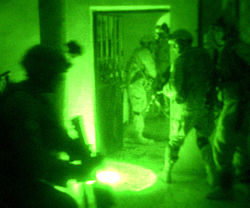
Paratroopers in Fallujah, Iraq, conduct a night raid using Night Vision Goggles
Paratroopers in Fallujah, Iraq conduct a night raid using night vision goggles in 2003
Seen through a night vision device, United States Army Sergeant Andrew Burch and an Afghan soldier scan a tree line for militants with an IR laser sight during Operation Champion Sword in 2009

Night combat is combat that occurs during the hours of darkness. It is distinguished from daytime combat by lower visibility and its reversed relation to the circadian cycle. Typically, night combat is favorable to the attacker, with offensive tactics being focused on exploiting the advantages to maximum effect.[1][2] Defensive night tactics mainly focus on negating the advantages given by the night to the attacker.[3]

Effects of night

[edit]

The most obvious effect of darkness is reduced visibility. This affects a soldier's ability to observe friendly troop movements, understand terrain, and especially affects perception of enemy movements and positions. Officers find that darkness hampers many aspects of command, including their ability to preserve control, execute movement, firing, maintenance of direction, reconnaissance, security, and mutual support. A U.S. Army report on the history of Japanese warfare described an instance of this confusion:

An example is recorded in the history of Japan when about 1180 a force [sic] of the Heike confronting a force of the Genji across the Fuji river (Shizuoka Prefecture) beat a hasty retreat one night due to mistaking the noise made by water fowl for an attacking Genji force.[citation needed]

Indeed, a side effect of the reduced visibility is heightened audibility, as soldiers focus more on what they can hear. There are many instances of soldiers losing their bearings at night due to flashes from guns or enemy searchlights.[4] The difficulties of perception lend themselves to fear of the unknown. Soldiers under fire can't tell where the fire originates and can't devise appropriate countermeasures. Such uncertainty is associated with feelings of loneliness and helplessness, and creates a tendency to overestimate enemy strength or be excessively pessimistic of the combat situation.[4]

In addition, without the aid of artificial illumination, a soldier's marksmanship is negatively affected in total darkness. According to a report by Jean L. Dyer, Seward Smith and Nancy R. McClure,

Prior to the introduction of aided night vision devices, effective firing at night with a rifle was limited to very close distances, typically within 50 meters. The ability to hit targets was dependent upon a soldier's ability to acquire targets in their sights, which in turn, depended greatly upon the amount of natural and artificial illumination.[5]

History

[edit]

Night operations have been subject to vast shifts in effectiveness and frequency throughout history, as tactics and technology became more sophisticated.

Classical antiquity

[edit]

Night fighting between standing armies was rare in ancient times. Night logistics were mostly limited to the carrying of torches or navigation by what little light was provided by the stars or moon. However, circumstances occasionally necessitated fighting at night. Usually due to the massive nature of the battles, they could not be resolved in one day, and combat could not be cleanly disengaged as darkness fell, or prevented as armies camped near each other overnight.[original research?] Sieges which lasted for weeks, months or, even years were often fought day and night. Below are a few notable examples.

Ancient historian Diodorus claims that at the Battle of Thermopylae the Spartans attempted to assassinate Persian King Xerxes by infiltrating his camp at night.

"They immediately seized their arms, and six hundred men rushed into the camp of five hundred thousand, making directly for the king's tent, and resolving either to die with him, or, if they should be overpowered, at least in his quarters. An alarm spread through the whole Persian army. The Spartans being unable to find the king, marched uncontrolled through the whole camp, killing and overthrowing all that stood in their way, like men who knew that they fought, not with the hope of victory, but to avenge their own deaths. The contest was protracted from the beginning of the night through the greater part of the following day. At last, not conquered, but exhausted with conquering, they fell amidst vast heaps of slaughtered enemies."[6]

At the Battle of the Teutoburg Forest, over a period of 3 days, an alliance of Germanic tribes wore down and eventually annihilated 3 Roman legions (about 16,000 to 20,000 men). The Romans attempted several defensive night tactics. On the first night they managed to erect a fortified camp. On the second night, they marched at night in an attempt to break through the encircling Germanic forces, but the Germans had already built a wall in their way, and when combat resumed the following day, the Romans were defeated.

The Battle of the Catalaunian Plains saw exceptional chaos caused by nightfall. The night before the battle proper, one of the Roman allied forces stumbled on a band of Hunnic troops and in the resulting skirmish, as many as 30,000 (unverified) men were killed. Later in the battle, Thorismund, son of king Theodoric, accidentally walked into Attila the Hun's encampment while attempting to return to his own forces at night. He was wounded in the ensuing mêlée before his followers could rescue him and withdraw. That same night, the Roman commander Flavius Aëtius became separated from his men and, believing that disaster had befallen them, had to stay the night with his Germanic allies.

Early Modern

[edit]

The Night Attack of Târgoviște pitted Vlad The Impaler of Wallachia against Mehmed II of the Ottoman Empire. Vlad reportedly disguised himself as a Turk and walked freely throughout the Ottoman camp in an effort to find Mehmed's tent and learn about the organization of his army. One chronicle of the battle says that Mehmed disallowed his troops to exit their tents so as not to cause a panic in case of an attack. According to that chronicle, Vlad learned of this and planned his attack at night knowing that the enemy soldiers would have to remain in their tents. Accounts of the battle and its casualties are mixed, but in the end it was a Wallachian victory, with around 5000 Wallachian casualties compared to around 15,000 for the Ottomans. The Ashanti army sometimes, although seldom, fought at night. The Ashanti engaged in a night attack at Dodowa in 1826. The army was led by torch-carrying scouts. [7]

World War I

[edit]

The adoption of illumination rounds led to an improvement in the ability to carry out night operations. These projectiles were fired from howitzers and field guns in the direction their light was required. The first illumination rounds (also called starshell) were modified shrapnel shells which ejected magnesium pellets. These were somewhat ineffective, and were soon replaced by improved designs that had greater candle power, and a parachute to prolong the descent to ground. Tracer ammunition was also introduced during World War I. Tracers made marksmanship at night easier for soldiers because they could observe the trajectory of their shots and correct their aim accordingly.

World War II

[edit]

Nighttime continued to have a significant impact on combat during World War II. Particularly in the Pacific Theater, the Japanese military was proficient in night warfare, as acknowledged by the Allies. In anticipation of a conflict with the Soviet Union, whose numbers of tanks, planes, and artillery were vastly superior, the Japanese developed a series of training manuals designed to counter these advantages. The "Red Books" (classified materials bound in red paper) emphasized the advantages of attacking at night, in the evening, and at dawn. These tactics later proved useful against the other Allies who were similarly better equipped.

The Japanese used this advantage to win engagements where they were severely outnumbered in China and against the Allies at sea. It wasn't until late in the war that early warning technologies of the Allies subverted their surprise attacks at night, reducing their effectiveness. These tactics completely broke down once the Japanese military replaced their well-trained troops with hastily trained recruits.[4]

Another type of illumination device was the tripflare, consisting of a pyrotechnic instrument activated by tripwire, planted near trails to provide early warning of enemy movement. By 1944, the Wehrmacht was making extensive use of tripflares in Italy, after their perimeters had been repeatedly infiltrated at night by U.S. Army Rangers. Tripflares helped foil an attack launched by the Fifth Army on January 20 at the Rapido River.[8]

Post-World War II

[edit]

In the First Battle of al-Faw in 1986, during the late stages of the Iran–Iraq War, one of the elements that contributed to the success of Iranians was their use of dug-in infantry which would move only at night and during poor weather. This reduced the Iraqis' advantage in armor. The Iranian forces had been trained in night warfare prior to the battle.

Tactics

[edit]

Perhaps the most important deciding factor in a battle at night is preparation. This includes training, reconnaissance, and planning. As with any military operation, leadership is important in both the high-ranking officers and the low-level squad and unit leaders.[3]

Offensive tactics

[edit]

The decision to engage at night or continue an engagement at night is usually made by the attacking force. Combat continued at night is aimed at exploiting an advantage gained from an attack during the day or similarly denying the defending force the opportunity to regroup or reinforce. Combat initiated at night can either be aimed to gain an advantage (such as territory or prisoners) which is then held during the following day or to harass and demoralize the enemy before disengaging prior to sunrise. The latter case is considered a raid.[citation needed]

Historically, night combat involves greater risk and reward compared to similar battles in the daytime. Victories can be crushing, with the defending side taken completely by surprise and hardly firing a shot in response to the attack. Alternatively, defeats can be disastrous, with huge casualties resulting from attacking armies floundering chaotically while they themselves are ambushed in pitch darkness.[citation needed]

See also

[edit]

References

[edit]
Revisions and contributorsEdit on WikipediaRead on Wikipedia
from Grokipedia
Night combat, also referred to as nocturnal warfare, involves operations and engagements conducted under low-light conditions during nighttime, exploiting to achieve tactical advantages such as surprise, concealment of troop movements, and reduction of exposure to enemy observation or aerial attacks. This form of warfare has been a critical element in since ancient times but gained heightened importance in the due to the dominance of air power during daylight hours, compelling forces to adapt specialized tactics to counter visibility limitations and environmental challenges. Key principles of night combat emphasize meticulous planning, disciplined execution, and reliance on non-visual senses like hearing, as reduced visibility demands self-reliant troops trained in orientation by stars, compass, and terrain to maintain cohesion and initiative. Night operations have evolved significantly over time, with notable tactical developments during driven by the need to counter air superiority, and post-war advancements in illumination, , and sensor technologies enhancing capabilities across conflicts. Psychological factors play a pivotal role, with darkness amplifying soldiers' insecurity and fatigue—rural recruits often adapting more readily than urban ones—while physical demands test endurance through silent movement and marksmanship under duress, necessitating substantial night training for proficiency. Contemporary night combat faces challenges from peer adversaries like and , who employ advanced night-vision systems and conduct large-scale night exercises, eroding previous U.S. advantages and highlighting the need for signature reduction techniques like thermal cloaks to avoid detection by strobes or lasers. Recent conflicts, including the ongoing Russian-Ukrainian War as of 2025, illustrate effective night tactics such as Ukrainian hit-and-run ambushes, drone strikes (e.g., 13 drones targeting on November 23, 2023, and Altius 600M operations in July 2025), and raids disrupting Russian advances, with advancements like the ENVG-B goggles aiding in nighttime engagements against North Korean forces in (January 2025). These underscore the role of initiative, rapidity, and electronic warfare countermeasures in mitigating friction from unreliable communications and scarce sustainment, alongside reports of Russian limitations in affordability. U.S. , as outlined in publications like ATP 3-21.8 and Circular 3-21.60, calls for expanded night training through situational training exercises (STXs) spanning multiple nights and incorporation of massed drones to prepare for large-scale combat operations, ensuring forces can transform night from a domain of boredom and terror into one of controlled advantage.

Environmental and Physiological Effects

Visibility Challenges

In low-light conditions, human vision shifts from photopic (cone-dominated) to scotopic (rod-dominated) mode, severely limiting . Cone cells, concentrated in the fovea, require higher illumination levels to function and are responsible for color perception and high-resolution central vision; in darkness, they become largely inactive, resulting in a complete loss of color discrimination and reliance on for imaging. , far more numerous and sensitive—about 1,000 times more so than cones—enable detection in dim environments but provide lower and are primarily peripheral, leading to blurred details and impaired depth judgment due to reduced contrast and binocular cues. This visual degradation directly compromises targeting accuracy in combat scenarios. Without illumination aids, hit probabilities for firearms and artillery plummet, with studies indicating reductions of 50-90% depending on distance and conditions; for instance, in poor ambient light, the probability of hitting a target at 200 meters drops to approximately 6%, compared to over 90% at close range (50 meters) under better illumination. Error rates in aiming increase due to misjudged distances and poor target identification, exacerbating risks in dynamic engagements. Environmental factors further intensify these visibility challenges. Moonlight phases dictate natural illumination levels, with a providing about 0.1-0.27 —enough for basic shape recognition—while a quarter moon offers only 0.001-0.01 , and yields as little as 0.0001 , rendering distant objects nearly invisible. Urban settings introduce and reflective surfaces that scatter unevenly, often creating or , whereas rural areas may offer clearer but minimal natural glow; adverse weather like or rain scatters remaining light particles, reducing effective by an additional 50% or more in overcast conditions. Human eyes have inherent biological limits to adapting to such darkness, primarily through rhodopsin regeneration in rod cells. After exposure to bright light, full dark adaptation requires 20-30 minutes for rhodopsin recovery, during which sensitivity increases up to 1,000,000-fold, but incomplete adaptation leaves soldiers vulnerable to sudden engagements with persistently low acuity.

Sensory and Psychological Factors

Night conditions disrupt non-visual senses, compelling combatants to rely more heavily on audition and olfaction, which can lead to disorientation and erroneous threat perception. In darkness, sound propagation alters due to reduced visual cues, creating acoustic echoes and shadows that distort distance and direction judgments; for instance, urban environments amplify reverberations, impairing soldiers' ability to localize threats accurately during operations. Olfactory detection becomes critical at night, as troops are trained to sense odors—such as enemy presence or explosives—by facing into the wind at a 45-degree angle to enhance sensitivity, though this reliance can overwhelm perception when combined with other stressors. Psychological impacts of night combat intensify due to prolonged darkness, fostering heightened fear and "night terrors" akin to trauma-related nightmares, which affect up to 31% of military personnel with sleep disturbances and manifest as re-experiencing combat events during rest. Sustained alertness exacerbates fatigue, with studies showing reductions in reaction times under prolonged stress and sleep deprivation, while isolation in low-visibility settings erodes morale, contributing to interpersonal conflicts and emotional exhaustion as observed in Vietnam-era troops. These effects compound visibility challenges, amplifying overall sensory overload and impairing cognitive processing. Night operations degrade through confusion-driven errors, notably increasing incidents; for example, in the , multiple air amicicide incidents occurred in reduced conditions, and in Desert Storm, 11 of 12 vehicular incidents took place at night. Physiologically, night combat elevates levels due to deprivation—often less than 5 hours per night—triggering a stress response that sustains heightened but impairs error-free performance in extended missions. This hormonal surge, combined with chronic , reduces overall combat effectiveness by 15-25%, as seen in studies of under operational sleep restriction, leading to lapses in judgment and coordination.

Tactical Approaches

Offensive Maneuvers

Offensive maneuvers in night combat prioritize the exploitation of darkness to achieve surprise, disrupt enemy cohesion, and seize initiative through rapid, coordinated actions. Core principles revolve around , ambushes, and raids, where units advance undetected to close with the enemy before detection. emphasize silent movement, such as maintaining noise and light discipline while using devices to navigate terrain, allowing small teams to penetrate lines without alerting defenders. Bounding , adapted for low light, involves alternating advances by elements spaced 20 meters apart, with the overwatch providing covering fire to suppress potential threats while the bounding team moves forward under cover of shadows. Ambushes leverage concealed positions to channel enemy movement into kill zones, employing hasty setups for immediate engagement or deliberate ones with emplaced weapons like machine guns for sustained fire superiority. Raids focus on swift execution—infiltrate, with of action using direct and indirect fires, then withdraw—often timed for pre-dawn hours to maximize disorientation from transitioning light conditions. Terrain plays a pivotal role in concealment, with units approaching under cover of natural obstacles like woods, swamps, or to movement and sounds, such as by aligning advances with or . Speed is critical to compensate for reduced , but formations remain dispersed at 1-3 meters spacing to avoid bunching, with reduced march rates of 1.25-2.5 ensuring control. Coordination relies on , radios, and luminescent markers for alignment, enabling staggered advances where teams maintain momentum without losing cohesion. These elements overcome visibility limits by integrating detailed , including route and phase lines, to synchronize movements across units. Fire and movement tactics adapt to nocturnal acoustics, where sound travels farther and can betray positions, by using patterns that prioritize short bursts from fixed positions to pin enemies while maneuver elements advance in bounds. Staggered advances maintain coverage, with base-of-fire elements suppressing before the assault team closes, often employing smoke or obscurants to screen movements. or heavy weapons provide preparatory fires via radio coordination, timed to lift just before the assault to avoid friendly interference. In naval contexts, night surface actions emphasize -directed surprise attacks, with destroyers launching torpedo salvos without illumination to exploit low visibility, followed by gunfire once superiority is established. Coordination through combat information centers ensures synchronized maneuvers, such as light forces flanking heavier enemies in darkness, with timing keyed to contacts for rapid deployment. flares may illuminate targets selectively, but doctrine prioritizes stealth to preserve initiative. For air operations, offensive strikes leverage pre-dawn timing around 0400 to achieve surprise, using low-altitude approaches with night vision goggles and for . delivers precision-guided munitions day or night, coordinated via joint terminal attack controllers for real-time direction, with or marking enhancing accuracy in low light. These tactics focus on massing effects at decisive points, minimizing exposure through speed and sensor integration.

Defensive Strategies

Defensive strategies in night combat emphasize fortifying positions to detect and repel infiltrations while minimizing exposure, leveraging the cover of darkness to enhance effectiveness and control responses. Perimeter relies on layered defenses, including listening posts and patrols, to monitor approaches where challenges heighten detection difficulties. Key perimeter techniques include establishing observation posts, typically manned by at least two soldiers for up to 12 hours, positioned to cover gaps between units and adjusted for overlapping fields of view in low light. patrols actively probe these areas to counter infiltrators, with aggressive night patrolling essential to maintain security and close potential breaches. Defense in depth structures sentries in multiple echelons, such as primary battle positions supported by alternate and supplementary sites, with spacing reduced to 50-100 meters in limited visibility to ensure mutual support and rapid reaction. Tripwires connected to alarm devices further bolster these perimeters, alerting defenders to stealthy advances without relying on visual cues. Obstacles exploit nocturnal invisibility, with minefields and wire entanglements emplaced along likely avenues to channel attackers into kill zones. networks, often concealed in darkness, integrate with protective perimeters around critical assets, while scatterable mines provide flexible denial. signals enable on-demand illumination to expose threats without prematurely revealing defender locations, planned to silhouette enemies against planned engagement areas. Upon alerts, response protocols prioritize disciplined reactions to avoid position compromise, including immediate reporting from outposts and controlled to interdict penetrations. Rapid counter-ambush drills deploy local reserves to seal breaches, with units withholding until triggers are met to preserve surprise. Fire discipline enforces engagement criteria, such as sector boundaries and trigger lines, ensuring coordinated volleys that mass effects on detected foes. Sustained defense addresses fatigue through rotating watches, with leaders scheduling rest cycles and duty shifts to sustain alertness over extended periods. Communication maintains cohesion via low-signature methods, including whispered commands, , or redundant wire lines, positioning reserves near command posts for swift deployment. These measures ensure endurance, integrating service elements into the defensive framework for prolonged vigilance.

Reconnaissance Methods

Reconnaissance in night combat relies heavily on stealthy patrols to gather without alerting the , as reduced amplifies the risks of detection. The primary types of reconnaissance patrols include route, area, and zone variants, each adapted for nocturnal conditions to prioritize information collection over engagement. Route patrols focus on surveying specific paths and adjacent for obstacles, positions, or trafficability, often employing a fan-shaped deployment to cover flanks while maintaining silence through minimal equipment and . Area targets a defined and its surroundings, using small teams of 4-6 personnel who infiltrate quietly, observe from concealed positions, and withdraw without contact, emphasizing heel-to-toe movement and noise discipline to counter the way sounds carry farther at night. Zone extends coverage over a broader sector by combining multiple area or route efforts, with patrols sacrificing speed for stealth to dispositions under cover of darkness. Observation posts and sniper overwatch play crucial roles in monitoring enemy movements during night operations, leveraging low-light adaptations to maintain from static positions. These posts are established in concealed , such as ridgelines or defilades, where observers detect by their silhouettes against horizons, moonlit skies, or ambient backlighting rather than direct visual identification, allowing for extended monitoring without movement that could generate noise. teams, integrated into roles, use similar techniques to track patrols or reinforcements, positioning prone to minimize their own outline while employing basic to confirm enemy activity at distances up to several hundred meters in conditions. Patrols supporting these posts rotate personnel to fatigue, ensuring continuous coverage while adhering to light discipline to avoid compromising the position. Human intelligence gathering integrates seamlessly with rudimentary tools like for starlight viewing, enabling scouts to map enemy positions non-combatively by amplifying faint ambient light from stars or the . , typically 7x50 models with large objective lenses, enhance contrast in low illumination, allowing observers to discern outlines of , tents, or personnel from 500-1,000 meters without artificial aids, thus supporting detailed sketches or reports on defensive layouts. This approach relies on trained scouts who combine visual cues with auditory , such as intercepted conversations or sounds, to build a composite picture of enemy strength and routines while avoiding direct confrontation. Night-specific challenges, including disorientation and heightened detection risks, necessitate targeted mitigations to ensure patrol success. Navigation during extended operations often depends on celestial aids like the North Star or constellations for alignment, supplemented by luminous es to maintain bearings in featureless , with pace counts calibrated for uneven ground to track distance accurately. To prevent from limited , patrols conduct frequent halts for verification and use pre-plotted routes, reducing the likelihood of or lost teams. Psychological strain on scouts, such as heightened anxiety from isolation, can impair judgment but is mitigated through rigorous training in low-light confidence.

Technological Adaptations

Illumination and Signaling Devices

In night combat, illumination and signaling devices have historically relied on open flames and pyrotechnic compositions to counter visibility challenges, enabling forces to detect enemies, coordinate movements, and execute maneuvers under cover of darkness. These tools, ranging from ancient torches to early 20th-century searchlights, provided temporary light but often at the cost of operational security. Torches, bonfires, and oil lamps formed the earliest methods of battlefield illumination, dating back to ancient sieges where they revealed advancing foes or signaled troop positions. Torches, constructed by wrapping pine sticks with sulfur-coated rope or boiling them in niter solutions, burned steadily to light paths or intimidate enemies, as seen in Roman legions' use during nocturnal assaults. Bonfires, built from pitched fascines—bundles of 20-inch twigs dipped in pitch and tallow—were ignited to illuminate perimeters in medieval defenses, such as during castle sieges, though their large flames posed significant fire hazards by spreading uncontrollably in dry conditions. Oil lamps, simpler and more portable, offered dimmer light for close-quarters signaling in and Roman night operations, but their open flames risked igniting ammunition or clothing, limiting their tactical reliability. By the , flares and advanced illumination capabilities, transitioning from rudimentary rockets to parachute-suspended devices for sustained area lighting. Congreve rockets, employed by British forces in the for signaling and incendiary effects, ascended to 400-2,000 feet, providing brief illumination or fire-starting capabilities. In , parachute flares and star shells, such as French variants, provided illumination for 30 seconds to several minutes over areas of 50-300 yards, with intensities reaching 225,000-350,000 to expose enemy positions for and machine-gun fire. Colored , such as Very pistol cartridges in red, green, or white, facilitated signaling for coordination or unit identification, as in U.S. rockets that reached 200-400 feet during pre-WWI night exercises. Bengal flares and smoke torches further extended these uses, burning for up to seven minutes to delineate friendly lines without permanent structures. Searchlights and projectors emerged in the late 19th and early 20th centuries as powerful tools for static defenses and naval engagements, concentrating light over greater distances. During the 1870 Siege of Paris, early electrical searchlights achieved ranges of up to 10 kilometers, blinding attackers and guiding defensive fire. In U.S. coast artillery by 1906, 36-inch and 60-inch projectors—recommended for harbor defenses—illuminated naval targets at night, with the larger models becoming standard due to superior power for spotting ships beyond visual range. Fixed installations in concrete emplacements concealed operators initially, while mobile truck-mounted versions allowed flexibility in , often paired with star shells to extend effective reach. Tactical employment of these devices balanced illumination benefits against inherent risks, particularly the betrayal of positions that could invite counterfire. Continuous use of bonfires or searchlights exposed defenders, as their beams or glows pinpointed locations for enemy , prompting guidelines for intermittent bursts—such as 20-30 second burns—to minimize detection while aiding attackers in surprise maneuvers. Flares, while enhancing visibility for offensive pushes, risked mimicry by adversaries or sparking unintended fires, as evidenced in the 1805 Boulogne raid where over 200 carcass s illuminated and ignited the town for two days, complicating retreats. In naval contexts, projectors revealed both hostile vessels and friendly batteries, necessitating shadow tactics where illumination targeted enemies while keeping own forces obscured. Overall, controlled application—limiting duration and integrating with terrain—mitigated these trade-offs, allowing illumination to support without fully surrendering the advantage of darkness.

Night Vision and Sensor Technologies

Image intensification devices represent a of technology, operating by amplifying available ambient light—such as or —through a process involving photocathodes, microchannel plates, and screens to convert photons to electrons and back, producing a visible green-hued . These devices are categorized into generations based on advancements in tube technology and performance. Generation 1 (Gen 1), introduced in the , provides basic amplification of about 1,000 times but suffers from and limited resolution due to cascaded tube designs. Generation 2 (Gen 2), developed in the , incorporates a microchannel plate for , reducing and enabling clearer images with amplification in the range of several thousand times. Generation 3 (Gen 3), from the 1980s onward, utilizes a photocathode and ion-barrier film, achieving 30,000 to 50,000 times amplification—such as 40,000x gain—allowing visibility down to 0.00001 under conditions, with a exceeding . Generation 4 (Gen 4) builds on Gen 3 with filmless and auto-gated tubes for enhanced in varying light, though it lacks official U.S. military designation and offers marginal gains over high-end Gen 3 systems. Thermal imaging and sensors complement image intensification by detecting heat signatures rather than visible or near- light, making them effective for identifying targets obscured by darkness, , or foliage. (FLIR) systems, a prominent example in military applications, use uncooled or cooled detectors to capture long-wave radiation (8-12 micrometers) emitted by objects warmer than their surroundings, such as human bodies or vehicle engines. These sensors excel in penetrating obscurants; for instance, vehicle-mounted FLIR units can detect human-sized targets at 1-5 kilometers through light foliage or , depending on contrast and atmospheric conditions, providing a monochromatic image where hotter areas appear brighter. Limitations include reduced effectiveness against insulated or cooled targets and susceptibility to environmental heat sources that create clutter. Integration of these technologies occurs across various equipment forms to enhance operational flexibility in night combat. Monocular goggles like the , equipped with Gen 3 tubes, offer hands-free helmet mounting with a 40-degree and detection ranges up to 300 meters for man-sized targets under quarter-moonlight, though operational range diminishes in total darkness without supplemental illumination limited to about 3 meters. scopes and clip-on attachments, such as those fusing intensification with overlays, extend sighting accuracy to 500 meters or more, while vehicle mounts on platforms like tanks integrate stabilized FLIR systems for reconnaissance up to several kilometers. A key limitation is blooming, where sudden bright lights—such as headlights or flares—overload the intensifier tube, causing temporary washout and reduced contrast, which auto-gating in Gen 3 and 4 mitigates but does not eliminate. Emerging digital night vision technologies address some analog limitations by employing low-light charge-coupled device (CCD) or complementary metal-oxide-semiconductor (CMOS) sensors combined with fusion algorithms to merge visible, near-infrared, and thermal data for enhanced scene interpretation. As of 2025, advancements include AI-enhanced fusion for real-time threat detection in cluttered environments, ultra-thin infrared filters for improved low-contrast sensitivity, and nanomanufactured membranes enabling compact designs with extended battery life. These systems use digital signal processing for noise reduction and colorization, enabling operation in extreme low light without the green phosphor glow of traditional devices, though they require higher power—typically 5-10 watts from batteries—compared to analog's 2-3 watts, limiting continuous use to 4-8 hours without recharging. Fusion algorithms, often based on wavelet transforms or region-based segmentation, overlay thermal heat signatures onto intensified images to highlight concealed threats, improving target discrimination in cluttered environments. Effective deployment demands specialized to interpret fused and manage power conservation, as users must adapt to digital artifacts like in very low light.

Historical Evolution

Ancient and Medieval Periods

Night combat during ancient and medieval periods relied heavily on surprise, stealth, and rudimentary coordination methods, as armies lacked advanced lighting or sighting technologies to counter the inherent darkness. In , commanders sought to exploit the cover of night for strategic maneuvers, such as Alexander the Great's night march before the in 331 BCE. On the night of September 29/30, Alexander positioned his Macedonian forces in battle array under darkness, aiming to launch a surprise dawn assault on Darius III's Persian army, thereby disrupting enemy preparations and gaining a tactical edge in the ensuing battle. Roman military practices similarly incorporated nocturnal elements for both defense and offense, with legions maintaining watch fires around fortified camps to illuminate perimeters and deter surprise attacks from enemies. These fires served as basic security measures, allowing sentries to monitor approaches during the four vigiliae (night watches) divided by clepsydra timekeeping. However, offensive night operations demanded strict noise discipline to preserve stealth, as outlined in late Roman and Byzantine treatises like Maurice's Strategikon (late CE), which prescribed silent marches for troops approaching enemy positions, using only minimal signals such as whistles or clangs to relay commands and avoid detection. Limitations in often led to chaotic engagements if coordination faltered, with scouts employing lanterns on moonless nights for , as recommended by Syrianus Magister in his military manual. These adaptations highlighted the psychological edge of night actions, where disorientation could amplify fear among defenders. In , night combat evolved with the rise of mounted forces and fortified structures, emphasizing mobility and subversion over large-scale battles. Mongol horse archers under in the 13th century frequently launched nocturnal raids across the Eurasian steppes, capitalizing on their superior horsemanship and composite bows to strike sleeping encampments or villages before withdrawing into the darkness, as evidenced in accounts of their campaigns against the Khwarezmian Empire (1219–1221). This tactic exploited the vast open terrain, allowing small units to cover great distances undetected and sow panic without committing to prolonged fights. During castle sieges, attackers turned to night —digging tunnels beneath walls under cover of darkness to undermine fortifications—reducing exposure to arrow fire and boiling oil from defenders above. For instance, in the (1215 CE), King John's forces employed sappers to collapse a corner tower, a method typically conducted nocturnally to maximize surprise and minimize casualties. Cultural and strategic doctrines further shaped these practices, viewing night as a realm for cunning over brute force. In ancient , Sun Tzu's (5th century BCE) advocated nocturnal assaults to catch enemies "unawares," urging commanders to "let your plans be dark and impenetrable as night, and when you move, fall like a ," thereby emphasizing and timing in guerrilla-style operations. Such attitudes persisted into the medieval era, where the absence of reliable illumination forced reliance on auditory signals—like whistles or imitated animal calls for scouts—and disciplined silence, underscoring the high risks of disarray in low-visibility conditions.

Early Modern to 19th Century

The introduction of weaponry in the fundamentally altered night combat tactics, shifting emphasis from engagements to coordinated volleys and surprise assaults that exploited darkness for concealment while relying on auditory signals to overcome visibility limitations. Firearms like and provided flashes that could reveal positions but also enabled silent approaches with unloaded weapons, culminating in charges. This era saw European armies adapt linear formations to night conditions, using to synchronize movements amid and , as visibility often reduced musket accuracy beyond close range. During the Seven Years' War, night attacks demonstrated the vulnerabilities and innovations of gunpowder-era infantry. In the on October 14, 1758, Austrian forces under Marshal Leopold von Daun launched a pre-dawn on Prussian King Frederick the Great's encampment near Hochkirch, , using fog and woodland cover to mask the advance of 30,000 troops. The Austrians employed a ruse with campfires and deserter infiltrations to lull Prussian sentries, initiating the attack at 5 a.m. with a signal volley that caught Frederick's 30,000-man force by surprise, leading to chaotic close-quarters fighting around the village church where bayonets proved decisive due to poor visibility. Prussian casualties reached approximately 10,000, including the loss of 101 artillery pieces, while Austrians suffered 7,500; the Prussians rallied with charges and signal rockets but retreated, highlighting how darkness amplified the disorienting effects of musket smoke. Naval warfare in the Age of Sail increasingly incorporated night actions, where broadsides illuminated the darkness but demanded precise signaling to avoid . The Battle of Cape St. Vincent, known as the Moonlight Battle, on January 16, 1780, exemplified this during the , as British Admiral Sir George Rodney's fleet of nine ships of the line engaged a larger Spanish squadron of 11 ships under Admiral Juan de Lángara off Portugal's coast. Commencing in late afternoon, the engagement extended into night, with the Spanish flagship Fenix (80 guns) captured after a fierce exchange; one Spanish vessel, San Domingo (70 guns), exploded from accumulated damage, its flash briefly lighting the scene. British forces captured or destroyed six Spanish ships, suffering 32 killed and 102 wounded, while Spanish losses exceeded 300 killed and four ships escaped; the night chase relied on moonlight and ship silhouettes rather than lanterns, underscoring 's role in sustaining prolonged combat despite visibility challenges. The prevalence of muskets and bayonets in 18th-century night combat necessitated adaptations like auditory coordination, as low light impaired aiming and loading. Armies removed flints from muskets to ensure silence during approaches, reserving fire for volleys timed by drum beats such as the "Preparative" to ready troops or "The General" to advance, compensating for smoke-obscured views. In the Paoli Massacre on September 20, 1777, during the Philadelphia Campaign of the American Revolution, British Major General Charles Grey's 1,200 light infantry executed a midnight bayonet assault on American General Anthony Wayne's 1,500-man division encamped near Paoli Tavern, Pennsylvania, advancing through woods without firing to maintain surprise. The attack resulted in 53 American deaths and 272 casualties (mostly prisoners), with minimal British losses of four wounded; Patriot accounts exaggerated the brutality, dubbing it a "massacre" to vilify bayonet use on sleeping foes, though it demonstrated the weapon's efficacy in darkness where musket volleys were impractical. Colonial warfare further emphasized guerrilla-style night ambushes, leveraging terrain and surprise against formal line tactics. The on July 15–16, 1779, saw American General lead 1,200 in a nighttime on a British fortification on the , New York, using two silent columns with unloaded muskets and to scale rocky slopes under cloudy cover. White paper cockades on hats distinguished friend from foe amid confusion; the attack overran the 750 British defenders in 30 minutes, capturing the fort, its commander, and supplies with only 15 American killed and 83 wounded, versus 63 British killed, 56 wounded, and 505 prisoners. This victory boosted Continental morale but had limited strategic impact, illustrating how bayonets enabled decisive close combat in gunpowder-limited night conditions, avenging earlier defeats like Paoli.

World Wars and 20th Century Conflicts

During , night combat in the trenches emphasized stealthy raids to gather intelligence, capture prisoners, and demoralize the enemy, particularly along the Western Front. German forces conducted "silent raids" at in 1916, where small teams infiltrated Allied lines using wire cutters to breach entanglements and clubs or knives for close-quarters fighting to avoid alerting defenders with gunfire. These operations relied on darkness for surprise, with raiders often blackening their faces and equipment to reduce visibility. Allied defenses countered with flare guns, which illuminated no-man's-land to expose intruders, forcing raiders to freeze or retreat under machine-gun fire. On the Eastern Front during , night combat became essential due to Soviet air superiority, prompting German forces to develop specialized tactics including infiltration assaults, defensive use of flares and mines, and small-unit operations to evade detection. For instance, in February 1942, Russian battalion advances north of utilized night movements, while German counterattacks in employed nocturnal maneuvers to disrupt Soviet gains. Soviet forces also adapted with coordinated night offensives, emphasizing stealth and rapid advances to exploit darkness, as detailed in military analyses of the period. In other theaters of , night combat expanded to include airborne assaults, naval engagements, and , integrating early mechanized elements. During the in May 1941, German paratroopers faced intense close-quarters fighting after dusk, with Allied forces using the cover of night for counterattacks against scattered units amid olive groves and rugged terrain. In the Pacific theater, the featured pivotal night naval battles in 1942, where U.S. PT boats conducted torpedo runs against Japanese destroyers and cruisers in the "Slot," exploiting darkness to evade superior firepower during operations like the midnight raid in Iron Bottom Sound. These engagements highlighted the chaos of nighttime surface actions, with PT boats achieving successes such as the sinking of the Teruzuki on December 12, 1942. Technological adaptations played a crucial role in WWII night operations, particularly in aerial and maritime domains. The Royal Air Force introduced searchlights like the in 1942, a 22-million-candela spotlight mounted on aircraft such as the Liberator bomber, enabling Coastal Command to illuminate surfaced s at night for precise depth-charge attacks during the . Early systems complemented these efforts; for instance, ASV (Air-to-Surface Vessel) allowed RAF patrols to detect U-boat periscopes or surfaced vessels in darkness, dramatically increasing nighttime kill rates after mid-1943. Post-World War II conflicts in Korea and Vietnam showcased night combat's evolution in asymmetric and conventional settings. In the (1950–1953), Chinese People's Volunteer Army forces adapted by launching infiltration attacks under night cover, using bugles and human-wave tactics to penetrate UN lines, as seen in the Second Phase Offensive starting November 25, 1950, where darkness facilitated surprise assaults across the . U.S. forces responded with night fighters like the F3D Skyknight, which downed 17 enemy aircraft in nocturnal intercepts. In (1955–1975), guerrillas leveraged extensive tunnel networks, such as those at Củ Chi, for nighttime operations, emerging from hidden entrances to conduct ambushes and resupply under cover of darkness, enabling sustained against superior U.S. forces. These tunnels, spanning over 250 kilometers, served as bases for launching hit-and-run raids, underscoring night combat's role in prolonging insurgent resilience.

Contemporary and Post-Cold War Engagements

In the 1991 , during Operation Desert Storm, U.S. forces leveraged technologies to initiate combat operations under cover of darkness, marking a shift toward continuous, round-the-clock engagements. On January 17, 1991, eight AH-64 Apache helicopters from Task Force Normandy conducted the war's first strikes against two Iraqi radar sites north of the Saudi border, using goggles (NVGs) and (FLIR) systems to navigate a moonless sky and maintain blackout conditions. The Apaches fired 27 laser-guided Hellfire missiles, achieving near-total destruction of the targets and disrupting Iraq's early warning network, which allowed coalition air forces to launch subsequent strikes without detection. This operation exemplified the integration of NVGs and thermal imaging, enabling U.S. forces to operate effectively at night and sustain a 24/7 operational tempo that overwhelmed Iraqi defenses. During the U.S.-led insurgencies in and from into the 2020s, night combat highlighted asymmetric dynamics between advanced surveillance technologies and insurgent adaptations. fighters increasingly employed captured or black-market night-vision devices to execute ambushes after dark, doubling the frequency of such attacks between 2014 and 2017 and tripling related casualties among Afghan and coalition forces. In response, U.S. troops utilized night observation devices (NODs) for patrols and sweeps in rugged terrains like Afghanistan's Korengal Valley, where operations in total darkness aimed to disrupt movements and locate weapons caches despite extreme altitude and fatigue challenges. Complementing ground efforts, U.S. MQ-1 Predator drones provided persistent thermal imaging surveillance over positions, identifying heat signatures for targeting in low-visibility conditions across insurgency hotspots. In the of the 2010s, urban night fighting against combined high-tech coalition capabilities with insurgents' low-tech exploitation of darkness, particularly in densely populated areas like . militants frequently used nighttime cover to emplace improvised explosive devices (IEDs) along urban advance routes, creating dense fields—such as over 11,000 defused by forces in northern —that targeted coalition and local advances in confined cityscapes. These tactics blended rudimentary booby traps, like victim-initiated IEDs hidden in doorways or debris, with the natural concealment of darkness to advancing forces, complicating clearance operations in booby-trapped neighborhoods. Coalition responses incorporated night-vision-equipped drones and ground sensors to detect such threats, though the urban density and insurgent familiarity with local shadows often neutralized technological edges. In the Russian-Ukrainian War since 2022, night combat has emphasized initiative, rapidity, and technological integration to counter challenges like unreliable communications and limited sustainment. Ukrainian forces have effectively used superior night optics from Western aid for tactical advantages in assaults, conducting hit-and-run ambushes and wave drone strikes, such as the 13 drones targeting on November 23, 2023. These operations disrupted Russian advances and infrastructure, with continued adaptations through 2025 incorporating electronic warfare countermeasures and massed drones for nocturnal and strikes. As of January 2025, Ukrainian night attacks have demonstrated proficiency in overcoming through surprise and against Russian defenses. Looking ahead, post-Cold War night combat trends emphasize AI integration for enhanced targeting and defense. AI-assisted systems fuse multi-sensor data for real-time targeting, improving accuracy and enabling threat identification. Counter-drone measures, powered by AI, aim to detect and neutralize small unmanned aerial vehicles operating under night cover, addressing their role in surveillance and attacks as seen in recent conflicts.

References

Add your contribution
Related Hubs
Contribute something
User Avatar
No comments yet.