.jpg)

Braga
View on Wikipedia
Braga (European Portuguese: [ˈbɾaɣɐ] ⓘ; Proto-Celtic: *Bracara) is a city and a municipality, capital of the northwestern Portuguese district of Braga and of the historical and cultural Minho Province. Braga Municipality had a resident population of 201,583 inhabitants (in 2023),[2] representing the seventh largest municipality in Portugal by population. Its area is 183.40 km2.[3] Its agglomerated urban area extends to the Cávado River and is the third most populated urban area in Portugal, behind Lisbon and Porto Metropolitan Areas.
Key Information

.jpg)
_(cropped).jpg)
.jpg)
_(cropped).jpg)
_(cropped).jpg)

.jpg)


It is host to the oldest Portuguese archdiocese, the Archdiocese of Braga of the Catholic Church and it is the seat of the Primacy of the Spains. During the Roman Empire, then known as Bracara Augusta, the settlement was the capital of the Roman province of Gallaecia and would later become the capital of the Kingdom of the Suebi, one of the first territories to separate from the Roman Empire in the 5th century. Inside the city there is also a castle tower that can be visited. Nowadays, Braga is among the most noted entrepreneurial and technological centers of the country,[4][5][6][7][8] as well as a major hub for inland Northern Portugal, and it is an important stop on the Portuguese Way path of the Road of St James. The city hosted two games of the UEFA Euro 2004[9] and was the European Youth Capital in 2012.[10]
History
[edit]
.JPG)
Pre-Roman
[edit]Human occupation of the region of Braga dates back thousands of years, documented by vestiges of monumental structures starting in the Megalithic era. During the Iron Age, the Castro culture extended into the northwest, characterized by Bracari peoples who occupied the high ground in strategically located fortified settlements (castrum).
The region became the domain of the Callaici Bracarii, a Celtic[11] tribe who occupied what is now northern Portugal, Galicia and Asturias in the northwest of Iberia.
Roman rule
[edit]The Romans began their conquest of the region around 136 BC, and finished it, by conquering the northern regions, during the reign of Emperor Augustus. The civitas of Bracara Augusta was founded in 16 BC; in the context of the administrative reorganization of these Roman acquisitions, Bracara was rededicated to the Emperor taking on the name Bracara Augusta. The city of Bracara Augusta developed greatly during the 1st century and reached its maximum extension around the 2nd century.
Towards the end of the 3rd century, the Emperor Diocletian promoted the city to the status of capital of the administrative area Conventus bracarensis, the southwestern area of the newly founded Roman province of Gallaecia.
Braga in Late Antiquity and Middle Ages
[edit]
The city was described as prosperous by the poet Ausonius, in the 4th century.[12] Between 402 and 470 the Germanic Invasions of the Iberian Peninsula occurred, and the area was conquered by the Suebi, a Germanic people from Central Europe. According to records the city was protected by a wall, still in use since the 3rd century, and the old Roman amphitheatre was repurposed into a fortress.[12] In 410, the Suebi established a Kingdom in northwest Iberia covering what is present-day's Northern half of Portugal,[13] Galicia and Asturias, which they maintained as Gallaecia, and had Bracara as their capital. This kingdom was founded by Hermeric and lasted for over 150 years. However, the departure of the Vandals and the arrival of the Visigoths brought a new instability to the region. Between 419 and 422, Braga was threatened by the Vandals so it prepared itself for a siege, closed its gates and refused to open them; this led to the destruction of the surrounding countryside.[12] Nevertheless, between 429 and 455, the Suebi made a military comeback in Iberia reinforcing their hold in Galeicia and Lusitania.[12] In 455, while the Visigothic king Theodoric II sacked Braga, utterly destroying many historical and archaeological records,[12] the Suebi king Rechiar escaped the city, wounded, to Porto.[14] However, records of a list of dioceses and parishes of Braga, made in 570 still exist.[12] By about 584, the Visigoths took permanent control of Gallaecia from the Suebi, and Braga was made a provincial capital.
Because historians are still unsure of the dating of the Chapel of São Pedro de Balsemão, in Lamego, currently Braga hosts the oldest chapel in Portugal, the Chapel of São Frutuoso. The chapel was built by the Visigoths on top of a Roman temple to Asclepius and it was made to be a Royal Chapel. In 656 AD, it was consecrated by Saint Fructuosus[12] to be used as his tomb.


Historical records show, so far, that the first known bishop of Braga was named Paternus,[12] who famously renounced priscillianism at the First Council of Toledo, in September of 400 AD. We also have records of a bishop named Balconius (415-447), who was also recorded to be present when the Iberian clergy received, in 435, a German priest from Arabia accompanied by several Greeks with news from the Council of Ephesus (431).[12] Balconius was also a contemporary and correspondent of Pope Leo I.[12]
Tradition, however, states that Saint Peter of Rates was the first bishop of Braga, a Jew personally elevated to the role by Saint James. Another bishop, Saint Ovidius (d. 135 AD) is also sometimes considered one of the first bishops of this city.
Braga had an important role in the Christianization of the Iberian Peninsula. In the early 5th century, Paulus Orosius (a friend of Augustine of Hippo) wrote several theological works that expounded the Christian faith. While thanks to the work of Saint Martin of Braga the Suebi in Iberia renounced the Arian and Priscillianist heresies during two synods held here in the 6th century.[12] It is also worth noting that Rechiar, the suebi king, was also the first Germanic king in Europe to convert to Chalcedonian Christianism, predating Clovis of the Franks.[15] At the time, Martin also founded an important monastery in Dumio (Dume), and it was in Braga that the Archbishopric of Braga held their councils. There were also some attempts at further elevating the religious status of the city, such as Paulus Orosius and Avitus of Braga's attempt at bringing relics of Saint Stephen, from the Holy Land to Braga. Originally, Avitus entrusted the delivery of the relics to Paulus Orosius. However, after arriving at Majorca, the theologian heard news of the invasion of the peninsula by the Vandals and halted his pilgrimage to return to North Africa. The relics never reached their destination and their fates are unknown.[16]
As a consequence, the Archbishops of Braga later claimed the title of Primatus Totus Hispania, claiming supremacy over the entire Hispanic church. Yet, their authority was never accepted throughout Hispania, and today they only retain the title of Primate of Portugal. The bishop Balconius, who was later elevated to become the first Archbishop of Braga, and according to later sources, was also the first to be given said title.[17][18]
The transition from Visigothic reigns to the Muslim conquest of Iberia was very obscure, representing a period of decline for the city. The Moors briefly captured Braga in 714–716, but were repelled by Christian forces under Alfonso I of Asturias in 741,[19] (alongside Chaves, Porto and Lamego), with intermittent attacks until 868 when they were definitively ousted by Alfonso III of Asturias. The bishopric was restored in 1070 and elevated to new heights. The first new Archbishop, Peter of Braga (?-1096), immediately started rebuilding the Cathedral (which was modified many times during the following centuries). According to historical records and oral tradition, the Archbishop Diego Gelmírez of Santiago de Compostela, fearing the rise of the Cathedral of Braga, stole the relics of Braga's saints in an attempt to diminish the religious importance of the city.[18] The relics only returned to Braga in the 1990s.
When, after his death, Alfonso III the Great of the Kingdom of Asturias divided his kingdom among his sons in 908, he assigned the Kingdom of Galicia to Ordoño of Galicia, who established his capital in Braga.[20] Between 1093 and 1147, Braga became the residential seat of the Portuguese court. In the early 12th century, Count Henry of Portugal and bishop Geraldo de Moissac reclaimed the archbishopric seat for Braga, with power over a large area in Iberia. The medieval city developed around the cathedral, with the maximum authority in the city retained by the archbishop.
Braga in the Kingdom of Portugal
[edit]

Braga as the main center of Christianity in Iberia, during the Reconquista (until the emergence of Santiago de Compostela and, later, the conquest of Toledo from the Muslims, in 1085), held a prominent stage in medieval politics, being a major contributor to the Independence of Portugal with the intervention of the Archbishop D. Paio Mendes in the Vatican, with Pope Alexander III, which lead to the promulgation of the Bula Manifestis Probatum, in 1179, recognizing Portugal as an independent Kingdom under D. Afonso I Henriques. It is traditionally told that the future king was baptized by Saint Gerald of Braga, although the exact location is still being debated.[21] Because of this support for D. Afonso Henriques, the new king gave large privileges to the city of Braga handing it over to direct control of the Church, basically making it a personal fiefdom of the Archbishop. This legal particularism continued all throughout history until the instauration of the Republic giving the city and its surrounding area the nickname of "Paiz Bracarense" (roughly translated as "Country of Braga").[22]
In the 16th century, due to its distance from the coast and provincial status, Braga did not profit from the adventures associated with the Age of Portuguese Discoveries (which favoured cities like Lisbon, Évora and Coimbra, new seats for the Portuguese court). Yet, Archbishop Diogo de Sousa, who sponsored several urban improvements in the city, including the enlargement of streets, the creation of public squares and the foundation of hospitals and new churches, managed to modernize the community. He expanded and remodelled the cathedral by adding a new chapel in the Manueline style, and generally turning the mediaeval town into a Renaissance city.
A similar period of rejuvenation occurred during the 18th century, when the archbishops of the House of Braganza contracted architects like André Soares and Carlos Amarante, to modernize and rejuvenate the city; they began a series of architectural transformations to churches and civic institutions in the Baroque style, including the municipal hall, public library, the Sanctuary of Bom Jesus do Monte and many urban palaces. D. Luís de Sousa was another main archbishop who, with other merits, ordered the Church of the Parish of Saint Victor to be rebuilt, ordered the Campo de S. Ana to be enlarged, to rebuild the Church of S. Vicente, to requalify the Chapel of S. Sebastian and the construction of the Igreja dos Congregados which would later be monumentalized into the current version of the Basilica of the Congregados. Likewise, under the auspices of this diplomatic archbishop, the canon of the Braga Chapter, João Meira Carrilho, ordered the construction of the Chapel of the Congregation of the Oratory that existed within the Campo de S. Ana (modern day Avenida Central).[23] The old fortress built on top of the Roman amphitheatre still stood in the 18th century (a description of it was made during the reign of Queen D. Maria I), in the southern part of Maximinos.[12]
In 1758, Braga, like many other places, was included in the census requested by the monarchy, under the 1st Marquis of Pombal. These records are known as the Parochial Memories (Memórias Paroquiais) which can be consulted through various sources.[24]
In March 1809 it was the scene of the Battle of Braga, when French troops under Marshal Soult took the town from its Portuguese garrison. With the invasion of French troops, during the Peninsular Wars the city was relegated, once again, to a provincial status. But, by the second half of that century, with influence from Portuguese immigrants living in Brazil, new money and tastes resulted in improvements to architecture and infrastructures.
Braga in the Republic
[edit]The Castle of Braga, previously located in the city center, was destroyed in 1905 (to great popular fanfair), despite attempts to save it by several people such as archaeologist Albano Belino, who tried to change the location of his municipal museum to the building in an attempt to protect it. Belino, disgusted, suffered from a stroke, passing away the following year and ending up donating his estate to the Archaeological Museum of the Martins Sarmento de Guimarães Society. Albano Belino's dream of creating a museum in Braga was only realized in 1918, with the founding of a museum directly precursor to the Dom Diogo de Sousa Regional Museum of Archaeology.
On 28 May 1926, General Gomes da Costa began his march from Braga to Lisbon starting the Revolution of 28 May, where he abolished the First Republic and implementing the dictatorial government which would eventually become the Estado Novo. In the tenth anniversary of the Revolution, dictator António de Oliveira Salazar, visited the city prompting a large fair, a parade and a speech, which he gave on the balcony of the Town Hall. Afterwards, the dictator would return several times to the city in its anniversary, such as the 40th anniversary.[25]
In the 20th century, Braga faced similar periods of growth and decline; demographic and urban pressures, from urban-to-rural migration meant that the city's infrastructures had to be improved in order to satisfy greater demands.
Geography
[edit]Physical geography
[edit].jpg)
Situated in the heart of Minho, Braga is located in a transitional region between the east and west: between mountains, forests, grand valleys, plains and fields, constructing natural spaces, moulded by human intervention. Geographically, with an area of 184 square kilometres (71 sq mi) it is bordered in the north by the municipalities of Vila Verde and Amares, northeast and east by Póvoa de Lanhoso, south and southeast with Guimarães and Vila Nova de Famalicão and west by the municipality of Barcelos.[26]
The topography in the municipality is characterized by irregular valleys, interspersed by mountainous spaces, fed by rivers running in parallel with the principal rivers. In the north it is limited by the Cávado River, in the south by terrain of the Serra dos Picos to a height of 566 metres (1,857 ft) and towards the east by the Serra dos Carvalhos to a height of 479 metres (1,572 ft), opening to the municipalities of Vila Nova de Famalicão and Barcelos. The territory extends from the northeast to southwest, accompanying the valleys of the two rivers, fed by many of its tributaries, forming small platforms between 20 metres (66 ft) and 570 metres (1,870 ft).
The municipality lies between 20 metres (66 ft) and 572 metres (1,877 ft), with the urbanized centre located at approximately 215 metres (705 ft). In the north, where the municipality is marked by the Cavado, the terrain is semi-planar, the east is mountainous owing to the Serra do Carvalho 479 metres (1,572 ft), Serra dos Picos 566 metres (1,857 ft), Monte do Sameiro 572 metres (1,877 ft) and Monte de Santa Marta 562 metres (1,844 ft). Between the Serra do Carvalho and Serra dos Picos is the River Este, forming the valley of Vale d’Este. Similarly, between the Serra dos Picos and Monte do Sameiro, there exists the plateau of Sobreposta-Pedralva. To the south and west, the terrain is a mix of mountains, plateaus and medium-size valleys, permitting the passage of the River Este, and giving birth to other confluences including the River Veiga, River Labriosca and various ravines.
Climate
[edit]Braga has a warm-summer Mediterranean climate similar to other cities in the northwest Iberian Peninsula except for having significantly hotter summer temperatures due to being some distance from the ocean: the absolute maximum is as much as 5 °C (9 °F) higher than neighbouring A Coruña or Santiago de Compostela. The highest and lowest recorded temperatures are 42.2 °C (108.0 °F) and −7 °C (19.4 °F) respectively. The climate is affected by the Atlantic Ocean which influences westerly winds that are channeled through the region's valleys, transporting large humid air masses. Consequently, the climate tends to be pleasant with clearly defined seasons. The air masses have the effect of maintaining morning relative humidity around 80%: annual mean temperatures hover between 12.5 °C (54.5 °F) and 17.5 °C (63.5 °F). Owing to nocturnal cooling, frost usually forms frequently between three and four months of the year (about 29 days of frost annually)[27] and annually the region receives 1,449 millimetres (57.0 in) of precipitation, with the major intensity occurring between fall/winter and spring.
| Climate data for Braga, 1981–2010 normals, extremes 1941–present, altitude: 190 m (620 ft) | |||||||||||||
|---|---|---|---|---|---|---|---|---|---|---|---|---|---|
| Month | Jan | Feb | Mar | Apr | May | Jun | Jul | Aug | Sep | Oct | Nov | Dec | Year |
| Record high °C (°F) | 24.0 (75.2) |
23.5 (74.3) |
29.5 (85.1) |
31.0 (87.8) |
35.6 (96.1) |
38.5 (101.3) |
41.1 (106.0) |
42.2 (108.0) |
38.5 (101.3) |
33.3 (91.9) |
28.5 (83.3) |
24.1 (75.4) |
42.2 (108.0) |
| Mean daily maximum °C (°F) | 13.7 (56.7) |
14.8 (58.6) |
17.6 (63.7) |
18.3 (64.9) |
21.1 (70.0) |
25.4 (77.7) |
27.8 (82.0) |
28.0 (82.4) |
25.5 (77.9) |
20.9 (69.6) |
16.8 (62.2) |
14.4 (57.9) |
20.3 (68.5) |
| Daily mean °C (°F) | 9.0 (48.2) |
9.9 (49.8) |
12.3 (54.1) |
13.2 (55.8) |
15.8 (60.4) |
19.5 (67.1) |
21.4 (70.5) |
21.4 (70.5) |
19.4 (66.9) |
15.9 (60.6) |
12.3 (54.1) |
10.2 (50.4) |
15.0 (59.0) |
| Mean daily minimum °C (°F) | 4.3 (39.7) |
4.9 (40.8) |
7.0 (44.6) |
7.9 (46.2) |
10.4 (50.7) |
13.5 (56.3) |
14.9 (58.8) |
14.7 (58.5) |
13.2 (55.8) |
10.8 (51.4) |
7.7 (45.9) |
6.0 (42.8) |
9.6 (49.3) |
| Record low °C (°F) | −7.0 (19.4) |
−4.5 (23.9) |
−5.0 (23.0) |
−1.2 (29.8) |
−0.5 (31.1) |
3.3 (37.9) |
7.5 (45.5) |
6.7 (44.1) |
3.8 (38.8) |
2.5 (36.5) |
−1.7 (28.9) |
−2.5 (27.5) |
−7.0 (19.4) |
| Average precipitation mm (inches) | 176.4 (6.94) |
114.8 (4.52) |
121.6 (4.79) |
130.8 (5.15) |
112.9 (4.44) |
48.6 (1.91) |
22.0 (0.87) |
34.0 (1.34) |
81.7 (3.22) |
191.7 (7.55) |
193.9 (7.63) |
220.2 (8.67) |
1,448.6 (57.03) |
| Average precipitation days (≥ 0.1 mm) | 14.8 | 13.5 | 12.2 | 13.5 | 13.4 | 8.2 | 5.4 | 4.7 | 7.4 | 12.7 | 13.1 | 15.5 | 134.4 |
| Source: Instituto Português do Mar e da Atmosfera[28] | |||||||||||||
Human geography
[edit]


|
The municipality is densely populated, with approximately 962 inhabitants per square kilometre, equivalent to 181,474 residents (2011); it is one of the more populous territories in Portugal, as well as one of the "younger" markets.[29] The majority of the population concentrates in the urban area of Braga, itself, where densities are more than 10000 per square kilometre.
The Bracarense population consists of approximately 78954 male and 85238 female individuals, with 35% of the population less than 25 years of age, while seniors conform to 11% of the population; the working population of the municipality occupies 54% of this structure.[29] Although largely native Portuguese, other segments of the population include Brazilians, Africans (principally from the former Portuguese colonies), Chinese and eastern European peoples, namely Ukrainians.[29]
.JPG)
The urban structure includes approximately 70,268 residences (2001), even as the typical classic representation of family only includes 51,173 members in the municipality.[29] The "extra" homes are primarily temporary residences, normally for students, migrant workers and professionals working in the city. There is, also, a great number of homes owned by Portuguese residents living overseas (who use the homes periodically while in Portugal) even as constant and development has attracted new growth in the population.[29] Further, the difference in resident to transitory population means that, on average, the population of Braga hovers between 174,000 and 230,000 individuals annually.[29]
Growth in the population, roughly 16.2% between 1991 and 2001, occurred mainly in the older suburban civil parishes, such as Nogueira (now abolished) (124.6%), Frossos (now abolished) (68.4%), Real (now abolished) (59.8%) and Lamaçães (now abolished) (50.9%).[29][30]
Civil parishes
[edit]Administratively, the municipality is divided into 37 civil parishes (freguesias):[31]
- Adaúfe
- Arentim e Cunha
- Braga (Maximinos, Sé e Cividade)
- Braga (São José de São Lázaro e São João do Souto)
- Cabreiros e Passos (São Julião)
- Celeirós, Aveleda e Vimieiro
- Crespos e Pousada
- Escudeiros e Penso (Santo Estêvão e São Vicente)
- Espinho
- Esporões
- Este (São Pedro e São Mamede)
- Ferreiros e Gondizalves
- Figueiredo
- Gualtar
- Guisande e Oliveira (São Pedro)
- Lamas
- Lomar e Arcos
- Merelim (São Paio), Panóias e Parada de Tibães
- Merelim (São Pedro) e Frossos
- Mire de Tibães
- Morreira e Trandeiras
- Nogueira, Fraião e Lamaçães
- Nogueiró e Tenões
- Padim da Graça
- Palmeira
- Pedralva
- Priscos
- Real, Dume e Semelhe
- Ruilhe
- Santa Lucrécia de Algeriz e Navarra
- São Vicente
- São Victor
- Sequeira
- Sobreposta
- Tadim
- Tebosa
- Vilaça e Fradelos
There is no formal city government, only municipal government authority, with local administration handled by the individual juntas de freguesia or civil parish councils.
Economy
[edit]
The major industries in the municipality are construction, metallurgy and mechanics, electrical and electronic equipment, software development and web design. The computer industry is significant. Braga hosts PRIMAVERA – Business Software Solutions SA (PRIMAVERA BSS) company headquarters,[32][33] a Portuguese multinational software company best known for its leading enterprise project management software. The International Iberian Nanotechnology Laboratory (INL), a joint research center in nanotechnology established and funded by both the Portuguese and the Spanish governments, is also headquartered in Braga. The automotive industry has a long history in Braga. Aptiv operates a technical center for the development and production of automotive infotainment systems.[34] This plant was previously owned by Grundig. Next to Aptiv, Robert Bosch GmbH operates a similar technical center, mainly for branches of infotainment and sensors. This plant was previously founded by Blaupunkt. Bosch has been working closely with the University of Minho in Portugal since 2012, producing one of the country's largest university-corporate partnerships. In the process, many projects for the mobility of the future are being tackled. In 2018, German Chancellor Angela Merkel and Portuguese Prime Minister António Costa were on site for the launch of a new technology campus.[35] The university, headquartered in Braga, is also by itself a major driving force of the city's economy.
Transport
[edit]The municipality has a small-sized airfield (Aerodromo de Braga) in Palmeira. The major international airport used by the people of Braga is the Sá Carneiro International Airport (also known as Porto Airport) located 50 kilometres (31 mi) away, in Porto Metropolitan Area. Access to the international airport located near Porto is made by public transit from Braga city centre (roughly 40 minutes) or aerobus (50 minutes).
Braga is serviced by both regional and high-speed rail connection to major urban centres in the country and abroad.
It has an efficient bus network (TUB - Transportes Urbanos de Braga) with 76 lines in the urban area and over a 300 km network.
Architecture
[edit]-
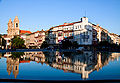 Central Avenue in Braga
 -
 Campo das Hortas, Braga

.jpg)
.JPG)


The region of Braga is scattered with Neolithic, Roman, Medieval and Modernist monuments, buildings and structures attracting tourists. Although there are many examples of these structures, only the following have been classified by the Instituto de Gestão do Património Arquitectónico e Arqueológico as National Monuments:
Archaeological
[edit]
- Castro of São Mamede (Castro de Monte Redondo/Castro Monte Cossourado/Castro de São Mamede)
- Roman milestones, several Roman-era granite markers currently on display at the Museum D. Diogo de Sousa, dating from AD 41 to 238, that is, the reigns of Emperor Claudius to Maximinus II.[36]
- Roman Thermae of Maximinus (Portuguese: Termas romanas de Maximinos/Alto da Cividade/Colina dos Maximinos), discovered in the 20th century, the thermae occupy 800 square metres (8,600 sq ft), in the civil parish of Braga (Maximinos, Sé e Cividade), and were constructed in the 1st to late 3rd century;[37]
Civic
[edit]- Arch of Porta Nova/Rua de Souto (Arco da Porta Nova/Arco da Rua do Souto), a Baroque and Neoclassical arch, designed by André Soares in the late 18th century, and decorates the western gate of a medieval wall. It was opened in 1512 and since has been traditionally used to present to promote to visiting dignitaries and celebrities.[38]
- Palace of the Falcões (Portuguese: Palácio dos Falcões/Governo Civil de Braga), a Baroque-era palace originally commissioned by Francisco de Meira Carrilho on 23 July 1703, and later, upon successive renovations, used by the Civil Governor's residence;
- Fountain of the Idol (Portuguese: Fonte do Ídolo), the 1st century Roman fountain dedicated to an indigenous god, located in the central civil parish of Braga (São José de São Lázaro e São João do Souto);
- Fountain of the Iron Waters (Portuguese: Fonte das Águas Férreas), following the discovery in July 1173 of iron-rich springs in the parish of Fraião, Archbishop Gaspar de Bragança ordered the municipal council to begin the canalization of these waters for public use, giving rise to a series of fountains, such as the Baroque decorated main fountain;
- Hospital of São Marcos (Portuguese: Hospital de São Marcos), with a façade comparable to any religious monument in the city, the Hospital of São Marcos, is an example of the complex Baroque style of Carlos Amarante, featuring ornate double belfry and accents;
- Pillory of Braga (Portuguese: Pelourinho de Braga), the 15th century pillory, that marks municipal authority for the town, was constructed, demolished and moved various times, before being relocated on the grounds of the Sé Cathedral;[39]
- Palace of Raio (Portuguese: Palácio de Raio), an 18th-century Baroque-Rococo urban residence, with richly decorated blue azulejo façade of Andre Soares;
- Residence of the Crivos (Portuguese: Casas das Gelosias/Casa dos Crivos), a Renaissance-era shop-residence constructed outside the old walls characteristic of late Renaissance architecture and one of the few examples of a building covered in wood-lattice façade from this period.
- Seven Sources Aqueduct (Portuguese: Sete Fontes), a complex network of aqueducts that provided potable water to citizenry of Braga;
- Theatro Circo (Portuguese: Teatro Circo de Braga), 20th century revivalist theatre, known for its architecture, as much for the films, theatre plays and performances;
- Bridge of Prado (Ponte do Prado)
- Bridge of Prozelo (Ponte de Prozelo/Ponte do Porto)
Military
[edit]- Tower of Santiago (Portuguese: Torre de Santiago e troço das antigas muralhas de Braga), part of the ancient walls of Braga, the Tower of Santiago was designed by Portuguese Baroque master André Soares, based on a mixture of Gothic, Baroque and Rococo elements;
- Tower of Castle of Braga (Castelo de Braga), actually the remnants of the castle's keep, constructed during the reign of King Denis of Portugal, which was part of the defensive system of the city of Braga, and included a semi-circular walled enclosure centred on the Sé Cathedral.[40]
Religious
[edit]


- Archiepiscopal Palace of Braga (Portuguese: Antigo Paço Arquiepiscopal de Braga), between the 14th–18th centuries, a religious residence, but after the 20th century, the home of the municipal offices, public library and archive;
- Chapel of the Espírito Santo (Portuguese: Capela do Espírito Santo), an example of mixed styles, the chapel includes elements of Baroque, Neoclassical and Manerist eras;
- Chapel of Nossa Senhora da Consolaçã (Portuguese: Capela de Nossa Senhora da Consolação), a simple single-nave chapel constructed in the Baroque-style
- Chapel of São Bento (Portuguese: Capela de São Bento), constructed in the middle of the 18th century, the chapel was blessed by Archbishop José of Bragança in 1755;
- Chapel of Senhor do Bom Sucesso (Portuguese: Capela do Senhor do Bom Sucesso), a Baroque and Neoclassical chapel, is highlighted by a main façade, typical of André Soares, but constructed by Carlos Amarante, at the beginning of his career, who timidly applied Neoclassical decorative elements;
- Chapel of the Coimbras (Capela de Nossa Senhora da Conceição/Capela dos Coimbras/Capela do Senhor Morto), a Manueline chapel, probably designed by Castillian architect Filipe Odarte, with sculptures attributed to Hodart, an altar by João de Ruão and posterior tomb sculptures by the same artist.[41]
- Church of Santa Cruz (Portuguese: Igreja de Santa Cruz), and the Hospital of the Brotherhood of the Holy Cross of Jerusalem (Portuguese: Irmandade de Santa Cruz de Jerusalem), constructed in 1581, and later supported by the nuns of the Order Hospitaler;
- Church of Santa Eulália (Portuguese: Igreja de Santa Eulália), is a 13th–14th century Romanesque church, located near Bom Jesus do Monte;
- Church of Santa Maria (Portuguese: Igreja Paroquial de Ferreiros/Igreja de Santa Maria), constructed in 1560, under the orders of Archbishop Bartolomeu dos Mártires, as a church of the Society of Jesus;
- Church of Santo André (Portuguese: Igreja Paroquial de Gondizalves/Igreja de Santo André), an example of the reformulations of the Modernist aesthetic of the mid-20th century: the 18th-century church was adapted and expanded after the parish's de-annexation in 1975;
- Chapel of São Frutuoso, also known as the Chapel of São Frutuoso of Montélios or the Chapel of São Salvador of Montélios, is a pre-Romanesque chapel, forming part of group of religious buildings that include the Royal Church originally built by the Visigoths in the 7th century, in the form of a Greek cross.[42]
- Chapel of São Sebastião das Caravelheiras (Portuguese: Capela de São Sebastião das Caravelheiras)
- Church of São Martinho (Portuguese: Igreja Matriz de Espinho/Igreja de São Martinho), the Baroque and Classical parochial church of Espinho, known for its ornate façade and belfrey, as well as its Rococo interior;
- Church of São Miguel de Frossos (Portuguese: Igreja Paroquial de Frossos/Igreja de São Miguel), a 16th-century parochial church in the civil parish of Frossos;
- Church of São Miguel de Gualtar (Portuguese: Igreja Paroquial de Gualtar/Igreja de São Miguel), part of the intense building period of the 16th–17th century, the parochial church of Gultar was constructed in the 17th century, but later remodelled during the 18th century;
- Church of São Paio (Portuguese: Igreja Paroquial de Arcos/Igreja de São Paio), located in Arcos, the church is an early 18th-century church (built in 1706);
- Church of São Paulo (Portuguese: Igreja de São Paulo e Seminário de Santiago), the historical seminary and church of Saint Paul with its contrast between stoic façade and decorated Baroque interior, built in the era of archbishop Bartholomew;
- Church of São Pedro de Lomar (Portuguese: Igreja de São Pedro de Lomar), remnant of ancient Benedictine monastery of São Pedro in Lomar, the Church of Saint Peter exemplifies a mix of Baroque, Mannerist and Neoclassical architecture;
- Church of São Pedro de Maximinos (Portuguese: Igreja de São Pedro de Maximinos), known for the missing organ of organist Manuel de Sá Couto;
- Church of São Tiago (Portuguese: Igreja Paroquial da Cividade/Igreja de São Tiago)
- Church of São Vicente (Portuguese: Igreja de São Vicente)
- Convent of Nossa Senhora do Carmo (Portuguese: Convento de Nossa Senhora do Carmo), principally recognizable for its central spire/belfrey, which was designed by João de Moura Coutinho de Almeida e Eça, and constructed in the 17th–18th century;
- Church of the Misericórdia (Portuguese: Igreja da Misericórdia)
- Church of the Third Order of St. Francis (Portuguese: Igreja dos Terceiros), the Terceiros began the process of constructing their church in 1685, which they dedicated to Our Lady of Conception (Portuguese: Nossa Senhora da Conceição);
- Church, Convent and College of the Congregation of São Filipe de Néri (Portuguese: Igreja dos Congregados), attributed to the architect André Soares, for the complex/risky façade of the church and corner convent windows, Monk's chapel (or Chapel of Our Lady of the Appearance), and retable of Our Lady of Pain (Portuguese: Nossa Senhora das Dores)
- Convent of Nossa Senhora da Conceição (Portuguese: Convento da Nossa Senhora da Conceição), which includes the Chapel of São Domingos, an 18th-century convent, home to the Instituto Monsenhor Ariosa;
- Convent of Pópulo (Portuguese: Convento do Pópulo), the Mannerist, Baroque, Rococo and Neoclassical austere elements of the convent belying the extravagant interior, that was originally the home to Augustine monks, highlighted by the Baroque façade of the Church of Pópulo (Portuguese: Igreja de Pópulo);
- Convent of Salvador (Portuguese: Convento do Salvador/Lar Conde de Agrolongo), began with the need to transfer the nuns from the Monastery of Vitorino das Donas in 1528
- Convent of São Francisco de Montélios (Portuguese: Convento de São Francisco/Igreja de São Jerónimo de Real), the Baroque, Rococo and Neoclassical convent, highlighted by the imposing three-storey façade of the Church of São Jerónimo;
- Cross of Nossa Senhora dos Aflitos (Portuguese: Cruzeiro da Nossa Senhora dos Aflitos), a Baroque cross on an ionic column, with an image of Christ in wood, surmounted by a rectangular Tuscan colonnade and roof;
- Cross of the Espírito Santo (Portuguese: Cruzeiro do Espírito Santo)
- Monastery of Dumio (Portuguese: Ruínas Arqueológicas de São Martinho de Dume), the ancient religious seat founded by Martin of Braga in the provincial centre of Dume;
- Monastery of Tibães (Portuguese: Mosteiro de Tibães), the 17th–18th century Benedictine monastery renowned for the ornate/artistic gilt work in its chancel and altars;
- Sanctuary of Bom Jesus do Monte (inscribed on the World Heritage List in July, 2019[43]), constructed on Monte Santo, overlooking the urban sprawl of Braga, the 18th to early-19th century, Neoclassic sanctuary and church (itself preceded by Baroque stairway), is reachable by trail or Bom Jesus funicular (one of the oldest in Iberian Peninsula);
- Sanctuary of Nossa Senhora do Sameiro (Portuguese: Santuário de Nossa Senhora do Sameiro), isolated on the hilltop of Monte do Sameiro, the church and retreat began in 1861, from the mind of Father Martinho António Pereira da Silva, who wished to construct a monument dedicated to Our Lady of the Conception;
- Sanctuary of Santa Maria Madalena (Portuguese: Santuário de Santa Maria Madalena/Santuário da Falperra), located on Monte Falperra, the Baroque-era sanctuary church, was designed by local architect André Soares, incorporating decorative elements into a two-bell tower homage to the Mary Magdalene;
- Sé Cathedral of Braga (Portuguese: Sé Catedral de Braga)
- Wayside shrine of São Brás (Portuguese: Alminhas de São Brás), although conjecturally a contemporary monument, the wayside shrine in Ferreiros has the characteristics of many Baroque monuments in Braga;
- Cross of Campo das Hortas (Cruzeiro do Campo das Hortas)
- Cross of Santana (Cruzeiro de Santa Ana/Cruzeiro de Santana)
- Cross of Tibães (Cruzeiro de Tibães)


Museums
[edit].jpg)
In addition, many of the district's treasures and historical artifacts are housed in several museums that are scattered throughout the city, such as:
- Museum of the Biscainhos (Portuguese: Museu dos Biscainhos), housed in the historical Palace of the Biscainhos, the museum exhibits a permanent collection of decorative art, that includes furniture, ceramics, European and Oriental porcelain, European Glass, European and Portuguese watches and clocks;
- Treasure Museum of the Sé Cathedral (Portuguese: Tesouro Museu da Sé Catedral), the collection varies, but collects together artefacts from the 16th to 18th century during the period of religious/cultural exploration, associated with the cathedral, including images and azulejo tiles;
- Museum of Image (Portuguese: Museu da Imagem), dedicated to photography, located near the Arco da Porta Nova and Braga Castle;
- Museum Medina (Portuguese: Museu Medina), located in the same building as the Museum of Pius XII, the collection is the home to the 83 oil paintings and 21 drawings of the painter Henrique Medina;
- Museum of Nogueira da Silva (Portuguese: Museu Nogeuira da Silva), bequeathed to the University of Minho, the collection includes artefacts, paintings, furniture and sculptures collected over a lifetime, such as Renaissance artwork, 17th furniture, ceramics and objects in ivory, silver and religious art;
- Museum of Pius XII (Portuguese: Museu Pio XII), housing a collection of Palaeolithic, Neolithic and Bronze Age implements, Pre-historic and Luso-Roman pottery;
- Dom Diogo de Sousa Museum (Portuguese: Museu D. Diogo de Sousa), its collection includes many items discovered during archaeological excavations within the municipality, extending as far back as the Palaeolithic to the Middle Ages.
- Museum of String Instruments (Portuguese: Museu dos Cordofones), the collection features Portuguese instruments as far back as the Middle Ages including Cavaquinhos, Portuguese guitars, Mandolins and banjos among others.
Education
[edit],_Braga.jpg)
The city is the headquarters and main campus for the Universidade do Minho (Minho University), a public university founded in 1973.[44] A campus of the oldest private university of Portugal, a branch of the Universidade Católica Portuguesa, is also established since 1947,[45][46] as well as the Escola Secundária Sá de Miranda (the oldest Secondary school in Braga).[47]
In the late 2000s, the International Iberian Nanotechnology Laboratory also opened their international research centre in the city. Besides scientific research and technological development, this laboratory is a center of postgraduate education.[48]
The Braga Pedagogical Farm is a farm dealing with animals and agriculture, welcoming extra-curricular activities from schools and visitors.[49][50]
Sports
[edit].jpg)
Braga's major sports club, Sporting Clube de Braga (SC Braga), was founded in 1921 and its main men's football team play in the top division of Portuguese football, the Primeira Liga, from Braga Municipal Stadium, carved out of the Monte Castro hill that overlooks the city. The success of SC Braga's football team in the first quarter of the 21st century, including participations in the UEFA Champions League, winning the Taça de Portugal (Portuguese Cup) for the second time in 2016 and the third in 2021 and reaching the UEFA Europa League final in 2011, which they lost to fellow Portuguese side FC Porto, improved it on the UEFA club rankings and Portugal's professional football landscape to such an extent that SC Braga started to be dubbed the fourth greatest football club in Portugal, only surpassed by the well-established classic Big Three.[51][52][53][54][55][56]
ABC Braga, founded in 1933, is a decorated professional handball team which has won several major trophies in the sport.[57]
The Rampa da Falperra, established as such since 1950 but whose historical origins can be traced back to 1927, nowadays a round of the European Hillclimb Championship, is held every year in the outskirts of the city.[58]
The Circuito Vasco Sameiro race track and the adjacent Kartódromo Internacional de Braga (KIB) kart racing track are located around the local airfield.[59] The racing track held European Touring Car Cup events in 2009 and 2010, and the KIB has held rounds of the Karting World Championship.
Notable citizens
[edit]

Public service
[edit]- Avitus of Braga (?- ca. 440 AD), produced a first person account of the miraculous finding of St. Stephen's tomb.
- Saint Ovidius (martyred 135 AD) third Bishop of Braga, buried in the cathedral.
- Saint Engratia venerated as a virgin martyr and saint, tradition is that she was martyred with 18 companions in 303AD
- Paulus Orosius (ca.383 – ca.420), historian and theologue from the Braga diocese
- Hermeric (died 441), landlord and then king of the Suebi with capital in Braga, from at least 419 and possibly as early as 406 until his abdication in 438.
- Martin of Braga (c. 520–580), Bishop of Braga in 562–579, converted the Suebi to Catholicism.
- Henry, Count of Portugal (1066–1112) Count of Portugal 1093–1112, turned Braga into his capital
- Teresa of León, Countess of Portugal (1080–1130) was married to Count Henry in 1094
- Antipope Gregory VIII (died 1137) born Mauritius Burdinus, the second Archbishop of Braga
- D. Paio Mendes (died 1137): he was the Archbishop of Braga from 1118 to 1137
- Pope John XXI (ca.1215–1277) born Pedro Julião, Archbishop of Braga 1272–1275, elected Pope in 1276.
- Francisco Sanches (ca.1550 – ca.1623) a skeptic, philosopher and physician of Sephardi Jewish origin
- Miguel de Carvalho (1579–1624), a Roman Catholic missionary, was burned at the stake in Japan, beatified in 1867.
- Manuel António Martins (1772–1845) governor of Cape Verde and Portuguese Guinea, 1833 to 1835
- João Crisóstomo de Amorim Pessoa (1810–1888) Bishop of Santiago de Cabo Verde and archbishop of Goa and Braga
- Manuel Gomes da Costa (1863–1929) an army officer and politician, the tenth President of the Portuguese Republic and led the famous 28 May 1926 coup d'état in Braga
- Domingos Leite Pereira (1882–1956), Portuguese politician of the Portuguese First Republic
- Salgado Zenha (1923–1993), a Portuguese left-wing politician and lawyer.
- Ricardo Rio (born 1972) an economist, politician and current mayor of Braga.
Arts & Science
[edit]
- Gabriel Pereira de Castro (1571-1632) a priest, lawyer and poet.
- João Antunes (1642–1712), an important architect credited for introducing baroque architecture
- André Soares (1720–1769) architect of several important Rococo buildings in Braga area.
- Carlos Amarante (1748–1815) an architect who favoured neoclassical architecture
- Adriano de Paiva (1847–1907) a scientist and pioneer of the telectroscope.
- Albano Ribeiro Belino (1863-1906) a journalist and archaeologist who studied the Roman and pre-historic ruins in Braga.
- Elísio de Moura (1877–1977) a physician, professor and leading psychiatrist
- Lúcio Alberto Pinheiro dos Santos (1889-1950) philosopher, coined the term rhythmanalysis
- Luís de Almeida Braga (1890–1970) a Portuguese writer and politician, in the Integralismo Lusitano movement.
- António Variações (1944–1984), innovative pop composer and singer
- Torcato Sepulveda (1951–2008), an influential Portuguese newspaper journalist.
- Sara Braga Simões (born 1975) an operatic soprano
Sport
[edit]
- Carlos Carvalhal (1965) a former footballer with 259 club caps and manager of S.C. Braga.
- Litos (born 1974) a former footballer with 433 club caps
- Henrique (born 1980) a former footballer with 451 club caps
- Pedro Pereira (born 1984) a former footballer with over 460 club caps
- Emanuel Silva (born 1985) a sprint canoeist and silver medallist at the 2012 Summer Olympics
- Carole Costa (born 1990) a footballer with 133 caps for the Portuguese female national football team
- Júlio Ferreira (born 1994) a taekwondo practitioner
- Diogo Dalot (born 1999) a footballer with Manchester United F.C. and 6 caps for Portugal
- Francisco Macedo (born 2008) a racing driver
International relations
[edit] Bissorã, Guinea Bissau
 Clermont-Ferrand, France
 Cluj-Napoca, Romania
 Cuenca, Ecuador
 Ivano-Frankivsk, Ukraine
 Poggibonsi, Italy
- Puteaux, France
 Ribeira Brava, Cape Verde
 Santa Fe, Argentina
- Tarrafal de São Nicolau, Cape Verde


See also
[edit]References
[edit]- ^ [1]
- ^ "Statistics Portugal". www.ine.pt. Archived from the original on 18 June 2023. Retrieved 17 July 2024.
- ^ Eurostat Archived 7 October 2012 at the Wayback Machine
- ^ Marmé, Paulo (12 October 2023). "Braga no centro da estratégia da Issuu". Forbes Portugal (in European Portuguese). Retrieved 7 December 2023.
- ^ "Mercedes abre centro tecnológico em Braga. Quer contratar 100 pessoas em 2022". www.jornaldenegocios.pt (in European Portuguese). Retrieved 7 December 2023.
- ^ "Bosch investe 15 milhões para ampliar fábrica de Braga". www.jornaldenegocios.pt (in European Portuguese). Retrieved 7 December 2023.
- ^ "Criação de empresas cresce em Braga e descem as insolvências e encerramentos". Diário do Minho (in Portuguese). 3 February 2022. Retrieved 7 December 2023.
- ^ "Startup do futuro são "minúsculas". Em Braga, são Startup.Nano". Dinheiro Vivo (in European Portuguese). 10 May 2016. Retrieved 7 December 2023.
- ^ "Estádio Municipal de Braga". We Braga. 18 July 2016. Retrieved 7 December 2023.
- ^ Braga 2012 Capital Europeia da Juventude (in Portuguese), Braga, Portugal, 2012, archived from the original on 4 May 2012, retrieved 19 April 2012
{{citation}}: CS1 maint: location missing publisher (link) - ^ Machado, José Barbosa (1 January 2014). Introdução à História da Língua e Cultura Portuguesas. Edições Vercial. ISBN 9789897001857. Retrieved 27 March 2018 – via Google Books.
- ^ a b c d e f g h i j k l Marques, António Henrique R. de Oliveira (1997). História de Portugal : manual para uso de estudantes e outros curiosos de assuntos do passado pátrio (13th ed.). Lisboa: Presença. pp. 43–44. ISBN 972-23-2189-7. OCLC 476465662.
- ^ Thompson, E. A. Romans and Barbarians: The Decline of the Western Empire. Madison: University of Wisconsin Press, 1982. ISBN 0-299-08700-X pp. 153–154.
- ^ Díaz Martínez, Pablo de la Cruz (2011). El reino suevo (411-585). Tres Cantos, Madrid, España. ISBN 978-84-460-3648-7. OCLC 958059531.
{{cite book}}: CS1 maint: location missing publisher (link) - ^ Visigothic Spain : new approaches. Edward James. Oxford: Clarendon Press. 1980. ISBN 0-19-822543-1. OCLC 5100979.
{{cite book}}: CS1 maint: others (link) - ^ Wace, Henry; Piercy, William Coleman, eds. (2014). A dictionary of early Christian biography: and literature to the end of the sixth century A.D. ; with an account of the principal sects and heresies. Peabody, Mass.: Hendrickson Publ. pp. 1263–1264. ISBN 978-1-61970-269-1.
- ^ Aranha, Boaventura Maciel (1761). Cuidados da morte e descuidos da vida... Com a addicao das prodigios as vidas dos dous mayores santos... na officina de Francisco Borges de Sousa. p. 276.
- ^ a b Cunha, D. Rodrigo da (1634). Primeira [-segunda] parte, da historia ecclesiastica dos arcebispos de Braga, e dos Santos, e Varoes illustres, que florecerão neste arcebispado. Por dom Rodrigo da Cunha arcebispo, & senhor de Braga, primàz das Hespanhas (in Portuguese). Vol. II. pp. 18–22.
- ^ Menéndez Pidal, Ramón (1906). PRIMERA CRÓNICA GENERAL. ESTORIA DE ESPAÑA DE ALFONSO X (2022 ed.). Biblioteca Digital de Castilla y León. p. 357. Retrieved 10 June 2023.
- ^ de Braga, Bernardo (1843). da Silveira Pinto Albano, Antero (ed.). Tratado sobre a precedencia do Reino de Portugal ao Reino de Napoles. Typogr. da revista. p. 25.
- ^ Cunha, D. Rodrigo da (1634). Primeira [-segunda] parte, da historia ecclesiastica dos arcebispos de Braga, e dos Santos, e Varoes illustres, que florecerão neste arcebispado. Por dom Rodrigo da Cunha arcebispo, & senhor de Braga, primàz das Hespanhas (in Portuguese). Vol. II. pp. 2–29.
- ^ Bandeira, Miguel (1993). "O espaço urbano de Braga em meados do séc. XVIII". Revista da Faculdade de Letras - Geografia. IX: 171–173.
- ^ Portocarrero, Gustavo (2010). Braga na Idade Moderna : paisagem e identidade. Tomar: CEIPHAR. pp. 81–100. ISBN 978-972-95143-2-6. OCLC 733958410.
- ^ Capela, José Viriato (2003). As freguesias do distrito de Braga nas Memórias Paroquiais de 1758: a construção do imaginário minhoto setecentista.
- ^ "Salazar no 40.º Aniversário do 28 de Maio de 1926". RTP.
- ^ Pereira, P. Gomes (2009), "Caracterização do Concelho de Braga", Diagnóstico do Concelho de Braga (PDF) (in Portuguese), Braga, Portugal: Unidade de Saúde Pública de Braga, archived from the original (PDF) on 24 September 2015, retrieved 21 March 2012
- ^ "Climate normals for Braga (1971-2000)" (PDF). Instituto Português do Mar e da Atmosfera. Retrieved 20 October 2024.
- ^ "Normals Climatológicas" (PDF). Instituto Português do Mar e da Atmosfera, IPMA. Retrieved 6 June 2024.
- ^ a b c d e f g Census de 1991, 2001 e Território em números de 2004 (in Portuguese), Lisbon, Portugal: INE – Instituto Nacional de Estatistica, 2004, retrieved 24 March 2012
- ^ "0000200147" (PDF). DRE (in European Portuguese). Retrieved 29 December 2022.
- ^ Diário da República. "Law nr. 11-A/2013, pages 552 26–28" (PDF) (in Portuguese). Retrieved 18 July 2014.
- ^ "De Braga para o mundo, a PRIMAVERA da cidade". Alumni UMinho (in European Portuguese). Retrieved 3 March 2023.
- ^ "PRIMAVERA - Business Software Solutions SA". COTEC Portugal (in European Portuguese). Retrieved 3 March 2023.
- ^ Aptiv (13 November 2019), Aptiv's Braga Technical Center, retrieved 16 January 2021
- ^ "Politikprominenz bei Bosch: Bundeskanzlerin Merkel und Premier Costa eröffnen Tech Center in Portugal". Bosch Media Service (in German). Retrieved 16 January 2021.
- ^ Sereno, Isabel; Dordio, Paulo (1994). SIPA (ed.). "21 Marcos Miliários (série Capela) Braga incerta via (v.PT01130700002)" (in Portuguese). Lisbon, Portugal: SIPA–Sistema de Informação para o Património Arquitectónico. Retrieved 26 February 2012.
- ^ Sereno, Isabel; Dordio, Paulo (1994), SIPA (ed.), Termas romanas de Maximinos/Alto da Cividade/Colina dos Maximinos (v.PT010303070040) (in Portuguese), Lisbon, Portugal: SIPA – Sistema de Informação para o Património Arquitectónico, retrieved 26 April 2012
- ^ Sereno, Isabel; Leão, Miguel; Basto, Sónia (2010). SIPA (ed.). "Arco da Porta Nova/Arco da Rua do Souto (v.PT01130700002)" (in Portuguese). Lisbon: SIPA–Sistema de Informação para o Património Arquitectónico. Archived from the original on 17 March 2012. Retrieved 26 February 2012.
- ^ Sereno, Isabel; Santos, João (1994), SIPA (ed.), Pelourinho de Braga (IPA.00000207/PT010303520013) (in Portuguese), Lisbon, Portugal: SIPA – Sistema de Informação para o Património Arquitectónico, archived from the original on 21 August 2016, retrieved 15 August 2016
- ^ Sereno, Isabel; Dordio, Paulo; Gonçalves, Joaquim (2007). SIPA (ed.). "Castelo de Braga, designadamente a Torre de Menagem (restos)" (in Portuguese). Lisbon: SIPA–Sistema de Informação para o Património Arquitectónico. Archived from the original on 12 November 2013. Retrieved 26 February 2012.
- ^ Sereno, Isabel; Santos, João (1994). SIPA (ed.). "Capela de Nossa Senhora da Conceição/Capela dos Coimbras/Capela do Senhor Morto" (in Portuguese). Lisbon, Portugal: SIPA –Sistema de Informação para o Património Arquitectónico. Archived from the original on 1 April 2012. Retrieved 26 February 2012.
- ^ Sereno, Isabel; Dordio, Paulo; Gonçalves, Joaquim (2004). SIPA (ed.). "Capela de São Frutuoso de Montélios/Capela de São Salvador de Montélios" (in Portuguese). Lisbon, Portugal: SIPA – Sistema de Informação para o Património Arquitectónico. Archived from the original on 3 December 2013. Retrieved 15 November 2013.
- ^ "Portugal". UNESCO World Heritage Centre. Retrieved 9 July 2019.
- ^ "Universidade do Minho". CRUP (in European Portuguese). Retrieved 7 December 2023.
- ^ "PSD Braga visita Universidade Católica Portuguesa" (in European Portuguese). 21 January 2022. Retrieved 7 December 2023.
- ^ "História | UCP". www.ucp.pt (in European Portuguese). Retrieved 7 December 2023.
- ^ "Escola Sá de Miranda | Agrupamento de Escolas Sá de Miranda" (in European Portuguese). Retrieved 7 December 2023.
- ^ "Instituto de Nanotecnologia em Braga cria 24 bolsas de doutoramento". O Minho (in European Portuguese). 15 February 2019. Retrieved 7 December 2023.
- ^ "Viver | Ambiente | Quinta Pedagógica de Braga". www.cm-braga.pt. Retrieved 7 December 2023.
- ^ "Quinta Pedagógica – Quinta Pedagógica – Município de Braga" (in European Portuguese). Retrieved 7 December 2023.
- ^ Barton, Aaron (27 September 2022). "Braga's Push to Break the Big Three Hegemony in Portugal". The Analyst. Retrieved 29 October 2023.
- ^ "Braga, o quarto grande". Jornal de Notícias (in Portuguese). Retrieved 29 October 2023.
- ^ "O "quarto grande" que ainda quer ser maior". www.record.pt (in European Portuguese). Retrieved 29 October 2023.
- ^ Renascença (16 September 2015). "Braga com carimbo de quarto grande - Renascença". Rádio Renascença (in European Portuguese). Retrieved 29 October 2023.
- ^ SAPO. "António Salvador: "O Braga tem a ambição de ser campeão. Quando, não sabemos..."". SAPO Desporto (in Portuguese). Retrieved 29 October 2023.
- ^ "Artur Jorge revela o que falta ao Sp. Braga para ser "um grande"". Maisfutebol (in Portuguese). Retrieved 29 October 2023.
- ^ "ABC de Braga" (in European Portuguese). Retrieved 7 December 2023.
- ^ "Rampa da Falperra: A subida aos céus minhotos | AutoSport". www.autosport.pt (in European Portuguese). Retrieved 7 December 2023.
- ^ Dias, Miguel (23 April 2021). "Inédito troféu GT3 Cup arranca já este fim de semana em Braga". Razão Automóvel (in European Portuguese). Retrieved 7 December 2023.
- ^ "Geminações". cm-braga.pt (in Portuguese). Braga. Archived from the original on 14 March 2016. Retrieved 10 December 2019.
Bibliography
[edit]- . Encyclopædia Britannica. Vol. 4 (11th ed.). 1911. pp. 375–376.
External links
[edit]

 Braga topics Braga topics | ||
|---|---|---|
| Main topics | | |
| Cathedral and sanctuaries | ||
| Monasteries and convents | ||
| Churches | ||
| Chapels | ||
| Museums | ||
| International | |
|---|---|
| National | |
| Geographic | |
| People | |
| Other | |

Braga
View on GrokipediaEstablished by the Romans as the civitas of Bracara Augusta around 20 BC, Braga developed as a key administrative center in the province of Gallaecia, reflecting its strategic position along Roman trade and military routes.[3] Over two millennia of continuous settlement have positioned it among Portugal's most ancient urban centers, with archaeological evidence of pre-Roman occupation by Celtic tribes such as the Bracari.[4] The city's ecclesiastical prominence stems from its early Christianization, leading to the establishment of its diocese in the 4th century AD and elevation to metropolitan see, granting its archbishop the enduring title of Primate of Portugal.[4]
In contemporary times, Braga functions as a regional economic hub, bolstered by the University of Minho and sectors including manufacturing, services, and tourism drawn to its Baroque architecture and pilgrimage sites like the Sanctuary of Bom Jesus do Monte.[5] Its urban fabric preserves medieval and Renaissance structures alongside modern infrastructure, underscoring a blend of historical preservation and development that has sustained its population growth and cultural vitality.[6]
History
Pre-Roman and Roman origins
Archaeological evidence indicates that the region surrounding modern Braga was occupied during the Iron Age by the Bracari, a subtribe of the Gallaeci peoples, who established hillfort settlements known as castros on nearby elevations, such as those excavated at nearby sites revealing defensive structures and domestic artifacts dating to the 1st millennium BC.[7] Pre-Roman baths discovered in 2003 near the current train station, through excavations by the University of Minho's archaeology unit, suggest organized water management and possible ritual or communal use predating Roman influence, with ceramic and lithic remains pointing to local indigenous craftsmanship.[8] These findings align with broader patterns of Celtic-influenced settlements in northwest Iberia, characterized by oppida-like agglomerations rather than fully urbanized centers.[9] Bracara Augusta was established ex novo around 16–15 BC under Emperor Augustus during his campaigns in Hispania, marking it as the sole Augustan foundation north of the Douro River and serving as the administrative capital of the Conventus Bracarensis within the province of Gallaecia.[10][11] The city's name honored both the local Bracari tribe and Augustus, as evidenced by dedicatory inscriptions and coinage recovered from early strata, which corroborate its role in consolidating Roman control over the northwest frontier.[7][10] As a Roman municipium, Bracara Augusta featured a grid-based urban layout with a central forum supported by a cryptoporticus for structural elevation, wide cardo maximus streets up to 7.6 meters allowing access to public spaces, and connections via the Via XVIII road network linking it southward to Olisipo (Lisbon) and eastward to Asturica Augusta.[12][13] Excavations since the 1970s have unearthed architectural terracotta stamps, mosaics, and over 1,200 marked bricks from 41 sites, indicating organized production and import of materials for temples, baths, and insulae, underscoring its status as a provincial hub for governance, trade, and veteran settlement.[14][15]Late Antiquity and early medieval periods
Following the decline of Roman authority in Hispania during the early 5th century, the Suebi, a Germanic tribe, invaded the Iberian Peninsula in 409 alongside the Vandals and Alans, settling primarily in the province of Gallaecia. Under King Hermeric, who ruled from approximately 409 to 438, the Suebi formalized their control over western Gallaecia, establishing Braga (ancient Bracara Augusta) as the kingdom's capital around 411.[16] Hermeric's reign involved consolidating power through alliances and conflicts with local Roman authorities and other invaders, including a treaty in 411 that recognized Suebi sovereignty in parts of Gallaecia. The kingdom endured as an independent entity, marked by internal strife and external pressures from the Visigoths, until its annexation in 585 by Visigothic King Leovigild, who captured Braga and integrated Gallaecia into the Visigothic realm.[17][18] Braga's prominence grew as an early Christian center during this period, with the episcopal see playing a pivotal role in the region's religious life. The Suebi, initially adherents of Arianism or paganism, underwent conversion to Nicene Catholicism in the mid-6th century, facilitated by missionary efforts and local clergy.[19] St. Martin of Braga, arriving from the East around 550, founded monasteries such as that at Dumio (near Braga), adapting rigorous Eastern ascetic practices to local conditions and promoting monastic discipline among the Suebi elite and populace.[20] As bishop of Dumio and later metropolitan of Braga, Martin emphasized moral reform and evangelization, authoring works that addressed Suebi customs and heresies.[21] The First Council of Braga in 561, convened under Suebi King Miro, reinforced Catholic orthodoxy against lingering Arian influences, issuing 22 canons on ecclesiastical discipline, baptismal practices, and clerical conduct.[22] This assembly, attended by eight bishops including Martin, underscored Braga's status as a hub for affirming Trinitarian doctrine in the northwest, predating the Visigothic conversion from Arianism in 589.[19] Post-conquest, the city's ecclesiastical infrastructure persisted under Visigothic rule, maintaining its influence despite political shifts.[22]Medieval consolidation and ecclesiastical power
Following the Muslim conquests, Braga's ecclesiastical prominence was reasserted during the Reconquista. In 868, Vímara Peres, acting as a vassal of King Alfonso III of Asturias, reconquered the territory between the Douro and Minho rivers from Muslim forces, establishing the County of Portugal (Portucale) and integrating Braga as a key Christian see within this frontier region, which later fell under the Kingdom of León.[23] The city's bishops maintained continuity of the ancient diocese amid these shifts, providing spiritual and administrative stability.[24] By the late 11th century, under Bishop Gerald of Moissac (r. c. 1096–1129) and the patronage of Count Henry of Burgundy, Braga was elevated to metropolitan status, with Pope Paschal II confirming its jurisdiction over suffragan sees including Porto, Coimbra, and others in 1109–1111, restoring its pre-Visigothic authority.[25] This consolidation positioned Braga as the primatial see of Hispania in archbishops' claims, sparking enduring disputes with Toledo, whose primacy over Iberian churches was asserted from the 11th century onward and upheld by popes like Callixtus II in 1120, despite Braga's appeals to ancient councils like Braga I (561).[24] Archbishops leveraged papal legations and forgeries of privileges to defend metropolitan rights, though Toledo's royal Castilian backing often prevailed in curial decisions.[26] In the 12th century, Braga's archbishops exerted significant political influence during Portugal's emergence as an independent kingdom. Paio Mendes (r. 1115–1137) excommunicated León's Alfonso VII for territorial encroachments, asserting ecclesiastical autonomy.[24] His successor, João Peculiar (r. 1138–1175), advanced diplomatic efforts at the papal court, supporting Afonso Henriques' campaigns and securing Pope Alexander III's Manifestis Probatum bull of 1171, which recognized Portugal's royal status and Braga's exemptions from Leonese oversight, thereby bolstering the nascent state's legitimacy amid Reconquista pressures.[25] These actions intertwined ecclesiastical power with secular consolidation, elevating Braga's archbishops as mediators between Portuguese counts and Iberian monarchs.[27]Early modern era under Portuguese monarchy
Under the absolutist Portuguese monarchy from the 16th to 18th centuries, Braga retained its status as the primatial see of Portugal, with the archbishop wielding considerable temporal authority alongside royal oversight, though centralized decrees often imposed fiscal strains on local ecclesiastical estates through taxes and requisitions documented in royal charters.[28] The city's governance intertwined church and crown interests, as seen in the maintenance of inquisitorial vigilance against heresy, aligned with the Portuguese Inquisition's broader operations established in 1536, which enforced orthodoxy in northern regions including Braga's domain.[29] The early 18th century marked a peak in Baroque architectural patronage, funded by archiepiscopal revenues, including the ongoing construction of the Sanctuary of Bom Jesus do Monte, initiated in the late 17th century and substantially developed through the 1700s, featuring its iconic escalatory staircases that facilitated pilgrimage processions.[30] The 1755 Lisbon earthquake propagated seismic effects northward, inflicting cracks on structures like Braga Cathedral and prompting repairs sustained by church funds, amid royal reconstruction mandates that prioritized seismic resilience but burdened local resources.[31] Economically, Braga depended on surrounding agricultural output in cereals and livestock, supplemented by modest textile manufacturing in wool and linen, characteristic of Minho region's proto-industrial activities, with growing revenue from pilgrim traffic to Bom Jesus attracting devotees and vendors by mid-century.[32] These sectors underpinned stability under monarchical policies favoring export-oriented agriculture, though periodic royal impositions highlighted fiscal mismanagement evident in uneven tax enforcement. Braga contributed to Enlightenment-era tensions through participation in the 1820 constitutionalist revolution, as liberal sentiments spread from Porto, prompting local provisional juntas to challenge absolutist rule under King João VI and demand a constitution, reflecting broader discontent with centralized absolutism.[33]19th to mid-20th century developments
In the late 19th century, Braga experienced initial industrialization driven by the textile sector, particularly in the surrounding Minho region, where factories in the Ave Valley emerged as early industrial units, attracting rural migrants from agrarian areas to work in linen and cotton production.[34] This shift marked a transition from traditional agriculture to manufacturing, with flax fibers imported for processing, contributing to urban growth amid Portugal's broader economic modernization efforts between 1850 and 1914, though overall progress remained modest.[35] The 1910 Republican Revolution, which overthrew the monarchy and established the First Portuguese Republic, had notable local reverberations in Braga, a city with strong republican sympathies exemplified by Teófilo Braga's role as provisional president.[36] However, the ensuing period was characterized by political instability, with the First Republic suffering from over 40 government changes in 16 years, economic volatility, and social unrest that undermined development, including anticlerical policies that strained Braga's longstanding ecclesiastical influence despite its provisional support for the regime.[37] Worker protests in local factories, such as those at Taxa e Faria in the 1910s, highlighted labor tensions amid this turbulent transition.[38] Under the Estado Novo regime established in 1933 by António de Oliveira Salazar, Braga benefited from corporatist policies aimed at stabilizing the economy through regulated guilds and agricultural campaigns, though these often prioritized wheat production over regional textile strengths, exacerbating rural depopulation as internal migration to urban centers like Braga accelerated from the 1930s onward.[39] Infrastructure initiatives under Salazar included plans for enhanced connectivity, reflecting national efforts to modernize transport, but persistent rural exodus—fueled by limited mechanization and low productivity—drew populations into Braga's expanding industrial base, setting patterns of demographic pressure by mid-century.[40]Post-1974 contemporary evolution
Following the Carnation Revolution on 25 April 1974, which ended Portugal's authoritarian Estado Novo regime, Braga transitioned to democratic local governance.[41] The 1976 Constitution established unitary state principles with subsidiarity and self-government, granting municipalities like Braga autonomy in areas such as urban planning and public services.[42] Democratic municipal elections began in 1976, allowing Braga's city council to exercise independent decision-making, marking a shift from centralized control to localized administration.[43] Portugal's entry into the European Economic Community in 1986 unlocked structural funds that bolstered regional development, including in Braga through enhancements in education and connectivity.[44] The University of Minho, founded in 1973, underwent significant expansion in the 1990s and 2000s, evolving into a research-oriented institution that drives innovation in technology and startups, positioning Braga as a key node in Portugal's knowledge economy.[45] These investments supported infrastructure like improved transport links and tech ecosystems, contributing to economic diversification beyond traditional textiles.[46] In the 21st century, Braga's dynamism earned it the European Youth Capital designation in 2012, fostering youth-led initiatives and cultural events that enhanced its appeal.[47] By 2024, the city secured the World Travel Awards' title for Europe's Leading Emerging Tourism Destination, driven by urban renewal projects and rising visitor numbers.[48] This recognition correlates with robust property market growth, with Portugal's residential values projected to rise 5% to 8% in 2025 amid regional demand in areas like Braga.[49] Such metrics underscore Braga's consolidation as a modern, integrated urban center within the EU framework.[50]Geography
Physical landscape and location
Braga is located in the Minho province of northwestern Portugal, at approximately 41°33′N 8°26′W, as the seat of the Braga District and a key settlement in the region's historical core.[51] The municipality spans 183.4 km², positioned about 40 km inland from the Atlantic coast near Esposende and roughly 60 km from the Spanish border with Galicia, facilitating its role in ancient and medieval trade networks linking Iberian interior routes to maritime access.[52][53] The terrain features irregular valleys carved by rivers, interspersed with low granite-dominated hills and small mountainous outcrops, with elevations ranging from 20 m to 570 m.[54][51] The urban center sits at around 200 m above sea level, amid a landscape of granitic formations evident in local quarries and boulder fields.[55][56] Hydrologically, Braga lies between the valleys of the Cávado River to the north, which forms a natural boundary and drains toward the Atlantic, and the Este River to the south, contributing to the area's fertile alluvial plains characteristic of the Minho.[57] The region experiences seismic activity owing to proximity to the Azores-Gibraltar fault zone; the 1755 Lisbon earthquake (magnitude ~8.5–9.0) generated widespread shaking across Portugal, with aftershocks impacting northern areas including Minho.[58][59]Climate patterns
Braga possesses a temperate maritime climate strongly moderated by the Atlantic Ocean, classified as Csb (Mediterranean with warm, dry summers) in the Köppen-Geiger system, featuring mild, wet winters and short, warm summers with low humidity.[60] [61] Average high temperatures reach 21.4°C in July and August, the warmest months, while January, the coldest, averages 9°C overall, with lows occasionally dipping below 5°C but rarely freezing.[62] Precipitation averages 1,200–1,500 mm annually, concentrated in autumn and winter from frequent Atlantic frontal systems, yielding drier conditions from May to September with monthly totals under 50 mm.[63] [64] Topographic variations across Braga's municipality, spanning elevations from 50 m near the Cávado River to over 500 m in surrounding hills like Monte Pico, generate localized microclimates; lower urban areas experience more persistent morning fog and coastal moisture, while elevated zones see sharper diurnal temperature swings and occasional frost in winter.[62] Atlantic influences temper extremes, limiting summer highs below 30°C on most days and preventing prolonged cold snaps, though heatwaves have intensified in frequency per regional patterns.[64] Long-term meteorological records from the Instituto Português do Mar e da Atmosfera (IPMA) reveal a modest warming trend of approximately 1–1.5°C in annual mean temperatures since the mid-20th century, aligned with observed increases in minimum temperatures and subtle shifts toward drier summers, based on station data from nearby observatories.[65] These changes reflect broader Iberian Peninsula patterns without deviating significantly from historical variability.[66]Urban morphology and civil parishes
The municipality of Braga encompasses 37 civil parishes (freguesias), which serve as the primary administrative subdivisions, following the 2013 territorial reform that consolidated former parishes into unions to enhance local governance efficiency.[67] These parishes collectively span 183.4 km², integrating densely built urban zones with expansive rural peripheries.[68] Braga's urban morphology features a compact historic core radiating outward from the southeastern quadrant, anchored by the Roman-era forum site now overlaid with medieval and baroque structures like the Sé Cathedral and adjacent episcopal palace.[69] Development has followed a spontaneous, radial pattern along principal axes such as the Avenida da Liberdade and routes toward surrounding hills, progressively enveloping suburbs including Maximinos and São Lázaro into a cohesive built environment while preserving topographic contours.[70] In the urban core, spatial organization reflects high-density clustering with narrow, irregular streets dating to medieval consolidation, yielding densities around 1,100 inhabitants per km² amid multi-story residential and ecclesiastical edifices.[71] Outer parishes exhibit sparser morphologies, blending low-rise housing with agricultural plots and green corridors, as evidenced by the 2021 census delineating an urban-rural gradient where preservation mandates in classified historic areas curtail infill to safeguard patrimonial integrity against peripheral sprawl.[72] This configuration balances expansion pressures with zoning regulations that allocate buffer zones for ecological continuity, ensuring the municipality's hybrid character.[67]Demographics
Population trends and statistics
The municipality of Braga recorded a resident population of 181,494 inhabitants in the 2011 census conducted by Portugal's Instituto Nacional de Estatística (INE).[73] By the 2021 census, this figure had risen to 195,136, reflecting a decennial increase of 7.5% or an average annual growth rate of approximately 0.7%.[73] INE estimates place the 2023 population at 201,583, indicating continued modest expansion driven primarily by net migration and natural increase.[74] This growth aligns with broader patterns in northern Portugal, where Braga's urban core has attracted residents from rural parishes and adjacent regions, contributing to a population density of about 1,100 inhabitants per square kilometer across its 183.4 km² area.[75] The municipality's demographics show signs of aging, with roughly 22% of the population aged 65 or older as of recent estimates, paralleling national trends where the elderly proportion reached 23% in 2023 amid low birth rates.[76] Portugal's total fertility rate stood at 1.44 children per woman in 2023, with Braga's vital statistics—birth rate of 8.5 per 1,000 and death rate of 7.8 per 1,000—suggesting a similar sub-replacement level locally.[77][78]| Census Year | Resident Population | Annual Growth Rate (from prior census) |
|---|---|---|
| 2011 | 181,494 | - |
| 2021 | 195,136 | 0.7% |
Ethnic and national composition
Braga's population remains highly homogeneous, with Portuguese nationals comprising the vast majority. The 2011 census recorded 97.5% of residents as Portuguese nationals, reflecting the city's longstanding ethnic continuity rooted in its Galician-Portuguese heritage.[79] Foreign residents formed a modest 2.5% at that time, underscoring limited diversification relative to Portugal's coastal urban centers.[79] By 2023 estimates, the foreign-born proportion in Braga municipality had risen to approximately 5%, driven by national trends in labor migration amid Portugal's overall foreign resident growth to 16% of the population.[80] This increase is tempered in Braga, where the district's foreign population stood at about 2.8% (23,619 individuals out of 846,515 residents in 2021), indicating restrained inflows compared to Lisbon or Porto.[81] Primary immigrant nationalities include Brazilians (historically 0.86% of the total), Ukrainians (bolstered post-2022 conflict), Romanians, and those from African nations such as Cape Verde, with smaller contingents from China.[79][82] These groups predominate in service industries, including hospitality and domestic work, leveraging linguistic and cultural proximities for entry-level employment.[83] Integration dynamics in Braga exhibit fewer strains than in peer southern European locales, attributable to proactive municipal policies like intercultural mediation and targeted reskilling programs, as highlighted in UN-Habitat's 2024 assessment of the city as a model for migrant inclusion amid demographic shifts.[83] Empirical indicators, including low reported ethnic tensions and sustained employment uptake among newcomers, support this characterization, though data gaps persist on second-generation outcomes.[84] No significant ethnic enclaves have formed, preserving the city's cohesive national fabric despite incremental diversification.[83]Religious affiliations and cultural homogeneity
Braga serves as the seat of the Archdiocese of Braga, the primatial see of Portugal with historical precedence dating to the 4th century, encompassing a territory where Catholicism predominates. As of December 2022, the archdiocese reports 916,100 Catholics, comprising 91.8% of its total population of 998,100. [85] This figure exceeds the national average of 80.2% Catholic identification recorded in Portugal's 2021 census. The high affiliation rate reflects Braga's role as a ecclesiastical center, with institutions like the Cathedral of Braga and surrounding sanctuaries reinforcing doctrinal orthodoxy and communal devotion. Religious practice in Braga sustains traditions at rates surpassing national norms, evidenced by robust participation in liturgical events such as the Semana Santa processions, which draw thousands annually and underscore active piety rather than nominal adherence. [86] While Portugal overall sees weekly Mass attendance around 19%, regional analyses of Minho cohorts born between 1940–1950 and 1965–1975 indicate persistent belief structures, with older generations maintaining orthodox views on sacraments and morality, contrasting the secular drift in urban centers like Lisbon. [86] Cultural homogeneity in Braga stems from this Catholic continuity, fostering social cohesion through shared rituals and values that resist broader European secularization pressures. Empirical studies highlight minimal erosion of religiosity among locals, attributing stability to historical insularity and familial transmission of faith, unlike national trends where non-religious identification has risen to 14.5%. [86] [87] Non-Catholic minorities, including small Protestant and Orthodox communities, remain marginal, comprising under 5% regionally, preserving a unified cultural fabric centered on Catholic patrimony. [85]Government and administration
Local governance structure
Braga's local governance follows Portugal's municipal system, codified in the 1976 Local Authorities Law following the Carnation Revolution, which decentralized powers from the central state. The structure comprises the executive Câmara Municipal, led by an elected president (mayor) and vereadores (councillors), and the deliberative Assembleia Municipal, consisting of directly elected members plus presidents of the 62 freguesias (civil parishes). The assembly approves budgets, plans, and oversees executive actions, while the mayor holds executive authority over daily administration, including urban planning, public services, education, and social welfare, subject to national legal constraints.[88] The mayor is elected every four years via proportional representation lists, with the top candidate assuming the role; since 2013, Ricardo Rio of the centre-right Social Democratic Party (PSD) has served continuously, securing re-elections in 2017, 2021, and 2025 amid PSD-led coalitions dominating the council. This continuity reflects PSD's electoral strength in Braga, though opposition from parties like the Socialist Party (PS) persists. Voter turnout in local elections hovers around 50%, indicating moderate civic engagement.[89][90] Fiscal autonomy is partial, with municipalities levying local taxes such as property tax (IMI) and corporate surtax (Derrama), supplemented by state transfers and EU structural funds; Braga's 2024 budget reached 195 million euros, funding investments in infrastructure and services, while the 2025 allocation escalated to 242 million euros for expanded projects. Participatory budgeting, initiated in 2013 under Rio's administration, allocates a portion of funds (typically 0.5-1% of the budget) for citizen-proposed projects, with online voting and empirical selection processes, though actual implementation depends on feasibility and council approval.[91][92][93]Political landscape and leadership
Braga's political landscape is characterized by consistent center-right governance under the Social Democratic Party (PSD), with Ricardo Rio serving as mayor since his election in 2013. Rio, an economist, secured victories in the 2013, 2017, 2021, and 2025 municipal elections, reflecting PSD's enduring majorities in the city council.[89][90][94] This pattern underscores northern Portugal's preference for PSD's liberal-conservative policies, in contrast to the Socialist Party's (PS) stronger hold in southern regions, rooted in historical socioeconomic differences.[95] Under Rio's leadership, Braga has prioritized economic development and fiscal responsibility, establishing initiatives like Braga Economy Week to attract investments and stimulate growth. These efforts have contributed to the city's recognition as one of Portugal's top performers in economics and quality of life, with annual job creation averaging hundreds of positions.[96][97] Policies emphasizing sustainable urban planning and business collaboration have enhanced municipal competitiveness without specified debt increases, aligning with PSD's broader emphasis on prudent local management.[83][98] Electoral outcomes demonstrate voter approval of this approach, with PSD coalitions securing key council seats and enabling policy continuity on infrastructure and cultural investments. While PS remains competitive, Braga's repeated endorsement of Rio's administration highlights the efficacy of center-right strategies in fostering local prosperity amid national political shifts.[99][100]Economy
Traditional and industrial sectors
Braga's traditional economy is anchored in the textile sector, a hallmark of the Minho region's industrialization that began in the 19th century with the establishment of early mills and weaving units, particularly in the Ave River basin adjacent to the city.[34] This heritage persists through clothing and technical textile manufacturing, exemplified by firms such as Playvest, which produces performance-enhancing fabrics and garments for sports applications.[101] The sector leverages skilled labor and export-oriented production, aligning with northern Portugal's emphasis on high-quality woolens, linens, and synthetics developed from historical linen imports and local craftsmanship.[102] Agricultural activities in Braga's environs sustain vinho verde wine production across the Minho's pergola-trained vineyards, where varieties like Alvarinho and Loureiro yield crisp, low-alcohol whites dominant in output.[103] The broader Vinho Verde demarcated region, including Braga district, generated exports valued at €60 million as of 2018, with subsequent growth driven by demand in markets like the United States and Germany, representing about 42% of total production volume.[104][105] Complementary small-scale manufacturing encompasses footwear assembly and basic electronics components, drawing on the area's industrial clusters for subcontracting and export supply chains.[106] These sectors maintain employment in legacy facilities, though output remains modest compared to national aggregates, with regional data indicating textiles and apparel as persistent employers amid Portugal's northern industrial base.[107]Modern growth drivers and tourism
Braga's modern economic expansion since the early 2000s has been propelled by advancements in technology and biotechnology, anchored by the University of Minho, which maintains 31 research units, over 90% rated "Very Good" or "Excellent" by national evaluations, fostering innovation in fields like nanotechnology and health technologies. The establishment of Startup Braga in 2014 has positioned the city as a key European innovation ecosystem, supporting startups in digital economy, biotech, and sustainability, with upcoming infrastructure like the DeepTech BioHub enhancing capabilities in these sectors.[108] [109] This academic and entrepreneurial synergy has drawn foreign direct investment by capitalizing on a robust talent pool, as highlighted in analyses of Braga's competitive advantages in research-driven industries.[110] Tourism has emerged as a parallel growth driver, amplified by the 2019 UNESCO World Heritage designation of the Sanctuary of Bom Jesus do Monte, which evokes Christian Jerusalem through its sacred landscape and Baroque architecture.[30] In 2024, Braga received the World Travel Awards for Europe's Leading Emerging Tourism Destination, underscoring its rising appeal amid Portugal's record 30 million international visitors that year.[48] [50] This accolade, coupled with the site's UNESCO status, has boosted visitor interest in Braga's religious heritage and urban vibrancy, contributing to service sector expansion.[111] Investment in real estate has been incentivized by attractive rental yields of 5-7%, with reports citing up to 7.4% in Braga due to demand from students, professionals, and tourists, outpacing national averages and supporting property market growth.[112] [113] These yields reflect the city's dual pull from tech employment and tourism, drawing investors seeking stable returns in a region with rising rental prices, up 6% year-over-year as of late 2025.[45]Fiscal and investment trends
Braga's real estate market has demonstrated steady appreciation, driven by its affordability relative to coastal hubs like Lisbon and Porto, attracting private investors seeking value in residential and commercial properties. Local dynamics include consistent demand from both domestic buyers and expatriates, with the city's lower entry barriers—such as average prices per square meter remaining below national medians—fostering year-over-year growth amid Portugal's broader housing surge.[114][115] The municipality maintains fiscal stability through prudent budgeting and resident-engaged planning, aligning with national trends of a projected 0.1% GDP surplus in 2025 that supports regional investments without excessive public debt reliance. Private sector contributions are evident in the expansion of innovation clusters, where Braga's startup ecosystem grew 24.3% in 2025, accommodating 39 active ventures that secured over $4.19 million in funding, positioning the Minho region as a northern Portugal hub for tech and entrepreneurial activity.[116][117][118] EU structural funds under the Portugal 2030 program, totaling €23 billion nationally, bolster Braga's sustainable initiatives, including tourism infrastructure and green urban projects funded via integrated action plans that leverage both municipal allocations and European grants for low-carbon development. These efforts emphasize private-public partnerships, such as hospitality expansions, to enhance competitiveness without overdependence on subsidies, evidenced by the city's recognition as Europe's Rising Innovative City in 2024 for balanced growth strategies.[119][120]Infrastructure and transport
Road and rail connectivity
Braga is connected to the national road network primarily via the A3 motorway (Autoestrada do Minho), which links the city southward to Porto, approximately 50 kilometers away, with a typical driving time of 45 minutes under normal conditions.[121] Northward, the A3 extends 80 kilometers to the Portugal-Spain border at Valença do Minho, facilitating cross-border freight and passenger traffic as part of the Iberian E01 European route.[122] This infrastructure supports high daily volumes, with the A3 handling significant commercial traffic due to its role in regional logistics, though specific capacity metrics indicate occasional congestion near urban interchanges during peak hours.[123] Rail connectivity is provided by the Minho Line, an electrified regional route operated by Comboios de Portugal (CP), terminating at Braga station with direct services to Porto Campanhã averaging 54 to 71 minutes for the 65-kilometer journey, depending on the stopping pattern.[124] Recent upgrades, including signaling improvements and electrification completed in phases through the 2010s, have increased line speeds to up to 160 km/h in sections, enhancing reliability for commuter and freight services with daily passenger counts exceeding 10,000 on peak routes.[125] Connections to Porto Airport are achieved via transfer at Campanhã to the metro Line E (about 30 minutes additional), yielding total travel times of roughly 1.5 hours, though ongoing Iberian high-speed initiatives aim to integrate the network more seamlessly with neighboring Vigo.[126] Access to maritime exports is enabled through the nearby Port of Leixões, located 40 kilometers southwest near Matosinhos, reachable via the A28 or A3 motorways with dedicated rail spurs for containerized goods.[127] Leixões, Portugal's second-largest port, processes over 700,000 TEUs annually, with Braga's industrial output—particularly in textiles and manufacturing—routed there for transshipment to global markets, supported by multimodal corridors that handled 26 million tons of cargo in 2023.[128] This linkage underscores Braga's role in northern Portugal's export economy, with road and rail modalities accounting for the bulk of hinterland throughput.[129]Public transport and urban mobility
Transportes Urbanos de Braga (TUB) manages the city's primary bus network, consisting of a fully electric fleet that serves the urban core and extends across the municipality's 62 parishes, prioritizing low-emission operations to minimize environmental impact while maintaining service reliability.[130][131] The system's electric buses have demonstrably lowered greenhouse gas emissions, energy consumption, and noise levels compared to diesel predecessors, with operational data indicating sustained efficiency gains post-rollout.[130] A Bus Rapid Transit (BRT) initiative, branded as Braga Metro Bus, addresses growing intra-urban demand through dedicated infrastructure; the Red Line's construction contract was signed in October 2025, with service slated to begin in June 2026 using 12 articulated vehicles each carrying up to 130 passengers at six-minute headways.[132][133] This €75.5 million project, fully funded via Portugal's Recovery and Resilience Plan, aims to enhance capacity and speed without the higher capital costs of rail-based alternatives.[133] Active mobility options complement bus services, including a municipal bicycle-sharing program integrated with expanded bike lane networks to alleviate road pressure and cut per-trip emissions in high-density areas.[134] The historic center features extensive pedestrian precincts, such as Rua do Souto and Avenida da Liberdade, which restrict vehicular access to promote walking and reduce localized congestion without compromising accessibility.[135] Braga's urban footprint, spanning under 120 square kilometers with a population density favoring short trips, yields congestion levels notably below those in Lisbon, where drivers face up to 36% additional travel time in peak conditions; this compactness supports efficient public transport uptake, evidenced by daily commuting volumes exceeding 113,000 trips predominantly intra-municipal.[136][137][138]Culture and heritage
Religious traditions and institutions
The Archdiocese of Braga, established as a diocese by the late 4th century and elevated to metropolitan status around 440 AD, holds a primatial position in the Catholic Church, with its archbishop bearing the title of Primate of the Spains, a claim rooted in medieval papal bulls affirming precedence over Iberian sees dating back to the 11th century.[24][85] This canonical primacy underscores Braga's role in the early Christianization of the Iberian Peninsula, where local synods from the 6th century onward shaped liturgical and doctrinal norms, emphasizing episcopal authority independent of external metropolitan influences like Toledo.[139] The Sé Cathedral of Braga serves as the primatial church and episcopal seat, constructed in the 11th century on the site of earlier Roman-era Christian foundations, housing relics and treasures that symbolize its foundational status in Portuguese Catholicism.[140] Liturgical practices in the archdiocese historically followed the Braga Rite, a variant of the Roman liturgy with distinct local elements such as unique collects and sequences, which aligned closely with Tridentine reforms but retained peculiarities until its general suppression in 1971 in favor of the post-Vatican II Roman Missal, though occasional uses persist under archdiocesan authorization.[141] Pilgrimages to the Sanctuary of Bom Jesus do Monte and the Sanctuary of Our Lady of Sameiro, both atop nearby hills, form central devotional traditions, with the former's monumental Baroque staircase evoking the Via Sacra and drawing pilgrims for penitential ascents during major feasts like Pentecost.[30] These sites, under the archdiocese's pastoral oversight, host annual processions and Marian devotions that reinforce Braga's identity as a hub of popular piety, with Sameiro's August pilgrimage featuring mass gatherings for the Virgin's Assumption.[142] Theological formation occurs through institutions like the Seminário Conciliar de Braga, founded in the 16th century and reformed post-Trent, which continues to train clergy in traditional dogmatic and moral theology, preserving influences from the council's emphasis on scriptural exegesis and sacramental discipline amid broader liturgical standardization.[143] This seminary, alongside confraternities tied to the primatial see, maintains canonical continuity in priestly education, focusing on the archdiocese's historical mission of evangelization in northern Iberia.[25]Festivals, customs, and folklore
Braga's Semana Santa, known locally as Semana Maior, encompasses a series of solemn processions from Palm Sunday through Easter Sunday, reenacting events of Christ's Passion, including the Ecce Homo procession on Maundy Thursday and the Lord's Burial on Good Friday.[144] These rituals, rooted in Baroque-era traditions, involve hooded penitents, ornate statues, and liturgical chants, drawing participants and observers who maintain familial and communal roles passed down generations.[145] Officially recognized as of tourism interest since 2011, the events underscore Braga's position as Portugal's premier site for Holy Week observances, with streets lined in purple and filled with incense during key evenings.[146] The Festa de São João, held over two weeks in June to honor Saint John the Baptist, features street festivities with music, folk dancing, and communal meals that reinforce social bonds in urban and rural settings alike.[147] Participants engage in traditional practices such as bonfires and herb exchanges, echoing pre-Christian solstice customs adapted into Catholic folklore, while local fairs often pair these with tastings of vinho verde, the region's lightly sparkling white wine produced from ancestral grape varieties.[148] This festival, distinct from Porto's larger counterpart, preserves Minho's emphasis on spontaneous gatherings over structured tourism, limiting commercial intrusions to sustain authentic rural-urban continuity.[149] Minho folklore around Braga thrives through regional dances like the rancho folclórico, performed at family feasts and village feasts, showcasing embroidered costumes and instrumental ensembles that transmit oral histories and agrarian rhythms.[150] Customs such as the romaria pilgrimages to rural shrines integrate familial pilgrimages with seasonal labors, resisting modern dilutions by prioritizing hereditary participation over external sponsorships, as seen in religious festivals' adherence to ritual forms despite economic pressures.[151] These practices, embedded in Catholic and pre-Roman substrates, foster intergenerational transmission amid Portugal's northern heartland.[152]Literary and artistic contributions
Maria Ondina Braga (1931–2004), born in the city, contributed to Portuguese literature through biographies of female writers such as Virginia Woolf and Selma Lagerlöf, alongside narratives informed by her time in Macau during the 1960s, often exploring themes of displacement and cultural intersection tied to Minho roots.[153] [154] In the 19th century, Camilo Castelo Branco's Novelas do Minho, a series of short stories published serially from 1875, portrayed rural Minho society—including customs, humor, and social dynamics in locales near Braga—drawing on the region's agrarian identity without direct authorship from the city itself.[155] [156] Visual arts in Braga emphasize contemporary expressions linked to local heritage, with the Centro Internacional das Artes José Guimarães exhibiting works by regional and international artists since its establishment in 2013, focusing on modern sculptures and paintings that engage Minho's historical context.[157] Street art has proliferated since the 2010s, featuring murals on urban walls that blend historical motifs with modern youth culture, often supported by community-driven projects amid Braga's designation as a UNESCO Creative City for Media Arts in 2017.[158] [159] [160] Folk music traditions from Braga and surrounding Minho areas, including vira dances and ranchos folclóricos performed by groups like those at the University of Minho, incorporate rhythmic elements that parallel and influence localized fado interpretations, emphasizing saudade and rural narratives in live performances at traditional venues.[161] [162] Braga's 2025 status as Portuguese Capital of Culture further amplifies these outputs through exhibitions and events showcasing endogenous artistic production.[163]Architecture
Archaeological and ancient remnants
The Citânia de Briteiros, located in the municipality of Guimarães within the greater Braga region, represents a key Iron Age settlement of the Castro culture, characterized by granite stone houses arranged in proto-urban patterns across 3.8 hectares. Inhabited from roughly 300 BC to AD 300, the site includes over 150 dwellings, water management systems, and defensive walls, with artifacts such as pottery and iron tools indicating sustained occupation and possible resistance to Roman incursions after 19 BC.[164][165] Braga itself, established as the Roman municipium Bracara Augusta around 16 BC under Emperor Augustus, preserves urban remnants from the imperial period. The Thermae of Maximinus, a complex of public baths constructed in the late 1st to early 2nd century AD, feature excavated hypocaust underfloor heating pillars, drainage channels, and bathing pools integrated into the city's fabric north of the forum area, with discoveries commencing in 1977.[166] Excavations adjacent to the thermae at Alto da Cividade uncovered foundations and structural elements of a Roman theater in 1999, dating to the same era and likely accommodating public spectacles, though the subsurface remains preclude public access and limit stratigraphic interpretation to architectural fragments.[167] The D. Diogo de Sousa Archaeology Museum in Braga curates pre-Roman and Roman artifacts from local digs, including floor mosaics depicting geometric and figural motifs from domestic contexts, epigraphic stones with Latin inscriptions recording civic dedications and officials, and milestones delineating Roman road networks. These holdings, supplemented by necropolis grave goods like ceramics and metalwork, substantiate Bracara Augusta's role as a provincial capital with over 20,000 inhabitants by the 2nd century AD.[168][169]Religious monuments
The Sé de Braga, Portugal's oldest cathedral, began construction in the late 11th century under episcopal initiative and was consecrated on August 28, 1089, dedicated to the Virgin Mary.[170] Its Romanesque structure incorporates later Gothic elements, including a cloister erected in the 14th century featuring pointed arches and vaulted galleries.[171] The Sanctuary of Bom Jesus do Monte exemplifies 18th-century Baroque ecclesiastical architecture, with its church initiated in 1722 under the patronage of the Archbishop of Braga to enhance pilgrimage devotion.[172] The complex's monumental escalatory staircase, comprising 577 steps with fountains, statues depicting the Passion of Christ, and allegorical terraces, was designed by architect Carlos Amarante and constructed from 1784 to 1811, commissioned to rival major European sanctuaries in scale and symbolism.[173] The Basílica dos Congregados, a Baroque edifice reflecting Counter-Reformation emphases on ornate interiors and theatrical facades, saw construction begin in 1703 under architect Manuel Fernandes da Silva, though completion extended into the late 18th century with contributions from André Soares, including twin towers and sculptural details added post-1773.[174] These monuments, spanning Romanesque origins to Baroque culmination, underscore Braga's role as a primatial see fostering architectural patronage tied to archdiocesan authority and Tridentine renewal.[175]Civic and military structures
The Torre de Menagem, the principal surviving remnant of Braga's medieval castle, was erected in the early 14th century under King Dinis I, who reigned from 1279 to 1325. This imposing keep, approximately 30 meters in height and comprising three floors, functioned as the core defensive structure atop the highest point of the medieval settlement, with sparse traces of the original walls observable in adjacent urban areas. Classified as a National Monument in 1910, it underscores the limited physical legacy of local fortifications primarily intended for garrison defense rather than expansive military campaigns.[176][177] Civic architecture evolved from functional administrative needs, exemplified by the 18th-century Câmara Municipal de Braga in Praça do Município, constructed in Renaissance style to replace earlier structures and serve as the municipal governance hub. This building reflects the integration of secular authority amid ecclesiastical influence, featuring ornate facades adapted for public administration. Complementing such edifices, 19th-century urban expansions introduced arcaded commercial galleries enhancing pedestrian flow and trade, while the Theatro Circo, designed by architect João de Moura Coutinho and inaugurated on April 21, 1915, represents early 20th-century cultural infrastructure blending theater and circus functions in a neoclassical interior accommodating up to 1,000 spectators.[178] Post-2000 urban renewal initiatives revitalized central civic spaces, incorporating modern administrative centers and public facilities to accommodate population growth exceeding 180,000 residents by balancing heritage preservation with contemporary utility, such as upgraded municipal offices and event venues fostering community governance. These developments, driven by tourism and economic incentives, avoided wholesale demolition, instead retrofitting structures for multifunctional use including local assemblies and services.Education and research
Higher education institutions
The University of Minho, established in 1973 by Decree-Law No. 352/73 of July 3, serves as the primary public university in Braga, with its rectory and main campus located in the city alongside a secondary campus in nearby Guimarães. It enrolls approximately 21,000 students across undergraduate, master's, and doctoral programs, with a strong emphasis on engineering, management sciences, social sciences, and architecture, fostering vocational training aligned with regional industrial needs such as textiles and manufacturing.[179] The institution's structure supports practical outputs through integrated cycles of study that combine theoretical foundations with applied projects, contributing to workforce development in northern Portugal. The Braga Regional Centre of the Catholic University of Portugal, operational since 1967 as the university's inaugural campus, focuses on humanities, theology, law, and education, offering bachelor's and master's degrees in fields like philosophy, history, and pastoral studies.[180] This private institution maintains a smaller, specialized enrollment within the broader UCP network of over 13,000 students nationwide, prioritizing ethical and cultural formation alongside vocational preparation for professions in education, media, and public service. Its programs emphasize interdisciplinary approaches rooted in Catholic intellectual traditions, producing graduates oriented toward leadership in non-technical sectors. Polytechnic education in Braga is anchored by the Polytechnic Institute of Cávado and Ave (IPCA), founded in 1994 via Decree-Law No. 304/94 of December 19, with a dedicated campus in the city complementing its main site in Barcelos.[181] IPCA specializes in applied sciences, including business administration, informatics, tourism, and industrial management, enrolling thousands in short-cycle and bachelor's programs designed for direct employability in vocational roles.[182] These offerings prioritize hands-on training through internships and industry partnerships, yielding practical outputs like certified technicians and managers tailored to the Minho region's entrepreneurial economy, distinct from university-level research pursuits.[183]Scientific and technological advancements
The International Iberian Nanotechnology Laboratory (INL), headquartered in Braga, has driven advancements in nanotechnology, filing eight patent requests in 2015, the highest number from any Portuguese institution that year.[184] INL's research focuses on nanomaterials and applications in health, energy, and environment, contributing to Portugal's innovation landscape through international collaborations.[185] Braga leads Portugal in patent filings per capita and absolute numbers, surpassing Lisbon and Porto, with a concentration of science and technology students supporting this activity.[110] The University of Minho's 2C2T Centre for Textile Science and Technology advances materials science, particularly in fibrous materials engineering and biotechnology for textiles, including enzyme-based processes for sustainable functionalization.[186] These efforts have produced innovations like nanoparticle deposition for antimicrobial textiles, with 18 patent applications from related programs reported in 2022.[187][188] In the 2020s, Braga's startup ecosystem, hosting around 39 companies, emphasizes AI, sustainability, and biotech, with initiatives like Startup Braga's pre-acceleration programs targeting nanotech and healthtech ideas.[117][189] Local firms contribute to sustainable solutions, aligning with broader Portuguese trends in renewable energy and materials innovation, though specific EU Horizon grants for Braga-based biotech remain integrated within national participations exceeding 550 in Horizon Europe by 2022.[190]Sports
Professional clubs and achievements
Sporting Clube de Braga (SC Braga), the city's flagship professional football club, competes in Portugal's Primeira Liga and has established itself as a consistent challenger to the traditional "Big Three" (Benfica, Porto, and Sporting CP). The club has won the Taça de Portugal three times: in the 1965–66 season, 2015–16, and most recently on May 23, 2021, defeating Benfica 2–0 in the final.[191] It has also claimed the Taça da Liga three times, including the 2019–20 edition and the 2023–24 title, solidifying its domestic cup pedigree with seven total trophies outside league championships.[191][192] In UEFA competitions during the 2020s, SC Braga has featured prominently in the Europa League, regularly advancing from group stages and reaching knockout rounds, such as the 2020–21 participation where domestic success bolstered European qualification.[191][193] The club's fan base, known as Arsenalistas, maintains strong regional loyalty, with average Primeira Liga attendances exceeding 10,000 in recent seasons, supporting sustained competitiveness without the national dominance of larger rivals.[191] Handball club ABC de Braga (also associated with UMinho) ranks as Portugal's third-most successful team in Andebol 1, with multiple national league titles and the distinction of being the only Portuguese side to compete in the EHF Champions League final stages, including quarterfinal appearances.[194] Athletics efforts under SC Braga's multi-sport umbrella have yielded national-level medals in track and field events, though without overarching league dominance, focusing on individual performer development in Portuguese championships.[191] Refereeing debates intensified in SC Braga's 2025 Europa League campaign, exemplified by the October 2 match against Celtic, where a potential equalizer by Kelechi Iheanacho was ruled out after VAR intervention for minimal handball contact, drawing criticism for inconsistent application and fueling broader discussions on video assistant accountability in high-stakes fixtures.[195][196]Facilities and community involvement
The Estádio Municipal de Braga, inaugurated in 2003 and uniquely integrated into a former quarry site, accommodates 30,286 spectators and incorporates sustainable features like rainwater recycling for irrigation. It hosted two group stage matches during UEFA Euro 2004—Portugal versus Russia on June 12 and Greece versus Spain on June 16—and regularly features international fixtures, including UEFA Europa League games.[197][198][199] Complementing this, the Rodovia Sports' Park Complex offers public fields for football, beach volleyball, basketball, and multi-use activities, with expansions completed in recent years that added renovated pitches and equipment to promote outdoor recreation. Braga's recognition as European City of Sport in 2018 spurred community-wide events and programs, enhancing resident participation in diverse athletic pursuits and integrating sports into local public policy.[200][201][202] Grassroots engagement thrives through futsal, with university-linked teams like Sporting Clube de Braga/AAUM competing in national divisions while fostering local matches via social networks, and cycling, where advocacy groups such as Braga Ciclável maintain community bike workshops and push for infrastructure to support recreational routes. Youth initiatives, including football academies and training camps, draw participants across age groups, emphasizing skill development and physical fitness in municipal venues.[203][204]Notable individuals
Statesmen and public figures
Francisco Mesquita Machado led Braga as mayor from April 1976 to October 2013, spanning 37 years across multiple terms under the PSD party, during which he directed major infrastructure expansions including roads, public housing, and cultural facilities that modernized the city's urban fabric from post-revolutionary stagnation.[205] His administration's emphasis on physical development contributed to population growth and economic activity, though it drew scrutiny for fiscal opacity and legal probes, such as his 2016 status as a defendant in an expropriation case alleged to favor relatives through irregular land dealings.[206] Ricardo Rio, affiliated with the PSD-CDS coalition, has served as mayor since October 2013, securing re-elections in 2017 and 2021 with mandates emphasizing sustainable mobility, digital governance, and cultural investment, such as elevating Braga's UNESCO Creative City status in music and expanding public transport to reduce emissions by integrating bike-sharing and electric buses.[89] Rio's policies have positioned Braga as a model for mid-sized European cities, garnering international accolades including finalist placements in the World Mayor Project for fostering inclusive growth amid post-2008 recovery.[207][96] Miguel Macedo (1959–2025), born in Braga and trained as a lawyer, advanced to national prominence as Minister of Internal Administration from 2011 to 2013 in Pedro Passos Coelho's government, overseeing justice reforms and security enhancements like integrated police operations that reduced urban crime rates in select metrics during austerity constraints. His tenure emphasized administrative efficiency but faced criticism for austerity-linked cuts to public safety budgets, reflecting broader fiscal pressures without evidence of localized bias in Braga-specific implementations.Scholars, artists, and innovators
André Soares (1720–1769), born in Braga, emerged as a leading figure in Portuguese late Baroque architecture and sculpture, blending rococo elements with local influences in the Minho region. His designs emphasized ornate facades, intricate sculptural details, and innovative structural solutions, as seen in the Palacio do Raio (1754–1755), commissioned by merchant João Duarte de Faria and featuring elaborate azulejo tiles and allegorical sculptures symbolizing commerce and prosperity.[208][209] Soares also crafted gilt wood altarpieces and contributed to civic structures, demonstrating engineering prowess in seismic-prone areas through reinforced foundations and balanced proportions.[210] His work, rooted in empirical adaptation of European styles to regional materials like granite, influenced subsequent Minho architecture.[211] Braga's modern intellectual landscape centers on the University of Minho, founded in 1973 with campuses in Braga and Guimarães, fostering advancements in science and engineering. Rui L. Reis, a professor there since the 1990s, pioneered biomaterials for tissue engineering and regenerative medicine as founding director of the 3B's Research Group (Biomaterials, Biodegradables, and Biomimetics), authoring over 1,000 peer-reviewed papers with an h-index exceeding 100 as of 2023.[212] His causal approach emphasizes mimicking natural extracellular matrices for clinical applications, such as bone scaffolds using marine-derived polymers, validated through in vivo trials.[213] Fellow Minho faculty like Manuela Gomes have driven innovations in stem cell-biomaterial interactions, with over 450 publications cited more than 17,000 times, focusing on orthopedic and neural regeneration via 3D bioprinting techniques tested in preclinical models. These contributions, supported by empirical data from controlled experiments, position Braga as a node for applied physics and agronomy research, including nanoscale materials for sustainable agriculture in the Minho's agroecosystem.[213][214]Athletes and sports personalities
Diogo Dalot, born on March 18, 1999, in Braga, is a professional footballer known for his versatility as a right-back and wing-back. He debuted for the Portugal national team in 2018 and has earned over 40 caps, contributing to appearances in UEFA Euro 2020, the 2022 FIFA World Cup, and UEFA Euro 2024, where he started multiple matches and provided assists in key fixtures.[215][216] Emanuel Silva, born on December 4, 1985, in Braga, is a sprint canoeist specializing in K-1 and K-2 events over 200m and 500m distances. He has competed in five consecutive Summer Olympics from Athens 2004 to Tokyo 2020, achieving a silver medal in the K-2 1000m at the 2012 London Games alongside Fernando Pimenta and multiple podium finishes at World Championships, including gold in K-2 500m in 2013.[217][218]International relations
Sister cities and partnerships
Braga maintains formal sister city agreements with several international municipalities, primarily to promote cultural, educational, and economic exchanges through reciprocal visits, joint events, and institutional cooperation. These twinnings often leverage historical ties, shared linguistic heritage, or mutual development goals, with activities including youth mobility programs and urban innovation sharing. Key partnerships include:- Clermont-Ferrand, France, established in 1999, which involved renewed institutional dialogues and collaborative initiatives in 2017 to address dormant relations and enhance bilateral ties.[219]
- Santiago de Compostela, Spain, formalized on May 9, 2022, building on longstanding historical and ecclesiastical connections as ancient archdioceses, facilitating cultural and religious exchanges.[220][221]
- Shenyang, China, agreed upon September 30, 2020, focusing on innovative cooperation pathways in economic and cultural domains.[222]
- Gaziantep, Turkey, recently formalized as both cities hold OECD "Champion Cities" status, emphasizing exchanges in sustainable urban policies and economic development.[223]
- Bissorã, Guinea-Bissau, reflecting Lusophone solidarity, with ongoing cooperation in social and developmental projects.