


Community hub
Recent from talks
Contribute something
Nothing was collected or created yet.
British Rail Classes 101 and 102
View on Wikipedia
| British Rail Classes 101 and 102 | |
|---|---|
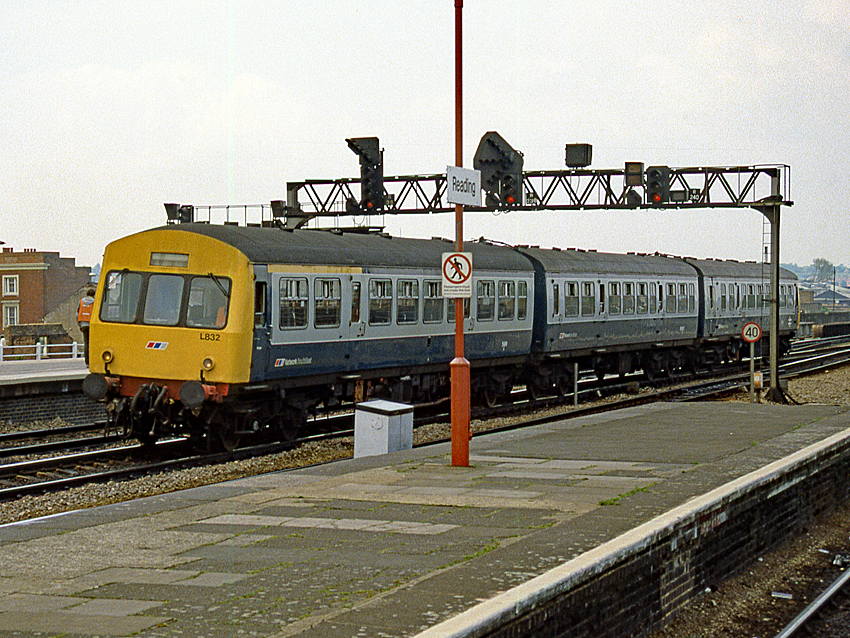
 A Class 101 at Reading in 1989 | |
 Interior of 101654 | |
| In service | 1956–2003 |
| Manufacturer | Metropolitan Cammell |
| Order no. | List
|
| Family name | First generation |
| Replaced | Steam locomotives and carriages |
| Constructed | 1956–1960 |
| Entered service | 1956 |
| Number built | 620 vehicles (DMCL(AEC engines): 97, DMCL(Leyland engines): 53, DMBS(AEC engines): 164, DMBS(Leyland engines): 53, DTCL: 123, TCL: 71, TSL: 31, TBSL: 28) |
| Number preserved | 41 cars |
| Formation | 2-, 3-, or 4-car sets |
| Operators | British Rail Network SouthEast ScotRail First North Western |
| Depots | |
| Specifications | |
| Car length | 57 ft 0 in (17.37 m) |
| Width | 9 ft 3 in (2.82 m) |
| Height | 12 ft 4 in (3.76 m) |
| Maximum speed | 70 mph (113 km/h) |
| Weight | 32.5 tonnes (32.0 long tons; 35.8 short tons) (powered), 25 tonnes (25 long tons; 28 short tons) (unpowered)[4] |
| Prime mover(s) | Two BUT (AEC or Leyland) 6-cylinder diesels |
| Power output | 150 bhp (112 kW) each engine |
| Transmission | Mechanical: 4-speed epicyclic gearbox |
| Braking system(s) | Vacuum |
| Coupling system | Screw-link couplings, British Standard gangways |
| Multiple working | ■ Blue Square |
| Track gauge | 4 ft 8+1⁄2 in (1,435 mm) |
The British Rail Classes 101 and 102 diesel-mechanical multiple units were built by Metro-Cammell at Washwood Heath in Birmingham, England, from 1956 to 1959, following construction of a series of prototype units. These classes proved to be some of the most successful and longest-lived of BR's First Generation DMUs, second in longevity only to the Class 121, with the final five units being withdrawn on 24 December 2003. The oldest set was, by then, just over 47 years old.[5]
Background
[edit]
In 1955, British Rail published a Modernisation Plan to streamline the railway network, bringing it up to date in comparison to European standards. Steam power would be phased out in favour of diesel powered railcars and locomotives, and projects were put out to tender.[6] BR hoped that by replacing steam with DMUs, costs would be reduced sufficiently to make rural lines viable.[7]
Since there was no time for BR to issue a standard specification, train builders were invited to submit plans on the understanding that the units could be built and put into service quickly. Having gained experience with early lightweight DMUs, Metro Cammell won a contract and put the Class 101 into production. The type featured a steel chassis with an aluminium body to reduce weight. Five orders for batches were placed for the type.[8][failed verification]
Metro-Cammell advertised their new train highlighting the wide availability and modern features the 101 offered. Demand was so high that at one point four cars per week were rolling off the Washwood Heath production lines.[9] The trains underwent testing on the Sutton Park line near the works from 1956, before the sets were released to BR.[10]
The 101s came in two, three or four car units, with two driving carriages one or two of which were powered by 11.3 litre BUT six cylinder diesel engines with epicyclic gearboxes. Being a first generation DMU, they were a prime example of a slam-door train. They had a top speed of 70 mph (110 km/h).[11]
Operations
[edit] | This section needs additional citations for verification. (January 2025) |
In the mid-1970s, the type was chosen for a refurbishment to extend their service life. Vehicle interiors were improved with the fitting of fluorescent lighting, new upholstery and carpeting, and fitting of extra heating equipment. They also had uprated engines fitted.[12] The work was carried out by BR Doncaster.[13]
The Class 111 was a variant of the 101, having more powerful Rolls-Royce engines. They were built to serve Greater Manchester and West Yorkshire PTE. The 111 lasted in service until 1989, fourteen years earlier than the 101.[14]
The 101 fleet was used across much of the British Rail network (with the notable exception of the Southern Region - apart from some inter-regional workings). Notable concentration of services included:
Scotland
[edit]Class 101s operated various routes in Scotland starting in July 1958. Edinburgh - Dundee was a regular working, with units stabled at Dundee depot.[15] Upon ScotRail's formation, the units continued in use and were in service up to Privatisation in 1997, with some painted in orange and black Strathclyde PTE livery.[citation needed]

In January 1984, a fire at Ayr depot destroyed six 101s and as a result an equivalent number of Class 104 were drafted in to fill the gap.[citation needed]
Upon Privatisation in 1997, ScotRail retained eleven units in service, running the Glasgow to Barrhead, East Kilbride, Paisley Canal and Whifflet as well as the Motherwell to Cumbernauld services. Although Class 101s were a common sight in Scotland up to the late 90s, they started to disappear from Glasgow Central high level with the introduction of the Class 156.[citation needed] Newer Class 170s started a stock cascade and the type's withdrawal began. Upon the 101s final withdrawal from Scotland in November 1999, the remaining sets were returned to Manchester.[16]
Wales
[edit]The type was seen in South Wales working commuter routed around the Valleys and West Wales Line until the early 1990s, and on rural Welsh lines until the early 2000s. In the 1970s, a diagram from Birmingham to Aberystwyth via the Cambrian Line was a regular route for the 101s.[17] From 1982, they were used on the Central Wales Line between Shrewsbury and Swansea.[18] The 101s were scheduled along with a mixture of other first generation DMUs and Sprinters to work the Crewe - Holyhead services from the early 1980s.[19]
West Midlands
[edit]Starting on 14 April 1958, the region received a batch of two and three car units. Class 101s were extensively used for commuter services on the Cross-City Line and Chase Line in Birmingham and services to Worcester before being put to work in outlying areas.[20]
Operating from Tyseley depot, the type was used all over the West Midlands well into the 1980s. Just as with the Class 116 which was also heavily used on the same routes, the 101s were withdrawn from WMPTE service on 12 July 1993 when the Cross-City Line was fully electrified. In all, the 101 served the West Midlands for over 35 years.[21]
Teesside
[edit]Arriving in 1957 at the newly opened Darlington depot, the 101s were initially used on runs between Darlington and Saltburn on the Tees Valley Line. Most of the first batch of 101s ordered were allocated to Darlington. The class continued to serve the line well into the 1980s.[22] The type was withdrawn 21 September 1989 in favour of Pacers.[citation needed]
Tyneside
[edit]
The initial order of 339 vehicles were allocated to the Tyneside area. The 101s first went into service on 24 October 1956 when seven 4-car and 10 2-car units were delivered. A route from Newcastle to Middlesbrough followed. From February 1957, they began operating a stopping service between Newcastle and Carlisle. A longer diagram between Newcastle and Leeds offered a buffet service. The 101s routes were expanded to the whole Tyneside area, replacing the local steam-hauled services.[23] This included the Alston line between Haltwhistle and Alston where the class operated until the line closed in 1976.
Later services were run by Tyne and Wear Passenger Transport Executive and stabled at South Gosforth depot. They remained in service in the region until 30 May 1981 when they were superseded by the Tyne and Wear Metro.[citation needed] At which point, the class was withdrawn and the sets sent to Neville Hill depot in Leeds to be re-deployed.
West and South Yorkshire
[edit]
An initial batch of 10 units went into service in Bradford in December 1956. Operating out of Neville Hill depot in Leeds, the 101s were used extensively for short commuter services. Because of the relatively underpowered engines, the more powerful Class 111 was paired up with some 101 units, while others were moved to other depots.[24] Occasional services between York - Manchester and beyond were worked via the Calder Valley. Regular services were run between Leeds, Bradford, York and Sheffield but the units could also be seen in places such as Scarborough and Whitby.[25]
Western Region
[edit]
From 1967, several 101 sets were transferred to serve the South West. Services from Reading to Gatwick Airport and Oxford to Paddington were common.[26] Diagrams expanded as more 101s arrived in the region with regular runs in the Bristol area. They were stabled at Reading and Plymouth Laira depots, with the units serving until 1987 when they were largely replaced by Class 108s.[24] Several 101s received Network Southeast branding and by the early 1990s had been scaled back to running local services between Didcot, Oxford and Bicester.[27] However, some 101 units were still working in the Plymouth area as late as May 1993 with the final withdrawal coming in 1996.[28]
Thanks to the withdrawal of other units and types, 101s were paired up with different carriages. From the early 1980s it was not uncommon for example for a 101 trailer to be paired to another first generation DMU driving car on various routes and different regions.[citation needed]
East Anglia
[edit]First introduced in the region in January 1970, the 101 units were allocated to Norwich depot and used on rural lines, notably Norwich to Sheringham and on the Fen line, as well as regular services to Ipswich amongst others. In later years, additional units were based at Cambridge.[29] The Cambridge-based trains primarily ran shuttle services from Cambridge to Royston and from Hitchin to Huntingdon.[30] However, with the electrification of the region and introduction of newer rolling stock, by the early 1990s they had fallen out of favour and were re-allocated to other parts of the rail network.[27] The remaining 101 unit was finally withdrawn from Norwich in August 1996.[31]
Greater Manchester
[edit]When the Pacers serving Manchester to Blackpool shortly after their introduction proved unreliable in the mid-1980s, the 101 filled the gap at short notice despite not being common in the region.[citation needed] The 101s were then rolled out across the Greater Manchester area.
Despite the intention to phase out the type and other Heritage DMUs in favour of newer stock, the 101 proved to be a dependable workhorse. Thirty five units were removed from service by 1992 and received a further refurbishment. At this point, they were repainted in Regional Railways livery, and had the class number applied concurrently with several Sprinter and Pacer sets. The work was once again undertaken at Doncaster.[32] Along with other first generation types, corrosion of the body panels and asbestos used during construction was seen as major concerns and were leading causes for their eventual retirement.[33]
Once the units from Scotland had returned, they were put into use working the rural lines around Greater Manchester, especially the Buxton and Hope Valley Lines on services into Manchester Picadilly.[34] It was intended to phase the 101s out of service in favour of the Class 142 in the late 1990s, but the Privatisation of British Rail delayed those plans.[citation needed]
Post privatisation
[edit]
Following privatisation the remaining 101 sets in mainline service fell under the ownership of Angel Trains and operated by the First North Western franchise once the units from Scotland had been returned to Manchester. FNW declined to repaint the trains again, and they retained their former liveries. A total of 18 sets were in service initially.[35] Ongoing problems with the Pacer units and the Sprinters' use on other lines meant that the 101s were called on to continue in service. The 101s outlasted the Class 141 Pacer in service, a type which had been intended to replace the older unit.[36]
The 101 was seen regularly running on the North Wales Coast Line service between Crewe and Holyhead alongside loco hauled trains as late as 1999.[37] The type was unsuited to the route, and was replaced with the British Rail Class 175 from 2000.[38] It fell to the 101s to run the stopping service from Manchester to Stoke-on-Trent, along with other rural routes in the north west.[39]
Beginning in late 2000, the age of the units was starting to tell and the remaining 101s were gradually retired. They were used exclusively on the Hope Valley services until the end of their career. The very last scheduled service for the type anywhere was run on 24 December 2003 between Rose Hill and Manchester Piccadilly at which point the final five units were decommissioned from service, and sent to Shoeburyness for storage.[40]
Farewell
[edit]Because of the type's popularity and longevity in service, a final farewell tour for the 101s was run in late 2003 which was a railtour of northwest England.[41]
Accidents and incidents
[edit]- On 10 August 1961, Class 45 D105 running light to Neville Hill over-ran signals and collided with a Leeds - Scarborough Class 101 almost opposite Leeds East Signal Box. Leaking diesel caught fire and the leading two DMU vehicles (51440 & 59533) overturned, but were returned to traffic after repair. One person was killed, and two injured. The driver of the locomotive mistakenly accepted the signal that had been cleared for the DMU.[42]
- On 15 June 1965, an empty stock train passed a colour light signal and two ground subsidiary signals at danger before colliding at slow speed with the leading coach of the approaching 15.57 Scarborough - Leeds Class 101. Both drivers and twelve passengers were injured.
- On 11 July 1967, A 101 working on the 10.11 Chester to Manchester Exchange service collided at a speed of approx. 20 mph (32 km/h) with the rear of the 02.00 Margam to Carlisle Class 5 freight train which was standing at the Winwick Junction Down Fast Home signal. There were no injuries.[43]
- On 16 February 1977, an express passenger train hauled by Class 55 locomotive 55 008 collided with a Class 101 diesel multiple unit operating an empty stock train after failing to stop at Darlington. One of the vehicles of the DMU overturned. The guard of the express was slightly injured. The cause of the accident was that the brakes on the carriages of the express had become isolated whilst the train was moving in a freak event. The train had struck an object on the track, which had caused a traction motor cover to come loose. This struck the handle of the brake isolating cock, closing it and thus separating the brakes between the locomotive and train.[44]
- On 28 March 1983, the 20.58 Falkirk Grahamston to Glasgow Queen St. service collided with a van that was allowed to roll away and drop 40 ft (12 m) into the cutting near Eastfield shed.
Original TOPS classes
[edit] |
When TOPS was originally introduced only the Driving Motor Brake Second (DMBS) and the Driving Motor Composite (with Lavatory) (DMCL) were classified as Class 101 (AEC engines) or Class 102 (Leyland engines). The Driving Trailer Composite (with Lavatory) (DTCL) were Class 144, the Trailer Seconds (with Lavatory) (TSL) were Class 162, the Trailer Brake Second (with Lavatory) (TBSL) were Class 168 and the Trailer Composite (with Lavatory) (TCL) were Class 171. Later all the cars were reclassified, becoming Class 101.
| Fleet numbers |
Type | Class | Seating | Weight | Lot No | Diagram | Formation (Original) | Year built |
|---|---|---|---|---|---|---|---|---|
| 50138–50151 | DMC(L) | 101/1 | 12F+45S (2/2) | 32t | 30249 | BR 618 | 4-car | 1956 |
| 50152–50157 | DMBS | 101/2 | 52S | 32t | 30252 | BR 523 | Power-Twin | 1956/7 |
| 50158–50163 | DMC(L) | 101/1 | 12F+53S | 32t | 30253 | BR 620 | Power-Twin | 1956/7 |
| 50164–50167 | DMBS | 101/2 | 52S | 32t | 30254 | BR 523 | Power-Twin | 1956/7 |
| 50168–50171 | DMC(L) | 101/1 | 12F+53S | 32t | 30255 | BR 620 | Power-Twin | 1956/7 |
| 50172–50197 | DMC(L) | 101/1 | 12F+53S | 32t | 30256 | BR 620 | 4-car | 1957 |
| 50198–50209 | DMBS | 101/2 | 52S | 32t | 30259 | BR 523 | Power-Trailer | 1957 |
| 50210–50233 | DMBS | 101/2 | 52S | 32t | 30261 | BR 523 | Power-Trailer | 1957 |
| 50234–50245 | DMC(L) | 101/1 | 12F+45S | 32t | 30263 | BR 619 | 4-car | 1957 |
| 50246–50248 | DMBS | 101/2 | 52S | 32t | 30339 | BR 522 | Power-Trailer | 1957 |
| 50250–50259 | DMBS | 101/2 | 52S | 32t | 30266 | BR 523 | Power-Twin | 1957 |
| 50260–50269 | DMC(L) | 101/1 | 12F+53S | 32t | 30267 | BR 621 | Power-Twin | 1957 |
| 50290–50292 | DMBS | 101/2 | 52S | 32t | 30270 | BR 523 | 3-car | 1957 |
| 50293–50296 | DMBS | 101/2 | 52S | 32t | 30270 | BR 523 | Power-Trailer | 1957 |
| 50303–50320 | DMBS | 101/2 | 52S | 32t | 30275 | BR 523 | 3-car | 1958 |
| 50321–50338 | DMC(L) | 101/1 | 12F+53S | 32t | 30276 | BR 621 | 3-car | 1958 |
| 50745–50747 | DMC(L) | 101/1 | 12F+53S | 32t | 30271 | BR 621 | 3-car | 1957 |
| 50748–50751 | DMC(L) | 101/1 | 12F+53S | 32t | 30271 | BR 621 | 4-car | 1957 |
| 51174–51203 | DMBS | 101/1 | 52S | 32t | 30467 | BR 523 | Power-Trailer | 1958 |
| 51204–51223 | DMBS | 101/2 | 52S | 32t | 30467 | BR 523 | Power-Trailer | 1958 |
| 51224–51253 | DMBS | 101/2 | 52S | 32t | 30467 | BR 523 | Power-Trailer | 1958 |
| 51425–51434 | DMBS | 102/2 | 52S | 32t | 30500 | BR 523 | Power-Trailer | 1959 |
| 51435–51444 | DMBS | 102/2 | 52S | 32t | 30500 | BR 523 | 4-car | 1959 |
| 51445–51470 | DMBS | 102/2 | 52S | 32t | 30500 | BR 523 | 3-car | 1959 |
| 51495–51504 | DMC(L) | 102/1 | 12F+53S | 32t | 30501 | BR 621 | Power-Twin | 1959 |
| 51505–51514 | DMC(L) | 102/1 | 12F+53S | 32t | 30501 | BR 621 | 4-car | 1959 |
| 51515–51540 | DMC(L) | 102/1 | 12F+53S | 32t | 30501 | BR 621 | 3-car | 1959 |
| 51795–51801 | DMBS | 102/2 | 52S | 32t | 30587 | BR 523 | 3-car | 1959 |
| 51802–51808 | DMC(L) | 102/1 | 12F+53S | 32t | 30588 | BR 621 | 3-car | 1959 |
| 56050–56061 | DTC(L) | 144 | 12F+53S | 25t | 30260 | BR 630 | Power-Trailer | 1957 |
| 56062–56085 | DTC(L) | 144 | 12F+53S | 25t | 30262 | BR 630 | Power-Trailer | 1957 |
| 56086–56089 | DTC(L) | 144 | 12F+52S | 25t | 30272 | BR 630 | Power-Trailer | 1957 |
| 56218–56220 | DTC(L) | 144 | 12F+45S | 25t | 30340 | BR 629 | Power-Trailer | 1957 |
| 56332–56361 | DTC(L) | 144 | 12F+53S | 25t | 30340 | BR 630 | Power-Trailer | 1957 |
| 56362–56381 | DTC(L) | 144 | 12F+53S | 25t | 30468 | BR 630 | Power-Trailer | 1957 |
| 56382–56411 | DTC(L) | 144 | 12F+53S | 25t | 30468 | BR 630 | Power-Trailer | 1957 |
| 59042–59048 | TS(L) | 162 | 61S | 25t | 30250 | BR 622 | 4-car | 1956 |
| 59049–59055 | TBS(L) | 168 | 45S | 25t | 30251 | BR 626 | 4-car | 1956 |
| 59060–59072 | TS(L) | 162 | 71S | 25t | 30257 | BR 623 | 4-car | 1957 |
| 59073–59085 | TBS(L) | 168 | 53S | 25t | 30258 | BR 627 | 4-car | 1957 |
| 59086–59091 | TS(L) | 162 | 61S | 25t | 30264 | BR 622 | 4-car | 1957 |
| 59092–59097 | TBS(L) | 168 | 45S | 25t | 30265 | BR 626 | 4-car | 1957 |
| 59112–59113 | TBS(L) | 168 | 53S | 25t | 30274 | BR 627 | 4-car | 1957 |
| 59114–59131 | TC(L) | 171 | 12F+53S | 25t | 30277 | BR 624 | 3-car | 1957 |
| 59302–59304 | TS(L) | 162 | 71S | 25t | 30273 | BR 623 | 3-car | 1957 |
| 59305–59306 | TC(L) | 171 | 71S | 25t | 30273 | BR 623 | 4-car | 1957 |
| 59523–59542 | TC(L) | 171 | 12F+53S | 25t | 30277 | BR 624 | 3-car | 1957 |
| 59543–59568 | TC(L) | 171 | 12F+53S | 25t | 30502 | BR 624 | 3-car | 1958 |
| 59686–59692 | TC(L) | 171 | 12F+53S | 25t | 30589 | BR 624 | 3-car | 1959 |
Preservation
[edit]The Class 101 was one of the largest classes of first-generation DMUs and, partly thanks to their relatively late withdrawal from revenue-earning service, numerous vehicles have been preserved on heritage railways, including the Great Central Railway and the North Yorkshire Moors Railway. There are only three centre cars preserved: at the Severn Valley Railway, North Yorkshire Moors Railway and Mid-Norfolk Railway. No Trailer Brake Seconds were preserved.
| Set number | Vehicle numbers | Livery | Location | Image | Notes | ||
|---|---|---|---|---|---|---|---|
| DMBS | TCL | DMCL | |||||
| 101685 | 50164 | 59539 | 50160 | BR Green | North Yorkshire Moors Railway | 
|
Last to be withdrawn, operational |
| 960992 | - | - | 50193 | BR Blue and Grey | Great Central Railway | Stored. | |
| - | 50203 | - | 50266 | BR Blue | Great Central Railway | 
|
Operational |
| 101680 | 50204 | - | 51511 | BR Green | North Yorkshire Moors Railway | Stored | |
| Iris 2 | 50222 | - | 50338 | BR Green | Barry Island Railway | Operational | |
| 101692 | 50253 | 59303 (TSL) | 50170 | BR Green | Severn Valley Railway | Operational. Moved to the SVR in September 2024.[45] | |
| - | 50256 | - | 56343(DTCL) | BR Blue | Wensleydale Railway | Stored | |
| - | 51187 | - | 51512 | BR Green | Cambrian Heritage Railways | Under repair | |
| - | 51188 | - | 51505 | BR Blue | Ecclesbourne Valley Railway | 
|
Operational (51188 on loan to North Norfolk Railway for 2018/19) |
| - | 51189 | - | 51803 | BR Blue | Keighley and Worth Valley Railway | 
|
Operational [46] |
| - | 51192 | - | 56352(DTCL) | BR Green | North Norfolk Railway | Operational | |
| - | 51205 | - | 56055(DTCL) | BR Green | Cambrian Heritage Railways | Operational | |
| 101678 | 51210 | - | 50746 | BR Blue / BR Blue and Grey | Wensleydale Railway | Last to be withdrawn, under restoration | |
| - | 51213 | - | 56358(DTCL) | BR Blue and Grey / BR Blue | East Anglian Railway Museum | 
|
Operational |
| 101695 | 51226 | - | 51499 | BR Green | Mid Norfolk Railway | 
|
Operational |
| - | 51228 | - | 56062(DTCL) | BR Green | North Norfolk Railway | 
|
Operational |
| 960993 | 51427 | 59575 (Class 111) | 50321 | BR Green | Great Central Railway | 
|
Operational |
| L836 | 51434(DMBC) | 59117 | 51503 | BR Blue and Grey | Mid Norfolk Railway | 
|
Operational (Currently as 2-car only) |
| - | - | - | 56342(DTCL) | BR Blue and Grey | Great Central Railway | Under restoration | |
| - | - | - | 56347(DTCL) | BR Green | Mid Norfolk Railway | 
|
Operational |
| - | - | - | 56356(DTCL) | Non Standard Green and Cream | Barry Island Railway | Stored | |
| - | - | - | 56408(DTCL) | SR Malachite Green | Spa Valley Railway | 
|
Operational |
| - | 50211 | - | - | Regional Railways | Private Site | Stored, cab only | |
| - | - | - | 50269 | Regional Railways | Private Site | Stored, cab only | |
| - | 51177 | - | - | BR Blue | Private Site, Ashton-under-Lyne, Lancashire | Cab only, used as a store room. | |
Model railways
[edit]Hornby Railways first produced a version of the BR Class 101 in OO gauge in 1958 which was last produced in 1977.[47] Lima also produced a Class 101 for a number of years, in Green, Blue/Grey, Regional Railways and Network Southeast liveries. The tooling was used by Hornby following purchase of their assets. In 2007, Hornby reintroduced the Lima version of the OO gauge Class 101 in BR green and BR blue liveries.[48] Bachmann Industries launched their BR Class 101 in OO gauge in 2014 and this has also been produced in a variety of liveries
In fiction
[edit]The Class 101 DMUs were the basis for the character Daisy the Diesel Railcar in The Railway Series books written by the Rev. W. Awdry, and the adapted television series Thomas the Tank Engine and Friends, although Daisy is a single car.[49][50][51] 101685 on the North Yorkshire Moors Railway is named after her.[52]
References
[edit]- ^ a b Fox 1987, pp. 8, 10–11, 15–16, 26, 28–33, 35–36.
- ^ a b c d e f g h i j k Fox 1986, pp. 136–147.
- ^ Fox, Hall & Webster 2001, pp. 186–187.
- ^ "CLASS 101, 102, 144, 147, 162, 164, 168, 171". The RailwayCentre.Com. Archived from the original on 7 February 2009.
- ^ "Class 101 DMU". railcar.co.uk.
- ^ "Modernisation and Re-Equipment of British Railways :: The Railways Archive".
- ^ "BR Class 101 DMU No. 101680". 2 February 2016.
- ^ "Rail Express" (PDF). December 2018.
- ^ "Class 101 DMU Met-Camm Adverts".
- ^ "Gallery". 19 May 2015.
- ^ Bolton, William F. (1963). "Railcar Transmissions". The Railwayman's Diesel Manual (4th ed.). pp. 137–143.
- ^ "Class 101 | Great Central Railway – the UK's Only Main Line Heritage Railway".
- ^ Cole, Andrew (15 August 2017). First Generation DMUs. Amberley Publishing Limited. ISBN 9781445666419.
- ^ "Class 111 DMU".
- ^ "Metropolitan-Cammell DMU (TOPS Classes 101 & 102)".
- ^ "Class 101 DMU Decline".
- ^ "Railways of North Wales 1975-1983: cambriancoast:DMUs1". www.2d53.co.uk.
- ^ Howat, Colin J. (15 August 2019). First Generation Scottish DMUs. Amberley Publishing Limited. ISBN 9781445691886.
- ^ "DMU's in focus 2". www.penmorfa.com.
- ^ "Railways in Worcestershire".
- ^ "West Midlands Cross-City South: The Diesel Years".
- ^ "David Hey's Collection - BR STEAM DAYS LEEDS - 2". Archived from the original on 20 August 2008.
- ^ "Class 101 DMU Operations - Initial".
- ^ a b "Class 101 DMU Operations - Later".
- ^ Edgar, Gordon (15 February 2015). Yorkshire & Humberside Traction. Amberley Publishing Limited. ISBN 9781445643335.
- ^ "DMU".
- ^ a b "Martin Loader's Railway Photography - Class 101".
- ^ "Taillampphotography.com".
- ^ "500". M&GN Railway. Archived from the original on 15 December 2023. Retrieved 15 December 2023.
- ^ "Disused Stations: Cambridge Station".
- ^ "51503".
- ^ "Carriage & Wagon News: COMPLETION SPECIAL: Class 101 Railcar E56062". 21 August 2015.
- ^ "A fiery end - Rail Express". 12 May 2017.
- ^ "The Manchester South Class 101 DMU".
- ^ Marks, Roger (15 February 2015). Heritage DMUs: The Final Years. Amberley Publishing Limited. ISBN 9781445640297.
- ^ Thomas, David St. John; Whitehouse, P. B. (1990). BR in the Eighties. Newton Abbot: David & Charles. ISBN 978-0-71539-854-8.
- ^ "Class 101". www.zen70752.zen.co.uk. Archived from the original on 27 February 2023. Retrieved 24 May 2021.
- ^ "First North Western - News". 28 November 1999. Archived from the original on 28 November 1999. Retrieved 24 May 2021.
- ^ Collection, D. C. "A Second Chance To See… Class 101 DMUs - Rail Express". Everand.
- ^ "Class 101 DMU - 51228/56062 - 'Heritage Railcar'".
- ^ "North Wales Coast Railway Notice Board 23 December 2013". www.nwrail.org.uk. Retrieved 24 May 2021.
- ^ "Report on the Collisions which occurred on 10th August 1961 at Leeds City Station in the North Eastern Region British Railways :: The Railways Archive".
- ^ "Accident at Winwick Junction on 11th July 1967 :: The Railways Archive".
- ^ "Report on the collision that occurred on 16th February 1977 at Darlington in the Eastern Region of British Railways" (PDF). Department of Transport. 13 July 1978. Retrieved 2 August 2019.
- ^ "Second DMU joins home fleet". Branch Lines. Severn Valley Railway. September 2024. Retrieved 13 September 2024.
- ^ Marshall, Tom (21 October 2023). "Class 101 DMU". Keighley & Worth Valley Railway. Retrieved 21 October 2023.
- ^ "Hornby BR Class 101 DMU". Hornby Railways Collector Guide. Retrieved 2 February 2020.
- ^ Wild, Mike (April–May 2007). "Class 101 DMU returns with Hornby". Hornby Magazine. No. 1. Hersham: Ian Allan Publishing. p. 78. ISSN 1753-2469. OCLC 226087101.
- ^ "Class 101 Metro-Cammel DMU Diesel Multiple Units British Railway images photos pictures photographs". www.docbrown.info.
- ^ Wilbert Vere Awdry. The Island of Sodor - its People, History and Railways. p. 126.
- ^ "Daisy - Character Profile & Bio". Thomas & Friends. Gullane (Thomas) Ltd. Archived from the original on 28 June 2017. Retrieved 28 June 2017.
- ^ "BR Class 101 DMU No. 101685 "Daisy"". North Yorkshire Moors Railway. 5 January 2016. Retrieved 23 March 2022.
Sources
[edit]
- Fox, Peter (1986). Locomotives & Coaching Stock 1986. Sheffield: Platform 5. ISBN 0-906579-58-9.
- Fox, Peter (1987). Multiple Unit Pocket Book. British Railways Pocket Book No.2 (Summer/Autumn 1987 ed.). Platform 5 Publishing Ltd. ISBN 0906579740. OCLC 613347580.
- Fox, Peter; Webster, Neil (July 1982). Multiple Unit Pocket Book. Sheffield: Platform 5 Publications. ISBN 0-906579-26-0.
- Fox, Peter; Hall, Peter; Webster, Neil (2001). British Railways Locomotives & Coaching Stock 2001. Sheffield: Platform 5. ISBN 1-902336-19-4.
- Golding, Brian. A Pictorial Record of British Railways Diesel Multiple Units.
- Haresnape, Brian. British Rail Fleet Survey 8: Diesel Multiple Units—The First Generation.
- Marsden, Colin J. Motive Power Recognition: 3 DMUs.
- Robertson, Kevin. British Railway Pictorial: First Generation DMUs.
British Rail Classes 101 and 102
View on GrokipediaHistory and Development
Origins and Modernisation Plan
British Rail's 1955 Modernisation Plan represented a pivotal effort to modernize the railway network through widespread dieselisation, aiming to replace steam locomotives entirely with diesel and electric traction as part of a £1.2 billion investment programme designed to enhance competitiveness against road and air transport.[4] The plan emphasized the rapid introduction of diesel locomotives and multiple units across various services, prioritizing efficiency and cost savings in operations.[5] Within this framework, lightweight diesel multiple units (DMUs) emerged as a practical and economical alternative to steam-hauled trains, particularly for branch lines and suburban routes where traffic volumes were low but regular service was essential.[4] These units promised reduced staffing requirements, lower fuel consumption, and faster turnaround times, making them ideal for maintaining uneconomic but vital local services amid post-war financial pressures.[5] Building on early 1950s experiments with lightweight railcar designs—initiated around 1952 to trial self-propelled units for cost-effective operations on sparsely populated lines—British Rail sought versatile, high-capacity DMUs capable of handling typical branch line demands without excessive infrastructure costs.[5] Metro-Cammell was chosen as the primary builder, leveraging their established proficiency in fabricating lightweight aluminium and steel car bodies for trams and buses, which translated effectively to rail applications. The initial design brief specified a maximum speed of 70 mph, powered by two 150 bhp engines per power car, with seating for 60-70 passengers to balance comfort and operational flexibility.[3] These parameters guided the development of prototypes completed in 1956.[6]Prototypes, Orders, and Production
The first units for the Class 101 were constructed in 1956 and underwent testing on the Western Region.[7] These initial vehicles featured AEC engines and served as the basis for the design, demonstrating the Metro-Cammell lightweight construction approach under British Rail's Modernisation Plan. The initial production was allocated mainly to the North Eastern Region for branch and local services. Meanwhile, the first units for the Class 102 were built in 1958 but equipped with Leyland engines to evaluate alternative power options.[2] Full production commenced at Metro-Cammell's Washwood Heath works in Birmingham, with a total of 527 vehicles delivered for Class 101 between 1956 and 1960.[2] For the Class 102, production was more limited, with 52 two-car sets (106 vehicles) assembled in 1958 and 1959, all fitted with Leyland engines to assess their performance in service.[8] The vehicle composition across both classes included driving motor brake seconds (DMBS), driving motor composite vehicles with luggage (DMCL) using AEC or Leyland engines, driving trailer composites with luggage (DTCL), trailer composites (TCL), trailer seconds (TSL), and trailer brake seconds with luggage (TBSL), totaling 527 vehicles under the Class 101 designation (including reclassified Class 102 units).[2] Production evolved with adaptations to enhance practicality and reliability. Early units incorporated bus-type destination blinds for passenger information, while later batches transitioned to more durable route indicators. Minor bodywork modifications were also introduced, such as reinforced underframes and improved door mechanisms, to address issues identified during initial trials and ensure longevity in everyday operations.[7] These changes reflected iterative feedback from prototype testing, allowing Metro-Cammell to streamline assembly at a rate of up to four vehicles per week by the late 1950s.[7]Key Differences Between Classes 101 and 102
The primary difference between British Rail Classes 101 and 102 diesel multiple units lies in their powerplants, with Class 101 units powered by two AEC 220 6-cylinder direct-injection diesel engines rated at 150 bhp each, while Class 102 units used two Leyland 680 6-cylinder direct-injection diesel engines of equivalent power output.[6][9] Both engine types were horizontally mounted under the floor and paired with a Standard Cog Gear (SCG) R14 4-speed epicyclic mechanical transmission, but the Leyland 680 required minor adaptations in mounting to fit the Metro-Cammell body design.[6] Class 102 production was confined to a batch of 106 vehicles (53 driving motor composite lavatory cars and 53 driving trailer composites), all assembled by Metro-Cammell at Washwood Heath between 1958 and 1959 as a variant of the more prolific Class 101 design.[8] This limited output reflected challenges in Leyland engine availability during the late 1950s, compounded by emerging reliability concerns that elevated maintenance demands compared to the AEC-powered Class 101.[10] The units featured subtle body modifications, including revised ventilation grilles over the engine compartments to suit the Leyland engines' cooling needs and adjusted gearbox positioning for compatibility.[11] In operation, Class 102 power cars were frequently marshalled with Class 101 trailers to form mixed two- or three-car sets, enabling flexible deployments on branch lines and suburban services.[2] However, the Leyland engines' propensity for wear led to earlier withdrawals for Class 102 units, with many re-engined with AEC units in the 1970s and reclassified under the Class 101 designation by the late 1970s to standardize the fleet.[2]Technical Specifications
Body and Dimensions
The British Rail Classes 101 and 102 diesel multiple units employed a lightweight construction to enhance efficiency and reduce operational costs, featuring a steel body with aluminium alloy roof panels for weight savings. This design resulted in powered cars weighing approximately 32.5 tonnes and unpowered trailer cars around 25 tonnes.[6] Each car in these classes measured 57 ft (17.37 m) in length over body, 9 ft 3 in (2.82 m) in width, and 12 ft 4 in (3.76 m) in height, facilitating flexible formations of two or three cars connected via flexible gangways.[12] The saloon interior utilized a straightforward layout with transverse bench seating for 53 or 57 second-class passengers per powered car, depending on the specific layout, while certain composite variants included a small first-class section with 12 seats; the driver's cab was equipped with a single-piece windshield for improved visibility and standard multiple-unit control provisions.[6] Durability challenges arose in early examples due to underframe corrosion exacerbated by damp operating environments, particularly in regions with high moisture exposure, prompting reinforcements and protective treatments during subsequent refurbishment programs.Powertrain and Mechanical Components
The power cars of British Rail Classes 101 and 102 diesel multiple units were fitted with two BUT (British United Traction)-built six-cylinder diesel engines, providing mechanical propulsion directly to the wheels. Class 101 units utilized AEC 220 engines rated at 150 bhp (112 kW) each, for a combined output of 300 bhp (224 kW) per power car, while Class 102 units employed equivalent Leyland 680 engines also delivering 150 bhp (112 kW) each.[6][3] Power was transmitted through a standard mechanical four-speed epicyclic gearbox, specifically the Self-Changing Gears (SCG) R14 model, coupled to axle-mounted final drives (AEC F239 type) on the inner axles of the driving bogies.[6][3] This configuration enabled a top speed of approximately 70 mph (113 km/h), suitable for the secondary and branch line services these units were designed for.[3] The braking system relied on vacuum actuation as standard, employing a Gresham & Craven twin-pipe quick-release setup with exhausters belt-driven from the engines.[6] Power cars incorporated two 22-inch sliding band or 21-inch rolling ring vacuum cylinders for effective retardation, while trailer cars used two 18-inch cylinders.[6] Suspension was provided by Metropolitan Cammell-designed bogies (types DD15 for powered vehicles and DT11 for trailers), featuring primary helical coil springs on the axleboxes for load distribution over the axles, supplemented by secondary nests of coil springs in the bolsters for ride stability.[13] These units demonstrated strong mechanical reliability, with many achieving service lives exceeding four decades through routine maintenance of their robust diesel-mechanical components.[3]Electrical and Control Systems
The electrical systems of the British Rail Classes 101 and 102 diesel multiple units supplied 24V DC power for auxiliaries, controls, lighting, and heating, with engine-driven generators charging batteries for backup and engine starting. Early production batches (Batch 2) featured dynamos on power cars, while later batches (Batch 3) used alternators for more reliable generation, supporting the low-voltage DC network standard across first-generation BR DMUs. Batteries provided essential redundancy, enabling cold starts and maintaining critical functions during generator downtime.[14] Operational controls centered on a master controller integrated with a deadman's handle, requiring constant driver pressure to prevent unintended movement and ensure safety compliance. From the early 1970s, many units received the Automatic Warning System (AWS), which delivered audible alarms and visual indicators to alert drivers of signal aspects. Later modifications added public address systems to selected units, facilitating onboard announcements for passenger information and safety. Interior lighting initially used incandescent bulbs, but refurbishment programs from the mid-1970s introduced fluorescent fixtures for brighter, more energy-efficient illumination, alongside updated upholstery and carpeting.[15] Electric heating systems drew from the 24V auxiliary supply, with early single-vehicle controls evolving to through-train configurations in Batch 3 for coordinated operation across formations, and additional heaters installed during refurbishments to enhance passenger comfort.[14]Operational History
Initial Introduction and Early Service
The British Rail Class 101 diesel multiple units (DMUs) entered service in late 1956, with the first batch of vehicles from Metro-Cammell's Order 2A delivered to South Gosforth depot in the North Eastern Region during October and November. These prototypes commenced operations on 24 October 1956, initially trialling on local services between Newcastle and Middlesbrough. A second batch (Order 2B) followed in December 1956, allocated to Neville Hill depot near Leeds, entering service on 17 December for West Riding local routes such as Leeds to Harrogate. By early 1957, additional units from Order 2C were introduced at Darlington for services to Saltburn, marking the rapid expansion of the class across the North Eastern Region.[16][2] Full production fleets were allocated by 1958 to the Scottish, North Eastern, and London Midland Regions, reflecting British Rail's push to modernise branch and suburban services under the 1955 Modernisation Plan. In Scotland, Class 101s began appearing from July 1958, primarily on Edinburgh-area routes. The London Midland Region received its initial sets from April 1958, based at depots like Tyseley in Birmingham for suburban duties including services to Worcester and the Cross-City Line precursors. Meanwhile, the North Eastern allocations continued to dominate early deployments, with units handling peak-hour demands through coupled formations. Class 102 units, a variant with Leyland engines built from 1958, were similarly allocated to the Scottish Region at Leith Central depot, entering service on routes between Edinburgh, Dundee, Stirling, and Dunblane.[2][17][18] Early operational patterns focused on replacing steam on secondary and branch lines, with Class 101s taking over Newcastle to Carlisle and Newcastle to Hexham services from February 1957. In the West Riding, they operated short-haul locals amid the region's dense network of mills and commuter flows, while London Midland units supported growing suburban traffic in Birmingham and Manchester areas by the late 1950s. These deployments highlighted the units' versatility for low-density routes, though initial testing revealed limitations on steeper gradients without additional cars.[16][19] Teething issues emerged shortly after introduction, particularly with mechanical components. Gearbox failures were reported as early as November 1957, such as on unit 50223/56075 during trials near Scarborough, leading to temporary withdrawals for adjustments. Engine reliability also posed challenges with the initial 150 bhp AEC engines, including overheating on demanding runs; improved cooling and transmission tweaks largely resolved these issues by 1960.[16][20] Formation practices standardised around two-car power-twin sets for everyday branch work, comprising a driving motor brake second (DMB) and driving trailer composite (DTC) to optimise crew efficiency. For peak suburban hours, units were augmented to three-car configurations by inserting a centre trailer (TS or TBS), or occasionally four-car sets in high-density areas like the North Eastern Region; this flexibility allowed adaptation to varying passenger loads without dedicated locomotives.[16][2]Regional Deployments in England and Wales
In North East England, Class 101 diesel multiple units (DMUs) were extensively deployed from the late 1950s, initially replacing steam traction on routes such as Darlington to Penrith and Newcastle to Sunderland/South Shields.[21] Class 101 units were allocated to the Tyneside area, operating local services until their withdrawal in 1981 following the introduction of the Tyne and Wear Metro. Class 101 units continued in the region through the 1980s, based at depots like Darlington (which handled up to 13 four-car and 14 two-car sets until its 1984 closure) and Heaton, supporting services around Teesside and Tyneside.[21] In West and South Yorkshire, these DMUs handled duties on lines including Sheffield to Goole, with Class 101 sets frequently observed on Goole-bound trains from Leeds in the 1970s and 1980s.[22] In the West Midlands, Class 101 DMUs saw intensive suburban operations from depots such as Tyseley in Birmingham, serving routes across the region well into the 1980s and often paired with Class 116 units for higher-capacity workings.[23] Similarly, in Greater Manchester, they were a mainstay on services from Manchester Piccadilly to destinations like Sheffield, New Mills, Rose Hill, and Marple from the 1960s until 1993, with some formations enhanced by additional power cars for improved performance.[21] These pairings with other first-generation DMU classes, such as the Class 108, allowed for flexible formations to meet peak-hour demands in these urban areas.[21] In Wales, Class 101 DMUs entered sustained service in the 1970s, particularly on Valleys routes emanating from Cardiff, including the Central Wales Line from Swansea to Shrewsbury, which they took over in 1982 using two-car sets allocated to Cardiff Canton depot.[21] They remained prominent on these services through the 1990s, integrating with newer Class 150 and 153 Sprinter units as part of mixed-fleet operations before gradual displacement.[21] By the late 1990s, their role diminished as Sprinters fully supplanted them on high-frequency Valleys lines. East Anglia saw sporadic but notable use of Class 101 DMUs on rural branches from the 1960s, often in hybrid formations with Classes 100 and 105 on Norwich-area services.[21] At Cambridge depot, they operated shuttles to Royston and London King's Cross from 1977 to 1992, peaking at 46 vehicles in 1987 before withdrawal.[21] In the Western Region, trailer cars were allocated to Reading in 1967, with three-car sets introduced at Plymouth Laira in 1974 (sets P800–P804) and later at Bristol and Cardiff; by the 1980s, they served across multiple depots but were displaced by Class 108 units in 1987.[21] This marked the end of their rural branch operations in the early 1980s, as more modern railcars took over.[21]Operations in Scotland
The British Rail Classes 101 and 102 diesel multiple units (DMUs) constituted the largest allocation of first-generation Met-Cammell stock to the Scottish Region, with 159 vehicles forming 63 two- and three-car sets introduced from July 1958. These units were distributed across key depots including Ayr, Dundee, Eastfield, Hamilton West, Haymarket, Leith Central, and Thornton Junction (later Millerhill), enabling widespread deployment on Scotland's diverse network of rural branch lines and inter-urban services. Their reliability and adaptability made them a staple of Scottish operations, particularly where electrification was absent, allowing them to outlast many southern counterparts into the late 20th century.[17][24] During their peak from the 1960s to the 1980s, Classes 101 and 102 dominated rural and inter-urban routes, including the Glasgow-Edinburgh main line via Falkirk, the Fife Circle around Kirkcaldy and Leven, and Highland lines such as the Kyle of Lochalsh branch where a modified observation saloon set provided tourist services from 1987 to 1994. Units handled intensive diagrams on lines like Dundee to Edinburgh/Glasgow (starting 7 July 1958 on the Deeside extension), Edinburgh to Fife (from 4 April 1960), and Glasgow to Ayr, often operating in three-car formations to accommodate passenger volumes on non-electrified tracks. This longevity stemmed from Scotland's limited electrification compared to southern England, preserving the need for versatile DMUs on secondary routes amid the Beeching cuts and subsequent rationalizations. By the mid-1970s, allocations had standardized to three-car sets following the transfer of driving trailer composites south, enhancing capacity for peak-hour and holiday services.[17][25][26] The decline began in 1989 with the introduction of second-generation Class 150 and 156 Sprinter units, which progressively displaced the aging Classes 101 and 102 on core routes like Glasgow-Edinburgh and the Fife Circle. Refurbished sets lingered on residual services, such as Glasgow to Barrhead and East Kilbride into the 1990s, but by 1997 only a handful remained under ScotRail branding. The final passenger workings occurred in November 1999, marking the end of nearly 42 years of service in Scotland, with surviving units transferred south for scrap or preservation.[17][26][23]Refurbishment Programmes
The refurbishment programmes for British Rail Classes 101 and 102 diesel multiple units formed part of a broader initiative launched in the mid-1970s to modernize ageing first-generation DMUs, focusing on interior and mechanical enhancements to improve passenger comfort and extend operational viability. A prototype three-car Class 101 set—comprising driving motor brake second E51451, trailer composite E59545, and driving motor composite E51518—was selected for initial trials at Doncaster Works, with work beginning in April 1974 and completing by July. This prototype incorporated key upgrades such as fluorescent lighting to replace the original tungsten systems, providing up to six times the illumination while lowering ceiling panels for better aesthetics; revised seating with new brown moquette upholstery and arrangements inspired by contemporary designs like those in Class 313 units; and additions like carpeting, wall panelling, and orange laminate in vestibule areas. The trialled set toured various depots and stations, including a display at York on 14 August 1974, to solicit feedback from operational staff and passengers before wider implementation.[15] The main refurbishment effort, which treated Classes 101 and 102 vehicles interchangeably due to their close design similarities, ran from 1976 to April 1984 and encompassed 562 of the approximately 590 vehicles built, representing a substantial portion of the fleet. Refurbishments occurred at multiple British Rail facilities: Doncaster Works handled 278 vehicles, Derby Etches Park 100, Glasgow Works 131, and Swindon Works 53, with allocations based on regional needs and capacity. Interior modifications emphasized practicality and durability, including the widespread adoption of vinyl flooring and moquette-covered seating revisions that prioritized second-class capacity; in many units, first-class compartments were removed or converted to standard class to accommodate growing commuter demands, often replacing original Inter-City 70 seats with denser 2+2 or 2+3 layouts. Fluorescent lighting became standard across refurbished saloons, complemented by improved ventilation and panelling to combat wear from decades of service. External alterations included new cantrail guttering for better rainwater management and the elimination of obsolete headcode equipment, streamlining maintenance.[15] Mechanical refinements during the programme targeted reliability and comfort without full overhauls of core components. New engine mountings and enhanced silencer systems were fitted to reduce vibration and noise from the original AEC 150 bhp engines, while heating upgrades—such as additional ducting and more responsive controls—addressed common complaints about inconsistent warmth in pre-refurbishment interiors, which had relied on basic under-seat heaters. Although no large-scale engine replacements with alternatives like the Cummins NT-855 occurred for these classes in the 1980s, selective powertrain tweaks supported ongoing performance. Overall, these interventions extended the units' service life by 15-20 years, enabling continued use on secondary routes well into the 1990s and delaying full replacement until the early 2000s, though issues like asbestos in insulation prompted premature retirements for some vehicles around 1987. The programme's focus on cost-effective upgrades, rather than new builds, underscored British Rail's strategy to maximize existing assets amid fiscal constraints.[15][12]Later Operations and Withdrawal
Post-Privatisation Use
Following the privatisation of British Rail, which began in 1994 and saw passenger operations franchised out by 1997, the remaining operational Class 101 and 102 diesel multiple units were allocated to private Train Operating Companies (TOCs). Several sets were transferred to the North West Regional Railways franchise, operated by First North Western from 1997, for use in the Manchester area, while others were assigned to Valley Lines for services in South Wales. In Scotland, ScotRail retained eleven units for local services until their withdrawal in 2000. Some units, particularly centre trailers, were placed into storage at locations including Cardiff, Bristol, and Reading shortly after 1996 as demand fluctuated during the transition to private operation.[21] Under First North Western, the units continued providing local passenger services in the Manchester region until 2003, primarily on routes such as Manchester Piccadilly to Sheffield, New Mills Central, Rose Hill Marple, and select North Wales destinations. These deployments leveraged the reliability enhancements from earlier refurbishment programmes, allowing the ageing fleet to meet ongoing short-haul needs. In South Wales, Valley Lines utilised the units on shuttle services through the Welsh Valleys and on the Central Wales line from Swansea to Shrewsbury, often operating alongside Class 153 single-car units to optimise capacity on branch lines.[21] Maintenance practices evolved with privatisation, as depots like Longsight in Manchester were outsourced to private contractors such as Alstom, handling servicing and repairs for the allocated sets. Franchise agreements introduced heightened demands for reliability and punctuality, leading to upgrades like the installation of the Train Protection and Warning System (TPWS) on key units to comply with safety and performance targets.[27][21][28] The retention of Class 101 and 102 units by TOCs was driven by economic considerations, as their lower acquisition and operating costs—stemming from lighter construction and established mechanical simplicity—made them more viable than introducing new stock for low-density routes. This approach sustained their use on lines like the Manchester to Rose Hill Marple branch, where passenger volumes did not justify fleet renewal investments.[21]Final Withdrawals and Farewell Runs
The majority of surviving Class 101 and 102 diesel multiple units were withdrawn from service between 1996 and 1998, following the decline in demand for first-generation DMUs amid fleet modernisation programmes.[21] Class 102 units, which had been primarily allocated to Tyneside services, were all withdrawn by May 1981 upon the opening of the Tyne and Wear Metro.[8] The last operational Class 101 sets, allocated to First North Western after rail privatisation, continued in revenue service on short branch lines in northwest England until the end of 2003.[21] From the mid-1990s, withdrawn units were placed in storage at various depots, including Carlisle Upperby and Polmadie in Scotland, where they awaited disposal or scrapping.[29] Many stored vehicles were cannibalised for spare parts to maintain the remaining active fleet, extending the operational life of the final units.[30] The very last scheduled service operated by a Class 101 occurred on 24 December 2003, when two-car set 101685 worked the Manchester Piccadilly to Rose Hill Marple shuttle, marking the end of 47 years of mainline passenger operations for these units—the longest service life achieved by any first-generation DMU class.[31] To commemorate the withdrawal, First North Western and rail enthusiast groups organised a special "Class 101 Farewell Tour" on 21 December 2003, utilising four two-car sets: 101676, 101679, 101685, and 101693 for a circular route from Manchester Piccadilly via Buxton, Barrow-in-Furness, and Preston.[21][32] The event, which highlighted the units' historical significance, attracted widespread media attention as the symbolic close of an era for British Rail's original DMU designs.[12]Incidents and Accidents
Notable Collisions and Derailments
One of the earliest and most serious incidents involving a Class 101 diesel multiple unit occurred on 10 August 1961 at Leeds City Station, where a passenger train from Leeds to Scarborough was rear-ended by a light diesel locomotive (Class 45 No. D105) that had passed a signal at danger, leading to the derailment and overturning of the leading two coaches on a road bridge below the station.[33] The collision, which happened at approximately 10-15 mph, resulted in the death of one passenger and injuries to two others, with the driver of the DMU suffering shock; a small fire from leaked fuel was quickly extinguished, and rapid response by relief trains minimized further disruption.[34] On 16 February 1977, an empty stock Class 101 unit (comprising vehicles E50213 and E56065) was struck from behind by the 1S16 express passenger train hauled by Deltic locomotive No. 55 008 at Darlington station, after the express's brakes failed due to a cock in the brake pipe being deliberately closed by vandals, causing the DMU to be pushed along the platform.[35] Although no passengers were aboard the DMU and only the guard sustained minor bruising, the investigation by the Department of Transport emphasized limitations in the braking systems' vulnerability to such interference, leading to the withdrawal of the damaged leading vehicle.[34] On 11 July 1967, a Class 101 unit working the 10:11 Chester to Manchester Exchange service collided at approximately 20 mph with the rear of the 02:00 Margam to Chester freight train near Chester, resulting in damage to the leading vehicle but no fatalities.[8] Across their operational lifespan of over 40 years from 1957 to the late 1990s, Classes 101 and 102 experienced fewer than 10 serious collisions or derailments, with most occurring during early service and resulting in low overall fatalities—primarily the single death at Leeds—reflecting their generally reliable design despite occasional issues with signaling and environmental factors like snow.[34]Safety Improvements and Investigations
Following the collision at Leeds City Station on 10 August 1961, which involved an early Class 101 DMU passenger train being rear-ended by a light diesel engine that had passed a signal at danger, leading to derailment, a formal inquiry was conducted by Lieutenant Colonel J. R. H. Robertson of Her Majesty's Railway Inspectorate (HMRI). The investigation determined that the primary cause was the driver's misinterpretation of signals due to their positioning and the unfamiliarity with the route, marking the third such incident at those signals in two years. Recommendations included repositioning signal No. 35 to reduce confusion and altering the interlocking to increase protective overlap on the conflicting route by approximately 17 yards, measures that enhanced signal protection and contributed to broader mandates for improved driver training programs across British Rail's DMU operations. These changes represented early steps toward automated warning systems, precursors to later train protection technologies like the Train Protection and Warning System (TPWS), by addressing human error in signaling interpretation.[36][34] A significant investigation arose from the collision at Darlington Station on 16 February 1977, where a stationary two-car Class 101 DMU was struck by a high-speed Deltic-hauled express passenger train after vandals deliberately closed a cock in the brake pipe, causing brake failure. The Department of Transport inquiry, led by Major A. J. Pearce, found that the express train's brakes were isolated due to the deliberate closure of a brake-pipe cock by vandals, exacerbated by the guard's distraction preventing timely emergency application. Key outcomes included recommendations for redesigning brake-pipe cocks to require a deliberate secondary action for closure, preventing inadvertent operation, and stricter protocols for securing brake systems against vandalism. These findings prompted targeted safety enhancements for DMU and locomotive brake systems, influencing HMRI guidelines for vacuum-to-air brake conversions to improve reliability in failure scenarios.[37][38] The Classes 101 and 102 demonstrated a strong overall safety record throughout their service, with relatively low rates of serious incidents compared to other first-generation DMUs, attributable to their robust design and widespread adoption of post-inquiry modifications. Inquiries from the 1960s and 1970s collectively informed 1980s British Rail standards for DMU operations, emphasizing enhanced training and mechanical safeguards that reduced collision risks. By the 1990s, amid railway privatization, these classes benefited from regulatory evolution under the Railways (Safety Case) Regulations 1994, which required operators to submit detailed safety cases demonstrating compliance with updated risk assessments. Successful adherence to these requirements, including structural integrity checks and operational protocols, enabled extended service life for surviving units into the early 2000s despite their age.[39]Classification and Numbering
Pre-TOPS Numbering
The pre-TOPS numbering system for British Rail Classes 101 and 102 diesel multiple units employed a manual allocation process based on regional prefixes and dedicated number series for power cars and trailers, facilitating identification and management prior to the introduction of computerised classification in the early 1970s. This scheme was applied to over 500 vehicles built between 1956 and 1960, with Class 101 units featuring AEC engines numbered primarily in the 501xx (driving motor composite, DMC) and 502xx (driving motor brake second, DMBS) series, while Class 102 units with Leyland engines used the 514xx (DMBS) and 515xx (DMC) series. Trailers, including driving trailer composites (DTC) and trailer seconds (TS), were assigned numbers in the 56000 and 59000 series, respectively, to distinguish non-powered vehicles.[40] Regional variations were incorporated through prefixes to avoid conflicts across British Rail's divisions. In the Scottish Region, early Class 101 units received an "Sc" prefix, with power cars in the 514xx and 515xx series—for instance, the first three-car set delivered in 1959 comprised Sc51447 (DMBS), Sc59545 (TS), and Sc51517 (DMC). The London Midland Region used an "M" prefix, as seen in DMBS vehicles M50303 to M50320 built in 1958, paired with trailer composites M59114 to M59131. The Eastern Region, encompassing initial North Eastern allocations for Tyneside services, applied an "E" prefix, with examples including DMC units E50138 to E50151 from 1956 and DTC trailers E56050 to E56085. The Western Region utilised a "W" prefix for its allocations, though fewer units were assigned there compared to other areas.[40][17] During the 1970s refurbishment programmes, many Class 102 units were re-engined with AEC units and reclassified as Class 101, with the process largely complete by the 1980s. This evolution addressed over 620 vehicles in total for Class 101 alone, including 347 for the North Eastern area, 114 for London Midland, and 159 for Scotland. However, the manual process occasionally led to duplicate numbers across regions due to decentralised management, issues that were systematically resolved with the transition to the TOPS system by 1973.[40][41]TOPS Classification and Subclasses
The Total Operations Processing System (TOPS), introduced by British Rail in 1973, revolutionized the management of locomotives and rolling stock by implementing a computerized classification and numbering framework. For the Metro-Cammell diesel multiple units, this system designated the standard power-twin formations—comprising two powered driving cars without trailers—as Class 101, while the similar units fitted with Leyland engines were classified as Class 102 to reflect their mechanical differences. Under TOPS, powered vehicles, including Driving Motor Brake Seconds (DMBS) and Driving Motor Composites (DMC), were allocated numbers in the 501xx series initially, with later batches in 511xx; in 1983, to resolve conflicts with Class 50 locomotives, 50xxx series vehicles were renumbered to 53xxx. Non-powered trailers, such as Driving Trailer Composites (DTC) and Trailer Composites (TC), received numbers in the 56xxx and 59xxx series, with some 56xxx renumbered to 54xxx in 1983.[42][43][40] Subclasses within these designations further differentiated vehicle types to aid inventory and maintenance tracking. For Class 101, the 101/1 subclass applied to driving motor composite with lavatory (DMC(L)) vehicles, while 101/2 covered driving motor brake second (DMBS) vehicles. Class 102 followed a parallel structure with 102/1 for DMC(L) and 102/2 for DMBS vehicles, though these were less numerous and primarily integrated into mixed formations after reclassification. Refurbished units were not assigned a separate subclass but often re-engined and integrated into Class 101. These subclass distinctions, rooted in vehicle roles and power arrangements, ensured precise categorization without altering the core class identity.[43][40] A significant evolution in numbering occurred in 1977, when TOPS set numbers were formalized in the 10xxx series to identify complete unit formations rather than individual vehicles, exemplified by designations like 101 680 for a specific two-car set. This change streamlined scheduling and allocation across the network, with a total of 310 sets ultimately classified under Classes 101 and 102, encompassing both original and hybrid configurations. The system's legacy lay in its enhanced data management capabilities, which provided British Rail with accurate fleet utilization metrics and condition reports, directly supporting strategic decisions for withdrawals throughout the 1990s as newer rolling stock displaced these first-generation units.[43][40]Preservation and Legacy
Preserved Units and Locations
As of 2025, a total of 41 vehicles from British Rail Classes 101 and 102 have been preserved, forming approximately 14 complete sets, primarily in two- or three-car configurations, though Class 102 vehicles are rare in preservation due to their limited original production run of 106 power cars, most of which were later re-engined with AEC units and reclassified as Class 101, with components occasionally integrated into Class 101 sets.[44][8] These units are maintained by volunteer groups and heritage operators, with operational examples providing passenger services on preserved lines, while others undergo restoration or serve as static displays. Preservation efforts emphasize authenticity, including returns to original British Railways green livery where possible.[44] Key preservation sites include the North Yorkshire Moors Railway (NYMR), where set 101685 "Daisy" (including 50164 after its contact overhaul) returned to operational service in March 2025 for heritage passenger runs.[45] Set 101680 (comprising vehicles 50204 and 51511) was acquired by a preservation group in late 2024 to avoid scrapping and is under restoration for static accommodation use as of November 2025.[46] The NYMR also houses additional vehicles such as 50160 and 59539.[44] At the Severn Valley Railway (SVR), a three-car Class 101 set (50170, 50253, and 59303) was added to the fleet in September 2024, restored to as-built condition in BR green livery, and entered passenger service during the February 2025 half-term.[47] The Great Central Railway (GCR) maintains six Class 101 vehicles, including the operational two-car set formed by 50321 and 51427, which entered service in 2004 after restoration and repainting, with ongoing projects for 53266 (internal restoration complete, awaiting bodywork) and the unique buffet car 59575 (long-term overhaul to restore 53 seats and counter).[3] Additional vehicles at the GCR include 50193, 50203, and 56342, used for spares or support roles.[44] The North Norfolk Railway (NNR) holds six vehicles, such as 51188, 51192, 51228, 51505, 56062, and 56352, with several operational for branch line simulations and events.[44] Other notable sites include the Wensleydale Railway with five vehicles in various states of preservation.[44] Static displays include vehicle 56358 at the East Anglian Railway Museum and a complete set (51192 and 56352) in the National Collection at the National Railway Museum (NRM) in York, though the latter has not been relocated to the site and remains in storage.[44] As of November 2025, key developments include the SVR set entering service in February and NYMR's 101685 "Daisy" returning in March, with 101680 under static restoration; no other major changes to the preserved fleet occurred.[44] Preservation challenges include sourcing spare parts from donor vehicles scrapped during the units' withdrawal in the 1990s and 2000s, as original Metro-Cammell components are scarce, often requiring fabrication or adaptation from similar classes.[44] Maintenance is predominantly volunteer-funded, with costs for full overhauls—such as engine rebuilds and underframe repairs—escalating due to the units' age exceeding 65 years, leading to some vehicles being placed in long-term storage rather than active use.[44] Despite these hurdles, the preserved Classes 101 and 102 continue to operate on heritage railways, offering public rides and educational experiences tied to their historical role in British regional services.[44]| Preservation Site | Key Units/Sets | Status (as of November 2025) | Notes |
|---|---|---|---|
| North Yorkshire Moors Railway | 101685 "Daisy" (incl. 50164), 50160, 59539 | Operational | Returned to service March 2025.[45] |
| North Yorkshire Moors Railway | 101680 (50204/51511) | Under restoration for static use | Acquired late 2024 to avoid scrapping; off-site project.[46] |
| Severn Valley Railway | 50170/59303/50253 (3-car) | Operational since Feb 2025 | Added 2024; restored by DMU Group West Midlands.[47] |
| Great Central Railway | 50321/51427 (2-car operational), 53266, 59575, 50193, 50203, 56342 | Mixed operational/spares/restoration | Buffet car 59575 long-term project.[3] |
| North Norfolk Railway | 51188/56352, 51192, 51228/56062, 51505 | Operational | Six vehicles for passenger services.[44] |
| Wensleydale Railway | 50256, 50746, and others (5 vehicles) | Various (restoration/spares) | Contributing to preserved fleet.[44] |
| National Railway Museum, York | One complete set (National Collection) | Static/storage | Not on public display at York site.[44] |
| East Anglian Railway Museum | 56358 | Static display | Single vehicle exhibit.[44] |