

Bucknell University
View on Wikipedia
Bucknell University is a private liberal-arts college in Lewisburg, Pennsylvania, United States. Founded in 1846 as the University at Lewisburg, it now consists of the College of Arts and Sciences, the Freeman College of Management, and the College of Engineering. It offers 65 majors and 70 minors in the sciences and humanities. Located just south of Lewisburg, the 445-acre (1.80 km2) campus rises above the West Branch of the Susquehanna River.
Key Information


Approximately 3,700 undergraduate students and 50 graduate students attend Bucknell. It is a member of the Patriot League in NCAA Division I athletics. Its athletic teams are the Bucknell Bison and its mascot is Bucky the Bison.
History
[edit]Founding and early years
[edit]Founded in 1846 as the University at Lewisburg, Bucknell traces its origin to a group of Baptists from White Deer Valley Baptist Church who deemed it "desirable that a Literary Institution should be established in Central Pennsylvania, embracing a High School for male pupils, another for females, a College and also a Theological Institution."[6]
The group's efforts for the institution began to crystallize in 1845, when Stephen William Taylor, a professor at Madison University (now Colgate University) in Hamilton, New York, was asked to prepare a charter and act as general agent for the development of the institution. The charter for the University at Lewisburg, granted by the Pennsylvania General Assembly and approved by the governor on February 5, 1846, carried one stipulation–that $100,000 ($3,500,000 today) be raised before the new institution would be granted full corporate status.
In 1846, the "school preparatory to the University" opened in the basement of the First Baptist Church in Lewisburg. Known originally as the Lewisburg High School, it became in 1848 the Academic and Primary Department of the University at Lewisburg.[7]
The school's first commencement was held on August 20, 1851, for a graduation class of seven men. Among the board members attending was James Buchanan, who would become the 15th President of the United States. Stephen Taylor officiated as his last act before assuming office as president of Madison University. One day earlier, the trustees had elected Howard Malcom as the first president of the institution, a post he held for six years.[8]
Female Institute
[edit]
Although the Female Institute began instruction in 1852, it wasn't until 1883 that college courses were opened to women. Bucknell, though, was committed to equal educational opportunities for women. This commitment was reflected in the words of David Jayne Hill of the Class of 1874, and president of the college from 1879 to 1888: "We need in Pennsylvania, in the geographical centre of the state, a University, not in the German but in the American sense, where every branch of non-professional knowledge can be pursued, regardless of distinction of sex. I have no well-matured plan to announce as to the sexes; but the Principal of the Female Seminary proposes to inaugurate a course for females equal to that pursued at Vassar; the two sexes having equal advantages, though not reciting together."[9] Within five years of opening, enrollment had grown so sharply that the college built a new hall–Larison Hall–to accommodate the Female Institute.
Benefactor William Bucknell
[edit]In 1881, facing dire financial circumstances, the college turned to William Bucknell, a charter member of the board of trustees, for help. His donation of $50,000 ($1,630,000 today) saved the college from ruin. In 1886, in recognition of Bucknell's support of the college, the trustees voted unanimously to change the name of the University at Lewisburg to Bucknell University.[10] Bucknell Hall, the first of several buildings given to the institution by Bucknell, was initially a chapel and for more than a half century the site of student theatrical and musical performances. Today, it houses the Stadler Center for Poetry.[11]
Continued expansion
[edit]
The 40 years from 1890 until 1930 saw a steady increase in the number of faculty members and students. When the Depression brought a drop in enrollment in 1933, several members of the faculty were "loaned" to found a new institution: Bucknell Junior College in Wilkes-Barre, Pennsylvania. Today, that institution is a four-year university, Wilkes University, independent of Bucknell since 1947. The depression era also saw the commissioning by President Homer Rainey (1931–35) of architect Jens Larson to design Bucknell's master plan. Subsequent expansion of the institution still largely adheres to this plan.[12]
The post-War period saw a dramatic increase in higher education enrollment across the United States, thanks first to the G.I. Bill and then to the baby boom. Like other institutions, Bucknell's campus grew to accommodate a growing student body, and the college broke ground on many of the academic buildings that comprise upper campus. Chief among these is the Ellen Clarke Bertrand Library, commissioned in 1946 under Bucknell President and former Governor of Maine Horace Hildreth and opened in 1951.[13] Other major additions from the building spree of the 1950s and 60s include the Olin Science Building and Coleman, Marts and Swartz Halls.
Building for the future
[edit]A growing reputation and changing expectations for undergraduate education in the United States called for improved facilities. The 1970s brought construction of the Elaine Langone Center, the Gerhard Fieldhouse and the Computer Center. In the 1980s, the capacity of Bertrand Library was doubled, facilities for engineering were substantially renovated, and the Weis Center for the Performing Arts was inaugurated.
Heading into the 21st century, new facilities for the sciences included the renovation of the Olin Science Building, the construction of the Rooke Chemistry Building in 1990 and a new Biology Building in 1991. The Weis Music Building was inaugurated in 2000, the O'Leary Building for Psychology and Geology opened in the fall of 2002, the new Kenneth Langone Recreational Athletic Center opened in 2003 and the Breakiron Engineering Building in 2004.[14]
Campus
[edit]Grounds
[edit]Bucknell's 450-acre (180 ha) campus comprises more than 100 buildings located over a gentle rise adjacent to the West Branch Susquehanna River. The campus is divided into Lower Campus and Upper Campus by Miller Run and the Grove, a stand of oak trees that ascends the slope. Lower Campus consists primarily of student housing and the institution's sports facilities. Upper Campus mainly contains academic buildings. It offers views northwest across the Buffalo Valley toward Mount Nittany and southeast across the Susquehanna River toward Montour Ridge. Bucknell's campus forms a cohesive architectural ensemble due to the sustained use of brick and the recurrent themes of Georgian style. The institution's first building, Taylor Hall, was constructed in 1848.[15] The oldest residential hall on the campus is Daniel C. Roberts Hall (originally known as Old Main in 1858). Its newest building, Holmes Hall, was inaugurated in 2021.
-

-
-
 Vaughan Literature Building
 -
 Coleman Hall in winter


Non-academic facilities
[edit]
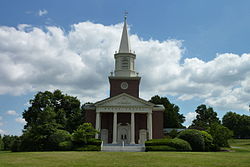
Rooke Chapel is the non-denominational setting for campus worship, weddings, and celebrations, opened in 1964. The chapel was a gift of Robert Levi Rooke (class of 1913), a member of the board of trustees.[16]
Christy Mathewson–Memorial Stadium is a 13,100-seat multi-purpose stadium built in 1924 and renovated in 1989, when it was also renamed in honor of Christy Mathewson (class of 1902), a New York Giants Hall of Fame pitcher.[17][18]
The Bucknell Farm was established in 2018, building on the success of the Lewisburg Community Garden, a partnership between Bucknell University and the Borough of Lewisburg.[19] The 5-acre (2.0 ha) organic farm overlooking Montour Ridge offers learning and service opportunities for students and provides fresh, local produce for the institution's dining system. Along with a 1.76-megawatt solar array installed in 2022,[20] the farm reflects Bucknell's commitment to achieving carbon neutrality by 2030 and long-term environmental sustainability.[21]
Bucknell Greenhouse is located on the fourth floor of the Biology Building. In 2023, the Century Plant (Agave americana) bloomed for the first time in thirty years.[22] The greenhouse contains three ecosystems: a desert, wetlands, and tropical and temperate forests.[23]
In 2023, the school began the first part of the Bucknell Greenway, what will be a 4-mile (6.4 km) educational recreation path around campus, while also connecting to the athletic fields across U.S. Route 15.[24]
Spratt House is the home of the institution's Army Reserve Officer Training Corps (ROTC) program.
Academics
[edit]Bucknell has a total enrollment of around 3,950 undergraduate and thirty graduate students. With around 400 faculty, the faculty to student ratio is 9:1, with the average class size of approximately twenty students. Bucknell has traditionally had strong engineering programs. With the addition for the Freeman College of Management in 2017, Bucknell offers a balance of foundational liberal-arts study and pre-professional training, a statistic reflected in the 25% of students who choose to double major.[25] In 2021, the largest majors were Accounting and Finance (79 graduates), Political Science and Government (76 graduates), and Economics (67 graduates).[26] For the years between 2015 and 2021, 18% of students reported pursuing post-graduate study within nine months of graduating.[27]
College of Arts and Sciences
[edit]
The College of Arts and Sciences anchors Bucknell University in the liberal-arts tradition. Its three divisions—arts and humanities, social sciences, and natural sciences and mathematics—host 275 faculty members in 34 departments and 66% percent of all students enrolled in fifty majors.[28] The college emphasizes intellectual community in diversity, transformative education for the common good, mentorship that encourages students to lead examined lives and leading-edge research and scholarship.[28]
College of Engineering
[edit]
Among American colleges that do not offer a PhD in engineering, Bucknell was ranked 7th, according to the 2024 edition of the U.S. News & World Report college ranking.[29] The same report ranked Computer Engineering 5th, Civil Engineering 3rd, Electrical Engineering 4th, and Mechanical Engineering 3rd.[29]
Freeman College of Management
[edit]Students can choose from five tracks leading to the Bachelor of Science in Business Administration degree: managing for sustainability, markets innovation and design, global management, accounting and financial management, or analytics and operations management. A five-year, dual degree in Engineering and Management is available for engineers with management career goals. In 2025, The Freeman College of Management was ranked 23rd among undergraduate business schools by Poets & Quants.[30]
Centers and institutes
[edit]
The Bucknell Humanities Center opened in 2017 with the inauguration of Hildreth-Mirza Hall. The center continues Bucknell's tradition of humanistic inquiry through grants and fellowships for faculty and student research. It also coordinates programming ranging from the student-organized Humanities Week to guest speakers and faculty colloquia as part of its annual themed programming. Recent themes include "Non/Humanity" (2021–22), "Pandemics" (2022–23), and "Colonial entanglements" (2023–24).[31]
The Geisinger-Bucknell Autism and Developmental Medicine Institute was formed in April 2013 as a partnership between Bucknell and the Geisinger Health System, headquartered in nearby Danville. This facility combines clinical treatment and interdisciplinary research on neurodevelopmental disorders.[32]
Other centers and institutes include: the Bucknell Institute for Lifelong Learning, the Bucknell Institute for Public Policy, the Center for Social Science Research, the Center for the Study of Race Ethnicity and Gender, the China Institute, the Griot Institute for the Study of Black Lives and Cultures, the Stadler Center for Poetry and Literary Arts, and the Weis Center for the Performing Arts.[33]
Study Away
[edit]Almost half of all Bucknell students study abroad through a large number of exchanges with partner institutions, as well as Bucknell operated sites in Accra, Athens, Granada, London, Singapore, Sydney, and Tours. Bucknell also runs a semester-long program in Washington, D.C., to support students with an interest in government public service.[34]
Rankings
[edit]| Academic rankings | |
|---|---|
| Liberal arts | |
| U.S. News & World Report[35] | 31 |
| Washington Monthly[36] | 93 |
| National | |
| Forbes[37] | 85 |
| WSJ/College Pulse[38] | 81 |
In the 2024 edition of U.S. News & World Report, Bucknell tied for 31st in the "National Liberal Arts Colleges" category.[39] The 2025 edition of Forbes rated Bucknell 85th in its list of "America's Top Colleges" and 19th among liberal arts colleges.[40] The 2022 edition of the Times Higher Education U.S. College Rankings placed Bucknell 27th among U.S. liberal arts colleges.[41] In 2025, Washington Monthly, which ranks colleges and universities based on perceived contribution to the public good as measured by social mobility, research, and promoting public service, ranked Bucknell 93rd among liberal arts colleges.[42] In 2024, the Payscale "College Salary Report" ranked Bucknell 40th among all colleges and universities and 10th among liberal arts colleges for salary potential.[43][44] Bucknell is listed as one of the "Hidden Ivies" as published in 2016 by educational consultants Howard and Matthew Greene.
Admissions
[edit]U.S. News & World Report classifies Bucknell's selectivity as "more selective".[29] For the Class of 2028 (enrolled Fall 2024), Bucknell received 11,377 applications and accepted 3,291 (28.9%), with 994 enrolling (30.2% yield rate). The middle 50% range of SAT scores for the enrolled freshmen was 640–740 for reading and writing, and 670–760 for math, while the ACT middle 50% composite range was 31–34. Beginning in 2022, Bucknell like most of its peer institutions is now test optional, meaning applicants can choose whether or not to submit SAT and ACT scores when applying. The average high school grade point average (GPA) for enrolled freshmen the class of 2028 was 3.62.[45]
Athletics
[edit]
Bucknell is a member of the Patriot League for Division I sports (Division I FCS in football).
In 2005, the men's basketball team went to the NCAA men's basketball tournament and became the first Patriot League team to win an NCAA tournament game, upsetting Kansas 64–63. The victory followed a year that included wins over #7 Pittsburgh and Saint Joseph's. They lost to Wisconsin in the following round but received the honor of "Best Upset" at the 2005 ESPY Awards.[46] The following year, Bucknell received a #9 seed (highest in Patriot League history) and defeated #8 seed Arkansas in the first round.
Traditions and symbols
[edit]The current Bucknell seal was approved in 1849. It shows the sun, an open book, and waves. The sun symbolizes the light of knowledge, while the book represents education surmounting the storms and "waves" of life.[47] Bucknell's colors are blue and orange, having been approved by a committee of students in 1887.[48] The bison is the current mascot of Bucknell University. In 1923, William Bartol, a professor of mathematics and astronomy, suggested the animal due to Bucknell's location in the Buffalo Valley.[49] The school cheer is "'ray Bucknell!"
Student life
[edit]Bucknell has over 150 student organizations,[50] a historical downtown cinema (Campus Theatre), a makerspace and crafts studio (7th Street Studio) and a calendar full of visiting speakers, art exhibits, performances, recitals, and year-end celebrations such as the "Chrysalis" ball and dinners sponsored by international student organizations.
Bucknell's student newspaper, The Bucknellian, is printed weekly. Its headquarters are in Stuck House on South 7th Street on the campus.[51] The college radio station is WVBU-FM.
Fraternities and sororities
[edit]As of 2024[update], Bucknell University has seven active fraternity chapters and nine active sorority chapters.[52]
Alumni
[edit]Alumni of Bucknell University include: Burma's first physician Shaw Loo (class of 1863),[53] National Baseball Hall of Fame pitcher Christy Mathewson (1902), Pro Football Hall of Fame Fullback/Linebacker Clarke Hinkle (1932), actor Ralph Waite (1952), novelist Philip Roth (1954), investor and philanthropist Ken Langone (1957), actor Edward Herrmann (1965), literary theorist and translator Peggy Kamuf (1969), CBS media executive Leslie Moonves (1971), author and pastor of Redeemer Presbyterian in New York City Tim Keller (1972),[54] 2016 Pulitzer Prize winner for poetry, Peter Balakian (1973), New Jersey congressman Rob Andrews (1979), CEO of Lord & Taylor and The Children's Place, Jane T. Elfers (1983), entrepreneur Jessica Jackley (2000), and basketball player Mike Muscala (2013).
References
[edit]- ^ a b c "The Facts About Bucknell". Bucknell University. n.d. Retrieved 16 February 2019.
- ^ "U.S. and Canadian 2022 NTSE Participating Institutions Listed by Fiscal Year 2022 Endowment Market Value, Change in Market Value from FY21 to FY22, and FY22 Endowment Market Values Per Full-time Equivalent Student (Excel)". NACUBO. February 17, 2023. Retrieved 2023-08-23.
- ^ a b c d e "Bucknell Facts 2022–23" (PDF). Bucknell University. Bucknell University Division of Communications. December 2022. Retrieved 23 August 2023.
- ^ "Direction, Defined. Our Brand Guidelines" (PDF). Bucknell University. Bucknell University Division of Communications. August 2017. Retrieved 16 February 2019.
- ^ "History and Traditions". Bucknell University. n.d. Archived from the original on 4 January 2019. Retrieved 16 February 2019.
- ^ "The University's Founding". Bucknell University Bucknell University.
- ^ "History & Traditions of Bucknell University". www.bucknell.edu. Retrieved 2024-01-31.
- ^ James Orin Oliphant, The Rise of Bucknell University. Chapters 2 and 3.
- ^ "The Female Institute". Bucknell University Bucknell University.
- ^ Brackney, William H. (2008). Congregation and Campus: North American Baptists in Higher Education (1 ed.). Macon, Georgia: Mercer University Press. p. 206. ISBN 978-0-88146-130-5. Retrieved 15 October 2017.
- ^ "Milestones – Benefactor William Bucknell". Bucknell University.
- ^ Bonan, Tom. "From the Special Collections/University Archives: Jens Larsen, Bucknell University's Architect". Bucknell University. Retrieved May 15, 2020.
- ^ Stodart, Haley. "From the Special Collections/University Archives: Who is Ellen Clark Bertrand?". Bucknell University. Retrieved May 15, 2020.
- ^ [1] Archived 2012-04-24 at the Wayback Machine "Continued Expansion Bucknell University."
- ^ "The Bucknell Campus" Archived 2017-01-13 at the Wayback Machine University website. Retrieved January 1, 2016
- ^ "Open House". www.bucknell.edu. 2014-10-24. Retrieved 2024-05-04.
- ^ Christy Mathewson Archived 2015-05-15 at the Wayback Machine Historic Baseball. Retrieved January 1, 2016
- ^ "Christy Mathewson Stats" Archived 2016-12-06 at the Wayback Machine Baseball Almanac. Retrieved January 1, 2016
- ^ "The Bucknell Farm". bucknell.edu. Bucknell University. Retrieved February 10, 2023.
- ^ "Bucknell Set to Celebrate Solar Project Completion". bucknell.edu. Bucknell University. Retrieved February 10, 2023.
- ^ "Sustainability at Bucknell". bucknell.edu. Bucknell University. Retrieved February 10, 2023.
- ^ "Century Plant brings excitement to Bucknell's greenhouse". wnep.com. 2023-01-05. Retrieved 2024-05-03.
- ^ "SELF-GUIDING TOUR OF THE BIOLOGY GREENHOUSE". www.departments.bucknell.edu. Retrieved 2024-05-03.
- ^ Dandes, Rick (2023-04-20). "Bucknell Greenway walking path to be commissioned today". The Daily Item. Retrieved 2024-05-07.
- ^ "Majors & Minors". Bucknell University.
- ^ "Bucknell University". nces.ed.gov. U.S. Dept of Education. Retrieved January 26, 2023.
- ^ "Graduate Outcomes". bucknell.edu. Buckenll University. Retrieved February 10, 2023.
- ^ a b "About the College of Arts & Sciences". Bucknell University.
- ^ a b c "Bucknell University Rankings".
- ^ "Freeman College of Management Ranks 23 in Poets&Quants (2025)". Poets&Quants. 15 March 2025.
- ^ "Bucknell Humanities Center". Bucknell University.
- ^ "Geisinger-Bucknell ADMI". Geisinger.
- ^ "Bucknell Academic Centers and Institutes". Bucknell University.
- ^ "Global and Off-Campus Education". Bucknell University Bucknell University.
- ^ "2025-2026 National Liberal Arts Colleges Rankings". U.S. News & World Report. September 23, 2025. Retrieved November 12, 2025.
- ^ "2025 Liberal Arts Colleges Rankings". Washington Monthly. August 25, 2025. Retrieved November 12, 2025.
- ^ "America's Top Colleges 2025". Forbes. August 26, 2025. Retrieved November 12, 2025.
- ^ "2026 Best Colleges in the U.S." The Wall Street Journal/College Pulse. September 29, 2025. Retrieved November 12, 2025.
- ^ "Bucknell University Rankings". U.S. News and World Report. Retrieved November 11, 2024.
- ^ "Forbes America's Top Colleges List 2025". Forbes. Retrieved September 11, 2025.
- ^ "Bucknell University". Times Higher Education (THE). Retrieved November 11, 2024.
- ^ "2025 Liberal Arts Colleges Ranking". Washington Monthly. Retrieved September 15, 2025.
- ^ "College Salary Report: Best Universities and Colleges by Salary Potential". Payscale.com. September 2024. Retrieved November 11, 2024.
- ^ "College Salary Report: Best Liberal Arts Colleges by Salary Potential". Payscale.com. September 2024.
- ^ "Fast Facts". Bucknell University.
- ^ "2015 ESPYS – Past Award Winners". espn.com/espys. Retrieved December 15, 2015.
- ^ "University Seal". Bucknell University. Archived from the original on July 30, 2012.
- ^ "University Colors". Bucknell University. Archived from the original on July 30, 2012.
- ^ "University Mascot". Bucknell University. Archived from the original on July 30, 2012.
- ^ "Get Involved @ Bucknell". getinvolved.bucknell.edu. Retrieved 2020-12-10.
- ^ Spears, Natalie (2016-09-22). "The Bucknellian's 120th Anniversary". The Bucknellian. Retrieved 2024-05-04.
- ^ "Fraternity & Sorority Chapters". www.bucknell.edu. Retrieved 2024-05-06.
- ^ po, myo min (2020-10-01). "The Day When a US President Praised a Student From Myanmar". The Irrawaddy. Retrieved 2022-11-10.
- ^ "Jane T. Elfers: Executive Profile & Biography - Bloomberg". www.bloomberg.com.
Further reading
[edit]- Theiss, Lewis Edwin, Centennial history of Bucknell University: 1846–1946, Grit Publishing Co. Press (1946)
- The rise of Bucknell University Oliphant, James Orin, The Rise of Bucknell University] Appleton-Century-Crofts (1965)
- Krist, Robert, Bucknell University, Harmony House (1990), ISBN 9780916509293
External links
[edit]

Bucknell University
View on GrokipediaHistory
Founding and Baptist Origins (1846–1870s)
The University at Lewisburg was chartered on February 5, 1846, by Pennsylvania Governor Francis R. Shunk, marking it as the first Baptist college in the commonwealth and the nation's 100th institution of higher education in sequence of founding.[10] Initiated by the Northumberland Baptist Association, a group of Baptists from the Susquehanna region sought to establish a literary institution in central Pennsylvania to deliver affordable education, primarily aimed at training ministers, missionaries, teachers, and laymen grounded in Christian principles.[11] [10] The preparatory department commenced operations that year in the basement of the First Baptist Church in Lewisburg, reflecting the denomination's commitment to fostering self-reliance, moral formation, and classical scholarship among young men from modest backgrounds.[11] College-level classes organized in 1847, with the inaugural commencement held on August 10, 1851, following the completion of the initial wing of the main building in 1850.[12] [13] The curriculum centered on a rigorous liberal arts program, including classical studies such as Latin, Greek, mathematics, and sciences, designed to cultivate intellectual discipline and ethical character in line with Baptist values of personal responsibility and piety.[12] Early enrollment remained modest, typical of nascent denominational colleges, with the institution emphasizing accessible tuition to serve regional youth while integrating theological instruction through a dedicated department to prepare students for clerical roles. [14] The 1850s brought infrastructural progress, including the establishment of a Female Institute in 1852 for women's education, though the core collegiate program remained male-focused until later expansions.[11] Financial constraints persisted as the young university relied on local Baptist support and modest endowments, compounded by the disruptions of the Civil War era, which strained resources and likely affected student numbers amid national enlistments, though specific enrollment declines are not well-documented for this period.[10] By the 1870s, the institution upheld its Baptist heritage, prioritizing moral and religious education alongside academics to instill virtues of diligence and faith in its graduates.[11]Renaming and Expansion Under William Bucknell (1880s–1900)
In 1881, the University at Lewisburg faced acute financial distress, prompting President David Jayne Hill to seek assistance from William Bucknell, a charter trustee and Philadelphia businessman with Baptist ties. Bucknell provided critical support through donations totaling $140,000 in the years following, which directly addressed institutional debts, funded scholarships, and enabled infrastructural investments essential for operational stability.[15] [11] [16] These funds facilitated the construction of Bucknell Hall between 1885 and 1886, a multi-purpose structure initially known as Reunion Hall or the Chapel, which housed academic functions and religious services; it was explicitly named for Bucknell to honor his role in averting collapse.[17] In gratitude for this philanthropy, the board of trustees renamed the University at Lewisburg to Bucknell University on February 18, 1886, signaling a formal acknowledgment of his causal impact on the institution's survival and growth.[18] Bucknell's contributions extended pragmatic expansion by supporting land improvements and endowments that reduced fiscal vulnerabilities, allowing the university to shift incrementally from its primary seminary orientation toward a diversified curriculum incorporating scientific studies and broader liberal arts, alongside enrollment increases attributed to enhanced financial security.[19] This era's developments, grounded in verifiable donor records, underscore how targeted Baptist philanthropy stabilized a struggling denominational college, paving the way for sustained academic maturation without reliance on speculative or unsubstantiated narratives.[15]Coeducation and Mid-20th Century Growth (1900–1960s)
Bucknell University's transition to full coeducation advanced in the early 20th century, following the 1883 opening of college-level courses to women via integration with the Lewisburg Female Institute, which had operated since 1852.[11] In 1884, trustees authorized women from the institute to join university classes, marking a practical unification of curricula and facilities that evolved into comprehensive coeducation by the 1910s, with women comprising a growing share of the student body amid broader societal shifts toward female higher education.[20] The university adapted to the impacts of the World Wars, which disrupted but ultimately spurred enrollment and infrastructure growth. During World War I, Bucknell implemented the Student Army Training Corps, intensifying military preparation for male students while maintaining academic operations.[21] In World War II, it hosted naval training programs that temporarily swelled the student population with service members, necessitating adjustments in housing and scheduling; post-1945, the GI Bill facilitated a veteran influx that strained capacity, as administrators noted inability to house all applicants alongside ongoing military programs.[22] This post-war boom drove mid-century expansions, particularly in student housing to accommodate rising numbers. Enrollment in engineering programs surged rapidly from 1945 to 1946, reflecting veterans' preferences for technical fields aligned with industrial economic demands rather than curricular overhauls.[23] New dormitories, such as expansions to women's facilities like Larison Hall—which had reached full occupancy by 1939—were prioritized to support the coed population growth, enabling Bucknell to sustain academic rigor amid demographic pressures without diluting admissions standards.[24]Late 20th and Early 21st Century Developments (1970s–Present)
In the 1970s, Bucknell University expanded its infrastructure to support growing academic and student needs, constructing the Elaine Langone Center for student activities, the Gerhard Fieldhouse for athletics, and the Computer Center to advance technological capabilities.[25] These developments reflected a broader emphasis on interdisciplinary studies, including the introduction of flexible college majors and freshman seminars to foster integrated learning across disciplines.[11] The 1980s and 1990s brought further consolidations in facilities and curriculum. Early in the decade, Bertrand Library's capacity was significantly increased to accommodate expanded collections and research demands.[25] By the 1990s, faculty adopted the Common Learning Agenda, a comprehensive general education framework requiring all College of Arts and Sciences students to engage in broad curricular goals emphasizing critical thinking and ethical reasoning.[11] These changes supported steady programmatic growth, particularly in engineering, where enrollment and research output contributed to the college's reputation for hands-on technical education amid national trends in STEM investment. Into the 21st century, Bucknell prioritized modern academic facilities and sustainability. The Academic West building, a 70,000-square-foot LEED Silver-certified structure, opened in 2013, providing nine advanced classrooms, flexible project spaces, and faculty offices to enhance collaborative learning in the humanities and social sciences.[26] [27] In 2005, the university established the Bucknell Center for Sustainability and the Environment, which has driven initiatives like efficient campus shuttles and a zero-impact greenhouse; this evolved into a 10-year sustainability plan in the 2020s targeting carbon neutrality by 2030 through reduced emissions and renewable energy integration.[28] [29] The Kenneth W. Freeman College of Management was formally named and elevated as the university's first standalone professional college in 2018, integrating liberal arts with business education to offer majors in accounting, analytics, and markets, innovation, and design.[30] Undergraduate enrollment has stabilized near 3,900 students in recent years, with record totals of 3,950 in fall 2024, reflecting effective recruitment amid competitive admissions.[4] The student-faculty ratio improved to 9:1, enabling smaller classes and personalized instruction, while six-year graduation rates reached 89%, indicating strong retention and completion outcomes driven by academic support and experiential programs.[7] [31]Campus and Facilities
Location and Physical Grounds
Bucknell University's 450-acre campus occupies a riverside setting in Lewisburg, the seat of Union County, central Pennsylvania. Positioned just south of the borough along the West Branch of the Susquehanna River, the grounds ascend from riverfront bluffs, affording elevated vistas of the Susquehanna River Valley and the Appalachian Mountains.[18][1] The topography features undulating terrain that integrates academic structures with expansive green spaces, including a 66-acre natural area serving as an outdoor laboratory. The central Malesardi Quadrangle, originally the Athletic Quadrangle and renamed in 2016 following a major donation, forms the historic core of the layout, encompassing open lawns framed by key campus landmarks.[32][33] Bucknell maintains an arboretum encompassing campus trees, many predating the institution, with ongoing efforts to catalog and measure specimens for educational use. Environmental resilience includes adaptations post the March 1936 St. Patrick's Day Flood, which inundated regional areas along the Susquehanna; the subsequent Flood Control Act of 1936 authorized upstream dams by the U.S. Army Corps of Engineers, mitigating future riverine risks to the bluff-top site.[34][35][36]Academic and Research Facilities
The Charles A. Dana Engineering Building, originally constructed starting in 1921 and renovated in 1985 with an added third floor, houses Bucknell University's College of Engineering and features specialized laboratories supporting undergraduate research and instruction.[37] These include computer science facilities equipped with 150 computers across nine labs and collaborative spaces, chemical engineering labs for fluid flow, heat and mass transfer, and biochemical processes, as well as mechanical engineering multi-use laboratories and renewable energy testing areas.[38][39][40] Adjacent to Dana, the Brungraber Civil Engineering Structural Test Laboratory contains a 600,000-pound Baldwin universal testing machine for structural materials analysis.[41] The Academic East building, a three-story 53,000-square-foot structure, provides dedicated spaces for engineering research, including independent labs for multiple disciplines, laboratory instruction areas, and senior design studios.[42] Complementing these, the 78,000-square-foot Biology Building, completed in 1991, offers 25 laboratories with advanced research equipment for biological sciences.[37][41] Holmes Hall, a 78,500-square-foot facility opened in 2021, serves as the home for the Freeman College of Management, integrating classrooms, studios, and spaces for experiential learning in business disciplines.[43][44] The Ellen Clarke Bertrand Library maintains holdings of approximately 500,000 physical volumes and has incorporated renovated collaborative spaces following a major collection relocation project.[45][46] The Bucknell Center for Sustainability & the Environment (BCSE) supports interdisciplinary research infrastructure through programs in watershed sciences, sustainable technologies, and place studies, funding student-faculty projects including summer wages up to $3,500 per participant.[47][48]Student Housing and Non-Academic Amenities
Bucknell University guarantees on-campus housing for all undergraduate students throughout their four-year enrollment, fostering a residential learning environment with over 3,600 beds distributed across traditional residence halls, suite-style accommodations, and apartment options.[49] First-year students are assigned to dedicated halls such as Smith Hall, McDonnell Hall, Swartz Hall, and Vedder Hall, where most rooms feature double occupancy and measure approximately 160 square feet, equipped with standard furnishings including beds, desks, and wardrobes.[50] These halls support thematic living arrangements, including residential learning communities focused on areas like global studies, which integrate shared academic and social experiences to enhance student engagement.[49] Upperclass housing expands to facilities like the Bucknell West apartments, where recent construction added capacity with four initial buildings each housing 70 students and a fifth building accommodating 94 beds, completed for fall 2025 occupancy.[51] Other options include the Gateway Residence Center with suite-style units featuring private bedrooms and shared kitchens, alongside halls like Harris Hall offering singles and doubles with closets averaging 4.5 by 6.5 feet.[52] [53] Non-academic amenities include six dining venues ranging from all-you-can-eat halls to cafés and take-out options, accessible via meal plans integrated with the university's GET app for mobile ordering.[54] Recreational facilities center on the Kenneth Langone Athletics and Recreation Center, which houses the Krebs Family Fitness Center, a 4,000-seat pavilion, and natatorium for aquatic programs, complemented by indoor climbing walls, group fitness classes like yoga and spinning, and club sports equipment rentals.[55] [56] Cultural amenities feature the Weis Center for the Performing Arts, a 1,200-seat venue hosting professional music, dance, theater productions, and lectures, with student access to free tickets per performance to encourage attendance.[57] [58] These resources support student well-being, though empirical data on maintenance expenditures remains limited in public disclosures, with recent upgrades including unlimited laundry in select residences indicating ongoing investments in functionality.Academic Programs
Grading System and Policies
Bucknell University calculates a student's grade point average (GPA) by dividing quality points earned by course credits attempted, with grades from Bucknell courses only (A=4.0, F=0.0, etc.). Transfer credits from other institutions are awarded for degree progress but are not included in the Bucknell GPA calculation. Effective Spring 2023, Bucknell has an F Grade Replacement Policy applicable to all active students. When a student retakes a course originally failed with an F and earns a passing grade (either by retaking at Bucknell or by transferring credit from a directly equivalent course at another school with a grade of D or better), the Registrar's Office automatically replaces the original F with NC (No Credit) on the transcript. The NC grade carries no quality points and does not impact the GPA, thereby removing the F's negative effect on the cumulative average. The replacement applies only to F grades (not other low grades), requires completion before graduation, and excludes F grades assigned as penalties from academic misconduct cases. Departmental approval is required for transfer equivalency. This policy supports student recovery from early academic setbacks while maintaining transcript accuracy.College of Arts and Sciences
The College of Arts and Sciences constitutes the foundational liberal arts component of Bucknell University, housing over 30 academic departments and interdisciplinary programs spanning humanities, social sciences, natural sciences, and mathematics.[59] It enrolls the majority of undergraduates and offers nearly 50 majors—such as animal behavior, anthropology, biology, economics, philosophy, physics, political science, and psychology—alongside 70 minors, enabling combinations like environmental studies that integrate natural and social sciences.[60] [61] This breadth supports empirical outcomes where economics (121 graduates in a recent cohort), political science (87), biology (75), and psychology (71) rank among the most selected majors, reflecting student preferences for fields with strong analytical and evidentiary foundations.[62] The curriculum prioritizes foundational skills in critical thinking, quantitative reasoning, and communication, delivered through a flexible core structure and hundreds of courses that encourage cross-disciplinary exploration without prescriptive ideological frameworks.[60] Departments in philosophy and religious studies, drawing from the university's 1846 Baptist origins as an institution dedicated to moral and intellectual cultivation, provide rigorous training in ethics, social and political philosophy, philosophy of religion, and Western religious ethics, emphasizing logical analysis and historical texts over modern activism.[11] [63] [64] Undergraduate research opportunities, integrated across departments, pair students with faculty mentors from their first year, yielding hands-on projects in areas like neuroscience, East Asian studies, and sustainability; participants frequently co-author publications and present findings, with hundreds attending annual campus symposia such as the Kalman Research Symposium.[65] [60] This model fosters causal understanding through direct experimentation and data analysis, as evidenced by student outputs in peer-reviewed venues and conferences.[66]College of Engineering
The College of Engineering at Bucknell University provides undergraduate degrees leading to the Bachelor of Science in biomedical engineering, chemical engineering, civil and environmental engineering, computer engineering, computer science and engineering, electrical engineering, and mechanical engineering.[67] All programs hold accreditation from the Accreditation Board for Engineering and Technology (ABET), ensuring alignment with professional standards for engineering education.[68] The curriculum integrates a liberal arts foundation with technical rigor, featuring small class sizes that facilitate personalized instruction and collaborative projects from the outset of students' studies.[69] Engineering education at Bucknell traces its origins to the early 20th century, amid the university's shift toward professional programs alongside its liberal arts core, evolving into a distinct college with expanded facilities and faculty expertise by the mid-century. Current enrollment stands at approximately 500 undergraduates, supporting an environment where students engage in laboratory work, design challenges, and interdisciplinary applications early in their academic careers.[70] A hallmark of the college is its Senior Design capstone course, required for all majors, in which senior teams address authentic engineering problems posed by industry sponsors or campus stakeholders, fostering skills in innovation, teamwork, and practical implementation.[71] These initiatives are bolstered by formal industry partnerships, including sponsored projects for capstone and coursework, which connect students with external organizations for real-world applications.[72] Graduates demonstrate strong outcomes, with placement rates exceeding 93 percent in employment or graduate school within six months of graduation, reflecting the programs' emphasis on employability and technical proficiency.[73]Freeman College of Management
The Freeman College of Management was established in 2017 as Bucknell University's standalone business school, evolving from over a century of prior management education offerings within the College of Arts and Sciences.[74] It confers Bachelor of Science in Business Administration (BSBA) degrees with majors in accounting, business analytics, finance, management and organizations, and markets, innovation, and design.[75] The curriculum emphasizes experiential learning through real-world applications, including concentrations in entrepreneurship within the management major, which integrates skills in innovation, startup development, and sustainable business practices.[76] Key facilities supporting this focus include the Small Business Development Center (SBDC), which delivers no-cost consulting on marketing, financial management, and capital acquisition to entrepreneurs and small firms in central Pennsylvania, often in collaboration with Freeman faculty and students.[77] Global immersion opportunities feature the Language and Cultural Immersion Scholars Program, enabling students to enhance language proficiency and cultural understanding through targeted study abroad, alongside global management tracks that require foreign language competency and international exposure.[78] These elements prioritize hands-on economic impact over theoretical abstraction, fostering causal links between education and practical outcomes like venture creation. Graduates demonstrate strong return on investment, with the Class of 2023 reporting an average starting salary of $72,735 across the university, and Freeman-specific cohorts achieving higher medians around $80,000 in recent years, reflecting 93% placement in jobs or further opportunities within nine months.[79] [80] This performance underscores the program's efficacy in preparing students for high-value roles in finance, consulting, and entrepreneurship, where empirical earnings data validate the emphasis on marketable skills amid competitive labor markets.[73]Interdisciplinary Centers and Institutes
Bucknell University maintains several interdisciplinary centers and institutes that bridge its colleges of Arts and Sciences, Engineering, and Management, promoting collaborative research, experiential learning, and cross-disciplinary projects. These entities prioritize empirical inquiry and practical outputs, such as faculty-led grants and student-involved initiatives, with funding often derived from federal sources like the National Science Foundation (NSF) and internal allocations. For instance, in fiscal year 2023, the university secured approximately $527,000 in NSF engineering grants and $573,000 in National Institutes of Health awards, supporting center-affiliated research efficiency through targeted, outcome-focused expenditures rather than expansive administrative overhead.[81][82] The Griot Institute for the Study of Black Lives & Cultures facilitates interdisciplinary engagement on topics related to Africana studies, hosting annual speaker series and events that draw on historical and cultural data to examine issues like Black intellectual traditions. Established to encourage cross-fertilization between Africana studies and arts disciplines, it has produced outputs including scholarly publications and campus dialogues, with activities grounded in primary source analysis rather than prescriptive frameworks.[83][84] The Institute for Leadership in Technology and Management (ILTM) integrates engineering, management, and liberal arts perspectives through a selective six-week summer program for 24 students annually, emphasizing leadership development via team-based projects simulating real-world technological challenges. Launched in the early 2000s, it has evolved to incorporate liberal arts components for holistic decision-making, yielding outputs like student prototypes and case studies that inform industry applications, with program efficiency maintained through low-cost, high-impact experiential formats.[85][86] Other notable centers include the Bucknell Center for Sustainability & the Environment, which coordinates interdisciplinary research on ecological systems, securing grants such as a $148,000 NSF award in 2025 for analyzing Devonian fossil records to model ancient climate dynamics and vertebrate adaptation—contributing to resilience-focused outputs like predictive environmental datasets. The Bucknell Institute for Public Policy (BIPP) supports cross-departmental policy analysis with faculty grants for empirical studies, fostering outputs in areas like economic and governance metrics without overt ideological constraints. Similarly, the Center for Social Science Research advances methodological rigor in quantitative and qualitative social inquiry, enabling efficient resource use for replicable findings across disciplines. These centers collectively enhance research productivity by leveraging shared faculty expertise and external funding, prioritizing verifiable data over narrative-driven agendas, though self-reported university metrics warrant scrutiny for potential institutional optimism bias.[87][88][89][90]Study Abroad and Experiential Learning
Bucknell University facilitates study abroad through faculty-led "Bucknell In" programs, exchange partnerships, and approvals for over 450 external programs, enabling students to earn credits toward their degrees in diverse international locations.[91] In the 2022-23 academic year, 486 undergraduates participated, ranking the institution fourth nationally among baccalaureate colleges for study abroad engagement.[92] Approximately 40% of Bucknell students study abroad before graduation, far exceeding the national average of 10%.[7] The Bucknell in London program, offered each fall and spring semester to sophomores and above, immerses small cohorts of 10-15 students in central London, focusing on urban identity and cultural fabric through Bucknell-taught courses.[93] Exchange agreements extend to institutions such as the Chinese University of Hong Kong, the University of Nottingham (with options in England or China), and Universidad de los Andes in Chile, promoting direct enrollment and bilateral academic exchange.[94] Program selection requires minimum GPA thresholds and conduct evaluations to assess readiness for independent living abroad, with emphasis on cultural immersion to foster adaptability, as evidenced by participant accounts of local lifestyles and interdisciplinary coursework.[95] Credits from approved programs transfer seamlessly, supporting curriculum continuity while exposing students to global perspectives essential for professional versatility.[96] Experiential learning extends off-campus via internships integrated into majors, particularly in management and engineering, where students apply coursework in real-world settings and earn academic credit.[97] The Shepherd Poverty Internship Program places participants in eight-week roles with nonprofits and government agencies addressing human services, yielding skills in policy implementation and community engagement.[98] The Undergraduate Executive Intern Program targets high-achieving students for professional shadowing and projects, enhancing leadership and analytical abilities through structured mentorship.[99] These opportunities, often combined with study abroad, prioritize hands-on skill acquisition—such as project management and cross-cultural communication—over passive observation, with institutional support ensuring alignment with career outcomes like improved employability in global markets.[100] While co-op programs are less formalized than at technical institutes, internship durations and credit structures provide comparable depth, with risk mitigation through vetted placements and pre-departure training on ethical and safety protocols.[100]Admissions, Enrollment, and Student Demographics
Admissions Process and Selectivity
Bucknell University maintains a holistic admissions process that prioritizes academic merit, evaluating applicants based on the rigor of their high school curriculum, grade point average, and demonstrated intellectual preparation. Very important factors include the strength of secondary school records, academic GPA, application essays, extracurricular commitments, talent or ability, and personal character, while teacher and counselor recommendations hold secondary importance; elements such as standardized test scores, class rank, and legacy status are merely considered.[101] Applicants must complete a standard high school program, including four years of English, three years each of mathematics, laboratory science, history, and social studies, and two years of the same foreign language, with additional prerequisites like precalculus or chemistry for certain majors in engineering, sciences, or management.[102] This merit-oriented framework underscores preparation for Bucknell's demanding liberal arts and professional programs, without reliance on quotas or preferential admissions beyond standard considerations. The university adopted a test-optional policy in 2020, permitting applicants to withhold SAT or ACT scores without penalty, though submitted scores are reviewed when provided to contextualize academic performance. Among enrolling first-year students in recent cycles, approximately 67% submitted SAT scores, with middle 50% percentiles ranging from 1300 to 1450 for those who did so, reflecting a competitive pool of self-selecting high achievers.[103] [101] The average high school GPA for admitted students stands at 3.74 on a 4.0 scale, emphasizing consistent excellence over isolated metrics.[7] Selectivity has hovered around 29-32% in recent years, with 11,010 applications yielding 3,524 admits for the Class of 2027, amid broader post-pandemic application volume increases driven by test-optional flexibility and heightened interest in small liberal arts institutions.[101] [104] This trend, while stabilizing after initial COVID-era surges, maintains Bucknell's position as moderately selective, favoring applicants with robust academic profiles rather than diversity-driven relaxations of standards.[7]Enrollment Statistics and Diversity
As of fall 2024, Bucknell University enrolls approximately 3,920 undergraduate students, with a small graduate population of around 47 students.[5][7] The undergraduate body is slightly majority female, comprising about 52% women and 48% men, reflecting a modest gender imbalance common among selective liberal arts institutions.[105] The student population remains predominantly White, with empirical data indicating limited representation of racial and ethnic minorities among U.S. domestic undergraduates. According to recent enrollment breakdowns, approximately 74% identify as White, 8% as Hispanic or Latino, 5% as Asian, 4% as Black or African American, and 4% as two or more races, yielding non-White domestic minorities at roughly 25%.[106][107] International students constitute about 10% of undergraduates, drawn primarily from over 40 countries, contributing to geographic diversity but not significantly altering the domestic racial composition.[7]| Demographic Category | Percentage of Undergraduates |
|---|---|
| White | 74% |
| Hispanic/Latino | 8% |
| Asian | 5% |
| Black/African American | 4% |
| Two or More Races | 4% |
| International | 10% |
Financial Aid and Accessibility
Bucknell University meets 100% of demonstrated financial need for admitted students through a combination of grants, scholarships, work-study, and loans, with 64% of undergraduates receiving some form of aid. The institution prioritizes grant-based assistance, awarding Bucknell-funded grants or scholarships to approximately 57% of students, primarily on a need-blind basis for U.S. citizens and permanent residents. Average need-based grant aid exceeds $40,000 annually for recipients, contributing to an overall average aid package of $52,500 and an average net price of $38,486 after scholarships and grants for those qualifying for aid.[113][7][114] The total cost of attendance for the 2025-26 academic year stands at $91,904, including tuition and fees of approximately $70,576, room and board around $16,000, and allowances for books, travel, and personal expenses. Merit-based scholarships, such as the Presidential Scholars Program, are awarded based on academic excellence, leadership, and extracurricular achievements rather than financial need or demographic factors, with awards ranging from $10,000 to full tuition coverage for top performers. Work-study opportunities, funded partly by federal sources and supplemented by university contributions, allow students to earn up to $3,000 annually without repayment obligations, further reducing reliance on debt.[115][116][117] Bucknell's approach to accessibility emphasizes low debt accumulation, with graduating students who borrow averaging $21,371 in federal loan indebtedness—about half the national average of $38,000 for bachelor's degree recipients. This outcome stems from capped loan recommendations in aid packages and institutional grants that cover a substantial portion of need, enabling a higher return on investment through reduced post-graduation financial burdens compared to peers with higher average debt loads exceeding $30,000.[7][118]Rankings and Reputation
National and International Rankings
In the 2026 U.S. News & World Report rankings, Bucknell University placed tied for 30th among national liberal arts colleges, a position reflecting metrics such as graduation rates, faculty resources, and peer assessments, though the methodology has drawn criticism for weighting subjective reputational surveys heavily, potentially amplifying institutional echo chambers over direct outcome measures like alumni earnings or employment rates.[5][119] The university has maintained consistency in this category, ranking in the top 30 for multiple years, including tied for 30th in 2024 and a climb to that level in 2023 after prior positions in the upper 30s.[120][121] Forbes' 2026 America's Top Colleges list ranked Bucknell 85th overall, emphasizing return on investment through alumni salaries, student debt levels, and graduation outcomes rather than prestige surveys, providing a more empirical gauge of value that contrasts with reputation-driven approaches.[122] LinkedIn's 2025 analysis of long-term career success, derived from alumni professional trajectories on the platform, positioned Bucknell as the top liberal arts college and 21st overall among U.S. institutions, highlighting strong pathways to high-impact roles based on observable career progression data.[123][124] Bucknell does not feature prominently in major international rankings such as QS World University Rankings or Times Higher Education, which prioritize research output, citations, and global reputation metrics suited to larger research universities over undergraduate-focused liberal arts institutions.[125][126] The Foundation for Individual Rights and Expression's 2026 College Free Speech Rankings placed Bucknell 133rd out of 257 schools with a score of 57.16 and an "F" grade for speech climate, based on student surveys of tolerance for diverse viewpoints, indicating an average environment marred by administrative interventions and self-censorship pressures common in higher education settings.[127][128]| Ranking Source | Category | Position (Year) | Key Metrics Emphasized |
|---|---|---|---|
| U.S. News & World Report | National Liberal Arts Colleges | #30 (tie, 2026) | Peer assessments, graduation rates, faculty resources[5] |
| Forbes | Overall U.S. Colleges | #85 (2026) | Alumni salaries, debt, ROI[122] |
| Career Success (Liberal Arts) | #1 (2025) | Alumni career advancement, job titles[123] | |
| FIRE | Free Speech Climate | #133 (2026) | Student surveys on viewpoint diversity[127] |