Recent from talks
Nothing was collected or created yet.
Calophyllum
View on Wikipedia
| Calophyllum | |
|---|---|
| Calophyllum inophyllum | |
| Scientific classification | |
| Kingdom: | Plantae |
| Clade: | Tracheophytes |
| Clade: | Angiosperms |
| Clade: | Eudicots |
| Clade: | Rosids |
| Order: | Malpighiales |
| Family: | Calophyllaceae |
| Genus: | Calophyllum L. |
| Species | |
| Synonyms[1][2][3][4][5][6] | |
| |
Calophyllum is a genus of tropical flowering plants in the family Calophyllaceae. They are mainly distributed in Asia, with some species in Africa, the Americas, Australasia, and the Pacific Islands.[7]
History
[edit]Members of the genus Calophyllum native to Malaysia and Wallacea are of particular importance to traditional shipbuilding of the larger Austronesian outrigger ships and were carried with them in the Austronesian expansion as they migrated to Oceania and Madagascar. They were comparable in importance to how oaks were in European shipbuilding and timber industries. The most notable species is the mastwood (Calophyllum inophyllum) which grows readily in the sandy and rocky beaches of the island environments that the Austronesians colonized.[8][9]
Description
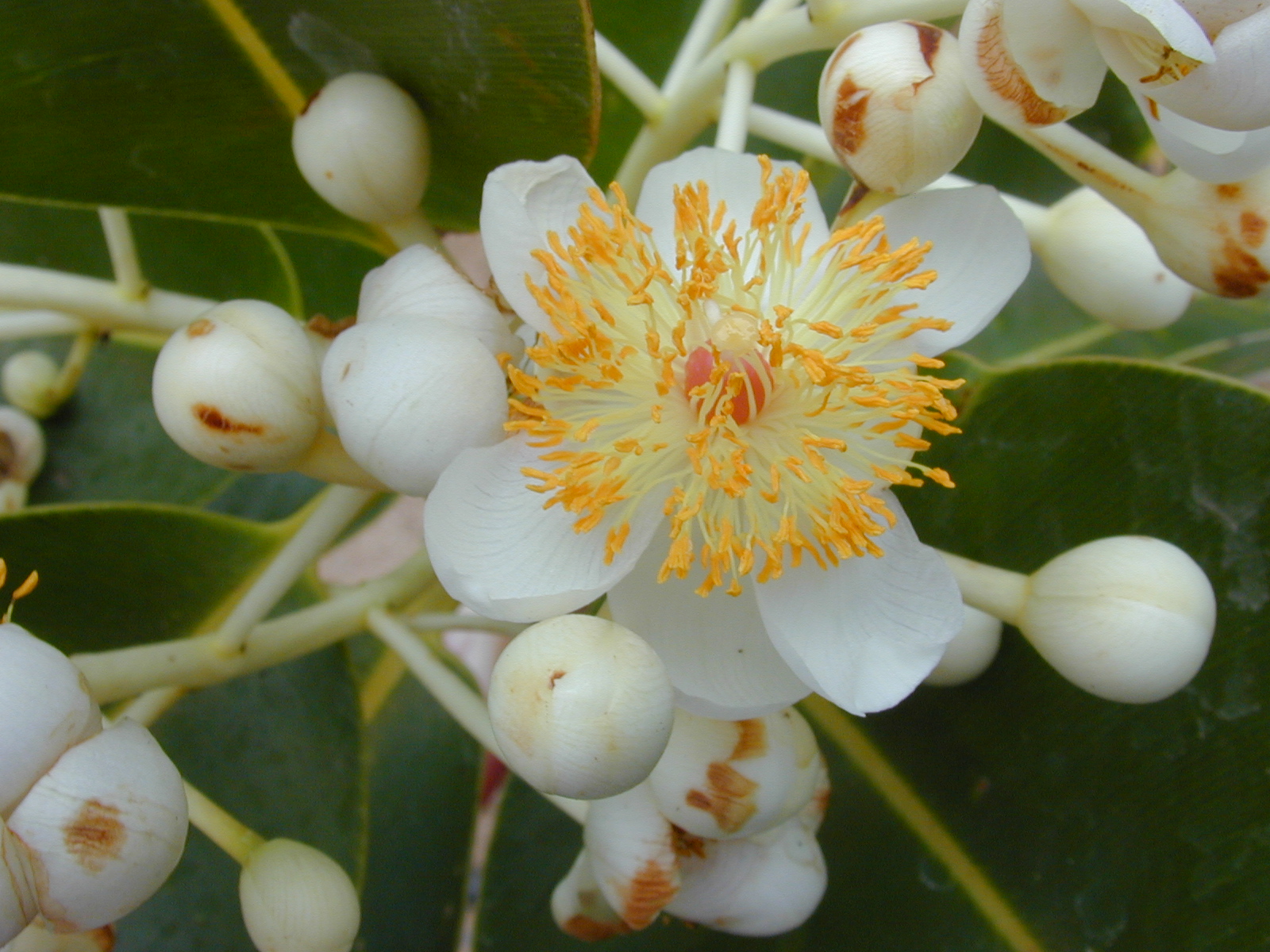
[edit]Calophyllum are trees or shrubs. They produce a colorless, white, or yellow latex. The oppositely arranged leaves have leathery blades often borne on petioles.[7] The leaves are distinctive, with narrow parallel veins alternating with resin canals.[10] The inflorescence is a cyme or a thyrse of flowers that grows from the leaf axils or at the ends of branches. In the flower the sepals and petals may look similar and are arranged in whorls. There are many stamens. The fruit is a drupe with thin layers of flesh over a large seed.[7]
Uses
[edit]Many species are used for their wood. Some are hardwood trees that can reach 30 meters in height. They tend to grow rapidly. The outer sapwood is yellowish, yellow-brown, or orange, sometimes with a pink tinge, and the inner heartwood is light reddish to red-brown. The wood has a streaked, ribboned, or zig-zag grain. The wood has been used to build boats, flooring, and furniture, and made into plywood.[11][12] Calophyllum wood may be sold under the name bitangor, and the species may be used interchangeably; one shipment may contain boards from several different species.[13]
The timber provides very high chatoyance, with an average value above 24 PZC.[14]
Plants of the genus are also known for their chemistry, with a variety of secondary metabolites isolated, such as coumarins, xanthones, flavonoids, and triterpenes. Compounds from the genus have been reported to have cytotoxic, anti-HIV, antisecretory, cytoprotective, antinociceptive, molluscicidal, and antimicrobial properties. Some plants are used in folk medicine to treat conditions such as peptic ulcers, tumors, infections, pain, and inflammation.[15]
C. inophyllum is the source of tamanu oil, a greenish, nutty-scented oil of commercial value. It has been used as massage oil, topical medicine, lamp oil, and waterproofing, and is still used in cosmetics. Tacamahac is the resin of the tree. This species is also cultivated for its wood and planted in coastal landscaping as a windbreak and for erosion control.[13]
Symbolism
[edit]A stylized Calophyllum is featured on the national coat of arms of Nauru.[citation needed]
Species
[edit]As of August 2025[update], Plants of the World Online accepts the following 204 species:[1]
- Calophyllum acidus Kosterm.
- Calophyllum acutiputamen P.F.Stevens
- Calophyllum aerarium P.F.Stevens
- Calophyllum africanum Cheek & Q.Luke
- Calophyllum alboramulum P.F.Stevens
- Calophyllum amblyphyllum A.C.Sm. & S.P.Darwin
- Calophyllum andersonii P.F.Stevens
- Calophyllum angulare A.C.Sm.
- Calophyllum apetalum Willd.
- Calophyllum archipelagi P.F.Stevens
- Calophyllum ardens P.F.Stevens
- Calophyllum articulatum P.F.Stevens
- Calophyllum ashtonii Fatimah & Latiff
- Calophyllum aurantiacum P.F.Stevens
- Calophyllum aureobrunnescens M.R.Hend. & Wyatt-Sm.
- Calophyllum aureum M.R.Hend. & Wyatt-Sm.
- Calophyllum australianum F.Muell. ex Vesque
- Calophyllum austroindicum Kosterm. ex P.F.Stevens
- Calophyllum balansae Pit.
- Calophyllum banyengii P.F.Stevens
- Calophyllum barioense Fatimah & Latiff
- Calophyllum beaufortensis Fatimah & Latiff
- Calophyllum bicolor P.F.Stevens
- Calophyllum biflorum M.R.Hend. & Wyatt-Sm.
- Calophyllum bifurcatum P.F.Stevens
- Calophyllum blancoi Planch. & Triana
- Calophyllum brachyphyllum Merr.
- Calophyllum bracteatum Thwaites
- Calophyllum brasiliense Cambess.
- Calophyllum brassii A.C.Sm.
- Calophyllum calaba L.
- Calophyllum calcicola P.F.Stevens
- Calophyllum caledonicum Vieill. ex Planch. & Triana
- Calophyllum canoides Fatimah & Latiff
- Calophyllum canum Hook.f. ex T.Anderson
- Calophyllum capsicoides Fatimah & Latiff
- Calophyllum carrii P.F.Stevens
- Calophyllum castaneum P.F.Stevens
- Calophyllum caudatum Kaneh. & Hatus.
- Calophyllum celebicum P.F.Stevens
- Calophyllum cerasiferum Vesque
- Calophyllum ceriferum Gagnep. ex P.F.Stevens
- Calophyllum chapelieri Drake
- Calophyllum clemensiorum P.F.Stevens
- Calophyllum collinum P.F.Stevens
- Calophyllum comorense H.Perrier
- Calophyllum complanatum P.F.Stevens
- Calophyllum confertum P.F.Stevens
- Calophyllum confusum P.F.Stevens
- Calophyllum cordato-oblongum Thwaites
- Calophyllum coriaceum M.R.Hend. & Wyatt-Sm.
- Calophyllum cornutum Fatimah & Latiff
- Calophyllum costatum F.M.Bailey
- Calophyllum costulatum M.R.Hend. & Wyatt-Sm.
- Calophyllum cucullatum Merr.
- Calophyllum cuneifolium Thwaites
- Calophyllum dasypodium Miq.
- Calophyllum depressinervosum M.R.Hend. & Wyatt-Sm.
- Calophyllum dioscurii P.F.Stevens
- Calophyllum dispar P.F.Stevens
- Calophyllum dongnaiense Pierre
- Calophyllum drouhardii H.Perrier
- Calophyllum dryobalanoides Pierre
- Calophyllum echinatum P.F.Stevens
- Calophyllum elegans Ridl.
- Calophyllum enervosum M.R.Hend. & Wyatt-Sm.
- Calophyllum eputamen P.F.Stevens
- Calophyllum euryphyllum Lauterb.
- Calophyllum exiticostatum P.F.Stevens
- Calophyllum ferrugineum Ridl.
- Calophyllum fibrosum P.F.Stevens
- Calophyllum flavoramulum M.R.Hend. & Wyatt-Sm.
- Calophyllum fraseri M.R.Hend. & Wyatt-Sm.
- Calophyllum garcinioides P.F.Stevens
- Calophyllum gemmatum Fatimah & Latiff
- Calophyllum glaucescens Ridl.
- Calophyllum goniocarpum P.F.Stevens
- Calophyllum gracilipes Merr.
- Calophyllum gracillimum M.R.Hend. & Wyatt-Sm.
- Calophyllum grandiflorum J.J.Sm.
- Calophyllum griseum P.F.Stevens
- Calophyllum havilandii P.F.Stevens
- Calophyllum heterophyllum P.F.Stevens
- Calophyllum hirasimum P.F.Stevens
- Calophyllum honbaense V.S.Dang, H.Toyama & Tagane
- Calophyllum hosei Ridl.
- Calophyllum humbertii P.F.Stevens
- Calophyllum iliasii Fatimah & Latiff
- Calophyllum incumbens P.F.Stevens
- Calophyllum inophyllum L.
- Calophyllum insularum P.F.Stevens
- Calophyllum kinabaluensis Fatimah & Latiff
- Calophyllum lanigerum Miq.
- Calophyllum lankaensis Kosterm.
- Calophyllum laticostatum P.F.Stevens
- Calophyllum latiffii Fatimah
- Calophyllum laxiflorum Drake
- Calophyllum leleanii P.F.Stevens
- Calophyllum leptocladum A.C.Sm. & S.P.Darwin
- Calophyllum leucocarpum A.C.Sm.
- Calophyllum lineare Kosterm.
- Calophyllum lingulatum P.F.Stevens
- Calophyllum lonchophyllum O.Schwarz
- Calophyllum longifolium Willd.
- Calophyllum lowei Planch. & Triana
- Calophyllum macrocarpoides Fatimah & Latiff
- Calophyllum macrocarpum Hook.f.
- Calophyllum macrophyllum Scheff.
- Calophyllum membranaceum Gardner & Champ.
- Calophyllum mesoamericanum Vela Díaz
- Calophyllum milvum P.F.Stevens
- Calophyllum molle King
- Calophyllum moonii Wight
- Calophyllum morobensis P.F.Stevens
- Calophyllum mukunense P.F.Stevens
- Calophyllum multitudinis P.F.Stevens
- Calophyllum neoebudicum Guillaumin
- Calophyllum nodosum Vesque
- Calophyllum novoguineense Kaneh. & Hatus.
- Calophyllum nubicola D'Arcy & R.C.Keating
- Calophyllum obliquinervium Merr.
- Calophyllum obscurum P.F.Stevens
- Calophyllum oliganthum Merr.
- Calophyllum pachyphyllum Planch. & Triana
- Calophyllum paniculatum P.F.Stevens
- Calophyllum papuanum Lauterb.
- Calophyllum parkeri C.E.C.Fisch.
- Calophyllum parviflorum Bojer ex Baker
- Calophyllum parvifolium Choisy
- Calophyllum pascalianum B.R.Ramesh, Ayyappan & De Franceschi
- Calophyllum pauciflorum A.C.Sm.
- Calophyllum peekelii Lauterb.
- Calophyllum pelewense P.F.Stevens
- Calophyllum pentapetalum (Blanco) Merr.
- Calophyllum persimile P.F.Stevens
- Calophyllum pervillei Drake
- Calophyllum piluliferum P.F.Stevens
- Calophyllum pinetorum Bisse
- Calophyllum pisiferum Planch. & Triana
- Calophyllum poilanei Gagnep. ex P.F.Stevens
- Calophyllum polyanthum Wall. ex Choisy
- Calophyllum praetermissum P.F.Stevens
- Calophyllum pubescens Vela Díaz
- Calophyllum pulcherrimoides Fatimah & Latiff
- Calophyllum pulcherrimum Wall. ex Choisy
- Calophyllum pyriforme P.F.Stevens
- Calophyllum recedens Jum. & H.Perrier
- Calophyllum recurvatum P.F.Stevens
- Calophyllum recurvum Fatimah & Latiff
- Calophyllum rigidulum P.F.Stevens
- Calophyllum rigidum Miq.
- Calophyllum rivulare Bisse
- Calophyllum robustum P.F.Stevens
- Calophyllum roseocostatum P.F.Stevens
- Calophyllum rotundifolium Ridl.
- Calophyllum rubiginosum M.R.Hend. & Wyatt-Sm.
- Calophyllum rufigemmatum Hend. & Wyatt-Sm. ex P.F.Stevens
- Calophyllum rufinerve Kaneh. & Hatus.
- Calophyllum rugosum P.F.Stevens
- Calophyllum rupicola Ridl.
- Calophyllum sakarium P.F.Stevens
- Calophyllum savannarum A.C.Sm.
- Calophyllum sclerophyllum Vesque
- Calophyllum scriblitifolium M.R.Hend. & Wyatt-Sm.
- Calophyllum sibatii Fatimah & Latiff
- Calophyllum sil Lauterb.
- Calophyllum soepadmoi Fatimah & Latiff
- Calophyllum soulattri Burm.f.
- Calophyllum stenophyllum Fatimah & Latiff
- Calophyllum stevensii Fatimah & Latiff
- Calophyllum stipitatum P.F.Stevens
- Calophyllum streimannii P.F.Stevens
- Calophyllum suberosum P.F.Stevens
- Calophyllum subhorizontale M.R.Hend. & Wyatt-Sm.
- Calophyllum subsessile King
- Calophyllum sundaicum P.F.Stevens
- Calophyllum symingtonianum M.R.Hend. & Wyatt-Sm.
- Calophyllum tacamahaca Willd.
- Calophyllum terminaliflorum Fatimah & Latiff
- Calophyllum tetrapterum Miq.
- Calophyllum teysmannii Miq.
- Calophyllum thorelii Pierre
- Calophyllum thuriferum Poepp.
- Calophyllum thwaitesii Planch. & Triana
- Calophyllum tomentosum Wight
- Calophyllum tonsuonensis Fatimah & Latiff
- Calophyllum touranense Gagnep. ex P.F.Stevens
- Calophyllum tournanense Gagnep. ex P.F.Stevens
- Calophyllum trachycaule Lauterb.
- Calophyllum trapezifolium Thwaites
- Calophyllum undulatum P.F.Stevens
- Calophyllum utile Bisse
- Calophyllum vanoverberghii Merr.
- Calophyllum venulosum Zoll.
- Calophyllum vergens P.F.Stevens
- Calophyllum vernicosum P.F.Stevens
- Calophyllum verticillatum P.F.Stevens
- Calophyllum vexans P.F.Stevens
- Calophyllum vitiense Turrill
- Calophyllum waliense P.F.Stevens
- Calophyllum walkeri Wight
- Calophyllum wallichianum Planch. & Triana
- Calophyllum whitfordii Merr.
- Calophyllum woodii P.F.Stevens
Gallery
[edit]See also
[edit]References
[edit]- ^ a b "Calophyllum L." Plants of the World Online. Board of Trustees of the Royal Botanic Gardens, Kew. 2022. Retrieved 19 August 2025.
- ^ Blume 1825, p. 218.
- ^ Loureiro 1790, p. 468.
- ^ Miller 1754, p. [1].
- ^ Ludwig & Böhmer 1760, p. 268.
- ^ Ludwig & Böhmer 1760, p. 371.
- ^ a b c Li, Xi-wen; Li, Jie; Stevens, Peter (n.d.). "Calophyllum (Linnaeus) Sp. Pl. 1: 513. 1753., 1841. 红厚壳属 hong hou ke shu". Flora of China. pp. 1, 38.
- ^ Damon, Frederick H. (2016). "A Story of Calophyllum: From Ecological to Social Facts". Trees, Knots, and Outriggers: Environmental Knowledge in the Northeast Kula Ring. Berghahn Books. pp. 180–246. ISBN 9781785332333.
- ^ Orwa, C.; Mutua, A.; Kindt, R.; Anthony, S. (2009). "Calophyllum inophyllum" (PDF). Agroforestree Database:a tree reference and selection guide version 4.0. World Agroforestry.
- ^ Díaz, D. M. V. (March 2013). "Multivariate analysis of morphological and anatomical characters of Calophyllum (Calophyllaceae) in South America: Multivariate Analysis of Calophyllum". Botanical Journal of the Linnean Society. 171 (3): 587–626. doi:10.1111/boj.12012.
- ^ Calophyllum. Archived 2014-09-11 at the Wayback Machine Wood Properties and Uses of Australian Timbers. Queensland Department of Agriculture, Fisheries and Forestry. 2010.
- ^ Richter, H. G. and M. J. Dallwitz. 2000 onwards. Calophyllum. Commercial Timbers. DELTA. Version: 25 June 2009.
- ^ a b Friday, J. B. and R. Ogoshi. Farm and Forestry Production and Marketing Profile for Tamanu (Calophyllum inophyllum). In: Elevitch, C. R. (ed.) Specialty Crops for Pacific Island Agroforestry. Permanent Agriculture Resources. Holualoa, Hawaii. 2011.
- ^ "Bintangor". PZC Chatometry (in Italian). Retrieved 2025-07-27.
- ^ Cechinel Filho, V.; Meyre-Silva, C.; Niero, R. (2009). "Chemical and Pharmacological Aspects of the Genus Calophyllum". Chemistry & Biodiversity. 6 (3): 313–327. doi:10.1002/cbdv.200800082. PMID 19319867. S2CID 45018591.
Bibliography
[edit]- Blume, Carl Ludwig von (1825). Bijdragen tot de Flora van Nederlandsch Indie (in Latin and Dutch). Vol. 5. Batavia: Ter Lands Drukkerij. p. 218.
- Loureiro, João de (1790). Flora cochinchinensis: sistens plantas in regno Cochinchina nascentes. Quibus accedunt aliæ observatæ in Sinensi imperio, Africa Orientali, Indiæque locis variis. Omnes dispositæ secundum systema sexuale Linnæanum. Ulyssipone (in Latin). Vol. 2. Berolini: Impennsis Haude et Spener. p. 468.
- Ludwig, Christian Gottlieb; Böhmer, Georg Rudolf (1760). D. Christiani Gottlieb Ludwig ... Definitiones generum plantarum : olim in usum auditorum collectas nunc auctas et emendata (in Latin) (2 ed.). Lipsiae: Ex Officina I.F. Gleditschii. pp. 239, 371.
- Miller, Philip (1754). The gardeners dictionary : containing the methods of cultivating and improving all sorts of trees, plants, and flowers, for the kitchen, fruit, and pleasure gardens, as also those which are used in medicine : with directions for the culture of vineyards, and making of wine in England... Vol. v.1 (4 ed.). London: Printed for the author and sold by John and James Rivington.
External links
[edit]
Media related to Calophyllum at Wikimedia Commons
Data related to Calophyllum at Wikispecies
Calophyllum
View on GrokipediaTaxonomy and Etymology
Classification
Calophyllum is a genus of flowering plants classified within the kingdom Plantae, division Tracheophyta, class Magnoliopsida, order Malpighiales, family Calophyllaceae.[2] This placement reflects the current understanding based on the Angiosperm Phylogeny Group (APG) IV system, which recognizes Calophyllaceae as a distinct family of about 14 genera and 475 species, primarily tropical trees and shrubs. Historically, Calophyllum and its relatives were included in the broader family Guttiferae (an older synonym for Clusiaceae), but molecular and morphological analyses led to the segregation of Calophyllaceae in the late 20th century.[6] Phylogenetic studies using chloroplast and nuclear markers have confirmed the monophyly of Calophyllum within Calophyllaceae and highlighted its close relationships to genera such as Garcinia in the adjacent family Clusiaceae and Mammea in Calophyllaceae, based on shared traits like resinous exudates and inflorescence structure.[7] For instance, mitochondrial genome analysis positions C. soulattri as a sister taxon to G. mangostana, underscoring evolutionary ties across these lineages.[8] The genus encompasses approximately 204 accepted species, as documented in the Plants of the World Online database (August 2025 update), distributed predominantly in tropical regions.[2] The type species is Calophyllum inophyllum L., designated from Linnaeus's original description in Species Plantarum (1753), which serves as the nomenclatural type for the genus.Etymology and History
The genus name Calophyllum is derived from the Ancient Greek words kalos (beautiful) and phyllon (leaf), a reference to the attractive and often glossy foliage characteristic of its species.[9][10] The genus was first formally described by the Swedish botanist Carl Linnaeus in his seminal work Species Plantarum in 1753, where he established the binomial nomenclature for several species, including Calophyllum inophyllum. Linnaeus's description drew from specimens and accounts from tropical regions, marking the initial scientific recognition of this pantropical group. Prior to European botanical documentation, species of Calophyllum, particularly C. inophyllum, played a vital role in Austronesian cultures, valued for their durable timber in constructing large outrigger ships that supported migrations across Oceania from approximately 3000 to 1000 BCE.[11][12] Nomenclaturally, Calophyllum was originally classified within the family Guttiferae (now synonymous with Clusiaceae in broader senses), but post-1970s cladistic revisions based on morphological and molecular data led to its placement in the modern family Calophyllaceae, reflecting a more precise phylogenetic understanding.[6] Key contributions to this taxonomic evolution include Linnaeus's foundational work and later efforts by botanist Peter F. Stevens, who in 1980 published a comprehensive revision of the Old World Calophyllum species and advanced familial reclassifications through phylogenetic studies of Clusiaceae.[13]Description
Morphology
Calophyllum species are evergreen trees or, rarely, shrubs that typically reach heights of 10–30 m, with some larger individuals attaining up to 45 m; they feature straight trunks, and buttresses develop in many larger species.[14][15][16] The leaves are arranged oppositely, petiolate, entire, and coriaceous, usually elliptical to obovate in shape and 5–20 cm long, with numerous slender parallel secondary veins closely spaced and nearly perpendicular to the midrib, alternating with translucent glandular resin canals that appear as pellucid dots (guttation dots).[16][17][18] The bark is rough and dark, often exhibiting characteristic diamond-shaped or boat-shaped (naviculiform) fissures, and it exudes white to yellowish latex upon injury; resin canals permeate the plant's tissues.[16][19] Inflorescences occur as terminal or axillary cymes or thyrses, typically comprising 4–10 flowers with small, deciduous bracts.[16][20] Flowers are bisexual, featuring 4 free, decussate sepals, 4–8 imbricate white to yellowish petals, and numerous stamens with slender filaments. Fruits are subglobose drupes measuring 2–5 cm long, green when immature and turning brown at maturity, with a fleshy exocarp, coriaceous to fibrous mesocarp, and containing 1 seed.[16][17][21]Reproduction
Calophyllum species exhibit varied flowering phenology adapted to tropical environments, with blooming often seasonal in regions with distinct wet and dry periods, such as May to June in parts of India for C. inophyllum, while equatorial populations may flower year-round or in multiple episodes linked to rainfall patterns.[22][23] Flowers are typically hermaphroditic, measuring 1–2 cm in diameter, with 4–8 white or cream-colored petals, and numerous stamens providing nectar rewards that attract pollinators.[24] In some species like C. brasiliense, both hermaphroditic and functionally male flowers occur on the same tree, contributing to variable reproductive strategies within populations.[25] Pollination in Calophyllum is primarily entomophilous, mediated by small insects such as bees and beetles that visit the fragrant flowers for nectar and pollen.[22][26] These pollinators facilitate cross-pollination in low-density populations, though self-compatibility allows for autogamous reproduction in some cases, enhancing reproductive assurance in fragmented habitats.[26] Fruit development follows pollination, resulting in globose drupes that mature over 6–12 months, with pericarp turning from green to purplish black upon ripening; for instance, in C. brasiliense, ripening peaks 200–240 days after anthesis.[27] The fruits, measuring 2–4 cm in diameter, contain a single large seed (1–3 cm long) with a hard, oily endosperm rich in lipids, often comprising 50–70% oil content, which aids in dispersal by gravity, animals, or water in coastal species like C. inophyllum. Seeds of Calophyllum maintain viability for short periods, typically weeks to a few months under moist conditions, with fresh seeds achieving up to 40% germination rates that decline significantly after one year of storage.[28][29] Germination is predominantly hypogeal, where cotyledons remain belowground within the seed coat, supporting initial seedling establishment in shaded, humid understories typical of their habitats. Mechanical scarification, such as cracking the endocarp, can accelerate this process to 6–10 weeks, improving emergence in cultivation.[30]Distribution and Habitat
Geographic Range
The genus Calophyllum exhibits a pantropical distribution, with approximately 204 accepted species native to the tropics and subtropics worldwide.[2] These species are predominantly found in the Old World, with the vast majority occurring primarily in the Indo-Malesian region serving as the center of diversity.[2] This region encompasses Southeast Asia, including Indonesia, Malaysia, and the Philippines, with extensions to India, Sri Lanka, and various Pacific Islands such as Fiji, Samoa, and the Caroline Islands.[2] In Africa, Calophyllum species are present in disjunct populations, notably in Madagascar, the Mascarene Islands, and East African coastal regions from Kenya to Mozambique and Tanzania.[2] The genus also reaches Australasia, including northern Australia and New Guinea, where diversity is elevated. Endemism hotspots are concentrated in Malesia, particularly Borneo and New Guinea, which harbor a significant proportion of the genus's species richness.[2] In the Americas, the distribution is more limited, with approximately 10 species occurring from Mexico and Central America southward to Brazil, including the Caribbean, representing a notable disjunction from Old World populations that suggests ancient long-distance dispersal events.[31] Beyond its native range, Calophyllum has been introduced and cultivated in various tropical areas for ornamental, timber, or medicinal purposes, including Hawaii, Florida, the Bahamas, Bermuda, and Trinidad-Tobago.[2] These introductions often occur in coastal or wetland environments similar to native habitats.Habitat Preferences
Species of the genus Calophyllum predominantly occupy lowland tropical rainforests, coastal mangroves, and secondary forests, with a typical elevation range of 0–1,800 m above sea level.[1] These habitats are characterized by humid, evergreen conditions in tropical regions, where the trees contribute to canopy layers in undisturbed primary forests or colonize edges in more open secondary growth areas.[32] Calophyllum thrives in well-drained sandy or loamy soils, though it tolerates a range of substrates including peat, acidic low-fertility soils, and alkaline sandy types with low humus content.[19][33][34] Optimal climatic conditions include high annual rainfall of 1,500–4,000 mm and mean temperatures of 20–30°C, supporting growth in consistently warm and moist environments.[19][34] Adaptations such as salt tolerance enable coastal species like C. inophyllum to persist in saline-influenced littoral zones and mangroves, while deep root systems and thick leaves confer resistance to wind, drought, and periodic waterlogging.[19] Juveniles exhibit shade tolerance, facilitating establishment beneath forest canopies, and many species function as pioneers in disturbed habitats, rapidly colonizing gaps in secondary forests.[35][33]Ecology
Pollination and Dispersal
Calophyllum species exhibit entomophilous pollination, primarily facilitated by generalist insect pollinators such as bees from the family Apidae. In Calophyllum brasiliense, key vectors include the honeybee Apis mellifera and stingless bees like Paratrigona subnuda and Tetragonisca angustula, which visit flowers for pollen rewards during the day.[36] Similarly, Calophyllum apetalum is pollinated by diurnal honeybees (Apis dorsata and Apis mellifera) and carpenter bees (Xylocopa violacea and Xylocopa pubescens), as well as anemophily, attracted to bright white flowers lacking petals but featuring prominent anthers.[37] Across the genus, floral scents—often described as pleasant—and colors like white or cream further draw these generalist visitors, though beetles and flies occasionally contribute in the broader Clusiaceae family.[38][39] Seed dispersal in Calophyllum occurs mainly through zoochory, with birds and mammals consuming the fleshy drupes and depositing seeds away from parent trees. For instance, in C. brasiliense, frugivorous bats such as Artibeus lituratus and Platyrrhinus lineatus remove pulp and transport large seeds (average diameter 15.8 mm) to feeding roosts, enhancing germination by scarification while dispersing up to 5% of seeds beyond the parent crown.[40] Frugivorous birds also play a role, preferring fruits with higher pulp-to-seed ratios, though bats dominate in some Neotropical habitats.[41] Barochory supplements this in forest understories, where undispersed drupes fall by gravity directly beneath trees, comprising over 95% of fruits in some populations.[40] Coastal species like Calophyllum inophyllum additionally rely on ocean currents (thalassochory) for long-distance spread, enabling gene flow across islands, with seeds remaining viable in seawater for over 90 days.[42] Dispersal efficiency in Calophyllum is constrained by the large seed size, which restricts mobility and favors short-distance events near maternal plants, increasing vulnerability to predation (up to 4% under roosts).[40] In fragmented habitats, large-seeded species like those in Calophyllum experience diminished reliance on large-bodied frugivores like bats and birds, leading to reduced dispersal distances and concentrated seed deposition under parents compared to continuous forests, potentially lowering seedling diversity without intact disperser populations.[43] This dependence heightens risks in altered landscapes, where secondary dispersal by smaller animals fails to compensate for lost megafrugivores.[43]Ecological Interactions
Calophyllum species play significant trophic roles in tropical forest ecosystems, often acting as keystone providers of habitat and resources. In coastal and lowland rainforests, trees such as Calophyllum inophyllum offer shelter, nesting sites, and food sources for vertebrates including bats, which preferentially feed on their fruits, thereby facilitating seed dispersal and supporting local faunal diversity.[44] Additionally, these trees produce nectar-rich flowers that serve as a key resource for honey production, attracting bees and contributing to pollination networks while enhancing ecosystem productivity.[45] The latex exuded from their bark and stems functions as a primary defense mechanism, deterring herbivorous insects through its viscous, toxic properties that can immobilize mouthparts or cause irritation, thus reducing foliage damage and maintaining plant fitness in herbivore-rich environments.[46] Symbiotic relationships further integrate Calophyllum into ecosystem dynamics, particularly through associations with arbuscular mycorrhizal fungi (AMF). Species like Calophyllum hosei and Calophyllum sp. in peat swamp forests form mutualistic bonds with AMF such as Glomus clarum and G. aggregatum, which enhance nutrient uptake—especially phosphorus and nitrogen—from nutrient-poor soils, promoting early seedling growth and survival.[47][48] These symbioses are crucial in wetland habitats, where they improve host plant resilience to waterlogged conditions and support overall forest regeneration by facilitating establishment in challenging substrates.[49] Calophyllum contributes to biodiversity by sustaining diverse arthropod communities and sequestering carbon in biomass. In tropical rainforests, the complex canopy and bark structures of Calophyllum trees harbor varied invertebrate assemblages, including beetles and ants, which utilize the foliage, resin, and litter as microhabitats, thereby bolstering trophic complexity and ecosystem stability. Although specific studies on arthropod diversity associated with Calophyllum are limited, general patterns in similar rainforest canopies indicate support for hundreds of arthropod species per tree, aiding in decomposition and nutrient cycling. Regarding carbon dynamics, Calophyllum-dominated stands in rainforests exhibit substantial sequestration potential; for instance, mature C. inophyllum plantations store approximately 54 Mg C/ha in biomass, while broader tropical forest contexts with Calophyllum contributions reach 100–200 Mg C/ha, underscoring their role in mitigating atmospheric CO₂.[50][51] These functions are particularly pronounced in coastal rainforest habitats, where Calophyllum helps maintain structural integrity against erosion.[19]Uses and Cultural Significance
Economic and Traditional Uses
Calophyllum species, particularly C. inophyllum, yield a valuable hardwood utilized in various commercial applications due to its strength and workability. The timber is employed in boat-building, especially for constructing outrigger canoes and traditional vessels in tropical regions, where it forms keels, ribs, masts, spars, and oars.[52] It is also used for furniture, cabinetry, flooring, and plywood production, serving as a general utility wood in construction.[52] The air-dry density of the wood ranges from 540 to 900 kg/m³, with a reference value of 640 kg/m³, contributing to its suitability for structural uses.[15] While durability varies by species, the heartwood exhibits moderate resistance to decay in certain contexts, such as marine environments, enhancing its longevity in boat construction.[53] Beyond timber, Calophyllum provides materials for other products. Seeds of C. inophyllum, known as tamanu nuts, are pressed to extract oil used in cosmetics for its moisturizing and emollient properties, rich in fatty acids like oleic (30-55%) and linoleic (15-45%) acids, which nourish the skin without medicinal claims.[54] Bark decoctions serve as a natural dye and toughener for fishing nets and cords in traditional settings.[53] The tree is commonly planted as an ornamental in coastal landscapes for its evergreen foliage and shade provision, valued in landscaping across tropical areas.[19] In Pacific Island cultures, Calophyllum wood plays a key role in traditional crafts, particularly the construction of canoes essential for fishing and inter-island travel. Its historical use in boat-building facilitated Austronesian navigation and settlement patterns across Oceania, as the durable timber supported long-distance voyages. Communities in Polynesia and Micronesia incorporate the wood into rituals involving seafaring tools, underscoring its cultural utility in crafts tied to maritime heritage.[55]Medicinal Properties
The genus Calophyllum is renowned for its rich array of bioactive compounds, particularly coumarins such as calophyllolide, xanthones, and inophyllums, which exhibit anti-inflammatory, antiviral, and cytotoxic properties.[56] These secondary metabolites, isolated primarily from species like C. inophyllum and C. brasiliense, contribute to the plant's pharmacological potential through mechanisms including inhibition of inflammatory pathways and modulation of viral enzymes.[31] For instance, xanthones and coumarins from Calophyllum species have demonstrated significant cytotoxic effects against various cancer cell lines in vitro, attributed to their ability to induce apoptosis and inhibit cell proliferation.[57] In traditional medicine, oil extracted from the seeds of C. inophyllum, known as tamanu oil, has been widely used topically for wound healing and treating skin conditions such as eczema, burns, and infections in Polynesian and Indian practices.[58] This oil promotes tissue regeneration and reduces inflammation when applied to cutaneous lesions, a practice documented in ethnomedicinal records from Pacific Island and Southeast Asian communities.[59] Its efficacy in accelerating cicatrization stems from the presence of fatty acids and bioactive coumarins that enhance collagen deposition and antimicrobial defense at wound sites.[60] Modern research has substantiated and expanded on these traditional applications, revealing antimicrobial activity against bacteria and fungi. Extracts from Calophyllum species, including ethanol and ethyl acetate fractions of C. inophyllum, inhibit Gram-positive bacteria such as Staphylococcus aureus and certain fungi, with minimum inhibitory concentrations as low as 0.5 mg/mL in some assays.[61] Notably, inophyllum B, a coumarin derivative, acts as a potent non-nucleoside inhibitor of HIV-1 reverse transcriptase, with an IC50 value of 38 nM, demonstrating antiviral efficacy in cell-based models without significant cytotoxicity at therapeutic doses.[62] Cytotoxic properties have been explored for cancer treatment, where Calophyllum-derived xanthones and coumarins suppress tumor growth in leukemic and colon cancer cell lines, though clinical trials remain limited as of 2025, with most evidence confined to preclinical studies.[63] Safety profiles indicate low acute toxicity in animal models, but high doses of coumarin-rich extracts may pose risks of hepatotoxicity due to metabolic activation in the liver, necessitating cautious use and further toxicological evaluation.[64]Symbolism
Calophyllum inophyllum holds a prominent place in national symbolism as part of Nauru's coat of arms, adopted in 1968, where a stylized branch of its white flowers appears in the lower right quarter against a blue background, evoking the island nation's coastal flora and natural heritage.[65] This depiction underscores the tree's integral role in the Pacific island's identity, reflecting its prevalence along shorelines and its enduring presence amid environmental challenges. In Polynesian lore, Calophyllum inophyllum, known locally as tamanu or kamani, is associated with voyaging and protection, stemming from its historical use in crafting durable outrigger canoes essential for long-distance ocean travel across the Pacific.[66] Dedicated to deities like Tane, the god of forests, the tree was often planted near temples and sacred sites, symbolizing spiritual safeguarding and the interconnectedness of land and sea in indigenous traditions.[67] Today, Calophyllum embodies tropical biodiversity and sustainability, serving as a key element in eco-tourism and conservation projects that promote coastal restoration and environmental resilience in regions like Southeast Asia and the Pacific.[68] Its adaptability to marginal lands positions it as a model for sustainable practices, highlighting the balance between human activity and ecological preservation in modern tropical contexts.Conservation
Threats and Status
Calophyllum species face significant threats primarily from anthropogenic activities that degrade their tropical forest habitats. Deforestation for agriculture, particularly oil palm plantations, and commercial logging has led to substantial habitat loss across Malesia, where many species occur; for instance, Malaysia alone experienced a 28% decrease in tree cover between 2000 and 2019, equivalent to 8.12 million hectares lost.[69] Overharvesting for high-quality timber, valued in construction and furniture, further exacerbates population declines, as seen in species like Calophyllum inophyllum, which is selectively logged in its native range.[17] Climate change poses additional risks, especially to coastal species such as Calophyllum inophyllum, through sea-level rise and increased salinity, which threaten mangrove-associated and littoral forest habitats by inundation and altered hydrology.[70] These pressures compound habitat fragmentation, reducing genetic diversity and regeneration potential in remaining stands. Regarding conservation status, the International Union for Conservation of Nature (IUCN) has assessed only a subset of the approximately 200 Calophyllum species, with no comprehensive genus-wide evaluation available as of 2025. Several taxa are classified as threatened, including Calophyllum morobense and Calophyllum waliense, both imperiled by deforestation in Papua New Guinea. In contrast, widespread species like Calophyllum inophyllum are listed as least concern globally.[71] Some Calophyllum species exhibit invasive potential outside their native range. Calophyllum inophyllum has naturalized in Hawaii, where it spreads in coastal and disturbed areas, potentially competing with native vegetation due to its salt tolerance and seed dispersal by ocean currents, though it is not aggressively invasive.[19]Conservation Measures
Several Calophyllum species are protected within key in situ reserves that safeguard tropical rainforest habitats. In Indonesia, the genus is present in Gunung Leuser National Park, a UNESCO World Heritage site encompassing the Leuser Ecosystem, where it forms part of the diverse dipterocarp and lowland forest flora essential for regional biodiversity. In Madagascar, species such as C. paniculatum, C. drouhardii, and C. milvum occur in protected areas like Ranomafana National Park, supporting conservation efforts amid threats like vascular wilt pathogens. Ex situ conservation complements these efforts through botanic garden collections focused on propagation and genetic safeguarding. The National Tropical Botanical Garden (NTBG) in Hawaii maintains living accessions and herbarium specimens of C. inophyllum, facilitating research and reintroduction potential. Similarly, the Royal Botanic Gardens, Kew, contributes via its Plants of the World Online database, which documents Calophyllum distributions and supports global threat assessments for species conservation. Reforestation initiatives in the Pacific Islands prominently feature C. inophyllum for coastal stabilization and landscape restoration, with programs in regions like Hawaii and Indonesia promoting its use in agroforestry systems to enhance resilience against erosion and climate impacts. While no Calophyllum species are listed under CITES at the genus level, individual taxa such as C. cuneifolium (Critically Endangered, IUCN) highlight the need for enhanced protections.[72] Ongoing research emphasizes genetic diversity preservation through studies on population structure, such as those on C. brasiliense in Brazilian wetlands, which advocate for germplasm banks and targeted restoration to maintain adaptive variation. Sustainable harvesting protocols for medicinal Calophyllum species, valued for compounds like calanolides, align with WHO Good Agricultural and Collection Practices, ensuring non-destructive collection to support long-term resource availability.Species
Diversity and Enumeration
The genus Calophyllum comprises 204 accepted species, according to the most recent compilation in the Plants of the World Online database maintained by the Royal Botanic Gardens, Kew, though taxonomic revisions continue to refine this count as new phylogenetic and morphological data emerge.[2] Numerous synonyms—over 1,000 names historically associated with the genus—and a handful of unresolved taxa are documented in major botanical databases, highlighting the challenges in delimiting species boundaries due to morphological variability and historical misclassifications.[2] These revisions often involve integrating molecular evidence to resolve polyphyletic groupings previously recognized within the genus. Historically, Calophyllum has been informally divided into sections such as Calophyllum and Kayea, differentiated primarily by leaf venation patterns (e.g., parallel vs. non-parallel secondary veins) and fruit characteristics (e.g., capsule dehiscence and seed coat texture).[73] Recent phylogenetic analyses, however, have supported the reinstatement of Kayea as a distinct genus within Calophyllaceae, separating it from Calophyllum based on monophyletic clades defined by reproductive and inflorescence traits, thereby simplifying the intrageneric classification of Calophyllum proper.[74] This shift underscores the evolving understanding of the genus's internal structure through cladistic approaches. In terms of regional diversity, the genus exhibits a strong center of richness in the Asia-Pacific region, with the majority of species occurring predominantly in tropical rainforests of Southeast Asia and the Indo-Malesian floristic realm.[31] Only about 10 species are native to the Americas, mainly in Central and South American neotropical forests, representing a minor portion of the genus's overall distribution.[31] Biodiversity hotspots like Borneo host particularly high endemism, with over 50 species recorded across the island, many restricted to its diverse montane and lowland habitats.[75]Notable Species
Calophyllum inophyllum, commonly known as the tamanu tree or Alexandrian laurel, is a medium-sized evergreen tree characterized by its red outer bark, opposite leaves with parallel veins, and drupe fruits. It exhibits a pantropical distribution, native to coastal regions from eastern Africa through southern Asia, Malesia, Australia, and the Pacific Islands, where it thrives in sandy or rocky seaside habitats. This species is renowned for producing tamanu oil from its seeds, which has been traditionally used in cosmetics and medicine for its anti-inflammatory and wound-healing properties, and it also serves as a source for biodiesel production.[31][19] Calophyllum brasiliense, or Santa Maria, is another medium-sized tree found predominantly in the Neotropics, including the Amazon Basin, Central America, and parts of southern Mexico. It features similar taxonomic traits to other Calophyllum species, with buttressed trunks and elliptic leaves. In traditional Brazilian medicine, its trunk bark decoction treats diabetes, while leaves yield mammea-type coumarins with anticancer potential; the heartwood contains xanthones exhibiting trypanocidal activity against parasites like Trypanosoma cruzi. The wood is highly valued for timber in construction, furniture, and flooring due to its durability and resistance to decay, making it a commercially important species in the American tropics.[31][76] Calophyllum soulattri is a medium-sized tree with reddish bark and drupe fruits, distributed across Southeast Asia, including Indonesia, Malaysia, and the Philippines, often in lowland rainforests. Traditionally, its root infusion alleviates rheumatic pain, and seed oil addresses skin infections and leprosy, supported by xanthones and coumarins with antimicrobial effects. This species faces threats from habitat loss in tropical forests, contributing to its endangered status in certain regions.[31] Other notable species include Calophyllum tetrapterum, a Southeast Asian tree valued for its ornamental white flowers and potential in landscaping, and Calophyllum ferrugineum, an endemic to Sri Lanka's wet zone forests, recognized for its ecological role in montane habitats despite limited commercial uses.References
- https://en.wiktionary.org/wiki/Calophyllum
