Hubbry Logo
ChinguettiChinguettiMain
Open search
Chinguetti
Community hub
Chinguetti
logo
8 pages, 0 posts
0 subscribers
Be the first to start a discussion here.
Chinguetti
Chinguetti
from Wikipedia

Chinguetti (/ʃɪŋˈɡɛti/ shing-GHET-ee; Arabic: شنقيط, romanizedŠinqīṭ) is a ksar and a medieval trading center in northern Mauritania, located on the Adrar Plateau east of Atar. Chinguetti had a population of 4,800 as of 2013.[1]

Key Information

Founded in the 13th century as the center of several trans-Saharan trade routes, this small city continues to attract a handful of visitors who admire its spare architecture, scenery, and ancient libraries. The city is seriously threatened by the encroaching desert; high sand dunes mark the western boundary and several houses have been abandoned to the sand.

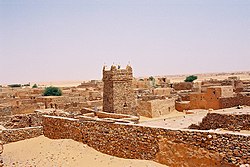
The town is split in two by a wadi. On one side, there is the old sector, and on the other the new one. The indigenous Saharan architecture of older sectors of the city features houses constructed of reddish dry-stone and mud-brick techniques, with flat roofs timbered from palms. Many of the older houses feature hand-hewn doors cut from massive ancient acacia trees, which have long disappeared from the surrounding area. Many homes include courtyards or patios that crowd along narrow streets leading to the central mosque.

History

[edit]

Occupied for thousands of years, the Chinguetti region was once a broad savannah; rock paintings at Agrour Amogjar, in the nearby Amogjar Pass, feature images of giraffes, cows, and people in a green landscape. It is quite different from the sand dunes of the surrounding desert, which make up most of the region today.[2]

Founding

[edit]

The city was founded in AD 777. The name Chinguetti means "spring of horses" in the Azayr language, an extinct dialect of Soninke that was heavily mixed with Berber. The area, at that time far more green than today, was home to agricultural peoples ancestral to several sub-Saharan ethnic groups, including the Soninke.[3] : 15, 71 

Center of Trade

[edit]

By the 11th century, Chinguetti had become a trading center for a confederation of Berber tribes, known as the Sanhaja. They eventually melded with the Almoravids, represented by Abdallah ibn Yasin, who would eventually control an empire stretching from present-day Senegal to al-Andalus in modern-day Spain. The city's stark, unadorned architecture reflects the strict religious beliefs of the Almoravids, who spread the Malikite rite of Sunni Islam throughout the Western Maghreb.

After two centuries of decline, the city was effectively re-founded in the 13th century as a fortified trading-center for nomadic trans-Saharan caravans, and as a means of connecting the Mediterranean with Sub-Saharan Africa. Although the walls of the original fortification disappeared centuries ago, many of the buildings in the old section of the city date from this period.

World Heritage Site

[edit]

In 1996, UNESCO designated Chinguetti, along with the cities of Ouadane, Tichitt and Oualata, also in the dunes area, as a World Heritage Site.[4] Notable buildings in the town include The Friday Mosque of Chinguetti, an 13th-14th century Berber structure of dry-stone construction,[5] featuring a square minaret capped with five ostrich egg finials; the former French Foreign Legion fortress; and a tall watertower. The mosque was restored by UNESCO in the 1970s.[6] The old quarter has five important manuscript libraries of scientific and Qur'anic texts, with many dating from the later Middle Ages. In recent years, the Mauritanian government, the U.S. Peace Corps, and various NGOs have attempted to position the city as a center for adventurous tourists. Visitors may "ski" down its sand dunes, visit the libraries, and appreciate the stark beauty of the Sahara.

The Friday Mosque is widely considered by Mauritanians to be the national symbol of the country.[2] The recently discovered offshore oilfield was named Chinguetti in its honor.

Religious importance

[edit]

For centuries, the city was a principal gathering place for pilgrims of the Maghreb to gather, on their way to Mecca. It became known as a holy city in its own right, especially for pilgrims unable to make the long journey to the Arab Peninsula. It also became a center of Islamic religious and scientific scholarship in West Africa.[7] In addition to religious training, the schools of Chinguetti taught students rhetoric, law, astronomy, mathematics, and medicine. For many centuries, all of Mauritania was commonly known in the Arab world as Bilad Shinqit, "the land of Chinguetti." It is sometimes said to be the seventh-most holy city of Islam,[8][9] The city remains one of the world's most important historical sites both in terms of the history of Islam and the history of West Africa.

Although largely abandoned to the desert, the city features a series of medieval manuscript libraries without peer in West Africa. The area around the Rue des Savants (or “street of intelligent ones”) was once famous as a gathering place for scholars, and as a place to debate the finer points of Islamic law. Today, the quiet city still offers the urban and religious architecture of the Moorish empire as it existed in the Middle Ages.[10]

Climate

[edit]

In 2021 Chinguetti was featured in a BBC documentary Life at 50 degrees C, which looked at ordinary people living in increasingly inhospitable areas.[11]

Climate data for Chinguetti
Month Jan Feb Mar Apr May Jun Jul Aug Sep Oct Nov Dec Year
Mean daily maximum °C (°F) 26.0
(78.8)
28.6
(83.5)
30.9
(87.6)
33.5
(92.3)
37.1
(98.8)
40.5
(104.9)
41.3
(106.3)
40.4
(104.7)
39.0
(102.2)
36.0
(96.8)
31.1
(88.0)
26.2
(79.2)
34.2
(93.6)
Mean daily minimum °C (°F) 11.5
(52.7)
13.0
(55.4)
15.4
(59.7)
17.7
(63.9)
21.0
(69.8)
24.7
(76.5)
25.7
(78.3)
25.5
(77.9)
24.5
(76.1)
21.3
(70.3)
16.7
(62.1)
12.2
(54.0)
19.1
(66.4)
Average precipitation mm (inches) 2
(0.1)
2
(0.1)
2
(0.1)
0
(0)
1
(0.0)
2
(0.1)
6
(0.2)
18
(0.7)
18
(0.7)
7
(0.3)
4
(0.2)
2
(0.1)
64
(2.5)
Source: Climate-data.org
[edit]

Notable residents

[edit]

See also

[edit]

Notes

[edit]
[edit]
Revisions and contributorsEdit on WikipediaRead on Wikipedia
from Grokipedia
Chinguetti is an ancient , or fortified trading town, situated in the Adrar region of northern , at the southern edge of the Desert. Established between the 11th and 12th centuries as a vital stop along trans-Saharan caravan routes linking to , it flourished from the 13th to 17th centuries as a hub for commerce in salt, , and dates, as well as a site for Sunni Muslims en route to Mecca. Designated a in 1996 as part of the Ancient Ksour of , Chinguetti, Tichitt, and Oualata, the town exemplifies Saharo-Sahelian architecture and nomadic , with its narrow, sand-swept streets lined by stone houses and a prominent featuring a distinctive square . At the heart of Chinguetti's cultural significance are its private family libraries, which preserve approximately 6,000 ancient Arabic manuscripts dating back to the late Middle Ages. These documents, written on paper, parchment, or sheepskin, cover diverse topics including Islamic theology, astronomy, mathematics, law, and poetry, reflecting the town's role as an intellectual crossroads where scholars and pilgrims exchanged knowledge. Housed in 13 discreet libraries scattered throughout the old quarter, the collections are maintained by local families as a sacred trust, though access is limited and requires permission from custodians. The manuscripts not only document Mauritania's scholarly heritage but also highlight broader exchanges across the Islamic world during the medieval period. Despite its historical prominence, Chinguetti faces existential threats from encroaching and , with the advancing southward at rates of up to 30 miles per year, burying buildings in sand dunes. Seasonal flash floods exacerbate , while limited resources hinder preservation efforts; has noted the site as vulnerable due to these threats. As of 2025, additional challenges include regional insecurity from conflicts in neighboring and dwindling tourism, with community-led sand removal and international support continuing to safeguard the town's structures and manuscripts. These efforts underscore Chinguetti's enduring value as a testament to human resilience in one of the world's harshest environments.

Geography and Environment

Location and Topography

Chinguetti is situated at geographic coordinates 20°27′N 12°21′W in the Adrar Region of northern , approximately 500 kilometers northeast of the capital city, . The town occupies a rocky plateau at the edge of the , a low central massif characterized by rugged hills, noticeable cliffs rising to about 240 meters in some areas, and surrounding expanses of sand dunes. This elevated terrain, reaching approximately 450 meters above , is intersected by wadis, including one that bisects the town itself, and lies adjacent to oases that supported ancient caravan routes linking to the Mediterranean. As one of four medieval ksour (fortified towns), Chinguetti is integrated into the known as the Ancient Ksour of Ouadane, Chinguetti, Tichitt, and Oualata, alongside nearby settlements like to the north and Tichitt to the southeast, which collectively served as key stops along paths. The site's position on the plateau historically offered strategic advantages, including natural defense from the elevated and rugged landscape, as well as access to underground aquifers that sustained oases and enabled settlement in the arid environment.

Climate and Environmental Challenges

Chinguetti experiences a hot classified as BWh under the Köppen system, characterized by extreme fluctuations and minimal . Daytime highs can reach up to 45°C during summer months, while winter nights occasionally drop to around 5°C, reflecting the stark diurnal and seasonal variations typical of Saharan environments. Annual rainfall averages less than 50 mm, primarily occurring in brief, intense summer storms between and , which provide scant relief from the pervasive aridity. Seasonal weather patterns exacerbate the challenges of daily life and structural preservation in Chinguetti. Intense sandstorms, known locally as simooms, sweep across the region, carrying fine particles that erode buildings and disrupt activities, while occasional —hariga—arising from Atlantic moisture influences visibility and adds to the harsh conditions during cooler periods. These phenomena not only hinder mobility and but also accelerate the wear on the town's ancient , burying pathways and forcing to continually clear dunes from homes and streets. As of 2024-2025, desert encroachment has accelerated, burying significant parts of the town since the 1980s, driven by climate change-induced reduced rainfall—averaging just 25 mm annually over the past decade—and that depletes sparse vegetation cover. This proximity to expansive sand seas like Erg Warane leaves Chinguetti vulnerable, with limited oases supporting resilient species such as acacias and date palms, which rely on underground water sources for survival amid the encroaching dunes. Its status as a underscores the urgency of these environmental threats to its cultural integrity.

History

Founding and Early Settlement

Chinguetti was established in the 11th and 12th centuries CE as one of several ancient ksour designed to support the burgeoning trans-Saharan caravan trade routes crossing the Sahara Desert. These fortified settlements emerged to facilitate commerce and provide respite for nomads and traders in the harsh Adrar Plateau environment of northern Mauritania. The town's origins trace to nomadic Berber groups, particularly the Sanhaja confederation, who migrated southward from North Africa and utilized the area as a seasonal camp around the turn of the second millennium. The Sanhaja, known for their role in early Islamic expansion and trade networks, initially set up outposts here drawn by the region's sparse but reliable water sources, including small springs that sustained both humans and livestock. The name "Chinguetti," or Shinqīt in local parlance, derives from the Soninke-Azer phrase "shi-n-gede," meaning "the horses' springs," highlighting the significance of these vital oases in an otherwise arid landscape. Over time, the settlement transitioned from a transient nomadic base to a more permanent village, bolstered by its strategic location at the intersection of salt and paths linking to West African empires. This early consolidation laid the groundwork for Chinguetti's evolution into a key hub, though its full prominence as a and center developed in subsequent centuries.

Development as a Trade and Pilgrimage Hub

Chinguetti emerged as a vital node in the network during the 13th century, serving as a major stopover on caravan routes linking and other North African regions with and the to the south. These routes facilitated the exchange of essential commodities, including salt transported northward from Saharan mines and , , ostrich feathers, and enslaved people moved southward from West African sources, underscoring the town's role in sustaining economic ties across the desert. At its zenith between the 14th and 16th centuries, Chinguetti supported up to 20,000 inhabitants and hosted annual gatherings of as many as 30,000 camels, reflecting the scale of commercial activity that transformed it from a modest settlement into a bustling economic center. The town's strategic location also positioned it as a crucial gathering point for Islamic pilgrims from the embarking on the to , earning it recognition as an essential waypoint in the pilgrimage itinerary during the medieval period. This dual function as a and religious hub attracted merchants, scholars, and travelers, who converged annually between the 13th and 17th centuries to exchange goods, news, and cultural influences amid the harsh environment. The influx of these groups stimulated a vibrant , where ancient texts on astronomy, , and were copied, preserved, and bartered, further embedding Chinguetti in broader Islamic networks. To accommodate the growing , Chinguetti developed supporting , including markets for direct transactions, warehouses for storing traded goods, and oasis-based systems that provided vital hydration for caravans and residents alike. Inns, known locally as fondaks, offered lodging and security for traders, fostering a dense urban layout of courtyard houses clustered around mosques by the . Key historical developments included its integration into routes affected by the 16th-century interactions between the and Moroccan Saadians, whose 1591 invasion disrupted southern trade flows but initially sustained northern caravan traffic through Chinguetti. This activity persisted into the 17th century before broader socio-economic shifts led to decline by the 19th century.

Colonial Period and Modern Recognition

During the early 20th century, Chinguetti experienced significant decline as routes shifted southward due to colonial influences and environmental pressures, compounded by periodic droughts that strained in the Adrar region. French forces arrived in 1909, establishing the town as a post and prompting the development of an extramural settlement to the east, which integrated colonial administrative structures into its traditional layout. This occupation marked Chinguetti's transition from a vibrant caravan hub to a peripheral outpost within , further eroding its economic vitality as camel-based commerce waned in favor of modern routes. Following 's independence from in , Chinguetti's population continued to shrink amid ongoing and severe droughts, particularly the devastating events of the that forced widespread sedentarization and abandonment of peripheral quarters. By the mid-1970s, the town's residents had dwindled to approximately 3,000–5,000, with many outer districts left uninhabited as sand encroachment buried structures and viable became untenable. These challenges reflected broader post-colonial struggles in , where rural depopulation accelerated urbanization and left historic sites like Chinguetti vulnerable to neglect. In 1996, Chinguetti was inscribed on the World Heritage List as part of the "Ancient Ksour of , Chinguetti, Tichitt and Oualata," celebrated for its exceptional preservation of medieval and urban fabric, which exemplifies adaptive desert settlements and nomadic cultural traditions. The designation highlighted the site's intact stone mosques, libraries, and housing clusters, underscoring their role in and scholarship despite centuries of environmental adversity. Its ancient manuscripts, numbering in the thousands and spanning , astronomy, and , further bolster its global significance, though they remain preserved locally without formal international registry inscription as of 2025. Recent developments have intensified international focus on Chinguetti's preservation, with 2024 reports documenting acute threats from accelerating , where sand dunes now bury streets and homes at an alarming rate due to climate-driven . Media coverage has drawn renewed attention to the site's endangerment, emphasizing the need for to combat and support as a sustainable lifeline for the community. As of November 2025, local efforts, including initiatives by individuals like Saif Islam to protect the libraries and manuscripts, continue amid ongoing threats from encroaching sands, dwindling , and regional insecurity.

Architecture and Cultural Heritage

Mosques and Religious Buildings

The Grande Mosquée, also known as the Friday Mosque or Chinguetti Great Mosque, stands as the central religious structure in Chinguetti, constructed primarily between the 13th and 15th centuries during the town's emergence as a key Muslim scholarly and trade center along Saharan caravan routes. Built using split stone and clay with a roof supported by palm beams on stone piers, it features a hall with four aisles, a , twin and niches in the qibla wall, and a prominent square sawma’a-type at the southwest corner that is the second oldest in continuous use in the Muslim world. The mosque has undergone multiple renovations, including a significant restoration in the 1970s by to preserve its structure against , and a more recent project initiated in December 2024 by to address erosion and maintain its architectural integrity as a prominent monument in the -listed . It continues to serve as the primary site for communal s, embodying Chinguetti's enduring role as one of Islam's seven holy cities. Beyond the Grande Mosquée, Chinguetti features several smaller neighborhood mosques that reflect the town's dense religious landscape, including structures like the Old Mosque, which consists of a simple prayer room and constructed from mud-brick to withstand the encroaching sands. These auxiliary , often built with local stone and palm wood elements, support daily worship and community gatherings in various quarters of the ancient . Religious complexes in Chinguetti also include zawiyas, or Sufi lodges, which function as integral stops for pilgrims and sites for spiritual retreat, integrated into the town's fabric to facilitate Islamic education and devotion alongside the mosques. Saharan architectural adaptations are evident across these buildings, with thick stone walls providing insulation against extreme heat and cold, flat or vaulted roofs allowing for efficient heat dissipation, and precise orientations aligning prayer spaces toward to symbolize . These features highlight the ingenuity of local builders in harmonizing form, function, and environmental resilience.

Libraries and Ancient Manuscripts

Chinguetti is renowned for its family-owned libraries, which collectively house over 6,000 ancient Arabic manuscripts across approximately 13 private collections, down from an estimated 30 in its historical peak. These libraries, maintained by scholarly families for generations, serve as repositories of Islamic intellectual heritage, with key examples including the Al-Shorfa and Al-Iniya libraries, as well as the Al-Habot, Al-Ahmad Mahmoud, Al-Hamoni, and Ould Ahmad Sherif collections. The Al-Habot library alone preserves more than 1,400 volumes, underscoring the scale of these familial archives. The manuscripts span from the 11th to the 20th centuries, encompassing a diverse array of subjects such as , astronomy, , , and , reflecting Chinguetti's role as a hub for trans-Saharan knowledge exchange. Written primarily in , many feature the distinctive , a regional variant characterized by its fluid, rounded forms adapted to North African and West African scribal traditions. Representative examples include 12th-century Quranic texts, 15th-century treatises on Arab astronomy bound in worn leather, and works on Islamic law and that illustrate the synthesis of Andalusian, Berber, and sub-Saharan influences. Preservation in these libraries relies on traditional methods suited to the harsh Saharan environment, with manuscripts stored in sturdy wooden chests often covered in , reinforced with iron bands and nails to guard against , , and . These bindings and enclosures, some dating to the early , protect fragile or pages inscribed with charcoal-based inks mixed with . Digitization initiatives, initiated in the early 2000s through international collaborations including restoration projects funded by the Spanish Agency for International Development Cooperation, aim to create virtual access while addressing deterioration from desert encroachment; however, progress remains limited due to resource constraints and the decentralized nature of the collections. These collections hold immense scholarly value, contributing to the understanding of medieval Islamic and education in , and have briefly supported local teaching traditions by providing access to scholars studying theology and astronomy. As part of Chinguetti's World Heritage status, the manuscripts exemplify African documentary heritage, emphasizing their role in preserving cultural continuity amid environmental threats.

Traditional Urban Layout and Housing

Chinguetti's traditional urban layout reflects a compact, fortified design adapted to the harsh Saharan environment, featuring a dense fabric of narrow, winding streets that radiate from the central . These labyrinthine alleys, often covered by passageways known as dhouleyla, serve to shield inhabitants from intense sunlight, , and encroaching sand, while the absence of main thoroughfares or public squares emphasizes communal privacy and defense. The overall morphology evolved as a , or fortified settlement, integrating nomadic influences with permanent structures to support trans-Saharan caravan trade, ensuring accessibility for merchants and pilgrims. Residential housing in Chinguetti consists primarily of single-storey adobe and stone dwellings clustered around inner courtyards, promoting family seclusion and thermal regulation in the desert climate. Constructed from local reddish dry-stone and mud-brick techniques reinforced with clay plaster, these homes feature thick load-bearing walls that provide insulation against extreme temperatures, with minimal exterior openings such as small loopholes or windows to minimize heat gain and dust entry. Flat roofs, timbered with palm beams and often used as terraces for drying goods or stargazing, crown the structures, while some incorporate stone elements quarried nearby for added durability against erosion. Decorative entrances with toothed wooden doors and intricate interior clay motifs highlight vernacular craftsmanship, though many rooms serve multipurpose roles suited to seasonal nomadic use. Defensive features underscore the town's ksar character, with its dense clustering of blank-walled houses forming a natural perimeter barrier against environmental and potential human threats, dating back to its medieval origins. While no expansive outer walls are prominently documented, the fortified layout includes high enclosing walls around individual compounds and the overall settlement's tight-knit design, which originated in the 11th-12th centuries to protect against sandstorms and raids along trade routes. Adaptations to nomadic lifestyles are evident in the modular, portable elements like wooden fittings that allow for flexibility in occupation. The town's traces its roots to a 13th-century core established as a key caravan hub, with subsequent organic expansions through the that preserved the medieval amid fluctuating trade prosperity. By the , minor enlargements accommodated growing scholarly communities, though the original layout remained dominant. Today, habitation is concentrated in the inner historic core, as peripheral areas have been largely abandoned due to shifting demographics, leaving the central quarters as the vibrant heart of traditional life.

Religious and Cultural Significance

Status as a Holy City of

Chinguetti earned its designation as the seventh of during its formative period in the 11th and 12th centuries, when it emerged as a vital religious and trading outpost for trans-Saharan caravans, paralleling the sanctity of , , and through its embodiment of piety and its pivotal role in disseminating Islamic teachings across . This title, traditionally recognized in West African Islamic contexts, reflects the town's early establishment as a center radiating intense religious life, where merchants and scholars fostered a deep commitment to amid the harsh Saharan environment. The theological foundation of Chinguetti's holiness stems from its strong ties to early Islamic scholars and Sufi traditions, including the influence of figures like Sidi al-Mukhtar al-Kunti (d. 1811), a prominent leader from the Kunta confederation who expanded religious and political influence in the , promoting mystical devotion and Islamic renewal in the region. Central to this basis is the veneration of saints' tombs scattered throughout the town, which serve as sites for spiritual intercession and baraka (blessing), drawing devotees in practices rooted in Sufi piety that underscore the town's role as a bastion of orthodox yet mystically infused . Symbolically, Chinguetti stands as a spiritual oasis in the vast , its sanctity reinforced by annual pilgrimages that transcend the logistical routes to , allowing West African to engage in devotional acts and communal that affirm its enduring religious prestige. The physical mosques within the town embody this holiness, acting as focal points for worship that integrate the sacred landscape with daily spiritual life. Unlike other Saharan settlements, Chinguetti uniquely merges commercial vitality, scholarly pursuit, and Sufi , elevating it to a singular status among Islamic outposts.

Role in Islamic Scholarship and Education

Chinguetti has served as a vital center for Islamic scholarship since the 13th century, attracting from across the who taught core disciplines such as , , and . As a key stop on and routes, the city drew scholars who established informal madrasas within mosques and zawiyas, fostering a of rigorous intellectual exchange amid its nomadic Berber and communities. This scholarly environment emphasized the of , which predominated in the region, and integrated practical knowledge relevant to desert life, including religious law and spiritual practices. Prominent Shinqiti scholars from Chinguetti made enduring contributions to Islamic thought, particularly in Maliki , while producing works that extended to astronomy and . For instance, Muhammad al-Amin al-Shinqiti (1907–1973), a renowned faqih and mufassir born in the Chinguetti region, authored influential texts like Adwa' al-Bayan fi Idah al-Qur'an bi I'rab al-Jayyan, which advanced Qur'anic exegesis and jurisprudential interpretation within the Maliki tradition. Manuscripts preserved in the city's libraries further highlight scholarly output, including star charts for that blended astronomy with religious observance and treatises on drawing from Islamic medical heritage. These works underscore Chinguetti's role in bridging theoretical scholarship with applied sciences, influencing broader West African Islamic intellectual networks. The educational system in Chinguetti relied on a blend of oral and written transmission, sustained through family lineages of who passed down knowledge across generations. Teaching occurred in intimate settings, such as family homes or courtyards, where students memorized texts and engaged in debates under established scholars, often inheriting private libraries as pedagogical tools. This mahdhara-style approach prioritized (certificates of authorization) from master to pupil, ensuring the continuity of authentic transmission in , , and Sufi tariqas despite the city's isolation. Scholarly families, like those descending from early 19th-century , maintained this system, embedding within communal and familial structures. In the modern era, Chinguetti's legacy persists through informal educational circles where continue to teach traditional sciences to local youth, adapting to contemporary challenges like .

Festivals and Cultural Practices

Chinguetti's cultural life is deeply intertwined with its Islamic heritage, where festivals serve as vibrant expressions of and devotion. The annual Festival of Heritage Cities, organized by the Mauritanian government, rotates among historic Saharan towns including Chinguetti, celebrating architecture, , , and crafts through performances and gatherings that draw locals and visitors alike. This event, held for over a decade, fosters cultural exchange and preservation, often featuring traditional and to highlight the town's role as a center of . Additionally, al-Nabi, commemorating the Muhammad's birthday, is observed nationwide in with processions, recitals, and communal prayers, particularly resonant in Chinguetti due to its status as a where such celebrations emphasize Sufi devotion. Zikr ceremonies, involving rhythmic Sufi chanting and remembrance of God, occur in the town's zawiyas—Sufi lodges that dot the landscape—drawing participants into meditative gatherings that reinforce spiritual bonds within the . Daily practices in Chinguetti reflect the town's nomadic-sedentary heritage and resilience, emphasizing as a core value. The ritual of preparing and sharing mint , known as ataya, is a of social interaction, served in three successive glasses of increasing sweetness to symbolize life's progression from bitterness to joy; hosts pour from a height to create frothy foam, a of extended to guests in homes or during gatherings. Traditional attire adapts to the harsh environment, with men donning loose boubou robes in white or blue, often paired with turbans for sun protection, while women wear flowing malahfa veils dyed in or other colors, embroidered with geometric patterns that echo the town's architectural motifs. These garments, lightweight and protective against sandstorms, are repainted or refreshed seasonally, maintaining cultural continuity amid daily life. Cultural arts thrive through oral traditions and music, preserving desert lore and history. Igawen—Mauritania's equivalent of griots—serve as poet-musicians and storytellers, reciting epics, folk tales, and genealogies that recount trans-Saharan journeys and Islamic narratives, often during evening gatherings around palm groves or after the guetna date harvest, a communal event uniting families in seasonal labor. Music accompanies these sessions, featuring the tidinit, a long-necked played by men to evoke haunting melodies like the awdid compositions of renowned Chinguetti artist Vala, blending Berber, , and African influences to narrate tales of endurance and . Street performances by Amazigh musicians with the tidinit add to the auditory tapestry, echoing the town's role as a caravan crossroads. In contemporary times, these practices adapt to while rooted in pre-colonial norms, with heritage festivals incorporating visitor-friendly performances of and to showcase Chinguetti's intangible heritage without diluting its essence. Such events, like the International Festival of the held in December, feature traditional chants and playing, attracting global interest and supporting local artisans through demonstrations of dyeing and oral recitals.

Economy and Society

Historical Trade Routes

Chinguetti served as a vital node on the ancient routes, particularly the Taghaza Trail, which connected the salt mines of in present-day with markets in and , facilitating the exchange of goods across the Desert from the 11th to the 16th centuries. This route, established after the introduction of domesticated camels in the 3rd century CE, passed through key oases in , positioning Chinguetti as a strategic staging point for caravans traveling southward to the regions and the valley. Alternative paths diverged through nearby , linking to in , where traders could access sub-Saharan networks for and other commodities, enhancing Chinguetti's role as a commercial crossroads. The town's growth as a bustling center was directly tied to these routes, which brought prosperity through seasonal influxes of merchants and nomads. The primary commodities exported from Chinguetti and surrounding areas included salt slabs mined at , valued as "white gold" for preservation and trade in , along with dates from local oases and leather goods crafted by Berber artisans. In return, caravans imported European-manufactured goods, books, and textiles starting from the , as and other European traders influenced North African ports like , routing these items southward via Moroccan intermediaries. Salt slabs, often loaded in blocks weighing up to 30 kilograms each, were a cornerstone of the economy, exchanged for and from the south, while books—primarily Islamic manuscripts—supported the town's scholarly reputation and were prized imports for local libraries. Supporting this commerce was a network of infrastructure adapted to the harsh desert environment, including deep wells for and fortified staging posts (ksour) that offered and rest for travelers. Camel-based dominated, with caravans comprising up to 2,000 animals arriving seasonally, guided by experienced Berber nomads who navigated by stars and ancient waypoints; these massive convoys could stretch several kilometers, carrying loads of 150–200 kilograms per over distances exceeding 1,500 kilometers. Chinguetti itself functioned as a secure depot, its stone-walled compounds protecting goods from raids and sandstorms, while communal wells ensured the survival of both humans and livestock during the grueling journeys. The decline of these routes began in the , accelerated by European maritime trade that circumvented the via coastal ports along , making overland obsolete for bulk goods like salt and . French colonial infrastructure, particularly the Dakar-Niger completed in 1924, further bypassed desert paths by linking coastal hubs directly to inland empires like those around , reducing the economic viability of Chinguetti's position by the early .

Contemporary Tourism and Economy

Chinguetti's contemporary economy centers on , which has become the primary source of livelihood for its residents following the decline of traditional caravan trade. The town attracts visitors drawn to its ancient mosques, private libraries housing rare manuscripts, and surrounding sand dunes, with guided tours offering access to these sites under strict preservation rules. infrastructure includes basic guesthouses like the and requires 4x4 vehicles for access from , approximately 65 miles away, though seasonal sandstorms can lead to temporary closures. Prior to 2020, Chinguetti drew several thousand international tourists annually, primarily from , making it Mauritania's most visited site despite the country's overall low figures of around 4,000 visitors per year. The and prior security issues in the caused a sharp decline, but recovery has been underway, with tourists gradually returning for cultural experiences such as exploring the Ahmed Mamoud family library. Economic activities tied to include sales of replica manuscripts, local crafts, and camel treks into the dunes, providing essential income in this remote desert outpost. Subsidiary economic pursuits involve limited oasis agriculture, focusing on date palms and millet cultivation, alongside nomadic herding of camels, goats, and sheep, which sustain local food needs but yield minimal surplus. Remittances from the diaspora, contributing about 1.6% to the national GDP in 2023, supplement household incomes in Chinguetti, helping to offset the challenges of isolation and environmental pressures. As of 2025, lingering security concerns from regional conflicts and encroaching continue to limit visitor numbers and growth potential, despite ongoing preservation initiatives.

Demographics and Community Life

Chinguetti's population stands at 4,844 as recorded in the 2023 census conducted by Mauritania's National Agency for Statistics and Demographic Analysis, reflecting a modest annual growth of 0.08% since 2013. This figure represents the permanent residents of the commune, a significant decline from the town's historical peak of approximately 20,000 inhabitants during the 11th to 18th centuries when it served as a bustling caravan hub. As a renowned pilgrimage site—one of Islam's holiest cities in Africa—Chinguetti experiences a notable seasonal influx of nomads and visitors, particularly during religious festivals, which temporarily swells the local population and revitalizes community interactions. The ethnic composition of Chinguetti is predominantly Arab-Berber Moors (Bidhan), who form the majority in northern , alongside smaller (descendants of enslaved Black Africans integrated into Moorish society) and Sub-Saharan groups such as Soninke or Fulani. This demographic mirrors the broader Moorish dominance in the Adrar region, where Arab-Berber heritage shapes cultural and social norms. The community is multilingual, with serving as the primary tongue for daily communication and religious discourse, French as the official language for administration and , and occasional use of Wolof or Pulaar among Sub-Saharan residents reflecting historical trade ties. Social structure in Chinguetti revolves around tribal affiliations, notably the Berber confederation—a prominent group of Arab-Berber origin known for their nomadic heritage and influence across northern —and lineages that preserve traditional roles. Families maintain custodianship of the town's ancient libraries, a responsibility passed down through generations to safeguard Islamic texts and scholarly works, underscoring the community's deep-rooted commitment to . roles follow traditional Islamic patterns, with men predominantly involved in religious scholarship and leadership, while women contribute significantly to local , cultivation, and household management, often balancing these duties amid the town's resource constraints. Daily life in Chinguetti demonstrates resilient adaptations to its remote Saharan location, where extreme isolation is mitigated by decentralized systems that provide to homes and , reducing reliance on sporadic diesel generators. Satellite communications enable and connectivity to the wider world, facilitating , , and family ties despite the lack of reliable terrestrial . However, challenges persist, including significant youth migration to urban centers like , driven by limited local opportunities, recurrent droughts, and the appeal of better and in the capital, which contributes to an aging resident and strains cohesion.

Preservation Efforts

UNESCO World Heritage Status

Chinguetti was inscribed on the World Heritage List in 1996 as part of the serial property "Ancient Ksour of , Chinguetti, Tichitt and Oualata." This recognition highlights its role within a network of historic fortified settlements that developed along Saharan caravan routes between the 11th and 16th centuries. The site meets three cultural criteria: (iii) for bearing unique testimony to a cultural , specifically the nomadic lifestyle and practices of Islamic ; (iv) as an outstanding example of medieval architectural ensembles illustrating in a context; and (v) as a representative traditional human settlement vulnerable to environmental changes. The inscribed boundaries for Chinguetti encompass the historic core of the old town, including its mosques, libraries, and traditional housing, forming an integral component of the broader network spanning Mauritania's Adrar region. This area preserves the authentic urban fabric of the , with its mud-brick structures adapted to the desert environment. Management responsibilities fall to the National Foundation for the Preservation of Ancient Towns, operating under the Mauritanian and Historical Heritage, which coordinates protection, conservation, and presentation efforts in line with guidelines. The designation has brought tangible benefits, including access to international funding for technical surveys and preservation planning, such as those supported by the World Heritage Fund and bilateral agreements like the France-UNESCO Convention. It has also elevated global awareness of Chinguetti's cultural treasures, particularly its ancient manuscript collections housed in private libraries, underscoring their importance as repositories of Islamic scholarship. Periodic monitoring reports by reaffirm the site's outstanding , particularly in exemplifying Islamic desert architecture through its adaptive building techniques and urban layout that harmonize with the arid landscape.

Threats from Desert Encroachment

Chinguetti, perched on the edge of the Desert in , faces severe threats from advancing sand dunes that are progressively burying its historic structures. In the region, dunes have been observed advancing at rates up to 10 meters per year, driven by persistent winds and arid conditions, leading to the gradual submersion of the city's outer walls and narrow alleys. Since the early 2000s, significant portions of the ancient have been impacted by sand accumulation, with homes and pathways now obscured under layers of dunes that deposit inches to feet of sand annually. The primary causes of this encroachment include sharply reduced rainfall, altered wind patterns, and the absence of natural barriers. Over the past decade, Chinguetti has received an average of just 2.5 centimeters of rain per year, insufficient to sustain , gum, and palm trees that once stabilized the , exacerbating dune migration through increased sandstorms. These winds, combined with and extreme temperatures, propel loose sands toward the city, while human factors like removal for and further diminish protective barriers. Funding shortages, as highlighted in 2024 reports, hinder efforts to counteract these advances, leaving local authorities under-resourced to implement barriers or stabilization measures. The impacts on Chinguetti's heritage are profound, with partial burial threatening key sites such as the 13th-century Friday and over a dozen private libraries housing thousands of ancient manuscripts. Sand infiltration has submerged doorways and courtyards, compromising the structural integrity of mud-brick architecture and exposing fragile texts on Islamic law, , and to damage from trapped humidity and abrasion. Ongoing risks rendering large sections of the ancient city uninhabitable and irretrievable.

Ongoing Conservation Initiatives

Efforts to combat desert encroachment in Chinguetti have included the of sand barriers and dune stabilization techniques, such as a 1999 UNESCO-funded project for sand stabilization at the site using $20,000 from the World Heritage Fund, and continuing through in recent years. These measures aim to trap shifting sands and protect the ancient ksour's structures, with local residents also manually clearing dunes from streets and homes to maintain accessibility. In 2024, the Islamic World Educational, Scientific and Cultural Organization (ICESCO) launched a comprehensive restoration project for the historic Friday Mosque in Chinguetti, focusing on structural rehabilitation, the Imam's house, courtyards, and interior and exterior preservation to safeguard this key Islamic heritage site. This initiative builds on earlier international support for the ksour, including UNESCO's technical assistance for urban rehabilitation and conservation strategies. Manuscript protection efforts emphasize climate-controlled storage in private libraries and digital archiving to preserve Chinguetti's approximately 6,000 ancient manuscripts, with ongoing projects by local preservation laboratories addressing environmental threats like sand infiltration and humidity. By 2025, collaborations with organizations such as have highlighted these collections through educational events, promoting global awareness and supporting to ensure long-term accessibility. Community involvement is central to these initiatives, with training programs for local technicians and residents in heritage conservation techniques, coordinated through UNESCO and national foundations to build capacity for ongoing maintenance. UNESCO's broader 2024-2025 heritage emergency responses have allocated resources for ksour sites, including capacity-building in , though specific funding for Chinguetti remains integrated into regional efforts totaling $139,632 in historical assistance. In 2023, community-led sand removal efforts cleared significant accumulations from key areas, demonstrating partial successes amid persistent challenges. Sustainable tourism plays a vital role in funding these conservation activities, with projects like the "Linguistic and Tourism Bridges" initiative training youth in eco-tourism to generate revenue while minimizing site impacts and supporting preservation. In 2025, tree-planting projects by the Mauritanian Ministry of Environment and European-funded NGOs aim to establish green belts to combat dune advancement. These efforts address the threats of advancing dunes, which continue to bury structures and libraries, by fostering economic incentives for long-term protection.

References

Add your contribution
Related Hubs
User Avatar
No comments yet.