


Community hub
Recent from talks
Contribute something
Nothing was collected or created yet.
Common shrew
View on Wikipedia
| Common shrew[1] | |
|---|---|

| |
Scientific classification 
| |
| Kingdom: | Animalia |
| Phylum: | Chordata |
| Class: | Mammalia |
| Order: | Eulipotyphla |
| Family: | Soricidae |
| Genus: | Sorex |
| Species: | S. araneus
|
| Binomial name | |
| Sorex araneus | |

| |
| Common shrew range | |
| Synonyms | |
|
Sorex europaeus | |

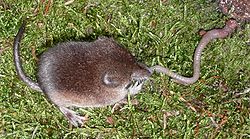
The common shrew (Sorex araneus), also known as the Eurasian shrew, is the most common shrew, and one of the most common mammals, throughout Northern Europe, including Great Britain, but excluding Ireland.[3] It is 55 to 82 millimetres (2.2 to 3.2 in) long and weighs 5 to 12 grams (0.2 to 0.4 oz), and has velvety dark brown fur with a pale underside. It is one of the rare venomous mammals.[4] Juvenile shrews have lighter fur until their first moult. The common shrew has small eyes, a pointed, mobile snout and red-tipped teeth. It has a life span of approximately 14 months.
Shrews are active day and night, taking short periods of rest between relatively long bursts of activity.[5]
Territory
[edit]Common shrews are found throughout the woodlands, grasslands, and hedgelands of Britain, Scandinavia, and Eastern Europe. Each shrew establishes a home range of 370 to 630 m2 (440 to 750 yd²). Males often extend the boundaries during the breeding season to find females. Shrews are extremely territorial and will aggressively defend their home ranges from other shrews. They make their nests underground or under dense vegetation.[6]
Diet
[edit]The common shrew's carnivorous and insectivorous diet consists of insects, slugs, spiders, worms, amphibians and small rodents. Shrews need to consume 200% to 300% of their body weight in food each day in order to survive; to achieve this they must eat every 2 to 3 hours, and they will starve if they go without food much longer than that. They do not hibernate because their bodies are too small to store sufficient fat reserves and they have a short fasting duration.[5][7]
Common shrews have evolved adaptations to survive through the winter. Their skulls shrink by nearly 20% and their brains get smaller by as much as 30%. Their other organs also lose mass and their spines get shorter. As a result, total body mass drops by about 18%. When spring returns, they grow until they reach roughly their original size. Scientists believe that low temperatures trigger their bodies to break down bones and tissues and absorb them. As temperatures start to rise with the onset of spring, their bodies start to rebuild the lost bones and tissues. This ability to shrink their bodies significantly reduces their food requirements and increases their chances of survival in the winter.[8][9] Common shrews exhibit three distinct seasonal phenotypes; however, these phenotypes have the same relative oxygen consumption despite varying temperatures.[10]
Shrews have poor eyesight and instead use their excellent senses of smell and hearing to find food.
Breeding
[edit]The common shrew breeding season lasts from April to September, but peaks during the summer months. After a gestation period of 24 to 25 days, a female gives birth to a litter of five to seven babies. A female rears two to four litters each year. The young are weaned and independent within 22 to 25 days.[11]
Young shrews often form a caravan behind their mother, each carrying the tail of its sibling in front with its mouth.
Chromosomal polymorphism
[edit]The chromosome number (karyotype) of Sorex araneus varies widely, with a number of distinct "chromosomal races" being present over the species' range.[2] One such race was described in 2002 as a new species, S. antinorii.[2] This is an example of chromosomal polymorphism (chromosomal variability as a result of chromosome fusions or disassociations).[12][13]
These karyotypes have been known to naturally hybridize, such as in the Petchora race and the Naryan-Mar variant in Northeastern Russia.[14]
Echolocation
[edit]A study by Nanjing Normal University in 2019 found that Sorex araneus is capable of echolocation via high-frequency tittering and close-range spatial orientation. Comparison of genes involved in hearing between bats, bottlenose dolphins and Sorex araneus suggests that this is a result of convergent evolution.[15]
Protection and population
[edit]
The common shrew is not an endangered species, but in Great Britain it, like other shrews, is protected from certain methods of killing by the Wildlife and Countryside Act of 1981.[16]
In Britain, shrews can be found at densities of up to one per 200 m2 (240 yd²) in woodlands. The main predators of shrews are owls, cats, weasels, snakes, stoats, and red foxes.[6]
References
[edit]- ^ Hutterer, R. (2005). "Order Soricomorpha". In Wilson, D.E.; Reeder, D.M (eds.). Mammal Species of the World: A Taxonomic and Geographic Reference (3rd ed.). Johns Hopkins University Press. p. 283. ISBN 978-0-8018-8221-0. OCLC 62265494.
- ^ a b c Hutterer, R.; Kryštufek, B. (2017) [errata version of 2016 assessment]. "Sorex araneus". IUCN Red List of Threatened Species. 2016 e.T29661A115170489. doi:10.2305/IUCN.UK.2016-3.RLTS.T29661A22315145.en. Retrieved 31 July 2020.
- ^ "Ireland's Pygmy Shrew, one of the world's smallest mammals, under threat from white-toothed invader". BirdWatch Ireland. 8 July 2014. Archived from the original on 12 July 2018. Retrieved 21 July 2015.
- ^ Kowalski, Krzysztof; Marciniak, Paweł; Rychlik, Leszek (7 June 2022). "A new, widespread venomous mammal species: hemolytic activity of Sorex araneus venom is similar to that of Neomys fodiens venom". Zoological Letters. 8 (1): 7. doi:10.1186/s40851-022-00191-5. PMC 9172195. PMID 35672837. S2CID 249437873.
- ^ a b Saarikko, Jarmo (1989). "Foraging behaviour of shrews". Annales Zoologici Fennici. 26 (4): 411–423. JSTOR 23734695.
- ^ a b British Wildlife. London: Collins. 2002. p. 402. ISBN 0-00-713716-8.
- ^ Churchfield, Sara; Rychlik, Leszek; Taylor, Jan R. E. (2012-10-01). "Food resources and foraging habits of the common shrew, Sorex araneus: does winter food shortage explain Dehnel's phenomenon?". Oikos. 121 (10): 1593–1602. Bibcode:2012Oikos.121.1593C. doi:10.1111/j.1600-0706.2011.20462.x. ISSN 1600-0706.
- ^ Stetka, Bret. "Small-Minded Strategy: The Common Shrew Shrinks Its Head to Survive Winter". Scientific American. Retrieved 2017-10-24.
- ^ Lázaro, Javier; Dechmann, Dina K.N.; LaPoint, Scott; Wikelski, Martin; Hertel, Moritz (2017-10-23). "Profound reversible seasonal changes of individual skull size in a mammal". Current Biology. 27 (20): R1106 – R1107. Bibcode:2017CBio...27R1106L. doi:10.1016/j.cub.2017.08.055. ISSN 0960-9822. PMID 29065289.
- ^ Schaeffer, Paul; O'Mara, M. Teague; Breiholz, Japhet; Keicher, Lara; Lázaro, Javier; Muturi, Marion; Dechmann, Dina (31 March 2020). "Metabolic rate in common shrews is unaffected by temperature, leading to lower energetic costs through seasonal size reduction". Royal Society Open Science. 7 (4) 191989. Bibcode:2020RSOS....791989S. doi:10.1098/rsos.191989. PMC 7211839. PMID 32431881.
- ^ "BBC Science and Nature: Animals". Archived from the original on January 13, 2013. Retrieved 11 September 2009.
- ^ Polymorphism: when two or more clearly different phenotypes exist in the same interbreeding population of a species. Ford E.B. 1975. Ecological genetics, 4th ed.
- ^ White M.J.D. 1973. The chromosomes. Chapman & Hall, London. p169
- ^ Pavlova, Svetlana; Shchipanov, Nikolay (July 2019). "New karyotypes of the common shrew Sorex araneus (Lipotyphla, Mammalia) at the northern periphery of the species range in European Russia". Mammal Research. 64 (3): 455–459. doi:10.1007/s13364-018-0409-6. S2CID 53567760.
- ^ Chai, Simin; Tian, Ran; Rong, Xinghua; Li, Guiting; Chen, Bingyao; Ren, Wenhua; Xu, Shixia; Yang, Guang (25 February 2020). "Evidence of Echolocation in the Common Shrew from Molecular Convergence with Other Echolocating Mammals" (PDF). Zoological Studies. 59 (4). doi:10.6620/ZS.2020.59-04. Archived from the original (PDF) on 15 April 2022. Retrieved 4 May 2020.
- ^ Wildlife and Countryside Act 1981 S11, Sch 6
External links
[edit]- ARKive on the common shrew
- BBC information on the common shrew
- View the shrew genome in Ensembl
- View the sorAra2 genome assembly in the UCSC Genome Browser
| National | |
|---|---|
| Other | |

Common shrew
View on GrokipediaTaxonomy and description
Taxonomy
The common shrew (Sorex araneus) belongs to the kingdom Animalia, phylum Chordata, class Mammalia, order Eulipotyphla, family Soricidae, genus Sorex, and species S. araneus. This classification places it among the shrews, a diverse group of small insectivorous mammals characterized by their elongated snouts and high metabolic rates. The binomial name was first described by Carl Linnaeus in 1758 in Systema Naturae. The genus name Sorex derives from the Latin word for "shrew," reflecting its historical recognition as a distinct type of small mammal. The specific epithet araneus comes from the Latin aranea, meaning "spider," likely referencing the shrew's diet that includes arachnids or the perceived spider-like venomousness of its bite in folklore. A historical synonym for the species is Sorex europaeus, proposed by Peter Simon Pallas in 1778, which emphasized its European distribution but was later subsumed under S. araneus. Taxonomic recognition within S. araneus is complicated by extensive chromosomal variation (detailed in Genetics), with over 40 cytotypes or "races" identified across its range in Europe and Asia; S. araneus itself has about 15 recognized subspecies. One notable form, the Valais race, originally described as S. antinorii by Bonaparte in 1840, was elevated to the distinct species S. antinorii in 2002 based on genetic and morphological distinctions.[4][5]Physical characteristics
The common shrew (Sorex araneus) is a small mammal with a head and body length ranging from 55 to 82 mm, a tail length of 24 to 56 mm, and a weight typically between 5 and 12 g, though it can reach up to 14 g in some individuals. Its body is compact and cylindrical, supported by short legs with five-toed feet equipped with slender claws, facilitating movement through dense vegetation and soil. The fur is velvety and tricolored, featuring glossy dark brown to black on the dorsal surface, paler brown on the flanks, and grayish-white on the underside; juveniles possess lighter, softer gray fur until their first molt, after which the adult coat develops, with seasonal molts occurring post-reproduction in spring. Distinctive morphological features include a pointed, flexible snout extended by long whiskers for tactile exploration, small eyes that are partially concealed by fur, and tiny ears also hidden within the pelage. The teeth are specialized for an insectivorous diet, with red tips on the upper incisors providing a diagnostic trait visible upon close inspection. Sensory adaptations emphasize non-visual cues due to poor eyesight from the reduced eye size; instead, the shrew relies on an acute sense of smell for detecting prey and an enhanced hearing capability for navigating and locating food sources. Additionally, enlarged salivary glands in the lower jaw produce venomous saliva containing hemolytic toxins, which aid in subduing larger prey by causing paralysis or tissue damage upon injection (detailed in Genetics).[6] Sexual dimorphism is evident in body size, with adult males generally larger than females across metrics such as body length, weight, and skull dimensions, though the difference is modest and influenced by age and seasonal factors. This small stature contributes to the shrew's exceptionally high metabolic rate, necessitating frequent feeding to sustain energy demands.Distribution and habitat
Geographic range
The common shrew (Sorex araneus) is native to northern and central Europe, with its distribution spanning from Great Britain and Scandinavia westward and northward to eastern Europe and western Russia eastward, reaching as far as Lake Baikal while avoiding dry steppes and deserts.[1][7] Its range includes much of the British Isles but excludes Ireland, where historical isolation after the last glacial maximum prevented colonization.[8][9] The southern boundary of its distribution lies in northern Spain, including the Pyrenees region, and northern Italy, such as South Tyrol.[1][10] Following the last glacial maximum, S. araneus underwent post-glacial recolonization, expanding northward and westward across Europe as ice sheets retreated.[11] In Britain, the species likely arrived via a temporary land bridge connecting the island to the European mainland around 8,000 years ago, prior to its submersion by rising sea levels.[12] This expansion reflects broader patterns of faunal recolonization in the Palearctic region, shaped by climatic warming and connectivity via land bridges like Doggerland.[13] No introduced populations outside its native range have been documented.[14] Within its range, population densities vary by habitat quality and season, reaching highs of 42–69 individuals per hectare (equivalent to approximately 1 individual per 145–238 m²) in optimal northern European forests and grasslands.[1][15] These densities underscore the species' adaptability to temperate and boreal environments but decline toward range edges due to climatic barriers.Habitat preferences
The common shrew (Sorex araneus) prefers habitats with dense ground cover that provide shelter and foraging opportunities, such as deciduous woodlands, grasslands, hedgerows, meadows, riparian areas, and forest edges.[1][17] It avoids open water bodies and dense coniferous forests with heavy moss cover, which lack suitable vegetation for protection.[18][19] For shelter, common shrews construct nests from grass and vegetation in underground burrows—either self-dug or commandeered from other small mammals—or under leaf litter, logs, and tussocks.[20][21] Their home ranges typically span 370–630 m², allowing access to multiple shelter sites within a territory defended against intruders.[1] To cope with winter conditions, common shrews exhibit Dehnel's phenomenon, a seasonal reduction in body size—including skull, brain, and organs—by up to 21% in mass from summer to winter, which conserves energy in food-scarce periods.00519-4)[22] They remain active year-round without hibernating, relying on these adaptations for survival.[19] The species shows notable tolerance for urban environments, commonly inhabiting suburban gardens, parks, old orchards, and arable land where vegetation cover persists.[23][17]Behavior
Territoriality
The common shrew (Sorex araneus) is highly territorial, maintaining a solitary lifestyle outside of the brief breeding period when males may enter female ranges. Both sexes establish and defend individual home ranges from a young age, using a combination of scent marking from flank glands and ultrasonic vocalizations to advertise presence and deter intruders. Scent marks play a key role in influencing spatial distribution, with individuals showing varied responses to conspecific odors that affect territory size and overlap with neighbors. Vocalizations, including high-pitched squeaks and twittering calls, are emitted during encounters to signal aggression or threats.[1][24][21][25] Adult home ranges typically measure 370–630 m², providing sufficient space for foraging while minimizing overlap, particularly between individuals of the same sex. Female ranges show limited intrusion by other females, whereas male ranges during the breeding season may overlap with those of multiple females but exhibit minimal extension beyond core areas. These ranges are maintained through ongoing patrolling and boundary reinforcement, ensuring resource access amid high population densities of 42–69 individuals per hectare.[1] Interactions between common shrews are predominantly aggressive, especially among males confronting intruders, with displays escalating to chases, bites, and physical combat that can result in fatal injuries due to the animals' high metabolic demands and stress responses. Females also exhibit sharp aggression toward non-breeding males or rivals, though direct confrontations are less frequent than in males. Juveniles disperse from natal areas shortly after weaning at around 22–25 days, establishing independent ranges to avoid conflict with adults and siblings, a process marked by high mortality risk from predation and territorial challenges.[26][27][1] Common shrews display crepuscular and nocturnal activity patterns, with bursts of movement throughout the 24-hour cycle to defend territories and forage continuously, with activity accounting for 19–28% of the day, higher in summer. This polyphasic rhythm allows for persistent range maintenance, often using echolocation briefly for navigation in dense vegetation.[28][1][29]Foraging and diet
The common shrew (Sorex araneus) is primarily insectivorous, with its diet consisting mainly of invertebrates such as earthworms, spiders, insect larvae, beetles, and slugs.[30][31] These prey items are selected based on availability and profitability, with shrews showing selectivity toward more energy-rich options when encounters are frequent.[32] Occasionally, the diet includes small vertebrates like amphibians or rodents, though such instances are rare and opportunistic.[33] Due to its exceptionally high metabolic rate—the highest among mammals, reaching 216–258% of the expected value for its body mass—the common shrew must consume 80–90% of its body weight in food daily to sustain energy demands and avoid starvation.[34][35] This elevated metabolism, which prevents the use of torpor and requires constant activity, necessitates feeding every 2–3 hours, as fat reserves deplete rapidly and starvation tolerance is among the lowest recorded in mammals.[36][37][2] Foraging occurs opportunistically at ground level, where shrews hunt by probing soil and leaf litter, relying heavily on their acute sense of smell to detect and track prey scents, including underground trails left by beetles.[38][39] Food caching is rare, typically limited to larger items during periods of surplus, as the shrew's high energy needs favor immediate consumption over storage.[40]Echolocation
The common shrew (Sorex araneus) employs echolocation as an acoustic navigation system, emitting low-amplitude, broadband ultrasonic clicks and high-frequency twittering pulses to detect obstacles and assess habitat structure in low-light environments. These vocalizations, produced via laryngeal mechanisms, consist of multi-harmonic tonal signals with higher harmonics in the ultrasonic range, typically around 40–60 kHz, enabling close-range echo-based orientation beyond the reach of the shrew's vibrissae (whiskers). This mechanism allows the shrew to identify open versus closed spaces, such as tunnels or protective cover, at distances up to approximately 200 mm.[41][42][29] The echolocation ability was first evidenced in laboratory experiments during the 1980s, where audio recordings captured ultrasonic emissions from wild-caught shrews navigating darkened, cue-isolated setups, demonstrating discriminatory behavior toward structural elements without visual, olfactory, or tactile input. Subsequent field and lab studies in the early 2000s reinforced this through recordings of twittering calls in novel or dense substrates, showing increased call rates in unfamiliar terrain to facilitate rapid environmental mapping. These pulses are not used for prey detection, which instead depends on acute olfaction and mechanoreception, but primarily support safe movement through cluttered undergrowth or subterranean passages, reducing predation risk during high-activity periods.[41][42] Compared to the sophisticated echolocation of bats, the common shrew's system operates at lower sound pressure levels and a more restricted frequency bandwidth, reflecting its adaptation for short-range, terrestrial navigation rather than aerial foraging or long-distance ranging. Molecular analyses of hearing-related genes, such as PRESTIN and OTOF, reveal convergent evolution with bats and cetaceans, underscoring shared genetic underpinnings for ultrasonic processing despite the shrew's simpler acoustic output. This rudimentary form of echolocation highlights the shrew's sensory versatility in navigating complex, low-visibility habitats.[29][41]Genetics
Chromosomal polymorphism
The common shrew (Sorex araneus) exhibits remarkable chromosomal polymorphism, characterized by extensive variation in diploid chromosome number (2n) ranging from 20 to 33 across its European range, while maintaining a constant fundamental number of autosomal arms (FNa = 40). This variation arises from differences in the configuration of 12 polymorphic acrocentric autosome pairs, resulting in 76 distinct chromosomal races or cytotypes identified as of 2020.[43][44] These cytotypes are geographically structured, reflecting post-glacial recolonization patterns from multiple refugia during the Pleistocene, and contribute significantly to understanding the phylogeography of this species.[45] The primary mechanism driving this polymorphism involves Robertsonian fusions and, to a lesser extent, fissions, where acrocentric chromosomes fuse at their centromeres to form metacentric or submetacentric chromosomes. In the ancestral acrocentric form, all 12 pairs remain unpaired rods, yielding the highest 2n of 33 (including sex chromosomes), whereas successive fusions reduce the count by two chromosomes per event, down to 2n = 20 in the most derived races.[46][47] When adjacent populations belonging to different cytotypes come into contact, they form hybrid zones where individuals heterozygous for multiple fusions display complex meiotic configurations, such as multivalents, which can impair chromosome pairing and segregation.[48][49] These chromosomal rearrangements have notable implications for reproductive isolation, as hybrids in zones with many differing fusions often experience reduced fertility due to meiotic instability, particularly in males where spermatogenesis is disrupted.[50] In extreme cases, such as between races differing by up to 10 fusions, hybrid males may be sterile, fostering partial barriers to gene flow and enhancing the potential for speciation.[51][52] This polymorphism thus represents a dynamic system for studying karyotypic evolution and the role of chromosomal change in mammalian diversification. Chromosomal variation in S. araneus was first documented in the late 1950s, with G.B. Sharman reporting differences in chromosome number (22–25) among individuals from British populations, attributing it to centric fusions.[53] Subsequent cytogenetic studies in the 1960s and beyond expanded this to continental Europe, identifying dozens of races and elucidating the Robertsonian basis, with ongoing research mapping hybrid zones and their genetic consequences.[54][55]Venom production
The common shrew (Sorex araneus) produces venom in its enlarged submandibular salivary glands, which are granular and specialized for toxin secretion.[56] These glands synthesize a mixture of proteins that contribute to the shrew's predatory capabilities, with venom replenishment linked to the animal's high metabolic demands.[57] The venom is delivered through grooved lower incisors, where the elongated, forward-facing teeth form a concave trough that channels the toxin into prey during bites.[57] This delivery mechanism ensures rapid injection, distinguishing it as one of the few mammalian systems relying on dental grooves rather than fangs.[58] Compositionally, the venom includes kallikrein 1-related peptidase, proenkephalin, beta-defensin, ADAM metalloprotease, and lysozyme C, as identified in a 2022 proteomic analysis; the kallikrein-like proteins are particularly notable for their role in disrupting prey physiology. A 2024 proteomic study identified 187 putative proteins in the submandibular glands, supporting the toxin profile and elucidating their roles in venom production and gland maintenance.[56][57] These components exert effects such as hemolysis, hypotension, and paralysis, effectively immobilizing insects and small vertebrates to facilitate capture and storage.[56] In humans, the venom is non-lethal but induces painful bites with localized swelling and numbness.[56] Evolutionarily, this venom system enhances hunting efficiency in S. araneus by reducing handling time for larger or more resistant prey, an adaptation convergent with other eulipotyphlans and tied to the shrew's need for frequent foraging.[56]Reproduction
Breeding season and behavior
The breeding season of the common shrew (Sorex araneus) extends from April to September, aligning with increasing photoperiod in temperate regions that stimulates reproductive activation in both sexes.[59] During this period, adult males exhibit heightened activity, expanding their home ranges to traverse multiple female territories in search of mates, while females maintain more stable ranges centered on nesting sites.[60] The mating system is promiscuous, with males attempting to copulate with several females over the season, often employing alternative tactics such as territorial defense or exploratory roaming to maximize encounters with receptive individuals.[61] Gestation lasts 24–25 days, after which females give birth to litters averaging 5–7 young (ranging from 3–10).[62][63] Each female typically produces 3–4 litters annually, with inter-litter intervals allowing rapid succession during the favorable months.[63] Nesting occurs in concealed burrows or under dense cover, where females construct spherical nests from grass and moss approximately one day prior to parturition; males play no role in nest-building or post-copulatory care, leaving females solely responsible for initial offspring protection.[64]Development and lifespan
Common shrew offspring are born altricial, blind, and hairless, weighing approximately 0.44 grams each in litters typically averaging six young.[65] Their eyes open between 14 and 16 days of age, during a period of rapid postnatal growth when fur begins to develop and mobility increases.[20] By weaning at 25 days, the young have nearly reached adult body mass, gaining weight at a rate that increases from birth weight to about 8.5 grams, driven by high metabolic demands that require frequent nursing.[65] At this stage, they become independent from the mother and begin foraging, though they remain in the natal area initially.[66] Sexual maturity is attained in the first breeding season, with females reaching maturity at approximately 6-7 months (198 days) and males at 10-11 months (335 days).[65] Prior to breeding, juveniles disperse from the natal range, often within weeks to months after weaning, to establish territories and reduce intraspecific competition; this natal dispersal is influenced by social dominance and resource availability.[67] The high energetic costs of rapid growth and dispersal contribute to substantial juvenile mortality, with only about 50% surviving the first two months of life due to predation, starvation, and environmental stressors.[68] In the wild, the average lifespan of common shrews is 12 to 14 months, with most individuals dying shortly after their first breeding season in the following summer.[65] Few survive to a second winter, as overwinter mortality exceeds 80% among adults, exacerbated by their elevated metabolic rate that demands constant foraging and leaves little reserve for prolonged harsh conditions.[68]Ecology and conservation
Predators and threats
The common shrew (Sorex araneus) faces significant predation pressure from a variety of natural predators, including tawny owls (Strix aluco), barn owls (Tyto alba), kestrels (Falco tinnunculus), weasels (Mustela nivalis), stoats (Mustela erminea), red foxes (Vulpes vulpes), grass snakes (Natrix helvetica), adders (Vipera berus), and domestic cats (Felis catus).[1] Juveniles experience particularly high predation rates, as they disperse shortly after weaning and are more exposed during this vulnerable phase.[1] Predation constitutes a major cause of mortality across all life stages, exacerbated by the shrew's small size, high metabolic demands, and active foraging behavior that increases encounter rates with predators.[1] To counter these threats, common shrews employ defensive strategies such as venomous saliva that can incapacitate larger prey, and a musky scent from anal glands that often causes predators to reject them after capture.[1] Human-induced threats pose additional risks to common shrew populations. Habitat destruction through agricultural intensification and urbanization fragments suitable moist grasslands and woodlands, reducing available cover and foraging areas essential for the species.[1] Pesticide exposure indirectly affects shrews by diminishing invertebrate prey abundance, while direct secondary poisoning occurs when they consume contaminated earthworms or insects, leading to behavioral impairments and elevated mortality.[69] Roadkill represents another significant hazard, as increased road networks from development elevate collision risks for dispersing individuals.[1] Climate change introduces further challenges by potentially altering prey availability through shifts in temperature and soil moisture, which influence invertebrate populations that form the shrew's primary diet. As of 2025, no major range shifts have been documented for the common shrew, though ongoing warming may intensify population fluctuations in northern regions.[70]Population status and protection
The common shrew (Sorex araneus) is classified as Least Concern on the IUCN Red List, based on a 2016 assessment (errata 2017) that indicates stable global populations with no significant declines or updates suggesting changes as of 2025.[3] While overall numbers remain robust across its wide Eurasian range, local variations occur, with densities typically ranging from 10 to 50 individuals per hectare in woodland habitats.[1] Declines have been noted in fragmented habitats, where isolation reduces viability and increases extinction risk for small populations.[1] In the United Kingdom, the species receives legal protection under Schedule 6 of the Wildlife and Countryside Act 1981, which restricts trapping and certain killing methods to prevent intentional harm.[71] Across the European Union, protections are provided indirectly through the Habitats Directive (Council Directive 92/43/EEC), which safeguards key habitats like woodlands and wetlands essential for shrew survival, though the species itself is not strictly listed. Population monitoring relies on citizen science efforts, such as the Mammal Society's "Searching for Shrews" project, which engages volunteers in pellet analysis and sightings to track distribution and abundance.[72] Camera traps are increasingly used for non-invasive detection in field studies, contributing to broader small mammal surveys.[73] Given its Least Concern status, no targeted recovery programs are implemented, though habitat loss from agriculture and urbanization remains a localized concern.[74]References
- https://www.[mdpi](/page/MDPI).com/2076-2615/12/1/57