Hubbry Logo
Counter-revolutionaryCounter-revolutionaryMain
Open search
Counter-revolutionary
Community hub
Counter-revolutionary
logo
8 pages, 0 posts
0 subscribers
Be the first to start a discussion here.
Counter-revolutionary
from Wikipedia

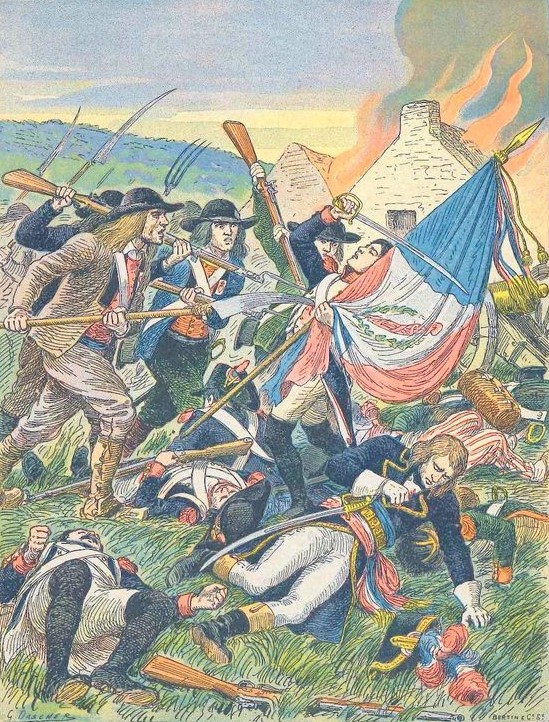
The War in the Vendée was a royalist uprising against revolutionary France in 1793–1796.

A counter-revolutionary or an anti-revolutionary is anyone who opposes or resists a revolution, particularly one who acts after a revolution has occurred, in order to try to overturn it or reverse its course, in full or in part.[1][2] The adjective "counter-revolutionary" pertains to movements that would restore the state of affairs, or the principles, that prevailed during a pre-revolutionary era.

Definition

[edit]

A counter-revolution is opposition or resistance to a revolutionary movement.[2] It can refer to attempts to defeat a revolutionary movement before it takes power, as well as attempts to restore the old regime after a successful revolution.[2]

Europe

[edit]

France

[edit]

The word "counter-revolutionary" originally referred to thinkers who opposed themselves to the 1789 French Revolution, such as Joseph de Maistre, Louis de Bonald or, later, Charles Maurras, the founder of the Action Française monarchist movement. More recently, it has been used in France to describe political movements that reject the legacy of the 1789 Revolution, which historian René Rémond has referred to as légitimistes.[citation needed]

Thus, monarchist supporters of the Ancien Régime following the French Revolution were counter-revolutionaries, as were supporters of the War in the Vendée and of the monarchies that put down the various Revolutions of 1848.[citation needed] The royalist legitimist counter-revolutionary French movement survives to this day, albeit marginally. It was active during the Révolution nationale of Vichy France, though, which has been considered by René Rémond not as a fascist regime but as a counter-revolutionary regime, whose motto was Travail, Famille, Patrie ("Work, Family, Fatherland"), which replaced the Republican motto Liberté, égalité, fraternité.[citation needed]

After the French Revolution, anti-clerical policies and the execution of King Louis XVI led to the War in the Vendée. The suppression of this counter-revolution produced what is considered by some historians to be the first modern genocide.[3][page needed] Monarchists and Catholics took up arms against the revolutionary French Republic in 1793 after the government asked that 300,000 men be conscripted into the Republican military in the levée en masse. The Vendeans also rose up against Napoleon's attempt to conscript them in 1815.[citation needed]

Germany

[edit]

The German Empire, and its predecessors the Holy Roman Empire and German Confederation, operated under counterrevolutionary principles, with these monarchical federations crushing attempted uprisings in, for example, 1848.[citation needed] After the 186771 creation of a new German realm by Prussia, chancellor Otto von Bismarck used policies favored by Socialists, such as state-sponsored healthcare, to undercut the opponents of the monarchy and protect it against revolution. Not long after the German Revolution of 1918–1919 and signing of the Treaty of Versailles, a failed coup d'état known as the Kapp Putsch was instigated by elements opposed to the Weimar Republic. It was led principally by Wolfgang Kapp and Walther von Lüttwitz.[citation needed]

During the Weimar era, the German Realm became an ideological battlefield between "red" and "white" factions. The state became bifurcated between the conservative Junker nobility which dominated the army and other high offices, including the presidency with Field Marshal Paul von Hindenburg, and the leftist revolutionaries who attempted several coups in the 1920s and later gained a base in parliament via the Communist Party of Germany, which, being internationalist in nature, opposed the extremist nationalism of the new Nazi Party.[citation needed] The Nazis, by making common cause with the counterrevolutionaries against the Communists, effected a takeover of the German state. At first under the adopted imagery of the monarchical era, and later, after the death of Hindenburg, under purely Nazi imagery.[citation needed]

The Nazis did not publicly characterise themselves as counterrevolutionaries. They condemned the traditional German forces of conservatism (e.g., Prussian monarchists, Junkers, and Roman Catholic clergy). For example, the Nazi Party march Die Fahne hoch labeled them as reactionaries (Reaktion) and counted them together with the Roter Frontkämpferbund as enemies of the Nazis.[citation needed] Nevertheless, in practice the Nazis supported many of the same ideas as the counterrevolutionary factions and virulently opposed revolutionary Marxism, using the conservative Freikorps to crush Communist uprisings, ostensibly idealising German tradition, folklore, and heroes, such as Frederick the Great.[citation needed]

The fact that the Nazis called their 1933 rise to power the national revolution showed that they understood the popular hunger for some type of radical change; nonetheless, they understood the equally powerful popular impulse toward stability and continuity, and rejected the parliamentarianism of the Weimar Constitution as merely a first step towards Bolshevism.[citation needed] Thus, for instance, they catered to reactionary tendencies among the German people by propagandistic demonstrations linking the Nazi state to the traditional Reich ("realm" or "empire") by referring to it informally as the "Drittes Reich" ("Third Empire"), implying a specious continuity between it and the historic German entities appealing to German reactionaries: the Holy Roman Empire (the "First Realm") and the German Empire (the "Second Realm"). (See also reactionary modernism.)[citation needed]

United Kingdom

[edit]

Many historians have held that the rise and spread of Methodism in the United Kingdom prevented the development of a revolution there.[4] In addition to preaching the Christian Gospel, John Wesley and his Methodist followers visited those imprisoned, as well as the poor and aged, building hospitals and dispensaries which provided free healthcare for the masses.[5] The sociologist William H. Swatos stated that "Methodist enthusiasm transformed men, summoning them to assert rational control over their own lives, while providing in its system of mutual discipline the psychological security necessary for autonomous conscience and liberal ideals to become internalized, an integrated part of the 'new men'… regenerated by Wesleyan preaching."[6]

The practice of temperance among Methodists, as well as their rejection of gambling, allowed them to eliminate secondary poverty and accumulate capital.[6] Individuals who attended Methodist chapels and Sunday schools "took into industrial and political life the qualities and talents they had developed within Methodism and used them on behalf of the working classes in non-revolutionary ways."[7]

The spread of the Methodist Church in the United Kingdom, author and professor Michael Hill states, "filled both a social and an ideological vacuum" in English society, thus "opening up the channels of social and ideological mobility… which worked against the polarization of English society into rigid social classes."[6] The historian Bernard Semmel argues that "Methodism was an antirevolutionary movement that succeeded (to the extent that it did) because it was a revolution of a radically different kind" that was capable of effecting social change on a large scale.[6]

Italy

[edit]

In Italy, after being occupied by the French army in the late 18th century, there was a counter-revolution in all the French client republics. The most well-known was the Sanfedismo, a reactionary movement led by the cardinal Fabrizio Ruffo, which overthrew the Parthenopean Republic and allowed the Bourbon dynasty to return to the throne of the Kingdom of Naples.[citation needed]

A resurgence of the phenomenon happened during the Napoleon's second Italian campaign in the early 19th century. Another example of counter-revolution was the peasants' rebellion in Southern Italy after the national unification, fomented by the Bourbon government in exile and the Papal States. The revolt, labelled pejoratively by opponents as brigandage, resulted in a bloody civil war that lasted almost ten years.[citation needed]

Austria

[edit]

In the Austrian Empire, a revolt took place against Napoleon called the Tyrolean Rebellion in 1809.[citation needed] Led by a Tyrolean innkeeper by the name of Andreas Hofer, 20,000 Tyrolean rebels fought successfully against Napoleon's troops. Hofer was ultimately betrayed by the Treaty of Schönbrunn, which led to the disbandment of his troops and was captured and executed in 1810.[citation needed]

Spain

[edit]

The Spanish Civil War was a counter-revolution. Supporters of Carlism, monarchy, and nationalism (see Falange) joined forces against the (Second) Spanish Republic in 1936.[citation needed] The counter-revolutionaries saw the Spanish Constitution of 1931 as a revolutionary document that defied Spanish culture, tradition and religion. On the Republican side, the acts of the Communist Party of Spain against the rural collectives are also sometimes considered counter-revolutionary. The Carlist cause began with the First Carlist War in 1833 and continues to the present.[citation needed]

Russia

[edit]
Red Army troops attack Kronstadt sailors in March 1921.

The White Army and its supporters who tried to defeat the Bolsheviks after the October Revolution, as well as the German politicians, police, soldiers and Freikorps who crushed the German Revolution of 1918–1919, were also counter-revolutionaries. The Bolshevik government tried to build an anti-revolutionary image for the Green armies composed of peasant rebels.[8][full citation needed] The largest peasant rebellion against Bolshevik rule occurred in 1920–21 in Tambov.[citation needed]

Hispanic America

[edit]

General Victoriano Huerta, and later the Felicistas, attempted to thwart the Mexican Revolution in the 1910s.[citation needed] In the late 1920s, Mexican Catholics took up arms against the Mexican Federal Government in what became known as the Cristero War. The President of Mexico, Plutarco Elias Calles, was elected in 1924. Calles began carrying out anti-Catholic policies which caused peaceful resistance from Catholics in 1926.[citation needed]

The counter-revolution began as a movement of peaceful resistance against the anti-clerical laws. In the summer of 1926, fighting broke out.[citation needed] The fighters known as Cristeros fought the government due to its suppression of the Church, jailing and execution of priests, formation of a nationalist schismatic church, state atheism, Socialism, Freemasonry and other harsh anti-Catholic policies.[citation needed]

The 1961 Bay of Pigs invasion into Cuba was conducted by counter-revolutionaries who hoped to overthrow the revolutionary government of Fidel Castro.[citation needed] In the 1980s, the Contra-Revolución rebels fighting to overthrow the revolutionary Sandinista government in Nicaragua. In fact, the Contras received their name precisely because they were counter-revolutionaries.[citation needed]

The Black Eagles, the AUC, and other paramilitary movements of Colombia can also be seen as counter-revolutionary. These right-wing groups are opposition to the FARC, and other left-wing guerrilla movements.[citation needed]

Some counter-revolutionaries are former revolutionaries who supported the initial overthrow of the previous regime, but came to differ with those who ultimately came to power after the revolution. For example, some of the Contras originally fought with the Sandinistas to overthrow Anastasio Somoza, and some of those who oppose Castro also opposed Batista.[citation needed]

Asia

[edit]

Japan

[edit]

During the mid-19th century Bakumatsu, especially during the Japanese civil war of 1868–1869, the pro-bakufu forces and especially the samurai, and after the period, ex-samurai, were left without money since their skills are obsolete.[citation needed] They banded up with the eastern shogunate led by the Shogun Tokugawa Yoshinobu who wished to drive foreign and especially Western European and American influence against the revolutionaries of Emperor Meiji, who sought to modernize Japan with the states of Western Europe as Japan's example. The war ended with a small number of casualties, mostly samurai. Years later, western samurai and imperial modernists engaged in the deadlier Satsuma Rebellion.[citation needed]

China

[edit]

In 1917, during the Warlord Era general Zhang Xun attempted to reverse the 1911 Revolution that brought an end to the Qing dynasty by seizing Beijing in the Manchu Restoration.[citation needed]

The anti-communist (and thus counter-revolutionary) Kuomintang party in China used the term "counter-revolutionary" to disparage the communists and other opponents of its regime. Chiang Kai-shek, the Kuomintang party leader, was the chief user of this term.[citation needed]

The reason that the nominally conservative Kuomintang used this terminology was that the party had several leftist revolutionary influences in its ideology left over from the party's beginnings.[citation needed] The Kuomintang, and Chiang Kai-shek used the words "feudal" and "counter-revolutionary" as synonyms for evil, and backwardness, and proudly proclaimed themselves to be revolutionary.[9] Chiang called the warlords feudalists, and called for feudalism and counter-revolutionaries to be stamped out by the Kuomintang.[10][11][12] Chiang showed extreme rage when he was called a warlord, because of its negative, feudal connotations.[13]

Chiang also crushed and dominated the merchants of Shanghai in 1927, seizing loans from them, with the threats of death or exile. Rich merchants, industrialists, and entrepreneurs were arrested by Chiang, who accused them of being "counter-revolutionary", and Chiang held them until they gave money to the Kuomintang. Chiang's arrests targeted rich millionaires, accusing them of communism and counter-revolutionary activities. Chiang also enforced an anti-Japanese boycott, sending his agents to sack the shops of those who sold Japanese made items and fining them. He also disregarded the internationally protected International Settlement, putting cages on its borders in which he threatened to place the merchants. The Kuomintang's alliance with the Green Gang allowed it to ignore the borders of the foreign concessions.[14]

A similar term also existed in the People's Republic of China, which includes charges such collaborating with foreign forces and inciting revolts against the government and ruling CCP. According to Article 28 of the Chinese constitution, The state maintains public order and suppresses treasonable and other counter-revolutionary activities; It penalizes actions that endanger public security and disrupt the socialist economy and other criminal activities, and punishes and reforms criminals.[15]

The term was widely used during the Cultural Revolution, in which thousands of intellectuals and government officials were denounced as "counter-revolutionaries" by the Red Guards. Following the end of the Cultural Revolution, the term was also used against Lin Biao and the Gang of Four.[citation needed]

Africa

[edit]

Egypt

[edit]

After the overthrow of Hosni Mubarak's authoritarian government in the 2011 Egyptian revolution, counter-revolutionary forces led by Abdel-Fattah Al Sisi subsequently overthrew the democratically elected president Mohamed Morsi and established an authoritarian regime under Sisi.[16][page needed]

On 1 February 2012, the biggest tragedy in Egyptian football resulted in the deaths of at least 74 people.[17] It happened exactly one year after Mubarak announced in a speech that there would be chaos if he stepped down, and on the same date when armed thugs attacked participants in the 2011 revolution. Some photographic and video evidence showed that police and security forces in the stadium were unwilling to respond to the riot. Many argue that the riot was planned as revenge against Ultras Ahlawy, the rowdy al-Ahly supporters who had taken part in the 2011 revolution and were known for their constant anti-governmental chants in football matches.[18]

In July 2013, Defense Minister Abdel-Fattah Al Sisi overthrew the president Mohamed Morsi, the first president democratically elected by the Egyptian people since the proclamation of the republic in 1953. The counter-revolution ended when Al Sisi was sworn in as Egypt's 6th president in June 2014.[citation needed]

Philosophical perspectives

[edit]

In the Laws, Plato relates a dialogue between Cleinias of Crete and an unnamed Athenian interlocutor. Part of their discourse touches on counter-revolution. Cleinias posits that a state can be considered morally superior when the virtuous citizens triumph over the unruly masses and the less virtuous classes. He asserts, "the state in which the better citizens win a victory over the mob and over the inferior classes may be truly said to be better than itself, and may be justly praised."[19]

However, the Athenian presents a hypothetical scenario wherein someone must pass judgment on a group of brothers, some of whom are behaving justly while others are acting unjustly. When questioned about the optimal resolution, Cleinias suggests that the most effective judge would not necessarily be one who imposes the just to govern over the unjust, whether by force or consent. Instead, he advocates for a judge who facilitates reconciliation by establishing a mutually agreed-upon set of laws designed to maintain harmony among them. This implies Cleinias' belief that a counter-revolutionary victory by the "better citizens" over "the mob" need not involve violence but can be attained through the enactment of just legislation.[19]

References

[edit]

Further reading

[edit]
[edit]
Revisions and contributorsEdit on WikipediaRead on Wikipedia
from Grokipedia
A counter-revolutionary denotes an actor—whether individual, group, or ideology—that opposes revolutionary upheavals by endeavoring to preserve, restore, or reinstate the pre-existing political order, social structures, or institutional frameworks disrupted by such changes. This opposition typically manifests through military resistance, political mobilization, or ideological critique, reacting to perceived threats from radical egalitarianism, property redistribution, or secular impositions that characterize many revolutions. Counter-revolutions are inherently defensive and elite-preserving in nature, coalescing diverse status quo defenders against challengers aiming to dismantle established hierarchies. Historically, counter-revolutionary movements have arisen in response to the coercive excesses of revolutions, such as mass executions and forced secularization, prompting restorations of monarchical or traditional authority. Prominent examples include the Vendée uprising during the French Revolution (1793–1796), where Catholic royalist peasants in western France waged guerrilla warfare against the Republican government's atheistic policies and Reign of Terror, symbolizing resistance to revolutionary centralization and anti-clericalism. Similarly, in the Russian Civil War (1917–1922), White Army forces comprising monarchists, liberals, and nationalists combated Bolshevik consolidation, intervening foreign powers aiding their efforts to avert the spread of communist governance amid Red Terror atrocities. These episodes underscore counter-revolutions' role in contesting revolutionary monopolies on violence and legitimacy, though successes like the Thermidorian Reaction in France often yield hybrid regimes rather than full pre-revolutionary revivals. Defining characteristics encompass a fusion of reactionary and restorative impulses, frequently rooted in defense of property rights, religious observance, and decentralized governance against utopian central planning that empirically correlates with economic disruption and authoritarian consolidation. Controversies surround portrayals of counter-revolutionaries as mere reactionaries, yet causal analysis reveals their emergence as rational responses to revolutionary pathologies, including hyperinflation, famine, and purges that undermine the very liberties revolutions ostensibly champion. While mainstream academic narratives, influenced by progressive biases, may underemphasize these dynamics, primary accounts and econometric studies of revolutionary outcomes affirm the stabilizing intent behind many counter-revolutionary endeavors.

Conceptual Foundations

Definition and Etymology

A counter-revolutionary refers to an individual, group, ideology, or movement that opposes or seeks to reverse the political, social, or institutional changes initiated by a revolution, often with the aim of restoring pre-revolutionary structures or halting further transformative shifts. This opposition can manifest as armed resistance, intellectual critique, or political organization against revolutionary governments or doctrines, as seen in efforts to counteract the establishment of new regimes born from prior upheavals. The concept emphasizes reactive forces rather than proactive revolutionary initiatives, distinguishing it from mere conservatism by its direct confrontation with ongoing or recent revolutionary dynamics. The term "counter-revolutionary" combines the prefix "counter-," denoting opposition or reversal, with "revolutionary," derived from "revolution" entering English in the 14th century but gaining modern political connotations during the 17th and 18th centuries. It emerged specifically amid the French Revolution of 1789, where it was employed—often pejoratively by revolutionaries—to describe adversaries like émigré nobles, royalist insurgents, and thinkers such as Joseph de Maistre and Louis de Bonald who rejected egalitarian and secular reforms in favor of monarchical and traditional orders. The noun "counter-revolution" first appears in English records around 1793, as used by American diplomat Gouverneur Morris in reference to anti-Jacobin efforts, while the adjectival form "counter-revolutionary" dates to 1799. Subsequent usages, such as by Bolsheviks against White forces post-1917, extended the term to denote perceived threats to proletarian transformations, illustrating its adaptability across ideological contexts while retaining a core meaning of restorative antagonism. Counter-revolutionaries oppose revolutions as discrete events or processes, typically seeking to halt, reverse, or mitigate their transformative effects through targeted resistance, which may include military, political, or ideological campaigns to reinstate pre-revolutionary structures such as monarchies or traditional hierarchies. This specificity contrasts with conservatism, which prioritizes the organic preservation of existing institutions via incremental change and pragmatic adaptation, without presupposing an acute revolutionary rupture; conservatism can coexist with moderate reforms and does not inherently demand the aggressive restoration of a prior status quo. For instance, while Edmund Burke's critique of the French Revolution embodied counter-revolutionary principles by advocating defense of constituted authority against radical egalitarianism, his broader philosophy aligned with conserving Britain's constitutional monarchy through evolutionary means rather than wholesale reversal. The counter-revolutionary label further diverges from "reactionary," a term denoting a general aversion to societal progress or innovation, often rooted in nostalgia for an idealized past but not tethered to countering a specific revolutionary dynamic. Reactionaries may advocate regressive policies in stable contexts, such as opposing industrialization or democratic expansions absent any upheaval, whereas counter-revolutionaries mobilize reactively to revolutionary violence or ideology, as seen in the White Army's armed opposition to Bolshevik rule from 1917 to 1923, aimed at dismantling the Soviet state rather than merely critiquing modernism. This distinction underscores that counter-revolution entails causal opposition to revolution's mechanisms—e.g., mass mobilization, expropriation, or terror—rather than abstract traditionalism. Unlike restorationism, which narrowly focuses on reinstating particular deposed elements like a royal dynasty (e.g., the Bourbon restoration in France post-Napoleon in 1814), counter-revolutionary efforts encompass broader coalitions against revolutionary principles, potentially including republicans or reformers who reject utopian radicalism without endorsing absolutism. Counter-insurgency, by contrast, refers primarily to military tactics suppressing rebel forces within an established regime, lacking the ideological commitment to undoing revolutionary ideology itself, as in colonial suppressions of independence movements that did not fully invert prior governance. These boundaries highlight counter-revolution's contextual emergence from revolutionary threats, privileging empirical responses over ideological purity.

Theoretical Perspectives

Conservative and Traditionalist Views

Conservative thinkers, exemplified by Edmund Burke, conceptualized counter-revolutionary action as a prudent defense of organic social structures against the perils of abstract rationalism and radical upheaval. In his Reflections on the Revolution in France, published in November 1790, Burke critiqued the French revolutionaries for prioritizing speculative "rights of man" over inherited customs and institutions, arguing that such innovations inevitably unleash chaos by severing ties to historical precedent and practical wisdom accumulated through generations. He advocated incremental reform within existing frameworks, warning that revolutions erode the "latent wisdom" embedded in traditions, which serve as bulwarks against human folly and factionalism. This perspective posits counter-revolution not as mere reaction but as fidelity to causal realities of human nature, where untested schemes ignore the interdependence of moral, legal, and economic orders. Traditionalist counter-revolutionary thought, as articulated by Joseph de Maistre, extends this skepticism into a more absolutist affirmation of divine hierarchy and authority. Writing in exile after the French Revolution upended his Savoyard homeland in 1792, Maistre viewed the upheaval as a providential chastisement for Enlightenment hubris and secular individualism, necessitating a restoration of throne-and-altar symbiosis to impose order on inherently sinful humanity. In works like Considerations on France (1797), he rejected constitutional tinkering in favor of monarchical absolutism sanctioned by providence, asserting that true stability arises from unyielding sovereignty rather than popular consent or rational design, which he deemed illusory experiments doomed to violence. Maistre's emphasis on executioners as instruments of divine justice underscored a causal realism: social cohesion demands coercive enforcement of transcendent norms, lest atomized liberty devolve into anarchy. These views converge in privileging empirical continuity over utopian blueprints, with Burke's evolutionary prudence complementing Maistre's restorative absolutism, both countering revolutionary ideologies that abstract from concrete historical contingencies. Subsequent traditionalists, drawing on this foundation, have maintained that counter-revolutionary efforts safeguard civilizational inheritance—family, faith, and polity—against egalitarian leveling, as evidenced in critiques of post-1789 egalitarianism's empirical failures, from Jacobin terror to Bolshevik purges.

Critiques of Revolutionary Utopianism

Counter-revolutionary thinkers contend that revolutionary utopianism, by positing an ideal society achievable through radical restructuring, fundamentally misapprehends human nature's inherent limitations and the organic evolution of social institutions. Edmund Burke, in his 1790 treatise Reflections on the Revolution in France, argued that revolutionaries' abstract rationalism—rooted in Enlightenment abstractions like the "rights of man"—dismisses the prescriptive wisdom embedded in traditions, customs, and inherited practices that have sustained societies over generations. This approach, Burke warned, invites chaos by presuming human perfectibility and the capacity for top-down societal redesign, inevitably yielding not liberty but unchecked power concentrated in ideologues who enforce uniformity through coercion. Such critiques emphasize the causal link between utopian blueprints and historical atrocities, as seen in the French Revolution's devolution into the Reign of Terror from September 1793 to July 1794, where the Jacobin-dominated Committee of Public Safety orchestrated mass executions to purge perceived enemies of the egalitarian ideal. Joseph de Maistre, a Savoyard counter-revolutionary, extended this analysis in his 1797 Considerations on France, portraying the Revolution not merely as a political error but as a metaphysical rebellion against divine order, where the rejection of monarchy and religion—anchors of authority—unleashes sacrificial violence inherent to human societies stripped of restraint. De Maistre insisted that sovereignty cannot derive from rational contracts or popular assemblies, as these ignore the irrational, hierarchical impulses that demand strong, transcendent governance to avert anarchy. Twentieth-century applications of these arguments highlight communism's utopian promises of classless harmony, which counter-revolutionaries attribute to similar flaws: the denial of private property, incentives, and dispersed knowledge, leading to economic collapse and authoritarian consolidation. Burkean heirs critique Marxist revolutions for their anti-institutional bias, evident in the Bolshevik suppression of dissent post-1917, where Lenin's vanguard party supplanted organic civil society with state monopoly, paving the way for Stalinist purges and engineered famines that claimed tens of millions of lives. Empirical outcomes, such as the Soviet Union's repeated harvest failures under collectivization—culminating in the 1932–1933 Holodomor—demonstrate how utopian egalitarianism disrupts causal mechanisms of production and accountability, fostering not abundance but scarcity and terror. These patterns underscore a recurring truth: revolutions that prioritize ideological purity over pragmatic adaptation erode the very foundations they seek to redeem, substituting inherited liberty with engineered servitude.

Historical Instances

Europe

Counter-revolutionary movements in Europe arose as organized resistances to radical upheavals, particularly the French Revolution of 1789 and Bolshevik Revolution of 1917, often defending monarchical, religious, and traditional social orders against egalitarian and secular ideologies. These efforts typically involved coalitions of aristocrats, clergy, peasants, and military officers opposing perceived tyrannical excesses, such as mass executions, property seizures, and forced secularization. In the 18th and 19th centuries, they manifested in armed uprisings and alliances among conservative powers, while 20th-century instances countered communist expansions following World War I. The paradigmatic case occurred during the French Revolution, where rural populations in western provinces rebelled against republican policies. The Vendée uprising, erupting on March 4, 1793, in Cholet after the imposition of mass conscription levies in February, drew on Catholic devotion and loyalty to the Bourbon monarchy, forming the "Catholic and Royal Army" that fielded up to 80,000 fighters at its peak. Republican reprisals, including General Turreau's "infernal columns" conducting scorched-earth operations from January 1794, resulted in 117,000 to 250,000 deaths, predominantly civilians, through executions, drownings, and village burnings. This conflict, alongside parallel revolts like the Chouannerie in Brittany, highlighted counter-revolutionary reliance on guerrilla tactics and foreign aid, though ultimately suppressed by 1796. In Eastern Europe, the White Movement during the Russian Civil War (1917–1922) embodied anti-Bolshevik counter-revolution, uniting monarchists, liberals, socialists, and nationalists under leaders like Admiral Kolchak in Siberia and General Denikin in the south. Comprising diverse forces totaling over 250,000 troops by 1919, the Whites sought to dismantle Soviet power amid Bolshevik Red Terror, which claimed millions of lives through executions and famines. Despite initial advances, such as Denikin's capture of Orel in October 1919, internal divisions, supply shortages, and Red Army mobilization under Trotsky led to defeat by late 1920, with remnants evacuating via Crimea in November 1920. Beyond these, counter-revolutions followed the 1848 liberal-nationalist revolts, where restored monarchies in Austria, Prussia, and Italy quashed uprisings through military intervention, as in the Austrian suppression of Hungarian independence under Radetzky's forces by August 1849. Post-1917, conservative victories occurred in Finland's Civil War (January–May 1918), where "Whites" under Mannerheim defeated Red Guards, killing 8,000–12,000, and in Poland's defense against Soviet invasion (1919–1921), halting Bolshevik expansion westward. These cases underscored counter-revolutionary success when backed by unified command, international support, and exploitation of revolutionary overreach.

France

Counter-revolutionary activity in France primarily manifested as resistance to the French Revolution from 1789 onward, encompassing both internal uprisings by royalist and Catholic elements and external efforts by émigrés seeking foreign aid to restore the monarchy. Approximately 100,000 to 150,000 individuals, predominantly supporters of the old regime including nobles and clergy, emigrated from France during the 1790s, with no more than a quarter being nobility; these émigrés formed armed groups such as the Armée des Émigrés near the northeastern frontier and lobbied European monarchs for intervention against the Republic. The most prominent internal counter-revolutionary movement was the War in the Vendée, a peasant-led uprising in western France that erupted on March 10, 1793, triggered by opposition to mass conscription decrees, the Civil Constitution of the Clergy, and broader dechristianization policies. Royalist and devoutly Catholic Vendéens, organized under leaders like François de Charette and Henri de La Rochejaquelein, waged guerrilla warfare against Republican forces, controlling much of the region by mid-1793 before suffering defeats in late 1793 battles such as Le Mans (December 12, where at least 15,000 rebels died) and Savenay (December 23). The conflict persisted intermittently until July 16, 1796, with Republican "Infernal Columns" under General Louis Marie Turreau conducting scorched-earth campaigns from January to May 1794, massacring 20,000 to 50,000 Vendéan civilians; total deaths are estimated at 170,000 to 200,000 Vendéens, representing about 20% of the local population, alongside tens of thousands of Republican soldiers. Parallel to the Vendée, the Chouannerie comprised royalist guerrilla actions in Brittany and parts of Normandy, involving smugglers, salt dealers, and peasants known as Chouans who resisted Republican authority through hit-and-run tactics starting in 1794. Named after the owl-like calls used for signaling (from "chouan," meaning screech owl), these bands disrupted supply lines and targeted officials, allying sporadically with Vendéan forces and foreign invaders, such as during the failed British-backed landing at Quiberon Bay in July 1795. The Chouannerie subsided after 1796 but flared again during the Hundred Days in 1815, reflecting enduring counter-revolutionary sentiment in the west rooted in loyalty to the Bourbon monarchy and traditional Catholic practices.

Russia

The primary counter-revolutionary effort in Russia manifested during the Civil War (1918–1922), where anti-Bolshevik forces known as the Whites opposed the Bolshevik regime established after the October Revolution on November 7, 1917 (October 25 Old Style). These forces, comprising monarchists, liberals, conservatives, and moderate socialists, sought to dismantle Bolshevik rule, restore order, and prevent the imposition of communist governance, viewing the revolution as a destructive upheaval that undermined traditional institutions and property rights. Initial White units formed in the Don region in November 1917 under generals like Lavr Kornilov and Mikhail Alekseev, who organized the Volunteer Army amid the chaos of Bolshevik consolidation. White armies operated across multiple fronts, lacking centralized command but achieving temporary territorial gains through military offensives. In Siberia, Admiral Alexander Kolchak seized control in Omsk on November 18, 1918, proclaiming himself Supreme Ruler and advancing westward to capture Perm by December 1918, controlling over 1 million square kilometers at peak. In southern Russia, General Anton Denikin's Volunteer Army pushed northward from the Caucasus, reaching Orel—mere 400 kilometers from Moscow—by October 1919, while General Nikolai Yudenich threatened Petrograd from the northwest. General Pyotr Wrangel later reorganized remnants in Crimea, launching a 1920 offensive that briefly recaptured parts of Ukraine before evacuation in November 1920. The Whites' ideology emphasized anti-Bolshevism and patriotism over rigid dogma, with many leaders favoring a constituent assembly or constitutional monarchy, reflecting broader Russian preferences for moderate reforms evident in pre-revolutionary elections. Defeat stemmed from internal disunity, logistical overextension, and the Bolsheviks' advantages in manpower, propaganda, and control of core industrial regions. White factions failed to coordinate effectively, with mutual suspicions hindering alliances; for instance, Kolchak's forces clashed with Siberian autonomists, diluting efforts. Limited foreign intervention—British, French, and American supplies to Whites totaled under 1 million rifles and sporadic troops—proved insufficient against Bolshevik mobilization, which fielded up to 5 million Red Army soldiers by 1920 through conscription and ideological appeals. The Whites peaked at around 1 million troops but suffered from desertions and reliance on peripheral bases, enabling Bolshevik counteroffensives that reclaimed key areas by late 1919. Battle deaths numbered approximately 325,000 for Whites and 475,000 for Reds, but total war-related losses, including famine and disease, reached 7–10 million, predominantly civilians. Later episodes included the Kronstadt Rebellion in March 1921, where sailors—initial Bolshevik supporters—demanded free soviets and an end to one-party rule under War Communism, prompting a Red Army assault that killed over 1,000 rebels. This suppression highlighted ongoing counter-revolutionary undercurrents but solidified Bolshevik control, transitioning to the New Economic Policy amid exhaustion. White émigrés preserved opposition abroad, influencing anti-Soviet thought, though domestic resistance waned as the regime entrenched through terror and economic coercion.

Other European Cases

In Spain, the Carlist Wars (1833–1840, 1846–1849, and 1872–1876) constituted a prolonged counter-revolutionary struggle against liberal constitutionalism and the centralizing reforms of the Isabelline regime. Carlists, loyal to the pretender Don Carlos and his descendants, sought to uphold absolute monarchy, traditional Catholic integralism, and regional privileges known as fueros, particularly in the Basque provinces and Navarre, where rural conservatives formed guerrilla armies numbering up to 50,000 at their peak in the First Carlist War. These conflicts pitted traditionalist forces against government troops backed by British and French liberal interests, resulting in over 100,000 deaths across the wars and ultimately failing to restore the ancien régime but highlighting deep societal divisions between revolutionary liberalism and counter-revolutionary agrarianism. Portugal experienced analogous counter-revolutionary resistance during the Liberal Wars (1828–1834), where absolutists supporting Dom Miguel's claim to the throne opposed constitutional liberals aligned with Queen Maria II and foreign interventions. Miguelist forces, drawing on clerical and rural support, aimed to reverse the 1820 liberal constitution and Napoleonic-era influences, controlling much of the north and center before defeat by a liberal coalition aided by British naval power at naval battles like Cape St. Vincent on July 5, 1833. The absolutist defeat entrenched constitutional monarchy but preserved underground traditionalist networks that resurfaced in later revolts, such as the 1846 Maria da Fonte uprising against liberal fiscal policies. The Revolutions of 1848 across Central and Southern Europe elicited swift counter-revolutionary consolidations by monarchical authorities. In the Austrian Empire, Habsburg loyalists, after initial retreats like Metternich's flight on March 13, 1848, reorganized with Prussian assistance to quash uprisings in Vienna and Bohemia, while Tsar Nicholas I dispatched 200,000 Russian troops to crush the Hungarian independence war by August 1849, executing leaders like Lajos Kossuth's associates. In Italy, papal and Neapolitan forces, reinforced by Austrian armies, restored absolutism in the Kingdom of the Two Sicilies following the Five Days of Milan (March 18–22, 1848), suppressing carbonari-style liberal-nationalist revolts. Prussian conservatives similarly revoked concessions after the June 1848 Berlin barricades, imposing martial law and dissolving the Frankfurt Parliament precursors, thereby preserving the post-Napoleonic order against demands for unification and parliamentary rule. These responses, involving over 500,000 troops continent-wide, underscored the resilience of dynastic alliances in thwarting revolutionary fragmentation.

The Americas

In the Americas, counter-revolutionary forces emerged prominently during the era of independence struggles against European colonial rule, seeking to preserve monarchical authority and imperial structures amid revolutionary bids for republican self-governance. These efforts paralleled European counter-revolutions by emphasizing loyalty to the crown, defense of traditional hierarchies, and resistance to radical political upheaval, often drawing support from colonial elites, clergy, and indigenous groups wary of post-independence instability. While ultimately unsuccessful in halting independence, royalist and loyalist campaigns delayed fragmentation and shaped regional political legacies, with fighters numbering in the tens of thousands across conflicts spanning 1775 to 1825.

Hispanic America

Royalist forces in Hispanic America, active from 1810 to 1825, opposed independence movements inspired by Enlightenment ideals and Napoleonic disruptions in Spain, aiming to uphold the Spanish Bourbon monarchy's unitary authority against creole-led insurgencies. Composed of peninsular Spaniards, American-born loyalists, military garrisons, and coerced indigenous levies, royalists controlled key viceregal strongholds like Lima and Mexico City until the mid-1820s, employing scorched-earth tactics and divide-and-rule strategies to fracture patriot coalitions. In New Spain (Mexico), Viceroy Félix María Calleja's counterinsurgency from 1810 to 1813 suppressed initial uprisings led by Miguel Hidalgo, executing thousands and reclaiming central territories through fortified presidios and intelligence networks, though guerrilla warfare persisted. In Peru, royalist armies under José de la Serna held the viceroyalty until 1824, leveraging Andean terrain and alliances with highland communities fearful of coastal creole dominance to repel Simón Bolívar's invasions. These campaigns, backed by Spanish reinforcements totaling over 20,000 troops by 1815, inflicted heavy casualties—estimated at 500,000 dead across the wars—but faltered due to metropolitan collapse following the 1820 liberal pronunciamiento in Spain, which alienated ultraroyalist officers. Royalist defeat entrenched caudillo rule but preserved monarchical sympathies in pockets, influencing later conservative restorations.

North America

In North America, British Loyalists constituted the primary counter-revolutionary bloc during the American War of Independence (1775–1783), rejecting colonial secession in favor of parliamentary reform within the British Empire and opposing republican radicalism as a threat to social order and property rights. Estimated at 15–20% of the white population (roughly 400,000–500,000 individuals), Loyalists spanned classes—from urban merchants and Anglican clergy to rural tenants and enslaved people promised freedom by British proclamations—but concentrated in New York, Pennsylvania, and the Carolinas, where they formed provincial regiments like the Queen's Rangers, totaling about 50,000 combatants by 1780. Leaders such as William Franklin (son of Benjamin) coordinated with Crown forces, using guerrilla raids and loyalist militias to contest patriot control, as in the 1776–1777 New York campaign where they aided British occupation of the city. Post-Yorktown (1781), reprisals including property confiscations under state treason acts displaced 60,000–80,000 Loyalists, with 40,000–50,000 resettling in British Canada as United Empire Loyalists, fortifying anti-republican sentiments there. Their ideological stance, rooted in constitutionalism rather than absolutism, critiqued independence as precipitate anarchy, influencing Canadian federalism's emphasis on crown loyalty over democratic fervor.

Hispanic America

In Hispanic America, counter-revolutionary efforts first manifested during the wars of independence from Spain (1810–1825), where royalist forces loyal to the Bourbon monarchy resisted creole-led separatist movements inspired by Enlightenment ideals and the Napoleonic invasion of Spain. These royalists, comprising Spanish peninsulares, American-born loyalists, indigenous groups, and enslaved people promised freedom for service, mounted prolonged defenses in strongholds like Peru and Upper Peru (modern Bolivia), delaying independence until decisive battles such as Ayacucho in 1824, where Spanish viceregal forces numbering around 9,300 were defeated by patriot armies of similar size under Antonio José de Sucre. Royalist commanders like José de la Serna and Pablo Morillo employed scorched-earth tactics and guerrilla warfare, preserving monarchical authority in regions controlling key silver mines that funded Spain's war efforts, though ultimate failure stemmed from logistical overextension and declining metropolitan support amid Ferdinand VII's absolutist restoration. A prominent 20th-century example was the Cristero War (1926–1929) in Mexico, where Catholic peasants and clergy rebelled against the post-revolutionary government's enforcement of Article 130 of the 1917 Constitution, which mandated secular education, restricted clerical numbers to 4,500 nationwide, and closed religious schools, prompting an estimated 90,000 Cristeros to take up arms under leaders like Enrique Gorostieta. This uprising, framed by participants as defense of traditional Catholic social order against revolutionary anticlericalism, resulted in 250,000 deaths from combat, famine, and reprisals, with federal forces employing scorched-earth policies and U.S.-brokered mediation leading to a 1929 truce that partially restored church rights but left underlying tensions unresolved. Historians characterize it as counter-revolutionary due to its aim to rollback revolutionary secular reforms, contrasting with the Mexican Revolution's broader agrarian and anti-elite thrusts. Later instances included military interventions against perceived Marxist threats, such as the 1973 Chilean coup led by Augusto Pinochet, which ousted socialist President Salvador Allende amid economic chaos (inflation exceeding 300% in 1972) and nationalizations, installing a junta that ruled until 1990 and implemented neoliberal reforms while suppressing leftists through operations causing over 3,000 documented deaths or disappearances. In Nicaragua, the Contras—formed in 1981 from ex-Somoza National Guard remnants and anti-Sandinista dissidents—waged insurgency against the FSLN regime post-1979 revolution, receiving U.S. aid totaling $100 million by 1984 despite congressional restrictions, aiming to restore pre-revolutionary property rights and curb Soviet-Cuban influence until the 1990 elections. These actions, often backed by U.S. security cooperation, reflected broader Cold War dynamics prioritizing anti-communist stability over revolutionary redistribution, though they drew criticism for human rights abuses and reliance on authoritarian pretexts.

North America

In North America, counter-revolutionary resistance manifested primarily through the Loyalists during the American War of Independence (1775–1783), who opposed the colonial rebellion against British authority and sought to preserve the established monarchical order. Constituting an estimated 15 to 20 percent of the white population, Loyalists included diverse groups such as Anglican clergy, wealthy merchants, and frontier settlers who viewed the revolutionary push for independence as a dangerous rupture with legitimate governance and traditional hierarchies. Their opposition stemmed from principled adherence to parliamentary sovereignty, fear of mob rule, and economic ties to the Empire, rather than mere timidity, as evidenced by their active collaboration with British forces, including forming provincial regiments that numbered over 50,000 men by war's end. Loyalists endured severe reprisals from Patriot authorities, including loyalty oaths, property seizures under state confiscation acts affecting tens of thousands of estates valued at millions in colonial currency, and vigilante violence that displaced or imprisoned up to 100,000 individuals. Following the British defeat in the Treaty of Paris on September 3, 1783, between 60,000 and 80,000 Loyalists emigrated, with many resettling in British North America, particularly Nova Scotia, New Brunswick, and Upper Canada (present-day Ontario). This exodus bolstered counter-revolutionary sentiments in Canada, where the influx of United Empire Loyalists—honored with that title by Governor Guy Carleton in 1789—reinforced monarchical loyalty and contributed to the Dominion's evolution as a constitutional counterpoint to the republican United States, emphasizing gradual reform over radical upheaval. In Mexico, counter-revolutionary forces emerged in response to the secularizing excesses of the post-revolutionary regime. The Cristero Rebellion (1926–1929), involving up to 50,000 Catholic insurgents primarily in west-central states like Jalisco and Michoacán, opposed President Plutarco Elías Calles's enforcement of 1917 Constitution articles mandating strict church-state separation, including clergy registration and suppression of religious education. Framed as a defense of traditional Catholic social order against revolutionary anticlericalism, the movement's slogan "¡Viva Cristo Rey!" underscored its restorative aims, resulting in an estimated 90,000 deaths before a U.S.-brokered truce in June 1929 restored limited religious freedoms. While the Mexican Revolution (1910–1920) itself featured conservative factions like the Felicistas who sought to reinstate Porfirio Díaz's dictatorship, the Cristeros represented a grassroots counter-reaction prioritizing empirical preservation of pre-revolutionary cultural institutions over utopian state secularism.

Asia

In Asia, counter-revolutionary efforts have typically arisen in response to upheavals challenging established monarchies, feudal structures, or emerging radical ideologies, often aiming to preserve traditional hierarchies or prevent communist dominance. These movements frequently involved military actions by loyalist factions or conservative elites, though they rarely succeeded in fully reversing changes due to the momentum of modernization or ideological fervor. Empirical records show high casualties and short durations for many such instances, underscoring the challenges of restoring prior orders amid rapid social transformations.

China

Following the Xinhai Revolution of 1911, which ended the Qing dynasty and established the Republic of China, monarchist elements attempted restorations to counter republican reforms. On July 1, 1917, General Zhang Xun, a Qing loyalist retaining his traditional queue hairstyle, led 4,000 troops into Beijing and proclaimed the restoration of the abdicated emperor Puyi, reinstating monarchical rule and dissolving the republican parliament. This Manchu Restoration, supported by some conservative warlords, sought to revive imperial authority but collapsed after 12 days when republican forces, including those under Duan Qirui, bombarded the Forbidden City and defeated Zhang's forces on July 12, 1917, resulting in over 1,000 deaths. During the subsequent Republican era, the Kuomintang (KMT) under Chiang Kai-shek pursued anti-communist campaigns to suppress Bolshevik-influenced revolutionaries within China. In April 1927, the Shanghai Massacre saw KMT forces execute an estimated 5,000-10,000 communists and leftists allied with the Chinese Communist Party (CCP), purging them from united front alliances and consolidating nationalist control amid the Northern Expedition. This action, rooted in KMT legislation from 1928 criminalizing communist activities as threats to national unity, framed radicals as counter-revolutionaries to the republican order, though CCP narratives later inverted the label against the KMT. The ensuing Chinese Civil War (1927-1949) pitted KMT armies, backed by traditional elites and landlords, against CCP forces, with KMT efforts peaking in encirclement campaigns that killed or displaced hundreds of thousands of communists by 1934, delaying but failing to prevent the 1949 communist victory.

Japan and Other Cases

In Japan, the Meiji Restoration of 1868 dismantled the Tokugawa shogunate and feudal samurai privileges, prompting counter-revolutionary samurai uprisings to resist centralization and Westernization. The Satsuma Rebellion (1877), led by Saigo Takamori, mobilized 40,000 disaffected samurai from Satsuma domain against the imperial government's abolition of stipends and conscript army reforms, invoking traditional bushido values and seeking to curtail emperor-driven modernization. Government forces, equipped with modern rifles and artillery, defeated the rebels at the Battle of Shiroyama on September 24, 1877, where Saigo died; total casualties exceeded 20,000, marking the effective end of samurai military resistance. Other Asian cases include Indonesia's 1965-1966 counter-revolution against communist influence. Following the September 30 Movement—an abortive coup allegedly involving Indonesian Communist Party (PKI) elements that killed six senior generals—Major General Suharto assumed command on October 1, 1965, and orchestrated a military purge framing the PKI as traitors. Army-led militias and civilian groups conducted mass killings from October 1965 to March 1966, targeting an estimated 500,000 to 1 million PKI members, sympathizers, and ethnic Chinese, dismantling the world's third-largest communist party and installing Suharto's anti-communist New Order regime by 1967. This prevented a potential leftist takeover amid Sukarno's Guided Democracy, with U.S. intelligence support aiding the operation through communications intercepts and suspect lists.

China

In Chinese history, counter-revolutionary actions prominently manifested in the Qing dynasty's suppression of the Taiping Rebellion (1850–1864), a radical millenarian uprising led by Hong Xiuquan that sought to overthrow the imperial order and establish a theocratic "Heavenly Kingdom" with egalitarian land reforms and iconoclastic attacks on Confucianism. Qing officials, facing a weakened central army, devolved military authority to provincial leaders like Zeng Guofan, a Confucian scholar-official who raised the Xiang Army of 120,000–300,000 troops from Hunan gentry and peasants loyal to traditional hierarchies. Zeng's forces recaptured Nanjing, the Taiping capital, on July 19, 1864, after a siege that ended the rebellion, which had caused an estimated 20–30 million deaths through combat, famine, and disease; this effort preserved the dynasty for another half-century by reinforcing Confucian restoration over revolutionary upheaval. A later instance occurred during the Chinese Civil War's decisive phase (1945–1949), where Kuomintang (KMT) forces under Chiang Kai-shek resisted the Chinese Communist Party's (CCP) revolutionary bid for power, framing their defense as safeguarding republican nationalism against Marxist-Leninist totalitarianism. The KMT, controlling major cities and backed by U.S. aid exceeding $2 billion in loans and equipment, mobilized over 4 million troops but faltered due to hyperinflation (reaching 5,000% annually by 1948), internal corruption, and logistical failures, enabling CCP encirclements like the Huaihai Campaign (November 1948–January 1949), where 550,000 KMT soldiers were defeated or defected. This counter-revolutionary stand collapsed with the CCP's capture of Beijing in January 1949 and Chiang's retreat to Taiwan, allowing Mao Zedong to proclaim the People's Republic on October 1, 1949. Post-1949, scattered KMT remnants and local anti-communist militias waged guerrilla resistance in southern and southwestern China, particularly in Guangxi and Yunnan provinces, hoping for external intervention amid the Korean War. These insurgents, numbering tens of thousands at peak, disrupted CCP consolidation until the regime's "Campaign to Suppress Counterrevolutionaries" (1950–1953) deployed over 1 million troops, resulting in 700,000–2 million executions or imprisonments of perceived threats, including former KMT personnel and landlords; by 1953, organized resistance was eradicated, stabilizing CCP rule.

Japan and Other Cases

The Satsuma Rebellion, occurring from January 29 to September 24, 1877, constituted a major counter-revolutionary challenge to the Meiji government's post-Restoration reforms, which had dismantled samurai stipends, privileges, and the feudal domain system in favor of centralized modernization and a conscript army. Led by Saigō Takamori, a former Satsuma domain leader who had initially supported the 1868 Restoration but grew disillusioned with its erosion of warrior status, the uprising mobilized around 40,000 rebels, primarily disaffected samurai and local supporters, who sought to reverse these changes and restore traditional hierarchies. Initial successes included capturing key positions in Kagoshima, but the imperial army's superior numbers, artillery, and rifle-armed conscripts—totaling over 300,000 mobilized—overwhelmed the rebels, culminating in the Battle of Shiroyama where Saigō and roughly 500 survivors were annihilated. The rebellion inflicted heavy losses on government forces, with approximately 6,000 imperial troops killed and 10,000 wounded, while rebel casualties exceeded 20,000 dead, underscoring the technological disparity between feudal sword-and-lance tactics and modern warfare. This defeat effectively eliminated organized samurai resistance, solidifying the Meiji oligarchy's authority and paving the way for Japan's industrialization without further large-scale feudal backlash, though it highlighted underlying tensions over rapid societal upheaval. In Vietnam, the Cần Vương (Aid the King) movement from 1885 to 1896 exemplified counter-revolutionary resistance to French colonial imposition, which disrupted the Nguyen dynasty's monarchical order through conquest and administrative overhaul beginning in the 1860s. Sparked by Emperor Hàm Nghi's edict urging loyalty to the throne and expulsion of the French, the movement united scholar-gentry, royalty, and peasants under regional leaders like Phan Đình Phùng to restore imperial sovereignty and traditional Confucian governance against Western legal and economic impositions. Lacking centralized coordination, it relied on guerrilla tactics across Annam and Tonkin, achieving sporadic victories but ultimately succumbing to French superior firepower and divide-and-rule strategies by 1896, with leaders either captured or killed. Other Asian instances included conservative uprisings in Korea against late Joseon reforms influenced by Japanese pressures, such as the 1894 Donghak Peasant Revolution's suppression by government forces allied with imperial powers, which preserved monarchical structures amid revolutionary peasant demands for land redistribution and anti-foreign purges. These efforts, while fragmented, reflected broader patterns of traditionalist backlash against external-driven modernization in the region prior to 20th-century upheavals.

Africa and Middle East

In the Africa and Middle East region, counter-revolutionary actions have often involved military or authoritarian interventions to halt Islamist electoral gains or post-uprising power shifts, prioritizing regime stability over democratic experimentation. These efforts, particularly in North Africa, responded to perceived threats from movements seeking theocratic governance, resulting in annulled elections, coups, and civil conflicts that preserved secular or military-dominated orders. Empirical data from the period show high civilian casualties and economic disruptions, with regimes citing security imperatives to justify suppression, though critics argue these measures entrenched authoritarianism without addressing underlying grievances.

Egypt

The 2013 ouster of President Mohamed Morsi exemplified a counter-revolutionary pivot in Egypt. Morsi, representing the Muslim Brotherhood, assumed office on June 30, 2012, following the 2011 revolution that ended Hosni Mubarak's 30-year rule; his government faced accusations of consolidating Islamist power, including a November 2012 constitutional referendum that secured 63.8% approval amid low turnout and opposition boycotts. By June 2013, the Tamarod petition campaign gathered over 22 million signatures demanding Morsi's resignation, culminating in protests estimated at 14 million participants on June 30. On July 3, 2013, Defense Minister Abdel Fattah el-Sisi announced Morsi's removal, citing failure to meet popular demands, with the military suspending the constitution and appointing Adly Mansour as interim president. This coup, backed by secular opposition, the National Salvation Front, and Coptic Church leaders but decried by the Brotherhood as illegitimate, reversed the revolutionary transition by reinstating military oversight, leading to el-Sisi's election in May 2014 with 96.9% of the vote after suppressing Islamist dissent, including the Rabaa massacre on August 14, 2013, where security forces killed at least 817 protesters. Analysts describe it as a counter-revolution due to its restoration of pre-2011 power dynamics, though supporters framed it as corrective against Brotherhood overreach; economic indicators post-coup showed initial stabilization, with GDP growth rising from 2.2% in 2013 to 4.1% in 2014, but at the cost of over 60,000 arrests by 2019.

Other Instances

In Algeria, the military's 1992 intervention countered potential Islamist revolution after the Islamic Salvation Front (FIS) secured 188 of 231 seats in the December 26, 1991, parliamentary election first round, positioning it to gain a constitutional majority. On January 11, 1992, the High State Council, backed by the army, annulled results, dissolved the parliament, and imposed emergency rule, sparking the Algerian Civil War (1991–2002) with an estimated 150,000–200,000 deaths from insurgent attacks and state reprisals. This preserved the secular National Liberation Front's dominance established post-1962 independence, averting FIS-led governance that promised Sharia implementation; human rights reports documented 7,000–20,000 disappearances under military counterinsurgency, yet the regime's survival stabilized oil-dependent economy, with exports reaching $20 billion annually by 2000. Other cases include Syria's response to the 2011 Arab Spring, where Bashar al-Assad's Ba'athist regime deployed military force against protesters demanding democratic reforms, escalating into civil war by 2012; government forces, with Russian and Iranian support, reclaimed territory from 2015, reducing opposition-held areas from 50% in 2014 to under 10% by 2020, thereby countering revolutionary fragmentation while sustaining pre-uprising authoritarian control amid 500,000+ deaths. In Bahrain, the Al Khalifa monarchy, aided by Saudi-led Gulf Cooperation Council troops deploying 1,200 personnel on March 14, 2011, suppressed Shia-led protests seeking constitutional monarchy, dispersing Pearl Roundabout encampments and arresting 2,800+ activists, restoring monarchical stability against perceived Iranian-influenced upheaval. These instances highlight military-centric strategies yielding short-term order but perpetuating cycles of repression, with data indicating reduced protest activity post-intervention yet persistent socioeconomic strains.

Egypt

The military-led ouster of President Mohamed Morsi on July 3, 2013, represented Egypt's principal counter-revolutionary response to the Islamist governance that followed the 2011 uprising against Hosni Mubarak. Mubarak's resignation on February 11, 2011, after 18 days of nationwide protests, paved the way for elections in which Morsi, representing the Muslim Brotherhood, secured 51.7% of the vote on June 2012, becoming the country's first civilian and democratically elected leader. His tenure, however, involved decrees granting him unchecked authority in November 2012 and a constitution emphasizing Islamic law, ratified by referendum on December 15, 2012, with 63.8% approval amid low turnout and Brotherhood mobilization. These moves, coupled with persistent fuel shortages, unemployment exceeding 13%, and inflation, alienated secularists, Coptic Christians, and liberals who had initially supported the revolution. Opposition coalesced around the Tamarod movement, initiated in late April 2013 by youth activists collecting signatures for early elections; by late June, it claimed over 22 million endorsements from eligible voters. Protests on June 30 drew an estimated 1 million to several million participants across cities, including large gatherings in Cairo's Tahrir Square and Alexandria, surpassing the 2011 demonstrations in scale according to organizers and media reports. The armed forces, commanded by Minister of Defense Abdel Fattah el-Sisi, demanded Morsi address the crisis within 48 hours; his refusal prompted the military to suspend the constitution, detain Morsi and Brotherhood leaders, and install Supreme Constitutional Court head Adly Mansour as interim president on July 3, with el-Sisi announcing the change before cheering crowds. This action, backed by secular politicians, the Coptic Church, and al-Azhar's grand imam, reframed the military as guardian of revolutionary ideals against perceived Brotherhood overreach. Subsequent measures solidified the counter-revolutionary framework, including a violent dispersal of Brotherhood sit-ins at Rabaa al-Adawiya and Nahda squares on August 14, 2013, resulting in over 600 deaths per government figures and thousands per human rights estimates, followed by the Brotherhood's judicial dissolution and terrorist designation by a Cairo court on December 25, 2013. El-Sisi won the presidency on May 26-28, 2014, with 96.9% of votes in a contest against a lone Nasserist opponent, amid a boycott by Islamists. His rule emphasized security restoration, with Sinai insurgency contained through operations like Comprehensive Sinai 2018, and economic stabilization via a 2016 IMF-backed flotation of the pound and megaprojects such as the New Suez Canal, completed in August 2015, boosting GDP growth to 5.6% by 2019. While left-leaning analyses from outlets like Jacobin portray this as a Mubarak-era restoration favoring elites, empirical indicators—such as reduced protest frequency from 4,567 in early 2013 to near-zero post-2014 and averted sectarian collapse—suggest effective reversal of radical Islamist consolidation, prioritizing order over pluralist experimentation.

Other Instances

In Syria, the 2011 uprising against Bashar al-Assad's Ba'athist regime, which began as pro-democracy protests amid the Arab Spring, evolved into a civil war where government forces, supported by Russian airstrikes from September 2015 and Iranian-backed militias, systematically suppressed rebel-held areas, reclaiming major cities like Aleppo by December 2016 through siege tactics and barrel bombings that killed over 500,000 people by 2020 according to UN estimates. This counter-revolutionary effort preserved the pre-uprising authoritarian structure, prioritizing regime survival over reform, with Assad retaining power into 2025 despite ongoing low-level insurgencies. Bahrain's 2011 protests, demanding constitutional monarchy reforms from the Al Khalifa Sunni ruling family amid Shia-majority grievances, were countered by a Saudi-led Gulf Cooperation Council intervention on March 14, 2011, deploying 1,200 troops to dismantle protest camps and arrest over 2,800 demonstrators, restoring the absolute monarchy's control through martial law and sectarian security policies that exacerbated divisions. The operation, framed as protecting Gulf stability from Iranian influence, succeeded in quelling the movement without yielding power-sharing, as evidenced by the regime's 2012-2025 crackdowns on opposition figures like those from Al-Wefaq society. In Sudan, the 2019 popular uprising ousted Omar al-Bashir's Islamist regime after 30 years, but a military counter-revolution in October 2021, led by General Abdel Fattah al-Burhan, dissolved the transitional civilian-military council and arrested Prime Minister Abdalla Hamdok, reverting to junta rule amid economic collapse and civil war escalation by April 2023 between Sudanese Armed Forces and Rapid Support Forces, resulting in over 15,000 deaths and 8 million displacements by mid-2024 per UN reports. This rollback suppressed democratic aspirations, with elites and international backers prioritizing stability over accountability for Bashir-era atrocities.

Modern Developments

20th-Century Anti-Communist Movements

Throughout the mid-20th century, anti-communist movements emerged in Soviet-dominated Eastern Europe as spontaneous uprisings against imposed regimes, often triggered by economic hardships, political repression, and demands for national sovereignty. These included worker-led protests in East Germany in June 1953, where strikes over work quotas escalated into widespread demonstrations in over 700 cities, calling for free elections and the end of Soviet occupation; the revolt was crushed by Soviet tanks and East German security forces, resulting in at least 55 deaths and hundreds arrested. Similar insurgencies persisted post-World War II in regions like Ukraine's Ukrainian Insurgent Army operations until the early 1950s and Romanian anti-communist guerrillas in the Carpathians, which involved armed resistance to collectivization and deportations but were systematically eliminated through mass arrests and executions by 1960. The Hungarian Revolution of 1956 represented a pivotal nationwide anti-communist revolt, ignited on October 23 by student marches in Budapest demanding democratic reforms, the withdrawal of Soviet troops, and an end to the Stalinist government under Mátyás Rákosi. Protesters toppled Stalin's statue, formed worker councils, and briefly established a reformist government under Imre Nagy, who declared Hungary's neutrality and multiparty elections; Soviet forces intervened on November 4 with over 1,000 tanks, killing an estimated 2,500 Hungarians and prompting 200,000 refugees to flee. The suppression, which executed Nagy and over 200 others, highlighted the Soviet Union's intolerance for deviations from centralized control, yet the event eroded legitimacy of communist rule across the bloc. In 1968, the Prague Spring in Czechoslovakia sought to liberalize the communist system through Alexander Dubček's "Action Programme," which promised freedom of speech, press, and economic decentralization while retaining socialism; mass participation included over 1,000 clubs and petitions for reform. Soviet-led Warsaw Pact forces invaded on August 20 with 500,000 troops, arresting leaders and reversing changes, leading to 137 deaths and a period of "normalization" that purged 300,000 party members. This crackdown underscored the limits of intra-communist reform, fueling long-term dissidence exemplified by Jan Palach's self-immolation in 1969. Poland's Solidarity movement, formalized on September 22, 1980, after strikes at the Gdańsk Shipyard led by Lech Wałęsa, grew into the first independent trade union in the Soviet bloc, amassing 10 million members by 1981 and advocating workers' rights, free elections, and an end to censorship. The government's imposition of martial law on December 13, 1981, interned 10,000 activists and killed dozens, but underground networks sustained the challenge, culminating in 1989 round-table talks that enabled semi-free elections and Solidarity's electoral victory on June 4, 1989, with 99 of 100 contested seats won. Outside Europe, the Afghan Mujahideen resistance against the Soviet invasion of December 27, 1979, mobilized diverse ethnic fighters in guerrilla warfare, inflicting over 15,000 Soviet casualties through ambushes and Stinger missile defenses supplied by the U.S.; the protracted conflict, involving 3 million Afghan deaths and 5 million refugees, contributed to the Soviet withdrawal on February 15, 1989, marking a strategic defeat for Moscow. These movements, often rooted in local grievances rather than external ideologies, demonstrated recurring patterns of popular rejection of communist authoritarianism, though most faced overwhelming military suppression until the Soviet system's internal collapse in the late 1980s.

21st-Century Counter-Reactions

In the 21st century, counter-revolutionary reactions emerged as populist and nationalist movements challenging the dominance of globalist institutions, unrestricted , and progressive cultural shifts in Western societies. These responses gained following the , which exposed economic vulnerabilities and detachment, leading to electoral shifts prioritizing national sovereignty and traditional values over supranational integration. A landmark example occurred in the United States during the , , presidential election, where Republican candidate defeated Democrat , securing 304 electoral votes to her 227 despite losing the popular vote by 2.1 percentage points (48.2% to 46.1%). Trump's platform emphasized border security, withdrawal from multilateral trade pacts like the , and skepticism toward international bodies, framing the election as a rejection of coastal cosmopolitanism. This victory reflected broader discontent with deindustrialization and cultural policies perceived as eroding national identity, with Trump receiving 62.9% of the white non-college-educated vote. In Europe, the June 23, 2016, United Kingdom European Union membership referendum exemplified similar dynamics, with 51.9% of voters (17,410,742 ballots) opting to leave the EU compared to 48.1% (16,141,241) for remaining, a margin of 3.8 percentage points on a 72.2% turnout. The Leave campaign, led by figures like Nigel Farage, highlighted immigration controls and regained parliamentary sovereignty as core issues, particularly resonating in regions affected by EU-driven labor mobility and austerity measures post-2008. The outcome prompted the invocation of Article 50 on March 29, 2017, culminating in the UK's formal exit on January 31, 2020. Across the European continent, right-wing populist parties expanded their electoral footprint, increasing average vote shares from under 10% in the early 2000s to over 20% by the 2020s in nations including France, Germany, Italy, and the Netherlands. In France, Marine Le Pen's National Rally garnered 41.5% in the 2022 presidential runoff; in Germany, the Alternative for Germany (AfD) rose to 10.3% in the 2017 federal election and maintained double-digit support amid migration debates following the 2015 crisis. These gains correlated with voter priorities on halting irregular migration—peaking at 2.4 million asylum applications EU-wide in 2015—and resisting federalist expansions like the Eurozone's fiscal integration. In Latin America, Jair Bolsonaro's October 28, 2018, presidential runoff victory in Brazil—winning 55.1% (57,797,847 votes) against Fernando Haddad's 44.9%—signaled a counter to the Workers' Party's 13-year rule under Luiz Inácio Lula da Silva and Dilma Rousseff, marred by corruption scandals like Operation Car Wash (exposing over $5 billion in graft) and a recession that contracted GDP by 3.5% in 2015. Bolsonaro's agenda focused on law-and-order reforms, privatization, and critiquing identity-based policies, drawing 59% support from evangelical Protestants and rural voters disillusioned with urban-centric socialism. Culturally, these reactions included pushback against institutional narratives reframing national histories through lenses of systemic oppression. In 2025, U.S. President Trump's executive order directed federal agencies, including the Smithsonian Institution, to eliminate race- and gender-essentialist training and curricula, countering initiatives like the 1619 Project, which posited 1619 as America's foundational date over 1776, amid debates over educational indoctrination evidenced by surveys showing 52% of Americans viewing such efforts as divisive. These measures aimed to restore empirical historical fidelity, prioritizing constitutional principles over revisionist frameworks often advanced in academia despite critiques of selective sourcing.

Empirical Outcomes and Debates

Successes in Restoring Stability

The Thermidorian Reaction of 1794 represented an early counter-revolutionary triumph within the French Revolution, as moderate revolutionaries ousted the radical Jacobin faction led by Maximilien Robespierre, thereby terminating the Reign of Terror that had claimed approximately 17,000 executions via guillotine and tens of thousands more through related violence. On July 27–28, 1794 (9–10 Thermidor Year II), the National Convention arrested and executed Robespierre, dismantling the Committee's surveillance mechanisms and the Revolutionary Tribunal, which curtailed arbitrary arrests and mass killings. This shift enabled the adoption of freer economic policies, including the abolition of price controls and the Maximum, fostering a temporary restoration of commercial activity and social order under the Directory government from 1795 to 1799, during which political executions dropped dramatically compared to the preceding year. In the Spanish Civil War (1936–1939), Nationalist forces under General Francisco Franco achieved a decisive counter-revolutionary victory against the Republican government's revolutionary policies, culminating in the capture of Madrid on March 28, 1939, and the surrender of remaining Republican holdouts by April 1. Franco's regime subsequently imposed centralized control, suppressing leftist insurgencies and regional autonomies that had fueled pre-war chaos, resulting in over three decades of authoritarian stability until his death on November 20, 1975. Institutional integration with traditional social elements, such as the Catholic Church and military, solidified this order, particularly in agrarian regions like eastern Andalusia, where land reforms were reversed to align with conservative hierarchies, enabling post-war economic reconstruction and averting further civil strife. The 1973 coup in Chile against Salvador Allende's socialist administration exemplified modern counter-revolutionary stabilization, as General Augusto Pinochet's junta implemented shock therapy reforms that reversed hyperinflation peaking at 606% in September 1973 through deficit reduction from 22.5% of GDP in 1973 to near zero by 1975 and liberalization of trade barriers. These measures, drawing on monetarist principles from the University of Chicago economists, yielded macroeconomic equilibrium, with annual GDP growth averaging 5.9% from 1977 to 1981 and resuming at 7% from 1984 to 1990 after a brief recession, transforming Chile from economic turmoil to regional leader in stability metrics like low inflation (under 10% by the late 1980s) and foreign investment inflows. Poverty incidence fell from 38% in 1973 to 17% by 1990, underpinned by privatizations and pension reforms that enhanced long-term fiscal resilience. Empirical analyses of revolutionary dynamics highlight counter-revolutions' efficacy in restoring stability when targeting regimes reliant on unarmed or fragmented insurgencies, as violent revolutions consolidate power more durably against reversal, whereas milder upheavals invite successful pushback that reins in chaos. In cases like Greece's Civil War (1946–1949), government forces, bolstered by U.S. aid via the Truman Doctrine, defeated communist guerrillas by October 16, 1949, ending widespread rural violence that had displaced over 700,000 people and enabling reconstruction under Western-aligned monarchy until 1967. Such outcomes underscore a pattern where counter-revolutionary interventions, by preserving institutional continuity, often yield lower post-conflict mortality and faster recovery compared to unchecked revolutionary escalations.

Criticisms and Shortcomings

Counter-revolutionary efforts have often been faulted for internal disunity and fragmented leadership, which undermine military cohesion and strategic effectiveness. During the Russian Civil War from 1918 to 1922, White Army factions under generals such as Anton Denikin, Alexander Kolchak, and Nikolai Yudenich operated as disparate groups with no overarching command structure, prioritizing personal ambitions and ideological differences—such as monarchism versus conditional republicanism—over collaborative action against the Bolsheviks, ultimately leading to their collapse despite initial territorial gains encompassing over 70% of former Russian Empire land by summer 1919. A recurring shortcoming is the absence of a compelling positive vision, with counter-revolutionaries typically seeking restoration of the antecedent regime without reforms to mitigate the socioeconomic pressures that precipitated the upheaval. This reactive posture fails to mobilize mass support, as evidenced in the Vendée War of 1793–1796, where royalist and Catholic peasant insurgents, numbering up to 80,000 at peak mobilization, lacked coordination with urban or moderate anti-Jacobin elements and adhered rigidly to traditionalist goals, rendering them susceptible to Republican forces that exploited superior organization and conscription to inflict over 200,000 casualties. Analyses highlight a tendency to misdirect efforts against immediate symptoms of unrest, such as peasant mobs, rather than the intellectual and bourgeois propagators of revolutionary ideology, compounded by pre-revolutionary "ideological softening" that erodes resolve for decisive countermeasures. Thomas Molnar, in his 1967 examination, contends that old-regime authorities frequently questioned their legitimacy, hesitating to suppress dissent ruthlessly—unlike revolutionaries—allowing upheavals like those of 1789 and 1848 to consolidate; this pattern persisted post-1918, where fragmented authoritarian restorations in Hungary under Miklós Horthy and Spain under Francisco Franco succumbed to larger totalitarian pressures by the mid-20th century. Counter-revolutions have also drawn criticism for alienating potential allies through atrocities and perceived elitism, mirroring revolutionary excesses while defending entrenched hierarchies. White forces in Russia perpetrated widespread pogroms against Jews, with estimates of 50,000 to 200,000 victims between 1918 and 1920, which eroded support among minorities and urban populations already disillusioned with Tsarist rule. In cases of partial success, such as the Thermidorian Reaction of 1794 that ousted Robespierre, the ensuing Directory regime devolved into corruption and fiscal mismanagement, with public debt ballooning to 4 billion livres by 1797, paving the way for Napoleon's 1799 coup and illustrating how counter-revolutionary stabilization can foster instability without structural renewal. Dependence on foreign intervention further compromises legitimacy, portraying counter-revolutionaries as puppets of external powers and inviting accusations of treason. Allied expeditions totaling over 180,000 troops from Britain, France, the United States, and Japan aided the Whites from 1918 to 1920 but withdrew amid domestic war fatigue and doubts over Russian self-determination, leaving forces without sustainable logistics across vast distances. Such reliance, coupled with unpopularity stemming from pre-war elite detachment—exemplified by Tsar Nicholas II's aloof governance—highlights a causal failure to forge inclusive coalitions, a pattern observable in earlier defeats like the Tyrolean insurgency of 1809 against Napoleonic forces.

Data-Driven Assessments of Revolutions vs. Counter-Revolutions

Empirical studies on the economic impacts of revolutions reveal frequent short-term disruptions and long-run underperformance relative to stable regimes. Analysis of the 1789 French Revolution, for example, documents immediate contractions in trade and agricultural output, with urban real wages falling by approximately 20-30% in the decade following the upheaval, though recovery patterns varied regionally and long-term effects on institutions remain debated. Broader cross-national research links political instability from revolutionary events to reduced GDP growth, estimating that episodes of regime upheaval correlate with 1-2% annual growth shortfalls in affected economies compared to non-revolutionary peers. In contrast, counter-revolutions—defined as organized efforts to reverse revolutionary gains—often prioritize rapid stabilization, yielding quicker returns to pre-crisis growth trajectories where successful. A comparative dataset of 123 revolutions from 1900 onward identifies 98 counterrevolutionary challenges, with approximately 22% succeeding in toppling revolutionary governments, particularly when targeting non-violent revolutions lacking broad societal mobilization. Successful cases, such as the 1936-1939 Spanish counter-revolution under Franco, restored economic output to pre-war levels by 1940 through centralized control, achieving 4-5% annual growth in the 1950s despite initial isolation, outperforming contemporaneous revolutionary experiments like the Bolshevik consolidation. Violent revolutions, by entrenching power through repression, face fewer immediate counter-threats but sustain higher long-term instability, as evidenced by persistent authoritarian backsliding in post-revolutionary states. Human costs further differentiate outcomes: revolutionary periods exhibit elevated mortality from purges, famines, and civil strife, with 20th-century cases like the Russian Revolution (1917-1923) incurring 7-12 million excess deaths amid counter-revolutionary White Army campaigns, while successful counters mitigated escalation in select instances. Non-violent civic revolutions, such as those in Eastern Europe (1989), correlate with improved governance metrics like reduced corruption and enhanced civil liberties post-transition, yet even these yield ambiguous net gains when measured against pre-existing stability. Counter-revolutions, often elite- or military-led, succeed in 20-25% of attempts by leveraging residual institutional loyalty, but failures prolong conflict, as in the Russian Civil War where Bolshevik victory entrenched a regime linked to subsequent 20-30 million deaths under Stalinist policies. Stability metrics underscore counter-revolutions' relative efficacy in preserving continuity: research on regime transitions shows that internal counter-movements during economic crises restore pre-revolutionary equilibria more reliably than revolutionary overhauls, which frequently devolve into hybrid authoritarianism. Successful revolutions, per datasets spanning 1900-2020, associate with elevated corruption indices post-event, diverging from stable autocracies or democracies that maintain lower variance in institutional quality. Overall, data indicate revolutions' high variance in outcomes—favoring disruption over sustained prosperity—while counter-revolutions, though rarer in success, empirically align with causal mechanisms for order restoration absent the ideological overreach of radical change.

References

Add your contribution
Related Hubs
User Avatar
No comments yet.