Hubbry Logo
County highwayCounty highwayMain
Open search
County highway
Community hub
County highway
logo
8 pages, 0 posts
0 subscribers
Be the first to start a discussion here.
County highway
County highway
from Wikipedia

Intersection of CR-442 and CR-1057 in Douglas County, Kansas, between Lawrence and Eudora

A county highway (also county road or county route; usually abbreviated CH or CR) is a road in the United States and in the Canadian province of Ontario that is designated and/or maintained by the county highway department. Route numbering can be determined by each county alone, by mutual agreement among counties, or by a statewide pattern.

Any county-maintained road, whether it is assigned a number or not, can be called a county road.[a] Depending on the state or province and county, these roads can be named after geographic features, communities, or people. Or they may be assigned a name determined by a standardized grid reference: "East 2000" would be a north–south road running 20 blocks/miles/km east of the designated zero point. Many other variations are also used. Many locales have somewhat arbitrarily assigned numbers for all county roads, but with no number-signage at all or only on standard street name blades.

County roads and highways vary greatly in design standards, funding, and regularity of maintenance. Some county highways in urban areas are freeways or expressways. County roads that link communities or serve residential areas are often indistinguishable from state highways or residential streets. In rural areas, many county roads carry very little traffic and are maintained infrequently. They may be in poor condition (if paved) or not paved at all. In remote areas, county roads may be sand, gravel, or graded earth, only occasionally seeing foot, equestrian, and four wheel drive traffic. Some states, such as Wisconsin, use county highways in great numbers, linking major highways and cities or towns to each other. Wisconsin also maintains a Rustic Road system where local routes are purposefully maintained as dirt or gravel roads in order to not interfere with natural scenery and preserve them in their past state.

United States

[edit]
County Road 64 marker in Baldwin County, Alabama
Current county highway marker in many states
County Trunk Highway WW marker
Example of a Wisconsin county trunk highway marker
Inter County Highway G marker
Example of a Minnesota inter-county highway marker

County highway markers are usually a yellow-on-blue pentagon (the Manual on Uniform Traffic Control Devices standard pattern) or a black-on-white square (largely older signs). Some states, like Virginia and North Carolina, have no county highways in most of their counties: the state government maintains all roads in unincorporated areas. In West Virginia, the state maintains secondary roads though they may be designated as county routes.[3] Other states, like Connecticut, have no county routes because there is no government at the county level. Alaska's county-equivalent boroughs maintain roads in unincorporated areas but none are numbered. Louisiana's county equivalent of parishes have parish routes.

Another standard style of county highway marker from Schoolcraft County, Michigan, used in some U.S. states

In the United States, county highways are denoted or signed in various ways, differing by state. In Wisconsin, county highways are marked with letters—with one- to three-letter combinations (i.e.: C, CC, or CCC). Wisconsin's county highways are frequently and clearly marked at most intersections. Because county road names are not exclusive, a state may have many county roads with similar or identical names. In states like Illinois, county highways are marked either with a number (usually one or two digits), a single letter followed by a one- or two-digit number (i.e.: V-34, A-29), or in Rock Island County, with letters like Wisconsin but on a blue pentagon marker. These highways are usually marked at the beginning of the highway and occasionally throughout the route; they cannot be relied on as geographic directions the way more major highways are (state or interstate). In New Jersey, there are two sets of county routes: the 500-series (500–599), part of a statewide system which usually run through multiple counties, but are county-maintained; and the non-500 routes which are usually contained within a single county and are repeated in different counties. The latter generally use numbers in the 600-series; some counties have routes in the 700s and 800s. Two counties, Bergen and Monmouth, along with some routes in Ocean County, have routes outside this range with one- or two-digit numbers along with some numbers in the 100s. New Jersey's county routes are usually signed just as well as state routes (with mile- and half-mileposts), and will appear on freeway exit signage.

Typical signage used on a county highway in Iowa, as seen along CR W66 in Louisa County, Iowa, south of Cotter

In Iowa, secondary roads are defined simply by the Iowa Code as "those roads under county jurisdiction."[4] The 99 counties in Iowa divide the secondary road system into farm-to-market roads and area service roads. Farm-to-market roads are maintained by the county and, paid for from a special fund: the Farm-to-Market Road Fund consists of federal secondary-road aid and 8% of Iowa's road use taxes.[citation needed] The farm-to-market road system is limited to 35,000 miles (56,000 km).[4] Unlike most states, Iowa's signed secondary roads are not numbered on a county-by-county basis. With exception to County Road 105, secondary roads use a uniform numbering grid using one letter and two or three numbers, e.g., E41. County roads running primarily east and west are assigned letters (from north to south) A through J. County roads running primarily north and south are assigned letters (from west to east) K through Z. The letters I, O, Q, and U are not used.[5]

In Minnesota, some county roads are known as county state aid highways. These roads are constructed and maintained by counties, but they are eligible for funding from the County State Aid Highway Fund. Differences in signage between CSAH routes and other county roads depends on the county. Some counties, such as Stearns County, delineate between the two by using the standard blue pentagon marker for CSAH routes and a normal white square marker for other county roads.[6] Most county roads in Minnesota are designated with numbers, although a few non-CSAHs in Dodge County utilize letters. A few roads that cross county borders are also signed with an inter-county designation and a letter.[citation needed]

Many counties in Ohio use markers to designate county roads. Ohio's county roads vary widely in construction, signage, and naming from county to county. Seneca County uses the default blue pentagon marker and limited signage (generally only at intersections); Logan County uses a square white marker with a black border (similar to the St. Louis County design in Missouri) and signage is nearly comparable to state route signage, with advance signage of intersections with county roads and termini; and Scioto County uses a marker with a county outline.

Canada

[edit]

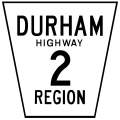
In Canada, numbered county roads are only found in Ontario, where they are similar to American county highways. Ontario county or regional roads are marked with trapezoid-shaped signs, usually (but not necessarily) with a white, black, green, or blue background, and normally identifying the county or region responsible for the road's maintenance, sometimes with the jurisdiction's coat of arms or corporate logo. The county road network has been present for many years, but has only been signed with the flowerpot logos since the 1970s and early 1980s (depending on the area). Previously, the roads simply had road names, such as "Essex Road 42" or "Kent County Road 14", and so on, but had no markers to designate them. Many Ontario county roads are built to provincial highway standards, as thousands of kilometres of highways were downloaded from the province to counties and regional municipalities in 1997 and 1998, and most of the downloaded highways were rolled into the county road systems. In some situations, these in turn were downloaded from the region/county to the local municipalities.

Not all jurisdictions in Ontario which maintain a numbered road system use the name "County Road" to designate them, however — depending on the official name of the jurisdiction which maintains them, they may instead be designated as a Regional Road, Municipal Road, Regional Highway, County Highway, District Road, Township Road, or City Road. In the unincorporated districts of Northern Ontario, as there is no county level of government the province maintains a secondary highway system to serve the same function.

In addition to county roads, many civil townships also have concession roads and (civil) township roads, such as Colchester South Road 3, and Concession 8. These usually do not have markers (only names on signs and maps). One exception is former Highway 620, which had a change in supervision.

This is to be contrasted with survey township roads which exist in Alberta after the 1981 Alberta rural addressing system was introduced. Range roads will run north to south, while (survey) township roads run east to west.

Highway 620 in Ontario, was downloaded to the Peterborough and Hastings county governments, and in one section, the highway was downloaded further to the township of Wollaston, and is now signed Wollaston Township 620, with a municipal sign similar to an Ontario tertiary highway.[7] A number of townships in Wellington County sign their township road system in a similar manner.

Germany

[edit]

Some German states also have a system of roads maintained by the kreis (county or district) known as a kreisstraße. These roads are numbered similarly to county routes in the U.S and Ontario. These roads carry traffic between the cities, towns and villages within a kreis and sometimes between two kreis. Most kreisstraße are two-lane roads but can also be built as limited access dual carriageways in urban areas.

Elsewhere

[edit]

In England and Wales, county road, as alluded to in section 29 et seq. of the Local Government Act 1929, was the term used to refer to any road for which a county council was the responsible highway authority.[8]

See also

[edit]

Notes

[edit]

References

[edit]
[edit]
Revisions and contributorsEdit on WikipediaRead on Wikipedia
from Grokipedia
A county highway, also referred to as a county , is a public roadway owned, maintained, and operated by a , distinct from state highways and streets. These roads primarily serve rural, suburban, and unincorporated areas, providing essential connectivity between local communities, agricultural lands, smaller towns, and higher-level roadways like state routes. Unlike interstate or U.S. highways, county highways are not part of a national numbering system but are often designated with -specific route numbers, such as "CR 20" in Arizona's Mohave , to aid in local navigation and management. County highways constitute a vital component of the nation's local road network, which encompasses about 76% of all U.S. roadways by mileage as of 2023 and is predominantly under jurisdiction, including counties, towns, and cities. In many states, such as Washington, they are defined as public highways outside and not designated as state routes, emphasizing their role in regional rather than interstate travel. Maintenance responsibilities typically fall to county highway departments, which handle construction, repairs, , and signage, funded through a mix of local property taxes, state appropriations, and federal programs like those administered by the . Functionally, county highways often align with collector or minor arterial classifications, balancing access to adjacent properties with moderate traffic flow to support daily , freight, and emergency services in non-urban settings. The establishment and oversight of county highway systems vary by state; for instance, in , they are intended to link principal municipalities and serve as feeders to the network, while in , they include any public highway constructed or laid out by county authority. Across the country, these roads carry a substantial portion of rural miles traveled, underscoring their importance to economic activity in , , and sectors, though they face challenges like funding shortages and increasing maintenance demands from climate impacts and traffic growth.

General Overview

Definition and Terminology

A county highway is a public road under the and administration of a , typically serving rural or suburban areas by connecting local communities, farms, minor towns, or smaller roadways to higher-level routes. These roads form an essential part of the local transportation network, providing access that supports agricultural, residential, and light commercial activities without the scale or funding of state or federal systems. In the United States, for instance, county highways are designated by county boards or commissioners and are supervised at the local level to ensure connectivity within county boundaries. Terminology for these roads varies by region but generally includes terms such as "county road," "county route," or simply "county highway," with common abbreviations like CR (for county road) or CH (for county highway). In the Canadian province of , the preferred term is "county road," referring to roadways managed by county municipalities to link urban centers, rural areas, and provincial highways. Internationally, similar concepts exist, such as Kreisstraßen in , which are district or county roads administered by rural districts (Landkreise) or independent cities for supra-local traffic between towns and villages. Legally, county highways are defined under state or provincial statutes as roads that do not meet the criteria for state or but are vital for regional connectivity and local economic function. For example, in , the county highway system comprises routes designated by county commissioners for supervision and upkeep, distinct from state-maintained arterials. They occupy an intermediate position in the road hierarchy, above municipal streets or roads but below interstates, state highways, or national routes, emphasizing their role in bridging local access with broader networks.

Functions and Characteristics

County highways primarily serve to provide access to residential, agricultural, and commercial areas while facilitating local traffic circulation without the high-speed capabilities of interstate or state highways. They balance mobility for moderate-distance trips with direct property access, often connecting local roads to higher-order arterials and supporting such as emergency response routes and school transportation. In rural settings, these roads play a key role in freight movement for and , enabling the transport of goods like or over short to medium distances. Physically, county highways are typically two-lane, undivided paved roads with lane widths of 10-12 feet and shoulders ranging from 1-6 feet, designed for speeds between 25-55 mph (40-90 km/h). In rural areas, sections may include gravel surfaces, narrower lanes (8-10 feet), or minimal shoulders, with uncontrolled access points such as driveways and intersections managed at the level. Bridges and drainage structures along these routes are also under county jurisdiction, emphasizing durability for local loads rather than heavy interstate traffic. Maintenance of county highways is handled by county or highway departments, encompassing tasks like and ice removal, repairs, upkeep, and control to ensure year-round . Funding for these activities derives from local sources such as property taxes and vehicle fees, supplemented by state aid programs and federal grants for eligible improvements. This decentralized approach allows counties to prioritize based on local needs, though it can vary in scope depending on budget constraints. Traffic volumes on county highways are generally lower than on state highways, often under 10,000 vehicles per day (AADT), with rural collectors typically seeing 150-2,600 vehicles and urban equivalents up to 6,300. This moderate usage underscores their role in serving local communities rather than regional or national travel corridors, contributing to overall system efficiency by distributing traffic from higher-volume routes.

In the United States

Historical Development

County highways in the United States trace their origins to the colonial era, when local roads were primarily constructed and maintained by governments to serve immediate needs, such as connecting farms, mills, and settlements. These rudimentary networks evolved through the amid growing agricultural and commercial demands, remaining largely under local control with minimal standardization. Following the Civil War, responsibility for road maintenance shifted in many states from townships to county boards, formalizing a county-level approach to oversight and funding as populations expanded and rural economies required more reliable . This transition marked the beginnings of what would become recognized county highway systems, emphasizing practical improvements for local travel over long-distance connectivity. The early 20th century brought federal involvement that reshaped county highways through key legislation. The Federal Aid Road Act of 1916 provided the first significant federal funding for rural post roads, allocating $75 million over five years on a matching basis and requiring states to establish highway departments while allowing partnerships with counties for project selection and construction. This act spurred coordinated state-county efforts, with funds often directed toward improving county-managed routes to enhance mail delivery and commerce. Building on this, the Federal Highway Act of 1921 introduced the "7% system," mandating that each state designate no more than 7% of its total mileage as eligible for federal aid, prioritizing primary inter-state highways while positioning county roads as essential feeder systems to connect rural areas and farms to these main arteries. These measures balanced national goals with local priorities, elevating county highways from paths to integral components of a nascent national network. Mid-20th-century demographic shifts further transformed county highways. Post-World War II suburbanization, driven by economic prosperity and the , led to rapid residential expansion beyond urban cores, necessitating extensive new county road construction to accommodate increased local traffic and development; rural road mileage surged as counties paved and extended networks to support this outward growth. The , establishing the Interstate System, redirected substantial federal resources toward 41,000 miles of limited-access highways, thereby shifting primary responsibility for non-interstate routes—including the vast majority of county roads—back to state and local governments. By the , this evolution had resulted in approximately 1.8 million miles of county roads nationwide, comprising about 43% of the total U.S. public road network and underscoring their enduring role in everyday mobility. Regional variations reflect diverse economic drivers in county highway development. In the Midwest and , systems expanded primarily to meet agricultural needs, with grid-like networks facilitating from farms to markets and railheads, as seen in states like and where county roads remain densely interwoven with farmland. Conversely, Western states experienced growth tied to land development and resource extraction, with counties building out routes to support settlement in arid regions and connect emerging communities, exemplified by expansions in and amid 20th-century population booms.

Governance and Jurisdiction

County highways in the United States are administered at the local level primarily through county governments, where boards of county commissioners or supervisors provide oversight by establishing policies, approving budgets, and directing strategic initiatives for road systems. Day-to-day operations, including , , , and , are managed by dedicated county highway departments or divisions, which employ professional engineers, surveyors, and field crews to implement projects and address needs. These entities ensure compliance with safety and standards while responding to local demands and environmental considerations. Jurisdiction over highways extends to public s located within a 's unincorporated areas and rural regions, encompassing approximately 43% of the nation's total road mileage owned and maintained by counties as of 2023. Incorporated cities and towns hold exclusive over streets within their boundaries, leading to clear delineations where urban limits end and control begins; however, boundary overlaps or shared routes are resolved through formal intergovernmental agreements that specify maintenance responsibilities and cost-sharing. This structure prevents duplication of efforts and promotes coordinated transportation management across local entities. Funding for county highways derives mainly from county general funds, generated through property taxes, sales taxes, and other local revenues, which support routine maintenance and operations. These local sources are augmented by state allocations from gasoline taxes and motor vehicle fees, as well as federal assistance programs like the Surface Transportation (STBG), which distributes flexible funds to states for suballocation to counties for preservation, safety enhancements, and capacity improvements. Annual spending per county on roads varies significantly based on and mileage—ranging from about $1 million in small rural counties to $10 million or more in urban-adjacent ones—reflecting the diverse scale of demands nationwide. Legally, counties exercise eminent domain authority under state statutes to acquire private property for highway expansions or realignments, adhering to federal Fifth Amendment requirements for public use and just compensation to affected landowners. For accidents occurring on county highways due to poor maintenance or design flaws, liability typically rests with the county, mitigated through public entity insurance policies and subject to state-specific sovereign immunity caps that limit damage awards. Traffic engineering and control standards are uniformly guided by the federal Manual on Uniform Traffic Control Devices (MUTCD), which counties must follow as adopted by their states, permitting minor local modifications to accommodate regional conditions while ensuring consistency in signage, markings, and signals.

Classification and Numbering

County highways in the United States are classified using the Federal Highway Administration's (FHWA) functional classification system, which groups roadways based on the type of service they provide, including mobility for longer trips and access to adjacent properties. This system categorizes county roads primarily as minor arterials, which connect major roads and serve moderate traffic volumes; collectors, which gather traffic from local roads and feed it into arterials; and local roads, which primarily provide direct access to abutting land uses with low traffic volumes. States and counties apply these categories to determine design standards, maintenance priorities, and eligibility for federal funding, with re-evaluations recommended every 10 years to reflect changes in land use and traffic patterns. There is no national standard for numbering county highways, leading to diverse systems managed at the county or state level to facilitate local navigation and maintenance tracking. Common approaches include sequential numbering, such as County Road (CR) 1 through CR 100 or higher in many counties, which assigns numbers based on order of designation or importance. In Midwestern states like and , grid-based systems often use alphabetical letters (e.g., CR A1, CR B20) aligned with township grids for rural areas, reflecting historical practices. Some regions employ mile-based or directional numbering, starting from county boundaries or population centers. State-specific variations highlight the decentralized nature of the system. In , county routes are designated under a statewide program using a letter prefix (A through S) indicating geographic zones, followed by a sequential number (e.g., in the ), totaling about 70 signed routes for key connections between state highways and local areas. Texas integrates county-like functions through its Farm to Market (FM) and Ranch to Market (RM) road system, state-maintained routes numbered sequentially from FM 1 to over 3,500, spanning approximately 48,000 miles to serve rural connectivity, though counties handle many similar local roads outside this network. In New York, numbering is assigned independently by each county (e.g., CR 1 in one county may continue as CR 50 in the adjacent one), with route markers often including the county name for clarity. Overall, county roads total approximately 1.8 million miles nationwide as of 2023, comprising about 43% of the total public road network. Over time, county highway classifications and numbers have evolved, particularly following the 1956 Interstate Highway Act, which prompted upgrades of select county routes to state or interstate facilities to support national mobility. For instance, in , numerous FM roads were realigned, extended, or incorporated into the interstate system during the 1950s–1970s expansions, reducing some county designations while enhancing others for higher traffic loads. Decommissions occur when routes are duplicated by superior roads or shifted to urban arterials, with FHWA guidelines ensuring classifications adapt to these shifts for continued federal aid eligibility.

Signage and Standards

County highway signage in the United States primarily follows the standards outlined in the Federal Highway Administration's Manual on Uniform Traffic Control Devices (MUTCD), which provides guidelines for route markers, warning signs, and other visual elements to ensure consistency and safety across jurisdictions. Route markers for county highways typically consist of rectangular shields designated as the M1-6 sign in the MUTCD, featuring a white background with black lettering and border, displaying "County Route," "CR," or the specific county name followed by a number or letter identifier. These shields are often 24 inches by 24 inches in size for two-digit routes, though variations exist to match adjacent state or U.S. route signage in assemblies. Warning signs, such as diamond-shaped yellow panels for curves, intersections, or other hazards, adhere to MUTCD specifications for reflectivity and placement, while mileposts or reference markers use standardized black-on-white plaques to indicate distance along the route. Design standards for county highways are guided by the American Association of State Highway and Transportation Officials (AASHTO) "A Policy on of Highways and Streets," which recommends lane widths of 10 to 12 feet for rural collector roads and 9 to 10 feet for low-volume local roads to accommodate typical volumes. Shoulders vary from 2 to 8 feet in width depending on the road's functional and speed, providing for stops and ; for instance, paved shoulders of at least 4 feet are advised on roads with design speeds over 40 mph. Horizontal and vertical curves are designed based on criteria in the AASHTO guidelines, ensuring safe navigation at posted speeds. Speed limits are established by county engineers using the 85th percentile operating speed method, as recommended in the MUTCD and state supplements, to reflect actual driver behavior while promoting safety. Safety features on county highways include guardrails installed on steep embankments or drop-offs exceeding 6 feet, following AASHTO criteria to mitigate run-off-road crash severity. Shoulder rumble strips, milled grooves typically 12 to 16 inches wide and 0.5 inches deep, are commonly applied on higher-volume county roads to alert drivers via vibration and sound when veering off the pavement, reducing run-off-road incidents by up to 20-30% according to evaluations. Lighting is provided at critical intersections or high-accident locations using MUTCD-compliant fixtures to enhance nighttime visibility. Under the National Bridge Inspection Standards (NBIS), bridges on county highways receiving federal aid must undergo inspections at least every two years, with annual checks for scour-critical structures, to identify and address safety deficiencies. Variations in signage occur between rural and urban county areas, where rural markers may employ simpler, smaller designs (e.g., 18x18 inches) to suit lower traffic densities while still meeting MUTCD minimums. Since the early , many counties have adopted high-intensity prismatic reflective sheeting for signs, mandated by the MUTCD's edition for compliance by 2018, to improve nighttime visibility through enhanced retroreflectivity that returns light directly to the driver's headlights. This upgrade, driven by assessments of sign degradation, has been particularly emphasized in rural settings to counter lower ambient light conditions.

In Canada

In Canada, county roads (also known as regional roads in some contexts) are primarily a feature of Ontario's municipal system, where they serve as key local connectors. Other provinces have analogous roadways under different names, such as municipal roads in , regional district roads in , or township and range roads in provinces, which fulfill similar roles in rural and suburban connectivity.

Development in Ontario

The development of county roads in Ontario traces its origins to the 19th century, evolving from rudimentary township roads maintained through statutory labor by settlers under early Upper Canada legislation. These local paths, often cleared for military and settlement purposes, were supplemented by colonization roads initiated in the 1850s to open the Ottawa-Huron Tract for resettlement, such as the Ottawa and Opeongo Road surveyed in 1851–1852. Formalization occurred with the Municipal Corporations Act of 1849, known as the Baldwin Act, which established a two-tier municipal system replacing districts with counties as upper-tier governments responsible for overseeing and funding higher-order roads beyond township limits. This shift empowered county councils to coordinate road improvements, petition for provincial funds, and manage infrastructure like bridges and culverts, marking the birth of structured county road networks. Post-World War II urbanization drove significant expansions, as population growth in necessitated better connectivity between rural areas and emerging suburbs. In the late 1990s, under the Progressive Conservative government of Premier , approximately 5,000 kilometers of provincial highways were "downloaded" to municipal jurisdictions, with many segments reclassified as county roads to alleviate provincial maintenance burdens. This process, initiated around 1997–1998, included transfers like portions of Highway 2 and secondary routes, enhancing county networks while aligning with fiscal restraint policies. By the , Ontario's county roads formed an extensive system spanning thousands of kilometers across more than 30 counties and regional municipalities, supporting regional economies and daily commutes. Governance of these roads is primarily outlined in the Municipal Act, 2001, which defines counties' authority over highway construction, maintenance, and transfers, including those from provincial downloads. Upper-tier municipalities like the Regional Municipality of Peel and York Region exemplify this framework, managing hybrid urban-rural road systems that balance high-traffic arterials with agricultural access routes. Technological shifts transformed county roads from predominantly gravel surfaces in the mid-20th century to paved dominance by the 1970s, driven by asphalt adoption and municipal paving programs amid suburban sprawl. Further evolution integrated county roads with GO Transit infrastructure, facilitating access to rail stations and promoting sustainable growth in the Greater Golden Horseshoe through enhanced multimodal connectivity.

Structure and Numbering

County roads in are managed by the or transportation departments of individual counties or regional municipalities, which oversee , , , and operations for their respective networks. These roads form a vital secondary system that primarily functions as feeders to the provincial King's Highways, providing essential connections for local and regional traffic while supporting access to higher-order provincial routes. The numbering system for county roads is established sequentially within each , typically ranging from County Road 1 to over 100 in larger jurisdictions, with no overarching provincial standard to ensure uniqueness across boundaries, resulting in duplicate numbers in different counties. Route markers, known as "" shields, are trapezoid-shaped signs featuring a background, white numbering, and the county or regional name for identification. For example, in , County Road 90 serves as a key connector between the urban center of and rural communities such as Angus and the surrounding areas, including links to Canadian Forces Base Borden. In , the system includes more than 20 numbered county roads encompassing approximately 315 kilometers in total length. Maintenance of these roads is primarily funded through municipal property taxes, supplemented by provincial subsidies via programs such as the Municipal Partnership Fund, which allocates resources for infrastructure improvements. Safety standards for county roads are aligned with guidelines from the Ministry of Transportation, including the Traffic Manual, to ensure uniformity in design, signage, and operational practices across the province.

International Equivalents

Germany: Kreisstraßen

In , Kreisstraßen serve as district roads primarily maintained by the Kreise, or rural districts, to connect local towns, villages, and neighboring districts within a federal state. They facilitate regional traffic flows at a sub-state level, often linking to higher-order roads like Landesstraßen while providing essential access for rural and suburban areas. Nationwide, the network spans approximately 91,814 kilometers as of , encompassing both free-flowing sections and urban stretches. Administration of Kreisstraßen falls under the responsibility of county governments (Landkreise) or independent cities (kreisfreie Städte), which handle , , , and operation. derives from county budgets, supported by allocations from state (Land) governments and revenues from local taxes such as the and trade tax. While overarching traffic regulations are governed by the federal Road Traffic Act (StVG), specific and occur through state-level road laws, ensuring alignment with national standards for safety and connectivity. Numbering for Kreisstraßen typically follows a "K" prefix followed by a numeric identifier unique to each district, such as K 1 or K 1234, to denote route segments. consists of yellow background signs with black lettering for route markers, often accompanied by stationing posts in green, white, or blue for mileage reference; these are placed at intersections and key points to guide local traffic. Speed limits generally range from 70 to 100 km/h on undivided sections, with most roads featuring two lanes and prioritizing efficiency over high-capacity design. Kreisstraßen emphasize regional connectivity over long-distance travel, ranking below federal Bundesstraßen and state Landesstraßen in the , which allows for more flexible local adaptations like integration with pedestrian paths or environmental measures. For instance, in , rural Kreisstraßen such as those in the connect agricultural communities to market towns, while in , routes on urban fringes like the K 1 near support commuter access to industrial zones without the infrastructure demands of higher-class roads.

United Kingdom: Local Authority Roads

In the United Kingdom, the equivalent to county highways in the United States are the non-trunk roads, comprising B-roads and unclassified roads, which form the majority of the local road network maintained by county councils, unitary authorities, and other local highway authorities. These roads total approximately 214,000 miles across Great Britain, with B-roads accounting for about 18,800 miles and unclassified (U) roads combined with minor classified (C) roads making up the remaining 195,000 miles. Local authorities primarily handle rural and suburban routes, ensuring connectivity for communities while distinguishing these from nationally managed trunk roads such as motorways and principal A-roads. Administration of these roads falls under the Highways Act 1980, which imposes a statutory duty on highway authorities to maintain public highways in their areas at public expense. In , there are 21 two-tier non-metropolitan () counties where county councils act as the highway authority for non-trunk roads, alongside numerous unitary authorities that combine county and district functions. Funding for maintenance derives from a mix of local revenues, which contribute around 52% to overall local authority budgets, and grants specifically allocated for highways, totaling over £2.7 billion for local maintenance between 2022 and 2025. Roads are classified nationally under a established in the , with B-roads designated for local traffic to link areas and distribute flows from higher-class routes to smaller roads, often serving rural or suburban needs without dedicated county-specific numbering. For instance, the B5000 in rural connects villages and provides access to the countryside, exemplifying typical B-road functions. Unclassified roads, the most numerous category, support minor access to properties and local destinations, identified locally rather than through a formal . While B-roads may use local route identifiers for management, the overall integrates into a national framework without separate designations. Key features of these local authority roads include default speed limits of 30 mph in built-up areas and 60 mph on rural single carriageways, with many villages implementing 20 mph zones to enhance safety by reducing collision risks—studies show a 2.5% fatality rate at 20 mph compared to higher speeds. Emphasis on measures, such as and crossings, is prominent in residential and village settings to prioritize safety. For example, manages over 4,300 miles of carriageways, focusing on maintenance and safety enhancements across its rural network.

Other Countries

In Australia, roads equivalent to county highways are maintained by local governments, including shires and councils that function similarly to counties, encompassing a network exceeding 678,000 km that forms the backbone of regional and rural connectivity. These roads are classified and numbered regionally, with examples such as B-roads in designated by numbers 51 to 99 to indicate secondary routes linking towns and remote areas. They play a vital role in outback connectivity, facilitating access to isolated communities and supporting freight movement in vast arid regions. In , county highways, referred to as xian dao, connect townships and rural locales across the island, totaling approximately 3,600 km in length as of 2017. These routes are administered by individual county governments in coordination with the Ministry of Transportation and Communications, ensuring integration with higher-level provincial highways. A representative example is County Road 118, which traverses rural districts in and provides essential links to mountainous and agricultural areas. India's roads, overseen by state departments at a level comparable to counties, span about 632,000 km and are indispensable for by linking villages to markets and higher-order roads. Numbered primarily as Major District Roads (MDR), they prioritize connectivity for agricultural transport and community access in underserved areas. Variations exist globally, such as Sweden's kommunala vägar, which are managed by municipalities to bridge and urban streets, emphasizing local mobility and integration within the broader . These county-level equivalents universally address the interstitial needs between national infrastructure and immediate urban or village access, adapting to diverse geographic and administrative contexts.

References

Add your contribution
Related Hubs
User Avatar
No comments yet.