Hubbry Logo
Arthropod eyeArthropod eyeMain
Open search
Arthropod eye
Community hub
Arthropod eye
logo
8 pages, 0 posts
0 subscribers
Be the first to start a discussion here.
Arthropod eye
Arthropod eye
from Wikipedia
Insects and all mandibulates have compound eyes, with the exception of some myriapods that have stemmata.
Although arachnids (like this spider) do not have compound eyes, xiphosurans and many other extinct chelicerates do.

Apposition eyes are the most common form of eye, and are presumably the ancestral form of compound eye. They are found in all arthropod groups, although they may have evolved more than once within this phylum.[1] Some annelids and bivalves also have apposition eyes. They are also possessed by Limulus, the horseshoe crab, and there are suggestions that other chelicerates developed their simple eyes by reduction from a compound starting point.[1] Some caterpillars appear to have evolved compound eyes from simple eyes in the opposite fashion.[citation needed]

The arthropods ancestrally possessed compound eyes, but the type and origin of this eye varies between groups, and some taxa have secondarily developed simple eyes. The organ's development through the lineage can be estimated by comparing groups that branched early, such as the velvet worm and horseshoe crab to the advanced eye condition found in insects and other derived arthropods.

Eyes and functions

[edit]

Most arthropods have at least one of two types of eye: lateral compound eyes, and smaller median ocelli, which are simple eyes.[2] When both are present, the two eye types are used in concert because each has its own advantage.[3] Some insect larvae, e.g., caterpillars, have a different type of simple eye known as stemmata. These eyes usually provide only a rough image, but (as in sawfly larvae) they can possess resolving powers of 4 degrees of arc, be polarization sensitive and capable of increasing their absolute sensitivity at night by a factor of 1,000 or more.[4] Flying insects can remain level with either type of eye surgically removed, but the two types combine to give better performance.[3] Ocelli can detect lower light levels,[a][5] and have a faster response time, while compound eyes are better at detecting edges and are capable of forming images.[3]

Taxonomic distribution of compound eyes

[edit]

Most species of Arthropoda with compound eyes bear just two eyes that are located separately and symmetrically, one on each side of the head. This arrangement is called dichoptic. Examples include most insects, and most of the larger species of Crustacea, such as crabs. Many other organisms, such as vertebrates and Cephalopoda are similarly and analogously dichoptic, which is the common state in animals that are members of the Bilateria and have functionally elaborate eyes. However, there are variations on that scheme. In some groups of animals whose ancestors originally were dichoptic, the eyes of modern species may be crowded together in the median plane; examples include many of the Archaeognatha. In extreme cases such eyes may fuse, effectively into a single eye, as in some of the Copepoda, notably in the genus Cyclops. One term for such an arrangement of eyes is cycloptic.

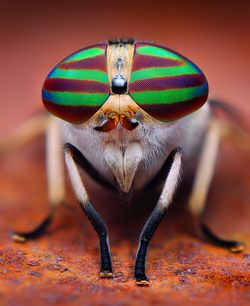
On the other hand, some modes of life demand enhanced visual acuity, which in compound eyes demands a larger number of ommatidia, which in turn demands larger compound eyes. The result is that the eyes occupy most of the available surface of the head, reducing the area of the frons and the vertex and crowding the ocelli, if any. Though technically such eyes still may be regarded dichoptic, the result in the extreme case is that borders of such eyes meet, effectively forming a cap over most of the head. Such an anatomy is called holoptic. Spectacular examples may be seen in the Anisoptera and various flies, such as some Acroceridae and Tabanidae.

In contrast, the need for particular functions may not require extremely large eyes, but do require great resolution and good stereoscopic vision for precise attacks. Good examples may be seen in the Mantodea and Mantispidae, in which seeing prey from particular ommatidia in both compound eyes at the same time, indicates that it is in the right position to snatch in a close-range ambush. Their eyes accordingly are placed in a good position for all-round vision, plus particular concentration on the anterior median plane. The individual ommatidia are directed in all directions and accordingly, one may see a dark spot (the pseudopupil), showing which ommatidia are covering that field of view; from any position on the median plane, and nowhere else, the two dark spots are symmetrical and identical.

Sometimes the needs for visual acuity in different functions conflict, and different parts of the eyes may be adapted to separate functions; for example, the Gyrinidae spend most of their adult lives on the surface of water, and have their two compound eyes split into four halves, two for underwater vision and two for vision in air. Again, particularly in some Diptera, ommatidia in different regions of the holoptic male eye may differ visibly in size; the upper ommatidia tend to be larger. In the case of some Ephemeroptera the effect is so exaggerated that the upper part of the eye is elevated like a risen cupcake, while its lower part that serves for routine vision looks like a separate organ.

Compound eyes are often not completely symmetrical in terms of ommatidia count. For example, asymmetries have been indicated in honeybees[6] and various flies.[7] This asymmetry has been correlated with behavioural lateralization in ants (turning bias).[8]

Genetic controls

[edit]

In the fruit fly Drosophila melanogaster (the best-studied arthropod species with respect to developmental biology), among the most important genes for patterning the eyes of insects are the Pax6 homologs eyeless (ey) and twin of eyeless (toy). Together, these genes drive the proliferation of cells early in eye development. Loss of either of these genes results in failure of eye formation. The activity of ey and toy includes the activation of the retinal determination genes sine oculis (so) and eyes absent (eya), which form a protein complex that regulates the transcription of downstream target genes.[9] Thereafter, the two visual systems of D. melanogaster are patterned differently. Anterior head patterning is controlled by orthodenticle (otd), a homeobox gene which demarcates the segments from the top-middle of the head to the more lateral aspects. The ocelli are in an otd-rich area and disruption of otd results in loss of the ocelli, but does not affect the compound eyes.[10] Inversely, the transcription factor dachshund (dac) is required for the patterning of compound eyes, but mutants lacking dac do not exhibit loss of the ocelli.[11] Different opsins are used in the ocelli of compound eyes.[12]

The visual systems of Chelicerata (the sister group to the remaining Arthropoda) are less well understood. It has been shown that homologs of many eye patterning genes are variably expressed in the eyes of different spider species, but the functional significance of these changes in expression is not well understood, due to lack of functional data.[13][14] In addition, it has been shown in horseshoe crabs and spiders that Pax6 homologs are not expressed in the same way as their counterparts in insects, suggesting that Pax6 may not be required as a top-level eye patterning switch in chelicerates.[15][16] Most of the functional data on eye patterning in Chelicerata is drawn from the daddy-longlegs Phalangium opilio, which has been used to show that eyes absent plays a conserved role in patterning both the visual systems of this species (an example of conservation of gene function, with respect to insects) and that dachshund affects the patterning of lateral eyes, but not median eyes (another example of conservation).[17]

Evolution

[edit]

Hexapods are currently thought to fall within the Crustacean crown group; while molecular work paved the way for this association, their eye morphology and development is also markedly similar.[18] The eyes are strikingly different from the myriapods, which were traditionally considered to be a sister group to the Hexapoda.

Both ocelli and compound eyes were probably present in the last common arthropod ancestor,[19] and may be apomorphic with ocelli in other phyla,[20] such as the annelids.[21] Median ocelli are present in chelicerates and mandibulates; lateral ocelli are also present in chelicerates.[20]

Origin

[edit]

No fossil organisms have been identified as similar to the last common ancestor of arthropods; hence the eyes possessed by the first arthropod remains a matter of conjecture. The largest clue into their appearance comes from the onychophorans: a stem group lineage that diverged soon before the first true arthropods. The eyes of these creatures are attached to the brain using nerves which enter into the centre of the brain, and there is only one area of the brain devoted to vision. This is similar to the wiring of the median ocelli (small simple eyes) possessed by many arthropods; the eyes also follow a similar pathway through the early development of organisms. This suggests that onychophoran eyes are derived from simple ocelli, and the absence of other eye structures implies that the ancestral arthropod lacked compound eyes, and only used median ocelli to sense light and dark.[2]

Fossilised eye of Anomalocaris daleyae from the Emu Bay Shale

A conflicting view notes, however, that compound eyes appeared in many early arthropods, including the trilobites and eurypterids. That suggests that the compound eye may have developed after the onychophoran and arthropod lineages split, but before the radiation of arthropods.[20] This view is supported if a stem-arthropod position is supported for compound-eye bearing Cambrian organisms such as the Radiodontids. Yet another alternative is that compound eyes independently evolved, multiple times within the arthropods.[21]

There were probably only a single pair of ocelli in the arthropod concestor, since Cambrian lobopod fossils display a single pair. And while many arthropods today have three, four, or even six, the lack of a common pathway suggests that a pair is the most probable ancestral state. The crustaceans and insects mainly have three ocelli, suggesting that such a formation was present in their concestor.[2]

It is deemed probable that the compound eye arose as a result of the 'duplication' of individual ocelli.[20] In turn, the dispersal of compound eyes seems to have created large networks of seemingly independent eyes in some arthropods, such as the larvae of certain insects.[20] In some other insects and myriapods, lateral ocelli appear to have arisen by the reduction of lateral compound eyes.[20]

Trilobite eyes

[edit]

The eyes of trilobites came in three forms, called holochroal, schizochroal, and abathochroal eyes. The eye morphology of trilobites is useful for inferring their mode of life, and can function as indicators of the palaeo-environment conditions.[22]

The holochroal eye was the most common and most primitive. It consisted of many small lenses – between 100 and 15,000 – covered by a single corneal membrane. This was the most ancient kind of eye. This eye morphology was found in the Cambrian trilobites (the earliest) and survived until the Permian extinction.[22]

The more complex schizochroal eye was found only in one sub-order of trilobite, the Phacopina (Ordovician-Silurian). There is no exact counterpart to the schizochroal eye in modern animals, but a somewhat similar eye structure is found in adult male insects in the order Strepsiptera. Schizochroal eyes developed as an improvement on holochroal; they were more powerful, with overlapping visual fields, and were particularly useful for nocturnal vision and possibly for colour and depth perception. Schizochroal eyes have up to 700 large lenses (large compared to holochroal lenses). Each lens has a cornea, and each has an individual sclera that separates it from the surrounding lenses. The multiple lenses for the eye were each constructed from a single calcite crystal. Early schizochroal eye designs appear haphazard and irregular – possibly constrained by the geometrical complications of packing identical sized lenses on a curved surface. Later schizochroal eyes had size graduated lens.[22]

The abathochroal eye is the third eye morphology of trilobites, but it has found only within the Eodiscina. This form of eye consisted of up to 70 much smaller lenses. The cornea separated each lens, and the sclera on each lens terminated on top of each cornea.[22]

Horseshoe crab

[edit]
Horseshoe crabs have two primary compound eyes and seven secondary simple eyes. Two of the secondary eyes are on the underside.[23]

The horseshoe crab has traditionally been used in investigations into the eye, because it has relatively large ommatidia with large nerve fibres (making them easy to experiment on). It also falls near the base of the chelicerates; its eyes are believed to represent the ancestral condition because they have changed so little over evolutionary time. Most other living chelicerates have lost their lateral compound eyes, evolving simple eyes in their place that vary in number.[24] Up to five pairs of lateral eyes occur in scorpions, whereas three pairs of lateral eyes are typical for Tetrapulmonata (e.g., spiders; Amblypygi).[25]

Horseshoe crabs have two large compound eyes on the sides of its head. An additional simple eye is positioned at the rear of each of these structures.[24] In addition to these obvious structures, it also has two smaller ocelli situated in the middle-front of its carapace, which may superficially be mistaken for nostrils.[24] A further simple eye is located beneath these, on the underside of the carapace; this eye is initially paired during embryonic stages and fuses later in development.[24][15] A further pair of simple eyes are positioned just in front of the mouth.[24] The simple eyes are probably important during the embryonic or larval stages of the organism, with the compound eyes and median ocelli becoming the dominant sight organs during adulthood.[24] These ocelli are less complex, and probably less derived, than those of the Mandibulata.[20] Unlike the compound eyes of trilobites, those of horseshoe crabs are triangular in shape; they also have a generative region at their base, but this elongates with time. Hence the one ommatidium at the apex of the triangle was the original "eye" of the larval organism, with subsequent rows added as the organism grew.[18]

Insects and crustaceans

[edit]
Eye of Triatoma infestans

It is generally thought that insects are a clade within the Crustacea, and that the Crustacea are monophyletic. This is consistent with the observation that their eyes develop in a very similar fashion. While most crustacean and some insect larvae possess only simple median eyes, such as the Bolwig organs of Drosophila and the naupliar eye of most crustaceans, several groups have larvae with simple or compound lateral eyes. The compound eyes of adults develop in a region of the head separate from the region in which the larval median eye develops.[18] New ommatidia are added in semicircular rows at the rear of the eye; during the first phase of growth, this leads to individual ommatidia being square, but later in development they become hexagonal. The hexagonal pattern will become visible only when the carapace of the stage with square eyes is molted.[18]

Although stalked eyes on peduncles occur in some species of crustaceans and some insects, only some of the Crustacea, such as crabs, bear their eyes on articulated peduncles that permit the eyes to be folded out of the way of trouble.

Myriapods

[edit]
Eye of Lithobius forficatus

Most myriapods bear stemmata – single lensed eyes which are thought to have evolved by the reduction of a compound eye.[20] However, members of the chilopod genus Scutigera have a compound eye, which is composed of facets [26] and not, as earlier interpretations had it, of clustered stemmata.[21] that were thought to grow in rows, inserted between existing rows of ocelli.[18]

See also

[edit]

Footnotes

[edit]

References

[edit]
Revisions and contributorsEdit on WikipediaRead on Wikipedia
from Grokipedia
The arthropod eye refers to the visual organs found across the phylum Arthropoda, which includes , crustaceans, chelicerates, and myriapods, and is predominantly characterized by eyes composed of thousands of individual photoreceptive units called ommatidia that collectively produce a mosaic-like image of the surroundings. These eyes enable a wide , often spanning nearly 360 degrees horizontally, and excel in detecting motion, polarization, and in some cases color, adapting to diverse ecological niches from deep-sea environments to aerial predation. Structurally, each ommatidium functions as a self-contained optical unit, typically featuring a corneal lens at the surface, a crystalline cone for light guidance, a rhabdomere array formed by the microvilli of typically eight photoreceptor cells, and surrounding pigment cells that isolate light input to prevent crosstalk between units. Arthropod compound eyes exhibit two primary optical designs: apposition eyes, where light is focused directly onto individual rhabdoms for high-resolution daytime vision in diurnal species like bees and dragonflies; and superposition eyes, which allow overlapping light from multiple ommatidia for enhanced sensitivity in low-light conditions, as seen in nocturnal moths and some crustaceans. In addition to compound eyes, many arthropods possess simple eyes or ocelli, which are single-lens structures aiding in sky navigation or light intensity detection, often complementing the compound system. Evolutionarily, arthropod eyes trace back to the over 541 million years ago, with the earliest preserved examples in trilobites featuring compound eyes with lenses arranged in hexagonal patterns for efficient packing. This ancient innovation underscores the eyes' role in arthropod diversification, with ongoing adaptations like dorsal rim specializations for polarized light detection in species such as parasitoid wasps, where even miniaturized eyes retain full cellular complexity for essential visual tasks. Neural processing occurs through layered optic neuropils in the brain, where signals from photoreceptors are integrated for behaviors like prey capture and obstacle avoidance, demonstrating remarkable efficiency despite relatively low compared to eyes.

Types and Anatomy

Compound eyes

Compound eyes in arthropods are multifaceted structures composed of numerous individual visual units called ommatidia, each functioning as a miniature eye with its own corneal lens, crystalline , and rhabdomeric photoreceptors that detect . enable the formation of a mosaic-like image through the parallel input from thousands of ommatidia, providing a wide and motion detection capabilities unique to arthropods. The basic anatomy of an includes a corneal lens at the surface, formed by the transparent , which focuses onto a crystalline made of elongated secretory cells that further direct the path. Beneath the cone lies the rhabdom, a stacked array of microvilli from typically eight retinula cells (photoreceptor neurons) that house the rhabdomeric photoreceptors responsible for phototransduction. Surrounding these elements are cells—primary and secondary—that isolate to specific ommatidia, and in some species, a pseudocone replaces the crystalline for enhanced guidance. This repeats across the eye's surface, with ommatidia arranged in a for optimal packing. Architectural variations in compound eyes primarily distinguish apposition from superposition types, adapting to different light environments. Apposition eyes, common in diurnal arthropods like flies and bees, feature optically isolated ommatidia where pigment cells block stray light, yielding higher resolution in bright conditions through a sharp image but limited sensitivity. In contrast, superposition eyes, prevalent in nocturnal or crepuscular species such as moths and some crustaceans, have a clear zone allowing light from multiple adjacent ommatidia to overlap on the , enhancing low-light sensitivity and providing a wider at the cost of reduced acuity. These differences arise from the positioning and pigmentation around the crystalline cone and rhabdom. The scale of compound eyes varies widely, with the number of ommatidia ranging from approximately 20 in tiny arthropods like to over 30,000 in large dragonflies, influencing overall and coverage. Specific adaptations, such as corneal nipple arrays—nanoscale protrusions on the corneal surface—reduce reflection by creating a gradual transition from air to , minimizing glare and improving transmission across a broad spectrum. These arrays, observed in diverse including moths and , enhance optical efficiency in natural environments.

Simple eyes

Simple eyes in , also known as ocelli, are single-lens or lensless photoreceptive structures containing a limited number of photoreceptor cells, primarily adapted for detecting light intensity and direction rather than forming detailed images. Unlike compound eyes, which resolve spatial patterns through arrays of ommatidia, ocelli provide broad, low-resolution visual input, often functioning in dim light conditions where compound eyes are less effective. These structures vary across arthropod groups but share a basic organization centered on rhabdomeric photoreceptors. In , dorsal ocelli are typically arranged in a triangular pattern on the vertex of the head, between the compound eyes, with three ocelli per individual. Each ocellus features a convex corneal lens secreted by underlying cone cells, which focuses onto a composed of rhabdomeres—microvillar extensions from photoreceptor cells housing photopigments like . In some s, lateral ocelli appear as simple, cup-shaped structures positioned beside compound eyes, consisting of a corneal lens and a small cluster of photoreceptors for basic sensing. Naupliar eyes, found in crustacean larvae, form a trio of pigment-cup ocelli: two facing laterally and one dorsally, each with a simple lens and a layer for detecting gradients during planktonic life. Variations in simple eye anatomy occur across arthropods, such as the pit-like ocelli in scorpions, where median and lateral eyes are embedded in shallow depressions on the , featuring biconvex cuticular lenses over pigmented retinal cups without a in lateral forms. In insect larvae, stemmata serve as simple eyes, often numbering up to six per side, with a single lens overlying a pigmented cup that houses rhabdoms formed by rhabdomeres in two asymmetric lobes, enabling crude imaging capabilities in some species like firefly larvae. Arthropod simple eyes employ rhabdomeric photoreceptors, characterized by microvillar rhabdomeres that amplify light capture, typically numbering in the dozens to hundreds per ocellus—far fewer than the thousands in eyes but more than the eight per . For instance, ocelli contain about 80 such cells, all expressing violet-sensitive . These photoreceptors with a small number of , facilitating rapid signal transmission. Ocelli contribute to specific functions like maintaining balance during flight and detecting polarized for orientation. In flying such as honeybees and dragonflies, dorsal ocelli monitor horizon movement to stabilize head attitude around roll and pitch axes, particularly in low . Additionally, ocellar photoreceptors exhibit polarization sensitivity, with ultraviolet-sensitive cells showing high preference for specific e-vector orientations, aiding celestial compass via skylight polarization patterns. In many species, ocelli complement compound eyes by providing supplementary light-direction cues during activities like flight stabilization.

Functions and Physiology

Visual processing

In arthropod compound eyes, phototransduction begins when photons are absorbed by molecules embedded in the microvilli of the rhabdomeres within photoreceptor cells. This absorption triggers a conformational change in , activating a G-protein cascade that leads to the opening of channels and subsequent hyperpolarization of the photoreceptor , converting light into electrical signals. The process is highly efficient, allowing rapid responses to light changes, as demonstrated in where the cascade provides substantial signal amplification, enabling detection of single photons. Image formation in arthropod eyes relies on the arrangement of ommatidia, producing distinct visual outputs depending on eye type. In apposition eyes, typical of diurnal insects like bees, each ommatidium functions independently, creating a mosaic vision where the image is a pixelated array of discrete points from unpooled photoreceptor inputs. In contrast, superposition eyes, found in nocturnal insects such as moths, pool light from multiple adjacent ommatidia through a clear zone, enhancing sensitivity in low light by summing signals for brighter, overlapping images. Neural processing of these signals occurs in the optic lobe, a specialized region. Photoreceptor axons project first to the lamina, where cartridges process local contrast and motion via interconnected neurons, then to the medulla for higher integration of spatial patterns. Tangential cells in the medulla and lobula detect wide-field motion, enabling behaviors like optomotor responses in flies, where directionally selective neurons compute flow across the . Arthropod eyes exhibit specialized adaptations for enhanced environmental perception. (UV) and polarization sensitivity arise from distinct rhabdomere orientations in photoreceptors, with UV opsins in the distal rhabdom enabling wavelength discrimination in insects like . Mantis shrimp achieve hyperspectral through tiered rhabdoms containing multiple photoreceptor types, each tuned to specific spectral bands, allowing discrimination of up to 12-16 wavelengths beyond capabilities. Visual resolution is limited by ommatidial optics, with angular acuity approximated by the formula Δϕd/f\Delta \phi \approx d / f, where dd is the facet diameter and ff is the focal length of the corneal lens. This yields interommatidial angles as small as 1° in predatory dragonflies, optimizing acuity for target detection.

Non-visual roles

Arthropod eyes play crucial roles beyond image formation, including the detection of polarized light for navigational orientation. Polarization vision in arthropods relies on the alignment of microvilli within photoreceptors in the ommatidia, which act as dipole antennae sensitive to the plane of polarized light. This mechanism allows insects and crustaceans to perceive patterns of skylight polarization, enabling compass-like orientation during migration or foraging, particularly when direct celestial cues like the sun are obscured. For instance, the dorsal rim area of compound eyes in many insects features specialized ommatidia with orthogonally arranged microvilli to analyze e-vector orientations, facilitating course correction in flight. Extraocular photoreceptors associated with eyes contribute to the entrainment of circadian rhythms by responding to environmental cycles. These photoreceptors, often located in the or linked to ocelli, express photopigments such as cryptochromes or rhodopsins that reset internal clocks independently of inputs. In species like the fruit fly Drosophila melanogaster, Hofbauer-Buchner eyelets serve as extraretinal sensors that mediate photic entrainment under high intensities, ensuring synchronization of behavioral rhythms with day-night transitions. Similarly, in and , lamina organs or photoreceptors support rhythm adjustment, highlighting the distributed nature of detection in arthropods. In some arthropods, ocelli exemplify these non-visual roles by aiding flight stabilization against environmental perturbations like . For example, in and locusts, ocelli detect horizon contrasts or sudden shifts, triggering rapid corrective maneuvers to compensate for roll or yaw induced by gusts, thus enhancing aerial maneuverability without relying on detailed from compound eyes.

Distribution Across Arthropod Groups

(insects and crustaceans)

, encompassing and crustaceans, exhibit a high diversity of eye structures, with compound eyes being nearly ubiquitous across both groups, serving as the primary visual organs in most species. These compound eyes typically consist of numerous ommatidia, allowing for wide visual fields and adaptations to varied habitats, from terrestrial to aquatic environments. Insects often possess three dorsal ocelli in addition to their compound eyes, which provide supplementary light detection and contribute to flight stabilization. In crustaceans, compound eyes are commonly either stalked, enhancing panoramic vision by elevating the eyes above the body, or sessile, integrated directly into the head capsule for a more compact design. In insects, compound eyes show remarkable specializations suited to ecological niches. Diurnal species like bees feature apposition compound eyes, where light from each ommatidium is optically isolated, enabling high-resolution color vision across ultraviolet, blue, and green wavelengths to facilitate foraging on flowers. In contrast, nocturnal insects such as moths employ superposition compound eyes, which pool light from multiple ommatidia to boost sensitivity in dim conditions, supporting navigation and mate detection at night. Some insects achieve extraordinary scale in eye structure; for instance, the Australian redeye cicada (Psaltoda moerens) has compound eyes with approximately 7,500 ommatidia per eye, contributing to broad visual coverage during short adult lifespans focused on reproduction. Crustacean eyes display parallel innovations, particularly in aquatic settings. Decapod , such as crabs and lobsters, possess compound eyes optimized for underwater , with corneal lenses and crystalline cones that correct for the of water to maintain focus and image clarity in marine or freshwater habitats. Larval stages often begin with simpler naupliar eyes—median, tripartite structures with fewer photoreceptors—that persist or integrate into more complex adult compound eyes during , reflecting developmental continuity across life stages. Stomatopods like (Gonodactylus spp.) exemplify advanced specializations, with apposition compound eyes featuring midbands sensitive to linearly and circularly polarized , aiding in prey detection and communication in complex environments. Aquatic adaptations further diversify crustacean visual systems. In fully aquatic species, the corneal cuticle is sclerotized and multilayered to resist osmotic swelling and maintain structural integrity in hypotonic or hypertonic waters, preventing distortion of the optical pathway. Certain isopods, such as Glyptonotus antarcticus, exhibit fusion eyes where retinular cells from adjacent ommatidia merge to form shared rhabdoms, enhancing light capture in low-visibility polar waters. However, in extreme environments like dark caves, some crustaceans have undergone eye reduction or loss; for example, the amphipod Gammarus minus lacks functional eyes entirely, with vestigial structures or none present, as vision becomes superfluous in perpetual darkness.

Chelicerata (arachnids and allies)

Chelicerates exhibit a range of eye configurations, predominantly featuring simple eyes, though some lineages retain or exhibit structures. Unlike many pancrustaceans, most chelicerates lack true compound eyes, with arachnids such as spiders possessing 6 to 8 simple eyes arranged in two rows, comprising a pair of principal eyes (anterior median) and secondary eyes (anterior lateral, posterior lateral, and posterior median). These eyes are camera-type, with principal eyes typically featuring everted retinas and secondary eyes having inverted retinas, enabling distinct visual roles. In arachnids like spiders, the principal eyes are often forward-facing and specialized for high-acuity vision, particularly in active hunters such as (Salticidae). These principal eyes provide detailed, color-sensitive imagery with a narrow , achieving spatial resolution as fine as 0.04–0.1 degrees, which supports prey identification and during leaps. In contrast, the secondary eyes offer wide-angle detection, primarily for motion sensing across a broader panorama, with fields of view up to 360 degrees in some species when combined. This division allows efficient scanning without constant head movement, as secondary eyes detect stimuli that prompt redirection of the principal gaze.31067-8) Horseshoe crabs (Xiphosura), a basal chelicerate group, retain lateral eyes adapted for diurnal activity, each comprising approximately 1,000 ommatidia that form images for detecting movement and shapes in bright light. These eyes feature corneal lenses over rhabdomeric photoreceptors, enhancing sensitivity to and visible wavelengths during mating and foraging. Complementing them are median simple eyes (ocelli), which provide low-resolution light detection and entrainment, positioned dorsally for overhead monitoring. This combination supports their intertidal lifestyle, where eyes excel in well-lit conditions. Specialized adaptations enhance chelicerate vision in specific ecological niches. In (Lycosidae), secondary eyes incorporate a —a reflective layer behind the —that boosts low-light sensitivity by redirecting photons through photoreceptors multiple times, producing eyeshine and aiding nocturnal prey pursuit on the ground. Similarly, in salticid spiders, image focusing occurs via muscular control of the retinal position within the fixed lens system; six intraocular muscles adjust the boomerang-shaped retina's distance from the lens (up to 0.5 mm translation) and tilt it for accommodation, enabling sharp focus from 1 cm to infinity without altering lens curvature. These mechanisms underscore the efficiency of simple eye designs in ambush and pursuit predators. Eye reductions are common in chelicerates adapted to dark or parasitic habitats. Cave-dwelling scorpions, such as those in the Typhlopiinae subfamily (e.g., Typhlochactas species), have completely lost functional eyes, with ocelli reduced to vestigial pits, reflecting in perpetual darkness where vision offers no advantage. Parasitic mites, including endoparasitic forms like those in the family Demodicidae, similarly exhibit eye loss or absence, as their lifestyles within host tissues eliminate selective pressure for visual structures. These modifications highlight the plasticity of chelicerate visual systems in response to environmental demands.

Myriapoda

Myriapods, encompassing centipedes (Chilopoda) and millipedes (Diplopoda), generally possess simple eyes in the form of lateral ocelli rather than complex imaging structures. These ocelli are arranged in clusters on each side of the head and function primarily for light detection rather than forming detailed images. In centipedes, the number of ocelli can reach up to 40 per side in some species, with each ocellus comprising a multicellular structure including retinula cells and pigment layers, but lacking crystalline cones in most groups. Millipedes typically have fewer ocelli, often ranging from 1 to 39 per side, or none at all, reflecting their more sedentary lifestyles. Variations among centipedes highlight adaptations to different habitats. In the order Lithobiomorpha, lateral ocelli are organized in irregular rows, serving basic phototactic responses such as guiding movement toward or away from sources. These ocelli contain 36 to 400 retinula cells each, enabling sensitivity to light intensity changes. In contrast, Scutigeromorpha exhibit stemmata-like structures with crystalline cones and approximately 39–46 retinula cells per unit, potentially allowing for rudimentary motion detection in their more active, epigean lifestyles. Tropical centipedes, such as those in like Scolopendra species, retain a higher number of photoreceptors per ocellus, supporting enhanced in diverse environments. Millipedes show greater eye reduction, with complete absence in soil-dwelling groups like , where no ocelli are present, likely due to their subterranean habits. In species like Glomeris (Glomerida), eyes are degenerate, forming low-resolution compound-like arrays with a small number (typically 5–13) of large, shallow ommatidia that mediate basic visual tasks such as shelter-seeking in dim light. Pigment cells within these ocelli contribute to by blending with soil or leaf litter, reducing visibility to predators. Eye reduction across correlates strongly with nocturnal or subterranean ecology, where reliance on chemosensory and tactile cues predominates over vision.

Genetics and Development

Key genetic mechanisms

The development of arthropod eyes is initiated by master regulator genes, particularly homologs of such as eyeless (ey) and in , which specify eye primordia across diverse arthropod lineages including and crustaceans. These homologs function as transcription factors that bind to DNA regulatory elements to activate downstream targets essential for eye formation. Eyeless activates a conserved retinal determination network (RDN) involving sine oculis (so), eyes absent (eya), and (dac), which collectively coordinate retinal cell proliferation and differentiation in both and other arthropods like the beetle . This cascade ensures the specification of retinal progenitors, with so encoding a homeodomain protein, eya a transcriptional co-activator, and dac a nuclear protein that represses non-retinal fates. The RDN's conservation extends to crustaceans, where homologs similarly trigger these downstream genes during development. This genetic toolkit extends to chelicerates, where homologs and RDN components regulate in spiders, as shown in recent embryogenic studies of species like Tegenaria pagana. Photoreceptor differentiation relies on the proneural atonal (ato), which promotes rhabdomere formation in the retinal cells of compound eyes by regulating cytoskeletal and membrane proteins. Concurrently, (hh) signaling facilitates ommatidial assembly by coordinating cell recruitment and patterning behind the morphogenetic furrow, a process conserved in eye discs. in arthropods is mediated by genes, which encode light-sensitive G-protein-coupled receptors tuned to (UV), , and wavelengths, with tandem duplications in enabling spectral diversity and trichromatic capabilities in species like . These duplications arose early in evolution, allowing specialized expression in different photoreceptor subtypes within ommatidia. Additionally, cryptochrome genes contribute to non-visual light responses, such as circadian entrainment, by acting as blue-light photoreceptors in and other , independent of canonical visual opsins. Specific mutations in eyeless, such as targeted misexpression in imaginal discs, induce homeotic transformations leading to ectopic eye formation on wings, legs, and antennae, demonstrating the gene's potent regulatory role. This genetic toolkit, including and RDN components, is conserved from to crustaceans like , where knockout abolishes compound eye development while sparing other structures.

Developmental patterns

In , particularly holometabolous species like , embryonic eye development begins with the of the eye-antennal from the embryonic , forming a sac-like structure that serves as the precursor for the adult . This disc undergoes proliferation during larval stages, setting the stage for post-embryonic differentiation. Within the disc, the morphogenetic furrow sweeps across the from posterior to anterior, sequentially recruiting cells into ommatidial clusters over approximately two and a half days, arresting the anterior to the furrow while promoting differentiation behind it. This process establishes the of ommatidia characteristic of the . Post-embryonic transitions vary between holometabolous and hemimetabolous . In holometabolous , such as , the larval consists of stemmata—simple, single-lensed eyes derived from embryonic clusters distinct from the adult precursors—providing basic phototaxis before everts and expands the into the mature during pupation. In contrast, hemimetabolous , like , hatch with partially formed s that grow incrementally through nymphal molts, involving the shedding of the endocuticle to accommodate expansion of ommatidial arrays without a complete metamorphic overhaul. Crustacean eye development often features a naupliar phase, where the initial simple, median naupliar eye—comprising three ocelli—forms early in the larva and persists or reorganizes into adult frontal eyes, while lateral compound eyes arise separately during later larval or post-larval stages through . In decapods, for example, compound eyes develop from ectodermal thickenings after the nauplius stage, maturing via ommatidial assembly and lens formation as the animal transitions to juvenile forms. Regenerative capacities differ across arthropods; some crustaceans, such as hermit crabs, can repair damaged ommatidia following partial corneal removal, regenerating photoreceptors and supporting cells to restore visual function. In spiders, eye size scales allometrically with body growth during post-embryonic molts, with juvenile eyes proportionally larger relative to body size than in adults, maintaining high acuity despite overall expansion, as photoreceptor numbers remain constant while lens and dimensions increase. Developmental patterns vary phylogenetically: myriapods exhibit direct development without larval stages, where eyes initiate during embryogenesis and grow postembryonically through lateral addition of ocelli to expanding fields during molts. In contrast, pancrustaceans typically undergo indirect development involving larval eyes that transform or supplement adult compounds during . Timing of these processes is modulated by ecdysis hormones, such as , which triggers furrow progression and ommatidial maturation in .

Evolutionary History

Origins and early forms

The evolutionary origins of eyes are hypothesized to trace back to the , approximately 540 million years ago, when complex visual systems emerged rapidly among early bilaterians, potentially driving ecological diversification through enhanced predation and capabilities. This period marked a transition from simple light-sensitive structures to more advanced eyes, with arthropods leading the development of high-resolution vision among metazoans. Hypotheses suggest these eyes evolved from basic photoreceptors in annelid-like ancestors, consisting of rhabdomeric cells organized into simple pit or cup-shaped depressions on the lateral head , providing directional light detection before the refinement into compound forms. Earliest fossil evidence for motile bilaterian activity in potential ancestors appears in trace fossils (~565–541 Ma), which record activity such as grazing tracks in soft-bodied precursors. Genetic studies further support deep conservation, with the gene— a master regulator of —shared across bilaterians and traceable to cnidarian ancestors via PaxB homologs, which activate and promoters essential for photoreceptor formation in early eye evolution. In cnidarians like , PaxB expression in tissues unites functions akin to arthropod Pax6 and Pax2, indicating a primordial genetic toolkit predating arthropod divergence. Fossils of stem-group arthropods from the early (~520 Ma) reveal advanced eye structures, such as the stalked compound eyes with ommatidial organization in Fuxianhuia protensa, enabling broad light detection. These primitive forms transitioned to more complex structures through incremental additions of focusing elements, as seen in early compound eyes like those of Schmidtiellus reetae, where internal crystalline cones and rhabdoms enabled improved without full . Molecular clock analyses estimate opsin diversification, critical for phototransduction, around 600 million years ago in ecdysozoan lineages leading to , aligning with bilaterian radiations. A key debate concerns the ancestral photoreceptor type: eyes derive from rhabdomeric cells with microvillar membranes for high-sensitivity detection, contrasting with ciliary photoreceptors in vertebrates, though both may stem from a common protostome-deuterostome ancestor with dual cell types serving ciliary (circadian) and rhabdomeric (visual) roles. The Nilsson-Pelger model provides a theoretical framework for this , simulating gradual improvements from a flat photoreceptor patch to a focused camera eye through small increments enhancing spatial information, requiring no more than 400,000 generations under conservative assumptions of and selection pressure.

Diversification in major lineages

eyes represent one of the earliest diversifications of visual systems, featuring calcified compound lenses that persisted from the period approximately 520 million years ago through the Permian around 250 million years ago. These eyes evolved two primary morphologies: holochroal eyes, characterized by numerous tightly packed hexagonal lenses sharing a common , which provided broad but lower-resolution vision suitable for detecting motion in early marine environments; and schizochroal eyes, unique to the Phacopina suborder from the to , with fewer, larger lenses each encased in individual corneas and featuring complex intralens structures that enhanced spatial resolution for more precise imaging. The schizochroal design, with its calcitic biconvex lenses and vertical intralens divisions, allowed for improved focus and reduced , adapting to varying light conditions in seas. In the chelicerate lineage, horseshoe crabs () exhibit remarkable stability in eye structure, retaining lateral compound eyes little changed over more than 450 million years since their origins. These compound eyes, composed of around 1,000 ommatidia, maintain a mosaic-like optimized for detecting mates and navigating coastal habitats during spawning. Complementing the lateral eyes, median simple eyes (ocelli) play a key role in lunar navigation, with heightened sensitivity to moonlight cues that synchronize annual spawning migrations to new and full moon phases, ensuring synchronized reproduction in intertidal zones. Among pancrustaceans, insect eyes underwent significant expansion coinciding with the evolution of flight around 350 million years ago in the period, as winged forms diversified and required enhanced motion detection for aerial maneuvers. Compound eyes in early pterygotes increased in facet number and , facilitating rapid visual processing essential for flight control and prey capture in terrestrial ecosystems. Insect ocelli, simple photoreceptive structures, represent a of ancestral simple eyes present in the last common ancestor of pancrustaceans, evolving to detect skylight polarization for orientation and stabilizing flight posture rather than forming detailed images. Crustacean eye diversification within highlights adaptations for panoramic vision, with stalked eyes emerging as a key innovation that positions compound eyes away from the body to achieve near-360-degree fields of view, crucial for predator avoidance in complex aquatic environments. In groups like and fiddler crabs, independently movable eyestalks enable periscopic scanning, expanding the visual horizon beyond the constraints of sessile or burrowing lifestyles. Conversely, parasitic crustaceans, such as rhizocephalan and copepods, frequently exhibit complete eye loss as an adaptation to endoparasitic lifestyles within hosts, where visual cues become irrelevant and energy is redirected to reproduction and host manipulation. Myriapods show trends toward eye reduction in subterranean lineages, where cave-dwelling millipedes and centipedes evolve depigmented, vestigial, or absent eyes as convergent adaptations to perpetual darkness, prioritizing chemosensory and tactile systems over vision. In chelicerates beyond xiphosurans, active arachnids like jumping spiders (Salticidae) have diversified toward sophisticated imaging eyes, with principal anterior median eyes featuring telescoping retinas and high-acuity foveae that enable detailed color vision and depth perception for precise prey localization and courtship displays. These camera-type eyes, evolved within Araneae, contrast with the simpler ocelli and secondary eyes used for motion detection, reflecting specialization for diurnal, visually guided behaviors in diverse habitats.

References

Add your contribution
Related Hubs
User Avatar
No comments yet.